








Luminance and illuminance in LED lighting
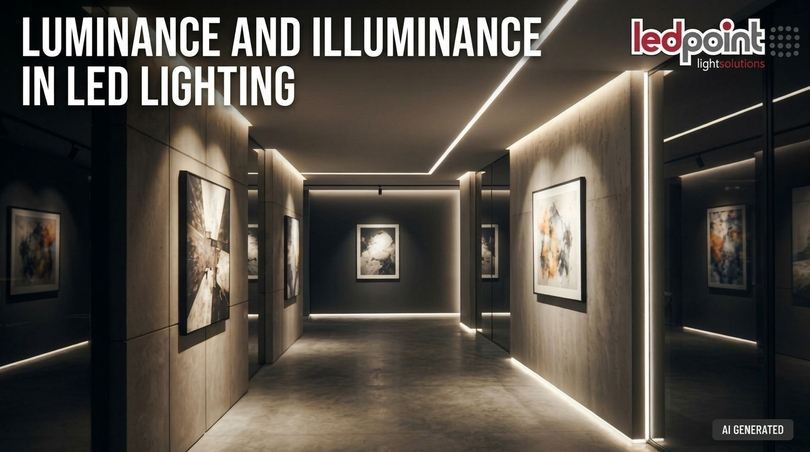
Luminance is the photometric quantity that measures how much light a surface emits, reflects, or transmits towards the eye in a given direction: it is expressed in candelas per square meter (cd/m², also known as nit). Illuminance, on the other hand, measures the light arriving on a surface and is expressed in lux (lm/m²).
When you enter a room and perceive a "bright" wall, a "glaring" monitor, or a "soft" LED profile, you are not judging how much light falls on the surfaces: you are judging their luminance. It is the only photometric quantity that our visual system perceives directly, which is why lighting designers, road safety engineers, display calibration technicians, museum conservators, and architects consider it the true starting point of any lighting project. Yet, luminance and illuminance are still confused in specifications, technical data sheets, and even in many online guides.
In this guide, curated by the Ledpoint technical team, we will walk you through step by step: from the definition of luminance to its unit of measurement, from the luminance formula to the difference between luminance and illuminance, from the instruments for measuring luminance to the luminance values recommended by UNI EN standards, up to the role of luminance in glare, screens, photography, and above all in LED lighting with strips and aluminum profiles. You will find conversion tables, worked calculation examples, real values taken from the Ledpoint catalog, and an FAQ section for quick answers.
In this article...
1. What is luminance: definition and meaning
Before talking about numbers, it is worth clarifying the concept. The term luminance appears everywhere, from TV data sheets to road specifications, but its meaning is often taken for granted. In this paragraph, we look at the definition of luminance, its symbol, correct and incorrect synonyms, and its translation into the main languages.
Definition of luminance
According to the CIE International Lighting Vocabulary (e-ILV), luminance is the ratio of the luminous intensity emitted by a surface in a given direction to the apparent area of that surface viewed from the same direction. In simple words: luminance tells us how much a surface "shines" for someone looking at it from a certain point. A surface can be a lamp, a diffuser, a wall, road asphalt, a monitor, or the sky: in all cases, luminance describes the light leaving there towards the observer.
Luminance is a photometric quantity, meaning it is weighted to the spectral sensitivity of the human eye (V(λ) curve). Its unweighted physical counterpart is radiance, measured in W/(sr·m²). This is why we speak of luminance and radiance as two sides of the same coin: radiance counts all energy, luminance only what the eye sees.
Luminance symbol and photometric quantity
The symbol for luminance is the letter L (sometimes Lv, where "v" stands for visual). In the family of photometric quantities, luminance joins luminous flux (Φ, in lumens), luminous intensity (I, in candelas), and illuminance (E, in lux). Among all of them, luminance is the closest to visual sensation, because the image formed on the retina depends precisely on the luminance of the observed objects.
Luminance: synonyms, meaning in Italian, and translation
The Treccani dictionary records luminance as a technical term in photometry. In the past, the synonym brilliance (from which the ancient unit "stilb" comes) was widespread, but it is now discouraged in technical documents. Be careful not to use the word "brightness" as a synonym for luminance: brightness is a subjective sensation, while luminance is a measurable quantity. Here is the translation of luminance into the most used languages in the technical field:
| Language (luminance) | Translation of luminance | Usage note |
|---|---|---|
| English | luminance | used in CIE, ISO, ITU standards |
| French | luminance | identical to English |
| Spanish | luminancia | note: "Luminanza" is also a jewelry brand, no technical link |
| German | Leuchtdichte | literally "luminous density" |
| Historical Italian | brillanza | outdated term; today "luminanza" is used |
Summarizing the meaning of luminance in a phrase to remember: illuminance describes the light that arrives, luminance describes the light that leaves towards your eyes. The rest of the guide is the development of this idea.
2. Unit of measurement of luminance: cd/m², nit, and conversions
One of the most frequent searches is "what is the unit of measurement of luminance?". The answer is simple, but the history of photometry has left us with several alternative units, still present in literature, in old American datasheets, and in the display world. Let's see them all, with a ready-to-use conversion table.
The candela per square meter (cd/m²)
The unit of measurement of luminance in the International System is the candela per square meter, cd/m². It derives from the base unit candela (luminous intensity), defined by the BIPM in the SI Brochure, divided by the apparent area in square meters. A surface with a luminance of 100 cd/m² emits, for every square meter viewed frontally, an intensity of 100 candelas in the direction of the observer.
The nit: the three-letter unit of measurement for luminance
If you search for "three-letter unit of measurement for luminance", the answer is nit (from Latin nitere, "to shine"). 1 nit is exactly equal to 1 cd/m²: it is the same value with a shorter name, widely used for monitors, smartphones, HDR TVs, and projectors. When you read "luminance 1000 nit" on a television, it means 1000 cd/m². The nit is not an official SI unit, but it is accepted in practice, as also documented in the candela per square metre article.
Luminance in stilb, lambert, apostilb, and foot-lambert
In older texts, luminance was expressed in CGS or Anglo-Saxon system units. The stilb (sb) equals 1 cd/cm², i.e., 10,000 cd/m². The lambert (L) and its submultiple millilambert were used for diffusing surfaces; the apostilb (asb, "luminance asb" in searches) was typical of ophthalmic perimetry; the foot-lambert (fL) is still used today in the United States for cinema screens.
| Unit of measurement of luminance | Symbol | Value in cd/m² | Where it is encountered |
|---|---|---|---|
| Candela per square meter | cd/m² | 1 | UNI EN, CIE standards, lighting design |
| Nit | nt | 1 | monitors, TVs, smartphones, HDR |
| Stilb | sb | 10,000 | historical texts, very bright sources |
| Lambert | L | ≈ 3,183 (10⁴/π) | pre-SI scientific literature |
| Millilambert | mL | ≈ 3.183 | visual psychophysics |
| Apostilb (blondel) | asb | ≈ 0.3183 (1/π) | ophthalmic perimetry |
| Foot-lambert | fL | ≈ 3.426 | cinema (US standard ~14 fL) |
A practical tip for those working on international projects: always convert to cd/m² before comparing luminance values, because confusing nit, foot-lambert, and apostilb can lead to errors by a factor of ten.
3. Luminance formula and physical meaning
Behind the word luminance there is a precise formula, which links luminous intensity, area, and direction of observation. Understanding it truly allows you to calculate the luminance of a fixture, a wall, or an LED diffuser without relying on guesswork. Let's proceed from the general definition to practical cases.
The general luminance formula
In rigorous form, the luminance formula is:
L = d²Φ / (dA · cos θ · dΩ)
where Φ is the luminous flux (lumens), dA the surface element (m²), θ the angle between the normal to the surface and the direction of observation, dΩ the solid angle (in steradians). The term dA·cos θ is the apparent area: the surface as it appears to the observer, which reduces when viewed obliquely.
The practical formula: luminous intensity and luminance
For a uniform emitting surface, the formula simplifies to:
L = I / (A · cos θ)
where I is the luminous intensity in candelas emitted in the direction θ and A the emitting area. Example: a diffuser of 0.01 m² emitting 50 cd frontally (θ = 0°) has a luminance of 50 / 0.01 = 5,000 cd/m². This is the relationship between luminous intensity and luminance: for the same intensity, the smaller the emitting surface, the higher the luminance. This is why a bare LED glares much more than a panel, even if it emits fewer lumens.
Lambertian surface: from luminance to illuminance
Many opaque materials (plaster, paper, opal diffusers) behave in a nearly Lambertian way: their luminance is the same from whatever direction you look at them, according to Lambert's cosine law. For a Lambertian diffusing surface, the most useful relationship in all of lighting engineering applies:
L = ρ · E / π
where ρ is the reflectance (reflection factor, from 0 to 1) and E the illuminance in lux. This is the formula for calculating luminance from illuminance: with 500 lux on a white wall (ρ = 0.8) you get L = 0.8 × 500 / 3.14 ≈ 127 cd/m². For a Lambertian source emitting directly, similarly, L = M / π, where M is the luminous emittance in lm/m².
Constant luminance along the ray
A often surprising property: in the absence of absorption, luminance does not decrease with distance. Moving away from a wall, you see it smaller but not "darker": the illuminance on your eye decreases with the square of the distance, but the subtended solid angle also reduces by the same measure. This is why the luminance of the Sun is the same on Earth and on Mars, and an LED profile appears equally bright at 2 or 5 meters, even though it illuminates less.
4. Luminance and illuminance: the difference (with lumens, lux, and candelas)
The question "what is the difference between luminance and illuminance?" is the most searched after the unit of measurement. The confusion arises because both describe "how much light there is", but from two opposite points of view. In this paragraph, we put order among the four fundamental photometric quantities, with a comparison table and the mathematical relations that link them.
Luminance and other photometric quantities compared
To understand the relationship between luminance and illuminance, it is convenient to follow the path of light: the source produces a luminous flux (lumens); the flux distributes in space with a certain luminous intensity per direction (candelas); arriving on a surface it generates an illuminance (lux); the surface, reflecting, appears with a certain luminance (cd/m²).
| Quantity (luminance and related) | Symbol | SI Unit | What it measures | Instrument |
|---|---|---|---|---|
| Luminous flux | Φ | lumen (lm) | total amount of light emitted by the source | integrating sphere |
| Luminous intensity | I | candela (cd) = lm/sr | light emitted in a direction | goniophotometer |
| Illuminance | E | lux (lx) = lm/m² | light arriving on a surface | lux meter |
| Luminance | L | cd/m² (nit) | light leaving a surface towards the eye | luminance meter |
| Luminous efficacy | η | lm/W | lumens produced per watt absorbed | sphere + wattmeter |
Difference between luminance and illuminance in a lighting design project
Illuminance depends only on the source and geometry; luminance also depends on the illuminated material and the point of view. Two walls, one white and one anthracite, can receive exactly 300 lux: the illuminance is identical, but the white wall will have a luminance of about 75 cd/m² and the anthracite one of about 10 cd/m². The eye will see two completely different environments. This is why a project that only checks lux on the work plane can be correct on paper and gloomy or glaring in reality.
Intuitive example of luminance: the flashlight and the paper
Point a flashlight at a white sheet of paper and then at a black velvet cloth at the same distance. The lux meter, resting on the two materials, shows the same value: the illuminance does not change. But the paper looks bright and the velvet almost invisible: it is the luminance that has changed, because the velvet absorbs almost all the light.
What lumens correspond to and what is measured in lux
The lumen measures the amount of light produced by a lamp or an LED strip (for strips it is indicated in lm/m). The lux measures how many lumens fall on each square meter: 1 lux = 1 lumen per square meter. The difference between lumen and lux is therefore the same as that between the water coming out of a watering can and the water falling on each square meter of lawn. For calculating lumens for a room, as a first approximation: required lumens ≈ required lux × surface area (m²) / utilization factor (typically 0.4–0.6).
Candela: unit of measurement of luminous intensity
How is luminous intensity indicated? With the candela (cd), one of the seven base units of the SI. One candela corresponds to one lumen per steradian. The name is historical: a common wax candle emits about 1 cd. So what does the candela measure? The "directional concentration" of light: a 500-lumen spotlight with a narrow beam can exceed 2,000 cd at the center, while a bare bulb with the same lumens emits about 40 in every direction.
Conversion between luminance and illuminance
There is no universal "lux → nit" conversion: the material must be known. For Lambertian surfaces, L = ρ·E/π is used; conversely, the illuminance required to obtain a given luminance is E = π·L/ρ. The following table shows the ratio between illuminance and luminance for some common materials at 500 lux:
| Surface (luminance) | Reflectance ρ | Illuminance | Resulting luminance |
|---|---|---|---|
| White paper | 0.80 | 500 lx | ≈ 127 cd/m² |
| White plaster | 0.70 | 500 lx | ≈ 111 cd/m² |
| Light wood (oak) | 0.40 | 500 lx | ≈ 64 cd/m² |
| Medium gray floor | 0.25 | 500 lx | ≈ 40 cd/m² |
| Dark carpet | 0.10 | 500 lx | ≈ 16 cd/m² |
| Black velvet | 0.03 | 500 lx | ≈ 5 cd/m² |
This table also answers the question "how is the amount of light striking a surface measured?": that is measured in lux with a lux meter; the light that the surface returns is measured in cd/m² with a luminance meter.
5. Luminance of surfaces and materials: reflectance and luminance factor
If illuminance is the "fault" of the source, luminance is largely the "merit" of the surfaces. The color, finish, roughness, and transparency of materials can double or halve the perceived luminance for the same installation. For designers and architects, it is the most economical way to save energy.
Reflectance and luminance
Reflectance indicates the fraction of light that a surface returns. Doubling the reflectance of a wall means doubling its luminance without adding a single watt. Standards for work environments suggest reflectance ranges: ceiling 0.7–0.9, walls 0.5–0.8, floor 0.2–0.4, work planes 0.2–0.6. These ranges serve precisely to guarantee a balanced distribution of luminances.
The luminance factor (β)
What is the luminance factor? It is the ratio between the luminance of a surface in a given direction and that of a perfect diffuser (ideal white Lambertian) illuminated in the same way. It is denoted by β. For opaque surfaces, β coincides with reflectance; for glossy surfaces, β varies greatly with the angle, and can exceed 1 in the specular direction. The luminance factor β is also used in road signage and safety devices: safety paints have prescribed minimum β values to be recognizable.
Retroreflected luminance coefficient
For horizontal signage and retroreflectors, the retroreflected luminance coefficient RL is used, expressed in mcd·m⁻²·lx⁻¹: it indicates how much luminance the stripe returns towards the driver for every lux that the headlights send it. New signage typically exceeds 150 mcd·m⁻²·lx⁻¹, while in rainy conditions the value plummets.
Opaque, glossy surfaces and color
Opaque surfaces distribute luminance uniformly; glossy surfaces concentrate luminance in the specular direction, creating reflections that can become indirect glare (for example, the reflection of an LED strip on a polished marble top or a screen). Color affects luminance twice: on the overall reflectance and on the perceived luminance of a color, because the eye is more sensitive to yellow-green (555 nm) than to blue or red. For the same reflected energy, a yellow appears much brighter than a dark blue.
Materials that distribute luminance better
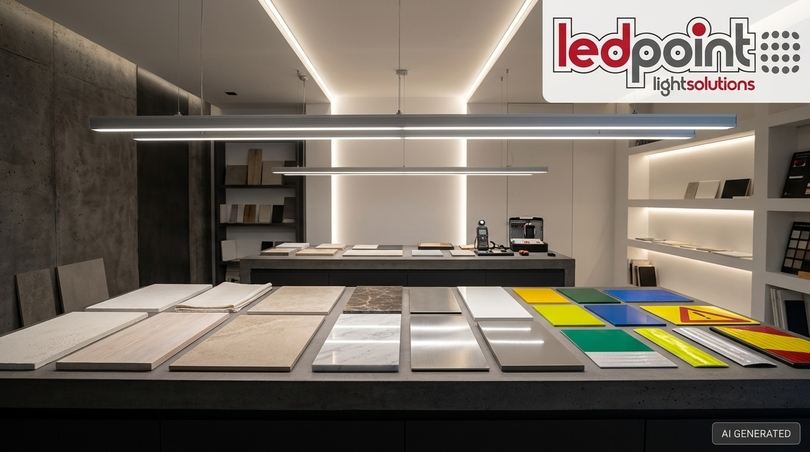
Light mineral plasters, bleached woods, opaque stoneware, and light fabrics distribute light softly. For suspended ceilings and valances, pairing an LED strip with a light opaque surface (indirect lighting) produces large areas of low luminance and high comfort, as with the aluminum profile with plasterboard 44x12mm, which integrates the light line directly into the slab.
6. Luminance and visual perception: adaptation, contrast, age
Luminance is a physical quantity, but the brain does not read it as an absolute number. The perception of luminance depends on eye adaptation, contrast with the background, age, and even expectations. For vision researchers, interface designers, and lighting designers, this is the most important chapter.
Luminance and brightness: why they are not the same thing
Brightness is the subjective sensation; luminance is the measurable stimulus. The relationship between the two is not linear: according to Stevens' power law, perceived brightness grows approximately with the cube root of luminance. In practice, to make a wall look "twice as bright", you need about eight times its luminance. This explains why small increases in LED strip power are barely perceived, while a dimmer adjustment to 50% appears less drastic than the number suggests.
Eye adaptation and adaptation luminance
The eye works over a huge range, from about 10⁻⁶ cd/m² (night threshold) to over 10⁶ cd/m², but not all at once. It adapts to the adaptation luminance, i.e., the average luminance of the visual field. Three regimes are distinguished:
| Visual regime for luminance | Luminance range | Receptors | Example |
|---|---|---|---|
| Photopic | above ~5 cd/m² | cones | offices, shops, daytime |
| Mesopic | ~0.005 – 5 cd/m² | cones and rods | illuminated streets, twilight |
| Scotopic | below ~0.005 cd/m² | rods | moonless night |
The threshold luminance is the minimum luminance (or minimum luminance difference) that an object must have to be detected against the background. It depends on the background luminance: the brighter the background, the greater the absolute difference required, but the relative difference remains approximately constant (Weber's law).
Luminance contrast
The visibility of an object depends on the luminance contrast with the background. Weber contrast is C = (Lobject − Lbackground) / Lbackground. Black text on white paper has a contrast close to −0.9; a gray obstacle on illuminated asphalt may have contrasts of just 0.2–0.3, which is why road luminance is decisive for safety. Luminance contrasts, not lux, decide whether an object is seen or not.
Luminance ratio and visual comfort
What is the luminance ratio? It is the ratio between the luminance of two zones in the visual field, typically the visual task, the immediate surround, and the background. The classic rule for designers is 1 : 3 : 10 (or 10 : 3 : 1): the task should not be more than 3 times brighter than its surround and more than 10 times brighter than the distant background. Ratios that are too high cause fatigue due to continuous readaptations; ratios that are too low create flat and monotonous environments.
Accessibility: relative luminance and luminance contrast in interfaces
For digital interfaces, the W3C guidelines define the relative luminance of a color (Y = 0.2126 R + 0.7152 G + 0.0722 B, on linearized values) and a contrast ratio (L1 + 0.05) / (L2 + 0.05). Level AA requires at least 4.5:1 for normal text. The same principle applies to physical signage and illuminated handrails: a good luminance difference between step, riser, and wall helps visually impaired people.
How luminance perception changes with age
With aging, the lens yellows and the pupil constricts: a sixty-year-old receives about a third of the light on the retina compared to a twenty-year-old for the same luminance, and is more sensitive to glare due to greater intraocular scattering. In environments for the elderly, more illuminance is needed but fewer point luminances: large surfaces, opaque diffusers, no bare sources in the visual field.
Luminance and psychology: excessive luminance and visual fatigue
Excessively high luminance levels in the peripheral visual field, source flicker, and strong non-uniformities are among the most documented causes of visual fatigue. For this reason, in addition to luminance, the quality of the power supply matters: Ledpoint 230V anti-flicker drivers reduce light modulation, while monochromatic dimmers allow adapting luminance to different times of the day.
7. Luminance and glare: veiling luminance, UGR, and TI
What is the phenomenon caused by an excessive difference in luminance between two surfaces called? It is called glare. It is the most concrete consequence of poorly managed luminance and, at the same time, the most controlled parameter by standards. Let's look at the types of glare, the concept of veiling luminance, and the UGR and TI indices.
Discomfort glare and disability glare
Glare is divided into two families:
- discomfort glare: annoyance, without loss of visibility; typical of offices with overly bright visible fixtures;
- disability glare: real reduction in the ability to see, caused by scattered light in the eye overlapping the retinal image; typical of headlights or street lamps while driving.
There is also direct glare from source luminance (the source is in the visual field) and indirect or reflected glare (the source is reflected on glossy surfaces, screens, shop windows, display cases).
Veiling luminance: definition and calculation
Veiling luminance (or equivalent veiling luminance Lv) is the uniform luminance that, superimposed on the retinal image, produces the same contrast reduction effect as the glaring source. It is the way disability glare is quantified. The empirical Stiles-Holladay formula, adopted by the CIE, for calculating veiling luminance is:
Lv = 10 · Σ (Eeye,i / θi²)
where Eeye is the illuminance produced by each source on the pupil (in lux, on a plane perpendicular to the line of sight) and θ the angle in degrees between the line of sight and the source. There is also a "dynamic" version that takes the observer's age into account. In tunnels and on roads, veiling luminance is used to calculate the threshold increment TI.
TI: threshold increment for roads
The threshold increment TI expresses, in percentage, how much the contrast of an object must increase to remain visible in the presence of glare. For average road surface luminances up to 5 cd/m², it is calculated as TI = 65 · Lv / Lavg0.8. The M road classes of UNI EN 13201-2 set maximum TIs between 10% and 20%.
UGR: discomfort glare indoors
For interiors, UNI EN 12464-1 uses the CIE UGR (Unified Glare Rating) index:
UGR = 8 · log₁₀ [ (0.25 / Lb) · Σ (L² · ω / p²) ]
where Lb is the background luminance, L the luminance of the luminous parts of each fixture, ω the subtended solid angle, and p the Guth position index. Typical limit values of the UGR luminance index: 16 for technical drawing, 19 for offices and reading, 22 for shops and light industry, 25–28 for corridors and warehouses. It is immediately noticeable that UGR grows with the square of the source luminance: halving the luminance of a fixture is much more effective than reducing its power.
How to reduce glare while maintaining adequate luminance
To reduce perceived luminance, the winning strategy is not "less light", but the same light over larger surfaces. In practice:
- enlarge the emitting surface with opaque or satin diffusers and wider profiles;
- prefer COB strips or high LED density strips, free of visible bright spots;
- shield the source with recessed, angular profiles, or with louvers, out of the direct visual field (angles greater than 65° from the vertical for offices with video terminals);
- use indirect lighting towards ceilings and light walls;
- avoid glossy surfaces where sources are reflected.
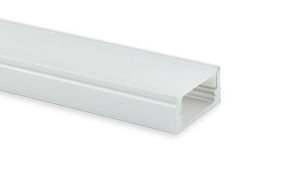
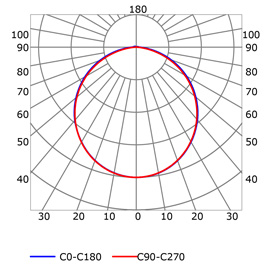
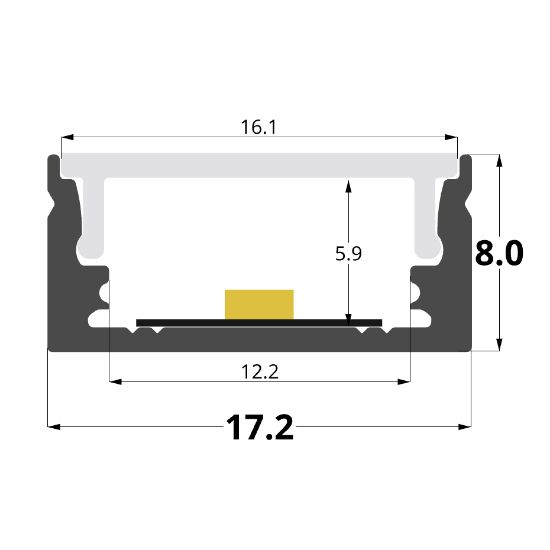
In the Ledpoint catalog, the diffusers for the 03 series profiles are photometrically tested: on the 17x8mm aluminum profile PR-SL08-03, the opaque diffuser causes a 32% flux loss and the satin one 39%, in exchange for a much more uniform and comfortable surface luminance. This is a compromise to be evaluated case by case, as we explain in chapter 9.
8. How to measure luminance: luminance meter and lux meter
How is luminance measured? And how are lux measured instead? They are two different measurements, with different instruments, and confusing them is one of the most common errors in commissioning. In this paragraph, we look at the instruments for measuring luminance, the correct procedure, and the limits of smartphone apps.
The luminance meter
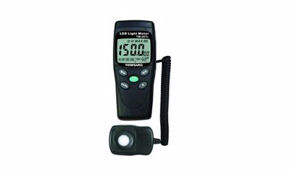
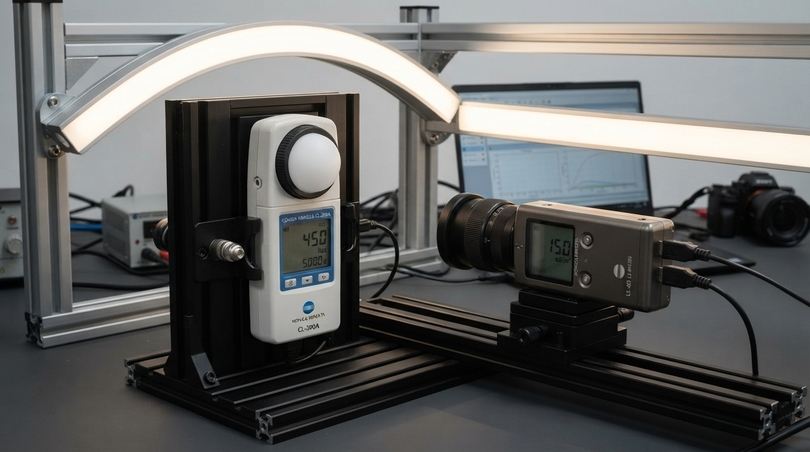
The luminance meter is the instrument that measures luminance. It works like a small camera with a sensor filtered according to the V(λ) curve: you frame the surface, center the measurement circle (with a typical measurement angle of 1°, 1/3°, or 2°), and read the value in cd/m². Since it measures within a fixed solid angle, distance does not affect the result, provided that the framed area is entirely occupied by the surface to be measured. There are also imaging luminance meters (ILMD, Imaging Luminance Measuring Device): calibrated cameras that return a luminance map of the entire scene, ideal for calculating UGR, uniformity, and luminance ratios in one go.
The lux meter: measures illuminance, not luminance
The lux meter, unlike the luminance meter, has a white diffusing dome and measures the illuminance on the plane on which it is placed. A lux meter does not measure luminance, but it can be estimated indirectly: you measure the lux on the surface and know (or measure with a sample) the reflectance, then apply L = ρ·E/π. This works well only on opaque surfaces.
Step-by-step procedure to measure luminance
- Let the LED sources stabilize for at least 15–30 minutes before measuring luminance (LED luminance varies with temperature).
- Position the instrument at the height of the typical observer's eyes (1.20 m seated, 1.60 m standing; 1.50 m and driving direction for roads).
- Verify that the measurement field of the luminance meter falls entirely on the surface whose luminance you want.
- Repeat the luminance measurement on a grid of points to calculate average luminance, minimum, and uniformity.
- Note the environmental conditions that influence luminance: daylight, state of the surfaces (wet/dry), aging of the sources.
Instruments for measuring luminance: comparison
| Instrument for luminance | Quantity measured | Typical precision | Recommended use |
|---|---|---|---|
| Spot luminance meter | luminance (cd/m²) | ±2–4% | commissioning, roads, tunnels, fixtures |
| Imaging luminance meter (ILMD) | luminance map | ±3–5% | UGR, offices, museums, research |
| Class A/B lux meter | illuminance (lux) | ±3–7% | lux verification on work planes |
| Colorimeter/spectrophotometer for displays | screen luminance and chromaticity | ±1–3% | monitor calibration |
| Smartphone apps | estimate of lux or luminance | ±20–50% | indicative only |
Luminance sensors in home automation systems and museums
In control systems, light sensors actually measure an "average" luminance of the framed area (the floor or desk under the sensor) and compare it with a setpoint. By integrating sensors and dimmers with DMX and DALI protocols or with 0/1-10V regulation, constant luminance is maintained by compensating for natural light (daylight harvesting). In the Ledpoint sensors section, you will find solutions for profiles and strips, such as the PIR sensor for installation on 12-24V profile.
9. LED luminance: strips, COB, profiles, and diffusers
We arrive at the heart of LED lighting. The LED is a very small and extremely efficient source: precisely for this reason, it has a very high luminance, which must be managed with optics, diffusers, and profiles. In this paragraph, we see how much the luminance of LEDs is worth, how it changes in LED strips, and how much diffusers reduce it, with real data from the Ledpoint catalog.
Why the luminance of an LED is so high
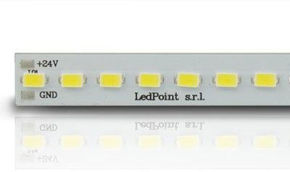
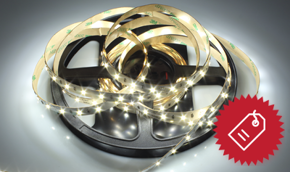
A single SMD 2835 LED emits a few lumens from an area of a few square millimeters. Since luminance is intensity divided by area, the result is enormous. Let's do an example calculation on Ledpoint catalog data: the 5m warm white 3000K 2835 240 led/m 24V 14.4W/m LED strip declares 2,000 lm/m with an efficiency of 155 lm/W. Each LED therefore emits about 2,000 / 240 ≈ 8.3 lm. Assuming an emitting area of about 5 mm² and a Lambertian emission, the emittance is 8.3 / 0.000005 ≈ 1.7 million lm/m² and the luminance L = M/π ≈ 530,000 cd/m²: an order of magnitude higher than that of a fluorescent tube.
Luminance of LED strips: density and "dotting effect"
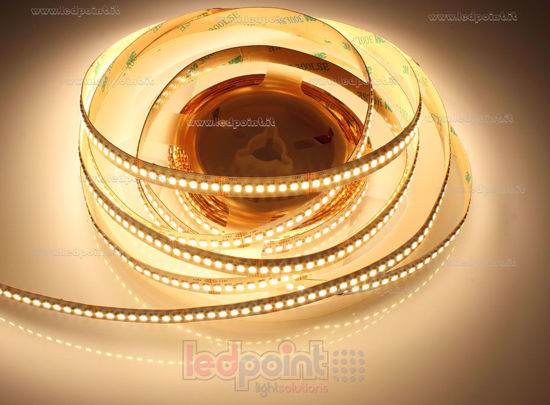
In LED strips, luminance is not uniform: there are peaks at the chips and darker areas between one LED and another. This is the famous dotting effect, especially visible when reflected on glossy surfaces. More LEDs per meter means closer points and, for the same total lumens, lower luminance peaks for each chip. You can compare densities in the 240 led/m LED strips and ≥384 led/m LED strips categories.
COB LED strips: uniform luminance without dots
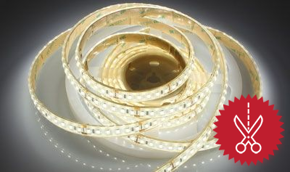
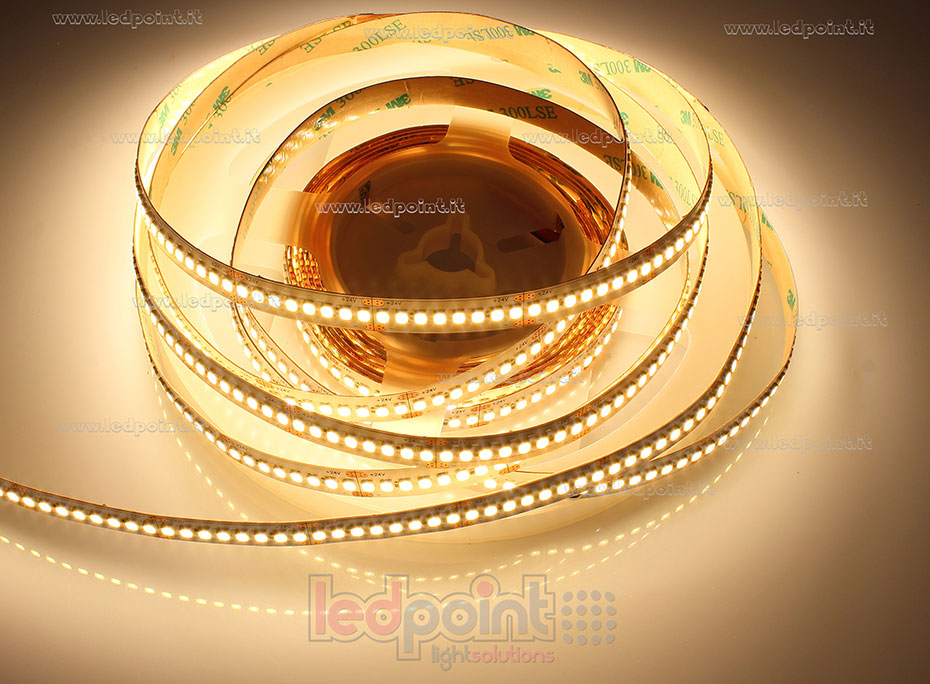
COB LED strips cover hundreds of chips per meter with a continuous layer of phosphors, creating a line of light without dots with an emission angle of about 180°. The luminance becomes uniform along the entire strip and the peak drops drastically. Examples from the catalog: the 5m white 4000K CRI>90 480 led/m 12V 10W/m COB LED strip (980 lm/m) and the softer version COB 3000K CRI>90 12V 4.8W/m (440 lm/m). Estimating for the first an emission over a band about 6 mm wide, the average luminance is 980 / 0.006 / π ≈ 52,000 cd/m²: about ten times less than the single SMD chip, with significantly superior visual comfort.
Aluminum profiles and diffusers: how they change luminance
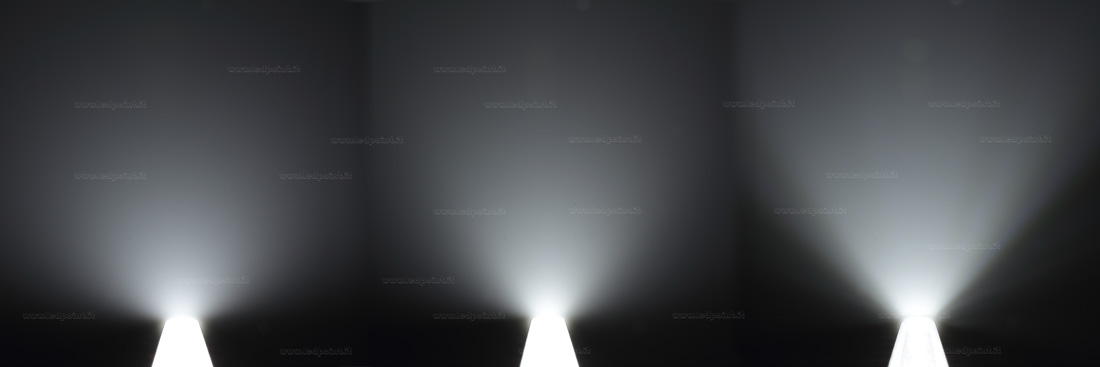
The diffuser distributes the strip's flux over a much larger area and lowers its luminance: it loses some lumens but drastically reduces luminance and improves its uniformity. Ledpoint publishes the photometric test and the flux loss of each diffuser for every profile. Here are the values measured on the 17x8mm profile:
| Diffuser (profile PR-SL08-03) | Declared flux loss | Residual flux with 2000 lm/m strip | Estimated average luminance* | Recommended use |
|---|---|---|---|---|
| Transparent | −16% | 1,680 lm/m | visible dots, high peaks | technical light hidden from view |
| Transparent with 60° lens | −16% | 1,680 lm/m | high peaks, concentrated beam | accent lighting, shelves |
| Semi-opaque | −20% | 1,600 lm/m | ≈ 34,000 cd/m² | efficiency/comfort compromise |
| Opaque | −32% | 1,360 lm/m | ≈ 29,000 cd/m² | furnishings, offices, visible lines |
| Satin | −39% | 1,220 lm/m | ≈ 26,000 cd/m² | maximum comfort, reflective surfaces |
| Black | −84% | 320 lm/m | very low | decorative effects, "off" light during the day |
*Estimate for Lambertian emission over a diffuser width of about 15 mm (L = Φm / (width · π)). Indicative luminance values, useful for relative comparisons.
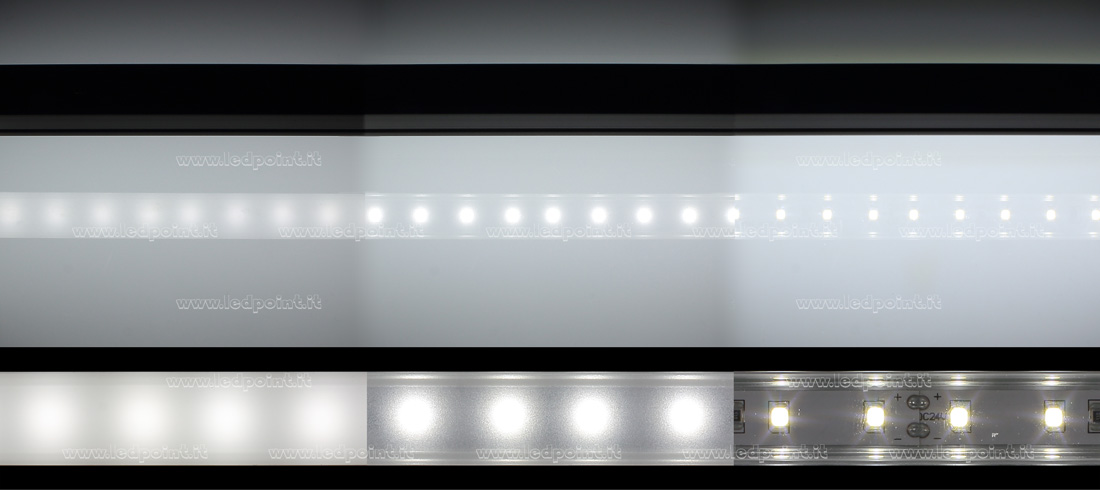
The right diffuser is not the one that loses the fewest lumens, but the one that brings the luminance to the level suitable for the observer. In a kitchen with a glossy top, a transparent diffuser will show the row of dots reflected on the surface; an opaque or satin one will return a continuous line. The diffuser for 03 series profiles is available in all variants, and the complete SL08-03-S2 installation kit includes profile, diffuser, end caps, and clips.
Luminance of recessed, angular, and dual-emission profiles
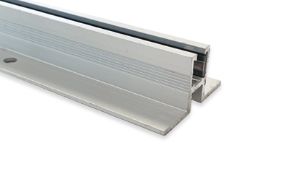
In addition to the diffuser, geometry also affects luminance. A 23x8mm recessed aluminum profile brings the luminous surface flush, reducing lateral luminances; a 16mm angular profile directs the light at 45° towards the work plane, keeping the source out of the line of sight; the 70x31mm wall dual-emission profile (opaque diffuser −38%, satin −39%) splits the flux between ceiling and floor, creating large surfaces of low luminance. To choose, consult the comparative table of profiles and the guide to profile and LED strip matching tables.
Color temperature, CRI, and perceived luminance
For the same luminance in cd/m², cool light tends to seem "brighter" than warm light (Helmholtz-Kohlrausch effect and melanopsinic receptor sensitivity), while a high CRI makes colors more saturated and surfaces more readable. The Sunled and Circadian Light lines and CCT LED strips allow working on spectrum and tone; to orient yourself among tones, consult the white color tones page.
10. Recommended luminance values: offices, shops, museums, nature
What luminance values are recommended? There is no single number: it depends on the visual task, the environment, and the observer. To get oriented, it is useful to start from the luminance values we encounter every day, and then move on to the normative references for offices, shops, and museums.
Table of reference luminance values
| Source or surface (luminance) | Typical luminance (cd/m²) |
|---|---|
| Solar disk at noon (sun luminance) | ≈ 1.6 × 10⁹ |
| Bare SMD LED chip (estimate) | 10⁵ – 10⁷ |
| Incandescent lamp filament | ≈ 10⁷ |
| T8 fluorescent tube (fluorescent lamp luminance) | ≈ 10⁴ |
| COB strip without diffuser (estimate) | ≈ 5 × 10⁴ |
| Clear sky (average sky luminance) | ≈ 5,000 – 8,000 |
| Full moon (moon luminance) | ≈ 2,500 |
| Overcast sky | ≈ 1,000 – 2,000 |
| HDR TV, peak | 1,000 – 4,000 |
| Office monitor | 100 – 300 |
| White paper at 500 lux | ≈ 127 |
| Illuminated urban street (class M) | 0.3 – 2 |
| Night vision threshold | ≈ 10⁻⁶ |
For a complete overview of the orders of magnitude of luminance, you can consult the Orders of magnitude (luminance) article.
Luminance in offices and video terminals
UNI EN 12464-1 requires a maintained illuminance of 500 lux on the task for writing and reading, UGR ≤ 19, and, in the 2021 revision, minimum illuminances also on walls and ceilings precisely to guarantee adequate background luminances. For workstations with screens, the standard limits the average luminance of fixtures that can reflect on the screen for elevation angles from 65° upwards: typically ≤ 3,000 cd/m² with high-luminance screens (over 200 cd/m²) and ≤ 1,500 cd/m² with less luminous screens, more restrictive values in case of screens with critical reflections. In a good office, the luminance of the screen, paper, and desk should remain within a ratio of about 1 : 3.
Luminance in shops and retail
In shops, before luminance, the general reference illuminance is considered to be about 300 lux in sales areas, but it is the hierarchy of luminances that guides the eye towards the product: a ratio of 3:1 between the highlighted product and the background is perceptible, 5:1 is striking, 10:1 is theatrical. High-luminance LED lines on shelves with opaque diffusers and track lights for furniture create high local luminances without glaring the customer.
Luminance in museums and artwork conservation
In museums, the difference between luminance and illuminance is decisive: damage to artworks depends on illuminance and exposure time, the quality of vision depends on luminance. CIE 157 recommendations indicate about 50 lux for highly sensitive works (paper, watercolors, textiles, with an annual reference exposure of 15,000 lux·h), 150–200 lux for moderately sensitive works like oil paintings (about 150,000 lux·h/year), and higher values for less sensitive materials. Since the eye adapts, a room with low background luminances (dark walls, 5–10 cd/m²) allows perceiving a work at 50 lux as well-lit. Strips with high CRI, negligible UV and IR emission, and satin diffusers in display cases reduce reflections and parasitic luminances.
Luminance in homes and sustainable building
In homes and low-consumption buildings, luminance design starts from natural light. UNI EN 17037 on daylight considers illuminance levels and glare risk from windows: the sky can reach luminances of thousands of cd/m², while internal walls remain at a few tens. Screens, technical curtains, and light walls near windows reduce luminance contrasts. Artificial LED light, regulated by sensors, completes the picture by keeping the perceived luminance constant.
11. Road and tunnel luminance
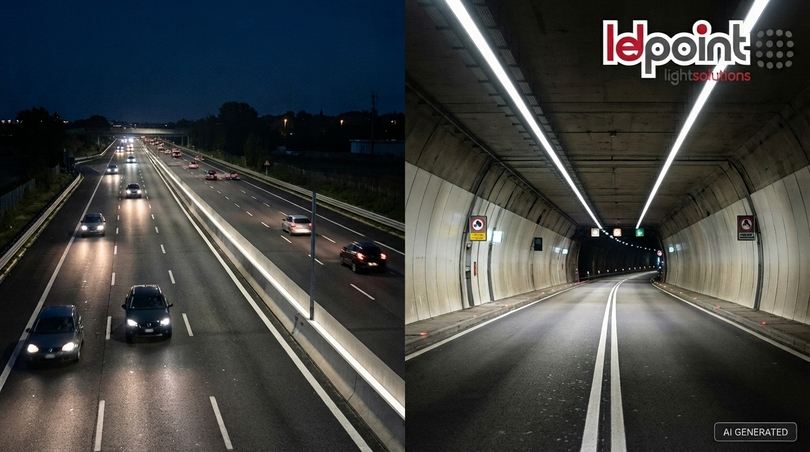
On the road, luminance is a safety issue, not an aesthetic one. The driver sees obstacles as dark silhouettes on the illuminated surface: it is the luminance of the road surface, not the illuminance, that determines visibility. This is why standards for motorized traffic use luminance as the main parameter.
M classes and maintained average luminance
UNI EN 13201-2 defines the M classes for motorized traffic roads, with minimum values of maintained average luminance and uniformity:
| Luminance class | Maintained average luminance L̄ (cd/m²) min | General uniformity Uo min | Longitudinal uniformity Ul min | TI max (%) |
|---|---|---|---|---|
| M1 | 2.00 | 0.40 | 0.70 | 10 |
| M2 | 1.50 | 0.40 | 0.70 | 10 |
| M3 | 1.00 | 0.40 | 0.60 | 15 |
| M4 | 0.75 | 0.40 | 0.60 | 15 |
| M5 | 0.50 | 0.35 | 0.40 | 15 |
| M6 | 0.30 | 0.35 | 0.40 | 20 |
In Italy, the choice of class is based on the risk analysis provided by UNI 11248. The uniformity ratio Uo = Lmin / L̄ guarantees that there are no "black holes" of luminance where a pedestrian could disappear, so maintained minimum luminance is as important as the average.
How to measure road surface luminance
UNI EN 13201-4 prescribes a grid of points on the carriageway, observed with a luminance meter placed at 1.5 m height and 60 m before the measurement field, with a very narrow measurement angle (typically 2' vertical), in order to simulate the driver's vision. Luminance measurements must be performed with a dry surface and without interference from other sources.
Luminance with rain and wet asphalt
With wet asphalt, reflection becomes specular and luminance changes radically: luminance concentrates in bright strips towards the driver and plummets elsewhere, worsening uniformity and signage visibility. For this reason, the standard also provides for MW classes, with uniformity requirements in wet conditions. As a first approximation, for a dry R3 class asphalt with an average luminance coefficient Q0 ≈ 0.07, road luminance is approximately L ≈ Q0 · E: with 20 lux average, about 1.4 cd/m² is obtained.
Tunnels: threshold luminance and adaptation
In tunnels, the problem is adaptation: entering during the day, the eye is adapted to external luminances of thousands of cd/m² (the L20 luminance of the access visual field) and the tunnel appears as a "black hole". The threshold zone must therefore have a threshold luminance equal to a fraction k of L20 (typically 0.05–0.10), which then decreases in the transition zone down to the internal zone. In Italy, the reference is UNI 11095, in line with CIE report 88.
12. Practical examples: how to calculate luminance
Theory becomes useful when it is transformed into numbers. Here are five solved exercises on luminance, chosen from the most frequent situations in design: from the luminance of a wall to the luminance ratio in an office, up to road luminance. Each example is solvable with a calculator.
Example 1 – Calculating luminance from illuminance
Data: white plastered wall, ρ = 0.7, illuminated with 250 lux by a ceiling LED strip. Calculation: L = ρ·E/π = 0.7 × 250 / 3.1416 ≈ 55.7 cd/m². If the same wall were medium gray (ρ = 0.3), the luminance would drop to 23.9 cd/m²: to maintain the same luminance, about 583 lux would be needed.
Example 2 – Calculating fixture luminance
Data: ceiling light with a 0.6 × 0.6 m diffuser emitting 1,200 cd in the vertical direction and 600 cd at 60°. Calculation: at 0°, L = 1,200 / 0.36 ≈ 3,333 cd/m²; at 60°, apparent area 0.36 × cos 60° = 0.18 m², so L = 600 / 0.18 ≈ 3,333 cd/m². Constant luminance at every angle: the diffuser is Lambertian. Comparing this luminance with the limit of 3,000 cd/m² above 65° for workstations with screens, the fixture would be on the limit: a wider diffuser or a dark-light optic would be better.
Example 3 – Intensity and illuminance from a spotlight
Data: LED spotlight with an intensity of 1,000 cd pointed at a painting at 2 m, perpendicular incidence. Calculation: E = I / d² = 1,000 / 4 = 250 lux; if the painting has an average reflectance of 0.35, its luminance is 0.35 × 250 / π ≈ 27.9 cd/m². With room walls at a luminance of 8 cd/m², the luminance ratio is about 3.5:1, sufficient to make the artwork "stand out".
Example 4 – Luminance ratio in an office
Data: 500 lux on the desk (ρ = 0.3), 500 lux on the paper (ρ = 0.8), monitor at 120 cd/m², background wall at 150 lux (ρ = 0.6). Calculation: desk ≈ 47.7 cd/m²; paper ≈ 127 cd/m²; wall ≈ 28.6 cd/m². Luminance ratios: paper/desk ≈ 2.7; monitor/wall ≈ 4.2. All luminance ratios remain within the 1:3:10 rule.
Example 5 – Calculating average road luminance
Data: urban road with R3 asphalt (Q0 ≈ 0.07), average illuminance 18 lux. Calculation: L̄ ≈ 0.07 × 18 ≈ 1.26 cd/m², compatible with class M3 (≥ 1.0 cd/m²). The exact calculation of luminance requires the road surface r tables and the intensity matrices of the fixtures, but this luminance estimate is useful in the preliminary phase.
Calculate lux and luminance of an LED strip in your project
For strips mounted in profiles, Ledpoint provides dedicated tools: the lux calculation for a specific installation estimates illuminance at different distances, and the PR-SL08-03 profile datasheet reports dimensions and curves. From the obtained lux, using the formula L = ρ·E/π, you immediately derive the luminance of the illuminated surfaces.
13. Luminance regulations: UNI EN and CIE
Which regulations govern luminance? The framework is broad, because luminance appears in very different fields: workplaces, roads, tunnels, daylight, light pollution, and photometric measurements. The table summarizes the main standards and technical recommendations to know.
| Luminance regulation | Scope | Luminance parameters covered |
|---|---|---|
| UNI EN 12464-1:2021 | Indoor workplaces | UGR, fixture luminance for video terminals, wall and ceiling illuminances |
| UNI EN 12464-2 | Outdoor workplaces | GR glare, intrusive light, facade and sign luminance |
| UNI EN 13201-2/3/4/5 | Road lighting | maintained average luminance, Uo, Ul, TI, calculation and measurement methods |
| UNI 11248 | Roads (Italy) | selection of lighting categories |
| UNI 11095 / CIE 88 | Road tunnels | threshold, transition, internal luminance |
| UNI EN 17037 | Daylight in buildings | glare from natural light, views |
| UNI 10819 | Light pollution | upward light ratio |
| CIE 117 / CIE 190 | Discomfort glare | UGR method |
| CIE 157 | Museums and conservation | illuminance and annual exposure |
| CIE S 017 (e-ILV) | Terminology | official definitions of luminance and photometric quantities |
| D.Lgs. 81/2008, Annex XXXIV | Video terminals | reflections and glare on the screen |
For the luminance of the sources themselves, photobiological safety is regulated by IEC/EN 62471, which classifies lamps into risk groups also based on radiance: a further reason not to leave bare LED chips in the visual field. Standards indicate the minimums, but comfort arises from the quality of the luminance distribution.
14. Designing luminance with Ledpoint products
After the theory, let's see how to translate luminance concepts into concrete product choices. Ledpoint has been designing and distributing professional LED strips and aluminum profiles for over a decade: below are our tips for the main professionals dealing with luminance.
Luminance for the lighting designer
Define the target luminance values (task, surround, background) first, then the lux. For visible lines in offices, choose high-density strips in the 17x8mm 2-meter profile with an opaque or satin diffuser; for indirect lighting, 14.4 W/m strips like the 3000K 2835 120 led/m 24V 14.4W/m LED strip (1,410 lm/m) on valances and cornices, which turn the ceiling into a large surface of moderate luminance.
Luminance for the architect and sustainable building
Integrate sensors and regulation to maintain constant luminance with natural light. Neutral white 3800-5300K LED strips blend better with daylight; warm white 2200-3500K strips are ideal for homes and hospitality. For path safety, the Ledpoint aluminum handrail provides grazing luminance on the steps, improving contrast for those with visual difficulties, and the emergency lighting section completes the system.
Luminance for the technical manager of a museum
Control the illuminance on the artworks and work on the background luminance and the display case luminance. CRI>90 COB lines in display cases with satin diffusers eliminate point reflections on the glass; regulation with a Mini Touch dimmer with memory or DALI systems allows lowering lux during closing hours and containing annual exposure.
Luminance for outdoor and humid environments
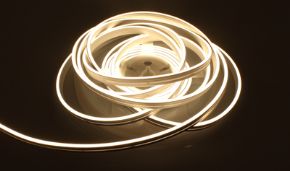
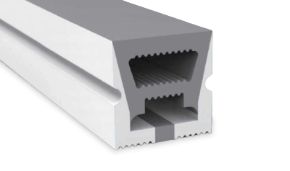
Outdoors, the luminance of sources against a dark night background is perceived much more strongly: it is better to use contained fluxes and large surfaces. The 15x10mm profile for silicone LED strips houses IP67 strips; Neon Flex offers continuous lines of low luminance for signage and architecture; to delve into protections, consult the guide to IP ratings.
15. Common errors and summary
We conclude with the most frequent terminological and design errors regarding luminance, those we see every day in quote requests and specifications. Avoiding them means more comfortable projects and more satisfied clients.
| Common error regarding luminance | Why it is wrong | Correct approach |
|---|---|---|
| Using luminance and brightness as synonyms | brightness is subjective | speak of luminance (cd/m²) for data, brightness for perception |
| Confusing lux and nit | they measure incoming and outgoing light | convert with L = ρ·E/π only for opaque surfaces |
| Measuring luminance with a lux meter | the lux meter measures illuminance | use a luminance meter or estimate with reflectance |
| Choosing the strip only by lumens | same lumens, very different luminances | evaluate LED density, COB, diffuser, emitting area |
| Transparent diffuser on glossy surfaces | reflected dots, indirect glare | opaque or satin diffuser |
| Checking only the lux on the work plane | ignores walls and ceiling | verify luminances and 1:3:10 ratios |
| Thinking that luminance decreases with distance | luminance is invariant along the ray | decreasing distance reduces illuminance, not luminance |
Luminance explained simply
If you had to remember three fundamental concepts of photometry: lumens are the light produced, lux are the light received, luminance is the light you see. It is measured in cd/m² (or nit), calculated as intensity divided by apparent area, and, for opaque surfaces, as reflectance times illuminance divided by π. Good LED design manages luminance with diffusers, profiles, LED density, and regulation, to achieve visibility, comfort, and safety with minimum consumption.
Key points about luminance to remember
- Luminance is the light leaving a surface towards the eye: luminance is what you see.
- The unit of measurement of luminance is cd/m², equal to the nit.
- Luminance formula: L = I / (A·cos θ); for opaque surfaces, luminance is ρ·E/π.
- Luminance and illuminance differ in direction: luminance is outgoing, illuminance is incoming.
- Luminance does not decrease with distance, illuminance does.
- The luminance meter measures luminance; the lux meter measures illuminance.
- Glare and UGR grow with the luminance of the sources: reducing luminance with diffusers and COB is the most effective solution.
- On roads, maintained average luminance ranges from 0.3 to 2 cd/m²; in offices, the ideal luminance ratio is 1:3:10.
Do you have a project where luminance is critical? Discover Ledpoint LED strips and aluminum profiles, or contact our technical office for a consultation or a quote. Further insights in the technical information category of the Ledpoint blog.
16. Luminance glossary: terms to know
The vocabulary of luminance is vast and often ambiguous: the same phenomenon has different names in lighting engineering, optics, and the display world. This luminance glossary collects the most searched terms in logical order, with a brief and operational definition for each.
| Term | Operational definition |
|---|---|
| Luminance (L) | luminous intensity per unit of apparent area; luminance is measured in cd/m² and is the basis of any visual evaluation. |
| Photometric luminance | luminance weighted with the V(λ) curve; it is the luminance "seen" by the eye, distinct from energy radiance. |
| Apparent luminance | luminance referred to the apparent area (A·cos θ) of the observed surface; the apparent luminance of a Lambertian diffuser does not change with the angle. |
| Surface luminance | luminance of a surface that reflects or transmits light; it depends on illuminance and reflectance. |
| Luminance of a Lambertian surface | luminance equal in all directions; for this surface, luminance equals ρ·E/π. |
| Direct luminance | luminance of a source viewed directly (LED chip, diffuser, lamp), as opposed to luminance reflected by surfaces. |
| Average luminance | arithmetic mean of luminance values measured on a grid; average luminance is the main parameter of M road classes. |
| Maintained average luminance | average luminance guaranteed at the end of the maintenance cycle, taking into account source depreciation and dirt. |
| Maintained minimum luminance | minimum luminance value in the grid at the end of maintenance; together with average luminance, it defines uniformity Uo. |
| Maximum luminance | highest luminance value in the field of view or in a fixture; a high maximum luminance indicates a risk of glare. |
| Peak luminance | in displays, the maximum luminance achievable on a small area (e.g., 1000 nit HDR); it differs from full-screen luminance. |
| White luminance | luminance of the screen displaying 100% white; it is the first parameter of monitor calibration. |
| Black luminance | residual luminance of the screen with a black signal; the ratio between white luminance and black luminance is the native contrast. |
| Background luminance | luminance of the background against which an object or fixture is observed; in the UGR formula, background luminance is Lb. |
| Adaptation luminance | average luminance of the field of view to which the eye is adapted; adaptation luminance establishes the photopic, mesopic, or scotopic regime. |
| Threshold luminance | minimum luminance (or luminance difference) detectable on a given background; in a tunnel, it is the luminance required in the entrance zone. |
| Reference luminance | luminance taken as a basis for comparison, such as the L20 access luminance for tunnels or the reference white at 203 cd/m² in HDR. |
| Veiling luminance | equivalent luminance produced by light scattered in the eye by a glaring source; it reduces contrast and defines disability glare. |
| Equivalent veiling luminance | technical synonym for veiling luminance, calculated as 10·Σ(E/θ²); the "dynamic" version of veiling luminance also considers age. |
| Disability luminance | informal expression for the luminance that causes disability glare, i.e., real loss of visibility. |
| Road surface luminance | luminance of the asphalt viewed by the driver; road luminance depends on illuminance, surface type (R classes), and observation geometry. |
| Sky luminance | luminance of the celestial vault, from about 1,000 to over 8,000 cd/m² during the day; zenith luminance varies with the sun's altitude and cloudiness. |
| Sun luminance | luminance of the solar disk, about 1.6·10⁹ cd/m²; no indoor artificial source should approach this luminance. |
| Moon luminance | luminance of the full moon, about 2,500 cd/m²: a luminance similar to that of a daytime overcast sky. |
| Perceived luminance | subjective impression related to luminance (brightness); perceived luminance grows approximately with the cube root of physical luminance. |
| Luminance of a color | luminance component of a colored stimulus (Y in the CIE XYZ space); for equal energy, yellow-green has the highest luminance. |
| Relative luminance | luminance normalized between 0 (black) and 1 (white), used by WCAG for the contrast of accessible interfaces. |
| Luminance and chrominance | separation of the video signal into luminance (Y/luma) and chrominance (Cb, Cr); luminance carries the detail, chrominance the color. |
| Luma | luminance calculated on RGB values with gamma correction (Y'); it approximates luminance but does not coincide with it. |
| Luminance noise | monochromatic graininess of high ISO photos; it is reduced with the luminance slider in Lightroom and Camera Raw. |
| Luminance masks | selections based on the luminance of pixels in Photoshop or Lightroom, to intervene only on highlights, midtones, or shadows. |
| Luminance histogram | graph of the distribution of pixels by luminance level; it helps to evaluate exposure. |
| Luminance contrast | relative difference in luminance between object and background; luminance contrasts determine visibility more than lux. |
| Luminance ratio | quotient between two luminance values in the field of view; practical rule 1:3:10 between task, immediate surround, and background. |
| Luminance uniformity | ratio between minimum and average luminance (Uo) or between minimum and maximum along a line (Ul). |
| Luminance coefficient | ratio between the luminance of a surface and the illuminance striking it (q, in cd·m⁻²·lx⁻¹); for asphalt, the average value Q0 is used. |
| Retroreflected luminance coefficient | luminance returned by the signage towards the headlights for each incident lux (RL), in mcd·m⁻²·lx⁻¹. |
| Luminance factor (β) | ratio between the luminance of a surface and the luminance of an equally illuminated perfect diffuser. |
| Luminance meter | instrument that measures luminance in cd/m² within a defined measurement angle; it also exists in the imaging version. |
| Limit luminance curves | historical method (Söllner) for glare control: it compared the luminance of fixtures with permissible curves, today replaced by UGR. |
| Synthesized luminance | luminance obtained by combining multiple components (sources or RGB channels), as in the luminance of a mixed RGBW LED strip. |
| LED luminance | luminance of the emitting surface of an LED or module; in LED luminance, chip area, optics, and diffuser matter. |
| LED strip luminance | linear luminance of an LED strip, with peaks on the chips in SMDs and uniform values in COBs or with a profile and diffuser. |
| Projector luminance | luminance of the screen illuminated by the projector; it depends on ANSI lumens, image size, and screen gain. |
17. FAQ on luminance
What is luminance?Luminance is the photometric quantity that indicates how much light a surface emits or reflects towards the observer in a certain direction, per unit of apparent area. It is denoted by L, measured in cd/m², and is the quantity closest to the sensation of brightness perceived by the human eye. |
What is the unit of measurement of luminance?The unit of measurement of luminance in the International System is the candela per square meter (cd/m²). It is equivalent to the nit, used for monitors and TVs. Historical units such as stilb, lambert, apostilb, and foot-lambert must always be converted to cd/m² before comparing values. |
What unit of measurement is the nit?The nit is a unit of measurement of luminance exactly equal to 1 cd/m². It is the most used three-letter unit to indicate the luminance of screens, smartphones, projectors, and HDR TVs. A 300-nit monitor has a white luminance of 300 candelas per square meter. |
What is the difference between luminance and illuminance?Illuminance (lux) measures the light arriving on a surface; luminance (cd/m²) measures the light leaving the surface towards the eye. Two walls with the same lux have different luminances if the color changes: for opaque surfaces, L = reflectance × lux / π. |
What is the formula to calculate luminance?The practical formula is L = I / (A · cos θ), i.e., luminous intensity in candelas divided by the apparent area of the surface. For opaque Lambertian surfaces, L = ρ · E / π is used, where ρ is the reflectance and E the illuminance in lux. The general formula uses flux, area, and solid angle. |
How is luminance measured?Luminance is measured with a luminance meter, which frames the surface with a narrow measurement angle and provides the value in cd/m². There are also imaging luminance meters that create complete maps. The lux meter instead measures illuminance; from it, luminance is estimated only by knowing the reflectance. |
What is the difference between lumen and lux?The lumen measures the total luminous flux emitted by a source, such as an LED strip (lm/m). The lux measures how many lumens arrive on each square meter of surface: 1 lux = 1 lm/m². The same lumens produce more lux if concentrated on a small area and fewer lux on a large area. |
What is the luminance factor?The luminance factor β is the ratio between the luminance of a surface and that of a perfect white diffuser illuminated in the same way. For opaque surfaces, it coincides with reflectance; for glossy surfaces, it varies with the angle. It is used for safety paints, signage, and material characterization. |
What is veiling luminance?Veiling luminance is the equivalent luminance that light scattered in the eye by a glaring source superimposes on the retinal image, reducing contrast. It is calculated with the formula Lv = 10 · Σ(E/θ²) and is the basis of the threshold increment TI in road and tunnel lighting. |
How to reduce the glare of an LED strip?By reducing luminance by distributing light over a larger area: aluminum profiles with opaque or satin diffusers, COB strips without bright spots, high LED density, recessed or angular mounts that hide the source. Ledpoint publishes the flux losses of diffusers to choose the best compromise. |
What luminance should a road have?According to UNI EN 13201-2, the maintained average luminance of the surface varies from 0.30 cd/m² (class M6) to 2.00 cd/m² (class M1), with a minimum general uniformity of 0.35–0.40 and a threshold increment TI between 10% and 20%. The class is chosen with the risk analysis of UNI 11248. |
What is the ideal luminance to calibrate a photographic monitor?For photo retouching intended for print, 80–120 cd/m² is typically used, with gamma 2.2 and a white point of D65 or D50. For SDR video, the reference is 100 cd/m², for HDR mastering often 1,000 cd/m². The measurement is done with a colorimeter and controlled ambient light. |
18. Designing with luminance, not just with lux
Luminance and illuminance are not two different ways of saying "how much light there is". They answer two different questions. Illuminance indicates how much light arrives on a surface, luminance indicates how much light the eye actually receives from that surface. A project that only checks lux can be correct on paper and result in gloomy, flat, or glaring reality. A project that controls the luminance of sources, walls, and the visual task guarantees comfort, safety, and energy savings instead. The three references to keep in mind are: the unit of measurement (cd/m², i.e., nit), the formulas (L = I/(A·cos θ) and L = ρ·E/π), and the recommended luminance ratios (1:3:10).
In LED lighting, this approach is decisive. LED chips have very high luminances, and only the right choice between LED density, COB LED strips, aluminum profiles, and diffusers transforms a point source into a uniform and comfortable line of light. The right diffuser is not the one that loses the fewest lumens, but the one that brings the luminance to the level suitable for the observer. Regulation and control, with dimmer, sensors, and DMX and DALI systems, complete the work and adapt luminance to the hours of the day, natural light, and people.
Are you designing an office, a shop, a museum, or a home and want to control luminance and glare right from the first draft? Use the Ledpoint lux calculation, consult the photometric tests of the profiles, or contact the Ledpoint technical office for a consultation or a quote. The best light is not the most intense: it is the one with the right luminance.
19. Sources and references
- CIE – International Lighting Vocabulary (e-ILV), entry "luminance"
- BIPM – The International System of Units (SI Brochure)
- W3C – WCAG 2.1, relative luminance and contrast ratio
- ITU-R BT.2100 – Image parameter values for HDR television
- Wikipedia – Luminance
- Wikipedia – Illuminance
- Wikipedia – Orders of magnitude (luminance)
- Treccani – Dictionary, luminance
- UNI EN 12464-1:2021, UNI EN 13201-2:2016, UNI 11248, UNI 11095, CIE 157:2004 (available on UNI Store)
This article was developed with the support of artificial intelligence and subsequently reviewed, corrected, and validated by the Ledpoint.it technical team, which guarantees its reliability and compliance with official sources.