






Light intensity: what it is, formula, and candela | Ledpoint
Luminous intensity is the photometric quantity that measures how much light a source emits in a specific direction, i.e., the luminous flux contained within a solid angle of one steradian. Its symbol is Iv, its unit of measurement in the International System is the candela (cd), and the basic formula is Iv = Φv / Ω, luminous flux divided by solid angle.
When a customer asks us "how much light does this LED strip produce?", the honest answer is always the same: it depends on what you mean by "how much". The total amount of light is measured in lumens, the light arriving on a work surface is measured in lux, and the brightness perceived by the eye looking at a surface is measured in candelas per square meter. Luminous intensity is the bridge connecting all these quantities, because it describes light in its most concrete dimension: direction.
Why luminous intensity matters more than ever: some data
Before diving into formulas, it's worth understanding why this topic has become central for those designing lighting. The transition to LED changed the rules: with incandescent lamps we reasoned in watts, today watts say little and precise photometric quantities are needed.
| Data | Value | What it means for the project |
|---|---|---|
| Kcd constant set by SI (2019) | 683 lm/W at 540 THz | It is the official "exchange rate" between radiant power and visible light |
| Efficacy of best Ledpoint LED strips | up to 155 lm/W | More than 10 times an incandescent bulb (approx. 12–15 lm/W) |
| Illuminance required for writing and reading in office (UNI EN 12464-1) | 500 lx maintained | Minimum value to guarantee on the visual task plane for the entire life of the system |
| Flux reduction with opaque diffuser on shelf profile | −37% (Ledpoint data) | The profile changes the real luminous intensity more than one might think |
| Power drop on 24V 5m strip powered from one side only | approx. −15% (Ledpoint data) | Less power means fewer lumens and non-uniform luminous intensity |
| Direct sunlight at noon in summer | up to 100,000 lx | The human eye works over a range of more than 9 orders of magnitude |
In this guide, written by the Ledpoint technical team who every day test LED strips in an integrating sphere and install them in aluminum profiles, we accompany you from the definition to the history of the candela, from formulas with solved examples to measurement with the luxmeter, up to practical adjustment with dimmers and controllers. You will find tables, real data from our products, and four interactive calculators to go straight from theory to project.
In this article...
1. What is luminous intensity: definition and physical meaning
Let's start with the most searched question: what is luminous intensity? It is the first quantity to understand because it is the only photometric quantity that the International System considers fundamental. Lumens, lux and luminance are all derived quantities, built starting from the candela.
The definition of luminous intensity in simple words
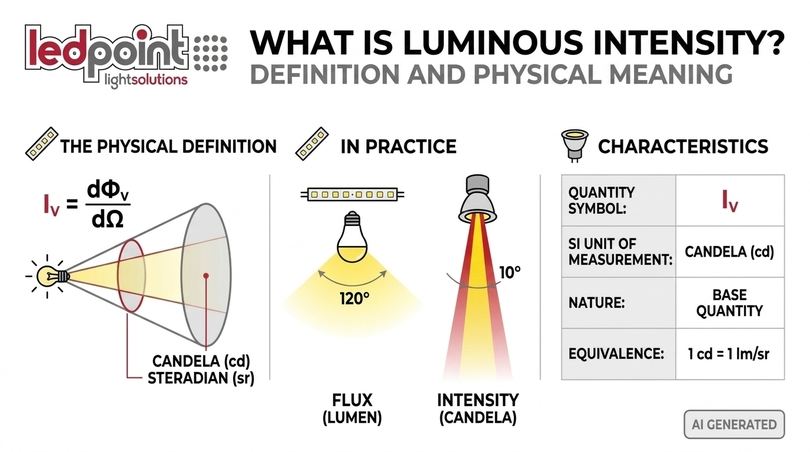
Imagine a point source, a small light bulb suspended in the dark. Light travels in all directions, but not necessarily with the same strength. Luminous intensity tells you how much light travels along a specific direction, regardless of the distance you are at. If you point a spotlight towards a wall, the luminous intensity along the axis of the spotlight is high; if you move sideways, out of the beam, the luminous intensity in that direction collapses.
In rigorous terms, according to the definition of luminous intensity adopted in photometry, it is the ratio between the luminous flux dΦ emitted within a small solid angle dΩ around a direction and the solid angle itself: Iv = dΦv/dΩ. The solid angle is measured in steradians (sr), the three-dimensional equivalent of the radian.
Luminous intensity symbol: why it is written Iv
The symbol for luminous intensity is the letter I with the subscript "v", which stands for visual. The subscript serves to distinguish it from radiant intensity Ie (subscript "e" for energetic), which measures electromagnetic power in watts per steradian without taking the eye into account. In technical texts and photometric datasheets you will often simply find "I", implying that we are talking about luminous intensity. When you read "Iv" on a datasheet, you are reading candelas.
| Element | Luminous intensity |
|---|---|
| Symbol of the quantity | Iv (or simply I) |
| SI unit of measurement | candela |
| Unit symbol | cd |
| Nature | Fundamental quantity of the International System (one of the 7) |
| Dimensional equivalence | 1 cd = 1 lm/sr |
| Corresponding radiometric quantity | Radiant intensity Ie, in W/sr |
| Measuring instruments | Photometer, goniophotometer; indirectly luxmeter (E·d²) |
What luminous intensity is used for in practice
A datum in candelas answers very concrete questions. How bright is a spotlight pointed at a painting? How much light arrives 3 meters below a pendant fixture? Why does an LED strip in a profile with narrow optics seem more powerful than a bare one, despite having the same lumens? Luminous intensity is the quantity the designer uses to predict illuminance on a surface and to control glare. Lighting calculation software, in fact, always starts from the candela distribution of the fixture, not from total lumens.
Luminous intensity and light intensity: are they the same thing?
In common language "light intensity" is used as a synonym for generic brightness. In physics, however, the correct expression is luminous intensity, and it exclusively indicates candelas in a direction. When someone asks "how do you measure light intensity in a room", they usually mean illuminance in lux: it is a difference we will see in detail, because confusing them is error number one in choosing lamps.
Beware of confusing it with current intensity
Those who work with LED strips also encounter current intensity, measured in amperes, which shares only the word with luminous intensity. However, the two quantities are linked: in LEDs the light emitted grows almost proportionally to the current crossing the chip, and it is precisely on this principle that constant current dimmers work. We discuss this in the section on adjustment.
2. History of luminous intensity: who invented it and how the candela was born
The history of measuring light is a history of real candles, wax and whale oil, before formulas. For centuries the only way to say "how much light" was to compare a source with a reference flame. Understanding this journey helps remember why even today the unit of measurement of luminous intensity is called exactly candela.
Bouguer and Lambert: the fathers of photometry
There is no single "inventor" of luminous intensity, but two names are essential. The Frenchman Pierre Bouguer published in 1729 the Essai d'optique sur la gradation de la lumière, in which he compared different sources by eye, adjusting distances until obtaining the same illumination on two screens: it is the first systematic photometric method. In 1760 the Swiss Johann Heinrich Lambert published "Photometria", the work that gave the name to the discipline and formalized the inverse-square law and the cosine law.
Old units of measurement of luminous intensity
Between the 19th and 20th centuries every country had its own "standard candle", and international comparisons were a puzzle. Those looking for the old unit of measurement of luminous intensity find several names, all linked to a standardized flame.
| Historical unit | Country and period | Physical reference | Approximate value in cd |
|---|---|---|---|
| Spermaceti candle (candlepower) | UK, 1860 | Spermaceti candle burning 120 grains per hour | approx. 0.98 |
| Carcel | France, mid-19th century | Colza oil Carcel lamp, consumption 42 g/h | approx. 9.7 |
| Hefnerkerze (HK) | Germany, 1884 | Hefner-Alteneck amyl acetate lamp | approx. 0.90 |
| Bougie décimale | France, 1889 | Twentieth of the Violle unit (molten platinum) | approx. 1.02 |
| International candle | USA, UK, France, 1909 | Group of carbon filament lamps | approx. 1.02 |
| New candle | Worldwide, 1948 | Black body at platinum freezing point | 1 (the "candela" is born) |
The English term candlepower still survives today in torch and headlight marketing, often used improperly. If you read "1 million candles" on a torch, it refers to the peak luminous intensity at the center of the beam, not the total light.
From 1948 to 2019: the modern candela
In 1948 the General Conference on Weights and Measures adopted the name "candela" and defined it via the luminance of a black body radiator at the temperature of platinum freezing. The method was difficult to reproduce, so in 1979 a revolutionary definition arrived, independent of materials: the candela is the luminous intensity, in a given direction, of a source that emits monochromatic radiation of frequency 540 × 1012 Hz and that has a radiant intensity in that direction of 1/683 watt per steradian.
Since May 20, 2019, with the revision of the International System, the definition has been reformulated by fixing the numerical value of the constant Kcd = 683 lm/W. The physical substance does not change, but today the candela rests on an exact constant, just as the meter rests on the speed of light. You can consult the official text on the BIPM page on SI base units.
Why exactly 540 THz and 683?
The frequency of 540 THz corresponds to a wavelength of approximately 555 nanometers, a green-yellowish light: it is the point where the human eye, under daylight conditions, is most sensitive. The number 683 was chosen to ensure continuity with old candles: a clever historical compromise that allowed existing measurements not to be overturned. It is also the reason why a green LED at 555 nm appears much brighter than a blue LED emitting the same power.
3. Unit of measurement of luminous intensity: the candela (cd)
What is the unit of measurement of luminous intensity? The short answer is the candela, symbol cd. The useful answer for designers is to understand how much a candela is worth in reality, and how it connects to the other units you find in catalogs.
The candela in the International System
The International System of Units is based on seven base units: meter, kilogram, second, ampere, kelvin, mole and candela. The candela is the only SI base unit linked to human perception: it is "physiological" by construction. Its symbol, cd, is always written lowercase and without a dot.
How much is a candela worth in real life
A normal lit wax candle has a horizontal luminous intensity close to 1 cd: hence the name. A 100 W filament bulb emits approximately 120 cd on average in every direction. An LED spotlight with a narrow 10° beam can exceed 10,000 cd at the center of the beam, while emitting few more lumens than a common bulb.
| Source | Typical luminous intensity |
|---|---|
| Candle flame | approx. 1 cd |
| Appliance indicator LED | 0.005–0.05 cd |
| 60 W equivalent omnidirectional bulb (806 lm) | approx. 65 cd |
| LED Strip 2000 lm/m, axial value per meter | approx. 640 cd/m |
| GU10 LED spotlight 36° beam, 400 lm | approx. 1,000 cd |
| LED spotlight 10° beam, 600 lm | over 20,000 cd |
| Car high beam headlight | from 50,000 to over 100,000 cd |
The LED strip data deserves explanation: the light from a strip spreads with a wide angle of approximately 120°, therefore for each meter the maximum luminous intensity, perpendicular to the strip, is equal to the flux divided by π. We calculate it step by step in the formulas section.
Submultiples and multiples in use
In signaling LEDs, the millicandela (mcd) is often used, while in architectural floodlights and headlights, kilocandelas (kcd) are encountered. The photometric curves of fixtures, instead, are normalized in candelas per kilolumen (cd/klm), to allow comparison of fixtures with different fluxes: it is a fundamental convention that we explain in the distribution section.
4. Lumens, lux, candela and luminance: comparing photometric quantities
Photometric quantities are four plus one, and each answers a different question. It is the section to bookmark: those who master the difference between luminous flux, luminous intensity, illuminance and luminance choose the right products at the first try. The reference definitions are those of photometry and the international vocabulary of the CIE, International Commission on Illumination.
Luminous flux: what are lumens
Luminous flux, symbol Φv, is the total amount of light emitted by a source in all directions, weighted by the sensitivity of the eye. Its unit is the lumen (lm). What does one lumen correspond to? One lumen is the luminous flux emitted within one steradian by a point source that has a luminous intensity of one candela in all directions: 1 lm = 1 cd·sr. The lumen is the datum that counts to compare "how much light" two products produce: in LED strips it is expressed in lumens per meter (lm/m).
What does 4000 lumens mean?
It means that the source emits, overall, the light of approximately 2.6 100 W incandescent bulbs. With Ledpoint LED strips of 2000 lm/m, 2 meters are enough to reach 4000 lumens, absorbing approximately 29 W instead of 260 W. How many lumens are needed for strong light, however, depends on the surface: 4000 lumens in a 5 m² bathroom are a lot, in a 60 m² open space they are few.
Illuminance: what is measured in lux
Illuminance, symbol Ev, is the luminous flux falling on a surface divided by the area of the surface. The unit is the lux: 1 lx = 1 lm/m². What does 1 lux correspond to? It is the illuminance produced by one lumen distributed uniformly over one square meter, more or less the light of a candle placed one meter away. The lux is the quantity requested by workplace regulations, because it describes the light that actually arrives on the plane where you read, cook or work. Illuminance is expressed in lux and measured with a luxmeter.
Luminance: what it is and unit of measurement
Luminance, symbol Lv, is the luminous intensity emitted or reflected by a surface divided by the apparent area of that surface seen by the observer. The unit of measurement of luminance is the candela per square meter (cd/m²), formerly called nit. Luminance is the only quantity the eye "sees" directly: it is what we perceive as brightness. A smartphone screen reaches 500–1000 cd/m², a white sheet in an office approx. 100 cd/m², a bare LED strip seen closely at very high values, and that is why it dazzles.
Luminance and illuminance: the difference
Illuminance describes the light arriving on a surface; luminance describes the light that surface sends back towards the eye. Two walls illuminated with the same 300 lux appear different if one is white and the other anthracite gray: illuminance is equal, luminance is not, because the reflection factor changes. For an opaque and diffusing surface, L = ρ·E/π holds, where ρ is reflectance.
Luminous emittance and luminous efficacy
Luminous emittance (or exitance), symbol Mv, is the flux emitted by a surface per unit area, in lm/m²: it has the same units as lux, but describes the light leaving and not the light arriving. Luminous efficacy, instead, is the ratio between emitted lumens and absorbed watts, in lm/W: it is the key indicator of the luminous efficacy of a source. How is luminous efficacy calculated? Divide the measured flux by electrical power: a strip of 2000 lm/m absorbing 14.4 W/m has an efficacy of approx. 139 lm/W at strip level, with declared values up to 155 lm/W under test conditions.
| Quantity | Symbol | Unit | Question it answers | Instrument |
|---|---|---|---|---|
| Luminous flux | Φv | lumen (lm) | How much light does it emit in total? | Integrating sphere |
| Luminous intensity | Iv | candela (cd) | How much light goes in that direction? | Photometer, goniophotometer |
| Illuminance | Ev | lux (lx) | How much light arrives on the surface? | Luxmeter |
| Luminance | Lv | cd/m² | How bright does the surface appear? | Luminancemeter |
| Luminous emittance | Mv | lm/m² | How much light leaves each m² of the source? | Calculation / sphere |
| Luminous efficacy | η | lm/W | How efficient is the source? | Sphere + wattmeter |
Lumens and lux: what is the difference? And how many lumens is 1 lux?
Here is the most widespread confusion, worth dismantling with an example. The lumen is like the amount of water coming out of a watering can; the lux is how much water falls on each square meter of flower bed; the candela is how strong the jet is in a certain direction. The relationship between lumens and lux always depends on the area: lux = lumens ÷ square meters illuminated. Therefore 1 lux corresponds to 1 lumen on 1 m², but also to 10 lumens on 10 m². The question "how many lumens is 1 lux" does not have a unique answer without knowing the surface.
Ledpoint converter of light measurement units
Quickly convert lux, foot-candles, lumens, candelas and luminance. For lumens and candelas the converter uses the beam angle; for lux the illuminated surface.
What is the difference between lumens and candela?
The lumen is "how much light in total", the candela is "how much light per steradian in a direction". Two spotlights of 500 lumens, one with a 15° beam and the other with 60°, emit the same amount of light, but the first has a central luminous intensity approx. 15 times higher. To pass from candela to lumens, you need to know the solid angle of the beam: it is the formula we see immediately.
5. Formula for luminous intensity: how to calculate it, with solved examples
How is luminous intensity calculated? There are few formulas and, once understood, they apply in seconds. In this section you find the basic formula, the formula with distance, the passage from candelas to lumens, and an interactive calculator to verify your projects.
The basic formula: I = Φ / Ω
For a source emitting a flux Φ uniformly within a solid angle Ω, the average luminous intensity is:
Iv = Φv / Ω [cd = lm / sr]
An isotropic source, emitting equally in all directions, occupies the entire sphere of 4π steradians (approx. 12.57 sr). Hence it follows that a 1 candela isotropic source emits 4π lumens, i.e., approx. 12.57 lumens, and that an omnidirectional 1000 lm bulb has an average luminous intensity of approx. 80 cd.
Solid angle of a conical beam
Real fixtures do not emit over the whole sphere. For a conical beam with total opening angle θ (the "beam angle" of catalogs) the solid angle is:
Ω = 2π · (1 − cos(θ/2))
| Beam angle θ | Solid angle Ω (sr) | Average intensity for 1000 lm (cd) | Typical application |
|---|---|---|---|
| 10° | 0.024 | approx. 41,800 | Accent on small objects, jewelry showcases |
| 24° | 0.137 | approx. 7,300 | Paintings, product displays |
| 36° | 0.307 | approx. 3,260 | Shop spotlights, wall accents |
| 60° | 0.842 | approx. 1,190 | General lighting with spotlights |
| 120° | 3.142 (π) | approx. 320 | LED strips, panels, ceiling lights |
| 360° (sphere) | 12.566 (4π) | approx. 80 | Omnidirectional bulb |
This table explains why for the same lumens, narrowing the beam multiplies luminous intensity: it is the principle with which profiles with lens and optics concentrate the light of an LED strip on a counter or shelf.
Luminous intensity and distance: the inverse-square law
How is illuminance calculated starting from luminous intensity? For a point source and a surface perpendicular to the ray:
E = I / d² [lx = cd / m²]
If the surface is inclined by an angle ε relative to the direction of the ray, Lambert's cosine law is added: E = I · cos ε / d². It is the inverse-square law: doubling the distance reduces illuminance to a quarter. Luminous intensity does not change with distance; it is illuminance that decreases. It is a subtle but decisive distinction.
When the inverse-square law does not hold
The law holds for sources assimilable to points. The practical rule used in the laboratory is the "rule of five": the measurement distance must be at least five times the largest dimension of the source. A 3-meter long LED strip seen from 50 cm is not a point: it is a linear source, and for a very long linear source illuminance drops approx. with 1/d, not with 1/d². It is the reason why LED strips under cabinets guarantee such uniform worktop lighting.
Solved examples: exercises on luminous intensity
Example 1: from lumens to candelas for a spotlight
A spotlight emits 800 lm in a 40° beam. The solid angle is Ω = 2π(1 − cos 20°) = 2π(1 − 0.9397) = 0.379 sr. The average luminous intensity in the beam is I = 800 / 0.379 ≈ 2,110 cd. At 2.5 meters the central illuminance is E = 2,110 / 6.25 ≈ 338 lx.
Example 2: from candelas to lumens
How to pass from candela to lumens? An LED declares 5,000 cd with a 15° beam. The solid angle is Ω = 2π(1 − cos 7.5°) = 0.0538 sr, therefore Φ ≈ 5,000 × 0.0538 ≈ 270 lm. In reality the peak value is higher than the beam average, so this estimate tends to slightly overestimate the flux.
Example 3: luminous intensity of an LED strip
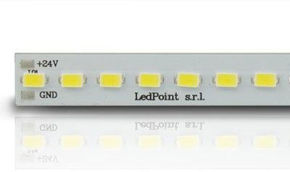
An LED strip emits in a nearly lambertian way: the maximum luminous intensity I0 is perpendicular to the strip and decreases with the cosine of the angle. For a lambertian source, Φ = π · I0 holds. The LED strip 3000K 2835 240 led/m 24V 14.4 W/m declares 2000 lm/m: each meter thus has an axial luminous intensity of approx. 2000 / π ≈ 637 cd.
Example 4: how many candelas to illuminate a surface at 60 cm
You want 500 lx on a surface 0.6 m from a spotlight: I = E · d² = 500 × 0.36 = 180 cd. A small spot with a narrow beam is enough. The same objective at 3 meters requires 4,500 cd: the same illuminance costs 25 times more luminous intensity.
Ledpoint calculator: luminous intensity, solid angle and lux at distance
Enter the flux, beam angle and distance: the calculator applies the formulas I = Φ/Ω and E = I/d² and returns candelas, central lux and spot diameter.
6. Photometry and radiometry: why watts are not candelas
How many candelas is 1 watt? How many watts is 3 candelas? These are very frequent questions, and the correct answer is: it depends on the color of the light. To understand this, one must distinguish between photometric quantities, which measure light "as the eye sees it", and radiometric quantities, which measure pure electromagnetic energy.
Luminous intensity and radiant intensity
Radiant intensity (or radiation intensity), Ie, is measured in watts per steradian and counts all emitted energy, including infrared and ultraviolet that the eye does not see. Luminous intensity weighs the same radiation with the spectral sensitivity function V(λ) of the eye, which is 1 at 555 nm and drops almost to zero below 400 nm and above 700 nm. A very powerful infrared radiation has a luminous intensity of zero: for the eye it is darkness.
| Radiometric quantity | Unit | Corresponding photometric quantity | Unit |
|---|---|---|---|
| Radiant flux Φe | W | Luminous flux Φv | lm |
| Radiant intensity Ie | W/sr | Luminous intensity Iv | cd |
| Irradiance Ee | W/m² | Illuminance Ev | lx |
| Radiance Le | W/(sr·m²) | Luminance Lv | cd/m² |
Watt to candela conversion: the role of 683
Only for monochromatic light at 555 nm, 1 radiant W corresponds to 683 lm, and 1 W/sr corresponds to 683 cd. For any other wavelength the value is lower: at 450 nm (blue) the eye sensitivity is approx. 3.8%, so 1 W/sr is worth only 26 cd. For white light the ratio between lumens and radiant watts typically ranges between 250 and 370 lm/W depending on the spectrum. Therefore there is no fixed conversion between electrical watts and candelas: only the measured photometric datum counts.
Photopic and scotopic vision
The curve V(λ) describes photopic vision, daytime, entrusted to cones. In the dark, rods come into play and scotopic vision, with a sensitivity peak shifted towards 507 nm: it is the Purkinje effect, which makes blues appear brighter and reds darker at twilight. All catalog values in lumens and candelas refer to photopic vision.
7. Light distribution, photometric curve and photometric solid
No real source emits the same luminous intensity in all directions. The way luminous intensity varies with direction is the "signature" of a fixture, and knowing it is what distinguishes a lighting design from a guesswork purchase.
The photometric solid
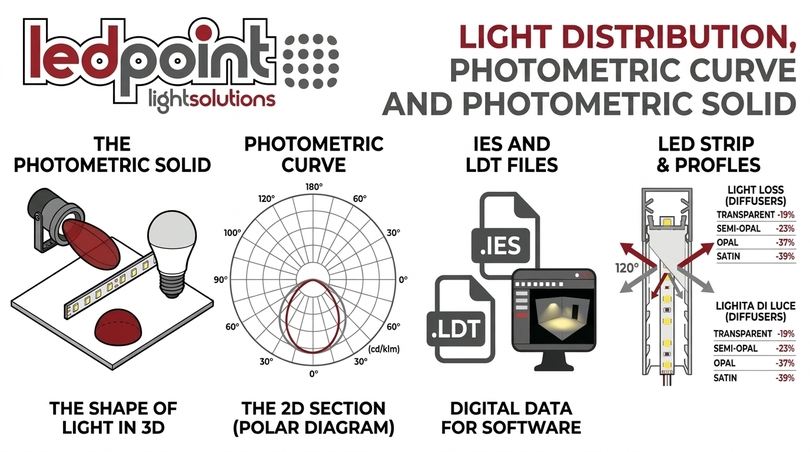
If from a source you trace, in every direction, a vector as long as the luminous intensity in that direction, the tips of the vectors draw a closed surface: the photometric solid. A spotlight has an elongated photometric solid like a spindle, a bare LED strip has a solid similar to a sphere resting on the strip plane, an omnidirectional bulb has an almost spherical solid. The volume of the solid is linked to the total luminous flux.
Photometric curve and polar diagram
Since a three-dimensional solid is difficult to read, manufacturers publish its sections on vertical planes: the photometric curves, drawn in a polar diagram. The center of the diagram is the source, concentric circles indicate luminous intensity values, angles indicate direction. The curves are almost always expressed in cd/klm, i.e., candelas per every 1000 lumens emitted: to obtain real candelas just multiply by the fixture flux in kilolumens.
IES and LDT files
Complete photometric curves are exchanged in digital files in IES format (North American standard) or EULUMDAT (.ldt, European standard). These are the files imported into lighting calculation software to simulate an environment. Measurements are obtained with a goniophotometer, according to the principles of optical photometry and the standards of the EN 13032 series.
LED strips: lambertian emission and the role of the profile
An SMD LED strip has an approximately lambertian emission, described by Lambert's cosine law: I(α) = I0 · cos α, with a useful emission angle of approx. 120°. Mounting it in an aluminum profile radically changes the distribution: the profile walls cut lateral light, the diffuser makes it homogeneous but absorbs part of it. In the sheets of Ledpoint aluminum profiles for LED strips you find precisely the photometric curves measured with the different diffusers.
| Ledpoint Profile | Diffuser | Retained light (measured data) |
|---|---|---|
| Shelf profile PR-SH01-03-S2 | Transparent | −19% |
| Semi-opaque | −23% | |
| Opaque | −37% | |
| Satin | −39% | |
| Mirror profile PR-MR01-03 | Opaque | −62% |
| Satin | −67% | |
| 45 mm profile for 3 strips PR-SLW10 | Transparent | 3% |
| 50% Opaque | 15% | |
| Opaque | 25% |
These data demonstrate that the diffuser can halve the useful light: it must always be accounted for when calculating real luminous intensity. Not coincidentally we dedicated a guide to matching tables between profiles and LED strips, and a comparative table of profiles to choose quickly.
8. How to measure luminous intensity: instruments and methods
What is the instrument for measuring luminous intensity? In the laboratory, the photometer and the goniophotometer; on site, the luxmeter, which measures illuminance from which luminous intensity is derived. Let's see how it is measured in practice, with what precision and which errors to avoid.
Measuring instruments: from lab to site
| Instrument | What it measures | Where it is used | Typical precision |
|---|---|---|---|
| Photometer on optical bench | Luminous intensity (cd) in one direction | Metrology labs | Very high |
| Goniophotometer | Complete distribution of luminous intensity | Manufacturers' labs | High, generates IES/LDT files |
| Integrating sphere with spectroradiometer | Luminous flux (lm), CCT, CRI | Quality control of LED strips | High |
| Luxmeter | Illuminance (lx) | Site, safety checks, shops | ±3–8% depending on class |
| Luminancemeter | Luminance (cd/m²) | Glare, screens, roads | High |
| Smartphone app | Estimation of illuminance | Amateur use | Errors even 20–50% |
The Ledpoint method: lumens per meter in integrating sphere
The lumens per meter value declared on Ledpoint LED strips is not a theoretical estimate: it is obtained by testing one meter of strip in an integrating sphere with a spectroradiometer, after leaving it lit for about an hour and a half to thermally stabilize it. It is a detail that makes the difference, because a freshly turned-on LED is cooler and performs better than at steady state: measuring "cold" inflates numbers. For each strip, the test report and technical sheet are available for download from the product page.
The luxmeter: the measuring instrument for luminous intensity in the field
The luxmeter is the most widespread instrument for light measurement: a silicon photocell with a filter adapting its response to the V(λ) curve of the eye, and a diffuser applying cosine correction. Often ignored aspect: cheap luxmeters are calibrated for incandescent lamps and can err with the LED spectrum, which has a strong peak in blue.
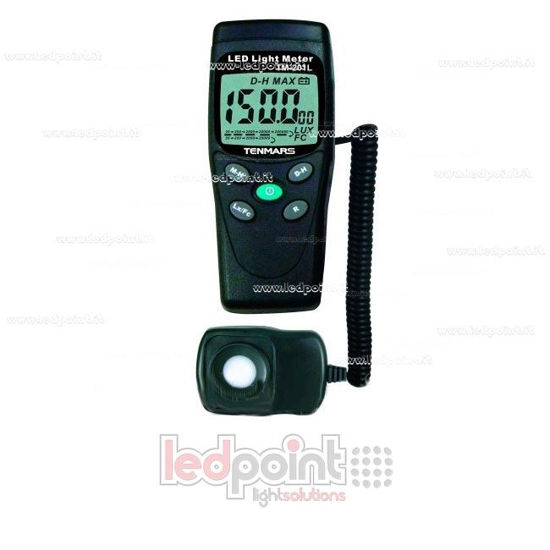
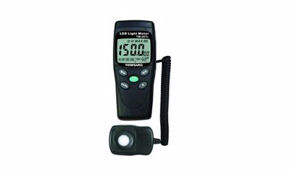
The Tenmars TM-201L luxmeter for LEDs available on Ledpoint has a specific calibration for the LED emission spectrum, with a precision of ±3% on white LED light (±8% on other sources), scales from 200 to 200,000 lx and from 20 to 20,000 fc, and a remote sensor with 1.5 m cable avoiding casting one's shadow on the measurement. It is the instrument we recommend to installers, designers and safety managers who need to document lux with LED strips.
How to measure luminous intensity with a luxmeter: step-by-step procedure
With a luxmeter you measure illuminance, but by inverting the inverse-square law you derive luminous intensity: I = E × d². Here is the procedure we use to measure the luminous intensity in candelas of a spotlight or a segment of LED strip:
- Prepare the environment: complete darkness or ambient light measured with source off (to subtract), source lit for at least 30 minutes.
- Fix the distance: at least 5 times the size of the source; for a 5 cm spotlight 0.25 m is enough, for a 30 cm strip segment at least 1.5 m is needed.
- Align the sensor: perpendicular to the source axis, centered in the beam.
- Read the value and subtract background: Enet = Eon − Eoff.
- Calculate: I = Enet × d². Example: 450 lx at 2 m give 450 × 4 = 1,800 cd.
- Repeat at multiple angles: rotating the source every 10° simplifies reconstruction of the photometric curve.
How to measure light in a room: the measurement grid
To verify an environment, one point is not enough. Standard UNI EN 12464-1 provides measuring illuminance on a grid of points on the visual task plane, with spacing depending on area dimensions (indicatively between 0.5 and 1 m for small rooms). Then average illuminance Em, minimum Emin and uniformity U0 = Emin/Em are calculated. A correct average value with poor uniformity means shadow zones: it is the most frequent cause of visual fatigue.
9. LED luminous intensity: strips, lumens per meter and efficiency
In the world of LED strips, luminous intensity depends on three factors: flux per meter, LED density, and how the strip is powered and mounted. Understanding these parameters allows choosing the right strip without oversizing and without surprises.
Lumens per meter, LEDs per meter and efficiency: the data that count
Luminous flux per meter (lm/m) determines how much light the strip produces; efficacy (lm/W) how much energy is needed to produce it; LED density per meter determines how continuous the light line appears inside a profile. A high-density strip like 240 led/m is not necessarily more powerful, but distributes the same light over more points, reducing dotting effect and luminance peaks.
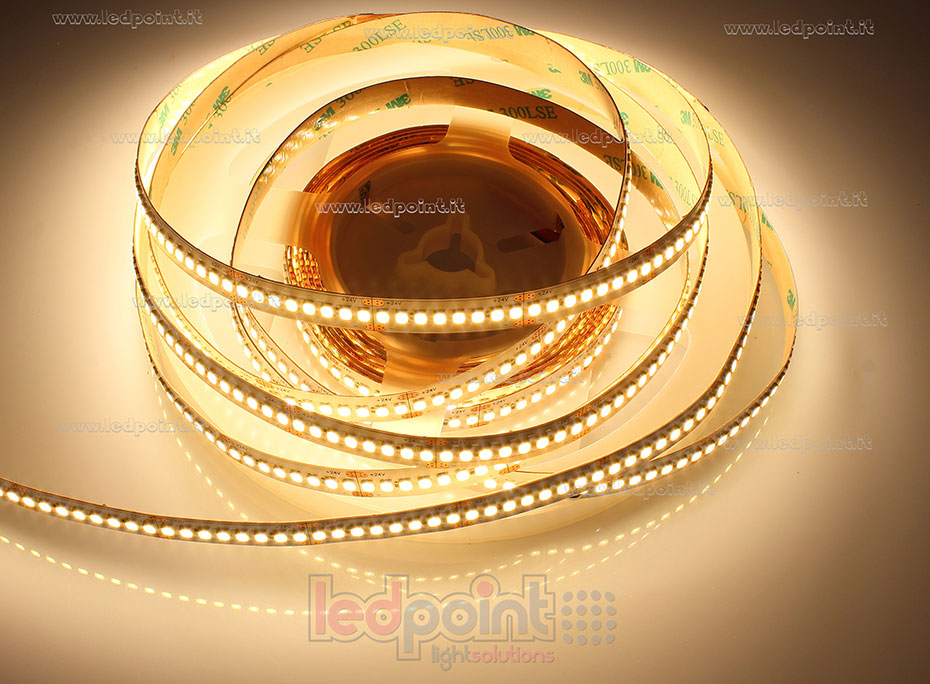
| Ledpoint LED Strip | LED/m | Power | Flux | Declared efficacy | Estimated axial intensity |
|---|---|---|---|---|---|
| F52-30s-x240DF2/14.4 – 3000K 24V | 240 | 14.4 W/m | 2000 lm/m | 155 lm/W | approx. 640 cd/m |
| F52-30s-1208F2/14.4 – 3000K 24V | 120 | 14.4 W/m | 1410 lm/m | 110 lm/W | approx. 450 cd/m |
| FE2-40s-120822/14.4 – 4000K 24V, 50 m reel | 120 | 14.4 W/m | 1600 lm/m | 123 lm/W | approx. 510 cd/m |
| Fx2-280-240D22 – 2800-2900K 24V | 240 | 19.2 W/m | 2071 lm/m | 120 lm/W | approx. 660 cd/m |
| F52-R300-840OM2 – COB 3000K + RGB | 840 | 20.2 W/m | 570 lm/m (white) | 85 lm/W | approx. 180 cd/m |
The comparison between the first two rows is instructive: for the same 14.4 W/m, the 240 led/m version produces 42% more light, because each LED works at lower current and thus higher efficiency. You can explore ranges by characteristic in categories 240 led/m LED strips, COB LED strips for a dot-free line, and high brightness LED strips over 24 W/m when maximum luminous intensity is needed.
Lumen watt table: equivalence with old bulbs
How many lumens does a 100 watt bulb have? The European regulation on lamp labeling established reference equivalences that remain the simplest way to orient between lumens and watts.
| Traditional incandescent | Equivalent flux | LED at 100 lm/W | Ledpoint strip 2000 lm/m |
|---|---|---|---|
| 25 W | 249 lm | approx. 2.5 W | approx. 12.5 cm |
| 40 W | 470 lm | approx. 4.7 W | approx. 24 cm |
| 60 W | 806 lm | approx. 8 W | approx. 40 cm |
| 75 W | 1055 lm | approx. 10.5 W | approx. 53 cm |
| 100 W | 1521 lm | approx. 15 W | approx. 76 cm |
| 150 W | 2452 lm | approx. 24.5 W | approx. 1.23 m |
How many watts is 2000 lumens? With a 100 lm/W LED, 20 W are needed; with a 155 lm/W strip, approx. 13 are enough. It is the heart of energy saving: reducing consumption while maintaining high luminous intensity means choosing sources with high efficacy, not lowering lumens.
The temperature factor and voltage drop
Luminous intensity of an LED strip is not a fixed value. Flux drops when junction temperature rises: for this Ledpoint recommends applying strips on a metal heat sink, preferably oxidized aluminum. Furthermore, voltage drops along the strip: a 5-meter strip powered from one side only absorbs approx. 15% less power, with visibly weaker light at the end. The solution is powering from both sides or choosing LED strips with constant current control system, which maintain uniform luminous intensity even on long runs.

10. How to adjust luminous intensity: dimmers, controllers and profiles
How is luminous intensity adjusted? In LED strips the answer passes through three levers: electronics (dimmers and controllers), optics (profiles and diffusers), and choice of source (lumens per meter and color temperature). Adjusting light well means getting the right atmosphere, saving energy and extending LED life.
What adjusts LED luminous intensity
The light of an LED depends on the current crossing it. Adjusting luminous intensity of an LED strip thus means controlling the average current reaching the chips. There are two techniques: continuously reducing current (CCR, Constant Current Reduction) or rapidly turning the strip on and off varying the on/off ratio (PWM, pulse-width modulation). Almost all dimmers for 12V and 24V constant voltage strips work in PWM.
PWM and flicker: beware of video and photography
With PWM the eye sees continuous light because frequency is very high, but cameras may capture lines and flickering. For workplaces, photo sets and video, it is advisable to choose dimmers with high PWM frequency (several kHz) and, for 230V sources, anti-flicker drivers. European regulation Ecodesign EU 2019/2020 sets precise limits for light source flickering.
Dimmable LED strips: comparison of control systems
Dimmable means luminous intensity can be continuously adjusted. Almost all constant voltage LED strips are dimmable: what changes is the control system, to be chosen based on the installation and desired automation level.
| System | How it works | When to choose it | Ledpoint Category |
|---|---|---|---|
| RF 2.4G remote control dimmer | Receiver on 12/24V line, radio command | Home retrofit without new cables | Monochrome dimmers |
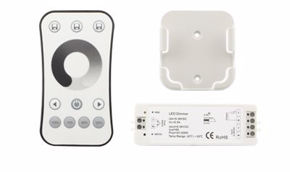
| Push dim | Traditional button: short press on/off, long press adjusts | Homes, offices, wall command | Remote control kit + controller with button 5/36V |
| WiFi / app / voice | Control from smartphone, Alexa, Google | Smart home, scheduled scenarios | WiFi+IR dimmer kit 1CH 5A |
| ZigBee | Domotic mesh network | Integration with hubs and sensors | ZigBee controllers |
| Triac / phase cutting | Regulation on 230V | Existing installations with wall dimmers | 230V push dim triac controller |
| 0/1-10V | Analog signal from panel | Offices, shops, building automation | 0/1-10V dimmers |
| DALI / DMX | Addressable digital protocols | Professional projects, scenography | DMX and DALI decoders |
| Sensors | Presence, motion, daylight | Corridors, closets, energy saving | Sensors |
Connecting the dimmer: golden rules
The dimmer for low-voltage LED strips is connected between power supply and strip. Three rules avoid 90% of problems: strip current must not exceed dimmer channel current, power supply must be sized with at least 20% margin, and power supply output voltage must match strip voltage. For a 5-meter strip at 14.4 W/m (72 W at 24V, 3 A), a channel of at least 5 A and a power supply of approx. 90–100 W are needed, found among 24V power supplies.
Dimming curve and perception
The eye does not perceive light linearly: going from 100% to 50% flux is perceived as a reduction much smaller than half, while at low levels small variations are noticed greatly. For this reason quality controllers adopt logarithmic or quadratic dimming curves, making adjustment "natural" and allowing descent down to 1% without jumps.
Adjusting light with profiles: optics as passive dimmer
Even before electronics, the profile decides how much luminous intensity arrives where needed. A deep recessed profile reduces glare, an opaque diffuser eliminates bright spots but retains light, an angular profile directs beam at 45° towards worktop. Among the most used are the 17x8 mm aluminum profile 2 meters, the 16 mm angular profile, the 23x8 mm recessed profile and the 44x12 mm drywall profile for flush ceiling light cuts. Replacement diffusers are in category profile diffusers.
Color temperature: adjusting not just how much light, but which light
What is the difference between 2700K and 3000K? Both are warm lights, but 2700K recalls incandescence and is more enveloping, 3000K is slightly more neutral and enhances materials better. Between 3000K and 4000K the difference is sharper: 4000K is a neutral white increasing clarity and concentration sensation. Better 3000K or 4000K light? 3000K for homes, hotels and catering; 4000K for offices, laboratories, professional kitchens and warehouses. With CCT LED strips and CCT controllers luminous intensity and color temperature are adjusted together, while the Circadian Light line follows natural daily rhythm.
Ledpoint configurator: LED strip, profile and dimmer
Choose strip, length, diffuser and dimming level: get effective lumens, axial luminous intensity, power, recommended power supply and annual consumption.
11. How much light is needed: lux per room and lumen calculation
We pass from physics to design. How many lumens are needed to illuminate a room? How many lumens per square meter? The answer always starts from required illuminance in lux, then goes back to lumens and finally to meters of strip or number of fixtures.
Recommended illuminance levels
For workplaces values are set by standard UNI EN 12464-1; for homes there are no obligations, but good design practice converges on consolidated values. Indicated values are maintained average illuminances on the visual task plane, not lamp lumens.
| Environment or task | Recommended illuminance | Design notes |
|---|---|---|
| Living room, ambient light | 100–200 lx | Multiple dimmable light layers, 2700–3000K |
| Home kitchen, worktop | 300–500 lx | Strip under cabinet in angular profile, CRI ≥90 recommended |
| Bathroom, mirror zone | 300–500 lx on face | Frontal and lateral light, avoid shadows |
| Corridors and passages | 100 lx | Presence sensors for saving |
| Office, writing and reading | 500 lx | UGR ≤ 19, Ra ≥ 80, uniformity ≥ 0.60 |
| Technical drawing, quality control | 750–1000 lx | Ra ≥ 90 where color counts |
| Warehouse, shelves | 100–200 lx | Higher if label reading occurs |
| Shop, sales area | 300–500 lx | Accents on products 3–5 times background |
| Sensitive artworks (paper, fabrics) | 50 lx | Also limit annual exposure |
| Oil paintings, medium-sensitive objects | 150–200 lx | Narrow beam, high CRI |
| Outdoor, cloudy day | 1,000–10,000 lx | Reference to understand ratios |
| Outdoor, direct sun | up to 100,000 lx | How many lux outdoors: even 200 times an office |
Room lumen calculation: practical formula
The simplified method, called total flux method, is: required lumens = required lux × surface (m²) ÷ (utilization factor × maintenance factor). Utilization factor accounts for how much light really arrives on the plane (depends on wall colors, room shape, optics): for bright environments with direct light indicatively 0.5–0.7 is used. Maintenance factor considers decay over time and dirt: 0.8 is a prudent value for LEDs.
Example: 12 m² kitchen
You want 300 lx average: 300 × 12 ÷ (0.6 × 0.8) = 7,500 lm. With the 2000 lm/m strip in profile with transparent diffuser (−19%) you get 1,620 lm/m useful: approx. 4.6 meters are needed, distributable among under-cabinets, ceiling groove and island zone.
Ledpoint calculator: how many lumens and how many meters of strip needed
Choose environment, enter surface and strip yield: calculator estimates required lumens, lumens per square meter and meters of LED strip.
12. Luminous intensity by profession: practical cases
The same physical quantity translates into very different needs depending on who designs. We collected the questions we receive most often from six professional profiles, with operational answers and most suitable Ledpoint products.
Lighting designer: precision and uniformity
For those who must precisely calculate illuminance levels, starting point is photometric files and measured data, not estimates. The rule is to design on maintained illuminance and always verify uniformity U0, not just average. To reduce consumption while maintaining high luminous intensity, winning strategy combines high-efficacy sources, optics bringing light only where needed, and control with presence and daylight sensors. For professional lux measurements during commissioning, luxmeter with LED calibration is indispensable.
Interior architect: atmosphere, glare and paintings
Which luminous intensity for a home kitchen? 300–500 lx on worktop, with grazing light from cabinets. To create welcoming atmosphere in living room key is layering: indirect ceiling light in drywall groove, punctual accents and decorative light, each independently dimmable. To avoid glare and reflections, source must never be directly visible: recessed profiles, opaque diffusers and orientation towards non-glossy surfaces. To illuminate paintings and furniture items, work with 3:1 ratio to background and concentrated luminous intensity with narrow beam, using sources with high color rendering index, like Sunlike line with spectrum similar to natural light.
Professional photographer: stable and adjustable light
How to calculate necessary luminous intensity for a set? Start from desired exposure: at ISO 100, f/4 and 1/125 s approx. 5,000 lx on subject are needed, at ISO 400 approx. 1,250 suffice (indicative values for incident light measurement). Difference between luminous intensity and power of LED light is substantial: power in watts indicates consumption, candelas indicate how much light arrives on subject in that direction. Bringing light closer by 30% almost doubles illuminance and softens shadows, because source becomes larger relative to subject. For adjustable illuminators, flicker-free dimmers and CRI ≥ 90 count.
Indoor grower: lux vs PPFD
What is difference between lux and PPFD? Lux weighs light on human eye sensitivity, maximum in green; plants mainly use red and blue. For this reason in horticulture PPFD, photosynthetic photon flux density is used, in µmol/m²/s. Indicative values: 200–400 for salads and seedlings, 400–600 in vegetative phase, 600–1000 in flowering. Approximate conversion for white LEDs is 1 µmol/m²/s ≈ 55–75 lx, depending on spectrum. Strips of Growing line have spectra dedicated to plant growth, and luminous intensity adjustment with dimmer allows adapting to different phases.
Safety manager: requirements and documentation
D.Lgs. 81/2008 imposes workplaces have sufficient lighting for safety and health; technical reference values are those of UNI EN 12464-1. Warehouse typically requires 100–200 lx, offices 500 lx. To identify insufficient lighting zones, measure on grid and compare each point with requirement, noting date, instrument, conditions and position. To correctly document measurements, luxmeter with valid calibration certificate and adequate declared precision for source is needed.
Clothing store owner: selling with light
What is ideal luminous intensity for clothing store? Background of 300–500 lx and accents on showcases and flagship items 3 to 5 times more intense. Showcases require even higher values to compete with external daylight. To avoid excessive luminous intensity altering garment colors, light quality counts more than quantity: CRI ≥ 90, temperature 3000–3500K for warm fabrics and 4000K for sportswear, no glare towards customer. Most effective way to adjust luminous intensity in different areas is dividing system into zones with independent controllers and recallable scenarios. LED bars and strips in shelf profiles are ideal for shelves and displays.

13. Perception: why the eye is not a luxmeter
Two environments with same lux may seem one bright and other gloomy. Perception of luminous intensity depends on eye, light spectrum, surfaces and even observer age. Knowing these factors avoids oversizing a system to compensate a problem that is not quantitative.
Factors influencing light perception
- Visual adaptation: eye regulates pupil and retinal sensitivity; entering from sunny day a 500 lx shop seems dark, in evening same shop seems bright.
- Surface reflectance: white walls return 70–80% of light, dark surfaces 10–20%; perceived luminance changes accordingly.
- Contrast: bright accent is perceived in relation to background, and ratio between luminances guides gaze.
- Color temperature: for same lux, 4000K light is often perceived as clearer than 2700K.
- Age: lens yellows and becomes less transparent; at 60 years approx. double lux compared to 20 years are needed for same visual performance.
- Glare: too bright source in visual field reduces ability to see everything else, even if increasing lux.
Perceived brightness and measured luminance
Brightness is subjective sensation, luminance is its measurable counterpart. Relationship between them is not linear: to perceive light "twice as bright" indicatively 3 to 5 times higher luminance is needed. It is precious data: to make product stand out in showcase, increasing light by 20% is not enough, sharp jump relative to background is needed.
14. Standards and design criteria for luminous intensity
Correct project is based on recognized standards. Standards do not indicate which product to use, but define minimum levels, measurement methods and light quality requirements every system must respect.
| Standard or reference | Scope | What it establishes |
|---|---|---|
| UNI EN 12464-1 | Indoor workplaces | Maintained illuminance, uniformity, UGR, color rendering for each activity |
| UNI EN 12464-2 | Outdoor workplaces | Requirements for outdoor areas, parking lots, construction sites |
| UNI EN 1838 | Emergency lighting | Minimum illuminance on escape routes |
| EN 13032 Series | Photometric data | Measurement and presentation of luminous intensity and photometric curves |
| IEC 60598 | Fixture safety | Construction and electrical safety requirements |
| EU Regulation 2019/2020 | Ecodesign light sources | Minimum efficiency, flicker, mandatory information |
| D.Lgs. 81/2008 | Workplace safety | Obligation of adequate lighting in workplaces |
Quality parameters beyond lux
UNI EN 12464-1 does not ask only quantity of light. Discomfort glare (UGR), uniformity, color rendering and flicker weigh on comfort as much as illuminance. Office with 500 lx but UGR 25 is less comfortable than one with 450 lx and UGR 16. Standards are available from UNI, Italian Standards Body, while for candela metrology national reference is INRiM, National Institute for Metrological Research.
15. Most common errors with luminous intensity
In years of technical assistance we have seen same errors repeating. Here they are, with practical solution for each.
- Choosing by watts instead of lumens. Watts measure consumption; two 14.4 W/m strips may differ by 42% in light.
- Confusing lumens, lux and candelas. Spotlight with many candelas and few lumens illuminates well a point, not a room.
- Ignoring diffuser. Up to 60% of light may stay inside profile: must be calculated beforehand, not discovered afterwards.
- Powering long strips from one side only. Voltage drop, approx. −15% power on 5 m, uneven light.
- Undersizing power supply. Without 20% margin power supply heats and flux drops.
- Measuring with smartphone app. To document, calibrated and LED-specific instruments are needed.
- Leaving strip exposed. Visible high-luminance source dazzles: recessed profile is better.
- Forgetting dimming. System without adjustment is sized for worst case and wastes energy rest of time.
16. Frequently asked questions about luminous intensity
We collected most searched questions about luminous intensity, with brief and precise answers. Click each question to open answer.
What is luminous intensity?Luminous intensity is the photometric quantity indicating how much light a source emits in a determined direction. It corresponds to luminous flux emitted per unit solid angle, is indicated with symbol Iv and measured in candelas (cd), the fundamental unit of International System for light. |
What is the unit of measurement of luminous intensity?Unit of measurement of luminous intensity in International System is candela, symbol cd. One candela equals one lumen per steradian. It is one of seven SI base units and is defined fixing constant Kcd at 683 lm/W for monochromatic radiation of 540 THz. |
What is the symbol of luminous intensity?Symbol of luminous intensity quantity is Iv, where "v" stands for visual and distinguishes it from radiant intensity Ie, measured in watts per steradian. Symbol of unit of measurement, instead, is cd, always written lowercase and without final dot. |
What is the formula to calculate luminous intensity?Basic formula is I = Φ / Ω: luminous flux in lumens divided by solid angle in steradians. For conical beam with opening θ solid angle is Ω = 2π(1 − cos θ/2). Knowing illuminance E at distance d derives instead I = E × d². |
What is the instrument for measuring luminous intensity?In laboratory photometer and goniophotometer are used, measuring candelas in every direction. In field luxmeter is used: measures illuminance in lux, from which luminous intensity is derived multiplying by square of distance. With LEDs, luxmeter with specific calibration for their spectrum is needed. |
What is difference between lumens and lux?Lumen measures total light emitted by source, lux measures light arriving on each square meter of surface. One lux equals one lumen per square meter. Same 1000 lumens give 1000 lux on one square meter, but only 100 lux distributed over ten square meters. |
How to pass from candela to lumens?Multiply luminous intensity in candelas by solid angle of beam in steradians: Φ = I × Ω. Isotropic source of 1 cd emits approx. 12.57 lumens (4π). Spotlight of 5000 cd with 15° beam emits approx. 270 lumens. Always need to know beam angle. |
How many candelas is 1 watt?No fixed conversion between watts and candelas exists. Only for green monochromatic light at 555 nm, 1 watt per steradian corresponds to 683 candelas; with other colors value drops. For electrical watts source efficacy counts: 150 lm/W LED produces ten times light of incandescent. |
How many lumens to illuminate a room?Multiply desired lux by square meters and divide by approx. 0.5. 12 m² kitchen at 300 lux requires approx. 7,500 lumens, 20 m² living room at 150 lux approx. 6,000 lumens. Exact value depends on wall color, height and fixture optics. |
How to adjust luminous intensity of LED strip?Install dimmer or controller between power supply and strip: varies average current to LEDs, almost always in PWM. Can command with remote, push dim button, WiFi app, ZigBee, 0/1-10V signal, DALI or DMX. Also profile and diffuser modify useful light output. |
What was old unit of measurement of luminous intensity?Before modern candela, adopted in 1948, units based on sample flames were used: English spermaceti candle, French Carcel lamp, German Hefnerkerze of 1884, bougie décimale and international candle of 1909, all close to current candle except Carcel. |
What is unit of measurement of luminance?Luminance is measured in candelas per square meter (cd/m²), formerly called nits. Indicates how bright surface appears to eye: white sheet in office approx. 100 cd/m², smartphone 500–1000 cd/m². It is quantity governing glare and visual comfort. |
Better 3000K or 4000K light?3000K light is warm white, welcoming, ideal for homes, hotels and restaurants. 4000K is neutral white favoring concentration and detail reading, suitable for offices, professional kitchens, laboratories and warehouses. With CCT LED strips both can be had and adjusted with controller. |
How many lux in an office?Standard UNI EN 12464-1 requires 500 lux maintained on worktop for writing, reading and data processing, with uniformity at least 0.60, color rendering Ra ≥ 80 and glare UGR ≤ 19. In surrounding zones value can drop, but without abrupt jumps. |
17. From luminous intensity to project
Luminous intensity is quantity giving direction to light. Those reasoning in candelas, lumens and lux instead of watts design more efficient, comfortable and easier to adjust systems. In world of LED strips this translates into precise choices: measured lumens per meter, profiles with declared photometric data, power supplies with margin and context-appropriate dimmers.
If you have a project and want to verify calculations, Ledpoint technical team is available: you can contact us for consultation, consult Ledpoint catalogs with all technical data or deepen other technical articles of Ledpoint blog, like guide to white shades.
Sources and further readings
This article was developed with support of artificial intelligence and subsequently revised, corrected and validated by Ledpoint.it technical team, which guarantees its reliability and conformity to official sources.