









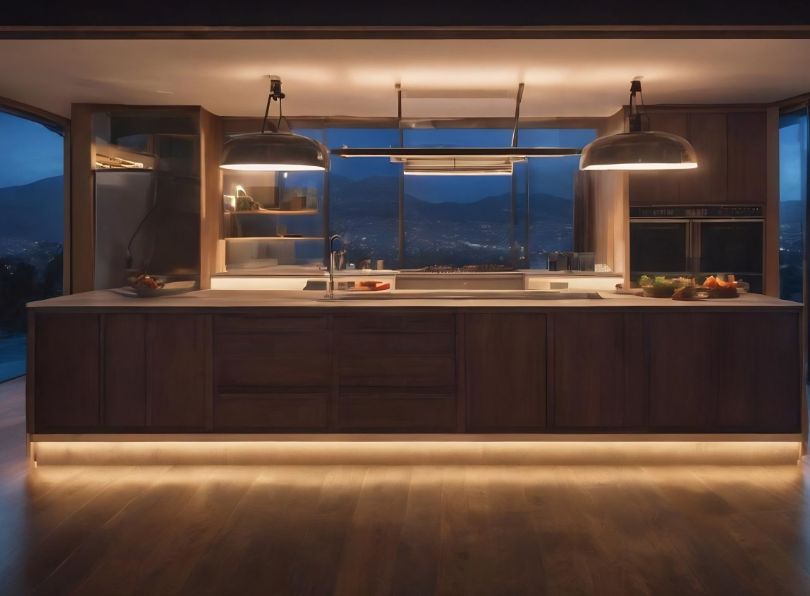
Kitchen lighting: complete LED guide 2026
Kitchen lighting in 2026 is no longer an accessory choice, but the true design centerpiece of every evolved domestic environment. When we talk about modern kitchen lighting, we refer to an integrated system of light sources, technical profiles, sensors and smart controls capable of communicating with each other to deliver perfect visual comfort, refined aesthetics and measurable energy savings. Designing kitchen lighting today requires a holistic vision: it's not enough to choose a central chandelier or a few spotlights; it's necessary to layer light by activity, by functional zones and by moments of the day, integrating ceiling LED kitchen lighting with under-cabinet kitchen lighting, kitchen island lighting and kitchen counter lighting.
This complete guide stems from direct experience in selling and designing professional LED systems and is intended for architects, interior designers, chefs, homeowners and entrepreneurs who want to get the most from their modern kitchen lighting. We will address in depth every technical, aesthetic and functional aspect, from required lumens to color temperature selection, from COB strips to aluminum profiles, from touchless sensors to multi-zone controllers, from materials to 2026 trends, from budget to maintenance. The goal is to provide an authoritative and definitive reference for anyone who needs to design, renovate or simply improve the kitchen lighting in their home or professional space.
LED kitchen lighting represents today's absolute technological standard: energy efficiency up to 180 lumens/watt, lifespan over 50,000 hours, color rendering CRI>97 with Sunlike series, wireless app control, smooth dimming and zero flicker. 2026 kitchen lighting is intelligent, modular, sustainable and deeply personalized. In this guide you will discover how to translate these advantages into concrete solutions for your kitchen, with precise references to products from the Ledpoint, LightingLine, Skydance and Mean Well ecosystem.
In this article...
Why kitchen lighting has radically changed in 2026
In the last five years, kitchen lighting has undergone a transformation we can define, without exaggeration, as epochal. If until 2020 designing kitchen lighting mostly meant choosing a central chandelier, possibly accompanied by a few spotlights and a halogen under-cabinet light, today the paradigm is completely different. Modern kitchen lighting is a layered system, composed of at least three overlapping levels (ambient light, task light, accent light) each managed with specific LED technologies, dedicated sensors and digital controls. This introductory chapter serves to frame the context and explain why ignoring this evolution means settling for a mediocre, energy-inefficient and visually dated result.
The first major change concerns the massive adoption of LED in every segment of kitchen lighting. Market research in the Italian lighting sector indicates that in 2026 over 92% of new domestic installations use exclusively LED sources, with a 38% increase compared to 2021. This data is not purely technological: it reflects a new consumer awareness regarding energy savings, durability and light quality. Old halogen, fluorescent and incandescent sources are now relegated to residual niches, while LED strips, COB modules and precision electronic drivers have conquered the LED kitchen lighting market.
The second change is design-related: we have moved from the logic of the "point light" to the logic of "continuous luminous flow". LED strips have made it possible to illuminate lines, edges, perimeters, architectural coves, under-cabinets, backsplashes, compartments and niches with continuity unimaginable in the past. This has allowed designers and architects to treat light as a plastic material, moldable, integrable into the very structure of furniture or architecture. Under-cabinet kitchen lighting, for example, is no longer a thin fluorescent bar placed under the cabinet, but a true COB light line hidden in a 45° angled profile that illuminates the work surface without glare and without creating shadows.
The third change is the revolution of distributed intelligence. 2026 kitchen lighting is smart by default. Every circuit can be dimmed, programmed, synchronized with other home automation devices, controlled via app or voice assistant. Skydance WiFi controllers and touchless sensors allow management of complex scenarios (work light, atmosphere light, night light, emergency light) without any installation complexity. All this would have required, until a few years ago, complex and very expensive centralized systems. Today it is within reach of any domestic kitchen.
Market data on kitchen lighting in Italy
To understand the scale of the phenomenon, it is useful to observe some key data from the Italian kitchen lighting market in the 2024-2026 biennium. The Italian residential lighting sector exceeded €2.4 billion in revenue in 2025, with a growing share (now stable around 28%) specifically destined for the kitchen. This is because the kitchen has become, in many Italian homes, the true center of domestic life, integrated with the living room in increasingly widespread open space configurations. The average expenditure for LED kitchen lighting in a mid-level renovation ranges between €800 and €2,500, while in high-end projects it easily exceeds €6,000-8,000 for the lighting component alone.
| 2026 Market Indicator | Value |
|---|---|
| LED adoption in new kitchens | 92% |
| Kitchens with integrated smart system | 47% |
| Average kitchen lighting expenditure (renovation) | €800 – €2,500 |
| Average kitchen lighting expenditure (high-end) | €4,000 – €8,000 |
| Energy savings vs halogen | up to 85% |
| Average lifespan of professional LED modules | 50,000 hours |
| Increase in COB strip requests in 2025 | +62% |
| Kitchens with voice control (Alexa/Google) | 34% |
These numbers tell of a mature, aware and fully expanding market, where LED kitchen lighting now represents an essential standard. Anyone who today designs or renovates a kitchen without considering these parameters makes a technical and economic error difficult to correct afterwards, because the electrical system, predispositions, cable passages and mechanical structures of the furniture must be conceived from the start to accommodate modern LED solutions.
What consumers seek today in kitchen lighting
Sector research highlights five major families of requests that characterize the 2026 consumer. The first is light quality: high CRI, absence of flicker, calibrated color temperature, smooth dimming are requested. The second is flexibility of use: the same kitchen must be able to host different scenarios, from intense work to romantic dinner. The third is energy savings, supported also by still-high energy costs. The fourth is aesthetic integration: the light must disappear or, conversely, become a declared design element. The fifth is smart connectivity, with apps, voice and automations.
All these needs find answers in the Ledpoint ecosystem, which combines high-performance LED strips, professional LightingLine profiles, Skydance controls and Mean Well power supplies in an integrated offering. In the coming chapters we will see in detail each element and how to compose them to obtain professional-level kitchen lighting.
Technical fundamentals of kitchen lighting: lumens, kelvin, CRI and watts
Before delving into specific solutions, it is essential to clarify the four technical parameters that govern any kitchen lighting project. Understanding them well means being able to independently evaluate product quality, compare offers, avoid gross errors and competently dialogue with installers and designers. These parameters are lumens, kelvin, CRI and watts, and each tells a different dimension of the light we will install in the kitchen.
Lumens: how much light is really needed in the kitchen
The lumen is the unit of measurement of total luminous flux emitted by a source, regardless of direction. It is the most important parameter for sizing a kitchen lighting system. The general rule, validated by residential lighting standards, provides for between 300 and 400 lumens per square meter as general ambient lighting, but on work zones this value must double or triple. On the kitchen work surface, between 500 and 700 lumens per linear meter are recommended, achieved with high-density COB LED strips installed under cabinets. Translated into practical terms: a 15 m² kitchen requires approximately 4,500-6,000 total lumens, to be distributed among general light, task light and accent light.
| Kitchen Zone | Recommended Lumens | Light Type |
|---|---|---|
| Ceiling / general ambient | 300-400 lm/m² | Diffuse, 3000-4000K |
| Under-cabinet work surface | 500-700 lm/m | Directional COB, 4000K |
| Island / peninsula | 800-1200 lm pendant | Concentrated, 3000K |
| Dining table | 2000-3000 lm total | Warm 2700-3000K, dimmable |
| Internal cabinets / pantry | 150-250 lm/m | COB 4000K, door sensor |
| Kitchen hood | 400-600 lm | Neutral 4000K, CRI>90 |
| Skirting / night light | 50-100 lm/m | Warm 2200-2700K |
It should be emphasized that lumens declared by manufacturers refer to the total flux of the source, but the flux actually perceived on the work surface (illuminance, measured in lux) depends on factors such as distance, optics, surface color and any obstacles. For this reason it is always advisable to slightly oversize the luminous power and manage it with a dimmer, rather than undersizing and ending up with a poorly lit kitchen. Ledpoint LED strips make it easy to implement this "abundance with reserve", thanks to native compatibility with Skydance dimmers.
Kelvin: color temperature and atmosphere in the kitchen
Kelvin (K) measures the color temperature of light, i.e., its hue which varies from warm orange to cool bluish. This parameter is decisive for kitchen lighting because it directly influences both visual comfort and food perception. Light at 2700K is very warm, similar to old incandescence, ideal for relaxing environments like the dining room or the social area of the kitchen. Light at 3000K is still warm but more neutral, perfect for classic or rustic kitchens. 4000K represents neutral white, considered the optimal standard for the work surface because it renders colors naturally and maintains high concentration. 5000-6000K are cool whites, more suitable for professional environments, laboratories and industrial kitchens than domestic contexts.
| Color Temperature | Appearance | Recommended Kitchen Use |
|---|---|---|
| 2200K | Candlelight, amber | Scenographic effects, backlight |
| 2700K | Very warm white | Dining table, evening ambient |
| 3000K | Warm white | General ambient, living zones |
| 4000K | Neutral white | Work surface, under-cabinet |
| 5000K | Cool white | Professional kitchens, pantries |
| 6000K | Daylight | Industrial kitchens, labs |
The difference between 3000K and 6000K is enormous from a perceptual point of view: the first creates a warm and welcoming environment, the second returns an aseptic and analytical atmosphere. The difference between 3000K and 4000K, while more subtle, is significant: 4000K is objectively more suitable for work, 3000K more suitable for meal consumption. The difference between 2700K and 3000K is minimal but perceptible: the first is slightly more amber, the second more neutral. The modern professional solution is Tunable White (CCT) technology, which allows adjusting color temperature with a dimmer or via app, switching from 2700K to 5000K in the same environment based on the time of day. Ledpoint F52-CCT series strips are designed precisely for this purpose.
CRI: the color rendering that makes the difference
CRI (Color Rendering Index) measures a light source's ability to render colors faithfully compared to sunlight. It is expressed on a scale from 0 to 100. For kitchen lighting, a minimum CRI of 90 is recommended, while for those who cook at a high level or work with fresh raw materials the correct choice is CRI>97 from Ledpoint's Sunlike series. Low CRI makes fruit appear dull, meat grayish, vegetables faded: an aesthetic but also practical drama, because it prevents correctly evaluating food freshness. High CRI, instead, returns vivid, deep, faithful colors, exactly as under sunlight.
CRI is particularly critical in professional kitchens, restaurants, pastry shops and delicatessens, where correct perception of food color also influences customer evaluation. But it is also very important at home, because a kitchen with low CRI appears less pleasant and less functional. Ledpoint LED strips start from CRI 80 in economy versions, reach CRI 90+ in standard series and exceed CRI 97 in Sunlike versions, which faithfully simulate the solar spectrum including near-UV useful for perceived food freshness.
Watts: efficiency and consumption
Watts indicate electrical consumption, not light emission. Efficiency is measured in lumens/watt: a good modern LED strip delivers 130-180 lumens per watt, compared to 12-15 lm/W of old halogens. Translated: to obtain the same light, an LED kitchen consumes less than one tenth compared to a traditional kitchen. With average use of 6 hours per day, annual savings for a medium-sized kitchen ranges between €80 and €150, fully recovering the initial investment in 2-4 years.
| Light Source | Efficiency (lm/W) | Lifespan (hours) |
|---|---|---|
| Incandescent | 10-15 | 1,000 |
| Halogen | 15-25 | 2,000 |
| Compact Fluorescent | 50-70 | 8,000 |
| Standard LED | 90-120 | 30,000 |
| Ledpoint Professional LED | 140-180 | 50,000+ |
This table clearly shows why LED kitchen lighting is now the only sensible choice. It's not just about economic savings but about durability, stability, absence of maintenance, reduced heat dispersion: a non-secondary factor in the kitchen, where ambient temperature is often already elevated due to stoves.
Ceiling LED kitchen lighting: designing general light
Ceiling LED kitchen lighting represents the first layer of the lighting system and has the task of providing a diffuse and homogeneous base that allows moving safely in the environment, reading labels, recognizing objects and creating the general atmosphere. The most common mistake is entrusting this single layer with the entire kitchen lighting: a single central ceiling light or chandelier inevitably produces hard shadows on the work surface (the user stands between the light and the operational zone) and cannot uniformly cover corners, especially in large or irregularly shaped kitchens. Correct design of ceiling kitchen lighting instead starts from a strategic distribution of multiple sources.
The technical solutions available today for ceiling kitchen lighting are numerous and each has specific characteristics. The first is the LED ceiling light, ideal for small kitchens or environments where a simple and economical solution is sought: today there are low-profile, dimmable LED ceiling lights with adjustable color temperature, capable of delivering 3000-5000 lumens from a single point. The second is the recessed ceiling spotlight, often used in batteries of 4 to 12 units distributed according to a geometric pattern designed to uniformly cover the environment. The third, increasingly widespread, is kitchen track lighting, which allows orienting individual spotlights on precise zones. The fourth is ceiling linear LED lighting, realized with LightingLine aluminum profiles and LED strips, perfect for contemporary design kitchens.
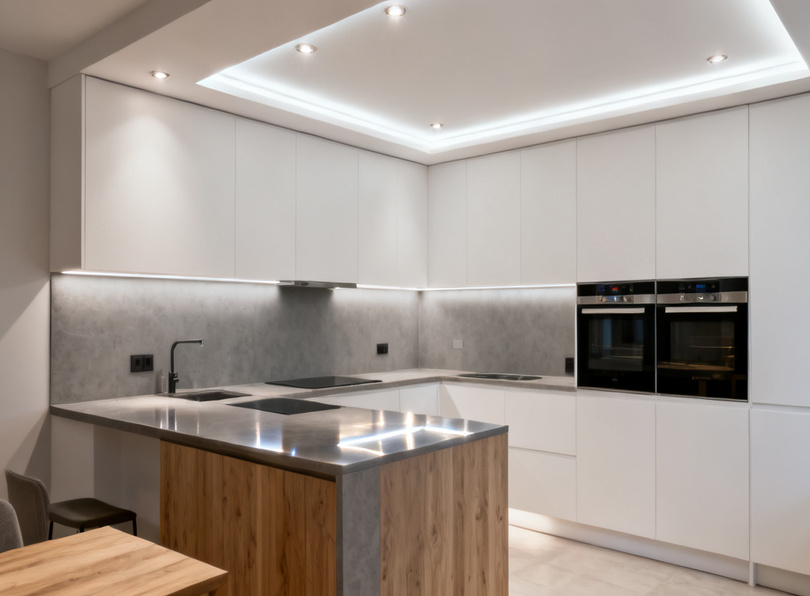
Modern LED ceiling lights for kitchen
The LED ceiling light remains a valid choice especially in small or medium kitchens and when seeking installation simplicity. Modern ceiling lights have thin profiles, often less than 5 cm thick, and integrate the driver internally. The best ceiling lights for kitchen are those with luminous flux of at least 3000 lumens, CRI>90, color temperature 3000-4000K or, even better, adjustable CCT. LED ceiling lights for kitchen should be sized considering 25-35 watts every 10 m² of surface, with higher values in windowless kitchens or with dark finishes.
A limitation of the single ceiling light, however, is the tendency to produce sharp shadows when working under wall cabinets. For this reason, in modern kitchens the ceiling light is almost always integrated with a second level of under-cabinet light, or entirely replaced by more articulated solutions such as adjustable spotlights or linear LED profiles.
LED recessed and track spotlights
Recessed spotlights are the most versatile solution for kitchen lighting with spotlights. Distributed according to a grid designed during planning, they guarantee uniform coverage and allow orienting light on specific zones such as the cooktop, sink or snack area. The empirical rule is to install one 7-9W LED spotlight every 1-1.5 m² of ceiling, with 60° optics for general light and 36° optics for accents. To avoid the "runway" effect it is important to alternate general spotlights and accent spotlights, possibly on independently dimmable circuits, to create different scenarios.
Track lighting for kitchen represents an interesting evolution because it combines the flexibility of repositioning spotlights with the formal cleanliness of a continuous line. It is particularly appreciated in industrial kitchens, lofts and environments with high ceilings, because it virtually lowers the lighting plane without weighing down the environment. Modern 48V tracks also allow powering LED strips and spotlights on the same system, integrating heterogeneous solutions with a single power supply.
Linear LED ceiling lighting with LightingLine profiles
The most contemporary and refined solution for ceiling LED kitchen lighting is the continuous line realized with LightingLine profiles and Ledpoint COB strips. This technique allows drawing light as a graphic stroke, following the geometries of furniture, island or architectural elements. LightingLine recessed profiles, with satin diffuser, return a perfectly homogeneous light line, without dots, similar to a neon tube but with all the efficiency and longevity of modern LED.
The most frequent configurations include perimeter lines around the ceiling drywall, central lines above the kitchen island, perpendicular lines crossing the wall cabinet zone and lines that draw a square or rectangle as the main luminous frame. Combined with high-density COB strips (480 LED/m or 720 LED/m), these profiles deliver up to 2000 lumens per linear meter, sufficient to illuminate environments of any size while maintaining a minimalist and technological aesthetic.
Drywall kitchen lighting and luminous coves
Drywall kitchen lighting is one of the most scenographic techniques of modern kitchen lighting. Luminous coves created in the lowered ceiling host LED strips that reflect light onto the ceiling, generating soft indirect lighting, free of glare, ideal as atmosphere light. When combined with Tunable White COB strips, coves allow switching from warm evening light to neutral daylight with a simple command.
To obtain a professional result, it is fundamental that the cove depth is at least double the height, that the LED strip is positioned on the inner side (not on the bottom) and that it is always housed in an aluminum LightingLine profile to dissipate heat. Without a heat-dissipating profile the LED strip drastically reduces its useful life and luminous flux decays over time. This constructive detail is often ignored by less experienced installers, but makes the difference between a system that lasts 5 years and one that lasts 15.
Under-cabinet kitchen lighting: the operational heart of the kitchen
If there is a point where kitchen lighting shows all its technical importance, this is the work surface. Under-cabinet kitchen lighting is the true functional heart of the entire system, because it covers the zone where 90% of manual activities take place: cutting, kneading, reading recipes, weighing ingredients, decorating dishes. A poorly designed under-cabinet light forces working in shadow, strains the eyes, increases the risk of cuts and burns, and ruins the overall kitchen experience, however beautiful it may be aesthetically. For this reason it is the first element to care for in any serious project of modern kitchen lighting.
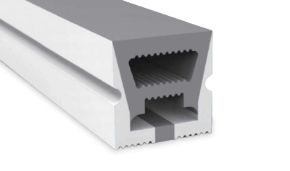
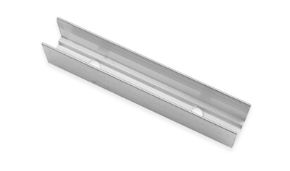
The optimal technical solution for under-cabinet kitchen lighting is today the high-density COB LED strip installed in a 45° angled profile. This configuration, developed by Ledpoint with the 16 mm LightingLine profile, offers precise technical advantages: the COB strip eliminates the typical dots of old SMD strips returning a perfectly continuous light line while the angled profile directs the luminous flux exactly onto the work surface, avoiding light hitting the user's eyes directly; the aluminum profile cover dissipates heat keeping the LED junction temperature below 65°C, a necessary condition to guarantee the declared useful life.
Why choose COB LED strips for under-cabinet
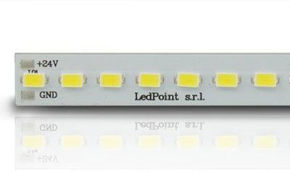
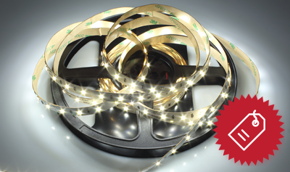
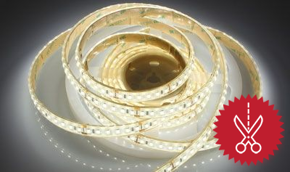
COB (Chip On Board) strips represent the evolution of classic SMD strips. While in SMDs individual LEDs are visible as dots distributed along the strip, in COBs the chips are encapsulated under a continuous phosphor that diffuses light uniformly. The result is a light line without interruptions, without dotted shadows on the work surface, aesthetically much more pleasant and technically much more efficient in diffusion. Ledpoint COB strips series FA2-400-480OR2 with 480 chips/m and flux up to 1800 lumens/m are the reference standard for professional under-cabinet.
Another decisive advantage of COBs is better luminous flux distribution: the natural 180° optics allows uniformly illuminating the entire depth of the counter (60-65 cm typical) without creating bands of different intensity. In photometric terms, a good COB strip on work surface under cabinet guarantees 500-700 lux uniformly over the entire counter depth, which is the value recommended by lighting standards for manual precision activities.
The LightingLine angled profile
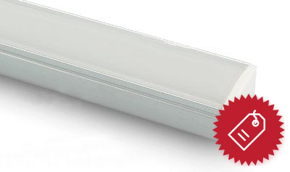
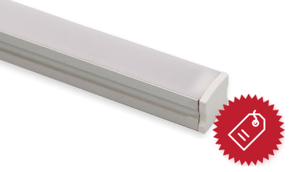
The 16 mm angled profile is specifically designed for under-cabinet installation. It is applied in the angle between the cabinet and the wall, or on the lower front edge of the cabinet itself, and orients the LED strip at 45° toward the work surface. This angulation is essential for two reasons: first, it directs light exactly where needed without dispersing it upward or toward the user's eye; second, it avoids direct glare that would occur with a strip mounted horizontally under the cabinet. The perceived difference is enormous: with correct installation, one works for hours without straining the eyes.
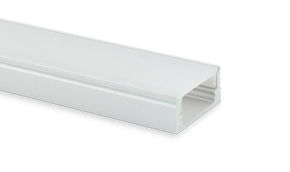
LightingLine profiles are made of anodized 6063-T5 aluminum, with UV-stable opal polycarbonate cover for perfect light diffusion. The PR-A16 section is only 16x16 mm, compact enough to hide easily. For particularly thin kitchens or without space, ultra-slim profiles can be used such as PR-SL13-02 (only 5 mm high) or PR-SL08-03 (8 mm), which integrate under the cabinet or inside shelves in an almost invisible way.
Skydance touchless sensors for under-cabinet
In the kitchen, hands are often dirty or wet, and pressing a traditional switch means leaving flour, sauce or water residues on delicate surfaces. For this reason Ledpoint proposes integration of Skydance Hand Sweep sensors, which allow turning on, off and dimming under-cabinet lights with a simple hand gesture in front of the sensor, without any physical contact. One movement turns on, a second movement turns off, a prolonged movement adjusts intensity.
These sensors are not just a comfort, but also a very important hygienic and safe solution. In environments like professional kitchens and restaurants, where hands must stay clean to avoid contamination, touchless sensors are now a standard. Their installation is very simple: they are inserted in the circuit between the driver and the LED strip, and require no additional wiring or technical boxes. Skydance offers versions with adjustable activation distance (from 5 to 15 cm) and double versions to manage two independent strips.
Internal cabinet kitchen lighting
A separate chapter deserves cabinets with internal lighting. Internal cabinet kitchen lighting is a typical solution of high-end kitchens and is realized with low-power COB LED strips (60-120 lumens/m) installed on the internal side of the cabinet and activated by Skydance door sensors. When doors open, light turns on gradually; when they close, it turns off. This solution is particularly useful in cabinets with glass doors or open shelves, where it also becomes an aesthetic enhancement element of the contents.
For deep cabinets and pantries, internal lighting transforms usability: finding a jar in the most remote corner becomes immediate. Ledpoint strips for internal mobile use can be supplied with high-hold 3M VHB adhesive, guaranteeing durable installation even under thermal stress.
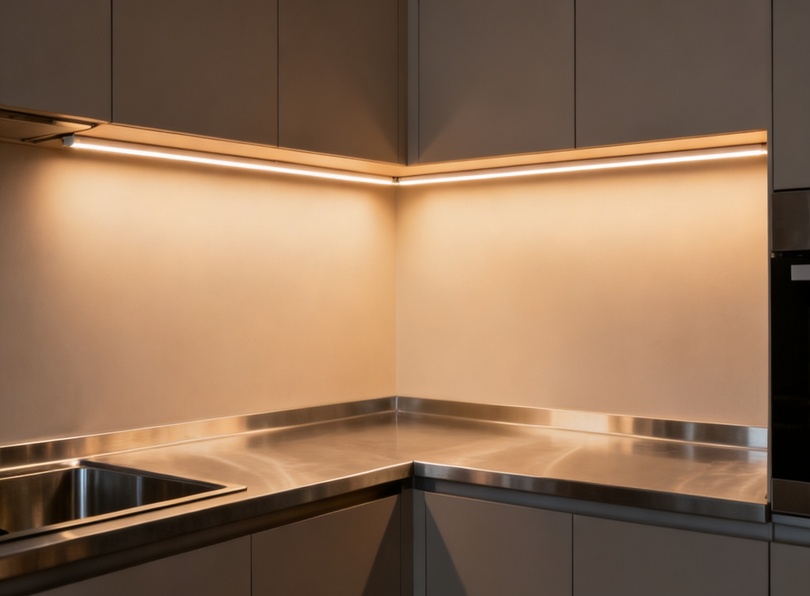
Kitchen island and counter lighting
Kitchen island lighting is one of the most impactful design choices from both aesthetic and functional points of view. The island is the social fulcrum of the contemporary kitchen: one cooks there, has breakfast, organizes an aperitif, works on the computer while chatting with family. For this multiplicity of uses, lighting on kitchen island must be layered, adjustable and capable of serving very different scenarios. A single central pendant, however beautiful, is not enough.
The classic configuration provides for 2 or 3 aligned pendants above the counter, positioned at 70-85 cm above the work surface. Pendants must deliver at least 800-1200 lumens each and must be dimmable, because light needs vary greatly between operational use (preparation) and social use (dinner). An even more complete solution integrates to the pendants a linear LED line at ceiling above the island, realized with LightingLine profile and COB strip, which provides general light, leaving pendants the role of accent and character light.
Pendant lamps for kitchen island
Pendant lamps for kitchen island have become in recent years a true protagonist of interior design. Shapes range from classic cone to cylinder, from sphere to sculptural volume, from minimalist Scandinavian lines to more baroque compositions. The model choice depends on the overall kitchen style. For minimalist modern kitchens, cylindrical pendants in anodized aluminum or satin brass are ideal; for industrial kitchens, metallic volumes with raw finishes are chosen, for classic or country kitchens traditional blown glass shapes are suitable.
Regardless of the model, what matters is the quality of the internal LED source: color temperature 3000K, CRI>90, native dimmability, and preferably replaceable bulb over time. Many economical pendants integrate non-replaceable LEDs: a choice that makes the entire luminaire a consumable, against any logic of sustainability.
Kitchen counter lighting with LED strips
A less obvious but increasingly requested solution for kitchen counter lighting is the integration of LED strips in the island volume itself. The most widespread configurations include LED strips under the overhanging top ("floating island" effect), strips in the island base skirting, strips inside shelves or niches on the side, strips in drawers that turn on when opened. These integrations transform the island into a luminous architectural element, capable of functioning also as the sole source of evening atmosphere.
To obtain the best result, LED strips installed under the top must be high-density COB with 120°-180° emission angle, housed in recessed or angled LightingLine profiles, and managed by a Skydance multi-zone controller to dim each circuit independently.
Skydance multi-zone control for the island
The kitchen island typically requires management of multiple independent circuits: pendants above the counter, any linear LED ceiling light above the island, strips integrated in the island itself, any accent lights on shelves. Managing all this with traditional switches would mean having 4-5 distinct buttons, an impractical and inelegant solution. Skydance multi-zone controllers allow managing up to 4 independent zones from a single wall touch panel or via smartphone app, with preset scenarios recallable with a single touch.
A "preparation" scenario can for example activate under-cabinet strips and ceiling linear light at 100%, leaving pendants off: a "dinner" scenario can lower general light to 30%, turn on pendants at 70% and activate warm skirting light at 20%, generating a totally different atmosphere in the same space.
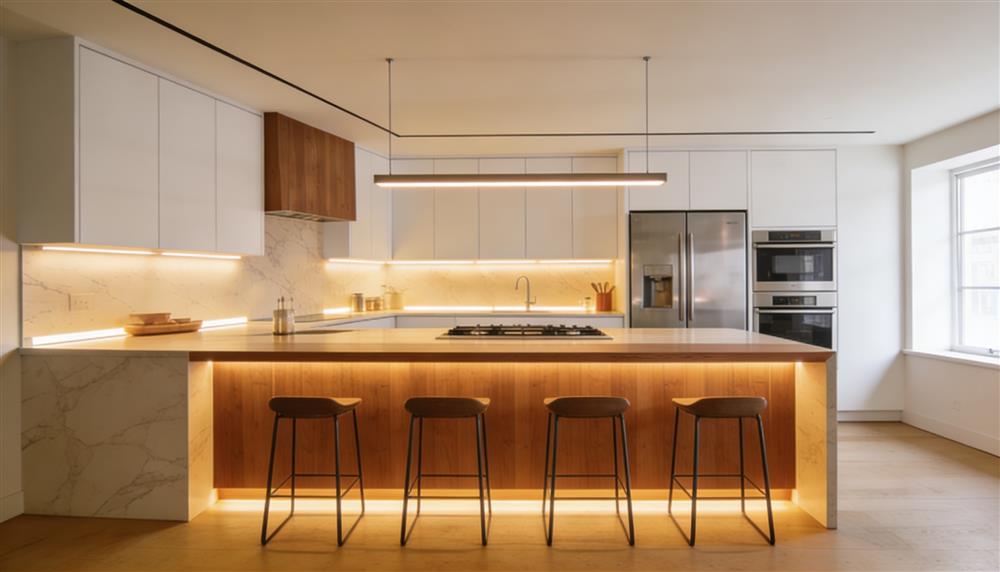
Open space kitchen-living room lighting
Open space kitchen-living room lighting is probably the most complex and fascinating design case of modern kitchen lighting. In a single environment must coexist two profoundly different functions: the kitchen operational zone and the social and relaxation living room zone. Light must be capable of marking the difference between the two areas without breaking the visual continuity of the environment, and must adapt during the day to very different uses. Without careful design, the open space risks appearing as two environments poorly stitched together.
The winning strategy for kitchen and living room lighting in open space is based on three principles: differentiation (different light for different zones), color temperature uniformity (the same white throughout the environment to avoid jarring contrasts), and scenographic flexibility (the same light must be able to change character). Translated into technical solutions, this means adopting Tunable White LED strips, Skydance multi-zone controllers, dimmable pendants and a balanced mix of direct and indirect light.
Tunable White: variable color temperature
Tunable White (CCT) technology allows electronically adjusting LED color temperature from about 2700K to 6000K within the same strip. Ledpoint F52-CCT-144822 series strips are designed precisely for open space applications, where it is necessary to switch from neutral daylight white (4000-5000K) to warm evening light (2700-3000K) with a simple slider or voice command.
During work hours, 4500K light maintains high concentration and renders colors neutrally, perfect for meal preparation. When moving toward mealtime or relaxation, temperature drops to 3000K creating an intimate and welcoming atmosphere. In the evening, further to 2700K, the environment becomes enveloping and relaxing, similar to a living room with fireplace. This flexibility is one of the greatest advantages of modern LED kitchen lighting.
Luminous zoning: separating without dividing
In open space, light also has a psychological task: defining functional zones without resorting to walls or physical dividers. A well-lit kitchen island defined by character pendants naturally distinguishes itself from the sofa zone underneath a softer chandelier. An LED line that draws the kitchen zone perimeter "frames" it virtually. An accent light above a living room bookshelf enhances that point as a different visual stop. The light project thus becomes a spatial drawing, capable of articulating the environment without raising walls.
Skydance multi-zone controllers are fundamental in this game of zones: they allow activating different scenarios that enhance now one part, now the other of the environment. The "cinema" scenario drastically lowers light on the kitchen and maintains accent light on the sofa; the "dinner" scenario activates the island and maintains warm light on the table; the "relax" scenario activates only indirect ceiling lights and living room wall lights.
Lighting ideas for open space kitchen-living room
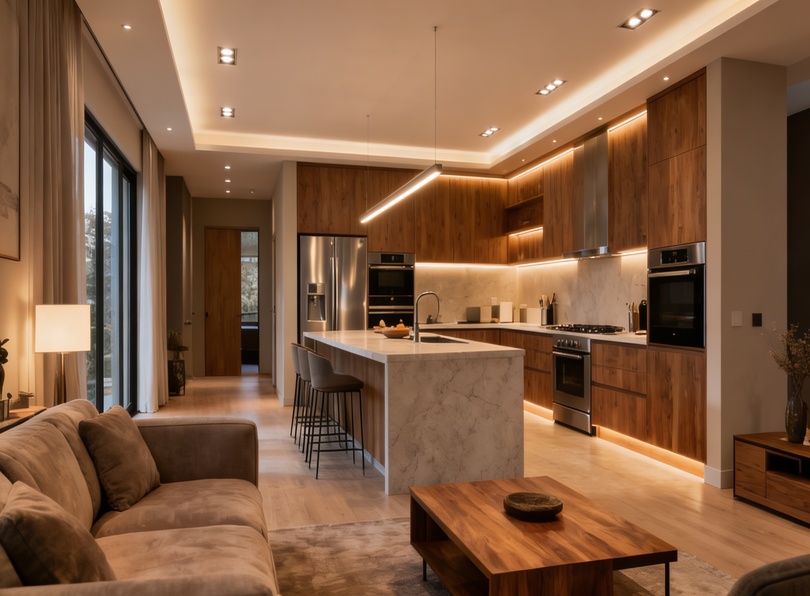
Among the most successful ideas for open space kitchen-living room lighting we find: the continuous LED line that crosses the entire ceiling visually unifying the environment, perimeter luminous coves that create soft and homogeneous indirect lighting, strips integrated in living room storage furniture coordinated with kitchen cabinet strips, statement pendants above the island that become the main decorative element, arc floor lamps that project indirect light onto the ceiling. The important thing is to maintain stylistic and chromatic coherence, choosing homogeneous finishes and color temperatures among the different areas.
Kitchen types and space-saving solutions for every square meter
Each kitchen type presents specific lighting needs, dictated by space geometry, ceiling height, furniture layout, natural exposure and activities carried out there. There is no universal formula for kitchen lighting, there is only the correct formula for that precise environment, the result of careful analysis. In this chapter we will review the most frequent configurations (kitchenette, linear kitchen, L-shaped kitchen, U-shaped kitchen, kitchen with island, kitchen with peninsula, open space kitchen) proposing for each the most effective technical solutions, with particular attention to situations where space is precious.
Small kitchen and kitchenette lighting
In small kitchens, under 6-8 m², every decision counts double. The restricted space amplifies both the merits and defects of kitchen lighting: too intense light appears oppressive, insufficient light transforms the environment into a cave. Correct techniques for small kitchen lighting aim at three objectives: maximizing the sensation of space, guaranteeing functionality on the work surface, avoiding visible encumbrances and wiring.
The ideal solution combines a low-profile LED ceiling light (3000-4000 lumens, 4000K, CRI>90) as general light, a continuous COB under-cabinet line with ultra-slim LightingLine PR-SL13-02 profile, and a small accent light above the sink. Ultra-thin LightingLine profiles PR-SL08-03 (8 mm) and PR-SL13-02 (5 mm) are perfect for kitchenettes, because they integrate into the furniture structure without stealing precious millimeters.
Also the choice of light color is strategic: a 4000K color temperature makes the environment perceptually wider compared to 3000K, because neutral light enhances contrasts and better defines surfaces. Light walls and reflective surfaces amplify this effect, contributing to make a small kitchen perceived as a luminous and welcoming space.
Linear kitchen lighting
The linear kitchen, with all furniture on a single wall, is one of the most common configurations in Italian apartments. The lighting of this type of kitchen particularly benefits from a continuous COB strip along the entire row of wall cabinets, housed in an angled LightingLine PR-A16 profile. This solution, combined with 3-4 adjustable ceiling spotlights for general light, perfectly covers the need. A single continuous LED line is aesthetically cleaner and technically more effective than many small separate under-cabinet lights.
L-shaped and U-shaped kitchen lighting
In L-shaped or U-shaped kitchens, the work surface follows two or three walls and corners become critical points. Spotlight kitchen lighting must be distributed to also cover the internal corners of wall cabinets, where typically shadows are strongest. COB strips must continue uninterrupted even in corners, using LightingLine angular connectors that maintain the light line without interruptions. The corner is the true test of the quality of an under-cabinet system: in economical installations the interruption is clearly visible, in professional installations light turns without solution of continuity.
Kitchen with peninsula lighting
The peninsula, "light" evolution of the island, requires similar management but with some specific considerations. Above the peninsula typically 1-2 aligned pendants are installed, dimmable and with warm light (3000K). Kitchen lighting with peninsula also benefits from integration of LED strips under the overhanging top (floating effect) and strips in the base skirting, managed via Skydance for scenarios independent from the rest of the kitchen.
Kitchen with exposed beams lighting
Kitchens with exposed beams, typical of rustic, country houses and attics, present a particular lighting challenge: the irregular ceiling makes difficult the installation of traditional central ceiling lights. The solution consists in integrating LED strips in LightingLine profiles fixed directly on the beams, or in the use of dimmable pendants hung from the beams themselves. Kitchen lighting with exposed beams offers the opportunity for a unique scenographic effect, where indirect light enhances the wood and creates an extremely welcoming atmosphere, perfect for rustic or evolved country kitchens.
Attic kitchen lighting
Attic kitchens have sloped ceilings that require particular attention. A traditional ceiling light risks hanging on one side or not correctly illuminating the walls. The best solution is the use of recessed spotlights along the oblique slope, integrated with LED strips in LightingLine profiles on the attic edge. LED strips in architectural coves typical of the attic create indirect lighting that enhances the inclined volume and gives breath to the environment.
COB LED strips: the uniformity revolution for kitchen lighting
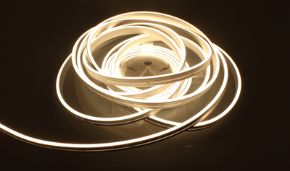
COB (Chip On Board) LED strips represent the most important technological evolution of LED lighting in recent years and have conquered a dominant role in LED kitchen lighting precisely for their unique characteristics. Unlike traditional SMD strips, where each LED is individually encapsulated in a visible component, in COB strips the chips are soldered directly onto a substrate and covered by a continuous phosphor layer that diffuses light homogeneously. The result is a perfectly continuous light line, without dots, without dotted shadows under cabinets, aesthetically impeccable.
For under-cabinet kitchen lighting, where strips are often seen obliquely and reflected on glossy surfaces like marble, quartz, steel or glass, the uniformity of COBs is a decisive advantage. Old SMD 5050 or 2835 strips clearly showed the chip sequence, creating a visual effect similar to a dotted line, particularly annoying on reflective kitchen top surfaces. COBs solve this problem once and for all.
Ledpoint COB series for the kitchen
Ledpoint proposes various COB strip series optimized for different kitchen uses. The FA2-400-480OR2 series with 480 chips/m is the standard for professional under-cabinet: it delivers up to 1800 lumens/m at 24V with 14-16W/m consumption, and has CRI>90 in standard versions. Series with 720 chips/m offer even greater uniformity and luminous flux, ideal for applications where the strip remains partially visible or where high illuminance is needed. The "720 kitchen lights" and "480 kitchen lights" strips have become market reference precisely thanks to these performances.
CRI and Sunlike: light quality
A particular chapter deserves the Ledpoint Sunlike series, developed for applications where chromatic fidelity must be absolute. Sunlike strips have CRI>97 and spectrum that faithfully imitates the solar one, including also near-UV components useful for natural food perception. For professional chefs, food bloggers, pastry chefs and in general for those who work with fresh raw materials, Sunlike is the best choice available on the LED kitchen lighting market.
The perceptual differences between CRI 80 light and CRI 97 are enormous: the first makes meat appear grayish, vegetables faded, fruit dull while the second returns vibrant, deep, natural colors. For food photography and for those who use their kitchen also as a social stage (influencers, food bloggers), Sunlike is practically indispensable.
IP65/IP67 protection: safety in humid environments
The kitchen is an intrinsically humid environment: cooking vapors, sink splashes, condensation on cabinets above the cooktop. LED strips in zones potentially exposed to humidity or splashes must have minimum IP65 protection, i.e., silicone or parylene coating that protects circuits without yellowing over time. Ledpoint proposes the B52 series with Parylene protection, a very thin conformal layer that protects the strip without altering its aesthetics and without additional thicknesses, and the L52 series in solid silicone, more robust and suitable for installations exposed to direct water contact.
Parylene, in particular, is a polymeric coating deposited in vapor phase that also coats the micro-electronic components of the strip, offering mechanical, thermal and humidity protection without yellowing. It is a professional and durable solution, far superior to classic "epoxy" type silicones that after a few years tend to become opaque.
Chip density and dotted effect
Chip density in an LED strip is a crucial parameter for uniformity. Economical SMD strips with 60 LED/m clearly show luminous dots; those with 120 LED/m are acceptable; those with 240 LED/m are good but still visible up close. Only COB strips with 320, 480 or 720 chips/m reach total uniformity, indistinguishable from a continuous fluorescent tube. For under-cabinet, where the strip is seen at 30-40 cm distance, the difference is enormous.
| Strip Type | Chip Density | Uniformity | Recommended Use |
|---|---|---|---|
| SMD 2835 | 60/m | Visible dotting | Not recommended in kitchen |
| SMD 2835 | 120/m | Attenuated dotting | Only inside cabinets |
| SMD 2835 | 240/m | Acceptable uniformity | Skirting, coves |
| COB | 320/m | Continuous | Inside cabinets |
| COB | 480/m | Perfectly continuous | Under-cabinet, island |
| COB | 720/m | Hyper-uniform | Premium applications |
LightingLine profiles: optical precision and design for kitchen lighting
LightingLine aluminum profiles are the indispensable complement of LED strips to obtain professional-level kitchen lighting. Far from being simple "aesthetic casings", profiles perform three crucial technical functions: dissipating strip heat (effectively doubling LED useful life), mechanically protecting components, and shaping the light beam through the polycarbonate diffuser. An LED strip installed without profile loses up to 40% of its useful life and tends to visually age in an accelerated way.
LightingLine offers the widest range on the Italian market of profiles for residential and commercial applications, with over 80 different models divided by type: recessed, ceiling, wall, angled, suspended, for drywall, under-cabinet, for steps, ultra-slim, and special furniture models. For the kitchen, the most relevant models are few but fundamental.
PR-A16: the angled profile for under-cabinet
The PR-A16 is the absolute reference for under-cabinet kitchen lighting. It is installed in the angle between the lower side of the cabinet and the wall (or on the front lower edge of the cabinet itself) and orients the LED strip at 45° toward the work surface. The compact dimensions (16x16 mm) allow discreet integration, the UV-stable opal diffuser guarantees light homogeneity and the anodized aluminum effectively dissipates heat. The difference between an under-cabinet with PR-A16 and one without profile is widely visible in any direct comparison: in the first light arrives clean on the surface, in the second the source is clearly visible and the glare is annoying.
PR-SL13-02 and PR-SL08-03: ultra-slim profiles
For kitchens where every millimeter counts, LightingLine has developed the ultra-slim series. The PR-SL13-02 has a total height of only 5 mm, a 13 mm section and installs easily under thin cabinets or inside shelves. The PR-SL08-03 is even more compact, with 8 mm section and 3 mm height. These ultra-thin profiles represent a fundamental space-saving solution for kitchenettes, studios and kitchens integrated in cabinetry, where furniture depth is reduced and every space is optimized. Despite minimal dimensions, they guarantee adequate thermal dissipation thanks to the choice of aluminum alloy and surface treatment.
Recessed ceiling profiles
For ceiling LED kitchen lighting realized with continuous lines, LightingLine proposes recessed profiles that integrate completely into the drywall structure or counter-ceiling. Sections range from 24 to 80 mm width and from 6 to 35 mm recess depth. These profiles, combined with Ledpoint COB strips, create perfectly integrated light lines in the ceiling, indistinguishable from classic contemporary lighting design. The diffuser can be flush with the ceiling ("insertion" effect) or slightly protruding, according to aesthetic taste.
Profiles for coves and drywall
Luminous coves in counter-ceilings require specific profiles, capable of housing the LED strip so that the flux is directed upward (reflected indirect light) or toward a downward opening (ambient light). LightingLine offers dedicated solutions for this area, with "L" or "U" profiles to position on the inner side of the cove. Drywall kitchen lighting realized in this way creates an extremely refined atmosphere, enhances the ceiling volume and becomes the ideal base for evening scenarios and integrated living zones.
Suspended and visible profiles
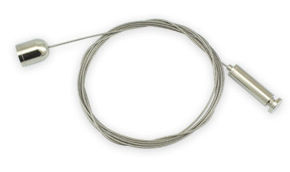
In industrial kitchens, lofts or character environments, linear LED lighting can be left visible, suspended from the ceiling as a declared decorative element. LightingLine suspended profiles install with adjustable steel cables and continuous opal diffuser. A suspended LED line above the kitchen island, of length equal to the counter, is one of the most contemporary and photogenic lighting choices of 2026, particularly appreciated in design kitchens and by those who care about visual aspect for social media.
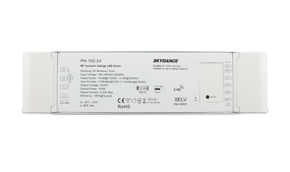
Skydance sensors and controls: hygiene, smart home and automation
The evolution of controls has transformed kitchen lighting from a system of "on/off switches" to an intelligent ecosystem, capable of reading context, anticipating user needs and integrating light with the entire home automation universe. Skydance, historical Ledpoint partner for control components, offers a range of sensors, dimmers, WiFi controllers, touch panels, remote controls and receivers that covers every design need. Integration of these devices in the kitchen brings concrete benefits in terms of hygiene, comfort, safety and energy efficiency.
Hand Sweep E1-W sensors: light without contact
The Hand Sweep E1 sensor by Skydance is a small infrared device that installs under the cabinet, near the LED strip, and allows controlling turning on, off and dimming simply by passing the hand in front of the sensor. One movement turns light on at 100%, a second movement turns it off, a prolonged movement progressively adjusts intensity between 10% and 100%. For the kitchen this is revolutionary: no more switches dirty with flour, sauce or water, no more fumbling for the command, no more physical contact with delicate surfaces.
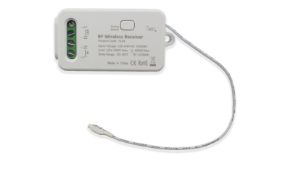
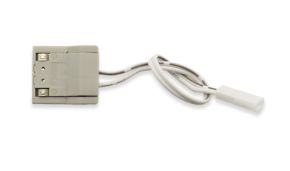
The sensor installation is very simple: it connects in series between the driver and the LED strip, and the activation distance is adjusted via a small screw (from 5 to 15 cm). Once installed, it is invisible and works reliably for years. It is compatible with monochromatic LED strips and can also be integrated with CCT systems via specific receivers.
Door sensors: automatic cabinet lighting
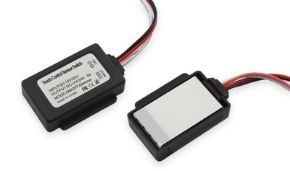
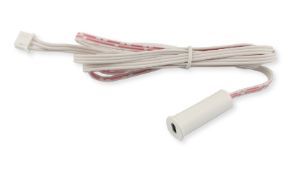
Skydance door sensors (Door Sensor Switch) install in cabinet, pantry, drawer and storage furniture doors, automatically activating light when opening and turning it off when closing. Light turns on gradually, with a gentle fade, and turns off with the same elegance. This automation transforms every cabinet into an "intelligent" element, eliminating the need to search for switches in inconvenient zones and zeroing consumption when the cabinet is closed.
Applications in the kitchen are multiple: pantries, open shelves, drawers with accessories, wall cabinets, column cabinets. In all these situations, internal lighting activated by door sensor is a solution as efficient as it is refined. It is now a consolidated standard in mid-to-high-end kitchens.
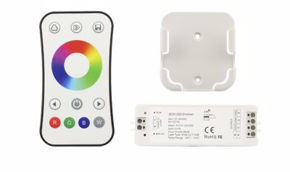
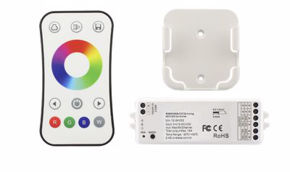
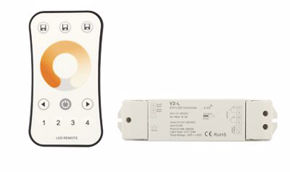
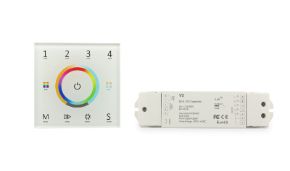
TD and T1-4S multi-zone controllers
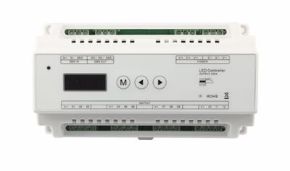
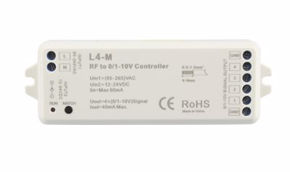
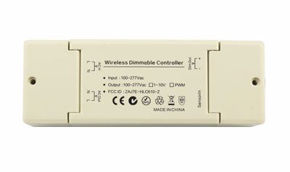
To manage multiple independent circuits (under-cabinet, ceiling, island, luminous cove, any accent lighting) Skydance offers advanced multi-zone controllers. The TD series integrates a tempered glass wall touch panel that manages up to 4 zones with individual dimming, preset scenarios and timer. The T1-4S series is instead designed for installation in technical box and is controlled via app or remote, ideal when wanting a completely "clean" aesthetic without wall panels. Both solutions are compatible with monochromatic, CCT and RGB strips, and can be integrated into existing home automation systems via standard protocols.
WT series WiFi controllers and Tuya Smart app
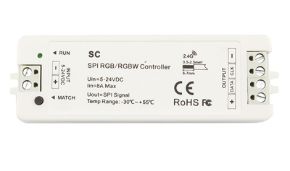
Complete integration with the smart home world occurs via Skydance WT series WiFi controllers, compatible with the Tuya Smart app and with Amazon Alexa, Google Home and Siri voice assistants (via Apple Home). Once a WiFi controller is installed, the user can: turn lights on and off from anywhere in the world, program on times (Schedule), create complex scenarios (Scenes), simulate presence at home during vacations, integrate light with motion sensors, sirens, thermostats and other home devices. Kitchen lighting becomes an integral part of domestic intelligence, contributing not only to comfort but also to home security.
Voice control with Alexa and Google Home
Voice control is now a consolidated reality. "Alexa, turn on the work surface light at 70%" or "Hey Google, dinner scenario" are commands that work perfectly with Skydance WiFi controllers paired with Ledpoint strips. For architects, influencers and homeowners seeking a premium user experience, voice control represents one of the most evident quality jumps of modern kitchen lighting.
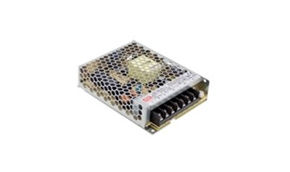
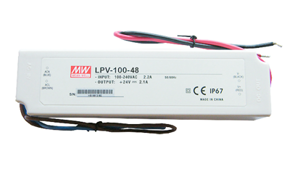
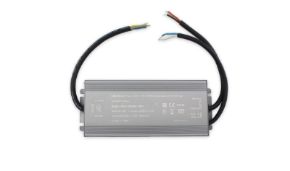
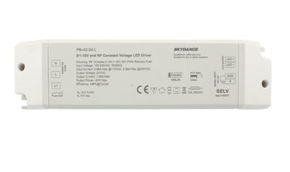
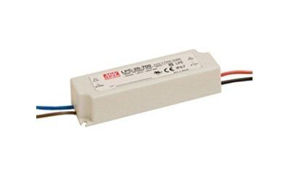
Mean Well drivers: stability, safety, longevity
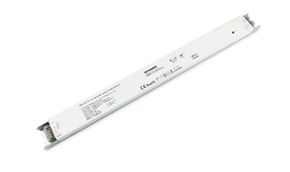
A professional-level LED kitchen lighting system is only as strong as its power supply. The driver is the most underestimated component by non-professionals, but is in reality the single element on which light quality, system durability and installation safety depend. A poor-quality driver can cause flicker, luminous flux instability, premature strip decay, and in worst cases fires and short circuits. For this reason Ledpoint proposes exclusively professional drivers in combination with its strips, in particular from the Mean Well line, world leader in the sector.
XLG and HLG series: professional standard
Mean Well XLG and HLG series are the reference standard for LED lighting in kitchen and advanced residential applications. The HLG series offers powers from 40W to 600W, IP65/IP67 class, 0-10V or triac dimming, protections against overtemperature, overcurrent and overvoltage. The XLG series is optimized for cost/performance in residential applications, with powers from 25W to 240W and slightly reduced but still professional functionality. Both guarantee flicker-free, an essential condition for prolonged visual comfort.
What flicker-free means and why it matters
Flicker is a very rapid oscillation of luminous flux, often consciously imperceptible but detectable by the nervous system. Even invisible flicker can cause visual fatigue, headaches, reduced concentration and, in predisposed subjects, epileptic seizures. Economical drivers often have flicker above 20%, while professional Mean Well drivers stay below 5%, guaranteeing perfectly stable lighting. In a kitchen where one works for hours with intense light, the difference is felt indeed.
Driver sizing
Correct driver sizing is fundamental: the nominal power of the power supply must be at least 20% higher than the total consumption of the powered strips. A 15W/m Ledpoint COB strip installed for 5 meters requires 75W consumption: the driver must be at least 90W. Undersizing the driver is one of the most frequent errors in DIY installations, and leads to overheating, buzzing and premature failure of both driver and strips.
Safety in humid environments
In the kitchen, near the sink or cooktop, the driver must be placed in a dry position or protected with adequate IP rating. Mean Well offers IP65 and IP67 versions capable of operating even in the presence of splashes and condensation. The IP20 power supply must instead be placed in a ventilated technical box, away from sources of humidity and direct heat, possibly in an internal compartment of the column cabinet or in a closet.
Materials, finishes, styles and kitchen lighting trends 2026
Modern kitchen lighting is not only technology, but also precise stylistic choice. The luminaire (pendant, ceiling light, wall lamp, visible profile) becomes a decorative element in all respects, capable of defining the character of the environment exactly as furniture and finishes do. 2026 trends in kitchen design lighting reflect five major currents: technical minimalism, organic shapes, industrial recovery, material luxury, declared sustainability. Each of these currents declinates into specific choices of materials, finishes, shapes and technologies.
Technical minimalism: clean lines and integrated LED
Technical minimalism is the dominant current of contemporary kitchen design lighting. It is characterized by continuous lines, essential volumes, "noble industrial" materials like anodized aluminum, satin steel, extra-clear glass. LightingLine LED lines integrated in furniture, essential cylindrical pendants, flush ceiling spotlights define this aesthetic. Light itself becomes the true design object: perfectly continuous light lines thanks to Ledpoint COB strips, without superfluous decorative details.
This style pairs perfectly with matte lacquered cabinets, concrete finishes, natural stone or composite quartz tops, handleless doors. Preferred color temperatures are 3000-4000K, neutral and functional. Control is always hidden: wall touch panels, WiFi controllers, touchless sensors.
Organic shapes: soft forms and natural materials
In opposition to geometric minimalism, 2026 sees the explosion of the organic shapes trend. Pendants in Japanese paper, artisanal ceramic, hand-blown glass, molded wood. Rounded, irregular shapes, inspired by nature. An organic pendant above the island, paired with a sober ceiling LED line, creates a refined balance between technology and artisanal warmth, particularly appreciated in eclectic kitchens and character homes.
Industrial recovery: raw metal and Edison style
The industrial style remains a strong current, especially in lofts, renovated attics and vintage-evolved kitchens. Pendants in black metal, brushed iron, burnished brass, visible Edison-type bulbs (today in LED filament version, energy efficient); visible tracks; LightingLine profiles visible in matte black finish. 2026 industrial kitchen lighting combines vintage charm with contemporary LED efficiency, a winning combination that avoids the energy waste of the past without renouncing aesthetics.
Material luxury: brass, marble, smoked glass
For high-end kitchens, the 2026 trend values noble materials: satin brass and burnished brass, Calacatta or Verde Alpi marble, smoked glass, leather, hide. Luxury pendants become sculptural objects, often unique pieces or limited editions. High-end kitchen design lighting aims for the "jewel" effect: few lights but of great impact, integrated with a sophisticated system of hidden indirect light for functional comfort.
Declared sustainability: recycled materials and eco-design
A new environmental sensitivity brings to the forefront lamps in recycled or recyclable materials: recovered aluminum, bio-based plastics, FSC-certified wood. Companies openly declare material origin and product carbon impact. For a conscious audience, 2026 sustainable kitchen lighting is an ethical choice as well as aesthetic. Ledpoint LED strips naturally fit into this trend thanks to durability exceeding 50,000 hours, which drastically reduces replacements compared to inferior solutions.
Trend colors and light: earth warm, sage green, deep blue
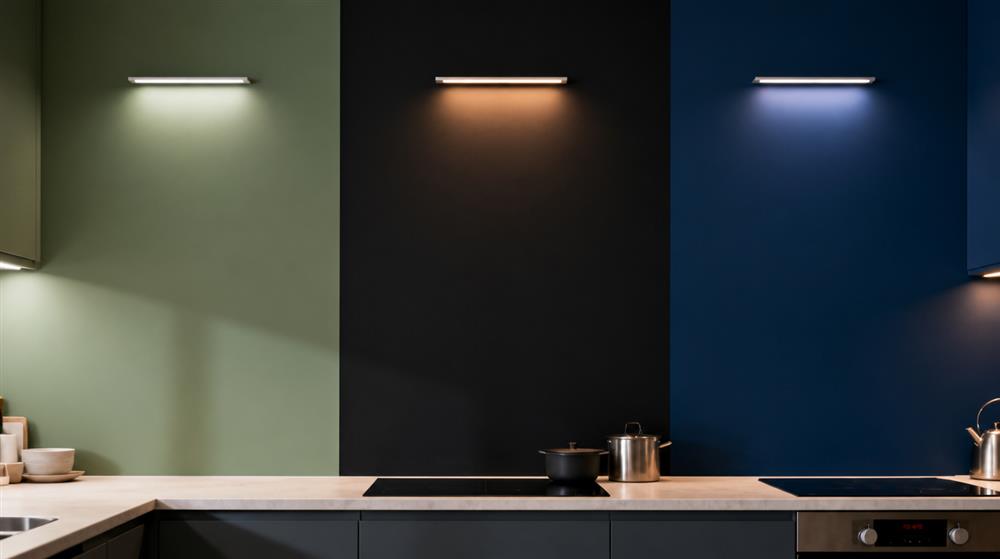
Trend colors for 2026 kitchens (earth warm, sage green, deep blue, cream white) interact in specific ways with light. Dark walls absorb more light and require higher lumens, but enhance accent lighting. Sage green walls are enhanced by neutral 4000K light, because the depth of color is rendered. Deep blue walls require warm 3000K light to not "cool" the environment too much. Color temperature choice must always be coordinated with the dominant colors of the kitchen, because light is the true "filter" through which we perceive all other elements.
Lamp materials: metal, glass, plastic, wood
Kitchen lamps use a variety of materials, each with specific advantages. Metal (aluminum, brass, stainless steel) is the most widespread for durability, humidity resistance and formal versatility. Glass (blown, satin, extra-clear, smoked) is ideal for diffusing light and creating decorative effects. Technical plastic (polycarbonate, ABS) allows free shapes and contained costs. Wood (precious or tinted essences) adds artisanal warmth to country, Scandinavian or eclectic kitchens. For a kitchen environment, material choice must also consider cleanability: smooth and non-porous surfaces are easier to clean, a non-secondary factor in a place subject to vapors and oil particles.
Energy savings and sustainability in kitchen lighting
The theme of energy savings is today one of the main motivations for choosing LED lighting in the kitchen. A kitchen entirely illuminated with LED consumes up to 85% less than a kitchen with traditional halogen sources, and this is the number that, alone, justifies the investment. But energy savings is only one dimension of sustainability, which also includes product durability, recyclability, light quality and impact on user health.
Calculating real savings
Let's make a concrete example. An average 15 m² kitchen illuminated with traditional halogen system consumes approximately 400W between central ceiling light (200W in fluorescent), halogen under-cabinet (120W), adjustable spotlights (80W). With 6 hours average daily use, annual consumption is 876 kWh, equal to about €220/year at average Italian energy cost. The same kitchen illuminated with Ledpoint professional LED system consumes approximately 70W total, for 153 kWh annual equal to €38/year. Annual savings is approximately €180, which recovers in 3-4 years an average investment of €700-800 for the LED component alone.
| System Type | Total Power | Annual Consumption | Annual Cost |
|---|---|---|---|
| Traditional Halogen | 400W | 876 kWh | €220 |
| Compact Fluorescent | 200W | 438 kWh | €110 |
| Standard LED | 120W | 263 kWh | €66 |
| Ledpoint Professional LED | 70W | 153 kWh | €38 |
Durability and impact on replacements
The durability exceeding 50,000 hours of Ledpoint LED strips translates, with average use of 6 hours per day, into over 22 years of useful life. In the same period, a halogen lamp must be replaced on average 22 times, a compact fluorescent 5-6 times. This means drastically less waste, less production, less transport, less cost. Sustainability is not only in hourly consumption but also in the drastic reduction in the number of products that are manufactured, distributed and disposed of.
Smart home and automatic optimization
Integration with sensors, timers and Skydance automations allows further optimizing consumption. Door sensors turn on light only when needed. Time programming automatically turns off forgotten lights. Dimmers reduce intensity during hours when full light is not needed, further extending LED life and cutting consumption. With good smart programming, the additional energy savings compared to a "manual" LED can reach 20-30%, bringing the overall advantage toward truly remarkable values.
Prices, budget and return on investment
The budget for kitchen lighting depends widely on square footage, product choice, system complexity and automation level. It is useful however to provide realistic ranges for orientation. A 12-15 m² kitchen with quality LED lighting costs indicatively between €700 and €1,500 for materials alone; with professional Ledpoint, LightingLine, Skydance and Mean Well products the cost rises to €1,500-3,000; for high-end solutions with integrated home automation it easily reaches €4,000-7,000. To these values must be added installation labor, generally between €300 and €1,000 depending on complexity.
Price range by product category
| Product | Indicative Price |
|---|---|
| Ledpoint COB Strip 5m | €80 – €200 |
| LightingLine Profile 2m | €35 – €90 |
| Mean Well Driver 100W | €45 – €90 |
| Skydance E1-W Sensor | €35 – €60 |
| WT Series WiFi Controller | €60 – €120 |
| TD Touch Panel | €90 – €180 |
| Kitchen Design Pendant | €150 – €1,500 |
| Modern LED Ceiling Light | €80 – €400 |
Economical modern lamps vs design
The market offers solutions for all budgets. Economical modern kitchen lamps start from €50-80 for essential but good quality technical models, while design lamps for kitchen are placed between €200 and €2,000, with peaks up to €5,000-10,000 for author pieces. The advice is not to skimp on the hidden technical part (strips, profiles, drivers) and invest in quality on visible lamps, because the first determines light quality while the second determines aesthetic impact.
Return on investment
Summing energy savings (€180/year average), savings in replacements (€50/year average) and property valorization (perceived 1-3% increase in market value thanks to a well-lit kitchen), the return on investment on a professional LED kitchen lighting system generally occurs between the third and fifth year. Considering the over 20-year durability of the system, the cumulative economic advantage is significant, in addition to positive repercussions on comfort, visual health and overall quality of domestic life.
Installation and maintenance
Installing a professional LED kitchen lighting system is not particularly complex, but requires attention to several details that make the difference between a professional result and an amateur installation. For complex systems it is always advisable to turn to a qualified installer, both for electrical safety reasons and to obtain the best result from chosen products. Ledpoint provides technical support and wiring diagrams for every configuration.
LED strip installation in profile
Correct LED strip installation begins with thorough cleaning of the application surface (degreaser, isopropyl alcohol, complete drying). The strip must be glued to the profile bottom applying constant pressure to guarantee perfect adhesion between the 3M adhesive and aluminum: thermal contact is essential for dissipation. Never bend the strip at right angles: for corners dedicated LightingLine connectors are used, avoiding stress on conductors and substrate.
Wiring and cable sizing
Cables that carry power from driver to strip must be sized for the current involved. For 14-16W/m strips at 24V, a 1.5 mm² section is adequate up to 5 linear meters. For greater distances or higher powers, the section must be increased or power supplied at multiple points of the strip. The most frequent error is cable undersizing, which causes visible voltage drops (the strip appears less luminous in the final part) and dangerous overheating.
Cleaning and maintenance
Modern LED systems require minimal maintenance. Strips housed in LightingLine profiles should be cleaned delicately with a soft and slightly damp cloth, without aggressive products. Visible luminaires (pendants, ceiling lights) should be dusted periodically. In the kitchen, especially above the cooktop, luminaires accumulate greasy residues that should be removed every 3-6 months with a microfiber cloth and neutral detergent, avoiding contact with electronic components.
Warranty and replacements
Ledpoint LED strips are guaranteed 5 years, Mean Well drivers also 5 years, Skydance controls 2 years. In case of failure, the single component is replaceable without having to intervene on the entire system, thanks to system modularity. This is an enormous advantage compared to monolithic integrated luminaires, where component failure often means replacing the entire product.
Restaurant kitchen lighting and professional kitchens
Professional kitchens (restaurants, hotels, delicatessens, pastry shops) have specific lighting needs that go beyond the domestic scope. Sector regulations require minimum 500 lux on work surfaces, high CRI for correct evaluation of raw materials, adequate protection against humidity and vapors, ease of cleaning, extreme durability. Restaurant kitchen lighting requires products specifically designed for professional environment, and Ledpoint strips with CRI>97 (Sunlike series) and IP65 protection (B52 parylene series) represent a primary choice in the sector.
Regulations and requirements
Professional kitchens must comply with UNI EN 12464-1 standard which imposes minimum illuminance on work surfaces (500 lux), minimum CRI (Ra>80, recommended Ra>90), absence of glare (UGR<22), uniformity (Uo>0.4). Ledpoint COB strips installed in LightingLine profiles easily satisfy all these requirements, offering performances that often exceed regulatory minima.
Materials and protections for professional environment
In professional kitchen, exposure to vapors, grease, condensation and thermal shocks is daily. Strips must be chosen with minimum IP65 protection, preferably IP67 in the most critical zones. Profiles must be in quality anodized aluminum to resist corrosion. Diffusers must be washable with professional detergents. The slightly higher initial investment is amply repaid with durability and reliability over time, critical factors in an environment where a failure during service is unacceptable.
Food perception and lighting
Light profoundly influences food perception. Warm light (2700K) makes dishes more appetizing and welcoming, but can falsify the chef's evaluation of meat cooking or raw material freshness. Neutral light (4000K) is objective and functional, ideal for the work zone. In high-level restaurants a dual-zone solution is often adopted: 4000K Sunlike on work zones, 2700-3000K dimmable in the dining room, managed by Skydance multi-zone controllers for different service scenarios.
Mistakes to avoid in kitchen lighting
Field experiences highlight a series of recurring errors that compromise the quality of kitchen lighting even when chosen products are of good level. Knowing these errors is the first step to avoid them. Let's see the seven most frequent.
Relying on a single central light source
Error number one is still today the "single chandelier" in the center of the ceiling as the only light source. This configuration produces shadows on the work surface, poorly covers corners and offers no flexibility. The correct solution is always layering: general light + task light + accent light.
LED strips without heat-dissipating profile
Installing bare LED strips, without aluminum profile, is a frequent error in DIY installations. The LED overheats, useful life plummets, luminous flux decays rapidly. The profile is not optional but necessary for any professional installation that wants to last over time.
CRI too low
Purchasing economical strips with CRI 70-80 is a classic false saving. Light appears unpleasant, food colors seem faded, the overall experience suffers. Minimum CRI 90 for kitchen, ideal CRI 97 with Sunlike series.
Undersized or non flicker-free driver
Saving on the driver is the worst possible saving. Poor drivers cause flicker, instability, overheating, drastic reduction of strip life. Always Mean Well or equivalent professionals, always flicker-free, always with 20% power margin.
Wrong color temperature
Putting warm light 2700K on the work surface or cool light 6000K in the dining zone are common errors that compromise comfort and functionality. The professional solution is Tunable White CCT, which allows adapting color temperature to the moment of the day.
Ignoring dimming
A kitchen without dimmer is a rigid kitchen, capable of only one scenario. Dimming is essential for evening comfort, for social situations, for additional energy savings. Always provide dimmable drivers and adequate controls.
Not providing predispositions during design phase
When the kitchen is in design or renovation phase, it is essential to provide cable passages, driver positions, predispositions for sensors and controls. Correcting afterwards is always more difficult and costly: better to dedicate 30 more minutes to light design during survey than finding oneself dismantling installed cabinets to pass a cable.
Case studies and real kitchen lighting configurations
To concretize what has been said so far, we present three real kitchen lighting configurations with products from the Ledpoint ecosystem. Each is designed for a specific user profile among those described in the introduction and shows how to compose the different system elements into concrete solutions.
Case 1 — Architect's kitchen: minimal tech open space
Architect Marco, who lives in a 90 m² loft in Milan, designed a minimal open space kitchen-living room with central island. Lighting choices: 7-meter continuous COB LED line above the island, PR-A16 under-cabinet profile, Tunable White CCT strip, Skydance multi-zone controller with wall touch panel, Alexa voice integration. The result is a kitchen that changes atmosphere during the day: neutral white 4500K for morning work, warm white 3000K for dinner, evening atmosphere light at 20% for after-dinner. Investment: approximately €2,800 for materials, recovered in 4 years between energy savings and environment valorization.
Case 2 — Influencer's kitchen: photogenicity first
For Giulia, interior design influencer, kitchen lighting must be first of all photogenic. Choices: statement organic pendants in blown glass above the island, Sunlike COB strips CRI>97 under-cabinet for food photography, strips integrated in island skirting for "floating" effect, WiFi controller with programmable scenarios for photo sessions, color temperature kept fixed at 4000K Sunlike for visual coherence. The result is a kitchen that functions both as everyday space and as professional photo set, with museum-quality light for food shoots.
Case 3 — Chef's kitchen: precision and hygiene
For chef Andrea, who has a semi-professional kitchen in his villa, precision, durability and hygiene matter. Choices: Sunlike COB strips CRI>97 at 4000K on all work surfaces for absolute chromatic fidelity, LightingLine PR-A16 profiles with opal diffuser, IP65 protection everywhere, Skydance Hand Sweep E1-W sensors for contactless activation, door sensors in all cabinets. The kitchen becomes a professionally illuminated space, hygienically impeccable, with stable light for hours of work without visual fatigue. Mean Well HLG drivers for guaranteed stability and durability.
Kitchen lamps: types, design and in-depth selection
The world of kitchen lamps is extraordinarily wide and in continuous evolution. Understanding the different types, their technical characteristics, optimal uses and stylistic declinations is essential to make informed choices. A kitchen lamp is not simply a decorative object, but a precision lighting tool that must combine aesthetics, functionality, energy efficiency, durability, safety in humid environment and ease of cleaning. In this chapter we explore in detail all the main types of kitchen lamps available on the market today.
Pendant lamps for kitchen
Pendant lamps for kitchen are the most visible and iconic category of kitchen lighting. Suspended from the ceiling via cables or rigid stems, they define the overall aesthetic of the environment with strong scenic presence. Typical applications are above the island, above the counter, above the dining table and above the peninsula. Correct installation height is 70-85 cm above the surface, but can vary based on pendant size and ceiling height. A pendant too low "crushes" the environment, one too high loses functionality.
Modern pendants can be classified by shape (cone, cylinder, sphere, bell, sculptural), by material (metal, glass, ceramic, wood, fabric), by style (minimal, industrial, classic, country, Scandinavian, eclectic) and by internal technology (integrated LED, replaceable, smart). The choice must coordinate with the overall kitchen style, but also satisfy precise technical requirements: adequate luminous flux (minimum 800 lumens per pendant on island), CRI>90, dimmability, durability.
Among the most requested kitchen design pendant lamps of 2026 we find hyper-minimal models in matte black anodized aluminum, cylindrical pendants in extra-clear glass with visible LED, organic models in Japanese paper and artisanal ceramic, metallic pendants of industrial matrix in burnished brass. The trend is toward compositions of 2-3 aligned or clustered pendants, to create a pendant kitchen lighting of strong character.
Ceiling lights for kitchen
Ceiling lights for kitchen represent the simplest and most versatile solution for general ambient lighting. Adhering to the ceiling, they occupy little vertical space and are ideal for kitchens with low ceilings (under 2.60 meters) or for environments where one wants to keep the upper part visually "light". Modern LED ceiling lights for kitchen have very thin profiles (3-7 cm thickness), high luminous fluxes (3000-6000 lumens) and often already integrate smart functionalities such as dimming, adjustable CCT and remote control.
Among the most appreciated models for modern kitchen we find square or rectangular ceiling lights in aluminum with opal diffuser, ring LED circular ceiling lights, complex geometric ceiling lights with motifs inspired by contemporary design. For a 12-15 m² kitchen a 30-40W ceiling light with 3500-4500 lumens and 4000K color temperature is a balanced choice, to be then integrated with under-cabinet light and punctual accents.
New generation LED ceiling lights for kitchen often integrate presence sensors that automatically activate light upon entering the environment, reducing consumption and improving comfort of use. Some models are compatible with voice assistants and smartphone apps, positioning themselves halfway between traditional product and IoT device.
LED spotlights for kitchen
Spotlights for kitchen are the basic tool for directional and punctual light. They can be recessed in ceiling, adjustable on wall, on track or integrated in linear profiles. Spotlights for kitchen lighting must be chosen with care for optics, power and light quality. A good LED spotlight for kitchen has 7-12W power, 600-1000 lumens flux, CRI>90, 3000-4000K color temperature, adjustable optics, dimmability.
Spotlight kitchen lighting requires a studied distribution. The general rule provides for one spotlight every 1-1.5 m² of ceiling for general light, with possible punctual concentrations on specific zones such as cooktop, sink, snack table. Never put a spotlight directly above the frontal work surface: it would produce operator shadows. Spotlights should be advanced 30-40 cm from the edge of wall cabinets, to illuminate the work zone from a useful direction.
Spotlights for modern kitchens include trimless recessed models (without frame), low UGR models to reduce glare, magnetic sphere directional models for free orientation, articulated arm wall models. Finishes range from classic white to matte black, from burnished gold to satin aluminum.
LED strips as a category unto themselves
LED strips, already widely treated, constitute today an autonomous category of products for kitchen lighting, distinct from traditional lamps. Applications in kitchen are multiple: under-cabinet, inside cabinets, inside drawers, in architectural coves, in skirting, under overhanging island tops, in backsplash, in open shelves, in niches and technical compartments. Under-cabinet kitchen LED lighting with Ledpoint COB strips is probably the application of greatest practical impact in any modern kitchen.
Wall lamps for kitchen
Wall lamps for kitchen are wall-mounted lamps used mainly as accent or ambient light. They install above the backsplash, at the sides of open shelves, above the hood, or along side walls in open space kitchens. Modern wall lamps for kitchen generally have contained fluxes (200-500 lumens) and perform decorative and accent role more than functional. Kitchen wall lamps with indirect upward light create remarkable scenographic effects, enhancing painted walls or material finishes.
Frequently asked questions specific by profession
Kitchen lighting presents different challenges depending on the context of use. Architects, influencers, chefs, homeowners and entrepreneurs have specific needs that merit specific answers. In this section we address the most recurring questions for each profile, drawing from Ledpoint's experience in supporting all these professional categories.
For architects and interior designers
Architects ask above all for integration, aesthetic continuity and design adaptability. The latest trends in modern kitchen lamps include continuous LED lines integrated in furniture, statement organic pendants, ultra-thin flush ceiling lights, 48V magnetic track systems. Lamp choice must always start from the overall project, evaluating coordination with materials, colors, geometries and functions of the environment. The most durable materials for kitchen environment are anodized aluminum, stainless steel, tempered glass. All modern Ledpoint solutions are controllable via Tuya app, integrable in home automation systems and customizable in the smallest details.
For interior design influencers
For interior design influencers kitchen lighting must be first of all photogenic. The most photogenic modern lamps are those with characterized shapes (organic pendants, sculptural models), with visible filament LED, with indirect light effects on material surfaces. To combine lamps with other furnishing elements requires chromatic coherence (maximum 2-3 metallic finishes in the same kitchen), stylistic coherence and coordination of color temperatures. The most trendy colors and shapes of 2026 are burgundy red, sage green, deep blue, organic shapes and elongated cylindrical volumes. LED strips are perfect for photography thanks to the uniformity and high CRI of Sunlike series, which return food with vibrant colors. Design lamps at accessible prices are found on Ledpoint.it with a range starting from €80 and reaching over €1,500 for premium solutions.
For professional chefs
For professional chefs, kitchen lighting must serve work. The best lamps for professional kitchen are high-density COB strips with CRI>97 (Sunlike), IP65 LightingLine profiles, Mean Well drivers, Skydance touchless sensors. Cleanability and maintainability are guaranteed by the design of anodized aluminum profiles. Lighting profoundly influences food perception: 4000K Sunlike light enhances colors and allows correct evaluations of cooking and freshness. All Ledpoint strips are dimmable, and Skydance solutions allow precise intensity regulation. The most recent innovations include circadian spectrum (automatic color temperature variation during the day), Sunlike CRI>97 and touchless controls.
For smart apartment owners
Modern owners seek smart integration and sustainability. All Ledpoint LED strips are compatible with smart home systems via Skydance WiFi controllers and Tuya app, integrating with Alexa, Google Home and Apple HomeKit. Energy savings is guaranteed by LED choice, by dimming and by time programming. Sustainable lighting options include recycled materials in LightingLine profiles, eco-friendly packaging, durability exceeding 50,000 hours. Smart lamps can be controlled via voice assistants with natural commands in Italian. Characteristics to look for in a modern kitchen lamp are: quality integrated LED, CRI>90, dimmability, smart compatibility, guaranteed durability, minimum 2-year warranty.
For entrepreneurs and high-end clientele
For high-end clientele, quality and exclusive design are priorities. The most reliable luxury modern lamp brands on the Italian market include historical names of Milanese, Scandinavian and German design, integrable with Ledpoint technical components to realize custom projects. The average cost of a design lamp for kitchen is placed between €400 and €2,500, with peaks over €5,000 for unique pieces. Integration with the rest of the furnishing requires coordination of finishes, materials and proportions. Distinctive characteristics of luxury lamps are precious materials (brass, marble, blown glass, leather), artisanal workmanship, author design, limited editions, maniacal attention to detail. Exclusive high-quality lamps are found in specialized galleries, selected showrooms and online on Ledpoint.it for premium technical components.
Technical in-depth on LED kitchen lighting
For those who want to go deeper into the technical understanding of LED kitchen lighting, we dedicate this chapter to specific aspects that make the difference between an ordinary system and an excellent one. We will touch on themes such as visual comfort theory, photometry applied to kitchen, anti-glare strategies, luminous ergonomics, interaction between light and materials, and the most recent developments of LED technology.
Visual comfort and fatigue
Visual comfort is the result of a series of parameters: adequate illuminance on work surfaces, absence of direct glare, soft contrasts between illuminated and shadow zones, light uniformity, chromatic fidelity, stability over time (zero flicker). In a poorly lit kitchen one works with increasing stress, eyes fatigue, posture worsens trying to see better, attention drops with consequences on safety and efficiency. Visual comfort is therefore also a health issue, as well as aesthetics.
The UGR (Unified Glare Rating) index measures the glare level of a system. For kitchen UGR<22 is recommended, value achievable with strips in angled profile with opal diffuser, pendants with soft screens and spotlights with adequate optics. The most serious error for comfort is direct exposure of eyes to the source: a bare strip under the cabinet, a pendant without diffuser, a spotlight oriented too low. All situations that generate glare and accumulated fatigue.
Photometry applied to kitchen
Photometry studies the numerical characteristics of light: luminous flux (lumens), illuminance (lux), intensity (candelas), luminance (cd/m²). To correctly design kitchen lighting it is necessary to size illuminance on different planes: 500-700 lux on work surface, 300-500 lux on island, 200-300 lux in dining zone (net of dimming), 100-150 lux on floors as average ambient illuminance. These values are lighting recommendations and are compatible with prolonged use comfort.
Interaction between light and materials
Wall, furniture and top materials react differently to light. Opaque surfaces absorb and diffuse, glossy surfaces reflect like mirrors creating annoying hot spots, dark surfaces absorb much more light compared to light ones. A kitchen with glossy black marble top requires significantly higher luminous powers than one with matte white laminate top, because marble absorbs and mirrors. Light design must always consider the materials involved.
Circadian spectrum and wellbeing
One of the most fascinating frontiers of modern LED kitchen lighting is the circadian spectrum: light that automatically varies during the day simulating the natural solar cycle. Morning: cool light 5000K that activates and prepares for work. Noon: 4500K neutral and productive. Afternoon: 4000K balanced. Evening: 3000K warm and relaxing. Night: 2700K enveloping. This variation synchronizes with the body's biological rhythms, favoring sleep and daytime energy. Ledpoint CCT strips paired with Skydance WiFi controllers allow easily programming this scenario.
RGBW, RGBWW and scenography
For those who want to go beyond white, RGBW and RGBWW strips (RGB channels + warm white + cool white) allow scenographic effects of great impact. Purple light in backsplash, amber light in island skirting, green light in glass cabinets: infinite possibilities for those seeking personalization. In kitchen however color use must be dosed: better reserve it for well-defined accent zones, maintaining neutral white in functional zones to not compromise correct food perception.
Power line communication and protocols
Modern controls use various protocols to communicate with devices: WiFi (Tuya, Tasmota), Bluetooth Mesh, Zigbee, DALI, DMX. Skydance offers products for almost all these protocols, with cross compatibility. For domestic kitchen WiFi Tuya is the most practical choice, for professional kitchens or complex installations DALI offers greater reliability and diagnostics.
How to choose the perfect chandelier for the kitchen
The choice of chandelier for the kitchen deserves a dedicated chapter for the importance it holds in defining the environment. How to choose the right chandeliers for the kitchen? Several parameters must be considered: environment size, ceiling height, furnishing style, luminous need, presence of island or table, budget, integration with other luminaires.
Sizing based on environment dimensions
A practical rule for sizing the central chandelier is to sum the diagonals in meters of the environment: the result in centimeters represents the indicative diameter of the chandelier. For a 4x5 meter kitchen, sum 4+5 = 9, therefore about 90 cm diameter for the central chandelier. For smaller kitchens under 12 m² it is preferable to avoid bulky chandeliers and opt for ceiling lights or multiple compositions of small pendants. For large kitchens, the central chandelier can even reach 1.2-1.5 meters.
Installation height
The installation height of chandelier or pendant depends on the function. Above a dining table: 70-85 cm from table surface (ensuring that the lower base of the lamp is at least 65 cm above). Above an island: 75-90 cm from work surface. In the center of the environment without table underneath: minimum 220 cm from floor to not interfere with passage. A poorly sized pendant in height compromises both aesthetics and functionality: too low it glares and encumbers, too high it loses its scenic presence.
Style and coordination
The chandelier style must coordinate with the overall kitchen style. Minimal kitchen with matte lacquered doors: cylindrical pendants in matte black aluminum. Industrial kitchen: metallic pendants with Edison filament LED. Country kitchen: blown glass or ceramic pendants. Classic kitchen: crystal chandeliers, Tiffany glass, burnished brass. Contemporary luxury kitchen: author pieces in precious materials. Stylistic coherence is a value factor: a single dissonant element perceptually devalues the entire environment.
Which chandelier for modern kitchen
For a modern kitchen in 2026, the most contemporary choices include: continuous LED lines at ceiling in LightingLine profile, minimal cylindrical pendants in matte black or burnished gold, compositions of 3-5 small clustered pendants, ultra-thin geometric ceiling lights flush with ceiling, organic statement pendants as main decorative element. The chandelier for modern kitchen of 2026 is always LED, always dimmable, always smart-ready, even when aesthetically "traditional".
What to put instead of the central chandelier
A frequent question is what to put instead of the classic central chandelier. Alternatives to the traditional chandelier include: ultra-thin LED ceiling light, system of adjustable recessed spotlights, continuous LED line at ceiling, 48V magnetic track with multiple spotlights, luminous coves in drywall, composition of multiple pendants. The choice depends on the sought style and functional need. For a contemporary kitchen, the combination "ceiling LED line + adjustable spotlights + pendant above island" is the reference solution, because it covers all functional and aesthetic needs.
How many lumens, watts and kelvin: the exact numbers for the kitchen
Let's see in detail the exact numbers to correctly size kitchen lighting. This section collects the most requested numerical answers in easily consultable format.
How many lumens are needed to light the kitchen
To light a kitchen, an average of 300-400 lumens per square meter is needed as general ambient. For a 10 m² kitchen therefore 3000-4000 total lumens are needed distributed among various sources. For the under-cabinet work surface, 500-700 lumens per linear meter are needed. For the island 800-1200 lumens per pendant are needed. For the dining table 2000-3000 total lumens are needed, dimmable.
How many watts are needed to light the kitchen
With modern LEDs at 130-180 lumens/watt, a 15 m² kitchen requires approximately 30-50 total watts for general light, plus 15-25 watts for linear under-cabinet, plus 30-60 watts for any pendants above island and table. The typical total is 70-130 watts for a well-lit kitchen, compared to 400-600 watts of a traditional halogen kitchen.
How many kelvin for the kitchen
The ideal kelvin in kitchen are: 4000K on the work surface for excellent visibility and chromatic fidelity, 3000K in the general ambient for a welcoming atmosphere, 2700-3000K above the dining table for a warm convivial effect. The optimal solution is Tunable White CCT from 2700K to 5000K, adjustable based on activity and time of day.
Kitchen lighting trends 2026: what to expect
2026 marks a turning point for kitchen lighting with several innovative trends that are consolidating. Let's see the most significant.
Full solar spectrum LED
Ledpoint's Sunlike CRI>97 series are becoming the premium standard, with spectrum that faithfully imitates sunlight. This is the greatest qualitative evolution of LED in recent years, offering chromatic rendering practically indistinguishable from natural sun.
Gestural and voice control
Gestural control via Skydance Hand Sweep sensors and voice control via Alexa/Google Home are becoming standard in mid-to-high kitchens. The traditional switch is on the way to extinction, replaced by touch panels, sensors and natural commands.
Continuous LED lines as architectural element
Light becomes architecture. Continuous LED lines at ceiling, in furniture, on island edges are now a declared language of contemporary design. LightingLine profiles are the tool to realize this vision, with an unmatched range of solutions.
Integrated smart home and scenarios
Lighting integrates completely with home automation: door sensors, motion sensors, time programming, multi-zone scenarios, integration with motorized blinds and thermostats. The kitchen becomes the nerve center of the intelligent home.
Material sustainability
Sector companies invest in recycled materials, reducible packaging, environmental certifications. Sustainable kitchen lighting is no longer a niche but a consolidated market request, satisfied by supply chain choices of players like Ledpoint.
Extreme personalization
LED strips cuttable to the centimeter, profiles in custom lengths, configurable controllers, scenarios programmable in detail: 2026 kitchen lighting is hyper-personalized, capable of adapting to every project and every specific user.
Kitchen lighting by architectural style
Each architectural style has its own luminous identity. Correct choice of kitchen lighting must dialogue with the overall architectural language, enhancing it instead of contrasting it. In this section we deepen optimal choices for the most widespread styles in Italian homes.
Classic kitchen lighting
Classic kitchen lighting is characterized by the presence of prestigious chandeliers, decorative wall lamps, pendants in crystal or worked glass. Preferred color temperature is 2700-3000K, warm and welcoming. Metallic finishes tend to burnished, brass, antiqued nickel. Classic chandeliers for kitchen include multi-arm models with LED filament candles, crown chandeliers with hanging crystals, pendants in brass with fabric lampshade.
For the functional part, even in a classic kitchen under-cabinet LED strips are now a standard, but must be integrated discreetly in LightingLine profiles with coordinated finishes. A common error is installing modern LED strips in evidence in a classic kitchen, creating a stylistic short circuit. Functional light must be present but invisible, leaving the scene to decorative luminaires.
Rustic kitchen lighting
The rustic kitchen, with exposed beams, terracotta floors, solid wood furniture, requires rustic kitchen lighting coherent with the country atmosphere. Pendants in wrought iron, metal lanterns, artisanal ceramic lamps are typical choices. Color temperature is almost always very warm, 2700K, to enhance the warm tones of wood and terracotta.
LED strips in rustic kitchen should be integrated where not visible: inside cabinets, in hidden coves, under shelves. Kitchen lighting with exposed beams often uses wall spotlights with articulated arm fixed on the beams themselves, or LED lines hidden along the beam edges that illuminate from above. The result is an extremely welcoming atmosphere, typical of evolved Italian country houses.
Industrial kitchen lighting
Industrial style prefers raw metal, exposed brick, high ceilings, "visible" finishes. Industrial kitchen lighting uses metallic pendants with visible Edison filament LED, ceiling tracks with adjustable spotlights, converted workshop lamps. LightingLine profiles in matte black finish are perfect for this style, because they integrate into the raw aesthetic without hiding.
A well-lit industrial kitchen combines high functionality (COB under-cabinet strips, adjustable spotlights) with strong aesthetic character (Edison pendants, visible tracks). Color temperature can oscillate between 3000 and 4000K, with preference for 3500K that balances functionality and atmosphere.
Scandinavian kitchen lighting
Scandinavian style seeks diffuse luminosity, light finishes, natural materials. Scandi-style kitchen lighting prefers low-profile ceiling lights, pendants in natural materials (paper, turned wood), arc floor lamps. Color temperature is generally 3000K warm, to compensate for long northern winters. Even if in Italy the need for perceived warmth is lesser, the style maintains this characteristic.
LED strips in Scandinavian kitchens often integrate under light wood wall cabinets, enhancing the naturalness of the material. Iconic Scandinavian design pendants (Louis Poulsen, Secto, Muuto) are often protagonists of the island or dining table.
Contemporary minimal kitchen lighting
Contemporary minimal kitchen aims at absolute formal cleanliness. Handleless doors, flush tops, pure geometries dominate aesthetics. Minimal-key modern kitchen lighting chooses integrated continuous LED lines, ultra-thin trimless ceiling lights, flush recessed spotlights without visible frame, essential cylindrical pendants. The aesthetic of light is that of disappearance: the source must not be seen, only the luminous effect must exist.
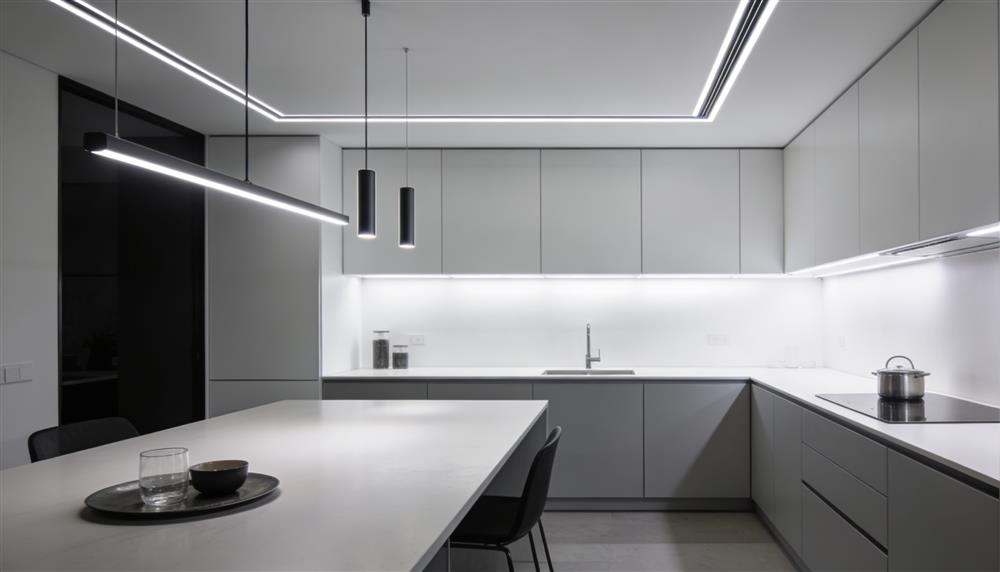
How to light specific kitchen zones
After having seen general theory, let's descend into the operational detail of how to light single functional zones of the kitchen. Each has technical particularities that merit specific attention.
How to light the work surface
The work surface should be lit with high-density COB LED strips installed in angled profile PR-A16 at 45°. Correct installation height is inside or under the cabinet, at 50-65 cm from the work surface. Necessary luminous flux is 500-700 lumens/linear meter, color temperature 4000K, CRI>90. Continuity of the LED line eliminates shadows and guarantees uniformity over the entire counter depth (60-65 cm typical).
How to light the kitchen island
The island requires layered management: general ambient light (ceiling LED line), concentrated direct light (2-3 dimmable pendants at 75-85 cm above the surface), eventual light integrated in the island itself (strips under overhanging top, in skirting, inside drawers). Skydance multi-zone control allows managing different layers independently, creating different scenarios for cooking, eating or socializing.
How to light above wall cabinets
Lighting above wall cabinets is a refined technique that creates indirect light reflected on the ceiling, generating atmosphere and visually dilating space. It is realized with COB LED strips in "L" or "U" profile positioned on the upper crown of cabinets, with light oriented toward the ceiling. To obtain the best result the ceiling must be white and at least 30 cm from the cabinet crown. Flux is generally moderate (200-400 lumens/m), sufficient to create atmosphere without replacing main lighting.
How to light the cooktop without cabinets
When the cooktop has no cabinet above (by design choice or for presence of a special hood), correctly lighting it is a challenge. The classic solution provides for adjustable ceiling spotlights directed on the cooking zone, or luminous integration in the hood itself. Modern hoods often include integrated LEDs of good quality, but in many cases it is convenient to add dedicated spotlights at 4000K CRI>90 to guarantee 500-700 lux on the cooktop, essential for correctly evaluating food cooking.
How to light the sink
The sink needs specific light for washing dishes well, cleaning vegetables, filling pots. The optimal solution is a COB LED strip under-cabinet directly above the sink, in IP65 profile, with flux 600-800 lumens/m and temperature 4000K. IP65 is important: near the sink splashes are frequent, and an unprotected strip risks premature failure.
How to light the dining table
The dining table requires warm, dimmable light, calibrated on the table surface. The single or double pendant at 70-85 cm from the surface is the classic choice. Total luminous flux must be 2000-3000 lumens, color temperature 2700-3000K, always dimmable to regulate intensity between work dinner and romantic dinner. The pendant must be proportional to the table: indicatively the lamp diameter equal to 50-60% of table width.
How to light a kitchen without windows
Windowless kitchens, lacking natural light, require kitchen lighting oversized to compensate for absence of solar contribution. 400-500 lumens/m² of ambient illuminance are recommended (compared to standard 300-400), adjustable CCT to vary atmosphere during the day simulating the solar cycle, high CRI to not lose chromatic fidelity. Windowless kitchen lighting benefits enormously from circadian systems, which simulate the luminous course of the day and maintain the psychophysical wellbeing of inhabitants.
How to light a kitchen without chandeliers
Many current trends replace the classic chandelier with alternative solutions. Options include: continuous LED line at ceiling in LightingLine profile, system of adjustable recessed spotlights, ultra-thin low-profile ceiling light, 48V magnetic track with multiple spotlights. Kitchen lighting without chandeliers is today a very widespread choice in modern key, because it leaves the ceiling clean and modular, integrating light into the architectural structure.
How to light a kitchen without wall cabinets
Kitchens without wall cabinets, called "open kitchens" or "open kitchen", require specific solutions for the work surface because the natural support of the cabinet above is missing. Alternatives are: adjustable ceiling spotlights directed on the surface, ceiling LED lines above the work zone, articulated arm wall lamps. Kitchen lighting without wall cabinets requires greater design attention to avoid operator shadows on the surface.
Kitchens with island
Kitchens with island have become one of the most widespread archetypes of contemporary kitchen. Let's specifically deepen how to manage kitchen lighting with island in all its components.
Pendant positioning above the island
Above the island typically 2 or 3 aligned pendants are installed. The distance between pendants must be equal or slightly less than their diameter, maintaining visual balance. Distance from island ends must be proportional. For a 240 cm island often 3 pendants of 30-35 cm diameter are installed, spaced 50-60 cm between them and 50-60 cm from edges.
Lighting above kitchen island with linear LED
A contemporary solution is to replace or flank pendants with a continuous LED line in suspended LightingLine profile. A 2-3 meter LED line suspended horizontally above the island creates a unique scenographic effect, very photogenic and in line with 2026 design trends. The line can be mono-color neutral 4000K or adjustable CCT for different scenarios.
LED strips integrated in the island
The island can itself be a light source through integration of LED strips in different positions: under the overhanging top for "floating" effect, in the base skirting for night light, inside shelves or niches on the side, inside drawers that illuminate when opened. These integrations transform the island into a living luminous volume, capable of functioning also as the sole source of atmosphere in evening hours.
Lighting ideas for kitchen with island
The most successful ideas for kitchen lighting with island include: three cylindrical pendants in burnished brass on black marble island, 4-meter continuous neutral light LED line at ceiling above white lacquered island, RGBW strip integrated in island skirting for colored night accents, organic paper Japanese pendants on solid wood island, LED line on LightingLine profile suspended 50 cm above island surface with CCT adjustable light via app.
Advanced installation
For those who install directly or closely follow the works, knowledge of practical details makes the difference between a professional result and an approximate one. Let's see the critical points.
Surface preparation
Before applying profiles and strips it is essential to perfectly clean the surface. Use professional degreaser or isopropyl alcohol, dry completely, verify absence of dust or residues. The 3M VHB adhesive of strips and profiles has perfect hold only on perfectly clean and dry surfaces. On porous materials (raw wood, plaster) a specific primer may be needed.
Strip cutting
Ledpoint LED strips have cutting marks every 25 mm (24V version) or 50 mm (24V version with wider cuts). Cutting must be performed with sharp scissors exactly on the mark, never before or after, never freehand. A wrong cut compromises the functioning of the entire segment. After cutting, if the strip must be reconnected, rapid connectors are used or wires are soldered directly on the pads.
Connections and soldering
For durable installations, soldered connections are always preferable to rapid connectors. A well-executed soldering never fails, while rapid connectors can loosen over time or oxidize. Soldering requires a low-power soldering iron (15-30W) and flux-containing tin, and must be executed rapidly to avoid overheating the strip circuits.
System wiring
Power cables from strips to driver must be sized for the current involved. For 14-16W/m strips at 24V, a 1.5 mm² section is adequate up to 5 linear meters. Beyond, the section is increased (2.5 mm²) or the strip is powered at multiple points. Voltage drop is the main enemy of long LED strips: beyond certain distances luminous flux visibly decays in the final part, and the only solution is to power at multiple points.
Driver positioning
The driver must be positioned in a dry and ventilated place. Never in closed compartments without ventilation, because generated heat can reduce useful life. Never near sources of humidity (under the sink, near the cooking vapor zone). Never visible, if possible: drivers have industrial aesthetics little suited to the living zone. The ideal is to place the driver in dedicated technical compartments, in internal compartments of column cabinets or in inspectable technical boxes.
Electrical safety
The LED system must always be realized in conformity with Italian electrical regulations (CEI 64-8). The power circuit must be protected by dedicated magnetic-thermal differential. Cables must have adequate insulation. Connections must be realized in inspectable junction boxes. For systems of a certain complexity the intervention of a qualified electrician and the release of the declaration of conformity is mandatory.
Strategic vision
Kitchen lighting is no longer an accessory chapter of domestic design, but an integrated and strategic system capable of radically transforming the living experience. The 2026 kitchen is the space where light expresses to the maximum its technical and aesthetic potential, integrating precision functionality, variable atmosphere, intelligent control and measurable sustainability. Investing correctly in kitchen lighting means improving every day the quality of one's life, both in functional terms and in terms of perceived wellbeing.
The Ledpoint, LightingLine, Skydance and Mean Well ecosystem today offers an integrated proposal that covers every need, from domestic user to professional designer, from residential to commercial context. High-density COB LED strips for perfect uniformity, aluminum profiles for optical precision and durability, touchless sensors for hygiene and comfort, multi-zone controllers for personalized scenarios, Mean Well drivers for stability and safety: each component is designed to dialogue with the others, giving life to systems that function with reliability for decades.
The operative conclusions of this guide are clear. First of all: always layer light, never rely on a single source. Second rule: choose professional quality products, because in lighting the false initial saving is always paid over time. Third rule: invest in dimming and control, because flexibility is the true contemporary luxury. Fourth rule: prefer LED CCT, to not bind oneself to a single color temperature. Fifth rule: integrate smart home, for a fluid and modern user experience.
For those who wish to deepen further, the entire range of products cited in this guide is available on Ledpoint.it, with dedicated technical assistance, personalized wiring diagrams and design support for every configuration. Kitchen lighting is too important to be left to chance: dedicate to it the same attention you dedicate to furniture, finishes and appliances, and the results will accompany you for many years to come.
Smart kitchen 2026: complete home automation integration
The smart kitchen of 2026 is a completely integrated space, where lighting, appliances, security systems and comfort dialogue with each other. Smart kitchen lighting is the backbone of this system: it is what is controlled most frequently, what reacts to other events (cooking, presence, time of day), what defines the experience of the environment. In this chapter we analyze how to design a smart kitchen at the highest level, integrating Skydance controls with the rest of home automation.
Automatic scenarios for the kitchen
A well-designed smart kitchen proposes preset scenarios that the user activates with a voice command, a touch, or automatically based on time. The "Good Morning" scenario gradually turns on under-cabinet kitchen lighting at 2700K with 30% intensity, simulating dawn. The "Cooking" scenario activates lights at full intensity 4000K on under-cabinet, island and cooktop for maximum visibility. The "Dinner" scenario lowers main lights to 40%, illuminates only the table and island with warm 2700K, creates atmosphere. The "Night" scenario turns off main lights and leaves only a soft service light for passages.
Programming of these scenes occurs once only, via the Tuya app or a centralized system. After initial activation, the user lives the kitchen without touching switches anymore: light follows the rhythm of the day and activities. It is a paradigmatic change compared to the on/off logic of the Twentieth Century.
Integration with appliances
Smart appliances of 2026 (ovens, induction cooktops, hoods) send notifications and states to the home automation system. Kitchen LED lighting can react: when the cooktop is turned on, lights above the surface automatically turn on; when the hood is in function, hood lights synchronize; when the oven reaches temperature, a light blink signals readiness. These are micro-automations that sensibly improve daily experience.
Integration occurs via MQTT protocol, IFTTT, Home Assistant, or proprietary ecosystems like Samsung SmartThings, Apple HomeKit, Google Home. Skydance WT is compatible with the main standards and integrates without difficulty in most domestic ecosystems.
Environmental sensors and adaptability
Ambient light, presence, temperature, humidity sensors allow lighting to automatically adapt to real conditions. On a sunny day, kitchen lighting remains off or reduced as long as natural light is sufficient. At sunset, lights activate gradually following the external luminous curve. In absence of presence for more than 10 minutes, lights automatically turn off for energy savings.
These automations, once configured, work in background without requiring attention. The result is a kitchen that seems "alive", reactive, intelligent, where technology disappears and only the fluid user experience remains.
Kitchen lighting and food photography
For interior design influencers, food bloggers, professional food photographers, the quality of kitchen lighting is a strategic factor. Photos of kitchen and food are made or ruined based on light. In this chapter we treat specific criteria to optimize the kitchen as a continuous photo set.
High CRI: the basis of everything
The first rule of food photography is high CRI. Under CRI 80 light (standard of many economical LEDs) reds appear faded, greens appear yellowish, whites appear cool. The camera faithfully records what the light shows, and no editing software completely recovers colors that were not illuminated. For food photography CRI>90 is essential, ideally CRI>95: Ledpoint's Sunlike series was born precisely for this.
Directionality and softness
Food photography loves soft and directional light. LED strips diffused in opal profile with semi-opaque cover produce soft light that wraps subjects without sharp shadows. Directionality is obtained by positioning strips in specific zones (above the work surface, on one side of the table) to create luminous modeling. Flat frontal light kills food photos, while lateral light at 45° enhances textures, vapors, food brilliance.
Tunable White for every mood
For influencers and content creators, the possibility to change color temperature in a few seconds is precious. A breakfast photo requires warm light 2700-3000K for comfort mood. A cocktail photo may require perhaps 3500-4000K more neutral. A chef preparation photo requires 4500-5000K more professional. A Ledpoint Tunable White strip controlled via Tuya app allows switching from one scenario to another in a few seconds, maintaining the same physical set.
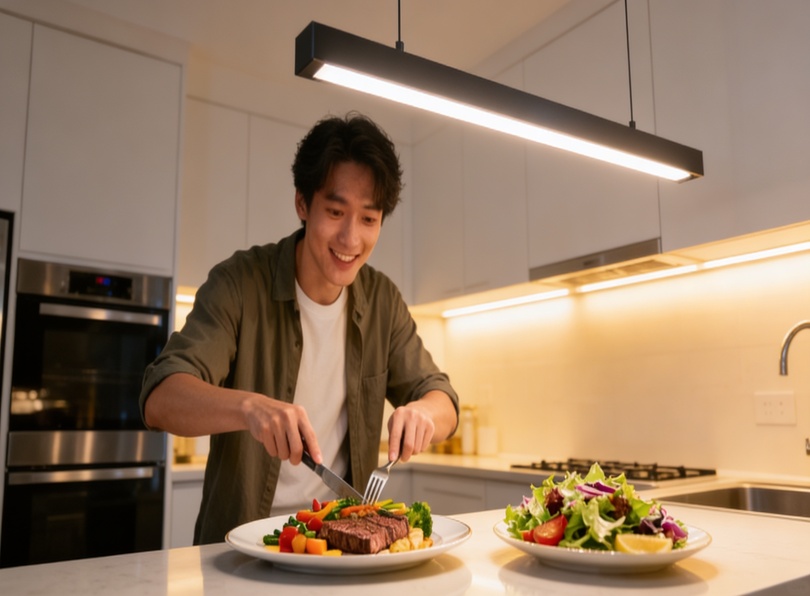
Luxury kitchen lighting: author projects
The luxury kitchen lighting segment requires specific products, solutions and design. It is not just about spending more, but about accessing a level of personalization, material quality and author design that characterizes high-profile homes. In this chapter we treat the criteria of professionally illuminated luxury kitchen.
Noble materials and custom finishes
Luxury kitchen prefers noble materials: burnished brass, bronze, brushed stainless steel, blown glass, precious marbles. Lighting must dialogue with these materials, enhance them, tell their quality. Ledpoint LED strips installed in LightingLine profiles with burnished brass finish (on request) blend perfectly with high-end finishes. The difference between a luxury kitchen and a high-end kitchen often lies in finishing details, and lighting is one of these decisive details.
Exclusive design pendants
Above the island of a luxury kitchen are often found signature pendants: Flos Aim, Vibia Mayfair, Foscarini Tress, Tom Dixon Beat, Davide Groppi Moon. These are pieces that function as applied works of art, conversations with author design, investments that maintain value over time. Combining these pendants with a technical layer based on Ledpoint LED strips and LightingLine profiles is the hallmark of intelligent luxury project: art above the table, technology that works silently hidden.
Premium control systems
In luxury kitchens the control system is centralized and professional level. Skydance WT controls integrate with high-level home automation systems like KNX, Crestron, Lutron, AVE Domina. Backlit glass wall panels, cordless remotes with refined design, voice control via assistants integrated in the environment. The user experience is that of a five-star hotel: every gesture is fluid, every environment reacts instantly, nothing is left to improvisation.
ROI calculations and detailed economic analysis
For those who approach kitchen lighting with entrepreneurial mentality or long-term investment mindset, ROI (Return on Investment) analysis is fundamental. In this chapter we propose concrete calculations that demonstrate the economic convenience of switching to professional LED compared to traditional or economical LED solutions.
10-year consumption comparison
Let's compare three scenarios for a 20 m² kitchen with 6 hours average daily use. Scenario A (traditional halogen): 600W total, 4.38 kWh/day, 1,598 kWh/year, 15,980 kWh in 10 years. At €0.30/kWh = €4,794 of energy. Plus 30 bulb replacements = +€500. Total: €5,294. Scenario B (economical LED): 120W total, 0.88 kWh/day, 320 kWh/year, 3,200 kWh in 10 years = €960. Plus 2 complete replacements (real lifespan 5 years) = +€600. Total: €1,560. Scenario C (Ledpoint professional LED): 100W total, 0.73 kWh/day, 267 kWh/year, 2,670 kWh in 10 years = €801. Plus zero replacements (guaranteed lifespan over 50,000 hours). Total: €801 plus initial investment.
Savings are evident. Scenario C costs 85% less than Scenario A over 10 years, and 50% less than economical Scenario B, considering also avoided replacements. The additional initial investment (compared to economical LED) pays back in 3-4 years, after which it is pure saving.
Added real estate value
A less considered but relevant datum is the impact of quality kitchen lighting on the perceived value of the property. A kitchen with professional LED lighting, smart controls, scenarios, touchless sensors, communicates modernity and care to potential buyers or tenants. Real estate market research indicates that superior-level kitchen lighting can increment the perceived value of an apartment by €5,000-15,000 according to size and segment. The €2,000-4,000 investment in professional kitchen lighting therefore has a positive multiplier on overall value.
Regulations, certifications and CE markings
Kitchen lighting must respect specific Italian and European regulations, both for electrical safety and for electromagnetic emissions, and for energy efficiency. Knowing these regulations allows choosing truly compliant products and avoiding unpleasant surprises.
CE marking and declarations of conformity
All lighting products sold in the European Union must bear CE marking and be accompanied by declaration of conformity. CE marking attests that the product respects applicable European directives (Low Voltage, EMC, RoHS, WEEE, Eco-design). Ledpoint, LightingLine, Skydance and Mean Well products are fully compliant and have related documentation, downloadable from official sites or requestable from the retailer.
CEI 64-8 standard for electrical systems
CEI 64-8 standard regulates electrical systems in homes and public-use premises. LED kitchen lighting falls within this regulation: circuits must be correctly sized, protected by magnetic-thermal differentials, realized with state-of-the-art materials. For systems that are significantly modified or expanded, the intervention of an authorized electrician and the consequent declaration of conformity (DICO) provided by DM 37/2008 is mandatory.
European energy label
Since 2021 LED lamps are subject to the new European energy label, which evaluates luminous efficiency on an A-G scale (with A most efficient). Ledpoint professional LED products are placed in A or B band, while many poor-quality economical LEDs stop in E or F band. Verifying the energy label is a good indicator of real product quality.
Practical tips for designing kitchen lighting
We conclude this guide with an operative sequence of practical tips. They are the distillate of years of design and installation experience, applicable to any kitchen lighting project, from small kitchenette to representative open space.
Measure the work surface and mark positions
The first operative step is to precisely measure the work surface and mark with adhesive tape where under-cabinet strips will be installed, where spotlight beams should fall, where to hang pendants above the island. This exercise of "grounding" the project reveals criticalities not visible on paper: shadows created by cabinets, interferences with hood or appliances, wrong distances.
Plan the control system before finishes
Deciding in advance whether the system will be traditional, smart, multi-zone, voice, is crucial because it determines cables, boxes and predispositions that must be made before screeds and plasters. Laying additional cables during construction costs few euros, while intervening afterwards to add predispositions means breaking walls.
Verify compatibility between components
LED strips, drivers, controllers, sensors must be compatible with each other. Operating voltage (12V or 24V), maximum current, dimming protocol, control signal. Do not improvise combinations: ask advice to the retailer or Ledpoint technical support, which knows which combinations work and which do not.
Invest in quality for hidden components
LED strips, profiles, drivers are hidden from view but are those that determine quality, durability and reliability of the entire system. Saving on these components is the most costly false saving: one pays in malfunctions, anticipated replacements, inferior light quality. For visible pendants the choice can be freer according to taste and budget.
Document the system
A good design practice is to document the realized system with a single-line diagram and a list of installed components. Brand, model, position, codes. When after 5 or 10 years something fails, having this documentation allows rapid and targeted interventions. Without documentation one starts every time from hypotheses, losing time and money.
Complex questions and specific cases
In this chapter we address some complex questions that our technicians receive, often outside standard FAQs. These are specific cases useful for particular designs.
Kitchen with low ceiling (under 240 cm)
In very low ceilings traditional pendants are problematic: they occupy perceptual space, can be bumped, reduce the sensation of height. The professional solution is to focus everything on LED strips in drywall profile, on flush recessed spotlights, on continuous lines. The luminous effect remains total but the aerial volume remains free, indeed accentuating the sensation of height.
Kitchen without predisposed light points
It happens to transform an existing environment that did not have adequate predispositions for the kitchen. In these cases, LightingLine visible profiles allow installing LED strips wherever reachable by an electrical cable, even with wall paths or partial counter-ceiling. Also battery-powered strips (with USB charging) are valid for temporary solutions. No space is "lost" to modern lighting, just design creatively.
Rented kitchen: reversible solutions
Those who live in rental can still improve kitchen lighting with reversible solutions: self-adhesive LED strips with removable adhesive, clip profiles without drilling, design floor lamps that do not require fixed installation, pendants replacing existing chandelier. At the end of the contract, everything is dismantled and taken away, leaving the apartment in original conditions.
In-depth circadian light and wellbeing
Circadian lighting science has demonstrated that light is not only a visual tool but a fundamental biological factor. Cool daylight (5000-6500K) rich in blue activates vigilance and suppresses melatonin, ideal for activity hours. Warm evening light (2700-3000K) and amber (2200K) favors relaxation and prepares for sleep. Kitchen lighting that follows this rhythm measurably improves sleep quality, daytime energy, hormonal balance.
Ledpoint Tunable White strips with CCT adjustable from 2200K to 6500K controlled via Tuya app with automatic programming realize in practice professional circadian lighting. An invisible but real benefit, that most users discover only after having tried it, and from which they hardly go back.
Frequent errors in kitchen lighting and how to avoid them
We resume the theme of errors, with a more systematic and detailed analysis of the most frequent cases. Knowing these errors before designing avoids having to correct them afterwards, with even significant costs.
Relying on the central chandelier
A kitchen illuminated only by the central chandelier is destined to be poorly lit. The user working at the surface casts shadow on himself. Marginal zones remain dark. Modern kitchen lighting requires layering: ambient, task, accent, decorative. The central chandelier is one of the layers, not the total solution.
Wrong color temperature
Too cool light (6000K+) in kitchen transforms it into sterile laboratory, aesthetically cold, annoying for eyes and atmosphere. Too warm light (under 2700K) flattens colors, makes it difficult to evaluate ingredient freshness. The correct range is 3000-4000K, ideally adjustable CCT to choose according to scenario.
Undersized lumens
Thinking that 500-1000 lumens suffice for a kitchen is a classic error. A 15-20 m² kitchen requires 3,500-5,000 total stratified lumens. Undersizing light means working in an always somewhat dark environment, with visual effort and fatigue. Abundant and well-controlled light is always better than scarce light: excess is dimmed, deficiency is not recovered.
Low CRI
Purchasing LED CRI 70-80 because they cost less is a strategic error. Light returns faded colors, foods appear less appetizing, work surface materials do not render. The price difference between CRI 80 and CRI 90 is modest, but the aesthetic and functional difference is enormous.
Poor drivers
The driver is the hidden component on which everything depends. Poor drivers produce flicker perceived or subliminal that tires eyes and is annoying on videos. Poor drivers overheat and fail in the first 1-2 years. Investing in Mean Well drivers or equivalents is the basis of a durable system.
Environmental sustainability and reduced impact
Modern LED kitchen lighting is also an act of environmental responsibility. Ledpoint LEDs have 8-10 times lower consumption than traditional lamps, 25 times superior durability, contain 90% recyclable materials, are free of mercury and other dangerous substances. Production is RoHS and WEEE certified, with traced supply chain. Adopting professional LED lighting means tangibly and measurably reducing one's carbon footprint.
The numbers speak clearly. A kitchen with 100W LED working 6h per day consumes 0.6 kWh/day, 219 kWh/year, 2,190 kWh in 10 years. Equivalent to 870 kg of avoided CO2 compared to traditional halogen (5,220 kg of CO2). Multiplied by the millions of kitchens that renew each year in Italy, the cumulative impact is significant: contributing to this change is a conscious choice that has value beyond the single domestic balance.
Operative guide to the perfect under-cabinet
The under-cabinet kitchen is probably the zone where kitchen lighting shows its maximum functional utility. In this monographic chapter we deepen every aspect of the perfect under-cabinet: design, component choice, installation, control.
Luminous flux geometry
The fundamental rule of under-cabinet is that luminous flux must reach the work surface without creating shadow zones and without glaring the user. To obtain this result, the LED strip is positioned near the front edge of the cabinet (at about 5-8 cm from the frontal edge), so that the beam illuminates the work surface precisely in the zone where manual work takes place, not on the bottom behind the surface where it is not needed. The PR-A16 angled profile at 45° guarantees this correct angulation without need for complex calculations.
The typical height of the work surface is 90-92 cm and the typical height of the lower edge of wall cabinets is 145-150 cm. The useful distance between the two quotes is 55-60 cm. In this band the LED flux must distribute uniformly. With high-density COB strips (480 chips/m) and well-positioned angled profile, illuminance on the work surface easily reaches 500-700 lux, optimal value for any culinary preparation activity.
Lengths and powers
For a row of cabinets 3 meters long, the necessary COB strip is 3 meters. At 14-16W/m we speak of 42-48W total, powered by a 60-75W Mean Well driver with safety margin. Total luminous flux is approximately 3,600-4,000 lumens distributed over the 3 linear meters, sufficient to illuminate a work surface of equal length with professional values.
If the cabinet composition is interrupted (e.g. presence of a central hood), the under-cabinet must be split into two independent trunks, each with its own power supply. They can be put on a single control channel for simultaneous activation, or separated on two channels for independent managements. Skydance flexibility allows any configuration, just plan it in advance.
Hand Sweep sensor integration
The Hand Sweep E1-W sensor is installed in a convenient and reachable position, typically under the central cabinet (the one above the main work surface) at about 80-90 cm height from floor. The position allows the user to turn on and dim lights with a natural gesture, without looking at the sensor. Wiring goes from the sensor to the driver, where it replaces or flanks any traditional switch.
The sensor sensitivity is adjustable via internal trimmer or via app for smart models. It is calibrated to ignore accidental passages of dishes or objects during cooking, and respond instead to the decided gesture of the hand near the sensor. Once calibrated well, functioning is perfect and users quickly fall in love with it.
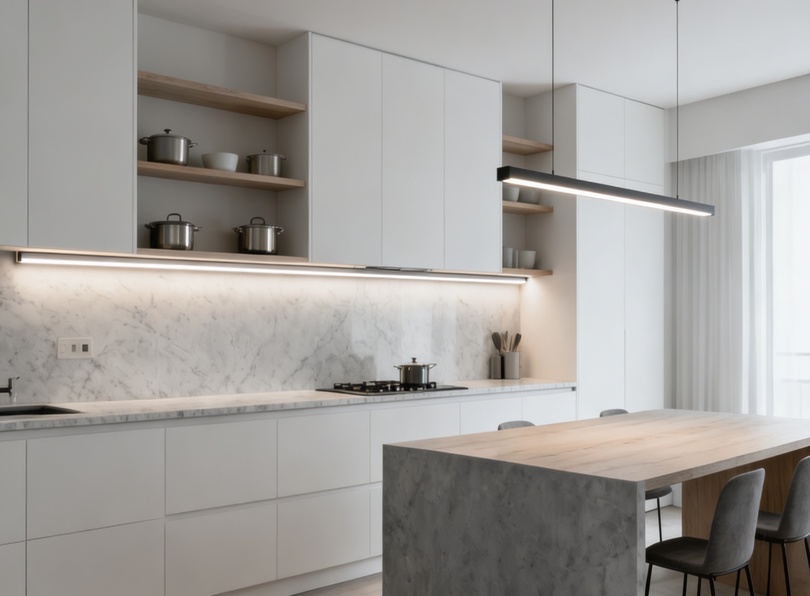
Kitchen lighting in renovations
Renovation of an existing kitchen offers the great opportunity to radically rethink kitchen lighting. In this chapter we address typical criticalities of renovations and LED solutions that allow obtaining professional results even in constrained contexts.
Electrical predispositions to add
In a renovation, electrical predispositions must be provided for all future light points, even for those not installed immediately. Power for under-cabinet (even if current cabinets do not provide it), light points for additional ceiling spotlights, predisposition for pendants above eventual future tables or islands, cables for smart controls. Tracing cables with building works open costs very little, doing it afterwards costs a lot.
Reuse of existing structures
An existing drywall or wood counter-ceiling can be reused to integrate new LED kitchen lighting. A perimeter lowered cove is made to host LED strips in recessed profile, obtaining diffuse indirect lighting without demolishing and redoing the counter-ceiling. Also existing decorative bands (ceiling cornices, wood finishes) can be "electrified" with strips applied behind, creating unexpected luminous effects on pre-existing structures.
Coordination with other systems
A kitchen renovation involves electrical system, hydraulic, ventilation, gas, and obviously kitchen lighting. It is fundamental to coordinate all systems because they interfere with each other: the hood must be powered and connected to the cooking zone light, the induction cooktop requires high power and the panel must be sized, smart sensors can interact with the security system. Coordination of different professionals (electrician, plumber, installer, lighting designer) determines the final quality of the result.
Emerging technologies: OLED light, microLED and perspectives
The future of kitchen lighting looks beyond traditional LED. OLED (Organic LED) and microLED represent the next technological frontiers. OLED offers perfectly uniform light from thin and flexible surfaces, ideal for luminous panels integrated in furniture or kitchen surfaces. microLED combines very high efficiency, extreme durability and miniaturized dimensions for absolute precision applications.
For now these technologies have costs that make them accessible only to luxury or experimental projects, but the price is dropping rapidly. Ledpoint follows these evolutions with attention and will progressively introduce products based on these new technologies as they mature commercially. Those who design a luxury kitchen today can already request custom OLED applications for specific effect areas, maintaining the rest of the system on high-level traditional LED technology.
Kitchen materials and suitable lighting
Different work surface or furniture materials require different kitchen lighting strategies. In this chapter we analyze the most frequent combinations and optimal choices for each.
White marble and quartz
White marble or light quartz tops reflect much light and tend to shine. Recommended color temperature is 3000-3500K, slightly warm to not make marble cold. High CRI (Sunlike CRI>97) enhances natural veining. The angle of incidence from under-cabinet must be precise to avoid direct reflections in the eyes when working.
Stainless steel
Stainless steel is highly reflective, therefore punctual light sources create annoying reflections. The solution is to use high-density COB strips (480 chips/m) with opal cover: continuous light produces soft and acceptable reflections, while punctual LEDs create constellations of punctual reflections. For steel COB light is essentially mandatory.
Natural wood
Natural wood or veneered tops require warm light 2700-3000K that enhances their natural color and veining. Under cool light wood appears gray and dull. High CRI is essential to return real color tones. A Sunlike strip at 3000K on walnut or oak top is an aesthetically exceptional combination.
Laminate and technical materials
HPL laminate or technical material tops (Fenix, Dekton) have matte surface and low reflection index. They are relatively "easy" to illuminate, accept both warm and neutral light. Ideal temperature is 3000-3500K, intensity must be generous (400-600 lux on surface). They are the most tolerant materials from a lighting point of view.
Tempered glass
Tempered glass tops (on design islands) require particular attention: direct light from above creates strong reflections. Lateral or diffused lighting is preferred, avoiding perpendicular spotlights. Pendants above the island should be chosen with opaque lampshade or with shielded LEDs to avoid reflections in the eyes.
Examples of complete projects
We conclude with three examples of complete kitchen lighting projects, sized and quoted, to give a concrete idea of the investment and expected results.
Project A: linear kitchen 12 m²
Compact linear kitchen 3.6 meters, wall cabinets along entire length, separate table. Solution: 6 recessed GU10 LED 7W 3000K CRI 90 spotlights, 3.6 meters of Ledpoint COB strip 14W/m in PR-A16 profile under-cabinet, Hand Sweep sensor, 60 cm design pendant above table, 75W dimmable Mean Well driver, Skydance TD touch panel. Estimated total investment: €1,500-2,000 (components + labor). Result: perfectly lit kitchen, two distinct scenarios, smart experience.
Project B: kitchen with island 25 m²
Kitchen with central island 2.4 meters, wall cabinets 3.6 meters, open space toward living room. Solution: 10 adjustable recessed LED 8W CCT spotlights, 3.6 meters of Sunlike COB strip under-cabinet, Hand Sweep sensor on two points, 3 design pendants above island (Flos or Vibia), 4 meters of CCT strip in PR-A16 angled profile above island integrated in furniture, 2 dimmable Mean Well HLG 100W drivers, Skydance T1-4S multi-zone controller, WT WiFi controller. Estimated total investment: €4,500-7,000 (components + labor + design pendants). Result: high-end kitchen, multiple scenarios, complete smart integration.
Project C: luxury open space kitchen 50 m²
Representative kitchen in penthouse, 3-meter marble island, integrated dining zone, panoramic view. Solution: perimeter drywall cove with 8 meters Sunlike Tunable White COB strip, 20 adjustable recessed CCT spotlights, 6 meters of strip in angled profile under-cabinet, multiple sensors (Hand Sweep, presence, ambient light), 4 design pendants above island (Foscarini Tress or equivalent), 1 linear pendant above dining table, KNX home automation system with Skydance WT integration, backlit glass touch panels in multiple positions, redundant premium Mean Well drivers. Estimated total investment: €12,000-25,000 (components + labor + design + home automation). Result: iconic kitchen, five-star hotel experience, multi-decade durability.
The winning formula in kitchen lighting
Kitchen lighting in 2026 is no longer matter for amateurs. It requires technical competence, aesthetic sensitivity, attention to detail, conscious component choice. The good news is that today there are professional-level products accessible even to the end user, supported by specialized retailers like Ledpoint.it that offer consultation, sizing, after-sales support. The winning formula is clear: high-density COB for uniformity, aluminum profiles for durability and optical precision, touchless sensors for hygiene, multi-zone controls for scenarios, Mean Well drivers for reliability, smart integration for fluid experience. Applying this formula guarantees a result of the highest level, whatever the size and style of the kitchen.
To conclude, we remember that the quality of kitchen lighting influences every moment of the day lived in this central environment of the home. Breakfast, morning coffee, lunch preparation, dinner with family, dinners with friends, the daily pleasure of cooking. Investing in light means investing in quality of life, in a concrete and daily way. The well-lit kitchen is a more loved, more lived, more satisfying kitchen. It is a gift that one gives to oneself and to those who live with us, every single day, for many years.
Kitchen lighting and accessibility: designing for everyone
An important and too often neglected chapter of kitchen lighting design is accessibility for people with motor, sensory or cognitive disabilities, and for elderly people. An inclusive kitchen is a kitchen that works well for everyone, and lighting plays a crucial role in this accessibility. In this chapter we address design criteria to realize truly accessible and universal kitchen lighting.
Lighting for elderly people
With advancing age visual sensitivity reduces, the eye lens becomes less transparent, annoyance for glare increases. A kitchen designed for elderly people must have illuminance 30-50% higher than standard (therefore 500-700 lux on work surface instead of 300-500), absolute absence of direct glare, neutral color temperature 3500-4000K (too low warm light appears yellow to elderly eyes), high CRI to well distinguish foods and objects. Good kitchen lighting can prevent domestic accidents and maintain autonomy.
Accessible controls
Controls must be easy to reach and use. Hand Sweep sensors (for those with fine manual difficulties) and voice control (for those with motor difficulties) transform the kitchen into an environment accessible to anyone. Voice control via Tuya Smart and voice assistants paired with Skydance WT controllers is a true revolution for people with motor limitations, because it allows managing kitchen lighting with voice alone, from any position in the room.
Safety sensors
Presence sensors that automatically turn on light upon entering the kitchen prevent nighttime falls. Door opening sensors that automatically illuminate the interior of column cabinets and pantries help those who have difficulty rummaging. Low-intensity step-marking LED strips (along the skirting or under cabinets) provide night light sufficient to orient without needing to turn on main lights. These are details that improve quality of life and safety in a concrete way.
Kitchen lighting in commercial contexts
Restaurants, bars, bakeries, delicatessens, hotels: all commercial contexts where kitchen lighting has specific needs and dedicated regulations. In this chapter we treat design criteria for professional kitchens, food presentation purpose, hygienic certifications.
Restaurant kitchens: production zone
In the production zone of a restaurant kitchen lighting must be intense, neutral (4000K), free of glare, with high CRI for product evaluation. Illuminance on work surfaces must reach 700-1,000 lux. Ledpoint Sunlike LEDs with CRI>97 are ideal because they allow the chef to evaluate cooking, freshness, presentation with absolute chromatic fidelity. Luminaires must have minimum IP65 protection to resist vapors and cleaning with water jets.
Gastronomy counters and food showcases
For food product presentation in counters and showcases light quality is strategic: it must enhance natural colors, not heat foods (LED with low thermal emission), not emit damaging UV or IR. Sunlike LEDs are perfect for this: continuous spectrum, high R9 for reds (meat, cured meats, fruit), no emission outside the visible. Refrigerated showcases with Sunlike lighting register measurable sales increases compared to standard LED lighting, because products appear fresher and more attractive.
Restaurant customer areas
In a restaurant dining room the visible kitchen lighting (open kitchens) must dialogue with the atmosphere of the room. 3000K temperature is recommended, dimmable to manage lunch (brighter) and dinner (softer) scenarios. Decorative pendants become aesthetic protagonists and contribute to the identity of the establishment. Author design pendants or contemporary continuous lines communicate the kitchen style. Lighting is branding, as well as function.
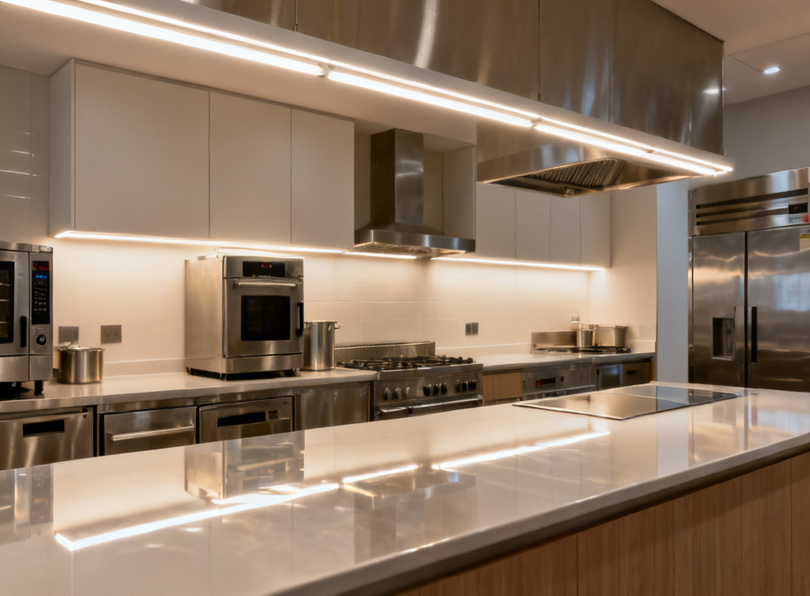
Preventive maintenance and lifecycle management
Even kitchen lighting LED, although being very low maintenance, benefits from correct lifecycle management. Few periodic interventions guarantee optimal performances for decades.
Periodic cleaning
Diffuser surfaces get dusty and slightly yellow above kitchen vapors. Cleaning every 3-6 months with soft damp cloth (no alcohol, no solvents) maintains optimal transparency. Metallic bodies of profiles are cleaned like other kitchen finishes. Decorative pendants require specific attention according to material (blown glass, fabric, ceramic).
Driver control
Mean Well drivers, if installed in accessible places, should be visually inspected every year to verify absence of discolorations or signs of overheating. Degrading drivers produce first perceptible flicker, then malfunctions. Preventive replacement of a driver after 8-10 years of intense service is a good practice, even if the existing one still seems to function.
Smart controller firmware update
Skydance WT controllers and Tuya app release periodic firmware updates that improve stability, security, functionality. It is recommended to keep devices updated via app to exploit to the maximum new functionalities and security corrections. An updated smart system is a secure and performing system.
Professionals' questions
We conclude with a chapter dedicated to typical questions of some professionals like architect, interior design influencer, professional chef, smart apartment owner, luxury entrepreneur. Each with specific needs and targeted answers.
For the architect: trends and durability
The latest trends in modern kitchen lamps include total integration between technical and decorative layers, Tunable White strips with scene control, sculptural author pendants, sustainable materials and noble finishes (burnished brass, bronze). Choice must adapt to kitchen style: minimalism for total black or white kitchens, material for wood kitchens, industrial for lofts. The most durable materials are anodized aluminum, tempered glass, solid brass. Modern lamps are fully controllable via app (Tuya Smart, KNX, Casambi). The best quality-price ratio is found combining professional Ledpoint technical components with selected decorative pendants.
For the influencer: photogenicity and versatility
The most photogenic lamps for kitchen are author design pendants and Tunable White strips that allow changing mood in a few seconds. They combine well with natural elements (wood, stone, plants) for authentic kitchen photographs. Trendy colors and shapes of 2026 are burnished brass, smoked glass, sculptural organic shapes. High CRI LEDs are excellent for photos because they return real colors. Design lamps at accessible prices are found on specialized retailers like Ledpoint.it that also propose proprietary design lines.
For the professional chef: performance and cleanliness
The best lamps for professional kitchen are Ledpoint Sunlike COB with CRI>97 in IP65 LightingLine profile. They are easily cleanable (damp cloth on diffuser cover) and maintainable. The effect of lighting on food perception is enormous: under CRI 97 light dishes appear as nature made them. Skydance lamps allow regulating intensity in real time. The most innovative solutions for professional kitchens include integration with smart appliances and Tunable White for preparation/service scenarios.
For the smart owner: integration and savings
Smart lamps compatible with home automation systems are Skydance WT controllers with Tuya Smart, compatible with Alexa, Google Assistant, Apple HomeKit (via HomeBridge), Samsung SmartThings. Energy savings of Ledpoint LED lamps is 80-90% compared to traditional halogens. Sustainable lighting options include low-consumption LEDs, controllers with auto-off, intelligent time programming. Voice control via Alexa, Google and Siri is fully supported. Characteristics to look for are CRI>90, adjustable CCT, dimmability, A or B energy certifications.
Final design verification: the complete checklist
We conclude with an operative checklist of design verification, applicable to any kitchen lighting project. Checking off every point guarantees having forgotten nothing.
Ambient layer: have I provided diffuse general lighting? Recessed spotlights or central ceiling light? Correct positioning (not above work stations)? Color temperature 3000-4000K? CRI>90? Dimmability?
Functional layer: is under-cabinet provided along entire length? High-density COB strip? PR-A16 angled profile? Hand Sweep sensor installed? Mean Well driver sized? Correct wiring?
Accent layer: pendants above island/table provided? Correct quantity according to width? Pendant height 70-90 cm from surface? Decorative pendants in harmony with kitchen style? Dimmable LED filament bulbs?
Decorative layer: light points on decorative elements (pictures, pantries, showcases)? LED strips in shelves or showcases? LED strips in drywall cove?
Controls: touch panel in strategic position? Skydance T1-4S multi-zone controller or equivalent? WiFi controller for Tuya app? Alexa/Google compatibility? Voice predisposition?
Drivers: are all drivers Mean Well or equivalent professionals? All dimmable? All positioned in ventilated and inspectable technical compartments? All sized with 20% margin?
Safety: system compliant with CEI 64-8? Dedicated magnetic-thermal differentials? Declaration of conformity DICO planned? Strips in humid zones have adequate IP?
Documentation: single-line diagram available? List of installed components with codes? Controller programming documented? Commercial warranties archived?
If you could answer positively to all these items, your kitchen lighting project is complete and professional. You have realized a system destined to last decades, to offer maximum quality of use, to valorize real estate investment.
The value of specialist consultation
Kitchen lighting of professional level is not a purchase, it is a project. The difference between putting together products and designing an integrated system is substantial. A preliminary specialist consultation allows correctly sizing luminous fluxes, choosing mutually compatible components, foreseeing future usage scenarios, avoiding costly errors. In this final chapter we deepen the value of consultation and what to expect from technical interlocution with sector professionals.
What a lighting consultant does
A consultant specialized in kitchen lighting collects information on the project (floor plans, finishes, dimensions, usage habits), develops a proposal of luminous layout (positions of points, types of sources, scenarios), sizes powers and fluxes, chooses specific components (strips, profiles, drivers, controllers, sensors), produces wiring diagrams, supports installation, accompanies commissioning and scenario programming. An experienced consultant saves time, money and frustrations, in addition to guaranteeing superior result.
When it is worth relying on a professional
Specialist consultation is absolutely worth it when: the project involves surfaces over 20 m², includes complex smart or home automation systems, foresees integration of Tunable White and multiple scenes, concerns commercial or hospitality contexts, has overall budget over €2,500-3,000 for lighting alone. For simpler projects (small kitchen, standard solutions), telephone or email support from the specialized retailer is often sufficient. Ledpoint.it offers both service levels.
How to prepare for consultation
To obtain the maximum from consultation it is useful to arrive prepared: kitchen floor plan with dimensions (even detailed hand sketch), photos of existing environment or render of new project, choice of work surface and cabinet materials, indication of orientative budget, description of prevalent usage scenarios (who cooks, how many people, dinners with guests, presence of children), stylistic preferences (minimal, classic, industrial). The more information provided to the consultant, the more precise and useful the design proposal will be.
History of kitchen lighting: from today to tomorrow
To understand where we are going helps briefly looking at where we come from. Kitchen lighting has undergone in one hundred years successive revolutions. From bare incandescence of the '20s-'30s, to tonal fluorescent ceiling lights of the '60s-'70s (the classic "kitchen neon light" characteristic of a generation), to golden halogens of the '80s-'90s with their punctual spotlights, to first LEDs of the 2000s often cold and poorly realized, to mature and refined LEDs of today that combine efficiency, light quality, digital control, extreme durability.
Each passage brought benefits: greater efficiency, better light quality, greater flexibility. Recent years have brought the definitive qualitative step: a light that is no longer only "good enough", but technically better than what nature offers in many parameters (efficiency, durability, controllability, adjustability). We are in the era of lighting that is both technology and poetry, work tool and matter of emotion.
The next decade
What to expect from the next decade? Complete diffusion of Tunable White and Full Spectrum (complete control of color temperature and spectrum). Complete integration with domestic AI that learns habits and adjusts accordingly. OLED technologies on large surfaces for totally uniform wall and ceiling lighting. MicroLED for absolute precision applications. Biometric sensors that adapt light in real time to user's physiological parameters (fatigue, vigilance, mood). Kitchen lighting will become increasingly adaptive, personalized, attentive to wellbeing.
Ledpoint's philosophy
Throughout this evolutionary path, Ledpoint has chosen to position itself as a provider of accessible professional technology. Not luxury boutique, not mass discount, but that essential middle point: verified professional quality products, competitive prices thanks to optimized supply chain, real technical support to end customers and professionals. A philosophy that allows anyone, from the conscious citizen to the demanding architect, to access truly high-level kitchen lighting solutions, without price or channel barriers.
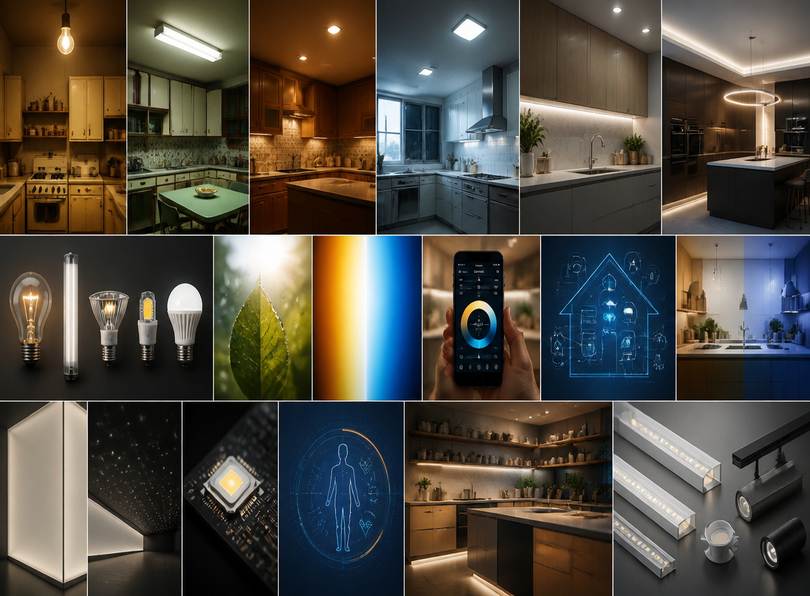
Kitchen lighting: awareness in light selection
We have arrived at the end of this long and detailed guide on kitchen lighting. We have treated technical fundamentals, design choices, specific products, usage scenarios, errors to avoid, future trends, case studies. What remains is to pass to action: apply what has been learned to one's specific project, choose the right components, realize a system destined to last and to gift beauty every day.
The starting point is always awareness. Recognizing that kitchen lighting is not secondary matter, but strategic factor in the overall quality of domestic space. Investing time in design, energies in component choice, resources in the right products. The return arrives every day for many years, in the form of better light, richer atmosphere, more gratifying culinary experiences.
The arrival point is the perfect kitchen: a kitchen that functions magnificently well at every hour of the day, that adapts to different scenarios without effort, that enhances chosen finishes and materials, that stays young and current for many years despite passing fashions. A kitchen where cooking is pleasure, where being together is pleasant, where every gesture is supported by the right light. All this is possible, and is within reach of those who consciously choose products like Ledpoint, LightingLine, Skydance, Mean Well.
Explore now the complete range of LED strips, profiles, sensors, controllers and drivers, ask for consultation to the technical team, evaluate solutions sized on your specific project. The first step toward a wonderfully lit kitchen is the one you decide to take today.
FAQ - Frequently Asked Questions on kitchen lighting
Below the answers to the most frequent questions on kitchen lighting, organized in dropdown format for rapid consultation. Click on each question to expand the detailed answer.
What light should I use in the kitchen, warm or cool?The ideal color temperature for kitchen is placed in the range 3000-4000K. Warm light 2700-3000K is perfect for convivial atmosphere and dining zones. Neutral light 3500-4000K is ideal for work surface and precision activities. The professional solution is to use Ledpoint CCT (Tunable White) strips that allow dynamically adjusting temperature according to time and scenario. |
How many lumens are needed to light the kitchen?For a 15-20 m² kitchen 3,500-5,000 total lumens are recommended, stratified on multiple sources. Illuminance on work surface must reach 400-700 lux, value much higher than domestic average. Under-cabinet is the main source of flux on work surface and must be sized accordingly. |
What type of LED for kitchen?For kitchen high-density COB LEDs (480 chips/m) with CRI above 90 are recommended, ideally Ledpoint Sunlike series with CRI Ra>97. COB LED eliminates dotted effect and produces continuous light perfect for under-cabinet. For general spotlights CCT LEDs with adjustable temperature are chosen. |
How to light the kitchen work surface?The work surface is lit with COB LED strips in angled LightingLine PR-A16 profile at 45°, mounted under the cabinet. This configuration directs luminous flux directly on the surface avoiding glare. 14-16W/m strips at 24V with high CRI are recommended, controlled by Hand Sweep sensor for touchless management. |
What to put instead of the chandelier in kitchen?Different solutions can be adopted: recessed or adjustable spotlights for diffuse lighting, LED strips in drywall profile for continuous luminous lines, modern LED ceiling lights in decorative versions, multiple pendants decentralized above functional zones. Choice depends on ceiling height and kitchen style. |
How to light a kitchen island?The island is lit with decorative pendants suspended at 70-90 cm from surface (1, 2 or 3 according to width), integrated by COB LED strips hidden under the island edge for service lighting. Skydance T1-4S multi-zone system is recommended to independently manage island and rest of kitchen. |
How many watts are needed to light a kitchen?With modern LEDs a 15-20 m² kitchen requires 80-120W total LED power, distributed on multiple sources. A kitchen with island and complete professional lighting can reach 150-200W. Consumption is 8-10 times lower compared to traditional halogen or incandescent solutions. |
Are Ledpoint LED strips dimmable?Yes, all Ledpoint LED strips are dimmable via compatible drivers (dimmable Mean Well) and Skydance controllers. Dimming is smooth and flicker-free. For kitchen dimmability is always recommended to be provided during design to manage different scenarios. |
Can smart lamps be controlled with voice?Yes, Skydance WT series WiFi controllers with Tuya Smart app integrate natively with Alexa, Google Assistant and Siri (via HomeBridge). Scenes, dimming, single zone activation can be commanded with natural voice commands. Voice integration is particularly useful in kitchen where hands are often occupied. |
What are Tiffany lamps?Tiffany lamps are decorative lamps with stained glass leaded lampshade, inspired by the Art Nouveau style of Louis Comfort Tiffany. They are suitable for classic and rustic kitchens, where they add an important decorative touch. They pair well with dimmable LED filament bulbs for the right evening mood. |
What is the difference between 3000K and 4000K?3000K is warm white (slightly yellow, welcoming, similar to sunset sunlight). 4000K is neutral white (clearer, neutral, similar to daylight). 3000K creates convivial atmosphere, 4000K is better for precise activities. In kitchen CCT strips are recommended that allow switching from one to the other according to need. |
How to light a kitchen without wall cabinets?Without wall cabinets, work surface lighting occurs via adjustable ceiling spotlights (8-10 W each, CRI>90, 3000-4000K) pointed on the surface, linear pendants above the surface, or LED strips in profile applied to wall above the surface. Perimeter lighting is also recommended to not have a flat environment. |
How long do Ledpoint LED strips last?Ledpoint LED strips have declared useful life of 50,000 hours with flux maintenance above 80% (L80B10). In typical domestic use (4-6 hours per day) actual lifespan exceeds 20-25 years, practically unlimited. Commercial warranty is typically 3-5 years according to series. |
How to choose the chandelier for the kitchen?Size is considered (indicative diameter 60-90 cm for medium kitchens, 30-40 cm for small kitchens), suspension height (70-90 cm from surface if above table or island), style coherent with kitchen (industrial, classic, design), type of source (integrated LED or replaceable bulbs). Above the island 2-3 smaller pendants are recommended rather than one large. |
What are the kitchen lighting trends 2026?2026 trends include: high-density COB strips for uniformity, almost invisible ultra-slim profiles, smart controls with app and voice, Hand Sweep touchless sensors, Tunable White for multiple scenarios, sustainable materials and noble finishes (burnished brass), sculptural author pendants, complete integration with advanced home automation. |
For further technical questions or personalized consultation, the support team of Ledpoint.it is available for project sizing, component choice, wiring diagrams. Kitchen lighting realized with competence is a heritage that accompanies the home for many years: it is always worth approaching it with the level of attention it deserves.
This article was developed with the support of artificial intelligence and subsequently reviewed, corrected, and validated by the Ledpoint.it technical team, which guarantees its reliability and compliance with official sources.