














Living room lighting: practical tips
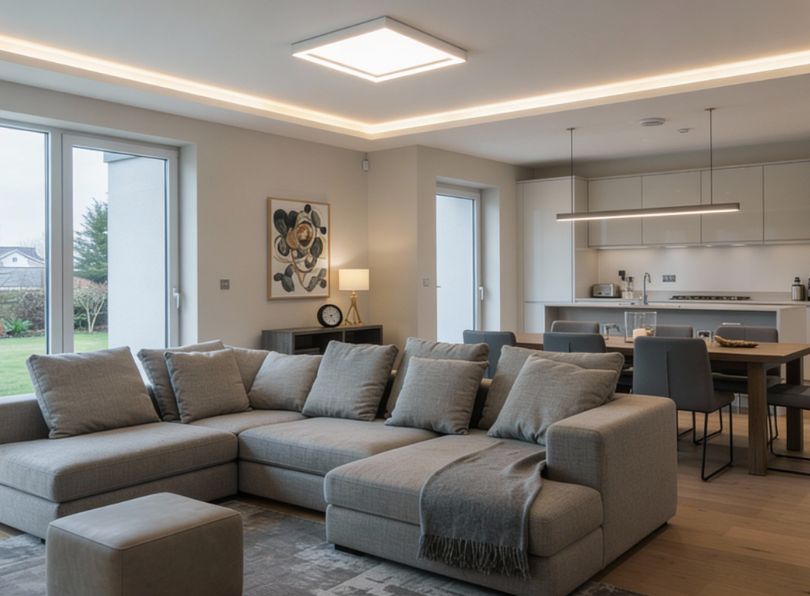
Living room lighting: a choice that may seem simple but actually requires a keen eye for both the needs of the inhabitants and the room’s dimensions and layout. It often happens after arranging all furniture and decor elements that something feels off or missing—frequently, this sensation stems from inadequate lighting.
Poor lighting design can flatten spaces, strain the eyes, and ruin the atmosphere. For this reason, we aim to guide you in selecting the right LED strips and profiles, leveraging our expertise to explain how to light a living room professionally, avoid common mistakes, and make the most of LED technology. We’ll cover both small and large spaces, open-plan layouts, and take a quick look at the latest trends spotted at the "Fuorisalone" and the "Light + Building International Fair" in Frankfurt.
Living room lighting: plan before choosing individual spotlights
Lighting a living room goes beyond simply installing LED lamps. For effective living room illumination, careful consideration must be given to layout, square footage, color temperature, and the chromatic rendering of LED strips. There are three distinct types of lighting—let’s explore them.
The three lighting levels
- Ambient lighting (general): the base layer of light that allows navigation within the room. If used alone, it feels flat and unwelcoming—it serves as the foundation to which secondary lights are added to impart character.
- Task lighting (functional): designed for specific activities such as reading, working on a computer, sewing, or similar tasks. It is directional and more intense.
- Accent lighting: adds personality to the space. Used to highlight artwork, plants, or wall textures. Creates drama and depth within the room.
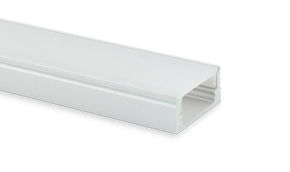
A well-executed project always blends at least two of these levels. In our catalog, profile solutions are available to address all three lighting types.
Color temperature
Color temperature profoundly shapes the ambiance: choosing between warm and cool light is the most impactful decision for the room’s atmosphere. Temperature is measured in Kelvin (K).
| Temperature (K) | Feeling | Living room recommendations |
|---|---|---|
| 2700K - 3000K | Warm, cozy, intimate | Ideal for traditional or relaxation-focused living rooms. Perfect for evening use. |
| 3500K - 4000K | Neutral, natural, balanced | Best for open-plan areas flowing into the kitchen, reading nooks, and modern minimalist living rooms. Simulates daylight. |
| >5000K | Cool, dynamic, clinical | Strongly discouraged for general living room use, except to accentuate small, isolated details. Can feel harsh or aggressive. |
Always pay attention to chromatic rendering too: an LED strip with CRI >90 is essential to render the true colors of furniture, sofas, and artwork. A low CRI "dims" the vibrancy of spaces and objects.
Living room lighting: common mistakes
Often, simple lighting errors undermine what could be a beautiful, comfortable, and welcoming space—all due to inadequate living room illumination. Below are the most frequent pitfalls.
- A single central ceiling light: creates harsh shadows and evokes an interrogation room. Solution: distribute light sources evenly. Even installing two off-center profiles makes a significant difference.
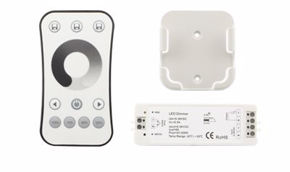
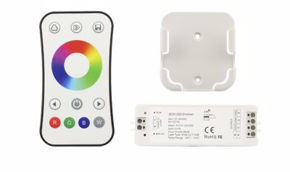
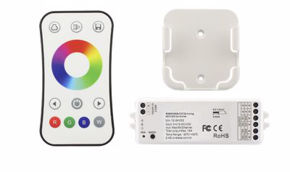
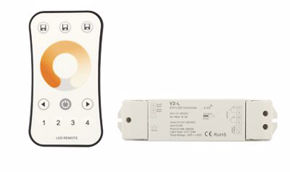
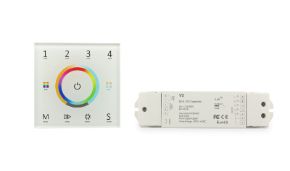
- Ignoring separate circuits and dimming: overlooking modern, affordable technology prevents high-quality LED strips from showcasing their full potential across different times of day. Fix: install at least two circuits (general ambient light + accent light) and use dimmers to adjust intensity.
- Over- or under-lighting: living room lighting must be balanced. Excess light causes stress; insufficient light feels sad and limits usability. Solution: calculate required lumens before selecting profiles and strips. For living rooms, 200–300 lumens/m² is typical. Example: installing 60W of LED (≈6000lm) in a 20m² living room would be a serious error.
- Mixing color temperatures randomly: lighting colors must harmonize. Combining warm, cool, and neutral strips creates visual chaos. Stick to a dominant tone (e.g., 2700K) for ~80% of sources, with minor variations only in well-defined functional zones.
Different living rooms, different lighting
After this theoretical overview, let’s move to practical applications across various living room types.
Small living room (under 20 m²)
Here, lighting should visually expand the space while avoiding clutter (e.g., no floor lamps). Applying our three lighting levels:- Ambient: two slim suspended profiles.
- Accent: an LED strip in a recessed profile behind the sofa or within a niche.
In compact spaces, warm light (2700K–3000K) is recommended to create a cozy, enveloping atmosphere.
Large living room or open-plan space with visible kitchen
This scenario requires defining, distinguishing, and delineating zones (dining, relaxation, kitchen) without creating visual "light walls." The solution lies in LED profiles and strips, offering diffuse light, visual continuity, and clean design—avoiding the visual clutter of multiple spotlights.
Ambient lighting and spatial zoning
While grid spotlights are common, linear indirect lighting is preferable here. Install perimeter ceiling light frames or zone-defining lines. A recessed profile with an opal diffuser creates a seamless line integrated into the plaster. In a 40m² open space, a full perimeter with high-output LED strips (1200 lumens/meter) delivers professional-grade, glare-free ambient light. For a modern touch, create one or two suspended "light islands" above key zones (e.g., sofa area, dining table) using 360° round profiles.
Functional zone definition
Dining area: replace traditional pendant lights with rectangular light profiles above the table, forming a suspended frame with a dimmable 2700K LED strip. Ensures uniform, shadow-free illumination across the entire surface.
Visible kitchen: for upper cabinets, use an under-cabinet profile with a high-CRI 4000K LED strip (CRI>95) to perfectly illuminate work surfaces. For lower cabinets, choose an extruded profile with visible diffuser to create subtle nighttime ambiance.
Focal point: to highlight a fireplace or artwork, consider grazing light beams or light frames. A skirting or floor-mounted profile at the base of a stone wall or large artwork enhances texture and visual depth.
Accent and atmosphere:
Bookshelves and niches: line interiors with recessed profiles and LED strips to create a floating effect that showcases books and objects.
Floating ceiling effect: a top trend from recent national and international lighting fairs. Install an angular profile a few centimeters below the main ceiling—along the full perimeter or opposite sides. Upward indirect light optically lifts the ceiling, making the living area feel distinct and airy.
Visual partitions: in elongated open spaces, create a vertical "curtain of light" using aligned floor-to-ceiling profiles with visible LED strips, forming a subtle, non-physical room divider.
To optimize lighting in such complex environments, we recommend zone-specific dimming and tunable white CCT LED strips. This simplifies installation and allows real-time temperature adjustments. Seamlessly shift from dynamic neutral light (4000K) for cooking or work to warm, enveloping ambiance (3000K) for evenings—all controlled via a single switch or remote. Total flexibility, impeccable design.
Living room lighting and windows
Now, let’s address rooms with natural light ingress: context changes everything. Windows are a daytime asset but pose challenges at night (backlighting effects).
| Window type | Challenge | Evening/Night lighting solution |
|---|---|---|
| Large south-facing window (abundant light) | Room feels too dark by contrast in the evening | Create uniform, diffuse illumination. Avoid spotlights aimed at the window. Use LED strips on cornices or curtains to visually "extend" natural light. |
| Small or north-facing window (limited light) | Perpetually gray ambiance | Opt for neutral light (3500–4000K) to mimic daylight. Maximize lateral light points to reduce reliance on ceiling-only lighting. |
| French door to terrace | Transition zone risks feeling like a dark cave | Illuminate door sides with slim surface-mounted profiles. A skirting LED strip can guide the eye and define the passage. |
2025/2026 living room lighting trends
Staying current through research and attendance at major events, we identify these upcoming LED-based living room lighting trends:
- Human Centric Lighting (HCL): focus shifts beyond intensity to LED strips’ ability to adapt dynamically to daylight cycles via smart systems and tunable white technology.
- Invisible lighting design: light should be present, hardware unseen. Ultra-slim LED profiles (≤5mm) and pervasive indirect lighting lead the trend.
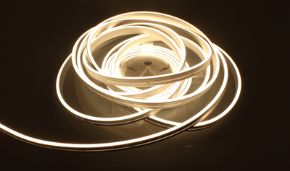
- Geometric curves: soft lines, light arcs, circles. Neon Flex enables organic shapes on ceilings.
Living room lighting isn’t just light—It’s the atmosphere you live in
This article underscores that living room lighting is far from trivial—especially in spaces where we spend significant time or perform daily activities.
The LED profiles an architect selects for a floating ceiling, the warm strip hidden inside a bookshelf, the scene controller that transitions your space from day to evening with a tap—none are random choices. They shape the emotional memory of lived-in spaces and influence well-being. Poor lighting fatigues, irritates, isolates; thoughtful lighting welcomes, connects, inspires.
Your living room awaits the right light to reveal its full beauty. When in doubt, contact our support team!