






Retrofit with LED strips: what it is, how it works, and how to plan the upgrade of existing lighting
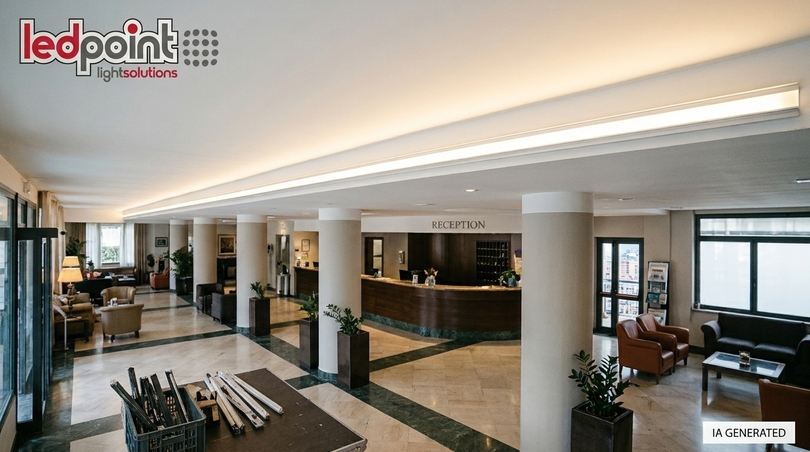
Lighting retrofit is the refurbishment intervention that replaces obsolete light sources (T8 and T5 fluorescent tubes, linear halogens, glass neon, discharge lamps) with high-efficiency LED systems, while maintaining the structure, architecture, and most of the existing system. LED strip retrofit reduces lighting consumption by 50% to 80%, extends useful life, and enables intelligent control, without complete restructuring.
Every day in Italy, millions of meters of cove lighting, valances, shop windows, signs, under-cabinet areas, condominium staircases, and warehouses remain illuminated by technologies that the European Union has already withdrawn from the market. Retrofit is the fastest, least invasive, and most profitable way to transform these systems into efficient LED systems, without demolishing suspended ceilings, without rewiring the electrical system from scratch, and, in most cases, without interrupting the activities of those who live or work in the spaces. For an energy manager, a condominium administrator, a system designer, or a commercial property owner, LED retrofit is currently one of the energy efficiency interventions with the best ratio between investment, savings, and payback time.
This technical guide was written by the team at Ledpoint, a company based in Faenza specializing in professional LED strips, aluminum profiles, power supplies, and control systems, for those who design, approve, finance, or install retrofits. You will find the technical definition of retrofit, its meaning, and the difference from maintenance, restructuring, relamping, and revamping; the main application areas; the most suitable LED strip technologies; technical compatibility requirements; project phases; regulations, Conto Termico 3.0 incentives, costs, return on investment, application cases, and post-intervention management. Every choice is accompanied by data, calculation tables, and real catalog products, because a retrofit is judged by numbers, not promises.
In this article...
1. What is retrofit: meaning and technical definition
Before choosing strips, profiles, and power supplies, a shared vocabulary is needed. The word retrofit is used very broadly, and this very breadth generates misunderstandings between clients, designers, and installers: some confuse it with simply replacing a light bulb, others with a restructuring, and others with an automotive intervention. In this section, we establish the meaning of retrofit, its technical definition, and how the term applies to lighting.
What retrofit means: origin of the term
The term retrofit originates in English from the fusion of retro (backward, a posteriori) and fit (to adapt, to install). The literal meaning of retrofit is therefore "to install a posteriori": adding to an existing system a technology that was not available or not foreseen at the time of its construction. Retrofitting is the action, the process that brings the retrofit to completion. In every field, from construction to industry, the meaning of retrofit remains the same: updating what exists instead of replacing it entirely.
Definition of retrofit
A definition of retrofit valid for all sectors is the following: retrofit is a refurbishment intervention that integrates next-generation components or technologies into an existing asset (building, system, machinery, vehicle, appliance) in order to improve its performance, efficiency, safety, or functionality, while preserving the main structure. The preservation of the existing is the element that distinguishes retrofit from a new realization; the technological leap is the element that distinguishes it from maintenance.
Technical definition of retrofit applied to lighting
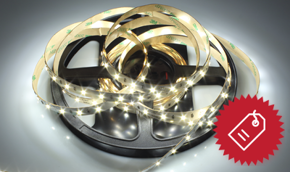
In lighting, the technical definition of retrofit becomes more precise. We speak of light retrofit when the light source and, if necessary, the power supply (ballast, transformer, driver) of an existing system are replaced, while maintaining the housing, architecture, position of the light points, and, when possible, the electrical line. Typical LED retrofit involves the conversion of fluorescent tubes, linear R7s halogens, dichroic spotlights, glass neon signs, and discharge lamps into LED sources; LED strip retrofit, in particular, employs flexible LED strips in aluminum profiles to replace linear sources inside coves, valances, shop windows, niches, shelves, handrails, signs, and suspended ceilings.
What is retrofitting and what purposes it pursues
What is retrofitting in practice? It is the set of diagnostic, design, supply, installation, and testing operations that bring an existing system to a higher performance level. The purposes of retrofit in lighting are five: to reduce electrical consumption, eliminate recurring maintenance costs (changing tubes, starters, ballasts), improve light quality (color rendering, absence of flicker, uniformity), adapt the system to European regulations and standards, and enable modern functions such as dimming, sensors, and building automation.
Advantages of retrofit in summary
The advantages of retrofit can be summarized in a few key words that an energy manager recognizes immediately: measurable energy savings, short payback times, reduced impact on the construction site, continuity of operation, asset valorization, and extension of the system's useful life. Unlike a complete restructuring, retrofit works on the part of the system that consumes (the source) and leaves in place the parts that work (structures, suspended ceilings, finishes, lines).
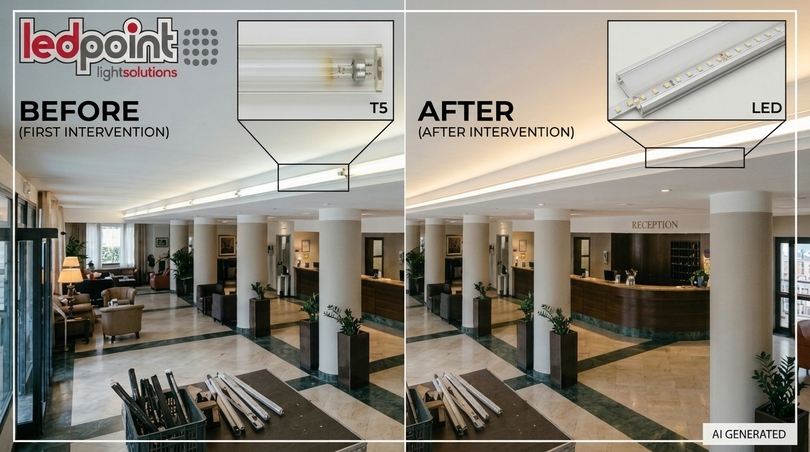
2. Difference between retrofit, maintenance, restructuring, relamping, and revamping
One of the reasons why retrofit projects are underestimated, or conversely oversized, is terminological confusion. Maintenance, retrofit, relamping, revamping, and restructuring are interventions with different objectives, costs, authorizations, and accessible incentives, and calling them by the right name is the first step to writing a correct specification and presenting the retrofit project to a condominium assembly or a board of directors.
Difference between retrofit and restructuring
The difference between retrofit and restructuring lies in the scope of the retrofit intervention. Restructuring modifies the building organism or the system as a whole; retrofit intervenes in a targeted manner on specific components to improve their performance. In the case of lighting, a restructuring implies new suspended ceilings, new lines, new light points; an LED retrofit preserves coves, valances, and trunking and replaces the sources with next-generation LED strips, profiles, and power supplies. The practical consequence is enormous: costs, dust, noise, and downtime are reduced by an order of magnitude.
Retrofit and maintenance: why they are not the same thing
Maintenance restores a system to its original conditions: an exhausted fluorescent tube is replaced with an identical fluorescent tube. Retrofit, on the other hand, brings the system to conditions superior to the original ones. Replacing a T8 tube with another T8 is maintenance; replacing it with a 24V LED strip in a dissipating profile with an electronic power supply is retrofit. This distinction is also relevant for incentives, which reward efficiency improvement and not restoration.
Relamping, revamping, and retrofit
Relamping is the replacement of only the lamps with more efficient models, often with a compatible base (e.g., LED E27 lamps instead of incandescent). Revamping, a term widely used in industrial revamping, is the profound modernization of a system or line, with the replacement of substantial parts. Retrofit sits in the middle: deeper than relamping because it also replaces the power supply and adapts thermal and control management, but less invasive than revamping because it preserves the appliance or the structure that houses it.
Comparative table of lighting interventions
| Intervention | What is replaced | What is conserved | Performance improvement | Invasiveness | Example |
|---|---|---|---|---|---|
| Maintenance | Faulty component with an identical one | Everything | None (restoration) | Minimal | New T8 tube instead of exhausted T8 |
| Relamping | Only the lamp | Appliance, power supply, line | Medium | Low | LED E27 lamp instead of incandescent |
| LED Retrofit | Source + power supply + thermal management | Structure, cove, valance, line | High | Low-medium | LED strip retrofit instead of T5 tubes in valance |
| Revamping | Consistent parts of the system | Part of the structure | Very high | Medium-high | New system with DALI control and new lines |
| Restructuring | System and building organism | Little or nothing | Maximum | High | New suspended ceiling, new light points, new system |
Retrofit occupies the most efficient position in the table: maximum improvement per unit of invasiveness. This is the reason why, in tertiary energy diagnoses, lighting retrofit almost always appears among the interventions with the fastest economic return.
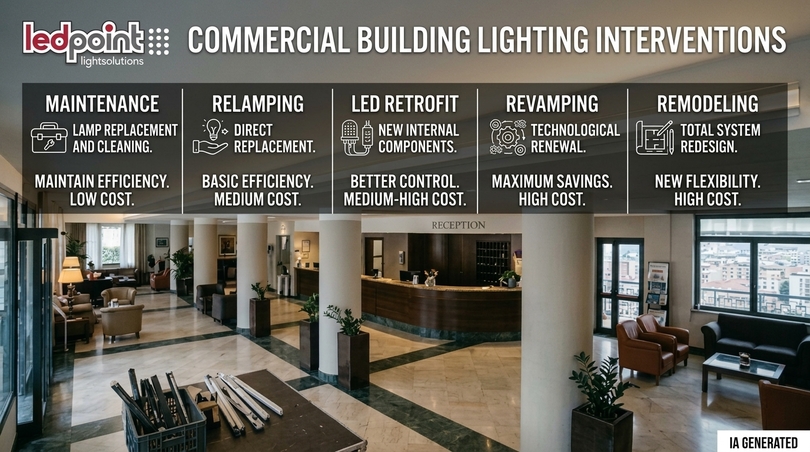
3. LED retrofit and LED strip retrofit: solution, system, and retrofit kit
On construction sites, expressions like retrofit solution, retrofit system, and retrofit kit circulate. These are three different levels of intervention, corresponding to three different ways of purchasing and installing LED retrofit. Understanding them allows the designer to choose the formula best suited to the budget, available time, and competence of the installation team.
What is a retrofit solution
What is a retrofit solution? It is the design response to a specific problem: a combination of source, optics, power supply, and control chosen to replace an obsolete technology in a precise context. For example, for the cove lighting of a hotel hall with 28 W T5 tubes, the retrofit solution might be a high-efficiency 24V 2835 LED strip in a valance profile, powered by a Mean Well driver with DALI dimming. The retrofit solution is always custom-made: it depends on the cove dimensions, required flux, existing color temperature, and management system.
What is a retrofit system
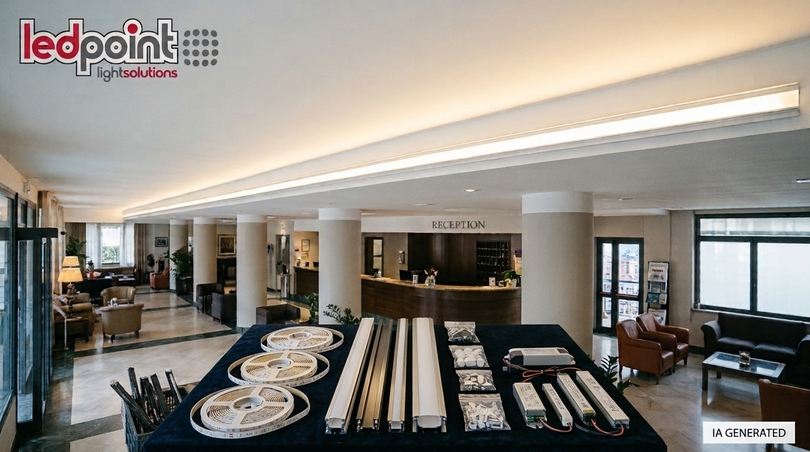
What is a retrofit system, or the retrofit system of a building? It is the coordinated set of components that, when installed together, guarantee the declared performance: LED strips, aluminum profiles, diffusers, end caps, clips, connectors, cables, power supplies, controllers, sensors. In LED strip retrofit, the system is modular: each component is chosen separately, but must be compatible with the others. For this reason, Ledpoint publishes profile and LED strip matching tables and the comparative profile table, indispensable tools for sizing a retrofit system without thermal errors.
What is a retrofit kit
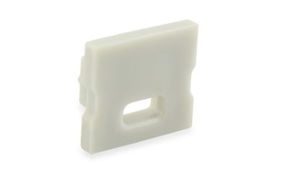
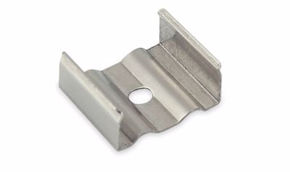
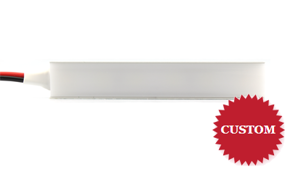
What is a retrofit kit? It is a pre-assembled or pre-configured retrofit system, sold as a ready-to-use set. The retrofit kit reduces installation times and construction site errors, because the manufacturer has already verified compatibility and sizing. In the world of LED strips, Ledpoint profile and accessory kits respond to this logic: profile, diffuser, end caps, and brackets in a single supply. For specific lengths, cable exits, and configurations, customized profiles are used, transforming the standard retrofit kit into a custom retrofit kit for the single construction site.
LED retrofit lamps and LED strip retrofit: two different paths
On the market, there are also "retrofit" LED lamps, i.e., LED tubes with G13 or G5 bases that fit into the existing luminaire in place of the fluorescent tube. These are a form of evolved relamping, but they present important limitations: they depend on the original wiring, often require bypassing the ballast, inherit the optical geometry of the old luminaire, and rarely allow quality dimming. LED strip retrofit, on the other hand, replaces the entire emission system within the structure that housed the source: you gain in efficiency, uniformity, control, and thermal management, and you design the light instead of suffering it.
When to choose LED strip retrofit
LED strip retrofit is the technically superior choice when the original source is linear (tubes, neon, linear halogens), when the housing is architectural (coves, valances, niches, shop windows, shelves) and not a standard appliance, when a continuous line of light without shadow zones between tubes is needed, and when dimming or color temperature variation is desired. In all these situations, the profiled LED strip is effectively the only LED retrofit that yields a better result than the original, not just an equivalent one.
4. Market data, regulatory context, and "retrofit decree"
LED retrofit is not a trend: it is the mandatory technical response to a European regulatory framework that has progressively excluded less efficient sources from the market. Those managing a real estate portfolio with fluorescent systems today face increasingly rare and expensive spare parts, and retrofit becomes a choice of operational continuity even before savings. In this section, we analyze the regulatory context, the sector's numbers, and clarify what is meant by the expression "retrofit decree".
The phase-out of traditional light sources in Europe
The Regulation (EU) 2019/2020 on the eco-design of light sources, applied from September 1, 2021, has set minimum requirements for efficiency, color rendering, and flicker. Revisions to the RoHS Directive 2011/65/EU, which limits the use of mercury, have led to the withdrawal of compact fluorescent lamps with integrated ballasts from February 2023 and most linear T5 and T8 fluorescent tubes from August 2023. Residual stocks are running out, spare part prices are rising, and every failure becomes a forced opportunity for an LED retrofit: it is better to plan it in advance than to suffer it in an emergency.
How much lighting weighs on consumption
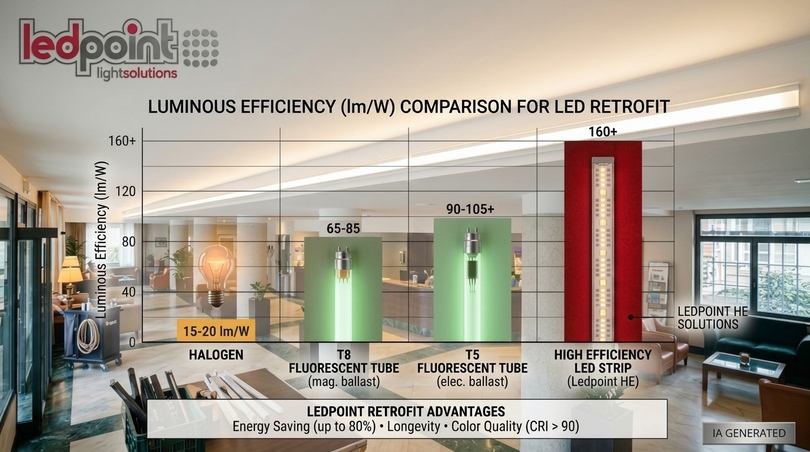
In the tertiary sector, lighting represents, depending on the intended use, indicatively between 20% and 40% of a building's electrical consumption, with higher peaks in shops and activities open many hours a day. For this reason, lighting retrofit is almost always the first intervention proposed in energy diagnoses: it is rapid, measurable, non-invasive, and repeatable on a large scale. The table summarizes the typical consumption of technologies to be replaced compared to the LED retrofit solutions in the Ledpoint catalog.
Source efficiency: existing technologies and LED retrofit solutions
| Source | Typical system efficiency | Indicative average life | Dimmability | Regulatory status |
|---|---|---|---|---|
| Linear halogen R7s | 15-25 lm/W | 2,000 h | Yes, but with high heat | Strongly penalized |
| Glass neon for signs (high voltage) | 20-50 lm/W | 10,000-15,000 h | Limited | Declining technology, high voltage transformers |
| Fluorescent T8 with electromagnetic ballast | 55-70 lm/W | 10,000-15,000 h | No | Withdrawn (RoHS, August 2023) |
| Fluorescent T5 with electronic ballast | 75-90 lm/W | 15,000-20,000 h | Only with dedicated ballasts | Withdrawn (RoHS, August 2023) |
| COB LED strip in Ledpoint catalog (e.g., FE2-300-320OM2) | 108 lm/W declared | Over 50,000 h with correct dissipation | Yes (PWM, 0/1-10V, DALI) | Compliant |
| 2835 LED strip Ledpoint (e.g., FE2-30s-120822) | 114 lm/W declared | Over 50,000 h with correct dissipation | Yes | Compliant |
| High-efficiency LED strip Ledpoint Fx2 series (F52-30s-160822A) | Over 160 lm/W declared | Over 50,000 h with correct dissipation | Yes | Compliant |
The emerging data is clear: a high-efficiency LED strip retrofit doubles or triples the light produced per watt compared to fluorescent tubes, and multiplies that of halogens by ten. At equal useful flux, the installed power drops accordingly, and with it heat, loads on the air conditioning system, and operating costs.
What is the retrofit decree
Many search online for "what is the retrofit decree". The so-called retrofit decree, in Italy, is the Ministerial Decree of December 1, 2015, n. 219, which regulates the electrical retrofitting of vehicles, i.e., electric car retrofit and electric car conversion with homologated automotive retrofit kits. It therefore concerns the automotive sector and historic vehicles, not lighting. For light retrofit, there is no specific "retrofit decree": the reference framework is composed of EU Regulation 2019/2020, product directives (low voltage, electromagnetic compatibility, RoHS), CEI and UNI technical standards, and, for incentives, the Conto Termico 3.0 decree. We discuss this in detail in the sections dedicated to regulations and incentives.
Flicker and light quality: a legal requirement
Regulation 2019/2020 has introduced limits on the flicker of LED sources powered by the grid, expressed with the indices Pst LM (perceptible flicker) and SVM (stroboscopic effect). A LED retrofit made with low-quality components can worsen visual comfort instead of improving it: light that vibrates on video recordings, visual fatigue, stroboscopic effects on moving parts in an industrial environment. For this reason, in LED strip retrofit, the power supply and controller count as much as the strip.
5. Application areas of retrofit in lighting
The application sectors of retrofit are numerous: construction, industry, automotive, energy plants, infrastructure. In this guide, we read them all through a single lens, that of lighting with LED strips, because that is where Ledpoint offers concrete solutions. For each area, we indicate where LED retrofit is most effective and where, instead, a different approach is needed.
Building retrofit and building retrofit
Building retrofit is the broadest area. It includes offices, hotels, shops, shopping centers, schools, healthcare facilities, condominiums. In building retrofit, lighting is the system that is refurbished most quickly: cove lighting with T5 tubes, perimeter valances, suspended ceilings with neon, corridors, stairwells, and covered parking lots become dimmable LED systems governed by sensors in a few days. In occupied buildings, LED strip retrofit is executed by zones, without interrupting activity.
Industrial retrofit and modernization of industrial plants
In industrial retrofit, lighting is part of the modernization of industrial plants: lighting of production lines, workbenches, electrical panels, machinery, warehouses, and cells. Industrial machinery retrofit often includes internal machine lighting (machining compartments, painting booths, inspection areas), where an IP65/IP67 profiled LED strip replaces fragile fluorescent tubes subject to vibrations. In production line retrofit, the stroboscopic effect also matters: with rotating parts, flicker-free light is a safety requirement. The digitalization of existing machinery finds an ally in lighting: strips controlled via DALI or 0/1-10V integrate with the plant's supervision systems.
Energy plant and infrastructure retrofit
In energy plant retrofits, lighting concerns cabins, substations, technical rooms, thermal and refrigeration plants: environments often illuminated by fluorescent sealed luminaires left on for long periods. Retrofit with IP65 and IP67 LED strips in closed profiles reduces consumption and zeroes tube maintenance in places where access is inconvenient. In infrastructure, LED strips find space in pedestrian underpasses, bridge parapets and walkways, canopies, pedestrian tunnels, escalators, and illuminated handrails.
Road maintenance retrofit: where LED strip makes sense
Road maintenance retrofit mainly concerns public lighting, regulated by UNI 11248 and UNI EN 13201 standards and Minimum Environmental Criteria. For vehicular roads, LED strip is not the indicated source: street luminaires with dedicated optics are required. The LED strip becomes the ideal retrofit solution for urban furniture and signaling elements instead: step markers, parapets, handrails, underpasses, crossings illuminated from below, public signs. In these cases, high-protection strips and outdoor neon flex are used.
Automotive retrofit: a different field
Automotive retrofit (electric car retrofit, electric car conversion, historic vehicle retrofit, electric retrofit homologation) is a sector of its own, regulated by the decree cited in the previous section. Ledpoint LED strips are not components for homologated vehicles, and for this reason, we do not discuss the topic further: those seeking automotive retrofit kits must turn to authorized workshops and installers for vehicle electrical refurbishment.
Table of LED strip retrofit areas
| Area | Typical sources to replace | LED strip retrofit solution | Recommended IP | Typical control |
|---|---|---|---|---|
| Offices and corporate | T5 in coves and valances, T8 in trunking | 2835 or Fx2 24V strip in valance profile | IP20 | DALI, presence sensors |
| Hospitality and food service | T5 in coves, linear halogens in niches | COB or Sunlike strip, CCT in halls | IP20 / IP65 in kitchen | Multi-zone scenes |
| Retail and shop windows | T5 in shop windows, halogens in displays | High CRI COB strip, slim profiles | IP20 | Timer, scenes |
| Condominiums | Fluorescent luminaires in stairs and halls | 24V strip in profile + sensors | IP20 / IP44 | Motion sensors |
| Industry | Sealed T8, tubes on machines | 24V or 48V IP65/IP67 strip in closed profile | IP65-IP67 | 0/1-10V, DALI |
| Signs and lightboxes | Glass neon, T8 tubes in casings | Neon flex, LED modules and backlighting bars | IP65-IP67 | On/off, timer, twilight |
| Pedestrian infrastructure | Sealed fluorescent, halogens | IP67/IP68 strip and neon flex | IP67-IP68 | Twilight, telemanagement |
6. Energy retrofit of buildings: the weight of lighting
When talking about energy retrofit, the mind immediately goes to thermal insulation, windows, heat pumps, and photovoltaic systems. However, lighting is the system that, for equal investment, often offers the fastest and easiest savings to measure, and that interacts with all the others: it reduces internal thermal loads, lightens summer air conditioning, and improves the energy class of non-residential buildings. In this section, we place LED retrofit in the broader framework of energy refurbishment.
Energy retrofit refurbishment: where light is placed
A complete energy retrofit refurbishment follows a hierarchy: first, demand is reduced (envelope, thermal insulation retrofit, windows), then production is made efficient (heat pump retrofit, photovoltaic system retrofit), and finally, management is optimized (domotics for existing buildings, building automation). LED lighting crosses all three levels: it reduces electrical demand, is willingly powered by photovoltaic production in self-consumption, and is one of the easiest loads to automate. LED retrofit is therefore an energy efficiency intervention that "prepares" the building for subsequent interventions.
Building energy retrofit and energy class
Can retrofit improve the building's energy class? For non-residential buildings, yes, because the energy performance certificate also includes the demand for lighting, according to the national methodology of minimum requirements. For residential buildings, lighting does not enter the performance index calculation, but the consumption reduction remains real on the bill and in common condominium areas. An building energy retrofit that includes light, in the tertiary sector, therefore contributes directly to the class jump, along with the envelope and thermal systems.
The effect of LED retrofit on the HVAC system
For the HVAC system designer, there is an often overlooked aspect: every watt of lighting saved is also one less watt of heat to be disposed of with summer air conditioning. In offices and shops with many hours of operation, internal loads due to fluorescent or halogen lighting affect the sizing of terminals and cooling consumption. An LED retrofit that halves the installed power reduces internal loads by the same order; in winter, conversely, some of that heat must be compensated by heating. The net balance, in Italian climates and tertiary buildings, is generally favorable to retrofit, but it must be evaluated in the overall energy diagnosis.
Building consumption reduction and retrofit emission reduction
Can system retrofit contribute to the reduction of CO2 emissions? Yes, in direct proportion to the energy saved. With an emission factor of the Italian electricity mix in the order of 0.25-0.30 kg of CO2 per kWh, every 1,000 kWh saved avoids about a quarter of a ton of CO2. The environmental benefits of retrofit do not stop here: eliminating fluorescent tubes means eliminating mercury from the waste cycle, and extending the life of systems reduces materials and transport. For an energy manager, retrofit emission reduction is easily accounted for in sustainability reports.
Table: energy retrofit objectives and lighting contribution
| Objective | Contribution of LED retrofit | Indicator |
|---|---|---|
| Reduction of electrical consumption | Direct, typically 50-80% on the lighting quota | kWh/year, kWh/m² |
| Emission reduction | Proportional to kWh saved | t CO2/year |
| Energy class (non-residential) | Reduction of lighting demand | Energy performance index |
| Comfort | Color rendering, absence of flicker, uniformity | CRI, Pst LM, SVM, lux |
| HVAC loads | Reduction of summer internal loads | W/m² of internal load |
| Maintenance | Elimination of tube, starter, ballast changes | €/year, interventions/year |
| Property value | Modern, manageable, documented system | Attractiveness, rent, EPC |
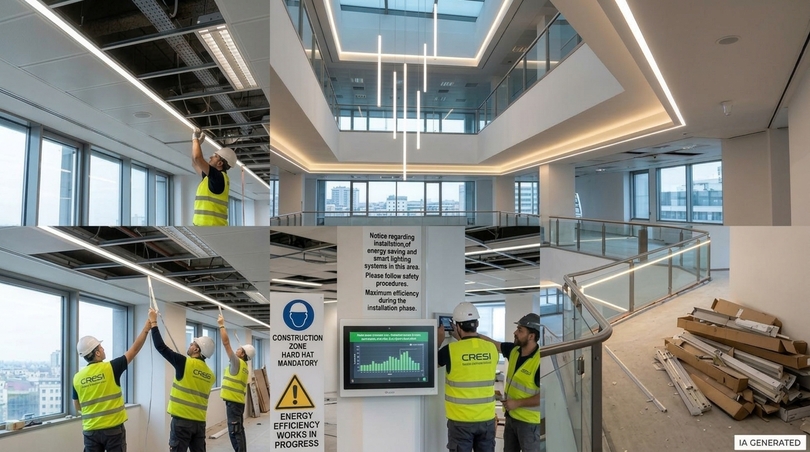
7. How LED strip retrofit works: from obsolete source to LED system
How does retrofit work, concretely, when the source to be replaced is a fluorescent tube hidden in a valance or a glass neon in a sign? The principle is always the same: the old source with its power supply is removed, the structure housing it is verified, an LED system sized for flux, thermal, and power supply is installed, it is connected to the existing or a new control, and it is tested. Let's look at the most frequent cases, those that cover the majority of LED strip retrofit requests.
Replacing neon tubes with LED in coves, valances, and trunking
The replacement of neon tubes with LED, i.e., the T5 and T8 fluorescent tubes that common language calls "neon", is the most requested retrofit. In coves and valances, tubes inevitably leave shadow zones between one lampholder and another; the LED strip creates a continuous line of light, without interruptions even in corners. Tubes, lampholders, and ballasts are dismantled, an aluminum profile like the profile for plasterboard valances PR-DW16-03 or a surface profile on the bottom of the cove is placed, the strip is applied, and the power supply is connected in an inspectable point. Replacing neon with LED reduces the power per linear meter by more than half for the same perceived light.
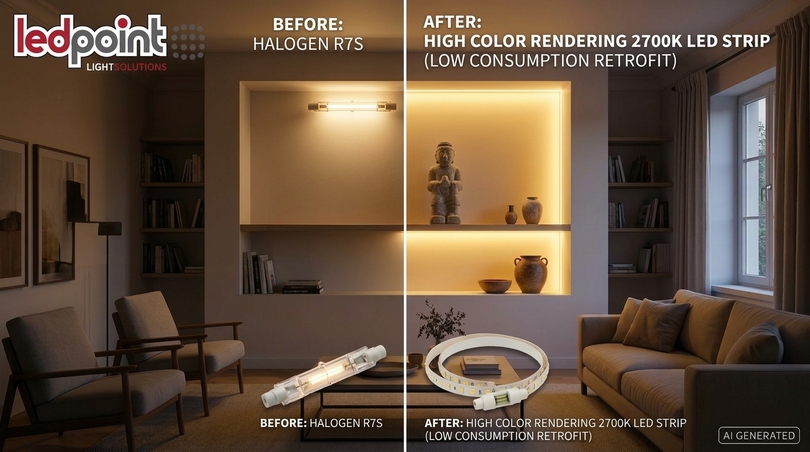
Replacing linear halogen lamp with LED
Linear R7s halogens are still widespread in niches, bookcases, indirect lighting of old suspended ceilings, and floor lamps. Replacing the linear halogen lamp with LED via profiled strip eliminates excessive heat, which has often yellowed paints and diffusers, and reduces consumption by about 85-90%. In these cases, a 2700-3000K strip with high CRI is chosen, such as the strips from the Sunled (Sunlike) line, to maintain the chromatic warmth that made halogen light pleasant. For replacing halogen spotlights with LED, however, the correct source remains punctiform: in that case, we draw from the bulbs and spotlights category, coordinating color temperature and rendering with the strips in the same environment.
Signage retrofit: from glass neon to neon flex
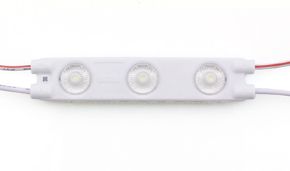
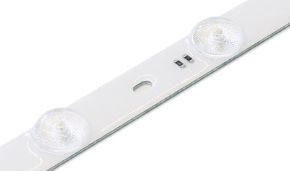
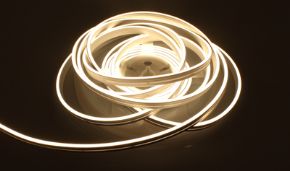
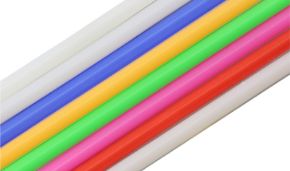
Glass neon signs operate at high voltage, are fragile, and expensive to repair. Retrofit with neon flex, Ledpoint's flexible LED tubes, reproduces the effect of a continuous line of light at low voltage, with impact resistance and outdoor protection. For lightboxes illuminated by T8 tubes, retrofit instead passes through LED modules and LED backlighting bars, which distribute light evenly over the panel surface with a fraction of the power.
Retrofit of shop windows, displays, shelves, and under-cabinets
Shop windows and display counters illuminated by T5 tubes and halogens suffer from heat, shadows, and falsified colors. Retrofit with high color rendering LED strips in slim profiles restores faithful colors without heating the merchandise, an essential aspect for food, cosmetics, fabrics, and jewelry. For food counters, Ledpoint proposes strips with dedicated spectrum in the light for food category. In kitchen under-cabinets and shelves, the PR-SL08-03 17x8 mm profile replaces old linear luminaires in a few millimeters, with activation via sensor.
Retrofit of condominium stairs, entrance halls, and corridors
Condominium stairs and entrance halls are often illuminated by fluorescent luminaires controlled by a timer. Retrofit with profiled LED strip, combined with presence sensors, transforms a system that is always on or on a fixed timer into a system that turns on only when needed, and that can remain at a minimum courtesy level during night hours. It is one of the most appreciated retrofit interventions in condominium assemblies, because the savings on the common areas' bill is immediate and easy to document.
Conversion table: existing source and LED strip retrofit solution
| Existing source | Typical power per meter | Ledpoint retrofit solution | LED power per meter | Indicative reduction |
|---|---|---|---|---|
| T5 28 W tube in cove (approx. 1 tube/m, with ballast) | ≈ 27-31 W/m | Fx2 24V strip in valance profile | 10-14.4 W/m | 50-65% |
| T8 36 W tube with electromagnetic ballast | ≈ 35-38 W/m | 2835 24V 14.4 W/m strip in profile | 14.4 W/m | ≈ 60% |
| R7s 150 W linear halogen on 118 mm (per 1 m niche) | 150 W per point | Sunlike 2700K strip in profile | 10-14 W/m | ≈ 90% |
| Glass neon for sign with transformer | 15-25 W/m | 24V Neon flex | 8-12 W/m | 40-60% |
| 2x36 W sealed luminaire in technical room | ≈ 80 W per appliance | IP65/IP67 strip in closed profile | 14.4-19.2 W/m | 55-70% |
The values are indicative and must always be verified with a measurement of the power absorbed before and after the retrofit intervention, as we will see in the section dedicated to monitoring. The useful data for the quote is the ratio between power after and before: it is the coefficient that, multiplied by hours of operation and kWh cost, yields the expected retrofit energy savings.
8. Technologies and Ledpoint components for the best retrofit
Retrofit technologies with LED strips can be grouped into five families: sources, profiles, power supply, control, and connections. The best existing retrofit does not come from the most expensive component, but from the most coherent system: an excellent strip in an undersized profile ages quickly, a quality power supply with an inadequate controller produces flicker. In this section, we analyze each family with references to the products in the Ledpoint catalog that allow realizing professional-level energy retrofit solutions.
LED strips for retrofit: which technology to choose
The source is chosen based on three questions: will the strip be seen directly? Is maximum efficiency or maximum color quality needed? Should the light change throughout the day? From the answers derives the correct family: COB, high-efficiency SMD, high color rendering, CCT, or circadian. All are available in the catalog in the professional LED strips section, filterable by power, voltage, density, and color.
COB Strip: the continuous line for visible profiles
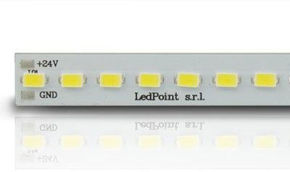
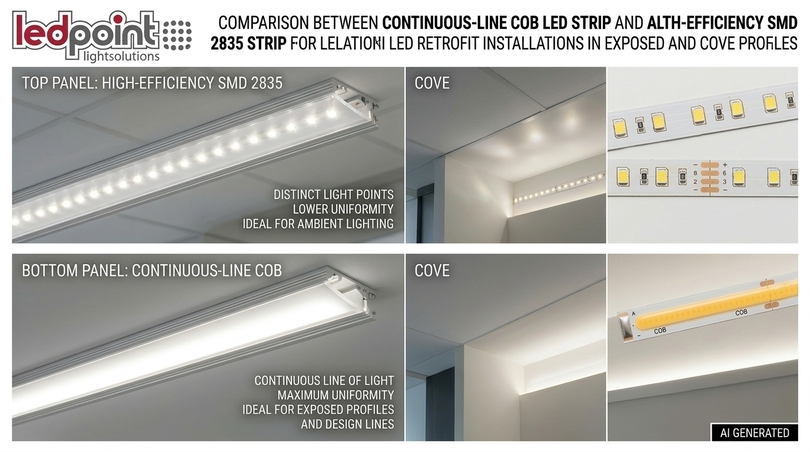
COB LED strips have hundreds of microchips embedded in a continuous layer of phosphors. In the retrofit of shop windows, shelves, light cuts, and shallow profiles, they eliminate the dotted effect that would betray a replacement made with low-density SMD. The model COB LED strip 3000K CRI Ra>93 320 led/m is a reference for residential and hospitality retrofit; for long runs, the 50-meter version FE2-300-320OM2 declares 108 lm/W at 8 W/m. For high fluxes, the 4000K COB F52-400-1600OR2 with 1600 LED/m and CRI over 93 reaches 3700 lm/m, to be obligatorily paired with a dissipating profile of adequate section.
SMD 2835 Strip and high efficiency: the engine of savings
When the strip is hidden in a cove or valance, the priority is efficiency. Ledpoint 2835 LED strips with Honglitronic chips cover most office and commercial retrofits: the FE2-30s-120822, 50 meters, 3000K at 3 MacAdam steps, declares 2465 lm/m and 114 lm/W. The high-efficiency series with current control, such as the 2835 strip 160 led/m 24V with current control, exceeds 160 lm/W: for the same light, less power is needed, therefore fewer power supplies, less heat, and less expense on the bill. Strips with constant current control system also maintain uniform brightness along the entire run.
High color rendering, CCT, and circadian light
In the retrofit of boutiques, museums, restaurants, and hotel rooms, light quality is as valuable as savings. The Sunled line reproduces a spectrum close to solar with a very high color rendering index; CCT strips allow varying the color temperature from warm to cool with a controller; the Circadian Light line follows the natural rhythm of the day, a function appreciated in offices, healthcare facilities, and elderly residences.
Supply voltage: 24V, 48V, or 230V
Voltage is a design choice of the retrofit. 24V LED strips are the standard: safety extra-low voltage (SELV), close cuts, wide choice of controllers. 48V LED strips allow longer runs with less voltage drop, ideal for warehouses, corridors, and perimeter coves of large halls. 230V LED strips eliminate the external power supply and are used for very long outdoor runs, paired with anti-flicker 230V drivers to contain flicker.
Aluminum profiles: dissipation, protection, and optics
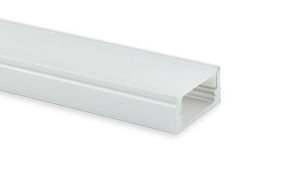
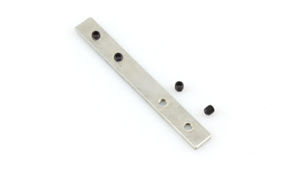
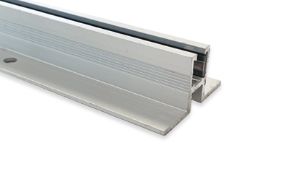
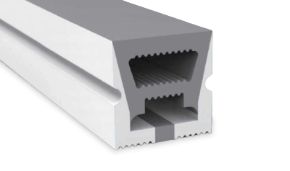
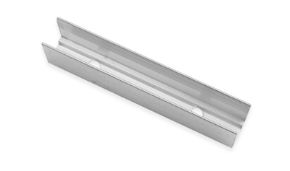
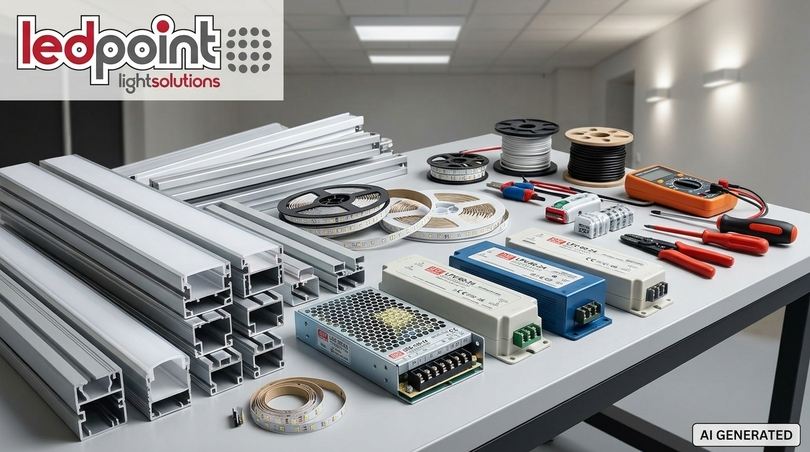
In retrofit, the profile is often the component that makes the difference between an intervention that lasts twenty years and one that decays in two. Ledpoint aluminum profiles dissipate heat, protect the strip, and support the diffuser. For plasterboard retrofits, the trimless profile PR-DW07-01 62x12 mm creates flush light cuts; for offices and clinics, the anti-glare profile PR-CL02-07 50x75 mm shields direct view of the source. The system is completed by diffusers, end caps, mounting clips, and profile joints.
Power supplies: the reliable heart of the retrofit
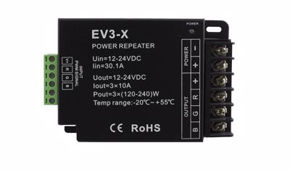
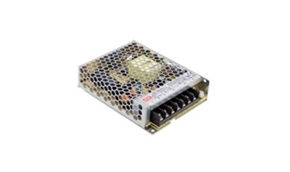
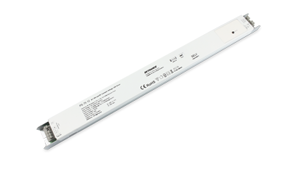
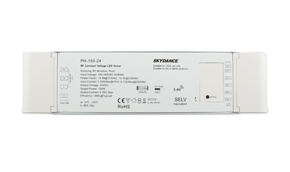
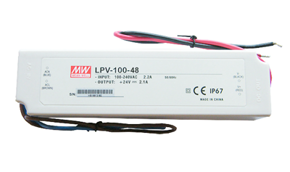
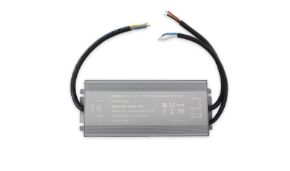
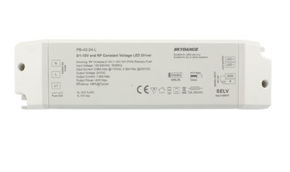
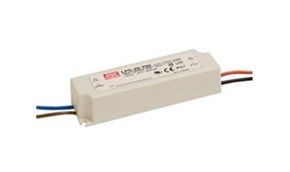
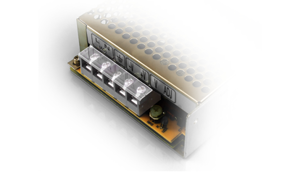
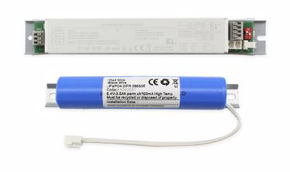
An LED retrofit almost always fails at the power supply. Mean Well power supplies for industry are the professional standard, also available in the 24V power supplies and 48V power supplies categories. Smart power supplies integrate control functions, while constant current power supplies serve modules and sources that require it. When the retrofit also concerns escape routes, the emergency lighting category offers components to maintain service continuity.
Controllers and retrofit control systems
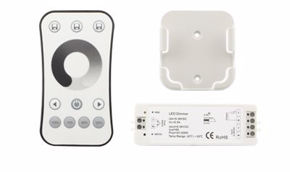
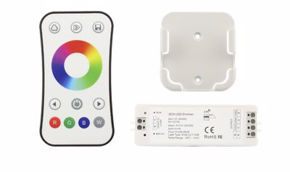
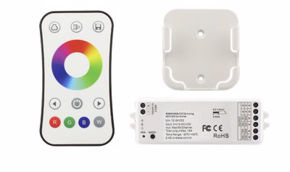
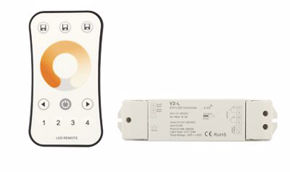
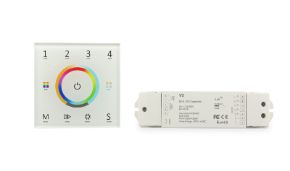
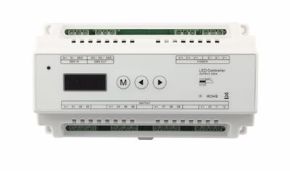
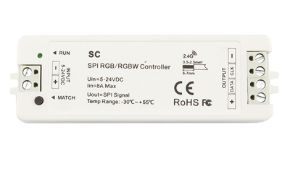
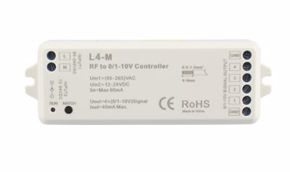
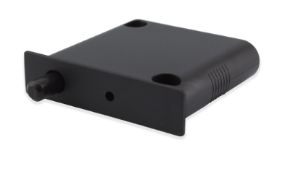
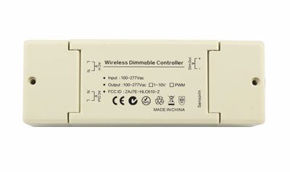
Control transforms retrofit from simple replacement to an intelligent system. Ledpoint controllers cover all protocols encountered in existing buildings: monochromatic and CCT dimmers, 0/1-10V interfaces to integrate the system into supervision systems, DMX and DALI decoders for addressing individual circuits, ZigBee devices for retrofit without new cables, and Skydance controllers V1 series and V3 series for single-zone and multi-zone management.
Connections: where reliability is at stake
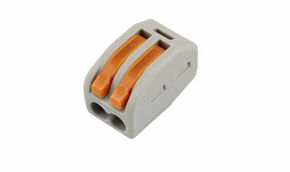
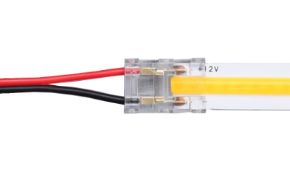
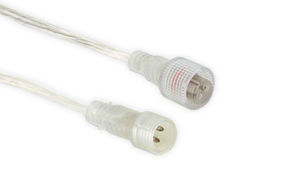
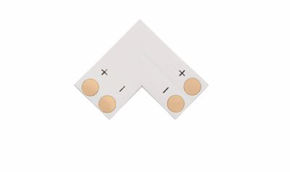
A poorly executed connection is the most frequent cause of intermittent failure. In retrofit, PCB connectors for LED strips, adequately sized cables, soldered joints, and end caps for LED strips are used to restore IP protection after cutting. In commercial contexts with long warranties, soldering with heat shrink tubing remains technically preferable to clip connectors.
Summary table: LED strip retrofit system components
| Component | Function in retrofit | Selection criterion | Ledpoint category |
|---|---|---|---|
| COB Strip | Continuous visible line | Shallow profile, glossy surfaces | COB LED strips |
| High-efficiency 2835 Strip | Maximum savings in cove | lm/W, binning ≤3 SDCM | 2835 LED strips |
| Sunled / CCT / Circadian Strip | Light quality and dynamics | CRI, R9, kelvin range | LED strip lines |
| Aluminum profile | Dissipation and optics | Manageable W/m, PCB width | Aluminum profiles |
| Power supply | Conversion and protection | Power +20-25%, IP, PF, dimmability | Power supplies, Mean Well |
| Controller / interface | Management, scenes, BMS integration | Existing protocol in the building | Controllers, DALI, 0/1-10V, ZigBee |
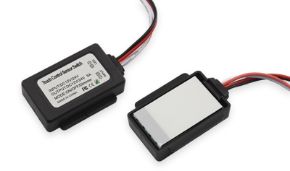
| Sensors | Activation on presence and natural light | Detection area, voltage | Sensors |
| Connectors and cables | Electrical continuity | PCB width, cable section, IP | Accessories |
9. Retrofit and technical requirements: compatibility, thermal, voltage, flicker
Retrofit and technical requirements always go together: an existing building brings with it lines, switches, dimmers, control buses, and geometries that the new LED system must respect. How to avoid incompatibilities between new components and existing systems? With a systematic verification of critical points, which in this section we organize as a project checklist useful for installers, designers, and work directors.
Retrofit system compatibility: the existing electrical line
The first verification concerns the line: conductor section, insulation condition, presence of the protective conductor, coordination with upstream protections. LED electronic power supplies have inrush currents at startup much higher than the nominal current: connecting many of them to the same circuit breaker can cause untimely tripping. The maximum number of power supplies per protection, indicated in the Mean Well technical sheets, must be respected during the project phase.
Existing dimmers and control systems
Many buildings have phase-cut dimmers designed for halogen lamps or 1-10V systems linked to dimmable fluorescent ballasts. The retrofit must decide whether to reuse them, interface with them, or replace them. 0/1-10V interfaces allow recovering existing commands; DALI decoders integrate with existing buses; where no control wiring exists, a ZigBee receiver or radio controller avoids masonry work. A phase-cut dimmer connected to an incompatible power supply is one of the most frequent causes of flicker and premature failures.
Thermal management: the hidden limit of existing coves
Coves and valances built for fluorescent tubes are often closed and poorly ventilated cavities. The LED strip produces less heat than tubes, but concentrates it on a very small surface: without an aluminum profile, the PCB temperature rises, flux drops, and useful life shortens. The practical rule is to choose the profile based on W/m: Ledpoint tables classify profiles into thermal classes from T1 to T5, with recommended maximum powers ranging from a few W/m for micro profiles to over 40 W/m for more generous architectural sections.
Voltage drop and length of runs
In 24V strips, voltage drop along the strip and along the power cable generates drops in brightness and tone differences. Beyond 5 meters, feeding from both ends or from the center is recommended, and the cable from the power supply to the strip must be sized for current and distance. In perimeter coves of large environments, 48V strips or those with constant current control simplify the retrofit project, reducing the number of power points.
Flicker, stroboscopic effect, and electromagnetic compatibility
In industrial retrofit and environments with video cameras, flicker is a technical requirement. High-frequency PWM dimming, like that of Skydance controllers, reduces perceptible flicker and that captured by cameras. Electromagnetic compatibility must also be verified: compliant power supplies and separated wiring between 230V lines and extra-low voltage lines avoid disturbances on data networks, audio systems, and security systems.
Checklist of technical requirements for retrofit
| Verification | Question to ask | Risk if ignored | Solution |
|---|---|---|---|
| Electrical line | Section, insulation, PE, adequate protections? | Overheating, tripping | Instrumental verification, adaptation |
| Inrush currents | How many power supplies per breaker? | Tripping at startup | Respect of sheet limits |
| Existing control | Phase cut, 1-10V, DALI, KNX? | Flicker, incompatibility | Dedicated interfaces |
| Thermal | Closed cove? Expected W/m? | Flux drop, failures | Profile of adequate thermal class |
| Voltage drop | Runs over 5 m? | Non-uniform brightness | Dual power supply, 48V |
| Inspectability | Power supplies reachable? | Future demolitions | Hatches and technical compartments |
| IP protection | Humidity, dust, washing? | Corrosion, short circuits | IP65-IP68 strips and accessories |
| Emergency | Does the circuit power escape routes? | Non-compliance | Components for emergency lighting |
10. Phases of design and realization of the retrofit
The phases of a retrofit project follow a sequence that every professional should make explicit to the client: diagnosis, design, technology selection, installation, testing, and commissioning. Skipping a phase does not shorten times: it moves them forward, when correcting costs much more. This section describes the operational path with the detail necessary to write a realistic schedule.
Phase 1: energy diagnosis before retrofit
The energy diagnosis before retrofit photographs the state of the art. Light points are censused (type, power, power supply, condition), existing illuminance levels in lux are measured, real operating hours are detected, and consumption is read, ideally with an energy meter on the lighting line. How to understand if a building is suitable for an energy retrofit project? You understand it right here: systems with many operating hours, fluorescent or halogen sources, structures in good condition, and recoverable lines are ideal candidates.
What data is needed to develop an accurate retrofit project
An accurate retrofit project requires: updated floor plans with source positions; dimensions and sections of coves, valances, and housings; powers and types of existing power supplies; circuit and command diagrams; existing control protocol; illuminance levels required by UNI EN 12464-1 for workplaces; operating hours per zone; average electricity tariff. Without this data, any savings estimate is a hypothesis, and the client is right to distrust it.
Phase 2: retrofit intervention design
Retrofit intervention design translates data into choices. The necessary flux for each zone is calculated, the strip family is chosen, profiles, power supplies, cables, and protections are sized, and the control scheme is defined. The basic calculation is simple: total flux in lumens equals required illuminance per surface, divided by the product of utilization factor and maintenance factor. Dividing the flux by the strip efficiency in lm/W yields the power; dividing by lumens per meter yields the meters of strip. For complex geometries, a lighting simulation is advisable.
Phase 3: technology selection and bill of materials
Once the retrofit project is defined, the bill of materials is compiled: strip codes, profiles, diffusers, accessories, power supplies, controllers, sensors. All material for the same environment must be ordered in a single supply, to guarantee batch and binning uniformity; strips from different batches may show visible tone differences in the same cove. It is also the moment to decide between standard and custom components, evaluating with Ledpoint technical support cuts, wiring, and pre-assembled kits that reduce times on site.
Phase 4: retrofit systems installation
Retrofit systems installation follows a precise order: circuit safety, removal of sources, ballasts, and starters (with disposal of tubes as WEEE waste containing mercury), verification and cleaning of housings, profile placement, strip placement and connection, placement of power supplies in inspectable points, control connection. Is it possible to carry out the retrofit without completely interrupting services? Yes: in occupied buildings, it proceeds by zones or circuits, during closing hours or weekends, always keeping escape route lighting active.
Phase 5: retrofit system testing and commissioning
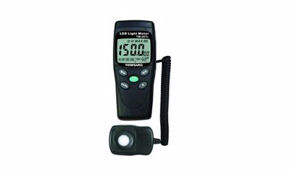
Retrofit system testing verifies that the declared performance has been reached. Illuminance and uniformity, absorbed power, profile temperature after one hour of operation at 100%, absence of flicker, correct operation of scenes, sensors, and commands are measured. The installer releases the system declaration of conformity and delivers to the client diagrams, technical sheets, power supply locations, and maintenance indications. Only at this point does the retrofit enter into operation and the results monitoring period begins.
Table of retrofit project phases
| Phase | Main activities | Typical responsible | Output | Indicative duration (medium building) |
|---|---|---|---|---|
| 1. Diagnosis | Census, lux measurements, consumption, hours | EGE, designer, ESCo | Diagnosis report | 1-3 weeks |
| 2. Design | Calculations, system selection, diagrams | Lighting/electrical designer | Project and computation | 1-3 weeks |
| 3. Bill of materials and supply | Codes, batches, custom kits | Designer + supplier | Single order | 1-3 weeks |
| 4. Installation | Removal, placement, wiring | Company authorized by DM 37/2008 | Installed system | From days to a few weeks, by zones |
| 5. Testing | Measurements, verifications, documentation | Installer + work director | Declaration of conformity | 1-3 days |
| 6. Monitoring | Consumption reading, baseline comparison | Energy manager | Savings report | 12 months recommended |
11. Regulations, authorizations, certifications, and safety
A well-designed retrofit is also a compliant retrofit. Italian retrofit regulation, for lighting, is not contained in a single text but in a set of European regulations, product directives, technical standards, and system laws. Knowing its structure allows designers and installers to deliver a defensible system, and clients and administrators to know which documents to demand. In this section, we summarize obligations, authorizations, retrofit certifications, and safety requirements.
Component certifications: what a product must have for retrofit
Every component of an LED strip retrofit system must comply with applicable European directives and be CE marked. The Low Voltage Directive 2014/35/EU, the electromagnetic compatibility directive 2014/30/EU, and the RoHS directive are the basic reference, along with Regulation 2019/2020 on eco-design and Regulation (EU) 2019/2015 on energy labeling of light sources. The most recurring product technical standards are the EN 60598 series for luminaires, EN 62031 for LED modules, EN 61347 series for power units, and EN 62471 for photobiological safety. The strips in the Ledpoint catalog are CE and RoHS certified, and the sheets report the energy class.
Retrofit system compliance: CEI 64-8 and DM 37/2008
From the system point of view, retrofit system compliance passes through the CEI 64-8 standard for electrical utilization systems and DM 37/2008, which reserves installation to authorized companies and requires the release of the declaration of conformity at the end of the retrofit works. An LED retrofit that modifies power supply, protections, or circuits is an intervention on the electrical system and must be documented as such. For workplaces, UNI EN 12464-1 sets maintained illuminance, uniformity, glare (UGR), and minimum color rendering; for safety lighting, UNI EN 1838 and related standards.
Whoever modifies a device becomes responsible for it
There is a delicate, little-known, and decisive point. According to the European Union's Blue Guide on the implementation of product legislation, whoever substantially modifies a product already placed on the market may assume the obligations of the manufacturer. Transforming a CE-marked fluorescent luminaire by inserting an LED strip and a new power supply inside it may constitute a substantial modification of the appliance. In the retrofit of architectural coves, valances, and niches, however, the system is built on-site with individually compliant components, installed following the respective manufacturers' instructions. The distinction must be evaluated case by case by the designer, and it is one of the reasons why LED strip retrofit in architectural structures is often preferable to the tampering of standard appliances.
Retrofit intervention authorizations
What authorizations are needed? Indoor lighting retrofit, when it does not modify structures, facades, or intended use, generally falls under interventions that do not require building permits. The main exceptions are three: buildings protected under the Cultural Heritage Code, where any intervention affecting appearance must be agreed with the Superintendence; signs and lighting visible from the outside, regulated by municipal regulations; common condominium parts, which require an assembly resolution. For energy consumption containment interventions on common parts, Art. 26 of Law 10/1991, as amended by the condominium reform, provides for facilitated majorities. In any case, before starting retrofit works, it is advisable to verify with an authorized technician and the applicable municipal and condominium regulations.
Safety in retrofit works
Safety in retrofit works concerns both the construction site and the finished system. On the construction site, Legislative Decree 81/2008, rules for work at height, and CEI 11-27 standard for electrical work apply, which requires qualified personnel and de-energization procedures. On the finished system, the extra-low SELV voltage of 24V and 48V strips reduces contact risk; removed fluorescent tubes must be managed as waste containing mercury, through WEEE channels. A safe retrofit is also one where power supplies remain accessible and ventilated, never walled up or covered by thermal insulation.
Table of regulatory references for LED retrofit
| Reference | Scope | What it requires in retrofit |
|---|---|---|
| Regulation (EU) 2019/2020 | Eco-design of light sources | Minimum efficiency, CRI, flicker limits (Pst LM, SVM) |
| Regulation (EU) 2019/2015 | Energy labeling | Declared energy class of sources |
| Directives 2014/35/EU and 2014/30/EU | Electrical safety, EMC | CE marking of components |
| Directive 2011/65/EU (RoHS) | Hazardous substances | Components free of prohibited substances; fluorescent phase-out |
| EN 60598, EN 62031, EN 61347, EN 62471 | Product standards | Safety of luminaires, modules, power supplies, photobiological risk |
| CEI 64-8 | Electrical systems | Design and execution according to the rule of art |
| DM 37/2008 | System installation | Authorized company, declaration of conformity |
| UNI EN 12464-1 | Indoor workplaces | Maintained lux, uniformity, UGR, CRI |
| UNI EN 1838 | Emergency lighting | Continuity of escape routes |
| Legislative Decree 81/2008, CEI 11-27 | Safety in retrofit works | Procedures, qualified personnel |

12. Retrofit costs, return on investment, and amortization
Retrofit costs are the first question of every client, and retrofit return on investment is the second. Answering with a dry number is impossible without diagnosis; answering with a method is instead a duty. In this section, we explain which factors determine costs, how to calculate retrofit amortization time, and how to build a credible retrofit cost-benefit analysis, with a complete numerical example elaborated by Ledpoint on technical sheet data of catalog products.
What retrofit costs depend on
The cost of an LED strip retrofit is composed of four items: materials (strips, profiles, diffusers, accessories), power supply and control (power supplies, controllers, sensors), labor (removal, placement, wiring, testing), and ancillary charges (disposal, scaffolding or platforms, finishing works, design). The variables that shift the retrofit quote the most are the accessibility of the housings, the required level of control, and the need to adapt the lines. A retrofit in an accessible cove from a ladder is very different from one in an eight-meter-high hall.
Indicative ranges per linear meter of LED strip retrofit
| Item | Basic configuration | Professional configuration | Premium configuration |
|---|---|---|---|
| LED Strip | Standard SMD 2835 | High efficiency or COB | Sunled, CCT, Circadian |
| Profile and diffuser | Surface profile | Valance or recessed profile | Trimless, anti-glare, custom |
| Power supply and control | On/off power supply | Dimmable power supply + dimmer | DALI, sensors, scenes, BMS |
| Order of magnitude of materials | Tens of euros per meter | Several tens of euros per meter | Up to over a hundred euros per meter |
The ranges are indicative: the real quote must be built on the project's bill of materials, requesting updated catalog prices and quotations for any custom processing. In premium configurations, the higher cost is justified by light quality and control functions that impact comfort, sales, and property value.
How to calculate return on investment
The average payback time for an efficiency intervention is calculated with the simple payback: net investment divided by annual savings. Annual savings include energy savings (power difference times operating hours times kWh cost) and maintenance savings (avoided tubes, starters, ballasts, and labor). Net investment is the total cost minus any incentives. For larger projects, NPV and IRR are also used, which account for the time value of money, and the useful life of the LED system, much longer than the payback, is considered.
Calculation example: retrofit of a hall's cove lighting
Consider a hotel hall with 80 meters of cove lighting illuminated by 28 W T5 tubes with electronic ballast, about one tube per meter, on for 6,000 hours a year. The system power of the tubes, including the ballast, is in the order of 27 W/m. The retrofit provides a high-efficiency 24V 2835 strip, over 160 lm/W, regulated to about 10 W/m in a valance profile, with dimmable Mean Well power supplies. The energy cost is hypothesized at 0.25 €/kWh.
| Parameter | Before (T5) | After (LED strip retrofit) | Difference |
|---|---|---|---|
| Power per meter | ≈ 27 W/m | ≈ 10 W/m | −17 W/m |
| Total power (80 m) | 2,160 W | 800 W | −1,360 W (−63%) |
| Annual energy (6,000 h) | 12,960 kWh | 4,800 kWh | −8,160 kWh |
| Annual energy cost | 3,240 € | 1,200 € | −2,040 € |
| Tube maintenance (life ≈ 20,000 h) | ≈ 300 €/year | Negligible | −300 € |
| CO2 avoided (≈ 0.26 kg/kWh) | — | — | ≈ 2.1 t/year |
| Hypothesized investment (materials + installation) | — | ≈ 5,000 € | — |
| Simple payback | — | — | ≈ 2.1 years |
With a payback of about two years and a useful life exceeding fifteen, the retrofit generates over a decade of net savings, not counting the benefit on cooling loads and comfort improvement. This is an example calculation with declared hypotheses: hours, tariff, installation costs, and real powers must be replaced with the data of the single construction site.
Economic benefits of retrofit beyond the bill
The economic benefits of retrofit do not end with energy savings. Maintenance interventions, downtime due to failures, spare parts warehouse are reduced, and, in the tertiary sector, the attractiveness of the property for tenants increases. In commercial activities, better light impacts customer停留 and product perception, an effect difficult to quantify but real. The extension of the useful life of systems, finally, postpones heavier investments in time.

13. Tax incentives and financing for energy retrofit
Italian retrofit tax incentives change often, and for this reason, they must always be verified at the date of the retrofit intervention. For lighting, today, the main reference for tertiary and public administration buildings is the Conto Termico 3.0, flanked by White Certificates for businesses and financial instruments like energy performance contracts. In this section, we present an indicative overview: retrofit incentive regulation always requires punctual verification with your consultant and GSE rules.
Conto Termico 3.0 and efficient lighting
The Conto Termico, managed by GSE, was updated with the decree of August 7, 2025 (Conto Termico 3.0). Among the admitted energy efficiency increase interventions is the replacement of indoor lighting systems and external pertinences of existing buildings with efficient systems, along with the installation of building automation technologies. Public administration, third-sector entities, and, for tertiary buildings, also private subjects and companies can access it. Among the technical requirements foreseen for lighting, a color rendering index higher than 80 for interiors is indicated. Percentages, ceilings, efficiency requirements, and access methods are defined by the decree and the GSE Application Rules, which must be consulted before designing the retrofit intervention.
White Certificates for businesses
White Certificates, or Energy Efficiency Certificates, reward certified energy savings obtained from efficiency projects. For a company planning lighting retrofit across multiple sites or plants, they can represent a contribution to evaluate, typically with the support of an ESCo or an energy management expert, because they require the measurement and reporting of savings against a baseline.
Deductions for energy refurbishment in homes
For homes, the replacement of light sources alone is not normally an incentivizable intervention autonomously. Lighting retrofit can fall under deductions for building works when it is part of larger works, for example, the refurbishment of the electrical system within the scope of extraordinary maintenance, or the installation of building automation systems where provided. Rates, spending ceilings, and conditions are established year by year by the budget law: for energy refurbishment deductions, the reference information source is the ENEA portal for energy efficiency.
Energy efficiency financing and EPC contracts
When capital is the constraint, there are energy efficiency financing instruments that do not require advancing the entire expense. The energy performance contract (EPC) with an ESCo links the remuneration of the investment to the savings actually obtained; leasing and operational rental distribute the cost over time. For an LED retrofit with a payback of two or three years, these instruments often make the retrofit intervention cash-flow positive from the first year.
Retrofit contributions: summary framework
| Instrument | Typical beneficiaries | Relevance for LED retrofit | Where to verify |
|---|---|---|---|
| Conto Termico 3.0 | PA, ETS, private individuals and companies on tertiary buildings | Direct: efficient lighting and building automation | GSE, Application Rules |
| White Certificates | Companies, ESCos | Measured savings projects | GSE |
| Building deductions | Private individuals, condominiums | Indirect, if part of larger works | ENEA, Revenue Agency |
| EPC / third-party financing | Companies, condominiums, PA | High, thanks to short paybacks | Certified ESCos |
| Leasing / rental | Companies | High for multi-site systems | Financial institutions |

14. Criticalities, limits, and risks of retrofit
A serious professional also presents the problems of retrofit to the client, not only the advantages. Knowing limits and risks in advance allows preventing them in the project, providing budget reserves, and avoiding disputes. The most common criticalities concern technical compatibility, structural constraints, unexpected costs, operational downtime, and component availability.
Limits of retrofit in existing buildings
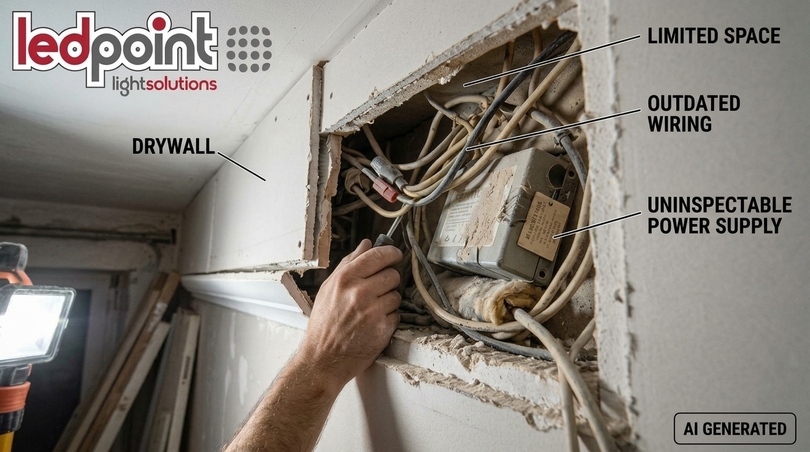
Existing buildings impose their geometry. Coves that are too low, valances with insufficient edges, closed cavities without ventilation, and non-inspectable suspended ceilings limit choices: sometimes the strip remains visible to the eye, sometimes there is no space for the power supply, sometimes the adequate profile does not fit in the housing. In historic buildings, protection constraints may prevent modifying finishes and positions. In these cases, the retrofit project must adapt with custom profiles, low-profile strips, and remote power supplies.
Retrofit problems: compatibility and outdated systems
The most insidious problem is the existing system in poor condition: degraded insulation, oxidized joints, absent protective conductors. Retrofit must not become the occasion to power new sources with an old and unsafe line: the diagnosis must include instrumental verifications, and the quote a line for any adaptations. Retrofit system compatibility also concerns commands: unsuitable dimmers, luminous switches with leakage currents, obsolete control buses.
Retrofit project risks: unexpected costs and operational downtime
Among the most recurring retrofit project risks are unexpected costs emerged upon opening the housings and unplanned downtime. A 10-15% reserve on the budget and a sample survey before the final quote drastically reduce surprises. Downtime is managed with a zone-by-zone schedule agreed with the building occupants, and with safety lighting always guaranteed.
Industrial retrofit criticalities
In industrial retrofit, criticalities are specific: environments with dust, oils, vibrations, and high temperatures; moving parts that make the stroboscopic effect dangerous; very short machine downtime windows. High-protection strips in closed profiles, industrial power supplies, and planning that exploits scheduled stops are required. Every intervention must be coordinated with the plant's safety manager.
Component availability and batch uniformity
A retrofit extended over multiple phases risks installing strips from different batches, with tone differences. The solution is to order all material for the same zone in a single supply, choose strips with tight binning (3 MacAdam steps), and provide a small spare for future repairs. Relying on a supplier with a stable catalog and technical assistance reduces the risk of no longer finding the original component.
Table of risks and countermeasures
| Risk | Probability | Impact | Countermeasure |
|---|---|---|---|
| Insufficient space in housing | Medium | Medium | Dimension survey, custom profiles |
| Existing line not suitable | Medium | High | Instrumental verifications in diagnosis |
| Incompatibility with existing dimmers | High | Medium | 0/1-10V, DALI, ZigBee interfaces |
| Overheating in closed coves | Medium | High | Profile of adequate thermal class |
| Tone differences | Medium | Medium | Single order, binning ≤3 SDCM |
| Operational downtime | Medium | High | Zone-by-zone schedule |
| Unexpected costs | Medium | Medium | 10-15% budget reserve |
15. Examples and application cases of LED strip retrofit
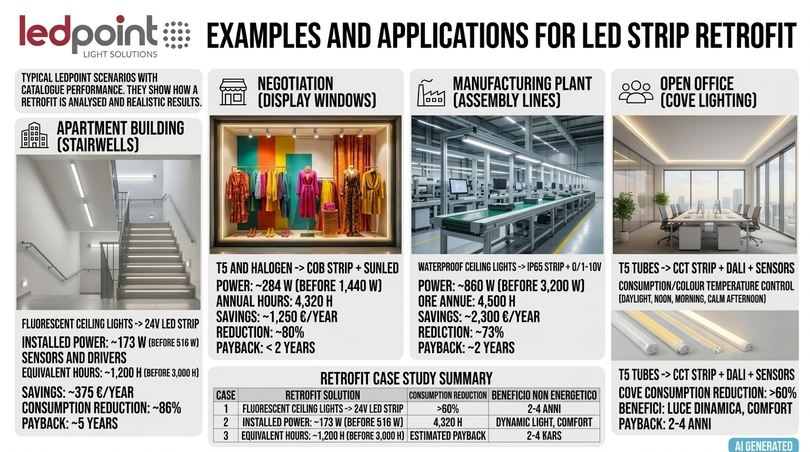
The following energy retrofit examples are typical scenarios, built by the Ledpoint technical team with declared hypotheses and with the sheet performance of catalog products. They do not replace the diagnosis of the single building, but show how one reasons about a retrofit and what results retrofit interventions are realistic in four very different contexts: a condominium, a shop, a production plant, and an office. Each case closes with lessons learned, which are often the most useful part of a building retrofit case history.
Case 1: retrofit of condominium stairs
A six-story condominium has stairs and entrance halls illuminated by 12 fluorescent luminaires of 36 W with electromagnetic ballast, about 43 W each, controlled by twilight sensor and timer for about 3,000 hours a year. The retrofit provides 12 meters of 24V 2835 strip at 14.4 W/m in a surface profile, with a presence sensor per landing and a minimum courtesy level during night hours. The equivalent full-power operating time drops to about 1,200 hours.
| Parameter | Before | After retrofit |
|---|---|---|
| Installed power | ≈ 516 W | ≈ 173 W |
| Equivalent hours | 3,000 h | ≈ 1,200 h |
| Annual energy | ≈ 1,550 kWh | ≈ 210 kWh |
| Savings at 0.28 €/kWh | — | ≈ 375 €/year |
| Consumption reduction | — | ≈ 86% |
| Payback with investment ≈ 1,900 € | — | ≈ 5 years |
Lesson learned from retrofit: in condominium retrofit, the sensor is as valuable as the source. Merely replacing the luminaires would have halved consumption; sensors reduce it by almost nine-tenths. It is also the simplest argument to present in assembly: a number on the bill, a share per thousandths, a payback time.
Case 2: retrofit of shop windows and niches
A clothing store has 20 meters of shop windows with T5 tubes (about 27 W/m) and 6 niches with 150 W linear halogens, on for 4,320 hours a year. The retrofit employs high color rendering COB strips at about 10 W/m in slim profiles and 6 meters of 2700K Sunled strip at about 14 W/m in the niches. Power drops from about 1,440 W to about 284 W, with an estimated savings of about 5,000 kWh a year, equal to about 1,250 € at 0.25 €/kWh, and a payback under two years with an investment in the order of 2,400 €.
Lesson learned from retrofit: in retail, retrofit is sold with light quality, justified with savings. The disappearance of halogen heat also improved customer comfort and reduced the load on the shop window's summer conditioning; fabric colors, with high CRI, appear more faithful. In shops, it is advisable to provide scenes for opening, closing, and cleaning, managed by a multi-zone controller.
Case 3: retrofit of production line lighting
A plant has 40 sealed 2x36 W luminaires (about 80 W each) above the stations of an assembly line, on for 4,500 hours a year on two shifts. The retrofit installs above each station 1.5 meters of 24V IP65 strip at 14.4 W/m in a closed profile, with a 0/1-10V interface connected to department supervision. Power drops from 3,200 W to about 860 W; savings are about 10,500 kWh a year, over 2,300 € at 0.22 €/kWh, with a payback of about two years on an investment of about 4,800 €.
Lesson learned from retrofit: in production line retrofit, light must be brought where needed, not diffused everywhere. Bringing the source closer to the work plane increases useful illuminance and reduces power; the absence of flicker eliminates stroboscopic effects on moving parts. Installation was planned during the summer shutdown, with no impact on production.
Case 4: retrofit of an open space with perimeter coves
A 400 m² open space has direct light from already LED panels and 60 meters of perimeter coves with T5 tubes, on for 2,800 hours a year. The retrofit replaces the tubes with CCT strips in a valance profile, governed by DALI controllers and natural light sensors: in the morning the light is cooler and more intense, in the afternoon warmer and regulated based on window contribution. Energy savings exceed 60% on the cove quota, and perceived comfort improves significantly according to internal questionnaires.
Lesson learned from retrofit: retrofitting only the "forgotten" components (coves, valances, corridors) is often the most convenient, because these are loads on for a long time and never optimized. Integrating dynamic light into the retrofit transformed a savings intervention into a well-being project, appreciated also in the key of building environmental certifications.
Summary table of retrofit case studies
| Case | Retrofit solution | Consumption reduction | Estimated payback | Non-energy benefit |
|---|---|---|---|---|
| Hotel hall (section 12) | High-efficiency strip in valance | ≈ 63% | ≈ 2 years | Continuous line, dimming |
| Condominium stairs | 24V strip + sensors | ≈ 86% | ≈ 5 years | Safety, zero maintenance |
| Shop | High CRI COB + Sunled | ≈ 80% | < 2 years | Color rendering, less heat |
| Production line | IP65 strip + 0/1-10V | ≈ 73% | ≈ 2 years | No stroboscopic, targeted light |
| Open space | CCT strip + DALI + sensors | > 60% | 2-4 years | Dynamic light, comfort |
16. Retrofit for energy managers, administrators, designers, and owners
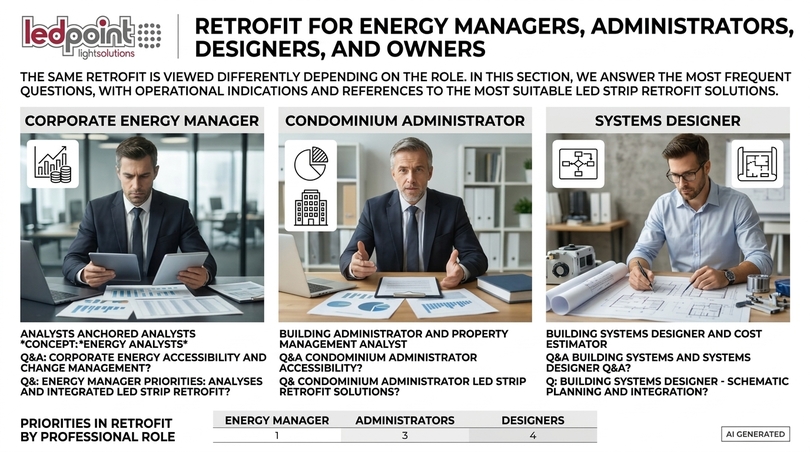
The same retrofit is viewed differently depending on the role. The energy manager asks for numbers, the condominium administrator asks for clarity and allocations, the designer asks for compatibility, the owner asks for value. In this section, we answer the most recurring questions of each figure, with operational indications and references to the most suitable LED strip retrofit solutions.
Corporate energy manager
Which energy retrofit interventions guarantee the greatest savings on consumption?
On lighting, the greatest savings come from retrofitting the loads on the longest with the least efficient sources: fluorescent coves and valances, production areas, warehouses, corridors, and technical rooms always on. Combining high-efficiency source, presence sensors, and regulation based on natural light typically leads to reductions exceeding 70% on the lighting quota. Light retrofit must then be coordinated with thermal system retrofit, because it reduces their internal loads.
How are the results obtained after a retrofit intervention measured?
Consumption measured after retrofit is compared with a baseline measured before, normalized for hours of activity and use. The international methodological reference is the IPMVP measurement and verification protocol. An energy meter on the lighting line and the recording of operating hours are sufficient in most cases; in projects with White Certificates, measurement is mandatory.
Condominium administrator
Which retrofit interventions are most suitable for a condominium built many years ago?
For lighting, the most effective are the retrofit of stairs, entrance halls, garages, and cellars with LED sources and presence sensors, and the replacement of outdoor lighting bodies of driveways and entrances. These are brief interventions, which do not require entering the apartments and which are executed without interrupting services, proceeding by floor or by staircase.
How to present the retrofit project to condominium owners and how to allocate costs?
The most convincing presentation is a page with three numbers: cost, annual savings, payback years, flanked by the before/after comparison and the share per thousandths. Expenses are normally allocated according to the thousandths tables applicable to the common parts interested and the condominium regulation; for the necessary majorities and for any particular criteria, a verification with the condominium's legal consultant is advisable.
System designer
How is the state of a system analyzed before designing a retrofit?
With a systematic survey: census of sources and power supplies, lux measurement, instrumental verification of lines, verification of commands and control buses, measurement of temperatures in housings. The same approach used for an HVAC system: first the state of the art, then the target performance, finally the choices.
Which technologies integrate an old system with building automation?
0/1-10V interfaces, DALI decoders, and gateways to KNX or supervision systems allow bringing light into the building automation system. Where it is not possible to lay cables, Zigbee radio allows a wireless retrofit. Presence and natural light sensors complete the retrofit control system.
What are the most common errors in designing a retrofit intervention?
There are five recurring errors: sizing based on power instead of flux; ignoring the thermal of cavities; not providing accessibility for power supplies; underestimating voltage drop in long runs; choosing control at the end of the project instead of at the beginning. All are avoided with the checklist in section 9 and with Ledpoint matching tables.
Commercial building owner
Which retrofit interventions most increase the value of a commercial building?
Those that improve energy performance, comfort, and manageability together: lighting retrofit with intelligent control, building automation, interventions on the envelope and air conditioning. A modern, documented, and tele-manageable lighting system is a concrete argument in negotiation with tenants and contributes to the improvement of the energy class in non-residential.
How to reduce consumption without a complete restructuring, and in what time?
Lighting retrofit is precisely the answer: consumption is reduced leaving suspended ceilings, coves, and finishes in place. In an occupied commercial building, retrofit is organized by floors or zones, often during closing hours: depending on the size, it goes from a few days for a shop to a few weeks for an office building, with diagnosis and design preceding the construction site.
Table of priorities by professional figure
| Figure | Retrofit priority | Key indicator | Typical Ledpoint solution |
|---|---|---|---|
| Energy manager | Measurable savings, CO2 | kWh/year, payback | High-efficiency strip + sensors + DALI |
| Condominium administrator | Clarity, continuity of services | €/year, thousandths quota | 24V strip + presence sensors |
| System designer | Compatibility, BMS integration | Lux, UGR, protocols | 0/1-10V, DALI, ZigBee interfaces |
| Commercial owner | Value, attractiveness, times | Energy class, rent | COB, Sunled, CCT with scenes |
17. Who does retrofit in Italy and how to choose the company
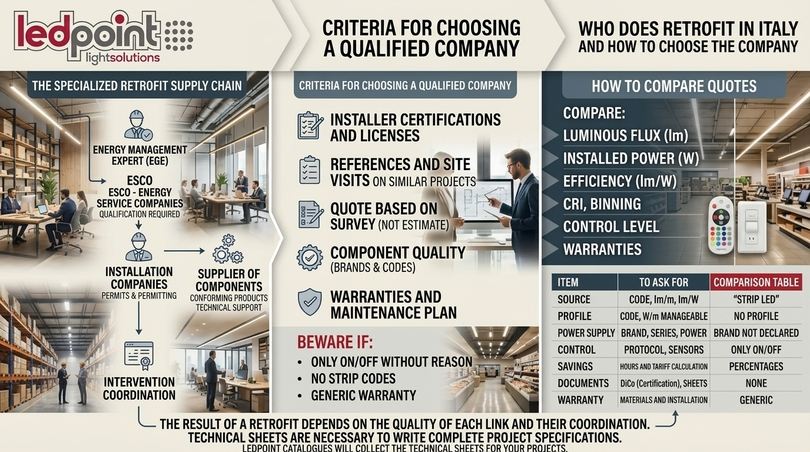
Who does retrofit in Italy? A supply chain of different figures: designers, energy management experts, ESCos, installation companies, lighting designers, and component suppliers. The result of a retrofit depends on the quality of each link and their coordination. This section offers practical criteria for choosing a company specialized in retrofit and for comparing quotes correctly.
The figures of the retrofit supply chain
The energy retrofit professional par excellence is the Energy Management Expert (EGE) certified according to UNI CEI 11339, who conducts efficiency diagnoses and projects. ESCos certified according to UNI CEI 11352 offer energy services with guaranteed results and EPC contracts. Installation companies must be authorized pursuant to DM 37/2008. The component supplier, finally, must guarantee compliant products, complete technical sheets, availability over time, and technical support.
How to choose a retrofit company
How to choose a qualified company to carry out the retrofit? By verifying five elements: installer retrofit authorizations and certifications; references on similar interventions, with the possibility of visiting them; a quote based on survey and not on sight estimate; the quality of proposed components, with declared brands and codes; guarantees on materials and installation and the maintenance plan. Distrust quotes that do not indicate powers, lm/W, CRI, and power supply brand.
Retrofit quote comparison: how to read them
In the comparison between retrofit quotes, the total price is the last data to look at, not the first. First, compare provided luminous flux, installed power, efficiency, component quality, control level, guarantees. Two offers with the same price can differ by 40% in future consumption. The following table proposes a comparison grid usable by clients and administrators.
| Item to compare | What to ask | Alarm signal |
|---|---|---|
| Source | Strip code, lm/m, lm/W, CRI, binning | "LED strip" without code |
| Profile | Code, section, manageable W/m | Strip without profile |
| Power supply | Brand, series, power, margin | Brand not declared |
| Control | Protocol, sensors, scenes | Only on/off without reason |
| Savings calculation | Hypotheses of hours and tariff | Percentages without calculation |
| Documentation | DiCo, technical sheets, diagrams | No documentation foreseen |
| Guarantee | Duration on materials and installation | Generic guarantee |
Ledpoint's role in retrofit
Ledpoint, based in Faenza, is a reference point for installers, retailers, and professionals in the sector of professional LED strips and aluminum profiles. In retrofit, the value of a specialized supplier lies in the complete system catalog and technical support during the project phase: verification of strip-profile matching, sizing of power supplies and controllers, custom processing. Ledpoint catalogs collect the technical sheets necessary to write complete retrofit specifications.
18. Maintenance, monitoring, and post-retrofit management
Retrofit does not end with testing. Post-retrofit management is the phase that transforms a savings estimate into certified savings, and that protects the investment over time. Retrofit performance monitoring, retrofit system maintenance, and energy savings verification are simple activities, but they must be planned and entrusted to a responsible person.
Retrofit performance monitoring
Monitoring compares real consumption with the baseline and project forecasts. In the first twelve months, it is advisable to read consumption at least monthly, to immediately intercept any anomalies: poorly regulated sensors, scenes left at 100%, circuits on outside of hours. Smart power supplies and DALI systems can provide status and consumption data directly to the supervision system.
Energy savings verification
Energy savings verification is executed at the end of the first year with a synthetic report: kWh saved, euros saved, CO2 avoided, comparison with project calculation and motivated deviations. It is the document that the energy manager brings to management and that the administrator presents in assembly, and it is also the basis for planning subsequent retrofits on other systems.
Retrofit system maintenance
A profiled LED strip system requires little maintenance, but not none. The plan provides for periodic cleaning of diffusers, visual check of uniformity, verification of power supplies and connections, testing of sensors and scenes. In dusty or industrial environments, cleaning is more frequent; in sanitary environments, closed profiles and smooth, easily sanitizable diffusers are chosen. Keeping a small spare of the same batch of strips simplifies any repair.
Retrofit control systems and extension of system useful life
Retrofit control systems do not only serve to save: by reducing hours at full power and operating temperature, they extend the life of sources and power supplies. A strip dimmed to 80% works cooler and maintains its flux longer. The extension of system useful life is therefore a direct benefit of good regulation, which adds to the savings on the bill.
Post-retrofit management plan
| Activity | Recommended frequency | Responsible | Objective |
|---|---|---|---|
| Lighting consumption reading | Monthly (first year) | Energy manager / administrator | Verify savings |
| Verification of scenes and sensors | Quarterly | Maintainer | Avoid waste |
| Diffuser cleaning | Semi-annual / annual | Maintainer | Maintain flux |
| Check of power supplies and connections | Annual | Authorized company | Prevent failures |
| Savings verification report | Annual | Energy manager / EGE | Reporting and new interventions |
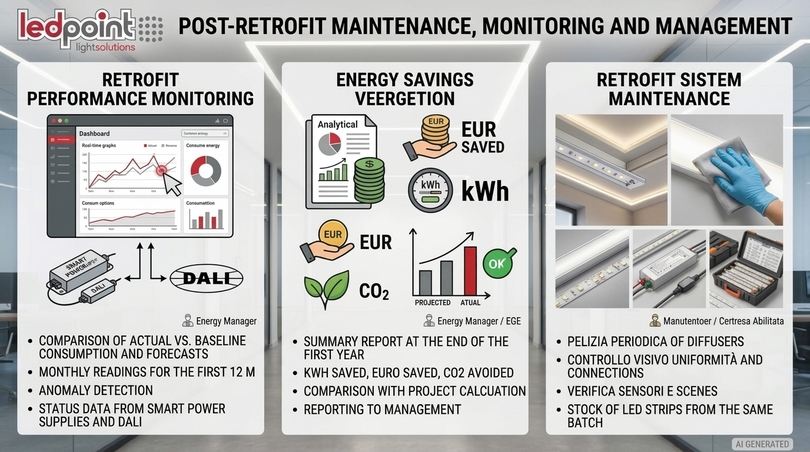
19. Frequently asked questions about LED retrofit
We collect here the questions that professionals and clients ask us most often about retrofit. Every answer is designed to be brief, precise, and immediately usable; for in-depth information, we refer to the guide sections and Ledpoint technical support.
What is retrofit in lighting?Lighting retrofit is the refurbishment of an existing system that replaces obsolete sources, such as fluorescent tubes, halogens, and glass neon, with efficient LED systems, preserving structures, housings, and most of the lines. It reduces consumption, eliminates recurring maintenance, improves light quality, and enables dimming and intelligent control. |
What is the difference between retrofit and relamping?Relamping replaces only the lamp with a more efficient one, leaving the appliance and power supply unchanged. Retrofit is deeper: it replaces the source and power supply, adapts thermal management, and often introduces a new control system. With LED strip retrofit, continuous lines of light, greater efficiency, and quality dimming are obtained. |
How much is saved with an LED strip retrofit?By replacing fluorescent tubes with high-efficiency LED strips, savings on the lighting quota are typically between 50% and 65%; compared to halogens, it exceeds 85%. With presence sensors and regulation on natural light, it can exceed 80% overall. The real value depends on operating hours, existing powers, and tariff. |
What is the payback time of an LED retrofit?In environments on for many hours, such as halls, shops, offices, and production lines, the simple payback of an LED retrofit is often between one and three years. In common condominium areas, with fewer operating hours, it frequently falls between three and six years. Incentives, where applicable, further reduce the amortization time. |
Is lighting retrofit incentivized?Yes, in several cases. Conto Termico 3.0 includes the replacement of indoor and outdoor pertinence lighting systems with efficient systems, for public administration, third-sector entities, and, on tertiary buildings, also private individuals and companies. Companies can evaluate White Certificates. Requirements and percentages must be verified with GSE. |
Can retrofit be done without interrupting activity?Yes. LED retrofit is organized by zones or circuits, during closing hours or scheduled stops, always keeping safety lighting active. In condominiums, it proceeds by floor or staircase, in shops outside of hours, in plants during stops. Profiled strip installation is rapid and generates little dust. |
Is an aluminum profile needed for LED strip retrofit?Yes, in almost all cases. The aluminum profile dissipates heat, protects the strip, and supports the diffuser that uniformizes the light. Coves built for fluorescent tubes are often poorly ventilated cavities: without a profile of adequate thermal class, the strip loses flux and useful life. Ledpoint tables indicate the maximum powers per profile. |
Does LED retrofit improve the building's energy class?In non-residential buildings, yes, because the energy performance certificate also considers the demand for lighting: reducing it contributes to the improvement of the index. In residential buildings, lighting does not enter the class calculation, but the savings remain concrete on the bill, especially on common condominium areas illuminated for many hours. |
20. LED strip retrofit as a technical investment, not just a simple replacement
Retrofit is the smartest form of existing system refurbishment: it preserves what works, replaces what wastes, and adds what was missing. In lighting, LED strip retrofit combines savings between 50% and over 80%, paybacks often under three years, better light, and intelligent control, with minimal impact on those who live and work in the spaces. Success depends on accurate diagnosis, coherent system of strips, profiles, power supplies, and controllers, compliant installation, and results monitoring.
To start your retrofit project, you can start with professional LED strips, choose the profile with the comparative profile table, deepen with the guide to ceiling LED strip and with the profile and strip matching tables, or request a quote and technical verification from the Ledpoint team, who will help you define the bill of materials, wiring diagrams, and custom solutions. Further insights are available in the Ledpoint blog.
This article was developed with the support of artificial intelligence and subsequently reviewed, corrected, and validated by the Ledpoint.it technical team, which guarantees its reliability and compliance with official sources.