



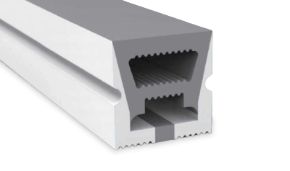
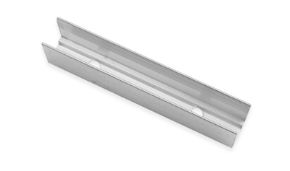
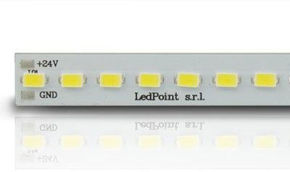

Aluminum LED profiles: applications table
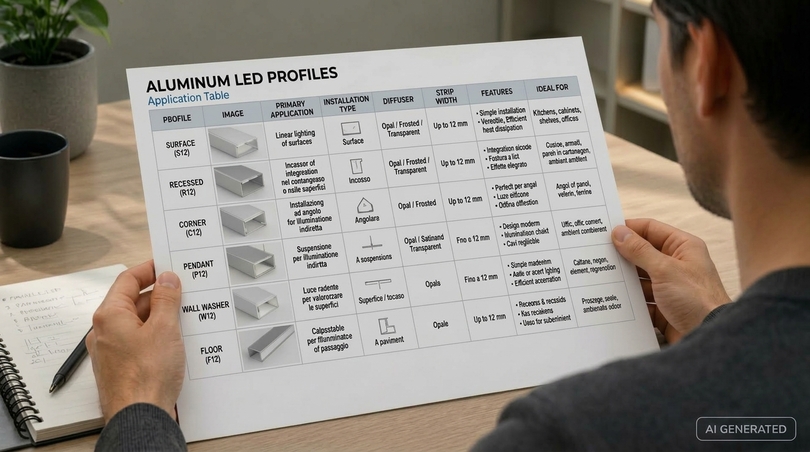
LED aluminum profiles are extruded aluminum alloy channels that house LED strips, dissipate their heat, protect them, and, together with the diffuser, transform individual light points into a uniform line. They are chosen based on application, PCB width, mounting type (surface, recessed, angular), and IP protection rating.
Choosing the wrong LED profile is one of the most common installation errors: a profile that is too narrow will not house the LED strip, a ceiling profile mounted on the floor will quickly get damaged, and a transparent diffuser used where an opaque one is needed will leave the LED dots visible. This guide presents the complete table of LightingLine LED aluminum profiles with dimensions, compatibility by strip width, recommended diffuser type, and ideal application.
In this new edition updated for 2026, we have expanded the guide with three interactive tools, a complete map of the Ledpoint.it LED aluminum profile catalog divided by family, conversion tables between power, luminous flux, and consumption, and a section dedicated to each professional who works daily with linear lighting: lighting designers, electricians, interior architects, construction companies, drywall installers, and furniture makers. The goal is simple: to get you to the right product sheet in a few minutes, with the certainty that the strip, profile, diffuser, power supply, and accessories are fully compatible.
LED aluminum profiles are not just an aesthetic accessory. They are the component that decides how long your LED strip will last, how uniform the light will be, and how clean the final result will look to the client. For this reason, it is worth spending a few minutes on the choice: read the tables, try the configurators, and if you have doubts, write to our technical office.
In this article...
1. What are LED aluminum profiles and what are they for
Before comparing measurements and codes, it is convenient to establish the basic concepts clearly. Many problems we see in technical support stem from an initial misunderstanding: considering the profile as just any "housing", interchangeable with a plastic channel. In reality, the aluminum profile is an integral part of the lighting system, exactly as the heat sink is for a spotlight. In this chapter, we will see what an LED profile is, how the LED inside it works, and why aluminum has become the professional standard.
Definition of LED profile
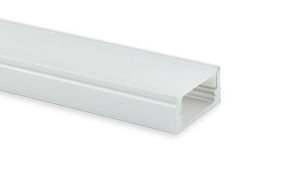
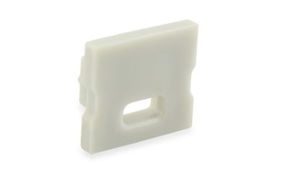
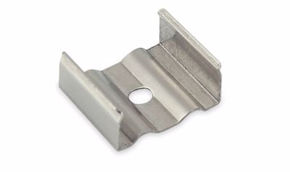
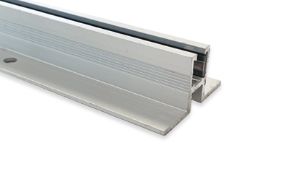
An LED profile, also called an LED channel, LED strip holder, LED track, or simply LED profile, is a linear element obtained by extrusion of an aluminum alloy. Inside, it features a flat seat, on which the LED strip is glued via its double-sided tape, and two fins or rails into which a polycarbonate or PMMA diffuser snaps into place. The ends are closed with dedicated end caps, while mounting is done with clips, screws, glue, or by simple recessing.
LED aluminum profiles perform three functions simultaneously: thermal dissipation, mechanical protection, and light aesthetics. If one is missing, the system performs worse or lasts less.
What is an LED and how it lights up
The LED (Light Emitting Diode) is a semiconductor diode that emits light when current passes through it in the correct direction. Electrons recombining in the junction release energy in the form of photons: this is the phenomenon of electroluminescence. In white LEDs, a blue chip excites a layer of phosphors that converts part of the radiation into yellow and red, returning white light at various color temperatures.
What is the purpose of an LED in a home, store, or office? To produce more light with less energy, for a long time, in minimal dimensions. Precisely this miniaturization has made the LED strip possible: dozens or hundreds of chips mounted on a flexible circuit (PCB) a few millimeters wide. And this is where the profile comes into play.
Why the LED needs an aluminum profile
An LED converts only a part of the absorbed energy into light; the rest becomes heat concentrated in the junction. The more the junction heats up, the more the luminous flux, color stability, and useful life decrease. A strip glued to wood, drywall, or plastic has no way to dissipate this heat. Glued to an LED aluminum profile, however, it transfers the heat to a metal with a thermal conductivity about a thousand times higher than that of PVC, which distributes it over its entire surface and releases it into the air.
The other two functions are equally concrete. Mechanical protection prevents dust, impacts, detergents, or fingers from touching the components. Aesthetics is what the client perceives: with a profile and diffuser, the light becomes a continuous, professional line, without dots and without visible PCB.
Does LED or neon produce more light?
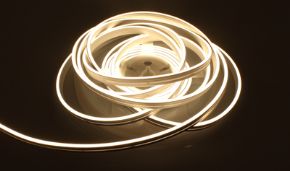
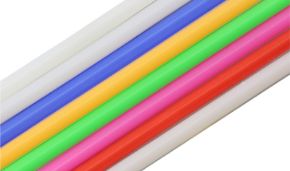
At equal consumption, LED today produces much more light than traditional high-voltage neon and also compared to fluorescent tubes. A quality LED strip easily exceeds 140–155 lumens per watt, while a classic decorative neon stays much lower. If you are interested in the "neon" effect for aesthetic reasons, there are Neon Flex LEDs, which replicate the continuous line of neon with LED consumption, and round aluminum profiles for a 360° tubular effect.
What are linear LED lamps made with profiles used for
LED strips and LED aluminum profiles, together, allow you to build custom linear lamps: luminous coves, under-cabinet lighting, pendant lamps, step lights, backlighting, shelf and wardrobe illumination. Compared to a catalog lamp, they have three advantages: length to the centimeter, free choice of color temperature and power, and total integration into architecture or furniture. This is why designers and furniture makers prefer to build light with profiles and strips rather than adapt a standard fixture.
What is the difference between an LED panel, LED spotlight, and LED profile?
The LED panel distributes light over a wide area, ideal for offices and modular suspended ceilings. The spotlight concentrates light in a cone, for accents and punctual general lighting. The LED profile creates a continuous linear light source, perfect for accent lighting, indirect light, signage, and architectural integration. In a well-designed project, all three often coexist; LED spotlights and bulbs complete the system where punctual light is needed.
LED, Full LED, and confusion over terms
We are often asked what the difference is between LED and Full LED. The term "Full LED" originates in the world of televisions and car headlights: it indicates a product in which all lighting functions are realized with LEDs, rather than just one. In the case of headlights, "Full LED" means that low beam, high beam, and position lights are all LED, while "LED headlights" may indicate only a part. For a strip mounted in a profile, the distinction makes no sense: the light source is 100% LED, and what matters instead is the quality of the chip, the density, and the thermal management.
2. Materials, finishes, and thermal dissipation of LED aluminum profiles
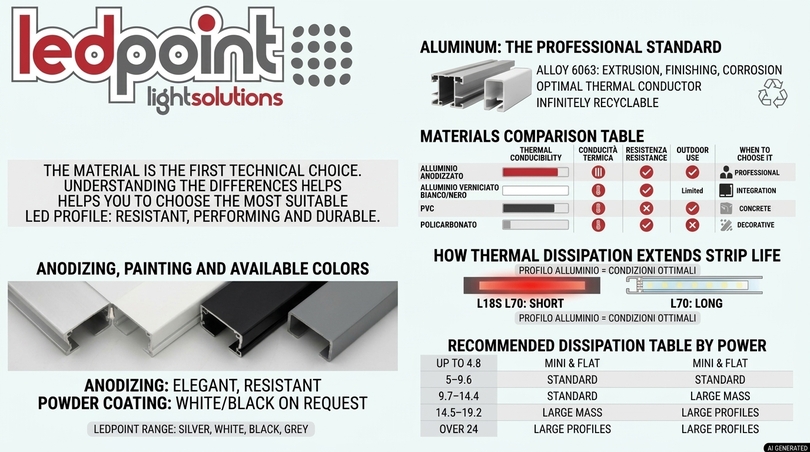
The material is the first technical choice, even though it is often taken for granted. On the market, you can find anodized aluminum, painted aluminum, PVC, polycarbonate, and mixed solutions. Each has a precise role, and understanding the differences helps answer a question that lighting designers often ask us: what are the most resistant and most suitable materials for LED profiles?
Aluminum: why it is the professional standard
Professional LED aluminum profiles are typically extruded from 6000 series alloys, such as 6063 aluminum alloy, appreciated for its ease of extrusion, good surface finish, and corrosion resistance. Aluminum is lightweight (density about 2.7 g/cm³, a third of steel), rigid, workable with common tools, and above all, an excellent heat conductor.
There is also a sustainability aspect that interests architects and construction companies: aluminum is infinitely recyclable without losing its characteristics, and recycling requires only a small fraction of the energy needed to produce primary aluminum. A discarded profile is not waste; it is raw material.
Comparison table of LED profile materials
| Material | Indicative thermal conductivity | Mechanical resistance | Outdoor use | Recyclability | When to choose it |
|---|---|---|---|---|---|
| Anodized aluminum | About 200 W/m·K | High | Yes, with sealed diffuser and end caps | Total | Standard for all professional applications |
| White or black painted aluminum | About 200 W/m·K (paint has little impact) | High | Yes | Total | When the profile needs to blend into colored walls, ceilings, and furniture |
| PVC | About 0.2 W/m·K | Medium | Limited | Partial | Concrete pours, very low power applications |
| Polycarbonate | About 0.2 W/m·K | Good impact resistance | Yes if UV stabilized | Partial | Diffusers, tubular profiles, decorative applications |
| PMMA (acrylic) | About 0.2 W/m·K | Medium, more rigid | Yes | Partial | Diffusers with high light transmittance |
The values are indicative and serve to give the order of magnitude: between aluminum and plastic, the difference in heat conduction capacity is about three orders of magnitude. This is why a plastic profile is only suitable where the power is minimal or where, as in the case of the PVC profile for concrete, the main function is to create a seat in the pour.
Anodizing, painting, and available colors
Anodizing is an electrochemical process that thickens the natural oxide layer of aluminum, making it harder and more resistant to corrosion. The typical finish is satin silver, elegant and neutral. Powder coating, on the other hand, allows you to obtain white or black profiles, highly requested by interior architects.
On Ledpoint.it you can find profiles in four colors: silver, white, black, and gray (for PVC). The 17x8mm white painted profile, for example, disappears on white ceilings and cabinets, while almost the entire drywall range is painted white to facilitate skimming and painting.
How thermal dissipation extends the life of the strip
In the industry, an empirical rule is used: every significant increase in junction temperature noticeably shortens the useful life of the LED. Life is expressed as L70 or L80, meaning the hours after which the flux drops to 70% or 80% of the initial value, and it is measured according to the LM-80 standard. Ledpoint strips declare LM-80 compliance, but that data is only valid if the strip operates at the expected temperature. The LED aluminum profile is the tool that guarantees these conditions.
Recommended dissipation table by strip power
| Strip power | Ledpoint examples | Minimum recommended profile | Notes |
|---|---|---|---|
| Up to 4.8 W/m | 4.8 W/m LED strips | Any profile, even mini and flat | Ideal for furniture, showcases, niches |
| 5–9.6 W/m | 9.6 W/m LED strips | Standard profile (e.g., 17x8mm) | Typical residential use |
| 9.7–14.4 W/m | 14.4 W/m LED strips | Profile with good mass (e.g., 17x15mm, 23x15mm) | Coves, main room lighting |
| 14.5–19.2 W/m | 19.2 W/m LED strips | Wide or tall profile, generous mass | Stores, offices, direct light |
| Over 24 W/m | ≥24 W/m LED strips | Large profiles (e.g., 35x35mm, wall and suspension series) | Professional and high-power applications |
3. Main LED aluminum profile table: profiles by type and dimensions
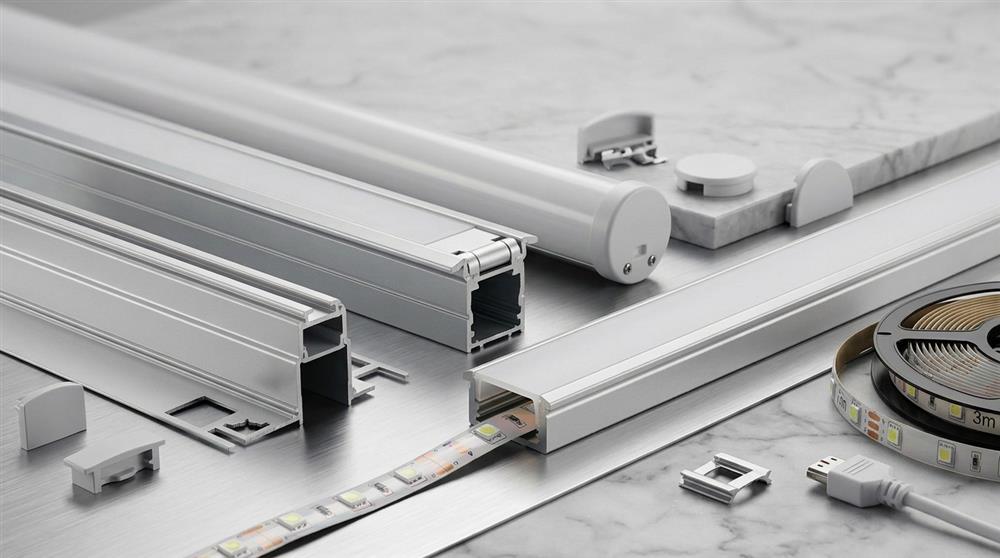
This is the reference table of the guide, the one to keep open while you design. It groups LED aluminum profiles by cross-section shape and indicates for each family the maximum strip width, installation depth, standard diffuser, dissipation capacity, and main applications. In the following chapters, we transform this into concrete choices with catalog codes.
| Profile type | Cross-section shape | Max strip width | Installation depth | Standard diffuser | Thermal dissipation | Main applications |
|---|---|---|---|---|---|---|
| Flat / low | Flat rectangular | 10–12mm | None (flush) | Opaque or transparent | Good | Under-cabinet, furniture, suspended ceiling |
| Standard recessed | Recessed rectangular | 10–12mm | 8–12mm | Opaque or transparent | Very good | Drywall, custom furniture, bookshelves |
| Wide recessed | Wide rectangular | 14–20mm | 10–14mm | Opaque or transparent | Excellent | COB LED strips, high power, professional environments |
| 45° Angular | Triangular (corner) | 8–10mm | — | Opaque or transparent | Good | Vertical corners, wall/ceiling junctions |
| 60° Angular | Triangular variant | 8–10mm | — | Opaque or transparent | Good | Non-90° corners, custom design |
| U-shape / surface | Open U-shape | 8–12mm | None | Opaque or transparent | Good | Wall, furniture, headboard applications |
| Stairs / step | Shaped for steps | 8–10mm | Recessed in the step | Opaque or transparent | Medium | Stair step lighting |
| Floor | Robust, walkable | 8–10mm | Flush floor recess | Tempered glass | Good | Stairs, walkable floors, signage |
| Handrail | Shaped for railing | 8–10mm | — | Opaque | Medium | Railings, illuminated handrails |
| Cove / round head | Semicircular | 8–10mm | None | Opaque | Good | Cove effects, indirect wall light |
| Neon flex profile | Rounded | Specific LED neon | — | Profile material | Medium | Neon effects, signs, decorative |
| TV backlight | Ultra-thin flat | 8mm | None | Specific diffuser | Medium | Behind TV, monitors, displays |
How to read the table
The most important column is the maximum strip width: if your LED strip PCB is wider than the channel, the profile will not work, period. Immediately after come installation depth and dissipation: a flat profile mounts anywhere but dissipates less heat than a wide recessed profile. The diffuser, finally, is chosen based on the viewing distance and the type of strip, as we will see in chapter 6.
What are the different types of LED profiles
The Ledpoint.it catalog filter recognizes seventeen types: surface mounted, recessed, bendable, angular, wall-mounted, for concrete, suspended, round, for tiles, for steps, for floors, for drywall, baseboard, handrail, for shelves, for wardrobes, and for mirrors. To these are added four very useful technical filters: recessed yes/no, walkable yes/no, waterproof yes/no, and installable PCB from 3 to 40 mm. You can apply them directly in the Profiles for LED strips category.
4. The Ledpoint catalog of LED aluminum profiles by family
Generic types are useful for orientation, but in the end, you purchase a specific code. In this section, we have mapped the entire range of LightingLine LED aluminum profiles distributed by Ledpoint.it, organized by family with the series code, the section indicated in the sheet, and the most frequent uses we see in our clients' projects. The dimensions are those reported in the product name (width x height); for the exact width of the installable PCB, always consult the technical sheet or the comparative profile table.
Surface mounted profiles (SL series)
These are the most versatile and sold profiles: they are fixed with clips, screws, or double-sided tape on any flat surface. They cover everything, from the micro-profile for showcases to the tall profile for high-power strips. The absolute best seller is the 17x8mm, available in a single bar, 2 and 3 meters, white, and in kits of 10 pieces.
| Profile | Section | Strengths | Typical applications |
|---|---|---|---|
| Profile 8x5mm | 8x5 mm | Minimum footprint | Showcases, display cases, niches, thin strips |
| Profile 8x10mm | 8x10 mm | Narrow but deep, good shielding | Shelves, frames, furniture details |
| Profile 13x8mm | 13x8 mm | Compact for 8–10 mm strips | Furniture, shelves, thin under-cabinets |
| Profile 13x12mm | 13x12 mm | More strip-to-diffuser distance, more uniform light | Furniture with close viewing |
| Profile 13x13mm | 13x13 mm | Square section | Furniture, bookshelves, shelves |
| Profile 15x11mm | 15x11 mm | Balance between footprint and diffusion | Kitchens, wardrobes, niches |
| Profile 17x7mm | 17x7 mm | Very low | Under-cabinets, under shelves |
| Profile 17x8mm · 2 m · 3 m | 17x8 mm | The best seller, universal | Under-cabinet, suspended ceiling, furniture, behind TV |
| SL08 installation kit 10 pieces | 17x8 mm | Profiles, end caps, and clips in one purchase | Installers, repetitive construction sites |
| Profile 17x15mm | 17x15 mm | Tall, excellent uniformity | High-power strips, dot-free light |
| Profile 21x10mm waterproof | 21x10 mm | Waterproof, 3 m | Bathrooms, outdoors, humid environments |
| Profile 21x13mm | 21x13 mm | Wide, good mass | Wide strips, RGBW, RGBCCT |
| Profile 21x16mm waterproof | 21x16 mm | Waterproof, taller | Outdoors with powerful strips |
| Profile 21x17mm | 21x17 mm | Great dissipation | Main light, offices |
| Profile 21x25mm | 21x25 mm | Very deep, shielding and visual comfort | Direct light, linear lamps |
| Profile 27x7mm | 27x7 mm | Wide and thin | Double strip, wide strips, furniture |
| Profile 27x12mm | 27x12 mm | Wide and medium | High power strips, double row |
| Profile 36x26mm | 36x26 mm | Large section | Offices, stores, general light |
| Profile 35x35mm | 35x35 mm | Square, maximum dissipation of the series | Linear lamps, retail, light industry |
| Bendable profile 18x6mm | 18x6 mm | Curvable | Curved surfaces, counters, columns |
| Profile 15x10mm for silicone strips | 15x10 mm | Dedicated to IP67/IP68 strips | Outdoors, pools, humid environments |
| Polycarbonate tubular profile | Tubular | 360° emission, steel insert | Decorative, installations |
Recessed LED profiles (RE series)
Recessed profiles have side flanges that cover the edge of the milling: the result is a surface-flush luminous line, the most elegant solution for furniture, countertops, walls, and suspended ceilings. The Ledpoint range goes from the micro 8x9mm to the 37x15mm, up to the 22x67mm for deep recesses and waterproof versions.
| Recessed profile | Section | Typical applications |
|---|---|---|
| Recessed 8x9mm | 8x9 mm | Minimal milling in furniture and doors |
| Recessed 12x21mm | 12x21 mm | Deep and narrow recess, shielded light |
| Recessed 15x8mm | 15x8 mm | Panels, shelves, doors |
| Recessed 17x8mm | 17x8 mm | Furniture, kitchen countertops, bookshelves |
| Recessed 17x12mm | 17x12 mm | More uniformity at close viewing |
| Recessed 17x17mm | 17x17 mm | Powerful strips, glare-free light |
| Recessed 21x9mm | 21x9 mm | Flush recesses in wood and drywall |
| Recessed 23x8mm · 2 m · without groove | 23x8 mm | The best-selling recessed: furniture, walls, ceilings |
| Recessed 23x15mm | 23x15 mm | 14.4–19.2 W/m strips, suspended ceilings |
| Recessed 25x32mm | 25x32 mm | Deep recess, highly shielded light |
| Recessed 32x15mm | 32x15 mm | Wide strips, important luminous lines |
| Recessed 37x15mm | 37x15 mm | Double strip, offices, retail |
| Recessed 22x67mm | 22x67 mm | Deep light cuts, technical suspended ceilings |
| Recessed 29x8mm waterproof | 29x8 mm | Bathrooms, showers, recessed outdoors |
| Recessed 29x14mm waterproof | 29x14 mm | Outdoors, facades, wet areas |
| Opaque LED bar 3 m with integrated COB strip | RE16 Series | Profile with integrated LED strip, ready to use |
Angular aluminum profiles for LED (AN series)
Angular profiles are mounted in the corner between two surfaces and direct the light at 45°, illuminating both walls or the work surface without glaring. They are the classic solution for wall-ceiling corners, under-cabinets without a valance, showcases, and furniture edges.
| Angular profile | Characteristic | Typical applications |
|---|---|---|
| Angular 10mm | Minimum footprint | Showcases, furniture edges |
| Angular 16mm · 2 m · 3 m | Angular best seller | Wall-ceiling corner, under-cabinet |
| Angular 16mm with groove | Groove for cable passage or fixing | Clean installations, hidden cables |
| Angular 18x18mm | More capacious | Wider strips |
| Empty angular 19x19mm | Hollow section | Edges, finishes |
| Angular 30mm | Large section | Powerful strips, large environments |
| Angular 30mm with groove | Large section with rear channel | Retail, large showcases |
Wall, shelf, wardrobe, and mirror profiles
This family is born for interior design and furniture: profiles that become wall lamps themselves, with single or double emission (bi-emission, light upwards and downwards), or profiles dedicated to specific elements such as shelves, wardrobes, and mirrors.
| Profile | Function | Typical applications |
|---|---|---|
| Wall 24x24mm | Linear wall lamp | Hallways, bedrooms, indirect light |
| Wall 29x30mm | Linear wall washer | Textured walls, paintings |
| Wall 34x34mm | Important section | Halls, offices |
| Wall 48x18mm | Wide and low | Headboards, grazing light |
| Bi-emission wall 70x31mm | Up and down light | Hotels, restaurants, hallways |
| White wall 92x42mm | Large wall lamp | Commercial and directional spaces |
| Shelf profile | Luminous shelf | Bookshelves, bathrooms, bars |
| Bi-emission for shelves 18mm | Light above and below the shelf | Showcases, displays |
| Bi-emission for shelves 25mm | For thick shelves | Stores, cellars, bookshelves |
| Wardrobe 15x29mm | Illuminated hanging rail | Walk-in closets, wardrobes |
| Mirror profile | Mirror backlighting | Bathrooms, fitting rooms, hotels |
| Baseboard 75x13mm | Luminous baseboard | Hallways, bedrooms, continuous step light |
| Aluminum handrail | Illuminated handrail | Stairs, ramps, hospitality structures |
Round, suspended, floor, tile, and step profiles
| Profile | Characteristic | Typical applications |
|---|---|---|
| Round Ø30mm · Round Ø30mm waterproof | Enveloping emission | Suspensions, outdoors, tube effect |
| Round Ø50mm · Round Ø75mm | Large diameters | Design pendant lamps |
| Profile 36x75mm · 50x75mm · 60x73mm | Large section for linear fixtures | Offices, meeting rooms, suspensions with suspension cables |
| Walkable floor 20x11mm | Walkable | Paths, entrances, step lights |
| Walkable floor 25x11mm | Walkable, wider | Stores, showrooms |
| Walkable floor 20x26mm | Walkable, deep | Screeds, technical floors |
| For ceramic floor 12mm waterproof | Walkable and waterproof | Bathrooms, showers, terraces |
| For ceramic cladding 8mm white | Installed between tiles | Bathroom and kitchen cladding |
| For ceramic cladding 11mm | For thicker tiles | Cladding, shower niches |
| For steps 30x27mm | Luminous step edge | Indoor stairs, night safety |
| PVC profile for concrete | To be embedded in the pour | Resin and concrete floors, outdoors |
The drywall family (DW and CR series) deserves a dedicated chapter: you will find it in chapter 8.

5. Tool: find the right LED profile
The configurator below takes up and expands the tool from the first version of this guide. Indicate where you are installing the profile, how you want to mount it, in what environment, and which LED strip you intend to use: the tool will return the compatible Ledpoint LED aluminum profiles, the recommended diffuser, the necessary accessories, and a practical tip for your profession. Each button opens the product sheet in a new window.
📐 Select the LED profile
Four choices, one result ready to order.
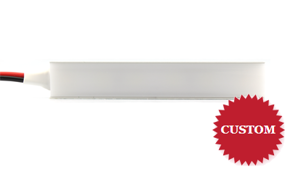
If the result does not convince you or you have a particular application, the catalog also provides custom profiles, with custom cuts and dedicated machining for series and construction sites.
6. Opaque vs transparent diffuser: when to use which
The diffuser is the "lens" of the LED aluminum profile and radically changes the perceived result. The same profile with the same strip can look like a professional line or a row of dots depending on the chosen cover. Let's first look at the comparison table and then how to shield LED light in the most common situations.
| Characteristic | Opaque Diffuser | Transparent Diffuser |
|---|---|---|
| LED chip visibility | Completely hidden | Visible (dotted effect) |
| Light uniformity | Excellent | Good (dots visible up close) |
| Luminous loss | 15–25% | 5–10% |
| Emission angle | About 120° | 120–150° |
| Recommended application | Luminous coves, mirrors, close viewing | Under-cabinet, warehouses, distant viewing |
| COB strip | Ideal | Not necessary (already uniform) |
| Low density SMD strip | Necessary | Not recommended |
| High density SMD strip (120+ led/m) | Recommended | Acceptable |
How to shield LED light and eliminate dots
The dotted effect depends on three variables: distance between one LED and another (density), distance between the strip and the diffuser (profile height), and diffuser opacity. Acting on only one yields little; acting on all three yields a perfectly continuous line. A practical rule used by installers is that the distance between the strip and the diffuser should approach the pitch between the LEDs: with chips 8 mm apart, tall profiles are needed; with COB or 240 led/m, low profiles are enough.
COB LED strips have solved most of the problem: the chips are so close together that they produce a continuous line even without a diffuser. For this reason, the table indicates the opaque diffuser as "ideal" but not mandatory.
What is the recommended distance between the LED strip and the wall
For indirect light in a cove or behind a valance, the distance between the profile and the surface to be illuminated decides the softness of the fade. As an indication: 5–10 cm for residential coves, 10–20 cm for high ceilings or walls to be "washed" uniformly. The closer the strip is to the surface, the more grazing the light is and the more it highlights plaster imperfections: it is a beautiful effect on stone and wood, less so on an imperfect skim coat.
Diffusers: materials and transmittance
Diffusers are generally made of polycarbonate, resistant to impacts, or PMMA, with slightly higher transmittance. In walkable profiles, more robust covers are used. You can also purchase diffusers separately, to replace them or change the effect without dismantling the profile, in the opaque and transparent diffusers category.
7. LED aluminum profile dimensions and LED strip compatibility
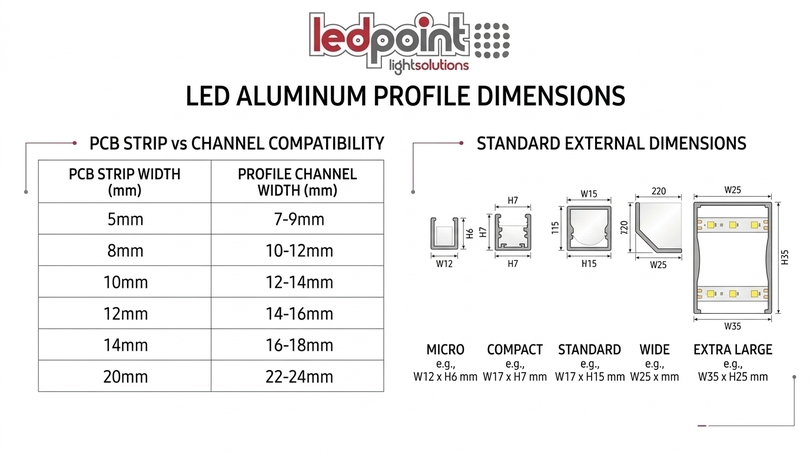
"What is the standard width of a profile for LED strips?" and "what is the height of an LED profile?" are among the most searched questions absolutely. The short answer is that a single standard does not exist, but there are reference measurements linked to the most common PCB widths. In this chapter, you will find the original compatibility table of the guide and the indications to read it correctly.
LED strip compatibility - PCB width vs profile channel
| Strip PCB width | Min profile channel width | Typically compatible strips |
|---|---|---|
| 5mm | 5mm | 2216 low density LED strip, skinny strip |
| 8mm | 8mm | 8mm COB LED strip, 0807, 2216 strip |
| 10mm | 10mm | Standard 2835 LED strip, 10mm COB (the majority) |
| 12mm | 12mm | 5050 RGB LED strip, RGBW, 12mm COB strip |
| 14mm | 14mm | High power LED strip, RGBCCT |
| 20mm | 20mm | Double PCB LED strip, high density |
The PCB width must be equal to or less than the internal channel width, never greater. One millimeter of tolerance is sufficient; more space is not a problem, but the strip must remain centered to avoid asymmetric shadows on the diffuser. In the Ledpoint.it catalog, the "installable PCB" filter allows you to see only compatible profiles: up to 3, 4, 5, 6, 8, 10, 12, 20, 30, or 40 mm.
Standard width and height: the most common measurements
In practice, the most common measurement for surface-mounted profiles is around 16–17 mm in external width by 7–8 mm in height, designed for 8–10 mm strips, which are the majority. This is exactly the section of the 17x8mm aluminum profile. Standard recessed profiles start from about 23 mm in external width, including flanges.
| Profile class | Indicative external width | Indicative height | Ledpoint example |
|---|---|---|---|
| Micro | 8–10 mm | 5–10 mm | 8x5mm |
| Compact | 13–15 mm | 8–13 mm | 15x11mm |
| Standard | 16–18 mm | 7–15 mm | 17x15mm |
| Wide | 21–27 mm | 7–25 mm | 21x25mm |
| Extra large | 35 mm and over | 26–75 mm | 50x75mm |
Lengths: 1, 2, 2.5, 3, and 6 meter bars
Ledpoint LED aluminum profiles are available in lengths of 99.5 cm, 2 m, 2.5 m, 3 m, and, for some series, 6 m. 3-meter bars reduce the number of joints in long lines, while 1 and 2-meter bars are more convenient to transport and manage on construction sites and in furniture. The profile can be easily cut to the desired length, as we will see in chapter 12.
How much does a 30x30 or 40x40 aluminum profile cost?
Be careful not to confuse LED aluminum profiles with structural 30x30 or 40x40 hollow profiles, used for frames and machines. The latter are construction elements, do not have a seat for the strip nor a diffuser, and their price depends on length, alloy, and machining. If you need an important section for a linear fixture, in the LED range you will find the 35x35mm profile, the 36x26mm, and the large section series from 36x75 to 60x73 mm, already complete with diffuser and dedicated accessories. Updated prices are always visible on the product sheet.
8. LED aluminum profiles for drywall and recess depth
Drywall is the material in which LED profiles shine best: ceiling light cuts, coves, valances, niches, luminous corners. It is also the context where mistakes cost the most, because they are discovered when the work is finished. This chapter is designed especially for drywall installers, construction companies, and architects.
Recess depth: how to plan the profile seat in drywall
Planning the LED profile seat in drywall must be done before taping the walls, as correcting mistakes later is very costly. The recess depth depends on the chosen profile, the channel width, and the possible presence of a retaining edge for the diffuser.
| Profile type | Seat depth (mm) | Seat width (mm) | Protrusion after recess (mm) | Notes |
|---|---|---|---|---|
| Mini recess (narrow) | 8–10 | 12–14 | 0–2 | For max 8mm PCB strip |
| Standard recess | 10–12 | 14–18 | 0–3 | For max 10mm PCB strip |
| Wide recess | 12–16 | 18–24 | 0–4 | For COB or high power strip |
| U-shape surface | 0 (no recess) | - | 12–18 | Flush application |
| 45° Angular | 0 | - | 18–25 per side | No recess required |
| Luminous cove | Depends on profile | 30–60 (cove) | Variable | Always plan with a drawing |
Ledpoint drywall LED profiles (DW and CR series)
Drywall profiles have perforated or knurled wings that are embedded in the joint compound: after skimming and painting, only the luminous line remains visible. Most are painted white to match the finish. Here is the entire series with the most frequent use.
| Drywall profile | Luminous effect | Where it is used |
|---|---|---|
| Angular drywall 16x12mm | Luminous edge | Wall and suspended ceiling corners |
| Angular drywall 64x22mm | Wide luminous edge | Drop ceilings, cornices |
| Drywall 50x10mm | Thin light cut | Flush ceilings and walls |
| Drywall 57x10mm | Flush light cut | Walls, hallways |
| Drywall 62x12mm | More marked luminous line | Ceilings, living rooms |
| Drywall 38x11mm | Compact light cut | Residential environments |
| Drywall 44x12mm | Flush line | Best seller of the family |
| Drywall 42x32mm | Deep recess, shielded light | Offices, stores |
| Drywall 36x34mm | Deep recess | Anti-glare direct light |
| Drywall 35x49mm | Cove or deep cut | High ceilings |
| Drywall 50x49mm | Luminous cove | Living rooms, halls |
| Drywall 54x47mm | Wide luminous cove | Large environments |
| Drywall valance 54x32mm | Indirect light from valance | Perimeter drop ceilings |
| Drywall 72x31mm | Wide line | Offices, retail |
| Drywall 97x35mm | Very wide line | Commercial spaces, open space |
Correct work sequence on site
For a drywall installer, the order of operations is everything. The LED profile for drywall is fixed to the framework or the board before joint compounding, never after. The recommended sequence is: layout drawing, preparation of cables and power supply boxes, mounting of boards with the opening, insertion of the profile, joint compounding with mesh on the wings, skimming, painting, insertion of the strip and diffuser after painting work is completed. This prevents dust and paint from getting on the strip.
Remember to always leave the power supply accessible: in an access panel, in an accessible junction box, or in a technical compartment. It is a detail that the electrician and the client will appreciate at the first maintenance intervention.
How much do drywall LED profiles cost
The cost of drywall LED profiles depends mainly on the section: the wider and deeper the luminous line, the greater the amount of aluminum. To the cost of the profile must be added the strip, diffuser, power supply, and installation and skimming labor. For a realistic quote, calculate the linear meters with the configurator in chapter 11 and check updated prices directly on the product sheets. Current offers are collected in the profiles on offer section.
9. Application table of LED aluminum profiles for professionals
Each professional looks at the profile from a different angle: the electrician thinks about connections and maintenance, the architect about aesthetics, the company about costs and times, the furniture maker about milling. This table lists the most recurring applications by sector, with the recommended profile, the paired strip, and the practical advice we give most often on the phone.
| Profession | Application | Recommended profile | Recommended strip | Practical advice |
|---|---|---|---|---|
| Electrician / installer | Kitchen under-cabinet | Kit SL08 17x8mm | 24V 9.6–14.4 W/m, 3000–4000K | Use kits to reduce times and forgotten components |
| Hallway courtesy light | Baseboard 75x13mm | 24V 4.8 W/m | Pair it with motion sensors | |
| Panels, technical compartments, cellars | 21x17mm | 24V 14.4 W/m, 4000K | Transparent diffuser to maximize flux | |
| Interior architect | Ceiling light cut | Drywall 50x10mm | COB 24V, 2700–3000K, CRI ≥90 | Keep the same CCT throughout the environment |
| Headboard and boiserie | Wall 48x18mm | CCT dimmable | Warm light in the evening, more neutral in the morning | |
| Shelves and bookshelves | Bi-emission shelves 18mm | COB 24V 3000K | Choose black finish for dark furniture | |
| Lighting designer | Offices and meeting rooms | 36x75mm suspended | 24V/48V 19.2–24 W/m, 4000K | Check lux and UGR according to UNI EN 12464-1 |
| Museums and showcases | Angular 30mm | Sunlike ultra-high CRI | Evaluate UV and heat on artworks | |
| Construction company | Condominium stairs and common areas | For steps 30x27mm | 24V 4.8–9.6 W/m | With a sensor, you reduce night consumption |
| Floors and paths | Walkable 20x26mm | 24V IP67 low power | Include the profile in executive drawings | |
| Drywall installer | Perimeter luminous cove | Valance 54x32mm | 24V 14.4 W/m | 3 m bars to reduce joints |
| Luminous edges | Angular drywall 64x22mm | COB 24V | Mesh on the wings before skimming | |
| Furniture maker / carpenter | Shelves and showcases | Recessed 8x9mm | COB 12V/24V 5–8 mm | Calibrated milling during the design phase |
| Walk-in closet | Wardrobe 15x29mm | 24V 9.6 W/m 4000K | Door opening sensor | |
| Countertops and doors | Recessed 23x8mm | 24V 9.6 W/m | Use furniture tracks for movable lights | |
| Retail and hospitality | Counters, bars, reception | Bendable 18x6mm | RGBCCT | Lighting scenarios with controller |
How to choose the most suitable LED profile for project needs
For the lighting designer, the choice always starts from the visual task: how much light is needed, where, and with what quality. The normative reference for workplaces is UNI EN 12464-1, which sets average illuminance, uniformity, glare control, and color rendering. The LED aluminum profile is the tool with which two of these variables are controlled: glare and uniformity. A deep profile and an opaque diffuser reduce perceived luminance; a wide profile with a double strip increases flux without exceeding thermal limits.
What are the most aesthetic and discreet LED profiles
For the interior architect, the answer is almost always recessed: a line of light without a visible frame is the cleanest possible result. In drywall, the DW series profiles disappear under the skim coat; in wood, flush recessed profiles like the 8x9mm and 23x8mm. Where recessing is not possible, white or black painted profiles blend with the surface.
LED profiles for intensive use and easy to maintain
For the installer, a profile is "easy to maintain" when the diffuser can be removed without tools, the strip can be replaced without dismantling the profile, and the power supply is reachable. Snap-in mounting clips are the best choice for a system that will need to be inspected. For intensive use (stores, offices, hallways open 24 hours), choose profiles with good thermal mass and strips not pushed to the limit of their nominal power.
10. Which LED strip to put in the aluminum profile
A profile is only as good as the strip it houses. In this chapter, we answer the most frequent questions about LED strips, always from the point of view of someone who has to insert them into an LED aluminum profile: how they are classified, which voltages to choose, how many meters to connect, how much they consume, and how long they last. A well-chosen and well-dissipated strip works for tens of thousands of hours without visible light loss.
How the LED strip works and how the LEDs are connected
An LED strip is a flexible printed circuit on which LEDs and resistors (or constant current control circuits) are soldered. The LEDs are organized in small groups connected in series, and the groups are connected in parallel along the entire strip. Each group is an autonomous "segment": this is why the strip can only be cut at the indicated points, between one segment and another, without the rest stopping working.
In 24V strips, the segment contains more LEDs than in 12V strips. There are also strips with a constant current control system, which maintain uniform brightness even over longer lengths.
How LED strips are classified and how many types exist
LED strips are classified according to six parameters, the same ones with which the Ledpoint.it catalog is organized: light color, power per meter, voltage, LED model, density (led/m), and special functions.
| Criterion | Main options | Ledpoint category |
|---|---|---|
| Light color | Warm white, neutral, cold, ice, RGB, RGBW, CCT, RGBCCT | LED strips by color |
| Power | From 4.8 to over 24 W/m | LED strips by power |
| Voltage | 5V, 12V, 24V, 48V, 230V | LED strips by voltage |
| LED model | 2835, COB, 2216, 4040, 3838, 3535, 335 side, 3014, 2016, 0807 | LED strips by model |
| Density | From less than 60 to over 384 led/m | LED strips by led/m |
| Special | Pixel, bendable, food-grade, IR, UV, growing | Special LED strips |
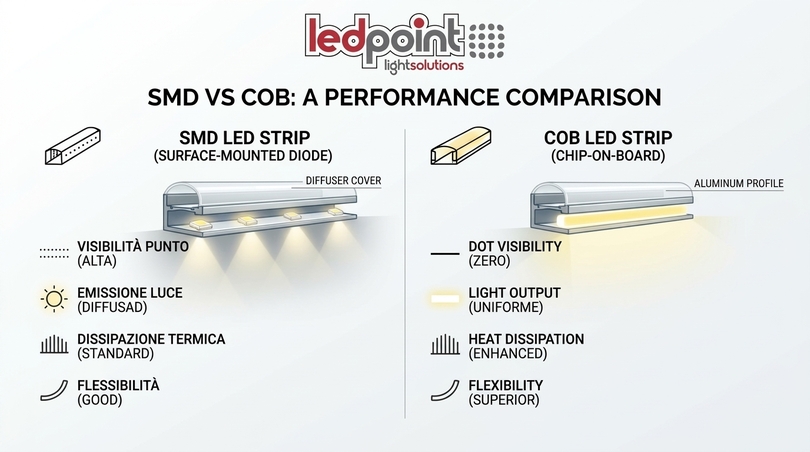
Difference between SMD and COB LED strips
SMD strips mount individual chips in a package (like the 2835) at regular intervals. COB (Chip On Board) strips have hundreds of micro-chips covered by a single layer of phosphors: what does COB LED mean in practice? A continuous line of light, without dots, even visible and without a thick diffuser. SMDs generally offer higher efficiencies and greater variety; COBs win in uniformity and are ideal in low profiles and furniture.
| Parameter | SMD Strip (e.g., 2835) | COB Strip |
|---|---|---|
| Appearance without diffuser | Distinct luminous dots | Continuous line |
| Recommended profile | Tall or with opaque diffuser | Even low and with transparent diffuser |
| Efficiency | Up to over 150 lm/W in the best versions | Good, generally lower than top SMDs |
| Applications | Main light, coves, high flux | Furniture, visible light cuts, mirrors |
12V, 24V, 48V, or 230V: what is convenient
Is it better to buy 220V or 12V LED strips? It depends on the application, but for LED aluminum profiles in a professional setting, the most frequent answer is 24V: it is the best compromise between safety, connectable length, product choice, and compatibility with dimmers and controllers.
| Voltage | Indicative length for single power supply | Advantages | Limits | When to use it |
|---|---|---|---|---|
| 5V | 1–2 m | USB power, pixels | Strong voltage drop | Behind TV, small objects, pixel LEDs |
| 12V | Up to about 5 m | More frequent cutting, compatibility | Higher currents | Furniture, short stretches, automotive and marine |
| 24V | Up to about 10 m | Professional standard | Cutting segments a bit longer | Almost all applications in profile |
| 48V | Up to about 20 m and beyond | Long lines with a single power point | More restricted product choice | Offices, retail, very long coves |
| 230V | Tens of meters | No external power supply | Mains voltage: installation by professionals only | Long outdoor lines, technical environments |
The lengths are indicative and vary with the power per meter: always check the maximum length reported in the sheet.
How the 230 Volt LED strip works and how to connect it without a transformer
230V strips integrate a rectifier or a dedicated driver and connect directly to the mains, without a low-voltage power supply. This is the answer to the question "how to connect an LED strip to the current without a transformer". Since it involves mains voltage, the connection must be performed by a qualified installer in compliance with system regulations, and the strip must be used only with the provided accessories. To avoid the flicker typical of some 230V solutions, Ledpoint offers anti-flicker 230V drivers.
How many meters of LED can be connected
The limit is not the power supply but the voltage drop along the copper tracks of the PCB: beyond a certain length, the end of the strip receives less voltage and the light drops or changes tone. There are three solutions: increase the voltage (from 12V to 24V or 48V), feed from both ends, or divide the system into multiple sections fed in parallel with adequately sized cables. The configurator in chapter 11 will signal when it is necessary to do so.
How much does a 5-meter LED strip consume
Consumption is calculated by multiplying the power per meter by the length. A 14.4 W/m strip 5 m long absorbs 72 W. On for 4 hours a day, it consumes about 105 kWh per year. Here is a conversion table useful for quotes and energy diagnostics.
| Strip power | Power 5 m | kWh/year (4 h/day) | kWh/year (10 h/day) | Indicative flux at 110 lm/W | Indicative flux at 155 lm/W |
|---|---|---|---|---|---|
| 4.8 W/m | 24 W | 35 | 88 | 528 lm/m | 744 lm/m |
| 9.6 W/m | 48 W | 70 | 175 | 1,056 lm/m | 1,488 lm/m |
| 14.4 W/m | 72 W | 105 | 263 | 1,584 lm/m | 2,232 lm/m |
| 19.2 W/m | 96 W | 140 | 350 | 2,112 lm/m | 2,976 lm/m |
| 24 W/m | 120 W | 175 | 438 | 2,640 lm/m | 3,720 lm/m |
To multiply the kWh by the energy cost, use your bill's tariff. Ledpoint fact: the 3000K 2835 240 led/m 24V 14.4 W/m LED strip declares 2000 lm/m with an efficiency of 155 lm/W, while the version at 120 led/m at the same power declares 1410 lm/m and 110 lm/W. At equal consumption, therefore, the high-efficiency strip produces about 42% more light: a fact that weighs on energy savings much more than the purchase price.
Graph: luminous flux per meter, same power (14.4 W/m)
What is the difference between 3000K and 6000K
The color temperature, expressed in kelvin, describes the tone of white light. 3000K is a warm white, welcoming, similar to halogen light: ideal for homes, hotels, restaurants. 6000K is a cold white with a bluish dominant, suitable for laboratories, warehouses, technical environments. In between, 4000K is the neutral light of offices and kitchens.
| Kelvin | Tone | Perception | Applications with LED profiles | Category |
|---|---|---|---|---|
| 2200–2700K | Very warm white | Intimate, evening | Coves, handrails, hospitality | Warm white |
| 3000–3500K | Warm white | Welcoming | Residential, furniture, restaurants | Warm white |
| 3800–5300K | Neutral white | Natural, concentration | Offices, kitchens, retail | White |
| 5500–8700K | Cold white | Technical, brilliant | Laboratories, warehouses, jewelry showcases | Cold white |
| 9000–15000K | Ice white | Scenographic | Installations, special effects | Ice white |
Alongside color temperature, the Color Rendering Index (CRI) matters: with CRI ≥90, the colors of skin, food, fabrics, and wood appear natural. For those working on well-being and the sleep-wake rhythm, there is the Circadian Light line.
What is the difference between RGB and RGBW
RGB strips mix red, green, and blue to obtain millions of colors, but the "white" they produce is cold and unnatural. RGBW strips add a dedicated white LED: saturated colors and a true white. RGBCCT strips, finally, combine RGB and adjustable temperature white. In profiles, multicolor strips require an opaque diffuser and a sufficiently tall profile to mix the colors well. To control them, you need the corresponding type of LED controllers.
What is the best LED strip and which are the brightest
The "best" LED strip does not exist absolutely: there is the best for an application. However, the objective criteria for evaluating it are always the same: luminous efficiency (lm/W), CRI, color stability (MacAdam steps), LM-80 certification, quality of the PCB and double-sided tape, clarity of the technical sheet. The most powerful and brightest LED strips are those over 19.2 W/m with high-efficiency chips: they produce over 3000 lm/m but require large-section profiles. Ledpoint strips report icons on the sheet with CRI, LM-80, chip, power, IP, voltage, cutting pitch, and energy class, to compare them transparently.
How long does an LED strip last
A quality LED strip, correctly powered and mounted in an aluminum profile, has a useful life of tens of thousands of hours. Often, the actual duration depends less on the LEDs and more on three factors: operating temperature, power supply quality, and correct voltage. The aluminum profile is the most economical way to extend the life of the strip. Similarly, an LED panel lasts a long time if its driver does not overheat.
Polarity: how to recognize it and what happens if you reverse it
Every direct current LED strip has a positive (+) and a negative (−) pole, printed on the PCB near the soldering points. The red cable is normally the positive. On a single LED, the longer terminal (anode) is the positive. If you reverse the polarity on a monochromatic strip, in most cases the strip simply will not turn on, because the diode blocks the current; however, this is not a practice to repeat, especially with controllers and RGB strips, where an incorrect connection can damage the components.
At which point to cut the LED strip
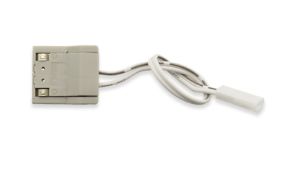
The strip can only be cut on the printed cutting lines, usually indicated by a scissor symbol between two pairs of copper pads. The pitch varies: for example, every 3.33 cm, every 5 cm, every 10 cm. Cutting outside the line turns off the affected segment. After cutting, the strip is reconnected with PCB connectors or with soldered joiners, and the end is closed with end caps for LED strips if the strip is waterproof.
How to eliminate LED strip flicker
Flicker can depend on an undersized or low-quality power supply, a dimmer with a PWM frequency that is too low, loose connections, or excessive voltage drop. The solutions: size the power supply with a margin, use quality dimmers and controllers, feed long lines from multiple points, and check terminals and connectors. For video recording and work environments, it is advisable to opt for explicitly anti-flicker systems.
Are LED lights harmful to health?
LED light sources for general lighting are evaluated according to the photobiological safety standard IEC 62471, which classifies products into risk groups. Strips for architectural use, mounted in a profile with a diffuser, are normally in risk group zero or low. Useful precautions are simple: avoid staring for a long time at very bright sources without a diffuser, choose warm color temperatures in the evening, and choose flicker-free products. The profile with an opaque diffuser also increases visual comfort.
Why LEDs light up in the dark when turned off
A faint glow when the switch is off is almost always due to induced or capacitive currents in the wiring, a switch that interrupts the neutral instead of the phase, or switches with a pilot light. LEDs are so efficient that just a few milliamps are enough to make them glow. The solution is to check the wiring with an electrician and, if necessary, interrupt the power supply upstream of the power supply.
11. Power supply configurator and accessory kits for LED aluminum profiles
After choosing the profile and strip, there are two calculations that decide the success of the system: the power supply power and the quantity of profiles and accessories to order. The two tools below do this for you. The first sizes the power supply with a 20% safety margin and takes you to the correct Ledpoint category; the second calculates bars, end caps, clips, and joiners.
⚡ Calculate the power supply for your LED strip
Enter voltage, power, and meters: get watts, current, and recommended power supply.
🧮 Calculate profiles and accessories to order
For quick quotes on site and in carpentry.
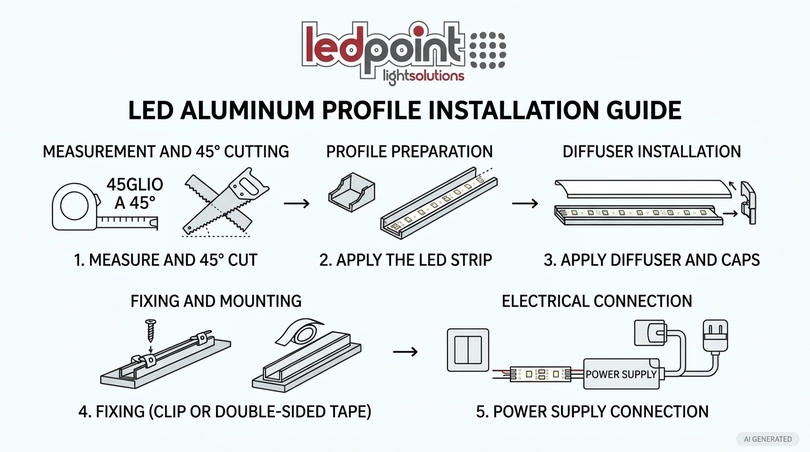
12. How to install LED aluminum profiles: installation guide
Installing an LED profile is not difficult, but it requires order. In this guide to installing LED profiles, you will find the complete sequence, from cutting the profile to maintenance, with answers to the most common questions: how to attach the strip to the profile, how to cut at 45 degrees, how to join two profiles, and how to hide the wires. A good installation is recognized by three details: a straight line, no visible cables, and a diffuser that comes off without effort.
What is needed to install LED strips and profiles
| Component | Function | Where to find it |
|---|---|---|
| Aluminum profile | Seat, dissipation, protection | Profiles |
| Diffuser | Uniformity and visual comfort | Diffusers |
| End caps | End closure, cable passage | End caps |
| Clips or brackets | Removable fixing | Mounting clips |
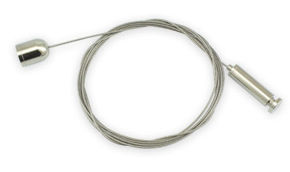
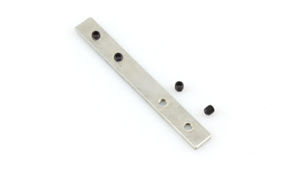
| Joiners | Joining of two bars in line or at an angle | Profile joiners |
| LED strip | Light source | LED strips |
| Double-sided tape | Gluing strip or profile | Tapes for LED strips |
| Power supply | 230V → low voltage conversion | Power supplies |
| Connectors and cables | Solderless connections | Connectors · Cables |
| Tools | Cutting, soldering, verification | Tools |
Step-by-step installation
Step 1 - Design and measure
Trace the line with a level or laser and measure the net length. Decide where the power cable arrives and where the power supply will be: the cable path must be thought of beforehand, not afterwards.
Step 2 - Cut the profile
The aluminum profile is cut with a chop saw equipped with a blade for aluminum or non-ferrous metals, or with a fine-toothed hacksaw and a jig. Remove burrs with a file. Cut the diffuser to the same length or a few millimeters shorter.
Step 3 - Fix the clips or prepare the recess
Screw the clips every 50 cm or so, always starting 5–10 cm from the ends. For recessing, mill the seat to the width and depth indicated in the sheet (see the table in chapter 8).
Step 4 - Glue the strip into the profile
Clean the seat with isopropyl alcohol and let it dry. Remove the double-sided tape film little by little and press the strip evenly, without pulling it and without bending it at a sharp angle. This is the correct way to attach an LED strip to an aluminum profile.
Step 5 - Connect and test
Connect the cables respecting the polarity and test the ignition before closing the diffuser.
Step 6 - Close with diffuser and end caps
Insert the diffuser by snapping it in or sliding it, then the end caps, one of which is drilled for cable passage.
Step 7 - Snap the profile into place
Push the profile into the clips until it snaps. In case of maintenance, it will be enough to unclip it.
How to cut the LED profile at 45 degrees
For the corners of cornices, showcases, and suspended ceilings, cut two bars at 45° with an aluminum blade chop saw, clamping the profile with a shaped support to prevent deformation. The diffuser must be cut with the same angle. Inside the corner, the strip is not bent at a sharp angle: it is interrupted and reconnected with a small cable or an angular connector, or bendable LED strips are used.
How to join two LED aluminum profiles
For lines longer than one bar, profile joiners are used, which align two bars in continuity. Staggering the diffuser joint relative to the profile joint helps make the union point less visible.
How to hide LED wires
Wires are hidden by planning: passage through the drilled end cap to the back, recessed channel, hole in the furniture, rear groove in profiles predisposed like the angular 16mm with rear groove. In drywall, cables run in the cavity before closing.
How LEDs are fixed and how to make the strip stick well
If the strip comes off, almost always the surface was dirty, cold, or not aluminum. Ledpoint strips use professional-grade 3M double-sided tape, but the golden rule is always the same: clean surface, room temperature, uniform pressure. In vertical applications or those subject to vibrations, add a dedicated double-sided tape.
How to fix the LED profile to the ceiling and how to install it in suspension
To the ceiling, use screwed clips, screws in the profile body, or recessed profiles. For pendant lamps, suspension cables are used, distributed to avoid profile bending, with the power cable brought from the ceiling rose.
How not to burn out LEDs
LEDs almost always burn out for three reasons: wrong voltage, excessive heat, overcurrent. Never connect a 12V strip to a 24V power supply; always mount it on an aluminum profile adequate for the power; do not exceed the maximum length for power supply and use quality power supplies.
How to see if an LED is good
With a multimeter in "diode test" mode, the single LED can be verified: in one direction it should light up weakly, in the other no. On a strip, if one segment is off and the others work, the fault is in that segment; if everything turns off beyond a point, the problem is likely a solder joint or an interrupted pad.
Maintenance and care of LED profiles
LED aluminum profiles do not require demanding periodic maintenance: just clean the diffuser with a soft cloth and neutral detergent, avoiding solvents that can cloud the polycarbonate. In greasy environments, such as professional kitchens, regular cleaning of the diffuser maintains constant luminous flux. Occasionally, it is advisable to check that the power supply is free of dust and well ventilated.
13. LED profiles for outdoors, bathrooms, and floors
Water, dust, thermal shocks, UV rays, and foot traffic are the enemies of any system. For outdoor applications and humid environments, the LED aluminum profile must work together with a strip with an adequate protection rating and sealed accessories. In this chapter, we will see how to read the IP rating and which Ledpoint profiles to use.
The IP protection rating
The IP code, defined by the IEC 60529 standard, indicates with the first digit the protection against solids and with the second that against liquids.
| IP Rating | Protection | Typical applications with LED profiles |
|---|---|---|
| IP20 | No protection from liquids | Dry indoors: furniture, suspended ceilings, coves |
| IP44 | Water splashes | Bathrooms outside the most exposed zones, kitchens |
| IP65 | Water jets, dust | Covered outdoors, facades, showers with waterproof profile |
| IP67 | Temporary immersion | Exposed outdoors, floors, flower beds |
| IP68 | Prolonged immersion | Pools, fountains, submerged applications |
Which LED aluminum profiles to use outdoors
For outdoor use, the Ledpoint range proposes waterproof surface-mounted profiles (21x10mm, 21x16mm), recessed (29x8mm, 29x14mm), round (Ø30mm waterproof), and walkable for ceramics. For pools and submerged applications, choose IP68 silicone strips and the dedicated 15x10mm profile; in concrete and resin pours, use the PVC profile for concrete. The power supply must always be protected with an adequate IP rating and placed, if possible, under cover.
Bathrooms, showers, and mirrors
In the bathroom, areas close to the bathtub and shower require high protection ratings and, often, the use of safety extra-low voltage. 12V or 24V strips in a waterproof profile, powered by a safety transformer placed outside the wet zones, are the most correct choice. For the mirror, there is a dedicated profile, pairable with touch or sensor mirror dimmers.
Floors, steps, and step lights
In walkable profiles, the strip works in a closed environment and under mechanical stress: choose low-power strips (4.8–9.6 W/m), profiles with robust covers, and check the allowed load in the sheet. Step profiles illuminate the tread and improve night safety; paired with sensors, they turn on only when passing.
Why in Italy you cannot put LEDs under the car
This question often arrives even to those who sell profiles and strips. In Italy, the Highway Code allows on vehicles only the lighting devices approved and provided by the manufacturer; the addition of unapproved lights, such as "underglow" strips, constitutes an unauthorized modification and can be penalized. Similarly, replacing halogen headlight bulbs with LEDs is legal only with kits specifically approved for that vehicle model. In a domestic setting, however, replacing halogen lamps with LEDs is not only legal but recommended, because many halogens are no longer marketable according to European ecodesign rules.
14. Efficiency, sustainability, incentives, and 2026 trends
For the construction entrepreneur and those who manage real estate, the key theme is the operating cost. LED aluminum profiles do not consume energy, but they determine how efficient and how long-lasting the strip they contain will be. In this chapter, we will see how to evaluate efficiency, what incentives exist, and what the sector trends are.
Which LED profiles guarantee maximum energy savings
Energy savings come from the combination of a high-efficiency strip (lm/W), a profile with good dissipation, and a diffuser with contained loss. A profile with a transparent diffuser, where the view allows it, recovers 10 to 15% more light than an opaque one; a strip at 155 lm/W, as seen in chapter 10, produces about 42% more light than one at 110 lm/W at equal consumption. According to the U.S. Department of Energy, residential LED lighting consumes at least 75% less energy and lasts up to 25 times longer than incandescent lighting.
How to evaluate the quality and efficiency of LED profiles on the market
| Criterion | What to check | Sign of quality |
|---|---|---|
| Alloy and thickness | Wall thickness, bar rigidity | Straight bar, no evident flexing |
| Finish | Uniform anodizing or painting | No stains, constant color between batches |
| Diffuser | Attachment, uniformity, UV stability | Inserts without forcing, does not yellow |
| Accessories | Dedicated end caps, clips, joiners | Complete system available for every profile |
| Documentation | Technical sheet with dimensions and installable PCB | Clear data and dimensioned drawings |
| Availability | Stock, lengths, delivery times | Warehouse in Italy and technical support |
Energy label and ecodesign
Light sources sold in the European Union report the energy label class according to European ecodesign and labeling regulations. In the Ledpoint strip sheets, the energy class is indicated with a dedicated icon; in the blog, you will find in-depth articles with the ErP tag.
Incentives and facilities for LED lighting
In Italy, the installation of efficient lighting systems can fall, under certain conditions, into tax deductions for building renovation interventions and, for public entities and in some cases companies, into energy efficiency incentive programs managed by the GSE. Rates, requirements, and deadlines change with budget laws: always check the updated situation on the Revenue Agency website and with your tax advisor before setting up a quote. For technical indications on building energy efficiency, the ENEA portal is also useful.
Sustainable and ecological LED profiles
A profile is sustainable when it lasts a long time, is reused, and is recycled. Aluminum satisfies all three conditions. To this is added a system advantage: with an inspectable profile, when the strip reaches the end of its life, only the strip is replaced, not the entire fixture. For the architect attentive to sustainability protocols, this is a concrete argument to use with the client.
2026 trends in lighting with LED profiles
The novelties we see in our clients' projects can be summarized in six directions.
| Trend | What it means | Ledpoint solutions |
|---|---|---|
| Flush light lines | Minimal recesses, no frame | DW series for drywall, RE recesses |
| Dot-free light | COB even in main light | COB line |
| Dynamic and circadian light | Color temperature that follows the day | CCT, Circadian Light |
| High-quality light | Spectrum close to sunlight | Sunlike |
| Smart control | App, voice, scenarios, sensors | ZigBee, Smart power supplies |
| Black and white finishes | Profiles that disappear into the furniture | Painted profiles and wall series |
15. Prices of LED aluminum profiles, custom-made, and where to buy
How much do quality LED aluminum profiles cost and where to buy them? These are legitimate questions that deserve a transparent answer. The price of a profile depends on section, amount of aluminum, finish, length, and presence of the diffuser; for the same appearance, the difference between an economic profile and a professional one is seen over time, in the rigidity of the bar, the quality of the diffuser, and the availability of dedicated accessories.
How to save on installation costs
The most effective way to save is not to buy the cheapest profile, but to reduce installation times and future interventions. Complete kits reduce ordering errors; 3-meter bars reduce joints; the choice of 24V or 48V reduces power points; the inspectable power supply eliminates demolition costs in case of failure. For repetitive construction sites, it is worth evaluating profile and accessory kits and custom profiles, cut to size.
How much does it cost to install LED strips with a profile
The overall cost of a luminous line consists of materials (profile, diffuser, strip, power supply, accessories) and labor (cutting, fixing, connections, possible drywall or carpentry work). On simple surface lines, the labor part is contained; on drywall coves and furniture recesses, it becomes prevalent. Use the configurators in chapter 11 to calculate materials and ask the installer for a linear meter estimate for installation.
Ledpoint.it, large retail, and marketplaces compared
Many search for LED aluminum profiles in large DIY stores like Leroy Merlin or Bricoman, or on marketplaces like Amazon and eBay. For a small domestic intervention, this may be enough. For a professional project, however, range breadth, consistency between profiles, diffusers, and accessories, complete technical sheets, stock, and pre- and post-sales technical support matter: this is the reason why installers, design studios, and furniture stores choose a specialist. On Ledpoint.it you will find the entire LightingLine range, strips, power supplies, and compatible controllers in a single order, with online sales and shipping throughout Italy, from Milan to Rome, from Turin to Naples and Palermo.
LED aluminum profile production and custom profiles
LightingLine profiles are designed specifically for LED lighting and produced by extrusion. For particular series, non-standard lengths, custom cuts, or dedicated finishes, consult the custom profiles section or contact the Ledpoint technical office: we will help you define the profile, strip, and accessories, with wholesale quantities for retailers, installers, and companies.
16. FAQ on aluminum LED profiles
We have collected the questions we receive most often from professionals and private individuals. Click on each question to read the answer.
What is the function of the aluminum profile for LED strips?The aluminum profile performs three functions: mechanical protection of the strip, thermal dissipation (conducts heat away from the LED chips), and aesthetics (hides the PCB and creates a uniform, professional luminous line). |
Opaque or transparent diffuser?The opaque diffuser hides the LED chips and uniformizes the light: ideal when the strip is visible. The transparent diffuser loses less light (5–10% vs 15–25%) and is preferred when luminous efficiency is a priority and the strip is not visible. |
How is the LED profile fixed to the ceiling?LED profiles are fixed with screwable mounting clips, or with screws in the profile body. For recessed profiles, the seat is carved into the drywall during construction. For coves, the profile is integrated during drywall installation. |
What is the standard width of a profile for LED strips?There is no single standard, but the most common measurement is a surface-mounted profile about 16–17 mm wide and 7–8 mm high, suitable for 8–10 mm strips. This is the section of the 17x8mm profile, the best seller on Ledpoint.it. Always verify that the PCB is narrower than the internal channel. |
What are the dimensions of the aluminum profile for LED?On Ledpoint.it, we go from the micro 8x5mm to profiles of 60x73mm, with channels for PCBs from 3 to 40 mm and lengths of 99.5 cm, 2 m, 2.5 m, 3 m, and 6 m. The choice depends on strip width, power to dissipate, and application. |
How are LED profiles mounted?The profile is cut to size, clips are fixed or the recess is prepared, the strip is glued onto the clean seat, connected and the ignition is tested, then the diffuser and end caps are inserted and the profile is snapped into place. The step-by-step guide is in chapter 12. |
How to connect the LED profile to the power supply?The profile is not connected: the strip inside it is connected. The cable exits from the drilled end cap and reaches the low-voltage power supply, which is connected to the 230V mains. The connection to the mains must be performed by a qualified electrician. |
How many meters of LED strip can I connect to a power supply?Indicatively, about 5 m at 12V, 10 m at 24V, and 20 m at 48V from a single end, depending on the power per meter. Beyond these lengths, it is advisable to feed from both ends or divide the system into sections. The configurator in chapter 11 calculates power and current. |
How to choose the power supply for an LED strip?Multiply the power per meter by the meters of strip and add a 20% margin. Choose a power supply of the same voltage as the strip, with an IP rating adequate for the environment and, if necessary, compatible with the intended dimming system. |
How to attach an LED strip to an aluminum profile?Clean the seat with isopropyl alcohol, let it dry, remove the double-sided tape film little by little, and press the strip evenly without pulling it. Work at room temperature. In vertical applications or with vibrations, add a dedicated double-sided tape. |
How to cut the LED profile at 45 degrees?Use a chop saw with an aluminum blade, clamp the profile on a support to avoid deformation, and cut the diffuser with the same angle. In the corner, interrupt the strip and reconnect it with a small cable or a connector. |
How much do drywall LED profiles cost?The price depends on the section, finish, and length of the bar: the wider and deeper the luminous line, the higher the cost. To this must be added the strip, diffuser, power supply, and installation. Updated prices are in the Ledpoint.it product sheets. |
LED aluminum profiles for outdoors: what to choose?Choose waterproof surface-mounted or recessed profiles, strips with IP65–IP68 rating, sealed end caps, and IP67 power supplies placed under cover. For pools and immersion, use IP68 silicone strips and the dedicated 15x10mm profile. |
What is the difference between SMD and COB LED strips?SMDs have distinct chips at regular intervals and offer very high efficiencies; COBs have hundreds of micro-chips under a single layer of phosphors and produce a continuous dot-free line. COBs are ideal in low and visible profiles. |
Is a 12V, 24V, or 230V LED strip better?For most installations in a profile, the best choice is 24V, a compromise between safety, connectable length, and availability of accessories. 12V is suitable for short stretches, 48V for very long lines, 230V for long runs without a power supply, installed by professionals. |
How long does an LED strip mounted in an aluminum profile last?A quality strip, correctly powered and dissipated by an aluminum profile adequate for the power, lasts tens of thousands of hours. Excessive heat, wrong voltage, and poor power supplies are the main causes of a shorter life. |
How to eliminate LED strip flicker?Verify that the power supply is of quality and sized with a margin, that the dimmer has an adequate PWM frequency, that connectors are well tightened, and that long lines are fed from multiple points. For 230V, use anti-flicker drivers. |
Where to buy aluminum profiles for LED strips?On Ledpoint.it you will find the entire range of LightingLine profiles with strips, diffusers, end caps, clips, joiners, power supplies, and compatible controllers, complete technical sheets, online sales and shipping throughout Italy, in addition to technical office support. |
17. LED profiles on Ledpoint.it
Now that you know how to select the right profile, start searching for the ideal products in the Ledpoint catalog! Below you will find direct access to the most useful categories to complete your project with LED aluminum profiles, strips, and fully compatible accessories.
→ All LightingLine aluminum profiles
→ Comparative table of all profiles
→ Opaque and transparent diffusers
→ Mounting clips for LED profiles
This article was developed with the support of artificial intelligence and subsequently reviewed, corrected, and validated by the Ledpoint.it technical team, which guarantees its reliability and compliance with official sources.