








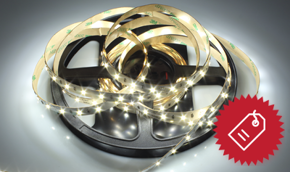



When buying an LED strip, the value that truly changes the atmosphere of a room is neither the power nor the number of LEDs per meter: it is the kelvin. Two strips identical in lumens and watts can transform the same living room into a cozy lounge or a waiting room, simply because one emits light at 2700 K and the other at 6500 K. Yet kelvin remains one of the most misunderstood parameters: some confuse it with brightness, some think that "more kelvin" means "more light," and some don't know that the same unit is also used to measure the temperature of the Sun or absolute zero.
In this guide, curated by the Ledpoint technical team, we start from the physical basics (what the kelvin scale is, how to convert it to degrees Celsius and Fahrenheit, why one should say "kelvin" and not "degrees kelvin") to arrive at what matters when designing a system: which color temperature in kelvin to choose for each room, each activity and each profession. You will find conversion tables, a kelvin color scale with natural and artificial sources, measured data on catalog LED strips, a °C/K/°F converter and a configurator that suggests the ideal shade of white in just a few clicks.
The guide is designed for those who need to make concrete decisions: the photographer who wants clean white balance, the videomaker who must match a panel to window light, the interior designer choosing between 2700 K and 3000 K for a bedroom, the electrician who must explain to the client the difference between kelvin and lumens, the store manager who wants garments with faithful colors, and the architect who designs offices and schools according to the UNI EN 12464-1 standard.
In this article...
1. Kelvin: what they are and what they indicate
Before choosing a shade of white, it is worth clarifying what kelvin actually measures. The word appears both in physics textbooks and on light bulb boxes, and that is no coincidence: it is the same unit applied to two related phenomena. Understanding the link between thermodynamic temperature and the color of light eliminates most design errors.
Definition of the kelvin in the International System
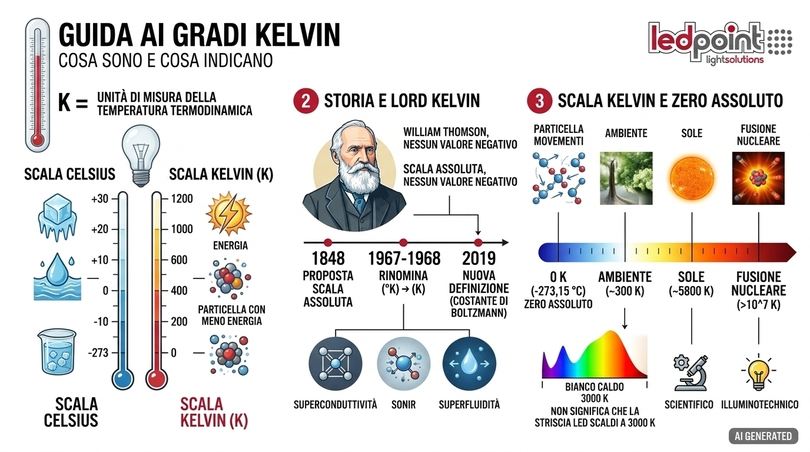
The kelvin is the unit of measurement of thermodynamic temperature and is one of the seven base units of the International System, together with the meter, kilogram, second, ampere, mole and candela. The symbol for kelvin is the uppercase letter K, without the degree symbol (°): one writes 300 K, not 300 °K. Unlike the Celsius scale, which sets zero at the freezing point of water, the kelvin scale starts from absolute zero, the lowest possible temperature in nature.
In simple terms, kelvin indicates how much thermal energy the particles of a body possess relative to the theoretical minimum. This is why the scale is called absolute: there are no negative values, and an object at 600 K possesses, in a thermodynamic sense, twice the temperature of one at 300 K. This does not hold for degrees Celsius: 20 °C is not "double" 10 °C.
What kind of unit K is and how to write kelvin
K is the official symbol of the unit; "kelvin" is the name, which is always written with a lowercase initial (like meter or second) and remains unchanged in the plural: 1 kelvin, 273 kelvin. The uppercase K is justified because the unit derives from the name of a person, William Thomson, Lord Kelvin. Be careful not to confuse K (kelvin) with lowercase k, which in the International System is the prefix "kilo" (e.g. kW, kilowatt) and in physics also indicates the Boltzmann constant.
Why we don't say "degrees kelvin"
Until 1967 the correct term was indeed "degree Kelvin" with the symbol °K. However, the 13th General Conference on Weights and Measures (1967-1968) established that the unit is simply called kelvin, with the symbol K. The reason is conceptual: "degree" indicates a step of a conventional scale with an arbitrary zero, whereas the kelvin measures an absolute physical quantity, just as the meter measures a length. Saying "degrees kelvin" is therefore technically improper, but the expression is so widespread in common language, in lamp retail and in online searches that we also use it in this guide, alongside the correct form "kelvin". On datasheets and projects, however, it is always best to write "3000 K".
What kelvin is used for: two uses, one scale
Kelvin is used in two broad families of applications:
| Field | What kelvin indicates | Typical example | Who uses it |
|---|---|---|---|
| Thermodynamics and science | The actual temperature of a body, measured from absolute zero | Water boils at 373.15 K at atmospheric pressure | Physicists, chemists, engineers, astronomers, meteorologists |
| Lighting engineering and imaging | The apparent color of white light (correlated color temperature, CCT) | A warm white LED strip emits light at 3000 K | Lighting designers, electricians, architects, photographers, videomakers |
When you read "3000 K" on an LED strip datasheet, it does not mean that the strip heats up to 3000 kelvin: the strip operates at a few tens of degrees Celsius. It means that the color of its light is similar to that emitted by an ideal body brought to 3000 K. We will see in chapter 6 why this comparison is so useful.
2. Lord Kelvin and the history of the absolute scale
The history of kelvin is the history of how humanity learned to measure heat in a universal way. From the first intuitions about gases to the 2019 redefinition based on a fundamental constant, each step has made the measurement more precise and independent of materials. Knowing it helps to understand why numbers like 273.15 are not arbitrary.
Who invented the kelvin scale: William Thomson
William Thomson (Belfast, 1824 - Largs, 1907), a British physicist and engineer, in 1848 proposed an "absolute" temperature scale, independent of the properties of any thermometric substance and founded on the principles of thermodynamics and the Carnot cycle. For his scientific and industrial merits (including his contribution to the laying of the first transatlantic telegraph cable) in 1892 he received the title of Baron Kelvin of Largs, from the name of the River Kelvin that flows near the University of Glasgow. It is from that title that the name of the unit derives.
What Lord Kelvin discovered and what his theory was
Kelvin's theory is based on a simple but revolutionary idea: if heat is the movement of particles, there must exist a minimum temperature at which this thermal movement is reduced to the minimum possible. Experiments on gases (Charles's and Gay-Lussac's law) showed that the volume of a gas at constant pressure decreases by about 1/273 for each degree Celsius of cooling. Extrapolating the line to zero volume yields a temperature around −273 °C: absolute zero. Kelvin gave this intuition a rigorous theoretical basis, freeing it from the behavior of a specific gas. His contributions also include the formulation of the second law of thermodynamics, studies on electromagnetism and estimates of the age of the Earth.
Evolution of the kelvin unit: from the triple point to the Boltzmann constant
| Year | Event | Practical significance |
|---|---|---|
| 1848 | Thomson proposes the absolute thermodynamic scale | The idea of a temperature independent of materials is born |
| 1954 | The 10th CGPM defines the scale through the triple point of water = 273.16 K | The reference becomes reproducible in the laboratory |
| 1967-1968 | The 13th CGPM renames "degree Kelvin" (°K) to kelvin (K) | The correct wording "300 K" is born |
| 2018 | The 26th CGPM approves the reform of the International System | All base units are tied to physical constants |
| May 20, 2019 | The new definition of the kelvin enters into force | The kelvin is defined by fixing the Boltzmann constant |
How the kelvin is defined today (SI definition 2019)
Since May 20, 2019, the kelvin is defined by fixing the exact value of the Boltzmann constant: k = 1.380649 × 10⁻²³ J/K. In other words, one kelvin corresponds to the change in thermodynamic temperature that produces a change in thermal energy equal to 1.380649 × 10⁻²³ joules per particle. The new definition, described by the BIPM, does not change the values we use every day (water still freezes at about 273.15 K), but makes the kelvin realizable with different methods, such as acoustic thermometry or Johnson noise thermometry, at any temperature and not only near the triple point of water. In Italy the custody of temperature standards is entrusted to INRIM, the National Institute of Metrological Research.
3. The kelvin scale and absolute zero
The kelvin scale has a starting point that is not a convention but a limit of nature. Understanding absolute zero helps to correctly read any value expressed in kelvin, from room temperature to the Sun. It is also the reason why every conversion contains the number 273.15.
What the kelvin scale is and what it is based on
The kelvin scale, also called the thermodynamic or absolute scale, is a temperature scale that starts from 0 K (absolute zero) and grows with intervals identical to those of the Celsius scale. It is based on the laws of thermodynamics: temperature is proportional to the average kinetic energy of the particles. An interval of one kelvin is exactly equivalent to an interval of one degree Celsius; only the starting point changes.
What zero corresponds to on the kelvin scale
Zero on the kelvin scale corresponds to absolute zero: 0 K = −273.15 °C = −459.67 °F. It is the temperature at which a system is in its state of minimum energy. Absolute zero is a theoretical minimum temperature: the third law of thermodynamics states that it cannot be reached with a finite number of steps. Low-temperature physics laboratories, however, have come very close, cooling atoms to infinitesimal fractions of a kelvin.
What happens at 0 kelvin (and at minus 273 degrees)
Approaching 0 K, matter exhibits surprising behaviors. The thermal motion of particles is reduced to a minimum, but does not vanish entirely: quantum mechanics predicts a residual "zero-point energy." At temperatures of a few kelvin, phenomena such as superconductivity appear (some metals conduct current without resistance) and the superfluidity of liquid helium, which flows without friction. Near a billionth of a kelvin, Bose-Einstein condensates can be created, a state of matter in which thousands of atoms behave as a single quantum entity. When one asks "what happens at minus 273 degrees?", the correct answer is therefore: one approaches an insurmountable limit, in which matter reveals its quantum properties.
Why exactly 273.15
The number 273.15 arises from the choice to keep intervals identical to the Celsius scale. Historically the triple point of water was set at 273.16 K, and since the freezing point of water at atmospheric pressure is about 0.01 °C below the triple point, Celsius zero falls at 273.15 K. The temperature of 273.15 kelvin is therefore called, in common language, "zero degrees Celsius." With the 2019 redefinition the value remains the same for continuity with all previous measurements.
How absolute zero was calculated
The first method was extrapolation: by measuring the volume or pressure of a gas at different temperatures and extending the resulting line to the zero value, a temperature close to −273 °C was identified. Today absolute zero is not "measured," but is the reference point of the thermodynamic scale; the precision of intermediate values is guaranteed by primary thermometers (gas, acoustic, Johnson noise) compared internationally.
Why the kelvin scale is called absolute
The kelvin scale is called absolute because its zero does not depend on a substance or a convention, as is the case for Celsius (water) and Fahrenheit (mixtures of ice and salt, body temperature). This is why in physics formulas temperature is measured in kelvin and not in Celsius: laws such as the ideal gas law (pV = nRT) or the Stefan-Boltzmann law on radiation only work with absolute temperatures. Using degrees Celsius in these equations would lead to meaningless results, such as negative volumes.
4. Converting Celsius, kelvin and Fahrenheit
Converting between degrees Celsius and kelvin is one of the most searched operations of all, from students to engineers. Fortunately it is also one of the simplest: it only takes an addition. Here you will find the formulas, a ready-to-use conversion table, worked examples and an interactive converter for Celsius, kelvin and Fahrenheit.
Formula from degrees Celsius to kelvin and vice versa
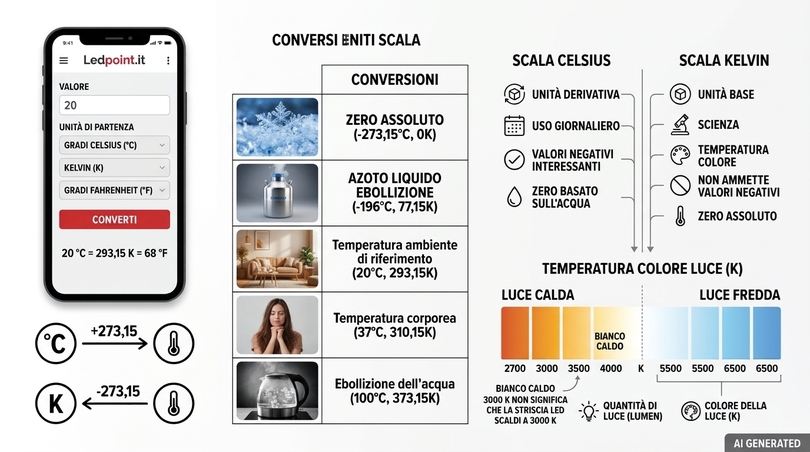
To convert degrees to kelvin, add 273.15 to the value in degrees Celsius: K = °C + 273.15. For the inverse conversion, from kelvin to degrees Celsius, subtract the same number: °C = K − 273.15. In most school exercises one rounds to 273, but in technical measurements it is best to keep the two decimals.
Formulas with degrees Fahrenheit
| Conversion | Formula | Worked example |
|---|---|---|
| From degrees Celsius to kelvin | K = °C + 273.15 | 25 °C + 273.15 = 298.15 K |
| From kelvin to degrees Celsius | °C = K − 273.15 | 300 K − 273.15 = 26.85 °C |
| From degrees Fahrenheit to kelvin | K = (°F − 32) × 5/9 + 273.15 | 68 °F → (68 − 32) × 5/9 + 273.15 = 293.15 K |
| From kelvin to degrees Fahrenheit | °F = (K − 273.15) × 9/5 + 32 | 310.15 K → 37 × 9/5 + 32 = 98.6 °F |
| From degrees Celsius to Fahrenheit | °F = °C × 9/5 + 32 | 20 °C → 68 °F |
| From degrees Fahrenheit to Celsius | °C = (°F − 32) × 5/9 | 212 °F → 100 °C |
Conversion table degrees Celsius, kelvin and Fahrenheit
The following table collects the most requested equivalences. You can use it as a quick reminder for exercises, datasheets and verification of operating temperatures of electronic components.
| Degrees Celsius (°C) | Kelvin (K) | Degrees Fahrenheit (°F) | Reference |
|---|---|---|---|
| −273.15 | 0 | −459.67 | Absolute zero |
| −196 | 77.15 | −320.8 | Liquid nitrogen (boiling) |
| −73.15 | 200 | −99.67 | 200 kelvin |
| −40 | 233.15 | −40 | Celsius and Fahrenheit coincide |
| −10 | 263.15 | 14 | Lower operating limit of many LED strips |
| 0 | 273.15 | 32 | Melting of ice |
| 0.01 | 273.16 | 32.02 | Triple point of water |
| 10 | 283.15 | 50 | Cool cellar |
| 20 | 293.15 | 68 | Reference ambient temperature |
| 23 | 296.15 | 73.4 | Air-conditioned office |
| 26.85 | 300 | 80.33 | 300 kelvin |
| 30 | 303.15 | 86 | Summer day |
| 35 | 308.15 | 95 | Intense heat |
| 37 | 310.15 | 98.6 | Body temperature |
| 45 | 318.15 | 113 | Typical upper operating limit of an IP20 strip |
| 50 | 323.15 | 122 | Operating limit of many professional strips |
| 93 | 366.15 | 199.4 | Water for green tea |
| 100 | 373.15 | 212 | Boiling of water (1 atm) |
| 301.44 | 574.59 | 574.59 | Kelvin and Fahrenheit coincide |
Worked examples: the most frequently asked questions about conversion
1 kelvin how many degrees Celsius is it?
It depends on what is meant. As an interval, 1 K is exactly equivalent to 1 °C: raising a temperature by one kelvin means raising it by one degree Celsius. As an absolute temperature, however, 1 K corresponds to −272.15 °C, just above absolute zero. The same applies to those searching "1 kelvin wieviel Grad" in German: 1 K = −272.15 °C.
1 degree how many kelvin is it?
1 °C corresponds to 274.15 K. As an interval, however, 1 degree Celsius is equivalent to 1 kelvin.
0 degrees Celsius how many kelvin is it?
0 °C = 273.15 K. It is the melting point of ice at normal atmospheric pressure.
10, 20, 30, 35 and 50 degrees Celsius how many kelvin are they?
10 °C = 283.15 K; 20 °C = 293.15 K; 30 °C = 303.15 K; 35 °C = 308.15 K; 50 °C = 323.15 K. In all cases one adds 273.15.
100 degrees Celsius how many kelvin is it? At what temperature does water boil in kelvin?
100 °C = 373.15 K. It is the boiling temperature of water at sea level (pressure of 1 atmosphere). In the mountains, where the pressure is lower, water boils at slightly lower temperatures.
To what temperature in degrees Celsius do 300 kelvin correspond? And 200 kelvin?
300 K = 26.85 °C, a warm spring day. 200 K = −73.15 °C, typical temperature of the surface of Mars on winter nights.
293 kelvin corresponds to 23 degrees?
No, it is a common mistake. 293 K corresponds to 19.85 °C (about 20 °C). To obtain 23 °C, 296.15 K are needed.
93 degrees in kelvin?
93 °C = 366.15 K. If instead the figure is in Fahrenheit, 93 °F = 307.04 K.
At what temperature do the Celsius and kelvin scales have the same value?
Never. Since the difference between the two scales is always 273.15, Celsius and kelvin never coincide. Celsius and Fahrenheit coincide at −40 and kelvin and Fahrenheit at about 574.59.
What is the difference between degrees Celsius and kelvin
| Characteristic | Celsius scale | Kelvin scale |
|---|---|---|
| Symbol | °C (with the degree symbol) | K (without the degree symbol) |
| Zero point | Melting of ice | Absolute zero |
| Negative values | Yes | No |
| Interval width | 1 °C | 1 K (identical) |
| Status in the International System | Derived unit | Base unit |
| Typical use | Weather, daily life, cooking | Science, engineering, color temperature of light |
The difference between the zero of the Celsius scale and the zero of the kelvin scale is 273.15 units. In short, the Celsius scale is practical for daily life, the kelvin scale is indispensable when absolute temperatures are needed, as in thermodynamic calculations or in describing the color of light.
Converter degrees Celsius, kelvin and Fahrenheit
Enter a value, choose the starting unit and immediately get the conversion in the other two scales. The converter also flags impossible values, below absolute zero.
| Result | 20 °C = 293.15 K = 68 °F |
Conversion exercises degrees Celsius and kelvin
To fix the concept, try solving these exercises before reading the solution:
| Exercise | Solution |
|---|---|
| Convert −18 °C (freezer) to kelvin | −18 + 273.15 = 255.15 K |
| Convert 77 K to degrees Celsius | 77 − 273.15 = −196.15 °C |
| Convert 451 °F to kelvin | (451 − 32) × 5/9 + 273.15 = 505.93 K |
| A thermometer shows an increase of 15 °C: by how many kelvin did the temperature increase? | By 15 K (the intervals coincide) |
| Convert the surface temperature of the Sun (5772 K) to °C | 5772 − 273.15 = 5498.85 °C |
5. How kelvin is measured and who uses it
Measuring a temperature in kelvin does not require "special" instruments: any calibrated thermometer can express the result in K. The case of the color temperature of light is different, as it is measured with optical instruments. In this chapter we look at both aspects, along with the most useful examples of temperatures expressed in kelvin.
How temperature in kelvin is measured
For thermodynamic temperature, a distinction is made between primary thermometers, which measure temperature directly from physical laws, and secondary thermometers, calibrated against primary ones.
| Instrument | Principle | Typical field of use |
|---|---|---|
| Gas thermometer | Pressure or volume of a gas proportional to absolute temperature | Primary metrology, low temperatures |
| Acoustic thermometer | Speed of sound in a gas | Primary realization of the kelvin |
| Johnson noise thermometry | Electrical noise generated by the thermal agitation of electrons | Research, very low or very high temperatures |
| Platinum resistance thermometer (Pt100) | Variation of electrical resistance with temperature | Industry, laboratories, HVAC systems |
| Thermocouple | Voltage generated by the junction of two different metals | Ovens, motors, industrial processes |
| Pyrometer / thermal camera | Infrared radiation emitted by the body | Non-contact measurements, verification of heat sinks and power supplies |
A "kelvin thermometer" in the strict sense is therefore any precision thermometer that reports the measurement in K: the conversion is only a matter of scale. For those installing LED strips, the most useful thermometer is the thermal camera, which allows verifying that the strip mounted in a profile does not exceed the operating temperature indicated on the datasheet.
How to measure the kelvin of light
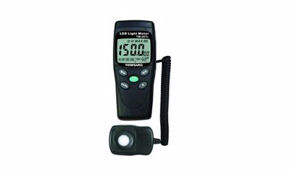
The color temperature of a light source is measured with a spectroradiometer or with a colorimeter (often improperly called a "kelvin meter"). The instrument detects the emitted spectrum, calculates the chromaticity coordinates and returns the CCT in kelvin, the color rendering index and the deviation from the blackbody curve (Duv). Ledpoint regularly verifies its strips with an integrating sphere and spectroradiometer, and it is thanks to these measurements that on product datasheets you find data such as lumens per meter, efficiency in lm/W, color temperature and CRI. Smartphone apps that promise to measure kelvin provide only an approximate estimate, because the phone camera applies automatic color corrections.
Who uses kelvin and when it is used
- Physics: thermodynamics, cryogenics, solid-state physics, superconductivity.
- Chemistry: reaction rates (Arrhenius equation), equilibria, gas laws.
- Astronomy: surface temperatures of stars, cosmic background radiation, spectral classification.
- Engineering and electronics: heat dissipation, component reliability, sensors.
- Meteorology and climatology: atmospheric and satellite models.
- Lighting engineering, photography and video: color temperature of light, white balance.
Examples of temperatures in kelvin
| Phenomenon | Temperature in kelvin (approx.) | Equivalent in °C |
|---|---|---|
| Absolute zero | 0 K | −273.15 °C |
| Cosmic background radiation | 2.7 K | −270.4 °C |
| Boiling of helium | 4.2 K | −268.9 °C |
| Boiling of nitrogen | 77 K | −196 °C |
| Freezing of water | 273.15 K | 0 °C |
| Ambient temperature | 293-298 K | 20-25 °C |
| Body temperature | 310.15 K | 37 °C |
| Boiling of water | 373.15 K | 100 °C |
| Domestic oven | 473-523 K | 200-250 °C |
| Volcanic lava | 1300-1500 K | 1000-1200 °C |
| Filament of an incandescent lamp | 2700-3000 K | 2400-2700 °C |
| Surface of the Sun (photosphere) | 5772 K | about 5500 °C |
| Core of the Sun | about 15 million K | about 15 million °C |
Notice how, for very high temperatures, the difference between kelvin and degrees Celsius becomes negligible: saying that the core of the Sun is at 15 million kelvin or degrees Celsius is practically the same thing. Conversely, at low temperatures the kelvin scale is the only one that allows intuitive reasoning.
The importance of the kelvin in science
The kelvin is a universal reference: it allows a laboratory in Turin and one in Tokyo to compare measurements of heat and energy without ambiguity. Without an absolute temperature there would be no modern thermodynamics, efficient engines, refrigeration, magnetic resonance imaging (which uses superconducting magnets cooled to a few kelvin) or the physical description of the light we use to choose a lamp. And it is precisely here that the science of kelvin meets the world of lighting.
6. From thermodynamics to light: color temperature in kelvin
Why did a unit born to measure heat end up on light bulb packages? The answer lies in an ideal object studied by 19th-century physicists: the blackbody. Understanding it means understanding why "3000 K" describes a color and why, paradoxically, "warm" light has fewer kelvin than "cool" light.
The blackbody and Planck's law
A blackbody is an ideal object that absorbs all the radiation it receives and emits it as a function of temperature alone. Heating a piece of iron produces something similar: first it becomes dark red, then orange, then yellow and finally white. Max Planck, in 1900, described this behavior mathematically. Each absolute temperature corresponds to a precise color of the emitted light: around 1800 K the color is orange like a candle, at 2700 K warm yellow like an incandescent bulb, at 5500-6500 K white similar to daylight, above 10000 K bluish. The color temperature of a source therefore indicates the temperature in kelvin of a blackbody that would emit light of the same color.
Correlated color temperature (CCT) and Duv
Incandescent and halogen lamps are very close to a blackbody, because they produce light by heating a filament. LEDs and fluorescents, on the other hand, generate light differently, and their color may deviate slightly from the blackbody curve, known as the Planckian locus. This is why datasheets speak of CCT (Correlated Color Temperature), the temperature of the blackbody whose color is closest to that of the source. The deviation from the curve is expressed by the Duv value: a positive Duv indicates a slight tendency toward green, a negative one toward magenta-pink. Two strips both at "4000 K" may therefore appear slightly different if they have different Duv values: one more reason to choose products with declared color tolerances.
The paradox: warm light, few kelvin
In physics a hotter body emits bluer light; in interior design language, on the other hand, yellow-orange light is called "warm" and bluish light "cool." This is why warm light has fewer kelvin (2200-3000 K) and cool light has more (5500-6500 K and beyond). The terms "warm" and "cool" describe the psychological sensation and associations (fire, sunset versus sky, snow), not the physical temperature. Keeping this in mind avoids one of the most frequent misunderstandings in lighting stores.
Mired: the scale that follows perception
The eye does not perceive differences in kelvin linearly: the jump from 2700 K to 3000 K is much more noticeable than the one from 6000 K to 6300 K, although both are 300 K. Photographers and lighting designers therefore use the mired (micro reciprocal degree): mired = 1,000,000 / K. 2700 K corresponds to about 370 mired, 3000 K to 333 mired (difference 37), while 6000 K and 6300 K are worth 167 and 159 mired (difference 8). At equal kelvin, differences between warm whites are much more visible than those between cool whites: this is why in the warm range it is worth being very precise in the choice and in the consistency between batches.
Color temperature and brightness are different things
One of the most important concepts to explain to clients is that kelvin does not indicate how much light a source emits, but what color its white light is. The amount of light is measured in lumens (luminous flux) and the illuminance on a surface in lux. A 3000 K strip can be brighter than a 6500 K one, and vice versa. It is true, however, that at equal lux, cool lights are often perceived as slightly more "brilliant," and this leads many to overestimate their brightness.
| Quantity | Unit | What it answers | Example on an LED strip |
|---|---|---|---|
| Color temperature | K (kelvin) | What color is the white? | 3000 K, warm white |
| Luminous flux | lm (lumen) | How much light does it emit? | 2850 lm/m |
| Luminous efficiency | lm/W | How much light per watt consumed? | 155 lm/W |
| Illuminance | lx (lux) | How much light reaches the surface? | 500 lx on the work surface |
| Color rendering | CRI / Ra | How faithful are the illuminated colors? | CRI Ra>90 |
| Power | W (watt) | How much energy does it consume? | 20 W/m |
7. Kelvin color scale: sun, lamps and sources
A good kelvin color scale is the most practical tool for orientation: it lines up the sources we know, from the flame of a candle to the blue sky, and allows you to "translate" a number into a mental image. Here you will find both natural and artificial sources, including the now outdated technologies that LED strips are replacing.
Natural light and sunlight in kelvin
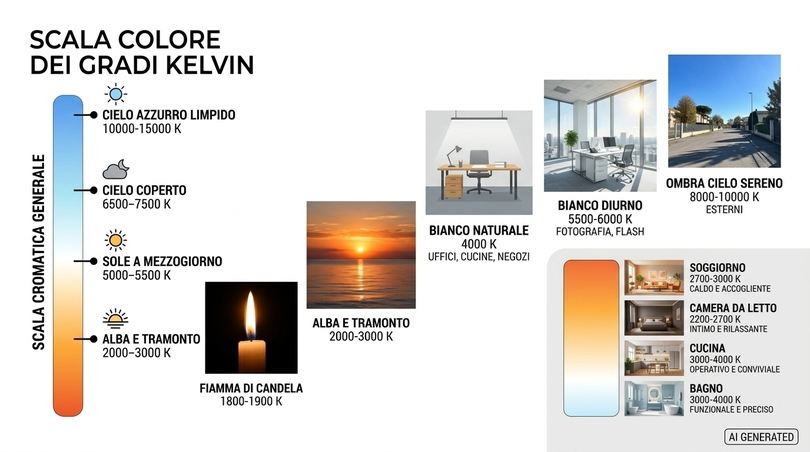
Natural light changes color temperature continuously during the day. Sunlight at noon with a clear sky is around 5000-5500 K, while at dawn and sunset it drops to 2000-3000 K because the atmosphere filters out the blue components. An overcast sky rises to 6500-7500 K and shade on a clear day can exceed 10000 K, because it is illuminated almost only by the diffuse blue light of the sky. By convention, the standard "daylight" illuminant CIE D65 corresponds to about 6500 K and the "daylight white" of photography to 5500-5600 K.
Kelvin table: color scale of sources
| Source | Kelvin (indicative) | Perceived color |
|---|---|---|
| Candle flame | 1800-1900 K | Intense orange |
| Sunrise and sunset | 2000-3000 K | Orange-golden |
| High-pressure sodium lamp | about 2000-2100 K | Yellow-orange |
| Extra warm white LED strip | 2200-2400 K | Amber, candle effect |
| Incandescent lamp | 2700 K | Warm yellow |
| Halogen lamp | 2900-3200 K | Bright warm white |
| "Tungsten" light for photo and video | 3200 K | Warm white |
| Fluorescent ("neon") warm white | 2700-3000 K | Warm white |
| Fluorescent ("neon") neutral white | 4000 K | Natural white |
| Full moon (reflected light) | about 4100 K | Neutral white, perceived as cool |
| Xenon headlights (HID) car | 4300-6000 K | Cool white |
| Sun at noon | 5000-5500 K | Pure white |
| Xenon photographic flash | 5500-6000 K | Daylight white |
| Standard daylight (D65) | 6500 K | Cool white |
| Fluorescent "daylight" | 6500 K | Cool white |
| Overcast sky | 6500-7500 K | Bluish white |
| Shade with clear sky | 8000-10000 K | Bluish |
| Clear blue sky | 10000-15000 K | Blue |
Halogen, incandescent, neon and xenon lamps: what replaces them today
Incandescent lamps (about 2700 K) and halogen lamps (about 3000 K) have accustomed generations of users to warm light with excellent color rendering. In the European Union most halogen lamps for domestic use have been out of production since 2018, and since 2023 compact fluorescent lamps and T5 and T8 tubes, commonly called "neon," have also been progressively eliminated. This is why those replacing these sources with LED strips must know their reference kelvin: to recreate the atmosphere of a halogen lamp, choose a 3000 K strip with high CRI; to replace an office fluorescent tube, 4000 K is generally chosen. For neon-style signs, today flexible LED neon tubes are used, available in white and colored versions.
RGB kelvin: why colored strips have no color temperature
Color temperature applies only to white or nearly white light, the kind found near the Planckian locus. Red, green or violet light has no significant color temperature. RGB strips, therefore, are not chosen based on kelvin: by mixing red, green and blue one can obtain white, but it is often cool, imprecise and with low color rendering. If both colors and a quality white are needed, the correct solution is RGB+CCT LED strips, which combine colored LEDs with two white channels, warm and cool, to adjust color temperature precisely.
8. LED kelvin: how the white of a strip is created
In LEDs the color temperature does not depend on heat but on the chemistry of the materials. This gives manufacturers enormous freedom, but also introduces variables that the designer must know: tolerances, batch differences, the effect of protective coverings. In this chapter we see how to read kelvin on LED strip datasheets and what real data emerges from the Ledpoint catalog.
How color temperature is obtained in an LED
Almost all white LEDs consist of a chip that emits blue light covered by a layer of phosphors that absorb part of the blue and re-emit it as yellow, green and red. By dosing the composition and thickness of the phosphors, the color temperature is adjusted: more "warm" phosphors mean fewer kelvin. This also explains why, with the same chip, warm white LEDs usually have slightly lower efficiency than cool white LEDs: the conversion of blue into red involves a small energy loss (the "Stokes shift"). There are also LEDs with violet chips and broad-spectrum phosphors, designed to reproduce a spectrum similar to sunlight with very high color rendering.
Binning, MacAdam ellipses and "3 step"
No production process generates identical LEDs. Manufacturers therefore divide LEDs into classes (bins) based on the actual color. The precision of a bin is expressed in steps of the MacAdam ellipse, also called SDCM (Standard Deviation of Colour Matching):
| Tolerance | What it means | Where it is suitable |
|---|---|---|
| 1-2 step | Practically imperceptible color differences | Museums, galleries, luxury retail |
| 3 step | Differences barely perceptible only to an attentive eye, by placing the sources side by side | Architectural projects, quality residential, offices, shops |
| 5 step | Visible differences when placing two sources side by side | Indirect lighting, technical environments |
| 7 step and beyond | Obvious differences | Non-critical applications |
Many strips in the Ledpoint catalog report the wording "3step" next to the kelvin, for example the 5m LED strip white 4000K 3step CRI>90 2835 240led/m 24V 19.2W/m. Using 3 step allows adding or replacing sections of strip of the same shade without visible color variations, even between different production batches. For a project that spans multiple rooms or will need to be expanded over the years, it is a requirement to be considered mandatory.
LED color temperature and strip color temperature
A detail that few notice: on Ledpoint datasheets there sometimes appear two distinct values, "strip color temperature" and "LED color temperature". Protective coverings (silicone, resins, extruded tubes) and profile diffusers can slightly shift the final color of the light. The value to consider for the project is always that of the finished strip, as it will be installed. The same applies to aluminum profiles: a quality opal diffuser changes the CCT little, while low-quality coverings can yellow or shift the light over time.
Real data: kelvin and efficiency in catalog strips
To give a concrete reference, we have collected some values published on the datasheets of Ledpoint LED strips, measured in the laboratory. The data shows that color temperature alone does not determine efficiency: the chip, LED density, power per meter and color rendering all matter.
| Ledpoint Strip | Kelvin | CRI | Lumen/m | Efficiency | Power |
|---|---|---|---|---|---|
| 5m warm white 3000K 3step 2835 240led/m 24V 20W/m | 3000 K 3step | Ra>80 | 2850 | 155 lm/W | 20 W/m |
| 3m warm white 3000K 3step 2835 576led/m 24V 44.4W/m | 3000 K 3step | Ra>80 | 6200 | 155 lm/W | 44.4 W/m |
| 5m warm white 3000K 3step 2835 252led/m 24V 45W/m | 3000 K 3step | Ra>80 | 5100 | 125 lm/W | 45 W/m |
| COB 5m warm white 3000K CRI Ra>93 480led/m 48V 9W/m | 3000 K | Ra>93 | 700 | 85 lm/W | 9 W/m |
| 5m white 4000K 3step CRI>90 2835 240led/m 24V 19.2W/m | 4000 K 3step | >90 | 2650 | 155 lm/W | 19.2 W/m |
| 5m white 4000K 3step 2835 CRI>95 (Ra>97) 128led/m 24V 13W/m | 4000 K 3step | Ra>97 | 1560 | 135 lm/W | 13 W/m |
| 5m white 4000K 2216pro CRI Ra>90 240led/m 24V 10.5W/m, PCB 5mm | 3900-4250 K | Ra>90 | 1250 | 130 lm/W | 10.5 W/m |
| 5m white 4000K 3step 2835 120led/m 24V 9.6W/m IP65 | 4000 K 3step | Ra>80 | 950 | 105 lm/W | 9.6 W/m |
| 5m RGB + CCT 2600-6500K 210led/m 24V (warm channel) | 2700 K | - | 1560 | 120 lm/W | 14.4 W/channel |
| 5m RGB + CCT 2600-6500K 210led/m 24V (cool channel) | 6600 K | - | 1700 | 130 lm/W | 14.4 W/channel |
Three useful indications emerge from the data. First: on the same RGB+CCT strip, the cool channel at 6600 K produces about 9% more lumens than the warm channel at 2700 K at equal power, consistent with the physics of phosphors. Second: latest-generation 3000 K strips reach 155 lm/W, the same efficiency as 4000 K models, so choosing warm light does not necessarily mean consuming more. Third: high color rendering has a cost in efficiency (85 lm/W for the COB Ra>93 versus 155 lm/W for the SMD Ra>80), which must be taken into account when faithful colors are a priority. Also remember that the IP65 version of the same family loses a few points of efficiency due to the silicone covering.
Does color temperature affect energy consumption?
Directly, no: a strip consumes the watts indicated on the datasheet regardless of its kelvin. Indirectly yes, but only slightly: with the same model, the cool version produces a few more lumens per watt, so to reach the same illuminance a slightly lower power might be needed. In practice the difference is on the order of 5-10% and is often canceled out by design choices (dimming, LED density, optics, profiles). Choosing kelvin based on visual comfort and the function of the room remains the correct decision.
Monochrome, CCT, RGBW and RGB+CCT strips: which to choose
| Type | Kelvin | Control needed | When to choose it |
|---|---|---|---|
| Warm white | Fixed, 2200-3500 K | Power supply, optional dimmer | Homes, hospitality, restaurants, relaxing atmospheres |
| Natural white | Fixed, about 4000 K | Power supply, optional dimmer | Kitchens, offices, shops, schools, laboratories |
| Cool white | Fixed, 5000-8700 K | Power supply, optional dimmer | Technical environments, garages, warehouses, daylight photo sets |
| Dynamic white CCT | Adjustable, e.g. 2700-6500 K | Controller or CCT receiver | Home automation, circadian lighting, photo and video, multifunctional environments |
| RGB+CCT | Adjustable + colors | 5-channel RGB+CCT controller | Scenography, clubs, events, smart homes |
| COB | Fixed or CCT | Like monochrome or CCT | Continuous lines of light without dotting effect, exposed profiles |
For a complete overview of chips, voltages and applications, also consult our guide LED strip: types, uses and how to choose the best one.
How a CCT dynamic white strip works
CCT (tunable white) strips mount two series of LEDs on the same circuit, one warm and one cool, connected to a common positive and two separate channels ("3-wire" configuration). The controller regulates the intensity of the two channels: with the warm channel at 100% and the cool one off, the minimum temperature is obtained, for example 2700 K; with both on, all intermediate shades are obtained. The Ledpoint catalog includes CCT strips with different ranges, from 2600-6500 K up to versions with a light spectrum similar to the sun 2700-5000 K and 48 V versions with current control for long runs. There are also addressable CCT strips, which allow varying the white in segments: we discuss them in the in-depth article addressable pixel LEDs: how to program them.
Calculator: what color temperature do you get by mixing two channels
With a CCT strip, the resulting temperature depends on the proportion of light from the two channels. The exact calculation requires chromaticity coordinates, but a good approximation is obtained by interpolating in mired. Enter the kelvin of the two channels and the percentage of cool light.
| 50% | |
| Estimated color temperature | about 3800 K |
Kelvin and smart systems: compatibility
A fixed-temperature strip is compatible with any smart system that manages a dimming channel. To adjust kelvin, however, a CCT strip and a two-channel controller compatible with the chosen protocol are needed: radio frequency, Wi-Fi, Zigbee, DALI DT8, DMX or 0-10 V. The Ledpoint guide on ceiling LED strips describes a CCT line with Skydance control and a logarithmic dimming curve, which gives the eye a variation perceived as linear. Before purchasing, always check voltage (12, 24 or 48 V), maximum current per channel and type of connection (3 wires for CCT, 5 wires for RGB+CCT).
9. How many kelvin for each room
There is no "best" color temperature in absolute terms: there is the right one for the activity carried out in a room, for the time of day and for the materials present. The following indications come from lighting practice and the UNI EN 12464-1 standard, and are intended as a starting point, to be adapted to personal preferences and furnishings.
The three families of white according to the UNI EN 12464-1 standard
The European standard on lighting of indoor workplaces, UNI EN 12464-1, groups sources into three color appearance classes:
| Color appearance | Kelvin | Sensation | Typical applications |
|---|---|---|---|
| Warm | below 3300 K | Cozy, relaxing, intimate | Homes, hotels, restaurants, spas |
| Intermediate (neutral) | 3300-5300 K | Balanced, active, bright | Offices, schools, shops, kitchens |
| Cool | above 5300 K | Technical, stimulating, "clinical" | Laboratories, industry, technical environments, quality control |
How many kelvin for warm light?
Warm light is defined as light with a color temperature between 2200 and 3300 K. Within this range, however, there are important differences: 2200-2400 K is an amber candle-like light, suitable for decorative effects and evening venues; 2700 K reproduces the classic incandescent bulb and is the most used warm light in homes; 3000 K is a cleaner, brighter warm white, similar to halogen, which brings out light woods, stone and fabrics. In the Ledpoint catalog the warm white LED strips 2200-3500K category collects all these shades.
What color of light is 4000 K?
4000 K is a natural (or neutral) white: neither yellow nor blue, similar to morning light. It is the most widespread temperature in offices, schools and shops because it promotes concentration and reading without appearing cold. At home it is suitable for kitchens, bathrooms, studies and work areas. If placed next to 2700 K in the same room, however, it may appear "cold" by contrast.
Difference between 2700 K, 3000 K and 4000 K in interior design
| Kelvin | Effect on the environment | Materials enhanced | Furniture styles |
|---|---|---|---|
| 2700 K | Intimate, enveloping, evening | Dark woods, warm fabrics, terracotta, brass | Classic, rustic, country, boho |
| 3000 K | Cozy but sharper | Light woods, stone, warm marbles, plasters | Contemporary, Mediterranean, japandi |
| 4000 K | Bright, active, orderly | Whites, grays, steel, glass, concrete | Minimalist, industrial, high-tech |
Recommended kelvin table by room
| Room | Recommended kelvin | Recommended CRI | Design notes |
|---|---|---|---|
| Living room | 2700-3000 K | ≥90 | Dimmable; CCT if the room is also a study or play area |
| Bedroom | 2200-2700 K | ≥90 | Indirect light, deep dimming, no cool light in the evening |
| Kitchen | 3000-4000 K | ≥90 | 4000 K under wall units for the work surface, 3000 K for the room |
| Bathroom | 3000-4000 K | ≥90 | Mirror with neutral light and high CRI; IP65 strip in wet areas |
| Study / home office | 4000 K (or CCT 3000-5000 K) | ≥90 | Cooler during the day, warmer in the evening |
| Corridors and stairs | 2700-3000 K | ≥80 | Consistent with adjacent rooms |
| Walk-in closet | 3000-4000 K | ≥90 | To recognize garment colors well |
| Office | 4000 K | ≥80 (≥90 recommended) | UNI EN 12464-1, 500 lx on the visual task for writing and reading |
| School / classroom | 4000 K | ≥80 | Possible CCT for different activities during the day |
| Clothing store | 3000-4000 K | ≥90, better ≥95 | Fitting rooms with the same light as the sales area |
| Restaurant / hotel | 2200-3000 K | ≥90 | Dimmable scenarios for lunch and dinner |
| Museum / gallery | 3000-4000 K | ≥95 | Color tolerance 2-3 step, attention to UV rays |
| Garage, laboratory, warehouse | 4000-6500 K | ≥80 | Priority to visibility and efficiency |
| Outdoors, garden, facades | 2700-3000 K | ≥80 | Warm light to limit impact on wildlife and the night sky; IP65-IP67 |
How many kelvin for living room lighting
For the living room the most versatile choice is 2700-3000 K. If the room is also used for working, reading or letting children play, a CCT strip allows rising to 4000 K during the day and returning to 2700 K in the evening. A strip in the ceiling cove with indirect light, combined with table lamps, creates layered lighting that reduces excessive contrasts.
What temperature in kelvin is ideal for a bedroom
In the bedroom evening light should be warm, between 2200 and 2700 K, and dimmable. Light rich in blue components, typical of high temperatures, can interfere with the production of melatonin, the hormone that regulates sleep. A strip behind the headboard or under the bed, at low intensity, is ideal for orienting oneself at night without fully "waking up."
How to choose kelvin for a modern kitchen
Two needs coexist in the kitchen: seeing well while chopping and cooking, and enjoying the room during meals. The most effective solution is to separate the functions: under-cabinet strips at 4000 K with high CRI for the work surface and ambient light at 3000 K. Alternatively, a CCT strip under the wall units allows switching from operational to convivial light. A CRI ≥90 makes food more appetizing and allows correct assessment of cooking.
How to combine warm and cool lights in an interior design project
The golden rule is not to mix very different temperatures in the same visual field. If a kitchen and living room coexist in an open space, a difference of 1000 K (3000 and 4000 K) is manageable if the areas are distinct; a difference of 3000 K (2700 and 5700 K) creates a disorderly effect. It is instead effective to use the temperature difference intentionally: a niche at 2700 K on a wall lit at 3000 K appears warmer and cozier, while a work of art lit at 4000 K in a 3000 K room stands out by contrast.
10. Configurator: find the right color temperature for your LED strip
Tables are useful, but every project has its priorities. The configurator below cross-references room, objective and need for adjustment to suggest the most suitable kelvin range, the minimum color rendering and the type of Ledpoint LED strip to start from. The result is a design indication: for complex installations our technical office is available to verify it with you.
| Result | Select the options and press the button. |
If the configurator suggests a CCT solution, remember to pair the strip with a compatible controller or CCT receiver. For very long installations, consider LED strips with constant current control, which keep brightness and color uniform even at the end of the run.
11. Kelvin for professionals
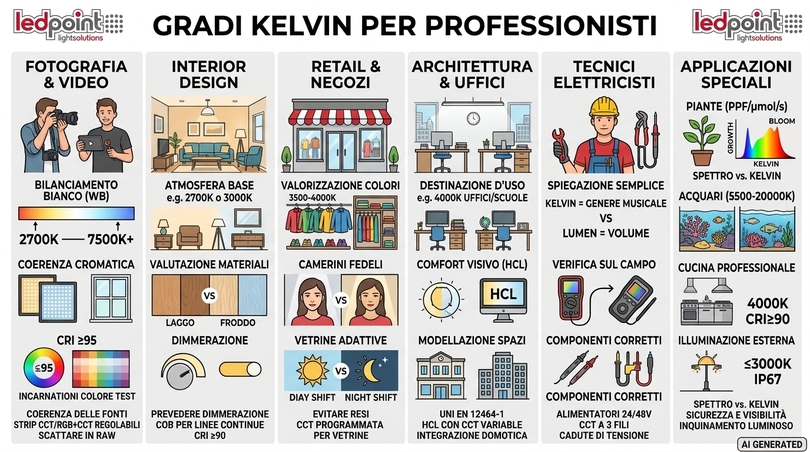
Each profession looks at kelvin with different needs: the photographer thinks about post-production, the interior designer about atmosphere, the electrician about component compatibility, the shopkeeper about sales, the architect about occupant well-being. In this chapter we answer the most frequent questions of each, with operational indications.
Photography: kelvin and white balance
In photography kelvin is the common language between lights and the camera. White balance tells the camera which color temperature to consider "neutral," so that a white object appears white in the final image.
How to set white balance based on kelvin
The camera is set to the same kelvin value as the light illuminating the scene: 3200 K under tungsten lights, 5500-5600 K with flash or daylight, 6500-7500 K with an overcast sky. If a value higher than the actual light is set, the image shifts warm (yellow-orange); if a lower value is set, it shifts cool (blue). Many photographers exploit this effect creatively, for example "warming" a portrait by setting 6000 K under 5500 K light.
How to choose the correct kelvin temperature for a photo shoot
The choice depends on the dominant light. In the studio, with flash, one almost always works at 5500-5600 K. On location, one measures or estimates the ambient light and adjusts the additional lights. The most important rule is consistency: all sources illuminating the subject should have the same color temperature, or intentional and controlled differences. High-CRI LED strips mounted in profiles or on self-built panels are excellent as background lights, rim lights and still life lighting.
Difference between warm and cool light in photography
Warm light communicates intimacy, nostalgia, comfort and is used for portraits, weddings, food and residential interiors. Cool light communicates cleanliness, technology, detachment and is used for tech products, silver jewelry, night or cinematic settings. The choice is not only technical but narrative.
How to avoid color casts with different light sources
Casts arise when sources with different kelvin illuminate the same subject, or when a source has a high Duv (green or magenta tendency). To avoid them: turn off or shield inconsistent ambient lights; use corrective gels (CTO to warm, CTB to cool) on the lights; choose LEDs with CRI above 95 and tight color tolerance; shoot in RAW to correct white balance in post-production without quality loss. The CRI, or color rendering index, is fundamental: a 5600 K light with CRI 80 will produce dull skin tones even with perfect white balance.
Which LED lamps offer adjustable color temperature
Bi-color panels and CCT strips allow adjusting color temperature without gels. A CCT strip mounted on an aluminum profile with diffuser becomes an adjustable light bar from 2700 to 6500 K, useful for light painting, backgrounds, still life and fixed set lighting.
Video, streaming and content creation
In video the consistency of color temperature is even more critical than in photography, because variations are noticeable from one shot to another and correcting them in post-production on every clip takes time.
How to set kelvin for recording video with natural light
With daylight one starts at 5600 K on the camera and adjusts based on conditions: higher values with overcast sky or in shade, lower at golden hour. Avoid automatic white balance: during a shoot it could change value if the subject moves or a colored object enters the frame, creating visible jumps. Lock the value manually or with a gray card reference.
What is the best kelvin temperature for streaming
There is no single value: the best temperature for streaming is the one consistent with the dominant light in the room. In a room without windows, lit only by LEDs, values between 4000 and 5000 K give natural skin tones and a professional appearance. If the room has domestic lights at 2700-3000 K that cannot be turned off, it is preferable to warm the main light toward 3200-3500 K. A strip at 2700-3000 K behind the desk or on the bookshelf creates depth and separates the subject from the background: the temperature difference, in this case, is an intentional style element.
How to match an LED light to a window without color differences
Window light varies during the day between about 5000 and 7000 K. The most reliable method is to use a CCT light: set the camera to a fixed value, adjust the LED light until the gray card appears neutral both on the window side and on the LED side. If the window light changes a lot, it can be filtered with diffusing curtains to stabilize it.
Which LED systems allow adjusting kelvin quickly
Bi-color panels, RGB+CCT lights and CCT strips with knob, remote control or app controllers. For a fixed set, an RGB+CCT strip offers both white adjustment and colored background lights, very popular in social media content.
How to correct a kelvin temperature error in post-production
In editing and color grading programs one uses the "temperature" slider (often expressed directly in kelvin) together with "tint" (green-magenta axis). The starting point is to sample with the eyedropper an area that should be neutral (gray or white). If two different temperatures coexist in the same shot, global correction is not enough: selective correction with masks is needed, which is much more laborious. Preventing with consistent lights always costs less time than correcting afterward.
Interior design: atmosphere and function
For the interior designer, kelvin is a compositional tool, like wall colors or materials. A consistent choice reinforces the style of the project; a random choice can cancel it.
The main indications for the interior designer: define a "base" color temperature for the entire home (typically 2700 or 3000 K) and deviate from it only intentionally; evaluate real materials under the chosen light, because a walnut wood at 4000 K may appear grayish and a white marble at 2700 K may look yellowish; always provide dimming, because the same light at full power and at 20% completely changes the atmosphere; in high-end projects, prefer strips with CRI ≥90 and 3 step tolerance, to ensure color continuity between rooms and different profiles. COB strips are particularly appreciated in exposed profiles, because they produce a continuous line of light without visible dots.
Retail: enhancing colors in clothing stores
In retail the color temperature directly affects sales: a garment that appears one color in the store and another in daylight generates returns and dissatisfaction.
Which kelvin temperature best enhances the colors of clothes
For clothing the most balanced range is 3500-4000 K with CRI ≥90, better ≥95. At these temperatures whites, blacks and saturated colors appear faithful. Luxury boutiques and stores of elegant clothing, bridal fashion and leather goods often choose 3000 K for a warmer atmosphere, compensating with a very high CRI. Cool temperatures (5000 K and above) are used for sportswear and technical clothing, where they communicate dynamism.
Can warm light alter the perception of garment colors?
Yes. Under very warm light (2200-2700 K) blues and purples appear darker and duller, whites tend toward cream, while reds, oranges and browns become more intense. If the light also has a low CRI, the differences between similar shades (for example navy blue and black) become difficult to distinguish.
How many kelvin are recommended for fitting rooms
In fitting rooms it is advisable to use the same temperature as the sales area, between 3000 and 4000 K, with CRI ≥90 and frontal and lateral lighting, not just from above, to avoid shadows on the face. Too cool a light makes the skin pale and discourages purchase; too warm a light falsifies the colors of the garment. Some stores install CCT strips in fitting rooms, allowing the customer to see the garment "as in the office" and "as at a dinner."
How to choose kelvin lighting for shop windows and shelves
Shop windows must compete with daylight: a 3000 K window in full sun will appear dim and yellowish, while in the evening the same light will look inviting. This is why shop windows often use strips with high lumen density or CCT solutions programmed to rise in temperature during the day and fall in the evening. On shelves, linear strips integrated into the shelves uniformly illuminate the products; the temperature must be consistent with the overall temperature of the store.
What is the best color temperature for an elegant atmosphere
An elegant atmosphere is born from controlled contrast and warmth: moderate general light at 3000 K, more intense accents on products, poorly lit dark surfaces. Strips at 2700-3000 K in ceiling coves, niches and backlit displays add depth. Elegance is also given by quality: a high CRI makes materials perceived as more precious.
Architecture: visual well-being, offices and schools
For the architect, color temperature is part of a broader framework, which includes regulations, visual comfort, energy efficiency, integration with natural light and occupant well-being.
How to choose kelvin based on the intended use of a building
One starts from the activity: residences, hotels and facilities for the elderly favor 2700-3000 K; offices, schools and clinics 4000 K; laboratories and industries 4000-6500 K. The UNI EN 12464-1 standard provides the values of illuminance, uniformity, glare and color rendering for each visual task; color temperature is left to the designer's choice, who must evaluate it in relation to the climate, available natural light and the identity of the building.
Which color temperature promotes visual comfort in offices
In offices the most widespread choice is 4000 K, which supports attention and reading without appearing cold. Studies on so-called Human Centric Lighting suggest that a variation during the day, with cooler values in the morning and warmer in the late afternoon, may support the circadian rhythm. CCT strips, including those with a sun-like spectrum, make it possible to create these scenarios at low cost.
How kelvin affects the perception of spaces
Cool temperatures tend to make spaces perceived as larger, taller and brighter, but also more formal; warm temperatures make them perceived as more intimate and cozy. A warm grazing light on a stone wall enhances its materiality; a neutral light on smooth white surfaces emphasizes their geometry. In architecture, color temperature therefore becomes a tool for shaping the perception of volumes.
Which kelvin values are suitable for schools and work environments
For classrooms and offices, 4000 K with CRI ≥80 is recommended (≥90 for drawing and art classrooms). In kindergartens many designers choose 3000-3500 K for a more domestic atmosphere. Relaxation areas, canteens and meeting rooms can drop to 3000 K. In all cases, color uniformity between different fixtures must be guaranteed: here the 3 step tolerance becomes a specification requirement.
How to integrate variable kelvin lighting into home automation
CCT strips integrate with the main protocols: DALI DT8 for tertiary buildings, KNX via gateway, Zigbee and Wi-Fi for residential, DMX for scenography. It is useful to provide in the design phase for 3-wire cabling up to the light points, even if monochrome strips are initially installed: in the future it will be enough to replace the strip and the driver. Automatic scenes can be linked to time, natural light sensors or presence.
Technical electricians: installing and recommending the right kelvin
The electrician is often the first person the client asks for an opinion on lighting. Knowing how to explain kelvin simply is an added value that reduces complaints and replacements.
How to explain to clients the difference between kelvin and brightness
An effective comparison: lumens are the volume of the music, kelvin is the musical genre. You can have a very powerful warm light or a very weak cool light. Another practical example is to show two pieces of strip, one at 3000 K and one at 4000 K, with the same flux: the client immediately sees that the color changes, not the amount of light.
Which kelvin values are most requested in domestic installations
In Italian residential settings the most requested values are 3000 K for living areas and bedrooms and 4000 K for kitchens, bathrooms, laundry rooms and garages. 2700 K is growing in bedrooms and in projects with warm furnishings, while CCT solutions are becoming common in renovations with home automation.
How to verify the real kelvin of a light bulb or LED strip
The reliable method is a portable spectrometer or a colorimeter, which returns CCT, CRI and Duv. In the absence of instruments, one can visually compare the source with a reference whose data are certain, always with the strip mounted and at operating temperature (after a few minutes of being on). Smartphone apps are useful only as an approximate indication. To avoid surprises, it is advisable to purchase strips with complete datasheets and declared color tolerance, such as those in the Ledpoint catalog, and to keep the item code for any future expansions.
Which components are needed for a strip with adjustable kelvin
A CCT strip, a constant voltage power supply (12, 24 or 48 V) sized with at least 20% margin, a two-channel controller or CCT receiver, a command (remote control, button, app, home automation bus) and 3-pole cables. For runs longer than 5 meters at 24 V, it is advisable to feed from both sides or choose 48 V strips with current control, to avoid voltage drops that alter brightness and color along the strip.
12. Plants, aquariums, kitchens and other applications
There are applications where kelvin alone is not enough to describe the light needed. Indoor growing and aquariums, for example, depend on the spectral composition more than on the perceived color. Others, such as professional kitchens or vehicle and boat lighting, have specific requirements. Let's look at them in summary.
Kelvin for plants, photosynthesis and flowering
Plants do not "see" light like the human eye. Photosynthesis mainly exploits blue (about 430-470 nm) and red (about 640-680 nm) wavelengths. For this reason, in indoor growing one speaks of photosynthetic photon flux (PPF) in µmol/s rather than kelvin. As a general rule, spectra richer in blue (associated with high temperatures, 5000-6500 K) favor compact vegetative growth, while those rich in red (low temperatures, 2700-3000 K) support flowering and fruiting. The growing LED strip 3000K + red + blue IP65 combines three channels: warm white at 3000 K, red at 640 nm and blue at 450 nm, with a declared total PPF of 52.5 µmol/s for the entire reel. The separate channels allow modulating the spectrum in the different growth phases.
Kelvin for freshwater and marine aquariums
In freshwater aquariums with plants, 5500-7000 K is typically used, with a full spectrum and good color rendering, to support vegetation and show natural colors. In marine and reef aquariums, very high temperatures (10000-20000 K) and blue actinic components are used, which simulate light filtered by deep water and support photosynthetic corals. For ambient lighting around the aquarium, or for furniture and display cases containing it, a neutral 4000 K strip avoids altering the perception of the tank's colors. The cool white strips of the cool white 5500-8700K category are a basis for decorative setups, while for the care of corals and plants it is always advisable to rely on systems with a declared spectrum.
Kelvin in the kitchen: domestic and professional kitchens
In the kitchen, light is needed to work safely and to correctly evaluate food. Too warm a light makes it difficult to judge the cooking degree of meat and vegetables, too cool a light makes food unappetizing. The ideal compromise is 3500-4000 K on the work surface, with CRI ≥90. In professional kitchens and food laboratories, where one works for long periods and checks product colors, 4000 K with high rendering is the most widespread choice. In service areas and dining rooms, on the other hand, one returns to 2700-3000 K.
Nautical and vehicle sector
On boats and campers, where work and rest environments alternate in small spaces, 12 or 24 V strips in warm white for interiors and neutral for technical areas are the most common; IP65-IP67 versions resist humidity and salt. In vehicle headlights, xenon lamps (4300-6000 K) and modern LEDs (5500-6500 K) prioritize visibility; too high values, however, worsen perception in fog and rain, which is why fog lights remain on warm tones.
Outdoor lighting and light pollution
Outdoors, color temperature also has an environmental impact. Blue-rich light spreads more in the atmosphere and affects insects and nocturnal animals more. Many Italian regional regulations against light pollution and industry guidelines recommend warm sources, typically not above 3000 K, for gardens, paths and facades. For exposed outdoors an adequate degree of protection is necessary: the 3000K IP67 solid silicone 230V LED strip is designed precisely for outdoor use on long runs.
13. The most common mistakes when choosing kelvin
After thousands of technical consultations with installers, retailers and private individuals, our team has collected the mistakes that repeat most often. Avoiding them means saving time, money and the effort of redoing a job.
| Mistake | Consequence | How to avoid it |
|---|---|---|
| Thinking that more kelvin means more light | Cold and uninviting environments, still insufficient brightness | Choose lumens for quantity and kelvin for color |
| Mixing very different temperatures in the same room | Disorderly effect, color casts in photos and videos | Define a base temperature and intentional differences |
| Buying strips at different times without declared tolerance | Visibly different color sections | Choose 3 step strips and note the item code |
| Ignoring CRI | Dull colors, grayish skin, unappetizing food | CRI ≥90 in living and commercial environments |
| Using cool light in the bedroom in the evening | Unrelaxing atmosphere, possible sleep disturbance | 2200-2700 K dimmable or CCT strip |
| Evaluating the strip turned off or in another room | Result different from expectations | Try the strip in the actual profile and on the actual surface |
| Forgetting the effect of the diffuser and surfaces | Final color warmer or cooler than expected | Consider wall color and diffuser in the choice |
| Long runs powered from one side only | Drop in brightness and color variation at the end of the strip | Double feeding, 48 V or current control |
| Choosing RGB to obtain white | Cool, imprecise white with low rendering | RGBW or RGB+CCT |
14. How to choose an LED strip based on kelvin: 7 steps
Let's put everything we have seen in order in a simple procedure, to follow for every project. These are the same steps our technical office applies when a client asks for a consultation.
- Define the main activity of the room: rest, conviviality, precision work, sales, video shooting.
- Choose the kelvin range: warm (2200-3000 K), neutral (3500-4000 K), cool (5000-6500 K) or adjustable (CCT).
- Establish the minimum color rendering: CRI ≥80 for technical environments, ≥90 for homes and shops, ≥95 for photo, video, museums and fashion.
- Calculate the lumens needed based on the surface, the type of lighting (direct or indirect) and the desired lux level.
- Verify the color tolerance: 3 step or better for continuous and expandable projects.
- Choose voltage, IP rating and profile: 24 V for most installations, 48 V or current control for long runs, IP65-IP67 for wet areas and outdoors.
- Complete with power supply and control: dimmer for monochrome strips, CCT or RGB+CCT controller for kelvin adjustment, compatible with the chosen home automation system.
To learn more about the available models, you can consult the Ledpoint catalogs, where each strip is described with color temperature, lumens, efficiency, CRI and wiring diagram.
15. Frequently asked questions about kelvin
We have collected the questions we most often receive about kelvin, conversions and the color temperature of LED strips. Click on each question to read the answer.
What is kelvin?Kelvin, correctly "kelvin" (symbol K), is the unit of measurement of thermodynamic temperature in the International System. The scale starts from absolute zero (−273.15 °C) and has intervals equal to those of Celsius. In lighting it also indicates the color temperature of white light. |
How do you convert degrees Celsius to kelvin?Simply add 273.15 to the value in degrees Celsius: K = °C + 273.15. For example 20 °C corresponds to 293.15 K. For the inverse conversion, from kelvin to degrees Celsius, subtract 273.15. The intervals coincide: an increase of 1 °C is equivalent to an increase of 1 K. |
What is absolute zero in kelvin, Celsius and Fahrenheit?Absolute zero is 0 K, −273.15 °C and −459.67 °F. It is the theoretical minimum temperature, at which a system is in its lowest energy state. According to the third law of thermodynamics it cannot be reached exactly, but laboratories have come close to infinitesimal fractions of a kelvin. |
Why don't we say "degrees kelvin"?Since 1967-68 the General Conference on Weights and Measures has established that the unit is called kelvin, symbol K, without the degree symbol. The kelvin measures an absolute temperature, not a step of a conventional scale. "Degrees kelvin" remains widespread in common and commercial language. |
Who invented the kelvin scale?The absolute scale was proposed in 1848 by the British physicist William Thomson, appointed in 1892 Baron Kelvin of Largs. The name derives from the River Kelvin, which flows near the University of Glasgow. Since 2019 the kelvin is defined by fixing the exact value of the Boltzmann constant. |
How many kelvin does warm light have?Warm light falls between 2200 and 3300 K. The most used value in homes is 2700 K, similar to the incandescent bulb; 3000 K is a sharper warm white, similar to halogen. For candlelight effects one goes down to 2200-2400 K, ideal for evening venues and bedrooms. |
What color of light is 4000 K?4000 K is a natural or neutral white, neither yellow nor blue. It is the most widespread temperature in offices, schools, shops and kitchens because it promotes concentration and reading. At home it is suitable for work areas, bathrooms and walk-in closets, preferably with CRI of 90 or higher. |
How many kelvin does sunlight have?The surface of the Sun has a temperature of about 5772 K. Sunlight at noon, with a clear sky, has a color temperature of about 5000-5500 K; at dawn and sunset it drops to 2000-3000 K. An overcast sky rises to 6500-7500 K and shade on a clear day exceeds 10000 K. |
Does kelvin indicate the brightness of an LED strip?No. Kelvin indicates the color of white light, not the quantity. Brightness is measured in lumens (luminous flux) and illuminance in lux. A 3000 K strip can be brighter than a 6500 K one. To choose well you need both data, together with CRI and efficiency in lm/W. |
Does color temperature affect consumption?A strip consumes the watts indicated on the datasheet regardless of kelvin. With the same model, cool versions produce a few more lumens per watt, about 5-10%. In latest-generation Ledpoint strips, however, even 3000 K models reach 155 lm/W, on par with many 4000 K versions. |
How many kelvin for the bedroom and living room?For the bedroom 2200-2700 K dimmable is recommended, to encourage evening relaxation. For the living room 2700-3000 K, or a CCT strip if the room is also used for working or studying. In both cases a CRI of 90 or higher is preferable. |
How do you set white balance in kelvin?Set the camera to the same kelvin value as the light illuminating the scene: about 3200 K for tungsten lights, 5500-5600 K for flash and daylight, 6500-7500 K for overcast sky. A value higher than the actual light warms the image, a lower one cools it. |
What is the best kelvin temperature for streaming?The one consistent with the dominant light in the room. Without windows, 4000-5000 K with CRI of 95 or higher gives natural skin tones. With warm domestic lights that remain on, it is advisable to warm the main light toward 3200-3500 K. A warm strip in the background adds depth. |
What does "3step" mean in Ledpoint strips?It indicates a color tolerance of 3 MacAdam ellipse steps: color differences between LEDs are barely perceptible. It allows adding or replacing sections of strip of the same shade without visible variations, even between different production batches. It is recommended for architectural and expandable projects. |
How do you get adjustable kelvin with LED strips?You need a CCT strip, with warm and cool LEDs on the same circuit, and a two-channel CCT controller or receiver. The controller doses the intensity of the two channels and obtains all intermediate shades, for example from 2700 to 6500 K. For adjustable white and colors, RGB+CCT strips are used. |
What color temperature enhances clothes in a store?The most balanced range is 3500-4000 K with CRI of 90 or higher, better 95. Elegant boutiques and leather goods often choose 3000 K compensating with high color rendering. In fitting rooms the same temperature as the sales area should be used, with frontal and lateral light. |
How do you verify the real kelvin of an LED lamp?With a portable spectrometer or a colorimeter, which measure CCT, CRI and deviation from the blackbody curve (Duv). The measurement should be made with the source installed and at operating temperature. Smartphone apps provide only an estimate. Ledpoint verifies strips with an integrating sphere and spectroradiometer. |
How many kelvin are needed for plants and aquariums?For plants the spectrum matters more than kelvin: blue and red guide photosynthesis. Cool spectra favor vegetative growth, warm spectra flowering. Freshwater aquariums use 5500-7000 K, marine ones 10000-20000 K with an actinic component. There are dedicated growing strips with separate channels. |
Kelvin as a design tool
Kelvin unites two worlds that seem far apart: the physics of absolute temperatures and the quality of the light that illuminates our homes, shops, offices and photo sets. Knowing that 0 K is absolute zero, that to convert degrees Celsius to kelvin you just add 273.15 and that a 3000 K strip emits a warm white and does not "heat up more" means being able to choose light consciously. In LED strips, color temperature must always be evaluated together with lumens, CRI, color tolerance and control system: it is the balance of these parameters that makes the difference between an ordinary installation and a successful project.
If you have a project in progress, start from the configurator, compare the datasheets of the warm white strips, the dynamic white CCT strips and the cool white strips and download the complete datasheets. For professional installations, the Ledpoint technical team helps you choose color temperature, power supply and profiles, even with custom products and no minimum order.
This article was developed with the support of artificial intelligence and subsequently reviewed, corrected and validated by the technical team of Ledpoint.it, which guarantees its reliability and compliance with official sources.