






External LED spotlight or floodlight: illuminate your surroundings
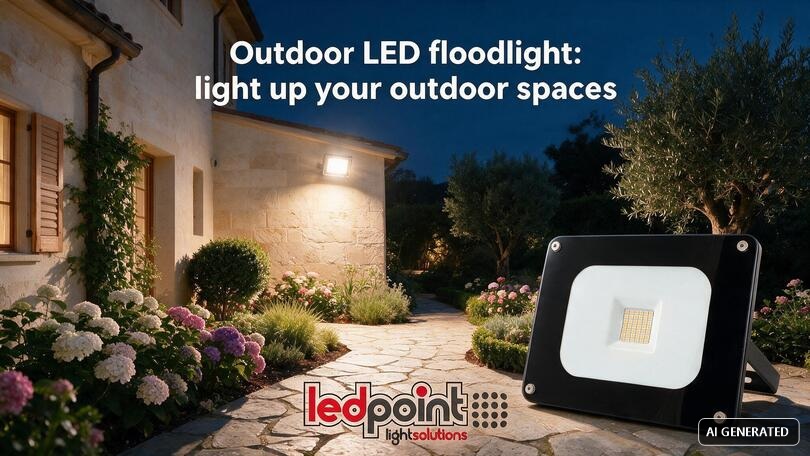
An outdoor LED spotlight is a compact, high-output floodlight designed to withstand rain, dust, and temperature fluctuations (IP65 or higher) and to provide diffuse or concentrated illumination for a building's outbuildings: gardens, driveways, facades, courtyards, vehicle areas, and entrances. Compared to older halogen floodlights, it consumes up to 80% less energy, lasts many times longer, and maintains stable light output for tens of thousands of hours. In this guide, we'll look at how to choose, size, install, and maintain an outdoor LED spotlight, with technical data, equivalence tables, regulatory differences between countries, and Ledpoint's professional floodlights.
Outdoor lighting has never been a purely decorative matter. A well-chosen outdoor LED spotlight solves three problems at once: security (dark areas and unmonitored entrances), usability (being able to enjoy the garden or patio even in the evening), and aesthetic value (enhancing architecture, trees, and surfaces). The shift to LED technology has made these three goals achievable with reduced consumption and almost zero maintenance, but it has also multiplied the options: watts, lumens, color temperature, beam angles, protection ratings, smart versions, and RGB. Navigating these choices requires a methodical approach, which is exactly what this guide aims to provide.
Whether you are a landscape designer, a landscape architect, a homeowner wanting to illuminate your garden, a building contractor, or a marketing professional in the lighting industry, you will find here the technical criteria to make informed decisions even in an international context where grid voltages, certifications, and light pollution regulations vary from country to country.
In this article...
1. What is an outdoor LED spotlight (and what distinguishes it from a floodlight and projector)
Before choosing, it's helpful to clarify the terminology, because in common language "spotlight", "floodlight", "projector", and "floodlight" are used interchangeably, but they refer to products with different application logics. Clarifying these terms helps you find the right product and communicate without misunderstandings with electricians, designers, and suppliers, both in Italy and abroad.
The English term floodlight literally translates the concept of "flooding light": a device that bathes a large surface with a wide beam. This is the core of this guide and the word you will find on international technical datasheets. In Italian, it corresponds to the outdoor LED spotlight or outdoor LED projector.
Spotlight, floodlight, projector, floodlight: the differences
The distinction is not strictly regulated, but in professional use some useful conventions have become established. An outdoor LED spotlight (or floodlight) is typically a compact, robust body with a wide beam, designed to illuminate areas and surfaces. A floodlight (faretto), on the other hand, indicates a smaller device, often recessed or adjustable, with a narrower beam and an accent function. A projector is conceptually similar to a spotlight but can have interchangeable optics and high power for long distances.
| Term | Typical beam | Main use | Installation examples |
| Outdoor LED spotlight / floodlight | Wide (60°–120°) | General area lighting | Facades, courtyards, parking lots, squares |
| Outdoor LED floodlight (faretto) | Narrow/medium (15°–60°) | Accent and detail | Wall recesses, step lights, niches |
| Outdoor LED projector | Variable (optics) | Long distances, large surfaces | Sports fields, monuments, warehouses |
| Recessed or inground floodlight/spotlight | Narrow/grazing | Light graphics, walkable | Driveways, uplighting on trees, walls |
In practice, when you are looking for an outdoor LED spotlight to illuminate a wall or a garden, you are looking for a floodlight; when you are looking for recessed outdoor LED floodlights to mark a path, you are looking for different products, often low-voltage. Knowing this prevents you from making wrong purchases and allows you to design a coherent system.
2. Why choose an outdoor LED spotlight: the real advantages
The question almost everyone asks (from the homeowner to the construction company) is simple: why switch to an outdoor LED spotlight when halogen or discharge solutions are still cheaper to buy? The answer lies in the total cost of ownership and a series of benefits that halogen cannot offer. Let's look at them with numbers, because the advantages of LED are truly appreciated only when you look at the data over a few years of operation.
The first argument is luminous efficiency, i.e., how many lumens you get for each watt consumed. A traditional halogen projector stops at around 15–20 lm/W, while a good modern outdoor LED spotlight exceeds 100–130 lm/W, with the best models over 150 lm/W. This means that, for the same light produced, the LED consumes a fraction of the energy.
| Parameter | Halogen projector | Metal halide | Outdoor LED spotlight |
| Efficiency (lm/W) | 15–20 | 70–90 | 100–150+ |
| Lifespan (hours) | 2,000–4,000 | 10,000–15,000 | 30,000–50,000+ |
| Ignition | Instant | Delayed (minutes) | Instant |
| Hot restrike | Instant | Slow | Instant |
| Dimmability | Limited | Complex | Yes (with suitable driver) |
| Heat emitted | Very high | High | Moderate |
| Sensitivity to on/off cycles | Medium | High | Low |
The second argument is lifespan. A quality outdoor LED spotlight claims tens of thousands of hours of useful life, measured with parameters such as L70 (the point at which the luminous flux drops to 70% of the initial value). On a system that is on for a few hours a day, this means many years without replacements: a huge advantage where access to the fixture is inconvenient, such as on a tall facade or a pole.
The third argument concerns light quality and control. With LED, you can precisely choose the color temperature (3000K warm, 4000K neutral, etc.), achieve instant ignition even at low temperatures, dim, or manage color scenarios. The fourth argument, often underestimated, is reduced maintenance: fewer interventions, fewer downtimes, lower labor costs. For a company managing third-party systems, this translates into profitability and reputation.
Savings are not just on the electricity bill: they are in the number of times you don't have to climb a ladder to change a lamp. This is the message that a consultant or reseller should convey to the end customer, because it is concrete and verifiable.
3. Illuminating outbuildings: garden, facades, driveways, and vehicle areas
The word "outbuildings" encompasses everything around the building that completes its function: garden, courtyard, driveway, boundary wall, entrance, parking lot, patio, swimming pool. Each of these areas has different requirements for intensity, direction, and color temperature of light. A good outdoor lighting project does not use a single outdoor LED spotlight everywhere, but combines different fixtures to achieve security where needed and atmosphere where desired.
Facades and walls
On facades, we almost always work with outdoor LED spotlights with a wide beam installed at ground level (uplight) or from above (downlight). The "wall washing" effect requires fixtures with uniform distribution, while grazing light enhances the texture of stone and brick. Color temperature makes the difference: 3000K enhances warm materials like terracotta and wood, while 4000K renders white plaster and contemporary architecture better.
Garden, trees, and flowerbeds
For greenery, you combine garden floodlights, adjustable spikes, and recessed fixtures. Uplighting on a tree, achieved with a garden LED spotlight with a narrow beam aimed at the canopy, creates depth and theatricality. For flowerbeds and low plants, low-power plant floodlights with warm light are preferred, which do not distort the green of the foliage. In these contexts, low voltage (12/24V) increases safety in the presence of water and soil.
Driveways, stairs, and paths
Here, visual guidance and safety are key. Recessed outdoor floor floodlights, step lights, and walkable inground floodlights outline the path without glare. For vehicle driveways, models certified for vehicle load are needed, with a high IP rating to withstand water and debris.
Vehicle areas, parking lots, and courtyards
In squares and courtyards, the protagonist is the outdoor LED spotlight of medium-high power mounted on a pole or wall, with a wide beam to cover large surfaces with few light points. In these cases, uniformity and glare control are carefully evaluated, to avoid disturbing neighbors and to comply with local light pollution regulations.
Entrances, gates, and surveillance areas
At entrances, the winning combination is often an outdoor LED spotlight with a motion sensor: light only when needed, deterrence, and savings. This is the solution that homeowners most often look for, because it combines comfort and security with a modest investment.
Rule of thumb: start from the function of the area, not the product. First define what the light must do (surveil, guide, enhance, create atmosphere), then choose the type, power, and color temperature of the most suitable outdoor LED spotlight.
4. Types of outdoor LED spotlights and floodlights
The market for outdoor LED spotlights is vast, and choosing one without a map of the types easily leads to errors. Each family responds to a specific need: some prioritize power, others discretion, others still color flexibility. Here are the main categories you will encounter when looking for outdoor LED floodlights, outdoor LED projectors, or recessed solutions.
Wall or pole-mounted projectors (floodlights)
These are the classic outdoor LED spotlights with a wide beam, the core of area lighting. Compact, robust, with an adjustable bracket, they cover powers from a few watts up to hundreds of watts. They are the choice for facades, courtyards, parking lots, and warehouses.
Recessed outdoor floodlights
Recessed outdoor floodlights are integrated into walls, porch ceilings, steps, and pavements. They provide a clean, architectural effect because the body disappears and only the light remains. They require preparation of the housing and attention to water drainage.
Inground and walkable floodlights
Inground garden floodlights are embedded in the ground or pavement to illuminate trees, walls, and columns from below. They must have a high protection rating (often IP67/IP68) and, if placed in transit areas, load resistance (vehicle-rated). Alternatively, you can opt for walkable outdoor profiles with IP67 LED strips.
Wall floodlights and step lights
Outdoor wall floodlights emit light upwards and downwards, creating double-beam scenography, while recessed step lights guide along stairs and walkways with low luminance to avoid glare.
Adjustable fixtures and those with sensors
Adjustable outdoor floodlights allow you to adjust the angle after installation, very useful for accenting mobile elements such as growing plants. Models with motion or twilight sensors add automation and savings.
RGB and RGB+CCT
Outdoor RGB LED spotlights and more advanced RGB+CCT combine dynamic color and adjustable white: perfect for scenographic facades, events, and venues that want to change atmosphere. They are managed via remote control, app, or protocols like ZigBee.
Solar
Outdoor solar LED floodlights do not require wiring and are ideal where running electricity is difficult or expensive. However, they must be sized realistically: autonomy and performance depend on irradiation, battery, and season, and in winter or at northern latitudes, performance drops significantly.
5. Technical features that really matter
When comparing two outdoor LED spotlights that appear similar, it is the technical parameters that make the difference between a successful purchase and a disappointing one. You don't need to be an engineer: just a few key indicators, read correctly. Here are the ones that every serious technical datasheet should declare and that you should always check.
Lumens, watts, and efficiency (lm/W)
Lumens measure the light emitted, watts the energy consumed. The ratio between the two, luminous efficiency in lm/W, is the true indicator of quality: for the same wattage, more lumens mean a better product. Beware of spotlights that only declare the watts: without the lumens, you don't know how much light you will actually get.
Color temperature (kelvin)
Expressed in kelvin (K), it defines the shade of light: approximately 3000K for warm, welcoming light, 4000K for neutral and functional light, above 5000K for cool, high-contrast light. In residential and hospitality settings, 3000K is preferred; in technical areas, parking lots, and security contexts, 4000K is often used.
Color Rendering Index (CRI)
CRI (Ra) indicates how faithfully the light reproduces colors compared to natural light. A value of Ra>80 is adequate for most outdoor applications; to enhance valuable facades, vegetation, and materials, aim for Ra>90.
IP and IK protection rating
The IP code describes resistance to dust and water: for a waterproof outdoor LED spotlight, the reasonable minimum is IP65 (protected against water jets), while for inground or submerged fixtures, IP67/IP68 are needed. The IK code indicates impact resistance, important in public areas exposed to vandalism.
| IP Rating | Protection | Where to use it |
| IP44 | Water splashes | Covered areas, under eaves |
| IP65 | Water jets | Facades, walls, poles (standard outdoor) |
| IP66 | Powerful jets | Exposed environments, coastal, industrial |
| IP67 | Temporary immersion | Inground and floor floodlights |
| IP68 | Continuous immersion | Fountains, pool edges, submerged |
Beam angle
The beam angle determines whether the light is concentrated or diffused. Narrow angles (15°–30°) are used for long-range accents (a tall tree, a column), wide angles (90°–120°) for illuminating extensive areas and surfaces. Choosing the right angle is often more decisive than power.
Driver, dimmability, and flicker
The driver is the electronic power supply that governs the LED: its quality affects lifespan, dimmability, and the absence of flicker. A good outdoor LED spotlight integrates or pairs a driver with surge protection and, if dimmable, compatibility with the chosen control system (TRIAC, 0/1-10V, DALI, PWM). A poor-quality driver is the primary cause of early failures, much more than the LED itself.
6. How many lumens and watts are needed
This is by far the most frequent question: "how many watts should an outdoor spotlight have?" or "how many lumens are needed to illuminate the garden?". The correct answer does not start from watts but from the lumens needed for the area and the desired effect; only then do you choose the power based on the product's efficiency. Here are some operational guidelines, always to be adapted to the real context.
Indicative halogen → LED equivalence
Many are looking for the "LED spotlight equivalent to 400W" or want to know what a old projector corresponds to. This table offers an indicative equivalence, valid for products of good efficiency.
| Traditional halogen | Equivalent LED | Indicative lumens |
| 150 W | 15–20 W | 1,500–2,200 lm |
| 300 W | 30–40 W | 3,000–4,500 lm |
| 500 W | 50–60 W | 5,000–7,000 lm |
| 1,000 W | 100–120 W | 10,000–15,000 lm |
How much light for each area
As a starting point for sizing (always to be verified with a lighting calculation if the project requires it):
| Area | Objective | General guideline |
| Entrance / door | Security + welcome | 1,000–1,500 lm, 3000K |
| Small facade | Wall washing | 2,000–4,000 lm, wide beam |
| Medium garden | Atmosphere + accents | Multiple points from 400–1,500 lm |
| Courtyard / square | Security + usability | From 5,000 lm per point, on pole/wall |
| Vehicle area 100 sqm | Uniformity | Multiple spotlights, evaluate uniformity |
Anti-error advice: better multiple light points at moderate power than a single very powerful spotlight. Distributing the light reduces harsh shadows and glare, improves uniformity, and makes the environment more natural and pleasant.
7. Correct installation and positioning
An excellent outdoor LED spotlight installed poorly performs like a mediocre product. Positioning affects visual comfort, effectiveness, and consumption, and some errors (glare, upward dispersion, water infiltration) are as common as they are avoidable. Here are the principles to follow, with an important note on electrical safety.
Low voltage or 230V?
The question of whether 12V or 220V LED floodlights are better is frequent and has a contextual answer. Low-voltage (12/24V) systems are safer in the presence of water and soil, ideal for gardens, flowerbeds, and pool edges, but require a dedicated transformer/power supply. 230V systems simplify wiring for high-power projectors on walls and poles, such as facade floodlights. The choice depends on the area, power, and distance from the electrical panel.
Height and angle
To illuminate a surface uniformly, aim the outdoor LED spotlight so that the beam does not directly hit the eyes of passers-by. In wall washing, the fixture is placed at a certain distance from the wall to distribute the light; in uplighting trees, the canopy is taken into account to avoid wasting light upwards.
Glare and light pollution control
A good installation illuminates what is needed, not the sky or the neighbor's window. Shields, louvers, and correct aiming reduce glare and upward dispersion. In many regions and countries, there are anti-light pollution regulations that require "full cut-off" fixtures and limits on dispersed flux: respecting them is not only an obligation but also improves the perceived quality of light.
Sealing, gaskets, and grounding
Check that cable glands and gaskets are correctly mounted to maintain the declared IP rating; incorrect tightening is the entry point for moisture. For Class I fixtures, grounding is essential. If you do not have electrical skills, the installation of an outdoor LED spotlight should be entrusted to a qualified professional: it is a matter of safety, not a detail.
8. International context: regulations and differences between countries
Those who buy, design, or resell outdoor LED spotlights in different markets must know that grid voltage, markings, and regulations change from country to country. Ignoring this exposes you to non-installable, non-compliant, or unsafe products. This section summarizes the main differences between Europe, the United Kingdom, and non-European markets, with an eye also on the climate, which affects technical choices.
Grid voltage and connections
In continental Europe, the domestic grid is 230V/50Hz; in the United Kingdom, it is also 230V but with its own plugs and standards; in North America, it is 120V/60Hz (with 240V for high-power appliances). A 230V floodlight designed for Italy is not suitable, without adaptations, for a 120V grid. Plugs and wiring systems also differ, so the same reference often needs to be adapted for each market.
Markings and certifications
In the EU, the CE marking applies with the relevant directives (low voltage, EMC), RoHS compliance on hazardous substances, and the Ecodesign/ErP regulation with the energy label. In the post-Brexit UK, the UKCA marking is added. In North America, marks such as UL or ETL are considered, and in some states, energy requirements like Energy Star or Title 24 in California. The product standards of the IEC/EN 60598 series for lighting fixtures are a recurring international reference.
| Area | Typical voltage | Main markings |
| European Union | 230V / 50Hz | CE, RoHS, ErP/Ecodesign |
| United Kingdom | 230V / 50Hz | UKCA (+ CE in transition) |
| USA / Canada | 120V / 60Hz | UL / ETL, cETL, Energy Star |
| Australia / NZ | 230V / 50Hz | RCM / SAA |
Light pollution and "dark sky"
Sensitivity towards the night sky is growing everywhere. In several Italian regions, there are laws requiring controlled emission fixtures; in the United States and elsewhere, the "Dark Sky" movement promotes certifications for fixtures that do not disperse light upwards. Designing outdoor LED spotlights that are "dark-sky friendly" is increasingly a requirement, not an option, and must be considered from the product selection stage.
Climate and seasonality
The operating temperature range, UV resistance of materials, and protection against salt spray or frost become decisive depending on the location: a spotlight intended for a coastal or harsh climate requires adequate materials and IP rating. The effectiveness of solar models also varies enormously with latitude and season, a point to communicate honestly to the international customer.
9. Consumption, costs, and incentives
Talking about an outdoor LED spotlight without talking about money would be incomplete. The cost topic has three dimensions: how much it consumes, how much it costs over time, and what incentives exist. Let's look at them with simple numerical examples, keeping in mind that the values depend on the price of energy and should be updated to your own context.
How much does an LED spotlight consume
To estimate the expense, simply multiply the power in kW by the hours of use and the cost per kWh. A 30W LED spotlight on for 6 hours a day consumes 0.03 kW × 6 h = 0.18 kWh per day, i.e., about 65 kWh per year. A 100W spotlight under the same conditions consumes just over three times as much. Compared to an equivalent halogen, the annual savings are considerable.
| LED power | Consumption 6 h/day | Estimated annual consumption |
| 10 W | 0.06 kWh/day | ~22 kWh/year |
| 20 W | 0.12 kWh/day | ~44 kWh/year |
| 30 W | 0.18 kWh/day | ~65 kWh/year |
| 100 W | 0.60 kWh/day | ~219 kWh/year |
Total cost of ownership
The purchase price is only the tip of the iceberg. Over the life cycle, energy, replacements, and labor weigh heavily: this is where LED more than recovers any higher initial cost compared to halogen. For a company or property manager, presenting the customer with a simple calculation of savings over 3–5 years is often the most effective sales argument.
Incentives and tax deductions
Incentives for energy efficiency and renovation change over time and from country to country. In Italy, there are tax deduction mechanisms linked to building and energy works that, in certain cases and under certain conditions, may include efficient lighting. Since rules and rates are often updated, always check the current regulations and consult a tax advisor before taking an incentive for granted.
10. Maintenance, lifespan, and why sometimes LEDs "don't last long"
One of the reasons for switching to LED is reduced maintenance, yet it happens that one reads that "LED floodlights don't last long" or that "the spotlight stays slightly on even when off". These are not mysterious defects: they have precise technical causes and are almost always preventable. Understanding them helps you choose better and explain to the customer what to really expect.
Why an LED should last a long time (and why sometimes it doesn't)
The life of an outdoor LED spotlight is measured in tens of thousands of hours, but three enemies shorten it: heat (insufficient dissipation rapidly degrades the LEDs), a poor-quality driver, and power surges. When a spotlight "doesn't last long", in most cases the culprit is thermal management or the power supply, not the LED chip. This is why it is advisable to choose products with good dissipation (aluminum body, fins) and reliable drivers.
How not to burn out LEDs
Avoid installing fixtures in enclosed spaces without air circulation, do not exceed the powers intended for the housing, and ensure that the IP rating is maintained to prevent infiltration. The combination of heat and moisture is the number one cause of early failures outdoors.
Why sometimes it "stays slightly on"
The phenomenon of the LED remaining dimly lit when off is almost always due to residual micro-currents: switches with indicator lights, non-compatible dimmers, or interruption of the neutral instead of the phase. It is resolved with the correct intervention on the system or with anti-residual devices, and it is an electrical issue, not a defect of the spotlight itself.
Practical maintenance
Maintenance of an outdoor LED spotlight system is simple: periodic cleaning of the front glass (dust and salt spray reduce performance), checking gaskets and tightening, verifying orientation after weather events. A few operations a year extend the useful life and keep the light at its maximum.
11. Trends and innovations: smart, RGB+CCT, solar, and dark-sky
The outdoor LED spotlight sector is evolving rapidly, driven by efficiency, connectivity, and sustainability. Knowing the trends helps designers propose durable solutions and sellers communicate value. Here are the most concrete directions, those already entering real installations and not just trade fairs.
Smart and connected lighting
Control via app, remote control, and protocols such as ZigBee, DALI, and 0/1-10V allow dimming, programming scenes, and integrating outdoor lighting into home automation. For the homeowner, it means turning on the garden from the smartphone; for a business manager, it means automatic scenes and savings.
RGB+CCT and dynamic white
RGB+CCT systems combine color and adjustable white in a single fixture: the facade can be neutral on weekdays and colored for events and holidays. This is the frontier of scenographic lighting accessible even with modest budgets.
Solar and off-grid
Solar spotlights and off-grid solutions are growing where wiring is expensive. The key is honest sizing of the panel, battery, and autonomy, taking into account climate and season: overestimating performance generates dissatisfied customers.
Sustainability and repairability
Ever higher efficiency, recyclable materials, replaceable drivers, and attention to end-of-life: sustainability is not just marketing, but a criterion that European regulations are making mandatory. An outdoor LED spotlight designed to last and be maintained is the true ecological choice.
Respect for the night sky
Demand is growing for "dark-sky friendly" fixtures with controlled upward emission, both due to regulatory obligations and environmental awareness. This is a trend set to consolidate and should be anticipated in product selection.
12. Ledpoint's outdoor LED floodlights
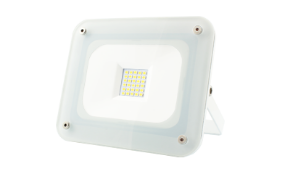
Ledpoint specializes in professional LED lighting — LED strips, aluminum profiles, controllers, and power supplies — and offers a line of floodlights (outdoor LED spotlights) designed to integrate with the rest of the system. These are compact IP65-rated fixtures at 230V, suitable for facades, courtyards, entrances, and outdoor areas. Let's look at the range and how to choose based on the criteria outlined above.
The floodlight range
Currently, Ledpoint's Floodlight category includes models with powers from 10 to 30W, in warm white, neutral white, and dynamic color versions:
| Model | Power | Light color | Protection / voltage |
| Outdoor floodlight 3000K 20W white | 20 W | 3000K (warm) | IP65 / 230V |
| Outdoor floodlight 3000K 30W black | 30 W | 3000K (warm) | IP65 / 230V |
| Outdoor floodlight 4000K 20W white | 20 W | 4000K (neutral) | IP65 / 230V |
| Outdoor floodlight RGB+CCT 10W black | 10 W | RGB + adjustable white | IP65 / 230V |
The 3000K models are ideal for enhancing warm facades, entrances, and residential or hospitality contexts; the 4000K version offers neutral light more suitable for technical and security contexts; the RGB+CCT floodlight adds dynamic color and adjustable white for scenographic facades and events. The availability of white and black finishes facilitates aesthetic integration on different surfaces.
How to choose within the range
Follow the guide's criteria: first define the function of the area, estimate the required lumens, choose the color temperature (3000K for atmosphere, 4000K for neutral rendering), verify that IP65 is adequate for the location, and evaluate whether you need dynamic color. For a residential entrance, a 20W 3000K is often sufficient; for a larger courtyard or facade, the 30W offers more light; for scenography and venues, the RGB+CCT model opens up creative possibilities.
Integrating the floodlight with the rest of the LED system
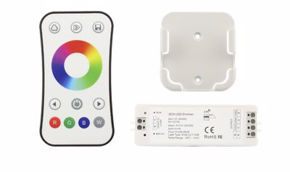
The added value of choosing a specialized supplier is the ability to design a coherent system. Alongside the spotlights, for architectural linear lighting on facades and perimeters, you can consider warm white LED strips in outdoor versions with suitable profiles and diffusers; for controlling the color model, you will find dedicated RGB+CCT controllers and for low-voltage power supply, the power supplies section completes the project.
13. Outdoor lighting techniques
Choosing the right outdoor LED spotlight is only half the job: the other half is knowing how to use it. Lighting techniques determine whether an installation looks flat and anonymous or three-dimensional and evocative. They are the same repertoire used by lighting designers and landscape architects worldwide, and knowing them allows you to achieve professional results even with a few well-positioned fixtures.
Wall washing and wall grazing
Wall washing "washes" a wall with uniform light, positioning the outdoor spotlights at a certain distance from the surface: ideal for smooth facades and light plaster. Wall grazing, on the other hand, places the fixture very close to the wall with a grazing beam, to enhance the texture of stone, brick, and concrete: the light slides over the material, creating shadows that reveal its relief. The same wall, with the two techniques, tells two completely different stories.
Uplight and downlight
Uplight illuminates from bottom to top and is the main technique for trees, columns, and facades: it creates drama and a sense of height. Downlight from above mimics natural light and is more reassuring and functional, perfect for walkways and work areas. Many successful projects alternate the two directions to avoid monotony.
Moonlighting and silhouette
Moonlighting places fixtures high in the branches of a tree to project soft shadows on the ground like moonlight: a natural and poetic effect. The silhouette technique illuminates a background, leaving the foreground object in shadow, which stands out as a silhouette: effective with plants that have a sculptural shape. These are techniques that transform a simple garden LED spotlight into a narrative tool.
Cross-lighting and accent
Cross-lighting illuminates a subject from two sides to reduce harsh shadows and show its volume: useful on statues, important trees, and architectural elements. Accent lighting, with outdoor LED floodlights with a narrow beam, isolates and enhances a single detail. The golden rule remains contrast: without shadow areas, light loses strength and everything appears flat.
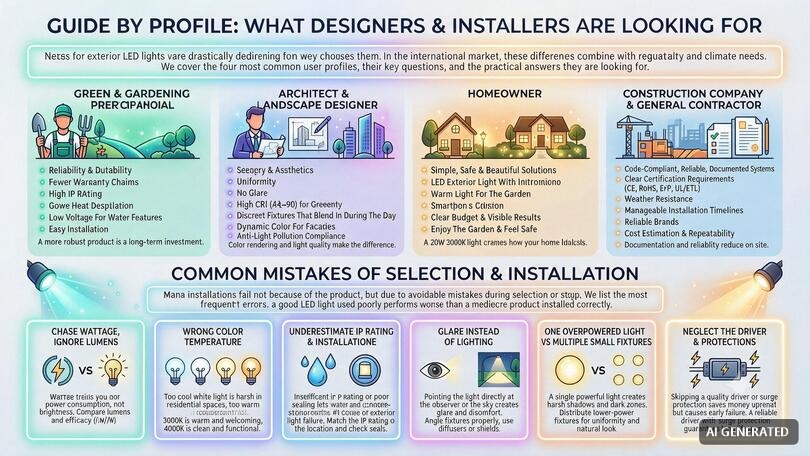
14. Profile guide: what designers and installers are looking for
The requirements for outdoor LED spotlights change radically depending on who chooses them, and in an international market, these differences are added to regulatory and climatic ones. Here we address the five profiles that most often approach these products, with the questions they ask and the practical answers they seek.
The green and gardening professional
Those who install systems for clients focus on reliability and durability: they want garden LED spotlights that don't fail after a winter and that reduce warranty calls. The priorities are a high IP rating, good dissipation, low voltage where there is water and soil, and ease of installation. For this profile, a slightly more expensive but robust product is an investment, not an expense.
The landscape architect
The landscape architect thinks in terms of scenarios and aesthetics: they look for uniformity, absence of glare, high color rendering (Ra>90) to not distort the greenery, and discreet fixtures that disappear during the day. They are interested in the techniques seen above and the possibility of integrating dynamic color on facades and elements. Compliance with anti-light pollution regulations is both a constraint and a design value for them.
The homeowner
Those illuminating their own home want simple, safe, and beautiful solutions: they often look for an outdoor LED spotlight with a sensor for the entrance, warm light for the garden, and perhaps smartphone control. Budget is an issue, but even more so is the visible result: enjoying the garden in the evening and feeling safe are the two needs that drive the purchase. For this profile, a well-positioned 20W 3000K really changes the perception of the house.
The construction company and general contractor
The company must deliver systems that are up to code, reliable, and documented. They look for clear requirements on certifications (CE, RoHS, ErP in the EU; UL/ETL in North America), weather resistance, short installation times, and reliable brands. Cost estimation and repeatability across multiple sites matter as much as the quality of the individual outdoor LED spotlight.
15. Common mistakes in selection and installation
Many installations disappoint not because of the products, but because of avoidable errors in the selection or installation phase. We list the most frequent ones, because knowing them in advance is worth more than any technical feature: a good outdoor LED spotlight used poorly performs worse than a mediocre product installed well.
Looking at watts and ignoring lumens
This is the number one mistake. Watts tell you how much it consumes, not how much light you get. Two outdoor LED spotlights of 30W can have very different outputs: always compare lumens and efficiency in lm/W.
Choosing the wrong color temperature
Too cool a light in a residential context is hostile; too warm in a security area reduces useful contrast. Adapt the kelvin to the function: 3000K for welcome, 4000K for functionality.
Underestimating the IP rating and installation
Insufficient IP or poorly mounted gaskets let water and condensation in: this is the primary cause of outdoor failure. Verify the IP suitable for the location and take care of cable glands and tightening.
Glare instead of illumination
Aiming an outdoor LED spotlight towards the observer or the sky wastes light and creates annoyance. Aim the beams at the surfaces to be illuminated, use shielding, and respect local regulations.
A single very powerful spotlight instead of multiple light points
Concentrating everything in a single fixture creates harsh shadows and dark areas. Distributing multiple outdoor LED floodlights at moderate power gives uniformity and naturalness.
Neglecting the driver and protections
Saving on the power supply often means paying for it in early failures. A reliable driver, with surge protection, is the true guarantor of the system's lifespan.
16. Frequently Asked Questions (FAQ)
Here we gather the questions that most often recur about outdoor LED spotlights and floodlights, with concise and practical answers. Click on each question to open the answer.
How many lumens should an outdoor spotlight have?It depends on the area: for an entrance, 1,000–1,500 lumens are enough; for a small facade, 2,000–4,000; for a courtyard or square, 5,000 lumens and above per light point are needed. First think about the required lumens, then choose the wattage based on the product's efficiency. |
How many watts should an outdoor LED spotlight have?There is no single value: a 20–30W LED spotlight illuminates an entrance or small facade well, while for large areas you go up to 50–100W. Efficiency matters: a good LED offers more lumens per watt, so fewer watts are needed for the same light. |
What is the LED spotlight equivalent to 400W halogen?Generally, a good efficiency LED of about 40–50W replaces a 400W halogen projector, with much lower consumption. The equivalence should be verified on lumens: look for an LED that declares a similar flux to the halogen being replaced. |
How much does a 100W LED spotlight consume?A 100W spotlight consumes 0.1 kWh for each hour of operation. With 6 hours a day, this means about 0.6 kWh per day and just over 200 kWh per year. The cost depends on the price per kWh in your supply contract. |
Are 12V or 220V LED floodlights better?Low voltage (12/24V) is safer in gardens, flowerbeds, and pool edges but requires a power supply. 230V simplifies wiring for high-power projectors on walls and poles. The choice depends on the area, power, and distance from the electrical panel. |
What IP rating is needed for an outdoor LED spotlight?For a spotlight on a wall or pole, the recommended minimum is IP65 (protected against water jets). For inground or pool-edge fixtures, IP67 or IP68 are needed. An inadequate IP is the primary cause of infiltration and failure. |
Why do LED floodlights sometimes not last long?It is almost never the fault of the LED chip: the most frequent causes are insufficient heat dissipation, a poor-quality driver, or power surges. Choosing well-dissipated products with reliable power supplies solves the problem at its root. |
Why does the LED spotlight stay slightly on when off?This is due to residual micro-currents: switches with indicator lights, non-compatible dimmers, or interruption of the neutral instead of the phase. It is resolved with the correct intervention on the system or with anti-residual devices. It is an electrical issue, not a defect of the spotlight. |
What color temperature to choose for outdoors?3000K (warm light) for a welcoming atmosphere on facades, entrances, and residential contexts; 4000K (neutral) for technical areas, parking lots, and security. Avoid overly cool lights in residential settings, as they are uncomfortable. |
Is an outdoor LED spotlight waterproof?It is if it has an adequate IP rating and is installed correctly, with gaskets and cable glands properly mounted. IP65 resists water jets; for immersion, higher ratings are needed. Installation counts as much as the product to maintain the seal. |
18. Outdoor LED spotlight: the right one for every environment
Choosing an outdoor LED spotlight does not mean looking for "the most powerful", but the right one for the function of the area: light is meant to make the outdoor space safe, livable, and beautiful, consuming little and lasting a long time. Start from the required lumens, choose color temperature and beam angle based on the desired effect, verify the IP rating for the location, and rely on products with good dissipation and reliable drivers.
Whether you need to illuminate a garden, a facade, a driveway, or a square, the principles remain the same, while voltages and certifications must be adapted to the target market. With a coherent range of floodlights, spotlights, and LED components, it is possible to design systems that combine efficiency, aesthetics, and compliance. The best light for your outbuildings is the one you don't notice: present where needed, invisible where not, and continuing to work for years.
This article was developed with the support of artificial intelligence and subsequently reviewed, corrected, and validated by the Ledpoint.it technical team, which guarantees its reliability and compliance with official sources.
```