












DALI vs. KNX Lighting: Which Protocol for Smart Buildings?
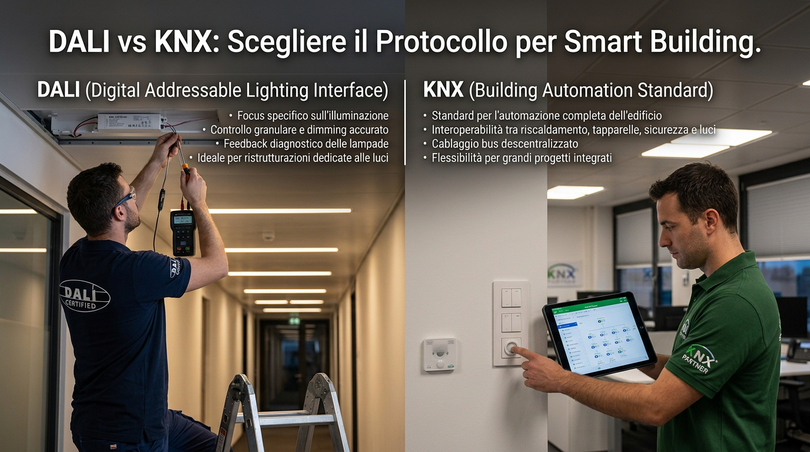
DALI (IEC 62386) is a digital protocol dedicated exclusively to lighting: simple, cost-effective, and ideal for offices, retail, hospitality, and small-to-medium installations. KNX (ISO/IEC 14543-3) is a comprehensive automation protocol that manages lighting, HVAC, blinds, security, and audio over a single bus: complex and more expensive, but essential for complete smart buildings. The most widespread professional solution today is KNX as the main bus + DALI as the lighting sub-network via a dedicated gateway.
What are DALI and KNX
DALI (Digital Addressable Lighting Interface) and KNX are the two leading digital protocols for professional lighting control in commercial buildings. While they share the same goal (replacing traditional on/off wiring with flexible digital management), they were born with different philosophies: DALI as a vertical standard dedicated exclusively to lighting, and KNX as a horizontal standard for comprehensive building automation. The choice between the two is one of the most impactful design decisions in smart building design, as it affects costs, scalability, integration, and maintenance for the subsequent 15–20 years.
DALI: features, topology, versions
DALI is a 2-wire digital protocol (polarized but polarity non-critical in DALI-2) that operates at SELV low voltage of 16 V DC. The bus communicates at 1200 bit/s and supports up to 64 individual addresses per line, with the ability to create 16 groups and 16 independent scenes. Maximum line length: 300 m with 1.5 mm² cable.
Main versions:
- DALI-1 (IEC 62386 ed. 1): the historical version, now considered legacy. On/off control, logarithmic dimming, basic scene management.
- DALI-2 (IEC 62386 ed. 2): the current standard. Supports sensors, push buttons, color tunable (CCT and RGB), bidirectional feedback, energy reporting. Interoperability certification managed by DiiA.
- D4i: extension of DALI-2 for IoT and driver management with predictive diagnostics, asset reporting, cloud integration.
Topology: line, star, or tree (free topology), any layout except closed loop.
Key strengths: ease of installation, low cost, individual addressing of each luminaire, easy retrofit on existing systems, wide availability of compatible drivers (all major lighting manufacturers offer DALI ranges).
KNX: features, topology, ecosystem
KNX is a comprehensive automation protocol that operates on a dedicated bus (TP — Twisted Pair, 9600 bit/s, SELV 29 V DC) or over powerline (PL), RF, or IP. It originated from the merger of three historical standards (EIB, EHS, BatiBUS) and is currently managed by the KNX Association with over 500 certified manufacturers worldwide.
Main features:
- Distributed architecture: every device is "intelligent" and communicates peer-to-peer, without a mandatory central unit
- Capacity: up to 256 devices per line, 15 lines per area, 15 areas per system (over 57,000 total devices)
- Integrated management: lighting, HVAC, blinds/curtains, access control, alarms, audio/video, energy management
- Configuration via ETS6 software (requires license and installer certification)
- Total interoperability among certified manufacturers
Topology: line, star, tree, or mixed, with line and area couplers for segmentation.
Key strengths: truly "building-wide" standard, longevity (over 30 years on the market), very little vendor lock-in, extremely rich ecosystem of devices (touch switches, thermostats, multifunction actuators, gateways to every protocol).
DALI vs KNX comparison table
| Criterion | DALI (DALI-2) | KNX |
|---|---|---|
| Standard | IEC 62386 | ISO/IEC 14543-3, EN 50090 |
| Scope | Lighting only | Comprehensive building automation |
| Network type | 2-wire bus SELV 16 V DC | TP bus 29 V DC / PL / RF / IP |
| Speed | 1200 bit/s | 9600 bit/s (TP1) |
| Devices per line | 64 | 256 |
| Max line length | 300 m | 1000 m (TP1) |
| Config. software | Manufacturer tool or ETS via gateway | ETS6 (license) |
| Installer | Qualified electrician | Certified KNX Partner |
| Average device cost | € | €€€ |
| Engineering cost | Low (5–10%) | High (20–30%) |
| Integration with other systems | Gateway only | Native |
| Scalability across entire building | Limited (gateways required) | Excellent |
| Individual light addressing | Yes, highly granular | Yes (more expensive) |
| Color tuning / RGB | Native (DALI-2 DT8) | Yes, via DALI gateway or dedicated actuators |
| Energy reporting | Native (D4i) | Via dedicated objects |
| Learning curve | Low-medium | High |
Cost analysis: investment and management
Considering a typical 500 m² office installation with 60 lighting points, presence sensors, daylight dimming, and 4 scenes, the approximate costs are:
- Pure DALI-2: €6,000–9,000 (drivers, sensors, control unit, cables, programming)
- Pure KNX: €12,000–18,000 (dimming actuators, KNX sensors, power supplies, couplers, ETS6 engineering)
- KNX + DALI via gateway: €9,000–13,000 (DALI for lighting, KNX for controls)
The 10-year maintenance cost is generally higher for KNX due to the need for certified personnel, but KNX offers greater longevity and flexibility for building reconfigurations. For lighting-only systems, DALI offers the best cost/benefit ratio.
Which to choose: application scenarios
Choose DALI (-2) if:
- The system is predominantly or exclusively for lighting
- Budget is tight or constrained
- Small-to-medium-sized building (up to ~2,000 m²)
- You need low-cost individual addressing of luminaires
- You want a quick retrofit on an existing system
- Applications: SME offices, retail, restaurants, showrooms, schools, industrial warehouses
Choose KNX if:
- You need to integrate lighting, HVAC, blinds, security, audio, energy management
- Large or complex building (hotels, hospitals, headquarters, luxury residences)
- Interoperability between many manufacturers and heterogeneous devices is required
- The system must remain flexible for 20+ years with frequent reconfigurations
- Applications: 4–5 star hotels, hospitals, commercial buildings, luxury villas, museums, theaters, LEED/BREEAM/WELL certified buildings
Hybrid architecture: KNX + DALI via gateway
For medium-to-large buildings, the dominant professional solution today is KNX as the main bus + DALI as the lighting-dedicated sub-network. A DALI-KNX gateway (e.g., ABB DG/S, Theben DALI-Gateway, Siemens N 141) is used to expose DALI luminaires as KNX objects, allowing unified scenes, dimming, and controls from push buttons, apps, or building management systems.
Advantages: it combines the cost-effectiveness and granularity of DALI for lighting with the integration capabilities of KNX for other systems. Disadvantage: dual expertise required (DALI configurator + KNX Partner). All Ledpoint DALI-2 luminaires are compatible with major certified DALI-KNX gateways.
Regulations and certifications
DALI is standardized by the IEC 62386 family (part 101 general, part 102 control gear, parts 2xx on drivers per source category). Interoperability certification is managed by the DiiA (Digital Illumination Interface Alliance): only products with the certified DALI-2 logo guarantee full compatibility between manufacturers.
KNX is standardized by ISO/IEC 14543-3 and EN 50090. Certification is managed by the KNX Association in Brussels and covers devices, installers (KNX Partner / Tutor / Advanced), and training centers. For complex systems, the use of ETS6 software with a valid license is mandatory.
Both protocols contribute to the calculation of LENI (UNI EN 15193) and LEED/BREEAM/WELL scores for energy performance and lighting control.
Ledpoint case study
For the lighting retrofit of a 4-star hotel (48 rooms, reception halls, restaurant, SPA), Ledpoint recommended a hybrid KNX + DALI architecture:
- KNX as the main bus to manage lighting, HVAC, motorized blinds, room controls, and integration with the hotel's PMS
- DALI-2 as a sub-network dedicated to 380 LED luminaires (rooms, corridors, halls, SPA), via 6 DALI-KNX gateways
- Preconfigured scenes: "welcome", "night", "cleaning", "checkout" activated by in-room touch panels
Results measured at 12 months:
- Lighting energy savings: −58% compared to the previous on/off system
- Integrated HVAC savings (climate reacting to room presence): −22%
- Average check-in time reduced by 40 seconds (room pre-set)
- Total system cost: €145,000 (vs pure KNX quote of €198,000) — −27% compared to KNX-only
- Overall payback (lighting + HVAC): 4.2 years
FAQ
- What is the difference between DALI and KNX?
- DALI is a protocol dedicated to lighting control, standardized under IEC 62386, simple and low-cost. KNX is a comprehensive building automation protocol (ISO/IEC 14543-3) that manages lighting, HVAC, blinds, security, and audio over a single bus. DALI is vertical, KNX is horizontal.
- DALI or KNX: which costs less?
- DALI has a significantly lower initial cost: drivers, sensors, and control units cost 40–60% less than their KNX equivalents. KNX is economically justified only when integrating multiple systems (lighting + HVAC + blinds + security) on the same bus.
- How many luminaires can I connect to a DALI line?
- A standard DALI line supports up to 64 individual addresses (DALI-1) or 64 devices plus 64 sensors and 64 masters (DALI-2), with a maximum bus length of 300 m and a total current of 250 mA. For larger systems, gateways are used to connect multiple DALI lines in a tree topology.
- Can KNX also control DALI lighting?
- Yes, via dedicated DALI-KNX gateways. This is currently the most widespread architecture in large smart buildings: KNX as the main automation bus and DALI as the lighting-dedicated sub-network, controlled via gateways with individual or group addressing.
- Is DALI-2 backward compatible with DALI-1?
- Partially. DALI-2 devices can control DALI-1 luminaires, but advanced features (sensors, color tunable, interoperability certification) require DALI-2 devices across the entire line. For new projects, Ledpoint always recommends DiiA-certified DALI-2.
- Does KNX require a specialized programmer?
- Yes. Configuring a KNX system requires ETS6 software and a certified KNX Partner installer. The learning curve is significant, and engineering can account for 20–30% of the total system cost. DALI, on the other hand, can be configured with simpler software by qualified electrical installers.
- Which protocol is more suitable for offices?
- For small and medium-sized offices focused on lighting, DALI-2 is the optimal choice for cost and simplicity. For large commercial buildings, headquarters, hotels, and hospitals where it is necessary to integrate HVAC, access control, multi-function scenes, and centralized management, KNX is preferable, often with DALI as the lighting sub-network.
- Are DALI and KNX open protocols?
- Yes, both are. DALI is standardized under IEC 62386 and administered by the DiiA (Digital Illumination Interface Alliance). KNX is standardized under ISO/IEC 14543-3 and administered by the KNX Association. Both guarantee interoperability among certified manufacturers, avoiding technological lock-in.
DALI and KNX lighting: a fusion of protocols.
DALI and KNX are not direct competitors: they are tools with different purposes that today complement each other. The Ledpoint rule of thumb: DALI-2 when the project is "lighting only" and budget is a priority; KNX when the building is a complete smart building and lighting is just one of the systems to integrate; KNX + DALI via gateway for the majority of medium-to-large professional projects. Always demand DiiA-certified DALI-2 devices (DiiA logo) and KNX Partner installers to ensure interoperability and longevity of the investment.