













How to light up a one-bedroom apartment
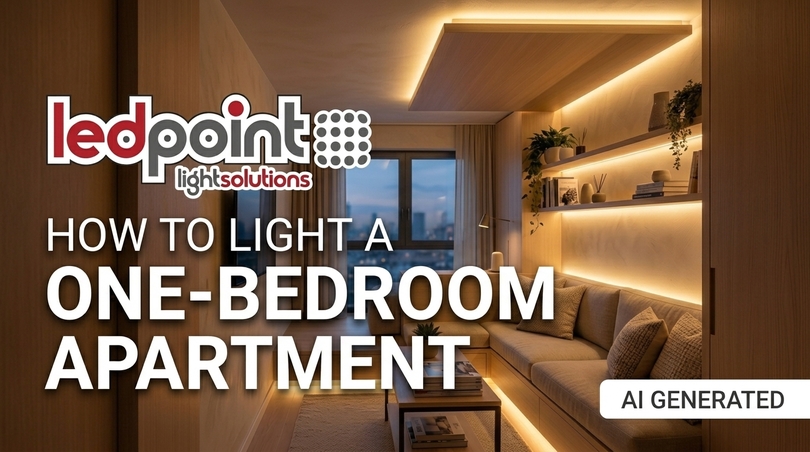
Learning how to light a one-bedroom apartment is the difference between an apartment that feels like a cramped box and one that breathes, feels taller, deeper, and surprisingly spacious. In a few square meters, light is not a decorative detail: it is the most powerful and cost-effective design tool you have to correct the perception of space. Lighting a one-bedroom apartment the right way means working on precise optical illusions (dematerializing the boundaries of walls, raising ceilings with indirect light, making furniture float, and creating continuous perspective lines) and the absolute protagonist of this strategy is LED strips integrated into aluminum profiles.
In this comprehensive guide, you will find a proven method to light a one-bedroom apartment room by room, with concrete solutions for different sizes (30, 40, and 50 sqm), the most suitable Ledpoint.it products for each function, measurable technical data (lumens, lux, watts, kelvin, CRI) and a scene control system. Whether you are an interior designer looking for replicable solutions, a homeowner wanting to enhance your apartment, a tenant looking for a reversible intervention, an architect, or the owner of a boutique hotel who cares about every detail in each room, here you will find an operational answer to every question about how to light a one-bedroom apartment and, above all, how to make it look bigger.
In this article...
1. Why light decides whether a one-bedroom apartment looks big or small
Before choosing a single meter of LED strip, it is useful to understand a counterintuitive principle: the perceived size of a room depends more on light than on actual square meters. Our brain measures space through visible boundaries, shadows, contrasts, and the amount of continuous surface it can read. A 40 sqm one-bedroom apartment poorly lit (with a single central light point projecting shadow cones in the corners) appears smaller and more oppressive than a 28 sqm studio designed with indirect light and well-distributed linear cuts. This is why learning how to light a one-bedroom apartment is, in fact, learning to rewrite the perception of space.
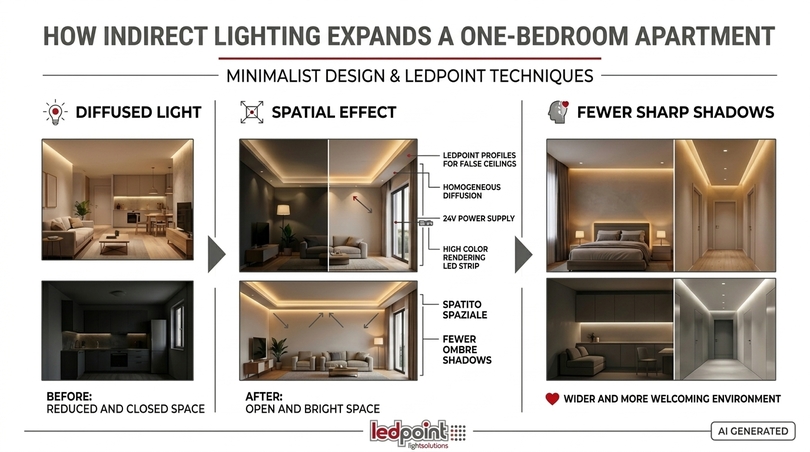
The physics of perception is simple to exploit. When a wall or ceiling is uniformly lit, its boundary "softens" and seems to move away; when left in shadow, the brain reads them as sharp, close limits. Lighting a one-bedroom apartment must therefore eliminate dark areas, especially high corners and the junctions between wall and ceiling, which are the points where the gaze "measures" the height of the room. This is where diffused indirect light becomes a weapon for visual expansion.
The starting point: why getting lighting wrong costs more in small spaces
In a large open space, a lighting design mistake "dilutes"; in a one-bedroom apartment, it does not. Distances from the eyes are reduced, glare is more annoying, shadows are more evident, and every poorly placed source is immediately perceived. According to the principles of lighting design applied to residential spaces and the indications of the UNI EN 12464-1 standard on indoor illumination levels, a small apartment requires finer, not coarser, design. Lighting a one-bedroom apartment means layering light on at least three levels (general, accent, and functional) so that the eye perceives depth and not a flat, uniformly lit wall.
| Perceptual parameter | Traditional central chandelier | LED strips + indirect light |
| Perceived ceiling height | Reduced ("flattening" effect) | Increased ("suspended" ceiling) |
| Room corners | In shadow, sharp and close boundaries | Illuminated, blurred and distant boundaries |
| Floor continuity | Interrupted by furniture shadows | Continuous thanks to illuminated floating furniture |
| Uniformity and visual comfort | Strong contrasts, direct glare | Soft light, anti-glare |
| Flexibility (day/night) | On/off | Dimmable scenes and dynamic light |
| Estimated average consumption (40 sqm) | Higher for the same output | Lower thanks to high LED efficiency |
The message is clear: to make a one-bedroom apartment look bigger, you don't need more light, you need better-distributed light. In the following paragraphs, we translate this principle into four precise optical tricks and the Ledpoint products that realize them.
2. The 4 optical tricks of light to expand a one-bedroom apartment
There are four lighting mechanisms that, combined, transform the perception of a small apartment. They are the same ones interior designers and architects use in boutique hotels and luxury homes, and they can all be achieved with COB LED strips and Ledpoint aluminum profiles. Understanding these four tricks is the heart of any project on how to light a one-bedroom apartment and how to make every single room look bigger.
Trick 1 - Raising the ceiling with indirect light (vertical expansion)
Direct light from the center of the room, typical of a chandelier, creates shadow cones in the corners and "flattens" the room downwards. The solution is indirect light cove lighting: a drywall recess that hides an upward-facing LED strip. The light bounces off the ceiling, illuminates it uniformly, and makes it perceive as a suspended, higher surface. It is the most effective trick of all to vertically expand a one-bedroom apartment: just a few centimeters of perimeter cove can visually gain tens of centimeters in height. To delve into intensity calculations, Ledpoint's internal guide on how to calculate the lux of an LED installation is a great starting point.
Trick 2 - Pushing back walls with wall washing (horizontal expansion)
Grazing one or two focal walls (the living room feature wall or the bed headboard) visually pushes the boundary of the room outwards. This technique, called wall washing, consists of "washing" the wall with a uniform beam of light from top to bottom. A uniformly lit wall seems further away, and the room gains depth. In a one-bedroom apartment, it is enough to choose the longest or most significant wall and treat it with a recessed light cut: the result is an environment that "expands" without moving a single wall.
Trick 3 - Dematerializing the floor with floating furniture and illuminated baseboards
The perception of space depends enormously on the visible continuous floor area. By inserting an LED strip under suspended furniture (kitchen base, TV unit, bed, bathroom vanity), the furniture seems to float and the floor flows uninterrupted underneath. The same effect is achieved with a grazing illuminated baseboard, which eliminates the sharp break between wall and floor. The brain reads more continuous surface and translates all this into "more space". It is one of the least known but most powerful secrets for those who want to understand how to make a one-bedroom apartment look bigger.
Trick 4 - The longitudinal perspective line
A linear light cut recessed flush into drywall or the ceiling, continuing uninterrupted from the entrance to the living area, draws the eye along the main axis of the apartment and visually lengthens it. It is the same logic as vanishing lines in painting: a continuous line of light becomes a track for the eye, which travels the entire depth of the one-bedroom apartment and perceives it as greater than it is. In a small apartment, continuity is everything: avoid visible joints and interruptions, because every break shortens the space. Continuous line COB LED strips, free of the classic dot effect, are perfect precisely for this.
| Optical trick | Effect on space | Where it applies | Ledpoint solution |
| Indirect ceiling light | Higher ceiling | Perimeter cove, recesses | Strip + drywall profile |
| Grazing wall washing | Further walls | Living wall, bed headboard | Strip + flush recessed profile |
| Floating furniture / baseboard | Continuous floor | Under kitchen, TV, bed, bathroom vanity | COB strip + slim white profile |
| Perspective line | Deeper apartment | From entrance to living area | Continuous COB strip + trimless profile |
3. Why LED strips are the best choice for a one-bedroom apartment
When it comes to lighting a one-bedroom apartment, LED strips beat any traditional fixture for a simple reason: they are the only light source you can "draw" in space, hide from view, and transform into continuous lines of light. A spotlight illuminates a point; a chandelier illuminates a center; an LED strip illuminates a direction, an edge, an entire perimeter, and it is precisely this ability to become luminous architecture that makes it irreplaceable in small spaces. The trend of recent years, as also explained in the Ledpoint in-depth article on 48V LED strips, increasingly leads to using strips as primary lighting and no longer just decorative.
The second reason is the almost zero footprint. In a one-bedroom apartment, every centimeter counts: an LED on a flexible circuit is just 8-12 mm wide and 2 mm thick, hides in a drywall recess or a flush-to-wall aluminum profile, and disappears when turned off. No protruding fixtures, no volumes eating up space, just light that seems to come from the architecture itself. The third reason is efficiency: Ledpoint LED strips reach and exceed 140-155 lumens per watt, consuming very little even when used as the main source.
COB or SMD? For small spaces, the answer is almost always COB
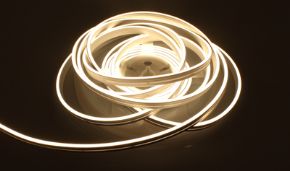
In one-bedroom apartments, distances from the eyes are reduced, so it is essential to avoid the visible dots of individual LEDs. This is where COB (Chip on Board) technology comes in: hundreds of micro-chips coated with a single layer of phosphors create a continuous and homogeneous line of light, free of the classic dot effect, with a wide 180° diffusion angle. For a cove, a light cut, or an under-cabinet viewed up close, the COB LED strip is the mandatory choice: the light appears as a luminous pencil stroke, clean and elegant, exactly what is needed for the four optical tricks described above. LED strips with 2835 chips, on the other hand, remain excellent when a lot of light output is needed inside a profile with an opaque diffuser, for example for high-efficiency general lighting.
| Feature | COB (Chip on Board) | SMD 2835 |
| Dot effect | Absent, continuous light | Visible up close without diffuser |
| Diffusion angle | Up to 180° | About 120° |
| Ideal for | Accents, coves viewed up close, baseboards | High-power general lighting |
| Typical color rendering | CRI>90 | CRI Ra>80 / >90 in top versions |
| Efficiency | High | Very high (up to 155 lm/W) |
4. Ledpoint aluminum profiles, zone by zone
An LED strip without a profile is an unfinished project. The aluminum profile performs three essential functions: it dissipates heat (prolonging the life of the strip), protects the circuit, and above all, houses a diffuser that transforms the LEDs into a soft, anti-glare line of light. In a one-bedroom apartment, where you look at the light from up close, the opal diffuser is not an accessory but a necessity. Below you will find the right profile for each strategic function, with the corresponding Ledpoint product. The complete range, including specific versions for coves and trimless, is in the Profiles category.
Indirect ceiling light: the profile for drywall coves
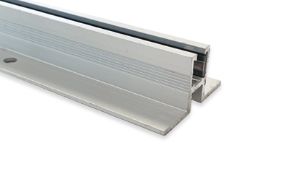
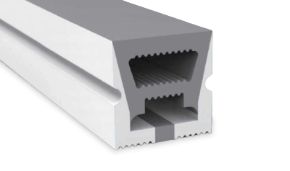
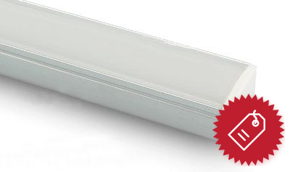
To create the perimeter coves that lift the ceiling, you need a profile dedicated to drywall, to be plastered and flushed. The 44x12 mm aluminum profile with drywall (code PR-CR4412) is designed exactly for this: integrated into the recess, it projects light upwards, creating a diffused halo that makes the ceiling appear suspended and higher. It is the heart of Trick 1 and the profile you will use along the entire perimeter of the living area and above the bed headboard.
Light cuts and wall washing: the flush recessed profile
For continuous light cuts and wall washing, you need a recessed profile that disappears into the surface, without a visible frame (trimless effect). The 23x8 mm recessed aluminum profile (PR-RE01-03-S2) creates clean lines of light flush with the wall or ceiling, perfect for guiding the perspective line from the entrance to the living room and for washing focal walls. It is the profile for Tricks 2 and 4, the ones that lengthen and widen the apartment.
Under-furniture, suspended bases, and baseboards: the slim white painted profile
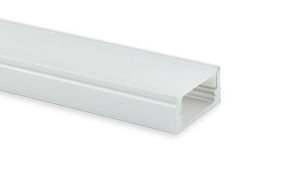
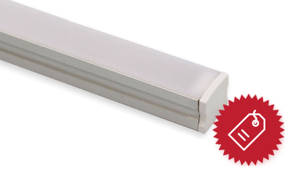
For the floating effect under the kitchen, TV unit, bed, or bathroom vanity, and for the illuminated baseboard, you need a thin and discreet profile. The 17x8 mm slim white painted aluminum profile (PR-SL08-03-W2) with opal diffuser is ideal: it blends with white furniture and houses a soft-light COB strip, realizing Trick 3. The 17x8 mm natural aluminum version is perfect when you prefer the metallic finish.
Niches, corner recesses, and wardrobes: the 90° corner profile
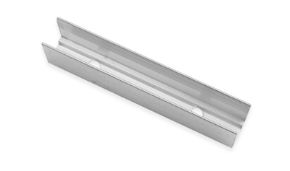
Dark 90° corners are enemies of perceived space. The 16 mm corner aluminum profile (PR-AN02-08) illuminates storage niches, bookshelves, and full-height wardrobes, eliminating corner shadows and restoring light exactly where the room tends to "close in". It is a detail that makes a huge difference in one-bedroom apartments with many storage volumes.
The shortcut: the ready-made LED bar
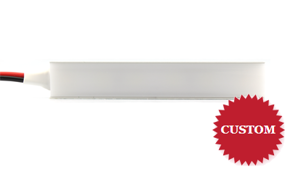
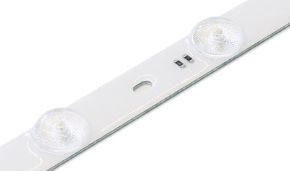
If you want to avoid assembling the strip, profile, and diffuser separately (typical for renters or those who need to intervene quickly) Ledpoint offers integrated solutions like the 3-meter opaque LED bar with pre-mounted 7 W/m COB strip: profile, strip, and diffuser in a single ready-to-use product, ideal for under-cabinets and shelves without drywall work.
| Function in the project | Recommended Ledpoint profile | Code | Optical trick |
| Indirect ceiling cove light | 44x12 mm drywall profile | PR-CR4412 | Raise the ceiling |
| Light cut / wall washing | 23x8 mm recessed profile | PR-RE01-03-S2 | Push back walls / perspective |
| Under-furniture, suspended base, baseboard | 17x8 mm slim white profile | PR-SL08-03-W2 | Dematerialize the floor |
| Niches, corner recesses, wardrobes | 16 mm corner profile | PR-AN02-08 | Eliminate dark corners |
| Ready-made under-cabinet solution | 3 m opaque LED bar with COB | PR-RE16-00 | Dematerialize the floor |
5. Which LED strips to choose: warm, neutral, or dynamic (CCT) light
Once the profiles are chosen, the most important question of any project on how to light a one-bedroom apartment remains: which LED strip to put inside each profile? The answer depends on two variables: the function (general or accent light) and the lifestyle of those who live in the space. Below you will find three tested scenarios, with real Ledpoint products for each. In all cases, the golden rule for small spaces is just one: CRI>90 and continuous light without dots, because in a one-bedroom apartment, the quality of light is seen, literally, an inch from your nose.
Option A - Homogeneous high-efficiency warm white (the most requested solution)
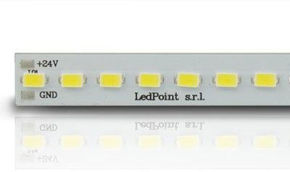
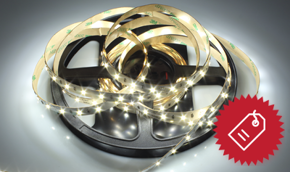
It is the ideal choice for those who want a welcoming atmosphere and a simple fixed-temperature system. For main coves and recesses (the reflected general light), you need a lot of output: the 3000K 2835 240 leds/m 14.4 W/m LED strip offers a full 2000 lm/m with efficiency up to 155 lm/W, perfect for acting as the main reflected lighting without overheating. For baseboards, under-furniture, niches, and accent cuts, where softness matters, the 3000K 480 leds/m 4.8 W/m CRI>90 COB LED strip is ideal: continuous line, low consumption, and anti-glare light perfect even at a very short distance from the diffuser. If the cove needs to output a lot, the 10 W/m 940 lm/m COB 3000K version combines output and homogeneity.
Option B - Dynamic CCT white (ideal for the multi-functional one-bedroom apartment)
In 40 sqm, the same room often has to function as a smart working space by day and a relaxation area by night. Here CCT (tunable white, 2700K-6500K) technology wins: it allows you to vary the color temperature with a command. During the day you set 4000K-4500K for a bright, energetic, and visually larger space; in the evening you drop to a dimmed 2700K at 20-30% for a warm and relaxing atmosphere. You can find the range in the CCT LED strips category. Those who also want colored light for effect scenes can consider the 840 leds/m RGB+CCT COB LED strip, which combines dynamic white and color in a single continuous line strip.
Option C - Neutral white for kitchen and bathroom (output and functionality)
In operational areas (kitchen counter and bathroom mirror), neutral 4000K light improves the perception of details and real colors. The 4000K 480 leds/m 10 W/m CRI>90 COB LED strip at 980 lm/m is perfect under kitchen wall cabinets and as functional light, maintaining the same continuous quality as the other strips in the project. Choosing the chromatic tolerance (MacAdam steps) ensures that all the strips in the system have the exact same shade, a crucial detail to avoid visually breaking the space.

6. Color temperature and CRI: the right light for small spaces
Two technical parameters decide more than anything else whether a one-bedroom apartment will appear welcoming and spacious or cold and compressed: the color temperature (in kelvin) and the color rendering index (CRI). Choosing them well is half the work to light a one-bedroom apartment professionally.
What color temperature to choose
Color temperature influences mood and dimensional perception. Warm tones (2700K-3000K) make the space intimate and enveloping, ideal for the sleeping area and for the evening; neutral tones (4000K) make the environment fresher, cleaner, and optically larger, great for the kitchen, bathroom, and daytime hours. In a one-bedroom apartment, the best combination is often mixed: warm in the resting areas, neutral in the operational areas. However, the most elegant solution remains the CCT strip, which allows you to have both atmospheres in the same light point. To understand how much light actually reaches the surfaces, the Ledpoint guide on how to calculate lux. is useful.
| Zone | Recommended temperature | Perceptual effect |
| Living area / living room (evening) | 2700-3000K | Welcoming, depth, relaxation |
| Living area / smart working (day) | 4000-4500K | Energetic, larger space |
| Kitchen / workspace | 4000K | Sharp details, real colors |
| Sleeping area / bedroom | 2700-3000K | Warm, relaxing |
| Bathroom / mirror | 4000K | Faithful rendering of face and colors |
Why CRI must be high
CRI measures how faithfully a source reproduces colors compared to natural light. In a one-bedroom apartment, where surfaces are close and the gaze continuously scans them, a CRI>90 makes materials look richer, colors fuller, and the space more curated and precious. A low CRI, on the contrary, flattens everything and makes the environment dull, with the psychological effect of making it perceive as smaller and duller. All the strips recommended in this guide are CRI>90 precisely for this reason. The Ledpoint in-depth article discovering CRI explains in detail how to read this value.
7. How to light a one-bedroom apartment room by room
Now let's put everything together. Lighting a one-bedroom apartment coherently means treating the apartment as a single sequence of light, not as isolated rooms: visual continuity from one room to another is what amplifies depth. Let's see zone by zone how to apply the four optical tricks with Ledpoint products.
Entrance and hallway: the gateway to the perspective line
The entrance is where the brain "measures" the apartment for the first time. Here the perspective line begins: a linear light cut on the ceiling or wall, made with the 23x8 mm recessed profile and a continuous COB strip, which continues without joints towards the living area. Avoid closely spaced spotlights, which break the line: in a narrow hallway, a single continuous line of light makes it seem longer and tidier. If there is a built-in wardrobe, illuminate the inside with the corner profile to eliminate the dark area.
Living area and living room: the engine of the space effect
It is the room where three of the four tricks are concentrated. First, the perimeter indirect light cove, with the drywall profile and a high-output 3000K strip: it is the general light that lifts the ceiling. Then the wall washing on the feature wall or TV wall, to visually push it away. Finally, the light under the suspended TV unit, with a slim profile and COB strip, to make it float and let the floor flow. The result is a living area that looks much larger than its square meters. For management, provide at least two independent circuits (cove and accents) to create different scenes.
Kitchenette and kitchen: functional light that doesn't steal space
In a one-bedroom apartment, the kitchen is almost always open plan, so its light must be functional but integrated. The solution is the 4000K COB strip under the wall cabinets, in the slim white profile: it illuminates the workspace with 300-500 lux without the need for suspended fixtures. A second strip under the kitchen base creates the suspension effect and lightens the volume. If the kitchen has an island, a grazing light cut on the side makes it look thinner. This way the kitchen "disappears" when not needed and remains perfectly functional when you cook.
Sleeping area and bedroom: comfort and lightness
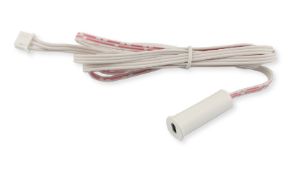
The bedroom of a one-bedroom apartment must convey calm and, at the same time, not seem saturated. The LED strip behind or above the bed headboard, with warm 2700-3000K light, creates an enveloping halo and pushes the wall away. A second strip under the bed (if suspended or raised) or in the bed frame generates the floating effect and acts as a delicate 5% night light. Always illuminate the inside of the wardrobe with the corner profile or a strip with an opening sensor : it is a functional luxury that makes a difference in boutique hotels. The light here must be dimmable, to switch from reading to resting.
Bathroom: spaciousness and color rendering
Even the bathroom of a one-bedroom apartment gains a lot from linear light. A 4000K strip around or on the sides of the mirror guarantees frontal light without shadows on the face; a strip under the suspended vanity unit makes it float and expands the visible floor. For humid environments, choose strips with an adequate protection rating (here the IP code counts) and a dedicated mirror dimmer . A small bathroom, well illuminated with grazing light, suddenly seems twice as big.

8. Solutions by size: 30, 40, and 50 sqm one-bedroom apartments
Every one-bedroom apartment has its own geometry, but the logic remains the same: the smaller the space, the more the light must be indirect, continuous, and layered. Here you will find three ready-to-adapt typical projects, with indicative linear meters of LED strip, profiles, and color temperature. They are real schemes that an interior designer or architect can use as a base, and that a homeowner or tenant can replicate step by step. For electrical sizing, always remember to match an adequate power supply to the total wattage.
30 sqm one-bedroom apartment: maximum essentiality, maximum effect
In 30 sqm, every intervention must be surgical. The absolute priority is the indirect light cove in the living area and a single perspective line from the entrance. You gladly give up redundant interventions to focus everything on perceived height and continuity. An essential but effective system includes: perimeter cove in the living room, light cut in the hallway, strip under the kitchen cabinet, and warm strip on the headboard. With a few meters of well-placed LED strips, a "missed" one-bedroom 30 sqm apartment can look like an airy environment.
| Zone | Intervention | Strip (indicative) | Linear meters | Kelvin |
| Living room | Indirect ceiling cove | High output COB/2835 | 6-8 m | 3000K |
| Entrance/hallway | Perspective light cut | Continuous COB | 3-4 m | 3000K |
| Kitchen | Under-cabinet + suspended base | 4000K COB | 3-4 m | 4000K |
| Bedroom | Headboard + night light | 3000K COB | 3-4 m | 2700-3000K |
40 sqm one-bedroom apartment: the most common and versatile size
40 sqm is the classic size of the urban one-bedroom apartment and offers space to apply all four optical tricks. Here it is worth investing in the CCT strip to manage the dual day/night use of the living area and adding wall washing on the feature wall. The ideal system divides the light into 3-4 independent zones: ceiling/coves, walls/cuts, bases/baseboards. This is the most complete project and the perfect balance point between output, comfort, and budget for those who really want to understand how to light a one-bedroom apartment and how to make it look bigger.
| Zone | Intervention | Strip (indicative) | Linear meters | Kelvin |
| Living room | Perimeter indirect cove | 2835 240 leds/m 14.4 W/m | 9-11 m | 3000K or CCT |
| Feature wall | Grazing wall washing | 10 W/m COB | 3-4 m | 3000-4000K |
| Entrance | Continuous perspective line | Continuous COB | 4-5 m | 3000K |
| Kitchen | Under-cabinet + base + island | 4000K COB | 4-6 m | 4000K |
| Bedroom | Headboard + under-bed + wardrobe | 3000K COB | 5-6 m | 2700-3000K |
| Bathroom | Mirror + under-vanity | Adequate IP 4000K COB | 2-3 m | 4000K |
50 sqm one-bedroom apartment: true apartment comfort
With 50 sqm, the one-bedroom apartment approaches the comfort of a larger apartment and can afford sophisticated scenes. Here you can introduce a complete multi-zone smart control, with preset scenes for every moment of the day, and carefully treat secondary elements too (niches, shelves, headboards). The objective changes slightly: not only to make the one-bedroom apartment look bigger, but to make it an environment with a modular atmosphere, worthy of a boutique hotel. In this size, the investment in a CCT strip and a smart control system pays off in daily quality of life.
| Zone | Intervention | Strip (indicative) | Linear meters | Kelvin |
| Living room | Cove + wall washing + perspective | CCT + COB | 14-16 m | CCT 2700-6500K |
| Kitchen | Under-cabinet, base, island, niches | 4000K COB | 6-8 m | 4000K |
| Bedroom | Headboard, under-bed, wardrobe, nightstands | CCT / 3000K COB | 7-9 m | 2700-3000K |
| Bathroom | Mirror, under-vanity, shower niche | Adequate IP 4000K COB | 3-5 m | 4000K |
| Hallways | Continuous illuminated baseboard | 3000K COB | 4-6 m | 3000K |
9. How many lumens and watts you really need
One of the most frequent questions from those who need to light a one-bedroom apartment is: how much light is needed? The correct answer is not "as much as possible", but "the right amount, well distributed". Thinking in lumens and lux avoids the two opposite mistakes: over-lighting (which flattens and glares) or under-lighting (which depresses and shrinks).
As a practical reference, to light a one-bedroom apartment comfortably you need roughly 100-150 lumens per square meter in the living area, 300-500 lux on the kitchen workspace, 150-200 lux in the sleeping area, and 300-400 lux at the bathroom mirror. In a 40 sqm apartment, this translates to about 4,000-6,000 total lumens, which however should not be concentrated in a single point: they must be divided between the cove, accents, and functional light. It is precisely the distribution, not brute power, that creates the space effect.
| Room | Recommended lux | Type of light |
| Living area (general) | 100-200 lux | Indirect from cove |
| Kitchen counter | 300-500 lux | Functional under-cabinet |
| Desk / smart working | 300-500 lux | Functional + general |
| Bedroom (general) | 100-150 lux | Warm indirect |
| Reading in bed | 300 localized lux | Dimmable accent |
| Bathroom mirror | 300-400 lux | Frontal 4000K |
From a consumption point of view, a modern LED strip consumes very little: a 10-meter cove at 14.4 W/m absorbs about 144 W, but it is rarely used at 100% and almost always dimmed. Thanks to efficiencies up to 155 lm/W, the entire system of a one-bedroom apartment can consume less than many single traditional fixtures, with the advantage of infinitely more modular light. For the precise calculation of lux on surfaces, the Ledpoint guide on how to calculate the lux of an LED installation is the reference tool.
10. Management and scenes: dimmers, CCT, and smart control
An LED strip system gives its best when it is controllable. The difference between a "lit" one-bedroom apartment and a "staged" one-bedroom apartment lies entirely in the management of zones and scenes. To maximize the yield of light cuts in a few square meters, it is advisable to divide the system into 3 or 4 independent zones (ceiling/coves, walls/cuts, bases/baseboards, functional) each adjustable separately. This allows you to instantly switch from a broad, bright daytime light to a warm, deep evening atmosphere.
The dimmer: the heart of the system
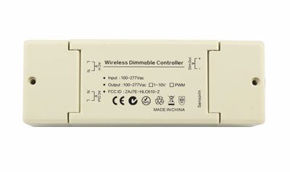
The ability to adjust intensity is what makes light alive. A dimmable system allows you to adapt the amount of light to the time and activity, saving energy and creating depth (remember: a darker area next to a lighter one increases the perception of depth). For single-color strips, choose a monochromatic dimmer, for dynamic white strips you need a dedicated CCT dimmer, which simultaneously manages intensity and color temperature. If you don't know what "dimmable" means, it is simply the ability of the light to be gradually adjusted from 0 to 100%.
Smart control and preset scenes
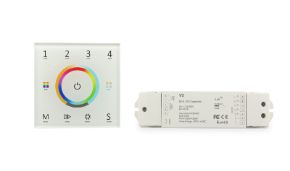
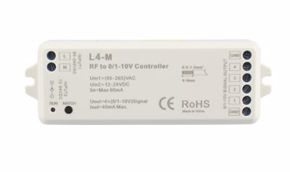
For maximum comfort, a smart ZigBee or Wi-Fi system allows control from an app and via voice assistants, with stored scenes. In a one-bedroom apartment, some scenes make a huge daily difference: "Day" (neutral light at 100% for working), "Evening relax" (warm light at 30%), "Dinner" (accents on table and kitchen), "Night" (only baseboard at 5%). A wall touch panel or a compact remote control (like those in the remote controls and sensors) categories allow you to recall the right scene with a gesture. Those who prefer total automation can add presence sensors for hallways and wardrobes.
| Scene | Active zones | Intensity | Kelvin |
| Day / smart working | Coves + functional | 100% | 4000-4500K |
| Evening relax | Coves + accents | 25-30% | 2700-3000K |
| Dinner | Accents + kitchen | 50% | 3000K |
| Night | Baseboard | 5% | 2700K |
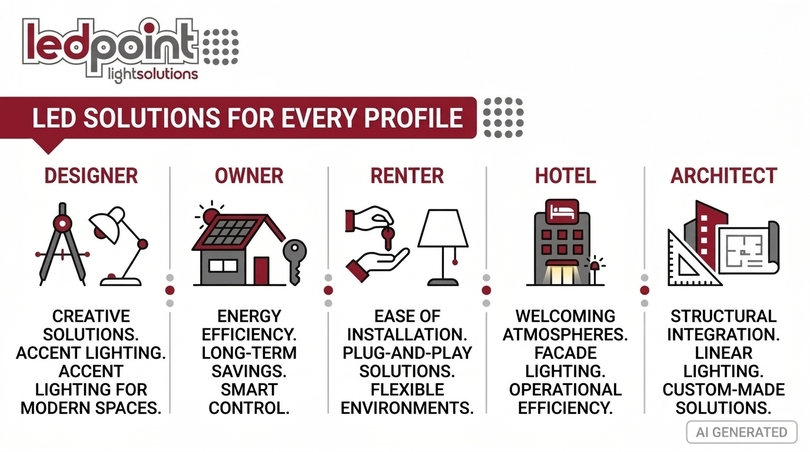
11. Solutions for every profile: designer, homeowner, tenant, hotel, architect
How to light a one-bedroom apartment changes depending on who lives in it and their goals. Here are five approaches calibrated to the most common audience profiles, all achievable with Ledpoint products.
For the interior designer: coherence and replicability
Those who design for clients need coherent and replicable solutions. The key is to standardize profiles and color temperature throughout the project, choosing strips with the same chromatic tolerance (MacAdam steps) to avoid shade differences from one room to another. A modular system of profiles and COB strips allows you to compose libraries of reusable construction details across multiple sites, with predictable results and a recognizable design image.
For the homeowner: long-term value and comfort
Those who own the property can invest in an integrated drywall system, destined to last. Here the priority is quality (CRI>90), durability (high L70), and a smart control that increases daily comfort and the perceived value of the home. A one-bedroom apartment with professional lighting sells and rents better: light is the first "business card" of a space.
For the tenant: reversible interventions without construction work
Those who rent need solutions that do not require drywall and are removable. The answer is LED strips with 3M double-sided tape and surface-mounted profiles applicable under furniture, behind shelves, on the back of the headboard, or above wardrobes. The ready-made LED bar is perfect: you position it, connect it to a power supply, and immediately create the indirect light effect without touching the walls. When moving, it can be dismantled without leaving a trace.
For the boutique hotel owner: repeatable atmosphere room after room
In a boutique hotel, every room must offer the same memorable experience. Preset scenes (welcome, relax, night), CCT light to adapt to the time of day, and curated details like light in wardrobes and under nightstands transform a small room into an environment to remember. Standardizing the system with Ledpoint profiles and strips makes the setup repeatable and maintainable across all rooms, with a coordinated image.
For the architect: light as a design material
For those who design architecture, light is a material in all respects. Trimless cuts, concealed coves, and perspective lines become part of the spatial design, not a later addition. Integrating LED strips right from the drywall design phase allows you to obtain perfect lines of light, without compromises, and to control dimensional perception with millimetric precision. It is the most sophisticated approach to how to light a one-bedroom apartment and how to make every room look bigger.
12. Mistakes to avoid when lighting a one-bedroom apartment
Even the best project can be ruined by a few recurring mistakes. Knowing them in advance is the fastest way to achieve a professional result. Here are the most frequent ones and how to avoid them.
Mistake 1 - Relying on a single central light point
The single chandelier in the center of the ceiling is the main responsible for the "box" effect. It creates harsh shadows in the corners, flattens the ceiling, and flattens the space. The solution is to distribute light on multiple indirect and linear sources, as seen in the four optical tricks.
Mistake 2 - Choosing low-quality strips with a dot effect
A string of LEDs visible as many dots, seen up close in a small environment, is unsightly and tires the eye. In a one-bedroom apartment, you need a continuous line COB strip or, alternatively, an SMD inside a profile with a quality opal diffuser. Do not skimp on the diffuser: it is what separates an amateur system from a professional one.
Mistake 3 - Neglecting the aluminum profile
Gluing strips directly to the furniture or wall is a double mistake: the light remains dotted and the undissipated heat shortens the life of the LEDs. The aluminum profile is mandatory for durability and quality, especially in high-power strips.
Mistake 4 - Randomly mixing color temperatures
Using 3000K in one spot and 4000K in the next, without logic, breaks the harmony and shrinks the space. Decide on a coherent chromatic strategy: warm for relaxation, neutral for operational areas, or CCT to have both in a controlled way.
Mistake 5 - Forgetting the power supply and sizing
Every strip needs an adequate power supply: undersizing it reduces light and lifespan, overloading it is dangerous. Always calculate the total wattage (W/m × meters) and add a 20% margin. For smart systems, consider smart power supplies.
Mistake 6 - Interrupting light lines
Every visible joint and every interruption shortens the perceived space. Design continuous lines, use connectors and profile joints of quality, and maintain continuity especially in the perspective line.
13. Data, statistics, and trends: why LED strips dominate small spaces
Understanding how to light a one-bedroom apartment also means reading the industry numbers. The residential lighting market is experiencing a structural transition towards linear LED, driven by efficiency, durability, and aesthetic versatility. The data tells why LED strips have gone, in a few years, from a decorative element to true main lighting even in small-sized apartments.
Today, LED lighting represents the vast majority of new residential installations in Europe, and small-sized homes (studios and one-bedroom apartments) are among the contexts where strip growth is fastest, because here the advantage of footprint and flexibility is maximum. The one-bedroom apartment, one of the most bought, sold, and rented typologies in Italian cities, has become the ideal testing ground for linear lighting, especially in the short-term rental and boutique hotel markets, where atmosphere is part of the experience. The design experience gained by Ledpoint in the field, in thousands of installations followed from the Faenza headquarters, confirms a recurring fact: for the same surface area, a well-designed LED strip system significantly increases the perceived space compared to a traditional point-light system.
| Indicator | Traditional lighting | Ledpoint LED strips |
| Luminous efficiency | Variable, often low | Up to 140-155 lm/W |
| Lifespan (L70) | Lower | Very high, tens of thousands of hours |
| Footprint | Fixture volume | 8-12 mm width, 2 mm thickness |
| Scene flexibility | Limited | Dimmer, CCT, multi-zone smart |
| Color rendering | Often medium-low CRI | CRI>90 available |
| Impact on perceived space | Neutral or negative | Strongly positive |
The second strong trend is dynamic light (CCT and Human Centric Lighting): the ability to vary the color temperature during the day responds to a real need, because in one-bedroom apartments the same room performs different functions (work, meals, relaxation, rest). The demand for CCT strips and smart control systems is growing strongly, and it is one of the reasons why the CCT LED strips category is now central for those designing small spaces. The third trend is the demand for clean, continuous light: COB technology, which eliminates the dot effect, has become the expected standard for coves and light cuts viewed up close.
Light and wall color: an alliance that multiplies space
An often-ignored lighting fact concerns the interaction between light and finishes. Light, matte walls reflect up to 80% of incident light, while dark ones absorb most of it. This means that the effect of an indirect light cove is enormously amplified by white or light-colored walls and ceilings: the same LED strip, in a light room, "yields" much more and expands the space more. When designing how to light a one-bedroom apartment, always coordinate light with colors: warm light on light surfaces for warmth, neutral light on light surfaces for maximum spaciousness. It is the synergy between these two elements that produces the most convincing "bigger" effect.
14. Step-by-step installation and essential accessories
Designing is half the work; the other half is installing it well. An LED strip system to light a one-bedroom apartment is within the reach of even a careful installer or an advanced DIY enthusiast, provided you respect a few steps and do not neglect accessories. Here is a complete operational guide.
Step 1 - Design the light lines on the floor plan
Before buying, draw the light lines on the apartment floor plan: where the cove runs, where the perspective cut is, where the under-furniture lights are. Measure the linear meters of each section and sum the total length for each color temperature. This will tell you how many meters of strip to order (reels are typically 5 meters) and how many profiles are needed.
Step 2 - Choose coordinated strip, profile, and diffuser
For each section, match the right strip to the right profile and the adequate diffuser (opal to hide LEDs, transparent for maximum output). Check the width of the strip against the profile cavity and the cut point (strips are only cut at specific points, every few centimeters). The COB strips recommended in this guide are cut every 2.5 cm, offering great flexibility.
Step 3 - Size the power supply
Calculate the total wattage of each circuit (W/m × meters) and choose a power supply with at least a 20% margin. Prefer 24V over 12V for long runs, because it reduces voltage drop and keeps the light uniform from the beginning to the end of the strip. For smart systems, a smart power supply simplifies integration with dimmers and app control.
Step 4 - Prepare surfaces and mount profiles
Clean and degrease the surfaces: the 3M double-sided tape of the strips and profiles holds perfectly only on clean, smooth, and not freshly painted surfaces. For optimal bonding, the temperature of the strip and surface must be between 21 and 38°C; full fixing is achieved after about 72 hours. Fix the profiles with the mounting clips or double-sided tape, depending on the type.
Step 5 - Lay the strip, connect, and close with end caps
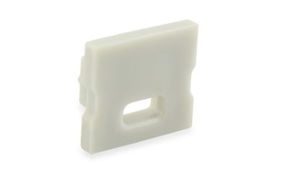
Insert the strip into the profile, make the connections with the quick connectors or soldered joints for more durable solutions, then close the ends with the end caps for a clean, finished result. Protect the cut and connection points: they are the most delicate points of the system. Finally, snap on the diffuser.
Step 6 - Connect dimmer and control, then create scenes
Connect each zone to its own dimmer or controller, check the operation, and if you have chosen a smart system, configure the scenes from the app. Dedicate time to this phase: it is what transforms a functioning system into a memorable light experience. Store at least the Day, Evening, Dinner, and Night scenes described above.
| Component | Function | Ledpoint Category |
| COB / 2835 LED strip | Light source | LED strips |
| Aluminum profile | Dissipation, protection, aesthetics | Aluminum profiles |
| Diffuser | Soft anti-glare light | Diffusers |
| Power supply | Conversion to 24V | Power supplies |
| Dimmer / controller | Adjustment and scenes | Controllers |
| Connectors and joints | Continuous connections | Accessories |
| End caps and clips | Finishing and fixing | Aluminum profiles |
A final methodological tip: when planning how to light a one-bedroom apartment, always think "project-wise" and not "product-wise". Start from the effect you want to achieve in each room (higher ceiling, further walls, continuous floor, depth) and only then choose the strip, profile, and control that realize it. It is this approach, more than any single component, that makes the difference between an apartment that looks small and one that, with the same square meters, looks decidedly bigger. And if you have doubts about sizing or products, the Ledpoint technical team is available to help you transform your one-bedroom apartment into a bright, welcoming, and surprisingly spacious environment.
15. Case studies: three one-bedroom apartments transformed by light
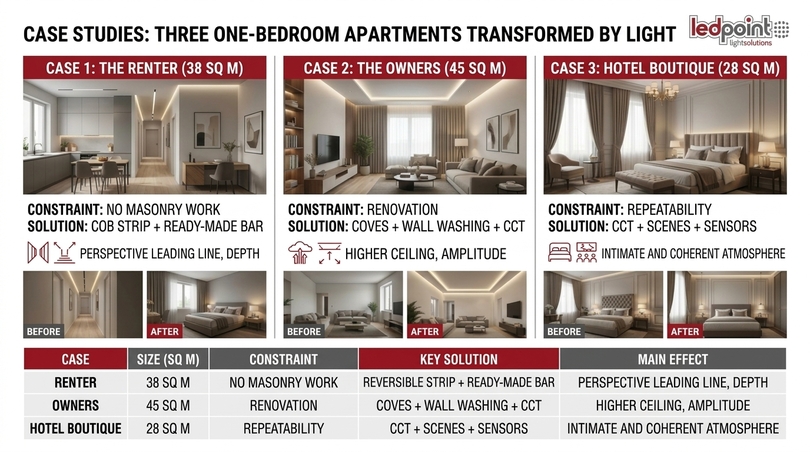
Theory becomes convincing when it translates into concrete results. Below are three case studies inspired by real projects followed by the Ledpoint technical team, with starting data and perceptual results. They show how the same apartment can radically change character just by changing the way it is lit, without moving a wall or giving up a single square meter.
Case 1 - The 38 sqm rented one-bedroom apartment: reversible intervention
A young tenant wanted to make a 38 sqm one-bedroom apartment with standard ceilings and white walls more welcoming and spacious, without being able to carry out masonry work. The solution was entirely reversible: 3000K COB strips above the wardrobes and behind the headboard, a ready-made LED bar under the kitchen wall cabinets, and an illuminated baseboard applied with double-sided tape in the hallway. The result: the hallway, previously dark and compressed, became a continuous line of light that "lengthens" the entrance; the sleeping area gained depth thanks to the illuminated wall. Everything can be dismantled when moving, without a trace. This case shows that professionally lighting a rented one-bedroom apartment is not only possible, but simple.
Case 2 - The 45 sqm owned one-bedroom apartment: integrated system
A couple owning a 45 sqm one-bedroom apartment chose an integrated drywall intervention during renovation. Perimeter indirect light cove in the living room with high-efficiency 3000K 2835 strip, wall washing on the feature wall, trimless cuts in the hallway, and CCT strip in the bedroom to manage day and night. The ceiling, previously perceived as low, appeared distinctly higher; the living area, thanks to the wall washing, gained surprising depth. The system, divided into four zones with smart control, allows different scenes for every moment. The perceived value of the home has grown, and with it daily comfort.
Case 3 - The 28 sqm boutique hotel room: repeatable atmosphere
The owner of a small boutique hotel wanted to transform 28 sqm rooms into memorable environments consistent with each other. The choice fell on a standardized system: CCT strip behind the headboard and in the false ceiling, warm light under the suspended nightstands, light in the wardrobes with sensor, and preset welcome, relax, and night scenes. Every guest, upon entering, finds the same curated experience; management via scenes allows staff to prepare the room with a gesture. The small size, thanks to indirect and dynamic light, is no longer perceived as a limit but as an intimate and sophisticated environment. It is proof that the principles on how to light a one-bedroom apartment apply, identically, even in luxury hospitality.
| Case | Size | Constraint | Key solution | Main effect |
| Tenant | 38 sqm | No masonry work | Reversible strip + ready bar | Perspective line, depth |
| Owners | 45 sqm | Renovation | Coves + wall washing + CCT | Higher ceiling, spaciousness |
| Boutique hotel | 28 sqm | Repeatability | CCT + scenes + sensors | Intimate and coherent atmosphere |
16. Technical glossary: the words of light for your one-bedroom apartment
To choose consciously how to light a one-bedroom apartment, it is useful to master a few key terms. This glossary collects the essential concepts you find in Ledpoint product sheets and in this guide, explained simply and applied to small spaces.
Lumen
The lumen measures the total amount of light emitted by a source. More lumens mean more light; in a one-bedroom apartment, however, it counts how these lumens are distributed, not just the total. An LED strip is described in lumens per meter (lm/m).
Lux
The lux measures the light that actually reaches a surface (lumens per square meter). It is the value that determines if a workspace is well lit: 300-500 lux on the kitchen counter, 100-200 lux in the living area.
Kelvin and color temperature
Kelvin indicates the color temperature: low (2700-3000K) = warm light; medium (4000K) = neutral light; high (5500K+) = cool light. In one-bedroom apartments, warm light creates intimacy, neutral expands space.
CRI (color rendering index)
The CRI measures how faithfully a light shows real colors, on a scale up to 100. For a one-bedroom apartment, always choose CRI>90: it makes materials and colors rich and the space more precious.
COB (Chip on Board)
LED technology with closely spaced LEDs coated with a continuous layer of phosphors, which generates a homogeneous line of light without visible dots, with an angle up to 180°. It is the ideal choice for coves and light cuts viewed up close in a one-bedroom apartment.
Cove
A drywall element that hides an LED strip and projects light towards the ceiling or wall. It is the main tool to create indirect light and visually raise the ceiling.
Wall washing
A technique that "washes" a wall with uniform light from above. It serves to make the wall perceive as further away, increasing the width of the space.
Dimmer and dimmable
The dimmer adjusts the light intensity from 0 to 100%. A "dimmable" strip can be adjusted gradually. Adjusting light is essential to create scenes and depth in a small environment.
CCT (tunable white)
Technology that allows varying the color temperature (typically 2700-6500K) with a command. Ideal in the multi-functional one-bedroom apartment: neutral light for working, warm for relaxing, from the same strip.
IP protection rating
The IP code indicates resistance to dust and water. In dry environments, IP20 is enough; in the bathroom or near water sources, a higher protection rating is needed.
L70 (lifespan)
Indicates the hours after which the strip still emits 70% of the initial light. A high L70 guarantees a system that remains efficient for many years, an important value in an integrated system.
MacAdam steps
Measures the chromatic uniformity between strips of the same model. A low value (e.g., 3 steps) ensures that all the strips in the one-bedroom apartment have the exact same shade, avoiding annoying color differences. The in-depth article MacAdam steps and CCT explains it in detail.
With these concepts clear, every Ledpoint product sheet becomes readable and every choice on how to light a one-bedroom apartment becomes conscious. Light stops being a random detail and becomes what it really is: the most effective tool to transform a small apartment into a space that looks, and lives, much bigger.
17. Natural light, open spaces, and energy saving
Lighting a one-bedroom apartment does not just mean adding artificial light: it means dialoguing with natural light, managing open spaces, and keeping consumption under control. Three aspects that, if neglected, nullify even the best LED strip project. Let's look at them one by one.
Working with natural light
Daylight is the first ally of perceived space. Never obstruct windows with heavy curtains or bulky furniture and use light surfaces and slightly reflective materials to bounce light into the corners. Artificial lighting must integrate with natural light, not fight it: during the day, LED light serves to fill the areas that the window does not reach (the end of the hallway, the inside of the kitchen, the reading corner). A CCT LED strip set to a neutral 4000K shade "tunes" with daylight and keeps the environment coherent and spacious. In the evening, when natural light fades, you drop to warm shades for comfort. This gradual transition, typical of human-centric lighting, makes the one-bedroom apartment pleasant at every hour and helps it always be perceived at its best.
Lighting an open space one-bedroom apartment and open kitchen
Many modern one-bedroom apartments are organized in open spaces, with an open kitchen overlooking the living room. Here the continuity of light is even more decisive: a single line of indirect light that runs through the living room and kitchen unifies the environment and makes it perceive as a single large volume, instead of two separate small rooms. The winning strategy is to use the same family of strips and the same color temperature for the general light of both zones, differentiating only the functional light (more neutral on the hob). Separate "islands" of light, on the contrary, fragment the space and shrink it. In a well-lit open space, the gaze runs without obstacles from one wall to the other and the one-bedroom apartment looks much bigger than its actual floor plan.
Energy saving and maintenance
A well-designed LED strip system is also an economical system to manage. Thanks to high efficiencies and the almost constant use of the dimmer, real consumption is lower than that of many traditional systems, for the same perceived light. Indirect light, moreover, requires less power than one might think, because it exploits light surfaces as amplifiers. From a maintenance point of view, quality strips have a high L70 and last for many years; the presence of the aluminum profile, which dissipates heat, is crucial to guarantee this longevity. Choosing reliable components from the start (CRI>90 strips, dissipating profiles, well-sized power supplies) means not having to think about the system for a long time. It is the last, concrete advantage of carefully designing how to light a one-bedroom apartment: a more beautiful environment, bigger to look at, and lighter to maintain.
18. The most searched questions about how to light a one-bedroom apartment
Those facing the topic for the first time always ask the same questions. Here you will find extended and reasoned answers, designed both for those who design and those who want to intervene independently. They are the operational summary of everything you have read, with the common thread that runs through the entire guide: making the space look bigger with light.
How do you light a one-bedroom apartment?
A one-bedroom apartment is lit in layers, never with a single central source. The correct method involves three levels: a general indirect light (the ceiling cove that lifts the room), an accent light (wall washing on the walls and light under suspended furniture), and a functional light (under-cabinet kitchen, bathroom mirror, reading in bed). LED strips in aluminum profiles allow you to realize all three levels discreetly and integrated, without bulky fixtures. The golden rule is to distribute light along the edges and surfaces, not concentrate it in one point: this way every corner is lit, harsh shadows disappear, and the apartment appears wider and tidier. For the rest, quality (CRI>90), continuity of light lines, and the ability to adjust intensity count.
How can a one-bedroom apartment look bigger?
A one-bedroom apartment looks bigger when light deceives the perception of boundaries. The four mechanisms are: raising the ceiling with indirect light, pushing back walls with wall washing, dematerializing the floor with illuminated suspended furniture and baseboards, creating a continuous perspective line from the entrance to the living area. Added to this is the synergy with light finishes, which reflect light and amplify every effect. None of these interventions require modifying the structure: only the light and its direction change. This is why light is the most economical and effective tool to visually enlarge a small apartment, and the reason why every serious project on how to light a one-bedroom apartment starts precisely from these perceptual principles.
What lights should you put in a one-bedroom apartment?
In a one-bedroom apartment, it is advisable to put mainly LED strips in aluminum profiles with opal diffusers, integrated into coves, light cuts, under-furniture, and baseboards. COB technology is preferred for continuous light without dots and warm 3000K light for atmosphere, with neutral 4000K light reserved for operational areas (kitchen, bathroom). Large central chandeliers are avoided, as they flatten the ceiling and create shadows in the corners. A few well-placed accent points complete the picture. Those who want maximum flexibility choose dynamic white CCT strips, which alone cover both daytime and evening needs. In short: linear, indirect, quality, and adjustable light.
Which LEDs for a one-bedroom apartment?
For a one-bedroom apartment, choose high color rendering LEDs (CRI>90) and, where the light is seen up close, continuous line COB strips. For general reflected light in coves, you need high-output strips (e.g., high-efficiency 2835 or 10 W/m COB); for accents, under-furniture, and baseboards, low-consumption COB strips (4.8 W/m) with soft light are enough. 24V voltage is preferable for long runs. The light color is chosen based on the room's function: 2700-3000K for rest and relaxation, 4000K for kitchen and bathroom, or CCT to have both temperatures in the same point. All strips must have the same chromatic tolerance to avoid "breaking" the space with different shades.
How to make a one-bedroom apartment look bigger, in practice?
In practice, start from the living area and install a perimeter indirect light cove: it is the intervention with the highest effect/cost ratio. Then illuminate the longest wall with wall washing, put an LED strip under the TV unit and under the kitchen base to make them float, and create a continuous line of light from the entrance to the living room. Keep finishes light, use warm light in the evening and neutral during the day (or a dynamic CCT), and always adjust the intensity with a dimmer. By following these steps, the exact same one-bedroom apartment (without moving a wall) will appear taller, deeper, and decidedly wider. That is the whole secret of how to light a one-bedroom apartment to make it look bigger.
19. Frequently Asked Questions (FAQ)
Concise answers to the most common questions about how to light a one-bedroom apartment. Click on each question to read the answer.
How do you light a one-bedroom apartment?To light a one-bedroom apartment, use a three-tier system: indirect ceiling light with LED strips in a cove for general lighting, grazing accent light on walls and furniture, and functional light in the kitchen and mirror. COB LED strips in aluminum profiles are the most effective, discreet, and integrated solution. |
How to make a one-bedroom apartment look bigger with lights?Visually raise the ceiling with indirect light, wash the walls with grazing light (wall washing), float the furniture with LED strips under the cabinets, and create a continuous perspective line from the entrance to the living area. These are optical illusions that expand the perceived space without touching the walls. |
What lights should you put in a one-bedroom apartment?It's best to install warm white or dynamic CCT white LED strips in aluminum profiles, integrated into coves, light slots, and under-cabinets, with a few accents. Avoid large central chandeliers, which flatten the room and create harsh shadows in the corners, reducing the perceived space. |
Which LED strips to choose for a one-bedroom apartment?COB LED strips with CRI>90, continuous light without dot effect: 3000K for atmosphere or CCT 2700-6500K to vary the temperature. Use high-efficiency strips for general lighting; low-consumption COB strips in profiles with opal diffusers for accents. |
How many lumens are needed to light a one-bedroom apartment?You need about 100-150 lumens per square meter in the living area, 300-500 lux on the kitchen counter, and 150-200 lux in the sleeping area. In 40 sqm, this means roughly 4,000-6,000 total lumens, distributed across multiple sources rather than concentrated in a single light point. |
Is warm or cool light better for a small one-bedroom apartment?Warm light at 2700-3000K creates comfort and depth in the evening, while neutral 4000K light makes the space feel larger and more energetic during the day. The ideal solution is a dynamic CCT LED strip that shifts from warm white to neutral depending on the time and activity. |
Are LED strips enough as the main lighting for a one-bedroom apartment?Yes: with adequate wattages (14-20 W/m) and a proper design of coves and light slots, LED strips can be the main lighting. Recent trends use them as a primary source rather than just decorative, thanks to high efficiency and uniform light. |
How much does it cost to light a one-bedroom apartment with Ledpoint LED strips?It depends on the linear meters, profiles, and control system. Typically, a complete system of strips, aluminum profiles, power supplies, and dimmers for 40 sqm falls within an affordable range compared to a traditional fixture system, with much lower energy consumption over time. |
20. Light as a true spatial design project
At this point, one thing should be clear: lighting a one-bedroom apartment is not an accessory operation to rush at the end of the works, but the project that more than any other decides how the space will be lived and perceived. In a few square meters, light does what no furniture can do: it raises ceilings, pushes back walls, makes the floor flow, lengthens perspectives. And it does so with an almost zero footprint, reduced consumption, and total flexibility, thanks to LED strips and aluminum profiles.
The method you have learned in this guide boils down to a few solid principles. Layer the light on three levels, favor indirect and linear light, choose CRI>90 COB strips in points viewed up close, coordinate the color temperature with the functions of the rooms, and make everything adjustable with a dimmer or smart system. Apply the four optical tricks (higher ceiling, further walls, continuous floor, perspective line) and adapt them to the size of your apartment, whether it is 30, 40, or 50 sqm. Whatever your starting point, you will know exactly how to light a one-bedroom apartment to get the most out of every centimeter.
Whether you are an interior designer looking for replicable solutions, a homeowner wanting to enhance your home, a tenant looking for a reversible intervention, an architect who treats light as a design material, or the owner of a boutique hotel attentive to every detail of the experience, Ledpoint products offer you everything you need to transform a small space into a bright, welcoming, and surprisingly spacious environment. Explore the catalog of LED strips, aluminum profiles and control systems, and start your light project today. Because, in the end, learning how to light a one-bedroom apartment is learning to give more space to life.
This article was developed with the support of artificial intelligence and subsequently reviewed, corrected, and validated by the Ledpoint.it technical team, which guarantees its reliability and compliance with official sources.