









Mean Well power supplies for industry: the complete technical guide 2026
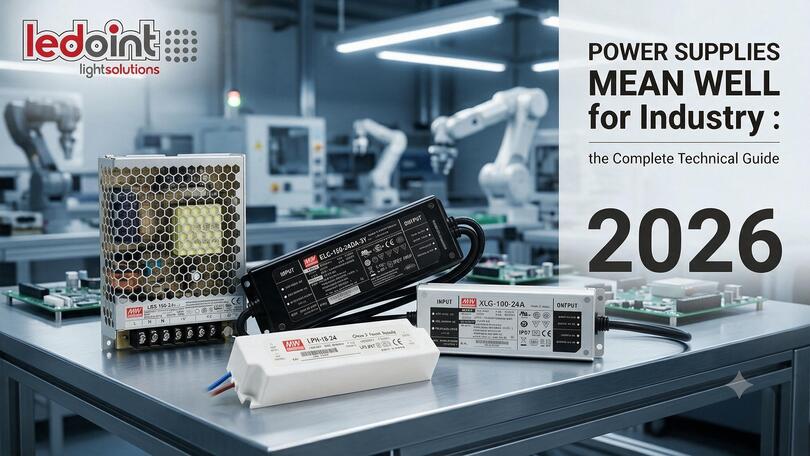
In industrial and professional lighting, the power supply is the beating heart of every system: if it fails, everything stops, regardless of the quality of the downstream LEDs. From highway signage to pharmaceutical production lines, from hydroponic greenhouses to industrial ports, from motorway tunnels to alpine shelters, Mean Well power supplies (often also referred to as "meanwell") have been the prevalent choice of major system integrators for over thirty years. This is not a marketing coincidence: it is the result of a comprehensive range, selected components for longevity, and a certification package that opens the doors even to the most demanding tenders.
In this in-depth guide, we compare the main families of Mean Well power supplies for industrial use (HLG, ELG, LRS, LPH, and NPF series), analyzing in detail IP protection ratings, derating regimes, electromagnetic compatibility (EMC), dimming protocols (1-10V, PWM, and DALI), mandatory certifications, power calculation, the difference between constant voltage and constant current, series and parallel connections, actual operating life, and integration with Industry 4.0. The goal is to provide you with a complete decision-making tool, with measurable data and real-world cases derived from our internal tests, to choose the right power supply and avoid the most costly mistakes. All technical data are expressed in standard units (lumens, watts, volts, amperes, hours, °C, kVAC) and refer to recognized standards such as EN 60529 and predictive methods like MIL-HDBK-217F.
In this article...
1. What are Mean Well power supplies and why do they dominate industry
Before choosing a specific series or model, it is essential to understand what a Mean Well power supply actually does and why this brand has become the de facto reference in the industrial sector. A power supply is not a simple "transformer": it is a complex electronic device that conditions energy, protects it, and makes it usable by delicate loads such as LEDs. Understanding this difference is the first step to avoiding wrong purchases and premature failures.
What is a Mean Well switching power supply
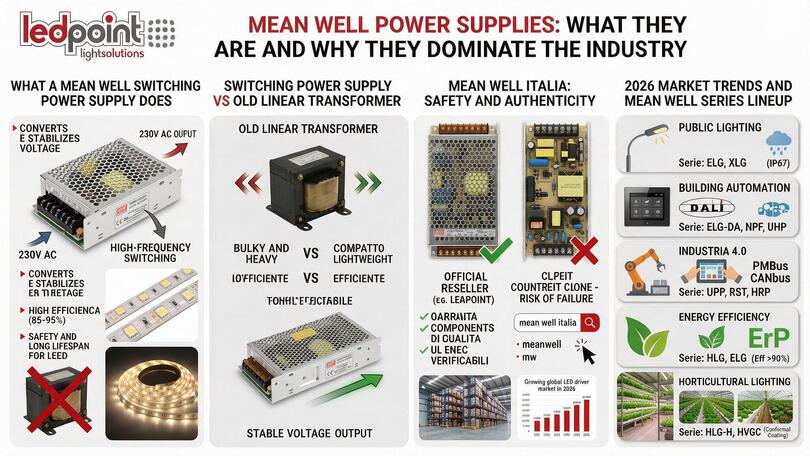
A switching power supply converts the mains alternating voltage of 230V into a stabilized direct current voltage — typically 12V, 24V, or 48V — through high-frequency switching. Compared to an old linear transformer, the Mean Well switching power supply achieves an efficiency between 85% and 95%, takes up less space, weighs less, and maintains a stable output voltage even as the load varies. This stability is crucial: LEDs are sensitive components to voltage variations and high ripple, which shorten their life and alter their color rendering.
The abbreviation "meanwell" (one word) is the informal spelling with which many electricians and designers search for the brand: whether you write "mean well", "meanwell", "mw", or "mean well power supplies", you are referring to the same Taiwanese manufacturer founded in 1982, today among the top three world manufacturers of standard power supplies. Its strength is the modularity of its catalogue: there is a Mean Well series optimized for almost every application scenario, from the dry interior of the electrical panel to temporary immersion in water.
Why "Mean Well Italy" distributors are among the most sought-after suppliers
Those who distribute "mean well italia" usually have a practical goal: to have a reliable manufacturer that guarantees original products, stock availability, and technical support. The market is full of clones and products declared Mean Well but not traceable. Buying from an official reseller like Ledpoint means having certainty of originality, verifiable UL and ENEC certification numbers, and manufacturer warranty — non-negotiable elements when the system must pass tests or withstand years of heavy conditions. A counterfeit product may have lower quality internal components, off-brand capacitors, and missing or poorly calibrated protections: differences invisible at purchase but devastating after a few months of operation.
Power supply, transformer, or driver: let's clarify the terms
In common language, the terms "power supply", "transformer", and "driver" are often used as synonyms, but technically they indicate different things, and confusion leads to wrong choices. A transformer in the strict sense only works with alternating current and does not stabilize the output; the old "12V transformers" for halogen spotlights belong to this category and are unsuitable for modern LEDs. A switching power supply, on the other hand, rectifies and stabilizes the voltage, providing a clean direct current. The term LED driver specifically indicates a constant current power supply designed to drive the diodes directly. In practice, when talking about powering professional LED strips and fixtures, the correct reference is almost always the Mean Well switching power supply, in constant voltage or constant current version depending on the load. Using the correct terminology avoids misunderstandings when ordering and designing.
The substantial difference between a consumer power supply and a Mean Well
On the market, there are inexpensive power supplies that, on paper, claim the same specifications as a Mean Well. The difference, however, emerges in the detail of the parameters and behavior under stress. A consumer power supply tends to have higher ripple, less sophisticated protections, and lower quality capacitors that age quickly with heat. A Mean Well, on the other hand, integrates gradual thermal derating, selected Japanese components, and design aimed at continuous operation. In a domestic system, the difference may be negligible, but in an industrial context — where a failure means production downtime — this difference translates into a measurable economic return. This is precisely why, as we will see in the following sections, the slightly higher cost of a Mean Well pays for itself many times over time.
2. The LED power supply market: numbers and trends 2026
To contextualize technical choices, it is useful to look at the industry numbers. The power supply sector (LED drivers and power supplies) is in constant growth, driven by the transition to LED lighting, industrial automation, and the spread of building automation systems. Understanding these trends helps to understand why certain features (such as DALI dimming or remote diagnostics) are becoming standard requirements rather than optional extras.
Market size and growth
Industry analyses indicate that the global LED driver market is estimated to exceed $30 billion by the end of the decade, with a double-digit compound annual growth rate (CAGR) in industrial and outdoor applications. The main driver is the replacement of traditional plants with LED solutions, which globally now represent the vast majority of new lighting points installed. In Italy and Europe, public lighting refurbishment plans and building energy efficiency regulations are further accelerating the demand for certified, high-efficiency power supplies.
Below is a summary table that synthesizes the key trends reshaping the demand for professional power supplies.
| Market trend | Impact on power supply choice | Mean Well series involved |
| LED transition in public lighting | Demand for IP67 drivers with transient protection and long life | ELG, XLG |
| Building automation and smart buildings | Growth of models with integrated DALI and diagnostics | ELG-DA, NPF, UHP |
| Industry 4.0 and predictive maintenance | Request for fault signaling and PMBus/CANbus remote control | UHP, RST, HRP |
| Energy efficiency and ErP | Reduced standby and efficiency >90% mandatory | HLG, ELG |
| Horticultural lighting and greenhouses | High power density power supplies and conformal coating | HLG-H, HVGC |
Why the choice of power supply impacts TCO
A fact that is often underestimated: in a professional LED system, the power supply is the primary cause of failure, not the LED. Technical assistance statistics in the sector attribute a significant share of plant failures to drivers, especially when they are undersized or installed in thermally hostile environments. Investing in a quality Mean Well power supply therefore means reducing the Total Cost of Ownership (TCO), reducing the heaviest items: maintenance interventions, production stoppages, and premature replacements.
3. Mean Well series compared: HLG, ELG, LRS, LPH, NPF
The first discriminant in choosing a Mean Well power supply concerns the installation environment and the required protection requirements. Each family has been designed to meet specific needs, and knowing the differences is what separates a reliable system from one destined to cause problems. In this section, we analyze one by one the most requested series, with their strengths, limitations, and ideal application scenarios.
The LPH series: economical for indoor use
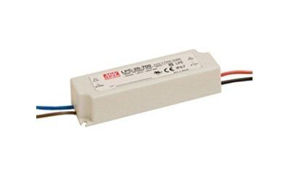
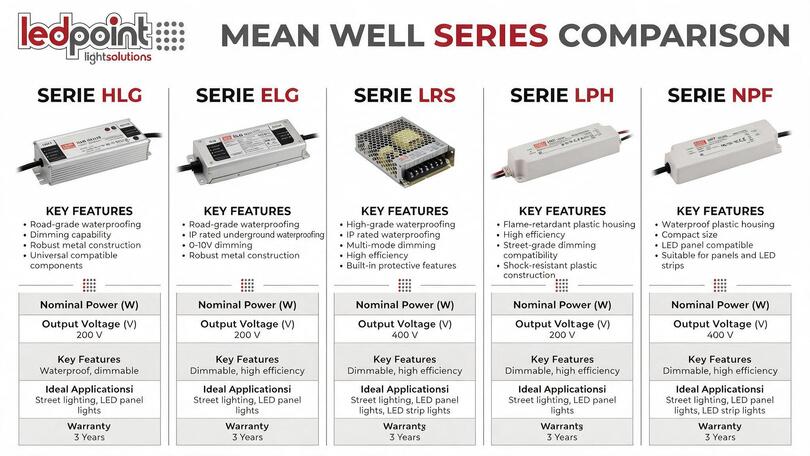
The LPH series represents the economical solution for indoor use, with IP20 rating and natural convection cooling. These power supplies are widely used in electrical panels, machine automation, and optical benches, where the environment is controlled and dry. Their use should instead be excluded in the presence of environments with large temperature variations or humidity: IP20 protection does not offer any barrier against fine dust and water.
The LRS series: the panel workhorse
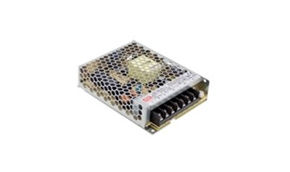
When searching for "lrs meanwell" or "lrs mean well", you are looking at the best-selling series for panel installation. The LRS series is a slim switching power supply, IP20, with an unbeatable price/performance ratio. It is perfect for DIN rail mounting via special mounting brackets, which transform a direct-mount power supply into a snap-on component. Its compactness makes it ideal in panels where space is at a premium. Like the LPH, it remains a product for dry indoor use only.
The HLG series: the most versatile for industry
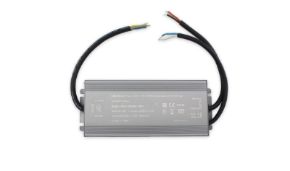
Those searching for "hlg meanwell" or "meanwell hlg" are looking for the most flexible and complete series in the catalogue. The HLG series introduces IP65/IP67 rating, double insulation, protection against mechanical overloads, and the possibility of adjustment via potentiometer or analog/PWM dimming. Its strength is the extended and adjustable voltage range (e.g., 12-24V adjustable), which makes it perfect even for retrofitting old systems. There is also the sub-family HLG-H (High power) with built-in fan for powers up to 1500W. It is the recommended choice for general industrial applications, both indoor and outdoor.
The ELG series: designed for street and outdoor lighting
The ELG series (mean well elg / meanwell elg) has been optimized for outdoor street and industrial lighting, with additional protection against transients (6kV) and greater EMC robustness. Its more robust EMI front-end reduces conducted emissions by about 15% compared to the HLG series, thanks to more aggressive common-mode filters. It is the prevailing choice for municipalities in public lighting and for all installations where electromagnetic compatibility is a strict requirement.
The NPF series: compact projectors
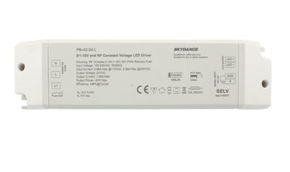
Finally, the NPF series is dedicated to compact LED projectors with an extremely slim profile (thickness below 30mm, typically 25mm) and IP67 rating. Its reduced geometry makes it ideal for recessed luminaires and compact designs, where every millimeter counts.
Table 1 — Comparison of the main Mean Well power supply families for industry and professional lighting
| Technical parameter | LPH Series | LRS Series | HLG (-H) Series | ELG Series | NPF Series |
| Protection rating | IP20 | IP20 | IP65/IP67 | IP67 | IP67 |
| Rated power | 35W - 350W | 35W - 350W | 40W - 600W (1500W with fan) | 75W - 300W | 20W - 100W |
| Output voltage | 12/24/36/48V | 12/24/36/48V | 12→54V (12,15,20,24,30,36,42,48,54) | 12/24/36/48/54V | 12/24/36/48V |
| Integrated Dimming | No | No | Yes (1-10V, PWM, resistance) | Yes (1-10V, PWM, optional DALI) | Yes (PWM, DALI) |
| MTBF @ 25°C | 200,000 h | ~230,000 h | 311,700 h | 296,000 h | 250,000 h |
| IN/OUT Isolation | 3kVAC | 3kVAC | 3.75kVAC | 4kVAC | 3.75kVAC |
| Operating temperature | -20 ~ +70°C | -25 ~ +70°C | -40 ~ +70°C (derating) | -40 ~ +70°C | -40 ~ +70°C |
| Certifications | CB, CE, UL, BSMI | CB, CE, UL, TÜV | UL/CUL, ENEC, CE, CCC, PSE, RCM | UL/CUL, ENEC, CE, CCC, RCM | UL, CE, ENEC, CCC |
How to choose the right series in 3 questions
Faced with dozens of series, the risk is analysis paralysis. In reality, three questions are enough to narrow the field in the vast majority of cases. First question: is the installation indoor or outdoor? If indoor and dry, LRS or LPH (IP20); if outdoor, humid, or dusty, HLG, ELG, or NPF (IP67). Second question: is intensity regulation needed? If yes, dimmable HLG or ELG; if no, LRS. Third question: does the load have an onboard driver or not? If yes, constant voltage power supply; if no, constant current. With these three answers, one almost always arrives at the correct family, leaving the final choice of power and voltage as the only remaining step. This decision-making approach is the same we use in our daily technical support and drastically reduces selection errors.
It is worth emphasizing that there is no "best" series in absolute terms: there is the right series for a given scenario. An HLG mounted in a dry indoor panel would be a waste of money, just as an LRS installed outdoors would be a guaranteed failure. The expertise lies precisely in correctly matching the family to the context, and that is why specialized technical consultation saves more than it costs.
Other Mean Well abbreviations you may encounter
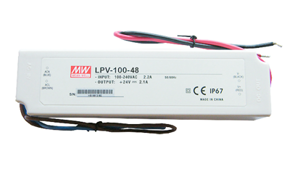
In addition to the main series, the Mean Well catalogue includes families that often appear in technical searches: LPV (meanwell lpv / mean well lpv), economical plastic IP67 power supplies for wet indoor use; LPC (lpc meanwell / mean well lpc), the constant current version of the LPV for power LEDs; APV and APC (meanwell apv / mean well apc), compact for low power; XLG (xlg meanwell / meanwell xlg), constant power and highly flexible; NDR, DRP, SDR, EDR for DIN rail in automation; and the already mentioned RSP, PSP, SE, RST, HRP for high power and current sharing. Knowing these abbreviations helps to quickly decode a quote or a datasheet.
4. Mean Well power supplies for outdoor use: selection based on IP, surges, and thermal cycling
When the installation is outdoors, the discriminating parameters change radically: it is no longer just about power, but the enclosure's ability to keep water and dust out and to withstand the voltage spikes typical of external networks. A miscalculation here does not result in a performance drop, but in the premature death of the power supply. Let's look at the decisive criteria.
IP67 versus IP20: what EN 60529 says
EN 60529 classifies IP67 as total protection against dust and temporary immersion (1 meter for 30 minutes). Conversely, IP20 only protects against solid objects larger than 12 mm and offers no protection against water. This difference is why an IP20 power supply installed outdoors is destined to fail at the first rain or condensation. The IP rating consists of two digits: the first indicates protection against solids (0-6), the second against liquids (0-9). For outdoor use, the minimum acceptable is IP65, but for wet or dusty areas, IP67 is the reference standard.
Resistance to salt mist and aggressive environments
Our climatic chamber tests have shown that the HLG and ELG series maintain full operation after 500 hours of salt mist. For this reason, for applications near the sea or in tunnels subject to condensation, we recommend models like the ELG-150-24 with additional 6kV protection. In chemically aggressive environments or with extremely high humidity, models with conformal coating (suffix "D2") offer an additional barrier against circuit corrosion.
Extreme thermal excursion and cold start
In contexts with extreme thermal excursion (e.g., alpine shelters or desert installations), the HLG series with -40°C start-up is the safest choice. It is important to note that models with suffix "A" integrate dimming and ±10% output adjustment, a valuable function to compensate for drops on long lines. The ability to cold start without damaging the capacitors is what distinguishes an industrial power supply from a consumer one.
5. How to calculate power supply wattage (step-by-step method)
We have already discussed in other articles how it is necessary to calculate the power needed to supply a system, but it is always important to refresh this concept to avoid irreparable damage. Correct load determination accounts for about 70% of long-term reliability of a system: an undersized power supply always works at its limit, heats up, and its capacitors age quickly. Here is the method we use in detailed design.
The sizing formula
The generally adopted formula is:
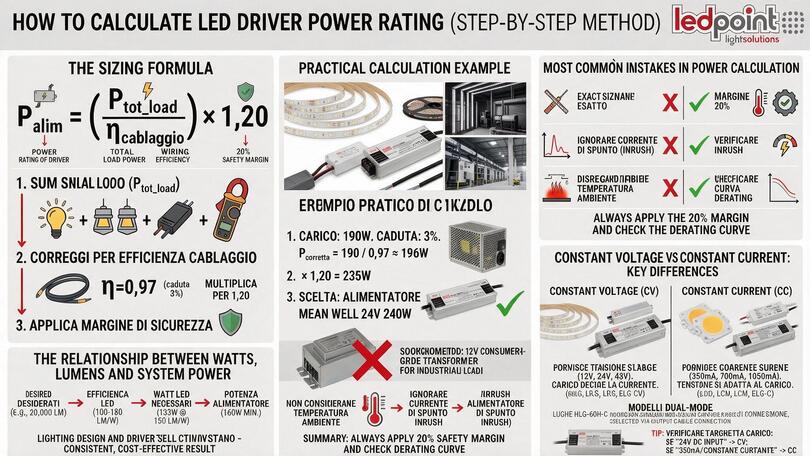
P_supply = (P_total_load / η_cabling) × 1.20
Where the factor 1.20 represents the 20% safety margin to avoid continuous operation at the limit, while η_cabling takes into account the voltage drop on the conductors. The procedure involves three steps:
- Sum the load power (P_total_load), reading it from the labels of the lighting fixtures or measuring the actual absorption with a clamp meter, including the inrush current value.
- Correct for cabling efficiency, dividing by the efficiency: with a 3% drop, the efficiency is 0.97.
- Apply the 20% safety margin, multiplying by 1.20 and choosing the next larger commercial size.
Practical calculation example
Let's take a real case: a 190W load on a line with a 3% drop. The calculation proceeds as follows: P_corrected = 190 / 0.97 ≈ 196W; multiplied by 1.20 = 235W. Therefore, select a Mean Well 24V 240W power supply, which is the closest standard size in excess. We absolutely advise against using consumer-derived 12V transformers for continuous industrial loads: the ripple parameters and load regulation are not remotely comparable to those of a Mean Well power supply.
The most common mistakes in power calculation
Incorrect sizing is one of the primary causes of failure. The most common mistake is sizing the power supply exactly to the nominal load power, without margin: in this way, the power supply constantly works at 100%, heats up, and the capacitors degrade quickly. A second frequent error is ignoring the inrush current, which at startup can be many times higher than the nominal current and trigger protection on an undersized power supply. A third error is not considering the ambient temperature: a power supply installed in a closed, hot panel should be chosen considering derating, therefore with a higher size compared to a ventilated installation. Always applying the 20% margin and checking the derating curve are the two habits that, by themselves, prevent most premature failures.
The relationship between watts, lumens, and system power
Many designers start from the desired lumens and need to derive the watts and therefore the power supply power. The luminous efficiency (lm/W) of a modern LED source typically varies between 100 and 180 lm/W: knowing this data allows estimating the watts needed to achieve the desired illuminance and, consequently, correctly sizing the power supply. For example, to obtain 20,000 lumens with a strip of 150 lm/W, about 133W of LEDs are needed, which with the 20% margin requires a power supply of at least 160W. Thinking in these terms links the lighting design to the choice of power supply in a coherent way, avoiding both unnecessarily expensive oversizing and dangerous undersizing.
6. Constant voltage or constant current: substantial differences
When faced with the choice of power supply, one of the most frequently asked questions is: "Should I get a fixed voltage or constant current one?". Let's try to clarify, because it's not just about technical specifications, but about understanding what is on the other end of the cable. Getting this choice wrong means, at best, a system that doesn't turn on; at worst, burned LEDs.
Constant Voltage (CV)
If you are powering an LED strip, a panel, or a fixture that already has its internal electronic components — or in any case an input designed to receive a stable voltage — then you need a constant voltage power supply, also called CV. This works like an electrical outlet: it always provides 12V, 24V, or 48V and it will be the load that decides how much current to draw. This is the most common case, and here the HLG, LRS, and ELG series in CV version come into play.
Constant Current (CC)
It is necessary to remember that there are LED modules, power arrays, or single chips that do not have an onboard driver. In that case, you need to provide constant current and not constant voltage. Here you use CC (Constant Current) power supplies like the LDD, LCM, or ELG in the -C version. These do not provide fixed 24V but rather 350mA, 700mA, or 1050mA, and the voltage automatically adapts to the load requirements. It is a more direct approach and is essential when driving power LEDs without intermediaries.
Dual-mode models
To make things easier, Mean Well has created some models such as the HLG-60H-C, which have a dual-mode function: they can work in either voltage or current. You just need to be careful about what is connected and configure them accordingly. The practical advice is always the same: first check the load by looking at the label of the strip, the datasheet of the fixture, or asking the manufacturer. If "24V DC input" is indicated, it means constant voltage is needed; if "350mA" or "constant current" is reported, a CC power supply is required.
7. PWM, 1-10V, and DALI dimming in Mean Well power supplies
Light intensity regulation (dimming) is now a required function in most projects, both for visual comfort and energy savings. Mean Well has implemented various dimming methods over the years, each with advantages and limitations. Understanding which system to choose and how to connect it correctly avoids most of the problems installers encounter in the field.
The three dimming modes
Mean Well has implemented three distinct dimming modes:
- 1-10V analog: a voltage signal regulates the intensity;
- PWM (10V signal): pulse width modulation;
- adjustment via variable resistor (potentiometer).
The HLG (suffixes B and AB) and ELG models support all three methods. During our tests, we verified full compatibility with DALI controllers of numerous brands, as long as an active DALI/1-10V converter is used. There are also ELG and NPF models with integrated DALI interface, which completely eliminate the need for an external converter.
PWM frequency and flicker-free for video recording
Mean Well's PWM dimming typically operates at frequencies between 300Hz and 1kHz. For video recording applications, where absence of flicker is essential, we recommend setting the frequency to values above 1kHz or using the new HLG models with "flicker-free" function. The connection requires correct polarity: failure to operate in dimming is very often due to the inversion of the DIM+ and DIM- signals, a trivial but very frequent mistake.
What "dimmable power supply" means
Since "dimmable meaning" is one of the most common searches, let's clarify the concept: a dimmable power supply is a model that allows regulating the luminous intensity of the load via an external control signal (a potentiometer, a 1-10V signal, a PWM command, or a DALI bus). Not all power supplies are dimmable: a basic model always provides the same power. To achieve regulation, both a suitable power supply and a compatible control device are needed. Also pay attention to the potentiometer value: many HLGs require 100kΩ, not 10kΩ, and with the wrong value the regulation curve is distorted or does not start from zero.
Which dimming system to choose for your project
The choice of dimming system depends on the complexity of the system and the desired level of control. The potentiometer is the simplest and most economical solution, suitable for single lighting points or small manually regulated zones. The 1-10V analog signal is the standard for medium-complexity systems, with dedicated control units. PWM offers finer control, particularly suitable when a linear, step-free regulation is needed. DALI, finally, is the preferred choice for professional systems and building automation: it allows addressable control of each individual fixture, scenario creation, scheduling, and diagnostics. As complexity increases, flexibility and cost also increase: the rule is to size the control system according to the real needs of the project, without oversizing or limiting yourself.
Common dimming problems and how to solve them
In the field, dimming problems almost always have recurring and easily diagnosable causes. If the light does not regulate at all, the first suspicion is the reversal of the DIM+ and DIM- wires. If the regulation is "stepped" or does not start from zero, the problem is typically the wrong potentiometer value or incompatibility between the control signal and the power supply input. If noticeable flicker appears, the PWM frequency needs to be raised above 1kHz or switch to a flicker-free model. If dimming works but the minimum is too high (the light does not dim enough), the power supply's regulation limit is probably being reached, which typically goes down to 10% and not 0% absolute. Knowing these patterns allows solving in a few minutes problems that would otherwise take hours of diagnosis.
8. Mean Well certifications for industrial use: the regulatory framework
Certifications are not bureaucracy: they are the guarantee that a power supply has been tested by independent bodies and can be legally installed in critical contexts. In tenders and supplies for public infrastructure, the lack of a certification can exclude a product regardless of its performance. Let's see which marks really count.
The main certification marks
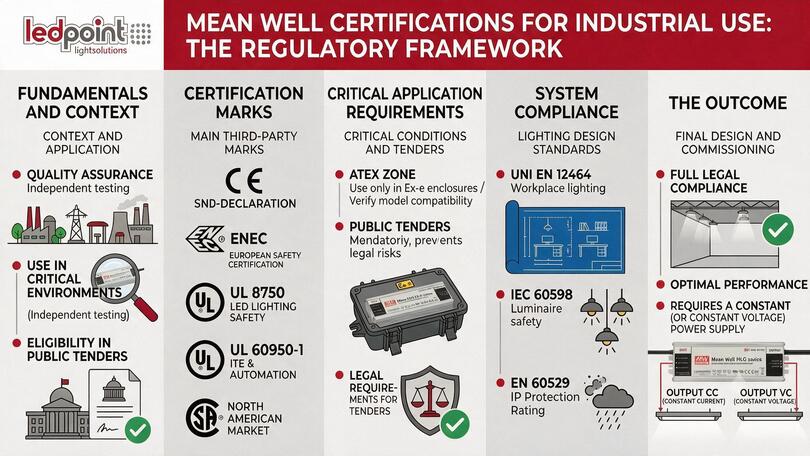
In addition to the CE marking (which is a self-declaration by the manufacturer), Mean Well power supplies intended for heavy industry and critical infrastructure have third-party product certifications. In particular:
- ENEC: European safety mark based on harmonized standards, widely required in lighting;
- UL 8750: safety of LED lighting equipment;
- UL 60950-1: information technology equipment, often required in automation;
- CAN/CSA-C22.2: for the North American market.
Use in ATEX areas
For use in ATEX areas (potentially explosive atmospheres), Mean Well does not provide intrinsically safe certified versions, but it is possible to house the HLG in Ex-e enclosures. The datasheets indicate the UL and ENEC recognition numbers; we recommend verifying them with accredited bodies during detailed design, because the validity of a certification also depends on the specific model and the date of issue.
Why certifications are decisive in tenders
In public tenders and supplies for large clients, certifications are not a simple "plus" but often an admissibility requirement. A power supply lacking the required certification is excluded a priori, regardless of its performance or price. This is because the public administration and large companies must protect themselves from legal liability: a system that causes a fire or an accident due to a non-certified component exposes the designer and installer to serious consequences. The presence of marks such as ENEC and UL is therefore the documentary guarantee that the product has been tested according to recognized international standards. Mean Well, covering a very wide range of certifications on all its main series, is for this reason particularly appreciated by those working on public and infrastructure contracts.
The reference regulations of the lighting sector
In addition to product certifications, professional lighting design relies on a body of regulations that the designer must know. UNI EN 12464 defines the lighting requirements for workplaces (indoor and outdoor), establishing the illumination levels, uniformity, and glare control required for each type of environment. IEC 60598 regulates the safety of lighting fixtures, while the aforementioned EN 60529 governs IP protection ratings. A system designed in compliance with these standards, powered by certified Mean Well drivers, offers not only optimal performance but also full legal conformity, an increasingly required element during testing.
9. Connection to LED strips, series and parallel: the constraints
The way a power supply is connected to the load is as important as the choice of the power supply itself. Incorrect wiring nullifies the advantages of a quality product and generates failures that are difficult to diagnose. In this section, we address the golden rules of connection, voltage drops, and constraints on series and parallel connections.
Connection to LED strips and voltage drops
A systematic error concerns the type of connection. Constant voltage (CV) power supplies like LRS, HLG, and ELG deliver stabilized voltage. For LED strips longer than 5 meters, the star architecture (in parallel) is mandatory. The conductors must be sized to have a drop of less than 4%. It is necessary to use a 24V power supply with a 1.5mm² cable section up to 10m with an 8A load, while beyond that a 2.5mm² section is needed. The output terminals of HLG accept up to 4mm². For powers above 300W, it is better to distribute the load over multiple Mean Well 24V power supplies in separate areas.
Parallel connection: only with current sharing
It is possible to connect two or more Mean Well power supplies in parallel to increase the total current, but only for models with current sharing function such as the RSP, PSP, and SE series. The HLG, LRS, and ELG series are not designed for direct parallel connection: the slight voltage difference between two units causes current imbalances. In redundancy cases, external ORing modules are used (for example, the Mean Well DRDN20) which isolate the failed power supply.
Series connection: not recommended
Series connection (e.g., 24V+24V=48V) is not recommended and can compromise insulation. It can only be considered in exceptional cases and only with models equipped with floating output (HLG, ELG) and with the addition of blocking diodes, but this way the integrated protections are lost. In practice, if a higher voltage is needed, it is almost always better to directly choose a power supply with the correct output voltage.
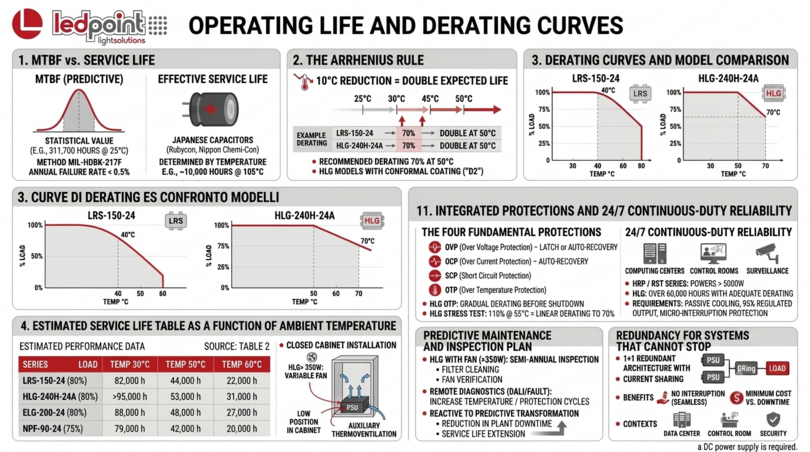
10. Operating life and derating curves
The life of a power supply is perhaps the most misunderstood parameter. Many only look at the declared MTBF value, but the actual life in the field depends almost entirely on the operating temperature. Understanding the relationship between heat and longevity allows designing systems that last decades instead of years.
MTBF: what it really says
Mean Well has published MTBF (Mean Time Between Failures) values calculated according to the MIL-HDBK-217F predictive method. For the HLG-240H-24, the MTBF stands at 311,700 hours at 25°C and 80% load. This means that, under ideal conditions, the annual failure rate is less than 0.5%. Be careful though: MTBF is a statistical value, not the useful life of the individual power supply. The actual useful life is determined by the electrolytic capacitors, for which Mean Well uses high-quality Japanese components (Rubycon, Nippon Chemi-Con) with a nominal life of around 10,000 hours at 105°C.
The Arrhenius rule and thermal derating
Applying the Arrhenius rule, every 10°C reduction doubles the expected life of the capacitors. For this reason, in environments at 50°C, 70% derating is recommended and, where possible, the adoption of HLG models with conformal coating (suffix "D2"). A Mean Well HLG-240H power supply delivers 100% power up to 50°C, then transitions to linear derating up to 70% at 70°C; for comparison, an LRS-100-24 begins derating already at 40°C.
Table 2 — Estimated useful life as a function of ambient temperature
| Series | Load | Temp 30°C | Temp 50°C | Temp 60°C |
| LRS-150-24 | 80% | 82,000 h | 44,000 h | 22,000 h |
| HLG-240H-24A | 80% | >95,000 h | 53,000 h | 31,000 h |
| ELG-200-24 | 80% | 88,000 h | 48,000 h | 27,000 h |
| NPF-90-24 | 75% | 79,000 h | 42,000 h | 20,000 h |
Thermal management and external heatsinks
The use of additional heatsinks is almost never required, since the metal case of HLG and LRS itself acts as a heatsink. However, in applications with ambient temperature close to the limit (65°C) and constant load at 100%, it is industrial practice to mount an additional aluminum plate thermally coupled, being careful not to obstruct the convective path. For HLG with power above 350W, Mean Well adopts variable speed fans: in these cases, we suggest a predictive maintenance plan with semi-annual inspections and cleaning of filters where present. In closed panels, the rule is to place the power supply in the lower part of the panel and, if necessary, use auxiliary forced ventilation.
11. Integrated protections and reliability in 24/7 continuous operation
Integrated protections are what allow a power supply to survive unforeseen events: a short circuit, a load peak, an overheating. In industrial systems that cannot stop, these functions make the difference between an automatically managed event and a plant shutdown with cascading damage.
The four fundamental protections
All Mean Well power supplies integrate four key protections:
- OVP (Over Voltage Protection) – overvoltage protection, usually latching or auto-recovery;
- OCP (Over Current Protection) – overcurrent protection with automatic recovery;
- SCP (Short Circuit Protection) – short circuit protection;
- OTP (Over Temperature Protection) – overtemperature protection.
In HLG and ELG models, OTP intervenes with a gradual power reduction (thermal derating) before shutdown. We stressed an HLG-600H with 110% load at 55°C: the power supply gradually reduced the current to 70%, maintaining integrity without shutting down. These characteristics are fundamental when creating a 24-hour active installation.
Reliability in continuous operation
Continuous cycle industrial applications (data centers, control rooms, surveillance systems) require power supplies with components selected for longevity. Mean Well has developed the RST and HRP series (powers up to 5000W) for these sectors, but even the HLG, if properly derated, guarantee over 60,000 hours of continuous life. The important thing is to maintain effective passive cooling, an output voltage regulated to 95% of nominal, and protection against possible mains micro-interruptions.
Predictive maintenance and inspection plan
Even the best power supply benefits from planned maintenance, especially in critical systems. For HLG models with fan (powers above 350W) we recommend semi-annual inspections to check filter cleanliness and proper fan operation, whose wear is often the first sign of degradation. For power supplies equipped with fault signaling or DALI interface, remote diagnostics allow anticipating problems: an abnormal increase in internal temperature or the number of protection cycles is an indicator that something is changing. Integrating this data into a SCADA system transforms maintenance from reactive (intervention after failure) to predictive (intervention before), reducing plant downtime and extending the overall useful life of the installation.
Redundancy for systems that cannot stop
In contexts like data centers, operating rooms, and security systems, power interruption is not an option. The 1+1 redundant configuration, achieved with models featuring current sharing and ORing modules, ensures that the failure of a single power supply does not stop the system: the healthy unit takes over instantaneously without interruption. This type of architecture, combined with UPS-protected power upstream, represents the state of the art for reliability. The additional cost of redundancy is minimal compared to the economic damage of a downtime in a critical environment, where every minute of inactivity can be worth considerable sums.
12. How to read the Mean Well datasheet: critical parameters
A Mean Well datasheet contains dozens of parameters, and for a non-expert it can be intimidating. In reality, to make a correct choice, it is enough to know where to look. Reading the datasheet well is what allows anticipating problems instead of discovering them on site.
The parameters to focus on
For an effective reading, it is sufficient to focus on these points:
- CV/CC zone (for dual-mode models);
- Derating curve vs temperature;
- Efficiency at different loads;
- Ripple & noise (typically less than 1% for good power supplies);
- Isolation voltage (kVAC between input and output);
- Expected pollution degree;
- Overvoltage category (OVC II or OVC III).
For applications with sensitive loads, the parameters "start-up time" and "hold-up time" are also relevant: in the case of Mean Well, the hold-up time is generally longer than 6ms, a value that guarantees continuity even in the presence of mains micro-interruptions.
13. Accessories for industrial installations: when the power supply alone is not enough
Those working in the industrial sector know that the power supply is the heart of the system, but that accessories are often needed that are too frequently underestimated during the design phase. Overlooking them means exposing the system to failures, electromagnetic disturbances, and avoidable maintenance interventions. Let's look at the most important ones.
Redundancy modules
In critical environments that can never stop – security systems, operating rooms, data centers, continuous production lines – there are models that allow connecting two power supplies in a 1+1 redundant configuration. If one fails, the other takes over without causing any interruption.
EMC filters
A switching power supply generates high-frequency noise that can disturb nearby sensitive equipment (sensors, data acquisition boards, audio systems). In industrial environments with motors, inverters, and welders, the noise is already high. Adding an external mains filter cleans the power supply and avoids intermittent behaviors that are difficult to diagnose. These filters are particularly recommended when the power supply is close to measurement instrumentation or when the system must pass severe electromagnetic compatibility tests.
Waterproof connectors and DIN plates
IP67 power supplies, such as HLG and ELG, already have cables wired with 0.75mm² or 1mm² section. However, on site it may be necessary to connect them to larger cables. Using original Mean Well connectors avoids cutting the cable and having to apply heat-shrink tubing, an operation always risky in humid or dusty environments. For the LRS series intended for panels, there are DIN rail mounting plates that transform a direct-mount power supply into a snap-on component.
Dimming resistors and thermal enclosures
Dimming resistors allow managing power supplies with dimming left at maximum, stabilizing the current input. Thermal enclosures and auxiliary heatsinks are aftermarket accessories that isolate power supplies from very high temperatures, such as those in a foundry.
14. Mean Well and Industry 4.0: remote control and diagnostics
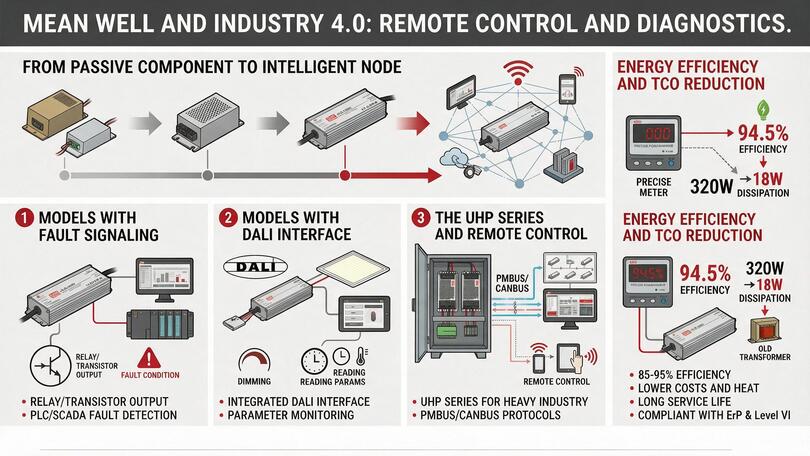
Industry is no longer what it was twenty years ago. Today, a power supply must not only provide energy: it must communicate with the supervision system, signal faults, and warn before shutdown. Mean Well has taken up this challenge with various technological strategies that transform a passive component into an intelligent node of the system.
Models with fault signaling
The first innovation is the introduction of models with fault signaling. On some HLG and ELG, a relay output or a transistor contact is available that switches when the power supply enters protection or shuts down. This is valuable information for a PLC or a SCADA system: it allows immediately noticing if a section of the system is out of service, without having to send a technician to physically check.
Models with integrated DALI interface
Then there are models with integrated DALI interface. In these cases, an external converter is no longer needed: the power supply speaks directly the language of building automation systems. Some of these allow not only dimming but also reading operational parameters: operating hours, internal temperature, number of startups.
The UHP series and remote control
Among Mean Well power supplies, we also find the UHP series, designed for heavy industry, which integrates remote control functions via PMBus or CANbus protocol. In a single cabinet, it is possible to monitor dozens of power supplies, adjust them remotely, and receive alarm signals in real time.
15. Energy efficiency and TCO reduction
In a context of high energy costs and increasingly stringent regulations, the efficiency of a power supply is no longer a technical detail but a budget item. An efficient power supply consumes less, heats less, lasts longer, and reduces the total cost of ownership of the system. Let's see the concrete numbers.
Efficiency measurements and classifications
The efficiency of a Mean Well switching power supply is between 85% and 95% depending on the model and load, and is measured with a precision wattmeter. The HLG-320H-24 reaches 94.5% at 230Vac with 80% load: this means only 18W dissipated for 320W delivered. Compared to a traditional transformer (70-80% efficiency), the energy savings are considerable and directly contribute to TCO reduction. Furthermore, many models meet ErP Stage 2 and Level VI requirements, the European and US standards on energy efficiency of external power supplies.
16. The 5 mistakes to avoid (even with Mean Well power supplies)
After years of technical assistance and interfacing with many installers and electricians, we have compiled a list of recurring mistakes. They are mistakes that may seem trivial but can waste hours of work, burn expensive products, and undermine the reputation of those who build the system. Knowing them in advance is the best way not to make them.
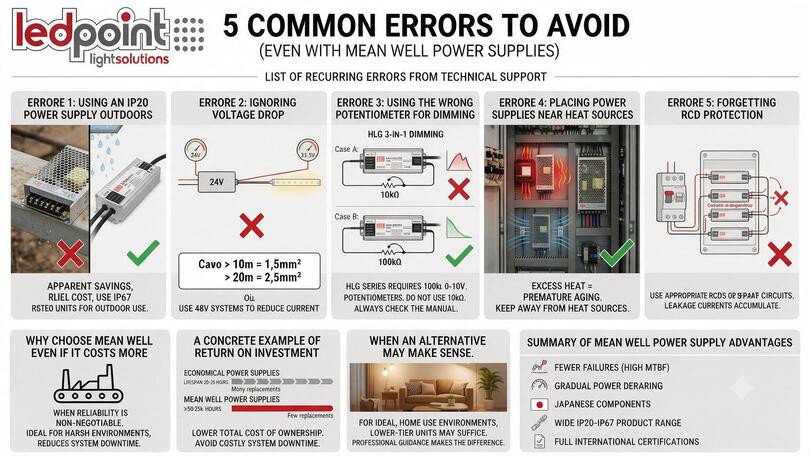
Mistake 1: IP20 power supply installed outdoors
The construction site is dusty, humid, and chaotic. The electrician mounts an LRS on a beam waiting for the final panel. It rains, some water gets in, the power supply dies. In this case, an IP67 power supply should have been installed from the start. Saving 20 euros turns into 100 euros of burned product plus hours of labor.
Mistake 2: not considering voltage drop
24V LED strip, 100W, 25-meter cable with 0.75mm² section. At the end, the voltage is 21.5V, the strips appear more yellow, and someone blames the LEDs for being poor quality. In reality, it is the fault of the cable sizing. The rule: for lengths over 10m, use 1.5mm² cable; over 20m, use 2.5mm² or more. To cover long distances, increase the voltage (48V instead of 24V) to halve the current and reduce the drop.
Mistake 3: dimming with the wrong potentiometer
The customer buys an HLG with dimming and a 10kΩ potentiometer, connects them, and the dimming does not work or is unstable. This happens because many Mean Well models require a 100kΩ potentiometer, or work better with an active 1-10V signal. With the wrong value, the regulation curve is distorted or does not start from zero. The solution is to always read the power supply manual to identify the correct potentiometer.
Mistake 4: power supply too close to heat sources
In an electrical panel, the power supply is mounted above a rectifier or near a contactor that heats up. The internal temperature rises, the capacitors age prematurely, and after two years the power supply dies. Just 10 cm more space and some air circulation would have been enough to cool it and extend its life.
Mistake 5: forgetting differential protection
Switching power supplies have EMI filters that cause leakage currents to ground. If multiple power supplies are connected to the same differential, it trips apparently without reason. It is not a real fault, but the sum of the leakages: it is solved by using 300mA differentials or separating the circuits.
17. Why choose Mean Well when it costs a little more
The catalogue contains many power supplies of different brands, all of quality and always tested before being selected. Yet, in certain contexts, Mean Well power supplies remain our first recommendation. It is worth explaining why, without wanting to take anything away from other products.
Mean Well products have a slightly higher cost, but in difficult environments – high temperatures, difficult access, systems where even providing assistance becomes complicated – they amply repay the price differential. The calculation should be made on the cost of installation, maintenance, and above all system downtime, which in a production line or a critical infrastructure can be worth thousands of euros per hour. They are power supplies designed and born to withstand extreme conditions over time, such as in large industrial plants: that is why, when reliability is non-negotiable, they are the choice we recommend first.
A concrete example of return on investment
Let's do a realistic calculation to understand the economic value of the choice. Suppose an industrial plant with 50 lighting points, each powered by a driver. With economical, short-life power supplies, in a hot environment (50°C) the useful life might settle around 20,000-25,000 hours; with correctly derated Mean Well power supplies, the same installation exceeds 50,000 hours. This means, over a ten-year period, potentially halving the number of replacements. If each replacement, between product and labor (often at height or in hard-to-reach areas), costs a significant amount, the overall savings far exceed the higher initial cost. To this must be added the value of avoided downtime, which in production contexts is the heaviest item of all. The "savings" of an economical power supply, in these scenarios, is almost always an accounting illusion.
When an alternative can make sense
For technical honesty, it must be said that Mean Well is not the only valid answer in absolute terms. In domestic applications, in air-conditioned and dry environments, with modest loads and easy access for maintenance, even well-selected lower-tier power supplies can perform their task excellently. In the Ledpoint catalogue, we offer several brands, all tested before selection, precisely because the right product depends on the context. The difference is made by consultancy: understanding when the environment and the criticality of the system justify the investment in Mean Well and when instead a more economical alternative is perfectly adequate. This honest approach oriented to the client's real interest is what distinguishes a technical supplier from a simple seller.
Summary of Mean Well power supply advantages
| Advantage | Practical benefit for the system |
| High MTBF (up to 311,700 h) | Fewer failures, fewer maintenance interventions |
| Gradual thermal derating | The power supply reduces power instead of shutting down abruptly |
| Selected Japanese components | Greater actual life of capacitors, the heart of useful life |
| Comprehensive range (IP20-IP67, 12-48V) | A series optimized for every application scenario |
| Complete certifications (ENEC, UL, CB) | Admissibility in tenders and guaranteed legal conformity |
| Dimming and diagnostics (DALI, PMBus) | Integration in building automation and Industry 4.0 systems |
| Efficiency up to 94.5% | Less dissipated energy, less heat, reduced TCO |
18. Real-world applications: case studies and usage scenarios for Mean Well power supplies
Theory is essential, but it is in the field that a power supply proves its value. In this section, we collect the most frequent application scenarios where Mean Well power supplies make a difference, with the technical choices we recommend for each. Each context has specific constraints – temperature, humidity, continuity of service, dimming requirements – and the right series changes accordingly. These examples will help you recognize your case and quickly orient yourself towards the most suitable family.
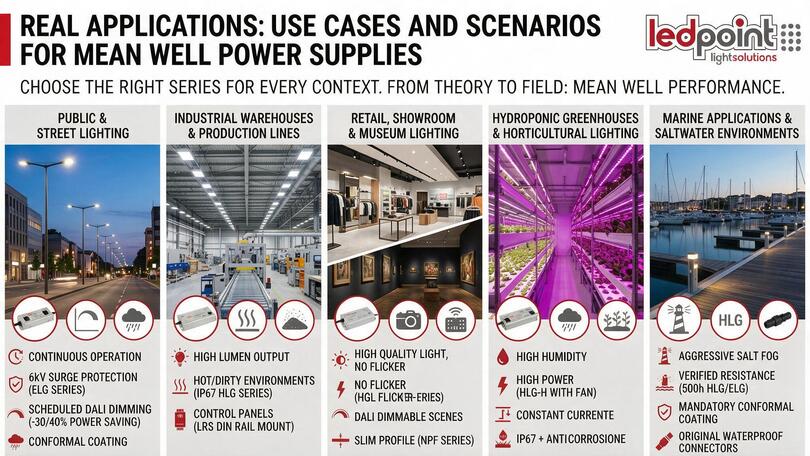
Public and street lighting
Public lighting is perhaps the most demanding scenario from a continuity perspective: a streetlight out is a safety issue, not just a service disruption. Here the ELG series is the prevalent choice for municipalities, thanks to 6kV transient protection that defends the power supply from voltage spikes typical of overhead networks, often subject to lightning strikes and load switching. An LED street lighting system with ELG drivers, correctly derated and dimmed at night via DALI profile, can easily exceed 50,000 hours of operation with minimal maintenance. Programmed dimming during the central hours of the night reduces consumption by as much as 30-40%, a figure that weighs heavily on a municipality's energy budget. In these applications, we always recommend models with conformal coating to resist nighttime condensation and seasonal thermal shocks.
Production lines and industrial warehouses
In industrial warehouses and on production lines, lighting must guarantee high and constant illumination levels, often over 24-hour shifts. Here the choice typically falls on the HLG series for high-bay suspended installations (LED high bays), where the required power is high and the environment can be hot. In the presence of dust or vapors, the IP67 rating of the HLG is an essential requirement. For control panels and machine automation, on the other hand, the LRS series on DIN rail remains the standard: compact, economical, and easy to maintain. A frequent error in these contexts is positioning the power supply too high in the panel, where heat accumulates: as seen in the derating section, every 10°C increase halves the useful life.
Retail, showrooms, and museum lighting
In retail and museum installations, light quality, absence of flicker, and the ability to adjust lighting scenes matter. For video shoots and photographed displays, flicker is the number one enemy: here we recommend flicker-free HLG models or dimming at frequencies above 1kHz. DALI compatibility allows integrating lighting into the showroom's building automation systems, creating programmable scenes for opening hours, events, and seasonal setups. The NPF series, with its slim profile, is ideal when the power supply must be hidden behind false ceilings or inside recessed luminaires.
Hydroponic greenhouses and horticultural lighting
Indoor cultivation lighting (horticultural) is a rapidly growing sector and particularly demanding for power supplies: high humidity, continuous light/dark cycles, and significant powers. The high-power HLG-H series, with fan and conformal coating, is the reference solution, often in constant current version to directly drive full-spectrum LED arrays. In these environments, IP67 protection and anti-corrosion coating are not a luxury but a necessity, given the constant condensation generated by irrigation and plant transpiration.
Marine applications and saline environments
In port installations, on piers, and near the sea, salt mist relentlessly attacks electronic components. As demonstrated by our tests (500 hours of salt mist resistance for HLG and ELG), these series are suitable, but the recommendation is to always favor models with conformal coating and to pay maximum attention to the quality of connections, using original waterproof connectors. A single point of moisture ingress can compromise the entire power supply.
19. Technical glossary of Mean Well power supplies
The world of power supplies is full of abbreviations, acronyms, and technical terms that can confuse even professionals. We have gathered in this glossary the essential definitions, in clear language, to help you read datasheets, quotes, and technical specifications without uncertainty. It is also a useful quick reference to consult during design.
| Term | Definition |
| Switching power supply | High-frequency switching power supply; converts 230V AC into stabilized DC voltage with 85-95% efficiency. |
| CV (Constant Voltage) | Constant voltage power supply: delivers a fixed voltage (12/24/48V) and the load draws the necessary current. |
| CC (Constant Current) | Constant current power supply: delivers a fixed current (e.g., 350/700/1050mA) and adapts the voltage to the load. |
| MTBF | Mean Time Between Failures: the average statistical time between two failures, an indicator of reliability (not of useful life). |
| Derating | Reduction of deliverable power as ambient temperature increases, to preserve component life. |
| Ripple & noise | Residual ripple on the output voltage; the lower it is (<1%), the better the power supply quality. |
| IP rating | Ingress Protection: two digits indicating protection against solids (0-6) and liquids (0-9), according to EN 60529. |
| OVP / OCP / SCP / OTP | Overvoltage, overcurrent, short circuit, and overtemperature protections integrated in Mean Well power supplies. |
| PWM | Pulse Width Modulation: dimming method that regulates intensity by varying the pulse width. |
| DALI | Digital Addressable Lighting Interface: digital protocol for lighting control and diagnostics. |
| Dimmable | Power supply that allows regulating the luminous intensity of the load via an external command signal. |
| Current sharing | Function that allows connecting multiple power supplies in parallel, evenly distributing the load (RSP, PSP, SE series). |
| Conformal coating | Protective coating of circuits against moisture and corrosion (suffix "D2" in Mean Well models). |
| Hold-up time | Time for which the power supply maintains the output after a mains interruption; in Mean Well typically >6ms. |
| Inrush current | Startup surge current, much higher than nominal; must be considered in sizing. |
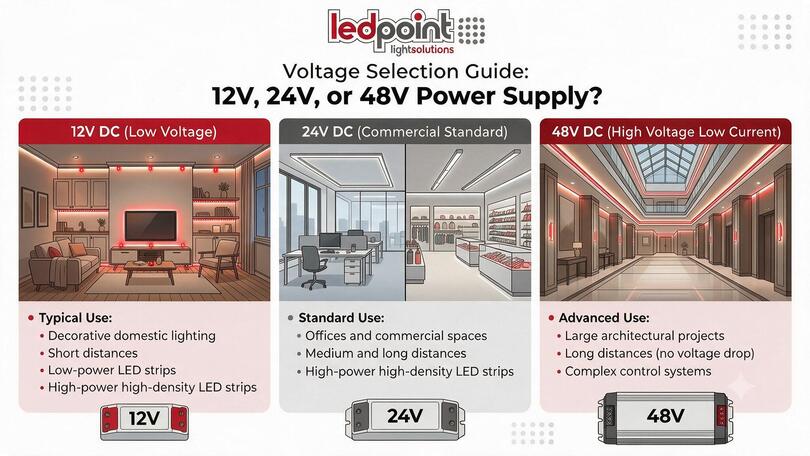
20. Selection guide by voltage: 12V, 24V or 48V power supply
One of the most recurring practical questions concerns the output voltage: is it better to use a 12V, 24V, or 48V power supply? The answer is never absolute, but depends on the length of the lines, the power, and the type of load. Choosing the wrong voltage means, in practice, excessive drops, oversized cables, or incompatibility with the load. Let's see the criteria to orient yourself with confidence.
When to choose a Mean Well 12V power supply
The 12V power supply is the historical choice for many consumer LED strips and for small-scale installations. The main limitation is voltage drop: at 12V, even small cable resistances cause significant percentage drops. For the same power, a 12V system draws twice the current compared to a 24V system, requiring larger cable sections and limiting the length of the runs. 12V makes sense for short installations (up to a few meters), for compatibility with existing equipment, or in automotive and marine applications.
Why 24V is the industrial standard
24V is now the de facto standard in professional LED lighting. It halves the current compared to 12V for the same power, reducing voltage drops and allowing longer runs with contained cable sections. The range of Mean Well 24V power supplies – available in all series and powers – is the widest by far, meaning maximum availability of sizes and models. For the vast majority of industrial and architectural projects, 24V is the default choice we recommend.
48V for long distances
When the runs become very long or the powers very high, 48V is the answer: it further halves the current compared to 24V, drastically reducing voltage drops and cable losses. It is the ideal voltage for extended lines, perimeter lighting of large buildings, and installations where savings on conductor section compensate for the cost. Mean Well 48V power supplies, such as the HLG-C models in constant current version, are increasingly in demand in architectural and horticultural lighting.
Table 3 — Practical comparison between supply voltages
| Voltage | Current for same power | Voltage drop | Recommended run length | Typical application |
| 12V | High (double compared to 24V) | High | Short (a few meters) | Small systems, marine, automotive |
| 24V | Medium | Contained | Medium (up to 15-20 m) | Industrial and architectural standard |
| 48V | Low (half compared to 24V) | Minimal | Long (extended runs) | Large buildings, horticultural, perimeter |
21. FAQ — Frequently asked questions about Mean Well power supplies
We have gathered the questions most frequently asked by designers, installers, and procurement managers. Click on each question to open the answer.
What does Mean Well mean and why is it used in industrial settings?Mean Well is a Taiwanese manufacturer of switching power supplies, often also written as "meanwell". It is the industry standard for reliability, broad range, and certifications: its series cover indoor, outdoor, dimming, and high power with MTBF up to 311,700 hours and IP20-IP67 protection. |
What is the difference between the Mean Well HLG, ELG and LRS series?The LRS series is IP20 for indoor panel mounting, cost-effective, and non-dimmable. The HLG series is IP67, dimmable, and versatile with a 12-54V range, suitable for general industry. The ELG series is IP67 with 6kV surge protection and reinforced EMC, designed for street lighting and outdoor applications. |
Which Mean Well power supply is needed for a 24V LED strip?You need a 24V Constant Voltage (CV) power supply, sized with a 20% margin over the load power. For outdoors, choose an IP67 model like HLG or ELG; for indoors, an IP20 LRS series. |
Are Mean Well power supplies dimmable and DALI compatible?Yes. HLG series with B or AB suffix and ELG support 1-10V, PWM, and resistance dimming. Some ELG and NPF models have built-in DALI, while others require an active DALI/1-10V converter. |
Can I connect two Mean Well power supplies in parallel?Only models with current sharing function, such as the RSP, PSP, and SE series. The HLG, LRS, and ELG series are not designed for direct parallel connection; for redundancy, use external ORing modules like the DRDN20. |
What is the difference between IP20 and IP67 in a power supply?IP20 protects only against solid objects larger than 12 mm and not against water, so it is for indoor use only. IP67 provides total protection against dust and temporary immersion up to 1 meter for 30 minutes: mandatory for outdoor, humid, or dusty installations. |
How long does a Mean Well power supply last?The declared MTBF reaches 311,700 hours, but actual life depends on temperature: applying the Arrhenius rule, every 10°C reduction doubles the expected life. With 70% derating, an HLG exceeds 60,000 hours of continuous 24/7 operation. |
Is it better to use a constant voltage or constant current power supply?It depends on the load. LED strips, panels, and fixtures with internal electronics require a Constant Voltage (CV) power supply. LED modules, power arrays, and individual chips without an onboard driver require a Constant Current (CC) power supply like the LDD, LCM, or ELG-C series. |
How do I calculate the power of the power supply to choose?Sum the load power, divide by the cabling efficiency, and apply a 20% margin. The formula is P_supply = (P_total_load / efficiency) x 1.20. A 190W load with a 3% drop leads to selecting a Mean Well 24V 240W power supply. |
Where can I buy original Mean Well power supplies in Italy?Ledpoint distributes in Italy the complete range of Mean Well IP67, IP20, 12V, 24V and 48V power supplies, with downloadable datasheets, warehouse availability, and dedicated technical support for design. |
Choose the right Mean Well power supply for your system now!
Choosing a Mean Well power supply means placing a reliable, certified component designed to last at the heart of the system. As we have seen in this guide, the key is not to look for "the best power supply" in absolute terms, but to match the correct series to the context: LRS and LPH for dry indoor environments, HLG and ELG for harsh and outdoor environments, NPF for compact designs, constant current versions for power LEDs without a driver. Added to this are choices on voltage (12V, 24V, or 48V), dimming (1-10V, PWM, DALI), and power sizing with the 20% safety margin.
Following these rules – and knowing the most common mistakes to avoid – is what distinguishes a reliable and durable system from one destined to cause problems. On the Ledpoint catalogue, you will find the complete range of Mean Well power supplies IP67 and IP20, in 12V, 24V, and 48V, with downloadable datasheets, warehouse availability, and the technical support of our experts for design. Whether you are lighting an industrial warehouse, a street, a showroom, or a greenhouse, the right solution is just a click away.
Explore the selection now: complete power supply catalogue · Mean Well HLG family · 24V power supplies · ELG-150-24 with DALI IP67. Have a specific project? Contact our technical office for dedicated consultation and a custom quote.
```