







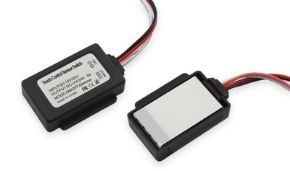
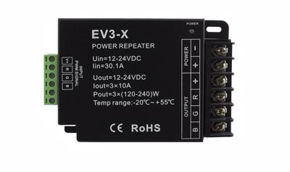
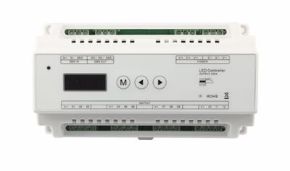
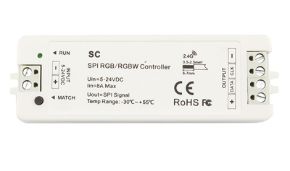
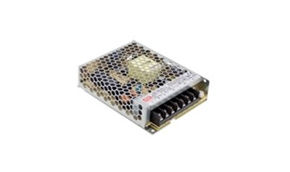
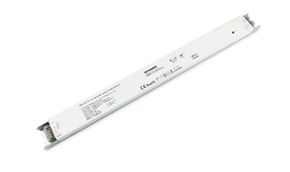
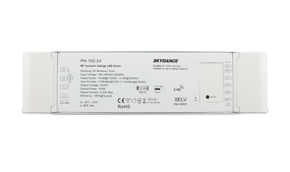
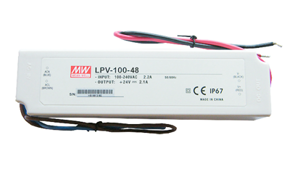
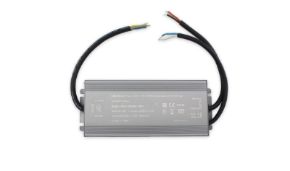
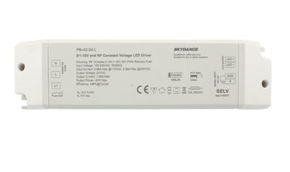
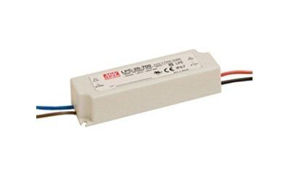
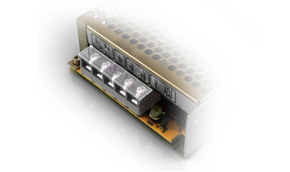

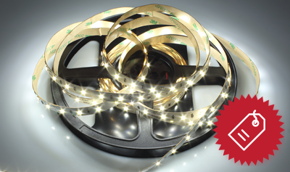

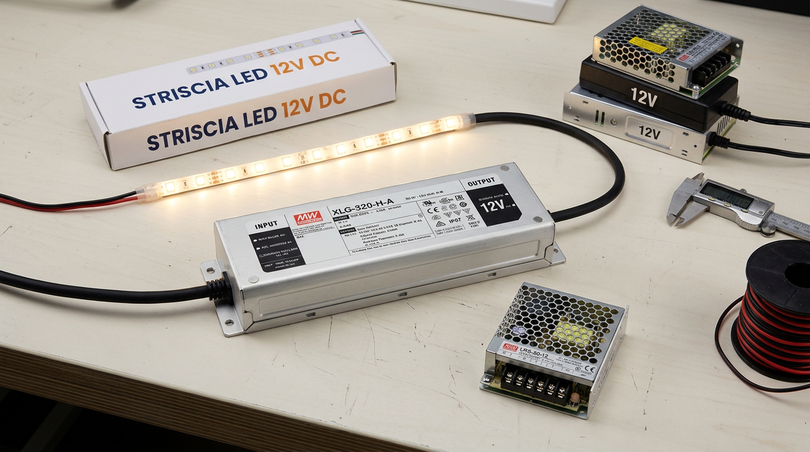
In this technical guide we will explore every relevant aspect of the 12v power supply: from basic electronic operation to the differences between various circuits, from choosing the correct sizing to mandatory safety protections, from the professional series of Mean Well and Skydance to integrated dimming techniques, from wired installation to smart solutions with WiFi control via the Tuya app.
In this article...
1. What is a 12V power supply: definitions and basic principles
Before getting into the details, it is useful to clear up a widespread terminological confusion. When talking about a 12-volt power supply, in the vast majority of practical cases in LED lighting, we are referring to an AC/DC switching power supply: an electronic device that receives 230V AC input (the European domestic voltage, standard CEI EN 50160) and provides stabilized 12V DC output. The term "transformer", often used as a synonym in common language, is actually technically imprecise: the transformer itself is a passive component that works only in alternating current (AC in, AC out, but at a different voltage), while a modern LED power supply contains not only a high-frequency transformer but also a rectifier, a filter, a regulator, and a whole series of control and protection circuits that make it an active and stabilized device. We will explore this distinction in the dedicated paragraph.
Why is the choice of a 12v power supply so crucial? Because a poorly sized power supply, of low quality or lacking proper protections can compromise the entire system in far from trivial ways: LED strips that turn off after a few hours of operation, annoying flickering visible to the naked eye or recordable on video (the infamous flicker), progressive reduction of brightness over time, cable overheating, and even fire risk in the worst cases. On the contrary, a correctly sized power supply, built according to international quality standards and installed to the rule of art guarantees an LED system that maintains its nominal performance for tens of thousands of hours, with efficient consumption and total safety for people and property.
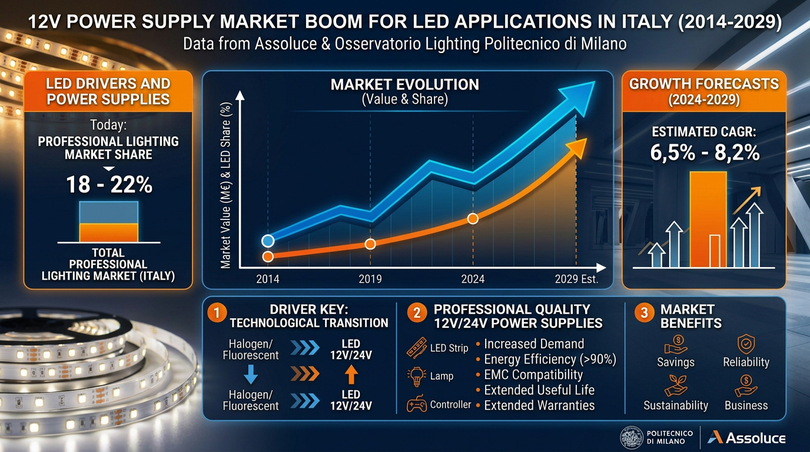
The market for 12-volt power supplies for LED applications has grown extraordinarily in the last decade. According to industry data collected by Assoluce and the Lighting Observatory of the Polytechnic University of Milan, the segment of LED drivers and power supplies today represents about 18-22% of the overall value of the professional lighting market in Italy, with a compound annual growth rate (CAGR) estimated between 6.5% and 8.2% in the five-year period 2024-2029. The transition from traditional halogen and fluorescent lighting to low-voltage LED technologies has driven up the demand for high-quality 12v and 24V power supplies, with growing attention to issues such as energy efficiency (modern switching units easily exceed 90% efficiency, compared to 60-70% for old toroidal transformers), electromagnetic compatibility (EMC), declared lifespan, and extended commercial warranties.
To deeply understand what a 12V power supply is, it is necessary to start from a technically rigorous definition: a 12V power supply is an active electronic device whose function is to receive electrical energy in one form (typically 230V, 50Hz AC in the European context, or 110-120V at 60Hz in the North American context) and return it in a different form, namely stabilized direct current with a nominal voltage of 12 volts. This transformation takes place through a chain of electronic stages that we will see in detail in the next chapter, and the final result is a "clean", stable, safe energy source suitable for powering sensitive electronic loads such as LEDs.
In Anglo-Saxon technical language, the 12-volt power supply is called 12V power supply, 12V DC power supply or, when you want to emphasize the internal technology, 12V switching power supply (abbreviated SPS or SMPS, from switched-mode power supply). In the specific world of LED lighting, the term LED driver is also used, although this word is more appropriate for constant current power supplies used with high-power LEDs, while for low-voltage LED strips we correctly speak of constant voltage (CV) power supplies.
The fundamental electrical quantities
To talk about 12v power supplies with full awareness, it is necessary to have a clear understanding of the four fundamental electrical quantities that characterize them: voltage, current, power, and efficiency. Voltage, measured in volts (V), represents the electrical potential difference between the two poles of the output: in our case, it is 12V nominal, with typical tolerances of ±3% on professional models. Current, measured in amperes (A), represents the amount of electrical charge that can flow in the circuit per unit of time: commercial 12v power supplies are available in a wide range of amperages, from a few tenths of an ampere up to 200 amperes and beyond for the most powerful industrial units.
Power, measured in watts (W), is the product of voltage and current: a 12v 3a power supply therefore delivers 36 nominal watts (12V × 3A = 36W), a 12v 30a power supply delivers 360 nominal watts, a 12v 200 ampere power supply reaches 2400 watts. Efficiency, expressed as a percentage, indicates the ratio between the useful output power and the power absorbed from the grid: modern high-quality 12v switching power supplies achieve efficiencies between 88% and 94%, while old linear power supplies often stop at 60-70%. The difference translates into lower consumption, less overheating, and greater lifespan.
What is a 12V power supply used for
This is perhaps the most frequent question among those approaching this component for the first time. The short answer is: it serves to provide stable, safe, and high-quality energy to any device that operates at 12 volts DC. The longer, more useful answer requires reviewing the main application areas.
In the LED lighting sector, the 12V power supply is the device that allows you to power flexible LED strips (the so-called LED strips, available in cool white, natural white, warm white, RGB, RGBW, and RGBWW versions), low-voltage recessed spotlights, wall sconces, aluminum profiles with integrated LEDs, architectural lighting for facades, step lighting for stairs, illuminated signs, and backlighting systems for counters, display windows, and furniture.
In the consumer electronics and maker prototyping sector, the 12V power supply is the standard power source for Arduino boards (most models accept input between 7 and 12V via the DC jack), compatible Raspberry Pis (with adapters), stepper motors and DC motors, IoT development boards, industrial sensors, small 3D printers, Wemos and ESP32 devices in configurations with onboard regulators. For these uses, a 12v 3a power supply or at most a 5-ampere 12v dc power supply is often sufficient.
In the electronic security and home automation sector, the 12V power supply powers analog and IP CCTV cameras, small NVR and DVR video recorders, burglar alarm control panels, self-powered outdoor sirens (via backup buffer batteries), electric locks for gates and doors, motorizations for roller shutters and curtains, and home automation systems based on 12V-powered Zigbee or Z-Wave gateways.
In the nautical, RV, and mobile sector, the 12V power supply performs a particular function: often it does not generate energy but receives it from the service batteries, integrated into converters and chargers. In a residential context, however, the 12v power supply of nautical or RV accessories (12V refrigerators, water pumps, lights, fans) requires a dedicated 12V power supply that simulates the behavior of a 12V battery when connected to the domestic grid.
In the audio sector, the 12V power supply is often used to power car radios installed at home (for example in workshops or garages), car audio amplifiers in domestic configurations for testing and listening, small professional audio mixers and peripherals, and entry-level active studio monitors.
History and technological evolution
To appreciate the quality of modern 12v power supplies, it is useful to take a look at the technological evolution of the sector. Until the 1990s, linear power supplies based on toroidal or column transformers with silicon laminations dominated. These were heavy, bulky, inefficient (60-70%) but very robust devices, capable of delivering high currents with stable voltages and very low ripple. Their main limit was weight: a linear 12v 30 ampere power supply could weigh 8-10 kg.
The advent of switching technology, perfected in the 1980s in the military and aerospace fields and then industrialized in the 1990s thanks to the lowering of semiconductor component costs, revolutionized the sector. A modern 12v switching power supply of 30 amperes weighs less than 1 kg, has an efficiency of over 90%, integrates intelligent electronic protections, and costs a fraction of the equivalent linear one. The acronym SMPS (Switched Mode Power Supply) or S.P.S. (Switching Power Supply) identifies precisely this technological family, today absolutely dominant in the LED lighting and consumer electronics market.
The term "12 volt" or "12v" has therefore become synonymous not only with a specific voltage but with an entire category of products, applications, and installations: every time we talk about "low voltage" in the LED field, we are mainly referring to 12V (and increasingly to 24V, which we will return to in the chapter dedicated to the comparison).
2. Internal electronic operation: AC/DC, switching, rectifier, filter
Understanding how a 12v power supply works internally is not a purely academic exercise: it is the basis for understanding why some models cost a few tens of euros and others exceed 200 euros, why a quality power supply lasts fifteen years and a poor one six months, why some power supplies produce radio interference and others do not. In this chapter, we will ideally open the metal cover of a modern 12v switching power supply and analyze the functional blocks that compose it, following the path that energy takes from the mains socket to the output terminals.
The input stage and the EMI filter
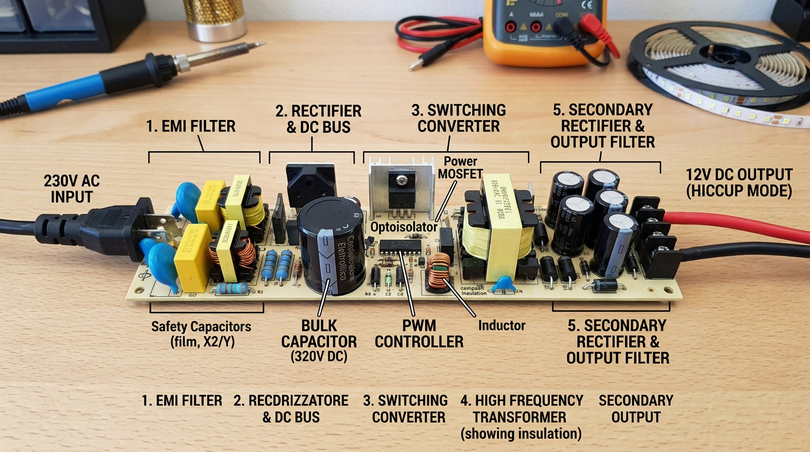
The first stage we encounter, right after the mains socket, is the EMI filter (Electromagnetic Interference). This block is composed of film capacitors (typically X2 and Y1/Y2), common mode inductors, and discharge resistors. Its function is twofold: on the one hand, to prevent electromagnetic interference generated internally by the power supply from returning to the grid and disturbing other appliances (outgoing EMC compatibility); on the other hand, to protect the power supply itself from interference coming from the electrical grid (incoming EMC immunity). A good EMI filter is what distinguishes a CE-certified 12v power supply compliant with EN 55015 and EN 61000 standards from a non-compliant low-cost product.
The rectifier and the DC bus
After the EMI filter, the energy meets the rectifier, typically consisting of a Graetz bridge with four diodes (or an integrated bridge), which converts 230V AC into unidirectional pulsating current. Downstream of the rectifier, we find a large electrolytic capacitor (the so-called bulk capacitor) that levels the pulsation and creates a high-voltage DC bus, typically around 320V DC. This is one of the critical points of the power supply: the quality, the nominal temperature (105°C for quality models), and the capacity of the bulk capacitor directly influence the lifespan of the entire device. The best manufacturers, including Mean Well, use capacitors from Japanese brands (Rubycon, Nichicon, Nippon Chemi-Con) with a guaranteed lifespan of 10,000 hours at 105°C, while cheap products often mount unbranded Chinese capacitors with an actual lifespan of 2,000-3,000 hours.
The switching converter
From the high-voltage DC bus, the energy passes to the switching converter itself. Here, a power transistor (typically a high-voltage MOSFET, or an IGBT in higher power units) switches at high frequencies (from 30 kHz up to 200 kHz in the most advanced models) under the control of a dedicated integrated circuit (the PWM controller). The most common topologies in 12v switching power supplies for LEDs are flyback for lower powers (up to 60-100W) and resonant LLC or forward converter for medium-high powers (over 150W). Mean Well's HLG and XLG series use LLC topologies that allow reaching efficiencies of 94% with very low electromagnetic emissions.
The high-frequency transformer
The switched transistor drives the primary of a high-frequency transformer, built with a ferrite core instead of iron laminations. The high frequency allows the use of much smaller and lighter cores than those that would be needed at 50 Hz: this is why a 100W 12v switching power supply weighs 500 grams while its linear equivalent would weigh 4-5 kg. The high-frequency transformer performs two functions: to step down the voltage from the 320V of the DC bus to the nominal 12V, and to provide galvanic isolation between the primary side (connected to the dangerous grid) and the secondary side (the safe 12V that will go to the LED strip). This isolation, designed to withstand impulses of several kV, is what makes it safe to touch the output terminals of a certified power supply.
The secondary rectifier and the output filter
At the secondary of the transformer, the voltage is still AC, but at a high frequency. A second rectifier (typically with low-drop Schottky diodes, or with MOSFETs in synchronous rectification configuration in the most performing units) converts it to DC. A second group of capacitors and inductors (the output filter) eliminates switching residues and provides the clean and stabilized 12V DC that we will see at the terminals. The residual ripple, i.e., the residual undulation on the DC voltage, is a quality parameter: high-end Mean Well 12v power supplies have ripple below 1% (120 mV peak-to-peak on 12V), while cheap products can reach 3-5%.
The control and feedback circuit
The entire switching is governed by a control circuit that continuously receives the output voltage in feedback (via an optocoupler that maintains galvanic isolation) and regulates the duty cycle of the switching transistor instant by instant to keep the 12V stable regardless of the load (LED dimming, switching on and off, temperature variations). This is the fundamental difference between a stabilized power supply and an unstabilized one: the presence of an active feedback loop that keeps the voltage constant.
Electronic protections
A quality 12v power supply integrates several electronic protections:
- OCP (Over Current Protection) against current overload;
- OVP (Over Voltage Protection) against overvoltage;
- SCP (Short Circuit Protection) against short circuits on the output terminals;
- OTP (Over Temperature Protection) against unit overheating.
These protections intervene in different ways: some limit the delivered current (foldback mode), others completely interrupt the output until manual reset (latch-off mode), and others still automatically retry after a few seconds (hiccup mode). All Mean Well models distributed by Ledpoint integrate these four protections as standard.
What's inside a cheap power supply (and what's missing)?
Generally, the EMI filter (causing radio interference on the rest of the electrical system), the bulk capacitor (reduced lifespan), the quality of the transformer (magnetic saturation at full power), the number of protections (often only OCP, without OVP or OTP), and the safety margin of the switching transistor (often used at 90% of its limit) are missing or undersized. All this translates into a product that works for a few months and then fails, perhaps ruining the connected LED strip along with it.
| Internal stage | Key component | Quality indicator |
|---|---|---|
| EMI Filter | X2/Y1 capacitors, common mode inductors | EN 55015 compliance, CE mark |
| Primary rectifier | Graetz bridge | Current oversizing |
| Bulk capacitor | 400V electrolytic | 105°C, Japanese brand, 10,000h |
| Switching converter | MOSFET + PWM controller | LLC/Resonant topology for HLG/XLG |
| HF Transformer | Ferrite core | 3-4 kV galvanic isolation |
| Secondary rectifier | Schottky diodes or sync rect | Low drop = high efficiency |
| Output filter | Capacitors + inductor | Ripple < 1% (120 mV on 12V) |
| Feedback | Optocoupler + TL431 | Line and load regulation < 1% |
| Protections | OCP, OVP, SCP, OTP | All four present |
3. 12V DC or AC?
The question "Is 12V a DC or AC voltage?" is among the most frequent, and deserves a detailed answer because it touches on a real point of confusion. The acronym "12V" only indicates the intensity of the voltage, not its waveform: it can therefore refer to both 12V direct current (12V DC) and 12V alternating current (12V AC). In the context of low-voltage LED lighting, and specifically in all 12v power supplies distributed by Ledpoint, we are always and only talking about 12V DC, i.e., direct current.
What 12V DC means
The acronym 12V DC (or 12vdc, written together) means "12 volts in direct current": a voltage that is constant over time, with a well-defined positive and negative pole. All LEDs, being semiconductor diodes, work in direct current: to turn them on, a DC voltage is therefore necessarily required. The 12V DC are the 12 continuous volts coming out of the output terminals of a switching power supply after the entire conversion, rectification, and filtering process described in the previous chapter has been completed.
What 12V AC means
The acronym 12V AC (or ac 12v power supply in certain contexts) means "12 volts in alternating current": a voltage that oscillates over time between a positive and a negative value, typically with a frequency of 50 Hz in Europe. 12V AC was historically used with low-voltage halogen lamps (the classic 20-50W GU5.3 dichroic spotlights) and was produced by simple toroidal transformers. In the LED world, 12V AC has practically disappeared: all our 12V power supplies provide stabilized 12V DC output.
Warning: some old halogen lighting systems with 12V AC toroidal transformers are still converted to LED today. In these cases, it is possible to use specific AC/DC LED strips with an integrated rectifier bridge, or (the more correct solution) replace the old toroidal transformer with a modern 12v dc switching power supply.
Recognizing polarity
If you are wondering how to recognize the polarity of a power supply's wires and which is the positive and negative wire of a 12v power supply, you are asking critical operational questions, because connecting the LED strip backwards can damage the LEDs (even if most monochromatic LED strips are protected by a blocking diode) or prevent them from turning on. International conventions establish that the positive pole (+) is identified by the color red, and the negative pole (–) by the color black or blue. On the power supply terminal block, the terminals are always screen-printed with the symbols "+V" and "-V" or "V+" and "V-". In case of doubt, a multimeter set to the DC scale allows you to verify the polarity: the red probe goes to the positive terminal and the black probe to the negative to read a value of +12V: if we read -12V, it means the probes are reversed.
4. Differences between power supply, transformer, battery charger, and driver
One of the areas of greatest terminological confusion in the world of 12v power concerns the distinction between power supply, transformer, battery charger, and LED driver. Often these terms are used as synonyms in common language, but in reality, they identify technically different devices, each with a specific function and its own selection criteria. Understanding the differences allows you to avoid purchasing and installation errors that can compromise the functioning of the entire lighting system.
Difference between power supply and transformer
A transformer in the strict sense is a passive electromagnetic component consisting of two or more copper windings on a magnetic core, which transforms an alternating voltage of a certain value into another alternating voltage of a different value. A pure transformer works only in alternating current, both in input and output: AC in, AC out.
A power supply, on the other hand, is an active and complex electronic device that, in addition to containing a transformer internally (high-frequency in switching models, 50 Hz in old linear models), also includes rectifiers, filters, regulators, and control circuits, and provides stabilized direct current in output: AC in, DC out. Therefore, every power supply contains a transformer, but not every transformer is a power supply.
In commercial language, however, the word transformer is often improperly used as a synonym for power supply: when you ask for "a transformer for LED strips" in a store, you actually mean a 12/24/48 volt DC power supply.
Difference between power supply and battery charger
This question is even more important because an error here can seriously damage the battery. A battery charger is a device specifically designed to recharge batteries of a certain type (lead-acid, AGM, gel, lithium): it has programmed charging curves, bulk/absorption/float phases, current and voltage control based on the battery's state of charge. A battery charger for a 12V battery actually delivers variable voltages from 13.5V to 14.8V depending on the charging phase.
A 12v power supply, on the other hand, delivers a fixed and stable voltage of 12V, without any charging intelligence. Using a power supply instead of a battery charger to recharge a battery is wrong and dangerous: the battery would not be charged correctly (the 12V voltage is not enough to recharge a battery that is dead precisely at 12V), and in the case of a power supply with sufficient output current, the battery could overheat.
Conversely, using a battery charger instead of a power supply to power an LED strip is equally wrong: the variable voltage between 13.5 and 14.8V would quickly burn the LEDs, designed for 12V nominal ±5%.
Constant current LED drivers vs constant voltage power supplies
In the specific world of LED lighting, there is a further distinction that often confuses even expert technicians: that between constant current (CC) LED drivers and constant voltage (CV) LED power supplies. 12V and 24V LED strips are constant voltage loads: they have integrated limiting resistors that set the current, and simply require that the applied voltage be stable at 12V (or 24V). They therefore need a CV 12v power supply.
Single power LEDs or high-power COB LED plates used in professional spotlights, on the other hand, are constant current loads: they require a driver that provides a fixed current (e.g., 350 mA, 700 mA, 1050 mA, 1400 mA) with variable voltage depending on the number of LEDs in series. For these, a specific CC driver is needed, not a CV power supply.
| Device | Input | Output | Function | Typical use |
|---|---|---|---|---|
| Pure transformer | 230V AC | 12V AC | Voltage step-down only | Old 12V AC halogens |
| 12V switching power supply | 230V AC | Stabilized 12V DC | Stabilized AC/DC conversion | LED strips, electronics |
| 12V battery charger | 230V AC | Variable 13.5-14.8V DC | Smart battery charging | Cars, motorcycles, UPS |
| CC LED driver | 230V AC | Constant current (mA) | Power LED driving | COB spotlights, ceiling lights |
| 12V linear power supply | 230V AC | 12V DC | Linear conversion | HiFi audio, laboratory |
Fundamental technical characteristics: power, amps, efficiency, protections
When evaluating a 12v power supply, it is essential to know how to read and interpret the technical characteristics declared by the manufacturer, because these determine the product's suitability for the specific application and allow an objective comparison between different models. In this chapter, we will review all the main technical parameters, explaining for each the meaning, typical market values, and practical impact on the choice.
Input voltage and AC range
The input voltage indicates the range of grid voltages within which the power supply works correctly. Modern 12v power supplies typically have a universal range of 90-264V AC, 47-63 Hz, which allows them to be used all over the world without switches: from European 230V/50Hz grids to North American 120V/60Hz grids, up to Japanese 100V/50Hz grids. This is a great advantage over old models that required manual 115V/230V switches with the risk of burning if positioned incorrectly.
Output voltage and tolerance
The nominal output voltage is 12V, but there is a declared tolerance. On Mean Well 12v power supplies of the medium range (LPV, APV series), the tolerance is typically ±5% (so 11.4 - 12.6V), while on professional models (HLG, XLG series) it drops to ±3% or less. Some models have an adjustment trimmer (potentiometer) that allows you to adjust the output voltage within a ±10% window (10.8 - 13.2V): useful for compensating for voltage drop on long cables.
Output current and amperes
The output current expressed in amperes is the maximum value that the power supply can deliver continuously: the amperes indicate the power supply's capacity to supply current, and must be greater than or equal to the current absorbed by the load. A 12v 3a power supply can power loads up to 36W (12V × 3A), a 5A 12v dc power supply up to 60W, a 12v 30a power supply up to 360W, a 12v 30 ampere power supply for more demanding applications, up to a 12 volt 100 ampere power supply (1200W) and a 12v 200 ampere power supply (2400W) used in industrial settings for large LED signs, professional audio, automotive test systems.
Nominal power
The nominal power in watts is the product of output voltage and current (P = V × I), and is the most commercially used reference parameter. The most common power ratings in 12v power supplies for LEDs are: 8W, 15W, 20W, 35W, 50W, 60W, 75W, 100W, 120W, 150W, 200W, 240W, 320W, 480W, 600W. For industrial applications, there are units of 1000W and beyond, but out of scale for consumers.
Energy efficiency
The efficiency of a 12v power supply indicates the ratio between useful output power and power absorbed from the grid. Modern switching power supplies declare efficiencies between 85% and 94%. A difference that seems small actually has significant long-term impacts: a 200W 12v power supply with 88% efficiency dissipates 23W in heat (200/0.88 = 227W absorbed, 27W lost) while the same 200W with 94% efficiency dissipates only 13W. In a year of continuous operation, the difference is 87 kWh, or about 30 euros on the bill. On a fleet of 100 power supplies in a large retail project, we are talking about a 3,000 euros/year difference.
Power Factor (PF) and PFC
The power factor (PF) indicates how much the current absorbed from the grid is in phase with the voltage. A PF of 1.00 (ideal) means perfect alignment. 12v power supplies with active PFC (Active Power Factor Correction) reach PFs of 0.95-0.99, while those without PFC stop at 0.5-0.6. In the residential sector, PF is not charged on the bill, but for commercial and industrial installations, the presence of PFC is important to avoid penalties on reactive power. All Mean Well series above 75W (HLG, XLG, ELG) have active PFC as standard.
Ripple and noise
The ripple is the residual undulation on the DC output voltage, expressed in millivolts peak-to-peak. For LED strips, a ripple of less than 1-2% is desirable to avoid flicker effects visible especially in video recordings or under prolonged observation conditions. Mean Well declares typical ripple between 120 and 240 mV on 12V output (1-2%), excellent values for lighting applications.
IP protection rating
The IP (Ingress Protection) rating according to the IEC 60529 standard indicates the enclosure's resistance to the penetration of solids (first digit) and liquids (second digit). For 12v power supplies, the most common ratings are: IP20 (for indoor use only in dry places, open enclosure), IP40 (closed enclosure without liquid protection), IP65 (totally protected against dust and resistant to water jets), IP67 (totally protected against dust and resistant to temporary immersion up to 1 meter). For outdoor installations, in bathrooms, or in humid environments, at least IP65 is mandatory, preferably IP67.
Operating temperature and derating
The operating temperature of a 12v power supply is defined by the ambient temperature range within which the unit can operate. Typical Mean Well values are -30°C / +70°C (case temperature), with power derating above 50°C ambient. This means that a 200W power supply installed at 25°C effectively delivers 200W, but at 60°C it delivers only 140W to avoid damage. Temperature is a critical factor for lifespan: every additional 10°C of ambient temperature statistically halves the life of internal electrolytic capacitors (Arrhenius rule).
Lifespan (MTBF) and warranty
The lifespan of a 12v power supply is expressed through two parameters: MTBF (Mean Time Between Failures) in hours, and declared commercial lifespan in years. Mean Well declares MTBF between 700,000 and 3,000,000 hours depending on the models (calculated according to MIL-HDBK-217F standard), and offers commercial warranties from 2 years (entry series) up to 7 years (HLG series).
6. Types of 12V power supplies: linear, switching, indoor, outdoor, smart
The 12v power supply market is today populated by a vast range of construction types, each optimized for specific application scenarios. Knowing the differences between the different families is the first step to orienting yourself in the choice and avoiding buying a product unsuitable for your context. In this chapter, we review the main merchandise categories.
12V linear power supplies
12v linear power supplies represent the historical technology, today almost entirely supplanted by switching but still present in niche applications. They are based on a large 50 Hz transformer, a rectifier, a large filter capacitor, and a linear regulator (typically a power transistor driven by a voltage reference). Their advantages are: very low ripple, very low electromagnetic noise, circuit simplicity, robustness. Their disadvantages: high weight (5-10 kg for a 12v 30 ampere power supply), size, low efficiency (60-70%), overheating. They are still used in high-end HiFi audio, in laboratories for precision measurements, and in some medical devices. For LED lighting, they are practically absent.
12V switching power supplies
12v switching power supplies (SMPS) are the current market standard. These are 12v power supplies that use the high-frequency switching technology described in chapter 2, with all the advantages of lightness, efficiency, and compactness.
Bench power supplies
Bench power supplies are units with adjustable voltage and current, equipped with digital displays, adjustment knobs, and configurable protections. They allow you to simulate different loads, test prototypes, and power devices at variable voltages. However, they are not what is needed to power an LED strip installed in a home: for that, you need the fixed-voltage 12v power supplies described in the other paragraphs.
Indoor power supplies (plastic enclosure)
12v power supplies for indoor use are characterized by insulating plastic enclosures, IP ratings from IP20 to IP40, and compact dimensions. They are designed to be installed inside furniture, false ceilings, light coves, and niches. Mean Well APV and LPV series are the market references for this segment.
Outdoor power supplies (metal enclosure)
12-volt power supplies for outdoor use have metal enclosures (die-cast aluminum or treated sheet metal), IP65 or IP67 ratings, resistance to extreme temperatures, and anti-salt spray protection in some variants. Mean Well's XLG and HLG series are the references.
Portable power supplies
Portable 12v power supplies are designed for mobile use: construction sites, temporary events, demos. They often integrate buffer batteries and multiple sockets.
Industrial power supplies
Industrial 12v power supplies have high powers (300-2000W), DIN rail or wall mounting, reinforced certifications, and very high MTBF. They are designed for automation applications, machine control, industrial lighting, and signage. Mean Well's SDR and DR series are the standard.
Universal power supplies
Universal 12v power supplies are units that accept any worldwide grid voltage (90-264V AC) and can therefore be used in any country without adapters. Practically all modern quality SMPS are universal.
Smart power supplies (WiFi, RF, apps)
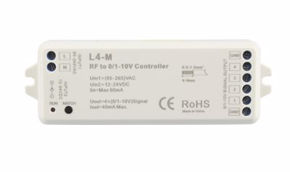
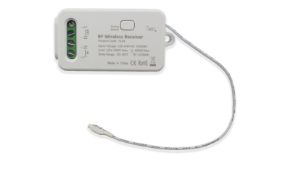
The new generation of smart 12v power supplies integrates 2.4GHz RF receivers, WiFi modules, and app compatibility (Tuya, Smart Life, eWeLink). They allow you to control the LED strip from a remote control or smartphone without having to add separate controllers. Skydance PB, PH series, and Mean Well/Skydance LPV-WT models are examples.
Dimmable power supplies
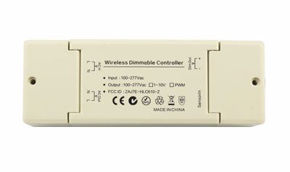
Dimmable 12v power supplies allow you to vary the output power via control signals: Triac/ELV (traditional wall dimmers), 0-10V (professional systems), DALI/DALI-2 (BMS systems), PWM (LED controllers), Push-Dim (button). Mean Well PWM series and Skydance TE series are the references.
7. How to choose a 12V power supply: the 20% rule
The correct choice of a 12v power supply is probably the aspect on which the most errors are made, even by experienced technicians. The questions "how to choose a 12v power supply", "how to choose a power supply", "how to choose the correct power supply", "how to choose a power supply", "how to understand which power supply to use" are among the most recurring, and deserve a structured procedure.
Step 1: calculate the load power
The first step to correctly choose a 12-volt power supply is to calculate the power absorbed by the load. For an LED strip, the calculation is simple: you multiply the power per meter (declared on the strip's data sheet) by the total installed length. Example: 14.4 W/m LED strip installed for 6 meters = 86.4 W total.
Step 2: apply the 20% rule
This is where the recommended 20% rule comes into play: the 12v power supply must have a nominal power at least 20% higher than the actual needs of the load. In our example: 86.4 W × 1.2 = 103.68 W minimum. You would then choose a 120 W nominal power supply (the closest commercial size).
Why this rule? Three fundamental technical reasons:
- First: reduced thermal stress. A power supply that works at 70% of its nominal power is significantly less hot than one that works at 100%, and this prolongs the life of the internal electrolytic capacitors according to the Arrhenius rule.
- Second: margin for switch-on peaks. LEDs, when switched on, can absorb inrush currents higher than the nominal rate.
- Third: margin for aging. LED strips tend to absorb slightly more current over time due to the increase in contact resistance and the aging of the chips.
Step 3: consider the ambient temperature
The ambient temperature influences the deliverable power (derating). If the 12v power supply is installed in a poorly ventilated false ceiling, in a closed niche, or in a hot outdoor environment, the internal temperature can easily exceed 50°C, forcing the power supply to reduce the delivered power. In these cases, it is prudent to apply a further 20-30% margin compared to the already conservative standard 30%.
Step 4: choose the IP rating
Based on the installation environment, choose the correct IP rating.
- Dry indoor: IP20-IP40. Damp indoor (bathroom, kitchen near the sink): IP65 minimum.
- Outdoor protected from direct rain (under eaves): IP54-IP65.
- Exposed outdoor: IP67.
- Underwater or immersion: IP68 (rare for 12v power supplies, more common for the LEDs themselves).
Step 5: choose the shape and mounting
For integration into furniture and LED profiles, choose slim and linear models like the Mean Well SLD series. For wall or bracket installation, choose models with integrated fixing flanges like HLG, XLG. For DIN rail mounting in electrical panels, choose DR/SDR industrial series. For small, hidden spaces, choose IP67 encapsulated models from the LPV series.
Step 6: dimming and control
If dimming is required, choose specific dimmable models (PWM, TE, PB). Otherwise, choose fixed-voltage models and possibly add external PWM controllers.

Mean Well APV, LPV, SLD series for indoor use
The Mean Well series for indoor use represent the commercial heart of the 12v power supply market for low and medium load LED lighting. Ledpoint officially distributes these three families in 12V versions, each designed for a specific application profile.
APV series: compact, economical, reliable
The Mean Well APV series includes compact 12v power supplies with powers from 8W to 35W. The most common 12V models are APV-8-12 (8W, 0.67A), APV-12-12 (12W, 1A), APV-16-12 (16W, 1.3A), APV-25-12 (25W, 2.1A), APV-35-12 (35W, 2.9A). They are characterized by: fully encapsulated plastic enclosure, IP42 rating, short circuit and overload protections, efficiency up to 84%, universal 90-264V AC input voltage range, extremely compact dimensions ideal for integration into lamps, furniture, sconces. They are the ideal choice for small LED step lights, furniture backlighting, and low-power decorative spotlights.
LPV series: the IP67 evergreen
The LPV series is probably the best-selling family of 12-volt power supplies in Europe for LED applications. It includes models from 20W to 150W: LPV-20-12 (20W, 1.67A), LPV-35-12 (35W, 2.9A), LPV-60-12 (60W, 5A), LPV-100-12 (100W, 8.5A), LPV-150-12 (150W, 12.5A). The distinctive features are: total IP67 rating (completely encapsulated in resin), excellent for humid environments, protected outdoors, and semi-sealed installations; lightweight plastic enclosure; typical efficiency 84-86%; short circuit, overload, and overvoltage protections. The LPV-150-12 model is one of the most requested for medium residential systems (kitchens, bathrooms, false ceilings). The LPV-150-12-WT version integrates a Tuya Smart compatible WiFi module, allowing you to control the connected LED strip directly from a smartphone app without external controllers.
SLD series: slim for integration into appliances
The SLD series is specifically designed to be integrated inside lighting fixtures, furniture, and aluminum profiles. The most common 12V models are SLD-25-12 (25W), SLD-50-12 (50W), SLD-80-12 (80W). Features: slim and linear form factor, excellent for hiding the power supply inside a wide LED profile, compliance with EN61347 safety standards for integration into lighting fixtures, Class II (double insulation, does not require grounding); efficiency up to 87%, 3-year warranty. Particularly appreciated by lighting and furniture designers for integrated design.
| Series | Typical 12V models | Power | IP | Efficiency | Ideal use | |
|---|---|---|---|---|---|---|
| APV | APV-8/12/16/25/35-12 | 8-35W | IP42 | up to 84% | Small loads, integration | |
| LPV | LPV-20/35/60/100/150-12 | 20-150W | IP67 | 84-86% | Damp indoor, semi-sealed | |
| SLD | SLD-25/50/80-12 | 25-80W | IP20 | up to 87% | Integration into appliances |
9. Mean Well XLG and HLG series for outdoor and professional use
For outdoor, professional, architectural, and industrial applications, Mean Well's XLG and HLG series represent the state of the art in 12v power supplies. They are units with an advanced technological core (resonant LLC topology), die-cast aluminum metal enclosure, IP67 rating, reinforced protections, multiple certifications, and commercial warranty up to 7 years.
XLG series: the perfect balance
The XLG series includes medium-high-end outdoor 12-volt power supplies. The most requested models are XLG-75-12 (75W), XLG-100-12 (100W), XLG-150-12 (150W), XLG-200-12 (200W). Distinctive features: IP67 metal enclosure, protection against 6kV/4kV transient overvoltages (line/neutral), efficiency up to 91%, active PFC (PF > 0.95), temperature range -40°C/+90°C, wall or bar mounting. They are the ideal choice for architectural facade lighting, outdoor landscape lighting, decorative public lighting, outdoor commercial display windows, and protected illuminated signs.
HLG series: the top of the range
The HLG series is the absolute reference for professional 12v power supplies. It includes models from 40W to 600W: HLG-40H-12, HLG-60H-12, HLG-80H-12, HLG-120H-12, HLG-150H-12, HLG-185H-12, HLG-240H-12, HLG-320H-12, HLG-480H-12, HLG-600H-12. Features: efficiency up to 94%, IP67 die-cast aluminum enclosure, 6kV overvoltage protection, active PFC, passive cooling (no fans = no noise), three control versions (A with adjustable trimmer, B with 3-in-1 dimming, AB with all functions), MTBF over 700,000 hours. They are used in architectural lighting of historical and modern buildings, museum lighting, church lighting and places of worship, industrial lighting, backlighting of large display windows, sports lighting, BMS systems.
10. Dimmable power supplies: Mean Well PWM and Skydance Triac/Smart
Dimming, i.e., the possibility of varying the light intensity of an LED strip, is one of the most requested features in modern lighting systems. There are several strategies to implement it, and consequently several families of dimmable 12v power supplies. Ledpoint distributes the most advanced solutions on the market.
Mean Well PWM series
The PWM series directly integrates the generation of the PWM (Pulse Width Modulation) signal at the output of the 12v power supply: instead of delivering constant 12V DC, it delivers a high-frequency square wave (typically 1 kHz) whose duty cycle is modulated to control the average power sent to the LED. The main 12V models are PWM-40-12, PWM-60-12, PWM-90-12, PWM-120-12, PWM-200-12. Advantages: the LED color remains constant throughout the dimming (it does not shift to warm as happens instead with current dimming), compatibility with professional DALI-2, KNX, 0-10V, 3-in-1 protocols; excellent for professional lighting and BMS.
Skydance TE series (Triac/ELV)
The TE series by Skydance allows dimming via traditional phase-cut wall dimmers (Triac or ELV), the same historically used for halogen lamps. The TE-75-12 model (75W) is particularly appreciated because it allows you to replace an old halogen system with a new 12V LED strip system while keeping the existing wall dimmer. It also integrates the AC Push-Dim function which allows control via a simple momentary push button.
Smart Skydance PB/PH solutions and Tuya WiFi
Smart 12v power supplies integrate a 2.4GHz RF or WiFi receiver directly into the power supply. The PH-150-12 (150W) model integrates a 2.4GHz RF receiver compatible with Skydance K series remote controls, while the LPV-150-12-WT model is Tuya Smart app compatible, allowing you to turn on, off, dim, and program scenarios directly from your smartphone. Ideal for smart home upgrades without having to add separate controllers.
When to use integrated dimmable power supplies vs external controllers
The choice between an integrated dimmable 12v power supply and a standard power supply + external controller is an important design decision. Pros of the integrated one: fewer components, simpler wiring, better overall efficiency, better EMC compatibility. Cons: less flexibility if you want to change the control mode in the future. Pros of the external controller: maximum flexibility, possibility to manage RGB and RGBW, integrability with more complex systems (HomeKit, Alexa, Google Home via gateways). Cons: more components, more wiring, total cost often higher.
11. 12V wiring: voltage drop, cable cross-sections, terminals
An often underestimated aspect, and a source of many problems on LED systems, is 12-volt wiring. Due to the lower voltage compared to 24V or 230V, 12V systems are particularly sensitive to voltage drop along the cables and require specific design attention.
Voltage drop
The voltage drop along a cable follows Ohm's law: V = R × I, where R is the resistance of the cable (proportional to the length and inversely proportional to the cross-section) and I is the current. For the same power transmitted, a 12V system carries twice the current compared to a 24V one (power = voltage × current), and therefore suffers from quadruple voltage drops for the same cable. A drop of 0.5V on a 12V cable is 4.2% of the voltage, and translates into a visible reduction in the brightness of the LED strip in the part furthest from the power supply.
Recommended cable cross-sections
As a practical rule for 12v power supplies: a cross-section of 1 mm² supports about 10A, a cross-section of 1.5 mm² about 15A, a cross-section of 2.5 mm² about 20A, a cross-section of 4 mm² about 30A, a cross-section of 6 mm² about 40A. These are current carrying capacity indications: to limit the voltage drop below 3% on long runs, it may be necessary to oversize.
Practical table
| Current | Max length for 1mm² cable (3% loss) | Max length for 2.5mm² cable (3% loss) | Max length for 4mm² cable (3% loss) |
|---|---|---|---|
| 2A | ~10 m | ~25 m | ~40 m |
| 5A | ~4 m | ~10 m | ~16 m |
| 10A | ~2 m | ~5 m | ~8 m |
| 20A | ~1 m | ~2.5 m | ~4 m |
Techniques to minimize drop
Three practical strategies to minimize voltage drop problems on 12V LED systems:
- position the 12v power supply as close as possible to the LED strip, ideally less than 2-3 meters away;
- power long strips from both ends (dual power) or from the center, effectively halving the actual length of each run;
- use cables of adequate cross-section or, on very long runs, switch to a 24V system which halves the current.
Terminals and connections
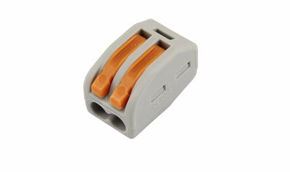
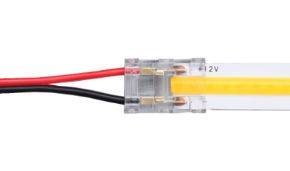
The terminals of the 12v power supply must be tightened correctly: an insufficient tightening torque leaves a high contact resistance which translates into overheating of the terminal itself, up to the risk of burning. For connections to the LED strip, screw terminals, quick terminals like Wago, or direct soldered joints are recommended. Never use adhesive tape or non-insulated DIY connections.
12. Step-by-step installation and electrical safety
The installation of a 12v power supply requires basic electrical skills and, for fixed installations in buildings, must be carried out by a qualified electrician in compliance with the CEI 64-8 standard (Italy). Let's see the fundamental steps.
Positioning the power supply
The 12-volt power supply must be positioned in a ventilated place (not in sealed closed boxes unless specifically designed for that), accessible for maintenance, protected from mechanical impacts, close to the load to minimize voltage drop, away from heat sources (boilers, hot air ducts, direct sunlight).
Grid side connections (primary side)
The 230V side of the 12v power supply has three terminals: L (line, phase), N (neutral), PE (ground, protection). It must be connected downstream of a dedicated residual current circuit breaker (16A/30mA typical for residential systems). Minimum cable cross-section 1.5 mm² for a 16A circuit. The conventional color is: phase brown or black, neutral blue, ground yellow-green. Grounding is mandatory on Class I power supplies (metal enclosure); it is instead absent on Class II models (double insulation, plastic enclosure), recognizable by the double square symbol.
Load side connections (secondary side)
The 12V side of the 12v power supply has two terminals: +V (positive) and -V (negative). They are connected to the positive and negative of the LED strip respecting the polarity. For RGB or RGBW LED strips, the supplementary wires (R, G, B, W) go to the controller, not directly to the power supply.
Final check
Before powering up: verify polarity, terminal tightness, absence of short circuits (with multimeter in continuity on the disconnected output). At first switch-on: measure the output voltage with a multimeter (it must be 12V ±5%), verify the absence of odors, excessive overheating, or abnormal noises in the first few minutes.
Safety
Never open a power supply while energized: the bulk capacitors maintain a dangerous charge even after switching off, for up to several minutes. Never use power supplies with damaged enclosures. Never exceed the maximum output current.
13. Energy consumption and bill cost calculation
How much does a 12v power supply actually consume? And how much does it cost to run it on the bill? These are practical questions that every user asks, and we can answer them with precise calculations.
Consumption calculation
The hourly consumption of a 12v power supply depends on the actually connected load and the efficiency of the power supply itself. Example: 100W LED strip connected to a power supply with 90% efficiency, the consumption from the grid is 100/0.90 = 111W. In one hour of operation: 0.111 kWh. In a day (5 hours): 0.555 kWh. In a year (5h/day): 202 kWh. At €0.35/kWh (average Italian residential tariff 2025-2026): about €71 per year.
No-load consumption (standby)
A 12v power supply turned on but without a load (or with the LED strip turned off via a controller) still consumes a small amount of energy, called no-load consumption. Mean Well typically declares values between 0.3W and 1W for its series. Apparently negligible, but over 8760 hours/year it makes 2.6-8.7 kWh, or €1-3/year per power supply. On systems with dozens of power supplies, it is worth disconnecting unused circuits.
Typical consumption table
| Load (W) | Power Supply (W) | Hourly consumption (kWh) | Cost 5h/day year (€) |
|---|---|---|---|
| 20 | 30 LPV-30-12 | 0.023 | ~14 |
| 50 | 60 LPV-60-12 | 0.058 | ~37 |
| 100 | 120 HLG-120-12 | 0.113 | ~72 |
| 200 | 240 HLG-240-12 | 0.221 | ~141 |
| 300 | 320 HLG-320-12 | 0.330 | ~211 |
14. Maintenance, fault diagnosis, and troubleshooting
Professional quality 12v power supplies are designed to work for tens of thousands of hours without active maintenance, but when a problem arises it is useful to know how to diagnose the origin. Let's see the most common faults and how to deal with them.
LED strip does not turn on
Checks in sequence:
- mains voltage present at the power supply input (test with multimeter or voltage tester);
- 12V output voltage at the terminals (test with DC multimeter);
- correct strip polarity;
- strip integrity (do the 12V reach the ends?);
- thermal protection intervened (power supply too hot).
Strip turns off after a few minutes
Almost certainly intervention of the 12v power supply's thermal protection: undersized power supply (see 30% rule) or installed in an unventilated place. Solution: replace with a higher power model or improve ventilation.
Strip flashes
Possible causes: power supply in hiccup protection for intermittent short circuit; repeated OCP/OVP intervention; PWM controller with incompatible frequency.
Brightness reduction towards the end of the strip
Classic voltage drop: undersized cables or strip too long. Solution: dual power or thicker cables.
Flicker
Excessive ripple of the 12v power supply (cheap model) or incompatibility with dimmer. Replace with a quality Mean Well model or add a filter.
Verification with multimeter: how to check if a 12V power supply works
Procedure:
- disconnect the 12v power supply from the load;
- apply power;
- set multimeter to DC volt 20V;
- place red probe on +V and black on -V;
- read the value: it must be between 11.4 and 12.6V (±5% tolerance). If zero or very low, power supply is faulty. If very high (over 13V), power supply is unstabilized or faulty.
15. Market prices and reliable brands
The prices of 12v power supplies vary enormously depending on brand, power, certifications, and build quality. Let's see the typical market ranges to get your bearings.
Price ranges by power
| Power | Economical (no-brand) | Mean Well/Skydance Ledpoint | Premium HLG |
|---|---|---|---|
| 20-35W | €5-10 | €12-20 | n/a |
| 60W | €10-15 | €20-30 | €40-50 |
| 100-150W | €20-30 | €35-55 | €65-90 |
| 200-240W | €35-50 | €60-80 | €95-120 |
| 320W | €50-70 | €90-110 | €140-160 |
| 480-600W | n/a | €140-170 | €180-220 |
Reliable brands
The reference brands for 12v power supplies internationally are: Mean Well (Taiwan, world leader, complete range), Skydance (specialized in smart and dimming), TCI (Italian, lighting focus), Helvar (Finnish, top-end DALI), Tridonic (Austrian, premium), Osram (German, premium). Ledpoint distributes Mean Well and Skydance as the reference choice for quality/price.
How much does a 12v 1a power supply cost
Frequent specific question: "how much does a 12v 1a power supply cost", i.e., a 12W 12v power supply. Economical no-brand models €3-6; Mean Well APV-12-12 about €10-15, models with medical certification or for special applications up to €25-30.
16. Comparison between 12V and 24V power supplies: when to prefer one over the other
It's a key question for those designing an LED system from scratch. Let's see the pros and cons of each voltage.
Pros of 12V
Advantages of 12v power supplies: historical standard, maximum product availability, compatibility with very cheap 12V LED strips, compatibility with 12V automotive and nautical devices, natural choice for small decorative installations.
Pros of 24V
Advantages of 24V: halved voltage drop for the same power (half the current), more efficient LED strips (fewer limiting resistors), longer runs can be powered without interruptions, smaller cable cross-sections, modern choice for professional systems.
When to choose 12V and when 24V
Choose 12V for: small installations (under 3-5 meters of strip), retrofit of existing halogen systems, compatibility with specific 12V devices, mobile applications (nautical, RV). Choose 24V for: medium and large residential and commercial systems, architectural lighting, long runs, professional applications.
17. Regulations, certifications, and CE marking
12v power supplies sold in Europe must respect an articulated regulatory framework. Knowing it is important both for the end user (safety of their systems) and for the professional (legal responsibility).
CE marking
CE marking is mandatory for every 12v power supply placed on the European market. It attests to compliance with three main directives: Low Voltage Directive 2014/35/EU (electrical safety), EMC Directive 2014/30/EU (electromagnetic compatibility), RoHS Directive 2011/65/EU (hazardous substances). The manufacturer must issue a Declaration of Conformity (DOC) citing the applied harmonized standards.
Main harmonized standards
EN 61347-1 (general safety for lamp control gear), EN 61347-2-13 (safety for LED drivers), EN 55015 (RF emissions for lighting equipment), EN 61000-3-2 (mains harmonics), EN 61000-3-3 (mains flicker), EN 62493 (assessment of luminaires relating to exposure to electromagnetic fields).
Voluntary certifications
ENEC, TÜV, UL, CB Scheme: third-party certifications that attest to independent testing. All Mean Well products distributed by Ledpoint have at least ENEC or TÜV.
18. FAQ — Frequently asked questions about the 12V power supply
We collect here the synthetic answers to the most frequent questions about 12v power supplies. Click on the question to expand the answer.
What is a 12V power supply used for?A 12v power supply is used to convert the 230V AC mains voltage into stabilized 12V DC to power LED strips, low-voltage spotlights, controllers, home automation systems, cameras, car radios, motors, and electronic devices that require safe and stable direct current. |
Is 12V a DC or AC voltage?12V only indicates the voltage value, it can be DC (direct current) or AC (alternating current). In 12v power supplies for LEDs, we always talk about 12V DC, i.e., stabilized direct current in output after conversion from the 230V grid. |
How to choose a 12V power supply for LED strips?Calculate the total watts of the strip (W/meter × length), add a 30% margin as recommended by Mean Well, choose IP65/IP67 for humid or outdoor environments, check the electronic protections, and prefer certified brands. |
What is a switching power supply used for?A switching power supply uses high-frequency switching to convert AC to DC with 88-94% efficiencies, compact dimensions, and reduced weights, replacing the old linear power supplies that were much heavier and less efficient. |
What is the difference between a power supply and a transformer?A transformer is a passive component that converts AC to AC at a different voltage. A 12v power supply contains a transformer but also a rectifier, filter, and regulator: it converts AC to stabilized DC. |
What happens if I use a power supply with more Amps?No problem: the load only absorbs the current it needs. A 12v power supply with excess amperes works less under strain, heats up less, and lasts longer. It is a recommended choice for reliability. |
What happens if I use a power supply with fewer Amps?The 12v power supply works under constant strain, goes into thermal protection, reduces its lifespan, and may turn off or be damaged. The LED strip may appear dim or unstable. Absolutely to be avoided. |
What happens if I use a power supply with more Volts?Dangerous: applying 24V to a 12V LED strip instantly burns the LEDs. Never use a power supply with a higher voltage than required by the load. Always check the label. |
What happens if I use a power supply with fewer Volts?The load will not work or will work far below nominal performance. A 12V LED strip powered at 9V will be very weak or off. The voltage must match what is required. |
What is the difference between a power supply and a battery charger?A 12v power supply delivers a fixed voltage of 12V; a battery charger delivers variable voltages of 13.5-14.8V with intelligent charging curves specific to the battery type. They are not interchangeable. |
How much does a 12V power supply consume?Consumption depends on the load and efficiency. Example: 100W strip with a power supply at 90% efficiency absorbs 111W from the grid. At no load it consumes 0.3-1W. |
How to understand the power of a power supply?On the 12v power supply label you find: output voltage (12V), max current (e.g., 12.5A), power (e.g., 150W). Power = Voltage × Current. Never exceed these values. |
How to understand the watts of a power supply?The watts are indicated directly on the label or can be calculated by multiplying volts × amperes. A 12v 30a power supply delivers 12 × 30 = 360W. |
How much does a 12V power supply cost?From €5-10 for cheap micro APVs up to €200-220 for 600W HLG-600s. LPV-100-12 models are around €35-45, HLG-240 around €95. |
How much does a 12v 1a power supply cost?A 1 ampere (12W) 12v power supply costs between €3-6 for no-brand models and €10-15 for professional quality Mean Well APV-12-12. |
What transformer for LED strip?You need a 12-volt power supply (improperly called a transformer) with a power equal to W/meter × length × 1.3. For 14.4 W/m strip × 5 meters: 14.4×5×1.3 = 94W → 100-120W model. |
How to connect a 12V power supply to an LED strip?Connect the 230V side of the power supply to the grid (phase L, neutral N, ground PE if Class I); the 12V side to the +V and -V terminals respecting the strip polarity (red=+, black=-). |
How to recognize the polarity of a power supply?The terminals of the 12v power supply are screen-printed +V and -V. The conventional wires are red (+) and black or blue (-). With a DC multimeter, red probe on + and black on - to read +12V. |
What is a stabilized power supply?A stabilized power supply keeps the output voltage (12V) constant regardless of load and grid variations, thanks to an active feedback loop. All modern quality SMPS are stabilized. |
How many types of power supplies are there?Main types: linear, switching, indoor, outdoor, bench, industrial, portable, dimmable, smart WiFi. The most widespread family for LEDs is that of indoor and outdoor 12v switching power supplies. |
What certifications to look for in a 12V power supply?Mandatory CE; voluntary but important ENEC, TÜV, UL, CB Scheme. RoHS for absence of hazardous substances. EN 61347, EN 55015, EN 61000 standards. |
How to stabilize a power supply?A 12v switching power supply is already stabilized in itself thanks to internal feedback. If greater stability is needed (HiFi audio, precision measurements), a linear regulator (LDO) is added downstream. |
How to check if a 12V power supply works?Multimeter on DC 20V, red probe on +V and black on -V with the power supply energized and at no load: it must read 11.4-12.6V. Under load, the voltage must not drop significantly. |
Which 12V power supply for Arduino?For standard Arduino UNO/MEGA, a 1-2 ampere 12v power supply (e.g., APV-12-12 or LPV-20-12) is sufficient. With active motors and shields, go up to 3-5 amperes. |
What is the difference between 12V and 24V for LED strips?12V has more product availability, 24V has halved voltage drop and allows longer runs. For small systems choose 12V, for large systems 24V. |
How does a switching power supply work?It rectifies the mains AC to 320V DC, switches it at high frequency (30-200 kHz) with a MOSFET, steps it down with a ferrite transformer, rectifies and filters it at the output obtaining stabilized 12V DC. |
What is a bench power supply used for?It allows you to manually adjust voltage and current to test prototypes and simulate loads. It is not suitable as a 12v power supply for fixed installations, where a fixed-voltage model is needed instead. |
What is meant by a switching power supply?A power supply based on SMPS (Switched Mode Power Supply) technology that uses high-frequency switching to convert AC to DC with high efficiency and low mass. |
Which type of power supply is most commonly used?For 12V LED lighting, the most widespread is the medium-range indoor IP67 12v switching power supply, like the Mean Well LPV-100-12 or LPV-150-12 series. |
How is a power supply composed?EMI filter, primary rectifier, bulk capacitor, switching converter (MOSFET + PWM controller), HF transformer, secondary rectifier, output filter, feedback, protections. |
What are amperes used for in a power supply?Amperes indicate the maximum continuous deliverable current. They must be equal to or greater than the current absorbed by the load. A 12v 3a power supply can power up to 36W. |
Which power supply for 5 meters of 14.4 W/m LED strip?5m × 14.4 W/m = 72W, + 30% margin = 94W minimum. Choose a 100W or 120W 12v power supply: LPV-100-12 for indoor IP67, HLG-120H-12 for outdoor or professional use. |
Can you connect multiple LED strips to a single power supply?Yes, in parallel, provided that the total power of all the strips does not exceed 70-80% of the nominal power of the 12v power supply (30% margin rule). |
Which power supply for a car radio at home?A car radio typically absorbs 10-15A. You need a 15-20A 12v power supply. For car radios with an amplifier, go up to 30-50A (12v 30a or 50a power supply). |
What does 12V DC mean?12V DC means 12 volts in direct current, i.e., voltage constant over time with defined polarity (+ and -). It is the standard output voltage from a 12v power supply. |
How much does a 220 to 12 volt transformer cost?What is improperly called a 220-12V transformer is actually a 12v AC/DC power supply. It costs €10-15 for 30W, €35-55 for 100-150W, €90-110 for 320W Mean Well. |
How does an electrical power supply work?It receives energy from the grid (230V AC), transforms it into stabilized 12V DC through conversion, rectification, regulation, and filtering, to power sensitive loads like LEDs. |
How to calculate the necessary power?Sum the powers (W) of all connected loads and multiply by 1.3 (30% rule). The result is the minimum power of the 12v power supply to choose. |
Difference between linear and switching power supply?The linear uses a heavy 50 Hz transformer with 60-70% efficiency; the switching uses HF switching with 88-94% efficiency and reduced weight. For LEDs, switching is always used. |
Does a 12V power supply require grounding?Class I models (metal enclosure, ground symbol) yes; Class II models (plastic enclosure, double square symbol) no, they have double insulation. |
How to dim an LED strip with a 12V power supply?Three options: (1) integrated dimmable 12v power supply (Mean Well PWM, Skydance TE); (2) standard power supply + external PWM controller; (3) smart WiFi power supply (LPV-WT). |
Can I use a 12V LED power supply instead of halogens?Yes, by replacing the 12V halogens with 12V LED strips or LED spotlights and replacing the old AC toroidal transformer with a new 12v DC switching power supply. |
Which IP rating for a bathroom power supply?In the bathroom, near the sink or shower, a 12v power supply of at least IP65, preferably IP67, is mandatory. Mean Well LPV or HLG series are suitable. |
How long does a 12V power supply last?Mean Well declares MTBF of 700,000-3,000,000 hours and offers 2-7 year commercial warranties. Under nominal conditions, a quality 12v power supply lasts 10-15 years. |
What is an AC/DC power supply?A device that converts alternating current (AC) from the grid into stabilized direct current (DC). All 12v power supplies for LEDs are AC/DC. |
What works at 12V?LED strips, spotlights, cameras, car radios, some amplifiers, DC motors, pumps, fans, automation controllers, some RV fridges, video surveillance systems. |
How to choose a 12V power supply for outdoors?Minimum IP67 rating, metal enclosure (XLG or HLG), overvoltage protection of at least 4kV, wide temperature range, 5-7 year warranty. Position in a sheltered place. |
Which 12V power supply for Tuya Smart?Models with integrated WiFi compatible with Tuya: LPV-150-12-WT (Mean Well/Skydance) or Skydance smart models that connect directly to the Tuya Smart app. |
Can I open a faulty power supply?No, never: internal capacitors maintain a dangerous charge for minutes after switching off. Also, opening voids the warranty. Replace the faulty 12v power supply with a new one. |
How to prevent power supply failures?Size correctly (30% rule), ensure ventilation, avoid exposure to heat sources, protect from grid overvoltages with upstream SPDs, periodic maintenance of terminals. |
19. Choosing the right 12V power supply for your project
Having reached the end of this guide, we can summarize the key concepts that every designer, installer, maker, or end user should take with them. The choice of the power supply is never a marginal detail: it is the component that determines the safety, efficiency, lifespan, and quality of light of the entire LED system. Investing a few extra euros in a 12-volt power supply from a recognized brand (Mean Well, Skydance), correctly sized according to the 30% rule, with an IP rating suitable for the environment and complete protections, means saving in the long term in terms of maintenance interventions, premature replacements, and safety issues.
Ledpoint makes available to professionals and individuals a complete range of 12v power supplies ready for delivery from the Italian warehouse, technical assistance in Italian, and competitive prices on Mean Well and Skydance brands. Visit our catalog to consult all the models, or contact the technical team via the Ledpoint Contacts page for personalized advice on sizing your system or to find a power supply not present in the catalog.
To complete your LED lighting system, also explore the related categories: LED Strips to choose the right light strip, LED Dimmers and Controllers for management and control, Aluminum Profiles for a professional and protected installation.