




LED lighting for yachts: a complete technical guide 2026
LED lighting for yachts is the set of light-emitting diode solutions (LED strips, neon flex, spotlights, underwater lights and waterproof ceiling fixtures) designed for the marine environment, powered by 12V or 24V DC and protected IP65-IP68 against salt spray, humidity and vibrations. It reduces energy consumption by up to 86% compared to halogen and lasts over 50,000 hours.
Imagine sailing the sea at sunset while your yacht transforms into a luminous work of art reflecting the last lights of the day. We are not talking about simple lighting, but about a true technological revolution that is redefining the very concept of nautical luxury. In this in-depth article, we will explore every aspect of yacht lighting, from the most advanced systems to practical solutions, with statistical data, comparison tables and technical advice that will guide you in making the perfect choice for your vessel.
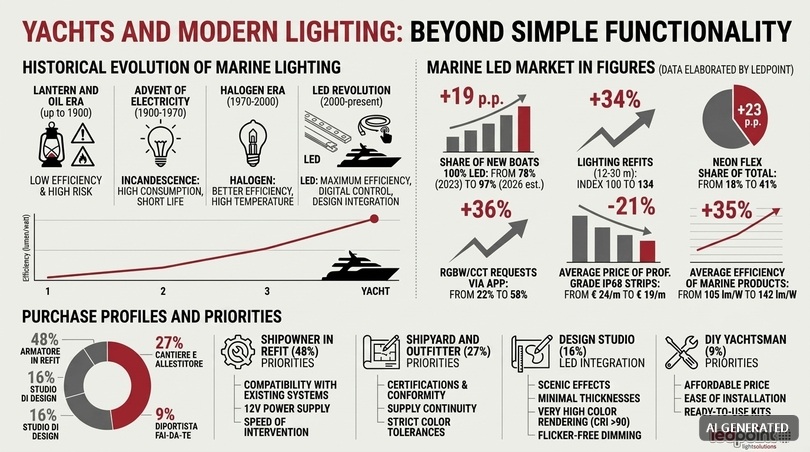
The yacht lighting market is experiencing exponential growth, with a 34% increase over the last three years according to data from Confindustria Nautica Association. But this is not just about aesthetics: modern LED lighting offers concrete advantages in terms of safety, energy efficiency and customization that no yacht owner can ignore. Whether you are planning the refit of a 15-meter vessel, evaluating LED lighting for a sailboat or specifying the system for a 40-meter superyacht, the technical principles and selection criteria you find in this guide are the same ones used by shipyards and naval lighting design studios.
In this article...
1. Yacht and modern lighting: beyond simple functionality
Contemporary yacht lighting has long since moved beyond a purely functional role to become a key element of design, the onboard experience and even safety. In this introductory chapter, we will explore the foundations of this transformation, analyzing how LED technology has opened up new possibilities previously unthinkable in the nautical sector. Understanding where we come from is essential to properly evaluate where we can go: the difference between a system designed with 1990s criteria and one designed today is not a matter of taste, but of orders of magnitude in terms of consumption, reliability and expressive possibilities.
The historical evolution of nautical lighting: from lanterns to LEDs
To fully understand the revolution underway, it is essential to trace a historical path. Nautical lighting has gone through several technological eras, each of which imposed precise constraints on how onboard spaces could be experienced after sunset. Each technological leap brought not only more light, but above all more light for every watt taken from the service batteries, which on board is the real currency of exchange.
The technological eras of yacht lighting
The era of lanterns and oil lamps (until 1900): for centuries, boats relied on primitive light sources that offered poor, dangerous and limited illumination. The average light produced was about 10-15 lumens, equivalent to a modern LED candle. The risk of fire was permanent and daily maintenance (refilling, cleaning the glass, replacing the wicks) occupied a significant part of the work on board.
The advent of electric lighting (1900-1970): with the introduction of electricity on board, incandescent bulbs became the standard. However, high consumption (up to 100W per light point) and a limited lifespan (about 1,000 hours) limited their application. On a sailboat with a reduced battery bank, turning on more than two or three light points at the same time meant compromising the autonomy of the following night.
The halogen era (1970-2000): halogen lamps brought better luminous efficiency (about 15-20 lumens/watt) and superior color rendering, but maintained high consumption and operating temperatures. Surface temperatures above 250-300 °C made safety distances from wooden cladding and fabrics necessary, heavily constraining interior design.
The LED revolution (2000-today): light-emitting diodes have radically transformed every aspect of nautical lighting. With efficiencies exceeding 100 lumens/watt, lifespans of 50,000 hours and digital control capabilities, they represent today the only rational choice for any modern yacht. 24V LED strips and aluminum profiles have made it possible to integrate the light source directly into the furniture, making the lighting fixture disappear and leaving only the light.
| Technology | Efficiency (lumens/watt) | Lifespan (hours) | Annual operating cost* | Operating temperature |
|---|---|---|---|---|
| Incandescent | 10-15 | 1,000 | € 185 | 250 °C |
| Halogen | 15-20 | 2,000 | € 150 | 300 °C |
| Fluorescent | 50-70 | 8,000 | € 45 | 60 °C |
| LED | 80-150 | 50,000 | € 22 | 40 °C |
*Calculated for one light point used 8 hours a day for 180 days a year, electricity cost € 0.30/kWh
Why LED won even where energy savings were not the problem
On superyachts over 40 meters, equipped with generators of hundreds of kilowatts, the energy savings of lighting are marginal compared to the loads of air conditioning and propulsion. Yet even in that segment, LED has completely replaced every other technology. The reason is that the real advantage of LED is not consumption, but control: smooth dimming capacity from 0.1% to 100%, real-time color temperature variation, instant ignition, very small dimensions of the source and the possibility of distributing light along continuous lines rather than points.
Added to this is a factor often overlooked: heat. A 7.5 kW halogen system injects 7.5 kW of thermal power on board, which the air conditioning must then dispose of with an additional consumption estimated at 2-2.5 kW electrical. Switching to LED, the thermal load drops below one kilowatt: you save twice, on lighting and on air conditioning. This compound effect is the reason why the most attentive owners calculate the return on investment on an LED refit also including the reduction of the HVAC load.
2. The LED nautical lighting market in figures
Before going into technical detail, it is worth framing the phenomenon with some numbers. The nautical lighting sector is not a marginal niche: it follows the trend of the pleasure boating industry, which in Italy represents one of the most solid and export-oriented manufacturing chains. The data below, processed by cross-referencing sector sources and internal Ledpoint surveys on the sales mix of products destined for marine applications, returns a clear picture of the direction in which demand is moving.
| Market indicator | 2023 value | 2026 value (estimate) | Variation |
|---|---|---|---|
| Share of new boats delivered with 100% LED system | 78% | 97% | +19 p.p. |
| Lighting refits on 12-30 m boats (IT market) | index 100 | index 134 | +34% |
| Incidence of neon flex on total linear meters sold for nautical use | 18% | 41% | +23 p.p. |
| Requests for RGBW/CCT systems controllable from app | 22% | 58% | +36 p.p. |
| Average price per meter of professional-grade IP68 LED strips | € 24/m | € 19/m | -21% |
| Average efficiency of nautical products in catalog | 105 lm/W | 142 lm/W | +35% |
The reading of this table is clear: prices fall while performance rises, and demand shifts towards continuous linear and controllable solutions. The most significant figure is that relating to neon flex, which in three years went from a niche technology to a solution requested in over four cases out of ten. It is a change that reflects a maturation of taste and expectations: the owner no longer wants to see individual LEDs, they want to see a clean line of light.
Who buys LED lighting for boating and with what objectives
From the analysis of technical requests received by the Ledpoint design office, four distinct purchasing profiles emerge, each with different priorities. Recognizing which profile you belong to is the first step to not oversizing or undersizing the investment.
- The refit owner (48% of requests): owns a 10-20 year old boat with halogen or fluorescent system and wants to reduce consumption while maintaining the original aesthetics. Priority: compatibility with existing lighting fixtures, 12V power supply, speed of intervention.
- The shipyard and fitter (27%): designs the system from scratch on new constructions. Priority: certifications, continuity of supply, complete technical data sheets, tight color tolerances (Step MacAdam ≤ 3).
- The nautical design studio (16%): looks for solutions for scenographic effects and architectural integration. Priority: flexibility, minimum thicknesses, color rendering CRI > 90, flicker-free dimming.
- The DIY boater (9%): works on dinghies, sailboats under 12 meters and small cabin cruisers. Priority: price, ease of installation, ready-to-use kits.
3. Strategic advantages of LED lighting on yachts
The choice of LED lighting on yachts is not simply a matter of fashion or aesthetics. It is a strategic decision that affects numerous crucial aspects of the nautical experience: from consumption to safety, from visual comfort to the residual value of the vessel on the used market. In this chapter, we will analyze every advantage in detail, supported by concrete data and updated statistics, so as to build a solid business case even before choosing the first product.
Energy savings: numbers that surprise
The energy efficiency of LED systems represents the main economic advantage for any yacht owner. Considering that a medium-sized vessel (20-30 meters) can have from 100 to 300 light points, the energy consumption of traditional lighting quickly becomes unsustainable, especially at anchor, when the only alternative to turning on the generator is the service battery bank.
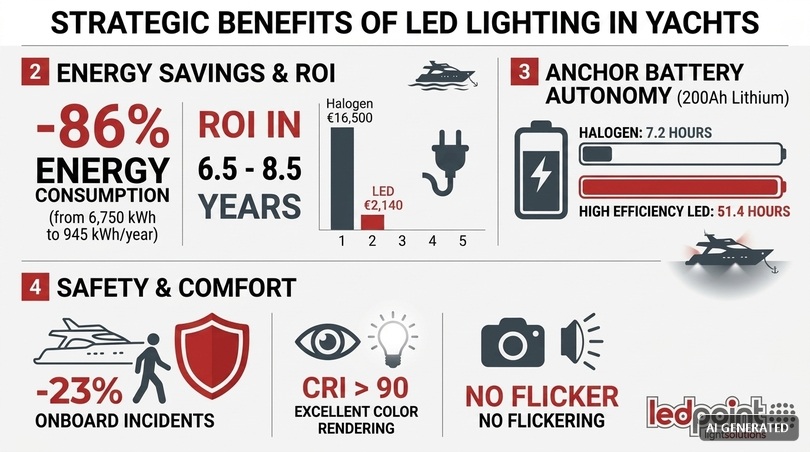
Let's make a concrete calculation: a 25-meter yacht with 150 halogen light points of 50W each consumes as much as 7,500W for lighting when all the light points are on. In one hour of use, this means 7.5 kWh. Considering an average use of 6 hours a day for 150 days a year (typical nautical season in the Mediterranean), we obtain an annual consumption of 6,750 kWh.
Replacing the same light points with equivalent LEDs of 7W (which produce the same light as 50W halogens thanks to greater efficiency), consumption drops to 1,050W total, equal to 1.05 kWh per hour. Annual consumption therefore becomes 945 kWh, with a saving of 5,805 kWh per year. In percentage terms, this is a reduction of 86%, a value that no other efficiency intervention on board is able to match for the same investment.
Cost-benefit analysis: return on investment
Considering an average cost of electricity in the marina of € 0.40/kWh (often higher than the domestic grid), the annual economic saving amounts to € 2,322. If we consider that the complete replacement of the system for a yacht of these dimensions has an average cost of € 15,000-€ 20,000, the investment pays for itself in just 6.5-8.5 years.
But there's more: most generators on board work in load conditions much lower than their capacity when powering traditional lighting. With LEDs, it is possible to reduce the power of the onboard generator or, in some cases, even eliminate the need to turn it on for lighting, relying instead on the service batteries. On a vessel moored at anchor, this means being able to spend an entire evening with all the lights on without the noise and vibrations of the generator: a benefit that hardly translates into euros, but which owners systematically indicate as the most appreciated after a refit.
| Scenario | Annual consumption (kWh) | Annual energy cost | Annual maintenance | 5-year total cost |
|---|---|---|---|---|
| Halogen lighting | 6,750 | € 2,700 | € 600* | € 16,500 |
| LED lighting | 945 | € 378 | € 50 | € 2,140 |
| LED saving | 5,805 kWh | € 2,322 | € 550 | € 14,360 |
*Lamp replacement, labor, disposal
Safety on board: lighting to protect
Correct lighting represents one of the most underestimated safety factors on board a yacht. According to statistics from the international nautical safety organization, 23% of accidents on board (falls, trips, bumps) occur in conditions of insufficient lighting. On a surface that moves, which is often wet and which presents continuous level changes, the quality of light is not an aesthetic detail but an active protection device.
LEDs offer unique characteristics for safety:
- Immediate ignition: unlike fluorescent technologies that require time to reach full brightness, LEDs provide 100% of the light immediately. This is crucial in emergency situations or when turning on lights in dark environments.
- Absence of flicker: quality LEDs do not present the typical flicker of fluorescent lights, which can cause visual fatigue, headaches and, in rough sea conditions, increase the risk of seasickness.
- Uniform lighting: with LEDs it is possible to design lighting systems that completely eliminate shadow areas and excessive contrasts, two of the main causes of accidents on board.
- Absence of incandescent surfaces: with operating temperatures around 40 °C, there is no risk of burns on contact or ignition on curtains and cladding.
- Resistance to vibrations: lacking filaments and pressurized gases, LEDs withstand mechanical stresses that would destroy any traditional lamp.
Particularly important is the lighting of passages, stairs and transit areas. For these applications, we recommend rigid LED strips which offer a perfectly uniform light distribution and exceptional durability even in difficult environments such as yacht interiors.
Battery autonomy: the advantage you feel at anchor
On a vessel, every watt saved on lighting is a watt that remains available for the refrigerator, the autopilot, navigation instruments or the inverter. The calculation is immediate: a 12V 200Ah lithium battery bank stores 2.4 kWh almost entirely usable. With a 300W halogen system at average load, autonomy is about 8 hours. With the same system converted to LED (42W average load), autonomy exceeds 57 hours.
| Configuration | Lighting load | Autonomy with 12V 100Ah AGM (50% DoD) | Autonomy with 12V 200Ah lithium (90% DoD) |
|---|---|---|---|
| Traditional halogen | 300 W (25 A) | 2.0 hours | 7.2 hours |
| Mixed halogen/LED | 150 W (12.5 A) | 4.0 hours | 14.4 hours |
| Standard LED | 60 W (5 A) | 10.0 hours | 36.0 hours |
| High efficiency LED + dimmer | 42 W (3.5 A) | 14.3 hours | 51.4 hours |
These numbers explain why conversion to LED is the first intervention recommended to those who want to increase energy autonomy even before investing in new batteries or a photovoltaic system: reducing consumption costs much less than increasing storage capacity. One meter of efficient LED strip replaced costs a fraction of what the additional kWh of lithium battery needed to power the old solution costs.
Visual comfort: CRI, color temperature and absence of flicker
A system can be extremely efficient and still be wrong. The parameter that determines whether the light on board is pleasant or annoying is spectral quality, measured mainly through the color rendering index. A CRI of 80 is acceptable for a technical room, but in a salon where food is served and precious wood finishes are observed, a CRI higher than 90 is necessary, ideally with R9 (saturated red) greater than 50 to correctly return complexions and fabrics. We have dedicated a complete technical insight to the subject in our guide Discovering CRI.
The second parameter is flicker, that is the oscillation of the luminous flux. On land it is often tolerable; on board, where the movement of the vessel adds its stroboscopic effect to that of the source, a high flicker is a documented cause of fatigue and nausea. LED strips powered by stabilized direct current and dimmed with PWM frequency higher than 2 kHz (ideally 10-25 kHz) eliminate the problem. Beware of cheap dimmers that work at 200-500 Hz: they are the most frequent cause of discomfort reported by guests.
The third parameter is chromatic uniformity between one meter of strip and another, measured in Step MacAdam. On a continuous line of 30 meters along a corridor, a tolerance of 5 Step produces differences in hue visible to the naked eye; a tolerance of 3 Step or less is instead imperceptible. It is a parameter that must be explicitly requested during the order phase and that clearly distinguishes the professional product from the generic one.
Value of the vessel and commercial appeal
In the nautical used market, the lighting system is one of the first elements that a potential buyer evaluates during the visit, because it immediately communicates the state of general updating of the boat. A modern, dimmable and scenographic LED system produces a "wow" effect that has a measurable impact on the negotiation. From surveys of sector brokers, a complete lighting refit on a 15-25 year old vessel recovers on average 60-80% of its cost in the sale price, and above all significantly reduces the time on the market.
Then there is the charter chapter: boats destined for rental with controllable RGBW lighting and underwater lights record higher occupancy rates and can apply premium rates, because the night photograph of the illuminated vessel has become the main marketing tool on booking portals. An investment of a few thousand euros in neon flex and underwater lights often pays for itself in a single season thanks to better commercial positioning.
4. Types of LED lighting for yachts: choosing with awareness
The world of LEDs for nautical applications is extremely varied. In this chapter, we will explore every available type, analyzing pros and cons, ideal applications and specific technical characteristics for the marine environment. The general rule to keep in mind is that on board there is no type that is good for everything: a well-designed system combines at least three or four product families, each assigned to the task for which it is optimal.
LED strips: the versatile solution for every need
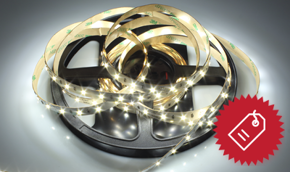
LED strips represent the most versatile and widespread solution for lighting modern yachts. Their installation flexibility, high customization and the possibility of creating continuous lighting effects make them ideal for numerous applications on board. In shipyard practice, today over 70% of linear meters of light installed on a new vessel is made with LED strips, integrated into coves, shelves, under-cabinets, false ceilings and skirting boards.
Flexible LED strips: adaptability without compromise
Flexible LED strips are made on a flexible copper tape that can be bent and curved to follow any profile. This characteristic makes them perfect for:
- Contour lighting: creating light games along the profiles of the yacht, highlighting the design lines without interruptions.
- Installation in irregular spaces: following complex curves such as those of furniture, ceilings or walls of internal environments.
- Creation of personalized shapes: with careful planning, it is possible to create personalized lighting motifs that reflect the owner's style.
High-quality flexible LED strips for nautical applications must have specific characteristics:
| Characteristic | Minimum value | Recommended value | Verification test |
|---|---|---|---|
| IP protection degree | IP65 | IP67 or IP68 | Temporary immersions |
| Operating temperature | -20 °C to +40 °C | -30 °C to +60 °C | Complete thermal cycles |
| Resistance to salt spray | 500 hours salt fog | 1000 hours salt fog | ASTM B117 standard |
| LED density | 30 LED/m | 60-120 LED/m | Lighting uniformity |
| Chromatic tolerance | 5 Step MacAdam | ≤ 3 Step MacAdam | Comparison on 10 m continuous |
| Color rendering index | CRI 80 | CRI 90+ (R9 > 50) | Spectrophotometer |
| Copper thickness of PCB | 1 oz (35 µm) | 2 oz (70 µm) | Microscopic section |
For external applications or in particularly humid environments such as yacht bathrooms, we recommend IP67 waterproof LED strips which offer complete protection against water splashes and humidity.
12V or 24V LED strips: which voltage to choose on board
It is the most frequent question we receive from those facing a refit, and the correct answer depends on the electrical architecture of the vessel. 12V LED strips are the natural choice on sailboats, dinghies and cabin cruisers up to 12-14 meters, where the onboard bus is 12V and the strip can be connected directly to the service line with a simple fuse and a dimmer. 24V LED strips dominate instead on vessels over 15 meters, where the bus is 24V.
The substantial technical difference concerns the voltage drop along the strip. A 12V strip of 14.4 W/m can be powered from one side for a maximum of 5 meters before the final end results visibly less bright; the same strip in 24V version comfortably reaches 10 meters. This translates into fewer power points, fewer cables, fewer junctions and therefore fewer potential failure points in an aggressive environment like the marine one.
| Criterion | 12V LED strip | 24V LED strip | Winner on board |
|---|---|---|---|
| Maximum length powered from one side | 5 m | 10 m | 24V |
| Current absorbed at same power | double | half | 24V |
| Cable section required | greater | smaller | 24V |
| Compatibility with small boat systems | direct | requires DC-DC converter | 12V |
| Typical cutting pitch | 2.5-5 cm | 5-10 cm | 12V |
| Availability of high density products | good | excellent | 24V |
| Line losses on 10 m | up to 12% | about 3% | 24V |
You can consult the entire range divided by voltage in the dedicated sections for 12V LED strips and 24V LED strips. If the onboard bus is 24V but 12V devices are needed (or vice versa), the correct solution is not a resistive divider but a quality isolated DC-DC converter, sized with at least 30% margin on the power absorbed.
COB LED strips: continuous light without dotting
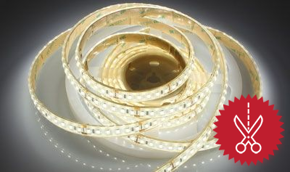
COB (Chip On Board) technology represents the most significant evolution of LED strips in recent years. Instead of mounting individual spaced SMD chips, COB has hundreds of micro-chips arranged under a uniform layer of phosphors, generating a line of light free of visible points even at close range and without the need for opaque diffusers. On a yacht, where shiny surfaces and mirrors multiply reflections, this characteristic is decisive: an SMD strip reflected in a crystal produces a row of dots, a COB strip produces a clean line.
The practical advantages of COB in the nautical field are three. First, the wider emission angle (up to 180°) better illuminates narrow coves. Second, distributed heat dissipation reduces hot spots and extends the life of the product. Third, the reduced minimum radius of curvature allows following the curved profiles typical of naval carpentry without stressing the components. You can find the complete range in the section COB LED strips.
LED spotlights: precision and performance
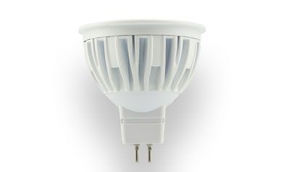
LED spotlights represent the ideal solution for precision lighting on board a yacht. Unlike strips that create diffuse lighting, spotlights allow you to direct the light exactly where it is needed, with opening angles ranging from 15° for accent lighting to 120° for general lighting. In naval lighting design, the spotlight is the tool with which the visual hierarchy is built: you choose what should be seen first.
Outdoor spotlights: resistance in extreme conditions
Lighting the exteriors of a yacht represents one of the most complex challenges in the field of nautical lighting. Waterproof outdoor LED spotlights must resist extreme environmental conditions:
- UV radiation: continuous exposure to direct sunlight can quickly degrade plastic materials and colors. Quality spotlights use materials with UV stabilizers and resistant finishes.
- Thermal cycles: the temperature difference between day and night, especially when sailing, can be considerable. Materials must have compatible thermal expansion coefficients to avoid cracking.
- Vibrations and mechanical stresses: wave motion and engine vibrations continuously stress the components. Spotlights must be designed with robust fixing systems and stabilized electronic components.
- Galvanic corrosion: contact between different metals in the presence of saline electrolyte triggers very rapid corrosive phenomena. For this reason, the bodies must be in AISI 316L stainless steel, chrome-plated brass or marine-grade anodized aluminum, never in generic alloys.
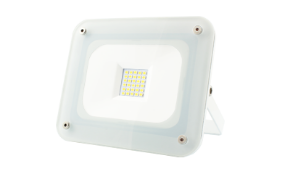
For lighting external decks, we recommend professional LED spotlights specifically designed for nautical applications, with certifications of resistance to weather and saline corrosion. For areas that require high luminous flux, such as the stern platform or tender garage, the choice falls on LED floodlight projectors, available in versions with high protection degree and asymmetrical optics that avoid glare towards the water surface.
Underwater lights and waterline lighting
Underwater lights for boats have gone from exotic accessory to almost standard element on vessels over 12 meters, and represent the single intervention with the greatest scenographic impact in absolute terms. Installed on the transom or on the hull below the waterline, they transform the surrounding water into a luminous volume that makes the vessel visible and recognizable from hundreds of meters away.
In addition to the aesthetic effect, there are two relevant practical functions. The first is safety: a vessel at anchor with underwater lights on is much more visible to passing boats and allows you to immediately spot a person in the water during night swimming. The second is fishing and observation: light attracts plankton and with it fish, an effect systematically exploited by those who practice night fishing.
| Type | Typical power | Flux in water | Installation | Ideal application |
|---|---|---|---|---|
| IP68 submersible LED strip | 14.4 W/m | 900-1,200 lm/m | Gluing/channel, above or below waterline | Waterline, platform steps |
| IP68 neon flex | 9-14 W/m | 500-900 lm/m | A316 stainless steel clips | Hull contours, continuous halo |
| Through-hull underwater spotlight | 50-300 W | 4,000-25,000 lm | Through-hole on hull | Transom, volumetric effect |
| Surface underwater spotlight | 20-80 W | 1,500-6,000 lm | External structural gluing | Refit without drilling |
| IP68 recessed walkable spotlight | 3-12 W | 200-900 lm | Recessed on teak/composite | Deck marker, pool edge |
For permanent submerged applications the rule is mandatory: only products declared IP68 with specified depth and duration of immersion. An IP67, which guarantees sealing to 1 meter for 30 minutes, is not suitable for continuous immersion. In our selection you can find special LED strips and submersible solutions with integral filling resin, the same technology used for lighting swimming pools, hot tubs and fountains.
Courtesy lights, step lights and waterproof ceiling fixtures
They are the least apparent and together the most used lighting fixtures. Courtesy lights recessed on bulkheads, steps and side decks provide the minimum level of night orientation without compromising the scotopic adaptation of the eye, essential for those at the helm. The design rule is simple: illuminate the walking surface, never the eyes of those walking. It follows that step lights should be installed at a height between 15 and 40 cm from the walking surface, with shielding that prevents direct vision of the source.
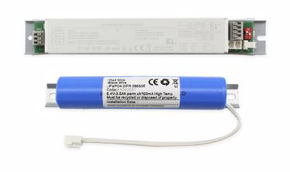
Waterproof LED ceiling fixtures are instead used in technical rooms, engine rooms, lockers and the tender garage, where robustness, high IP degree and zero maintenance are needed. In the engine room it is advisable to provide two separate circuits, one main and one emergency powered by an independent line, to guarantee visibility even in case of failure of the main panel. The same logic of redundancy applies to escape routes, where it is appropriate to provide devices with integrated emergency lighting and buffer battery.
LED bars, modules and furniture backlighting
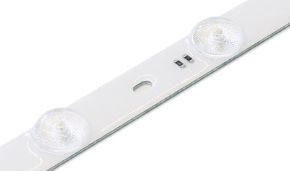
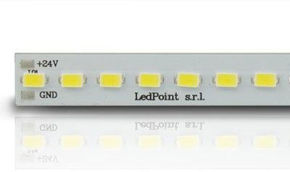
Rigid aluminum LED bars represent an interesting compromise between strip and finished fixture: they have the integrated heat sink, are already wired and are fixed with screws or clips, drastically reducing installation time in spaces where gluing a strip would be complicated. They are the preferred solution for under-cabinet lighting in the galley, for the interior of wardrobes and for technical compartments.
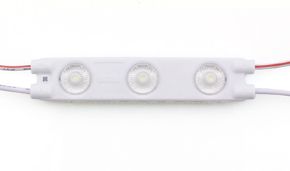
LED modules for backlighting instead allow you to create homogeneous luminous surfaces behind etched glass, onyx, corian or technical fabric panels: it is the technique with which the backlit walls of salons and the boat name signs are made. Design requires attention to the relationship between the depth of the box and the pitch of the modules, typically 1:1 to obtain uniformity without seeing the individual sources.
Comparison table: which technology for which area of the yacht
This table summarizes in an operational way the choice of type according to the environment, with the technical values to be specified during the order phase. It is the document we recommend bringing to the shipyard at the time of the survey.
| Yacht area | Recommended solution | IP degree | Color temperature | Minimum CRI | Design notes |
|---|---|---|---|---|---|
| Main salon | COB strips in cove + adjustable spotlights | IP20 | 2700-3000K | 90 | Dimming down to 1%, multiple scenes |
| Owner cabins | CCT strips + adjustable reading lights | IP20 | 2200-4000K variable | 90 | Independent reading circuit |
| Bathrooms and showers | IP67 strips + IP65 spotlights | IP65-IP67 | 3000-4000K | 90 | SELV 24V power supply mandatory |
| Galley and kitchen | Under-cabinet LED bars | IP20-IP44 | 4000K | 90 | 500 lux on work surface |
| Wheelhouse | Dimmable red/amber lights | IP44 | 1800-2200K | — | Preserve night vision |
| Engine room | Waterproof ceiling fixtures + emergency | IP65-IP67 | 5000-6500K | 80 | 300 lux, redundant circuit |
| External decks and side decks | IP67 step lights + neon flex | IP67-IP68 | 2700-3000K | 80 | No source in field of view |
| Hull contours and superstructures | IP68 neon flex | IP68 | 3000K or RGBW | 80 | A316 stainless steel clips, bilateral power supply |
| Waterline | IP68 submersible strips | IP68 | Blue/RGB | — | Integral resin, waterproof connectors |
| Beach club and platform | IP68 spotlights + submersible strips | IP68 | RGBW | 80 | Certified walkability |
| Tender garage and lockers | Bars and waterproof ceiling fixtures | IP66 | 5000K | 80 | Automatic ignition on opening |
| Flybridge | Neon flex + adjustable spotlights | IP67 | 2700K + RGBW | 80 | Dedicated evening scenes |
5. Marine neon flex: the superior technology for linear light
If there is a technology that has changed the face of yacht lighting in recent years, it is neon flex. In this dedicated chapter we analyze what it exactly is, why it is structurally superior to the traditional LED strip in the marine environment, where it is convenient to use it and what technical precautions the installation requires. It is the chapter densest with practical indications of the entire guide, because it is also the area where errors are paid for the most.
Neon flex: what they are and why they are superior for nautical applications
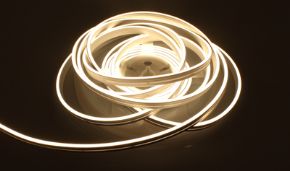
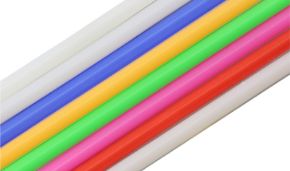
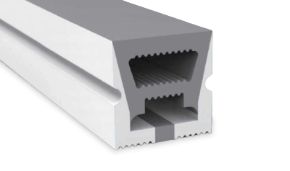
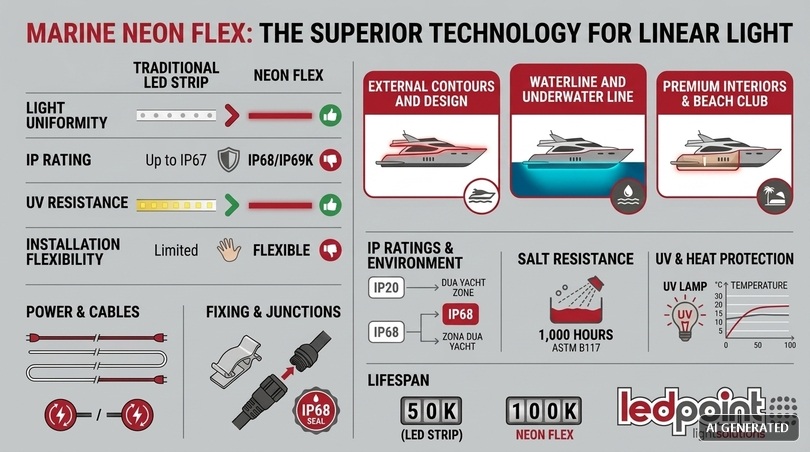
Neon flex, often also called LED neon or LED silicones, are flexible profiles in high-quality silicone or polyurethane inside which high-density LED chips are integrated. Unlike traditional LED strips, which expose individual light points, neon flex create a perfectly continuous and uniform line of light, without hot spots or shadow areas. This characteristic is particularly valuable in the environments of a yacht, where the quality of light and the absence of visual discontinuities are indispensable luxury parameters.
The structure of a quality neon flex for nautical applications is engineered to resist the marine environment: the outer shell in marine polyurethane or silicone (often with IP68 or IP69K certification) is completely hermetic, waterproof not only to splashes but also to temporary immersion. Resistance to UV rays is exceptional, with materials that do not yellow even after thousands of hours of exposure to direct sun and salt spray. Compared to traditional LED strips, which require aluminum profiles and diffusers to obtain uniform light and adequate protection, neon flex offer an integrated solution simpler to install and more reliable over time.
| Characteristic | Traditional LED strip + profile | Polyurethane Neon Flex | Neon flex advantage |
|---|---|---|---|
| Light uniformity | Discreet, shows single light points | Excellent, continuous light without points | +300% in uniformity |
| IP protection degree | IP65-IP67 with perfect installation | Intrinsic IP68-IP69K | Guaranteed superior protection |
| Mechanical resistance | Medium, exposed LED chips to impacts | High, chips completely encapsulated | +500% resistance to impacts/vibrations |
| UV/salt spray resistance | Depends on additional materials | Intrinsic of silicone/PU material | Guaranteed no yellowing |
| Minimum radius of curvature | 3-5 cm (risks damaging LEDs) | 1-2 cm (without risks to components) | +150% installation flexibility |
| Installation in humid environments | Requires additional sealants | Ready to use, factory-sealed | 70% reduction in installation time |
Specific applications for yachts where neon flex excel
On modern yachts, neon flex find ideal applications where continuous linear lighting of high aesthetic impact and maximum reliability is required. LED strips, although versatile, show their limits in these scenarios:
- External contours and design lines: the profiles of the yacht, railings, handrails and drip lines require continuous lighting that elegantly marks the shapes without interruptions. Neon flex, with their uniform light, create a particularly spectacular "suspended in the void" effect at night, defining the lines of the yacht with millimetric precision.
- Underwater lighting and flush with the waterline: this is perhaps the most demanding application and where neon flex demonstrate all their superiority. While LED strips require complex sealing and protection systems, neon flex are designed for continuous immersion. They can be installed along the waterline to create spectacular effects that make the yacht seem to float on a halo of light, or even in underwater configuration to illuminate the water around the hull, increasing visibility and night safety.
- Premium internal environments: in salons, cabins and common areas, neon flex installed in channels or flush with surfaces create superior quality indirect lighting. The total absence of visible light points and the homogeneity of the light source reduce glare and create more refined and comfortable atmospheres, essential on the luxury yacht.
- Onboard pools, hot tubs and beach club: in these areas subject to splashes, high humidity and intensive use, the total waterproofing of neon flex (IP68/IP69K) makes them the only really safe and durable choice over time. They can be installed at the poolside, along the steps or as atmosphere lighting in the beach club area without worries about infiltration or short circuits.
Technical considerations for installing neon flex on yachts
The installation of neon flex on a yacht requires some specific considerations that differ from traditional LED strips:
- Power supply and control: most neon flex operate at 12V or 24V DC, perfectly compatible with onboard electrical systems. However, given their potential length (up to 30-50 continuous meters without visible joints) and high luminous power, it is fundamental to correctly calculate the section of the power cables to avoid voltage drops that would cause differences in color or brightness along the path. For lengths over 10 meters, we recommend power supply from both ends (double power supply) or intermediate power points.
- Mechanical fixing: quality neon flex are equipped with A316 stainless steel (marine) or high UV-resistant plastic fixing clips. Installation on complex curved surfaces (typical of yachts) is simplified by the exceptional flexibility of the material, which can follow curves with radii of only 1-2 centimeters without mechanical stresses. For permanent installations, it is possible to use specific marine structural adhesives, but clips remain the preferred solution for ease of maintenance and replacement.
- Junctions and fittings: unlike LED strips that can be cut every 5-10 cm, neon flex have predetermined cutting points (typically every 50 cm or 1 meter). To connect two segments or create angles, there are special waterproof connectors that maintain aesthetic continuity and IP protection. For 90° angles or specific curves, it is possible to order preformed pieces or use special fittings that preserve the hermeticity of the system.
- Maintenance and duration: the declared useful life of high-quality neon flex is 50,000-100,000 hours (L70, that is when the luminous emission drops to 70% of the initial value), significantly higher than traditional LED strips (30,000-50,000 hours). This translates into 15-30 years of use with an average nautical season of 180 days/year at 8 hours/day. Maintenance is practically zero: occasional cleaning with fresh water and mild detergent to remove salt deposits is enough to maintain optimal performance.
In conclusion, while LED strips remain an excellent solution for many applications on board, neon flex and polyurethane neon represent the premium option for continuous linear lighting on yachts. They offer superior luminous uniformity, intrinsic protection against the marine environment, greater durability and an unparalleled aesthetic. For the yacht owner looking for the highest quality, reliability and visual effect, investing in a neon flex system means choosing the most advanced technology currently available in the field of nautical linear lighting.
Neon flex side view or top view: the choice that changes the result
A detail that often escapes during the specification phase is the emission direction. Top view neon flex emit perpendicularly to the laying plane and are the correct choice when the luminous line is seen from the front, for example along a horizontal handrail. Side view neon flex emit laterally and allow you to curve the profile on the horizontal plane, following the hull shapes seen from above: they are indispensable for outlining the shape of a deck or for following the curvature of a spiral staircase.
Choosing the wrong type often means having to force the material on a curvature plane that is not its own, with the result of mechanical stresses, deformation of the shell and in the worst cases detachment of the chips from the circuit. The practical rule is immediate: if the curve is "flat" you need side view, if the curve is "edged" you need top view. The complete range, including second-generation versions with double-density shell, is available in the sections Neon Flex and Neon Flex 2nd generation.
6. IP ratings, salt spray and materials: surviving the marine environment
No environment is more hostile to electronics than the marine one. The combination of permanent humidity, saline aerosol, thermal excursion, intense ultraviolet radiation and continuous vibration constitutes a durability test that few products pass. Understanding how these factors act, and what countermeasures to adopt, is the difference between a system that lasts fifteen years and one that starts giving problems in the second season.
IP protection degrees explained without ambiguity
The IP (Ingress Protection) acronym defined by the IEC 60529 standard is composed of two digits: the first indicates protection against solid bodies (from 0 to 6), the second against liquids (from 0 to 9K). The most common, and most expensive, error is to consider the degrees as a linear scale where "higher is better": in reality IP67 and IP68 describe different tests, and IP66 is not automatically included in IP67. A product certified IP67 might not have passed the powerful jet test provided by IP66.
| IP degree | Test provided | Suitable for | NOT suitable for |
|---|---|---|---|
| IP20 | No protection against liquids | Dry interiors, false ceiling coves in cabin | Bathrooms, exteriors, bilges |
| IP54 | Splashes from any direction, limited dust | Internal technical rooms | Exposed deck |
| IP65 | Water jets 12.5 l/min from 3 m | Covered deck, external dinette, showers | Immersion, high-pressure washing |
| IP66 | Powerful jets 100 l/min | Pressure-washed areas, engine room | Prolonged immersion |
| IP67 | Immersion 1 m for 30 minutes | Side decks, floodable lockers, pool edge | Permanent immersion |
| IP68 | Continuous immersion at declared depth | Waterline, submerged applications | — |
| IP69K | Jets at 80 °C and 100 bar | Areas subject to industrial washing | — |
A technical clarification that we always repeat to clients: the IP degree of an LED strip is valid only if the installation preserves it. Cutting an IP68 strip without correctly sealing the cut with the special resin kit and end cap means having bought an IP20 product with a decorative coating. Similarly, a non-waterproof quick connector inserted on an IP67 line makes the entire downstream section IP20. The protection chain is as strong as its weakest link.
Salt spray and corrosion: the invisible enemy
Saline aerosol penetrates everywhere, even in apparently protected environments like internal false ceilings, transported by air exchange. Depositing on electrical contacts and in the presence of humidity, it forms an electrolytic solution that triggers galvanic corrosion between metals with different electrochemical potential. The critical point on an LED system is not the chips, but the junction points: soldering, terminals, connectors.
Effective countermeasures are three and must be applied together. The first is the choice of materials: AISI 316L stainless steel for screws and clips, complete tinning of copper conductors, connectors with gold contacts. The second is conformal protection: application of acrylic or silicone conformal paint on exposed soldering points, and use of heat-shrink sheaths with internal adhesive on every junction. The third is physical separation: avoiding direct contact between the aluminum of the profiles and the stainless steel of the screws by interposing insulating washers, standard practice in naval carpentry that is too often forgotten in light system installation.
The laboratory reference verification is the salt fog test according to ASTM B117 (equivalent to ISO 9227): a product destined for marine exteriors should declare at least 1,000 hours of resistance without functional degradation. It is data that serious manufacturers report in the technical data sheet and that is worth explicitly requesting.
UV rays, heat and aging of materials
Ultraviolet radiation in the open sea is amplified by reflection on the water surface, with an increase in effective irradiation estimated between 15% and 25% compared to the same latitude on land. On a low-quality silicone shell this produces visible yellowing already after one season, with consequent drift of the color temperature towards warm and loss of flux up to 20%. The correct materials are UV-additivated LSR (Liquid Silicone Rubber) silicone and aliphatic polyurethane, both characterized by documented chromatic stability on QUV tests of at least 3,000 hours.
On the thermal front, the golden rule is that every 10 °C of junction temperature more halves the useful life of the LED. On a deck exposed to the sun, the surface temperature of a dark profile can exceed 70 °C: if that value is added to the heat generated by the strip, it easily exceeds the maximum declared junction temperature. The solution consists in oversizing the heat sink, preferring light-colored or naturally anodized aluminum profiles and, when possible, reducing the specific power by choosing a longer strip with lower W/m rather than a short one with high power.
7. Regulations and certifications for onboard lighting
A lighting system on a pleasure boat is not subject to the same rules as a civil system. Knowing the regulatory framework is not only useful to be in order: it is useful to make correct technical choices and to avoid that a classification body or an insurance expert contests the installation after a claim. Below is the summary of the regulations that actually affect the onboard lighting design.
| Standard / reference | Subject | Relevance for LED lighting |
|---|---|---|
| ISO 10133 | Low voltage DC electrical systems on pleasure craft | Cable sections, protections, conductor colors, admitted voltage drops |
| ISO 13297 | AC systems on board | Circuit separation, grounding, differential protection |
| IEC 60092 (series) | Naval electrical systems | Requirements of marine cables, fire and oil resistance tests |
| IEC 60598-1 / -2-18 | Lighting fixtures, fixtures for swimming pools and similar uses | Electrical safety of fixtures, SELV for wet areas |
| IEC 60529 | Degrees of protection of enclosures (IP code) | Definition and verification of declared IP classes |
| COLREG 72 / RIPAM | International regulations for preventing collisions at sea | Navigation lights: colors, sectors, range, approval |
| Directive 2013/53/EU | Pleasure craft and personal watercraft | CE marking of the vessel and component compliance |
| UNI EN 12464-1 | Lighting of indoor workplaces | Reference for lighting levels in technical and work rooms |
| Reg. EU 2019/2020 | Ecodesign of light sources | ErP/EPREL requirements and energy class of products |
| ASTM B117 / ISO 9227 | Salt fog test | Verification of resistance to marine corrosion |
Navigation lights: where aesthetics must stop
There is a line that no design choice can cross: running lights, or navigation lights, are safety devices regulated by COLREG and cannot be replaced, modified or integrated with decorative solutions. Colors, angular sectors of visibility and minimum range in miles are prescribed according to the length of the vessel and must be respected to the letter. An LED light is allowed only if specifically approved as such.
The point of attention mainly concerns external decorative lighting: neon flex and underwater lights must not in any way confuse the reading of navigation lights by other vessels, and in night navigation good seamanship practice requires turning off every scenographic lighting that can generate ambiguity or glare. For this reason, in the design phase of the control system, it is essential to provide a "Navigation" scene that automatically turns off all effect lights leaving only navigation lights, shielded courtesy lights and instrumental lighting in the wheelhouse active.
Safety extra-low voltage and wet areas
In bathrooms, showers, in the beach club area and near swimming pools and hot tubs, the power supply of fixtures must be of SELV (Safety Extra Low Voltage) type, with voltage not exceeding 12V in water and 24V out of water, obtained through a transformer or power supply with safety insulation. It is not allowed to power fixtures in the wet area from a 230V line, even with differential protection.
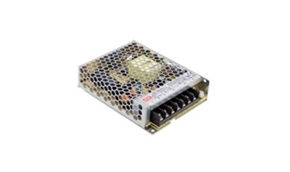
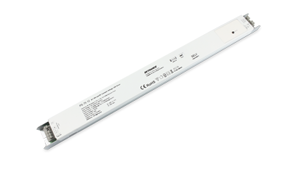
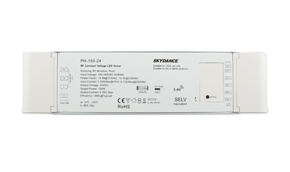
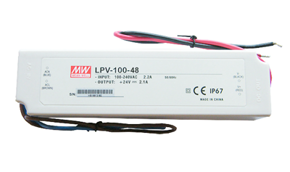
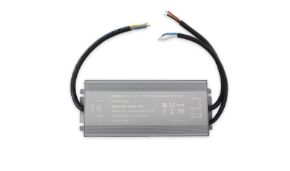
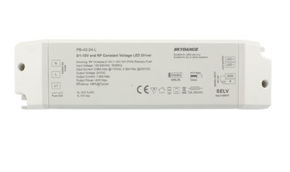
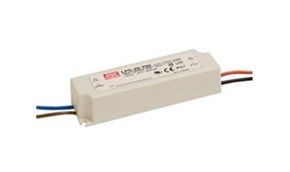
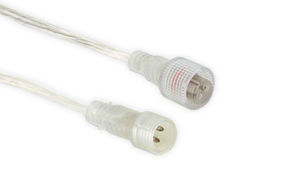
This requirement has an important practical consequence in the choice of power supply: a device with certified reinforced insulation is needed, not a simple commercial switching power supply. In the section 24V power supplies and 12V power supplies models with the appropriate certifications are available, including versions with high protection degree installable in humid environments.
8. Designing a yacht lighting system: a fundamental activity
Correctly designing the lighting system of a yacht requires specific technical skills and a deep understanding of both functional and aesthetic needs. In this chapter, we will guide you step by step through the design process, providing practical tools and proven methodologies. The guiding principle is that light is designed, not fixtures: the choice of product comes last, as a consequence of decisions made on atmospheres, lighting levels and usage scenes.
Analysis of lighting needs: the starting point
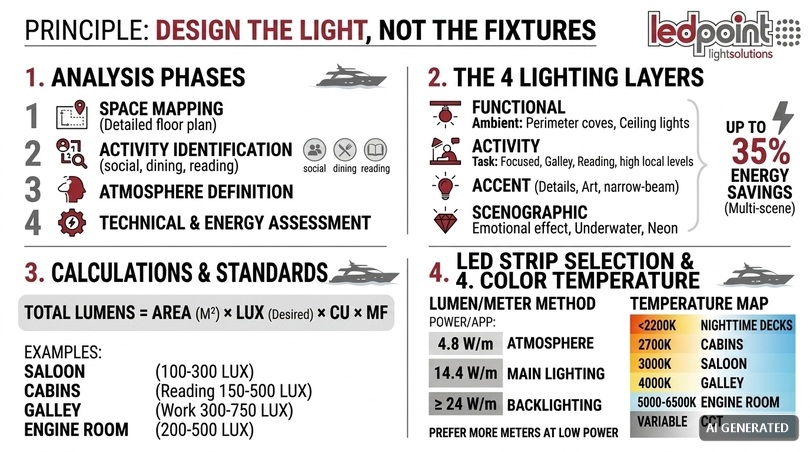
Before selecting any product, it is fundamental to conduct an in-depth analysis of the specific lighting needs of your yacht. This process is articulated in four fundamental phases:
Phase 1 - space mapping: create a detailed floor plan of every environment, indicating dimensions, heights, surface colors and presence of relevant architectural elements. For a 30-meter yacht, this phase typically requires 8-12 hours of work.
Phase 2 - identification of activities: for each area, define the main activities that take place there. For example, the main deck could host socialization, dining, reading and night navigation activities, each with specific lighting requirements.
Phase 3 - definition of atmospheres: establish the different desired lighting atmospheres for each space. The same salon could require functional lighting for cleaning, atmosphere lighting for dinners and accent lighting to highlight works of art.
Phase 4 - technical evaluation: analyze existing infrastructures (cables, transformers, sockets), energy constraints (battery capacity, generator power) and applicable regulations (international nautical regulations).
The four-layer lighting method applied to boating
Professional lighting design superimposes four independent layers, each with a precise function and its own control circuit. On a yacht this method is even more effective than on land, because it allows you to drastically reduce consumption in night configurations while maintaining full lighting capacity when needed.
- Functional layer (ambient): guarantees the minimum lighting level to move and carry out ordinary activities. Typically made with strips in perimeter cove and ceiling fixtures. It is the layer that is turned on for cleaning and that remains off during dinners.
- Task layer: illuminates specific surfaces where a visual task is performed such as galley counter, chart table, bathroom mirror, reading armchair. It requires high local levels and high CRI.
- Accent layer: highlights materials, works of art, carpentry details. It is made with narrow-beam spotlights and contributes in a determining way to the perception of luxury.
- Scenographic layer: the light that is seen but does not illuminate, we find neon flex on contours, underwater lights, backlighting. It is the layer with the greatest emotional return and the lowest absolute consumption.
Designing by layers means being able to build different scenes by combining the same sources at different intensities, rather than installing more fixtures than necessary. On a 50 m² salon a correctly layered system uses about 35% less installed power than a single-layer system sized for the worst case.
9. Lighting calculations: from theory to practice
Once the needs are defined, it is possible to proceed with the actual lighting calculations. These calculations are based on precise physical principles and allow you to determine exactly how much light is needed in each environment, avoiding both undersizing and excess, which on board translates into useless consumption and glare.
The lumen method: scientific calculation of lighting
The lumen method is the most used to design the lighting of internal environments. It is based on the following fundamental formula:
Total lumens required = Area (m²) × Desired illuminance (lux) × Utilization factor × Maintenance factor
Let's analyze each component of the formula:
Area (m²): the surface of the environment to be illuminated. For a salon of 8m × 6m = 48 m².
Desired illuminance (lux): the luminous intensity necessary for the activity carried out. The reference values for a yacht are:
| Environment/Activity | Minimum illuminance (lux) | Recommended illuminance (lux) | Premium illuminance (lux) |
|---|---|---|---|
| Control bridge (night navigation) | 50 | 100 | 150 |
| Salon (socialization) | 100 | 200 | 300 |
| Cabins (rest) | 50 | 75 | 100 |
| Cabins (reading) | 150 | 300 | 500 |
| External decks (safety) | 20 | 50 | 75 |
| Diving/swim platform area | 100 | 200 | 300 |
| Galley (work surface) | 300 | 500 | 750 |
| Engine room | 200 | 300 | 500 |
| Bathroom (mirror) | 200 | 300 | 500 |
| Corridors and stairs | 50 | 100 | 150 |
Utilization factor (CU): takes into account the efficiency of the optical system and the reflectance of the surfaces. For environments with light walls and efficient optical systems, the CU varies between 0.6 and 0.8.
Maintenance factor (MF): considers the reduction of light over time due to dirt and LED decay. For quality LED systems in nautical environment, the MF is typically 0.7-0.8.
Practical example: calculation for the main salon
Let's suppose we want to illuminate a 48 m² salon on a luxury yacht. The desired illuminance for socialization activities is 250 lux. The walls are in light teak (average reflectance) and we choose high-quality spotlights.
Applying the formula:
Total lumens = 48 m² × 250 lux × 0.7 (CU) × 0.75 (MF) = 6,300 lumens
If we choose 800 lumen spotlights each, we will need:
Number of spotlights = 6,300 lumens / 800 lumens per spotlight = 7.875 → 8 spotlights
To uniformly distribute 8 spotlights in a 48 m² salon (8m × 6m), an optimal arrangement could be two rows of 4 spotlights each, with a spacing of about 2 meters between the spotlights on the length and 2 meters on the width. If you prefer to quickly verify the values without doing the calculations by hand, we have published a simplified method in the guide How to calculate the lux of an LED installation.
How many meters of LED strip are needed: the reverse calculation
In refit practice the problem often presents itself in reverse: not "how many spotlights", but "how many meters of strip of what power". The calculation is set starting from the linear flux of the strip, expressed in lumens/meter, and from the physical available length of the cove or profile.
| Strip power | Typical flux (CRI 90) | Meters for 3,000 lm | Absorption at 24V | Typical application on board |
|---|---|---|---|---|
| 4.8 W/m | 450 lm/m | 6.7 m | 0.2 A/m | Atmosphere light, under berth, steps |
| 9.6 W/m | 950 lm/m | 3.2 m | 0.4 A/m | Perimeter coves of cabins, corridors |
| 14.4 W/m | 1,450 lm/m | 2.1 m | 0.6 A/m | Salon, main indirect lighting |
| 19.2 W/m | 1,950 lm/m | 1.5 m | 0.8 A/m | Galley, deep coves, high yield |
| ≥ 24 W/m | 2,400+ lm/m | 1.3 m | 1.0+ A/m | Onyx backlighting, extended surfaces |
An important warning: on board it is almost always preferable to install more meters of low-power strip than a few meters of high power. The reason is twofold. On the one hand, the junction temperature remains lower and the useful life is significantly extended. On the other hand, the light distributed over a longer line produces a soft effect, while a concentrated source creates hard contrasts that in a confined space result annoying. The complete range divided by power is available in the section LED strips by power.
Color temperature: the thermal map of onboard environments
The choice of kelvins is the single parameter that determines the perception of the environment more than any other. On a vessel the general rule is to maintain warm temperatures in living and rest spaces, and reserve cold tones only for technical rooms. A cabin illuminated at 5000K immediately communicates an office sensation, regardless of the quality of the finishes.
| Color temperature | Perception | Recommended environments on board | To avoid in |
|---|---|---|---|
| 1800-2200K | Flame, amber | Night wheelhouse, external atmosphere lights, "night" scene | Work areas |
| 2700K | Very warm white | Cabins, evening salon, external dinette | Galley, bathrooms |
| 3000K | Warm white | Salon, corridors, bathrooms, side decks | Engine room |
| 4000K | Neutral white | Galley, chart table, walk-in closet | Night cabins |
| 5000-6500K | Cold white | Engine room, lockers, tender garage | All living environments |
| Variable CCT 2200-6500K | Adjustable | Owner cabin, salon, spa | — |
The most versatile solution for representative environments is the bicolor CCT strip, which allows you to continuously adjust the tone with the same fixture, replicating the trend of natural light during the day. It is the technology behind the bio-adaptive systems we talk about in the chapter on future trends, and it is available in the section CCT LED strips.
10. 12V and 24V power supply: batteries, power supplies and voltage drops
The power supply chapter is where most of the real failures of nautical LED systems concentrate. It is almost never the LED that breaks: it is the undersized power supply, the too thin cable, the oxidized junction or the alternator voltage spike. We therefore address the issue with the level of detail it deserves.
Direct connection to the onboard bus or dedicated power supply
On a vessel there are two strategies for powering LED strips, both legitimate but suitable for different contexts.
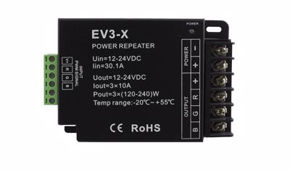
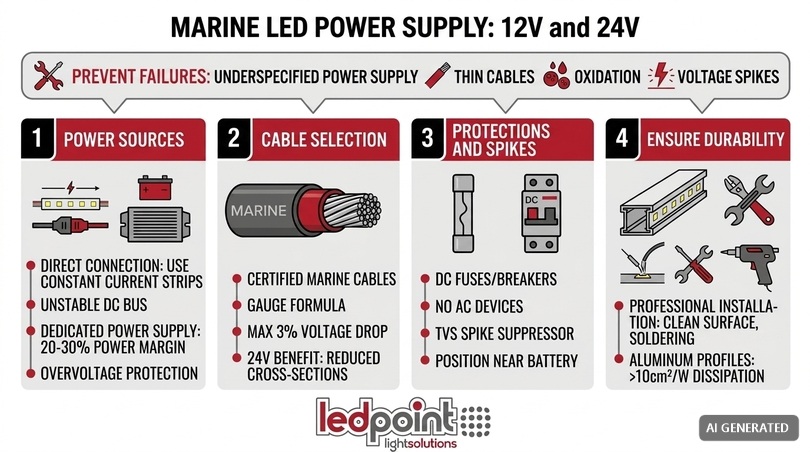
Direct connection to the onboard DC bus is the simplest and most efficient solution: the voltage is taken from the 12V or 24V service line, the circuit is protected with a correctly sized fuse and a dimmer is inserted. There are no intermediate conversions, so there are no efficiency losses. The limit is that the bus voltage is not stable: a "12V" system actually oscillates between 11.5V with discharged batteries and 14.8V during alternator charging, and on 24V it reaches peaks of 29.4V. Cheap strips with simple resistance react to these variations with brightness oscillations and, in the long term, with accelerated aging.
The professional solution consists in using strips with constant current control system, which integrate a regulator circuit capable of maintaining stable flux in the entire bus voltage range. They are available in the dedicated section for LED strips with constant current control and represent the correct choice in every application connected directly to the batteries.
The dedicated power supply is instead necessary when starting from the 230V line of the generator or shore power. In this case, models with wide input, overvoltage protection and, for wet areas, adequate protection degree must be chosen. A precaution often ignored: the power supply must be sized with at least 20-30% margin compared to the power absorbed, both to extend its life and to handle the startup surge.
Cable selection and laying: details that count
The choice of cables for a lighting system on a yacht must respect specific regulations and consider the unique operating environment of the sea.
Cable type: exclusively marine cables must be used, recognizable by the "Shipboard Cable" or "Marine Grade" acronym. These cables have specific characteristics:
- cross-linked polyethylene (XLPE) or ethylene propylene (EPR) insulation resistant to humidity and salt spray;
- outer sheath in polyurethane or polyvinyl chloride (PVC) resistant to UV and abrasion;
- coloring according to nautical standards (red for +, black for -, yellow/green for ground);
- flexible stranded conductors with tinned wires, never rigid, to resist vibrations;
- specific certifications (UL 1426, IEEE 45, CE EN 60092-350).
Section calculation: the section of the cables must be adequate to the current and the length of the path. Using the voltage drop formula:
Section (mm²) = (2 × Length (m) × Current (A) × Resistivity) / Admissible voltage drop
Where:
- resistivity of copper = 0.0175 Ω·mm²/m;
- admissible voltage drop = maximum 3% of the nominal voltage (for 12V: 0.36V; for 24V: 0.72V).
Example: to power a 5-meter LED strip that absorbs 2A at 12V, with a cable length of 8 meters from the power supply:
Section = (2 × 8m × 2A × 0.0175) / 0.36V = 1.56 mm² → 1.5 mm² cable is used (immediately higher commercial section)
| Current (A) | Cable length 5m | Cable length 10m | Cable length 15m | Cable length 20m |
|---|---|---|---|---|
| 1A | 0.75 mm² | 0.75 mm² | 1.0 mm² | 1.5 mm² |
| 3A | 1.0 mm² | 1.5 mm² | 2.5 mm² | 4.0 mm² |
| 5A | 1.5 mm² | 2.5 mm² | 4.0 mm² | 6.0 mm² |
| 10A | 2.5 mm² | 6.0 mm² | 10 mm² | 16 mm² |
Operational note: the values in the table refer to 12V systems. On a 24V bus, at the same power, the current is halved and the sections are reduced by about two sizes, with a saving in weight and cost of the wiring that on a large vessel becomes significant. It is one of the reasons why shipyards above 15 meters have standardized 24V.
Protections, fuses and voltage spikes
Every light circuit must have a dedicated protection, sized at 125-150% of the nominal current and installed as close as possible to the point of withdrawal from the battery, never downstream of long unprotected cable sections. On a DC onboard system the choice falls on ATO/MIDI type fuses or DC magnetic-thermal circuit breakers, never on devices designed for alternating current: the electric arc in direct current does not self-extinguish and an AC circuit breaker may not interrupt the circuit.
The second risk is represented by voltage transients generated by engine starting, sudden disconnection of inductive loads (winches, maneuvering propellers) and alternator regulators. A 40V peak on a nominal 24V line instantly destroys the driver circuits of the strips. The countermeasures are the installation of a transient voltage suppressor (TVS) on the light panel and the choice of power supplies and drivers with overvoltage protection declared in the technical data sheet.
11. Professional installation: ensuring performance and durability
The installation of LED systems on a yacht requires specialized skills and attention to details that can make the difference between a system that lasts years and one that presents problems already after a few months. In this chapter, we will provide a complete guide to professional installation, from cables to controls. It is worth underlining it immediately: in our after-sales assistance experience, over 80% of complaints on LED products in the nautical field are attributable to installation errors and not to product defects.
Infrastructure preparation: the invisible foundations
Before installing any light point, it is fundamental to correctly prepare the electrical infrastructure. This phase, often underestimated, represents 80% of the long-term reliability of the system. It includes the laying of trunking, the preparation of cable passages through bulkheads with appropriate cable glands and gaskets, the creation of derivation points in accessible positions and the documentation of the electrical diagram.
A specific aspect of the naval environment concerns passages through watertight bulkheads: every hole must be restored with certified cable gland that maintains the sealing degree of the bulkhead. Using silicone as the only sealing element on a structural passage is an error that can have serious consequences. Similarly, cables must be fixed with ties at intervals not exceeding 30 cm and never resting on surfaces that can reach high temperatures, such as exhaust manifolds or heating pipes.
Installation of LED strips: millimetric precision
The installation of LED strips requires particular attention to details to guarantee a professional and lasting result. We will follow step by step the process of installing an LED strip in a typical environment of a yacht.
Phase 1 - Surface preparation
The surface on which the LED strip will be applied must be:
- Clean: remove every trace of dust, grease, glue residues or contaminating substances. Use a specific detergent for surfaces to be glued, followed by a rinse with distilled water and complete drying.
- Dry: residual humidity would compromise adhesion. Use a microfiber cloth and, if necessary, a dryer at moderate temperature.
- Smooth and uniform: irregularities greater than 0.5 mm can cause detachment points or damage to the strip. For irregular surfaces, apply a leveling primer first.
- Dimensionally stable: avoid surfaces that undergo significant thermal expansions or vibrations without an adequate supplementary fixing system.
Phase 2 - Application of the LED strip
Quality LED strips are equipped with 3M adhesive on the back. For a correct application:
- progressively remove the protective film of the adhesive while applying the strip, avoiding exposing all the adhesive at the same time;
- precisely position the first section of strip, aligning it with the references traced in the design phase;
- apply uniform pressure along the entire strip, starting from the application point and proceeding along the path;
- for tight curves, respect the minimum radius of curvature specified by the manufacturer (typically 3-5 times the thickness of the strip);
- in points of greater stress (curves, junctions, near heat sources), apply supplementary mechanical fixing (plastic staples, clips, special hot glue).
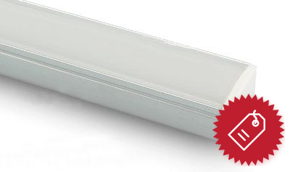
For particularly critical installations or in environments subject to strong vibrations, we recommend the use of aluminum profiles for LED strips which guarantee optimal heat dissipation and complete mechanical protection.
Phase 3 - Junctions and connections
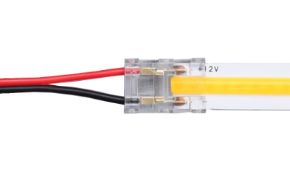
It is the most delicate point of the entire installation. In the marine environment, tin soldering with adhesive heat-shrink sheath remains the most reliable solution, decidedly superior to pressure connectors, which over time undergo contact oxidation and loosening due to vibrations. If quick connectors are used, models with declared IP degree and gasket must be chosen, and in any case reserved for dry and accessible internal areas for maintenance.
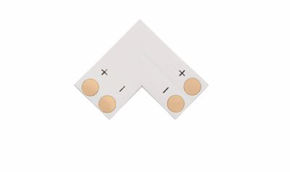
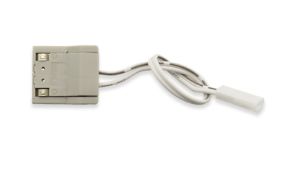
The correct procedure provides: preventive tinning of the strip pads and conductors, soldering with tin containing no-clean fluxing agent, cleaning of residues with isopropyl alcohol, application of conformal paint on exposed points and finally adhesive heat-shrink sheath that mechanically seals the junction. In the section solder junctions and PCB connectors for LED strips you can find all the necessary components.
Phase 4 - Testing and documentation
Before closing panels and false ceilings, every circuit must be individually tested by measuring voltage at the beginning and end of each section (the difference must not exceed 3%), actual absorption compared with the theoretical value and behavior in dimming at the extreme levels. It is also the moment to verify chromatic uniformity by observing the line from different angles.
The final documentation should include the updated single-line diagram, the position of every power supply and derivation, the exact product codes of every installed strip with related color temperature, and the controller settings. This folder is worth gold at the first maintenance intervention, when you need to replace a meter of strip identical to the one installed five years earlier.
Aluminum profiles: not an accessory but an active component
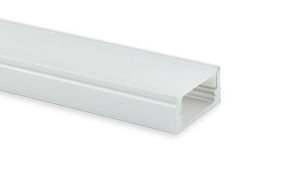
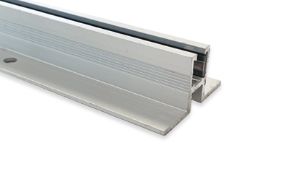
The aluminum profile simultaneously performs three functions that are often reduced to aesthetics alone. The first is heat dissipation: an adequate profile lowers the junction temperature by 15-25 °C, doubling or tripling the useful life of the strip. The second is mechanical protection against impacts, abrasions and accidental contact during cleaning. The third is optical control through the diffuser, which determines the emission angle and hides the dotting of SMD sources.
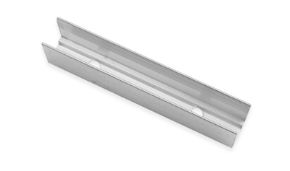
The practical sizing rule is that at least 10 cm² of dissipating surface are needed for every watt of power installed in still air conditions. On a 14.4 W/m strip this means a profile with at least 144 cm² of surface development per linear meter: a value that recessed profiles of 8-10 mm do not reach, which is why on high powers it is necessary to orient themselves on more massive profiles or reduce the specific power. The complete range, including customizable versions made to measure, is in the section aluminum profiles, with the related diffusers available in opal, satin and microprismatic versions.
12. Smart control systems for yachts: the soul of modern lighting
Control systems represent the element that transforms a simple set of light points into a true intelligent lighting system. In this chapter, we will explore the most advanced control technologies, from wireless solutions to integrated nautical building automation systems. It is good to clarify a concept immediately: the control system must be chosen before the sources, not after, because it determines which products are compatible and how they must be wired.
Communication protocols: choosing the right technology
The choice of communication protocol for the yacht lighting control system is a strategic decision that will influence for years the possibilities of expansion, integration and maintenance of the system.
DMX512: the professional of dynamic lighting
The DMX512 protocol (Digital Multiplex 512) is the professional standard for dynamic lighting control. Originally developed for the entertainment world, it has found natural application in the high-level nautical sector.
Technical characteristics:
- digital data transmission on shielded twisted pair cable;
- up to 512 channels per universe (each channel controls a parameter: intensity, color, movement, etc.);
- update frequency: up to 44 Hz (44 updates per second);
- maximum cable length: 500 meters without amplifiers;
- topology: linear with termination.
Advantages for yacht applications:
- extremely precise control of every single light point or group;
- perfect synchronization of hundreds of devices;
- programming of complex scenes with smooth transitions;
- integration with audio and video systems;
- industrial reliability consolidated for decades.
Typical configuration for a luxury yacht:
| Area | Number of DMX channels | Controlled devices | Preset scenes |
|---|---|---|---|
| Main deck | 64 | 24 RGBW spotlights, 40m LED strip, 8 wall lamps | Morning, Lunch, Cocktail, Dinner, Entertainment, Night |
| Owner cabins | 32 | 16 dimmable spotlights, 20m LED strip, 4 lamps | Wake up, Reading, Rest, Night |
| External decks | 48 | 20 warm/cold white spotlights, 30m RGB LED strip | Navigation, Docking, Party, Security |
| Beach club area | 24 | 12 underwater spotlights, 15m RGB LED strip | Day, Evening, Underwater, Disco |
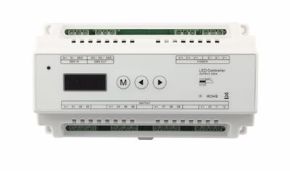
To implement a complete DMX system on your yacht, we recommend starting with a professional LED controller that offers intuitive interfaces and advanced programming possibilities.
DALI, 0-10V and PWM: the alternatives to know
The DALI protocol (Digital Addressable Lighting Interface) is bidirectional: every fixture has an address and can communicate its status to the system, signaling faults and operating hours. It is the ideal choice on large vessels where remote system diagnostics has concrete value, because it allows the crew to identify a faulty fixture without visual inspection. The limit is the update speed, lower than DMX, which makes it less suitable for rapid dynamic effects.
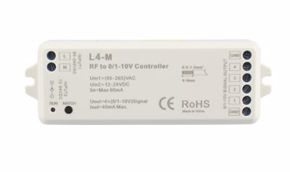
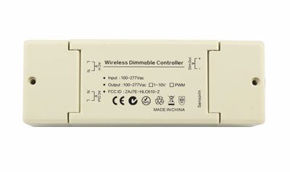
The 0/1-10V control is the simplest and most robust analog solution, suitable for dimming groups of fixtures without the need for addressing. It has the advantage of immunity to electromagnetic interference and simplicity of diagnosis, and remains valid for systems where only the intensity of a few zones needs to be regulated. Dedicated interfaces are available in the section 0/1-10V controllers.
PWM (Pulse Width Modulation) is not a communication protocol but the technique with which the driver actually modulates the flux of the strip, and it is the final level of every control chain. As already anticipated, the PWM frequency is a critical parameter on board: values below 1 kHz produce perceivable flicker, stroboscopic effects in the presence of propellers and fans, and artifacts in video recordings, a problem that is not at all secondary on vessels destined for charter.
Wireless control: freedom without constraints
Wireless systems offer unparalleled installation flexibility, eliminating the need for dedicated control wiring. However, the electromagnetic environment of a yacht presents specific challenges that must be carefully considered.
Wi-Fi and mobile app: control at your fingertips
Wi-Fi-based systems allow you to control lighting via smartphone, tablet or computer, without the need for dedicated remote controls.
System architecture:
- Wi-Fi gateway: central device that converts the commands of the Wi-Fi network into signals for the LED devices (typically via DALI, 0-10V or PWM);
- onboard router: provides the Wi-Fi network to which the control devices connect;
- mobile app: user interface for lighting control;
- LED devices: equipped with receivers compatible with the control system.
Technical considerations for the nautical environment:
- electromagnetic interference: motors, generators and onboard radio equipment can generate interference that compromises the stability of wireless connections;
- signal coverage: the metal structure of the yacht and the numerous bulkheads can hinder the propagation of the Wi-Fi signal;
- security: the control network must be isolated from the main data network of the yacht to prevent unauthorized access;
- energy consumption: Wi-Fi devices in constant listening consume more energy than wired solutions.
To overcome coverage limits, ZigBee technology offers a particularly suitable alternative for the naval environment: it works in a mesh network, so every powered device works as a repeater and the signal bypasses bulkheads bouncing from one node to another. Consumption is significantly lower than Wi-Fi and the 2.4 GHz band with automatic channel hopping reduces conflicts. The range of compatible devices is in the section ZigBee.
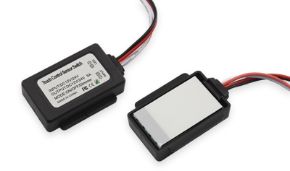
A final solution to consider for refit is kinetic control, with switches without battery and wiring that generate the energy necessary for transmission from the simple gesture of pressing. On an already finished vessel, where opening a bulkhead to pass a control cable means dismantling expensive cladding, a kinetic switch glued on the surface solves the problem in a few minutes.
The scenes that every yacht should have programmed
A sophisticated control system that no one uses because it is complicated is money wasted. Experience says that a well-programmed system has from five to eight scenes recallable with a single touch, and that beyond this number usage collapses. These are the scenes we recommend always providing.
| Scene | What it does | Indicative consumption | Moment of use |
|---|---|---|---|
| Navigation | Turns off every external effect light, wheelhouse in amber at 20%, internal courtesy at 10% | 3-5% of total | Night transfers |
| Night / Path | Only step lights and courtesy at very low intensity | 2-4% | Night movements on board |
| Wake up | Gradual rise in 20 minutes from 2200K to 4000K | 40-60% | Morning in owner cabin |
| Day / Service | All functional layers at 100%, neutral | 100% | Cleaning and maintenance |
| Dinner | Accent on tables, ambient at 25%, scenographic at 60% | 35-45% | Evening in dinette |
| Cocktail / Guests | Full scenographic, underwater lights on, minimal ambient | 50-70% | Evenings at anchor |
| Mooring | Side decks, gangway and platform at 100% | 30-40% | Port maneuvers |
| Emergency | All escape routes and engine room at maximum | 100% | Critical situations |
13. How much does it cost to light a yacht with LED: budget and ROI
We now address the question that every owner asks first and that almost no sector article answers with concrete numbers. The values below derive from the analysis of quotes prepared by the Ledpoint technical office for nautical projects, and are expressed as the cost of complete lighting material (strips, profiles, power supplies, controllers, accessories), VAT excluded and labor excluded. Installation labor, very variable depending on the shipyard and accessibility, affects on average for an additional 60-120% of the material cost on a refit and for 40-70% on a new construction.
| Vessel size | Basic level (functional) | Intermediate level (dimmable + scenes) | Premium level (RGBW, neon flex, underwater) | Typical linear meters |
|---|---|---|---|---|
| Dinghy / boat 6-9 m | € 250-600 | € 600-1,200 | € 1,200-2,500 | 15-30 m |
| Cabin cruiser / sailboat 10-14 m | € 800-1,800 | € 1,800-3,500 | € 3,500-7,000 | 40-80 m |
| Motor yacht 15-20 m | € 2,500-5,000 | € 5,000-11,000 | € 11,000-22,000 | 100-180 m |
| Yacht 21-30 m | € 6,000-12,000 | € 12,000-26,000 | € 26,000-55,000 | 200-400 m |
| Superyacht 31-45 m | € 15,000-30,000 | € 30,000-70,000 | € 70,000-160,000 | 450-900 m |
Where it is worth investing and where you can save
Not all euros spent on a light system yield in the same way. From the analysis of the projects carried out, investment priorities emerge that are quite constant, which we report in decreasing order of ratio between perceived result and cost incurred.
- Quality dimming on all main circuits: it is the intervention with the greatest impact on livability at relatively low cost. A salon with fixed light at 100% is unlivable in the evening, regardless of how much the fixtures cost.
- CRI 90+ in living areas: the difference between CRI 80 and CRI 90 on the price of the strip is 15-25%, but the perceptual difference on materials and food is enormous.
- Neon flex on external contours: maximum scenographic impact per linear meter spent, and direct commercial benefit in case of charter.
- Profiles with adequate dissipation: they cost little and double the life of the system; saving here means redoing the work in half the time.
- Oversized and branded power supplies: the component that most often breaks is the one on which you have saved the most.
On the contrary, the areas where it is reasonable to contain expenses are the lighting of technical rooms and lockers, where only functional and reliable light is needed, and the choice of excessively complex control systems in vessels under 15 meters, where a good dimmer with some preset scenes covers 95% of real needs.
The calculation of return on investment in a refit
The ROI of a lighting refit is made up of four items, not only of savings on the bill. Taking as reference an 18-meter motor yacht with original halogen system and a total investment of € 9,500 (materials plus labor):
| Return item | Estimated annual value | Notes |
|---|---|---|
| Direct energy saving | € 780 | On 140 days of use, mix shore/generator |
| Lower HVAC load for avoided heat | € 190 | Reduction of internal thermal load |
| Maintenance and spare parts no longer needed | € 420 | Lamps, labor, technical stops |
| Fewer generator hours (wear and servicing) | € 310 | About 90 hours/year less |
| Total annual | € 1,700 | Payback in about 5.6 years |
| Residual value on resale price | € 5,700-7,600 one-off | 60-80% of investment recovered |
Considering together annual flow and residual value, the effective payback of a well-designed LED refit is between 2 and 4 years, a horizon perfectly compatible with the average ownership duration of a pleasure boat in Italy.
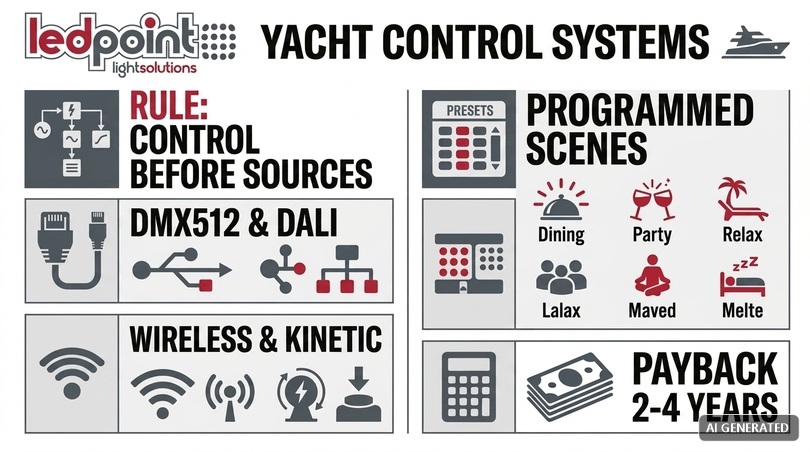
14. Maintenance and troubleshooting: ensuring optimal performance over time of yacht LED strips
A correctly designed and installed LED lighting system requires minimal but well-planned maintenance. In this chapter, we will provide a complete maintenance program and a systematic troubleshooting guide to quickly solve any problem. The difference between a system that reaches fifteen years and one that starts giving problems in the third season lies almost entirely in these few recurring practices.
Preventive maintenance program: the key to longevity
Preventive maintenance is the set of scheduled interventions that prevent failures and degradations before they occur. For a lighting system on a yacht, we recommend the following program:
Daily maintenance (to be carried out during yacht use)
- quick visual inspection: verify that all light points work correctly;
- cleaning of transparent surfaces: remove dust, fingerprints and water splashes from ceiling fixtures, spotlights and protections;
- temperature verification: check that no light point results excessively hot to the touch.
Weekly maintenance (during the nautical season)
- in-depth cleaning of diffusers: use a microfiber cloth and specific detergent for optical surfaces;
- verification of connections: check that connectors and junctions are dry and free of oxidation;
- testing of preset scenes: verify that all light scenes are accessible and work correctly;
- control system check: test all interfaces (panels, apps, remote controls).
Monthly maintenance (during the nautical season)
- cleaning of cooling fans (if present): remove dust and residues that could obstruct air flow;
- verification of watertightness: check gaskets and seals, especially for devices installed outside;
- voltage measurement: verify that all devices receive the correct voltage (±5% of the nominal value);
- energy consumption analysis: compare current consumption with reference values to identify anomalies.
Seasonal maintenance (at the beginning and end of the nautical season)
- complete inspection of all components: verify the absence of damage, corrosion or degradation;
- cleaning of printed circuits: use electronic cleaning spray and antistatic brushes;
- replacement of components subject to wear: gaskets, adhesives, fixing clips;
- firmware update: install the latest versions of the software for controllers and smart devices;
- fresh water rinsing of all external fixtures to remove accumulated salt deposits;
- updated documentation: record all maintenance carried out and modifications made to the system.
Solving problems step by step
Despite preventive maintenance, problems can occasionally occur. A systematic approach to troubleshooting allows you to quickly identify the cause and apply the correct solution.
Problem: LED strip that does not turn on
Follow this step-by-step procedure:
Step 1 - Power supply verification
- check that the power supply is connected to the network and that the switch is on;
- measure the output voltage from the power supply: it must be 12V ±5% or 24V ±5% depending on the strip;
- if the voltage is absent or out of tolerance, replace the power supply.
Step 2 - LED strip verification
- visually check the entire length of the strip looking for physical damage or burn points;
- verify that there are no loose or oxidized connections;
- directly connect the strip to a known working power supply (bypassing controller and dimmer).
Step 3 - Control component verification
- test the LED controller with a known working load;
- verify the controller settings (intensity, channels, scenes);
- check that there are no short circuits or overloads in the system.
To quickly solve power supply problems, we recommend always having on board reserve LED power supplies compatible with your system.
Quick guide to the most frequent symptoms
This diagnostic table summarizes the cases that technical assistance most frequently encounters on nautical installations, with the statistically most probable cause and the resolving intervention.
| Symptom | Most probable cause | Verification | Solution |
|---|---|---|---|
| The strip fades towards the end | Excessive voltage drop | Measure V at beginning and end of section | Bilateral power supply or larger section cable |
| Tone difference between two sections | Different batches or high Step MacAdam | Side-by-side comparison at same dimming | Replace with material from same batch |
| Flicker at low intensity | Insufficient PWM frequency or incompatible dimmer | Record with smartphone at 1/1000 s | Dimmer with PWM > 2 kHz |
| Some LEDs off in groups of three | Segment in short or burned resistor | Visual inspection of segment | Section replacement, verify overheating |
| The strip detaches from the support | Adhesive degraded by heat or humidity | Verify profile temperature | Dissipating profile and mechanical fixing |
| Green oxidation on pads | Saline infiltration in unsealed junction | Inspection of junctions | Redo junction with soldering and adhesive sheath |
| Color turning yellow after one season | UV degradation of silicone shell | Comparison with non-exposed section | Replace with UV-stable aliphatic PU neon flex |
| The controller loses programming | Voltage spikes from alternator | Record voltage during engine starting | Install TVS suppressor and protected power supply |
| Audible hum from power supply | Overload or incompatible dimming | Compare load and nominal power | Power supply with 30% margin |
| VHF radio interference with lights on | Driver conducted emissions | Turn off circuits one by one | EMC certified drivers, ferrites on cables |
15. The 12 most expensive mistakes in yacht lighting
This section collects the recurring errors that the Ledpoint technical office identifies in surveys on existing systems. Each of them has a concrete cost in terms of redoing, and all are avoidable in the design phase with a few more minutes of attention.
- Choosing the IP degree based on the catalog rather than real exposure. A side deck that is washed with the pump is not "covered exterior": at least IP66 is needed.
- Cutting an IP68 strip without resealing. It is the most frequent and most devastating error: it completely annuls the protection.
- Using pressure connectors in non-inspectable areas. They oxidize, loosen with vibrations and oblige to open cladding to intervene.
- Undersizing cables. It produces voltage drops, brightness differences and conductor heating.
- Installing high-power strips without dissipating profile. The useful life collapses to a fraction of the declared one.
- Mixing different production batches on the same continuous line. Chromatic differences are visible and not correctable afterwards.
- Forgetting the "Navigation" scene. Scenographic lights on in night navigation are a safety problem, not a style one.
- Powering wet areas without SELV. It is a regulatory violation with potentially serious consequences.
- Not providing accessibility to power supplies. Hiding a power supply behind a glued panel means condemning yourself to a carpentry intervention at the first failure.
- Pointing spotlights towards shiny surfaces. On board lacquers, crystals and stainless steel reflect everything: a badly oriented spotlight produces annoying glare at meters of distance.
- Using cold color temperatures in living environments. It annuls the work of the interior designer on wood essences.
- Not documenting the system. Without diagram and product codes, every future maintenance becomes an archaeological investigation.
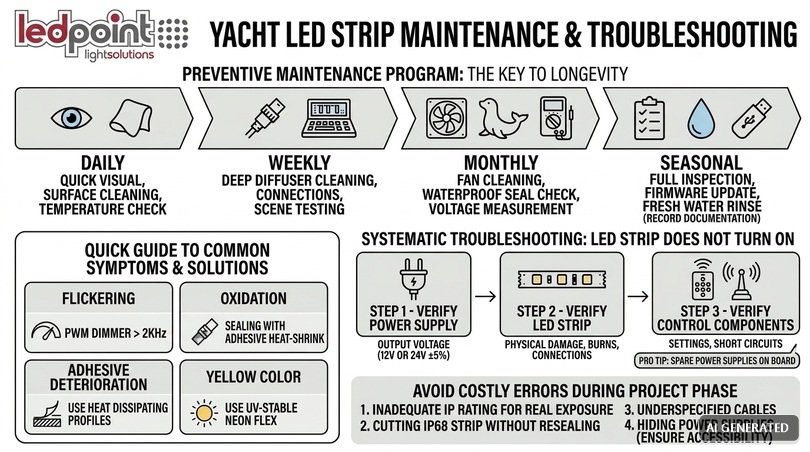
16. Ledpoint case study: luminous refit of a 24-meter motor yacht
To make concrete everything exposed so far, we report the data of an intervention carried out with Ledpoint materials on a 24-meter fiberglass motor yacht, built in 2006, with original mixed halogen and fluorescent system. The owner had two declared objectives: eliminate the noise of the generator during evenings at anchor and modernize the night aesthetics of the vessel in view of a possible use in charter.
| Parameter | Before the intervention | After the intervention | Variation |
|---|---|---|---|
| Installed lighting power | 4,180 W | 612 W | -85.4% |
| Average real evening absorption | 1,950 W | 210 W | -89.2% |
| Evening autonomy on battery bank | 1.8 hours | 16.5 hours | +817% |
| Generator hours per season | 310 h | 145 h | -53.2% |
| Total light points | 168 fixtures | 74 fixtures + 186 linear m | — |
| Average salon illuminance | 135 lux | 240 lux | +77.8% |
| Average CRI of living environments | Ra 72 | Ra 93 | +29% |
| Thermal load injected into environment | about 1.9 kW | about 0.2 kW | -89.5% |
| Overall system weight | 112 kg | 47 kg | -58% |
Composition of materials used: 186 meters of LED strips (of which 74 m COB 24V CRI 93 in dissipating profile for interiors, 62 m IP67 for bathrooms and side decks, 50 m of IP68 polyurethane neon flex for external contours and drip line), 74 fixtures between adjustable spotlights and step lights, 11 24V power supplies with 30% margin, mixed control system DMX for exteriors and ZigBee for interiors with 6 programmed scenes.
The most interesting data is not even the energy one: it is the weight reduction of 65 kg, obtained by eliminating toroidal transformers, massive lighting fixtures and oversized cable sections. On a planing vessel 65 kg less in the upper part of the hull have a measurable effect on stability and, marginally, on fuel consumption. It is a benefit that practically no one considers during the quote phase and that instead commanders notice immediately.
Times and criticalities: the intervention required 21 man-days. The main criticality emerged in the passage of cables towards the external drip line, where it was necessary to give up the centralized power supply planned in the project in favor of two separate points at stern and bow, not to drill structural bulkheads. A concrete example of how the lighting design must always confront with the constructive reality of the boat before being considered definitive.
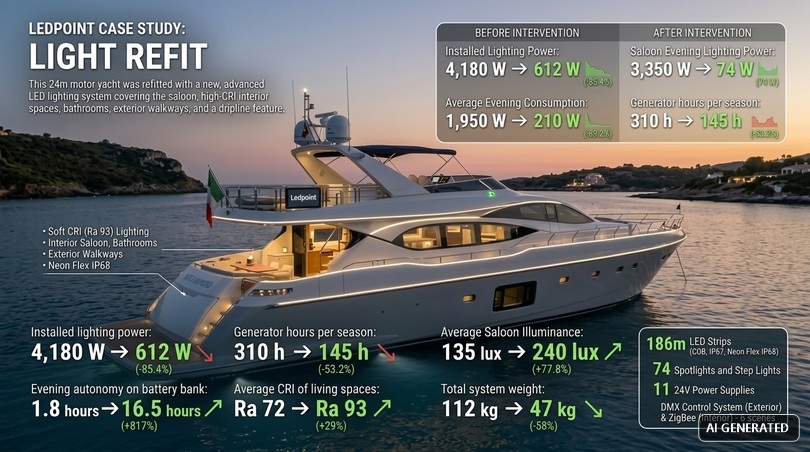
17. Trends and future innovations: tomorrow of nautical lighting
The yacht lighting sector is in continuous evolution, with innovations that promise to further revolutionize the experience on board. In this final chapter, we will explore emerging trends and technologies that will define nautical lighting in the coming years.
Adaptive and context-aware lighting: artificial intelligence on board
Next generation lighting systems will not only respond to manual commands, but will be able to automatically adapt to the context, ongoing activities and even the moods of the occupants.
Bio-adaptive systems: synchronization with circadian rhythms
Bio-adaptive lighting automatically regulates the color and intensity of light based on the time of day, supporting the natural circadian rhythms of the occupants. This approach is based on decades of research in chronobiology and offers measurable benefits:
- Morning (06:00-09:00): cold light at high intensity (5000-6500K, 300-500 lux) that suppresses melatonin and promotes wakefulness.
- Day (09:00-17:00): neutral light at variable intensity (4000-5000K, 200-400 lux) that supports concentration and productivity.
- Evening (17:00-21:00): warm light at medium intensity (2700-3000K, 100-200 lux) that favors relaxation and socialization.
- Night (21:00-06:00): very warm light at very low intensity (1800-2200K, 5-20 lux) that minimizes interference with sleep.
A study conducted by the nautical research institute in 2023 demonstrated that on yachts equipped with bio-adaptive lighting:
| Parameter | Improvement | Measurement method | Statistical significance |
|---|---|---|---|
| Sleep quality | +23% | Actigraphy + PSQI questionnaires | p < 0.01 |
| Daytime alertness | +18% | Psychomotor performance tests | p < 0.05 |
| Incidence of seasickness | -31% | Logbooks + MSSQ scale | p < 0.01 |
| Overall satisfaction | +27% | 7-point Likert scales | p < 0.001 |
The technologies that make this approach possible are already available and do not require exotic components: just CCT or Sunlike continuous spectrum strips, a programmable controller with astronomical clock and accurate programming. The solar spectrum sources of the Sunlike line and the Circadian Light solutions are born exactly for this type of application.
Innovative materials and sustainability: the future is green
Sustainability is becoming an increasingly important factor in the design and choice of lighting systems for yachts. Innovations in this field concern not only energy efficiency, but also materials, production processes and end of life of products.
Organic LEDs (OLED): when light becomes surface
Organic light-emitting diodes (OLED) represent the next frontier of solid-state lighting. Unlike traditional LEDs which are point sources, OLEDs are extended sources that emit uniform light from entire surfaces.
Distinctive characteristics of OLED:
- extended and uniform light source, without high luminance points that cause glare;
- extremely reduced thickness (thin as a sheet of paper);
- mechanical flexibility: they can be curved or even rolled up;
- transparency: some types of OLED are transparent when off;
- rapidly improving efficiency: currently 60-80 lm/W, expected 150+ lm/W by 2026.
Innovative applications for yachts:
- luminous walls: entire walls that become sources of diffuse light when necessary;
- smart windows: that opacize during the day and emit light in the evening;
- luminous furniture: tables, headboards, furniture that integrate lighting without dead spaces;
- interactive nautical charts: surfaces that show information and maps with uniform backlighting.
According to forecasts from the nautical research center, by 2028 35% of new yachts over 40 meters will integrate OLED systems in at least one significant area, with growth to 65% by 2033.
Micro LED, pixel mapping and integration with onboard systems
The technology of addressable LEDs, in which every single chip or group of chips can be individually controlled, is also arriving in the nautical field after having conquered architectural lighting. Pixel mapping on a continuous line of neon flex allows you to create scrolling effects, light waves and gradual chromatic transitions along the hull, with a visual impact that no single-channel source can match. The solutions are already available in the section addressable LED strips and the related SPI controllers.
The most significant direction of the coming years however concerns integration with onboard systems. Lighting is ceasing to be an isolated subsystem to become an output of the vessel management system: lights that automatically dim when the battery charge state falls below a threshold, the navigation scene that activates when the engine is started, the step lights that turn on at the detection of movement through the sensors already present on board. It is an evolution that does not require new technologies, but only the willingness to make systems that today coexist without talking to each other dialogue.
18. Yacht and LED: illuminating the future of boating
The lighting of your yacht is no longer a functional accessory, but a fundamental element that defines the experience on board, affects safety, determines energy consumption and expresses your personal style. The LED revolution, combined with intelligent control systems and advanced lighting design, has created possibilities that were unimaginable just a few years ago.
Investing in a cutting-edge lighting system for your yacht means:
- concretely improving the quality of life on board: through lighting that adapts to activities, times and desired atmospheres;
- significantly reducing operating costs: with energy savings that can exceed € 2,000-€ 5,000 per year depending on the size of the yacht;
- increasing the value of the vessel: a modern and well-designed lighting system is an important evaluation factor in the used yacht market;
- guaranteeing greater safety: through optimal lighting that prevents accidents and facilitates operations in every condition;
- expressing your personality: with practically unlimited customization possibilities that transform the yacht into an extension of your lifestyle.
Starting today the path towards perfect lighting for your yacht is simpler than it might seem. Start with professional advice, define your specific needs, and choose quality products specifically designed for the nautical environment. The team of experts at Ledpoint is at your disposal to guide you in every phase of this transformational journey.
The sea awaits you, and now you can sail it in a completely new light.
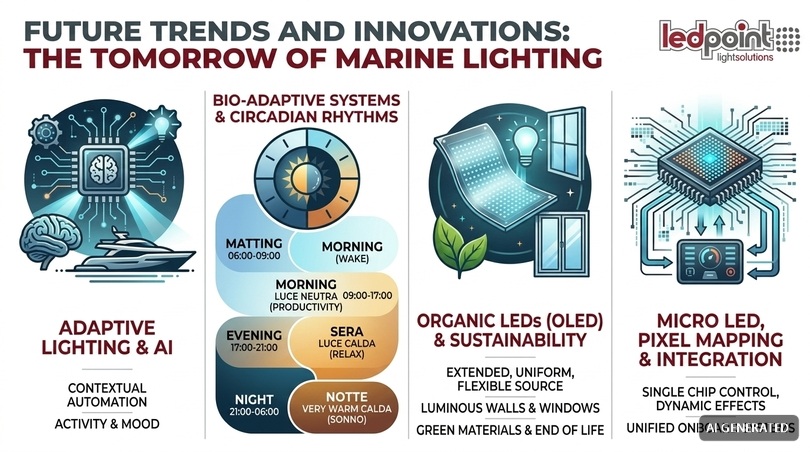
19. Frequently asked questions about LED lighting for yachts
We collect here the questions we most often receive from owners, shipyards and installers who deal with nautical lighting. The answers are synthetic and operational: for every topic covered you can find the complete insight in the corresponding chapters.
Which LED strips are suitable for a boat: 12V or 24V?On vessels up to 12-14 meters with 12V onboard bus, 12V LED strips connected directly to the service line are used. Above 15 meters the bus is 24V: 24V strips halve the current, allow sections up to 10 meters and require smaller section cables. |
What IP degree is needed for LED strips on a yacht?IP20 for dry interiors, IP65 for covered deck and showers, IP67 for side decks and floodable areas, IP68 for the waterline and submerged applications. The declared degree is valid only if cuts, junctions and terminals are correctly sealed during installation. |
How much do you save switching from halogen to LED lighting on a boat?Consumption reduction is on average between 82% and 89%. On a 25-meter yacht with 150 light points the saving is about 5,800 kWh and 2,300 euros per year, to which are added fewer generator hours, lower air conditioning load and almost zeroed maintenance. |
Are LED strips or neon flex better for external lighting of a yacht?For continuous external lines neon flex is superior: it is factory IP68, resists UV and salt spray without yellowing, curves with a radius of 1-2 cm and produces uniform light without visible points. LED strips remain preferable in interiors, where the dissipating profile allows higher powers. |
Are underwater lights for boats legal and safe?Yes, provided they do not interfere with the correct reading of navigation lights provided by COLREG. In night navigation they must be turned off. The power supply must be in safety extra-low voltage and the bodies must be certified IP68 with declared immersion depth. |
Why does my LED strip fade towards the end of the section?It is a voltage drop due to too long a section or insufficient cable section. It is solved by powering the strip from both ends, inserting intermediate power points or increasing the cable section. The difference between start and end of section must not exceed 3%. |
How many lumens are needed to illuminate the salon of a yacht?For a 48 m² salon with target illuminance of 250 lux about 6,300 total lumens are needed, considering utilization factor 0.7 and maintenance factor 0.75. They are equivalent to 8 spotlights of 800 lumens or to about 4.5 meters of LED strip of 1,450 lm/m. |
What color temperature to choose for the interiors of a boat?2700-3000K for salons, cabins and corridors, 4000K for galley and work surfaces, 5000-6500K only for engine room and lockers. In the wheelhouse amber tones 1800-2200K are used to preserve night vision. The CRI must be at least 90 in living environments. |
How long do LED strips installed on a vessel last?Quality LED strips declare 30,000-50,000 hours L70, neon flex 50,000-100,000 hours. With an average season of 180 days at 8 hours a day this means 20-70 theoretical years. Real duration depends above all on heat dissipation and quality of junctions. |
Can I install LED strips myself on my boat?On small vessels and for extra-low voltage circuits installation is within the reach of an experienced boater, provided cable sections, fuses and seals are respected. For complex systems, wet areas and interventions on structural bulkheads it is necessary to turn to a qualified naval installer. |
How to avoid flickering of LED lights on board?Using dimmers with PWM frequency higher than 2 kHz, ideally 10-25 kHz, stabilized power supplies and strips with constant current control. Flickering is particularly annoying when sailing because it adds to the movement of the vessel increasing the risk of nausea. |
How much does it cost to redo the LED lighting of a 20-meter yacht?The lighting material alone varies from 2,500-5,000 euros for a functional solution to 11,000-22,000 euros for a premium system with RGBW, neon flex and underwater lights. Labor affects for an additional 60-120% in case of refit on already finished vessel. |
This article was developed with the support of artificial intelligence and subsequently revised, corrected and validated by the Ledpoint.it technical team, which guarantees its reliability and compliance with official sources.
```