











What are volts and what are they used for in LED strips?
Volts are the unit of measurement for electrical voltage and, in LED strips, indicate the potential difference needed to make current flow through the diodes. In the most common LED strips, the volt values are 12, 24, 48, and 230: the correct choice of volts determines the installable length, brightness, safety, and durability of the lighting system.
When we talk about LED strips, volts are not a marginal technical detail but the parameter that governs the entire lighting design project. An LED strip powered with incorrect volts burns out in a few seconds; an LED strip with volts undersized for its length suffers from voltage drop and produces darker areas. Understanding volts therefore means understanding how an LED strip really works and how to choose it consciously for domestic, commercial, architectural, or industrial environments.
In this in-depth Ledpoint guide, we delve into the concept of volts applied to the world of LED strips: from the physical definition of the unit of measurement to practical use cases, with comparative tables, measured data, market statistics, regulatory references, and direct links to the Ledpoint.it LED strip catalog. The goal is to provide a unique, clear, and technically accurate resource capable of answering any question about volts, voltage, amps, watts, and conversions between these quantities in the specific context of LED lighting.
In this article...
What are volts: definition and physical meaning
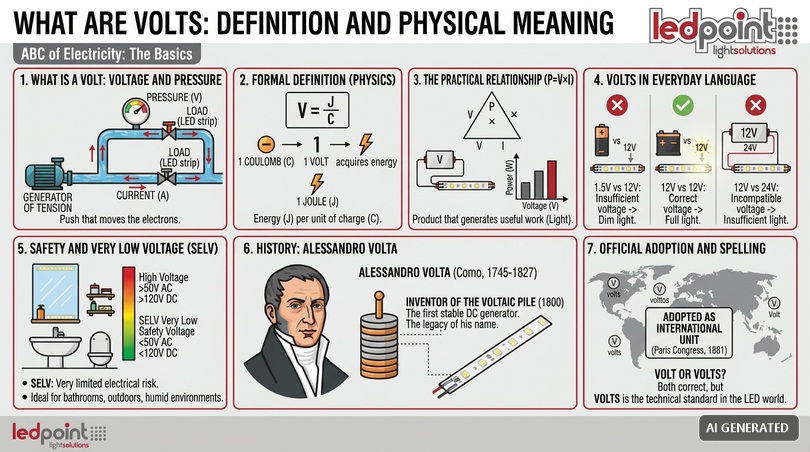
To truly understand LED strips, we must start with the ABCs of electricity: volts are the unit of measurement for electrical voltage, that is, the potential difference that pushes electric charges through a conductor. In simple terms, volts represent the "pressure" that the generator exerts on electrons, just as water pressure in a pipe pushes the liquid along the path. Without volts there is no current, and without current LED strips do not turn on.
The symbol for volts is V and is recognized by the International System of Units (SI). In physics, the volt is formally defined as the ratio between energy and charge: 1 volt equals 1 joule per coulomb. This means that when a charge of one coulomb crosses a potential difference of one volt, an energy of one joule is transferred. The fundamental formula is therefore V = J/C, where J is joules and C is coulombs. Those working with LED strips do not necessarily need to remember the formal definition, but it is useful to know that behind volts there is a precise physical relationship linking energy, charge, and time.
What does 1 volt correspond to and what is 1V equal to
Many users wonder what the volt corresponds to in practical terms. 1 volt equals the voltage needed to dissipate 1 watt of power in a load crossed by 1 ampere of current. This is where the famous relationship P = V × I (power equals volts times amps) comes from, often recalled when sizing LED strips and power supplies. 1V, therefore, is not an abstract value: it is the smallest energy step that, multiplied by current, produces useful work, i.e., light, heat, or motion.
What is a volt in everyday language
Imagine a 12-volt battery: that number indicates the "push" that the battery is able to give to electrons to make them circulate in a circuit. The higher the volts, the more energetic the push. A 1.5-volt battery (like AA batteries) struggles to light a 12-volt LED strip because the voltage is not sufficient. A 24-volt LED strip connected to a 12-volt power supply turns on dimly, incompletely, without producing the expected luminous flux. This everyday example makes the concept of volt immediate and shows why voltage compatibility between generator and load is essential.
What volt means in the context of safety
What does volt mean in terms of safety? International regulations (IEC 61140, CEI 64-8) classify installations into low, extra-low, and high voltage precisely based on volts. Below 50 volts in alternating current and below 120 volts in direct current, we speak of safety extra-low voltage (SELV). 12-volt and 24-volt LED strips fall fully into this category, which makes them suitable even for humid environments, bedrooms, bathrooms, outdoors, with very limited electrical risk.
History of volts: Alessandro Volta and the electric battery
The term volts derives from the surname of Alessandro Volta, an Italian physicist born in Como in 1745 and died in 1827. Volta is considered one of the fathers of modern electrophysiology and his most famous invention (the voltaic pile, from 1800) is the first stable direct current generator in history. Before Volta, electricity could only be studied in static form, but after Volta it became a continuous resource, usable to produce light, heat, and motion. It is no coincidence that the unit of measurement of voltage bears his name: the volt is, in a literal sense, the legacy of Alessandro Volta.
The biography of Alessandro Volta tells of a methodical researcher, a professor at the University of Pavia, corresponding with the greatest European scientists of his time. His pile consisted of zinc and copper discs separated by fabric soaked in saline solution: the electrochemical reaction generated a potential difference of about 1.1 volts per cell. Stacking more cells resulted in higher voltages, hence the term "pile." Every modern LED strip, every lithium battery, every charger conceptually descends from that experiment. When we talk about volts in LED strips today, we are, without knowing it, celebrating that principle.
The official adoption of the volt as a unit of measurement
The volt was adopted as the international unit of electrical voltage at the International Congress of Electricians in Paris in 1881. Since then, the entire scientific and industrial world has measured voltage in volts, regardless of the language spoken. In English, it is said "volts," in Spanish "volts" or "voltios," in French "volts," in German "Volt." The Italian spelling admits both "volt" and "volts" in the plural, with "volts" now very widespread especially in international technical and commercial contexts. And if you are wondering whether to say volt or volts, well, both forms are correct but in the technical practice of LED strips, the plural "volts" is now the market standard.
Volts, amps, and watts: the three fundamental quantities
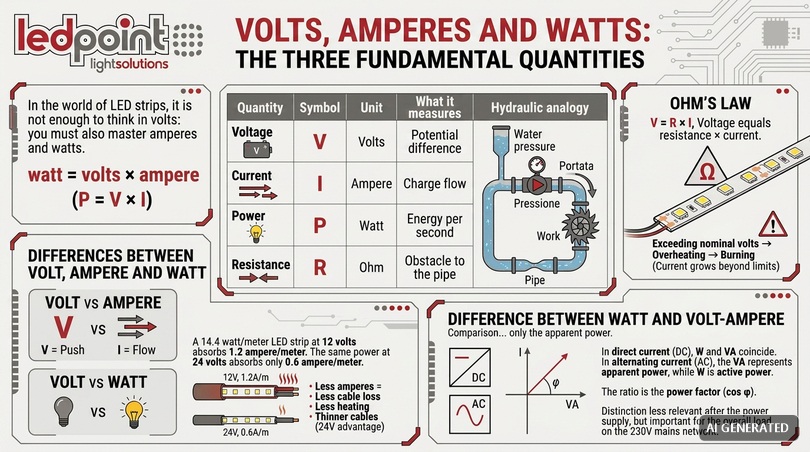
In the world of LED strips, it is not enough to think in volts: you must also master amps and watts. These three quantities are linked together, and understanding their relationship is essential to properly size the system. The volt indicates voltage, the ampere indicates current (that is, the amount of charges passing in one second), the watt indicates power (that is, energy per unit of time). The basic formula watts = volts × amps allows you to quickly derive any missing quantity knowing the other two.
| Quantity | Symbol | Unit | What it measures | Hydraulic analogy |
|---|---|---|---|---|
| Voltage | V | Volts | Potential difference | Water pressure |
| Current | I | Amps | Flow of charges | Water flow rate |
| Power | P | Watts | Energy per second | Work done |
| Resistance | R | Ohms | Obstacle to flow | Pipe constriction |
Ohm's Law: volts, amps, and ohms together
Ohm's Law is the cornerstone of electrical engineering: it states that V = R × I, that is, the voltage in volts equals the resistance in ohms multiplied by the current in amps. Applied to LED strips, this means that, with the same internal resistance, increasing volts increases current and therefore dissipated power. This is why exceeding the nominal volts of an LED strip causes rapid overheating and burnout: the current grows beyond the limits of the LED's copper and silicon.
Difference between volt and ampere
The volt measures the push, the ampere measures the flow. A system can have high volts and low amps (domestic network at rest) or low volts and high amps (starting a car engine). In LED strips, both parameters matter: volts determine compatibility with the power supply, amps determine cable sizing and total deliverable power.
Difference between volt and watt
What is the difference between volt and watt? Simple: volts do not produce work alone, they are only the available electrical pressure. The watt is the work actually done: to have it, you need both volts and amps. A 14.4-watt/meter LED strip at 12 volts draws 1.2 amps/meter (14.4 ÷ 12); the same power at 24 volts draws only 0.6 amps/meter. Fewer amps means fewer cable losses, less heating, thinner cables: hence the advantage of 24 volts over 12 volts in long installations.
Difference between watts and volt-amperes
In the world of professional lighting, the unit volt-ampere (VA) is often encountered, especially in power supply datasheets. What is the difference between watts and volt-amperes? In direct current, watts and volt-amperes coincide. In alternating current, however, volt-amperes represent apparent power, while watts represent active power: the ratio between the two is the power factor (cos φ). For an LED strip that works in DC after the power supply, the distinction is less relevant, but it should be kept in mind when summing the total load on the 230-volt mains system.
Volts in LED strips: why they are decisive
We arrive at the heart of the guide: why are volts decisive in LED strips? LED strips are composed of LED diodes connected in series and parallel on a flexible printed circuit. Each LED diode has an operating voltage between 2.8 and 3.4 volts depending on the color and technology. Since a single diode cannot be powered directly from the mains, the LED strip groups the diodes in series until reaching the desired total: 12 volts, 24 volts, 48 volts, or 230 volts.
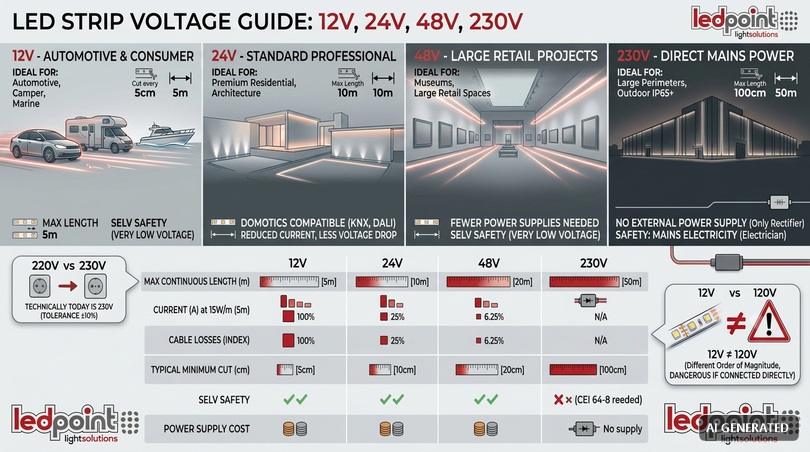
This grouping is what determines the minimum cutting length of the LED strip. In a 12-volt LED strip, the elementary module usually consists of 3 LEDs in series with a limiting resistor, so the minimum cut is therefore every 3 LEDs, typically every 5 cm. In a 24-volt LED strip, the LEDs in series are 6, and the minimum cut is every 10 cm. In 48-volt LED strips, the modules are even longer (up to 30 cm), while in 230-volt strips, it can reach up to 1 meter. The choice of volts therefore influences the freedom of cutting and installation flexibility.
Why there is no "universal" LED strip
Many customers ask Ledpoint if there is an LED strip compatible with any voltage. The answer is no: each LED strip is designed for a precise volt value and does not tolerate variations beyond ±10%. Connecting a 12-volt LED strip to a 24-volt battery means doubling the applied voltage, quadrupling the dissipated power (P = V²/R), and destroying the LEDs in a few seconds. Conversely, powering a 24-volt LED strip with only 12 volts makes it light up dimly, without permanent damage but without producing the expected result.
LED volts and voltage: international terminology
In international terminology, "led voltage" or "led volt" is used to indicate the operating voltage of the single diode, while "strip volts" or "strip led voltage" refers to the voltage of the complete strip. On Ledpoint.it, you will find clearly indicated for each product the input volt value, so as not to make mistakes. The key formulas to remember when talking about LED volts are two: P = V × I (power equals volts times amps) and voltage drop = R × I × L (the drop in volts along the cable depends on resistance, current, and length).
12-volt LED strips: characteristics and uses
12-volt LED strips are historically the most widespread on the consumer market and still represent an important slice of the Ledpoint catalog. 12 volts are the standard for automotive applications, campers, boating, custom furniture, and small furniture. The 12-volt LED strip is compatible with car and motorcycle batteries, alarm control panels, extra-low voltage home automation systems, and most motion sensors on the market.
The advantages of 12-volt LED strips are full compatibility with the automotive ecosystem, the widespread availability of economical power supplies, the reduced minimum cut (every 5 cm), and the intrinsic safety of 12 volts, well below the 50-volt SELV threshold. The main disadvantages are the more marked voltage drop over long distances and the high current (for the same power) which requires larger section cables.
When a 12-volt LED strip is convenient
A 12-volt LED strip is convenient when the installation length is limited (typically under 3 meters), when the environment is mobile (car, camper, boat), when an extra-low voltage system is already present, or when you want to maximize cutting freedom. In all these cases, 12 volts offer the best compromise between practicality, safety, and installation cost.
Limitations of 12 volts
Beyond 5 linear meters, the 12-volt LED strip begins to suffer a voltage drop visible to the naked eye: the end of the strip appears dimmer than the beginning. Ledpoint advises against exceeding 5 meters of unilateral power supply with 12-volt LED strips: beyond this threshold, it is necessary to power the strip from both ends or switch to 24-volt LED strips, which are much more efficient over extended lengths.
24-volt LED strips: the new standard
24-volt LED strips are today the reference standard for professional installations, quality residential environments, commercial spaces, and architectural projects. The shift from 12 volts to 24 volts reduces current for the same power, halves cable losses, allows continuous lengths up to 10 meters without significant drop, and makes the LED strip compatible with most KNX, DALI, and Casambi home automation systems available on the market.
The Ledpoint catalog dedicates a wide range of solutions to 24-volt LED strips:
- monochromatic in warm light 2700K and 3000K, natural light 4000K, cool light 10000K;
- RGB for scenic lighting;
- RGBW and RGBWW for premium color rendering;
- Tunable White for dynamic control of color temperature; COB (chip on board) for a continuous light line without visible dotting.
The LED density per meter varies from 60 to 700 chips, with powers from 4.8 W/m up to 30 W/m.
Why 24 volts are superior to 12 volts
The technical reason is simple: doubling the volts halves the current for the same wattage, and losses in a cable are proportional to the square of the current (P_loss = R × I²). Going from 12 volts to 24 volts therefore reduces losses by a factor of 4. In practice, a 15 W/m LED strip over 5 meters draws 6.25 amps at 12 volts versus just 3.12 amps at 24 volts. Fewer amps means thinner cables, less stressed connections, longer life, and better light uniformity.
Typical applications of 24-volt LED strips
24-volt LED strips are ideal for plasterboard light frames, mirror and TV backlighting, under-cabinet kitchen lighting, wall washing on internal facades, false ceilings and perimeter coves, shops and showrooms, offices, meeting rooms, spas, and hotels. Thanks to 24 volts, the length manageable with a single power supply easily reaches 10 meters, with light uniformity that the human eye perceives as constant.
48-volt LED strips: long distances without drops
48-volt LED strips represent the most recent evolution of the professional market. 48 volts allow powering continuous strips up to 20 meters without appreciable voltage drop, drastically reducing the number of power supplies needed in large projects. In commercial, museum, and retail settings, where light lines often exceed 15 meters, 48-volt LED strips are the rational choice.
From a safety point of view, 48 volts still remain in the SELV (Safety Extra Low Voltage) range, so they do not require special conduits or particular prescriptions as happens for 230 volts. 48 volts thus combine the benefits of extra-low voltage (safety, installation simplicity, quality dimmability) with the long run typical of large-scale installations.
Practical comparison: 12 vs 24 vs 48 volts
| Parameter | 12 volts | 24 volts | 48 volts |
|---|---|---|---|
| Max continuous length | 5 m | 10 m | 20 m |
| Current at 15 W/m over 5 m | 6.25 A | 3.12 A | 1.56 A |
| Cable losses (index) | 100% | 25% | 6.25% |
| Typical minimum cut | 5 cm | 10 cm | 20 cm |
| SELV safety | Yes | Yes | Yes |
| Automotive compatibility | Excellent | Good | Poor |
| Power supply cost | Low | Medium | Medium-high |
230-volt LED strips: direct mains power
230-volt LED strips connect directly to the Italian and European domestic electrical network without the need for an intermediate power supply. Instead of the power supply, there is a small rectifier (AC/DC plug) that converts alternating current to direct current. 230 volts allow continuous lengths up to 50 meters, but involve stricter safety constraints: the voltage exceeds the SELV threshold, so installation requires compliance with CEI 64-8 standard and generally the intervention of a qualified electrician.
230-volt LED strips are ideal for perimeter lighting of large spaces, long corridors, warehouses, extensive gardens, pool contours, and outdoor installations with IP65 class or higher. In the Ledpoint catalog, there are monochromatic, RGB, and IP67 versions for outdoors, with cuts every 100 cm and color rendering CRI >80. It is essential to remember that, being powered at 230 volts, they require a compliant system and correct grounding.
What 220 volts means (and why they are actually 230)
What does 220 Volts mean? Until the 1990s, the Italian mains voltage was officially 220 volts, while from 2003, for European uniformity (CENELEC HD 472 S1 standard), the nominal value changed to 230 volts with ±10% tolerance. In common language, people still say "220 volts," but technically today it is 230 volts. What does 110V and 220V mean? They are the two main global standards: 110-120 volts in the United States, Canada, Japan, and part of South America, and 220-240 volts in Europe, Asia, and Africa. A European 230-volt LED strip CANNOT be connected to the American 110-volt network, and vice versa.
Is 12 volts equal to 120?
A recurring question is whether 12 volts equals 120 volts. The answer is obviously no: these are two completely different values, an order of magnitude apart. An LED strip designed for 12 volts cannot be connected to 120 volts mains without being destroyed. Confusion often arises from the fact that some power supplies accept a universal 100-240 volt input and provide a stabilized 12-volt or 24-volt output: in this case, the load (the LED strip) always sees only the secondary extra-low voltage.
How to measure volts: tools and procedures
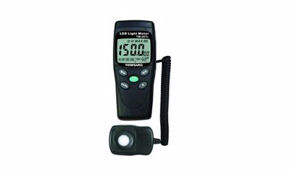
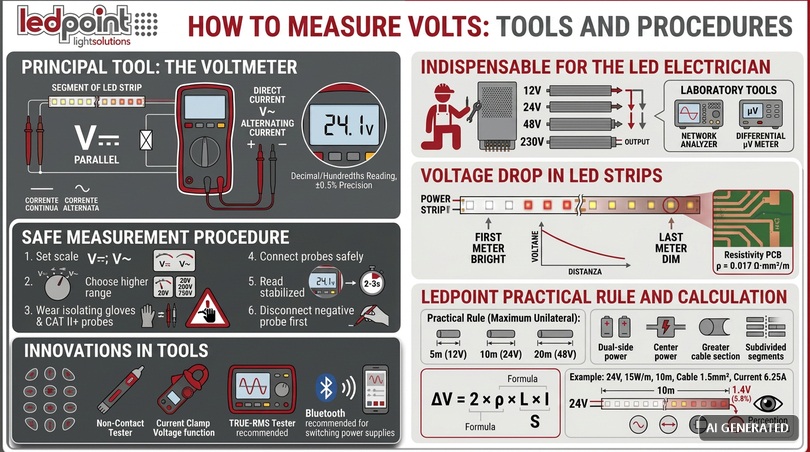
How do you measure volts? The main tool is the voltmeter, today almost always integrated into a digital multimeter. The voltmeter is connected in parallel to the load or source to be measured, with the red probe to the positive pole and the black probe to the negative pole (for direct current) or indifferently (for alternating current). The reading in volts appears on the display in tenths or hundredths of a volt, with typical accuracy of ±0.5%.
For an electrician working on LED systems, the multimeter is essential to verify that the output voltage from the power supply corresponds to the nominal value (12 volts, 24 volts, 48 volts, or 230 volts) and to identify any voltage drops along the line. In the laboratory, more sophisticated measuring instruments are used instead, such as oscilloscopes, network analyzers, and differential voltmeters, capable of detecting volt oscillations in the order of microvolts.
Safe procedure for measuring volts
- Set the multimeter to the correct volt scale (V= for DC, V~ for AC).
- Choose the range higher than the expected value: 20 volts for a 12-volt LED strip, 200 volts for a power supply, 750 volts for the mains.
- Wear insulating gloves and use CAT II or higher certified probes.
- Connect the probes without touching the metal tips.
- Read the stabilized value after 2-3 seconds.
- Disconnect starting from the negative probe.
Innovations in measuring instruments
Modern instruments for measuring volts include non-contact testers, clamp meters with integrated voltmeter function, true-RMS testers for distorted signals (such as those generated by switching power supplies for LED strips) and Bluetooth instruments that send readings in real-time to smartphones and tablets. For the LED strip installer, a true-RMS tester is recommended because it correctly reads volt values even when the signal is not purely sinusoidal.
Voltage drop in LED strips
Voltage drop is the phenomenon whereby the volts available at the end of the LED strip are lower than those at the input, due to the resistance of the printed circuit copper and the power supply cables. In LED strips, this drop is particularly significant because the current is distributed along the entire length and each segment subtracts energy from the next. The result is the classic light non-uniformity: first meter bright, last meter dim.
Ledpoint's practical rule is: maximum 5 meters of unilateral power supply for 12-volt LED strips, maximum 10 meters for 24-volt LED strips, maximum 20 meters for 48-volt LED strips. Beyond these thresholds, it is necessary to power the strip from both sides (bringing the input volts to the halfway point) or use larger section cables, or further divide the section into independent segments with dedicated power supplies.
Calculating volt drop
The voltage drop ΔV in a cable is calculated with the formula ΔV = 2 × ρ × L × I / S, where ρ is the resistivity of copper (0.017 Ω·mm²/m), L is the length in meters, I is the current in amps, S is the cable section in mm². For a 24-volt LED strip of 15 W/m over 10 meters, with 1.5 mm² cable and 6.25 A current, the volt drop is approximately 1.4 volts, that is, 5.8% of the nominal value: the limit threshold beyond which the eye perceives non-uniformity.
Conversions: volts, watts, amps, volt-amperes
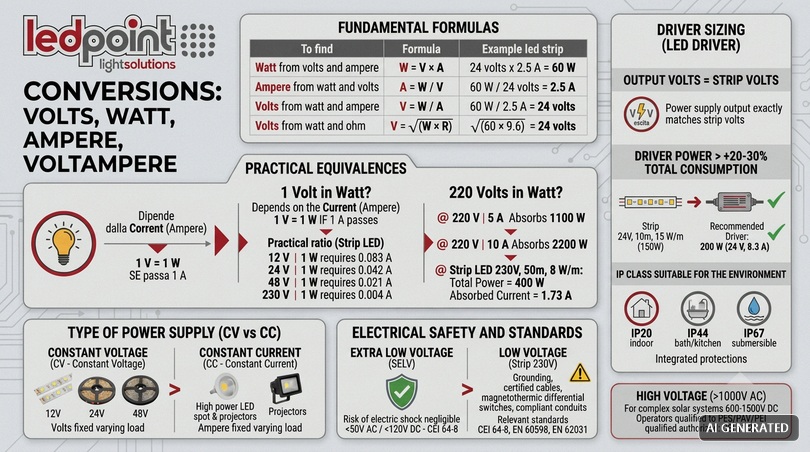
Conversions between volts, watts, and amps are the most frequent operations in sizing an LED strip system. Here are the fundamental formulas:
| To derive | Formula | LED strip example |
|---|---|---|
| Watts from volts and amps | W = V × A | 24 volts × 2.5 A = 60 W |
| Amps from watts and volts | A = W / V | 60 W / 24 volts = 2.5 A |
| Volts from watts and amps | V = W / A | 60 W / 2.5 A = 24 volts |
| Volts from watts and ohms | V = √(W × R) | √(60 × 9.6) = 24 volts |
How much is 1 volt in watts?
Typical question: how much is 1 volt in watts? There is no direct conversion, because volts and watts measure different things (voltage versus power). We can only speak of equivalence by fixing a current value: 1 volt = 1 watt if 1 ampere passes through the load. In LED strips, the practical ratio is: at 12 volts, each watt of consumption requires about 0.083 amps; at 24 volts, each watt requires 0.042 amps; at 48 volts, 0.021 amps; at 230 volts, 0.004 amps.
How much is 220 volts in watts?
Here too, the correct answer is: it depends on the current. At 220 volts, a 5-amp load draws 1100 watts; a 10-amp load, 2200 watts. For a 50-meter 230-volt LED strip with a specific power of 8 W/m, the total power is 400 W and the current drawn is 1.73 amps. The volt value of the network does not define watts alone: current is always also needed.
Sizing the power supply based on volts
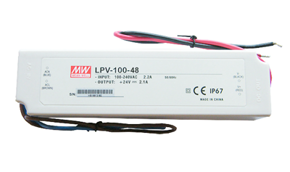
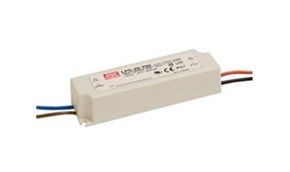
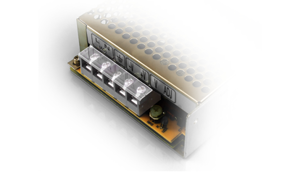
The power supply (or LED driver) is the heart of the installation: it converts the 230 volts of the mains into the voltage required by the strip (12 volts, 24 volts, or 48 volts). Choosing it correctly is essential for the durability of the system. The three golden rules are: output volts exactly equal to the strip volts, power supply power 20-30% higher than total consumption, IP class suitable for the installation environment.
A common mistake is to size the power supply exactly, without margin. A 24-volt LED strip of 10 meters and 15 W/m draws 150 W: the right power supply is 200 W (24 volts, 8.3 amps), not 150 W. The 25-30% margin prevents the power supply from always working at the limit, extending its life and reducing the risk of overheating. In the Ledpoint catalog, power supplies are available in IP20 version for indoors, IP44 for bathrooms and kitchens, IP67 for outdoors and submersible, all with integrated protections against overvoltage, short circuits, and overtemperature.
Constant voltage vs constant current power supplies
In LED strips, constant voltage (CV) power supplies are almost always used, which keep the output volts fixed as the load varies. High-power spot LED modules instead use constant current (CC) power supplies. On the Ledpoint product sheet, this distinction is always highlighted: standard LED strips are CV (12 volts, 24 volts, 48 volts), spotlights and floodlights are CC.
Electrical safety: extra-low voltage and regulations
An often overlooked aspect is the electrical safety related to volts. 12-volt, 24-volt, and 48-volt LED strips fall into SELV (Safety Extra-Low Voltage), defined by CEI 64-8 standard as nominal voltage not exceeding 50 volts in AC or 120 volts in DC. This means that, in case of accidental contact, the risk of electrocution is negligible.
230-volt LED strips, on the other hand, fall into low voltage and require the same precautions as any domestic system: differential circuit breaker, certified cables, compliant conduits, grounding. The reference standards are CEI 64-8 for user systems, EN 60598 for lighting equipment, and EN 62031 for LED modules. Ledpoint provides compliant technical documentation for each product, with CE declaration and detailed safety data sheets.
High volts: what changes beyond 1000 volts
Beyond 1000 volts in AC, we speak of high voltage, a domain that does not concern LED strips but is useful to mention for completeness. In domestic photovoltaics, we typically reach 600-1500 volts DC on the panel side, dangerous values that require qualified operators and certified DC disconnectors. Electricians working on these systems follow specific PES/PAV/PEI training according to CEI 11-27 standard.
Practical applications of Ledpoint LED strips
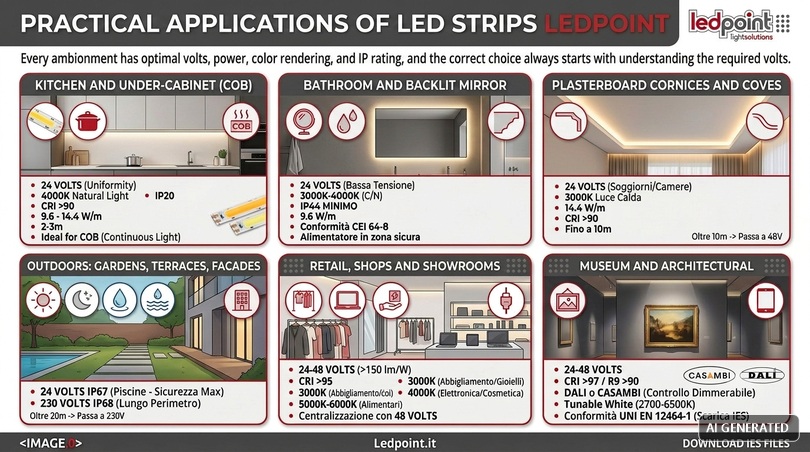
Let's now see how the concepts of volts translate into real applications through the Ledpoint.it LED strip catalog. Each environment has optimal volts, power, color rendering, and IP rating, and the correct choice always starts with understanding the required volts.
Kitchen and under-cabinet
For under-cabinet kitchen lighting, we recommend 24-volt LED strips, natural light 4000K, CRI >90 for faithful food color rendering, 9.6-14.4 W/m power, IP20. The typical length for a standard cooktop is 2-3 meters, so 24 volts guarantee perfect uniformity without the need for dual power supply. The 24-volt COB LED strip is ideal for a continuous light effect without visible dotting under the cabinet.
Bathroom and backlit mirror
In the bathroom, for mirror backlighting, we recommend 24-volt LED strips with 3000K (warm) or 4000K (natural) light, minimum IP44 rating, 9.6 W/m power. The extra-low voltage of 24 volts is particularly reassuring in a humid environment. The power supply must be installed outside zone 2 according to CEI 64-8.
Plasterboard frames and coves
Plasterboard light frames and perimeter coves are the most typical application of LED strips. For living rooms and bedrooms, we recommend 24-volt 3000K LED strips with 14.4 W/m power and CRI >90. For lengths up to 10 meters, 24 volts are perfect; beyond that, switch to 48-volt LED strips.
Outdoors: gardens, terraces, facades
For outdoor applications, we recommend 24-volt IP67 LED strips or 230-volt IP68 LED strips, depending on length. For pool contours and wet gardens, the extra-low voltage of 24 volts offers maximum safety. For extended perimeter lighting beyond 20 meters, 230 volts are the most practical choice.
Retail, shops, and showrooms
In retail, the standard is 24-volt or 48-volt LED strips with high luminous efficiency (150 lm/W), CRI >95, color temperature selected based on the displayed product: 3000K for clothing and jewelry, 4000K for electronics and cosmetics, 5000-6000K for fresh food. 48 volts allow lighting entire display walls with a single centralized power supply.
Museum and architectural
Museum lighting requires LED strips with CRI >97, R9 >90, DALI or Casambi dimmable control. Ledpoint offers 24-volt Tunable White (2700-6500K) and 48-volt LED strips for long display walls. Compliance with UNI EN 12464-1 on illuminance levels is guaranteed by the IES photometric sheets downloadable for each product.
Common mistakes about volts in LED strips
In Ledpoint's technical experience, we have classified the most frequent customer mistakes regarding volts:
- Confusing input volts and output volts: the power supply takes 230 volts from the mains and provides 12 or 24 volts to the LED strip; you cannot connect the strip directly to 230 volts unless it was designed for that voltage.
- Undersizing the power supply: buying a 100 W power supply for a strip that consumes 90 W means making it work at constant 90%, with drastically reduced useful life.
- Ignoring volt drop: connecting 8 meters of 12-volt strip from one side only produces evident non-uniformity. The solution is dual power supply or switching to 24 volts.
- Mixing LED strips with different volts on the same power supply: never connect a 12-volt strip and a 24-volt strip on the same driver.
- Cables too thin: 0.5 mm² cable for a 6-amp line causes excessive volt drop; use 1.5 mm² or larger.
- Ignoring the IP rating in relation to volts: 230 volts outdoors require minimum IP67 and certified waterproof boxes.
Volts in photovoltaics and integration with LED strips
Photovoltaic system owners have an interesting advantage in LED strip lighting: they can power the strips directly from storage batteries, avoiding the double DC-AC-DC conversion. The most common photovoltaic batteries have a nominal voltage of 24 volts, 48 volts, or 400 volts: for the first two categories, there are Ledpoint LED strips directly compatible without an intermediate power supply, with obvious energy and component savings.
To verify that the volts generated by the panels are correct, string monitors integrated into modern inverters are used, capable of measuring voltage, current, and power in real-time. Signs of voltage problems are: string volts below the nominal value in full light conditions, volt oscillations beyond ±5%, significant differences between parallel strings. Reducing volt losses in the photovoltaic system means using adequately sized cables (often 6 or 10 mm²), certified MC4 connectors, and limiting the length of DC sections.
Market data and statistics on the LED world
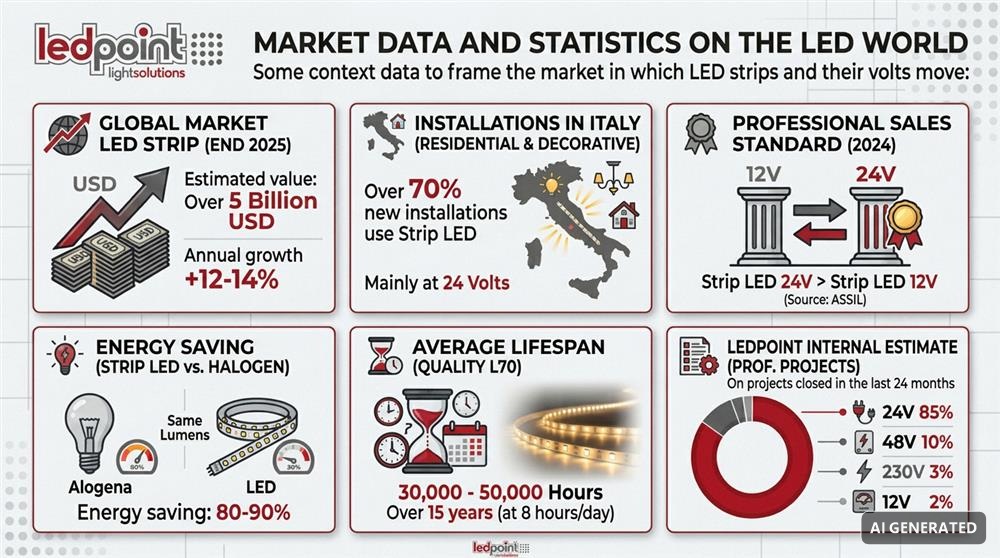
Some context data to frame the market in which LED strips and their volts operate:
- The global market for LED strips reached an estimated value of over 5 billion dollars at the end of 2025, with an average annual growth of 12-14%.
- In Italy, over 70% of new residential decorative lighting installations use LED strips, mainly at 24 volts.
- 24-volt LED strips surpassed 12-volt LED strips in 2024 as the sales standard in the professional channel (source: Assil).
- The energy savings of an LED strip compared to traditional halogen lighting, for the same lumens, is 80-90%.
- The average lifespan of a quality LED strip (L70) is 30,000-50,000 hours, over 15 years of use at 8 hours per day.
- Ledpoint internally estimates, on projects closed in the last 24 months, that 85% of professional installations use 24-volt LED strips, 10% at 48 volts, 3% at 230 volts, and only 2% still at 12 volts.
Frequently Asked Questions (FAQ)
What does Volt correspond to?The volt corresponds to the unit of measurement of electrical voltage in the International System. One volt equals the ratio between one joule of energy and one coulomb of charge. In practice, volts measure the "push" that the generator exerts on electrons to make them circulate in a circuit. |
What does 1 volt correspond to?1 volt corresponds to the voltage needed to dissipate 1 watt of power in a load crossed by 1 ampere of current. It is the fundamental value of the formula P = V × I, the basis for sizing any LED strip. |
What is 1V equal to?1V is equal to 1 joule divided by 1 coulomb, that is, the energy transferred per unit of charge. In the context of LED strips, 1V represents a minimum voltage step, while strips typically operate at 12, 24, 48, or 230 volts. |
What is a volt?The volt is the unit of measurement of electrical potential difference. It takes its name from Alessandro Volta and is indicated with the symbol V. In the world of LED strips, volts determine which power supply to use, what the maximum length is, and what degree of safety the system offers. |
What are volts and amps?Volts measure voltage, amps measure current. With a hydraulic analogy, volts are the water pressure in the pipe, amps are the flow rate (liters per second). In LED strips, both count: volts for compatibility with the power supply, amps for cable sizing. |
What does voltage indicate?Voltage, that is, the value in volts, indicates how much energy is available per unit of electric charge. In LED strips, the nominal voltage (12, 24, 48, or 230 volts) must be exactly respected by the power supply, with a maximum tolerance of ±10%. |
What does 220 Volts mean?220 volts was the nominal voltage of the Italian electrical network until the 1990s. From 2003, for European uniformity, the value was updated to 230 volts with ±10% tolerance. In common language, people still say "220 volts," but technically it is 230 volts. |
Is 12 volts 120?No, 12 volts and 120 volts are two completely different values. 12 volts is an extra-low voltage typical of automotive LED strips; 120 volts is the mains voltage in the United States. They are not interchangeable in any way. |
What is the difference between volt and watt?The volt measures voltage, the watt measures power. The watt is the product of volts and amps: W = V × A. In LED strips, volts tell you which power supply to pair the strip with; watts tell you how much energy it consumes per meter and how to size the power supply. |
What is the difference between watts and volt-amperes?In direct current, watts and volt-amperes coincide. In alternating current, volt-amperes represent apparent power, watts represent active power; the ratio is the power factor. For LED strip power supplies, the VA value is often indicated next to W. |
What is the difference between volt and current?The volt is the cause, current is the effect. Volts push electric charges to move, generating a current measured in amps. Without volts there is no current; without a closed path, the current remains zero even with high volts. |
How much is 1 volt in watts?There is no direct conversion: 1 volt corresponds to 1 watt only if the load is crossed by 1 ampere. In 24-volt LED strips, each watt consumed corresponds to about 0.042 amps; in 12-volt LED strips, it corresponds to 0.083 amps. |
Do you say volt or volts?Both forms are correct in Italian. "Volt" is the invariable Italian form, "volts" is the plural form borrowed from English and widely used in technical and commercial jargon. Ledpoint uses "volts" in line with the international standard of the lighting market. |
What is a voltmeter?The voltmeter is the instrument that measures volts, that is, the electrical voltage between two points of a circuit. It is always connected in parallel to the load and today is almost always integrated into a digital multimeter, with typical accuracy of ±0.5%. |
What does Ohm's law say?Ohm's law states that V = R × I, that is, volts equal resistance (in ohms) multiplied by current (in amps). It is the pillar of electrical engineering and allows calculating volts, amps, or ohms knowing the other two quantities. |
Which is the best LED strip: 12, 24, or 48 volts?It depends on the project. For lengths up to 3 meters and mobile environments, the 12-volt LED strip is fine. For residential installations up to 10 meters, 24 volts are the recommended standard. For professional installations over 15 meters, 48 volts offer the best uniformity. |
Can I power a 12-volt LED strip with 24 volts?No, absolutely not. Applying 24 volts to a strip designed for 12 volts means doubling the voltage, quadrupling the dissipated power, and burning out the LEDs in a few seconds. Volt compatibility between strip and power supply is mandatory. |
Volts: the foundation for realizing your project
Understanding volts in LED strips is the basis for designing beautiful, uniform, safe, and durable lighting systems. 12 volts remain valid for mobile and short applications, 24 volts are the reference standard for most residential and commercial installations, 48 volts win on long runs, 230 volts serve to cover extreme distances where an intermediate power supply would be inconvenient.
On Ledpoint.it, you will find a complete LED strip catalog with 12-volt monochromatic and RGB LED strips, 24-volt CRI >90 and Tunable White LED strips, 48-volt LED strips for professional projects, 230-volt IP67 LED strips for outdoors. Each product is accompanied by a downloadable datasheet, photometric curve, CE declaration. The online configurator helps you choose the right LED strip based on volts, power, color temperature, and IP rating, and the Ledpoint technical service is available for custom projects with dedicated lumen-per-lux calculation.
Go to the Ledpoint LED strip catalog, download the datasheets, request a quote, or talk to one of our technicians: we will transform your volts into quality light.
This article was developed with the support of artificial intelligence and subsequently reviewed, corrected, and validated by the Ledpoint.it technical team, which guarantees its reliability and compliance with official sources.