










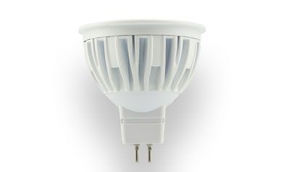
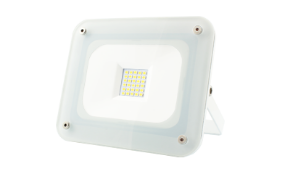
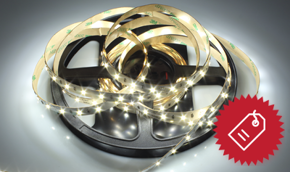
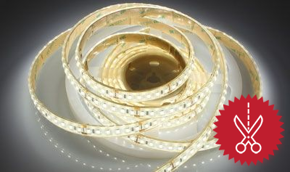

LEDs (Light Emitting Diodes) are semiconductor electronic components that convert electrical energy into light without producing excess heat. Today LEDs are everywhere: in homes, on construction sites, in shops, in architectural lighting, in displays and in LED strips and LED modules that power much of modern decorative and technical lighting. Understanding how LEDs work helps you choose the right product, save energy and install the solution best suited to each project.
In this article...
1. What are LEDs: definition and operation
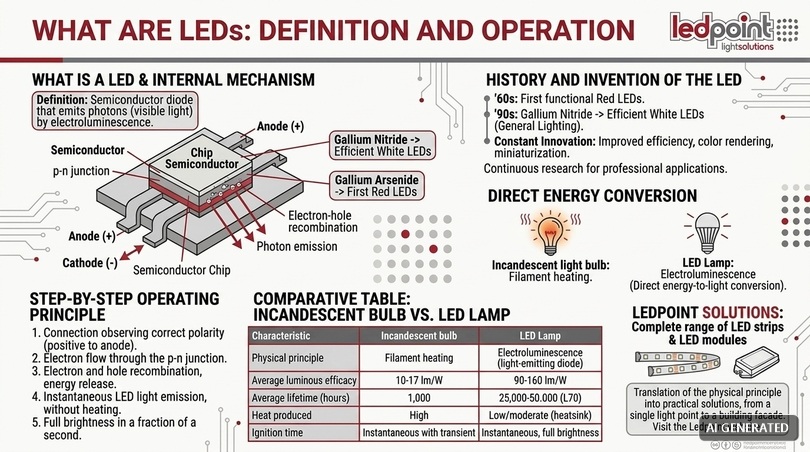
Before choosing an LED strip or LED module for a project, it's useful to truly understand what LEDs are and why they have replaced almost every other lighting technology in the last twenty years. An LED (acronym for Light Emitting Diode) is a semiconductor diode that, when crossed by electric current in forward bias, emits photons, i.e., visible light. Unlike incandescent bulbs, which produce light by heating a filament to incandescence, the LED converts electrical energy directly into light through a phenomenon called electroluminescence.
An LED consists of a semiconductor chip, an anode and a cathode: current enters from the anode (positive pole) and exits from the cathode (negative pole), crossing the p-n junction of the semiconductor. It is precisely in this junction that electrons recombine with holes, releasing energy in the form of photons. The color of the emitted light depends on the semiconductor material used and its energy band gap: from the red and infrared LEDs of the early '60s, made with gallium arsenide, we have moved to high-efficiency blue and white LEDs, made possible by the introduction of gallium nitride.
The operating principle step by step
When you connect an LED to current respecting the correct polarity (positive to anode and negative to cathode), the flow of electrons through the p-n junction is triggered inside the chip. This flow generates LED light emission almost instantly, without filament heating phases as happened in traditional lamps. This is why an LED turns on at full brightness in a fraction of a second and why it consumes a much smaller amount of energy for the same lumens emitted.
| Characteristic | Incandescent bulb | LED lamp |
|---|---|---|
| Physical principle | Heating of a filament | Electroluminescence (light emitting diode) |
| Average luminous efficiency | 10-17 lm/W | 90-160 lm/W |
| Average lifespan (hours) | 1,000 | 25,000-50,000 (L70) |
| Heat produced | High | Low/moderate (heat sink) |
| Turn-on time | Instant with transient | Instant, full brightness |
On the Ledpoint website you can find the complete range of LED strips and LED modules designed to translate this physical principle into practical lighting solutions, from a single light point to the facade of a building.
2. History and invention of LED technology
LED technology was not born today: its history begins in the early '60s, when the first working red LED was developed in the laboratory as a derivation of semiconductor studies applied to diodes. For decades LEDs remained confined to indicator lights and numeric displays, because an efficient blue LED capable of completing the RGB triplet necessary to generate white light was missing. Only in the '90s, thanks to the development of gallium nitride LEDs, was it possible to obtain a white LED really usable for general lighting, an achievement that paved the way for the mass replacement of traditional light bulbs.
Since then who invented LED technology has continued to be the subject of constant research and innovation: universities, research centers and specialized companies have progressively improved luminous efficiency, color rendering (CRI) and chip miniaturization, making LEDs increasingly suitable even for professional applications such as museum, retail and architectural lighting.
3. Types of LEDs: RGB, SMD, COB, high power
There is not just one type of LED: depending on the application, the required power and the desired light effect, there are different types of LEDs on the market, each with specific technical characteristics and areas of use. Knowing them is fundamental before choosing an LED strip or LED module, because the chip technology directly affects light output, consumption and lifespan.
Monochromatic LEDs and RGB LEDs
Monochromatic LEDs emit a single wavelength, therefore a single fixed color (warm white, cool white, red, blue, green, etc.). RGB LEDs instead combine three chips (red, green, blue) in a single package: by varying the intensity of each color it is possible to obtain millions of color combinations, which is why they are the standard choice for decorative lighting, retail environments and scenic setups.
SMD LEDs and COB LEDs
SMD LEDs (Surface Mounted Device) are small-sized chips soldered directly onto the printed circuit: they are the most widespread technology in LED strips thanks to the good compromise between cost, brightness and ease of installation. COB LEDs (Chip On Board) instead integrate multiple chips on a single surface, offering more uniform light free of the "dotted" effect, ideal for applications where homogeneous and high-performance lighting is needed.
High power LEDs
High power LEDs are designed for applications that require large amounts of lumens from a compact source: architectural projectors, industrial lighting, sports facilities. They require properly sized heat sinks, because thermal management is the factor that most affects the useful life of the chip.
| Type | Typical application | Strength |
|---|---|---|
| SMD | LED strips, backlighting, furnishings | Compactness and low cost |
| COB | Spotlights, LED modules, technical lighting | Uniform light, high performance |
| RGB / RGBW | Decorative, retail, scenic | Millions of colors, dimmable |
| High power | Industrial, architectural, sports | High lumens from compact source |
4. Advantages and disadvantages of LEDs
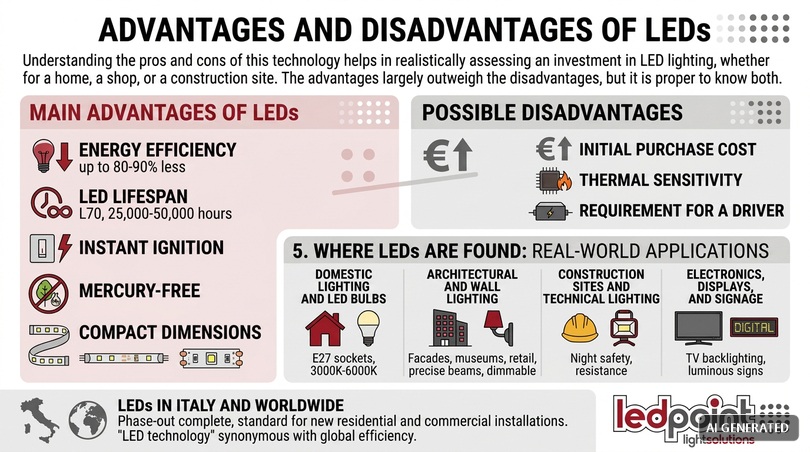
Understanding the strengths and limitations of this technology helps to realistically evaluate an investment in LED lighting, whether for a home, a shop or a construction site. The advantages largely outweigh the disadvantages, but it is correct to know both.
The main advantages of LEDs
- Energy efficiency: for the same lumens emitted, an LED consumes up to 80-90% less than an incandescent bulb.
- LED lifespan: the average useful life (calculated as L70, i.e., the moment when the luminous flux drops to 70% of the initial value) ranges from 25,000 to over 50,000 hours, compared to 1,000 hours of a traditional bulb.
- Instant turn-on and full compatibility with dimmers and smart control systems.
- Absence of mercury and lower environmental impact compared to fluorescent lamps.
- Compact dimensions, which allow the creation of flexible LED strips and miniaturized LED modules suitable even for small spaces.
Possible disadvantages
- Higher initial purchase cost compared to traditional lamps, although quickly amortized by energy savings.
- Thermal sensitivity: an inadequate heat sink can significantly reduce the chip's lifespan.
- Need for a dedicated driver or power supply, often not included in the LED component alone.
5. Where LEDs are found: real applications
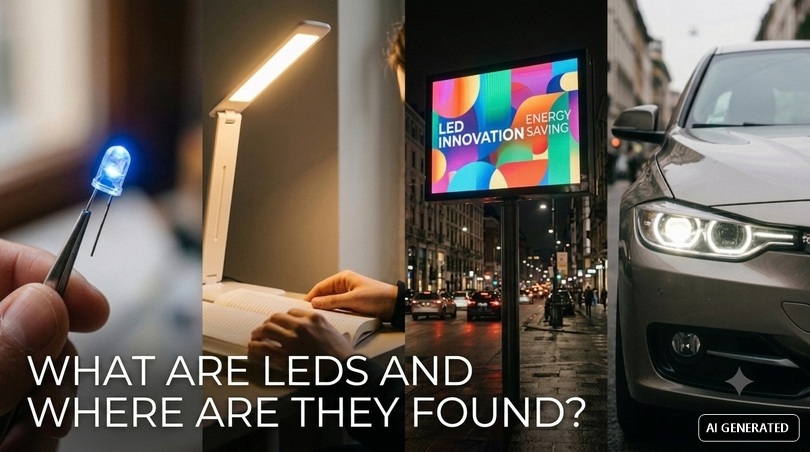
One of the most searched questions online is precisely "where are LEDs found", because this technology has now invaded practically every area of daily and professional life. Here is an overview of the most common applications.
Domestic lighting and LED bulbs
LED bulbs and LED lamps have almost completely replaced incandescent and halogen bulbs in Italian homes. They are found in all standard bases (E27, E14, GU10) and in all color temperatures, from 3000K warm white to 6000K cool white.
Architectural and wall lighting
LED wall lights are now the standard for lighting facades, museum surfaces and retail environments, thanks to the possibility of obtaining precise light beams, dimmable and available in different color temperatures.
Construction sites and technical lighting
In construction sites LEDs have replaced traditional halogen lamps for nighttime safety lighting, thanks to reduced consumption, impact resistance and lower maintenance.
Electronics, displays and signage
LEDs are fundamental components in consumer electronics: LED displays, backlighting of TVs and monitors (LED backlight, edge LED), illuminated signs and road signage.
LEDs in Italy and worldwide
The spread of LEDs in Italy grew rapidly after the European phase-out of incandescent and halogen bulbs: today almost all new installations, both residential and commercial, adopt LED technology, and the same trend is observed internationally, where the term LED technology (or led stripes, in the English terminology often searched even in Italy) is now synonymous with efficient lighting.
6. LED strips and LED modules: what they are and differences
Among the most requested products in the Ledpoint catalog there are undoubtedly LED strips and LED modules, two solutions often confused but with different construction characteristics and areas of use.
What are LED strips
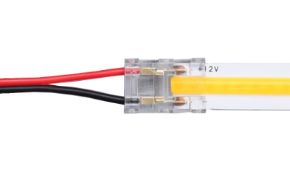
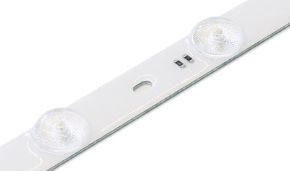
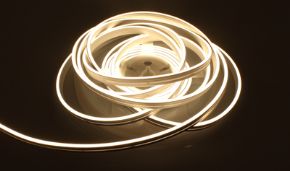
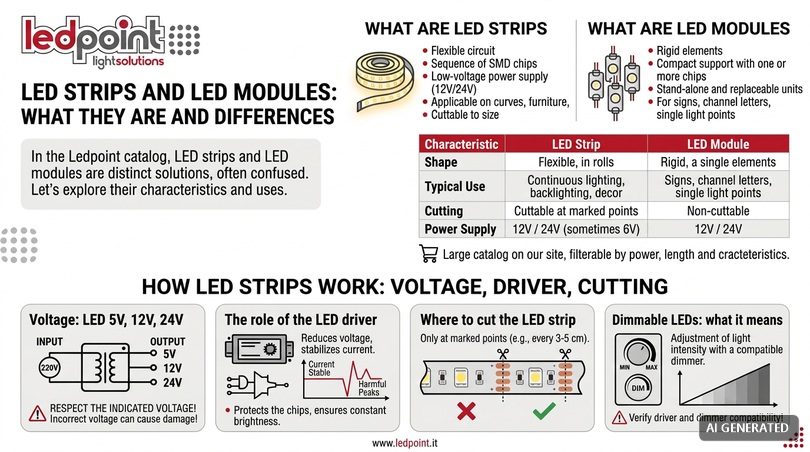
An LED strip (or led strip, strip led, terms used as synonyms even if sometimes searched with typos like "strisceled" or "strice led") is a flexible circuit on which numerous SMD chips are mounted in sequence, usually powered at low voltage (12V or 24V, more rarely 6V for miniaturized applications). Thanks to the flexibility of the support, the LED strip can be applied on curved profiles, furniture, false ceilings, stairs and walls, and is available cuttable to size at predetermined points.
What are LED modules
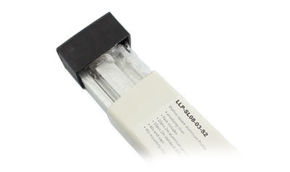
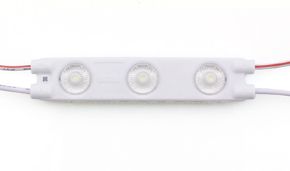
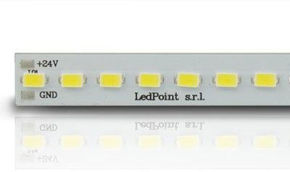
LED modules are instead rigid elements, often small in size, which integrate one or more LED chips on a compact support, designed for lighting signs, boxed letters, advertising panels and light points where a self-contained and easily replaceable unit is needed, rather than a continuous line of light.
| Characteristic | LED strip | LED module |
|---|---|---|
| Shape | Flexible, in rolls | Rigid, single elements |
| Typical use | Continuous lighting, backlighting, furnishings | Signs, boxed letters, single light points |
| Cutting | Cuttable at marked points | Not cuttable |
| Power supply | 12V / 24V (sometimes 6V) | 12V / 24V |
On our website you can find a wide catalog of strip led in different color temperatures, IP protection ratings (for indoor or outdoor use) and dimmable versions, as well as LED modules designed for advertising and technical applications: the LED strips section and the LED modules section collect all available references, filterable by power, length and technical characteristics.
7. How LED strips work: voltage, driver, cutting
To correctly install an LED strip it is necessary to understand some basic technical concepts, which allow you to avoid common errors and obtain optimal and lasting light output.
Voltage: 5V, 12V, 24V LEDs
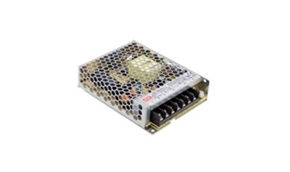
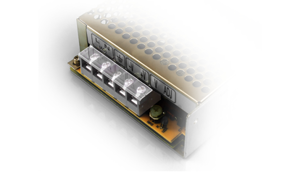
LED strips almost never work at mains voltage (220V): they require a power supply (driver) that transforms alternating current into low direct voltage, typically 12V or 24V. 5V LED versions are less common and used mainly in miniaturized or hobby applications. It is essential to respect the voltage indicated by the manufacturer: incorrect voltage can irreparably damage the chip.
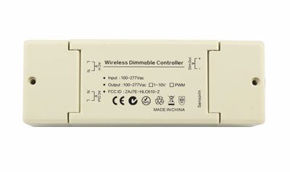
The role of the LED driver
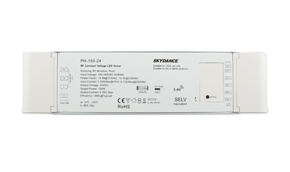
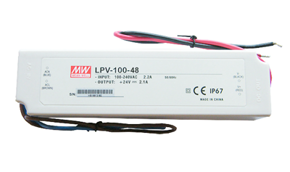
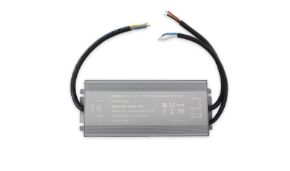
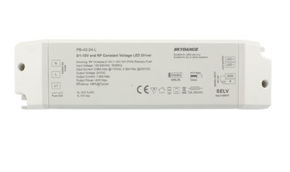
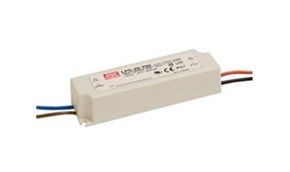
The LED driver not only serves to reduce the voltage, but also to stabilize the output current, protecting the chips from overcurrents and ensuring constant brightness over time. An undersized driver is one of the most frequent causes of premature failure of LED strips.
Where to cut the LED strip
One of the most frequent customer questions concerns precisely where to cut the LED strip: all quality LED strips have cutting points marked along the circuit, generally every 3 or 5 cm, at the copper contacts. Cutting outside these points damages the circuit and makes the subsequent strip section unusable.
Dimmable LEDs: what it means
When we talk about dimmable LED we refer to the possibility of regulating the light intensity via a compatible dimmer, maintaining stable color rendering even at low intensity. Not all LED strips are dimmable: it is necessary to verify the compatibility of both the driver and the dimmer itself, to avoid flickering or malfunctions.
8. How to choose the right LEDs for every profession
The choice of the ideal LED strip or LED module changes a lot depending on the professional context in which it is installed. Here are some practical indications for the most recurring profiles among our customers.
For the construction entrepreneur: construction site lighting
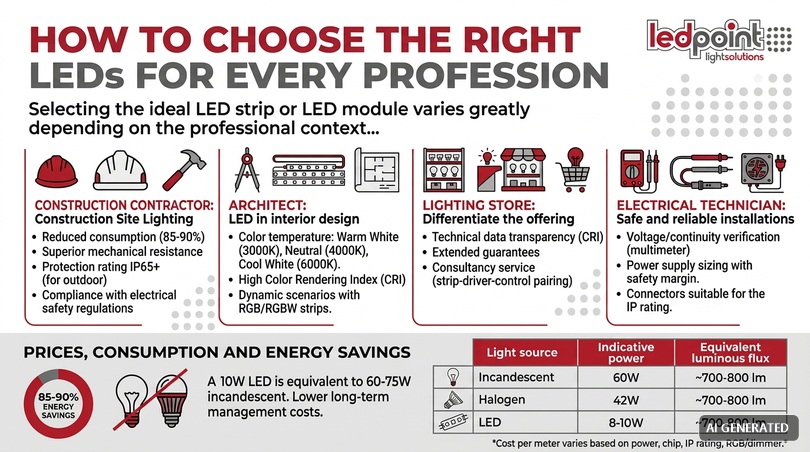
In construction sites, the main advantage of LEDs compared to traditional lamps is the drastic reduction in consumption for the same guaranteed nighttime visibility, combined with superior mechanical resistance to impacts and vibrations typical of a work environment. For safe installation it is important to choose products with an IP protection rating adequate for exposure (IP65 or higher for outdoor use) and respect the electrical safety regulations in force for construction sites.
For the architect: LEDs in interior design
For an architect, the choice of LEDs passes mainly through color temperature and color rendering (CRI): warm white (3000K) enhances residential and welcoming environments, neutral white (4000K) is suitable for commercial spaces, while cool white (6000K) adapts to technical or industrial contexts. RGB and RGBW LED strips also allow you to create dynamic and customizable scenarios.
For the lighting store: differentiating the offer
Those who sell LED lighting to the public can differentiate by focusing on products with transparent technical data (lumens, CRI, IP, lifespan), extended warranties and consulting services for matching LED strip, driver and control system, elements that the end customer is often not able to evaluate independently.
For the electrical technician: safe and reliable installations
For an electrical technician, the essential tools to correctly install LED strips and modules include a multimeter for checking voltage and continuity, a power supply sized with a safety margin compared to the overall load, and connectors adequate for the protection rating required by the installation.
9. Prices, consumption and energy savings
One of the most concrete aspects in choosing LEDs concerns the relationship between initial investment and energy savings over time. A 10W LED, for example, produces a luminous flux comparable to a 60-75W incandescent bulb, with an estimated energy saving of around 85-90%.
| Light source | Indicative power | Equivalent luminous flux |
|---|---|---|
| Incandescent | 60W | ~700-800 lm |
| Halogen | 42W | ~700-800 lm |
| LED | 8-10W | ~700-800 lm |
The cost of an LED strip per meter varies based on power, chip type, IP rating and presence or absence of the RGB/dimmable function, while the management cost over time remains in any case significantly lower compared to traditional technologies, thanks to the combination of low consumption and much longer useful life.
10. Regulations and certifications
The installation of LED lighting systems, particularly in professional environments and construction sites, must respect the reference regulatory standards, including the UNI EN 12464 standard for workplace lighting and the IEC 60598 standard relating to the safety of lighting equipment. It is also good practice to verify that the chosen products bear the CE marking and, where applicable, ENEC certifications, guarantee of conformity to European safety standards.
11. Recent innovations: OLED, smart LEDs, future
LED technology continues to evolve: alongside traditional LEDs, OLED (Organic LED) technology has established itself, used mainly in latest generation displays for the ability to illuminate each single pixel independently, obtaining deeper blacks and superior contrasts. At the same time, so-called smart LEDs are spreading, integrable in home automation systems and controllable via apps or voice assistants, which allow you to regulate color, intensity and time programming remotely. The future of LEDs also looks to even greater energy efficiency and progressive integration with presence and ambient light sensors, for increasingly automated and sustainable lighting.
12. Frequently asked questions about LEDs
What are LEDs and how do they work?LEDs are semiconductor diodes that emit light when crossed by electric current, through a phenomenon called electroluminescence. Unlike traditional bulbs they do not have a filament to heat, which is why they are more efficient and durable. |
What is the difference between an LED bulb and a traditional one?The main difference is the operating principle: the traditional bulb produces light by heating a filament, while the LED converts electricity directly into light. This translates into 80-90% lower consumption and a lifespan up to 50 times longer. |
Where to buy quality LED strips?Professional LED strips are found at specialized retailers like Ledpoint, which offers complete technical datasheets, warranty and assistance in choosing between the different powers, color temperatures and protection ratings available. |
Where do you cut the LED strip?The LED strip must be cut exclusively at the cutting points marked on the circuit, usually every 3-5 cm at the copper contacts, so as not to damage the subsequent strip section. |
What does dimmable LED mean?A dimmable LED is compatible with dimmers that regulate its light intensity, maintaining stable light quality even at low power. It is necessary to verify compatibility between driver, LED strip and dimmer used. |
What voltage do LEDs have, 6V, 12V or 24V?The most common LED strips work at 12V or 24V, while 6V versions are used in miniaturized applications. The correct voltage must always be checked on the product technical datasheet before installation. |
How long do LED strips and lamps last?The average lifespan of quality LEDs ranges from 25,000 to over 50,000 hours, calculated as L70, i.e., the moment when the luminous flux drops to 70% of the initial value, much more than the lifespan of traditional lamps. |
What are the advantages of LEDs compared to traditional lamps?The main advantages are energy efficiency, much longer lifespan, instant turn-on, compact dimensions and absence of substances like mercury, present instead in fluorescent lamps. |
LEDs: the reference standard of modern lighting
LEDs today represent the reference standard for lighting, thanks to efficiency, lifespan and versatility that no previous technology has managed to guarantee in the same way. Whether it's lighting a construction site, designing an architectural environment, furnishing a shop or creating a technical system, the choice of the correct LED strip or LED module makes the difference in terms of light output, consumption and duration over time. Discover the entire range of LED strips and LED modules available on Ledpoint.it and find the solution best suited to your project.
This article was developed with the support of artificial intelligence and subsequently reviewed, corrected, and validated by the Ledpoint.it technical team, which guarantees its reliability and compliance with official sources.