









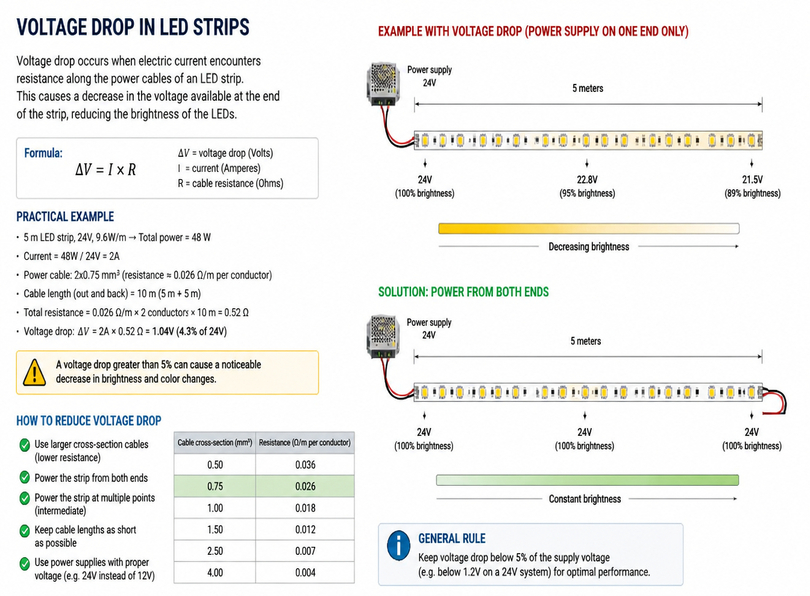
The phenomenon of voltage drop in LED strips is one of the most frequent causes of dissatisfaction in installations: the strip appears uniform when turned on, but when viewed from a distance or once installation is complete, it's clearly noticeable that one end shines less than the other. This article explains the technical causes, presents tables with voltage drops for the most common configurations, and provides an interactive calculator to estimate the voltage drop in your installation.
Voltage drop table by configuration — Reference values
| Strip | W/m | Voltage | Length | Current | Est. ΔV | % | Visual effect | Solution |
|---|---|---|---|---|---|---|---|---|
| 2835 low | 4.8 | 12V | 5m | 2.0A | 0.56V | 4.7% | Almost imperceptible | None |
| 2835 medium | 9.6 | 12V | 5m | 4.0A | 1.12V | 9.3% | Visible | Dual power supply or 24V |
| 2835 medium | 9.6 | 24V | 5m | 2.0A | 0.56V | 2.3% | Negligible | None |
| 2835 high | 14.4 | 12V | 5m | 6.0A | 1.68V | 14% | Very visible | 24V or dual power supply required |
| 2835 high | 14.4 | 24V | 5m | 3.0A | 0.84V | 3.5% | Negligible | None |
| 2835 high | 14.4 | 24V | 10m | 6.0A | 3.36V | 14% | Very visible | Dual power supply or 48V |
| 2835 high | 14.4 | 48V | 10m | 3.0A | 0.84V | 1.75% | Negligible | None |
| COB 10W/m | 10 | 24V | 5m | 2.1A | 0.59V | 2.5% | Negligible | None |
| COB 14W/m | 14 | 24V | 7m | 4.1A | 1.62V | 6.8% | Slightly visible | Dual power supply recommended |
| RGB 5050 | 14.4 | 12V | 5m | 6.0A | 1.68V | 14% | Inhomogeneous colors | 24V or dual power supply |
Why voltage drops along the strip
The PCB of LED strips is a copper conductor with its own resistance. As current flows from the power supply point toward the end of the strip, the cumulative resistance of the copper causes a progressive reduction in voltage. The LED chips receive less voltage and, consequently, less current: they shine less brightly. The effect is proportional to the current (more watts = more current = more drop) and to the length (longer = more resistance).
Switching from 12V to 24V is the simplest way to halve the current for the same power: since voltage drop is proportional to current, halving the current also halves the drop. Switching from 12V to 48V reduces the current to one quarter and the drop to one quarter.
Solutions for voltage drop
| Solution | When to apply | Complexity | Cost | Effectiveness |
|---|---|---|---|---|
| Dual power supply | Strips 5–15m long at 24V | Low | Only additional cables | High (halves the drop) |
| Switch from 12V to 24V | 12V strips with visible drop | Change strip and power supply | Medium | Very high (halves current) |
| Switch to 48V | Very long strips (>10m) | Change entire system | Medium-high | Excellent |
| Reduce single run length | Always applicable | Low (adds power supply point) | Additional | High |
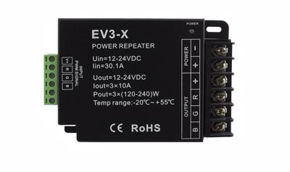
| Signal amplifier | Long RGB/RGBW strips | Medium | Medium | High (restores voltage) |
| Wider PCB | Same chips, 12mm vs 8mm PCB | Choice at time of purchase | Slight difference | Medium (reduces ~20%) |
Ledpoint's rule of thumb: if you want a worry-free installation, always use 24V for installations over 3 meters. The additional cost compared to 12V is minimal, but voltage drop problems are eliminated for the vast majority of standard residential and commercial installations.
FAQ on voltage drop
Why is my LED strip brighter on one side?
The cause is almost always voltage drop. The LEDs at the end of the strip receive less voltage and shine less brightly. Solutions: dual power supply, switch to 24V or 48V, reduce the length of the single run.
Beyond what length is dual power supply needed at 24V?
For 24V strips, dual power supply is recommended beyond 7–10 meters, depending on the power per meter. For high-power strips, the limit drops to 5–7 m.
Does 48V solve voltage drop?
Yes: for the same power, 48V carries half the current compared to 24V, so the voltage drop is proportionally reduced. For installations over 10 meters, 48V is the optimal technical solution.