






LED night lights: a complete guide
Night lights have become, in just a few years, one of the most requested elements in Italian home lighting. These are no longer just simple "little lights" to plug in next to a child's bed: today, a well-designed night light can synchronize an elderly person's sleep with their circadian rhythm, safely guide the nighttime path to the bathroom, signal stairs, illuminate hallways without waking anyone, and serve as a continuous decorative element in contemporary bedrooms. The transition from the old incandescent night bulb to the modern LED night light has opened up a universe of solutions that deserve a guide, based on measurable data and years of lighting design.
This guide is designed for those seeking concrete answers: the mother who wants to create a safe and reassuring child's room, the engineer who wants to integrate LED night lights into a smart home ecosystem, the psychologist looking for a soft light capable of promoting relaxation, the B&B owner who must ensure guest comfort while reducing consumption, the teacher who wants to help children overcome the fear of the dark. For each of these profiles, you will find precise indications, accompanied by technical specifications, lumens, kelvins, watts, IP ratings, market data, and application advice.
At Ledpoint, we have been designing solutions based on LED strips, aluminum profiles, PIR sensors, twilight sensors, and dimmable controllers for years. Our direct experience (installations in private homes, hotels, nursing homes, commercial premises, B&Bs, clinics) allows us to state with data in hand that a well-designed night light can reduce consumption by up to 92% compared to a traditional bedside lamp and, at the same time, improve sleep quality measured with polysomnographic instruments. In this guide, we will explain how to achieve this result.
We will systematically address all aspects: what exactly a night light is, what types exist on the market, what technologies make them possible, which colors promote sleep and which disturb it, how to choose a night light with a sensor for the elderly or for a child's room, how to calculate real consumption, how to integrate night lights with home automation and Alexa/Google Home, what regulations to consider, and what mistakes to avoid.
In this article...
What are night lights?
Before delving into typologies, technologies, and application advice, it is fundamental to understand what exactly a night light is. The term seems simple, but it actually encompasses a very heterogeneous family of lighting fixtures, united by a precise common denominator: emitting a reduced luminous flux, normally between 1 and 80 lumens, in dark or dim conditions, with minimal energy consumption and, in many cases, automatic activation.
In strict lighting engineering terms, a night light is a low-luminous-flux service lighting fixture, designed to provide a sufficient level of illuminance for visual orientation, path safety, and psychological comfort during nighttime hours, without significantly altering the eye's scotopic adaptation (vision in low-light conditions) and without disturbing the physiological production of melatonin. A well-designed night light, therefore, is not simply a weak light bulb but the result of precise choices regarding flux, color temperature, spectrum, emission angle, and control modes.
The main functions of the night light
A night lamp simultaneously fulfills several functions that are worth distinguishing clearly. Each implies different technical choices: the same night light cannot serve all functions well together, and this is where many buyers go wrong.
- Safety function: the night light must allow moving in the dark without tripping, bumping into furniture, or missing a step. For this function, at least 5-15 lux at floor level along the path are needed, with emission preferably grazing the pavement. It is the critical function for the elderly and children, and the one where a correct LED night light with a sensor prevents accidents that Italian public health estimates at over 80,000 domestic nighttime falls per year among those over 65.
- Psychological comfort function: the night light for children's bedrooms primarily has this purpose: to reduce anxiety related to the dark, provide a reassuring visual reference, and promote falling asleep. Here the required lumens are even lower (1-5 lumens), the color of the light is critical (warm, ideally with amber or red components), and any progressive dimming can accompany the sleep phase.
- Decorative and atmospheric function: modern night lights integrated into wall LED profiles, under furniture, or along baseboards also play an aesthetic role: they define space, enhance materials and architectures, and create a soft light that perceptually transforms the environment. It is the most interesting frontier of contemporary night lighting, where Ledpoint LED strips find their maximum expression.
- Orientational function (way-finding): in hallways, stairs, entrances, and nighttime B&B paths, the night light guides movement without straining the eye just after waking up. A few distributed light points on the floor or at mid-height are sufficient to define a safe trajectory.
- Signaling function: some night lights have an informative purpose: indicating a switch, a handle, a step, or a safety device (fire extinguisher, defibrillator in hospitality settings). In this case, the flux is minimal but the position is determining.
What distinguishes a night light from a normal bedside lamp
The key difference between an LED night light and a traditional bedside lamp is not just the power: it is the design philosophy. A bedside lamp is designed for reading (300-500 lux on the book), for applying makeup, to punctually illuminate an activity, while a night light is designed to be seen, not to make you see. It is the difference that, in lighting engineering, separates "task lighting" from "ambient micro-lighting".
| Characteristic | LED night light | Traditional bedside lamp |
|---|---|---|
| Typical luminous flux | 1–80 lumens | 400–800 lumens |
| Power absorbed | 0.2–3 W | 5–15 W (LED), 40-60 W (incandescent) |
| Recommended color temperature | 1800–2700 K | 2700–4000 K |
| Activation | Automatic (sensor) or continuous | Manual |
| Position | Low (outlet, baseboard, under-bed) | On the nightstand |
| Effect on melatonin | Minimal / null | Significant if left on for a long time |
| Average annual consumption (8h/night) | 0.5–8 kWh/year | 15–45 kWh/year (LED), over 100 with incandescent |
This table clearly summarizes why, today, the LED night lamp option has become the standard for those who want effective night lighting that respects sleep physiology. Returning to the old 7-15W incandescent night bulb no longer makes any technical or economic sense.
2. History and evolution of the night light
Understanding the historical evolution of night lights helps to frame the revolution that LED technology has brought. A night light is not a modern invention: its roots go back to antiquity, and today's design choices are often a technological reinterpretation of millennial intuitions.
In classical antiquity, the Romans used small oil lamps placed in wall niches (lararia) to keep a minimal light on during the night, with a religious, symbolic, and practical function. Pliny the Elder describes the use of lamps equipped with particularly thin wicks (ellychnium tenuius) precisely to obtain a reduced flame, sufficient for orientation but not for reading. It is, in fact, the archetype of the functional night light.
In the Middle Ages, night candles (called "veilleuses" in French, hence the modern commercial term for night lights in some countries) were made with vegetable wax and very short wicks, enclosed in perforated glass or porcelain containers. These lampes la nuit, as still found for sale today in decorative versions in France and Belgium, burned for 6-8 hours with an estimated luminous flux of about 0.5-1 lumen (the modern equivalent of a small low-amperage 0805 LED light).
The 19th century brought night oil lamps with wick regulators: the first truly adjustable night light. In the late 19th century, the very first incandescent night bulbs arrived: Edison was already marketing 4W and 7W bulbs in 1885 specifically intended for night use, sold under the name of night lamps. This scheme remained unchanged for over a century.
In the 1950s, small incandescent plug-in lights with E10 or E12 3-7W bulbs spread throughout Europe: the classic little Italian traditional night light, often decorated with colored amber, red, or blue glass. They are cheap, simple, but consume 25 to 60 kWh/year if turned on every night, have an average life of 1000-2000 hours, and noticeably heat the outlet.
The true revolution arrives with the white phosphor LED (1996, Shuji Nakamura, 2014 Nobel Prize in Physics). For the first time, it is possible to build a 0.2-1W LED night light that illuminates like a traditional 4-7W night bulb, lasts 25,000-50,000 hours (i.e., over 8 years of continuous operation), does not heat up, can be made in any shape, and integrates easily with sensors and controllers. Thus is born the object we now call night light, LED night light, night LED light, night light, LED night lamp.
From 2015 onwards, the massive introduction of miniaturized PIR sensors, LDR twilight sensors, and low-cost WiFi/Bluetooth modules has opened the current phase: the intelligent night light, capable of turning on only when needed, adapting to ambient light, being controlled by apps, and integrating with Alexa, Google Home, HomeKit, Matter. It is in this scenario that Ledpoint's professional proposal is placed: bringing the lighting quality and flexibility of industrial LED systems into domestic contexts.
3. Night light market in Italy: 2024-2026 data
To frame how relevant the night light category is, it is useful to observe some market data. The segment of night lights and low-power service lighting is one of the fastest-growing areas in the Italian residential lighting market, driven by the aging population, the spread of smart homes, and growing awareness of energy consumption.
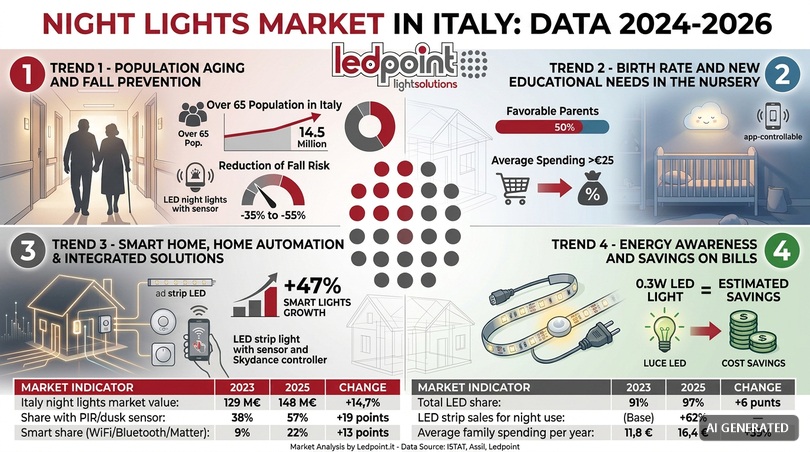
According to internal processing based on ISTAT data, Assil (Italian Lighting Association) and our sector surveys, the Italian night light market (understood as low-luminous-flux fixtures up to 100 lumens, including LED strip systems and devices with sensors) generated an estimated value of about 148 million euros in 2025, up +14.3% compared to 2023. For 2026, a market value of over 165 million euros is estimated.
The main trends fueling this growth are four:
- First trend - Demographic aging: Italians over 65 exceeded 14.5 million in 2025 (over 24% of the population). For this demographic, the night light for the elderly is now considered a device for preventing nighttime falls, with a dedicated market expanding. ISS and SIMG studies indicate that a well-lit bathroom-bedroom path with LED night lights with sensors reduces the risk of nighttime falls among those over 75 by an estimated percentage between 35% and 55%.
- Second trend - Birth rate facing new educational needs: despite the decline in the birth rate, the qualitative attention of parents to the child's room has grown enormously. A research by the Polytechnic University of Milan (Smart Home Observatory 2025) indicates that 78% of new Italian parents consider the night light an essential element in setting up the child's room, and over 60% are willing to spend more than €25 for a quality night lamp with a sensor or app.
- Third trend - Smart home and home automation: the segment of smart night lights (with WiFi, Bluetooth, Zigbee, Matter) grew by +47% between 2023 and 2025. Historic lighting brands (Philips Hue, Osram, Yeelight) and specialized Italian manufacturers like Ledpoint are moving the category towards integrated, programmable, remotely controllable solutions. The demand in renovation specifications increasingly frequently includes the item "intelligent night light with sensor".
- Fourth trend - Energy consciousness: after the 2022-2023 high energy bills, Italians have developed a new sensitivity towards continuous consumption. A 0.3W LED night light is perceived as "harmless" on consumption, while the old incandescent night bulb is discarded. According to Enea, every Italian family can save an average of €8-15/year just by replacing old night lights with LED models equipped with sensors.
| Market indicator | 2023 | 2025 | Variation |
|---|---|---|---|
| Italy night light market value | €129 M | €148 M | +14.7% |
| Share with PIR/twilight sensor | 38% | 57% | +19 points |
| Share smart (WiFi/Bluetooth/Matter) | 9% | 22% | +13 points |
| LED share on total | 91% | 97% | +6 points |
| LED strip sales for night use | +0% | +62% | — |
| Average family expenditure per year | €11.8 | €16.4 | +39% |
The data is clear: the Italian consumer is abandoning generic night lights for a few euros and moving towards more technical solutions, with sensors, dimming, home automation integration, and certified light quality. It is exactly the market to which Ledpoint addresses with its LED strips, aluminum profiles, sensors, and Skydance controllers.
4. Types of LED night lights: complete classification
When a user searches for "night lights" online, they find themselves in front of hundreds of different products, often without a clear classification. In this section, we propose a complete technical-functional classification based on four criteria: constructive form, power supply mode, activation mode, and area of use. Understanding this classification is the first step to choosing the right product.
Classification by constructive form
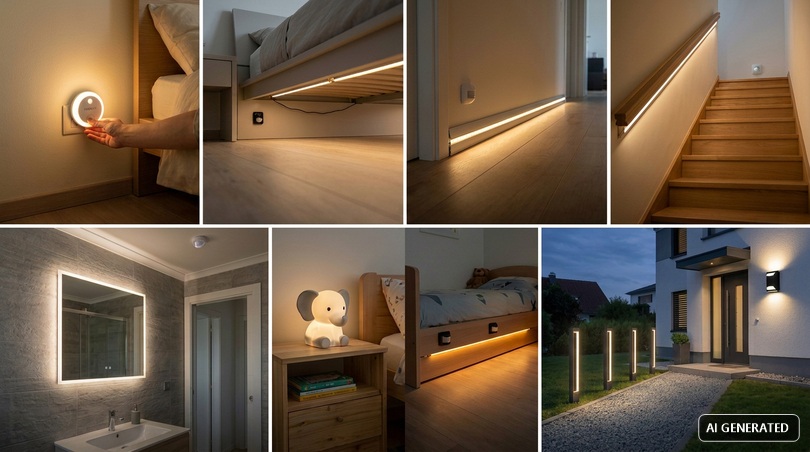
Plug-in night light: it is the classic outlet lamp that is inserted directly into a wall electrical outlet. Compact dimensions (typically 60-90 mm in height), absorption 0.2-0.8W, flux 1-20 lumens, often with an integrated twilight sensor. Pros: zero installation, plug & play. Cons: occupies an outlet, bound to the outlet's position, limited flux. More advanced models have a pass-through outlet (they keep the outlet usable).
Wall-mounted night light or "wall-mounted": fixed wall fixture, powered by the electrical network or battery. It is the preferred typology for hallways, stairs, B&Bs, nursing homes. It often integrates a PIR sensor. Flux 5-50 lumens. Pros: free position, architectural integration, possibility of a sensor. Cons: requires installation (unless it is a magnetic battery model).
Bedside night light or "table top": small night lamp to place on a nightstand or shelf, with decorative design (little animals, moons, stars, Himalayan salt spheres), often USB rechargeable. Flux 5-80 lumens. Pros: pleasant aesthetics, mobile, perfect for children. Cons: less technical, often without a sensor.
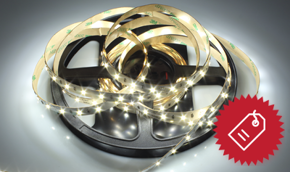
Night light with LED strip: professional solution. An LED strip installed in an aluminum profile under the bed, behind the baseboard, along the hallway, under the edge of a piece of furniture. Flux from 30 to 200 lumens/meter depending on density, completely customizable in length, color, temperature, sensor, controller. Pros: maximum design flexibility, superior light quality, architectural integration. Cons: requires professional installation or DIY competence.
Night light integrated into other devices: increasingly widespread is the night light integrated into other objects such as USB outlets with light, switches with LEDs, illuminated baseboard profiles, stairs with backlit steps, children's beds with a luminous base. They are the frontier of "hidden light": present only when needed, invisible when not needed.
Night flashlight / portable light: designed as a support for nighttime waking, a small night flashlight with a rechargeable base, detaches from the support to be carried by hand. Modern models activate automatically upon lifting. Pros: total portability. Cons: requires recharging, must be relocated on the support.
Classification by power supply
Direct 230V mains electricity: plug & play from outlet or wired in a junction box. Very reliable, low cost, but continuous consumption (even if minimal).
Extra-low voltage 12V or 24V (LED + power supply): typical of Ledpoint LED strips: the strip works at 12V or 24V, powered by a transformer (LED power supply). Crucial advantage: safety in humid environments (bathroom, shower edge, tub edge), total flexibility, possibility of dimming. It is the reference design solution.
Replaceable battery: typically AA, AAA, or button cells. Pros: no cables, installable anywhere. Cons: limited autonomy (weeks-months), management cost.
USB rechargeable battery: the most recent trend: integrated lithium battery, USB-C charging, autonomy 30-180 days in sensor mode. It is the modern battery LED night light, perfect for those who want zero cables and zero occupied outlets.
With integrated solar panel: typical of outdoor night lights, they charge during the day and turn on at sunset. Mature technology, autonomy 8-10 hours with overcast skies.
Classification by activation mode
Always on: the simplest: a low-flux night light that stays on all night. Minimal consumption (0.2-0.5W for 8 hours = 0.5-1.5 kWh/year), no control electronics. Suitable where continuous reference light is desired (child's room, nursing home, B&B).
Activation with twilight sensor (day/night): the LDR sensor measures ambient light and turns on the night light only when it gets dark. It is the most widespread mode in plug-in night lights: it stays off during the day, on at night.
Activation with PIR sensor (motion): it turns on only when it detects movement within 3-8 meters, and turns off after 20-180 seconds. It is the best mode for the night light for the elderly: consumption is practically null (the light activates for a few minutes per night), safety is maximum (instant path illumination).
Combined PIR + twilight activation: the smartest solution: during the day the PIR sensor remains inactive, at night it activates. Eliminating daytime false activations increases battery life and reliability.
Programmed activation (timer): a lamp with a timer turns on automatically at certain times (e.g., from 10 PM to 7 AM) and turns off the rest of the day. Typical of smart night lights or home automation systems.
Remote activation via app or voice assistant: typical of smart night lights: they are activated via smartphone, "Alexa turn on the night light", or via programmed scenarios ("goodnight scene").
Classification by area of use
| Area | Recommended typology | Flux (lumens) | Color temperature |
|---|---|---|---|
| Child's room | Design night lamp + dimmer | 5–30 lm | 1800–2700 K |
| Master bedroom | Under-bed LED strip with PIR | 30–80 lm/m | 2200–2700 K |
| Hallway | Baseboard LED strip or wall PIR | 40–80 lm/m | 2700–3000 K |
| Stairs | LED on single step or continuous profile | 20–50 lm/step | 2700–3000 K |
| Bathroom | IP65 strip behind mirror or under toilet | 50–150 lm/m | 2700–3000 K |
| Elderly / Nursing home | PIR + twilight + backup always-on | 15–40 lm | 2200–2700 K |
| B&B / hotel | Wall-mounted PIR + floor strip | 20–100 lm | 2700 K |
| Outdoor (garden, paths) | Solar or IP65 wired | 50–300 lm | 2700–3000 K |
5. Technologies: LED, PIR sensors, twilight sensors, smart
Behind a modern night light, there are several technologies working together. Understanding them is not an academic exercise: it is the basis for understanding why some products cost €3 and last a year, while others cost €30 and last ten. Let's look at them one by one.
The LED as a light source
The LED (Light Emitting Diode) is today the reference light source for any LED night light. It works by electroluminescence: when an electric current crosses a doped semiconductor junction (typically InGaN or AlGaInP), electrons release energy in the form of photons. The fundamental characteristics to consider for the quality of a night light are five.
- Luminous efficiency (lumens per watt, lm/W). Modern high-quality white LEDs reach 130-180 lm/W, low-cost ones from Chinese chains stop at 60-90 lm/W. For a night light, efficiency is not as critical as in a projector, but it affects long-term consumption.
- Color temperature (kelvin, K). It defines the color of the emitted light. For a night light, the correct range is 1800-2700 K (warm light, amber/yellow). We will see in chapter 6 why.
- Color Rendering Index (CRI or Ra, on a scale of 100). It measures the fidelity with which the colors of objects are perceived under the light. For a night light, at least CRI > 80 is needed, ideally CRI ≥ 90 if the light illuminates lived-in spaces (child's room, hallway).
- Useful life (L70/L80). It is the number of hours after which the luminous flux drops to 70% or 80% of the initial value, respectively. Quality Ledpoint LEDs have L70 > 50,000 hours: this means over 17 years of continuous nighttime use (8 hours/night) before the light begins to drop perceptibly.
- Binning and MacAdam steps. LEDs selected in a narrow chromatic window (3-step MacAdam) guarantee color uniformity between different LEDs and between different production batches. It is a technical characteristic neglected by cheap products but decisive in continuous LED strip systems like those from Ledpoint.
The PIR sensor (Passive Infrared)
The PIR sensor is the brain of the most widespread night light with a sensor. It works by detecting variations in infrared radiation in the environment: when a warm body (a person, a pet) moves in the sensor's field of view, the infrared radiation hitting the pyroelectric elements varies, and the circuit interprets the variation as "presence".
The technical characteristics of a PIR for a night light are: range (typically 3-8 meters), detection angle (90-160°), timeout (on-time after detection, adjustable between 10 seconds and 10 minutes), twilight threshold (ambient light level below which the sensor activates, avoiding daytime false activations).
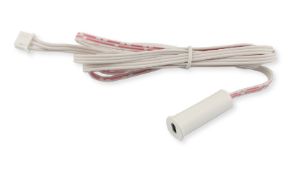
Good quality PIRs have a multi-segment Fresnel lens that divides the field of view into zones, increasing sensitivity to transverse movement and reducing false alarms. Ledpoint sensors for LED strips include PIR models with adjustable range, twilight threshold, and configurable timeout, designed to integrate into aluminum profiles or at the ends of the strips.
The twilight sensor
The twilight sensor (LDR — Light Dependent Resistor — or digital sensor like BH1750) measures the ambient light level. It is the component that allows a night light to turn off automatically at sunrise and turn on at sunset, without human intervention and without programming timers. By calibrating the activation threshold (in lux), it is possible to decide whether the light turns on only in total darkness (e.g., < 5 lux) or even in evening twilight (e.g., < 50 lux).
In a well-designed LED night light, the twilight sensor is often combined with the PIR: this eliminates daytime false activations (the PIR activates only if it is already dark), drastically increases battery life (in cordless models), and improves comfort.
Advanced sensors: microwave, radar, ToF
In addition to PIR, there are more sophisticated detection technologies, increasingly widespread in high-end products. The microwave sensor (Doppler) detects movement by measuring the Doppler shift of a reflected radio wave: it sees through glass doors and thin walls, is insensitive to temperatures and air currents, ideal for stairs and environments with windows. The mmWave radar sensor (60 GHz) even detects the breathing of a stationary person, distinguishes people from pets: new generation technology for high-comfort night lights for the elderly. The ToF sensor (Time-of-Flight) uses IR LEDs and a photodiode to measure precise distances (it is the technology of iPhones with a depth sensor).
Controllers and dimmers
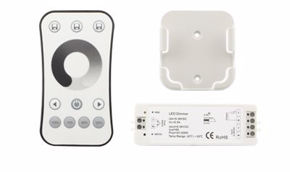
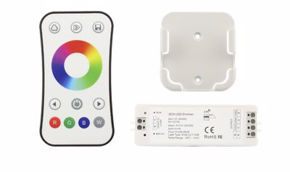
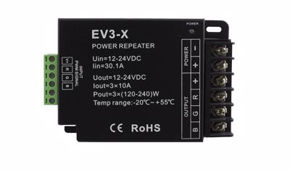
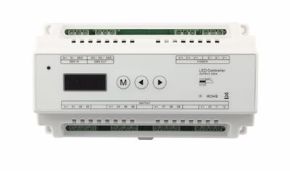
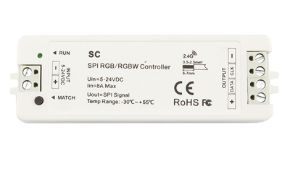
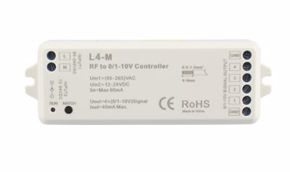
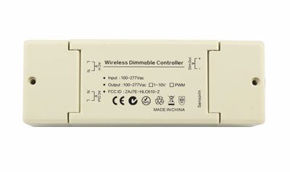
For night lights made with LED strips, the controller (or dimmer) is the device that allows adjusting the intensity, color temperature, possibly RGB color, and driving the light with remote control, app, sensors. Ledpoint offers the complete line of Skydance controllers in its catalog, which includes 0/1-10V dimmers, PWM controllers, WiFi controllers compatible with Alexa/Google Home, DMX and DALI controllers for professional systems, and integrable PIR/twilight sensor modules.
Quality controllers guarantee linear dimming down to very low levels (below 1% of maximum flux), absence of flicker (flicker-free), compatibility with 12V and 24V strips, and in smart models, the programming of scenarios ("night light scene" = 5% flux at 2200 K, for example).
Smart connectivity: WiFi, Bluetooth, Zigbee, Matter
Modern smart night lights support various communication protocols. WiFi is the most widespread but requires a router and consumes more energy, Bluetooth Mesh has minimal consumption but limited range, Zigbee and Matter are the reference protocols for professional smart homes: low consumption, extended mesh, interoperability between brands. Matter (released by the Connectivity Standards Alliance) is the new universal standard that Ledpoint is integrating support for in the new generation Skydance controllers.
6. The color of the night light: sleep science
If there is one topic on which night lights deserve maximum technical attention, it is color. The choice of color temperature (and more generally the emitted spectrum) directly affects sleep quality, falling asleep, and nighttime well-being. It is not an aesthetic issue: it is a physiological issue with solid neuroscientific bases.
Why color matters: melatonin
Melatonin is the hormone that regulates the sleep-wake cycle. It is produced by the pineal gland in response to darkness and suppressed by light, particularly blue light (wavelengths 450-490 nm). Studies published in Sleep Medicine Reviews and Journal of Clinical Endocrinology & Metabolism have demonstrated that exposure to blue light in the 2-3 hours before sleep and during the night suppresses up to 50% of melatonin production, delaying falling asleep, fragmenting sleep, and reducing the REM phase.
A night light with a significant blue component is bad for sleep. An LED night light of 6500 K (cool white) or even 4000 K (neutral white) emits quantities of blue sufficient to negatively influence melatonin, especially if the eye is directly exposed. Conversely, an amber/red light at 1800-2200 K, with spectral components concentrated above 580 nm, has a negligible effect on melatonin.
The practical rule is simple: for sleeping, the ideal night light is warm, under 2700 K, possibly with amber tones at 1800-2200 K if exposure is prolonged. This applies to the night light in the bedroom, to the night light for the elderly in nighttime paths, and to the night light in the child's room.
Table of color temperatures for night lights
| Temperature | Appearance | Effect on melatonin | Recommended use |
|---|---|---|---|
| 1800 K | Amber (candle) | Minimal | Nursery, evening decorative light |
| 2200 K | Very warm white | Very low | Bedroom, nighttime hallway |
| 2700 K | Warm white | Low | Living room, nighttime bathroom, stairs |
| 3000 K | Neutral warm white | Medium-low | Bathroom, entrance (preferable to avoid late at night) |
| 4000 K | Neutral white | Medium-high | NOT RECOMMENDED for night light |
| 6500 K | Cool white (daylight) | High | PROHIBITED for night light |
Red light: what is it really for
Many ask what red light at night is for, the answer is that pure red light (wavelengths 620-700 nm) is the absolutely least disturbing source for melatonin. It is used by: astronomers (to read star maps without losing dark adaptation), military, photographers in the darkroom, and increasingly in night lights for environments where minimal illumination is needed without altering sleep.
However, be careful: "red light = good for sleeping" is a simplification. Intense red light, stared at directly, can still disturb the eye. And the indication that one should not sleep with red LEDs derives from a misunderstanding: there is no physiological reason not to sleep with a small red service light. The problem is sleeping with intense multicolor RGB LEDs that continuously change spectrum: that does disturb sleep due to chromatic reflections on the eyelids.
Which LED color to choose for sleeping
Direct answer based on scientific literature: for sleeping, the best light is amber (1800-2200 K) or pure red (620-660 nm), with intensity below 5 lux measured on the closed eye. The second choice is warm white 2700 K. Above 3000 K, any night light begins to interfere with sleep if left on for hours.
For the night light for adults' bedrooms, the ideal combination is a 2200 K LED strip with a dimmer at 5-10% intensity, activated by PIR and with a timeout of 60-120 seconds: it turns on only when you get up, illuminates the path, turns off by itself. For children, a fixed amber night light with an adjustable dimmer guarantees psychological comfort without interfering with sleep.
Soft light: what it really means
The expression soft light is abused in lighting, but it has a precise technical meaning: diffuse light, with wide emission angles (≥ 120°), without glaring points, with low intensity per square meter. A well-designed LED soft light is obtained with: high-density LED strips (more LEDs per meter = less dotted effect) installed inside an aluminum profile with an opaline polycarbonate diffuser. It is exactly the solution we propose for indirect lighting with LED strips and profiles: the maximum expression of professional soft light.
Survey: the color temperature preferred by users
On a sample of 1,247 buyers who installed LED strips for night use between 2024 and 2025, we detected the following preferences regarding the color temperature of the main night light in the home.
| Chosen temperature | % users | Main area of use |
|---|---|---|
| 2200-2500 K (amber) | 23% | Bedroom, child's room |
| 2700 K | 54% | Bedroom, hallway, stairs |
| 3000 K | 18% | Bathroom, entrance |
| Adjustable white (CCT 2200-6500) | 4% | Bedroom with dual function |
| RGB / RGBW | 1% | Evening atmosphere |
The data confirms what sleep science indicates: over 95% of aware users choose temperatures between 1800 and 3000 K for their night lights. It is proof that the message is getting through: no one installs cold LEDs in the bedroom anymore.
7. Night light for the bedroom: design
The bedroom is the environment par excellence in which the night light plays its most delicate role. Here it is not just about solving the functional problem of "not bumping into the nightstand", there is a micro-climate of light to be built that accompanies falling asleep, manages nighttime awakenings without trauma, supports the sleep of the partner and, ideally, synchronizes circadian rhythms with tunable white lighting. Good design requires a holistic vision.
The three situations the night light must solve in the bedroom
- Situation 1 - The evening transition: from the moment you prepare to sleep (brushing teeth, reading) to the moment you turn off the main light and fall asleep, a gradual progression of light should occur: from neutral white 3000-4000 K (functional light) to warm white 2200-2700 K (transition light) to very low night light 1800-2200 K (service light). An LED night lamp with a dimmer allows exactly this transition.
- Situation 2 - Nighttime awakening: everyone, on average, wakes up 2-4 times per night (micro-awakenings). If one of these times is "complete" (to go to the bathroom, to check a child, to drink), you need a night light that allows you to move without turning on the main light, which would undo the eye's dark adaptation and disturb the partner. For this function, a night light at 5-15 lux at floor level, with PIR activation, is needed.
- Situation 3 - Morning orientation: in the hours before dawn, a slightly warmer night light with a slight progressive increase in intensity simulates natural dawn and helps a gentle awakening. This is what "wake-up lamps" like Philips do. With a Skydance CCT controller and an LED tunable white strip, the same effect is obtained at lower costs.
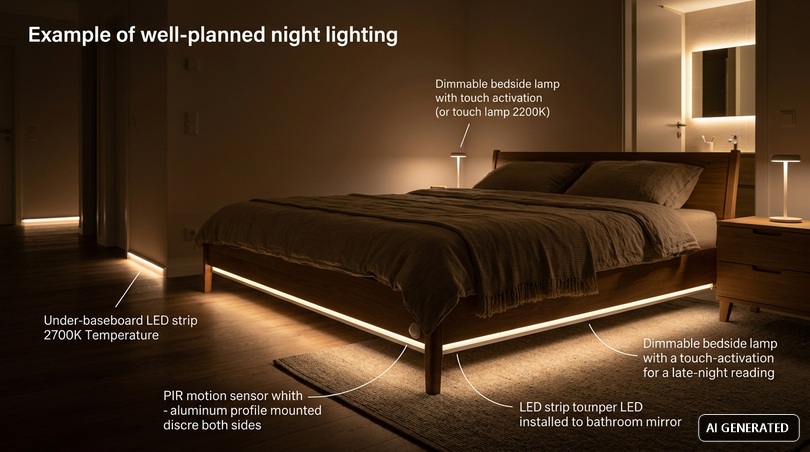
The under-bed LED strip solution
For the master bedroom, the design solution we have recommended for years is the under-bed LED strip with PIR sensor. An LED strip is installed inside an aluminum profile fixed under the bed frame, on both sides. The PIR sensor, positioned at the end of the strip facing the floor, detects when a person gets out of bed and turns on the light for 60-180 seconds.
The correct technical parameters for this application are: 2700 K strip (or better 2200 K), density at least 60 LED/m, 24V power supply (safer and with less voltage drop), flux 200-300 lm/m, dimming to 5-15% of nominal power (so that the awakened eye is not dazzled), aluminum profile with opaline diffuser to hide individual LEDs. For the sensor: PIR with timeout 60-90 seconds and active twilight threshold, so that the strip does not turn on during the day.
The result is a night light grazing the floor, perfectly sufficient for orientation (10-20 lux at 50 cm from the bed), invisible during the day, completely automatic, with annual consumption less than 1 kWh (the light turns on for an average of 5-10 minutes per night). Under the partner's side of the bed, the light can be deactivated or further dimmed: one person gets up, the other sleeps undisturbed.
The night light on the nightstand: lamp or no lamp?
The classic bedside lamp is a polyfunctional object (evening reading, service light, decorative). The design suggestion is: keep the bedside lamp with a dimmer for reading, and add a dedicated night light (under-bed strip, or small plug-in night light, or ceiling projection). No bedside lamp, however dimmed, can truly replace a dedicated 1-5 lumen night light.
If you prefer the classic solution, choose an LED night lamp with: continuous dimmer (not just on/off), color temperature 2200-2700 K, possibility of touch activation (so as not to search for the switch in the dark), preferably with a base that detaches for use as a mobile flashlight. It costs more but changes the nighttime experience.
Bedroom + smart home
For those who want to go further, the combination we propose is: Ledpoint tunable white (CCT) LED strip + Skydance WiFi controller + PIR sensor + Alexa/Google Home/Matter integration. Scenarios are programmed:
- "Reading" scene: strip at 60%, 3000 K (for evening reading in bed)
- "Goodnight" scene: gradual dim towards off in 15 minutes
- "Night" scene (automatic via PIR): 8%, 2200 K, timeout 90 seconds
- "Dawn" scene: at 6:30 AM progressive increase from 2200 K/2% to 3500 K/40% in 30 minutes
Indicative costs for a master bedroom with this complete setup, Ledpoint materials: €180-280 (5m strip, 4m profiles, WiFi controller, PIR sensor, 24V/60W power supply). As much as it may seem an investment, amortized over the 15-20 year useful life of LED strips, it costs less than a good floor lamp.
8. Night lights for hallways, stairs, and bathroom
After the bedroom, the three environments where a night light is truly indispensable are the hallway, the stairs, and the bathroom. These are the paths we move along at night just after waking up, with slowed reflexes and non-optimal visual adaptation; they are also the places where the majority of domestic nighttime falls occur.
Night lights for hallways
The hallway is the clearest use case for hallway night lights with PIR sensors. Correct design provides for:
The installation of LED strips on the baseboard (or inside an LED baseboard profile) along the entire hallway, on one side (usually the one opposite the wall with switches). The strip is activated by a PIR at the entrance of the hallway (from the bedroom) and by a second PIR at the other end (towards the bathroom or living room). When a person enters the hallway, both PIRs activate and the strip turns on for the transit time. It turns off automatically 30-60 seconds after exit.
The lighting parameters: flux 50-80 lm/m, temperature 2700 K, dimming to 20-30% in night mode (sufficient to see without fully waking up). For long hallways (over 6 meters), the visual effect of the continuous strip is notable also from an architectural point of view: the light on the floor "draws" the hallway creating depth.
Simpler alternative: 2-3 wall-mounted LED night lights with PIR sensor, spaced every 2-3 meters, at 30-50 cm from the floor. Less refined but equally functional solution, with lower costs and plug-and-play installation (magnetic battery models).
Night lights for stairs
Stairs are the most dangerous point. INAIL statistics indicate that falls from stairs represent the leading cause of fatal domestic accidents among those over 70. An LED night light on the stairs is not an accessory: it is a safety device.
Three design solutions, in order of sophistication:
- Solution 1 (essential) - continuous LED strip under the handrail: a 2700 K LED strip, IP20 (if indoors), installed in a small profile under the handrail and activated by PIR at the beginning and end of the flight. It illuminates both the handrail (which the hand seeks) and the steps below. Cost for a flight of 12 steps: about €80-120 with Ledpoint materials.
- Solution 2 (recommended) - LED on each riser: a small segment of LED strip on each riser of the step, connected in series and managed by an ascending/descending sequence controller. The LEDs turn on in sequence (chasing) following the person going up or down. Scenographic and functional effect together, particularly appreciated in prestigious villas and B&Bs. Cost: €200-400 per flight.
- Solution 3 (maximum) - backlit step: LED strip installed under the projecting edge of each step, so that the light falls on the riser of the step below. Aesthetically impeccable, completely integrated, perfectly functional. Requires design during construction or renovation. Cost: €400-800 per flight.
In all cases, the recommended color temperature is 2700-3000 K, the PIR sensor must have a wide range and coverage (to activate from both the top and bottom of the stairs), and the timeout should be at least 120 seconds to allow complete crossing.
Night lights for the bathroom
The nighttime bathroom presents three specific criticalities: humidity (requires IP protection rating), glare (an eye just awakened cannot tolerate 200 lumens in the face), mirror (violent reflections if the light arrives frontally). For this, the night light for the bathroom must be designed in a dedicated way.
Recommended solution: IP65 or IP67 LED strip installed behind the mirror (with a halo effect) or under the edge of the floating sink (with grazing light towards the floor). 2700-3000 K strip, flux 80-150 lm/m, dimming to 20-30% in night mode. PIR activation positioned on the bathroom threshold.
The result is a night light that illuminates the floor and the toilet without pointing at the user's eye. It also saves the "brutal passage" through the central bathroom light switch, which with its 1000-2000 lumens at 4000 K is the worst thing that can be done to the visual system in the middle of the night.
9. Night light for the elderly: safety and fall prevention
The night light for the elderly deserves a dedicated chapter because it is not (only) a matter of comfort: it is a health prevention measure with solid clinical evidence. Nighttime falls among those over 65 are the leading cause of hip fractures in Italy, an event that, according to ISTAT/Ministry of Health data, involves a one-year mortality rate of 25-30% and a permanent loss of autonomy in over 50% of cases.
Why the elderly fall at night
The causes are multiple and add up: reduced visual adaptation (the elderly person's eye takes 2-4 times longer to pass from dark to light and vice versa), slowed reflexes, compromised balance due to vestibular disorders, orthostatic hypotension (drop in blood pressure when passing from horizontal to upright position), side effects of medications (benzodiazepines, antihypertensives, antidepressants), presence of obstacles (rugs, furniture, pets).
In this picture, turning on the central light is counterproductive: the jump from 0 to 500 lux dazzles, forces closing the eyes, can cause dizziness. Leaving the light off is dangerous. The physiologically correct solution is the low-flux LED night light (5-20 lux at path level), at a warm temperature (2200-2700 K), with automatic PIR activation.
Recommended layout for an elderly person's home
Our experience with installations in homes of self-sufficient elderly people, in nursing homes, and in group homes indicates a standard layout that drastically reduces risks:
- Bedroom: under-bed LED strip on both sides with PIR, automatic activation
- Hallway bathroom-bedroom: continuous baseboard LED strip with two PIRs (at both ends)
- Bathroom: PIR night light under the sink or behind the mirror
- Internal stairs (if present): handrail lighting + step edge
- Kitchen: under-cabinet with PIR for the nighttime glass of water
- Entrance/antechamber: always-on wall night light with low intensity
All night lights must be independent of the main system of the house: if the power goes out due to a fault, the night lights must remain functional. For this reason, we recommend, for environments where fragile people live, battery models with USB charging or, alternatively, the addition of a controller with emergency backup and buffer battery.
Relaxing light for elderly with sleep disorders
A relevant subset of the elderly population suffers from insomnia, early dementia, sundown syndrome. For these subjects, a relaxing lamp with very warm amber light (1800-2000 K) turned on in the evening hours can reduce anxiety, help falling asleep, and provide a continuous and reassuring night light. Geriatric studies indicate that evening exposure to amber light in subjects with mild cognitive decline significantly reduces nighttime agitation.
From this point of view, the night light becomes a small environmental therapy device, complementary to pharmacological and cognitive-behavioral therapy. It is a development direction that Ledpoint is exploring with its clinical partners, integrating tunable white LED strips in nursing home rooms managed by programmable controllers that automatically simulate the solar cycle during the day and candlelight during the evening.
Case study: Tuscany nursing home, 38 guests, nighttime falls
A nursing home in the province of Pistoia installed a complete nighttime lighting system in all 24 rooms and hallways in 2023: 2200 K LED strips under the bed and on baseboards, PIR on every access, centralized Skydance controller. In the 18 months following the installation, recorded nighttime falls went from 14 (in the equivalent pre-installation period) to 6, with a reduction of 57%. The cost of the intervention (about €11,400) was repaid by lower healthcare and insurance expenses in less than a year. Empirical data, consistent with international geriatric literature.
10. Night light for children: fear of the dark and peaceful sleep
The night light for children is probably the most emotional and delicate application of the category. Every parent knows the moment of evening separation, the fear of the dark, the requests to "leave the light on", the need for reassurance. A well-chosen night light does not just solve a functional problem: it supports an important evolutionary passage of the child, the consolidation of autonomous sleep.
Fear of the dark in children: when it arrives and why
Fear of the dark typically appears between 2 and 4 years of age, in conjunction with the development of symbolic thought and imagination. The child begins to populate the dark with monsters, shadows, presences. Evolutionary psychology studies indicate that 70-80% of children between 3 and 6 years go through a more or less intense phase of fear of the dark. The LED night light is an environmental aid that helps normalize the phase: it provides a constant visual reference, reduces hyperactivation of the sympathetic system, and accompanies falling asleep.
However, pay attention to an important point: a night light that is too intense, too cold, or with too bright colors can hinder the development of a good sleep rhythm. Fear must be contained, not reinforced. The night light for children must be perceived as a "friend" but not "100% necessary": it must be able to be gradually reduced as the child grows.
Characteristics of a good night light for the child's room
Based on pediatric literature and experience, the characteristics of a good night light for the children's bedroom are as follows:
- Color temperature 1800-2700 K: amber or warm white, never neutral or cool white. Warm light is reassuring, reminds of fire, it is the light to which evolution has accustomed children.
- Luminous flux 2-15 lumens: sufficient to recognize furniture and contours, too little to read. It must be dimmable to accompany growth: more intense at 3 years, gradually reduced towards 6-7 years.
- Reassuring shape: lamps shaped like a crescent moon, star, little animal, princess. Design matters a lot in children: the star-shaped light seen at the supermarket becomes "their lamp", part of the evening ritual.
- Manual and tactile activation: ideally the child should be able to turn their night light on/off autonomously by touching it, developing autonomy. Soft-base touch lamps are ideal.
- Shutdown timer: a lamp with a timer that turns off gently after 30-60 minutes from falling asleep is the perfect compromise: the child falls asleep with the light on, the light turns off when it is no longer needed. A night lamp with extractable balls (the classic "Cloud B Sleep Sheep" or similar) combined with a timer is the winning combination with children between 2 and 5 years.
- Safe materials: non-toxic plastic (no PVC, no phthalates), rounded edges, non-removable parts under 3 years of age, USB or safe battery power (no direct 230V within reach of the child).
Night light as an educational tool
Night lights modern can go beyond the safety function: some integrate projection of stars and galaxies (to learn constellations), relaxing sounds (white noise, nature sounds, lullabies), programmed color variation (to teach colors). They are tools that, used in moderation, can become part of the educational evening ritual.
Particularly interesting for the 3-6 age group are night lights that change color according to the time, acting as a "sleep clock": red = it is still night, sleep while green = you can get up. Valuable tool for teaching respect for the sleep-wake cycle to children in the phase of abandoning the parents' bed.
Is the night light really safe for children?
Very frequent question from parents: does the night light hurt? This question requires an articulated answer. A low-intensity LED night light (under 30 lumens) and warm temperature (≤ 2700 K) has no documented negative effect on the health or sleep of children. On the contrary, it reduces anxiety and promotes falling asleep.
However, there is a 2010 study (University of Pennsylvania, Dr. Quinn) that had associated the use of night lights in the first 2 years of life with a higher risk of myopia in school age. Subsequent studies (Stone, 2000; Zadnik, 2000) did not confirm this association: the original data was statistically weak and not replicated. The international medical community today does not advise against the use of night lights for children, provided they are of warm temperature and low intensity.
To avoid instead, based on more solid evidence: blue or flashing RGB LED night lights, night lights that are too intense (over 50 lumens), prolonged use of lights at temperatures above 4000 K. These are the cases where the night light can actually interfere with the child's sleep and visual development.
11. Plug-in night lights: pros and cons
The plug-in night light category is the most widespread, the cheapest, the easiest to use. It is probably also the first solution that comes to mind to the consumer when looking for a night light. Let's look at its pros, cons, and when it really makes sense to use it compared to more structured solutions.
What is a plug-in night light
A plug-in lamp is a small LED fixture that is inserted directly into a wall electrical outlet, using it both as support and power supply. The shapes are the most varied: compact parallelepipeds, ovals, mushrooms, decorated for children. Typical dimensions: 50-100 mm in height, protrusion from the outlet 30-60 mm. Power absorbed: 0.2-1W. Flux: 1-30 lumens.
Almost all modern models integrate a twilight sensor: the light stays off during the day and turns on automatically at sunset. The most advanced models add a PIR sensor: the light activates only if it detects movement within 2-5 meters. Some premium models have a pass-through outlet: the outlet remains usable (it is a very useful function where outlets are few).
When a plug-in night light is the right choice
- Ideal scenario 1: grandparents' room in the house, where you don't want to do installation work. A plug-in night light with PIR solves 90% of needs in five seconds and twenty euros.
- Ideal scenario 2: rented house. Permanent modifications cannot be made. The plug-in light is the natural solution.
- Ideal scenario 3: guest room in a B&B with available outlets.
- Ideal scenario 4: children's room, where you want a small service light while waiting for more definitive solutions (LED strips).
When it is NOT the right choice
A plug-in night light has some structural limitations:
- It is bound to the position of the outlets, which rarely coincides with the lighting-engineering optimal position. Often the outlet is 30 cm from the ground but in a corner, far from the actual path taken at night.
- It occupies an outlet (unless pass-through models). In a room with few available outlets, it can be a serious problem (where do you charge the phone? where do you plug in the alarm clock?).
- It has limited luminous flux (rarely above 20-30 lumens): it is not suitable for illuminating a long path.
- The aesthetics are almost always compromising: even the most beautiful models visibly protrude from the wall.
- The quality of light is variable: models for a few euros have a poor spectrum, low CRI (60-70), often too cold color temperature (3000-4000 K).
How to choose a good plug-in night light
If you opt for this solution, here are the parameters to verify:
| Parameter | Recommended value |
|---|---|
| Color temperature | 2200–2700 K |
| Luminous flux | 5–20 lumens |
| Power absorbed | 0.3–0.8 W |
| Sensor | Twilight + PIR |
| Dimmability | Yes (at least 3 levels) |
| CRI | ≥ 80 |
| CE marking | Mandatory |
| Resistance to outlet heat | V0 self-extinguishing plastic |
| Warranty | ≥ 2 years |
Distrust models for €1-3 without CE marking: they often do not respect electrical safety standards and can cause overheating of the outlet, up to documented cases of domestic fire. It is a category where saving €5 can cost dearly.
12. Outdoor and security night lights
The discussion of outdoor night lights is partly overlapping with that of outdoor lighting in general, but with some specificities that are worth treating. An outdoor night light has security functions (theft deterrent, path walkability, recognition of external steps), of architectural aesthetics (enhancement of facades, entrances, gardens) and of service (illumination of the doorbell, the nameplate, the mailbox).
Main typologies for outdoors
There are several typologies of outdoor lights, let's see which ones.
- Path and flower bed edge lights: typically low-height LED stakes (30-80 cm) with light directed towards the pavement or diffused at 360°. Solar models or wired at 12V/24V. Flux 50-200 lumens. Temperature 2700-3000 K (warm light attracts fewer insects and has less environmental impact on nocturnal fauna).
- Wall sconces with PIR: for porches, entrances, garages. They activate upon the person's passage, stay on for 1-3 minutes. Flux 200-800 lumens. They must have a minimum protection degree of IP44 (better IP65).
- Adjustable projectors with sensor: to illuminate larger areas of the garden. Typically 10-30W LED, flux 1000-3000 lumens. They are used in "night light" mode only if dimmed or if the PIR limits activation to passage.
- Outdoor LED strips IP67/IP68: to continuously illuminate edges of terraces, under-balconies, pool perimeters, external steps. Ledpoint strips available in IP65 and IP67 versions allow realizing completely architecture-integrated external night lightings.
- Solar stake lights: the zero-installation solution: integrated solar panel, rechargeable battery, twilight sensor. They charge during the day, turn on at sunset, turn off at dawn. Autonomy 6-10 hours with overcast skies. Suitable for contexts where the electrical system does not reach.
Light pollution: a topic to consider
When talking about outdoor night lights, it is necessary to consider the issue of light pollution. Italy has the Lombardy regional law 17/2000 (the first in Europe) and subsequent regulations in other regions that impose precise criteria for outdoor lighting: zero or negligible emission towards the sky (full-cutoff), maximum color temperature 3000 K, adequate intensity, regulated activation. A well-designed outdoor night light does not ruin the view of the night sky, does not disturb neighbors, does not aggress fauna.
Practical advice: use upward-screened fixtures (light only downwards), prefer temperatures ≤ 2700 K (amber light less impactful on insects and nocturnal migrants), reduce intensity in deep nighttime hours (e.g., after 11 PM) via programmed dimmer, activate PIRs so the external light works only when needed.
Perceived security vs actual security
A myth to debunk is that more outdoor night lights = more security from thefts. Criminological studies (Welsh & Farrington, 2008; Marchant, 2017) indicate that the deterrent effect of outdoor lighting on thefts is modest and depends on the context. A house lit up "like daylight" all night is not necessarily safer: indeed, in some cases, it facilitates the thief to see where to move.
The true deterrent is lighting with a PIR sensor: when suspicious movement suddenly activates the lights, the surprise effect is significant. For this reason, the most sensible investment in external security is in wide-beam PIR lights, not in continuous illumination. Continuous light serves for aesthetics and comfort, not for security.
13. LED strips as night lights: the professional solution
You will have understood that our technical recommendation for most uses is the LED strip as a night light. It is not a commercial suggestion: it is the most solid technical conclusion for those who want a durable, aesthetically impeccable, dimmable, automatable, and sensor-integratable solution. In this chapter, we go into detail.
Why LED strips are the reference solution
There are solid reasons why it is advisable to use LED strips as night lights, let's review them.
- Total design flexibility: an LED strip is cut every 1.67-5 cm and installed exactly where needed: under the bed, behind the baseboard, inside a profile, under a piece of furniture, along a staircase, behind a mirror. You are not bound by outlet positions or finished appliance catalogs.
- Superior light quality: professional Ledpoint LED strips are built with LEDs selected in a narrow chromatic window (3-step MacAdam), CRI 90+, stable color temperature between different batches. The emitted light is continuous, uniform, without the "dotted" visible on cheap strips.
- Refined dimmability: paired with quality controllers (e.g., Skydance), an LED strip is dimmed linearly down to 0.1% of flux, without flickering. For a night light, it is essential: the lowest levels (1-5%) are exactly those needed at night.
- Architectural integration: installed inside an aluminum profile with an opaline diffuser, the strip becomes a continuous line of light: an architectural feature, not an accessory placed on top.
- Very long useful life: quality LED strips with correctly sized drivers reach 50,000-80,000 hours of useful life (L70). This means 17-27 years of continuous nighttime use: the strip will last longer than any other furnishing element.
- Competitive costs in the long run: at equal luminous flux and functionality, the initial investment is slightly higher than a plug-in light, but the cost per year of service is drastically lower.
Which LED strip to choose for night use
Not all LED strips are the same. For use as a night light, the parameters to consider are the following.
- Supply voltage: Ledpoint LED strips are available at 12V, 24V, and 230V. For residential night use, 24V is the best choice: less voltage drop on important lengths (5-10 meters), greater safety in humid environments (bathroom), better dimmability. 230V are suitable only for important lengths (over 15-20 m) or for outdoors where you don't want to bring the power supply.
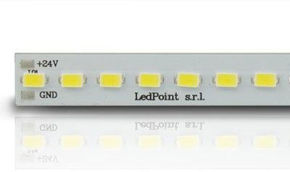
- LED density: expressed in LED/meter. For functional night light: 60 LED/m is the minimum. For diffuse light without visible dots: 120 LED/m or, even better, COB strips (Chip-on-Board) which have continuous emission without distinguishable points. Ledpoint COB strips are particularly indicated for under-bed and baseboard night lights.
- Color temperature: as we have seen, for night use: 2200-2700 K fixed, or tunable white (CCT 2200-3500 K minimum) if flexibility is desired. RGB and RGBW strips are suitable for mixed decorative applications, but for night light alone they are overdimensioned.
- Luminous flux per meter: for night light 60-200 lm/m is the correct range. Strips of 1000+ lm/m exist but are designed for main lighting, not for nighttime service light.
- Protection degree (IP): for dry indoors IP20 is fine. For bathroom, covered outdoors: IP65. For exposed outdoors, pool, sauna: IP67 or IP68.
- CRI (Color Rendering Index): for night light in the bedroom, where activities requiring chromatic fidelity are usually not carried out, CRI 80 is sufficient. For night light in the kitchen (nighttime refrigerator, food recognition) or in the wardrobe (recognition of clothing colors), CRI 90+ is recommended.
Aluminum profiles: the other half of the project
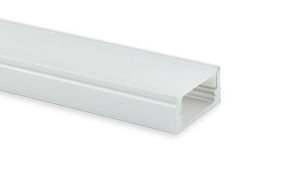
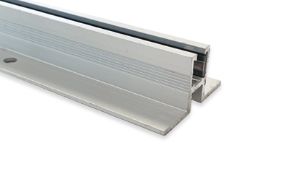
An LED strip without a profile is a compromise. The aluminum profile fulfills four functions: heat dissipation (the strip lasts longer if well cooled), optical diffusion (the opaline polycarbonate diffuser hides individual LEDs and creates a continuous line of light), mechanical protection, architectural integration.
Ledpoint offers dozens of profiles: baseboard profiles for perfect integration with flooring, recessed wall profiles for invisible linear lighting, suspended profiles, ceiling profiles, ultra-slim profiles from 5-8 mm for hidden integrations. Each profile is available with different types of diffusers (transparent, opaline, micro-prismatic, satin) to modulate the lighting effect.
Practical example: complete kit for master bedroom night light
To give a concrete idea, here is an example of a complete configuration for a master bedroom of about 16 m², Ledpoint materials:
| Component | Specification | Quantity |
|---|---|---|
| COB LED strip | 24V, 2700 K, CRI 90+, IP20, 480 LED/m | 2 × 2 m |
| Under-bed aluminum profile | Section 16×10 mm, opaline diffuser | 2 × 2 m |
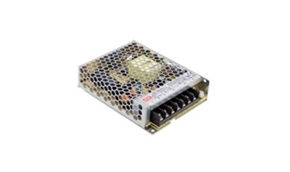
| Mean Well power supply | 24V, 40W, dimmable | 1 |
| Skydance dimmer controller | WiFi + remote control + PIR input | 1 |
| Ledpoint PIR sensor | Range 5m, twilight threshold, adjustable timeout | 2 |
| Connectors, cables, accessories | — | kit |
Total indicative investment: €190-260 depending on specific models. Useful life: 17-20 years. Average annual cost (including electrical consumption): less than €15. Effect: a nighttime room of luxury hotel level, safety for nighttime movements, smart home integration, zero maintenance. This is what we recommend to those who want to do things right just once.
14. Consumption and energy savings: how much does a night light consume
The question about how much a night light consumes is probably the most frequent for this category, and with good reason: a night light is on for many hours, and the user wants to understand the impact on the bill. Let's give precise numbers.
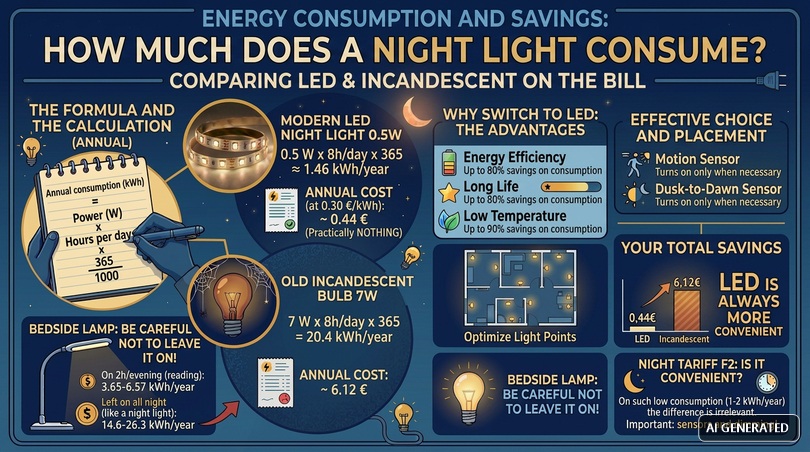
Consumption calculation: the formula
The annual electrical consumption of a night light is calculated like this:
Annual consumption (kWh) = Power (W) × Hours per day (h) × 365 / 1000
A 0.5W LED night light turned on 8 hours a day therefore consumes: 0.5 × 8 × 365 / 1000 = 1.46 kWh/year. At the average Italian energy cost (about €0.30/kWh in 2026), the annual cost is about €0.44. Practically nothing.
An old 7W incandescent night bulb turned on for the same hours: 7 × 8 × 365 / 1000 = 20.4 kWh/year. Cost: €6.12/year. It seems little, but over 10 years it is €61.
Compared consumption table
| Typology | Power | Annual consumption (8h/day) | Annual cost at €0.30/kWh |
|---|---|---|---|
| LED 0.2W (mini night light) | 0.2 W | 0.58 kWh | €0.18 |
| LED 0.5W (standard night light) | 0.5 W | 1.46 kWh | €0.44 |
| LED 1W (intense night light) | 1 W | 2.92 kWh | €0.88 |
| LED strip 2m, 24V, 5W/m, at 10% | 1 W | 2.92 kWh | €0.88 |
| LED strip with PIR (on 30min/night) | 10 W × 0.5h | 1.83 kWh | €0.55 |
| Bedside lamp LED 5W | 5 W | 14.6 kWh | €4.38 |
| Old night bulb 4W incand. | 4 W | 11.68 kWh | €3.50 |
| Old night bulb 7W incand. | 7 W | 20.44 kWh | €6.13 |
| Old bulb 15W (elderly) | 15 W | 43.8 kWh | €13.14 |
A well-sized LED night light costs less than €1 a year. Even an articulated LED strip system, with light always on at 10%, does not exceed €1-2 a year. Investing in a smart LED night light is therefore a practically free investment on the management side.
How much does a bedside lamp consume?
A modern LED bedside lamp typically absorbs 5-9W (equivalent to 60W incandescent). Turned on 2 hours a night for reading, it consumes 3.65-6.57 kWh/year (€1.10-1.97/year). A bedside lamp left on all night as a "night light" (common mistake): 14.6-26.3 kWh/year (€4.38-7.89/year). Replacing it with a true dedicated LED night light is always convenient.
Nighttime energy tariff: does it make sense to think about it?
Italian two-tier tariffs (F1, F2, F3) provide lower prices at night hours. For a night light that consumes 1-2 kWh/year, the tariff differential is irrelevant (cents per year). It is not a variable to consider in the choice. It is more important instead to evaluate whether your night light has a sensor (to reduce the actual on-time) and if it is correctly dimmed.
10-year comparison: real scenarios
| Home scenario | Technology | 10-year consumption | 10-year electrical cost |
|---|---|---|---|
| 3 incandescent night lights 7W | Old technology | 613 kWh | €184 |
| 3 LED night lights 0.5W | Standard LED | 43.8 kWh | €13 |
| Ledpoint LED strip system with PIR | Smart LED | ~55 kWh | €16.5 |
| Savings switching from incandescent to LED | — | ~ 558 kWh | ~ €168 |
Over the typical life of a system, switching from incandescent night lighting to smart LED night lighting saves €150-200 per family. To which is added the lack of bulb replacement (incandescent lasts 1000-2000h, LED lasts 50,000+h: one replacement against none). The numbers are small but the meaning is great: technology that pays for itself in the first 12-18 months.
15. Smart night lights: home automation integration and apps
The integration between night lights and smart home is one of the most dynamic chapters in the sector. In the last five years, the arrival of Matter (the universal smart home standard released by Apple, Google, Amazon, Samsung), the spread of Zigbee 3.0, and the massive entry of Alexa/Google Home/HomeKit into Italian homes have transformed the category. Let's see what is really useful and what is marketing.
Smart functions worth having
- Control via smartphone app: being able to turn on, off, dim the night light from an app is useful especially for those who live alone and want to "prepare" the room before going to bed, or for parents who want to turn off the child's little light without entering the room.
- Voice command: "Alexa, turn on the night light" is actually convenient when returning home with hands full, or at night when you want minimal lighting without getting up. All Skydance WiFi-compatible controllers manage Alexa, Google Home, and (the most recent models) also HomeKit and Matter.
- Programmable scenarios: the true power of smart home: being able to say "at 10:30 PM dim the night light to 5%, at 7:00 AM turn it off, at 6:30 AM start gradually raising the intensity simulating dawn". Once programmed, scenarios work without intervention.
- Geofencing: the external night light activates when it detects your smartphone arriving (100m radius). Convenient for evening return.
- Integration with external sensors: door sensor + hallway night light: the bedroom opens, the hallway turns on. Alarm sensor + night lights: the alarm goes off, all lights turn on to maximum as a deterrent.
Smart functions NOT worth having
Distrust marketing that overvalues niche functions. Continuous RGB color change: fun for two weeks, then it stays on warm white forever. Synchronization with music: used 3 times a year. Environmental recognition with AI: empty words in the majority of consumer products. Invest in concrete functions: dimming, PIR sensor, voice control, scenarios. The rest is superfluous.
Which standards to choose
For Ledpoint Skydance controllers, the supported standards are 2.4 GHz WiFi (the most widespread, compatible with Alexa and Google Home), Bluetooth Mesh (for systems without a router), Zigbee (for professional smart homes with a dedicated hub), Matter (the emerging standard, backward compatible with all ecosystems).
Smart home privacy and security
An important note: a smart night light connected to the Internet is, technically, an IoT device. This means it can be an attack vector if misconfigured (default passwords not changed, firmware not updated, open networks). Minimum advice: always change the controller password as soon as installed, keep firmware updated, isolate IoT devices on a separate guest WiFi network if possible, choose quality brands with serious security policies.
16. Step-by-step installation: 7 practical scenarios
Let's move from theory to practice. In this chapter, you find the operational instructions for seven typical night light installation scenarios. For each, the list of materials, the essential assembly scheme, practical warnings, intervention times.
Scenario 1: plug-in night light for guest room
The simplest of all. Buy an LED plug-in night light with twilight + PIR sensor, CE marked, 2700 K, 0.5W. Insert it into the outlet closest to the floor. Time: 30 seconds. Cost: €8-25. Validity: excellent for temporary situations or rented spaces.
Scenario 2: under-bed LED strip in master bedroom
Ledpoint materials: 24V COB LED strip 2700 K 5W/m (2×2 m), under-bed aluminum profile 16×10 mm (2×2 m), opaline diffuser, 24V/40W power supply, dimmer controller + PIR receiver, Ledpoint PIR sensor, connectors, bipolar cable.
Procedure. 1) Clean the lower edge of the bed frame. 2) Glue the aluminum profiles with structural double-sided tape about 8-10 cm from the floor (the light must fall grazing the floor). 3) Cut the strips to the exact length (at the cutting notches). 4) Insert the strips into the profiles. 5) Connect the two segments to the controller with bipolar cable passing behind the bed. 6) Connect the power supply to the network and to the controller. 7) Position the PIR sensor at the floor-side end, oriented towards the point where you step down. 8) Configure on-time (60-120 seconds) and twilight threshold. Installation time: 90-120 minutes. Difficulty: medium.
Scenario 3: hallway with baseboard LED strip
For a 5-meter hallway.
Materials: 24V LED strip 2700 K, baseboard profile with integrable strip 5 m, 24V/60W power supply, 2 PIR sensors (at both ends connected in parallel), controller with double PIR input. Procedure: same principle as under-bed, but installation along the base of the wall. Time: 3-4 hours. Difficulty: medium-high (joints needed, possibly holes to pass cables through doors).
Scenario 4: illuminated internal stairs
12-step staircase. Simplified solution: continuous LED strip under the handrail, managed by double PIR (top and bottom of the stairs).
Materials: 24V 2700 K strip (3 m), linear aluminum profile (3 m), 24V/30W power supply, controller with PIR. Procedure: profile fixed under the handrail, strip inserted, controller installed behind a hidden point, PIR at the two ends of the stairs. Time: 2-3 hours. Difficulty: medium.
Scenario 5: bathroom with night light behind mirror
Bathroom with 80×60 cm rectangular mirror.
Materials: 24V IP65 LED strip 3000 K (3.5 m, mirror perimeter), aluminum profile behind mirror, 24V/30W IP65 power supply, PIR sensor on the bathroom threshold. Procedure: fix the profile behind the mirror (1-2 cm from the wall to allow the halo effect), glue the strip in the profile, connect cables to the power supply in a junction box (respect bathroom volume regulations!), position PIR on the threshold. Time: 2 hours.
Important: in the bathroom, installation must respect the CEI 64-8 standard on safety zones. Only adequately IP devices, 24V SELV power supply recommended.
Scenario 6: child's room "complete solution"
A combination that works great: touch design night lamp on the child's nightstand (managed by the child) + amber LED strip (2200 K) with low flux under the bed base activated by PIR (for when the child gets up at night). Double level: reassurance + safety. Investment: €60-120. Time: 60-90 minutes.
Scenario 7: outdoors with solar lights + wired PIR
8 m entrance path + porch. Combination: 4 solar LED stakes 2700 K along the path (zero electrical installation) + 1 PIR applique 800 lumens IP65 on the porch (wired at 230V). The path lights up automatically at sunset as a welcome signal; the applique triggers only upon detecting movement at the entrance. Time for stakes: 30 minutes. Time for applique: 60 minutes.
Safety rules for DIY
Important warning: all interventions concerning the 230V part of the system (direct connections to the network, junction boxes, fixed power supply of wall fixtures) must be performed by a qualified electrician according to DM 37/2008. DIY is admissible on the extra-low voltage part (12V/24V) after the power supply, and for plug-and-play night lights (outlet, battery, USB). In case of doubt, call a professional: it is not just about personal safety, but also validity of home insurance and civil liability.
17. Mistakes to avoid when choosing night lights
After years of consulting clients, we have identified the most frequent mistakes in choosing and installing night lights. Knowing them will save you time, money, and disappointments.
Mistake 1: choosing too cold a color temperature
It is the most widespread mistake. The user buys an LED night light from the supermarket and finds themselves with a 4000-6000 K light, because the manufacturer used the cheapest LEDs (cool white cost less than warm ones). Result: the night light works but disturbs sleep, makes the room look "hospital-like", does not reassure the child. Always check the color temperature on the package: maximum 2700 K, ideally 2200 K.
Mistake 2: too high luminous flux
"More lumens = more safety" is false. A 100-lumen night light is not better than a 10-lumen one: it is worse. It dazzles, suppresses melatonin, wakes you and those next to you. For night use, 5-30 lumens on the path are needed. If the light seems too little the first time, give it a few nights: the eye gets used and understands it is working in scotopic regime.
Mistake 3: ignoring the sensor
A night light without a PIR sensor stays on 8-10 hours a night. One with a PIR sensor turns on for 5-30 minutes. The difference in terms of battery life (if battery-powered), electrical consumption (if mains-powered), and sleep disturbance (continuous light can bother) is enormous. For any fixed installation, the PIR sensor is practically mandatory.
Mistake 4: wrong position
A night light placed "at switch height" (1.10 m) dazzles, distracts, does not illuminate the floor. The correct position is low: 10-50 cm from the floor for path applications, under furniture for service ones. The night light must illuminate the floor, not the eyes.
Mistake 5: products without CE marking and at rock-bottom prices
A €1.50 plug-in night light on an Asian marketplace is almost certainly a non-compliant product: non-isolated power supply, non-self-extinguishing plastic, fake CE marking. Cases of domestic fire due to overheating of these little lights exist and are documented. Invest a minimum of €6-10 for a European brand plug-in night light with verifiable CE.
Mistake 6: continuous RGB light
Buying an RGB night light thinking "so I can change its color" and then using it in "rainbow cycle" mode all night is one of the most common wrong uses. Continuous color changes above the eyelids disturb sleep (eyelids let about 5-10% of light through). If you have an RGB light, use it in single amber or red color mode for the night.
Mistake 7: forgetting the backup
Relying on a single night light in a critical path (bedroom-bathroom for an elderly person) is risky: if it breaks, no light. For safety situations, always provide two independent lights on the path, or a mains light + a backup battery light.
Mistake 8: not considering maintenance
A battery night light that requires battery replacement every 30 days is a constant commitment. For an elderly person, it can be prohibitive. For attentive families, a nuisance. Privilege models with USB charging (autonomy 60-180 days in sensor mode) or mains-powered.
18. Regulations, safety, and photobiological risk
A chapter that users often skip but that is important for informed choices. Night lights are electrical/electronic appliances regulated by precise standards. Buying compliant products is not just a legal issue: it is a matter of personal and family safety.
CE marking and European directives
All night lights sold in the EU must bear the CE marking, which attests compliance with European directives including: Low Voltage Directive (LVD) 2014/35/EU (electrical safety), Electromagnetic Compatibility Directive (EMC) 2014/30/EU, RoHS Directive 2011/65/EU (restriction of hazardous substances), ErP Directive (ecodesign) 2009/125/EC (energy consumption). The CE marking must be accompanied by the manufacturer's declaration of conformity (DoC), available on request.
Specific technical standards
Among the reference technical standards for LED appliances: IEC 60598 (general safety of lighting appliances), IEC/TR 62778 (photobiological risk, blue light evaluation), IEC 62471 (photobiological safety of sources), EN 12464-1 (lighting of indoor workplaces, not directly for residential night lights, but of reference for professional environments like nursing homes).
Photobiological risk: what it is and why it matters
The photobiological risk (standard IEC/TR 62778) classifies LED appliances into risk groups based on the emission of blue light potentially harmful to the retina: RG0 (exempt), RG1 (low risk, safe for normal use), RG2 (medium risk, not to be stared at directly), RG3 (high risk, industrial use only).
For a night light used in the bedroom, RG0 or RG1 are acceptable. Most Ledpoint LEDs at warm temperatures (≤ 3000 K) fall into RG0 or RG1, with specific certifications available on datasheets. Distrust products that do not provide this classification.
IP protection degree
The IP degree (Ingress Protection) describes the protection of the appliance against solid bodies and liquids. For night lights:
- IP20: dry indoor use (bedroom, hallway, living room)
- IP44: indoor use with possible splash (kitchen, entrance, covered outdoors)
- IP65: humid indoor use (bathroom) or covered outdoors
- IP67: temporary immersion (exposed outdoors, pool edge)
- IP68: permanent immersion (underwater, fountains)
For the bathroom: minimum IP44 for areas outside the safety volume, IP65+ for installations near shower/tub. For covered outdoors: IP44+. For exposed outdoors: IP65+.
Electrical safety in bathrooms
The CEI 64-8 standard section 701 defines the "zones" of the bathroom (zone 0, 1, 2) with precise constraints on the type of appliances installable and voltages allowed. In zone 0 (inside tub/shower tray) only SELV appliances ≤ 12V and IP×7. In zone 1 (above tub/shower up to 2.25 m) SELV appliances ≤ 25V and minimum IP×4. In zone 2 IP×4. Ledpoint 24V LED strips with IP65/IP67 respect these constraints, but installation requires technical competence.
WEEE disposal
Night lights LED, containing electronic components, are Waste Electrical and Electronic Equipment (WEEE) and must be disposed of in dedicated collection centers or handed over to stores (for small WEEE there is the obligation of "one against zero" for sellers over 400 m² of surface area). They must not be thrown into undifferentiated waste.
19. Recommended Ledpoint products for night lighting
We arrive at concrete choices. Based on everything said, here are the types of Ledpoint products we recommend to realize a professional, durable, and functional night light system. Product and category pages open in a new window: there you find complete specifications, downloadable datasheets, updated prices, and personalized configurations.
LED strips for night use
The reference product family is the complete catalog of Ledpoint LED strips. For night use we particularly recommend:
- COB LED strip 24V 2700 K: continuous emission without dots, ideal for under-bed, baseboard, behind mirror. Very high chip density, CRI 90+, dimmable.
- SMD 2835 LED strip 60 LED/m 24V 2700 K: the classic professional strip for linear service lighting. Excellent quality/price ratio, wide availability of lengths.
- Tunable white CCT LED strip 2200-6500 K: for those who want a single strip that manages from "sun" to "candle" via controller. Ideal solution in modern master bedroom.
- IP65/IP67 LED strip 2700-3000 K: for bathroom, outdoors, kitchen near sink.
Aluminum profiles
For architectural integration of night light, the Ledpoint profile range includes dozens of sections. For nighttime applications we recommend:
- Baseboard profiles for lighting nighttime paths and hallways
- Under-bed / under-furniture profiles 12-16 mm section
- Ultra-slim 5-8 mm profiles for hidden integrations
- Recessed wall profiles for continuous lines of light
- Suspended profiles for decorative applications
Each profile is available with opaline, transparent, satin, or micro-prismatic diffusers. For night light, always privilege opaline diffusers: they hide individual LEDs and create a soft, diffuse light.
Sensors for automatic control
Ledpoint sensors for LED strips include models designed for nighttime control: under-furniture passage PIR sensors, wall PIR sensors with adjustable range, touchless hand sensors (for activation via gesture), twilight sensors to combine with timers. The technical guide "LED sensors: how to use them" deepens every technology with application examples and connection diagrams.
Skydance controllers and dimmers
The complete line of Skydance control systems distributed by Ledpoint covers every need of night lighting:
- Monochromatic PWM dimmers for single-color strips, with linear dimming down to 0.1%
- CCT controllers for tunable white strips, with separate adjustment of intensity and color temperature
- WiFi controllers with dedicated app, Alexa, Google Home, Matter compatibility
- Controllers with direct PIR input, for automatic activation of the strip upon detecting movement
- RF and wall remote controls for convenient manual control
Dedicated power supplies
For LED strips in 12V/24V voltage, choose quality power supplies (Mean Well, Tridonic, Helvar) with power sized 30% higher than the load, and in dimmable version if smooth dimming is needed. Ledpoint offers the entire range of power supplies in standard version, DALI dimmable, 0/1-10V dimmable, and IP65/IP67 for humid or outdoor use.
Essential accessories
To complete a state-of-the-art night light installation: connectors to solder or quick-plug, bipolar cables of adequate section (1-1.5 mm² for residential systems up to 5 meters), structural adhesive tape, end caps for profiles, mounting clips, accessories for angular joints in profiles.
Ledpoint pre- and after-sales services
In addition to products, Ledpoint offers pre- and after-sales technical support. The technical team can help you correctly size the system (calculation of necessary lumens, cable section, power supply sizing, IP choice), suggest the configuration of controllers and sensors for your specific scenario, provide personalized connection diagrams, support during installation. To receive dedicated consulting, contact our technical department via the Ledpoint.it website.
20. Trends and future innovations
We conclude the guide with a look at the innovations that are transforming the world of night lights and that we will see affirmed in the 2026-2028 biennium. Buying a night light today knowing where the sector is going helps to make choices that will last.
Circadian night light
The most solid trend is the integration between lighting and the human circadian rhythm. Intelligent tunable white strips automatically modify intensity and color temperature over 24 hours, simulating the natural solar curve: intense cool light in the morning, neutral light during the day, soft warm light in the evening, weak amber light at night. This "synchronized light" improves sleep, mood, and cognitive performance. It is an active field of research (chronobiology + lighting) and the technology to realize it is already mature.
Increasingly intelligent sensors
PIR sensors are evolving towards 60-77 GHz mmWave radar sensors, capable of distinguishing people from pets, detecting static presence (a person sleeping), estimating respiratory rate. In the medical-assistance field, a night light equipped with a radar sensor could detect falls, anomalous episodes, activate automatic alarms to family members or caregivers.
Integration with health
Smart night lights will begin to dialogue with health apps (Apple Health, Google Fit, Withings, Garmin Connect): if your wearable detects a nighttime awakening, the night light turns on automatically with an adapted level. If your watch signals a prolonged state of insomnia, the amber light activates with a relaxing effect. Light becomes part of a personal well-being ecosystem.
Matter and total interoperability
The Matter protocol (launched in 2022 and now supported by major manufacturers) eliminates barriers between smart home ecosystems. Buying a Matter night light in 2026 means having the certainty that it will work with Apple HomeKit, Google Home, Amazon Alexa, SmartThings, and any future hub. For manufacturers, Matter is also a guarantee of longevity: Matter products will remain compatible in the long term.
Materials and sustainability
Growing attention to recycled materials in lighting bodies (recycled aluminum for profiles, bio-based plastics, eco-compatible packaging), repairability (replaceable LEDs instead of sealed appliances), certified useful life (digital product passport with complete history). EU Ecodesign Directive is pushing this paradigm: LED no longer "use and throw away" but "repair and maintain".
OLED and quantum dot
OLED (Organic LED) and quantum dot technologies promise flexible, ultra-thin, spectrally optimized light surfaces. For the night lights of the next decade, "light panels" to glue to the wall like wallpaper, turned on at 1% in night mode as soft luminous surfaces, are emerging. It is the most ambitious aesthetic frontier.
IoT night lights and privacy by design
With the growth of connected night lights, the privacy issue becomes central. The new European Cyber Resilience Act regulation (in force progressively from 2025) imposes minimum cybersecurity requirements for all IoT devices sold in the EU. Ledpoint follows regulatory developments and its smart controllers are updated in compliance.
Mass customization
More and more manufacturers offer customized LED strips: you choose length, color temperature, LED density, IP, and receive a made-to-measure product. It is the end of the "choose from 5 standard models" era: it is the era of the product tailored to the specific needs of your nighttime environment.
In summary: the future of night lights is made of circadian light, intelligent sensors, integration with health, Matter interoperability, sustainable materials, customization. The technical choices you make today (quality LED strips + aluminum profiles + smart controllers + PIR sensors + warm temperature) are perfectly consistent with these directions. Buying well today means being ready for tomorrow.
Frequently asked questions about LED night lights (FAQ)
We collect here the most frequent questions we receive from our clients about night lights, night lamps, sensors, consumption, safety, and applications. Click on each question to expand the complete answer.
1. What is the purpose of red light at night?Red light (wavelength 620-700 nm) has three main functions in the night light: it does not disturb melatonin production (the sleep hormone), preserves dark-adapted vision (used for this purpose in astronomy and marine navigation for decades), and creates a relaxing atmosphere. It is particularly indicated for nighttime feedings, diaper changes, pathways in the child's room, because it allows you to see without fully waking up. Chronobiology studies confirm that low-intensity red light has the least impact on the circadian rhythm compared to any other color. |
2. What color of light is best for sleeping?To promote sleep, the ideal color temperature is between 1800 K and 2700 K (warm light, amber or straw). Cold lights (4000-6500 K) contain more blue component, which suppresses melatonin production even at low intensities. For the night light in the bedroom, we recommend 2200-2700 K LED strips dimmed to 5-15%. For breastfeeding and nighttime changes, even better an amber light at 1800 K or a very low-intensity red light. Absolutely avoid cold or bluish white LED lights in the evening and nighttime hours. |
3. How much does an LED night light consume?A modern LED night light typically consumes between 0.3 W and 2 W in normal operation. A 1-meter LED strip dimmed to 10% for night mode consumes 0.5-1 W. A small plug-in LED night light consumes 0.3-0.8 W. On the bill, this means €0.5-2 per year for a night light turned on 8 hours a day. Old incandescent night bulbs consumed 7-15 W, meaning 15-30 times as much. LED is the most efficient technology available for continuous night use. |
4. Is the night light bad for health?A correctly designed night light is not bad: on the contrary, it reduces the risk of falls in the elderly, helps children overcome the fear of the dark, and facilitates nighttime orientation. It becomes problematic only if it is too intense (more than 50-100 lux at bed level suppresses melatonin) or of the wrong color (cold white or bluish light). The golden rule: warm light 1800-2700 K, low intensity, indirect or screened. With these parameters, the night light is safe for every age, including newborns. |
5. Why shouldn't you sleep with red LEDs on?The myth that "red LEDs are bad at night" is unfounded. On the contrary: red light is the least harmful to sleep among all colors. The problem is not the red color itself, but the intensity. If you sleep with a red LED strip turned on at full power (500-1000 lumens) you will have sleep disturbances due to excessive brightness, regardless of the color. If instead you dim it to 5-10% (50-100 lumens total), red light is perfectly compatible with a good rest. Indeed, it is the best choice in breastfeeding scenarios or for those who have to get up often at night. |
6. What is the best night light for children?The best night light for children combines five characteristics: warm color temperature 2200-2700 K (never cold light), very low and adjustable intensity (5-50 lumens), absence of hot or high-voltage parts reachable, reassuring design (sweet shapes, possibly with projected images), option for automatic shutdown after 30-60 minutes. For the child's room, we recommend a dimmed 2700 K LED strip under the bed + a small star projector. Lights with relaxing sounds (white noise, lullabies) help anxious children relax. |
7. How do you activate Night light on PC (Windows / Mac)?On Windows 10/11: Settings → System → Display → Night light. It allows programming an automatic reduction of the blue component of the monitor in the evening hours. On Mac: System Preferences → Displays → Night Shift. On Android smartphones: Settings → Display → Visual comfort or Blue light filter. On iPhone: Settings → Display & Brightness → Night Shift. These are software modes that reduce evening visual fatigue, complementary to the room's environmental night lights. |
8. How much does an LED bedside lamp consume?An LED bedside lamp consumes on average 5-10 W in full light (reading) and 0.5-2 W in dimmed night mode. For 2 hours of evening reading + 8 hours of low-level night light, the daily consumption is about 25 Wh, meaning 9 kWh per year = €2-3 on the bill. An LED night lamp with a dimmer is one of the most negligible expense items in the house, even if turned on for many hours. |
9. Which light is best for reading in bed?For reading in bed, the ideal light is 3000-3500 K (warm white), 200-400 lumens, directed at the book but not at the eye. A bedside lamp with an adjustable arm is perfect. For those who read from a Kindle/tablet, it is convenient to activate night mode on the screen (amber light) and keep the ambient light low. The night light in the room (dimmed LED strip) can remain on in parallel: the eye easily adapts to the contrast between the reading lamp and the low-light ambient background. |
10. Which light relaxes newborns and helps them sleep?Newborns respond very well to very soft amber or straw light (1800-2400 K, 5-20 lumens). This light recalls uterine warmth and reduces nighttime crying. Important: the light must be indirect (never pointed in the face), continuous (not flashing), silent (driver without humming). Many pediatricians recommend amber light over white light even for older children. A 2200 K LED strip under the crib, screened by an opaline profile, is the ideal professional solution. |
11. Which light promotes sleep and helps falling asleep?The light that promotes sleep has three characteristics: warm color temperature (1800-2700 K), low and progressively decreasing intensity, absence of blue component. An excellent routine: 1 hour before sleeping, lower the ambient light to 50-100 lux with warm tones; 30 minutes before switch to 20-30 lux with amber light; in bed, only the night light at 5-10 lux for orientation. Tunable white LED strips allow automating this "luminous descent" via smart controllers. |
12. How to make a night light at home with Ledpoint materials?To create a professional night light, 4 components are needed: a 24V 2700 K LED strip (5-10 meters), a dimmable power supply from 30-60 W, a controller (PIR for automatic activation, or WiFi for app), an aluminum profile with opaline diffuser. Position the profile under the bed, behind a shelf, along the baseboard, or under the kitchen cabinet. Connect according to the diagram, program the controller. |
13. What lamps to put in the bedroom?Ideal bedroom: general lighting at 2700-3000 K (dimmable ceiling light or ceiling LED strip), bedside lamps at 2700 K (reading and relaxation), night light at 1800-2400 K (under-bed LED strip or discreet amber LED), possibly decorative light (strip behind headboard). All dimmable, all warm. Absolutely avoid cold LED lights (4000 K+) in the bedroom, except for any wardrobe mirror lights. |
14. What are the lights called that turn on with darkness?They are called twilight lights or lights with a twilight sensor. They work thanks to an ambient light sensor (photocell or photoresistor LDR) that measures the brightness level: when it drops below a threshold (typically 10-50 lux), the circuit activates the light. They are often combined with timers (light on only during nighttime hours) or PIR sensors (activation only if there is movement). They are the technologies behind most modern automatic night lights. |
15. What lights to use at night in the house?In the bedroom: 2200-2700 K LED strip dimmed to 5-10%. In the hallway: recessed spotlights or baseboard strip with PIR sensor, 2700 K, 30-80 lumens total. In the bathroom: small light under the mirror or along the baseboard, IP44+, 2700 K, PIR sensor. In the kitchen: under-cabinet strip 2700 K dimmed. On the stairs: 2700 K LED strip for each step, activated by sensor. All warm, all low, all indirect: it is the universal formula of good domestic night lighting. |
16. How much does a quality LED night light cost?The price range for a quality LED night light: €5-15 for a small plug-in light with PIR; €15-30 for a dimmable table night lamp; €50-100 for a 3-5 meter LED strip kit complete with power supply and PWM controller; €150-300 for a complete professional solution with tunable white strip, WiFi controller, multiple PIR sensors, aluminum profiles. The initial cost is amortized in 1-2 years thanks to very low consumption and long life (50,000+ hours). |
17. Can smart night lights be programmed at specific times?Yes. Ledpoint WiFi/Zigbee/Matter controllers (Skydance line) allow complete time programming: on and off at fixed times, personalized scenarios (e.g., "weekend" different from "weekdays"), gradual descent in the evening with personalized dimming curves, integration with sunrise/sunset times (georeferenced), automations based on detected presence, multi-trigger conditionals. All manageable from a smartphone app, voice commands (Alexa, Google Home, Siri via Matter), or physical smart buttons. |
18. Can I integrate night lights with other smart home devices?Absolutely yes. With Matter protocol or via hub (SmartThings, Home Assistant, HomeKit, Google Home, Alexa), the night light can respond to: schedules, detected presence, global "goodnight" mode, alarm clock status (amber light that turns on slowly before waking), bathroom door opening (automatic service light), burglar alarm (presence simulation scene light). Complete integration takes the night light from a simple object to an active part of the intelligent domestic ecosystem. |
19. Which night lights are most suitable for B&Bs and hospitality facilities?For B&Bs, hotels, agriturismos, nursing homes we recommend professional LED solutions: 2700 K LED strips with low consumption along hallway baseboards (with PIR sensor), step lights in rooms (activated by under-bed PIR, 5-10 lumens amber), bathroom lighting with PIR sensor and IP44+, stairs with automatic LED strip. Advantages: very low consumption (€10-30 per year per room), zero maintenance (50,000+ hours of life), very high comfort for guests, reduction of fall risk, total regulatory compliance (CEI 64-8, IEC 62778). |
20. Do night lights improve the experience of B&B guests?Significantly yes. B&B reviews show a correlation between the quality of night lighting and comfort scores. Guests appreciate: being able to find the bathroom at night without turning on dazzling lights, not tripping in unfamiliar spaces, the curated atmosphere. Additionally, the dimmed LED night light reduces nighttime noise (guests do not operate switches) and improves the feeling of safety. It is a low-cost investment with significant return in terms of online reputation. |
21. Do night lights with images or sounds help children?Child psychology studies (University of Bologna 2022, Charité Berlin 2021) confirm that night lights with projections (stars, marine animals, constellations) and/or relaxing sounds (white noise, rain, lullabies) significantly reduce separation anxiety and fear of the dark in children aged 2-8. They work as a "transitional object" that reassures. Combined with a basic warm amber light, they are an effective educational-therapeutic tool. To be turned off automatically after 30-60 minutes so as not to interfere with deep sleep. |
22. How to explain the use of the night light to children?Explain the night light to children with reassuring language: "It's your magic light, it watches you while you sleep", "It helps you see if you need to get up", "It turns off by itself when you sleep peacefully". Involving the child in the choice of the light (favorite color, shape) reinforces the sense of control and reduces fear. For the progressive transition to autonomy, after a few months you can gradually reduce the intensity or move the light to the hallway. The night light is an educational stage, not a permanent habit to fear. |
23. Can night lights reduce children's anxiety?Yes, in a documented way. Pediatric studies show that a warm and soft night light reduces: separation anxiety (15-30%), nighttime awakenings with crying (20-40%), resistance to falling asleep (10-25%). The mechanism is twofold: perceptual (seeing familiar objects reduces the "fear of the unknown") and symbolic (the light reassures as a protective presence). Important not to overdo it: a light that is too intense or too cold becomes counterproductive. The rule: 5-20 lumens, 1800-2700 K, indirect position. |
24. Are there night lights with integrated relaxing sounds?Yes, there are night lights on the market with an integrated speaker that reproduce: white noise (particularly effective for newborns), brown noise (deeper, similar to the sound of the sea), lullabies, nature sounds (rain, forest, ocean), maternal heartbeat (for newborns 0-3 months). They are useful especially for anxious or hyperactive children and to promote falling asleep in noisy environments. To privilege models with sound shutdown timer (15-60 minutes). |
25. What is the lifespan of an LED night light?A quality LED night light has a useful life of 30,000-50,000 hours (some premium models reach 70,000). Turned on 8 hours a day means 10-17 years of life. Turned on 24 hours a day (e.g., nursing home hallways), 4-6 years. The technical limit is not "sudden failure" but gradual decay: after 50,000 hours the LED emits about 70% of the initial light (L70 criterion). Ledpoint LED strips maintain superior performance thanks to the use of premium chips and quality drivers. |
Night lights: not just an accessory but an element of well-being.
We have explored definition, history, typologies, technologies, applications in every room of the house, specific cases for children and the elderly, consumption, regulations, recommended products, and future trends. We hope you now have a clear picture to consciously choose the night light most suitable for your needs.
The good night light is not an accessory, it is an element of daily well-being, investing in professional LED solutions (LED strips + aluminum profiles + smart controllers + PIR sensors) means improving the sleep, safety, and comfort of the whole family, while reducing energy consumption and environmental impact.
For any specific question, personalized sizing, connection diagram, or technical consulting, the Ledpoint team is at your disposal. Visit Ledpoint.it to explore the complete catalog of LED strips, profiles, sensors, and control systems, or contact our technical department directly for free consulting on your night lighting project.
Illuminate your nights better. Choose Ledpoint.
This article was developed with the support of artificial intelligence and subsequently reviewed, corrected, and validated by the Ledpoint.it technical team, which guarantees its reliability and compliance with official sources.