






Table lamps: how to make them LED
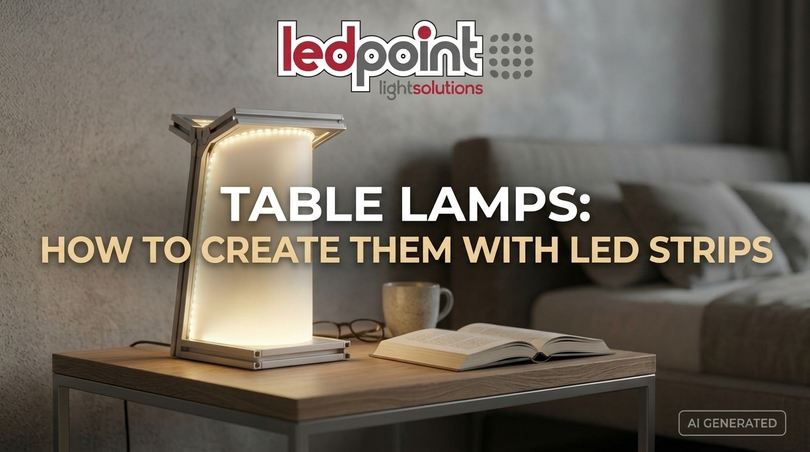
Table lamps are accent light sources, typically 30-70 cm high, that illuminate a specific area of the living room, bedside table, or desk. Handcrafted with LED strips, aluminum profiles, Neon Flex, mini power supplies, and Ledpoint controllers, they offer monochromatic, CCT, or adjustable RGB light, minimal consumption, and a unique design.
A table lamp is not just a simple accessory: it is the light source we use the most, the one we turn on in the evening to read, that accompanies study hours, that creates atmosphere in the living room when the central chandelier would be too much. Yet, when searching for table lamps online, we almost always come across the same mass-produced models, with replaceable bulbs but often with electronic components of uncertain quality, materials that age poorly, and light that cannot be truly customized.
In this comprehensive guide, we show you a concrete alternative: designing and building artisanal table lamps with professional Ledpoint components. We will see what table lamps are and what they are used for, what types can be made with aluminum profiles and Neon Flex, how to choose light, color, and dimensions, how to exploit CCT and RGB technology even for chromotherapy at different times of the day, and finally, two step-by-step guides to build two different table lamps, with material lists, calculation schemes, and workshop tips.
The guide is designed for interior designers, those who work from home, those looking for comfortable reading light, photographers and creators, students, and hospitality facilities. Each section opens with a concise answer and continues with technical data, tables, and practical indications verified by our team, which regularly tests LED strips with an integrating sphere and spectroradiometer.
In this article...
1. What are table lamps and what are they used for
Before picking up profiles and LED strips, it is useful to clarify what we are talking about. The term "table lamps" encompasses a wide family of fixtures, from the small bedside lamp to the desk lamp with an adjustable arm, up to large sculptural objects for consoles. Understanding the function of each type is the first step to designing one that is truly useful.
Definition of a table lamp
A table lamp (or desk lamp, accent lamp, table light) is a portable lighting fixture that rests on a surface, such as a living room side table, a bedside table, a console, a sideboard, or a desk, and is powered via a plug or, increasingly, via a USB port or battery. Unlike a chandelier or ceiling light, it does not illuminate the entire room but creates a localized zone of light, useful for a specific task or to build atmosphere.
In lighting design, table lamps fall under the so-called accent and task lighting: they are the "third light" added to general and architectural lighting, making an environment layered, welcoming, and functional.
What is a table lamp used for?
A table lamp serves three main purposes, often combined in the same object:
- Visual function (task lighting): provide sufficient light for reading, studying, working at a computer, sewing, drawing, or performing precise manual activities.
- Atmosphere function: create low, warm light points that make the living room or bedroom more intimate, reducing contrast with shadowed areas.
- Decorative function: be a furnishing object that characterizes the style of the room even when turned off.
A good artisanal table lamp with Ledpoint LEDs can perform all three functions: with a CCT strip, you can switch from neutral light for work to warm light for the evening; with an RGB strip, you add color; with a well-chosen profile, you get an object with a clean and durable design.
What are table lamps called?
Table lamps have many names, and knowing them helps both in online searches and in dialogue with clients and suppliers. Here are the most used:
| Name | Meaning and typical use |
|---|---|
| Table lamp / dining table lamp | Generic term for any accent lamp; "dining table lamp" is more used for lamps on dining tables and in restaurants. |
| Table lamps | Compact-sized lamps for living room side tables, consoles, and bedside tables. |
| Table light / table lights | A more classic term, often referring to lamps with a decorative base and a lampshade. |
| Abat-jour | From the French "lower the light": originally the lampshade, today the bedside lamp with a lampshade. |
| Bedside lamp | Low lamp, with warm light and easy-to-reach controls from the bed. |
| Desk lamp / bank lamp | Functional lamp for work and study, often with an adjustable arm. |
| Accent lamp | Term used in catalogs to indicate any lamp not fixed. |
| Table spotlight | Small directional lamp with a narrow beam, to accentuate objects or illuminate a specific point. |
The most correct answer is therefore table light or accent lamp; for the lamp that sits on the bedside table, the traditional term is abat-jour.
Difference between table lamps and abat-jour
What is an abat-jour? Strictly speaking, it is a table lamp equipped with a fabric, paper, or glass lampshade that "lowers" the light and diffuses it softly. Therefore, all abat-jours are table lamps, but not all table lamps are abat-jours: an aluminum column lamp with an opal diffuser, a Neon Flex ring, or a desk lamp with an arm do not have a lampshade, but they are still table lamps in every respect.
With Ledpoint profiles, the role of the lampshade is played by the diffuser: an element in opal, satin, or transparent polycarbonate or PMMA that makes the light uniform, eliminates the dotted effect of LEDs, and protects the eyes from glare. It is the contemporary version of the abat-jour, thinner, more efficient, and much more durable.
Where to place a table lamp
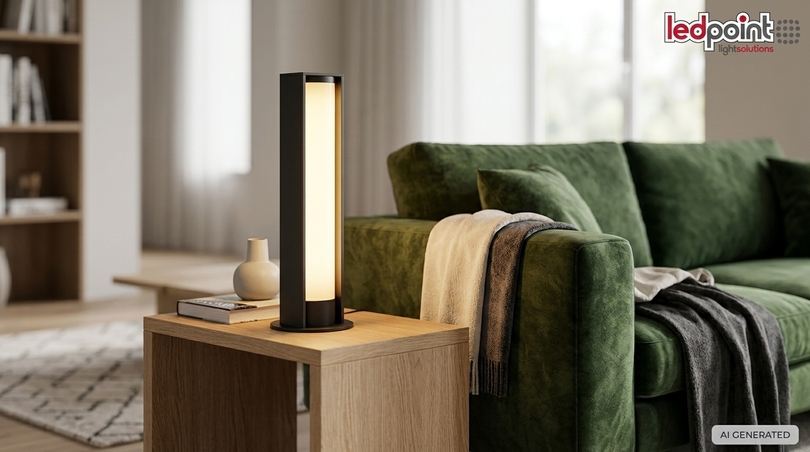
Where to place a table lamp depends on its function. For reading, it should be positioned to the side and slightly behind the shoulder, on the opposite side of the hand you write with, to avoid shadows on the paper. On the bedside table, the center of the light source should be roughly at chin height when sitting in bed. In the living room, table lamps work best next to the sofa, on consoles and low furniture, or on a corner table to "illuminate dark corners", the golden rule of interior designers to make a room feel larger and more welcoming.
2. Artisanal table lamps vs "take away" lamps
The market is full of cheap table lamps, bought in a click and replaced after a few years. Building or having artisanal table lamps built is a different choice: it means prioritizing component quality, repairability, customization, and the aesthetic value of an object designed to last. In this section, we see why it is worth it and what really changes.
The beauty of artisanal craftsmanship
An artisanal lamp is born from conscious choices: the profile section, the aluminum finish, the color temperature, the type of diffuser, the base material. Every detail can be decided based on the room, the decor, and who will use it. The result is a unique piece, bearing the mark of its maker: a precise profile cut, a solid wood base chosen for its grain, a fabric cable matching the textile colors.
There is also a cultural aspect. Italy has an extraordinary tradition in light design, and many of the most iconic 20th-century table lamps were born precisely in workshops and laboratories. Resuming that method, starting from the component and arriving at the finished object, means reclaiming the design instead of enduring choices made elsewhere for cost reasons.
Why prefer them to "take away" table lamps
Mass-produced decorative lamps have an obvious advantage, the entry price, but often hide some limitations. Here is an objective comparison:
| Criterion | Mass-produced "take away" table lamp | Artisanal table lamp with Ledpoint components |
|---|---|---|
| Light quality | CRI often not declared, fixed tone | CRI up to >90, chosen or adjustable color temperature (CCT) |
| Customization | None or limited to base color | Dimensions, shape, finish, light color, control |
| Repairability | Integrated LEDs often not replaceable | Strip, power supply, and controller replaceable individually |
| Flicker | Variable, rarely declared | Low voltage power supply and selectable controllers to reduce it |
| Durability | Tied to the weakest component | Professional components, heat dissipation in the aluminum profile |
| Aesthetic value | Object replicated in thousands of pieces | Unique piece or small series on project |
| Sustainability | Often destined for landfill at end of life | Recyclable aluminum, reusable and updatable parts |
The most important point is repairability. In an artisanal lamp made with modular components, if in ten years you want a warmer light or smart control, you just need to replace the strip or the receiver, not the entire lamp. It is the opposite of the "disposable" logic.
Artisanal table lamps for professionals
For interior designers, architects, and hospitality facility managers, the artisanal table lamp is also a design tool. It allows offering clients particular and original table lamps, consistent with the interior concept, replicable in small series for a boutique hotel or restaurant, and with documented performance. Ledpoint works without a minimum order quantity and can study customized profiles and custom strips, a possibility that catalog lamps simply do not offer.
3. Data, consumption, and 2026 trends for table lamps
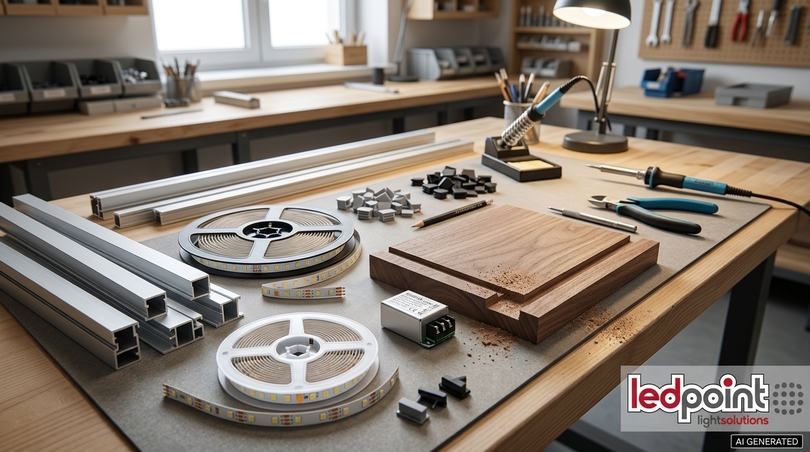
Talking about table lamps only in aesthetic terms would be reductive. Technological choices influence consumption, durability, and visual comfort. In this section, we line up the numbers: how much an LED table lamp consumes, how long it lasts, how it compares to old light bulbs, and what trends we see in 2026 projects.
How much an LED table lamp consumes
A table lamp made with LED strips has extremely low consumption. We have calculated the annual consumption of some typical configurations, assuming 4 hours of use per day for 365 days and an energy cost of €0.25/kWh (indicative value, to be adapted to your own tariff):
| Configuration | Absorbed power | Annual consumption (4 h/day) | Indicative annual cost |
|---|---|---|---|
| Bedside lamp with 30 cm of 4.8 W/m strip | approx. 1.5 W | approx. 2.2 kWh | approx. €0.55 |
| Column lamp with 2 × 40 cm of 9.6 W/m strip | approx. 7.7 W | approx. 11.2 kWh | approx. €2.80 |
| 1 m Neon Flex ring at 10 W/m | approx. 10 W | approx. 14.6 kWh | approx. €3.65 |
| Desk lamp with 50 cm of 14.4 W/m strip | approx. 7.2 W | approx. 10.5 kWh | approx. €2.60 |
| Comparison: 60 W E27 incandescent bulb | 60 W | 87.6 kWh | approx. €21.90 |
Note: values do not include power supply losses (typically 8-15%). These are Ledpoint calculation estimates based on the nominal power of the strips.
The key data is clear: a well-designed LED table lamp consumes 5 to 30 times less than a traditional lamp with an incandescent bulb, for the same useful light. To the question "which lamp consumes the least?" the answer today is undoubtedly the LED with high luminous efficacy.
Data measured in the Ledpoint laboratory
Ledpoint measures its strips with an integrating sphere and spectroradiometer, detecting luminous flux, efficacy, color temperature, and color rendering index. Some values declared in the data sheets of products suitable for table lamps:
| Product | Flux | Efficacy | CRI | Recommended use in table lamp |
|---|---|---|---|---|
| COB Strip 3000K 2.4 W/m 12V | 215 lm/m | 98 lm/W | >90 | Bedside lights, atmosphere light |
| COB Strip 4000K 4.8 W/m 12V | 480 lm/m | 106 lm/W | >90 | Reading, compact desk lamps |
| COB Strip RGB+CCT 2700-6500K 24V | 415 lm/m (2700K) | 80 lm/W | - | Multifunction lamps, chromotherapy, photo sets |
| Strip 2835 4000K 19.2 W/m 24V | 2600 lm/m | 150 lm/W | >80 | Bank lamps, highly illuminated workstations |
These numbers are the heart of the artisanal advantage: you know exactly how much light your lamp will produce before even building it, because you start from measured data and not generic promises.
How many years do LED lamps last
The lifespan of an LED is expressed with the L70 parameter: the number of hours after which the flux drops to 70% of the initial value. For quality and well-dissipated strips, we are talking about tens of thousands of hours. With 4 hours of use per day, 30,000 hours correspond to more than 20 years. The secret to reaching these values is thermal management: the aluminum profile acts as a heat sink and keeps the LEDs at correct temperatures, something many cheap plastic lamps do not do.
What are the trending lamps for 2026
Observing the projects of our professional clients and the requests arriving at our technical office, the strongest trends for table lamps in 2026 are:
- Pure light lines: column, portal, or arch table lamps made with thin profiles and COB strips without a dotted effect.
- Decorative Neon: soft shapes, rings, waves, and writings in Neon Flex as sculptural accent objects.
- Dynamic and circadian light: CCT lamps that change tone throughout the day, in line with research on visual well-being.
- Cordless and USB lamps: small portable lamps, rechargeable or 5V powered, to move from the table to the terrace.
- Natural materials and metal: solid wood, stone, ceramic, and marble bases paired with black, white, or natural anodized aluminum.
- Smart control: integration with voice assistants via ZigBee receivers.
Also in chandeliers, what is used in 2025 and 2026? The trend is the same: linear sources, suspended profiles, indirect and adjustable light. A table lamp coordinated with a suspended profile above the dining table creates a coherent language throughout the living area.
4. Ledpoint components for building table lamps
An LED table lamp is composed of a few elements, but each one counts. In this section, we analyze each component available on Ledpoint.it, explaining what it is for, how to choose it, and what mistakes to avoid. It is the "toolbox" from which the types and the two step-by-step guides will start.
LED strips: the heart of the lamp
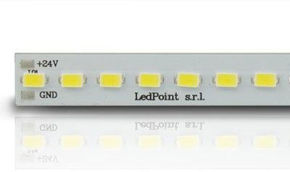
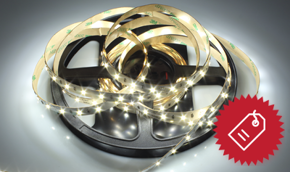
LED strips are flexible circuits on which LEDs are mounted, cuttable at predetermined points and equipped with double-sided tape for fixing. For a table lamp, they are chosen based on four parameters: light color, power per meter, voltage, and LED type.
Monochromatic strips
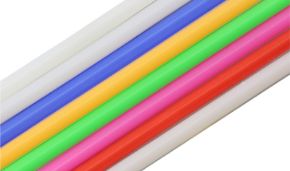
They emit a single shade of white or color. They are the simplest and most elegant choice for table lamps dedicated to a specific use. For the bedside table and living room, we recommend warm white LED strips 2200-3500K; for the desk and study, natural white LED strips 3800-5300K. For decorative effects, there are fixed colored light strips (amber, red, blue, green, and others).
CCT strips (adjustable white)
CCT LED strips contain two channels of LEDs, one warm and one cold, which when mixed allow adjusting the color temperature from about 2700K to 6500K. They are ideal for multi-purpose table lamps: neutral light for working, warm light for relaxing. Ledpoint also offers the Circadian Light line, designed to follow the natural rhythm of light.
RGB, RGBW, and RGB+CCT strips
RGB LED strips mix red, green, and blue to obtain millions of colors. RGBW add a pure white channel, and RGBCCT combine color and adjustable white in a single strip: they are the most complete solution for a table lamp that must be both functional light and emotional light.
COB strips: the continuous line
COB LED strips have chips covered by a continuous layer of phosphors that generates a homogeneous line of light, without the classic dotted effect, with an emission angle up to 180°. For table lamps, where the source is close to the eye and often visible, COB is almost always the best choice, even with thin diffusers.
5V, 12V, and 24V strips
5V LED strips can be powered from a USB port or a power bank: they are perfect for portable lamps and compact desk lamps. 12V LED strips and 24V LED strips are the standard for interior lighting; 24V reduces voltage drops and is preferable when using more than 1-2 meters of strip.
Aluminum profiles: structure, heat dissipation, and design
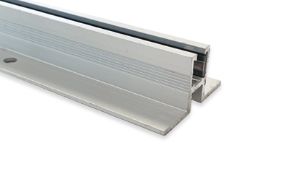
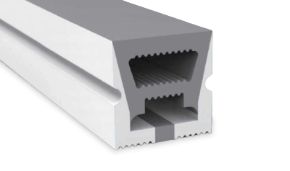
Ledpoint aluminum profiles are high-quality extrusions, of Italian design, available in many sections: flat, recessed, angular, round, suspended, double emission. In a table lamp, they play three roles simultaneously:
- Structure: they are the "body" of the lamp, rigid and light.
- Heat dissipation: aluminum dissipates the heat of the LEDs and extends their life.
- Aesthetics: the section and finish (natural, black, white) define the style of the object.
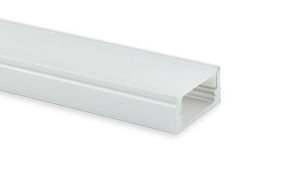
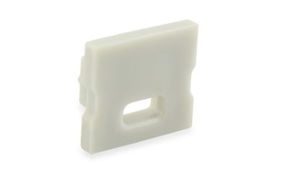
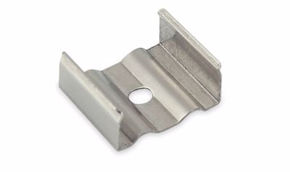
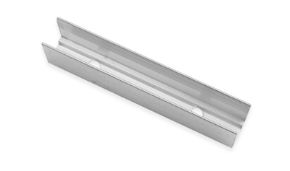
Profiles are completed with diffusers opal or transparent, end caps with or without cable hole, profile joints to create angles and shapes, and mounting clips. For those who want to start without calculations, there are profile and accessory kits.
Neon Flex: the light that bends
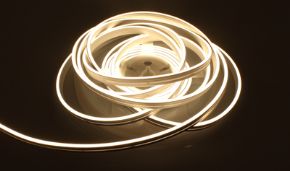
Neon Flex is a flexible silicone tube containing an LED strip and diffusing a continuous light, similar to that of old glass neon tubes, but low voltage, robust, and safe. It is perfect for curved table lamps: rings, arches, waves, writings. Ledpoint offers various sections, including the new mini versions like the Neon Flex 5×5 mm warm white 3000K 24V and the Neon Flex 3×5 mm white 4000K IP65, both with CRI >90 and 5.5 W/m, ideal for thin lines and design details. For complex shapes, there are also Neon Flex tubes, into which to insert a strip of choice, and Neon Flex accessories (caps, clips, channels).
Mini power supplies: small, efficient, hideable
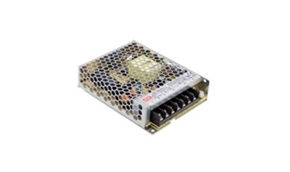
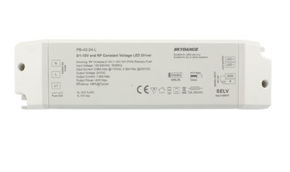
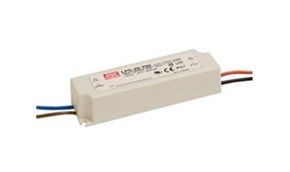
The power supply transforms the 230V mains voltage into the low voltage of the strips. For table lamps, compact power supplies are mainly used, to be integrated into the base or kept external with a plug. On Ledpoint you find 5V power supplies, 12V power supplies, and 24V power supplies in various powers, including mini models suitable for reduced bases, as well as smart power supplies. Rule of thumb: the power supply power must exceed that of the strip by at least 20%.
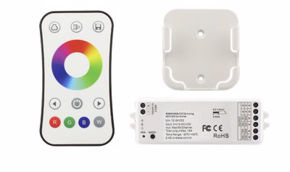
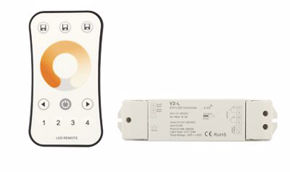
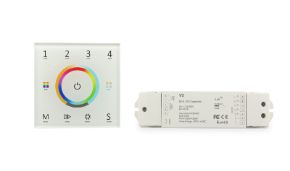
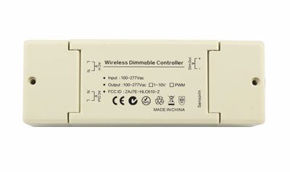
Controllers, dimmers, receivers, and remote controls
The controller decides how the light behaves. Ledpoint organizes the offer by strip type:
| Strip type | Component | Function in the table lamp |
|---|---|---|
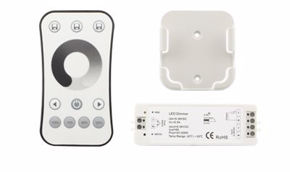
| Monochromatic | monochromatic dimmers, receivers, remote controls | Switching on and intensity adjustment |
| CCT | CCT controllers, CCT receivers, CCT remote controls | Intensity + color temperature |
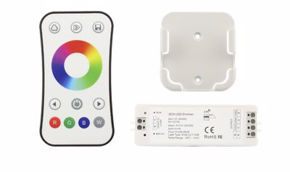
| RGB | RGB controllers, RGB receivers, RGB remote controls | Colors, scenes, dynamic effects |
| RGBW | RGBW controllers | Colors + pure white |
| RGB+CCT | RGB+CCT receivers, RGB+CCT remote controls | Complete control of color and white |
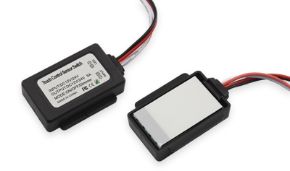
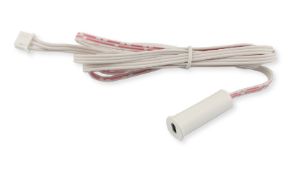
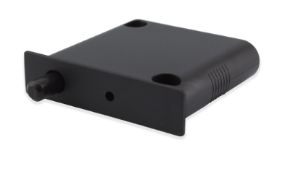
| All | sensors and ZigBee | Touch or motion activation, smart home integration |
For those looking for a "dimmable lamp": what does dimmable mean? It means that the light intensity can be continuously adjusted, usually via PWM modulation. All Ledpoint low-voltage strips are dimmable if paired with the correct controller.
Accessories: connectors, cables, and tools
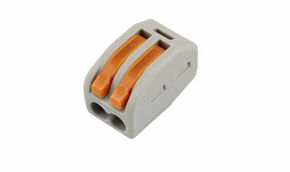
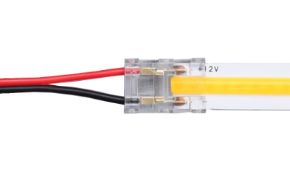
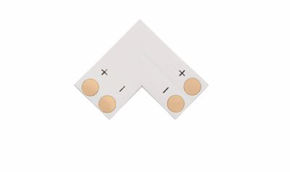
To complete a table lamp, a few but quality accessories are needed: connectors and PCB connectors for LED strips to connect the strip without soldering, adequately sized cables, solder joints, end caps for LED strips, and assembly tools.
5. How much light is needed: lumens, lux, kelvin, and CRI
The most frequent question of those who design table lamps is: how much light is needed? The answer depends on the use, the distance between the lamp and the work surface, and the sensitivity of the user. In this section, we translate technical concepts into practical values, so as to correctly size the strip before buying it.
Lumens and lux: the difference in simple words
The lumen (lm) measures the total amount of light emitted by a source. The lux (lx) measures how much light reaches a surface: 1 lux = 1 lumen per square meter. A table lamp can have few lumens but generate many lux if it is close to the surface and well directed. To calculate them precisely, you can follow our guide on how to calculate the lux of an LED installation.
How many lumens should a table lamp have?
| Table lamp use | Recommended flux | Illuminance on the surface | Indicative strip |
|---|---|---|---|
| Atmosphere light in the living room | 100-300 lm | 50-100 lx | 30-60 cm of 2.4-4.8 W/m strip |
| Bedside lamp for brief reading | 250-450 lm | 200-300 lx | 50-80 cm of 4.8 W/m strip |
| Prolonged reading, manual activities | 450-800 lm | 300-500 lx | 40-60 cm of 9.6-14.4 W/m strip |
| Study and computer work | 600-1000 lm | 500 lx | 50 cm of 14.4 W/m strip or higher |
| Precision work, modeling, embroidery | 1000-1500 lm | 750-1000 lx | 50-60 cm of 19.2 W/m strip |
The illuminance values for writing, reading, and data processing refer to the UNI EN 12464-1 standard on indoor workplace lighting, which indicates 500 lx as a reference for office activities. For the home, it is not mandatory, but it is an excellent parameter for designing a desk lamp that does not tire the eyes.
How many watts to illuminate a table?
With LEDs, the watt no longer indicates light but consumption. With strips of 100-150 lm/W, 5-10 W are enough to properly illuminate a reading surface; for an entire dining table, however, suspended fixtures of 20-40 W are needed. To the question "how many watts should a good lamp have?" the correct answer is: look at lumens and efficacy, not watts.
Color temperature: what type of light for studying and relaxing
| Color temperature | Sensation | Ideal use for table lamps |
|---|---|---|
| 2200-2700K | Very warm, similar to a candle | Bedside table, evening reading, atmosphere |
| 3000K | Warm and welcoming | Living room, lounge, hotels, restaurants |
| 3500-4000K | Neutral, clear | Study, desk, kitchen, work |
| 5000-6500K | Cold, similar to daylight | Precision work, color control, short sessions |
What type of light for studying? For long sessions, we recommend 4000K with a CRI higher than 90: it maintains attention without the harshness of cold light. A cold light table lamp (5000K and above) is useful for short precision activities, but in the evening it is better to return to warm tones. To deepen the coherence of whites between one strip and another, read our article on MacAdam step and CCT.
CRI: color fidelity
The color rendering index (CRI or Ra) indicates how faithfully a light reproduces colors compared to a reference source. For a table lamp that illuminates books, fabrics, art objects, or a photo set, a CRI higher than 90 makes a difference: colors appear natural, skin does not look gray, wood maintains its warmth. If you want to delve deeper, read discovering CRI on our blog. For those looking for a spectrum even closer to natural light, Ledpoint offers the Sunled line.
Flicker-free light: why it matters
Flicker is the rapid variation in luminous intensity, often invisible but perceived by the visual system as fatigue. It is particularly annoying for those who read for a long time and for those who photograph or shoot video, because it generates dark bands in images. To reduce it, it is important to use stabilized power supplies and controllers with high PWM frequency; for 230V applications, Ledpoint offers anti-flicker drivers. A flicker-free table lamp is the basis for visual comfort.
6. Monochromatic, CCT, or RGB: light and chromotherapy throughout the day
The choice of the strip is the decision that more than any other defines the character of a table lamp. A monochromatic light is simple and reassuring, a CCT is versatile, an RGB opens the doors to color and chromotherapy. Here we compare the three solutions and propose a real lighting program to accompany the different hours of the day.
Comparison between the three technologies
| Criterion | Monochromatic | CCT | RGB / RGBW / RGB+CCT |
|---|---|---|---|
| Channels | 1 | 2 (warm + cold) | 3-5 |
| Adjustment | Intensity | Intensity + white tone | Intensity, color, white, scenes |
| Wiring complexity | Low | Medium | Medium-high |
| Ideal use | Bedside table, living room, hotel | Desk, home office, reading | Atmosphere, chromotherapy, photo and video |
| Typical recipient | Retirees, hospitality facilities | Entrepreneurs, students, designers | Photographers, creators, emotional projects |
What is chromotherapy and how it applies to a table lamp
Chromotherapy is a practice that attributes effects on mood and well-being to light colors. It is good to be clear: it is not a medical therapy and does not replace cures or diagnoses. However, it is scientifically documented that light influences the circadian rhythm: blue-rich light in the morning promotes alertness, while warm light in the evening helps the production of melatonin and relaxation. An RGB+CCT table lamp is a perfect tool to build these light routines at home.
A light program for every moment of the day
| Moment | Recommended setting | Perceived effect |
|---|---|---|
| Awakening (6:30-8:00) | White 4000-5000K, increasing intensity | Energy, gradual activation |
| Morning work (8:00-12:30) | Neutral white 4000K, 100% | Concentration, crisp reading |
| Lunch break | Soft green or white 3500K | Relaxation, balance |
| Creative afternoon (14:00-18:00) | White 4000K with light blue accent | Lucidity, freshness |
| Aperitif and dinner | White 2700-3000K or amber | Conviviality, warmth |
| Evening relaxation | Orange/amber at low intensity | Relaxation |
| Before sleeping | Amber or red at 10-20% | Calm, minimal interference with sleep |
| Meditation or yoga | Soft purple or blue, slow fade | Introspection |
With an RGB+CCT receiver and a remote control with memories, these scenes can be saved and recalled with a button. With a ZigBee receiver, instead, you can automate the times via app and voice assistants, so the table lamp changes tone by itself.
Dynamic effects with addressable strips
For those who want to go further, there are addressable LED strips (pixel LEDs), where each segment can have a different color: gradients, waves, "breathing" effect. An example is the pixel strip RGB + warm white 3000K COB with CRI >90, which combines color effects and quality white light. It requires a dedicated SPI controller.
7. Types of table lamps that can be made
With profiles, strips, and Neon Flex, the possibilities are almost infinite. We have selected the most successful types, tested in our clients' projects, ordered from simplest to most complex. For each, you will find the description, recommended components, difficulty level, and a reference photo to draw inspiration from.
Summary table of types
| Type | Main components | Recommended light | Difficulty | Environment |
|---|---|---|---|---|
| Vertical column | Straight profile + base + opal diffuser | Monochromatic or CCT | Easy | Living room, bedside table, console |
| Portal / frame | Profiles + angular joints | CCT or RGBCCT | Medium | Living room, reception |
| Arch or "L" shape | Profile + 90° joint | CCT | Medium | Desk, reading |
| Neon Flex ring | Neon Flex + base + support | RGB or RGBCCT | Medium | Bedroom, creative studio, photo set |
| Prism / triangle | 3 profiles + joints | Monochromatic | Medium | Minimalist interiors |
| Desk lamp with arm | Flat profile + joint + weighted base | CCT 4000K | Medium-high | Home office, study |
| Low bedside lamp | Short profile or glass tube + COB | 2700K | Easy | Bedroom, hotel |
| Portable USB lamp | 5V strip + profile + power bank | Monochromatic | Easy | Students, outdoors, restaurant tables |
| Table spotlight | Round profile + optic or narrow diffuser | 3000K | Medium | Showcases, bookshelves, art objects |
| Luminous sculpture in Neon Flex | Neon Flex + channel + plexiglass base | Colored or RGB | High | Premises, retail, gifts |
| Lamp with technical lampshade | COB strip wrapped on support + lampshade | 2700K | Medium | Classic style, abat-jour |
| Lightbox / display box | Display box + strip | CCT or RGB | Easy | Retail, hotels, giftware |
Vertical column table lamp
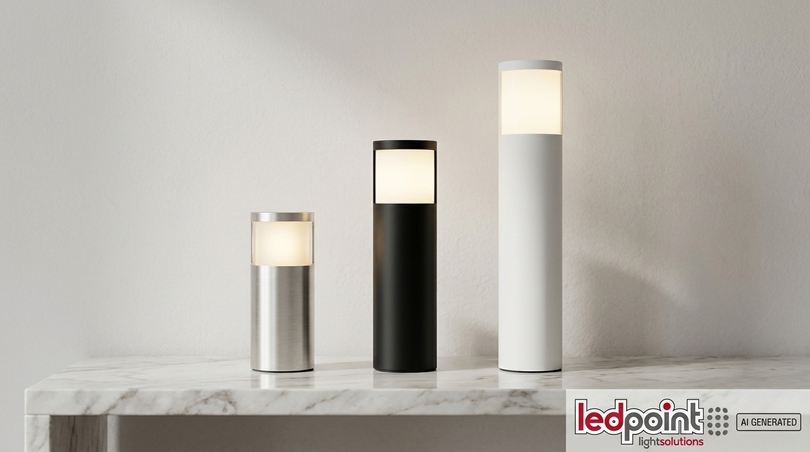
It is the most versatile type and also the most suitable to start with. An aluminum profile of 30-60 cm, mounted vertically on a heavy base, with COB strip and opal diffuser: the result is an elegant blade of light, suitable for any modern style. With a double emission profile or two opposing strips, the light diffuses 360°, like in a traditional lamp. It is the protagonist of our first step-by-step guide.
Portal or frame lamp
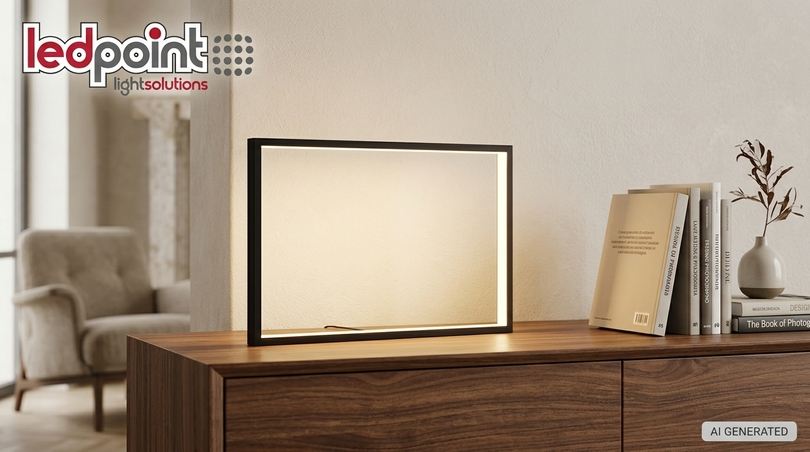
Four profiles joined by angular joints form a rectangle or square resting on one side: a true "portal of light". With inward emission, a scenic luminous frame is obtained, ideal as a particular table lamp in a contemporary living room or on a reception counter. In RGBCCT version, it becomes a furnishing object that changes character every hour of the day.
Arch or "L" shaped lamp
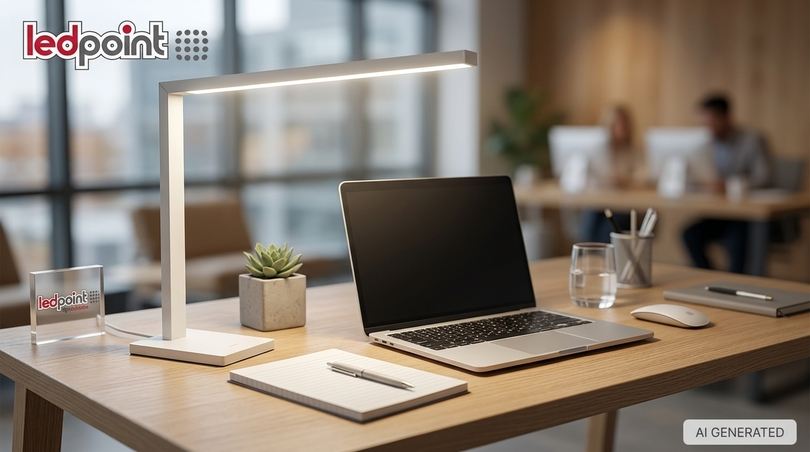
A vertical and a horizontal profile joined at 90° create a lamp that "leans over" the work surface. It is one of the best solutions for reading and writing, because it brings the source above the paper, reducing shadows. With a CCT strip, it becomes a professional desk lamp, adjustable in temperature and intensity.
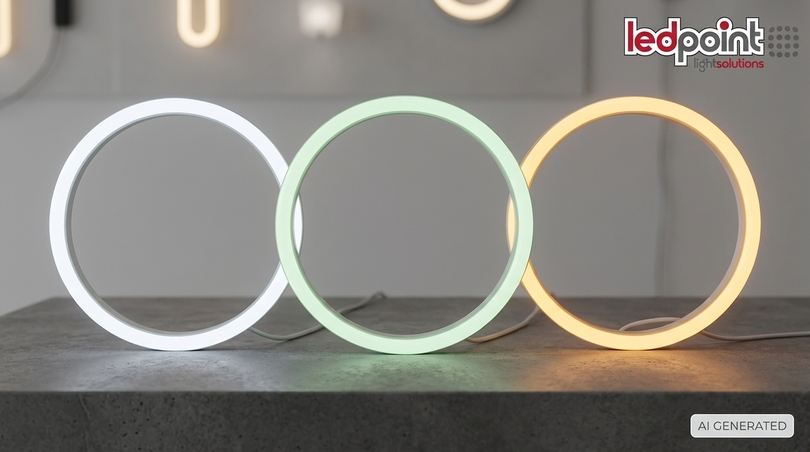
Neon Flex ring lamp
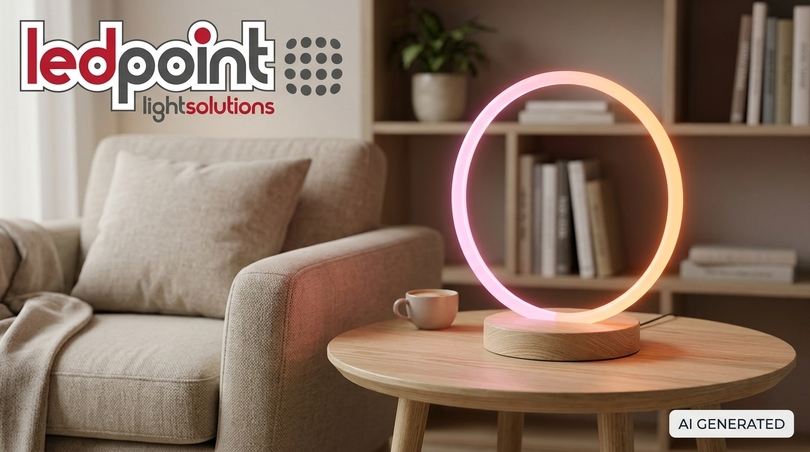
Neon Flex bent into a circle and fixed to a base produces a continuous and soft ring of light. It is the artisanal answer to the question "what is the lamp for making TikToks called?": it is the ring light, the ring light that illuminates the face uniformly. A decorative version in Neon Flex becomes both a decorative lamp and a light for video calls, live streams, and product photography. It is the second step-by-step project in this guide.
Prism or triangle lamp
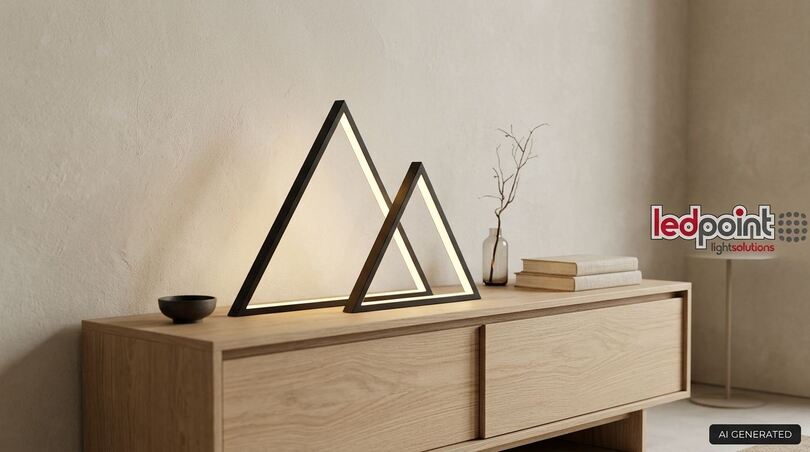
Three profiles joined to form an isosceles or equilateral triangle: pure geometry, perfect in minimalist and Japanese-style interiors. The light can be directed outwards or inwards, creating a "lantern" effect. It works very well in series: two or three triangular table lamps of different sizes form a sculptural composition.
Desk lamp with adjustable arm
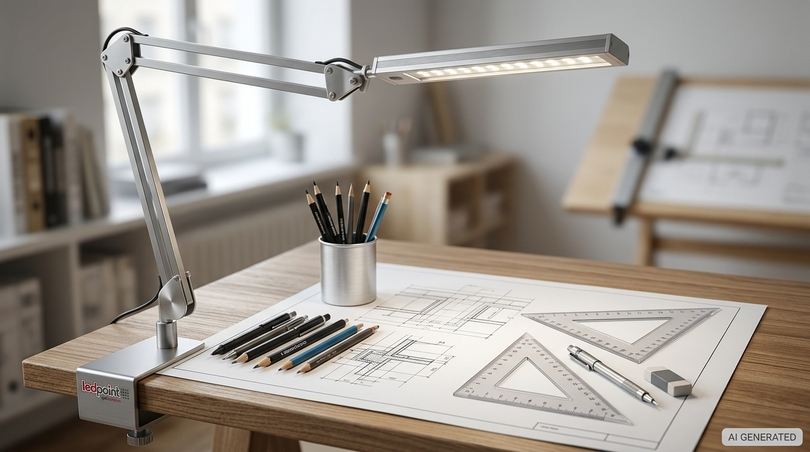
A flat profile mounted on a joint and a weighted base gives life to an adjustable bank lamp. It is the solution for those who work many hours at the computer or perform manual activities: the light is brought exactly where it is needed. Are there table lamps with an adjustable arm? Yes, and with a wide profile and high-efficiency strip, you get a desk lamp that does not cast shadows thanks to the extended linear source, similar in principle to the surgical lamps used above the operating table, which illuminate from multiple points to eliminate shadows.
Low bedside lamp
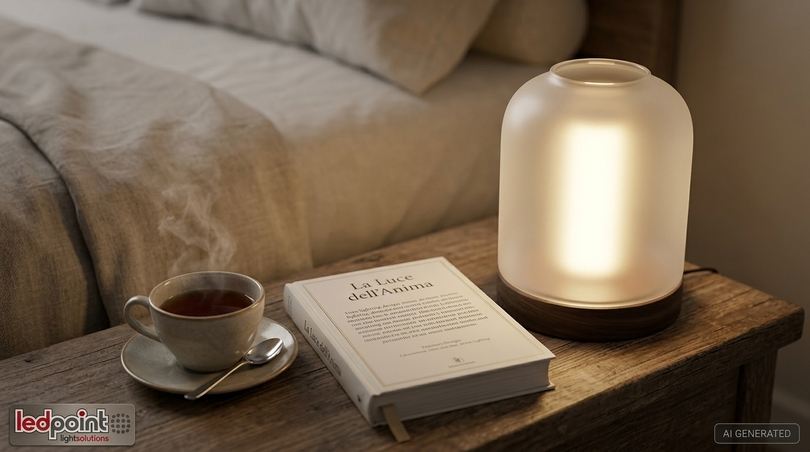
A small lamp of 20-30 cm, with very warm light and touch or remote control, reachable from the bed. It can be made with a short profile and an opal diffuser, or by inserting a COB strip into a frosted glass cylinder. Which table lamps are stable and safe enough for a bedside table? Those with a base at least as wide as half the height and low-voltage power supply, which do not heat up and do not have accessible 230V parts.
Portable USB table lamp
With a 5V strip and a compact profile, a lamp powered by a USB port, phone charger, or power bank is built. It is the ideal solution for students, for those who move between home and office, and for restaurant and outdoor tables, where cordless table lamps are increasingly in demand. Are there easily transportable table lamps powered via USB? Yes, and it is one of the simplest projects to realize.
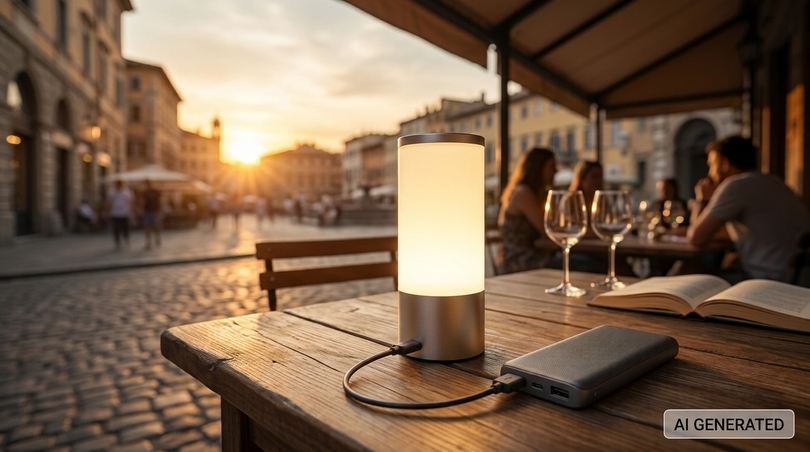
Table spotlight
A short round profile with a high-density strip and narrow diffuser becomes a small table spotlight to illuminate a sculpture, a leaning picture, a book collection. For those looking for table spotlights for showcases and shops, it is a discreet and easily orientable solution.
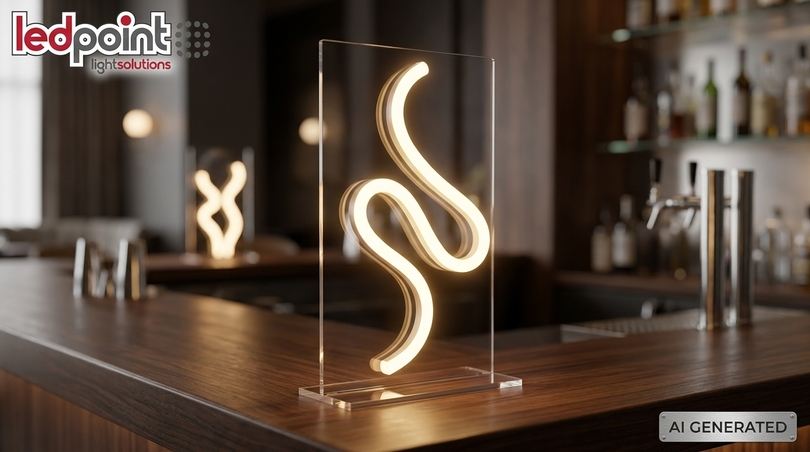
Luminous sculpture in Neon Flex
Waves, knots, mountain profiles, initials of a name, the logo of a venue: Neon Flex bends by hand and is fixed to a plexiglass or wooden base. It is the most creative type, suitable for personalized gifts, counter signs, and retail displays. To the question "what are the most original table lamps?" the artisanal answer is precisely this.
Classic lamp with lampshade and artisanal LED "bulb"
Even those who love classic style can benefit from Ledpoint components. A COB strip wrapped in a spiral on a cylindrical aluminum support replaces the bulb and generates homogeneous light inside the lampshade. You get a classic table lamp with contemporary technology, perfect for traditional style living rooms, villas, historic hotels. It is also the answer to those looking for a more efficient "DIY abat-jour".
Lightboxes and luminous boxes
Backlit display boxes can become cube or parallelepiped-shaped table lamps, with a customizable front (print, photo, logo). They are highly appreciated in receptions, shops, and as gift objects.
Table chandeliers and lamps for the dining table
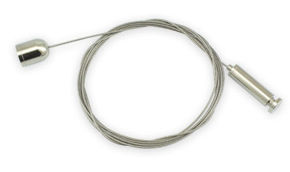
Many search for "table chandeliers" actually meaning the light above the dining table. Here the table lamp gives way to the suspended profile, realizable with Ledpoint suspension cables. What chandelier to put on a rectangular table? A linear suspension about 2/3 the length of the table, centered, is the most harmonious solution. At what height is it placed? Generally 70-80 cm from the surface, so as not to dazzle those seated and not obstruct the view of the diners. A coordinated table lamp on the sideboard completes the composition.
8. How to choose the right table lamp
Choosing or designing the perfect table lamp means crossing four variables: dimensions, light, materials, and intended use. In this section, we translate each criterion into concrete indications, useful both for those who build their own lamp and for the interior designer who must propose it to a client.
Recommended dimensions: how tall should a table lamp be
| Position | Recommended lamp height | Furniture height + lamp | Notes |
|---|---|---|---|
| Bedside table | 35-55 cm | 110-130 cm from the floor | Source at chin height when sitting in bed |
| Living room side table next to the sofa | 55-75 cm | approx. 110-125 cm | Lower edge of the diffuser at eye level when seated |
| Console | 60-80 cm | 140-160 cm | Space for a large and scenic table lamp |
| Desk | 40-50 cm (with arm) | - | Source 35-45 cm above the surface |
| Restaurant table | 20-30 cm | - | Must not obstruct the gaze between diners |
A simple rule of decorators: the table lamp should be about one and a half times the height of the furniture it rests on, and the base should not exceed 2/3 of the depth of the furniture. The ideal diameter of a lamp for a living room side table is between 25 and 40 cm; on the bedside table between 15 and 30 cm.
Brightness and control
Choose the lumens based on the table in section 5 and always provide a dimmer: the same table lamp will be more versatile if it can go from 100% for reading to 10% for night light. For those who prefer simple controls, a button or a touch sensor on the base is more intuitive than an app.
Materials: resistance and refinement
Which materials are more resistant and refined for a table lamp? Here are the most successful combinations:
| Material | Pros | Recommended pairing |
|---|---|---|
| Anodized aluminum | Light, dissipating, does not rust, recyclable | Luminous body, arms, columns |
| Solid wood (oak, walnut, ash) | Warm, tactile, workable | Bases, inserts, Nordic and Japandi style |
| Marble and stone | Stabilizing weight, luxury | Bases for hotels and elegant living rooms |
| Ceramic | Craftsmanship, color, texture | Decorative bases, Mediterranean style |
| Frosted glass | Soft diffusion, refinement | Bedside lights, classic style |
| Brass and steel | Value, durability | Details, deco and industrial style |
| Polycarbonate and PMMA | Uniform diffusion, impact resistance | Profile diffusers |
The anodization of aluminum creates a hard protective layer that resists scratches and corrosion: for this reason, anodized profiles are also suitable for the intensive use of hotels and restaurants.
Intended use: what lights to put in the various rooms
Living room and lounge
What lights to put in the living room? A combination of general light, accent light, and warm (2700-3000K) living room table lamps next to the sofa or on the console. Modern living room table lamps with profiles and diffusers create islands of light that make the room deeper.
Bedroom
What lamps to put in the bedroom? Soft general light and two warm, dimmable bedside lamps. The best lighting for the bedroom is one that can be lowered: 2700K, high CRI, and adjustable intensity.
Study and home office
How to best illuminate a desk? A 4000K CCT table lamp positioned laterally, with at least 500 lux on the surface, combined with ambient light that reduces contrast with the screen.
Kitchen and hallway
In the kitchen, the table lamp is a complement (peninsula, table, sideboard), while the main light should be entrusted to under-cabinet profiles. In the hallway, a small accent lamp on a console is often more welcoming than a ceiling spotlight. How to illuminate the house without chandeliers? With linear wall lights, under-cabinet profiles, and well-distributed table lamps.
Restaurants and hotels
For restaurant table lamps, autonomy, robustness, and warm light count. In hotel rooms, ease of use for the guest and maintainability for the staff count: standard replaceable components, low-voltage power supply, finishes resistant to frequent cleaning.
9. Styles and design: matching the lamp to the decor
A table lamp does not live alone: it dialogues with furniture, fabrics, wall colors. Interior designers know this well, and that is precisely why they look for elegant and original table lamps capable of adapting to different styles. In this section, we see how to decline Ledpoint components in the main decor styles.
Modern and minimalist table lamps
Clean lines, absence of decorations, neutral colors. Here aluminum profiles give their best: a blade of white or black light, an opal diffuser, a geometric base. The COB strip eliminates any dotting and makes the lamp an almost abstract object. Which table lamps adapt best to modern decor? Column, portal, and prism lamps, with black or white anodized finish.
Industrial table lamps
Brushed natural aluminum, visible fabric cables, steel or concrete bases. A wide profile on a jointed arm recalls workshop lamps, but with the efficiency of LEDs. A 3000K tone enhances bricks, aged wood, and metal.
Classic and elegant table lamps
For classic environments, lights with ceramic, marble, or brass bases and fabric lampshades work well, with a 2700K COB source and CRI >90 that restores the colors of fabrics and wood paneling. Classic living room lamps and LED technology are not contradictory: the source remains hidden, the effect is that of a traditional lamp, the consumption is that of LED.
Nordic and Japandi style
Light wood, paper, natural fabrics, soft shapes. A white profile on an ash base, or a warm white Neon Flex ring, fits in naturally. The Japanese concept of wabi-sabi, the beauty of imperfection, perfectly marries the artisanal logic: a wooden base with its unique grain makes each lamp unique. Even oriental rice paper lamps find a contemporary version with warm light COB strips.
Deco and boutique hotel style
Brass, velvet, green marble, fan geometries. Boutique hotel design table lamps can combine thin profiles in dark finish with marble bases and 2700K light. A boutique-style reception finds in the luminous frame or the Neon Flex sculpture an identity element, perhaps with the structure's logo.
Tiffany lamps and the legacy of colored glass
What are Tiffany lamps? Lamps with a lampshade made of leaded colored glass, made famous by Louis Comfort Tiffany between the 19th and 20th centuries. They are the perfect example of an artisanal lamp. Those who restore a Tiffany lamp can replace the old bulb with a 2700K COB LED source: less heat on the glass, more faithful colors, minimal consumption.
Famous design table lamps and iconic lamps
The history of design is full of table lamps that have become icons, often born from a simple idea: a balanced arm, a mushroom lampshade, a luminous tube. What is the secret of these iconic lamps? A recognizable shape and a clear function. It is the same lesson that guides a successful artisanal project: there is no need to add, there is a need to subtract until finding the essential. The Bauhaus movement, from which many 20th-century desk lamps derive, understood this a hundred years ago.
How to match the table lamp to the decor
| Room style | Recommended shape | Profile finish | Base | Light |
|---|---|---|---|---|
| Modern | Column, portal | Black or white | Metal, stone | 3000K or CCT |
| Minimalist | Prism, thin column | White | Corian, concrete | 3000K |
| Industrial | Arm, L | Natural | Steel, concrete | 3000K |
| Classic | Lamp with lampshade | Hidden | Ceramic, brass, marble | 2700K |
| Nordic / Japandi | Ring, column | White | Ash, oak | 2700-3000K |
| Boutique / deco | Frame, sculpture | Black, bronze | Colored marble | 2700K or RGBCCT |
10. Step-by-step guide no.1: CCT column table lamp
Here is the first complete project: a column table lamp about 45 cm high, with adjustable white light from warm to cold and intensity controlled by remote control. It is a lamp suitable for the living room, bedside table, and desk, ideal for those who want functional and atmospheric light in the same object. Estimated time: 2-3 hours. Difficulty: easy-medium.
Material list
| Component | Quantity | Where to find it |
|---|---|---|
| Double emission or square aluminum profile, 40 cm length | 1 | Aluminum profiles |
| Opal diffuser for the chosen profile | 1 or 2 (40 cm) | Diffusers |
| End caps (one drilled for the cable) | 2 | End caps |
| CCT LED strip 24V, preferably COB | 80 cm (2 × 40 cm) | CCT LED strips |
| CCT receiver | 1 | CCT receivers |
| CCT remote control | 1 | CCT remote controls |
| 24V power supply of adequate power (see calculation) | 1 | 24V power supplies |
| Connectors or 3-pole cable for CCT | as needed | PCB connectors / Cables |
| Solid wood, marble, or metal base (e.g., 14 × 14 × 3 cm) | 1 | Carpenter, marble worker, or laboratory |
| L-bracket or threaded rod to fix the profile to the base | 1 | Hardware store |
| Anti-slip felt or rubber feet | 4 | Hardware store |
Necessary tools
- Hacksaw for aluminum with fine-toothed blade or chop saw with non-ferrous metal disc
- File, fine sandpaper, scissors, tape measure, and square
- Soldering iron (if not using connectors), heat shrink tubing
- Drill with wood and metal bits
- Multimeter to verify polarity and voltage
Power and power supply calculation
Suppose we use a CCT strip of 10 W/m total. With 80 cm of strip, the power is 0.8 × 10 = 8 W. We add a 20% margin: 8 × 1.2 = 9.6 W. A 24V power supply of 15-20 W is the correct choice, compact enough to be hidden in the base or to remain external with a plug. If you use a more powerful strip, repeat the calculation: power per meter × meters × 1.2.
Step-by-step procedure
Step 1 - Design and draw
Draw the lamp on paper at a 1:1 scale: profile height, base dimensions, cable exit point, receiver position. Decide if the light will be on one side (directional lamp) or on two opposite sides (360° lamp). This step, typical of artisanal work, avoids cutting errors and lets you visualize the proportions.
Step 2 - Cut the profile and diffuser
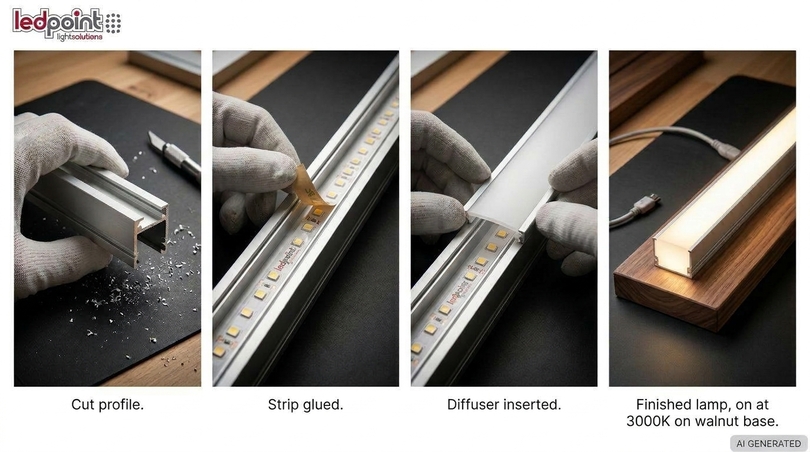
Mark the profile at 40 cm and cut it with the aluminum blade, holding it firmly in a vise with soft protections to avoid scratching it. Remove burrs with a file and fine sandpaper. Cut the diffuser to the same size. A perfectly square cut is the secret to a professional-looking lamp.
Step 3 - Cut and prepare the strip
Cut the CCT strip exclusively at the points indicated on the PCB (scissors mark). You will get two segments of about 40 cm. If you want to cut an LED strip without errors, remember: never cut between one cut point and another, otherwise the final segment will not turn on.
Step 4 - Connect the cables
On the CCT strip pads, you will find three contacts: common positive (+), warm white channel, and cold white channel. Connect the three-pole cable with a PCB connector or by soldering with tin and protecting with heat shrink tubing. If you use two segments, connect them in parallel, always respecting the channel correspondence. Verify with the multimeter that there are no short circuits before proceeding.
Step 5 - Glue the strip into the profile
Clean the inside of the profile with isopropyl alcohol and let it dry. Remove the double-sided tape film and apply the strip by pressing evenly. The double-sided tape adheres best at temperatures between 21 and 38 °C; full hold is reached in about 72 hours.
Step 6 - Close the profile
Insert the diffuser by pressure or sliding, then apply the end caps: the bottom one drilled to let the cable pass, the top one blind. A dot of transparent silicone gives further stability.
Step 7 - Prepare and fix the base
Drill a through hole for the cable and a seat for the bracket or threaded rod in the base. If the base is wood, you can carve a small cavity on the back to house the receiver. Fix the profile vertically, checking with a square that it is perfectly plumb. The weight of the base must guarantee stability: for a 45 cm column, we recommend at least 800 g-1 kg.
Step 8 - Connect receiver and power supply
Connect the output of the 24V power supply to the input of the CCT receiver, and the output of the receiver to the strip cable, respecting polarity and channels. Pair the remote control to the receiver following the manual procedure (usually a press of the learning button within a few seconds of turning on).
Step 9 - Testing and adjustment
Turn on the lamp, test the entire range of color temperatures and intensities, verify that the light is uniform along the entire profile and that there are no darker spots. Leave the lamp on for an hour and check the profile temperature: it should feel warm, never hot.
Step 10 - Finishing
Apply the anti-slip feet, arrange the cable (a fabric cable matching the base makes a difference) and, if you wish, sign the base with an engraving: it is your artisanal table lamp, unique and repairable.
Project variants
- Monochromatic version: replace the CCT strip with a warm white strip and the CCT receiver with a monochromatic dimmer: simpler and ideal for the bedside table.
- Smart version: use a ZigBee receiver compatible with home automation hubs to control the lamp with voice or an app.
- Touch version: integrate a sensor on the base to turn on and adjust with a touch, perfect for those who prefer simple controls.
- RGBCCT version: with the COB RGB+CCT strip and a dedicated receiver, the column also becomes a chromotherapy lamp.
11. Step-by-step guide no.2: RGB Neon Flex ring lamp
The second project is a sculptural table lamp: a ring of light in Neon Flex of about 30 cm in diameter, mounted on a wooden base, with RGB (or RGB+CCT) colors managed by remote control. It is a decorative lamp, a tool for home chromotherapy, and a soft light for video calls and social content. Estimated time: 3-4 hours. Difficulty: medium.
Material list
| Component | Quantity | Where to find it |
|---|---|---|
| RGB Neon Flex 24V (or Neon Flex tube + RGB strip) | approx. 1 m | Neon Flex / Neon Flex tubes |
| End caps and Neon Flex fixing accessories | 1 set | Neon Flex accessories |
| RGB receiver | 1 | RGB receivers |
| RGB remote control with scene memories | 1 | RGB remote controls |
| 24V 20-30 W power supply | 1 | 24V power supplies |
| 4-pole cable for RGB | as needed | Cables |
| Circular support: aluminum ring, curved plywood, or laser-cut plexiglass (Ø 30 cm) | 1 | Laser cutting laboratory or carpentry |
| Wooden base with groove (e.g., 20 × 10 × 4 cm) | 1 | Carpenter |
| Clips or channel to fix the Neon Flex to the support | as needed | Neon Flex accessories |
Length and power calculation
The circumference of a ring is calculated with the formula diameter × π. For a diameter of 30 cm: 30 × 3.14 = approx. 94 cm. With an RGB Neon Flex of 10 W/m, the power will be about 9.4 W; with a 20% margin, it reaches about 11.3 W. A 24V 20 W power supply is sufficient, a 30 W one leaves room for future modifications. Remember to cut the Neon Flex only at the points indicated by the manufacturer and to respect the minimum bending radius reported in the technical data sheet.
Step-by-step procedure
Step 1 - Prepare the circular support
Make or have cut a rigid ring of 30 cm diameter with a groove on the outer edge, as wide as the Neon Flex section. The support gives perfect shape to the circle and keeps the tube in position over time. If you prefer a "floating" effect, use transparent plexiglass.
Step 2 - Measure and cut the Neon Flex
Wrap the Neon Flex around the support leaving it still intact, mark the nearest useful cut point to the closure of the circle and cut with a sharp blade, perpendicular to the tube. Leave 2-3 cm of extra cable for the connection.
Step 3 - Close the free end
Apply the blind cap to the end opposite to the power supply, sealing it with the silicone indicated in the accessories. This protects the internal strip and maintains the degree of protection.
Step 4 - Connect the RGB cable
Connect the 4-pole cable: common positive, red, green, and blue. Respect the color correspondence up to the receiver. Apply the cable gland cap and verify continuity with the multimeter.
Step 5 - Fix the Neon Flex to the support
Insert the Neon Flex into the groove starting from the power supply point, which will be positioned at the bottom, towards the base. Fix it with clips or with dots of silicone every 8-10 cm. Work calmly: a uniform curve, without folds or crushing, is what distinguishes a well-cared-for artisanal object.
Step 6 - Prepare the base
Carve a groove in the base to fit the ring and a hole for the cable to pass. Under the base, create a compartment for the RGB receiver. Fix the ring with structural glue or small pins.
Step 7 - Connect electronics and power supply
24V power supply → RGB receiver → Neon Flex cable. Pair the remote control, test all colors, and verify that the ring lights up uniformly.
Step 8 - Program chromotherapy scenes
Save the scenes described in section 6 in the remote control memories: energizing white for the morning, soft green for the break, amber for the evening, soft red for the night. Set slow transitions: soft fades are much more pleasant than sudden color changes.
Step 9 - Final testing
Leave the lamp on for at least an hour, check that the Neon Flex does not detach from the support and that the cable is not under tension. Apply felt pads under the base.
Project variants
- Warm white version: with the mini Neon Flex 5×5 mm 3000K and a monochromatic dimmer, the ring becomes a refined and sober decorative lamp.
- Ring light version for photo and video: with a high CRI white Neon Flex like the Neon Flex 3×5 mm 4000K, you get a soft frontal light for video calls and product shoots.
- Double ring version: two concentric circles of different diameters, one white and one colored, controlled by two channels.
- Other shapes: with the same technique, arches, ovals, waves, and letters are made. Deepen the new mini line in the news Neon Flex mini: the line of light that draws the details.
12. Safety, regulations, and durability
Building an artisanal table lamp is a rewarding activity, but it requires attention to electrical safety and component quality. The good news is that working in low voltage drastically reduces risks. In this section, we summarize the essential rules, reference standards, and tips to ensure long life, even in professional contexts such as hotels and restaurants.
Low voltage: why it is safer
5V, 12V, and 24V strips work in safety extra-low voltage (SELV). The only 230V part is the power supply, which must be purchased already certified and CE marked, without ever being opened or modified. Those without electrical skills should limit themselves to low-voltage connections and entrust any intervention on the mains side to an electrician.
Who cannot make lamps? DIY lamps and commercial use
For personal use, anyone can assemble a low-voltage table lamp with certified components. The case is different for those who want to sell artisanal table lamps: in this case, the manufacturer must comply with applicable European directives (low voltage, electromagnetic compatibility, ecodesign) and product standards for lighting fixtures such as the IEC/EN 60598 series, draw up technical documentation, and affix the CE marking to the finished product. For hospitality facilities and public places, it is advisable to rely on a qualified designer or laboratory.
Fireproof materials and certifications for hotels
Are there models with fireproof materials or safety certifications? Yes: in an LED table lamp, aluminum does not burn, polycarbonate diffusers can have specific fire behavior classifications (verifiable in the technical data sheet), and the low operating temperature of LEDs reduces the risk. For hotels, it is convenient to choose metal, stone, or treated wood bases and cables with an adequate sheath.
Thermal management and durability
The main enemy of LEDs is heat. To make a table lamp last tens of thousands of hours: always glue the strip to an aluminum profile, do not exceed the recommended power for the chosen profile, avoid closing the power supply in compartments without ventilation, and prefer 24V for long runs. The indicated operating temperature in Ledpoint data sheets for many strips is between -10 °C and +45 °C ambient.
Energy class and disposal
LED strips have an energy class according to the European labeling regulation: you can delve deeper into the blog section dedicated to ErP and ecodesign. At the end of their life, strips, power supplies, and controllers are WEEE and must be delivered to the appropriate collection centers; the aluminum of the profiles is infinitely recyclable.
13. The right table lamp for every need
Everyone looks for something different in a table lamp. We have collected the most frequent questions from the profiles that turn to Ledpoint and transformed them into practical answers, with the most suitable project and components for each.
For the interior designer
Customizable table lamps for interior design projects exist, and Ledpoint components are designed precisely for this: profiles in different finishes, strips with CRI >90, possibility of customized profiles and no minimum order quantity. For modern decor, we recommend columns and frames in black or white finish; to save energy, high-efficiency COB strips. The most refined and resistant material? Anodized aluminum paired with marble or solid wood.
For the entrepreneur with a home office
The best table lamp for working at the computer is an arch or arm lamp, with a 4000K CCT strip and at least 500 lux on the surface. Adjustable brightness and temperature are obtained with a CCT receiver and remote control. For integration with voice assistants like Alexa or Google Home, a ZigBee receiver connected to a compatible hub is used. A USB port in the base to charge the phone can be added with a dedicated charging module, powered by the same low-voltage circuit.
For those looking for a simple light for reading
The most suitable table lamp for reading in the evening has warm light 2700-3000K, CRI higher than 90, no flicker, and a large and intuitive control, like a touch sensor on the base. Stability is obtained with a heavy and wide base; the adjustable arm helps to bring the light onto the page without dazzling.
For the freelance photographer
A table lamp can illuminate a photo set, provided it has high CRI and absence of flicker. The best solution is the RGB+CCT version of the column project or the high CRI Neon Flex ring: adjustable intensity and color, minimalist design, possibility of portable power supply with 5V strip and power bank for outdoor shoots.
For the university student
The ideal economical table lamp for studying is a small USB lamp with a 5V strip and compact profile: it takes up little space on the desk, consumes very little (a few watts), and is easily moved. The recommended color temperature for long study sessions is 4000K, to be lowered to 3000K in the evening.
For the boutique hotel manager
For hotel rooms, low-voltage bedside lamps are more suitable, with a heavy base, dimmable warm light, and standard components replaceable by the staff. For the reception, a luminous frame or a Neon Flex sculpture with the logo becomes an identity element. Is it possible to make table lamps in large quantities at a convenient price? Yes: Ledpoint supplies components for small and large series, with the order group management function that allows dividing purchases by environment.
| Profile | Recommended project | Strip | Control |
|---|---|---|---|
| Interior designer | Column, frame, sculpture | COB CRI >90 or RGBCCT | ZigBee or remote control |
| Entrepreneur | L-shaped or arm lamp | CCT 4000K | CCT + ZigBee |
| Reader / retiree | Low bedside lamp | Warm white 2700K | Touch sensor |
| Photographer | Neon Flex ring, RGBCCT column | CRI >90, RGBCCT | RGB+CCT remote control |
| Student | Portable USB lamp | 5V 4000K | Button |
| Boutique hotel | Bedside table + reception frame | 2700K, COB | Dimmer or remote control |
14. Common questions about table lamps, abat-jour, and home lighting
Those who look for table lamps online often ask related questions: about light bulbs, chandeliers, lighting in other rooms. We have collected the most useful answers here, always linking them to the LED solutions you can create with Ledpoint products.
What does E27 lamp mean? Is the E27 base large or small?
E27 indicates the Edison screw base with a diameter of 27 mm: it is the "large" base, the most widespread in table lamps and chandeliers. E14 is instead the "small" base, typical of abat-jours and decorative lamps. Artisanal lamps with LED strips do not have a base: the source is integrated and powered in low voltage.
What light bulb to use for an abat-jour?
For a traditional abat-jour, an E14 or E27 LED bulb with warm light (2700K) of 250-470 lumens is generally used. However, if you are building a DIY abat-jour, a 2700K COB strip with CRI >90 wrapped around an aluminum support distributes the light more evenly inside the lampshade and lasts much longer.
How to choose the right lampshade for a table lamp?
The lampshade must be proportional: diameter at the base approximately equal to the height of the lamp base, and height of the lampshade approximately 2/3 of that of the base. Light lampshades diffuse more light into the environment, dark ones concentrate it downwards.
Which lamps make the most light and are the most efficient?
The lamps with the highest luminous efficacy today are LEDs: the best strips exceed 150 lm/W, like the 2835 4000K strip at 2600 lm/m. To the question "what is the best LED lamp?" the honest answer is: the one with the right balance between efficacy, CRI, absence of flicker, and build quality for the specific use.
Which lamps do not cast shadows?
Extended linear sources, such as LED strips in long profiles or panels, produce much softer shadows than point sources. It is the same principle as the surgical lamp found above the operating table, composed of many sources that illuminate the field from different angles.
What light to put above the table and how to illuminate the dining table?
Above the dining table, a warm (2700-3000K), well-shielded, and dimmable light is needed, at about 70-80 cm from the surface. For a rectangular table, a linear suspension in an aluminum profile 2/3 the length of the table is the most balanced solution. How to illuminate an island and table in the same open space? With two coordinated suspensions, regulated on separate circuits.
How big should the chandelier be compared to the table?
For round chandeliers, the practical rule is a diameter equal to about half to 2/3 of the table width; for linear suspensions, a length equal to about 2/3 of the table length, leaving at least 15-20 cm per side.
What are wall lamps called and how do cordless ones work?
Wall lamps are called sconces. Cordless ones work on rechargeable batteries: with 5V LED strips and a battery with a charging module, both cordless sconces and table lamps can be made, controllable by sensor.
What types of lights exist?
In summary: general light (ceiling lights, chandeliers, ceiling profiles), accent light (spotlights, strips in niches), task light (table and desk lamps), and decorative light (Neon Flex, luminous sculptures). A well-lit house combines them all, and table lamps are the meeting point between task light and decorative light.
Table lamps online: what to check before buying
Those looking for table lamp sales online should always check: luminous flux in lumens, color temperature, CRI, dimming possibility, type of power supply, source replaceability, warranty. These are the same information you find in Ledpoint technical data sheets for each component; the advantage of those who build their own lamp is being able to choose them one by one.
15. FAQ - Frequently Asked Questions about table lamps
How is an LED table lamp built?An LED strip is glued inside an aluminum profile, closed with a diffuser and end caps, the profile is fixed to a heavy base, and the strip is connected to a low-voltage power supply, possibly via a dimmer or receiver with a remote control. With Ledpoint components, it takes just a few hours and common tools. |
How many lumens should a table lamp have?For atmosphere, 100-300 lumens are enough, for reading in bed 250-450, for prolonged reading 450-800, and for study or computer work 600-1000 lumens, to obtain about 500 lux on the surface. The distance from the surface and the diffuser influence the final result. |
Which color temperature to choose for a table lamp?2700K for bedside table and relaxation, 3000K for living room and hotel, 4000K for study and work. If the lamp has multiple uses, an adjustable CCT strip from 2700 to 6500K is convenient, so the same table lamp goes from the operational light of the day to the warm light of the evening. |
Can Neon Flex be used to make a table lamp?Yes. Neon Flex bends by hand and allows making rings, arches, waves, and writings. It must be fixed to a rigid support, respecting the minimum bending radius and cutting only at the indicated points. It works at 24V, is safe, and produces continuous light without dots. |
Is an RGB table lamp useful for chromotherapy?An RGB or RGB+CCT lamp allows creating color scenes for different times of the day, such as white in the morning and amber in the evening. Chromotherapy is not a medical therapy, but warm evening light and neutral daytime light favor comfort and respect for the circadian rhythm. |
What power supply is needed for an LED table lamp?A power supply with the same voltage as the strip (5V, 12V, or 24V) and a power at least 20% higher than that absorbed is needed. Example: 80 cm of 10 W/m strip absorbs 8 W, so a power supply of at least 10 W is needed; one of 15-20 W is the ideal choice. |
Are handmade LED table lamps safe?Yes, if certified components are used and work is done in low voltage: the only 230V part is the power supply, which must never be opened. The strip must be glued to an aluminum profile to dissipate heat. For sale, CE marking and compliance with lighting fixture standards are required. |
How much does it cost to make an artisanal table lamp?The cost depends on the profile, type of strip, controller, and base. A simple monochromatic lamp requires a contained investment, while an RGB+CCT version with smart control costs more but offers functions that mass-produced lamps do not have. The advantage is repairability: each component is replaced individually. |
16. Table lamps: the light source that makes the home welcoming
Table lamps are the most personal light source in the house, and for this very reason, they deserve more attention than an impulse purchase. With aluminum profiles, monochromatic, CCT, and RGB LED strips, Neon Flex, mini power supplies, and Ledpoint controllers, you can build elegant, particular, and functional table lamps, with measured, adjustable, and flicker-free light, and with an artisanal soul that no mass-produced product can offer.
In summary: choose the shape based on the environment, the lumens based on the use, the color temperature based on the time of day, and the materials based on the style. Start from one of the two projects in this guide, the CCT column or the Neon Flex ring, and then experiment: every lamp you build will be unique, repairable, and destined to last.
Ready to start? Explore the aluminum profiles, LED strips, Neon Flex, power supplies, and controllers, download the technical data sheets from the Ledpoint catalogs or contact our technical office for a quote or a custom project.
This article was developed with the support of artificial intelligence and subsequently reviewed, corrected, and validated by the Ledpoint.it technical team, which guarantees its reliability and compliance with official sources.