







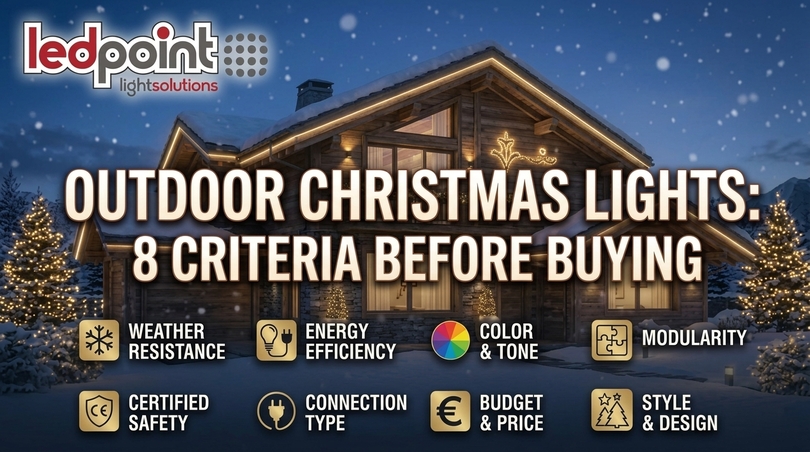
To choose outdoor Christmas lights, evaluate eight criteria: protection rating (minimum IP44, better IP65–IP67), 24V safety voltage, color temperature, required meters, wattage consumption, cold and UV resistance, programmable effects, and fixing system. Silicone LED strips and Neon Flex are the most durable and efficient solution.
Every year, between late October and early December, millions of Italians face the same shelf (physical or digital) full of light chains, cascade curtains, stars, reindeer, and meters of light tube. They all seem the same, cost from a few euros to several hundred, and all promise to be "for outdoor use". Then the first freezing rainy night arrives, a section goes out, the circuit breaker trips at midnight, and the tree in the garden stays dark right on the evening of the family dinner. Choosing outdoor Christmas lights is not just a matter of taste: it is a technical choice, concerning electrical safety, consumption, durability over time, and actual aesthetic performance.
In this guide, the technical team at Ledpoint, a company based in Faenza specializing in professional LED strips, has gathered everything you need to know before buying into a single document: the 8 decisive criteria, conversion tables to calculate meters and power, real seasonal consumption, color trends for Christmas 2026, fixing techniques that do not damage walls and railings, and specific solutions for restaurants with outdoor seating, shops, construction sites, and content creators. Whether you need to light up a small balcony or set up the outdoor Christmas lighting for a shopping mall, here you will find a method, not just a list of products.
The approach is the one we use every day with installers, electricians, and fitters: data first, opinions later. You will therefore find lumen values, watts per meter, IP ratings, color temperatures in Kelvin, and references to technical standards, explained in a way that is accessible even to those who have never connected a power supply. We recommend reading the guide in the proposed order: each criterion prepares the next, and at the end, you will have a complete checklist to use before purchasing.
In this article...
1. Why outdoor Christmas lights are a technical choice: data and market
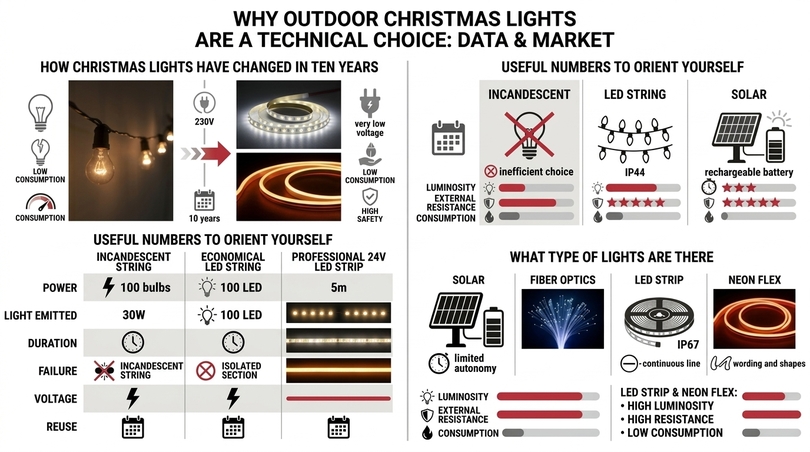
Before delving into the individual criteria, it is worth understanding why outdoor Christmas lighting has changed so much over the last ten years. The transition from incandescent bulbs to LEDs has reduced consumption by an order of magnitude, but it has also multiplied the offer of cheap products of highly variable quality. Today, the problem is no longer "how much it consumes", but how long it lasts, how safe it is, and what kind of light it actually produces.
How outdoor Christmas lights have changed in ten years
Until the early 2000s, outdoor Christmas lights were almost always chains of micro-incandescent bulbs connected in series at 230V: if just one bulb burned out, the entire section would go out, and each 0.5 W bulb multiplied by hundreds of light points became a significant load. The arrival of LEDs (light-emitting diodes) brought three decisive changes: consumption reduced by up to 90%, declared lifespans of tens of thousands of hours, and the ability to operate at very low voltage, which is much safer outdoors.
In parallel, tastes have changed. Alongside the classic multicolor intermittent chain, continuous lines of light that outline roofs and balconies, luminous curtains, decorative LED trees, Neon Flex signs, and programmable scenographies synchronized with music have emerged. Christmas lights are no longer just a decoration: they have become an element of temporary architecture, capable of enhancing a facade or transforming an outdoor seating area into a place to be photographed and shared.
Some useful numbers to get your bearings
The following data are technical estimates developed by our department based on nominal powers and typical usage scenarios. They are not official market statistics, but reference values that allow you to objectively compare different technologies.
| Parameter | Incandescent chain (100 bulbs) | Economy LED chain (100 LEDs) | Professional 24V LED strip (5 m) |
|---|---|---|---|
| Typical power | 40–50 W | 4–7 W | 24–48 W (4.8–9.6 W/m) |
| Emitted light | Low, warm | Point-like, variable | Continuous, 400–1,200 lm/m |
| Indicative lifespan | 1,000–3,000 h | 5,000–15,000 h | 30,000–50,000 h (with correct dissipation) |
| Failure of a light point | Often turns off the series | Variable | Affected section can be isolated and cut |
| Operating voltage | 230V | 31V or 230V | 12V / 24V SELV |
| Reuse over the years | Poor | 2–3 seasons on average | Multi-year, even for permanent use |
The most interesting data is not the power, but the light density per meter. A chain of 100 micro-LEDs distributed over 10 meters creates a pleasant but poorly luminous "dotted" effect; a continuous LED strip, for the same number of meters, draws a homogeneous line visible from hundreds of meters away. This is why hotels, restaurants, and municipal administrations increasingly choose strips and Neon Flex for outdoor Christmas lighting.
The hidden cost of cheap outdoor Christmas lights
A light chain costing a few euros seems like a bargain until you calculate the cost per season. If it lasts two winters, if it needs to be replaced in mid-December, or if it causes the circuit breaker to trip, the initial savings vanish. The correct criterion is the cost per hour of reliable operation, not the price tag. In the chapters on consumption and prices, we will show you how to do this calculation simply.
2. What types of lights are there: LED, incandescent, solar, fiber optic, strips, and Neon Flex
"What types of lights are there?" is the question anyone looking for outdoor Christmas lights starts with. There are essentially six available technologies, with very different characteristics in terms of brightness, robustness, and cost. Understanding the differences helps you avoid the most common mistake: buying a product designed for indoor or occasional use and expecting it to withstand two months of rain and frost.
Incandescent lights: the charm of the past, the limits of the present
Micro-filament bulbs have a very warm light and a nostalgic effect, but they consume a lot, heat up, break easily, and have short lifespans. For outdoor use, they are today the least recommended choice, both for efficiency and safety, since they almost always operate directly at 230V.
Traditional LED chains (string lights and micro-LEDs)
These are the classic wire Christmas lights, available in lengths from 5 to 50 meters and beyond. Quality varies enormously: the best products have rubber cables, an external low-voltage transformer, and an IP44 rating or higher; the worst have thin PVC cables that stiffen in the cold and unsealed joints. They are ideal for wrapping branches and hedges, less so for drawing architectural lines.
Solar-powered lights
Solar Christmas lights integrate a small photovoltaic module and a battery. They do not require cables or outlets, but in December, with few hours of sun and often overcast skies, evening autonomy is drastically reduced: it is normal for them to turn off after 2–4 hours or to appear dim. They are fine as a decorative accent in spots far from outlets, not as the main lighting for a garden or a venue.
Fiber optic lights
Fiber optics carry light from a central source to the ends of thin filaments, creating sparkling point-like effects. It is widely used for small indoor trees and decorative figures; outdoors it is less common because the source needs protection and the overall brightness is modest.
Outdoor LED strips
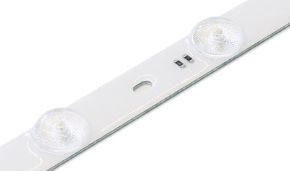
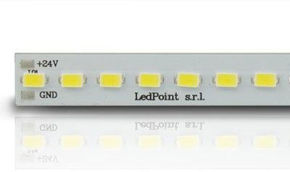
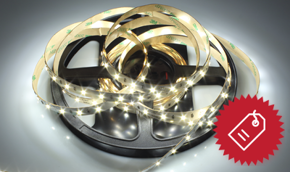
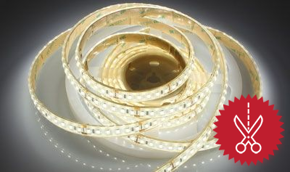
LED strips are flexible circuits with closely spaced LEDs, cuttable at fixed intervals, and protected by silicone or resin coatings. In the outdoor version (IP65, IP67), they are the basis of almost all professional Christmas installations: roof outlines, under-eaves, railings, pergolas, signs. They offer a continuous line of light, controlled consumption, and multi-year lifespans, and can be monochrome, tunable white, or RGB.
Neon Flex: the dot-free line of light
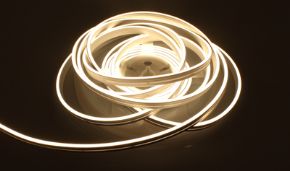
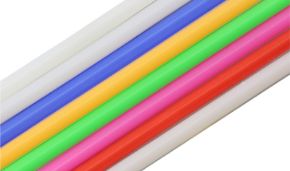
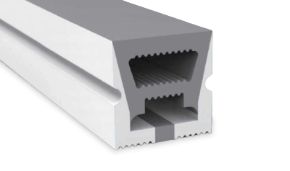
LED Neon Flex is an extruded silicone tube containing an LED strip and a diffuser: the result is a uniform line that mimics the old gas neon, but at low voltage, flexible, and water-resistant. It is the perfect choice for "Merry Christmas" signs, star silhouettes, storefront outlines, and outdoor Christmas light decorations that need to be photogenic even up close.
Comparative table: types of outdoor Christmas lights
| Technology | Brightness | Outdoor resistance | Consumption | Aesthetic effect | Recommended use |
|---|---|---|---|---|---|
| Incandescent | Medium | Low | High | Warm, vintage | Not recommended for outdoors |
| Micro-LED chain | Low-medium | Variable (IP20-IP44) | Very low | Point-like, "starry" | Hedges, branches, small trees |
| Solar | Low | Medium | None (grid) | Accent | Spots without outlets |
| Fiber optic | Low | Low–medium | Low | Sparkling | Decorative figures |
| IP65/IP67 LED Strip | High | High | Low | Continuous line | Roofs, balconies, pergolas, trees |
| IP65 Neon Flex | Medium-high | High | Low | Homogeneous line without dots | Signs, silhouettes, storefronts |
| Decorative LED trees | Medium | Medium (IP44-IP45) | Low | Scenographic | Gardens, entrances, outdoor seating |
As you can see, strip and Neon Flex solutions are the only ones that combine high brightness, high resistance, and contained consumption. In the following chapters, we will use these very products as a reference to apply the eight criteria, without forgetting traditional chains when they are the most sensible choice.
3. Criterion 1 - IP rating: how to tell if Christmas lights are for outdoor use
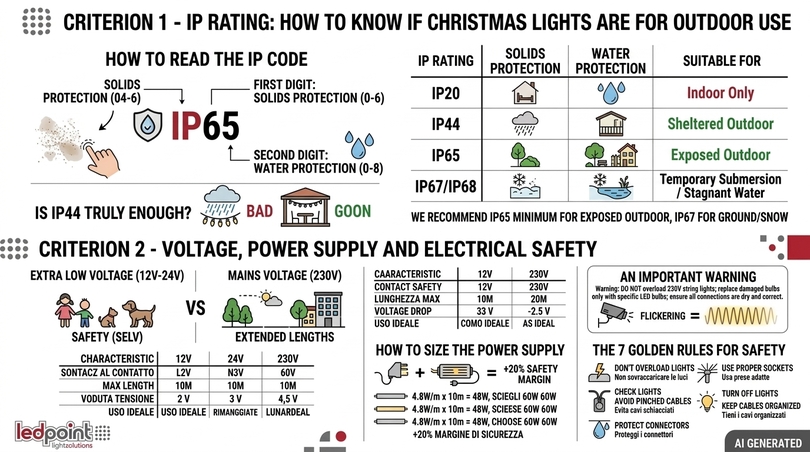
The first criterion is also the one that generates the most doubts: "How do I know if Christmas lights are for outdoor use?". The answer lies in an acronym that almost always appears on the packaging, the transformer label, or the technical data sheet: the IP protection rating. Learning to read it is the quickest way to distinguish a product suitable for balconies and gardens from one intended for the living room.
What the IP code means
The IP code (Ingress Protection) is defined by the international standard IEC 60529, adopted in Italy as CEI EN 60529. It consists of two digits: the first indicates protection against solid objects and dust (from 0 to 6), the second protection against water (from 0 to 8). The higher the numbers, the more protected the product. To learn more about the difference between the ratings applied to strips, you can read our dedicated guide What the IP code indicates.
| IP Rating | Solid protection | Water protection | Suitable for |
|---|---|---|---|
| IP20 | Objects > 12 mm | None | Dry indoor only |
| IP44 | Objects > 1 mm | Splashes from any direction | Sheltered outdoor (under porch, covered balcony) |
| IP53 | Dust (partial) | Rain up to 60° | Sheltered outdoor, semi-exposed areas |
| IP65 | Total against dust | Water jets from any direction | Exposed outdoor: facades, railings, trees |
| IP67 | Total against dust | Temporary immersion up to 1 m | Areas with stagnation, snow, lawns, planters |
| IP68 | Total against dust | Prolonged immersion | Fountains, pools, water features |
Is IP44 really enough? The IP rating of outdoor Christmas lights zone by zone
Many cheap light chains report IP44 and are sold as "for outdoor use". Technically this is correct, but IP44 protects against splashes, not driving rain, melting snow, or stagnation. It is adequate for a covered balcony or a porch; for a tree in the garden, an exposed railing, or a cornice, we recommend IP65 as a minimum and IP67 for anything that might rest on the ground, in snow, or in planters.
Zones and recommended IP rating
| Installation zone | Minimum rating | Ledpoint recommended rating |
|---|---|---|
| Indoor storefront, street side | IP20 | IP20-IP53 |
| Covered balcony, loggia, porch | IP44 | IP65 |
| Exposed railing, windowsill | IP65 | IP65 silicone / IP67 |
| Gutters, cornices, roofs | IP65 | IP67 |
| Garden trees, hedges | IP65 | IP67 |
| On the ground, flower beds, planters, snow | IP67 | IP67–IP68 |
| Restaurant outdoor seating with washing | IP65 | IP67 |
Warning: the IP rating applies to the entire system
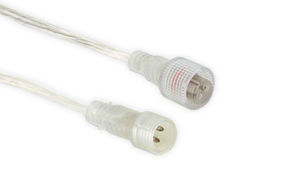
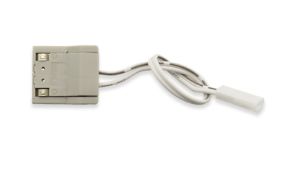
A very common mistake is to check the IP rating of the strip or chain alone and forget the rest. A system is only as watertight as its least protected component: connectors, joints, power supply, extension cords, and socket. An IP67 strip connected with an unsealed connector effectively becomes an IP20 system at the junction point. For this reason, in our projects we always use waterproof connectors like the IP65 waterproof connector for monochromatic strips and the 4-pin IP65 waterproof connector for RGB strips.
How to recognize outdoor Christmas lights: 6 quick checks
If you are in a store or evaluating a product online, here is how to see if Christmas lights are for outdoor use in less than a minute:
- Look for the IP acronym on the product and transformer labels: without it, consider them for indoor use.
- Look for the "crossed-out house" symbol or the wording "for indoor use only": if present, the product should not be used outdoors.
- Check the transformer: it must also report an IP rating (IP44 or higher) or be intended to stay under cover.
- Touch the cable: rubber or silicone remains flexible in the cold, while thin PVC tends to stiffen and crack.
- Verify the CE marking and the reference to the CEI EN 60598-2-20 standard, specific for light chains.
- Read the operating temperature: for the Italian winter, a range that goes down to at least -10°C, preferably -20°C, is required.
What happens if I put indoor lights outdoors?
It is one of the most searched questions, and the answer is clear: indoor lights used outdoors risk short circuits, circuit breaker trips, contact oxidation, and, in the worst cases, electric shocks. Nighttime humidity, condensation, and rain penetrate unsealed lamp holders and joints; if the product operates at 230V, the risk to people is real. Even when they work, their lifespan is reduced to a few weeks. A covered balcony does not turn an IP20 light into an outdoor light: condensation forms anyway.
Silicone, resin, or parylene: not all IP65 ratings are equal
In the world of LED strips, the same IP rating can be achieved with different technologies. The silicone coating is the most suitable for outdoor Christmas installations, because it resists UV rays and remains elastic in the cold. Parylene, an ultra-thin coating, protects well against water but, as indicated in our technical guide, should not be exposed directly to UV rays. Extruded silicone or "solid silicone" strips are the most robust: you can find them in Ledpoint's Outdoor lighting section, designed precisely for "storm-proof" installations. To know when a waterproof strip is truly worthwhile, you can find the details in the article When to use a waterproof LED strip.
4. Criterion 2 - Voltage, power supply, and electrical safety
The second criterion concerns the operating voltage, that is, at how many volts outdoor Christmas lights operate. It is a detail rarely checked in stores, yet it is the one that more than any other determines how safe the installation is and how long the runs can be. For those installing outdoor Christmas lights near children, venue customers, or passersby, this criterion is as important as the IP rating.
Extra-low voltage (12V–24V) or mains (230V)?
Lights that operate at 12V or 24V fall under safety extra-low voltage (SELV): any accidental contact with an exposed conductor is not dangerous to people under normal conditions. 230V lights connect directly to the mains, without a power supply, and allow for very long runs, but require greater precautions. For balconies, outdoor seating, and areas reachable by people, our recommendation is 24V; 230V is excellent for long lengths on cornices, facades, and tall trees, out of reach.
| Characteristic | 12V | 24V | 230V |
|---|---|---|---|
| Contact safety | Very high (SELV) | Very high (SELV) | Requires protection |
| Power supply | Required | Required | Not required (dedicated driver/rectifier) |
| Maximum length powered from one side | ≈ 5 m | ≈ 10 m | 25–50 m and beyond |
| Voltage drop | High on long runs | Contained | Negligible |
| Cutting step | Short (2.5-5 cm) | Medium (5-10 cm) | Long (10-100 cm) |
| Flicker | Absent | Absent | Possible without anti-flicker driver |
| Ideal use | Small decorations, signs | Balconies, outdoor seating, railings | Large perimeters, facades, lighting displays |
10-meter, 25-meter, 50-meter outdoor Christmas lights: when 230V is needed
If you need to cover the perimeter of a villa, the under-eaves of an apartment building, or the branches of a large tree, 230V becomes the most practical solution. Ledpoint offers, for example, the 50m 230V IP67 LED strip in transparent solid silicone, the 25m 230V LED strip in extruded silicone tube, and the colored version 25m RGB 230V IP67 LED strip. These solutions are the technical answer for those looking for 50-meter outdoor Christmas lights without having to manage dozens of power supplies. The entire range is gathered in the 230V LED strips category.
An important warning: 230V strips, powered directly from the mains, may exhibit a slight flicker visible especially in video recordings. If the installation is to be photographed or filmed (think of a venue or a creator), consider an anti-flicker driver or a 24V solution.
How to size the power supply
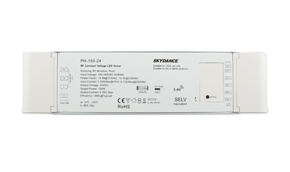
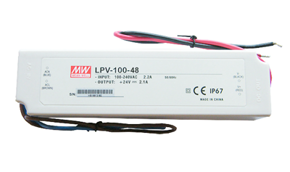
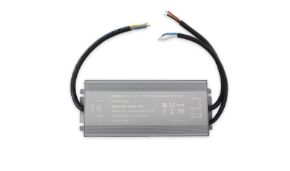
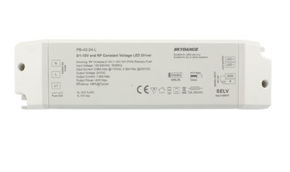
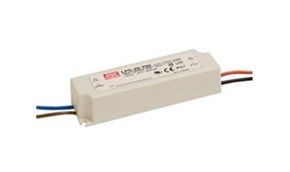
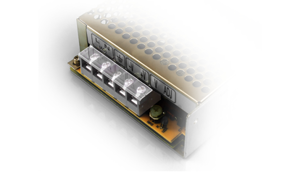
For 12V and 24V lights, the power supply is the heart of the system. The formula is simple: total power = W/m × installed meters; power supply = total power + 20% margin. The margin prevents the power supply from working at its limit, overheating, and failing right in the middle of the season. You can find the entire range in the Ledpoint power supplies section.
| Meters of strip | 4.8 W/m | 9.6 W/m | 14.4 W/m | 19.2 W/m |
|---|---|---|---|---|
| 5 m | 24 W → 30 W supply | 48 W → 60 W supply | 72 W → 90 W supply | 96 W → 120 W supply |
| 10 m | 48 W → 60 W supply | 96 W → 120 W supply | 144 W → 180 W supply | 192 W → 240 W supply |
| 20 m | 96 W → 120 W supply | 192 W → 240 W supply | 288 W → 350 W supply | 384 W → 480 W supply |
| 30 m | 144 W → 180 W supply | 288 W → 350 W supply | 432 W → 520 W supply | 576 W → 700 W supply |
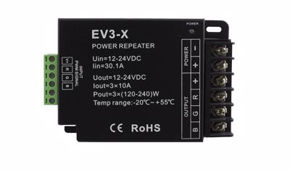
Beyond 10 meters at 24V, it is good practice to power the strip from both sides or at multiple points (voltage injection), to prevent the last section from appearing darker or yellowish due to voltage drop.
Sockets, extension cords, RCD: safety of outdoor Christmas lights
Outdoor Christmas lights must be connected to a system compliant with the CEI 64-8 standard. In practice, the outdoor socket must be at least IP44 (better IP55 with a cover) and protected by a residual current device (RCD) with high sensitivity of 30 mA. Extension cords must be specific for outdoor use, completely unrolled (a coiled cable reel heats up), and with plugs raised off the ground. Power supplies, even if IP67, should be placed in a sheltered and ventilated position, never immersed in puddles or covered by snow.
The 7 golden rules for Christmas light safety
- Never exceed the maximum power indicated on multiple sockets and extension cords.
- Do not daisy-chain more than indicated by the manufacturer.
- Avoid routing cables under doors and windows, where they can be crushed.
- Create a "drip loop" before every connection, so water does not run along the cable to the contact.
- Do not use metal staples or nails that could pierce the insulation.
- Turn off the lights when you are away from home for long periods or use a timer.
- For fixed, extensive, or commercial installations, always rely on a licensed electrician who issues a declaration of conformity.
5. Criterion 3 - Light color: warm or cold? Christmas 2026 trends
In outdoor Christmas lights, the color of the light is the criterion that most determines the atmosphere. Two installations identical in meters and power can communicate opposite emotions: welcome and tradition with warm white, Nordic elegance with cold white, festivity and dynamism with RGB. In this chapter, we answer the questions "is warm or cold light better for outdoors?" and "what color is in fashion this Christmas?".
Color temperature in Kelvin, explained simply
Color temperature is measured in Kelvin (K). Low values (2200-3000K) produce a warm, golden light, similar to that of a candle; high values (5500-6500K) produce a cold, bluish light. In between (3800-4500K) is neutral white. Ledpoint strips cover a very wide range, from warm white to ice white up to 10000K, in addition to monochromatic colored lights (red, green, blue, ice blue, yellow, pink, purple).
| Kelvin | Tone | Emotional effect | Ideal for |
|---|---|---|---|
| 2200–2500K | Extra warm, amber white | Intimate, vintage, "flame" | Historic villages, trattorias, natural trees |
| 2700–3000K | Warm white | Welcoming, traditional | Homes, balconies, restaurants, green trees |
| 4000K | Neutral white | Clean, contemporary | Modern facades, shops, offices |
| 6000–6500K | Cold white | Brilliant, wintry | Ice effect, white trees, Nordic style |
| 8700–10000K | Ice white | Scenographic, "snow" | Luminous waterfalls, artistic installations |
| RGB / RGB+CCT | Adjustable colors and whites | Festive, dynamic | Events, storefronts, social content |
Is warm or cold light better for outdoors?
There is no universal answer, but there is a practical rule that almost always works: warm light when you want to welcome, cold light when you want to amaze. For lighting a restaurant or a home, where the goal is to make people feel comfortable, 2700-3000K warm white is the safest choice: it enhances wood, bricks, and stone, makes faces more pleasant, and matches the indoor light filtering through the windows. Cold white is perfect for winter effects, white trees, contemporary facades in light plaster or concrete, and for those seeking a minimalist "Nordic" style.
A piece of advice we often give to designers: avoid mixing whites of different temperatures in the same frame, unless it is a deliberate choice. A 3000K outline next to a 6500K chain looks like a mistake, not an effect. Strips with a tight binning window (e.g., 3-step MacAdam) also guarantee that reels purchased at different times have exactly the same shade.
The role of Color Rendering Index (CRI)
The Color Rendering Index (CRI) indicates how faithfully a light reproduces the colors of objects. For a simple luminous outline, it matters little, but when the light illuminates decorations, red wreaths, bows, set tables, or outdoor seating food, a CRI above 90 makes the difference between a vivid red and a dull red. It is a detail that influencers and photographers notice immediately.
What color is in fashion for the Christmas tree in 2026?
Decorative trends observed at industry trade shows and in recent seasons' collections indicate some directions that, according to our retailer and fitter customers, will also characterize Christmas 2026. We report them as guidance, not as a rule:
- Natural and warm: forest green, wood, jute, natural branches, and 2200-2700K lights. It is the most stable and requested trend, especially for outdoor trees and outdoor seating.
- White and silver snow effect: trees white or snow-covered, silver decorations, and cold white or ice lights.
- Deep red and burgundy: a great classic returned in an elegant version, paired with gold and warm lights.
- Dusty tones and sage green: soft palettes for minimalist decorations, with low-intensity 3000K lights.
- Controlled dynamic color: RGB installations that remain warm white for most of the evening and animate only at specific moments, for events or social live streams.
To answer simply those who ask "what color for the Christmas tree in 2026?": if you want a result that does not go out of style, choose warm white lights and leave the color to the decorations. Decorations can be changed every year for a few euros; quality lights remain, and a warm light matches any palette.
What lights to put on a white or snow-covered tree?
A white tree or a fir with a snow effect reflects a lot of light. With 2700–3000K warm white, you get a "sunset snow" effect, golden and enveloping; with 6000K cold white or ice, you get a "moonlit snow" effect, more ethereal. Highly saturated multicolor chains should be avoided, as they tend to look confusing on a white surface. On snow-covered trees outdoors, where real snow settles on the branches, choose IP67: melting snow is water in every respect.
What are the most suitable colors for Christmas lights on the balcony?
The balcony is a "frame" seen from the street: the light must outline the shape without blinding neighbors and passersby. Warm white is the most elegant and condo-friendly choice; red and green, used as a continuous monochromatic line (for example, with a 6 mm green Neon Flex), create a modern graphic effect. If you live in a condominium, always check the regulations: some impose uniform colors or prohibit flashing effects towards the street.
6. Criterion 4 - Length and quantity: from 10 to 50 meters, how many lights for the tree
When buying outdoor Christmas lights, the fourth criterion seems the most trivial and yet it is the one most often got wrong: how many meters are really needed? Those who buy "by eye" almost always end up with lights that are too short (and a second purchase of a batch with a different shade) or with too many meters coiled behind a planter. Measuring before buying is the simplest way to save money and achieve a professional result.
How to measure balconies, railings, windows, and roofs
For outline lines, the measurement is linear: measure the exact path the light will follow and add a margin. Always add 10% for curves, corners, and ascents, plus the distance between the starting point of the light and the socket or power supply (which will be covered with cable, not light).
| Element | How to measure | Example | Recommended meters of light |
|---|---|---|---|
| Balcony railing | Length of the handrail (+ uprights if you want to outline them) | 4 m front balcony + 2 sides of 1.2 m | 6.4 m + 10% ≈ 7 m |
| Window | Perimeter of the frame or cornice | 1.2 × 1.5 m window | 5.4 m + 10% ≈ 6 m |
| Entrance door with arch | Two uprights + arch development (≈ 1.57 × width) | 1 m × 2.2 m door | 4.4 + 1.6 ≈ 6.5 m |
| Gutter / under-eaves | Length of the front | 12 m front villa | 13 m (a 25m 230V covers 2 fronts) |
| Pergola / gazebo of an outdoor seating | Upper perimeter + internal beams | 6 × 4 m pergola with 3 beams | 20 m + 12 m ≈ 35 m |
| Storefront facade | Window perimeter + sign | 5 × 2.5 m window | 15 m + 10% ≈ 16.5 m |
How many lights for a 2-meter tree? And for a 240 cm one?
For point-light chains, the most used rule of thumb by fitters is about 100 light points every 30 cm of height for a full effect, to be halved for a discreet effect. For a 2-meter tree, you therefore need between 350 and 700 lights, for a 240 cm tree between 400 and 800. With LED strips or Neon Flex, the reasoning is done in meters, wrapping the tree in a spiral.
The practical formula for the spiral is: meters ≈ (π × average diameter) × number of turns, where the average diameter in a conical tree is about half the diameter at the base. The more turns you make, the "fuller" the tree appears.
Conversion table: tree height → lights and meters needed
| Tree height | Typical base diameter | Chain: discreet effect | Chain: full effect | Strip/Neon Flex: 6 turns | Strip/Neon Flex: 10 turns |
|---|---|---|---|---|---|
| 120 cm | 70 cm | 200 lights | 400 lights | ≈ 6.5 m | ≈ 11 m |
| 150 cm | 90 cm | 250 lights | 500 lights | ≈ 8.5 m | ≈ 14 m |
| 180 cm | 105 cm | 300 lights | 600 lights | ≈ 10 m | ≈ 16.5 m |
| 200 cm | 120 cm | 350 lights | 700 lights | ≈ 11.5 m | ≈ 19 m |
| 240 cm | 140 cm | 400 lights | 800 lights | ≈ 13 m | ≈ 22 m |
| 300 cm | 170 cm | 500 lights | 1,000 lights | ≈ 16 m | ≈ 27 m |
| 500 cm (garden tree) | 250 cm | 850 lights | 1,700 lights | ≈ 24 m | ≈ 40 m |
Values calculated by Ledpoint on standard conical trees; for very dense or irregular trees, increase by 15–20%.
How to choose between 5, 10, 25, and 50 meter packages
12V and 24V strips are typically in 5 or 10 meter reels, because beyond that length the voltage drop becomes significant. 230V strips reach 25 and 50 meters with a single power supply. Practical rule: up to 10 meters per zone, choose 24V; beyond 20 continuous meters, consider 230V. For those looking for 10-meter outdoor Christmas lights on a single balcony, a 10m 24V reel with power from one side is the simplest solution; for 50-meter outdoor Christmas lights on cornices and facades, the 50m 230V strip drastically reduces junction points and wiring.
The cutting step: the detail that saves the installation
Every LED strip can only be cut at precise points, indicated by a line or copper pads. The step can be a few centimeters in low-voltage strips and 10, 50, or 100 cm in 230V ones. Before purchasing, verify that the cutting step is compatible with the measurements of your balcony or storefront, otherwise you risk having to leave a section unlit or exceeding with a piece of light beyond the corner.
7. Criterion 5 - Consumption and energy efficiency
"How much do outdoor Christmas lights consume?" is a legitimate question, especially for those running a business and keeping the lights on for many hours a day. The good news is that with LEDs, consumption has become very contained; the less obvious news is that large lighting installations can still weigh on the bill if not programmed. Let's see how to calculate them accurately.
The formula to calculate consumption
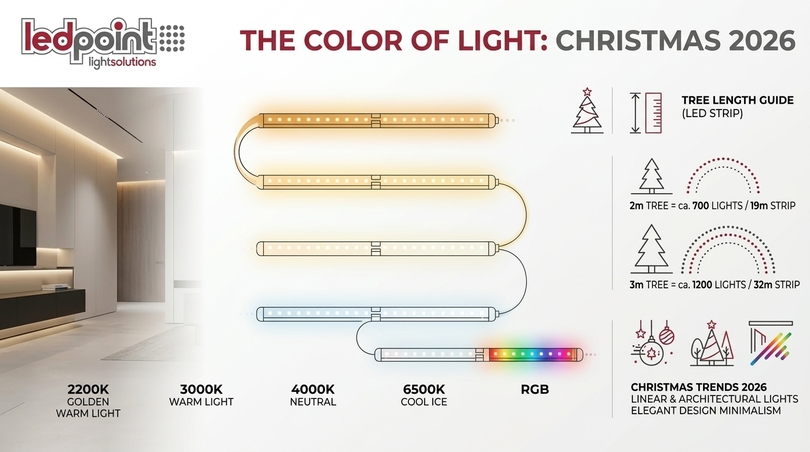
Consumption is measured in kilowatt-hours (kWh). The formula is: kWh = power in watts × hours of operation × days ÷ 1,000. To get the cost, multiply the kWh by the energy price on your bill. In the following examples, we use an indicative value of €0.30/kWh and a 45-day season (from December 1st to mid-January) with 6 hours of operation per day, i.e., 270 total hours.
Table of real consumption per season
| Installation | Power | kWh / season (270 h) | Indicative cost (€0.30/kWh) |
|---|---|---|---|
| Incandescent chain 500 bulbs × 0.5 W | 250 W | 67.5 kWh | ≈ €20.25 |
| Micro-LED chain 500 light points | ≈ 25 W | 6.75 kWh | ≈ €2.00 |
| Neon Flex 4×8 mm warm white 11 W/m, 5 m | 55 W | 14.85 kWh | ≈ €4.45 |
| 24V Strip 9.6 W/m, 10 m (balcony) | 96 W | 25.9 kWh | ≈ €7.80 |
| RGB Strip 230V 12 W/m, 25 m | 300 W | 81 kWh | ≈ €24.30 |
| 230V Strip 16 W/m, 50 m (facade) | 800 W | 216 kWh | ≈ €64.80 |
| Restaurant outdoor seating: 35 m strip 9.6 W/m, 10 h/day | 336 W | 151 kWh (450 h) | ≈ €45.40 |
Chart: indicative seasonal cost by type (€)
| Micro-LED 500 points | █ €2.00 |
| Neon Flex 5 m | ██ €4.45 |
| 24V Strip 10 m | ████ €7.80 |
| Incandescent 500 bulbs | ██████████ €20.25 |
| RGB Strip 230V 25 m | ████████████ €24.30 |
| 230V Strip 50 m | ████████████████████████████████ €64.80 |
Reading the chart requires a fundamental clarification: LED strips consume more than micro-chains because they produce much more light. A 9.6 W/m strip emits indicatively 900-1,000 lumens per meter, while a micro-LED chain emits a fraction of that. If the comparison is made at equal light produced, i.e., in lumens per watt, quality LEDs are by far the most efficient. The Ledpoint strip at 240 LEDs/m in 3000K warm white, for example, declares 2,000 lm/m with an efficiency of 150 lm/W.
How to reduce the consumption of outdoor Christmas lights without sacrificing the effect
- Choose the right density: for a decorative outline seen from a distance, 4.8-9.6 W/m is enough; higher powers are needed to illuminate surfaces.
- Use dimmers and controllers: reducing the intensity to 60-70% almost halves the glare and proportionally reduces consumption.
- Program the switch-ons: a timer or twilight sensor prevents the lights from staying on at dawn.
- Divide into zones: in the restaurant, turn on the facade only during opening hours and leave a minimal decorative amount until midnight.
- Reuse over the years: the most sustainable product is the one you do not have to buy again. Well-installed silicone strips last for many seasons.
Solar lights and sustainability: an honest clarification
Solar Christmas lights are often presented as the "green" choice par excellence. It is true that they do not consume grid energy, but in winter their performance is limited and the batteries have a lifespan of a few seasons. For sustainable Christmas lighting, the most effective combination is quality LEDs + programming + multi-year reuse, possibly powered by an existing domestic photovoltaic system.
8. Criterion 6 - Resistance to rain, frost, snow, and UV rays
"Do outdoor lights withstand winter weather?" This is the question restaurateurs and construction companies ask us most often, because a failure in mid-December means intervention costs and a poorly maintained image. The IP rating is only part of the answer: materials, operating temperature, mechanical resistance, and joint quality also matter.
The four winter stresses
As we explain on the page dedicated to Ledpoint outdoor lighting, strips installed outdoors are subjected to thermal excursion, UV rays, and weather. To these must be added mechanical stress: wind, moving branches, heavy snow, people touching or pulling.
| Stress | Effect on poor quality products | Technical solution |
|---|---|---|
| Rain and condensation | Oxidation, short circuits, dead sections | IP65–IP67 in silicone, waterproof connectors, sealed end caps |
| Frost and thaw | Micro-cracks in the coating, infiltration | Elastic silicone, operating temperature down to -20°C |
| UV rays | Yellowing, cracking coating | UV-resistant silicone; avoid exposed parylene |
| Wind and snow | Detachment, pulled cables, torn connectors | Mechanical fixing with clips, extruded silicone with steel reinforcement cables |
| Contact and impacts | Damaged LEDs, pierced coating | Aluminum profiles, Neon Flex, out-of-reach installation |
The problem with double-sided tape in winter
Many do not know this, but the double-sided tape of LED strips needs heat to adhere. In our technical data sheets, we indicate that the temperature of the strip and the surface must be between 21 and 38°C and that complete fixing is achieved after about 72 hours; moreover, double-sided tape does not guarantee adhesion on painted surfaces. Translated for Christmas: on a cold railing in December, double-sided tape alone is not enough. Mechanical fixing (clips, zip ties, profiles) is needed or, if possible, early installation in autumn on clean and degreased surfaces.
Watertight profiles for semi-permanent installations
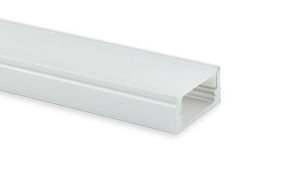
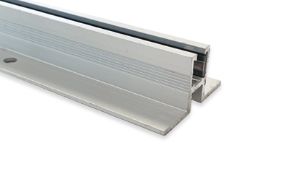
For construction companies and architects who want to integrate Christmas lights into a renovation project, the most elegant solution is to provide outdoor profiles with IP65/IP67 gaskets under cornices, gutters, or pergolas: the strip remains protected all year round and can be used at Christmas in RGB or warm white, and for the rest of the year as architectural lighting. It is a logic similar to that described in our complete guide to LED wall washing, applied to facades.
How long do outdoor Christmas lights really last?
The declared lifespan of LEDs (30,000-50,000 hours) refers to the chip under ideal conditions. The actual lifespan of an outdoor installation almost always depends on the weakest link: a poorly sealed joint, an undersized power supply, a crushed cable. With professional components and correct installation, a silicone strip can be reused for many seasons; a cheap PVC chain, exposed to rain and frost, rarely survives two or three winters.
9. Criterion 7 - Dynamic effects, RGB, remote control, and programming
The seventh criterion concerns what outdoor Christmas lights can do besides staying on. Dynamic effects, color changes, programmed scenarios, and smartphone control have become accessible even for small installations. For a shop or a creator, they are a real communication tool; for a home, they can be an extra touch. The rule is to choose the effect based on the purpose, not the other way around.
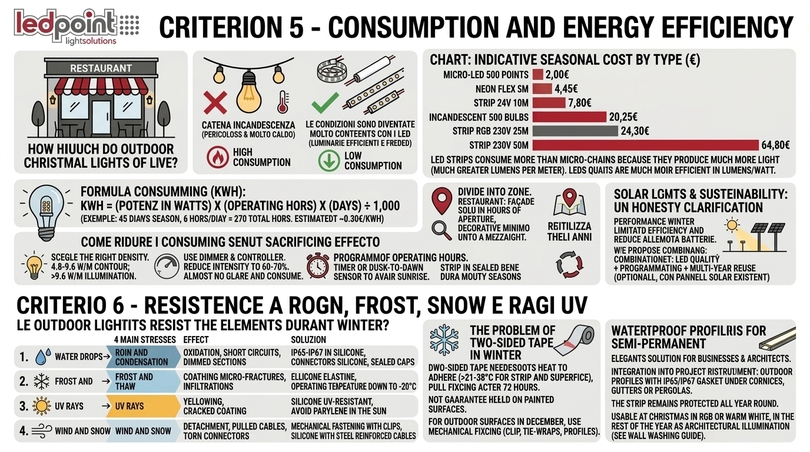
Monochrome, tunable white (CCT), RGB, and pixel
| Type | What it does | Strengths | Ideal for |
|---|---|---|---|
| Monochrome | A single fixed color (e.g., 3000K or red) | Simple, economical, elegant | Homes, balconies, restaurants |
| CCT (tunable white) | From warm to cold white | Adapts light to the event or season | Hotels, facades, year-round use |
| RGB | Millions of colors mixing red, green, blue | Festive effects, scene changes | Storefronts, events, social |
| RGB+CCT / RGBW | Colors + quality whites | The best of both worlds | Professional installations |
| Pixel LED (addressable) | Each LED or group controlled individually | Trails, chases, animations, music synchronization | Light shows, shopping malls |
To start with color without complications, a strip like the 5m RGB 5050 IP53 (IP65) 12V LED strip or the 8mm RGB 24V IP65 Neon Flex connected to a controller allows you to switch from Christmas red to warm white with a touch.
Are there outdoor lights with remote control or programmable?
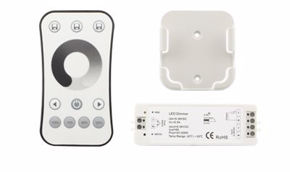
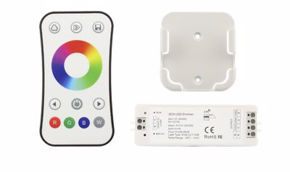
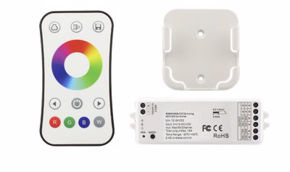
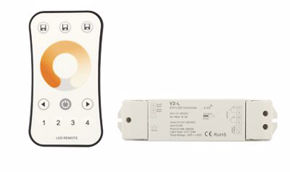
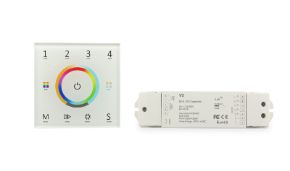
Yes, and they are increasingly widespread. There are three main solutions: radio frequency remote control (simple, range of tens of meters, no connection required), Wi-Fi or Bluetooth controller with app (hourly programming, scenarios, integration with voice assistants), and DMX or SPI systems for professional installations with many channels. Intensity adjustment in LEDs occurs via PWM modulation: if the installation will be filmed, prefer controllers with high PWM frequency, which avoid dark bands in videos shot with a smartphone.
Effects that work (and those to avoid)
- Work: slow fades, low-frequency "breathing", color change programmed at fixed times, scenographic switch-on at sunset.
- Use with moderation: fast flashes and strobe, which tire the eyes, can disturb neighbors, and are discouraged in some road contexts.
- Avoid: different effects on nearby elements without a common direction; the result is chaotic and not very photogenic.
10. Criterion 8 - Installation and fixing on balconies, walls, trees, and terraces
The last criterion is the one that turns a good product into a good result. You can buy the best LED strip on the market, but if you fix it poorly, connect it with makeshift joints, or stretch it over edges, you will have problems after a few days. In this chapter, we answer all the "how" questions in an operational way: how to put Christmas lights on the balcony, on the railing, on the external wall without ruining it, on the garden tree, and on the terrace.
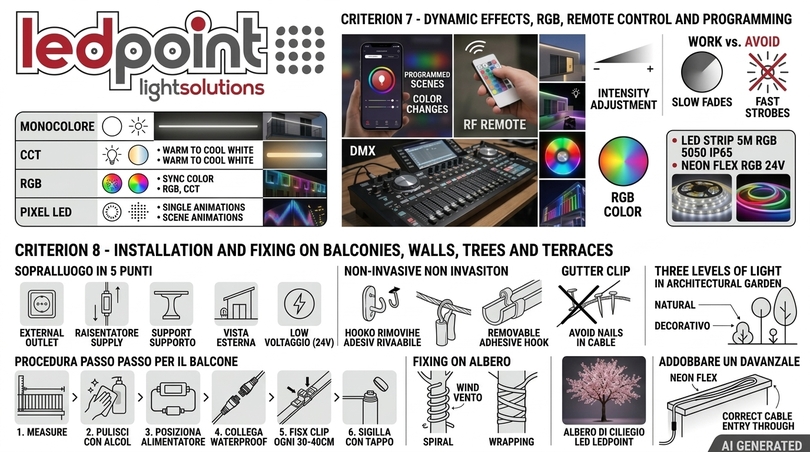
Before starting: the 5-point site survey
- Where is the socket? Identify a protected outdoor socket or the possibility of bringing the cable outside without crushing it in the frames.
- Where do I put the power supply? In a sheltered, ventilated spot, raised off the ground, and reachable for maintenance.
- What is the support? Iron, wood, masonry, glass, branches: each requires a different fixing.
- Where will the light be seen from? From the street, the garden, the inside? This decides whether the light should be directed outwards or hidden.
- Who can touch it? Children, customers, animals: in these cases, choose 24V and install out of reach.
How to put Christmas lights on the balcony and railing
For the railing, the cleanest technique is to run the light along the handrail, on the inner or upper side, fixing it with polycarbonate clips or UV-resistant zip ties every 30-40 cm. Do not overtighten the zip ties on the Neon Flex or strip: the coating must be able to expand with temperature variations. If the railing has vertical uprights, you can create a "waterfall" effect with vertical sections connected in parallel.
Step-by-step procedure for the balcony
- Measure the handrail and sides, add 10%, and choose the reel (e.g., 10m 24V).
- Clean the support with isopropyl alcohol, removing dust and grease.
- Position the IP67 power supply in a sheltered spot, near the socket, raised from the floor.
- Connect the strip with a waterproof connector and create a drip loop.
- Fix the light starting from the powered side, with clips every 30–40 cm and gentle curves (never bend the strip at a 90° angle on the circuit side).
- Seal the free end with an end cap and neutral silicone.
- Connect to a socket protected by an RCD and set a timer or twilight switch.
How to attach Christmas lights to the external wall without ruining it
It is one of the most frequent questions, especially in rentals or on newly renovated facades. Non-invasive solutions are various: removable outdoor adhesive hooks (applied at not too low a temperature and on non-dusty surfaces), gutter clips that hook onto the edge without screws, pressure hooks for windowsills and frames, and, on facades with insulation, spring or tensioner systems to anchor to existing elements (downpipes, hinges, grilles). Nails and staples in the cable should be avoided: they pierce the insulation and create bridges for moisture.
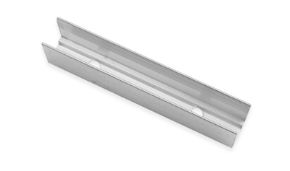
If, on the other hand, you are designing a semi-permanent installation, a few well-positioned wall plugs for an aluminum profile are the cleanest choice: minimal drilling, protected light, and perfect alignment for all subsequent seasons.
How to put Christmas lights on an outdoor tree
For a garden tree, there are two main techniques. The spiral starts from the base and goes up to the top, with tighter turns at the bottom and more spaced out at the top; it is ideal for firs and conifers. Branch "wrapping" wraps the trunk and main branches, it is the technique preferred by fitters for bare trees (olives, birches, maples), where the light draws the tree's structure like architecture.
- Always start from the point closest to the socket, so the power cable remains short and hidden.
- Leave slack on branches that move with the wind: a light that is too tight will tear.
- Never tighten the trunk with zip ties: the bark grows and the wind levers.
- For trees over 3 meters, use adequate ladders and work in pairs; for greater heights, rely on professionals with a platform.
As an alternative to decorating a real tree, Ledpoint decorative LED trees, like the 3-meter tall LED cherry tree with 2,560 LEDs at 24V and IP45 protection, create a scenographic focal point for entrances, gardens, and sheltered outdoor seating.
Outdoor Christmas lights on terrace and garden: how to light them
Terraces and gardens offer more surface and therefore more possibilities, but also more risks of visual clutter. The method we use in projects is that of the three levels of light:
- Architectural level: outlines of parapets, pergolas, gutters (IP67 or 230V strips).
- Natural level: trees, hedges, and pots (chains or wrapped strips, IP67 near the ground).
- Decorative level: signs, stars, outdoor luminous figures in Neon Flex or LED trees.
Three levels coordinated by color (for example, all 3000K with a single red accent) generate a professional effect. If the levels become five or six with different colors, the result loses readability.
How to decorate an external windowsill or a window
The windowsill is one of the most underestimated spaces. A line of warm white Neon Flex along the lower edge, paired with a small wreath or pots with natural branches, creates a luminous frame visible from the street and from the inside. Pass the cable from the bottom of the frame, where the gasket is softer, or from a cable gland hole if available, so as not to crush it when closing.
11. Design and styles: outdoor Christmas light ideas for every environment
After the eight technical criteria comes the creative part of outdoor Christmas lights. The same strips and the same Neon Flex can give life to completely different styles. Here you will find the outdoor Christmas lighting ideas that work best, with the technical choices that make them possible. Choose one style and keep it consistent across the entire facade: it is the secret of the houses and venues you see photographed everywhere.
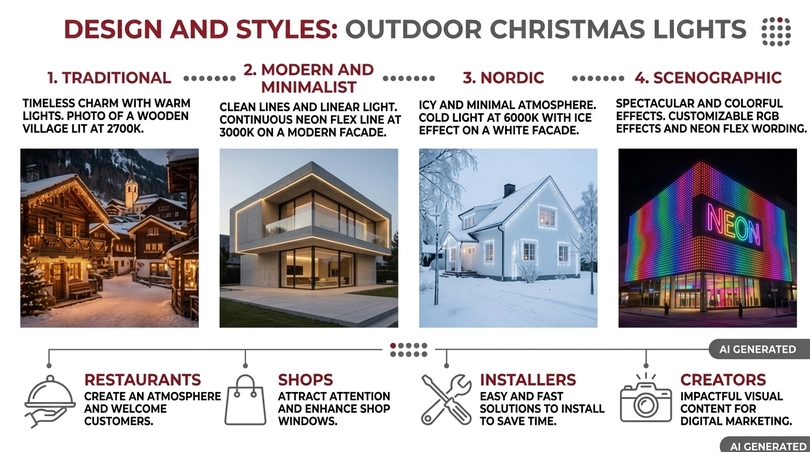
Traditional
2700K warm white, natural green, red decorations. Roof and window outlines, spirally wrapped trees, wreaths on the door. It is the most welcoming style and suitable for villages, agriturismos, trattorias, and houses with wood or stone elements.
Modern and minimalist
A single continuous line of light that follows the architecture: the under-eaves, the parapet line, the door jamb. 3000K warm white or 4000K neutral on light facades. Fewer elements, but perfectly aligned: this is where Neon Flex, without a dotted effect, shows its best.
Nordic and ice effect
6000K cold white or ice, white trees, silver branches, vertical waterfalls. Very photogenic with snow or on gray and white facades. Avoid mixing it with warm lights in the same scene.
Fantasy and scenographic
RGB, pixel LEDs, luminous signs, star and reindeer silhouettes, synchronized effects. It is the style of large lighting displays, shopping malls, and storefronts that want to be noticed. It requires direction: a few well-orchestrated effects, not everything at once. Many Christmas markets, as we show in our article on lighting signs with LED Neon Flex, use compositions of warm white, cold white, ice blue, red, green, and blue Neon Flex to create unique luminous signs.
Table: style, color, and recommended outdoor Christmas lights
| Style | Temperature / color | Main product | Accents |
|---|---|---|---|
| Traditional | 2700–3000K | IP67 warm white strip, chains on trees | Red in decorations |
| Modern | 3000–4000K | 4×8 mm 3000K IP65 Neon Flex | A sign or a symbol |
| Nordic | 6000K–ice | 4×8 mm 6000K IP65 Neon Flex | White trees, silver |
| Scenographic | RGB / pixel | 230V IP67 RGB strip for large perimeters | Programmed effects |
| Natural luxury | 2200–2500K | Extra warm strip on trees and pergolas | Branches, jute, wood |
Which lights are most photogenic for Christmas photos?
For content creators, some rules make a difference: continuous lights (strips, Neon Flex) appear cleaner than point chains in night photos; warm white makes skin look more natural; the light should be shot at the "blue hour", 20–40 minutes after sunset, when the sky still has color; and controllers must have high-frequency PWM to avoid bands in videos. Avoid framing very powerful LEDs directly: reflected light on branches, fabrics, or walls is better.
12. Professional Christmas lighting: restaurants, shops, construction sites, and creators
Those who use Christmas lights for work have different needs than those decorating a home: more hours of operation, more people passing by, more responsibility in case of failure, and, above all, a precise commercial objective. In this chapter, we transform the eight criteria into concrete solutions for four professional profiles that contact us every year from October onwards. Professional Christmas lighting is not "more light": it is light designed for a result.
Restaurants and venues with outdoor seating
For an outdoor restaurant, outdoor Christmas lights have a clear task: to make the outdoor seating visible and desirable from the street, and then welcoming for those who sit down. The winning combination is a highly visible outline line (pergola, curtains, planters) in 2700–3000K warm white and a softer atmospheric light on the tables, with adjustable intensity during the evening.
Restaurateurs' questions, in summary
| Question | Ledpoint technical answer |
|---|---|
| Which lights create the best atmosphere? | Warm white 2700–3000K strip or Neon Flex, high CRI to enhance food and faces. |
| How to install them safely and durably? | 24V SELV in areas reachable by customers, IP67 power supplies in protected positions, 30 mA RCD, installation by a licensed electrician. |
| What energy-saving options are there? | 4.8–9.6 W/m LEDs with dimmer and timer: a 35 m outdoor seating costs about €45 per season with 10 h/day. |
| How to achieve a more suggestive effect? | Three coordinated levels of light and a "signature" element (Neon Flex sign, LED tree at the entrance). |
| Do they withstand winter and washing? | Yes, with IP67 silicone and waterproof connectors; avoid direct high-pressure jets on joints. |
Our extra tip: create a photo spot. An LED tree, a luminous sign with the venue's name, or a frame of light on a wall encourage customers to take photos and share, bringing free visibility on social media. It is one of the most effective ways to turn Christmas lights into reservations.
Christmas decoration shops and retailers
Those who sell Christmas lights have a double objective: to sell and to build loyalty. Customers today are more informed and wary of products that break down after one season. Offering professional solutions, explaining the IP rating, and proposing complete kits (light + power supply + connectors + fixings) increases the average ticket and reduces returns.
- Trends to put in the window: continuous warm white light lines, Neon Flex for custom signs, decorative LED trees, RGB solutions with app.
- Easier to install products: pre-terminated strips with waterproof connectors, 5m reel Neon Flex with dedicated accessories (you can find terminals and supports among the Neon Flex accessories), kits with already sized power supply.
- How to promote them in-store: a test bench with different color temperatures side by side, an "outdoor" zone with misted water to show IP67 sealing, simplified technical data sheets with the tables from this guide.
- Features to communicate: IP rating, voltage, color temperature, seasonal consumption, lifespan, possibility of reuse.
Ledpoint has been working with retailers and professionals for years: as we tell in the About Us page, our technical department supports partners in choosing products and researching new fields of application.
Construction companies, installers, and designers
For companies working on renovations and public or private spaces, the key question is how to integrate Christmas lights into projects without creating extra work every year. The answer is pre-arranged architectural lighting: watertight profiles under gutters and cornices, cable trunking already provided, dedicated and protected external power points. Thus, the same infrastructure hosts white lights all year round and Christmas scenarios in December.
Regulatory references to keep in mind
| Standard | Scope | Why it matters |
|---|---|---|
| CEI 64-8 | Low voltage user electrical systems | Rules for outdoor sockets, protections, RCDs |
| CEI EN 60598-1 / 60598-2-20 | Lighting fixtures / light chains | Product safety requirements |
| CEI EN 60529 (IEC 60529) | IP protection ratings | Defines IP44, IP65, IP67, IP68 |
| DM 37/2008 | Installation of systems | Declaration of conformity for fixed systems |
| Municipal regulations | Lighting displays on public land, light pollution | Authorizations, hours, light orientation |
For temporary structures like stands and setups, you can find a selection of products designed for rapid assembly and intensive use in the Lighting for setups section.
Influencers and lifestyle creators
For content creators, outdoor Christmas lights are a set. Typical questions concern photogenicity, integration with existing decorations, and dynamic effects. The main advice is to build a set, not decorate randomly: a background (wall, hedge, door), a main light line, and a protagonist element.
- Most photogenic lights: Neon Flex and continuous strips, warm white for portraits, RGB for dynamic reels.
- Integration with existing decorations: thin strips and 6 mm Neon Flex hide behind wreaths, pot edges, and shelves.
- Programmable effects: app controllers to switch from "warm" scene to "party" scene during shooting.
- Social promotion: show the "before and after", tell the installation process, explain the technical choices (IP, color): educational content generates saves and shares.
Outdoor Christmas lighting displays for shopping malls and outdoor events
In the design of Christmas lights for outdoor events and shopping malls, scale, safety, and maintenance come into play. Work is done in separately powered zones, with 230V IP67 strips for large perimeters and 24V for areas in contact with the public, centralized controllers, and a periodic verification plan. The advantage of strips over traditional chains is the reduction of failure points and visual continuity from a great distance.
13. Prices and where to buy outdoor Christmas lights
In the choice of outdoor Christmas lights, price is naturally one of the decisive factors, but comparing such different products solely on the price tag leads to wrong choices. In this chapter, you will find indicative price ranges, purchasing channels, and a method to understand if an offer is truly convenient.
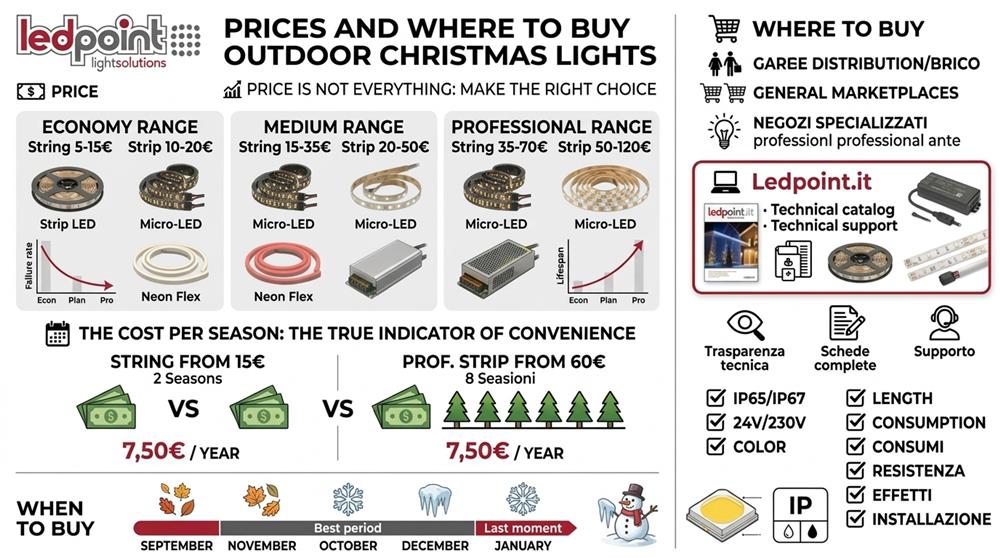
Indicative prices of outdoor Christmas lights
| Type | Economy range | Medium range | Professional range |
|---|---|---|---|
| 10 m micro-LED chain | €5–15 | €15–35 | €35–70 |
| IP65/IP67 LED strip 5 m (strip only) | €10–20 | €20–50 | €50–120 |
| 5 m Neon Flex | €20–35 | €35–70 | €70–150 |
| 25–50 m 230V strip | — | €80–200 | €200–500 |
| 100–150 W IP67 power supply | €15–25 | €25–50 | €50–100 |
| 2–3 m decorative LED tree | €80–150 | €150–400 | €400 and beyond |
Indicative market ranges as of 2026, VAT included, variable by brand, quantity, and period. For Ledpoint product prices, the online catalog, accessible upon registration, prevails.
The cost per season: the true indicator of convenience
To compare two offers, use this formula: cost per season = (purchase price ÷ expected seasons of use) + seasonal energy cost. A €15 chain that lasts 2 seasons costs €7.50 a year plus energy; a €60 professional strip that lasts 8 seasons costs €7.50 a year, but produces much more light, is safer, and does not need to be replaced in mid-December.
Where to buy outdoor Christmas lights
- Large retail, DIY, and hardware stores: wide choice of ready-to-use chains and luminous figures, convenient for quick purchases; quality is highly variable and technical data sheets are often incomplete.
- Generalist marketplaces: competitive prices but great uncertainty about certifications, actual IP rating, and assistance.
- Decoration shops: aesthetic advice, seasonal assortment.
- LED-specialized e-commerce like Ledpoint.it: complete technical data sheets, professional components compatible with each other, technical support, and the possibility of creating custom systems, even for large quantities.
When to buy and how to take advantage of offers
The best time to buy outdoor Christmas lights is between late September and early November: availability is full, you can install with still mild temperatures (useful for double-sided tape), and you have time to test the system. End-of-season offers, in January, are interesting for reusable products; also keep an eye on promotional sections, like LED strips on offer and reel cut-offs, ideal for small decorations.
What is the best brand of outdoor lighting?
Rather than a brand, it is advisable to look for technical transparency: a serious manufacturer or retailer declares IP rating, voltage, W/m, lumens/m, color temperature, CRI, operating temperature, cutting step, and type of LED chip used. If a product data sheet does not report this data, it is difficult to evaluate what you are buying. Ledpoint strips, for example, also indicate the chip used and the color binning window, useful information to guarantee uniformity across multiple batches.
14. Final checklist before purchasing
Having reached this point, you have all the elements to choose your outdoor Christmas lights. For convenience, we have summarized the eight criteria in a checklist to print or save on your phone before going to the store or completing an online order. If even a single item remains unanswered, stop and verify: it is much cheaper than redoing the system in December.
| # | Criterion | Question to ask yourself | Recommended value |
|---|---|---|---|
| 1 | IP rating | Are the light and all components suitable for the zone? | IP65 exposed, IP67 on the ground and in snow |
| 2 | Voltage | Can people touch it? | 24V SELV near people, 230V for large perimeters at height |
| 3 | Color | What atmosphere do I want to create? | 2700–3000K welcoming, 6000K+ ice effect |
| 4 | Length | Did I measure and add 10%? | Actual meters + 10% + cable to the socket |
| 5 | Consumption | How much will I spend per season? | W × hours × days ÷ 1,000 × €/kWh |
| 6 | Resistance | Are the material and operating temperature adequate? | UV-resistant silicone, at least -10°C / -20°C |
| 7 | Effects | Do I need color, dimmer, app, timer? | Suitable controller, high PWM if I will film |
| 8 | Installation | How do I fix it and where do I put the power supply and connections? | UV clips/zip ties, waterproof connectors, socket with 30 mA RCD |
We also remind you to always test the system on the ground before fixing it: connecting and turning on the reel for a few minutes allows you to verify color, operation, and polarity before climbing a ladder.
The 10 most common mistakes with outdoor Christmas lights
In years of technical support on outdoor Christmas lights, we have seen the same problems repeat themselves. Knowing them in advance allows you to avoid them with a few precautions, often at zero cost.
- Using indoor lights outdoors, even "just under the porch": nighttime condensation is enough to damage them.
- Checking the IP rating of the light but not that of connectors and power supply, which become the weak point of the system.
- Powering 20 meters of 12V strip from one side only: the last section appears darker and of a different color.
- Undersizing the power supply, which works at 100% load, overheats, and fails.
- Relying solely on double-sided tape in winter, when the temperature is well below the 21°C required for adhesion.
- Bending the strip at a sharp angle on the corners of the railing, breaking the circuit tracks.
- Mixing whites of different temperatures on the same facade without a design choice.
- Leaving extension cords coiled or plugs resting on the ground, where water pools.
- Forgetting timers and twilight switches, leaving the lights on all night and beyond dawn.
- Buying at the last minute, finding reduced assortments and installing in freezing conditions.
15. Frequently asked questions about outdoor Christmas lights
Regarding outdoor Christmas lights, we have gathered the questions we receive most often from individuals, restaurateurs, shopkeepers, and installers. Click on each question to read the answer.
How to tell if Christmas lights are for outdoor use?Check the IP rating on the packaging, label, and transformer: for sheltered outdoors, at least IP44 is required, for areas exposed to rain and snow, IP65 or IP67. Also verify the absence of the wording "indoor use only", CE marking, rubber or silicone cables, and an operating temperature that drops to at least -10°C. |
What happens if I put indoor lights outdoors?Humidity and condensation penetrate unsealed joints and lamp holders, causing short circuits, RCD tripping, oxidation, and rapid failures. With 230V products, there is also a risk of electric shock. Even under a covered balcony, IP20 lights are not safe: nighttime condensation forms anyway. |
Is warm or cold light better for outdoors?2700–3000K warm light is the most versatile and welcoming choice for homes, balconies, and restaurants, because it enhances wood, stone, and faces. 6000K cold or ice light creates a winter and scenographic effect, ideal for white trees and modern facades. The important thing is not to mix different temperatures in the same scene. |
How many lights are needed for a 2-meter Christmas tree?With point-light chains, between 350 lights for a discreet effect and 700 for a full effect are needed, according to the rule of about 100 lights every 30 cm. With an LED strip or Neon Flex wrapped in a spiral, about 11.5 meters for 6 turns and 19 meters for 10 turns are needed on a 2-meter tree. |
How much do outdoor Christmas lights consume?It is calculated with watts × hours × days ÷ 1,000. A 10-meter LED strip at 9.6 W/m turned on for 6 hours a day for 45 days consumes about 26 kWh, i.e., about 8 euros at €0.30/kWh. A micro-LED chain consumes less but produces much less light; old incandescent bulbs consume much more. |
How to put Christmas lights on the balcony railing?Run the light along the handrail, fixing it with UV-resistant clips or zip ties every 30–40 cm, without tightening too much. Avoid sharp bends, use waterproof connectors, seal the end, and position the IP67 power supply in a sheltered spot. Connect to an outdoor socket protected by a 30 mA RCD. |
How to attach Christmas lights to the external wall without ruining it?Use removable outdoor adhesive hooks, gutter clips, pressure hooks for windowsills, or anchors to existing elements like downpipes and grilles. Avoid nails and staples on the cable. For recurring installations, an aluminum profile with a few wall plugs is the cleanest solution. |
Do outdoor lights withstand frost and snow?IP67 silicone strips and IP65 Neon Flex are designed to withstand rain, frost, and thaw, provided that connectors, joints, and power supplies have the same protection. Check the operating temperature in the technical data sheet and use IP67 for what remains on the ground or in the snow, which becomes water when it melts. |
Are 24V or 230V lights better for outdoors?24V lights work in safety extra-low voltage and are ideal near people. 230V strips allow runs of 25 or 50 meters without power supplies, perfect for cornices and high facades, with greater precautions. |
Are there programmable outdoor Christmas lights or with remote control?Yes. RGB, RGB+CCT, and pixel LED strips connect to controllers with remote control, app, timer, and scenarios; for large installations, DMX or SPI are used. For videos, choose controllers with high-frequency PWM. |
Why are lights put outside at Christmas?The tradition stems from candles lit in the darkest periods of the year as a symbol of light and welcome. Today, outdoor lights communicate festivity, enhance architecture, and make commercial activities visible. |
What color is in fashion for the Christmas tree in 2026?Trends indicate natural and warm tones, white and silver snow effect, deep red with gold, and dusty palettes like sage green. To be safe, choose warm white lights and leave the color to the decorations. |
16. Choosing well today to light up many Christmases
Choosing outdoor Christmas lights means making a decision that combines aesthetics, safety, and efficiency. The eight criteria we have analyzed (IP rating, voltage, color, length, consumption, resistance, effects, and installation) are not a list to check off quickly, but a method that allows you to compare very different products with the same parameters. Those who apply this method buy once and reuse their lights for many seasons.
If we had to summarize everything in three recommendations, they would be these. First: for exposed areas, always choose IP65 or IP67 in silicone and protect connectors and power supplies in the same way. Second: prefer 24V extra-low voltage near people and reserve 230V for large perimeters at height. Third: choose a consistent color temperature, preferably warm white, and leave the color to the decorations, so your system will remain current whatever the trend of the year.
For individuals, restaurateurs, shopkeepers, businesses, and creators, Ledpoint's outdoor LED strips and Neon Flex represent the foundation on which to build professional, efficient, and durable Christmas lighting. Explore the range of outdoor LED strips, Neon Flex, and LED trees, or contact our technical department: we will help you size power supplies, choose the correct IP rating, and calculate the meters and consumption of your project, from a small balcony to the lighting displays of an entire shopping mall.
This article was developed with the support of artificial intelligence and subsequently reviewed, corrected, and validated by the Ledpoint.it technical team, which guarantees its reliability and compliance with official sources.