






LED Neon: how to mimic neon using LED strips and neon flex
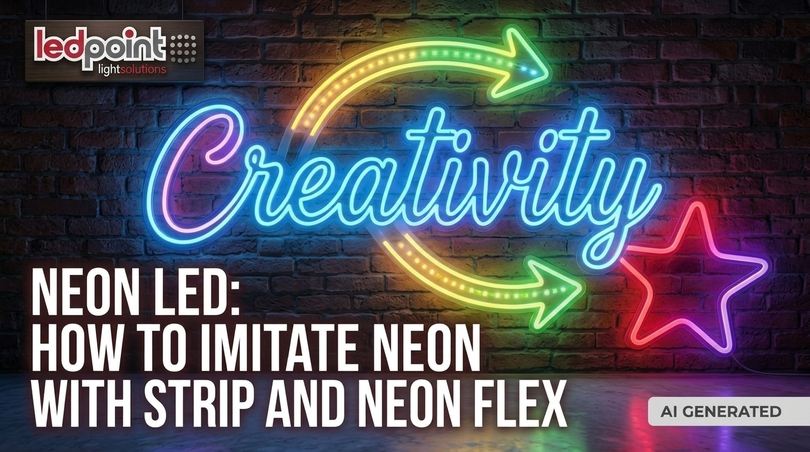
Neon is a noble gas (symbol Ne, atomic number 10) that, when crossed by an electric discharge inside a glass tube, emits the famous red-orange light of neon signs. Today, the neon effect is recreated with LED neon: neon flex, empty neon tubes with strips, round aluminum profiles, and COB strips, which consume up to 80% less, operate at 12–24V, and contain neither gas nor glass.
Just pronouncing the word neon evokes a precise image: a glowing sign shining in the night of a cocktail bar, the vintage sign of an American diner, the colored line of light crossing the wall of a trendy shop. Yet behind this word hide at least three different things: a chemical element of the periodic table, a discharge lighting technology born at the beginning of the twentieth century, and an aesthetic language that today is almost always realized with LEDs.
In this guide, curated by the technical team at Ledpoint in Faenza, we start from the basics (what neon is, why it glows, the difference between neon and LED) to get to the most practical part: how to imitate a neon tube and a neon sign using neon flex, empty neon flex tubes with LED strips, round aluminum profiles, and COB strips, with step-by-step instructions, comparative tables, consumption calculations, photographic ideas for inspiration, and specific advice for venues, shops, events, interior design, content creators, and arcades.
Whether you want to create a custom neon sign for your venue, replace an old neon ceiling light, or create a luminous background for your videos, you will find here everything you need to choose the right solution and install it correctly, without waste and without errors.
In this article...
1. What is neon: the chemical element that gave its name to a light
Before talking about signs, tubes, and LED strips, it is advisable to clarify the original meaning of the word. Understanding what neon is from a chemical point of view helps to understand why old neon lamps worked in a certain way, why they were expensive and delicate, and why today LED neon has largely replaced them.
What type of element is neon
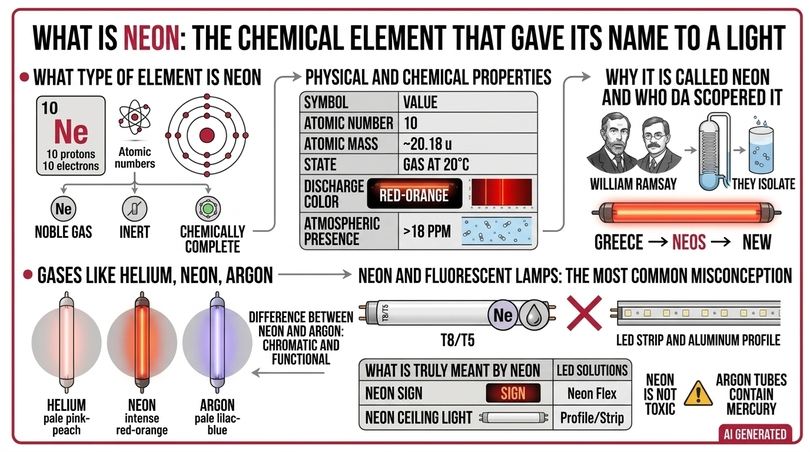
Neon is the chemical element with symbol Ne and atomic number 10. It belongs to group 18 of the periodic table, that of the noble gases, along with helium, argon, krypton, xenon, and radon. At room temperature, it is a colorless, odorless, and tasteless gas, and it is a non-metal: to the frequent question "is neon a metal or a non-metal?" the answer is therefore clear.
Neon is a noble gas because its outermost electron shell is complete (eight electrons in the second level). This configuration makes it chemically inert: it does not form stable compounds under normal conditions, does not burn, and does not react with oxygen. It is precisely this stability that, over a century ago, made it perfect for filling sealed glass tubes to make them glow with electricity.
Why it is called neon and who discovered it
Neon was discovered in London in 1898 by British chemists William Ramsay and Morris Travers, who isolated it by fractionally distilling liquefied air. The name derives from the Greek néos, "new": a "new gas" indeed. According to the most widespread account, when the two scientists subjected it to an electric discharge, they were struck by its crimson red glow, which Travers described as something never seen before.
Physical and chemical properties of neon
For those looking for precise data, here is a summary of the most requested characteristics of neon, also useful for understanding its behavior in discharge tubes.
| Property | Neon value | What it means in practice |
|---|---|---|
| Chemical symbol | Ne | Identifies the element in the periodic table |
| Atomic number | 10 | 10 protons in the nucleus, 10 electrons |
| Atomic mass | approx. 20.18 u | Light gas, but heavier than helium |
| Group | 18 (noble gases) | Inert, does not form stable compounds |
| State at 20 °C | Gas | Colorless, odorless, non-flammable |
| Boiling point | approx. −246 °C | Liquefies only at cryogenic temperatures |
| Presence in the atmosphere | approx. 18 ppm (0.0018%) | Rare: must be extracted from large volumes of air |
| Color in electric discharge | Red-orange | It is the "true" color of neon light |
Where neon is found and how it is produced
In the universe, neon is abundant, but on Earth it is rare: in the atmosphere there is about one part per 55,000. It is not extracted from mines: the industrial production of neon occurs through cryogenic air separation, that is, by cooling the air until it liquefies and separating its components based on their different boiling points, the same principle as industrial cryogenics. Neon is therefore a byproduct of plants that produce oxygen and nitrogen for the steel and medical industries.
Precisely because obtaining it requires complex plants, neon has a non-negligible cost and is a strategic material for the electronics industry: it is used, for example, in the mixtures of excimer lasers used in semiconductor production. The geopolitical tensions of recent years have made it evident how much the neon gas supply chain is concentrated in a few producing countries.
Neon and other noble gases compared
A highly searched curiosity concerns "gases like helium, neon, and argon" (it is also a famous crossword puzzle clue: the answer is "noble gases", or "inert"). Each of these gases, when electrically excited, emits a characteristic color. This is why in classic neon signs, not all the color comes from actual neon.
| Noble gas | Symbol | Typical discharge color | Use in lighting |
|---|---|---|---|
| Helium | He | Pale peach-pink | Rare in signs, used in cryogenics |
| Neon | Ne | Intense red-orange | Red and orange signs |
| Argon | Ar | Pale lilac-blue | With mercury and phosphors for blue, green, white |
| Krypton | Kr | Whitish-gray | Special lamps, flash |
| Xenon | Xe | White-blue | Headlights, spotlights, flash lamps |
The difference between neon and argon, in a traditional sign, is therefore chromatic and functional: pure neon gives a warm red; argon with a drop of mercury, combined with tubes coated with fluorescent powders, allows obtaining blue, green, white, and pink. What we commonly call "colored neon" is often, technically, an argon tube.
Is neon toxic?
Neon gas itself is not toxic: it is inert and does not react with the body. The only theoretical risk, in closed environments and with huge quantities (impossible to reach with a lamp), would be displacing oxygen in the air. The story changes for tubes: argon-colored tubes contain small amounts of mercury, and the same goes for fluorescent ceiling tubes. We discuss this in detail in the section dedicated to safety and disposal.
2. How a neon lamp works (and why it glows)
To properly imitate a neon tube, you need to know what you are imitating. The light of a traditional neon sign has very precise characteristics: it is continuous, without light dots, soft at the edges, and saturated in color. These are exactly the qualities that a good LED neon must reproduce. Let's then look at the physical principle behind classic neon lights.
The electric discharge in the gas
A neon lamp is a sealed glass tube, emptied of air and filled with neon (or argon) at low pressure. At the two ends there are two electrodes. When a high voltage is applied, the gas ionizes and becomes a plasma: accelerated electrons collide with neon atoms, "exciting" them by bringing their electrons to higher energy levels, and when these return to the ground state they release energy in the form of photons. The emission spectrum of neon is concentrated in the red and orange zone, which is why pure neon always produces that warm and recognizable hue.
High voltage, transformers, and blown glass
The weak point of traditional technology is the power supply: a glass neon sign requires transformers that work at thousands of volts (typically from 2,000 to 15,000 V, depending on the length and diameter of the tube). Furthermore, each letter must be hot-bent by a glass artisan, emptied with a vacuum pump, electrically "bombarded" to clean it, and finally filled with gas. It is a fascinating and highly specialized job, which explains the costs and fragility of these signs.
Brief history of the neon sign
The first commercial application is due to the French engineer Georges Claude, who presented neon tubes in Paris in 1910 and a few years later began selling them as advertising signs. In the 1920s, neon signs landed in the United States and in a few decades became the symbol of Las Vegas, Times Square, diners, and motels along the highways. In Italy, they have illuminated bars, cinemas, pharmacies, and tobacconists throughout the post-war period.
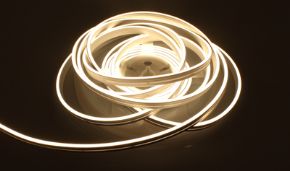
Since the 2000s, with the arrival of high-efficiency LEDs, the market has progressively shifted towards LED neon (also called LED neon flex, flex neon, or neon flex LED): an LED strip enclosed in a silicone, PVC, or polyurethane body that diffuses light uniformly. The visual result is very similar, but with drastically lower consumption, weight, and risks.
3. Neon and fluorescent lamps: the most common misunderstanding
When in Italy people talk about "neon in the kitchen", "neon ceiling light", "ceiling neon", or "changing the garage neon", they are almost never referring to a tube filled with neon gas. This linguistic misunderstanding is so rooted that it is worth clarifying, because it completely changes the way one chooses an LED alternative.
Home "neons" are fluorescent lamps
The white tubes 60, 120, or 150 cm long mounted in neon ceiling lights in kitchens, offices, workshops, and garages are actually linear fluorescent lamps. They contain argon and mercury vapors: the discharge produces ultraviolet radiation that strikes the layer of fluorescent powders inside the glass, which converts it into white light. The codes T8 and T5 indicate the diameter of the tube in eighths of an inch: T8 means about 26 mm, T5 about 16 mm.
Older versions light up thanks to a starter (the small cylinder that makes the tube "flicker" at startup) and an electromagnetic ballast that limits the current; the most recent ones use an electronic ballast. Compact fluorescent lamps (the spiral "energy-saving light bulbs") and circular neons (the "circline" 22W, 32W, and 40W) work on the same principle. There are also cold cathode fluorescent lamps (CCFL), once used to backlight monitors and signs.
Why fluorescent lamps are disappearing
With the update of the exemptions of the European RoHS directive, since 2023 compact fluorescent lamps and then linear T5 and T8 tubes can no longer be placed on the EU market as new products, except for residual exceptions. This is the reason why searches like replace neon with led, neon replacement with led, or convert neon ceiling light to led have exploded in recent years.
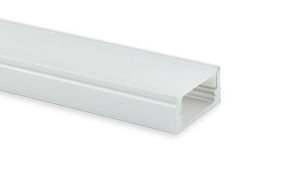
For those who have an old neon ceiling light, there are two paths: buy a compatible retrofit LED tube (checking the wiring, often to be modified by removing the starter and ballast) or, a cleaner and more durable choice, replace the entire fixture with an aluminum profile with LED strip and opal diffuser. The second option allows you to choose custom length, color temperature, luminous flux, and dimming, and to completely eliminate components subject to failure. Ledpoint has a wide range of aluminum profiles for LED strips suitable for this very purpose.
Summary table: what is really meant by "neon"
| How it is called | What it is technically | Contains mercury? | Ledpoint LED alternative |
|---|---|---|---|
| Neon sign, neon writing | Discharge glass tube with neon or argon | Only argon-colored tubes | Neon flex, empty neon flex tubes with strip |
| Neon ceiling light, kitchen neon | Linear T8/T5 fluorescent lamp | Yes | Aluminum profile with strip and diffuser |
| Circular neon, circline | Circular fluorescent lamp | Yes | Bendable profile or shaped neon flex |
| Low-consumption light bulb | Compact fluorescent lamp | Yes | LED light bulbs |
| LED neon, LED neon flex | LED strip in diffusing sheath | No | It is already the LED solution |
4. Difference between neon and LED: consumption, lifespan, and safety
It is one of the most searched questions absolutely: "what is the difference between neon and LED?" and its practical variant "what consumes more, neon or LED?". The short answer is that LED wins on almost all fronts, but it is useful to understand why and with what numbers, so as to make informed decisions when designing a sign or a light line.
Operating principle
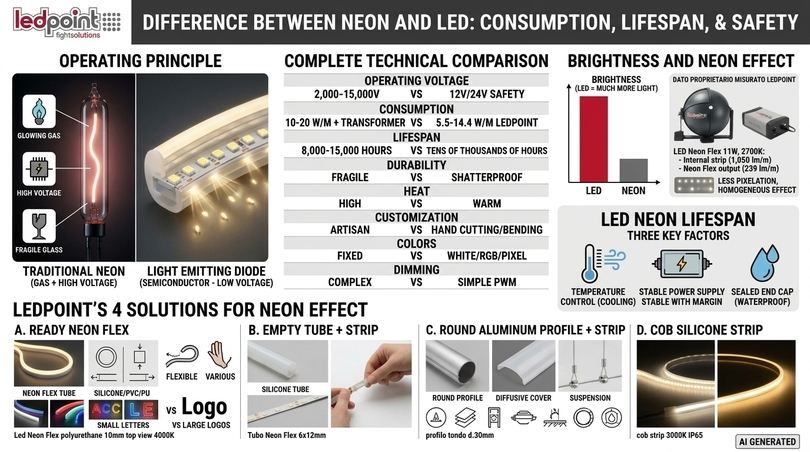
Traditional neon produces light by exciting a gas with high voltage. The LED (light-emitting diode), on the other hand, is a semiconductor that emits photons when crossed by low-voltage direct current. In LED neon, many small LEDs mounted on a flexible circuit are "hidden" by a diffusing material that merges the single points into a continuous line: the eye perceives a homogeneous luminous tube, just like a glass neon.
Complete technical comparison
| Criterion | Traditional glass neon | LED neon (neon flex) |
|---|---|---|
| Operating voltage | 2,000–15,000 V (with transformer) | 12V or 24V in extra-low safety voltage |
| Typical consumption | Indicatively 10–20 W per meter of tube, plus transformer losses | From 5.5 to 14.4 W/m in Ledpoint models |
| Average lifespan | Variable, typically 8,000–15,000 hours, with gas depletion | Tens of thousands of hours if well dissipated and powered |
| Shock resistance | Fragile (glass) | Shatterproof (silicone, PVC, polyurethane) |
| Surface heat | High near the electrodes | Contained, warm to the touch |
| Weight | High, structure and transformer | Very light |
| Customization | Only by glass artisan | Custom cut, hand bending |
| Colors | Fixed per tube | Fixed, adjustable whites, RGB, addressable pixels |
| Dimming | Complex | Simple with PWM dimmer |
| Outdoor use | Possible with protections | IP65 and IP67 versions |
| Repair | Tube remaking | Replacement of the damaged section |
Does LED or neon produce more light?
At equal watts, LED produces much more light than neon. However, in a sign, it is not only the quantity of light that matters: the homogeneity and "softness" of the line matter. A well-designed neon flex deliberately sacrifices part of the internal strip's flux to obtain a uniform line. A proprietary data measured by Ledpoint shows this well: in the Led Neon Flex 6x12mm warm white 2700K 24V 11W, the internal strip emits about 1,050 lumens per meter, while at the tube's output about 239 arrive. In other words, the diffusing body retains over three-quarters of the light in order to eliminate any dotting. It is exactly the "neon" effect: little glare, lots of scenic presence.
Ledpoint measurements are carried out with an integrating sphere and spectroradiometer, instruments that allow declaring real values of lumens per meter, color temperature, color rendering index, and absorbed power instead of theoretical estimates. When comparing two neon flexes, always look at the "lumens per meter of the LED neon" data and not that of the internal strip.
How long does an LED neon last
The lifespan of an LED neon depends above all on three factors: operating temperature, power supply quality, and correct sealing. A neon flex powered by a power supply sized with a margin, not exposed to extreme temperatures, and closed with sealed caps can work for many years even with 10–12 hours of daily operation, as happens in bars and arcades. The factor that most shortens the life of LEDs is heat: this is why, in solutions that provide for a bare strip inside a tube, it is fundamental not to exaggerate with the power per meter.
5. The 4 Ledpoint solutions to recreate the neon effect
We arrive at the heart of the guide. There are several ways to obtain a neon effect light with LEDs, and each has different strengths. Choosing well means starting from the final use: a wall neon sign, a rigid neon tube suspended above a counter, a luminous outline on a piece of furniture, or an outdoor sign require different solutions. Below we analyze the four product families present in the Ledpoint catalog, with their respective pros and cons.
Solution A: ready-to-use neon flex
Neon flex is the most immediate solution: a complete flexible LED tube, in which the strip is embedded in an extruded body that acts as a diffuser, protection, and aesthetic finish. It is cut at the indicated points, closed with caps, and powered. In the Ledpoint Neon Flex category, you will find models that cover almost every need.
Body materials: silicone, PVC, and polyurethane
Silicone is the most common material in quality neon flexes: it resists UV rays, does not yellow, and disperses heat better, which is why it is also suitable for outdoors. PVC is more economical and rigid, suitable for indoor installations or systems with dedicated fittings. Polyurethane (PU) is the choice for the most demanding uses: it is IP67 waterproof, resists solvents and salt water, and maintains its color over time, as in the Led Neon Flex in polyurethane 10mm top view 4000K CRI Ra>90 IP67, supplied with a kit of 15 clips and 2 caps.
Frontal emission (top view) or lateral emission (side view)
The bending direction is the parameter that is most often underestimated. A neon flex with horizontal bending curves "flat", like a letter drawn on a sheet resting on the wall: this is what is needed for wall neon signs. A neon flex with vertical bending curves upwards and downwards, and is ideal for following curved surfaces, arches, and steps. Before buying, always ask yourself: should the light come out towards the viewer while the tube draws a shape on the wall? If yes, you need horizontal bending.
Thin sections for signs and details
For small signs and logos with close strokes, minimum sections are needed. The Led Neon Flex 6mm green 24V 9.6W IP65 and the Led Neon Flex 6mm blue 12V 9.6W IP65, with a minimum bending diameter of 1 cm, are among the most used for custom neon signs. Even thinner are the new 3x5 mm and 5x5 mm mini neon flexes with 1515 strip at 350 led/m, presented by Ledpoint in the article Neon Flex mini: the line of light that draws the details.
Round rope effect neon flex: the closest to the glass tube
Those who want to replicate the cylindrical appearance of the classic neon tube, visible from all sides, have a specific solution: the Led Neon Flex rope effect 15mm round warm white 24V 20W 240led/m. It bends in all directions with a minimum diameter of 1.5 cm and returns about 840 lumens per meter compared to the 1,175 of the internal strip. It is ideal for suspended neon tubes, design neon chandeliers, and three-dimensional indoor installations (attention: it is IP20, so only for dry interiors).
RGB and DMX neon flex for dynamic effects
For arcades, discos, and sets, changing colors are needed. The Led Neon Flex 8mm RGB 5050 24V 14.4W IP65 is managed with an RGB controller, while the Led Neon Flex 11mm RGB DMX IP67 is compatible with the DMX512 protocol used in stage lighting, for animations synchronized with music and stage lights.
2nd generation Neon Flex
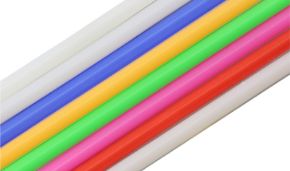
For projects that require large footage and very frequent cuts, Ledpoint offers the 2nd generation Led Neon Flex 6mm 12V 7W 120led/m, in 50-meter rolls, with cutting points every 2.5 cm, available in whites from 3000K to 10000K and in red, blue, green, yellow, and pink, with horizontal or vertical bending. To cut it perfectly perpendicularly, there is a dedicated cutter and a router, described in the guide when to use the cutter in neon flex and LED strip.
Solution B: empty neon flex tubes with LED strip
The second path is the most flexible from a design point of view: you purchase separately a silicone empty neon tube and a LED strip of your choice, which is inserted into the tube. It is the preferred solution for those who want to freely combine color, power, LED density, and diffuser shape, or create a neon with a particular strip (for example, CCT, RGBW, or high color rendering) that does not exist in neon flex version.
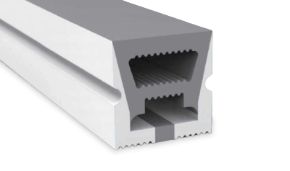
In the Neon Flex Tubes category, Ledpoint offers sections from 4x8 mm up to 20x20 mm, with installable PCBs up to 12 mm and horizontal, vertical, or all-direction bending. Some examples:
- the Neon Flex Tube 6x12mm, perfect for thin signs and outlines;
- the Neon Flex Tube 10x10mm, a good compromise between thickness and brightness;
- the Neon Flex Tube 16x16mm black, with dark sides that concentrate the light only on the front face;
- the Neon Flex Tube 20x20mm, for important light lines well visible from a distance;
- the Neon Flex Tube 18mm diameter, round, the most similar to a real glass neon tube.
The golden rule for a uniform neon effect with an empty tube is to use high-density strips or COB strips. COB LED strips have chips so close together that they already produce a continuous line on their own; inside a diffusing tube, the result is practically indistinguishable from a glass neon. Alternatively, choose strips of at least 120 led/m, better yet 240 led/m, by browsing the 240 led/m LED strips category.
Solution C: round aluminum profiles with diffuser and strip
If the goal is to imitate the rigid neon tube, the straight and cylindrical one of design installations, suspended neons above counters, or geometric wall compositions, the best answer is a round aluminum profile with an opal diffuser. Aluminum, unlike plastic tubes, is also an excellent heat sink: it allows the use of more powerful strips and obtaining more light, keeping the LED temperature low.
In the Ledpoint catalog, you will find the round aluminum profile diameter 30mm, 2 meters, combinable with the dedicated round opaque diffuser, and the round aluminum profile diameter 50mm, 2 meters, which can house wider PCBs and even two strips. According to the published photometric curves, the opaque diffuser retains about 13% of the light in the 30 mm profile and about 10% in the 50 mm one: a minimal loss in exchange for a very homogeneous line. For the choice of the most suitable strip based on PCB width and power, consult the profile and LED strip matching tables.
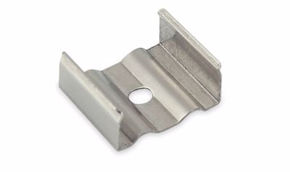
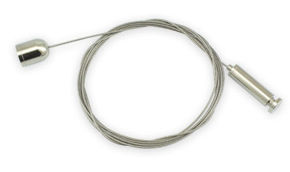
With a round profile, you obtain LED neon tubes of 60, 120, or 150 cm (the classic sizes of "120 cm LED neon" and "150 cm LED neon"), to hang with suspension cables, fix to the wall with mounting clips, or join together with profile joints to create geometric shapes, triangles, hexagons, and "bundle" compositions.
Solution D: COB strip in extruded silicone tube
A fourth solution, very practical for long lines and outdoors, is the LED strip already protected by an extruded silicone tube. Ledpoint offers, for example, the COB LED strip 3000K CRI Ra>90 24V 6.6W/m IP65 in extruded silicone tube: COB technology eliminates dotting, silicone protects from water and slightly diffuses the light. It does not have the optical depth of a real neon flex, but installed inside a cove, a frame, or an angular profile it produces a continuous line of light that the visitor perceives as "neon".
Comparative table: which neon effect solution to choose
Here is a summary based on explicit criteria: line uniformity, shape freedom, brightness, outdoor resistance, ease of installation, and customization. The score goes from 1 (poor) to 5 (excellent) and is the result of the Ledpoint team's application experience.
| Criterion | A. Ready neon flex | B. Empty tube + strip | C. Round profile + strip | D. COB strip in silicone |
|---|---|---|---|---|
| Line uniformity | 5 | 4–5 (with COB) | 4 | 4 |
| Shape freedom (curves, letters) | 5 | 5 | 1 (straight only) | 3 |
| Obtainable brightness | 3 | 3–4 | 5 | 3 |
| Heat dissipation | 4 | 3 | 5 | 3 |
| Outdoor use | 5 (IP65/IP67) | 3 (depends on sealing) | 2 | 4 |
| Ease of installation | 5 | 3 | 4 | 5 |
| Strip customization | 2 | 5 | 5 | 2 |
| Ideal for | Signs, logos, signs | Custom projects, special colors | Rigid neon tubes, suspensions | Long lines, coves, outdoors |
6. Photographic ideas for inspiration
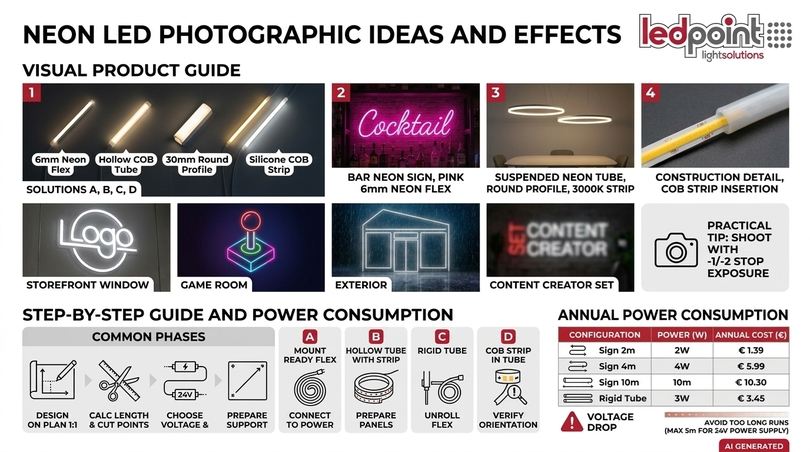
Images help more than a thousand specifications to understand what effect will be achieved. Below we propose a series of exemplary shots to be taken (or requested from the photographer) for the page, each with the product to use and an already optimized alternative text. They show how to replicate a neon tube with the different Ledpoint products, side by side.
| Photo | What to show | Products | Suggested alt text |
|---|---|---|---|
| 1. On/off comparison | Four 50 cm samples side by side: 6mm neon flex, 18mm empty tube with COB, 30mm round profile, COB strip in silicone; first off, then on | Solutions A, B, C, D | Comparison between four Ledpoint LED neon solutions turned on on a dark wall |
| 2. Bar neon sign | Pink cursive "Cocktail" sign on a transparent plexiglass panel, hanging behind the counter | 6mm pink neon flex, horizontal bending | Pink custom LED neon sign behind a cocktail bar counter |
| 3. Suspended neon tube | Three 120 cm round profiles suspended at different heights above a table | 30mm round profile, opaque diffuser, 3000K strip, suspension cables | 120 cm LED neon tubes in round profile suspended above a dining table |
| 4. Construction detail | Macro of the empty tube with the COB strip halfway inserted and the cap ready | 16x16mm neon flex tube, COB strip | Insertion of COB LED strip into empty silicone neon flex tube |
| 5. Shop window | Fashion brand logo in 4000K white neon flex on a matte black background | 6mm white neon flex, black panel | White LED neon sign with logo in a clothing store window |
| 6. Arcade | Stylized joystick and RGB frame that changes color | 8mm RGB neon flex, RGB controller | RGB LED neon in the shape of a joystick in an arcade |
| 7. Outdoors | Luminous outline of a sign on a facade in the rain | IP67 polyurethane neon flex | IP67 LED neon flex installed on the external facade of a venue |
| 8. Content creator set | Blurred neon sign in the background, creator in the foreground illuminated by frontal light | 4mm or mini neon flex, dimmer | LED neon sign as a background for content creator videos |
A practical tip for those taking the photos: shoot the lit version with an exposure 1–2 stops lower than automatic, so the neon color remains saturated and does not "blow out" to white. We delve into the topic in the section dedicated to content creators.
7. Step-by-step guide: from drawing to turning it on
This is the operational part of the guide. The first phases, namely design, measurement, and choice of components, are common to all solutions; then each method has its specific steps. Read the entire procedure before starting: many errors arise from a cut made too early or a power supply chosen by eye. Also remember that the connection to the 230V mains of the power supply must be entrusted to a qualified electrician, as required by DM 37/08 for systems.
Phases common to all solutions
Step 1: draw the project at 1:1 scale
Print or draw the sign, logo, or shape at actual size on paper or cardboard. This allows you to precisely measure the length of each stroke, verify that the curves respect the minimum bending diameter of the chosen product, and identify where the power cables will pass. For a wall neon sign, already mark the points where the tube will have to "disappear" behind the panel to pass from one letter to another.
Step 2: calculate lengths and cutting points
Add up the length of all sections and round to the nearest cutting point of the product: every 2.5 cm for many 12V neon flexes, every 5 cm for most 24V models, every 1.67 cm for some high-density models. Add a 10% margin for any errors. If a section does not coincide with a cutting point, it is better to lengthen it slightly or hide the excess behind the support, never cut off the mark.
Step 3: choose voltage and power supply
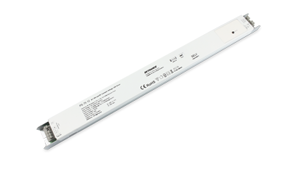
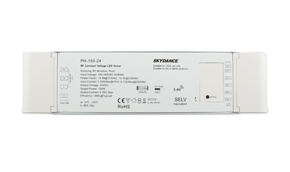
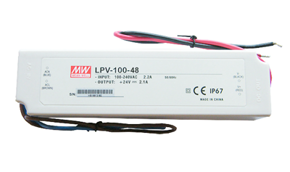
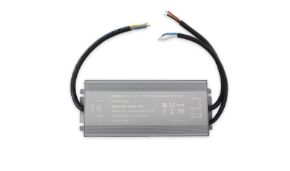
For small and medium-sized signs, 24V voltage is generally preferable to 12V: at equal power, it halves the current, reduces the voltage drop along the path, and allows longer powered sections. Calculate the total power by multiplying the meters by the W/m of the product and choose a power supply with at least a 20% margin. You can find the models in the 24V power supplies and 12V power supplies categories.
Step 4: prepare the support
Wall neon signs are usually mounted on a 5–8 mm transparent plexiglass panel, laser-cut following the profile of the drawing, or directly on a wall. For plexiglass, trace the drawing on the back with a marker, then make the holes for the passage of the cables and for the fixing clips. For wall installations, verify that the wall is dry and clean.
Method A: mounting a ready neon flex
- Unroll the roll and leave it at room temperature for at least an hour: cold silicone is less flexible and risks getting marked in tight curves.
- Cut only on the marks indicated on the tube, with a clean and perpendicular cut. For 2nd generation neon flexes, use the dedicated cutter; for others, a cutter with a new blade.
- Connect the power supply with the special cap with cable outlet or with compatible connectors, or by soldering the wires to the strip pads. Respect the polarity (+ and −).
- Seal the ends with the final cap and, for outdoors, with neutral silicone suitable for electronics, so as to maintain the declared IP protection degree.
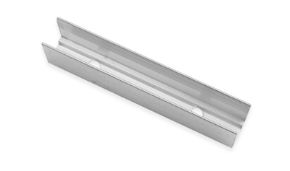
- Fix the neon flex with the clips or dedicated profiles of the neon flex accessories category, every 20–30 cm on straight lines and tighter in curves.
- Test the ignition on the bench before final fixing: it is much simpler to correct a wiring error with the tube still free.
Method B: making a neon with empty tube and strip
- Check compatibility between tube and strip: the width of the strip's PCB must fall within the "installable PCBs" value of the tube (for example, up to 8, 10, or 12 mm). A strip that is too wide gets stuck, one that is too narrow moves and creates shadow zones.
- Cut the strip to the exact length at its cutting point, then solder or connect the power cable and protect the soldering with heat shrink tubing.
- Cut the empty tube a few millimeters longer than the strip, so as to leave room for the cap.
- Insert the strip into the tube: for long sections, help with a guide wire or with a little talcum powder on the surface of the strip to reduce friction. Leave the double-sided tape film in place if the tube does not provide for gluing the strip, to avoid it sticking halfway.
- Check the orientation: the LEDs must face the diffusing face of the tube, not the sides. Turn on the strip at low intensity and scroll the entire section to verify uniformity.
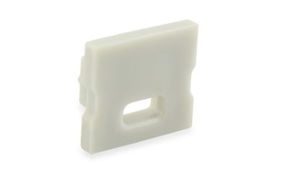
- Close the ends with silicone caps for LED strips, with or without a hole for the cable, and possibly seal with neutral silicone.
- Shape and fix the obtained neon on the support like a normal neon flex.
Pay attention to power: the silicone tube is not a heat sink. For bare strips inserted into an empty tube, prefer contained powers (indicatively up to 10 W/m) and low-consumption COB strips, so as to keep the LEDs at safe temperatures and guarantee a long lifespan.
Method C: building a rigid neon tube with round profile
- Cut the aluminum profile to the desired size with an aluminum cutting machine or a fine-toothed hacksaw, then deburr the edges. The diffuser must be cut to the same size (tolerance ± 2 mm).
- Clean the inside of the profile with isopropyl alcohol: the strip's double-sided tape adheres better and dissipation improves.
- Apply the strip to the internal seat of the profile, pressing uniformly along the entire section.
- Prepare the wiring by making the cable exit from a perforated cap or from the suspension cable, if provided.
- Insert the opaque diffuser by sliding it or by pressure, then close the ends with the profile caps.
- Install the tube with suspension cables or wall clips. To create geometric shapes, join multiple sections with angular joints.
Method D: laying a COB strip in a silicone tube
- Measure the path and cut the strip at the indicated point.
- Connect and seal the ends with the dedicated silicone caps.
- Place it inside a cove or a profile: the rear double-sided tape facilitates its installation even on curved surfaces.
- Hide the source from direct view when possible, for example with an angular profile: the neon effect will be softer and more sophisticated.
How to connect and dim LED neon
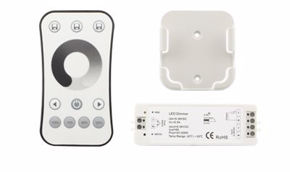
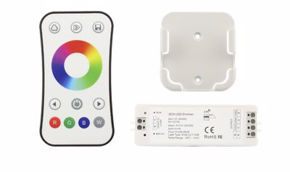
To adjust the intensity of a monochrome neon, a monochromatic dimmer installed between the power supply and the neon is used, often with a remote control. For RGB models, an RGB controller is needed; for professional installations managed by a stage system, DMX decoders are used. If the sign is composed of multiple parts (for example, sign and frame), it is advisable to power them in parallel starting from the same power supply, with cables of adequate section, instead of connecting them "in chain" in series: this avoids the drop in brightness on the furthest parts.
8. Power supply, consumption, and operating costs
One of the main reasons why low-consumption LED neon has replaced traditional neon is the savings on the bill. But how much does an LED neon really consume? And how much does it cost to keep it on? Let's do some concrete math, especially useful for owners of bars, shops, and arcades who keep their signs on for many hours a day.
How much does an LED neon sign consume
The formula is simple: consumption (kWh) = power (W) × hours of operation ÷ 1,000. A 4-meter neon sign made with a 9.6 W/m neon flex absorbs about 38.4 W; with the power supply (typical efficiency around 90%), it reaches about 43 W from the mains.
| Configuration | Absorbed power | Hours/day | kWh/year | Estimated annual cost (€0.25/kWh) |
|---|---|---|---|---|
| 2 m sign, 9.6 W/m neon flex | approx. 21 W | 6 | approx. 46 | approx. €11 |
| 4 m sign, 9.6 W/m neon flex | approx. 43 W | 8 | approx. 126 | approx. €31 |
| 10 m sign, 11 W/m neon flex | approx. 122 W | 12 | approx. 534 | approx. €134 |
| 3 rigid neon tubes 120 cm, 14.4 W/m strip | approx. 58 W | 6 | approx. 127 | approx. €32 |
| Equivalent glass neon sign, 10 m (estimate) | approx. 200–300 W | 12 | approx. 876–1,314 | approx. €219–329 |
The values are indicative and depend on the electricity rate and the model. The significant data is the ratio: for the same sign, LED neon generally consumes from a third to a fifth compared to glass neon, not counting the maintenance costs of high-voltage transformers.
Voltage drop: why long sections "dim" at the end
Along an LED strip, the voltage drops progressively, and the LEDs furthest from the power supply receive less energy. The result is a less intense (or slightly different color) light at the end of the section. To avoid this: prefer 24V, power long sections from both ends or from the center, and use cables of adequate section. As a general rule, with 24V neon flexes, it is prudent not to exceed 5 meters per single power point, unless otherwise indicated in the product sheet.
Can an LED neon sign be plugged into a normal outlet?
Yes, provided there is a power supply that converts the 230V mains to the 12V or 24V of the neon. For small desktop or wall signs, plug-in power supplies are often used, with an in-line switch or dimmer: a perfect solution for content creators, events, and temporary setups. For fixed installations in public places, a power supply installed in a junction box and connected to the system by an electrician is preferred.
9. Neon colors and color temperature: how to choose
Color is the first thing a customer notices about a neon sign, even before reading it. Choosing the right neon color means communicating an emotion consistent with the venue or the brand. But what exactly is meant by "neon color"? And how does it translate into the world of LEDs?
What color is neon?
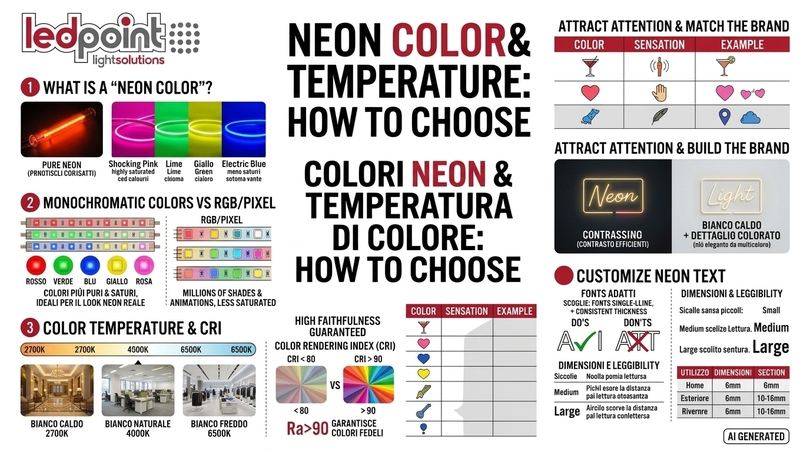
In a strict sense, pure neon emits a red-orange light. In common language, however, "neon color" indicates any very saturated and bright tint: shocking pink, lime green, acid yellow, electric blue. In graphics and fashion, we speak of "neon colors" or "fluorescent colors" to indicate these bright tones, the same ones we find in the signs and colored neon lights of nightclubs.
Monochromatic colors and whites compared
In LEDs, colored light is obtained in two ways: with monochromatic LEDs, which directly emit a color (red, green, blue, yellow, pink), or with RGB LEDs that mix red, green, and blue. Monochromatics give purer and more saturated colors, ideal for reproducing the "true" look of colored neon lamps; RGBs offer millions of shades and animations, but the mixed colors are generally a bit less saturated.
For white shades, we reason in terms of color temperature, measured in kelvin: 2700–3000K corresponds to warm white (warm light neon), 4000K to natural white, 6000–6500K to cool white (the classic "6400K neon" of offices), up to 10000K for ice white. When the color fidelity of illuminated objects is important, for example in a clothing store, the color rendering index (CRI) also matters: a value of Ra>90 guarantees faithful colors.
| Color | Communicated sensation | Where it works best |
|---|---|---|
| Red | Energy, passion, urgency | Cocktail bars, pubs, promotions, "Open" signs |
| Pink | Romanticism, irony, femininity, trend | Weddings, beauty, fashion stores, social backgrounds |
| Blue | Calm, technology, trust | Gaming, lounges, tech studios |
| Ice / cyan | Freshness, modernity | Design bars, ice cream parlors, beauty centers |
| Green | Nature, well-being, freshness | Herbalists, health bars, pharmacies |
| Yellow / orange | Cheerfulness, warmth, conviviality | Restaurants, pizzerias, vintage signs |
| Warm white 2700–3000K | Welcome, elegance | Homes, hotels, restaurants |
| White 4000K | Neutrality, clarity | Shops, shop windows, offices |
| RGB / pixel | Dynamism, show | Arcades, discos, events |
Which neon colors attract the most attention
To attract the eye, contrast is what matters most. On dark facades and walls, the most effective colors are red, pink, and cool white; on light backgrounds, blue and saturated red work better, because white tends to get lost. In a shop window, during the day, a colored neon competes with sunlight: to be visible, a brighter product or a dark background behind the sign is needed. In the evening, however, even a neon of 200–400 lumens per meter is more than enough to create a strong visual appeal.
How to match neon to brand identity
If the brand has an institutional color, the neon should match it as closely as possible. With monochromatic LEDs, the closest tint is chosen; with RGB or RGBW, the mixture can be adjusted. An interior designer trick: it is not mandatory for the sign to exactly reproduce the color of the printed logo. Often, a warm white applied to the logo, combined with a colored detail, results in a more elegant and readable look than a multicolored neon.
10. Custom neon signs: fonts, sizes, and readability
Custom neon signs are among the most requested applications: venue names, motivational phrases, names of the newlyweds, hashtags for events. The success of a sign depends on three choices: the font, the size, and the section of the neon flex. Let's see how to set them correctly.
Choosing the right neon font
Not all typographic characters lend themselves to becoming a neon sign. The most suitable fonts are those with a single stroke and constant thickness (monoline), because neon draws a line, it does not fill a surface. "Script" type italics are the most loved for weddings and bars, but they must be simplified: too tight ligatures or tiny loops become impossible to bend. Rounded sans serifs are ideal for signs readable from a distance and for shop logos.
- Avoid fonts with thin serifs: decorative terminations are lost or require complex cuts.
- Maintain a distance between strokes of at least 2–3 times the width of the neon flex, to avoid the luminous lines visually merging.
- Provide for "jump" points: where the neon passes from one letter to another, the connecting stroke must be hidden behind the panel or obscured with black paint or sheath.
- Check the radii of curvature: the curves of the font cannot be tighter than the minimum bending diameter of the product (for example, 1 cm for the 6mm neon flex).
What size should a neon sign be
A practical rule, also used for signage, links the height of the letters to the reading distance: about 2–3 cm in height for every meter of distance. A sign that must be read from 5 meters should have letters at least 10–15 cm high; a shop window sign readable from the opposite sidewalk, at 15 meters, requires 30–45 cm. For wall signs at home or behind a counter, we typically work between 40 and 120 cm in overall width.
| Use | Sign width | Letter height | Recommended neon section |
|---|---|---|---|
| Video background / desk | 30–60 cm | 8–15 cm | Mini neon flex or 4–6 mm |
| Living room / bedroom wall | 60–100 cm | 15–25 cm | 6 mm neon flex |
| Behind bar counter | 80–150 cm | 20–40 cm | 6–8 mm neon flex |
| Wedding / photo wall | 80–160 cm | 20–40 cm | 6 mm neon flex on plexiglass |
| Shop window | 60–150 cm | 15–40 cm | 6–10 mm neon flex |
| External sign on facade | 150–400 cm | 30–80 cm | 10–16 mm IP67 neon flex |
Is it possible to reproduce a logo in neon?
Yes: almost every logo can be transformed into a neon sign, provided it is "translated" into lines. The work consists of deriving its outline or skeleton from the logo, eliminating solid fills and details that are too small. Solid surfaces can be rendered with a backlit panel, thus combining neon flex and backlighting with LED modules. A tip: before producing the final sign, make a prototype of a single letter to verify brightness and curve rendering.
11. Professional applications: bars, design, events, shops, social, and gaming
Each sector has different needs, and the questions we receive from venue owners, designers, and organizers prove it. We collect here the most useful answers, organized by professional profile, with the most suitable Ledpoint solutions for each case.
Cocktail bars and nightclubs
For a cocktail bar, the neon sign is part of the venue's identity: it becomes the background of customers' photos and therefore a free advertising vehicle on social media. The most effective solutions are a neon sign with the name or logo of the venue behind the counter and an ironic phrase or an icon (a Martini glass, a cherry, a wave) in a strategic point of the room. The most used colors are pink, red, and ice blue, combined with the warm white of the general lighting.
For a venue open to the public, it is essential to choose extra-low voltage products, keep the power supply in an aerated and accessible position for maintenance, and have the connection certified by an electrician. With a silicone neon flex, maintenance is reduced to periodic cleaning with a soft cloth: no gas to recharge, no high-voltage transformers. For a 3–4 meter sign, consumption remains in the order of a few tens of watts.
Interior design: neon at home and in commercial spaces
For an interior designer, neon is a graphic element even before it is a light source. In modern living rooms, minimal light lines work well: a horizontal rigid neon tube above the sofa made with a round profile and 3000K strip, a geometric shape (circle, arc, triangle) in warm white neon flex, or a short italic word on a textured wall. The secret to integrating neon without weighing down the environment is to use it sparingly: a single protagonist element, dimmable, positioned where it does not conflict with other light sources.
The shade should be chosen based on the style: warm white for environments with wood and natural fabrics, neutral white for industrial styles with concrete and metal, saturated colors only as an accent in children's rooms, home bars, home theaters, or walk-in closets. For durability, the best materials are silicone and polyurethane for neon flexes and aluminum with a polycarbonate diffuser for rigid tubes.
Weddings and events
At weddings, the most requested signs are the names or initials of the newlyweds, phrases like "Better together", "Just married", "Love", or dedicated hashtags, almost always in pink or warm white on transparent plexiglass. For an event organizer, the key requirements are lightness, robustness, and ease of assembly: a neon flex sign on an acrylic panel weighs a few kilos, hangs with two hooks or rests on an easel, and turns on by plugging in a power supply.
For transport, it is advisable to provide a padded case with the panel vertically and protect the side with the neon from bumps and scratches. For outdoor events, IP65 or IP67 products are needed, power supplies protected from rain or positioned under cover, sealed connections, and cables that do not cross passage areas. The signs can be reused for dozens of events, and the customization of color, size, and font is total.
Clothing stores and shop windows
A neon sign in a shop window communicates the personality and style of the brand at a glance, even to those passing by in a car. It works particularly well for stores aimed at a young audience and for concept stores. In addition to the logo, neon can highlight seasonal messages and promotions: "Sale", "New collection", "Summer", to be alternated during the year on interchangeable panels.
For sizes, a sign in a shop window should indicatively occupy one third of the width of the glass, positioned at eye level. Pay attention to authorization aspects: external signs or those visible from the street are regulated by municipal regulations and, for roads, by Article 23 of the Highway Code; in many municipalities, an authorization or communication to the single desk is required, and in historical centers, landscape constraints may apply. Before installing a sign on a facade, always check with the technical office of your municipality.
Content creators and photo sets
For a content creator, the neon sign in the background is an element of recognizability: the audience associates that light with the channel. The most effective signs are short (the channel name, a keyword, a symbol) and of contained dimensions, so as to remain readable even in vertical formats. To look good on camera:
- Position the neon behind you and slightly off-axis, at a sufficient distance so that it appears blurred but recognizable.
- Lower the intensity with a dimmer: a neon that is too bright overexposes and becomes a white spot.
- Illuminate your face with a separate light and adjust the exposure on yourself, not on the neon.
- Avoid reflective surfaces (glass, glossy paintings, monitors) in the frame, or change the angle to eliminate reflections.
- Check for flicker: some cheap dimmers can create bands on the screen with certain shutter speeds; in this case, increase the intensity or modify the shutter speed.
Arcades and recreational centers
In arcades, neon contributes to immersion: luminous frames around cabinets, symbols inspired by video games, arrows, stylized controllers, flashes, and sound waves. Here, dynamic colors (RGB or DMX neon flex), mechanical resistance, and long duration with 10–14 hours of operation per day are especially needed. Blue, purple, cyan, and magenta are the most engaging colors, because they recall the "cyberpunk" and retrogaming aesthetics.
For installation near gaming and electronics stations, the advantage of LED neon is the extra-low voltage and contained heat: no risk of high-voltage discharges and no significant interference. However, it is good practice to fix the neon out of the reach of players, protect the cables in conduits, and group the power supplies in a dedicated panel. For symbols inspired by characters or registered trademarks of video games, remember that authorizations from the rights holders are required: it is better to focus on original icons.
12. Neon prices: how much does a custom neon sign cost
The question "how much does a neon cost?" does not have a single answer, because it depends on the technology, the size, the complexity of the design, and who performs the work. However, we can provide useful orders of magnitude to set a budget and understand where most of the cost is hidden.
The cost items of an LED neon
An LED neon sign consists of: luminous material (neon flex or empty tube plus strip, per meter), support (laser-cut plexiglass, panel, profile), power and control (power supply, dimmer, or controller), accessories (caps, clips, connectors, cables), and labor (design, bending, wiring, installation). In DIY, the first four items are often contained; in signs commissioned to a workshop, labor weighs for the larger share.
Indicative orders of magnitude
| Type | Indicative market range | Notes |
|---|---|---|
| DIY LED neon sign, 50–80 cm | A few tens of euros of material | Neon flex, plug-in power supply, plexiglass |
| 120 cm rigid neon tube with round profile | A few tens of euros per tube | Profile, diffuser, strip, caps, cables |
| Custom laboratory LED neon sign, 80–120 cm | From about 150 to 500 euros | Varies greatly depending on font complexity |
| External LED neon sign with logo, 2–3 m | From a few hundred to over 1,000 euros | IP67, structure, installation, permits |
| Artisan glass neon sign, 1 m | Often over 400–800 euros | Artisan work, high-voltage transformer |
These are indicative estimates, useful for comparison and not a price list: the updated prices of Ledpoint components can be consulted directly in the product sheets. The real savings of LED neon are seen over time: reduced consumption, no gas to recharge, possibility of replacing only the damaged section.
Can a neon sign be rented?
Yes, renting neon signs for a single day is a widespread service among setup companies and wedding planners. However, for those who organize events continuously, owning a small "park" of interchangeable LED neon signs quickly becomes more convenient: the materials are cheap, light, and reusable for years.
13. Safety, regulations, disposal, and maintenance
A good installation is not only beautiful: it is also safe and compliant. This section answers the most frequent questions about the risks of traditional neon, how to dispose of old tubes, and how to keep an LED neon efficient over time.
What happens if a neon breaks
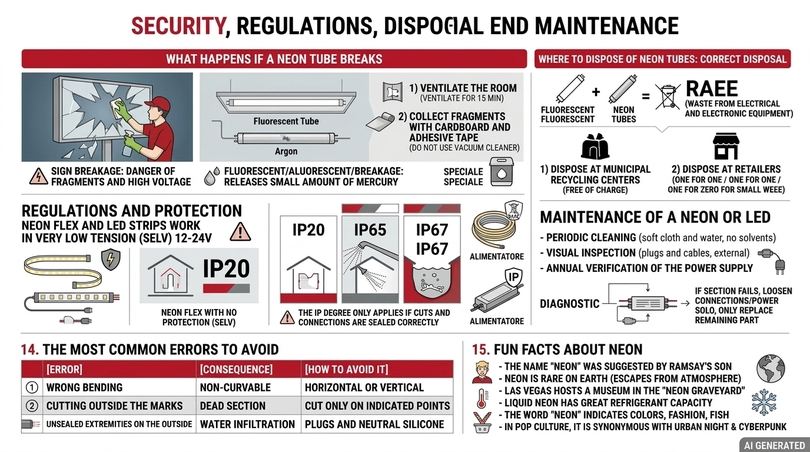
If a pure neon sign breaks, the gas disperses into the air without health consequences; the real danger is the glass fragments and, if the sign is on, the high voltage. If a fluorescent tube (the "neon" of the ceiling light) or an argon-colored tube breaks, however, a small amount of mercury is released. In this case, it is advisable to ventilate the room for at least 15 minutes, do not use a vacuum cleaner, collect the fragments with cardboard and adhesive tape, and close them in a sealed container to be disposed of as special waste.
Where to throw away neons: correct disposal
Fluorescent lamps and neon tubes are WEEE (waste electrical and electronic equipment) and should never be thrown in the unsorted waste or glass. They are delivered free of charge to municipal ecological islands or to retailers, who are required to collect them according to the "one for one" rules and, for small WEEE, "one for zero" in larger points of sale. Power supplies and end-of-life neon flexes also follow the same channel.
Regulations and degree of protection
Neon flexes and LED strips work in extra-low safety voltage (SELV) at 12 or 24V, and this makes the installation intrinsically safer than high-voltage systems. Lighting fixtures refer to the IEC/EN 60598 series of standards, while resistance to dust and water is indicated by the IP protection degree:
- IP20: dry interiors only, no water protection;
- IP65: protected from water jets, suitable for sheltered outdoors and humid environments;
- IP67: protected from temporary immersion, suitable for exposed outdoors and heavy-duty uses.
The declared IP degree is valid only if cuts and connections are correctly sealed with caps and suitable materials. The power supply, if installed outdoors, must have an adequate degree of protection or be positioned in a sheltered place.
Maintenance of an LED neon
The maintenance of an LED neon is minimal: periodic cleaning with a soft cloth and lukewarm water (no aggressive solvents on silicone or PVC models), visual check of caps and cables on outdoor installations, annual check of the power supply. If a section stops working, the first check always concerns connections and power supply; in case of section failure, only that portion is replaced.
14. The most common mistakes to avoid
In years of consulting for installers and private individuals, the Ledpoint team has collected a precise case history of the errors that compromise a neon effect project. Knowing them in advance saves time and money.
| Error | Consequence | How to avoid it |
|---|---|---|
| Choosing the wrong bending | The neon does not bend on the desired plane | Horizontal for wall signs, vertical for curved surfaces |
| Cutting outside the marks | Section turned off or damaged LEDs | Cut only at the indicated points |
| Undersized power supply | Flickering, overheating, failures | Margin of at least 20% on power |
| Sections too long from one side | Weaker light at the end | Power from multiple points, prefer 24V |
| Low-density strip in empty tube | Visible "polka dot" effect | COB strip or at least 120–240 led/m |
| Too powerful strip in silicone tube | Overheating, reduced lifespan | Contained powers or aluminum profile |
| Unsealed ends outdoors | Water infiltration and oxidation | Caps and neutral silicone |
| Font too complex | Illegible sign, impossible curves | Monoline font, wide spaces between strokes |
15. Curiosities about neon
To close the theoretical part, some interesting facts that explain why neon has become an icon of popular culture and not just an element of the periodic table.
- The name "neon" was suggested by William Ramsay's thirteen-year-old son, who proposed the Latin novum; the father preferred the Greek equivalent néos.
- Neon is the fifth most abundant element in the universe, but on Earth it is rare because, being light and inert, it largely escaped the primordial atmosphere.
- Las Vegas hosts a museum entirely dedicated to historic neon signs, the so-called "neon boneyard".
- Liquid neon has a much higher cooling capacity than liquid helium per unit of volume and is used in some cryogenic applications.
- The word "neon" has entered common language to indicate bright colors, fluorescent fashion, musical genres, and even a species of aquarium fish (neon tetras, so called for the iridescent stripe on the body).
- In pop culture, neon is synonymous with urban night: from film noir to cyberpunk settings, its light tells of cities that never sleep.
16. FAQ about neon and LED neon
We collect here the most frequent questions we receive about neon, neon lights, and LED neon, with short and direct answers. Click on each question to open the answer.
What is neon?Neon is a chemical element with symbol Ne and atomic number 10, belonging to the noble gases. It is a colorless, inert, and non-toxic gas that, when crossed by an electric discharge in a glass tube, emits red-orange light. Hence the name of neon signs and, by extension, of modern LED neon. |
What is the difference between neon and LED?Traditional neon produces light by exciting a gas with voltages of thousands of volts inside glass tubes. LED neon uses a 12 or 24V LED strip enclosed in a diffusing body. LED consumes much less, is shatterproof, heats up little, can be cut to size, and lasts longer. |
What consumes more, neon or LED?Traditional neon consumes more. For the same sign, an LED neon generally absorbs from a third to a fifth of the energy of a glass neon, which also requires a high-voltage transformer. A Ledpoint neon flex typically consumes between 5.5 and 14.4 W per meter. |
How do you imitate a neon tube with LEDs?There are four solutions: ready-to-use neon flex for signs and logos, empty neon flex tubes with LED or COB strips for custom projects, round aluminum profiles with opaque diffuser and strip for rigid neon tubes, and COB strips in silicone tube for long lines and luminous coves. |
How much does a custom neon sign cost?It depends on size, technology, and labor. A small DIY LED neon sign requires a few tens of euros of material; a custom laboratory sign costs indicatively from 150 to 500 euros; an external sign with a logo can exceed 1,000 euros. Artisan glass neon is generally more expensive. |
Can an LED neon sign be plugged into a normal outlet?Yes, through a power supply that converts the 230V mains to the 12 or 24V required by the neon flex. For small signs and temporary setups, plug-in power supplies with a switch or dimmer are used; for fixed installations in public places, the connection must be made by a qualified electrician. |
How long does an LED neon last?A quality LED neon, correctly powered and well sealed, can work for many years even with 10-12 hours of operation per day. The decisive factors are operating temperature, power supply with a power margin, and protection from humidity. Excessive heat is the main cause of LED aging. |
Is neon toxic? What happens if it breaks?Neon gas is not toxic because it is inert. If a pure neon sign breaks, the risk concerns glass and high voltage. Fluorescent tubes and argon-colored ones, however, contain mercury: it is necessary to ventilate the room, not use a vacuum cleaner, and collect the fragments in a sealed container. |
Where do you throw away exhausted neons?Neon tubes and fluorescent lamps are WEEE and should not be thrown in unsorted waste or glass. They are taken free of charge to the municipal ecological island or to retailers, who collect them according to the one-for-one rules and, for small WEEE, one-for-zero in larger points of sale. |
Which neon color attracts customers the most?Contrast with the background matters. On dark walls and facades, red, pink, and cool white are the most visible; on light backgrounds, blue and saturated red work better. In a cocktail bar, pink and red create atmosphere, in an arcade, blue, purple, and cyan are more engaging. |
Can neon signs be created with custom fonts?Yes. The most suitable fonts are monoline with constant thickness, with curves compatible with the minimum bending diameter of the neon flex and spaces between strokes equal to at least two to three times the width of the tube. Logos can also be converted into luminous lines. |
Can LED neon be used outdoors?Yes, by choosing neon flex with an IP65 or IP67 protection degree, such as Ledpoint silicone or polyurethane models, sealing cuts and connections with caps and neutral silicone, and protecting the power supply from rain. IP20 versions, like the round rope effect neon, should only be used in dry interiors. |
17. The neon of the future is LED
Neon was born as a rare gas discovered in the laboratory, became the light of twentieth-century cities, and today lives a second youth thanks to LEDs. LED neon retains all the charm of continuous and colored light, eliminating high voltage, fragility, and high consumption. Whether you choose a ready neon flex, an empty neon flex tube with your preferred strip, a round aluminum profile for a rigid neon tube, or a COB strip in silicone, you can obtain a professional result by following a few principles: design to scale, respect cutting points and radii of curvature, size the power supply well, and seal carefully.
To choose the most suitable components for your project, explore the Neon Flex - Flexible LED tubes catalog, download the Ledpoint catalogs with technical sheets and datasheets, or contact the Ledpoint technicians for a consultation or a personalized quote: we will help you transform your idea into a light that leaves a mark. For other application ideas, also read our case study on sign lighting with LED neon flex and the guide to DIY LED garden lanterns.
This article was developed with the support of artificial intelligence and subsequently reviewed, corrected, and validated by the Ledpoint.it technical team, which guarantees its reliability and compliance with official sources.