






Lumens, lux, and candles: conversion tables | Ledpoint
The lumen measures the total amount of light emitted by a source, the candela measures how much of that light travels in a specific direction, and the lux measures how much light actually reaches a surface. To convert between the three quantities, three formulas are needed: lumens = candelas × solid angle (steradians), lux = candelas ÷ distance², lux = lumens ÷ illuminated square meters. This guide collects all the ready-to-use conversion tables, with examples calculated on 12V and 24V LED strips for vehicles, campers, and fittings.
Anyone installing LED lighting on a vehicle, whether it's the ceiling of a camperized van, the cargo area of a commercial vehicle, the passenger compartment of a classic car being restored, or the cabin of a truck, eventually faces the same question from the customer: "How much light will it make?". And the answer cannot be "a lot". You need a number, and that number depends on how you read and convert the nameplate data: the lumens written on the datasheet, the candelas declared for a headlight or spotlight, the lux measured with a luxmeter on the work plane.
The problem is that these three units are often used as synonyms in catalogs, forums, and even by some suppliers, but they are not. Confusing lumens and lux is like confusing the flow rate of a faucet with the water level in the tub: the first quantity describes how much comes out, the second how much accumulates at a certain point. An installer who masters photometric conversions designs better, makes fewer ordering mistakes, correctly sizes power supplies and wiring, and can demonstrate to the customer, with hard numbers, the result they will achieve.
In this article, the Ledpoint technical team has gathered, in a single reference tool, the essential definitions, formulas, lumen, lux, and candle conversion tables, reference values for automotive lamps, voltage limits for on-board systems, recommended illuminance levels for passenger compartments, cargo areas, campers, and workshops, and a series of calculation examples based on real data from Ledpoint 12V LED strips. It is a guide designed to be bookmarked and reopened on the job site, with the customer present or with the van on the lift. And for those in a hurry, right after the quick answer you will find an automatic configurator that chooses the strip, estimates the lux, and sizes the power supply and cables in a few clicks.
In this article...
1. Lumen, lux and candles in a nutshell: the quick answer
Before going into detail, it is useful to establish an overview that can be remembered even without the guide at hand. Lumens, candles, and lux are not three different ways of saying "brightness": they are three distinct quantities, linked together by geometry, that is, by the angle in which the light is concentrated and the distance to the illuminated surface. Once you understand this, every conversion becomes a simple calculation.
The table of the three quantities
| Quantity | Unit of measurement | Symbol | What it describes | Question it answers | Where you find it |
|---|---|---|---|---|---|
| Luminous flux | lumen | lm | Total light emitted in all directions | "How much light does the source produce?" | LED strip datasheets (lumens/m), bulbs, modules |
| Luminous intensity | candela | cd | Light emitted in one direction, per unit of solid angle | "How intense is the beam in that direction?" | Headlights, spotlights, flashlights, projectors, taillights |
| Illuminance | lux | lx | Light reaching a surface, per square meter | "How much light is on the work plane?" | Standards (UNI EN 12464-1), luxmeter measurements |
| Luminance | candela per square meter (nit) | cd/m² | Light that a surface emits or reflects towards the eye | "How bright does that surface appear?" | Displays, dashboards, backlit panels, glare |
| Luminous efficacy | lumens per watt | lm/W | Light produced for every electrical watt absorbed | "How much light do I get for every watt consumed?" | Datasheets, ErP energy label |
The three formulas to remember
| Conversion | Formula | Quick example |
|---|---|---|
| From candelas to lumens | lumens = cd × Ω with Ω = 2π × (1 − cos(θ/2)) | 1,000 cd spotlight with 60° beam → Ω = 0.842 sr → about 842 lumens in the beam |
| From candelas to lux | lx = cd ÷ d² | 1,000 cd at 2 m → 1,000 ÷ 4 = 250 lux |
| From lumens to lux | lx = lumens ÷ m² | 1,000 lumens evenly distributed over 2 m² → 500 lux |
The practical rule that summarizes everything is: lumens tell you how much light you have, candles tell you where you are sending it, lux tell you how much arrives. If a customer asks you to "double the light" on a camper's cooktop, you can double the lumens (more strip or a more powerful strip), or halve the area over which the light disperses (profile with optics, closer position): in both cases, the lux double. It's the same logic used by lighting designers, and it applies identically to a vehicle.
★ Ledpoint automatic configurator: strip, lux, power supply and cables
Formulas are useful, but on the job site you need an immediate answer. For this reason, the Ledpoint technical team has transformed the calculation methods of this guide into an automatic configurator that works directly on the page, without installing anything and without registration. Choose the options and the result updates instantly: the recommended LED strip with a link to the product page, estimated lux, IP protection, color temperature, consumption in amps and amp-hours, power supply wattage, and minimum cable cross-section.
The configurator offers three complementary tools. Tool A starts from the vehicle area and the distance of the surface and proposes the most efficient Ledpoint strip that reaches the lux target, suggesting dimmer adjustment when the light is excessive. Tool B calculates the lux under a strip starting from lumens per meter, distance, and diffuser type, and also indicates the light to the side of the strip. Tool C sizes the electrical part: voltage, wattage, length, current, consumption, power supply, and cable. In sections 7, 9, and 12 you will find the details of the formulas used, so you can always verify and adapt the results to your project.
Choose the tool:
1. Where are you installing the light?
2. How far is the surface to be illuminated?
Configurator result
Area: Kitchen / under-cabinet | Distance: 0.4 m | Target: 300–500 lux
Recommended strip: F52-40s-060DF1 – 525 lumens/m, 4.8 W/m, 12 V, 4000K, CRI Ra>93, IP20.
Estimated illuminance under the strip: ≈ 463 lux (reference length 1.0 m, factor k = 0.88, transmission η = 0.80).
Recommended mounting: profile with satin diffuser (see aluminum profile and diffuser). Color temperature: 3000–4000K, CRI ≥ 90 preferable. Protection: IP20 in closed profile.
Full power consumption: ≈ 4.8 W, i.e., 0.40 A at 12 V (525 total source lumens).
Area: Kitchen / under-cabinet | Distance: 0.8 m | Target: 300–500 lux
Recommended strip: F52-40s-120DF1 – 1,000 lumens/m, 9.6 W/m, 12 V, 4000K, Ra>80, IP20.
Estimated illuminance under the strip: ≈ 321 lux (reference length 1.0 m, factor k = 0.64, transmission η = 0.80).
Recommended mounting: profile with satin diffuser (see aluminum profile and diffuser). Color temperature: 3000–4000K, CRI ≥ 90 preferable. Protection: IP20 in closed profile.
Full power consumption: ≈ 9.6 W, i.e., 0.80 A at 12 V (1,000 total source lumens).
Area: Kitchen / under-cabinet | Distance: 1.4 m | Target: 300–500 lux
Recommended strip: F52-65s-240DF1 – 1,900 lumens/m, 19.2 W/m, 12 V, 6500K, Ra>80, IP20.
Estimated illuminance under the strip: ≈ 228 lux (reference length 1.0 m, factor k = 0.42, transmission η = 0.80).
Warning: a single strip is not enough at this distance. Plan for 2 close parallel strips (or move the source closer): total estimated illuminance ≈ 410 lux.
Recommended mounting: profile with satin diffuser (see aluminum profile and diffuser). Color temperature: 3000–4000K, CRI ≥ 90 preferable. Protection: IP20 in closed profile.
Full power consumption: ≈ 38.4 W, i.e., 3.20 A at 12 V (3,800 total source lumens).
Area: Living area (general light) | Distance: 0.4 m | Target: 100–200 lux
Recommended strip: F52-260-120DF1 – 980 lumens/m, 9.6 W/m, 12 V, 2600–2800K, Ra>80, IP20.
Estimated illuminance under the strip: ≈ 958 lux (reference length 2.0 m, factor k = 0.98, transmission η = 0.80).
Tip: the light is above the target, adjust the dimmer to around 20% to save energy and avoid glare.
Recommended mounting: cove or profile with satin diffuser (see aluminum profile and diffuser). Color temperature: 2700–3500K. Protection: IP20 in profile.
Full power consumption: ≈ 19.2 W, i.e., 1.60 A at 12 V (1,960 total source lumens).
Area: Living area (general light) | Distance: 0.8 m | Target: 100–200 lux
Recommended strip: F52-260-120DF1 – 980 lumens/m, 9.6 W/m, 12 V, 2600–2800K, Ra>80, IP20.
Estimated illuminance under the strip: ≈ 432 lux (reference length 2.0 m, factor k = 0.88, transmission η = 0.80).
Tip: the light is above the target, adjust the dimmer to around 50% to save energy and avoid glare.
Recommended mounting: cove or profile with satin diffuser (see aluminum profile and diffuser). Color temperature: 2700–3500K. Protection: IP20 in profile.
Full power consumption: ≈ 19.2 W, i.e., 1.60 A at 12 V (1,960 total source lumens).
Area: Living area (general light) | Distance: 1.4 m | Target: 100–200 lux
Recommended strip: F52-260-120DF1 – 980 lumens/m, 9.6 W/m, 12 V, 2600–2800K, Ra>80, IP20.
Estimated illuminance under the strip: ≈ 195 lux (reference length 2.0 m, factor k = 0.70, transmission η = 0.80).
Recommended mounting: cove or profile with satin diffuser (see aluminum profile and diffuser). Color temperature: 2700–3500K. Protection: IP20 in profile.
Full power consumption: ≈ 19.2 W, i.e., 1.60 A at 12 V (1,960 total source lumens).
Area: Reading / sleeping area | Distance: 0.4 m | Target: 300–500 lux
Recommended strip: F52-260-120DF1 – 980 lumens/m, 9.6 W/m, 12 V, 2600–2800K, Ra>80, IP20.
Estimated illuminance under the strip: ≈ 629 lux (reference length 0.5 m, factor k = 0.64, transmission η = 0.80).
Tip: the light is above the target, adjust the dimmer to around 80% to save energy and avoid glare.
Recommended mounting: short profile with satin diffuser (see aluminum profile and diffuser). Color temperature: 2700–3500K. Protection: IP20 in profile.
Full power consumption: ≈ 4.8 W, i.e., 0.40 A at 12 V (490 total source lumens).
Area: Reading / sleeping area | Distance: 0.8 m | Target: 300–500 lux
Recommended strip: F52-35s-1208F1/14.4 – 1,550 lumens/m, 14.4 W/m, 12 V, 3500K, Ra>80, IP20.
Estimated illuminance under the strip: ≈ 290 lux (reference length 0.5 m, factor k = 0.37, transmission η = 0.80).
Warning: a single strip is not enough at this distance. Plan for 2 close parallel strips (or move the source closer): total estimated illuminance ≈ 522 lux.
Recommended mounting: short profile with satin diffuser (see aluminum profile and diffuser). Color temperature: 2700–3500K. Protection: IP20 in profile.
Full power consumption: ≈ 14.4 W, i.e., 1.20 A at 12 V (1,550 total source lumens).
Area: Reading / sleeping area | Distance: 1.4 m | Target: 300–500 lux
Recommended strip: F52-35s-1208F1/14.4 – 1,550 lumens/m, 14.4 W/m, 12 V, 3500K, Ra>80, IP20.
Estimated illuminance under the strip: ≈ 99 lux (reference length 0.5 m, factor k = 0.22, transmission η = 0.80).
Warning: a single strip is not enough at this distance. Plan for 4 close parallel strips (or move the source closer): total estimated illuminance ≈ 355 lux.
Recommended mounting: short profile with satin diffuser (see aluminum profile and diffuser). Color temperature: 2700–3500K. Protection: IP20 in profile.
Full power consumption: ≈ 28.8 W, i.e., 2.40 A at 12 V (3,100 total source lumens).
Area: Bathroom / mirror | Distance: 0.4 m | Target: 200–500 lux
Recommended strip: K52-40s-120DF1 IP65 – 950 lumens/m, 9.6 W/m, 12 V, 4000K, Ra>80, IP65.
Estimated illuminance under the strip: ≈ 849 lux (reference length 0.6 m, factor k = 0.72, transmission η = 1.00).
Tip: the light is above the target, adjust the dimmer to around 60% to save energy and avoid glare.
Recommended mounting: IP65 silicone strip, possibly in a profile (see aluminum profile and diffuser). Color temperature: 3000–4000K, CRI ≥ 90 if possible. Protection: IP65.
Full power consumption: ≈ 5.8 W, i.e., 0.48 A at 12 V (570 total source lumens).
Area: Bathroom / mirror | Distance: 0.8 m | Target: 200–500 lux
Recommended strip: K52-40s-120DF1 IP65 – 950 lumens/m, 9.6 W/m, 12 V, 4000K, Ra>80, IP65.
Estimated illuminance under the strip: ≈ 260 lux (reference length 0.6 m, factor k = 0.44, transmission η = 1.00).
Recommended mounting: IP65 silicone strip, possibly in a profile (see aluminum profile and diffuser). Color temperature: 3000–4000K, CRI ≥ 90 if possible. Protection: IP65.
Full power consumption: ≈ 5.8 W, i.e., 0.48 A at 12 V (570 total source lumens).
Area: Bathroom / mirror | Distance: 1.4 m | Target: 200–500 lux
Recommended strip: K52-40s-0608F1 IP65 – 1,300 lumens/m, 14.4 W/m, 12 V, 4000K, Ra>80, IP65.
Estimated illuminance under the strip: ≈ 123 lux (reference length 0.6 m, factor k = 0.26, transmission η = 1.00).
Warning: a single strip is not enough at this distance. Plan for 2 close parallel strips (or move the source closer): total estimated illuminance ≈ 221 lux.
Recommended mounting: IP65 silicone strip, possibly in a profile (see aluminum profile and diffuser). Color temperature: 3000–4000K, CRI ≥ 90 if possible. Protection: IP65.
Full power consumption: ≈ 17.3 W, i.e., 1.44 A at 12 V (1,560 total source lumens).
Area: Cargo area | Distance: 0.4 m | Target: 150–300 lux
Recommended strip: K52-40s-120DF1 IP65 – 950 lumens/m, 9.6 W/m, 12 V, 4000K, Ra>80, IP65.
Estimated illuminance under the strip: ≈ 1,179 lux (reference length 3.0 m, factor k = 0.99, transmission η = 1.00).
Tip: the light is above the target, adjust the dimmer to around 30% to save energy and avoid glare.
Recommended mounting: IP65 strip in protective profile (see aluminum profile and diffuser). Color temperature: 4000K. Protection: IP65.
Full power consumption: ≈ 28.8 W, i.e., 2.40 A at 12 V (2,850 total source lumens).
Area: Cargo area | Distance: 0.8 m | Target: 150–300 lux
Recommended strip: K52-40s-120DF1 IP65 – 950 lumens/m, 9.6 W/m, 12 V, 4000K, Ra>80, IP65.
Estimated illuminance under the strip: ≈ 566 lux (reference length 3.0 m, factor k = 0.95, transmission η = 1.00).
Tip: the light is above the target, adjust the dimmer to around 50% to save energy and avoid glare.
Recommended mounting: IP65 strip in protective profile (see aluminum profile and diffuser). Color temperature: 4000K. Protection: IP65.
Full power consumption: ≈ 28.8 W, i.e., 2.40 A at 12 V (2,850 total source lumens).
Area: Cargo area | Distance: 1.4 m | Target: 150–300 lux
Recommended strip: K52-40s-120DF1 IP65 – 950 lumens/m, 9.6 W/m, 12 V, 4000K, Ra>80, IP65.
Estimated illuminance under the strip: ≈ 285 lux (reference length 3.0 m, factor k = 0.84, transmission η = 1.00).
Recommended mounting: IP65 strip in protective profile (see aluminum profile and diffuser). Color temperature: 4000K. Protection: IP65.
Full power consumption: ≈ 28.8 W, i.e., 2.40 A at 12 V (2,850 total source lumens).
Area: Courtesy / steps / walkways | Distance: 0.4 m | Target: 20–50 lux
Recommended strip: F52-40s-060DF1 – 525 lumens/m, 4.8 W/m, 12 V, 4000K, CRI Ra>93, IP20.
Estimated illuminance under the strip: ≈ 463 lux (reference length 1.0 m, factor k = 0.88, transmission η = 0.80).
Tip: the light is above the target, adjust the dimmer to around 10% to save energy and avoid glare.
Recommended mounting: profile with satin or opal diffuser (see aluminum profile and diffuser). Color temperature: 2700–3000K. Protection: IP20 in profile, IP65 near doors. Activation recommended with sensor or door contact.
Full power consumption: ≈ 4.8 W, i.e., 0.40 A at 12 V (525 total source lumens).
Area: Courtesy / steps / walkways | Distance: 0.8 m | Target: 20–50 lux
Recommended strip: F52-40s-060DF1 – 525 lumens/m, 4.8 W/m, 12 V, 4000K, CRI Ra>93, IP20.
Estimated illuminance under the strip: ≈ 168 lux (reference length 1.0 m, factor k = 0.64, transmission η = 0.80).
Tip: the light is above the target, adjust the dimmer to around 30% to save energy and avoid glare.
Recommended mounting: profile with satin or opal diffuser (see aluminum profile and diffuser). Color temperature: 2700–3000K. Protection: IP20 in profile, IP65 near doors. Activation recommended with sensor or door contact.
Full power consumption: ≈ 4.8 W, i.e., 0.40 A at 12 V (525 total source lumens).
Area: Courtesy / steps / walkways | Distance: 1.4 m | Target: 20–50 lux
Recommended strip: F52-40s-060DF1 – 525 lumens/m, 4.8 W/m, 12 V, 4000K, CRI Ra>93, IP20.
Estimated illuminance under the strip: ≈ 63 lux (reference length 1.0 m, factor k = 0.42, transmission η = 0.80).
Tip: the light is above the target, adjust the dimmer to around 80% to save energy and avoid glare.
Recommended mounting: profile with satin or opal diffuser (see aluminum profile and diffuser). Color temperature: 2700–3000K. Protection: IP20 in profile, IP65 near doors. Activation recommended with sensor or door contact.
Full power consumption: ≈ 4.8 W, i.e., 0.40 A at 12 V (525 total source lumens).
Area: Mobile workshop / inspection | Distance: 0.4 m | Target: 750–1000 lux
Recommended strip: F52-40s-0608H1 – 1,260 lumens/m, 14.4 W/m, 12 V, 4000K, CRI Ra>97, IP20.
Estimated illuminance under the strip: ≈ 1,200 lux (reference length 1.5 m, factor k = 0.95, transmission η = 0.80).
Tip: the light is above the target, adjust the dimmer to around 80% to save energy and avoid glare.
Recommended mounting: profile with transparent or satin diffuser (see aluminum profile and diffuser). Color temperature: 4000–6500K, CRI ≥ 90 for color control. Protection: IP20 in profile, IP65 in dirty environments.
Full power consumption: ≈ 21.6 W, i.e., 1.80 A at 12 V (1,890 total source lumens).
Area: Mobile workshop / inspection | Distance: 0.8 m | Target: 750–1000 lux
Recommended strip: F52-65s-240DF1 – 1,900 lumens/m, 19.2 W/m, 12 V, 6500K, Ra>80, IP20.
Estimated illuminance under the strip: ≈ 757 lux (reference length 1.5 m, factor k = 0.80, transmission η = 0.80).
Recommended mounting: profile with transparent or satin diffuser (see aluminum profile and diffuser). Color temperature: 4000–6500K, CRI ≥ 90 for color control. Protection: IP20 in profile, IP65 in dirty environments.
Full power consumption: ≈ 28.8 W, i.e., 2.40 A at 12 V (2,850 total source lumens).
Area: Mobile workshop / inspection | Distance: 1.4 m | Target: 750–1000 lux
Recommended strip: F52-65s-240DF1 – 1,900 lumens/m, 19.2 W/m, 12 V, 6500K, Ra>80, IP20.
Estimated illuminance under the strip: ≈ 314 lux (reference length 1.5 m, factor k = 0.58, transmission η = 0.80).
Warning: a single strip is not enough at this distance. Plan for 3 close parallel strips (or move the source closer): total estimated illuminance ≈ 847 lux.
Recommended mounting: profile with transparent or satin diffuser (see aluminum profile and diffuser). Color temperature: 4000–6500K, CRI ≥ 90 for color control. Protection: IP20 in profile, IP65 in dirty environments.
Full power consumption: ≈ 86.4 W, i.e., 7.20 A at 12 V (8,550 total source lumens).
1. Lumens per meter of the strip
2. Distance from the surface
3. Type of diffuser
Estimated illuminance
525 lumens/m (4.8 W/m) at 0.3 m, bare strip / ip65:
≈ 788 lux on the line under the strip | ≈ 512 lux moving 30° to the side | ≈ 276 lux at 45°.
Suitable for: inspection, color control, precision work (consider dimmer if excessive).
525 lumens/m (4.8 W/m) at 0.3 m, satin diffuser:
≈ 630 lux on the line under the strip | ≈ 410 lux moving 30° to the side | ≈ 220 lux at 45°.
Suitable for: well-lit kitchen counter, mobile workshop.
525 lumens/m (4.8 W/m) at 0.3 m, opal diffuser:
≈ 512 lux on the line under the strip | ≈ 333 lux moving 30° to the side | ≈ 179 lux at 45°.
Suitable for: well-lit kitchen counter, mobile workshop.
525 lumens/m (4.8 W/m) at 0.5 m, bare strip / ip65:
≈ 472 lux on the line under the strip | ≈ 307 lux moving 30° to the side | ≈ 165 lux at 45°.
Suitable for: reading, kitchen counter, general manual work.
525 lumens/m (4.8 W/m) at 0.5 m, satin diffuser:
≈ 378 lux on the line under the strip | ≈ 246 lux moving 30° to the side | ≈ 132 lux at 45°.
Suitable for: reading, kitchen counter, general manual work.
525 lumens/m (4.8 W/m) at 0.5 m, opal diffuser:
≈ 307 lux on the line under the strip | ≈ 200 lux moving 30° to the side | ≈ 107 lux at 45°.
Suitable for: reading, kitchen counter, general manual work.
525 lumens/m (4.8 W/m) at 0.8 m, bare strip / ip65:
≈ 295 lux on the line under the strip | ≈ 192 lux moving 30° to the side | ≈ 103 lux at 45°.
Suitable for: living area general light, cargo area.
525 lumens/m (4.8 W/m) at 0.8 m, satin diffuser:
≈ 236 lux on the line under the strip | ≈ 154 lux moving 30° to the side | ≈ 83 lux at 45°.
Suitable for: living area general light, cargo area.
525 lumens/m (4.8 W/m) at 0.8 m, opal diffuser:
≈ 192 lux on the line under the strip | ≈ 125 lux moving 30° to the side | ≈ 67 lux at 45°.
Suitable for: living area general light, cargo area.
525 lumens/m (4.8 W/m) at 1.2 m, bare strip / ip65:
≈ 197 lux on the line under the strip | ≈ 128 lux moving 30° to the side | ≈ 69 lux at 45°.
Suitable for: living area general light, cargo area.
525 lumens/m (4.8 W/m) at 1.2 m, satin diffuser:
≈ 158 lux on the line under the strip | ≈ 102 lux moving 30° to the side | ≈ 55 lux at 45°.
Suitable for: living area general light, cargo area.
525 lumens/m (4.8 W/m) at 1.2 m, opal diffuser:
≈ 128 lux on the line under the strip | ≈ 83 lux moving 30° to the side | ≈ 45 lux at 45°.
Suitable for: sleeping area, soft general light.
525 lumens/m (4.8 W/m) at 1.6 m, bare strip / ip65:
≈ 148 lux on the line under the strip | ≈ 96 lux moving 30° to the side | ≈ 52 lux at 45°.
Suitable for: sleeping area, soft general light.
525 lumens/m (4.8 W/m) at 1.6 m, satin diffuser:
≈ 118 lux on the line under the strip | ≈ 77 lux moving 30° to the side | ≈ 41 lux at 45°.
Suitable for: sleeping area, soft general light.
525 lumens/m (4.8 W/m) at 1.6 m, opal diffuser:
≈ 96 lux on the line under the strip | ≈ 62 lux moving 30° to the side | ≈ 34 lux at 45°.
Suitable for: sleeping area, soft general light.
525 lumens/m (4.8 W/m) at 2.0 m, bare strip / ip65:
≈ 118 lux on the line under the strip | ≈ 77 lux moving 30° to the side | ≈ 41 lux at 45°.
Suitable for: sleeping area, soft general light.
525 lumens/m (4.8 W/m) at 2.0 m, satin diffuser:
≈ 94 lux on the line under the strip | ≈ 61 lux moving 30° to the side | ≈ 33 lux at 45°.
Suitable for: sleeping area, soft general light.
525 lumens/m (4.8 W/m) at 2.0 m, opal diffuser:
≈ 77 lux on the line under the strip | ≈ 50 lux moving 30° to the side | ≈ 27 lux at 45°.
Suitable for: sleeping area, soft general light.
980 lumens/m (9.6 W/m) at 0.3 m, bare strip / ip65:
≈ 1,470 lux on the line under the strip | ≈ 956 lux moving 30° to the side | ≈ 514 lux at 45°.
Suitable for: inspection, color control, precision work (consider dimmer if excessive).
980 lumens/m (9.6 W/m) at 0.3 m, satin diffuser:
≈ 1,176 lux on the line under the strip | ≈ 764 lux moving 30° to the side | ≈ 412 lux at 45°.
Suitable for: inspection, color control, precision work (consider dimmer if excessive).
980 lumens/m (9.6 W/m) at 0.3 m, opal diffuser:
≈ 956 lux on the line under the strip | ≈ 621 lux moving 30° to the side | ≈ 334 lux at 45°.
Suitable for: inspection, color control, precision work (consider dimmer if excessive).
980 lumens/m (9.6 W/m) at 0.5 m, bare strip / ip65:
≈ 882 lux on the line under the strip | ≈ 573 lux moving 30° to the side | ≈ 309 lux at 45°.
Suitable for: inspection, color control, precision work (consider dimmer if excessive).
980 lumens/m (9.6 W/m) at 0.5 m, satin diffuser:
≈ 706 lux on the line under the strip | ≈ 459 lux moving 30° to the side | ≈ 247 lux at 45°.
Suitable for: well-lit kitchen counter, mobile workshop.
980 lumens/m (9.6 W/m) at 0.5 m, opal diffuser:
≈ 573 lux on the line under the strip | ≈ 373 lux moving 30° to the side | ≈ 201 lux at 45°.
Suitable for: well-lit kitchen counter, mobile workshop.
980 lumens/m (9.6 W/m) at 0.8 m, bare strip / ip65:
≈ 551 lux on the line under the strip | ≈ 358 lux moving 30° to the side | ≈ 193 lux at 45°.
Suitable for: well-lit kitchen counter, mobile workshop.
980 lumens/m (9.6 W/m) at 0.8 m, satin diffuser:
≈ 441 lux on the line under the strip | ≈ 287 lux moving 30° to the side | ≈ 154 lux at 45°.
Suitable for: reading, kitchen counter, general manual work.
980 lumens/m (9.6 W/m) at 0.8 m, opal diffuser:
≈ 358 lux on the line under the strip | ≈ 233 lux moving 30° to the side | ≈ 125 lux at 45°.
Suitable for: reading, kitchen counter, general manual work.
980 lumens/m (9.6 W/m) at 1.2 m, bare strip / ip65:
≈ 368 lux on the line under the strip | ≈ 239 lux moving 30° to the side | ≈ 129 lux at 45°.
Suitable for: reading, kitchen counter, general manual work.
980 lumens/m (9.6 W/m) at 1.2 m, satin diffuser:
≈ 294 lux on the line under the strip | ≈ 191 lux moving 30° to the side | ≈ 103 lux at 45°.
Suitable for: living area general light, cargo area.
980 lumens/m (9.6 W/m) at 1.2 m, opal diffuser:
≈ 239 lux on the line under the strip | ≈ 155 lux moving 30° to the side | ≈ 84 lux at 45°.
Suitable for: living area general light, cargo area.
980 lumens/m (9.6 W/m) at 1.6 m, bare strip / ip65:
≈ 276 lux on the line under the strip | ≈ 179 lux moving 30° to the side | ≈ 96 lux at 45°.
Suitable for: living area general light, cargo area.
980 lumens/m (9.6 W/m) at 1.6 m, satin diffuser:
≈ 220 lux on the line under the strip | ≈ 143 lux moving 30° to the side | ≈ 77 lux at 45°.
Suitable for: living area general light, cargo area.
980 lumens/m (9.6 W/m) at 1.6 m, opal diffuser:
≈ 179 lux on the line under the strip | ≈ 116 lux moving 30° to the side | ≈ 63 lux at 45°.
Suitable for: living area general light, cargo area.
980 lumens/m (9.6 W/m) at 2.0 m, bare strip / ip65:
≈ 220 lux on the line under the strip | ≈ 143 lux moving 30° to the side | ≈ 77 lux at 45°.
Suitable for: living area general light, cargo area.
980 lumens/m (9.6 W/m) at 2.0 m, satin diffuser:
≈ 176 lux on the line under the strip | ≈ 115 lux moving 30° to the side | ≈ 62 lux at 45°.
Suitable for: living area general light, cargo area.
980 lumens/m (9.6 W/m) at 2.0 m, opal diffuser:
≈ 143 lux on the line under the strip | ≈ 93 lux moving 30° to the side | ≈ 50 lux at 45°.
Suitable for: sleeping area, soft general light.
1,000 lumens/m (9.6 W/m) at 0.3 m, bare strip / ip65:
≈ 1,500 lux on the line under the strip | ≈ 975 lux moving 30° to the side | ≈ 525 lux at 45°.
Suitable for: inspection, color control, precision work (consider dimmer if excessive).
1,000 lumens/m (9.6 W/m) at 0.3 m, satin diffuser:
≈ 1,200 lux on the line under the strip | ≈ 780 lux moving 30° to the side | ≈ 420 lux at 45°.
Suitable for: inspection, color control, precision work (consider dimmer if excessive).
1,000 lumens/m (9.6 W/m) at 0.3 m, opal diffuser:
≈ 975 lux on the line under the strip | ≈ 634 lux moving 30° to the side | ≈ 341 lux at 45°.
Suitable for: inspection, color control, precision work (consider dimmer if excessive).
1,000 lumens/m (9.6 W/m) at 0.5 m, bare strip / ip65:
≈ 900 lux on the line under the strip | ≈ 585 lux moving 30° to the side | ≈ 315 lux at 45°.
Suitable for: inspection, color control, precision work (consider dimmer if excessive).
1,000 lumens/m (9.6 W/m) at 0.5 m, satin diffuser:
≈ 720 lux on the line under the strip | ≈ 468 lux moving 30° to the side | ≈ 252 lux at 45°.
Suitable for: well-lit kitchen counter, mobile workshop.
1,000 lumens/m (9.6 W/m) at 0.5 m, opal diffuser:
≈ 585 lux on the line under the strip | ≈ 380 lux moving 30° to the side | ≈ 205 lux at 45°.
Suitable for: well-lit kitchen counter, mobile workshop.
1,000 lumens/m (9.6 W/m) at 0.8 m, bare strip / ip65:
≈ 562 lux on the line under the strip | ≈ 366 lux moving 30° to the side | ≈ 197 lux at 45°.
Suitable for: well-lit kitchen counter, mobile workshop.
1,000 lumens/m (9.6 W/m) at 0.8 m, satin diffuser:
≈ 450 lux on the line under the strip | ≈ 292 lux moving 30° to the side | ≈ 158 lux at 45°.
Suitable for: reading, kitchen counter, general manual work.
1,000 lumens/m (9.6 W/m) at 0.8 m, opal diffuser:
≈ 366 lux on the line under the strip | ≈ 238 lux moving 30° to the side | ≈ 128 lux at 45°.
Suitable for: reading, kitchen counter, general manual work.
1,000 lumens/m (9.6 W/m) at 1.2 m, bare strip / ip65:
≈ 375 lux on the line under the strip | ≈ 244 lux moving 30° to the side | ≈ 131 lux at 45°.
Suitable for: reading, kitchen counter, general manual work.
1,000 lumens/m (9.6 W/m) at 1.2 m, satin diffuser:
≈ 300 lux on the line under the strip | ≈ 195 lux moving 30° to the side | ≈ 105 lux at 45°.
Suitable for: reading, kitchen counter, general manual work.
1,000 lumens/m (9.6 W/m) at 1.2 m, opal diffuser:
≈ 244 lux on the line under the strip | ≈ 158 lux moving 30° to the side | ≈ 85 lux at 45°.
Suitable for: living area general light, cargo area.
1,000 lumens/m (9.6 W/m) at 1.6 m, bare strip / ip65:
≈ 281 lux on the line under the strip | ≈ 183 lux moving 30° to the side | ≈ 98 lux at 45°.
Suitable for: living area general light, cargo area.
1,000 lumens/m (9.6 W/m) at 1.6 m, satin diffuser:
≈ 225 lux on the line under the strip | ≈ 146 lux moving 30° to the side | ≈ 79 lux at 45°.
Suitable for: living area general light, cargo area.
1,000 lumens/m (9.6 W/m) at 1.6 m, opal diffuser:
≈ 183 lux on the line under the strip | ≈ 119 lux moving 30° to the side | ≈ 64 lux at 45°.
Suitable for: living area general light, cargo area.
1,000 lumens/m (9.6 W/m) at 2.0 m, bare strip / ip65:
≈ 225 lux on the line under the strip | ≈ 146 lux moving 30° to the side | ≈ 79 lux at 45°.
Suitable for: living area general light, cargo area.
1,000 lumens/m (9.6 W/m) at 2.0 m, satin diffuser:
≈ 180 lux on the line under the strip | ≈ 117 lux moving 30° to the side | ≈ 63 lux at 45°.
Suitable for: living area general light, cargo area.
1,000 lumens/m (9.6 W/m) at 2.0 m, opal diffuser:
≈ 146 lux on the line under the strip | ≈ 95 lux moving 30° to the side | ≈ 51 lux at 45°.
Suitable for: sleeping area, soft general light.
1,300 lumens/m (IP65, 14.4 W/m) at 0.3 m, bare strip / ip65:
≈ 1,950 lux on the line under the strip | ≈ 1,268 lux moving 30° to the side | ≈ 682 lux at 45°.
Suitable for: inspection, color control, precision work (consider dimmer if excessive).
1,300 lumens/m (IP65, 14.4 W/m) at 0.3 m, satin diffuser:
≈ 1,560 lux on the line under the strip | ≈ 1,014 lux moving 30° to the side | ≈ 546 lux at 45°.
Suitable for: inspection, color control, precision work (consider dimmer if excessive).
1,300 lumens/m (IP65, 14.4 W/m) at 0.3 m, opal diffuser:
≈ 1,268 lux on the line under the strip | ≈ 824 lux moving 30° to the side | ≈ 444 lux at 45°.
Suitable for: inspection, color control, precision work (consider dimmer if excessive).
1,300 lumens/m (IP65, 14.4 W/m) at 0.5 m, bare strip / ip65:
≈ 1,170 lux on the line under the strip | ≈ 760 lux moving 30° to the side | ≈ 410 lux at 45°.
Suitable for: inspection, color control, precision work (consider dimmer if excessive).
1,300 lumens/m (IP65, 14.4 W/m) at 0.5 m, satin diffuser:
≈ 936 lux on the line under the strip | ≈ 608 lux moving 30° to the side | ≈ 328 lux at 45°.
Suitable for: inspection, color control, precision work (consider dimmer if excessive).
1,300 lumens/m (IP65, 14.4 W/m) at 0.5 m, opal diffuser:
≈ 760 lux on the line under the strip | ≈ 494 lux moving 30° to the side | ≈ 266 lux at 45°.
Suitable for: inspection, color control, precision work (consider dimmer if excessive).
1,300 lumens/m (IP65, 14.4 W/m) at 0.8 m, bare strip / ip65:
≈ 731 lux on the line under the strip | ≈ 475 lux moving 30° to the side | ≈ 256 lux at 45°.
Suitable for: well-lit kitchen counter, mobile workshop.
1,300 lumens/m (IP65, 14.4 W/m) at 0.8 m, satin diffuser:
≈ 585 lux on the line under the strip | ≈ 380 lux moving 30° to the side | ≈ 205 lux at 45°.
Suitable for: well-lit kitchen counter, mobile workshop.
1,300 lumens/m (IP65, 14.4 W/m) at 0.8 m, opal diffuser:
≈ 475 lux on the line under the strip | ≈ 309 lux moving 30° to the side | ≈ 166 lux at 45°.
Suitable for: reading, kitchen counter, general manual work.
1,300 lumens/m (IP65, 14.4 W/m) at 1.2 m, bare strip / ip65:
≈ 488 lux on the line under the strip | ≈ 317 lux moving 30° to the side | ≈ 171 lux at 45°.
Suitable for: reading, kitchen counter, general manual work.
1,300 lumens/m (IP65, 14.4 W/m) at 1.2 m, satin diffuser:
≈ 390 lux on the line under the strip | ≈ 254 lux moving 30° to the side | ≈ 136 lux at 45°.
Suitable for: reading, kitchen counter, general manual work.
1,300 lumens/m (IP65, 14.4 W/m) at 1.2 m, opal diffuser:
≈ 317 lux on the line under the strip | ≈ 206 lux moving 30° to the side | ≈ 111 lux at 45°.
Suitable for: reading, kitchen counter, general manual work.
1,300 lumens/m (IP65, 14.4 W/m) at 1.6 m, bare strip / ip65:
≈ 366 lux on the line under the strip | ≈ 238 lux moving 30° to the side | ≈ 128 lux at 45°.
Suitable for: reading, kitchen counter, general manual work.
1,300 lumens/m (IP65, 14.4 W/m) at 1.6 m, satin diffuser:
≈ 292 lux on the line under the strip | ≈ 190 lux moving 30° to the side | ≈ 102 lux at 45°.
Suitable for: living area general light, cargo area.
1,300 lumens/m (IP65, 14.4 W/m) at 1.6 m, opal diffuser:
≈ 238 lux on the line under the strip | ≈ 154 lux moving 30° to the side | ≈ 83 lux at 45°.
Suitable for: living area general light, cargo area.
1,300 lumens/m (IP65, 14.4 W/m) at 2.0 m, bare strip / ip65:
≈ 292 lux on the line under the strip | ≈ 190 lux moving 30° to the side | ≈ 102 lux at 45°.
Suitable for: living area general light, cargo area.
1,300 lumens/m (IP65, 14.4 W/m) at 2.0 m, satin diffuser:
≈ 234 lux on the line under the strip | ≈ 152 lux moving 30° to the side | ≈ 82 lux at 45°.
Suitable for: living area general light, cargo area.
1,300 lumens/m (IP65, 14.4 W/m) at 2.0 m, opal diffuser:
≈ 190 lux on the line under the strip | ≈ 124 lux moving 30° to the side | ≈ 67 lux at 45°.
Suitable for: living area general light, cargo area.
1,450 lumens/m (14.4 W/m) at 0.3 m, bare strip / ip65:
≈ 2,175 lux on the line under the strip | ≈ 1,414 lux moving 30° to the side | ≈ 761 lux at 45°.
Suitable for: inspection, color control, precision work (consider dimmer if excessive).
1,450 lumens/m (14.4 W/m) at 0.3 m, satin diffuser:
≈ 1,740 lux on the line under the strip | ≈ 1,131 lux moving 30° to the side | ≈ 609 lux at 45°.
Suitable for: inspection, color control, precision work (consider dimmer if excessive).
1,450 lumens/m (14.4 W/m) at 0.3 m, opal diffuser:
≈ 1,414 lux on the line under the strip | ≈ 919 lux moving 30° to the side | ≈ 495 lux at 45°.
Suitable for: inspection, color control, precision work (consider dimmer if excessive).
1,450 lumens/m (14.4 W/m) at 0.5 m, bare strip / ip65:
≈ 1,305 lux on the line under the strip | ≈ 848 lux moving 30° to the side | ≈ 457 lux at 45°.
Suitable for: inspection, color control, precision work (consider dimmer if excessive).
1,450 lumens/m (14.4 W/m) at 0.5 m, satin diffuser:
≈ 1,044 lux on the line under the strip | ≈ 679 lux moving 30° to the side | ≈ 365 lux at 45°.
Suitable for: inspection, color control, precision work (consider dimmer if excessive).
1,450 lumens/m (14.4 W/m) at 0.5 m, opal diffuser:
≈ 848 lux on the line under the strip | ≈ 551 lux moving 30° to the side | ≈ 297 lux at 45°.
Suitable for: inspection, color control, precision work (consider dimmer if excessive).
1,450 lumens/m (14.4 W/m) at 0.8 m, bare strip / ip65:
≈ 816 lux on the line under the strip | ≈ 530 lux moving 30° to the side | ≈ 285 lux at 45°.
Suitable for: inspection, color control, precision work (consider dimmer if excessive).
1,450 lumens/m (14.4 W/m) at 0.8 m, satin diffuser:
≈ 652 lux on the line under the strip | ≈ 424 lux moving 30° to the side | ≈ 228 lux at 45°.
Suitable for: well-lit kitchen counter, mobile workshop.
1,450 lumens/m (14.4 W/m) at 0.8 m, opal diffuser:
≈ 530 lux on the line under the strip | ≈ 345 lux moving 30° to the side | ≈ 186 lux at 45°.
Suitable for: well-lit kitchen counter, mobile workshop.
1,450 lumens/m (14.4 W/m) at 1.2 m, bare strip / ip65:
≈ 544 lux on the line under the strip | ≈ 353 lux moving 30° to the side | ≈ 190 lux at 45°.
Suitable for: well-lit kitchen counter, mobile workshop.
1,450 lumens/m (14.4 W/m) at 1.2 m, satin diffuser:
≈ 435 lux on the line under the strip | ≈ 283 lux moving 30° to the side | ≈ 152 lux at 45°.
Suitable for: reading, kitchen counter, general manual work.
1,450 lumens/m (14.4 W/m) at 1.2 m, opal diffuser:
≈ 353 lux on the line under the strip | ≈ 230 lux moving 30° to the side | ≈ 124 lux at 45°.
Suitable for: reading, kitchen counter, general manual work.
1,450 lumens/m (14.4 W/m) at 1.6 m, bare strip / ip65:
≈ 408 lux on the line under the strip | ≈ 265 lux moving 30° to the side | ≈ 143 lux at 45°.
Suitable for: reading, kitchen counter, general manual work.
1,450 lumens/m (14.4 W/m) at 1.6 m, satin diffuser:
≈ 326 lux on the line under the strip | ≈ 212 lux moving 30° to the side | ≈ 114 lux at 45°.
Suitable for: reading, kitchen counter, general manual work.
1,450 lumens/m (14.4 W/m) at 1.6 m, opal diffuser:
≈ 265 lux on the line under the strip | ≈ 172 lux moving 30° to the side | ≈ 93 lux at 45°.
Suitable for: living area general light, cargo area.
1,450 lumens/m (14.4 W/m) at 2.0 m, bare strip / ip65:
≈ 326 lux on the line under the strip | ≈ 212 lux moving 30° to the side | ≈ 114 lux at 45°.
Suitable for: reading, kitchen counter, general manual work.
1,450 lumens/m (14.4 W/m) at 2.0 m, satin diffuser:
≈ 261 lux on the line under the strip | ≈ 170 lux moving 30° to the side | ≈ 91 lux at 45°.
Suitable for: living area general light, cargo area.
1,450 lumens/m (14.4 W/m) at 2.0 m, opal diffuser:
≈ 212 lux on the line under the strip | ≈ 138 lux moving 30° to the side | ≈ 74 lux at 45°.
Suitable for: living area general light, cargo area.
1,900 lumens/m (19.2 W/m) at 0.3 m, bare strip / ip65:
≈ 2,850 lux on the line under the strip | ≈ 1,853 lux moving 30° to the side | ≈ 998 lux at 45°.
Suitable for: inspection, color control, precision work (consider dimmer if excessive).
1,900 lumens/m (19.2 W/m) at 0.3 m, satin diffuser:
≈ 2,280 lux on the line under the strip | ≈ 1,482 lux moving 30° to the side | ≈ 798 lux at 45°.
Suitable for: inspection, color control, precision work (consider dimmer if excessive).
1,900 lumens/m (19.2 W/m) at 0.3 m, opal diffuser:
≈ 1,853 lux on the line under the strip | ≈ 1,204 lux moving 30° to the side | ≈ 648 lux at 45°.
Suitable for: inspection, color control, precision work (consider dimmer if excessive).
1,900 lumens/m (19.2 W/m) at 0.5 m, bare strip / ip65:
≈ 1,710 lux on the line under the strip | ≈ 1,112 lux moving 30° to the side | ≈ 598 lux at 45°.
Suitable for: inspection, color control, precision work (consider dimmer if excessive).
1,900 lumens/m (19.2 W/m) at 0.5 m, satin diffuser:
≈ 1,368 lux on the line under the strip | ≈ 889 lux moving 30° to the side | ≈ 479 lux at 45°.
Suitable for: inspection, color control, precision work (consider dimmer if excessive).
1,900 lumens/m (19.2 W/m) at 0.5 m, opal diffuser:
≈ 1,112 lux on the line under the strip | ≈ 722 lux moving 30° to the side | ≈ 389 lux at 45°.
Suitable for: inspection, color control, precision work (consider dimmer if excessive).
1,900 lumens/m (19.2 W/m) at 0.8 m, bare strip / ip65:
≈ 1,069 lux on the line under the strip | ≈ 695 lux moving 30° to the side | ≈ 374 lux at 45°.
Suitable for: inspection, color control, precision work (consider dimmer if excessive).
1,900 lumens/m (19.2 W/m) at 0.8 m, satin diffuser:
≈ 855 lux on the line under the strip | ≈ 556 lux moving 30° to the side | ≈ 299 lux at 45°.
Suitable for: inspection, color control, precision work (consider dimmer if excessive).
1,900 lumens/m (19.2 W/m) at 0.8 m, opal diffuser:
≈ 695 lux on the line under the strip | ≈ 452 lux moving 30° to the side | ≈ 243 lux at 45°.
Suitable for: well-lit kitchen counter, mobile workshop.
1,900 lumens/m (19.2 W/m) at 1.2 m, bare strip / ip65:
≈ 713 lux on the line under the strip | ≈ 463 lux moving 30° to the side | ≈ 249 lux at 45°.
Suitable for: well-lit kitchen counter, mobile workshop.
1,900 lumens/m (19.2 W/m) at 1.2 m, satin diffuser:
≈ 570 lux on the line under the strip | ≈ 371 lux moving 30° to the side | ≈ 200 lux at 45°.
Suitable for: well-lit kitchen counter, mobile workshop.
1,900 lumens/m (19.2 W/m) at 1.2 m, opal diffuser:
≈ 463 lux on the line under the strip | ≈ 301 lux moving 30° to the side | ≈ 162 lux at 45°.
Suitable for: reading, kitchen counter, general manual work.
1,900 lumens/m (19.2 W/m) at 1.6 m, bare strip / ip65:
≈ 534 lux on the line under the strip | ≈ 347 lux moving 30° to the side | ≈ 187 lux at 45°.
Suitable for: well-lit kitchen counter, mobile workshop.
1,900 lumens/m (19.2 W/m) at 1.6 m, satin diffuser:
≈ 428 lux on the line under the strip | ≈ 278 lux moving 30° to the side | ≈ 150 lux at 45°.
Suitable for: reading, kitchen counter, general manual work.
1,900 lumens/m (19.2 W/m) at 1.6 m, opal diffuser:
≈ 347 lux on the line under the strip | ≈ 226 lux moving 30° to the side | ≈ 122 lux at 45°.
Suitable for: reading, kitchen counter, general manual work.
1,900 lumens/m (19.2 W/m) at 2.0 m, bare strip / ip65:
≈ 428 lux on the line under the strip | ≈ 278 lux moving 30° to the side | ≈ 150 lux at 45°.
Suitable for: reading, kitchen counter, general manual work.
1,900 lumens/m (19.2 W/m) at 2.0 m, satin diffuser:
≈ 342 lux on the line under the strip | ≈ 222 lux moving 30° to the side | ≈ 120 lux at 45°.
Suitable for: reading, kitchen counter, general manual work.
1,900 lumens/m (19.2 W/m) at 2.0 m, opal diffuser:
≈ 278 lux on the line under the strip | ≈ 181 lux moving 30° to the side | ≈ 97 lux at 45°.
Suitable for: living area general light, cargo area.
2,000 lumens/m (24V, 14.4 W/m) at 0.3 m, bare strip / ip65:
≈ 3,000 lux on the line under the strip | ≈ 1,950 lux moving 30° to the side | ≈ 1,050 lux at 45°.
Suitable for: inspection, color control, precision work (consider dimmer if excessive).
2,000 lumens/m (24V, 14.4 W/m) at 0.3 m, satin diffuser:
≈ 2,400 lux on the line under the strip | ≈ 1,560 lux moving 30° to the side | ≈ 840 lux at 45°.
Suitable for: inspection, color control, precision work (consider dimmer if excessive).
2,000 lumens/m (24V, 14.4 W/m) at 0.3 m, opal diffuser:
≈ 1,950 lux on the line under the strip | ≈ 1,268 lux moving 30° to the side | ≈ 682 lux at 45°.
Suitable for: inspection, color control, precision work (consider dimmer if excessive).
2,000 lumens/m (24V, 14.4 W/m) at 0.5 m, bare strip / ip65:
≈ 1,800 lux on the line under the strip | ≈ 1,170 lux moving 30° to the side | ≈ 630 lux at 45°.
Suitable for: inspection, color control, precision work (consider dimmer if excessive).
2,000 lumens/m (24V, 14.4 W/m) at 0.5 m, satin diffuser:
≈ 1,440 lux on the line under the strip | ≈ 936 lux moving 30° to the side | ≈ 504 lux at 45°.
Suitable for: inspection, color control, precision work (consider dimmer if excessive).
2,000 lumens/m (24V, 14.4 W/m) at 0.5 m, opal diffuser:
≈ 1,170 lux on the line under the strip | ≈ 760 lux moving 30° to the side | ≈ 410 lux at 45°.
Suitable for: inspection, color control, precision work (consider dimmer if excessive).
2,000 lumens/m (24V, 14.4 W/m) at 0.8 m, bare strip / ip65:
≈ 1,125 lux on the line under the strip | ≈ 731 lux moving 30° to the side | ≈ 394 lux at 45°.
Suitable for: inspection, color control, precision work (consider dimmer if excessive).
2,000 lumens/m (24V, 14.4 W/m) at 0.8 m, satin diffuser:
≈ 900 lux on the line under the strip | ≈ 585 lux moving 30° to the side | ≈ 315 lux at 45°.
Suitable for: inspection, color control, precision work (consider dimmer if excessive).
2,000 lumens/m (24V, 14.4 W/m) at 0.8 m, opal diffuser:
≈ 731 lux on the line under the strip | ≈ 475 lux moving 30° to the side | ≈ 256 lux at 45°.
Suitable for: well-lit kitchen counter, mobile workshop.
2,000 lumens/m (24V, 14.4 W/m) at 1.2 m, bare strip / ip65:
≈ 750 lux on the line under the strip | ≈ 488 lux moving 30° to the side | ≈ 262 lux at 45°.
Suitable for: inspection, color control, precision work (consider dimmer if excessive).
2,000 lumens/m (24V, 14.4 W/m) at 1.2 m, satin diffuser:
≈ 600 lux on the line under the strip | ≈ 390 lux moving 30° to the side | ≈ 210 lux at 45°.
Suitable for: well-lit kitchen counter, mobile workshop.
2,000 lumens/m (24V, 14.4 W/m) at 1.2 m, opal diffuser:
≈ 488 lux on the line under the strip | ≈ 317 lux moving 30° to the side | ≈ 171 lux at 45°.
Suitable for: reading, kitchen counter, general manual work.
2,000 lumens/m (24V, 14.4 W/m) at 1.6 m, bare strip / ip65:
≈ 562 lux on the line under the strip | ≈ 366 lux moving 30° to the side | ≈ 197 lux at 45°.
Suitable for: well-lit kitchen counter, mobile workshop.
2,000 lumens/m (24V, 14.4 W/m) at 1.6 m, satin diffuser:
≈ 450 lux on the line under the strip | ≈ 292 lux moving 30° to the side | ≈ 158 lux at 45°.
Suitable for: reading, kitchen counter, general manual work.
2,000 lumens/m (24V, 14.4 W/m) at 1.6 m, opal diffuser:
≈ 366 lux on the line under the strip | ≈ 238 lux moving 30° to the side | ≈ 128 lux at 45°.
Suitable for: reading, kitchen counter, general manual work.
2,000 lumens/m (24V, 14.4 W/m) at 2.0 m, bare strip / ip65:
≈ 450 lux on the line under the strip | ≈ 292 lux moving 30° to the side | ≈ 158 lux at 45°.
Suitable for: reading, kitchen counter, general manual work.
2,000 lumens/m (24V, 14.4 W/m) at 2.0 m, satin diffuser:
≈ 360 lux on the line under the strip | ≈ 234 lux moving 30° to the side | ≈ 126 lux at 45°.
Suitable for: reading, kitchen counter, general manual work.
2,000 lumens/m (24V, 14.4 W/m) at 2.0 m, opal diffuser:
≈ 292 lux on the line under the strip | ≈ 190 lux moving 30° to the side | ≈ 102 lux at 45°.
Suitable for: living area general light, cargo area.
1. Strip / system voltage
2. Strip wattage
3. Strip length
Electrical sizing
4.8 W/m × 1 m at 12 V
Total power: 4.8 W | Current: 0.40 A | Consumption in 4 hours: 1.6 Ah at 12 V
Recommended power supply: stabilized DC-DC converter with 12 V output of at least 30 W (+25% margin). At home or camping with 230 V mains: 12V power supply of equal power.
Minimum cable cross-section (3 m connection, ≤ 3% drop): 0.75 mm², with an estimated drop of 0.06 V. Below 0.75 mm² is not recommended for mechanical robustness. Line fuse sized to the cable, close to the source.
Example strip: F52-40s-060DF1 (525 lumens/m → ≈ 525 total lumens).
4.8 W/m × 2 m at 12 V
Total power: 9.6 W | Current: 0.80 A | Consumption in 4 hours: 3.2 Ah at 12 V
Recommended power supply: stabilized DC-DC converter with 12 V output of at least 30 W (+25% margin). At home or camping with 230 V mains: 12V power supply of equal power.
Minimum cable cross-section (3 m connection, ≤ 3% drop): 0.75 mm², with an estimated drop of 0.11 V. Below 0.75 mm² is not recommended for mechanical robustness. Line fuse sized to the cable, close to the source.
Example strip: F52-40s-060DF1 (525 lumens/m → ≈ 1,050 total lumens).
4.8 W/m × 3 m at 12 V
Total power: 14.4 W | Current: 1.20 A | Consumption in 4 hours: 4.8 Ah at 12 V
Recommended power supply: stabilized DC-DC converter with 12 V output of at least 30 W (+25% margin). At home or camping with 230 V mains: 12V power supply of equal power.
Minimum cable cross-section (3 m connection, ≤ 3% drop): 0.75 mm², with an estimated drop of 0.17 V. Below 0.75 mm² is not recommended for mechanical robustness. Line fuse sized to the cable, close to the source.
Example strip: F52-40s-060DF1 (525 lumens/m → ≈ 1,575 total lumens).
4.8 W/m × 5 m at 12 V
Total power: 24.0 W | Current: 2.00 A | Consumption in 4 hours: 8.0 Ah at 12 V
Recommended power supply: stabilized DC-DC converter with 12 V output of at least 30 W (+25% margin). At home or camping with 230 V mains: 12V power supply of equal power.
Minimum cable cross-section (3 m connection, ≤ 3% drop): 0.75 mm², with an estimated drop of 0.28 V. Below 0.75 mm² is not recommended for mechanical robustness. Line fuse sized to the cable, close to the source.
Example strip: F52-40s-060DF1 (525 lumens/m → ≈ 2,625 total lumens).
Note: with 5 m at 12 V it is advisable to power the strip from both ends, or consider the 24 V version, to avoid light drop at the end of the strip.
8.0 W/m × 1 m at 12 V
Total power: 8.0 W | Current: 0.67 A | Consumption in 4 hours: 2.7 Ah at 12 V
Recommended power supply: stabilized DC-DC converter with 12 V output of at least 30 W (+25% margin). At home or camping with 230 V mains: 12V power supply of equal power.
Minimum cable cross-section (3 m connection, ≤ 3% drop): 0.75 mm², with an estimated drop of 0.09 V. Below 0.75 mm² is not recommended for mechanical robustness. Line fuse sized to the cable, close to the source.
Example strip: F52-40s-060821Z Zig-Zag (900 lumens/m → ≈ 900 total lumens).
8.0 W/m × 2 m at 12 V
Total power: 16.0 W | Current: 1.33 A | Consumption in 4 hours: 5.3 Ah at 12 V
Recommended power supply: stabilized DC-DC converter with 12 V output of at least 30 W (+25% margin). At home or camping with 230 V mains: 12V power supply of equal power.
Minimum cable cross-section (3 m connection, ≤ 3% drop): 0.75 mm², with an estimated drop of 0.19 V. Below 0.75 mm² is not recommended for mechanical robustness. Line fuse sized to the cable, close to the source.
Example strip: F52-40s-060821Z Zig-Zag (900 lumens/m → ≈ 1,800 total lumens).
8.0 W/m × 3 m at 12 V
Total power: 24.0 W | Current: 2.00 A | Consumption in 4 hours: 8.0 Ah at 12 V
Recommended power supply: stabilized DC-DC converter with 12 V output of at least 30 W (+25% margin). At home or camping with 230 V mains: 12V power supply of equal power.
Minimum cable cross-section (3 m connection, ≤ 3% drop): 0.75 mm², with an estimated drop of 0.28 V. Below 0.75 mm² is not recommended for mechanical robustness. Line fuse sized to the cable, close to the source.
Example strip: F52-40s-060821Z Zig-Zag (900 lumens/m → ≈ 2,700 total lumens).
8.0 W/m × 5 m at 12 V
Total power: 40.0 W | Current: 3.33 A | Consumption in 4 hours: 13.3 Ah at 12 V
Recommended power supply: stabilized DC-DC converter with 12 V output of at least 60 W (+25% margin). At home or camping with 230 V mains: 12V power supply of equal power.
Minimum cable cross-section (3 m connection, ≤ 3% drop): 1 mm², with an estimated drop of 0.35 V. Below 0.75 mm² is not recommended for mechanical robustness. Line fuse sized to the cable, close to the source.
Example strip: F52-40s-060821Z Zig-Zag (900 lumens/m → ≈ 4,500 total lumens).
Note: with 5 m at 12 V it is advisable to power the strip from both ends, or consider the 24 V version, to avoid light drop at the end of the strip.
9.6 W/m × 1 m at 12 V
Total power: 9.6 W | Current: 0.80 A | Consumption in 4 hours: 3.2 Ah at 12 V
Recommended power supply: stabilized DC-DC converter with 12 V output of at least 30 W (+25% margin). At home or camping with 230 V mains: 12V power supply of equal power.
Minimum cable cross-section (3 m connection, ≤ 3% drop): 0.75 mm², with an estimated drop of 0.11 V. Below 0.75 mm² is not recommended for mechanical robustness. Line fuse sized to the cable, close to the source.
Example strip: F52-40s-120DF1 (1,000 lumens/m → ≈ 1,000 total lumens).
9.6 W/m × 2 m at 12 V
Total power: 19.2 W | Current: 1.60 A | Consumption in 4 hours: 6.4 Ah at 12 V
Recommended power supply: stabilized DC-DC converter with 12 V output of at least 30 W (+25% margin). At home or camping with 230 V mains: 12V power supply of equal power.
Minimum cable cross-section (3 m connection, ≤ 3% drop): 0.75 mm², with an estimated drop of 0.22 V. Below 0.75 mm² is not recommended for mechanical robustness. Line fuse sized to the cable, close to the source.
Example strip: F52-40s-120DF1 (1,000 lumens/m → ≈ 2,000 total lumens).
9.6 W/m × 3 m at 12 V
Total power: 28.8 W | Current: 2.40 A | Consumption in 4 hours: 9.6 Ah at 12 V
Recommended power supply: stabilized DC-DC converter with 12 V output of at least 60 W (+25% margin). At home or camping with 230 V mains: 12V power supply of equal power.
Minimum cable cross-section (3 m connection, ≤ 3% drop): 0.75 mm², with an estimated drop of 0.34 V. Below 0.75 mm² is not recommended for mechanical robustness. Line fuse sized to the cable, close to the source.
Example strip: F52-40s-120DF1 (1,000 lumens/m → ≈ 3,000 total lumens).
9.6 W/m × 5 m at 12 V
Total power: 48.0 W | Current: 4.00 A | Consumption in 4 hours: 16.0 Ah at 12 V
Recommended power supply: stabilized DC-DC converter with 12 V output of at least 60 W (+25% margin). At home or camping with 230 V mains: 12V power supply of equal power.
Minimum cable cross-section (3 m connection, ≤ 3% drop): 1.5 mm², with an estimated drop of 0.28 V. Below 0.75 mm² is not recommended for mechanical robustness. Line fuse sized to the cable, close to the source.
Example strip: F52-40s-120DF1 (1,000 lumens/m → ≈ 5,000 total lumens).
Note: with 5 m at 12 V it is advisable to power the strip from both ends, or consider the 24 V version, to avoid light drop at the end of the strip.
14.4 W/m × 1 m at 12 V
Total power: 14.4 W | Current: 1.20 A | Consumption in 4 hours: 4.8 Ah at 12 V
Recommended power supply: stabilized DC-DC converter with 12 V output of at least 30 W (+25% margin). At home or camping with 230 V mains: 12V power supply of equal power.
Minimum cable cross-section (3 m connection, ≤ 3% drop): 0.75 mm², with an estimated drop of 0.17 V. Below 0.75 mm² is not recommended for mechanical robustness. Line fuse sized to the cable, close to the source.
Example strip: F52-40s-0608F1 (1,450 lumens/m → ≈ 1,450 total lumens).
14.4 W/m × 2 m at 12 V
Total power: 28.8 W | Current: 2.40 A | Consumption in 4 hours: 9.6 Ah at 12 V
Recommended power supply: stabilized DC-DC converter with 12 V output of at least 60 W (+25% margin). At home or camping with 230 V mains: 12V power supply of equal power.
Minimum cable cross-section (3 m connection, ≤ 3% drop): 0.75 mm², with an estimated drop of 0.34 V. Below 0.75 mm² is not recommended for mechanical robustness. Line fuse sized to the cable, close to the source.
Example strip: F52-40s-0608F1 (1,450 lumens/m → ≈ 2,900 total lumens).
14.4 W/m × 3 m at 12 V
Total power: 43.2 W | Current: 3.60 A | Consumption in 4 hours: 14.4 Ah at 12 V
Recommended power supply: stabilized DC-DC converter with 12 V output of at least 60 W (+25% margin). At home or camping with 230 V mains: 12V power supply of equal power.
Minimum cable cross-section (3 m connection, ≤ 3% drop): 1.5 mm², with an estimated drop of 0.25 V. Below 0.75 mm² is not recommended for mechanical robustness. Line fuse sized to the cable, close to the source.
Example strip: F52-40s-0608F1 (1,450 lumens/m → ≈ 4,350 total lumens).
14.4 W/m × 5 m at 12 V
Total power: 72.0 W | Current: 6.00 A | Consumption in 4 hours: 24.0 Ah at 12 V
Recommended power supply: stabilized DC-DC converter with 12 V output of at least 100 W (+25% margin). At home or camping with 230 V mains: 12V power supply of equal power.
Minimum cable cross-section (3 m connection, ≤ 3% drop): 2.5 mm², with an estimated drop of 0.25 V. Below 0.75 mm² is not recommended for mechanical robustness. Line fuse sized to the cable, close to the source.
Example strip: F52-40s-0608F1 (1,450 lumens/m → ≈ 7,250 total lumens).
Note: with 5 m at 12 V it is advisable to power the strip from both ends, or consider the 24 V version, to avoid light drop at the end of the strip.
19.2 W/m × 1 m at 12 V
Total power: 19.2 W | Current: 1.60 A | Consumption in 4 hours: 6.4 Ah at 12 V
Recommended power supply: stabilized DC-DC converter with 12 V output of at least 30 W (+25% margin). At home or camping with 230 V mains: 12V power supply of equal power.
Minimum cable cross-section (3 m connection, ≤ 3% drop): 0.75 mm², with an estimated drop of 0.22 V. Below 0.75 mm² is not recommended for mechanical robustness. Line fuse sized to the cable, close to the source.
Example strip: F52-65s-240DF1 (1,900 lumens/m → ≈ 1,900 total lumens).
19.2 W/m × 2 m at 12 V
Total power: 38.4 W | Current: 3.20 A | Consumption in 4 hours: 12.8 Ah at 12 V
Recommended power supply: stabilized DC-DC converter with 12 V output of at least 60 W (+25% margin). At home or camping with 230 V mains: 12V power supply of equal power.
Minimum cable cross-section (3 m connection, ≤ 3% drop): 1 mm², with an estimated drop of 0.34 V. Below 0.75 mm² is not recommended for mechanical robustness. Line fuse sized to the cable, close to the source.
Example strip: F52-65s-240DF1 (1,900 lumens/m → ≈ 3,800 total lumens).
19.2 W/m × 3 m at 12 V
Total power: 57.6 W | Current: 4.80 A | Consumption in 4 hours: 19.2 Ah at 12 V
Recommended power supply: stabilized DC-DC converter with 12 V output of at least 100 W (+25% margin). At home or camping with 230 V mains: 12V power supply of equal power.
Minimum cable cross-section (3 m connection, ≤ 3% drop): 1.5 mm², with an estimated drop of 0.34 V. Below 0.75 mm² is not recommended for mechanical robustness. Line fuse sized to the cable, close to the source.
Example strip: F52-65s-240DF1 (1,900 lumens/m → ≈ 5,700 total lumens).
19.2 W/m × 5 m at 12 V
Total power: 96.0 W | Current: 8.00 A | Consumption in 4 hours: 32.0 Ah at 12 V
Recommended power supply: stabilized DC-DC converter with 12 V output of at least 150 W (+25% margin). At home or camping with 230 V mains: 12V power supply of equal power.
Minimum cable cross-section (3 m connection, ≤ 3% drop): 2.5 mm², with an estimated drop of 0.34 V. Below 0.75 mm² is not recommended for mechanical robustness. Line fuse sized to the cable, close to the source.
Example strip: F52-65s-240DF1 (1,900 lumens/m → ≈ 9,500 total lumens).
Note: with 5 m at 12 V it is advisable to power the strip from both ends, or consider the 24 V version, to avoid light drop at the end of the strip.
4.8 W/m × 1 m at 24 V
Total power: 4.8 W | Current: 0.20 A | Consumption in 4 hours: 0.8 Ah at 24 V
Recommended power supply: stabilized DC-DC converter with 24 V output of at least 30 W (+25% margin). At home or camping with 230 V mains: 24V power supply of equal power.
Minimum cable cross-section (3 m connection, ≤ 3% drop): 0.75 mm², with an estimated drop of 0.03 V. Below 0.75 mm² is not recommended for mechanical robustness. Line fuse sized to the cable, close to the source.
Example strip: 24V LED strips in the chosen power range.
4.8 W/m × 2 m at 24 V
Total power: 9.6 W | Current: 0.40 A | Consumption in 4 hours: 1.6 Ah at 24 V
Recommended power supply: stabilized DC-DC converter with 24 V output of at least 30 W (+25% margin). At home or camping with 230 V mains: 24V power supply of equal power.
Minimum cable cross-section (3 m connection, ≤ 3% drop): 0.75 mm², with an estimated drop of 0.06 V. Below 0.75 mm² is not recommended for mechanical robustness. Line fuse sized to the cable, close to the source.
Example strip: 24V LED strips in the chosen power range.
4.8 W/m × 3 m at 24 V
Total power: 14.4 W | Current: 0.60 A | Consumption in 4 hours: 2.4 Ah at 24 V
Recommended power supply: stabilized DC-DC converter with 24 V output of at least 30 W (+25% margin). At home or camping with 230 V mains: 24V power supply of equal power.
Minimum cable cross-section (3 m connection, ≤ 3% drop): 0.75 mm², with an estimated drop of 0.08 V. Below 0.75 mm² is not recommended for mechanical robustness. Line fuse sized to the cable, close to the source.
Example strip: 24V LED strips in the chosen power range.
4.8 W/m × 5 m at 24 V
Total power: 24.0 W | Current: 1.00 A | Consumption in 4 hours: 4.0 Ah at 24 V
Recommended power supply: stabilized DC-DC converter with 24 V output of at least 30 W (+25% margin). At home or camping with 230 V mains: 24V power supply of equal power.
Minimum cable cross-section (3 m connection, ≤ 3% drop): 0.75 mm², with an estimated drop of 0.14 V. Below 0.75 mm² is not recommended for mechanical robustness. Line fuse sized to the cable, close to the source.
Example strip: 24V LED strips in the chosen power range.
8.0 W/m × 1 m at 24 V
Total power: 8.0 W | Current: 0.33 A | Consumption in 4 hours: 1.3 Ah at 24 V
Recommended power supply: stabilized DC-DC converter with 24 V output of at least 30 W (+25% margin). At home or camping with 230 V mains: 24V power supply of equal power.
Minimum cable cross-section (3 m connection, ≤ 3% drop): 0.75 mm², with an estimated drop of 0.05 V. Below 0.75 mm² is not recommended for mechanical robustness. Line fuse sized to the cable, close to the source.
Example strip: 24V LED strips in the chosen power range.
8.0 W/m × 2 m at 24 V
Total power: 16.0 W | Current: 0.67 A | Consumption in 4 hours: 2.7 Ah at 24 V
Recommended power supply: stabilized DC-DC converter with 24 V output of at least 30 W (+25% margin). At home or camping with 230 V mains: 24V power supply of equal power.
Minimum cable cross-section (3 m connection, ≤ 3% drop): 0.75 mm², with an estimated drop of 0.09 V. Below 0.75 mm² is not recommended for mechanical robustness. Line fuse sized to the cable, close to the source.
Example strip: 24V LED strips in the chosen power range.
8.0 W/m × 3 m at 24 V
Total power: 24.0 W | Current: 1.00 A | Consumption in 4 hours: 4.0 Ah at 24 V
Recommended power supply: stabilized DC-DC converter with 24 V output of at least 30 W (+25% margin). At home or camping with 230 V mains: 24V power supply of equal power.
Minimum cable cross-section (3 m connection, ≤ 3% drop): 0.75 mm², with an estimated drop of 0.14 V. Below 0.75 mm² is not recommended for mechanical robustness. Line fuse sized to the cable, close to the source.
Example strip: 24V LED strips in the chosen power range.
8.0 W/m × 5 m at 24 V
Total power: 40.0 W | Current: 1.67 A | Consumption in 4 hours: 6.7 Ah at 24 V
Recommended power supply: stabilized DC-DC converter with 24 V output of at least 60 W (+25% margin). At home or camping with 230 V mains: 24V power supply of equal power.
Minimum cable cross-section (3 m connection, ≤ 3% drop): 0.75 mm², with an estimated drop of 0.23 V. Below 0.75 mm² is not recommended for mechanical robustness. Line fuse sized to the cable, close to the source.
Example strip: 24V LED strips in the chosen power range.
9.6 W/m × 1 m at 24 V
Total power: 9.6 W | Current: 0.40 A | Consumption in 4 hours: 1.6 Ah at 24 V
Recommended power supply: stabilized DC-DC converter with 24 V output of at least 30 W (+25% margin). At home or camping with 230 V mains: 24V power supply of equal power.
Minimum cable cross-section (3 m connection, ≤ 3% drop): 0.75 mm², with an estimated drop of 0.06 V. Below 0.75 mm² is not recommended for mechanical robustness. Line fuse sized to the cable, close to the source.
Example strip: 24V LED strips in the chosen power range.
9.6 W/m × 2 m at 24 V
Total power: 19.2 W | Current: 0.80 A | Consumption in 4 hours: 3.2 Ah at 24 V
Recommended power supply: stabilized DC-DC converter with 24 V output of at least 30 W (+25% margin). At home or camping with 230 V mains: 24V power supply of equal power.
Minimum cable cross-section (3 m connection, ≤ 3% drop): 0.75 mm², with an estimated drop of 0.11 V. Below 0.75 mm² is not recommended for mechanical robustness. Line fuse sized to the cable, close to the source.
Example strip: 24V LED strips in the chosen power range.
9.6 W/m × 3 m at 24 V
Total power: 28.8 W | Current: 1.20 A | Consumption in 4 hours: 4.8 Ah at 24 V
Recommended power supply: stabilized DC-DC converter with 24 V output of at least 60 W (+25% margin). At home or camping with 230 V mains: 24V power supply of equal power.
Minimum cable cross-section (3 m connection, ≤ 3% drop): 0.75 mm², with an estimated drop of 0.17 V. Below 0.75 mm² is not recommended for mechanical robustness. Line fuse sized to the cable, close to the source.
Example strip: 24V LED strips in the chosen power range.
9.6 W/m × 5 m at 24 V
Total power: 48.0 W | Current: 2.00 A | Consumption in 4 hours: 8.0 Ah at 24 V
Recommended power supply: stabilized DC-DC converter with 24 V output of at least 60 W (+25% margin). At home or camping with 230 V mains: 24V power supply of equal power.
Minimum cable cross-section (3 m connection, ≤ 3% drop): 0.75 mm², with an estimated drop of 0.28 V. Below 0.75 mm² is not recommended for mechanical robustness. Line fuse sized to the cable, close to the source.
Example strip: 24V LED strips in the chosen power range.
14.4 W/m × 1 m at 24 V
Total power: 14.4 W | Current: 0.60 A | Consumption in 4 hours: 2.4 Ah at 24 V
Recommended power supply: stabilized DC-DC converter with 24 V output of at least 30 W (+25% margin). At home or camping with 230 V mains: 24V power supply of equal power.
Minimum cable cross-section (3 m connection, ≤ 3% drop): 0.75 mm², with an estimated drop of 0.08 V. Below 0.75 mm² is not recommended for mechanical robustness. Line fuse sized to the cable, close to the source.
Example strip: F52-30s-1208F2/14.4 (24V) (1,410 lumens/m → ≈ 1,410 total lumens).
14.4 W/m × 2 m at 24 V
Total power: 28.8 W | Current: 1.20 A | Consumption in 4 hours: 4.8 Ah at 24 V
Recommended power supply: stabilized DC-DC converter with 24 V output of at least 60 W (+25% margin). At home or camping with 230 V mains: 24V power supply of equal power.
Minimum cable cross-section (3 m connection, ≤ 3% drop): 0.75 mm², with an estimated drop of 0.17 V. Below 0.75 mm² is not recommended for mechanical robustness. Line fuse sized to the cable, close to the source.
Example strip: F52-30s-1208F2/14.4 (24V) (1,410 lumens/m → ≈ 2,820 total lumens).
14.4 W/m × 3 m at 24 V
Total power: 43.2 W | Current: 1.80 A | Consumption in 4 hours: 7.2 Ah at 24 V
Recommended power supply: stabilized DC-DC converter with 24 V output of at least 60 W (+25% margin). At home or camping with 230 V mains: 24V power supply of equal power.
Minimum cable cross-section (3 m connection, ≤ 3% drop): 0.75 mm², with an estimated drop of 0.25 V. Below 0.75 mm² is not recommended for mechanical robustness. Line fuse sized to the cable, close to the source.
Example strip: F52-30s-1208F2/14.4 (24V) (1,410 lumens/m → ≈ 4,230 total lumens).
14.4 W/m × 5 m at 24 V
Total power: 72.0 W | Current: 3.00 A | Consumption in 4 hours: 12.0 Ah at 24 V
Recommended power supply: stabilized DC-DC converter with 24 V output of at least 100 W (+25% margin). At home or camping with 230 V mains: 24V power supply of equal power.
Minimum cable cross-section (3 m connection, ≤ 3% drop): 0.75 mm², with an estimated drop of 0.42 V. Below 0.75 mm² is not recommended for mechanical robustness. Line fuse sized to the cable, close to the source.
Example strip: F52-30s-1208F2/14.4 (24V) (1,410 lumens/m → ≈ 7,050 total lumens).
19.2 W/m × 1 m at 24 V
Total power: 19.2 W | Current: 0.80 A | Consumption in 4 hours: 3.2 Ah at 24 V
Recommended power supply: stabilized DC-DC converter with 24 V output of at least 30 W (+25% margin). At home or camping with 230 V mains: 24V power supply of equal power.
Minimum cable cross-section (3 m connection, ≤ 3% drop): 0.75 mm², with an estimated drop of 0.11 V. Below 0.75 mm² is not recommended for mechanical robustness. Line fuse sized to the cable, close to the source.
Example strip: 24V LED strips in the chosen power range.
19.2 W/m × 2 m at 24 V
Total power: 38.4 W | Current: 1.60 A | Consumption in 4 hours: 6.4 Ah at 24 V
Recommended power supply: stabilized DC-DC converter with 24 V output of at least 60 W (+25% margin). At home or camping with 230 V mains: 24V power supply of equal power.
Minimum cable cross-section (3 m connection, ≤ 3% drop): 0.75 mm², with an estimated drop of 0.22 V. Below 0.75 mm² is not recommended for mechanical robustness. Line fuse sized to the cable, close to the source.
Example strip: 24V LED strips in the chosen power range.
19.2 W/m × 3 m at 24 V
Total power: 57.6 W | Current: 2.40 A | Consumption in 4 hours: 9.6 Ah at 24 V
Recommended power supply: stabilized DC-DC converter with 24 V output of at least 100 W (+25% margin). At home or camping with 230 V mains: 24V power supply of equal power.
Minimum cable cross-section (3 m connection, ≤ 3% drop): 0.75 mm², with an estimated drop of 0.34 V. Below 0.75 mm² is not recommended for mechanical robustness. Line fuse sized to the cable, close to the source.
Example strip: 24V LED strips in the chosen power range.
19.2 W/m × 5 m at 24 V
Total power: 96.0 W | Current: 4.00 A | Consumption in 4 hours: 16.0 Ah at 24 V
Recommended power supply: stabilized DC-DC converter with 24 V output of at least 150 W (+25% margin). At home or camping with 230 V mains: 24V power supply of equal power.
Minimum cable cross-section (3 m connection, ≤ 3% drop): 0.75 mm², with an estimated drop of 0.56 V. Below 0.75 mm² is not recommended for mechanical robustness. Line fuse sized to the cable, close to the source.
Example strip: 24V LED strips in the chosen power range.
Values calculated automatically using the lambertian linear source method (section 9) and the electrical formulas from sections 7 and 12, based on the data declared in the Ledpoint datasheets. These are design estimates: the real value must always be verified with a luxmeter during testing.
2. Why conversions matter: data and the automotive LED market
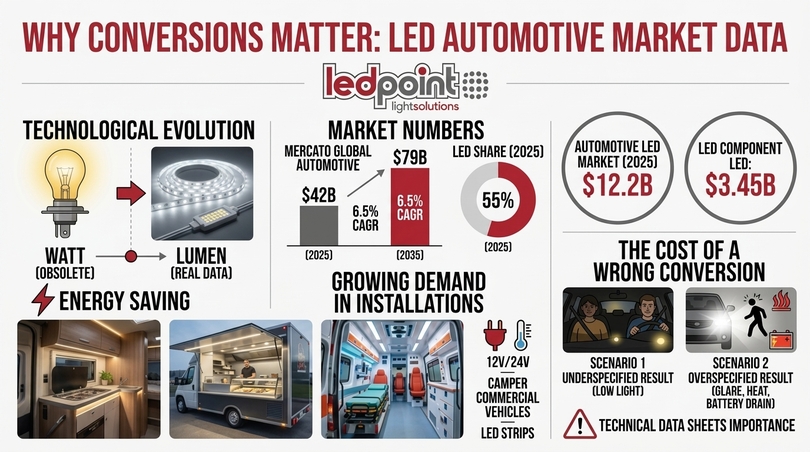
The world of vehicle lighting has changed more in the last ten years than in the previous fifty. Incandescent and halogen lamps, which were conveniently described in watts, have been replaced by LED sources that consume a fraction of the energy for the same amount of light. With LEDs, the watt has ceased to be a reliable indicator of brightness, and the lumen has become the data that really counts. This shifts the responsibility to the installer to correctly read the datasheets.
Market numbers
The main analysis firms agree on solid and constant growth in the sector. The picture emerging from the most recent research is summarized in the following table.
| Indicator | Value | Source |
|---|---|---|
| Global automotive lighting market (2025) | about 42 billion dollars, heading towards 79 billion by 2035 (CAGR 6.5%) | Future Market Insights via Aftermarket News |
| Share of LED technology in the automotive lighting market (2025) | about 55% | Future Market Insights via Aftermarket News |
| Automotive LED lighting market (2025, estimate) | 12.2 billion dollars, expected 20.2 billion by 2032 (CAGR 7.5%) | Persistence Market Research |
| Value of automotive LED components for lighting and displays alone | projection of about 3.45 billion dollars | TrendForce |
Behind these numbers is a very concrete phenomenon that every installer sees in the workshop: the demand for interior, ambient, and service lighting is growing especially in the fittings segment. Camperized vans, equipped commercial vehicles, food trucks, rescue vehicles, ambulances, long-haul truck cabins, boats, and exhibition vehicles demand 12V or 24V LED light that is efficient, thin, and dimmable. And it is precisely here that LED strips become the main working tool.
The cost of a wrong conversion
A conversion error does not stay on paper. If you mistake a lumen value for a lux value, or compare the candelas of a narrow-beam spotlight with the lumens of a diffused strip, the result is an undersized system (the customer complains that "it doesn't make enough light") or an oversized one (glare, excessive consumption from the service battery, overheating). In a vehicle, where energy is limited by the battery capacity and the space to dissipate heat is reduced, every watt and every lumen must be justified. The tables that follow serve exactly this purpose.
3. Photometric quantities explained for the installer
Photometry is the branch of physics that measures light as perceived by the human eye. It does not simply measure the energy of the radiation, but "weighs" it according to the eye's sensitivity, which is maximum in the yellow-green (555 nanometers) and drops towards the blue and red. For this reason, two sources that absorb the same number of watts can produce a very different number of lumens. Let's look at the quantities one by one, with a practical approach and without useless formalisms.
The lumen: the total amount of light
The lumen (symbol lm) is the unit of measurement of luminous flux in the International System. It describes the total amount of visible light emitted by a source in all directions, without saying anything about where that light ends up. Formally, one lumen is the flux emitted by a source with an intensity of one candela within a solid angle of one steradian: 1 lumen = 1 cd × 1 sr.
For the installer, the lumen is the starting data. An LED strip is described in lumens per meter (lumens/m): if the datasheet declares 1,450 lumens/m, it means that every meter of strip emits 1,450 lumens, and that 3 meters emit 4,350. The lumen is additive: you sum the lumens of multiple sources to obtain the total flux of a system. It is also the data that allows you to compare different sources, provided you take into account the losses introduced by profiles, diffusers, and silicone coatings.
Nominal lumens and real lumens
The lumen value declared in the datasheet is measured in laboratory conditions, at controlled temperature and nominal voltage. On the vehicle, the strip works inside a profile, perhaps under an opal diffuser, at an ambient temperature that in summer in a van parked in the sun can exceed 50°C. The lumens actually available can therefore be 10–35% lower than the nominal data, depending on the optics and dissipation. For this reason, in the calculations in this guide we will always introduce a transmission coefficient and a maintenance coefficient.
The candela: intensity in one direction
The candela (symbol cd) is one of the seven base units of the International System and measures luminous intensity, that is, the amount of light emitted in a given direction per unit of solid angle. The name is historical: originally the reference was literally the light of a standard wax candle, which emits about one candela of intensity.
The candela is the quantity that describes the "throw" of a beam. Two sources with the same lumens can have completely different candelas: a spotlight that concentrates 500 lumens in a 10° beam reaches about 20,900 cd, while an LED strip that distributes the same 500 lumens with a 120° opening stops at just over 150 cd at the center. This is why high beams are regulated in candelas: what matters for road safety is how much light reaches the direction of the eyes of other road users.
The steradian in simple words
The steradian (sr) is the unit of solid angle, that is, a three-dimensional "angle" in the shape of a cone. A full sphere measures 4π sr (about 12.57 sr), a hemisphere 2π sr. A cone with a 120° opening is worth π sr, or about 3.14 sr. The narrower the cone, the smaller the solid angle and the higher the candelas for the same number of lumens. In the formulas section you will find the table that directly connects the beam angle to steradians.
The lux: the light that reaches the surface
The lux (symbol lx) is the unit of measurement of illuminance. One lux corresponds to one lumen uniformly distributed over one square meter: 1 lx = 1 lm/m². The meaning of lux, in practical terms, is simple: it indicates how much light "falls" on a plane, whether it's the floor of a cargo area, a camper's cooktop, or a car hood under inspection.
The lux is the only one of the three quantities that is easily measured in the field with an inexpensive instrument, the luxmeter, and it is the one referenced by standards: UNI EN 12464-1 for indoor workplaces, for example, sets the maintained illuminance levels for every activity, from transit areas to color control stations. The customer does not perceive lumens, they perceive lux: this is why the project starts from the required lux and works back to the necessary lumens.
Lux and foot-candle
In documentation of US origin, especially that of accessories for pick-ups, off-road vehicles, and recreational vehicles, you often find the foot-candle (fc), which is one lumen per square foot. 1 foot-candle = 10.764 lux, and 1 lux = 0.0929 fc. A complete conversion table is reported later.
Luminance: perceived brightness
Luminance is the quantity that comes closest to what the eye calls "brightness". The unit of measurement of luminance is the candela per square meter (cd/m²), also known as nit in the display world. It measures how much light a surface, emitting or reflecting, sends towards the observer for every square meter of its apparent area.
In the automotive field, luminance is fundamental for two reasons: the driver's visual comfort and the risk of glare. An exposed LED strip, without a diffuser, has a very high punctual luminance: even if the total lumens are modest, the individual chips can be annoying if they enter the driver's field of view. An opal diffuser lowers the luminance by distributing the same light over a larger surface, at the cost of a small loss of lumens. It is a compromise that must be evaluated case by case, especially for ambient lights that remain on during night driving.
Luminous efficacy: lumens per watt
Luminous efficacy, expressed in lumens per watt (lm/W), tells you how much light you get for every electrical watt absorbed. On a vehicle, where every watt is drawn from a battery or an alternator, it is a decisive parameter. A 55 W H7 halogen lamp produces about 1,500 lumens, or about 27 lm/W; a good LED strip exceeds 110–150 lm/W. Translated into system terms: for the same amount of light, LEDs consume four to five times less.
In the Ledpoint catalog, efficacy is always indicated in the datasheet. For example, the 24V 3000K 240 led/m 14.4 W/m LED strip declares 2,000 lumens/m with an efficacy of 155 lm/W, a particularly interesting value for heavy vehicle cabins with a 24V system, where every ampere saved extends the autonomy while parked.
Table of relationships between quantities
| From / To | Lumen (lm) | Candela (cd) | Lux (lx) |
|---|---|---|---|
| Lumen | — | cd = lumens ÷ Ω (beam angle needed) | lx = lumens ÷ A (illuminated area needed) |
| Candela | lumens = cd × Ω | — | lx = cd ÷ d² (distance needed) |
| Lux | lumens = lx × A | cd = lx × d² | — |
No conversion between lumens, candelas, and lux is possible without a geometric datum: the beam angle, the distance, or the area. Anyone proposing a "lumen to lux" converter that only asks for the number of lumens is oversimplifying: without knowing how many square meters the light falls on, the result is meaningless.
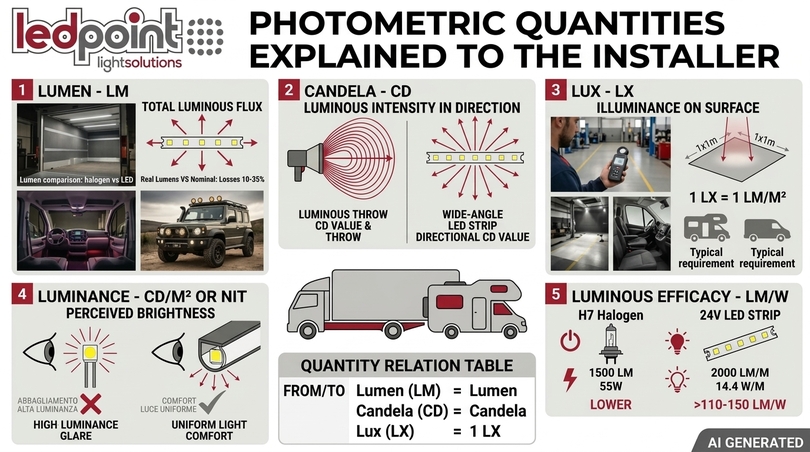
4. Essential conversion formulas
The formulas of basic photometry are few and can be applied with a normal smartphone calculator. The secret is not to memorize them, but to understand which geometric data is needed in each case. In this section we present them in the order they are most often used in a vehicle installation, each with a worked numerical example.
From lumens to candelas (and vice versa): the beam angle
For a source that emits its light approximately uniformly within a cone, the relationship between lumens and candelas depends only on the solid angle of the cone. The formula is:
Ω = 2π × (1 − cos(θ/2)) where θ is the beam opening angle in degrees
cd = lumens ÷ Ω and lumens = cd × Ω
Worked example. A camper reading light declares 180 lumens with a 36° beam. The solid angle is 2π × (1 − cos 18°) = 2π × 0.0489 = 0.307 sr. The intensity at the center of the beam is therefore about 180 ÷ 0.307 = 586 cd. At a distance of 60 cm, on the book, about 586 ÷ 0.36 = 1,630 lux will arrive: a very generous reading light, which can easily be dimmed.
The special case of the LED strip
LED strips with SMD chips like the 2835 have a Lambertian emission, with a conventional emission angle of about 120°. For a Lambertian source, a very convenient relationship holds: the total lumens are equal to π times the on-axis intensity, i.e., cd ≈ lumens ÷ 3.14. A 1,000 lumen/m strip therefore has an on-axis intensity of about 318 cd per meter. We will use this in the section dedicated to calculating lux.
From candelas to lux: the inverse square law
For a source that is small compared to the distance (a spotlight, a taillight, a work projector seen from a few meters), the illuminance on a surface perpendicular to the beam follows the inverse square law:
E (lux) = I (cd) ÷ d² (meters)
If the surface is inclined by an angle α with respect to the perpendicular to the beam, the value must be multiplied by cos α. By doubling the distance, the lux is reduced to a quarter; by tripling it, to a ninth. The following graph shows how the illuminance of a 10,000 cd beam collapses as the distance increases.
Distance (m)Illuminance (lux)123571010,0005,00001 m → 10,000 lx2 m → 2,500 lx3 m → 1,111 lx5 m → 400 lx10 m → 100 lx
Example
A work projector mounted on the back of an equipped van declares 8,000 cd on axis. At 4 meters, on the ground in front of the tailgate, the illuminance will be about 8,000 ÷ 16 = 500 lux, sufficient for night loading and unloading operations. At 8 meters it will drop to 125 lux. If the customer wants to illuminate well up to 8 meters, a source of at least 32,000 cd is needed, or two projectors.
When the inverse square law does not apply
The law works well when the distance is at least five times the largest dimension of the source. For a one-meter long LED strip seen from 50 cm, the inverse square law is way off: the source is linear, not point-like, and the illuminance decreases approximately with the inverse of the distance, not its square. For this reason, the LED strip requires a dedicated formula, which we present in section 9.
From lumens to lux: the area method
When you want to estimate the average illuminance of an enclosed environment, such as the interior of a van, a cabin, or a living cell, the so-called total flux method is used, the heart of every simplified lighting calculation:
E average (lux) = (Φ total × UF × MF) ÷ A
where Φ is the total flux in lumens, A is the area of the plane to be illuminated in m², UF is the utilization factor (the fraction of lumens that actually reaches the plane, typically 0.4–0.6 in small spaces with light walls) and MF is the maintenance factor (which takes into account decay over time and dirt, typically 0.8–0.9 for quality LED strips in a closed profile). The inverse formula, which is the one needed in the design phase, gives the necessary lumens:
Φ necessary (lumens) = (E required × A) ÷ (UF × MF)
Example
The floor of a cargo area measures 3.2 × 1.7 m, or 5.44 m². You want an average of 200 lux for handling operations. With UF = 0.5 and MF = 0.85, you need 200 × 5.44 ÷ 0.425 = about 2,560 lumens. A 1,450 lumen/m strip provides 2,610 with 1.8 meters. For those who want to delve deeper into the reasoning about square meters in domestic environments, Ledpoint has published a dedicated guide on how many lumens per square meter are needed, with a table per room.
From watts to lumens: efficacy
The watt lumen conversion is the one customers ask for most often, and the most insidious. There is no fixed factor between watts and lumens: it depends entirely on the efficacy of the source. The formulas are:
lumens = W × (lm/W) and W = lumens ÷ (lm/W)
A 9.6 W/m LED strip with an efficacy of 115 lm/W emits about 1,100 theoretical lumens/m; the value declared in the datasheet by the manufacturer, measured, is the reference to use. To the recurring question "what do 5 LED watts correspond to?" the correct answer is: from about 400 to about 750 lumens depending on the quality of the LED, roughly equivalent to a 40–60 W incandescent lamp or a small 25-30 W halogen.
From lux to radiant power: the 683 factor
For completeness, those working with sensors, photocells, or infrared cameras may need to switch from photometric to radiometric quantities. At a wavelength of 555 nm, where the eye is most sensitive, 1 watt of radiation corresponds to 683 lumens. For white LED light the real factor is much lower (about 280–350 lumens per optical watt, depending on the spectrum), and for infrared it is zero: an infrared LED strip, like those in the infrared LED strips range, emits optical power but zero lumens, because the eye cannot see it.
5. Ready-to-use conversion tables
This is the section to print and hang in the workshop. The tables are calculated with the formulas from the previous section and allow you to switch from one unit to another without a calculator, with an approximation more than sufficient for field work. All values are rounded.
Beam angle table → steradians → candelas per 1,000 lumens
This table answers the question: "If I concentrate 1,000 lumens in an X-degree beam, how many candelas do I get at the center?". For values other than 1,000 lumens, a simple proportion is enough: 500 lumens give half the candelas, 2,000 lumens double.
| Beam opening (θ) | Solid angle Ω (sr) | Candelas per 1,000 lumens | Lux at 1 m per 1,000 lumens | Lux at 3 m per 1,000 lumens | Typical vehicle application |
|---|---|---|---|---|---|
| 10° | 0.0239 | 41,825 cd | 41,825 lx | 4,647 lx | Driving lights, off-road spots |
| 15° | 0.0538 | 18,603 cd | 18,603 lx | 2,067 lx | Searchlights, spots |
| 20° | 0.0955 | 10,476 cd | 10,476 lx | 1,164 lx | Concentrated reading lights |
| 24° | 0.1373 | 7,283 cd | 7,283 lx | 809 lx | Accent lights, mobile displays |
| 30° | 0.2141 | 4,671 cd | 4,671 lx | 519 lx | Cabin reading lights |
| 36° | 0.3075 | 3,252 cd | 3,252 lx | 361 lx | Adjustable camper spotlights |
| 45° | 0.4783 | 2,091 cd | 2,091 lx | 232 lx | Courtesy lights, steps |
| 60° | 0.8418 | 1,188 cd | 1,188 lx | 132 lx | Diffused work projectors |
| 90° | 1.8403 | 543 cd | 543 lx | 60 lx | Ceiling lights, area floodlights |
| 120° | 3.1416 | 318 cd | 318 lx | 35 lx | SMD LED strips, diffused panels |
Method note
The table assumes a uniform distribution within the cone. In real optics, the intensity at the center is generally a bit higher and drops towards the edges; the candela data declared by the manufacturer, if available, is always to be preferred. For strips and panels with Lambertian emission, the value at 120° coincides exactly with the relationship cd = lumens ÷ π.
Candelas to lux table as a function of distance
This table applies the inverse square law and is used for headlights, projectors, spotlights, and any "point" source seen from an adequate distance.
| Intensity (cd) | 0.5 m | 1 m | 2 m | 5 m | 10 m | 25 m | 50 m | 100 m |
|---|---|---|---|---|---|---|---|---|
| 100 cd | 400 lx | 100 lx | 25 lx | 4 lx | 1 lx | 0.16 lx | 0.04 lx | 0.01 lx |
| 500 cd | 2,000 lx | 500 lx | 125 lx | 20 lx | 5 lx | 0.8 lx | 0.2 lx | 0.05 lx |
| 1,000 cd | 4,000 lx | 1,000 lx | 250 lx | 40 lx | 10 lx | 1.6 lx | 0.4 lx | 0.1 lx |
| 5,000 cd | 20,000 lx | 5,000 lx | 1,250 lx | 200 lx | 50 lx | 8 lx | 2 lx | 0.5 lx |
| 10,000 cd | 40,000 lx | 10,000 lx | 2,500 lx | 400 lx | 100 lx | 16 lx | 4 lx | 1 lx |
| 50,000 cd | — | 50,000 lx | 12,500 lx | 2,000 lx | 500 lx | 80 lx | 20 lx | 5 lx |
| 100,000 cd | — | 100,000 lx | 25,000 lx | 4,000 lx | 1,000 lx | 160 lx | 40 lx | 10 lx |
In the off-road and auxiliary lighting world, the "distance at 1 lux" is often used as a range indicator: it is the distance at which the illuminance drops to 1 lux, roughly the light of a full moon. It is calculated as d = √(cd). A 100,000 cd headlight has a 1 lux range of about 316 meters, a 10,000 cd one stops at 100 meters.
Lux ↔ foot-candle table
| Lux (lx) | Foot-candle (fc) | Foot-candle (fc) | Lux (lx) | |
|---|---|---|---|---|
| 10 | 0.93 | 1 | 10.76 | |
| 50 | 4.65 | 5 | 53.8 | |
| 100 | 9.29 | 10 | 107.6 | |
| 200 | 18.6 | 20 | 215.3 | |
| 300 | 27.9 | 30 | 322.9 | |
| 500 | 46.5 | 50 | 538.2 | |
| 750 | 69.7 | 75 | 807.3 | |
| 1,000 | 92.9 | 100 | 1,076.4 |
Less common units and conversion factors table
| Unit | Quantity | Equivalence | Where you encounter it |
|---|---|---|---|
| Foot-candle (fc) | Illuminance | 1 fc = 10.764 lx | US datasheets, off-road accessories |
| Phot (ph) | Illuminance | 1 ph = 10,000 lx | Historical texts, CGS system |
| Nit | Luminance | 1 nit = 1 cd/m² | Displays, dashboards, infotainment |
| Foot-lambert (fL) | Luminance | 1 fL = 3.426 cd/m² | Projection, US documentation |
| Stilb (sb) | Luminance | 1 sb = 10,000 cd/m² | CGS system |
| International candela (historical) | Intensity | ≈ 1.02 cd | Vintage documentation, classic car restoration |
| Candlepower (cp) | Intensity | 1 cp ≈ 1 cd | Vintage car lamps, American catalogs |
| Lumens per meter (lumens/m) | Linear flux | total lumens = lumens/m × meters | LED strips, neon flex, bars |
Useful curiosity for those restoring classic cars: in old American workshop manuals, bulbs are often classified in "candlepower" (cp). A 2 cp dashboard lamp corresponds roughly to 2 candelas of intensity, which, for a bare bulb radiating in all directions, is about 25 lumens (2 × 4π). Knowing how to convert these values allows you to choose an LED replacement with brightness consistent with the original, without "blasting" an anachronistic light into a historic dashboard.
Lumen watt table: equivalences between traditional sources and LEDs
The lumen watt table is the tool you need when the customer still thinks in watts ("I want the light of a 60 W bulb") and you need to translate the request into lumens. The starting point is always the lumens of the source to be replaced, not its watts: for the same lumens, the LED absorbs a fraction of the power. The values are indicative and rounded.
| Desired lumens | Equivalent incandescent | Equivalent halogen | LED Watts at 100 lumens/W | LED Watts at 120 lumens/W | LED Watts at 150 lumens/W | Meters of 1,000 lumen/m strip |
|---|---|---|---|---|---|---|
| 50 lumens | 5 W (W5W, R5W) | - | 0.5 W | 0.4 W | 0.3 W | 5 cm |
| 125 lumens | 10 W (R10W) | - | 1.25 W | 1.0 W | 0.8 W | 12.5 cm |
| 250 lumens | 25 W | ≈ 20 W | 2.5 W | 2.1 W | 1.7 W | 25 cm |
| 460 lumens | 21 W (P21W) / 40 W domestic | ≈ 33 W | 4.6 W | 3.8 W | 3.1 W | 46 cm |
| 800 lumens | 60 W domestic | ≈ 53 W | 8 W | 6.7 W | 5.3 W | 80 cm |
| 1,500 lumens | 100 W domestic | 55 W (H7) | 15 W | 12.5 W | 10 W | 1.5 m |
| 3,200 lumens | - | 35 W xenon (D2S) | 32 W | 26.7 W | 21.3 W | 3.2 m |
How to read the 1,500 lumens row: the same amount of lumens that a 55 W H7 lamp produces inside a projector is obtained with about 12.5 W of 120 lumen/W LED strip, less than a quarter of the power. However, be careful: the row compares lumens, not use. A headlight lamp and an interior strip have completely different functions, optics, and regulatory requirements, and equivalent lumens only serve to estimate consumption and amount of light in interior fittings.
Lumens per meter to total lumens table
For those working with LED strips, the most frequent conversion of all is the simplest: from the lumens per meter in the datasheet to the total lumens of the system. The table avoids the calculator even for the typical lengths of vehicle fittings.
| Strip lumens/meter | 0.25 m | 0.5 m | 1 m | 1.5 m | 2 m | 3 m | 5 m |
|---|---|---|---|---|---|---|---|
| 525 lumens/m | 131 lumens | 263 lumens | 525 lumens | 788 lumens | 1,050 lumens | 1,575 lumens | 2,625 lumens |
| 900 lumens/m | 225 lumens | 450 lumens | 900 lumens | 1,350 lumens | 1,800 lumens | 2,700 lumens | 4,500 lumens |
| 1,000 lumens/m | 250 lumens | 500 lumens | 1,000 lumens | 1,500 lumens | 2,000 lumens | 3,000 lumens | 5,000 lumens |
| 1,320 lumens/m | 330 lumens | 660 lumens | 1,320 lumens | 1,980 lumens | 2,640 lumens | 3,960 lumens | 6,600 lumens |
| 1,450 lumens/m | 363 lumens | 725 lumens | 1,450 lumens | 2,175 lumens | 2,900 lumens | 4,350 lumens | 7,250 lumens |
| 1,900 lumens/m | 475 lumens | 950 lumens | 1,900 lumens | 2,850 lumens | 3,800 lumens | 5,700 lumens | 9,500 lumens |
| 2,000 lumens/m | 500 lumens | 1,000 lumens | 2,000 lumens | 3,000 lumens | 4,000 lumens | 6,000 lumens | 10,000 lumens |
Remember to apply the diffuser coefficient (section 8.4) to the total lumens: the useful lumens are the datasheet lumens multiplied by the profile transmission. Two meters of 1,450 lumen/m strip under an opal diffuser provide about 1,900–2,200 useful lumens, not 2,900.
Lumens per square meter table: from requirement to lumens
Finally, the inverse table needed in the quoting phase: given the required average illuminance and the area, how many source lumens are needed? The values are calculated with UF = 0.5 and MF = 0.85, therefore with an overall factor of 0.425, typical of a small vehicle environment with light surfaces. In practice, for every lux of target you need about 2.35 source lumens per square meter.
| Required illuminance | Source lumens per square meter | Area 2 m² | Area 4 m² | Area 6 m² | Area 8 m² |
|---|---|---|---|---|---|
| 50 lux | 118 lumens/m² | 235 lumens | 471 lumens | 706 lumens | 941 lumens |
| 100 lux | 235 lumens/m² | 471 lumens | 941 lumens | 1,412 lumens | 1,882 lumens |
| 150 lux | 353 lumens/m² | 706 lumens | 1,412 lumens | 2,118 lumens | 2,824 lumens |
| 200 lux | 471 lumens/m² | 941 lumens | 1,882 lumens | 2,824 lumens | 3,765 lumens |
| 300 lux | 706 lumens/m² | 1,412 lumens | 2,824 lumens | 4,235 lumens | 5,647 lumens |
| 500 lux | 1,176 lumens/m² | 2,353 lumens | 4,706 lumens | 7,059 lumens | 9,412 lumens |
With this table, quoting becomes immediate: a 6 m² cargo area to be illuminated at 200 lux requires about 2,800 source lumens, or two meters of 1,450 lumen/m strip. It's the same logic as the "lumens per square meter" search many customers do online, applied with the correct coefficients for a vehicle.
6. Lumens and candelas of car lamps: reference table
One of the most frequent uses of conversions is comparing a vehicle's traditional lamps with possible LED alternatives, especially for interior and service lights. UNECE regulations set a reference luminous flux in lumens for each lamp category, and this is the number to use as a basis, not the wattage. The table reports the nominal reference values of the most common categories, with production tolerances typically between ±10% and ±15%.
Automotive lamp lumens table
| Category | Type | Nominal power | Reference flux (lumens) | Indicative efficacy (lm/W) | Typical use |
|---|---|---|---|---|---|
| H1 | Halogen | 55 W | ≈ 1,550 lumens | ≈ 28 | High beam, fog light |
| H3 | Halogen | 55 W | ≈ 1,450 lumens | ≈ 26 | Fog light, auxiliary lights |
| H4 | Dual filament halogen | 60/55 W | ≈ 1,650 / 1,000 lumens | ≈ 27 / 18 | High beam / low beam |
| H7 | Halogen | 55 W | ≈ 1,500 lumens | ≈ 27 | Low beam, high beam |
| H8 | Halogen | 35 W | ≈ 800 lumens | ≈ 23 | Fog light |
| H11 | Halogen | 55 W | ≈ 1,350 lumens | ≈ 25 | Low beam, fog light |
| HB3 | Halogen | 60 W | ≈ 1,860 lumens | ≈ 31 | High beam |
| HB4 | Halogen | 51 W | ≈ 1,095 lumens | ≈ 21 | Low beam, fog light |
| D1S / D2S | Discharge (xenon) | 35 W | ≈ 3,200 lumens | ≈ 91 | Discharge projectors |
| P21W | Incandescent | 21 W | ≈ 460 lumens | ≈ 22 | Stop, reverse, indicators |
| P21/5W | Dual filament incandescent | 21/5 W | ≈ 440 / 35 lumens | ≈ 21 / 7 | Stop and position |
| W16W | Incandescent | 16 W | ≈ 310 lumens | ≈ 19 | Reverse, stop |
| R10W | Incandescent | 10 W | ≈ 125 lumens | ≈ 12 | License plate, interior |
| W5W | Incandescent (T10) | 5 W | ≈ 50 lumens | ≈ 10 | Position, license plate, courtesy |
| R5W | Incandescent | 5 W | ≈ 50 lumens | ≈ 10 | Position, license plate |
| C5W | Festoon | 5 W | ≈ 45 lumens | ≈ 9 | Ceiling light, trunk, license plate |
| T4W | Incandescent | 4 W | ≈ 35 lumens | ≈ 9 | Position, dashboard |
What does this table tell us? That traditional service lamps produce very little light and with very low efficacy: a ceiling light with a C5W offers just 45 lumens while consuming 5 W. Twenty centimeters of a 1,000 lumen/m LED strip produces about 200 lumens, over four times as much, absorbing less than 2 W. This is why replacing courtesy and service lights with LED strips is one of the most requested interventions on campers and commercial vehicles.
Candelas and regulatory limits of headlights
For signaling and road lighting, the reference is not the lumen but the candela, because safety depends on how much light reaches certain directions. The UNECE R48 regulation on the installation of lighting devices provides, for example, that the sum of the maximum intensities of all high beams that can be switched on simultaneously does not exceed 430,000 cd. Every approved headlight bears a "reference number" indicating its share of this total.
Applying table 5.2, one understands the practical meaning of that limit: 430,000 cd produces about 43 lux at 100 meters and about 1 lux at 650 meters. Numbers that make it evident why an unapproved source, mounted in place of an optic designed for a specific bulb, can become dangerous: the same amount of lumens, distributed by an optic it was not designed for, can generate uncontrolled candelas in the wrong direction, i.e., towards the eyes of oncoming traffic.
The regulatory framework: what the installer can and cannot do
It is important to be clear on this point, because it concerns the professional responsibility of the installer. The exterior lights of a vehicle circulating on the road (headlights, fog lights, position lights, direction indicators, stop lights, rear fog lights, license plate lights) must be approved devices according to the applicable UNECE regulations, such as R48 for installation, R128 for replacement LED sources, R112 and R98 for projectors, and installed according to the manufacturer's specifications. In Italy, Article 78 of the Highway Code (references and procedures on the portal of the Ministry of Infrastructure and Transport) regulates modifications to the vehicle's construction characteristics, which require inspection and testing at the Motor Vehicle Office.
In some European countries, authorizations have been issued for specific LED retrofit lamps, limited to closed lists of vehicle models: before any intervention on exterior lights, current regulations and the compatibility indicated by the lamp manufacturer must be verified. Ledpoint LED strips are products for general and ambient lighting: their field of use on a vehicle is interior lighting, fittings, living cells, cargo areas, and work areas, not the replacement of approved road signaling devices. On road vehicles, furthermore, added electrical equipment must comply with the electromagnetic compatibility requirements of UNECE R10 regulation: an aspect to always verify, along with correct power supply, which we discuss in the next section.
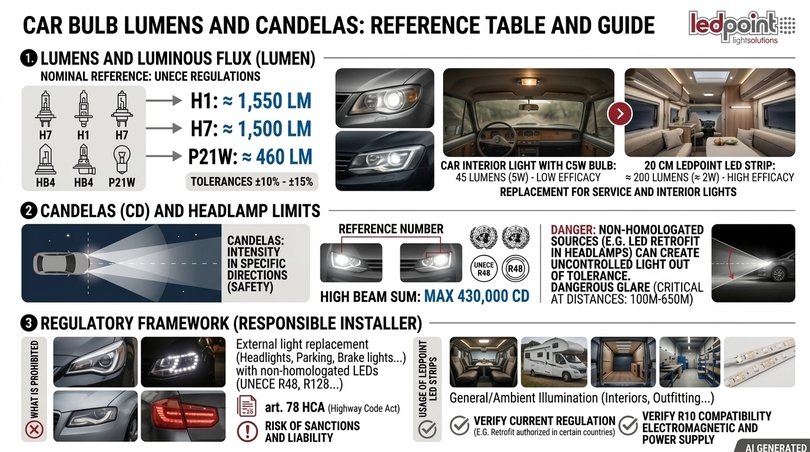
7. 12V and 24V on-board system: voltage, amps, watts and lumens
Here we enter the point that distinguishes an expert installer from an amateur. A 12V on-board system almost never works at 12 volts: with the engine off, a charged lead-acid battery is around 12.6–12.8 V, but with the engine running and the alternator charging, the voltage rises to 13.8-14.7 V, with even higher peaks and transients. And the luminous flux of an LED strip, as well as its lifespan, depend directly on the voltage it is powered with.
Table of real voltages of a vehicle system
| Condition | 12V system (cars, vans, campers) | 24V system (trucks, buses, heavy vehicles) | Effect on an unstabilized LED strip |
|---|---|---|---|
| Discharged battery | 11.8-12.0 V | 23.6-24.0 V | Slightly reduced light |
| Charged battery, engine off | 12.4-12.8 V | 24.8-25.6 V | Slight overvoltage, flux close to or above nominal |
| Engine running, alternator charging | 13.8-14.7 V | 27.6-28.8 V | 15–22% overvoltage: current and temperature increase |
| Battery charger or solar regulator in absorption phase | up to 14.4-14.8 V | up to 28.8-29.6 V | Same situation, often for many consecutive hours |
| Cold start | drops down to 8–9 V (or less) | drops down to 16-18 V | Momentary flickering or switching off |
| Transients (load shedding, switching) | rapid peaks of tens of volts | rapid peaks of tens of volts | Risk of damage to LEDs and resistors |
The transients and voltage variations of vehicle systems are described in the ISO 16750-2 and ISO 7637-2 standards, which automotive component designers use as a reference. For the installer, the practical conclusion is simple: 12V LED strips are designed for a voltage of 12V with tolerance (+0%, -15%), as explicitly stated in all Ledpoint datasheets, and therefore must not be connected directly to the on-board network when it can exceed 12 V.
Why overvoltage reduces lumens over time
In constant voltage LED strips, the current flowing through the LEDs is limited by resistors placed on each segment. The LED diode has a strongly non-linear characteristic: a 15–20% increase in voltage can cause the current to grow much more than proportionally. More current means, in the short term, a few more lumens; but it also means more heat on the chips and resistors, accelerated aging of the phosphor and encapsulation material, alteration of the color temperature, and, in the medium term, a much faster decay of the luminous flux than expected. In a closed profile inside a van in the sun, it's a recipe for finding a yellowed strip or dead segments after a few months.
The correct solution: stabilize the voltage
The professional solution is to interpose a stabilized DC-DC converter for automotive use between the on-board network and the strips, with an extended input range (e.g., 9–36 V) and a fixed 12 V or 24 V output, sized with a power margin of at least 20–25%. This way, the strip always receives its nominal voltage, no matter what the alternator does, and the luminous flux remains constant and predictable. Those installing strips in a living cell also powered by 230V mains at a campsite will instead use a 12V power supply for the 230V branch, always sized with a margin. For particular needs, it is also useful to evaluate, with Ledpoint technical support, LED strips with constant current control system, which maintain uniform brightness along the entire length.
Watts, amps and volts: the basic formulas
One of the most frequent searches by installers is "amps watts volts": how do you switch from one quantity to another? The formulas are those of electrical power in direct current:
| What I calculate | Formula | Example on LED strip |
|---|---|---|
| Power (W) | P = V × I | 12 V × 1.2 A = 14.4 W |
| Current (A) | I = P ÷ V | 72 W ÷ 12 V = 6 A |
| Voltage (V) | V = P ÷ I | 48 W ÷ 2 A = 24 V |
| Energy drawn from battery (Ah) | Ah = I × hours | 3.6 A × 4 h = 14.4 Ah |
| Energy (Wh) | Wh = W × hours | 43.2 W × 4 h = 173 Wh |
The current formula, I = P ÷ V, is the most useful: for the same power, a 24V system carries half the current of a 12V system, and therefore half the voltage drop on the cables. This is one of the reasons why, beyond 5 meters of linear development, it is advisable to prefer 24V LED strips when the on-board network allows it or when using a dedicated converter. The Ledpoint FAQs also emphasize that for lengths over 5 m, the 24V version suffers less from voltage drop.
Amps per meter calculation table for LED strips
This table answers two questions at once: how much current the strip absorbs and which converter or power supply is needed. It is calculated at nominal voltage.
| Strip power | Voltage | Current per meter | 1 m | 2 m | 3 m | 5 m | Recommended power supply for 5 m (+25%) |
|---|---|---|---|---|---|---|---|
| 4.8 W/m | 12 V | 0.40 A/m | 0.4 A | 0.8 A | 1.2 A | 2.0 A | ≥ 30 W |
| 8 W/m | 12 V | 0.67 A/m | 0.67 A | 1.33 A | 2.0 A | 3.33 A | ≥ 50 W |
| 9.6 W/m | 12 V | 0.80 A/m | 0.8 A | 1.6 A | 2.4 A | 4.0 A | ≥ 60 W |
| 14.4 W/m | 12 V | 1.20 A/m | 1.2 A | 2.4 A | 3.6 A | 6.0 A | ≥ 90 W |
| 19.2 W/m | 12 V | 1.60 A/m | 1.6 A | 3.2 A | 4.8 A | 8.0 A | ≥ 120 W |
| 14.4 W/m | 24 V | 0.60 A/m | 0.6 A | 1.2 A | 1.8 A | 3.0 A | ≥ 90 W |
| 19.2 W/m | 24 V | 0.80 A/m | 0.8 A | 1.6 A | 2.4 A | 4.0 A | ≥ 120 W |
Autonomy table: lumens, watts and amp-hours from the service battery
In a camper or camperized van, light is paid for in amp-hours. The following table relates the light obtained (lumens) with the hourly consumption from the 12V service battery, using real data from some strips in the Ledpoint catalog.
| Configuration | Total lumens | Power | Current at 12 V | Consumption in 4 hours | Consumption in 4 hours dimmed at 50% |
|---|---|---|---|---|---|
| 1 m of 4.8 W/m strip (525 lumens/m) | 525 lumens | 4.8 W | 0.40 A | 1.6 Ah | ≈ 0.8 Ah |
| 2 m of 9.6 W/m strip (1,000 lumens/m) | 2,000 lumens | 19.2 W | 1.60 A | 6.4 Ah | ≈ 3.2 Ah |
| 3 m of 14.4 W/m strip (1,450 lumens/m) | 4,350 lumens | 43.2 W | 3.60 A | 14.4 Ah | ≈ 7.2 Ah |
| Comparison: 4 ceiling lights with C5W | 180 lumens | 20 W | 1.67 A | 6.7 Ah | — |
The most eloquent data is the last row: four old festoon ceiling lights consume almost as much as two meters of LED strip, producing less than a tenth of the lumens. The consumption with dimmer at 50% is indicative, because with PWM regulation the average current is reduced in proportion to the duty cycle. For regulation, monochromatic dimmers from Ledpoint can be used, verifying compatibility with the available input voltage.
Dimmable: practical meaning on a vehicle
The term "dimmable" indicates a source whose brightness can be adjusted. In constant voltage LED strips, regulation almost always occurs with pulse width modulation (PWM): the strip is switched on and off thousands of times per second, and the ratio between on-time and off-time determines the perceived average lumens. On a vehicle, dimming is not an aesthetic whim: it reduces consumption, avoids night glare in the cabin, and extends the life of the strip. It is advisable to choose dimmers with a high PWM frequency to avoid visible flicker in video recordings and perceptual annoyance.
8. LED strips for vehicles and campers: lumens per meter table
We arrive at the operational heart of the guide. Once you understand how to read lumens, candelas, and lux, and how to correctly power a strip on a vehicle, you need to choose the product. The parameters to compare are, in order: lumens per meter, efficacy (lm/W), watts per meter, voltage, cutting pitch, IP protection rating, color temperature, and color rendering index (CRI). The following table collects the data declared in the official datasheets of a selection of strips from the Ledpoint catalog particularly suited for vehicle fittings.
Comparative table of Ledpoint LED strips for fittings
| Strip (code) | Lumens/meter | Efficacy | Power | Voltage | Cut | IP | Color / CRI | Recommended vehicle use |
|---|---|---|---|---|---|---|---|---|
| F52-40s-060DF1 | 525 lumens/m | 120 lm/W | 4.8 W/m | 12 V | 5 cm | IP20 | 4000K, CRI Ra>93 | Ambient lights, courtesy, steps, compartments |
| F52-40s-060821Z (Zig-Zag) | 900 lumens/m | 125 lm/W | 8 W/m | 12 V | 5 cm | IP20 | 4000K, Ra>80 | Curved profiles, rounded furniture edges |
| F52-260-120DF1 | 980 lumens/m | 115 lm/W | 9.6 W/m | 12 V | 2.5 cm | IP20 | 2600–2800K, Ra>80 | Camper sleeping area, relaxing warm light |
| F52-40s-120DF1 | 1,000 lumens/m | 115 lm/W | 9.6 W/m | 12 V | 2.5 cm | IP20 | 4000K, Ra>80 | Kitchen under-cabinet, van ceiling |
| F52-40s-0608H1 | 1,260 lumens/m | 90 lm/W | 14.4 W/m | 12 V | 5 cm | IP20 | 4000K, CRI Ra>97 | Color control, display fittings, workshop |
| F52-27s-0608F1 | 1,320 lumens/m | 100 lm/W | 14.4 W/m | 12 V | 5 cm | IP20 | 2700K, Ra>80 | Warm general light in living cell |
| F52-40s-0608F1 | 1,450 lumens/m | 110 lm/W | 14.4 W/m | 12 V | 5 cm | IP20 | 4000K, Ra>80 | Cargo area, general work light |
| F52-35s-1208F1/14.4 | 1,550 lumens/m | 120 lm/W | 14.4 W/m | 12 V | 2.5 cm | IP20 | 3500K, Ra>80 | Soft general light with high rendering |
| F52-65s-240DF1 | 1,900 lumens/m | 115 lm/W | 19.2 W/m | 12 V | 1.25 cm | IP20 | 6500K, Ra>80 | Inspection, mobile workshop, maximum light |
| K52-40s-120DF1 (IP65) | 950 lumens/m (estimated) | 110 lm/W | 9.6 W/m | 12 V | 2.5 cm | IP65 | 4000K, Ra>80 | Camper bathroom, lockers, wet areas |
| K52-40s-0608F1 (IP65) | 1,300 lumens/m (estimated) | 110 lm/W | 14.4 W/m | 12 V | 5 cm | IP65 | 4000K, Ra>80 | Cargo areas, boxes, food trucks |
| F52-30s-1208F2/14.4 | 1,410 lumens/m | 110 lm/W | 14.4 W/m | 24 V | 5 cm | IP20 | 3000K, Ra>80 | Truck cabins, buses, 24V systems |
| F52-30s-x240DF2/14.4 | 2,000 lumens/m | 155 lm/W | 14.4 W/m | 24 V | 3.33 cm | IP20 | 3000K, Ra>80 | Maximum efficiency on heavy vehicles |
Data taken from the official product datasheets on ledpoint.it. For IP65 versions, the output flux is indicated as an estimated value, because the silicone coating absorbs part of the light: the energy class refers to the internal source.
How to read the table: three selection criteria
First criterion: lumens per meter determine how much strip is needed. If the calculation in section 4.3 says you need 2,600 lumens, with a 1,450 lumen/m strip 1.8 meters are enough, with a 525 lumen/m strip you would need almost 5. In vehicles, available space is often the main constraint: the more powerful strip allows you to get the same light with fewer meters, but concentrates more heat in less space.
Second criterion: efficacy in lm/W determines consumption. Between two strips that produce the same lumens, the one with more lm/W draws fewer amps from the battery. The jump from 90 to 155 lm/W, for the same light, means consuming almost 42% less. On a camper parked for a long time without hookups, it's a difference measured in days of autonomy.
Third criterion: the cutting pitch determines the precision of the installation. In the tight spaces of a vehicle (edges of cabinets, ceiling frames, glove compartments) a cut every 2.5 cm or every 1.25 cm allows you to exploit every centimeter, while a cut every 5 or 10 cm forces you to leave dark areas or protrude beyond the profile. High-density strips, like those in the 240 led/m LED strips category, also offer a more continuous light line, with less visible "dotting" through the diffuser.
IP protection: which rating to choose on a vehicle
The IP protection rating describes the enclosure's resistance to dust and water. On a vehicle, the environment is harsher than domestic: condensation, thermal excursions, vibrations, washing, dust in cargo areas. The choice must be made area by area.
| Vehicle area | Main risks | Recommended IP rating | Note on light |
|---|---|---|---|
| Ceiling and walls of living area | Dust, occasional condensation | IP20 in closed profile with diffuser | No loss beyond that of the diffuser |
| Kitchen under-cabinet | Vapors, grease, splashes | IP20 in closed profile or IP65 | The profile makes cleaning easier |
| Cell bathroom and shower | High humidity, condensation | IP65 or higher | Silicone reduces flux by an estimated 5–15% |
| Cargo area, box | Impacts, dust, washing | IP65 in protective profile | Prefer impact-resistant diffusers |
| External lockers, tailgate, non-road external areas | Rain, splashes, UV rays | IP65–IP67 | Verify UV resistance of the coating |
An IP55 rating, which often appears in searches, protects against dust and water jets but not immersion; for LED strips, the reference threshold in the Ledpoint catalog is IP65 with extruded silicone tube, suitable for most wet areas of a living vehicle.
Aluminum profiles: dissipation and light control
On a vehicle, the aluminum profile is not an optional accessory. The profile dissipates the heat of the chips, protects the strip from impacts and vibrations, and, with the diffuser, transforms a row of luminous points into a continuous line of light, lowering luminance and therefore the risk of glare. Among the most used models in fittings are the 17x8 mm 2-meter aluminum profile, compact and suitable for ceilings and cabinets, and the 16 mm corner aluminum profile, ideal for directing light at 45° in the corners between wall and ceiling. The entire range of aluminum profiles and diffusers allows you to choose the best compromise between output lumens and visual comfort.
Table of indicative lumen losses per diffuser type
| Configuration | Indicative transmission (η) | Residual lumens from 1,000 lumens/m | Visual effect |
|---|---|---|---|
| Bare strip | 1.00 | 1,000 lumens/m | Visible luminous points, maximum luminance |
| Profile with transparent diffuser | 0.85–0.92 | 850–920 lumens/m | Visible points, mechanical protection |
| Profile with satin diffuser | 0.75–0.85 | 750–850 lumens/m | Good compromise, attenuated points |
| Profile with opal diffuser | 0.60–0.75 | 600–750 lumens/m | Continuous light line, low luminance |
| IP65 silicone strip | 0.85–0.95 | 850–950 lumens/m | Slight diffusion, humidity protection |
Indicative average values: real transmission depends on the thickness of the diffuser, the distance between strip and diffuser, and LED density per meter.
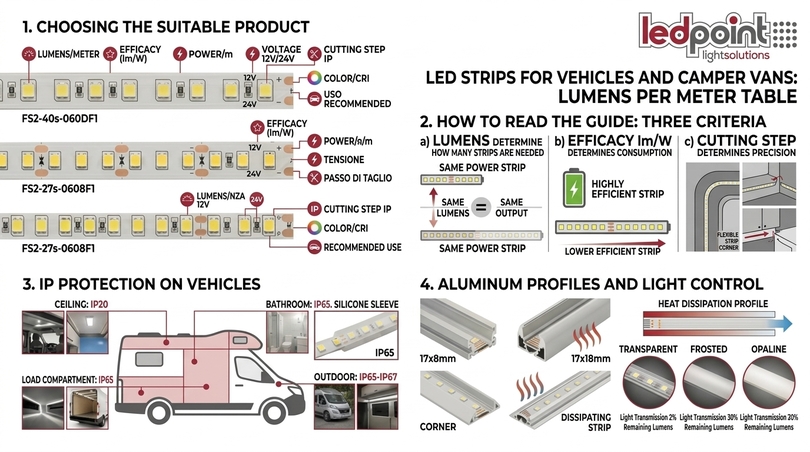
9. From lumens/meter to lux: calculating the illuminance of an LED strip
This is the section you won't find in most guides, because it requires an extra step compared to classic formulas. An LED strip is not a point source but a linear source, and its illuminance does not follow the inverse square law. The Ledpoint technical team proposes here a simplified calculation method, but physically correct for Lambertian sources like SMD strips, which allows you to go from datasheet lumens per meter to lux on the plane in a few seconds.
The linear source formula
For an LED strip with Lambertian emission (conventional 120° opening), facing a parallel plane placed at distance d, the illuminance under the strip is:
E (lux) ≈ [Φ' (lumens/m) ÷ (2 × d)] × k × η
where Φ' are the lumens per meter of the strip, d is the distance in meters, k is a factor that takes into account the finite length of the strip, and η is the transmission of the diffuser. For a very long strip compared to the distance, k is 1: a 1,000 lumen/m strip produces about 1,000 ÷ (2 × 0.5) = 1,000 lux at 50 cm below its center line. Note well: illuminance decreases with the inverse of the distance, not its square. By doubling the distance, the lux is halved, not reduced to a quarter.
Table of factor k for finite length strips
The factor k is calculated from the angle α under which half the strip is seen from the center point: k = (α + sin α × cos α) ÷ (π/2), with α = arctan(L ÷ 2d). For convenience, here are the pre-calculated values.
| Length/distance ratio (L/d) | Example | Factor k at center |
|---|---|---|
| 0.5 | 25 cm strip seen from 50 cm | ≈ 0.31 |
| 1 | 50 cm strip seen from 50 cm | ≈ 0.55 |
| 2 | 1 m strip seen from 50 cm | ≈ 0.82 |
| 3 | 1.5 m strip seen from 50 cm | ≈ 0.91 |
| 4 | 2 m strip seen from 50 cm | ≈ 0.95 |
| 6 or more | 3 m strip seen from 50 cm | ≈ 0.98–1.00 |
Illuminance to the side of the strip: the cosine cubed rule
If the point to be illuminated is not exactly under the strip, but shifted laterally by an amount x, the illuminance decreases according to an elegant and easy-to-remember rule: E(x) = E(0) × cos³φ, where φ is the angle between the vertical and the direction of the point (tan φ = x ÷ d). At 30° of shift, about 65% of the light remains, at 45° about 35%, at 60° just 12.5%.
| Lateral angle φ | Shift x at 1 m distance | Illuminance fraction (cos³φ) |
|---|---|---|
| 0° | 0 cm | 100% |
| 10° | 18 cm | 96% |
| 20° | 36 cm | 83% |
| 30° | 58 cm | 65% |
| 40° | 84 cm | 45% |
| 45° | 100 cm | 35% |
| 60° | 173 cm | 12.5% |
This rule explains why, in a 1.7-meter wide cargo area, a single central strip leaves the sides in semi-darkness, and why two parallel strips positioned at about a third of the width produce a much more uniform illuminance for the same total lumens.
Quick table: lux under an LED strip as a function of distance
The following table applies the formula with k = 0.9 (strip at least three times the distance long) and a satin diffuser (η = 0.8). The lumens per meter correspond to real strips from the Ledpoint catalog.
| Strip lumens/meter | d = 0.3 m | d = 0.5 m | d = 0.8 m | d = 1.2 m | d = 1.6 m | d = 2.0 m |
|---|---|---|---|---|---|---|
| 525 lumens/m | 630 lx | 378 lx | 236 lx | 158 lx | 118 lx | 95 lx |
| 900 lumens/m | 1,080 lx | 648 lx | 405 lx | 270 lx | 203 lx | 162 lx |
| 1,000 lumens/m | 1,200 lx | 720 lx | 450 lx | 300 lx | 225 lx | 180 lx |
| 1,450 lumens/m | 1,740 lx | 1,044 lx | 653 lx | 435 lx | 326 lx | 261 lx |
| 1,900 lumens/m | 2,280 lx | 1,368 lx | 855 lx | 570 lx | 428 lx | 342 lx |
| 2,000 lumens/m | 2,400 lx | 1,440 lx | 900 lx | 600 lx | 450 lx | 360 lx |
Calculated, not measured values: they represent the illuminance on the center line under the strip, without the contribution of wall reflections. In a vehicle with light walls, reflections typically add 10–25%.
Distance (m)Relative lux (100 = at 0.5 m)0.51.01.52.02.5100500LED Strip (1/d)Point source (1/d²)
The graph makes the practical advantage of the linear source evident: moving away from an LED strip, the light drops much more slowly than moving away from a spotlight. At 2 meters the strip retains 25% of the illuminance it had at 50 cm; the spotlight just 6%. This is why strips are ideal for the general and uniform lighting of elongated spaces like a cargo area or a camper corridor.
Three calculation examples
Example A: camper kitchen under-cabinet
F52-40s-120DF1 1,000 lumen/m strip, 1 m long, mounted in a satin profile at 50 cm from the counter. L/d = 2, so k = 0.82; η = 0.8. E = 1,000 ÷ 1.0 × 0.82 × 0.8 ≈ 656 lux at the center of the counter. The result is well above the 300–500 lux recommended for food preparation: the strip can be dimmed to 60–70% reducing consumption, or the more efficient F52-40s-060DF1 525 lumen/m can be chosen, which would give about 344 lux with halved consumption.
Example B: van cargo area
Two IP65 K52-40s-0608F1 1,300 lumen/m strips, 3 m long, fixed to the ceiling at 1.6 m from the floor and spaced 1.2 m apart (each 60 cm from the center line). For each strip: L/d ≈ 1.9, so k ≈ 0.80; η = 1 (silicone is already counted in the estimated data). Under the strip: 1,300 ÷ 3.2 × 0.80 ≈ 325 lux. At the center of the floor, shifted by 60 cm: tan φ = 0.375, φ ≈ 20.6°, cos³φ ≈ 0.82 → 266 lux per strip, about 530 lux total at the center, plus the contribution of reflections. Excellent illuminance for loading, unloading, and checking goods.
Example C: reading light above the bed
Warm F52-260-120DF1 980 lumen/m strip, 40 cm long, in an opal profile (η = 0.65) at 60 cm from the pillow. L/d ≈ 0.67, k ≈ 0.40. E ≈ 980 ÷ 1.2 × 0.40 × 0.65 ≈ 212 lux. 300–500 lux are recommended for reading: you can shorten the distance, switch to a satin diffuser (about 260 lux) or lengthen the strip to 60 cm (k ≈ 0.55, about 290 lux). It's the perfect example of how geometry counts as much as lumens.
10. How many lux are needed: passenger compartment, cargo area, camper, workshop
Every project starts with a lux target. Without a target, any amount of lumens is "too much" or "too little" depending on the opinion of the moment. For work environments there is a precise standard, UNI EN 12464-1, while for vehicle living spaces reference is made to the consolidated values of residential lighting, adapted to reduced distances and electrical autonomy needs. The following table collects the indicative values that the Ledpoint technical team suggests as a starting point.
Table of recommended illuminance levels
| Area or activity | Recommended illuminance | Suggested color temperature | Typical solution with LED strips |
|---|---|---|---|
| Ambient light during night driving (passenger compartment, cabin) | 1-10 lx | 2700K or dim colored light | Low flux dimmed strip, out of driver's field of view |
| Courtesy lights, steps, walkways | 20-50 lx | 2700-3000K | 4.8 W/m strip in profile, activated by sensors or door contacts |
| Camper living area, general light | 100-200 lx | 2700-3500K | 9.6-14.4 W/m strips in ceiling or coves, dimmable |
| Sleeping area, general light | 50-100 lx | 2200-2700K | Low flux warm white strips |
| Reading | 300-500 lx | 3000-4000K | Short strip in profile or dedicated spotlight |
| Camper or food truck kitchen counter | 300-500 lx | 3000-4000K, CRI ≥ 90 recommended | Under-cabinet 9.6-14.4 W/m in satin profile |
| Bathroom, mirror | 200-500 lx on face | 3000-4000K, CRI ≥ 90 | IP65 strip on sides of mirror |
| Cargo area, goods handling | 150-300 lx | 4000K | Two parallel IP65 1,300 lumen/m strips |
| Mobile workshop, general mechanical work | 300-500 lx | 4000-5000K | 14.4-19.2 W/m strips or LED bars |
| Inspection, bodywork and color control | 750-1,000 lx and above | 5000-6500K, CRI ≥ 90 | High color rendering and high density strips |
Indicative values. For fixed workplaces (workshops, body shops, inspection centers) the reference requirements are those of the UNI EN 12464-1 standard for the specific activity, to be verified with a lighting designer.
From lux to lumen: calculating lumens for a camper living area
Let's put the tables together. The living area of a camper measures 2.5 × 2.0 m, or 5 m². The target is 150 average lux. With UF = 0.5 (light wood walls, low ceiling) and MF = 0.85, the room lumen calculation gives: 150 × 5 ÷ 0.425 = about 1,765 lumens. With a 1,320 lumen/m strip in a satin profile (η = 0.8, so about 1,056 useful lumens/m) you need about 1.7 meters of strip. With two 1-meter side coves you get 2,112 useful lumens, with margin for dimming. Consumption: 2 m × 14.4 W/m = 28.8 W, or 2.4 A at 12 V at full power.
11. Color temperature and CRI: beyond lumens
Two strips with the same lumens can give completely different sensations. Color temperature determines the tone of the light, warm or cold, while the color rendering index determines how faithfully the colors of illuminated objects are rendered. On a vehicle, both parameters affect comfort, safety, and the perception of fitting quality.
LED color temperature in kelvin
Color temperature is measured in kelvin (K). Low values indicate a warm light, tending towards yellow-orange; high values a cold light, tending towards white-blue. The Ledpoint catalog organizes strips precisely by temperature ranges, a convenient setup for the automotive installer as well.
| Range | Kelvin | Sensation | Vehicle use | Ledpoint category |
|---|---|---|---|---|
| Warm white | 2200-3500K | Welcoming, relaxing | Sleeping area, ambient light, classic cars | Warm white LED strips |
| Neutral white | 3800-5300K | Natural, balanced | Kitchen, cargo area, general light | White LED strips |
| Cold white | 5500-8700K | Technical, stimulating | Mobile workshop, inspection | Cold white LED strips |
| Ice white | 9000-15000K | Scenographic, bluish | Aesthetic effects, display fittings | Ice white LED strips |
| Variable white | from warm to cold | Adjustable | Campers with day/night scenes | CCT LED strips |
With the same technology, warm light versions usually have slightly lower efficacy, because a larger part of the blue light from the chip is converted by the phosphor with some loss. This can also be seen in the catalog data: the F52-27s-0608F1 at 2700K declares 100 lm/W, while the F52-40s-0608F1 at 4000K of equal power declares 110. Those thinking in lumens must keep this in mind when comparing strips of different tones.
Color temperature of street lights
A useful observation for those restoring or fitting: halogen headlights work around 3000-3300K, xenon lamps around 4000-4500K, original factory LED projectors between 5000 and 6000K. For interior lighting, during night driving, low color temperatures and contained intensities disturb the eye's adaptation to the dark less and reduce reflections on the windshield. It is a good rule to design cabin ambient lights with warm tones and always dimmable.
The color rendering index (CRI)
The color rendering index (CRI or Ra) indicates, on a scale up to 100, how faithfully a source renders colors compared to a reference source. A CRI above 80 is sufficient for general light, a CRI above 90 is recommended where colors matter: kitchen, bathroom, makeup, bodywork control, product display in a shop-vehicle. The Ledpoint catalog offers strips with CRI Ra>97, like the F52-40s-0608H1, and an entire Sunlike line with a spectrum very close to sunlight.
The price of a very high CRI is paid in lumens: the F52-40s-0608H1 with Ra>97 declares 1,260 lumens/m and 90 lm/W, against the 1,450 lumens/m and 110 lm/W of the F52-40s-0608F1 with Ra>80 of equal power. The 13% less light is amply compensated where you need to recognize a shade of paint or evaluate the freshness of food, but it is not necessary in a cargo area.
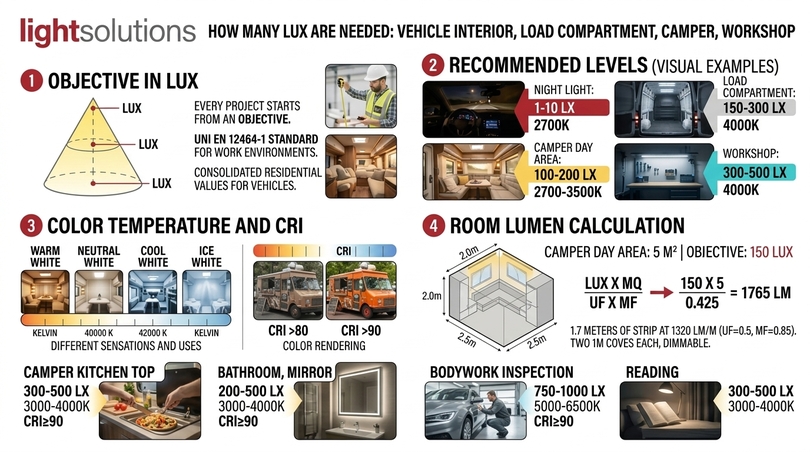
12. Wiring, cable cross-section and voltage drop
You can choose the perfect strip and calculate lux precisely, but if the wiring is undersized, the light that arrives will not be as expected. Every volt lost on the cables is a reduction in lumens downstream, and at low voltage, with currents of several amps, volts are lost quickly. In vehicle systems, where cables make long and tortuous paths inside the pillars, it is a very concrete problem.
The voltage drop formula in direct current
For a connection with round trip in copper, the voltage drop is:
ΔV = (2 × L × I × ρ) ÷ S
where L is the length of the connection in meters (one way only), I is the current in amps, S is the cable cross-section in mm², and ρ is the resistivity of copper, equal to about 0.0175 Ω·mm²/m at 20°C (it increases at higher temperatures). In a 12V system, it is good practice not to exceed a 3% drop, i.e. about 0.36 V between the power supply and the start of the strip.
Voltage drop table per cable cross-section
| Current | Cable length (one way) | 0.75 mm² | 1 mm² | 1.5 mm² | 2.5 mm² | 4 mm² |
|---|---|---|---|---|---|---|
| 2 A | 2 m | 0.19 V | 0.14 V | 0.09 V | 0.06 V | 0.04 V |
| 2 A | 5 m | 0.47 V | 0.35 V | 0.23 V | 0.14 V | 0.09 V |
| 4 A | 2 m | 0.37 V | 0.28 V | 0.19 V | 0.11 V | 0.07 V |
| 4 A | 5 m | 0.93 V | 0.70 V | 0.47 V | 0.28 V | 0.18 V |
| 6 A | 2 m | 0.56 V | 0.42 V | 0.28 V | 0.17 V | 0.11 V |
| 6 A | 5 m | 1.40 V | 1.05 V | 0.70 V | 0.42 V | 0.26 V |
| 8 A | 2 m | 0.75 V | 0.56 V | 0.37 V | 0.22 V | 0.14 V |
| 8 A | 5 m | 1.87 V | 1.40 V | 0.93 V | 0.56 V | 0.35 V |
| 10 A | 5 m | 2.33 V | 1.75 V | 1.17 V | 0.70 V | 0.44 V |
Reading the table: a 5-meter 14.4 W/m strip (6 A) powered with 5 meters of 1.5 mm² cable loses 0.7 V, almost 6% of the voltage, with a visible flux reduction and a strip end darker than the beginning. With a 2.5 mm² cable the loss drops to 0.42 V, acceptable; with a 24V power supply the same power would require 3 A and the drop would be halved. There are three solutions, which can be combined: increase the cross-section, shorten the connection by moving the converter closer, power the strip from both ends or from the center. For connections, Ledpoint provides cables, connectors, and solder joints.
Good wiring practices on a vehicle
On a vehicle, vibrations are the number one enemy of connections. Quick pressure connectors are convenient but, if subjected to continuous vibrations and thermal excursions, they can loosen and generate false contacts, flickering, and localized overheating. Where possible, soldering protected by heat shrink tubing and mechanical fixing of the cable upstream of the joint is preferable, to relieve stress. Every line must be protected by a fuse sized to the cable cross-section and positioned close to the power source. The strip terminals must be sealed with LED strip end caps in IP65 versions, so as not to nullify humidity protection.
13. Measuring in the field: luxmeter and testing procedure
Calculation predicts, measurement confirms. A professional installer closes the job with a lux measurement: it is the most effective way to demonstrate to the customer that the system does what was promised, and to have a reference in case of future disputes.
The instrument: the LED luxmeter
The luxmeter measures illuminance in lux via a photodetector with a spectral response corrected according to the eye's sensitivity curve. Cheap luxmeters calibrated for incandescent lamps can make significant errors with LED sources, which have a different spectrum. For this reason, Ledpoint offers the Tenmars TM-201L LED luxmeter, an instrument specifically designed to measure LED sources, which you can find in the instruments category.
Six-step testing procedure
| Step | What to do | Why |
|---|---|---|
| 1. Stabilize the system | Turn on the strips at maximum power and wait at least 15-30 minutes | LED flux drops slightly with temperature until it stabilizes |
| 2. Check the voltage | Measure with a multimeter the voltage at the beginning and end of the strip | A difference greater than 3-5% indicates undersized wiring |
| 3. Eliminate parasitic light | Measure in the dark or subtract the reading with strips off | External light falsifies the measurement |
| 4. Position the sensor | Place the sensor flat on the work surface, without shading it with your body | Lux depends on the inclination of the surface |
| 5. Measure on a grid | Take multiple points (center, edges, corners) and calculate average, minimum, and uniformity (minimum ÷ average) | Uniformity is as important as the average value |
| 6. Document | Note values, voltage, color temperature, and dimmer position in the delivery sheet | Technical reference for the customer and future assistance |
Comparing the measurement with the calculation is also the best way to refine your method. If the measurements are systematically 10–20% higher than the calculation, it is the contribution of reflections from light walls; if they are lower, it is advisable to check voltage, strip temperature, and real diffuser transmission.
14. The most common installer mistakes
From Ledpoint's technical support experience, some recurring errors emerge, almost always linked to a wrong reading of photometric or electrical quantities. Knowing them in advance saves time, material, and complaints.
Confusing lumens and lux
It's the most common mistake: reading "1,000 lumens" and expecting "1,000 lux". As we have seen, lux depends on area and distance; the same 1,000 lumens can produce 1,000 lux on one square meter or 100 lux on ten. The solution is to always start from the lux target and work back to lumens with the area method.
Comparing candelas and lumens
A "3,000 candela" spotlight is not brighter than a "1,500 lumen" strip: they are different quantities. The spotlight concentrates light in a narrow beam and reaches high intensity values, but its total lumens may be just a few hundred. To compare two sources, you must bring them to the same quantity with the tables in section 5.
Connecting 12V strips directly to the alternator
As seen in section 7, the on-board system when charging well exceeds 12 V. Connecting a 12V strip without stabilization drastically reduces its lifespan and luminous flux stability. The DC-DC converter is a small cost compared to redoing a fitting.
Ignoring diffuser and silicone losses
An opal diffuser can absorb up to 35-40% of lumens. If you design based on the nominal lumens of the bare strip and then mount an opal profile, the result will be significantly darker than expected. The η coefficient must always be included in the calculation.
Undersizing cables and power supply
Cables that are too thin and converters at the limit of nominal power cause light drops, flickering, and overheating. The rule is: 20-25% margin on power and voltage drop not exceeding 3%.
Placing light in the driver's field of view
A high luminance strip visible directly or reflected on the windshield during night driving is a risk, as well as an annoyance. Cabin ambient lights must be shielded, oriented towards opaque surfaces, and always adjustable, with warm tones and minimum intensity while driving.
Forgetting thermal dissipation
A 14.4 W/m or 19.2 W/m strip glued directly to a plastic panel or carpet coating, without an aluminum profile, operates at high temperatures. Heat is the main enemy of LED lifespan and lumen maintenance over time; the aluminum profile is the first defense.
15. Complete practical case: the camperized van
To conclude, let's put all the tools from this guide together in a real and typical project: the lighting fitting of a medium camperized van with a 12V service system, 100 Ah lithium battery, solar panel, and mains battery charger. The goal is to obtain a comfortable, efficient, and documentable lighting system, with consumption sustainable for three days of parking without hookups.
The requirements
| Area | Dimensions / distance | Target | Average daily use |
|---|---|---|---|
| Living area (ceiling) | 2.5 × 1.6 m, ceiling 1.3 m from table | 150 lx average, 2700–3000K, dimmable | 3 h at 60% |
| Kitchen (under-cabinet) | 1.0 m, 0.5 m from counter | 400 lx, 4000K, CRI ≥ 90 | 1 h at 100% |
| Bathroom | 0.6 m strip on side of mirror | 300 lx on face, IP65 | 0.5 h at 100% |
| Bed area (reading) | 2 × 0.5 m, 0.6 m from pillow | 300 lx, about 3000K | 1 h at 100% |
| Courtesy / step lights | 1.5 m total | 30 lx, with sensor | 0.5 h at 100% |
The choices and calculations
Living area. Area 4 m², target 150 lx, UF 0.5, MF 0.85: 150 × 4 ÷ 0.425 ≈ 1,410 useful lumens needed. Choice: 2 1.2 m coves with F52-27s-0608F1 at 2700K 1,320 lumens/m in satin profile: 2.4 m × 1,320 × 0.8 ≈ 2,530 useful lumens, about 270 average lux at full power, which at 60% drops to about 160 lux. Full power: 2.4 × 14.4 = 34.6 W (2.9 A).
Kitchen. 1 m of F52-40s-060DF1 525 lumens/m with CRI Ra>93 would give about 344 lux: slightly below target. Final choice: the F52-40s-0608H1 with CRI Ra>97 1,260 lumens/m, which with k = 0.82 and η = 0.8 produces about 826 lux, to be dimmed to around 50%, with excellent color rendering on food. Full power: 14.4 W (1.2 A).
Bathroom. 0.6 m of K52-40s-120DF1 IP65 950 lumens/m per side of the mirror, at about 40 cm from the face: with L/d = 1.5 factor k is about 0.72, so 950 ÷ 0.8 × 0.72 ≈ 850 theoretical lux per side on axis, abundant even considering the inclination of the face. Power: 1.2 m × 9.6 W/m = 11.5 W (0.96 A).
Reading. 2 0.5 m strips with F52-260-120DF1 980 lumens/m in satin profile at 60 cm: L/d ≈ 0.83, k ≈ 0.47, E ≈ 980 ÷ 1.2 × 0.48 × 0.8 ≈ 310 lux. Target hit. Power: 1 m × 9.6 W/m = 9.6 W (0.8 A).
Courtesy. 1.5 m of F52-40s-060DF1 525 lumens/m, activated by sensor: about 790 total lumens, abundant for the 30 lx of passage, even dimmed. Power: 7.2 W (0.6 A).
The energy balance
| Area | Full current | Usage | Estimated daily consumption |
|---|---|---|---|
| Living area | 2.9 A | 3 h at 60% | ≈ 5.2 Ah |
| Kitchen | 1.2 A | 1 h at 50% | ≈ 0.6 Ah |
| Bathroom | 0.96 A | 0.5 h | ≈ 0.5 Ah |
| Reading | 0.8 A | 1 h | ≈ 0.8 Ah |
| Courtesy | 0.6 A | 0.5 h | ≈ 0.3 Ah |
| Total | 6.5 A (all on) | ≈ 7.4 Ah per day |
Three days of parking cost about 22 Ah, just over a fifth of the 100 Ah battery, leaving ample room for refrigerator, water pump, and recharges. With old festoon ceiling lights, to get comparable light an enormous power would have been needed and the balance would have been unsustainable. All lines pass through a stabilized 12V DC-DC converter of at least 100 W (6.5 A × 12 V = 78 W, plus 25% margin), protected by a fuse, with 1.5-2.5 mm² cables sized according to table 12.2.
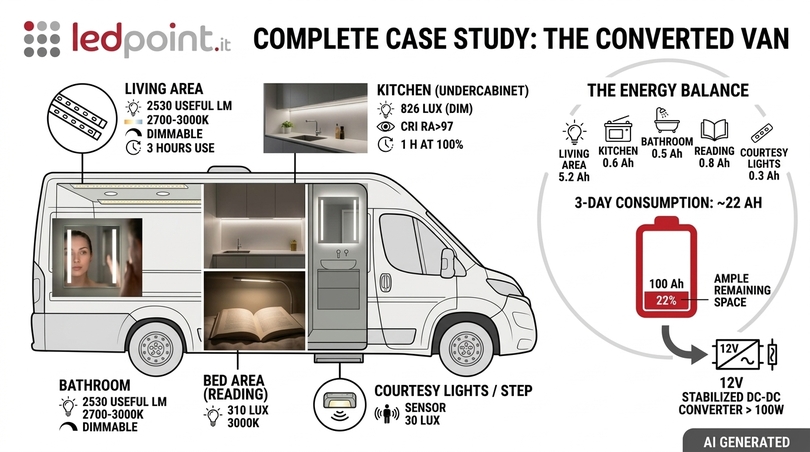
16. Frequently Asked Questions (FAQ)
Here we collect the questions that most often arrive at the Ledpoint technical service about lumens, lux, and candelas, with short and direct answers.
What is the difference between lumens and lux?The lumen measures the total amount of light emitted by a source in all directions; the lux measures how much of that light reaches a surface, per square meter. One lux equals one lumen distributed over one square meter. The same 1,000 lumens produce 1,000 lux on 1 m² but only 100 lux on 10 m². |
How do you convert lumens to lux?You divide the flux in lumens by the illuminated area in square meters: lux = lumens ÷ m². For a realistic calculation, multiply the lumens by a utilization factor (0.4–0.6 in small spaces) and a maintenance factor (0.8–0.9). Without knowing the area, conversion from lumens to lux is not possible. |
How do you convert candelas to lumens?You multiply the candelas by the solid angle of the beam in steradians: lumens = candelas × Ω, with Ω = 2π × (1 − cos(θ/2)). A 60° beam is worth 0.842 sr, so 1,000 cd correspond to about 842 lumens. For Lambertian LED strips, lumens are about π times the on-axis candelas. |
How many lux does a 1,000 lumen/m LED strip produce?Under a long strip, at distance d, the illuminance is about lumens/meter ÷ (2 × d). A 1,000 lumen/m strip produces about 1,000 lux at 50 cm and 500 lux at 1 meter, to be reduced for the finite length of the strip and for diffuser losses, typically 15–35%. |
Can I connect a 12V LED strip directly to the car battery?It is not recommended. With the engine running, the on-board voltage reaches 13.8–14.7 V, exceeding the tolerance of 12V strips, which is +0% and −15%. Overvoltage increases current and heat and reduces lifespan. The correct solution is a stabilized 12V DC-DC converter, sized with a 20–25% margin. |
Are 12V or 24V LED strips better on a vehicle?It depends on the system and lengths. On 24V trucks and buses, 24V strips are the natural choice. For the same power, 24V halves the current and voltage drop, so it is preferable beyond 5 meters of development. On 12V cars and campers, 12V strips with stabilized power supply are used. |
How many lumens are needed to illuminate a camperized van?For a living area of about 4–5 m² with 150 average lux, roughly 1,400–1,800 useful lumens are needed. For the kitchen counter, target 300–500 localized lux, for reading 300–500 lux, for walkways 20–50 lux. With 1,000–1,450 lumen/m strips, a few meters are enough, with consumption of a few amp-hours per day. |
Can I use LED strips instead of approved exterior lights?No. Headlights, position lights, stop lights, indicators, and license plate lights of a road vehicle must be approved devices according to UNECE regulations and installed according to specifications. Ledpoint LED strips are intended for interior, ambient, fitting, and work area lighting, always verifying applicable electromagnetic compatibility requirements. |
How does the Ledpoint automatic configurator work?The configurator automatically applies the formulas from this guide to the Ledpoint datasheet data. Choose area, distance, lumens per meter, diffuser, voltage, power, and length: you get the recommended strip, estimated lux, current, consumption in amp-hours, converter power, and minimum cable cross-section. The results are estimates to be verified with a luxmeter. |
17. Lumens, lux, candles: from numbers to the right light
Lumens, lux, and candelas are not concepts from a physics textbook, but the daily tools of those installing LED lighting on a vehicle. The lumen tells you how much light you have available, the candela tells you where you are sending it, the lux tells you how much actually arrives, and the formulas, tables, and automatic configurator in this guide allow you to switch from one to the other in a few seconds. By adding correct on-board voltage management, cable and power supply sizing, profile and diffuser choice, and a final measurement with a luxmeter, the installer can transform every project into a predictable, documented, and lasting result.
The Ledpoint catalog provides all the elements to do this: 12V LED strips and 24V LED strips with lumens, efficacy, and CRI declared in the datasheet, IP65 versions, aluminum profiles and diffusers, controllers and dimmers, wiring accessories, and the LED luxmeter for testing. For specific projects, complete datasheets, and sizing advice, the technical team can be reached from the contacts page, while in the Ledpoint blog and the catalogs section you will find other guides, insights, and downloadable documentation.
The final advice from the Ledpoint technical team: save this page, print the tables from sections 5, 7, 9, and 12, and bring them to the workshop. The next time a customer asks you "how much light will it make?", you will be able to answer with a number, and then prove it.
This article was developed with the support of artificial intelligence and subsequently reviewed, corrected, and validated by the Ledpoint.it technical team, which guarantees its reliability and compliance with official sources.
```