







LED strips: how to tell if the values declared in the technical data sheet are real or misleading
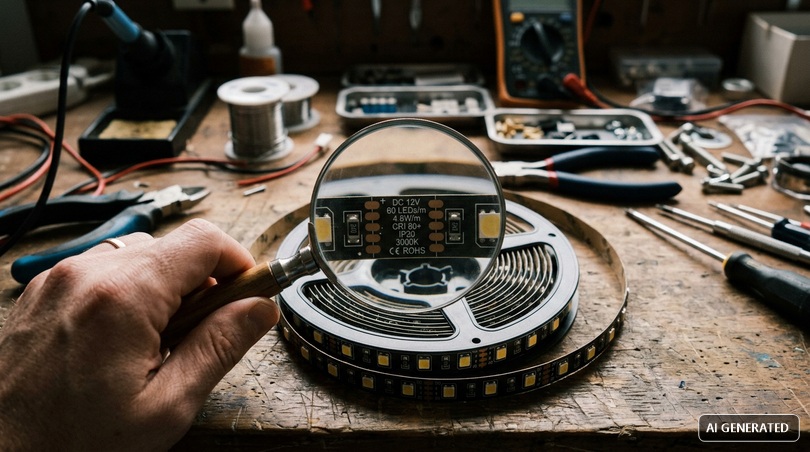
Anyone who has bought an LED strip by comparing two or three different technical datasheets has faced the same paradox: apparently identical products (same number of LEDs per meter, same stated power, same cut) that promise very different luminous fluxes, sometimes with differences of 30-40%. Who is right? Is it possible that a 14.4 W/meter strip really emits 1900 lumens per meter as written on the package, or was that number chosen at a desk to seem more competitive than the competitor's?
This article was created to answer these questions in a technical, verifiable and honest way. This is not a list of generic advice, but a real cross-verification method that anyone (designer, electrician, retailer or simple DIY enthusiast) can apply by reading a technical datasheet before purchasing. We will see which parameters, when related to each other, immediately expose artificially constructed data, we will see why a strip cut every 2 cm can never reach certain power values stated per meter, we will see what concretely distinguishes a supplier that attaches a laboratory test report from one that simply writes numbers on a PDF. And we will see, with real cases and comparison tables, what can happen (from a technical, economic and even safety point of view) when you install a product whose nameplate data does not correspond to reality.
The ultimate goal is very concrete: to put the reader in a position to protect themselves, without necessarily having to rely on a seller's word, but knowing exactly which numbers to check, which questions to ask and which documents to demand before signing an order whether it's 5 meters for a living room or 5,000 meters for a contract commission.
In this article...
LED strips: why the technical datasheet is (almost) the only proof we have
When purchasing an LED strip, especially online or through a distributor that works with generic catalogs, the buyer has a very limited number of tools to assess the real quality of the product before receiving it. They cannot turn on the strip in a store, cannot measure the luminous flux with an integrating sphere, cannot verify the LED junction temperature after two hours of continuous operation. The only thing they have in front of them is, precisely, a document: the technical datasheet.
This makes the technical datasheet a document with double potential. On one hand it is the most valuable tool that a serious supplier can make available, because it allows you to correctly design a system, calculate expected lux on a surface, size power supplies, verify compatibility with dimmers and controllers. On the other hand, precisely because no one really verifies it before purchase, it also becomes the most convenient place to "adjust" some numbers to make a product more competitive on paper compared to the competition.
The problem does not only concern the individual end buyer. It also concerns designers and lighting design studios that, basing themselves on a stated but not real lumen/watt value, calculate a system that then, once installed, proves to be undersized compared to the lighting design. It concerns retailers, who risk returns and disputes if the product they resell does not keep the promises of their supplier's technical datasheet. And it concerns, ultimately, the entire sector, because every inflated technical datasheet raises the bar of expectations incorrectly, pushing even honest manufacturers to compete with numbers that are competitive only on paper.
How widespread the problem is: market data
Those who think that non-compliance of technical datasheets in the LED lighting sector is an isolated case should look at the figures that emerged from control campaigns conducted at European level in recent years. These are not subjective feelings, but systematic checks conducted by industry associations and market surveillance authorities.
In 2026 LightingEurope published the results of an extensive online "mystery shopping" campaign conducted in seven European countries and seven marketplaces: out of 442 product offers analyzed, 76% did not comply with the basic information requirements required online, and among the 84 products subjected to physical inspection 95% proved to be non-compliant. The most alarming figure concerns laboratory tests: of the 9 products sent to an accredited laboratory for safety testing, all nine failed the test. Another campaign promoted by the European Commission on LED tubes found that 48 of the 58 samples tested, equal to 83%, did not comply with EU requirements, mainly due to labeling and safety instruction problems.
These figures relate to general regulatory compliance (markings, electrical safety, electromagnetic compatibility) rather than just the truthfulness of photometric values, but the underlying message is consistent with what is told in this article: a significant portion of LED lighting products on sale today, especially on online marketplaces, does not pass independent verification. Those who seriously invest in testing and technical documentation therefore find themselves competing with those who simply do not bear those costs and it is precisely to fill this information asymmetry that the cross-verification method described in the next chapters becomes a concrete protection tool for the buyer.
The fundamental parameters of a technical datasheet for LED strips
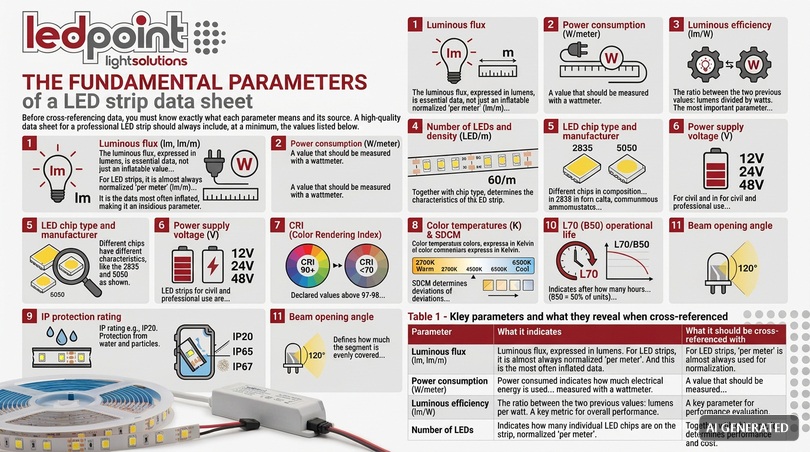
Before being able to cross-reference data, you need to know exactly what each parameter means and where it comes from. A serious technical datasheet of a professional LED strip should always report, as a minimum, the values listed below.
Luminous flux (total lumens and lumens/meter)
Luminous flux, expressed in lumens (lm), is the total amount of visible light emitted by the source in all directions. For LED strips it is almost always normalized "per meter" (lm/m), so as to be able to compare products of different lengths. This is the data that is most often inflated, because it is the one the buyer looks at first to estimate the luminous output of the installation.
Power consumed (W/meter)
Power consumed indicates how much electrical energy the strip actually consumes for each linear meter. This is a value that should be measured with a wattmeter on the real product powered at the nominal voltage, not calculated by adding the theoretical nameplate values of the individual LEDs, which in practice do not take into account the resistive losses of the printed circuit.
Luminous efficiency (lm/W)
This is the ratio between the two previous values: lumens divided by watts. It is the most important parameter of this entire guide, because it is the one that allows you to verify the internal consistency of a technical datasheet regardless of what is stated elsewhere. We will talk about it extensively later.
Number of LEDs per meter and density
Indicates how many individual LED chips are mounted on each meter of strip (e.g. 60, 120, 240, 480 LEDs/m). Together with the type of chip (2835, 5050, 3528, 5630, COB, etc.) it determines the maximum physical limit of power and therefore of flux that that configuration can realistically achieve.
Type of LED chip and manufacturer
Different chips have very different efficiencies and maximum powers among themselves. A high-end 2835 can have a higher starting efficiency (at the single component level, under laboratory conditions) compared to an economical 5050, but the real performance also depends on binning, chip manufacturer and the driving current chosen by the strip manufacturer.
Supply voltage
LED strips for civil and professional use are typically 12V, 24V or 48V low voltage, or 230V with direct mains power (with the relative limits we will see in chapter 5). The stated voltage must be consistent with the maximum cut length and with the number of parallel segments.
CRI (color rendering index)
The CRI, or IRC in Italian, measures how faithfully a light source reproduces the real colors of illuminated objects compared to a reference source. Stated values above 97-98 on economy range products always deserve cross-checking with the test report.
Color temperature (Kelvin) and SDCM
Color temperature, expressed in Kelvin, defines the light tone (warm, neutral, cool). The SDCM parameter (Standard Deviation of Color Matching), often indicated as "step" (e.g. 3 SDCM), measures how uniform the color is between one LED and another and between different production batches: the lower the value, the more stable and constant the color will be along the entire strip.
IP protection rating
The IP rating (e.g. IP20, IP54, IP65, IP67) indicates the level of protection against dust and water according to IEC 60529 standard. This is data that, if false, has immediate and often costly practical consequences, as we will see in chapter 8.
Stated useful life (L70, L80, B50)
Indicates after how many hours of operation the luminous flux drops below a certain threshold (for example L70 = 70% of initial flux) for a certain percentage of tested samples (B50 = 50% of samples). This is one of the most difficult data to verify without a real duration test, but its plausibility must still be evaluated in relation to the stated quality of chip, PCB and dissipation.
Beam opening angle
Defines how wide the light cone emitted by each individual LED is and, consequently, by the entire strip. It affects the lux output on a surface at a certain distance and is data often overlooked but useful for verifying the consistency of stated lux in any renderings or simulations provided by the manufacturer.
| Parameter | What it indicates | What to cross-reference with |
|---|---|---|
| Lumen/m | Amount of light emitted per meter | Watt/m, number of LEDs, chip type |
| Watt/m | Real energy consumption | Number of LEDs × maximum power per single chip |
| Efficiency lm/W | General consistency of stated data | Reference values for chip type |
| LEDs/m | Density of mounted components | Minimum cut, stated watt/m |
| Cut (cm) | Minimum length of cuttable segment | LEDs/m, electrical circuit of segment |
| Voltage | Nominal power supply | Maximum run length, cable section |
| CRI | Color fidelity | Price range, chip type, test report |
| IP rating | Protection from dust/water | Presence of real resin coating, IEC 60529 test |
How to cross-reference data to uncover inconsistencies
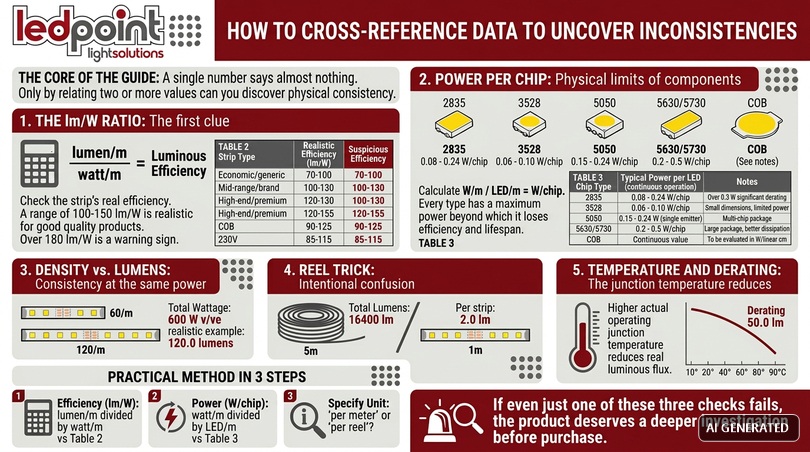
The heart of this guide is all here: no single number, taken alone, says almost nothing. It is only by relating two or more values that you discover whether a technical datasheet is consistent with the laws of physics or whether someone has simply written the number they wanted to show.
The lm/W ratio: the first clue, always
The simplest and most revealing calculation is dividing the stated lumens/meter by the stated watts/meter. The result is the luminous efficiency of the complete strip, including all real losses (PCB, current limiting resistors, control chip drivers if present, thermal derating).
Today, with high-end LED chips actually available on the market, an efficiency between 100 and 150 lm/W at complete strip level represents a realistic range for good quality products. Values between 150 and 170 lm/W are possible only with the best latest generation chips, contained driving currents and medium-high color temperatures (which naturally tend to have slightly higher efficiencies compared to very warm tones). When a technical datasheet states as efficiency 180, 200 or even over 220 lm/W for a complete strip, it is almost always a sign that the lumen value was calculated under laboratory conditions not replicable in reality, or that the watt value was underestimated compared to real consumption.
| Strip type | Realistic efficiency (lm/W) | Suspicious efficiency |
|---|---|---|
| Economy strip, generic chip, high density | 70 - 100 | > 130 |
| Mid-range strip, known brand chip | 100 - 130 | > 160 |
| High-end strip, premium chip, neutral CCT | 120 - 155 | > 180 |
| High density COB strip | 90 - 125 | > 150 |
| 230V strip direct power supply | 85 - 115 | > 140 |
Number of LEDs, chip type and maximum power per single component
Each type of LED chip has a realistic maximum operating power, beyond which the component is no longer driven efficiently and reliably, but only forced, with consequent loss of efficiency and useful life. Dividing the stated watts/meter by the number of LEDs per meter gives you the average power consumed by each single chip: a figure that should always be compared with the typical limits of the declared chip family.
| Chip type | Typical power per LED (continuous operation) | Notes |
|---|---|---|
| 2835 (mid power) | 0.08 - 0.24 W | Above 0.3 W in continuous operation thermal derating becomes significant |
| 3528 | 0.06 - 0.10 W | Small size chip, limited power |
| 5050 (single/triple chip) | 0.15 - 0.24 W (per single emitter) | The package can contain multiple chips in a single package |
| 5630 / 5730 | 0.2 - 0.5 W | Larger package, better dissipation |
| COB (per linear cm) | Continuous value along the strip, not per single point | Should be evaluated in W/cm rather than per single chip |
If a technical datasheet states, for example, 60 LEDs/m type 2835 and 24 W/m, the calculation is immediate: 24 W divided by 60 LEDs = 0.4 W per single chip. A value already beyond the realistic continuous operation threshold for a mid-power 2835, which should ring an alarm bell and push you to request the test report before proceeding with the purchase.
LED density and stated lumens: direct comparison
Another useful cross-reference is to compare two products with the same stated power but different LED densities. With the same watt/m, a strip with more LEDs (for example 120/m instead of 60/m) should have more uniform color rendering and comparable or slightly lower luminous flux per single LED, but not double with the same total power consumed. If the datasheet states that by doubling the LEDs per meter the total luminous flux doubles while keeping the total power consumed unchanged, the physics doesn't add up: it would be stating that the same electrical energy produces double the light, impossible with the same chip efficiency.
The trick of "reel luminous flux" passed off as lumens/meter
A rather widespread incorrect practice consists of stating the total luminous flux of an entire reel (for example a 5 meter reel) but presenting it, ambiguously, as if it were the "per meter" value. An inattentive reader can read "9500 lumens" on a 5 meter reel and think it is 9500 lm/m, when in reality the real value per meter is five times lower, about 1900 lm/m. Every serious technical datasheet must always specify unequivocally whether the reported luminous flux refers to the linear meter or to the entire reel, and with what length.
Junction temperature and undeclared thermal derating
The luminous flux values reported in LED chip manufacturer datasheets are almost always measured at a reference junction temperature of 25°C, a condition that in the reality of an installed LED strip (perhaps in a false ceiling, without adequate heatsink) almost never occurs. With increasing junction temperature the real luminous flux drops, often significantly. A technical datasheet that reports the "chip datasheet lumen value at 25°C" without applying any derating for real operating conditions is presenting an optimistic value that will hardly be reflected in the finished installation.
- divide lumen/m by watt/m and compare with Table 2
- divide watt/m by LED/m and compare with Table 3
- verify if the datasheet clearly specifies "per meter" or "per reel".
Cut, minimum length and why certain "per meter" lumens are impossible
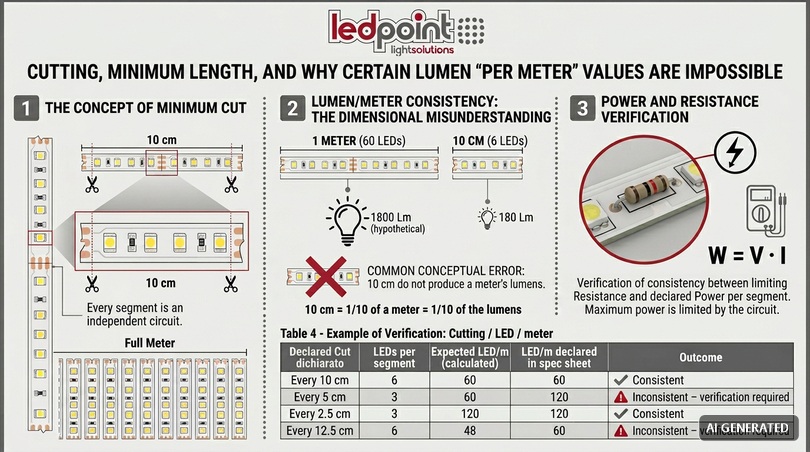
LED strips are designed to be cut into segments that are multiples of a minimum length, defined by the printed circuit layout: each segment contains a fixed number of LEDs connected in an autonomous circuit, delimited by the cut points marked on the PCB (printed scissors, dashed lines or dedicated copper tracks).
This technical aspect has a direct consequence on the truthfulness of stated data: the lumen/meter value only makes sense if referred to a complete linear meter, composed of an integer number of cuttable segments. If a strip is cuttable every 10 cm and contains 6 LEDs per segment, a complete linear meter will contain 60 LEDs therefore consistent with the "60 LEDs/m" data you expect to read in the technical datasheet. If instead the datasheet states "60 LEDs/m" but the actual minimum cut, calculated on the basis of the component pitch visible in the product images, returns a different number of LEDs per meter, it is an obvious inconsistency that needs to be clarified before purchase.
Why a short segment cannot "make the meter lumens"
A very common conceptual error, often fueled by unclear commercial communications, is thinking that a single cut segment (for example 5 or 10 cm) can emit the same luminous flux stated "per meter". This is not the case: a 10 cm segment of a 1800 lm/m strip will emit, under ideal conditions, about 180 lumens, not 1800. It is an elementary concept, but it is surprising how many commercial disputes arise precisely from this misunderstanding, sometimes deliberately fueled by those who communicate the "per meter" data ambiguously on small packages or samples.
The case of cuts not aligned with stated power
A second useful check concerns the consistency between the minimum cut and the stated power for that segment. If a 5 cm segment contains, by electrical construction, a resistive branch that limits the current to a fixed value, the power consumed by that segment cannot be higher than a precise maximum value calculable from the circuit. If the technical datasheet states a power per meter that, proportionally reported to the single segment, proves incompatible with the typical limiting resistance visible on the PCB (when photographed and enlarged), it is a further warning sign.
| Stated cut | LEDs per segment | Expected LEDs/m (calculated) | LEDs/m stated in datasheet | Result |
|---|---|---|---|---|
| Every 10 cm | 6 | 60 | 60 | Consistent |
| Every 5 cm | 3 | 60 | 120 | Inconsistent — requires verification |
| Every 2.5 cm | 3 | 120 | 120 | Consistent |
| Every 12.5 cm | 6 | 48 | 60 | Inconsistent — requires verification |
Voltage, voltage drops and power supply on long runs
A further parameter often overlooked but decisive is the stated supply voltage compared to the maximum installable length in a single continuous run. Low voltage LED strips (12V, 24V, 48V) suffer from progressive voltage drop along the circuit: the longer the run powered from a single point, the lower the voltage actually available to the LEDs furthest from the power supply point, with consequent loss of brightness and color uniformity towards the end of the run.
An honest technical datasheet always states the maximum recommended length per power supply point, typically more generous for 24V or 48V strips compared to 12V ones, precisely because with the same power the circulating current is lower and therefore the voltage drop along the PCB copper conductor is lower. If a technical datasheet states a voltage of 12V but suggests, without any precaution, continuous runs of 10 or more meters powered from one side only, the stated luminous uniformity data along the entire run is almost certainly optimistic.
230V strips: a separate case
230V LED strips, powered directly from mains voltage without an external low voltage power supply, deserve a specific mention: being composed of LED segments connected in series/parallel directly on alternating voltage, they are by their nature subject to a flicker phenomenon and it must be taken into account that these are products designed for predominantly outdoor use or in contexts where flicker does not constitute a perceptual or regulatory problem (for example in industrial settings, but not necessarily in environments where video recordings are made).
The test report: what it is, who issues it, why it's the real proof
If the technical datasheet is the declaration, the test report is the proof. This is a document, generated by a measurement laboratory (internal to the manufacturer but with traceable instrumentation, or external and independent), which reports the measurements carried out on a real physical sample of the product: luminous flux measured with integrating sphere, power consumed measured with precision wattmeter, CRI measured with spectrophotometer, real color temperature, and in many cases also flux decay curves over time (LM-80 test for LED useful life, when available).
What a reliable test report must contain
- Unique identifier of the tested sample (product code, batch, date)
- Test conditions (ambient temperature, supply voltage, stabilization time before measurement)
- Instrumentation used, with relative calibration
- Measured values of luminous flux, power, CRI, CCT, resulting efficiency
- Name and any certification of the laboratory that performed the test
- Test date and validity over time (tests do not have unlimited value if the product formulation changes)
Why a transparent supplier attaches it spontaneously
Attaching a test report has a cost, both economic (the test must be commissioned or performed with own calibrated instrumentation) and in terms of "exposure": a supplier that publishes a test report takes responsibility that the stated data corresponds to the measured data, and knows that a customer can always compare the two documents. Precisely for this reason, the spontaneous presence of the test report (not provided only upon explicit request, but made available by default for every catalog reference) is one of the strongest signals of real transparency, much more reliable than any commercial claim written in a technical datasheet.
How to read a test report and compare it with the technical datasheet
The comparison must be done item by item: the luminous flux measured in the test report must be in line (with a physiological tolerance of 5-10%, due to normal batch variations) with that stated in the technical datasheet. If the discrepancy exceeds 15-20%, or if the test report reports test conditions very different from those of real use (for example a measurement time too short, before the temperature stabilizes and the flux drops due to heating effect), the commercial data should be considered with caution.
The regulatory framework: EPREL, RoHS, LVD, EMC, Ecodesign
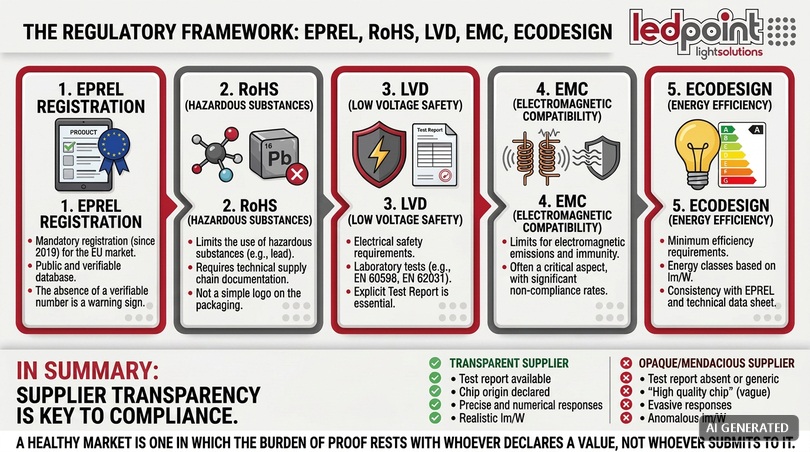
In addition to the physical plausibility of numbers, there is a second level of verification, equally concrete: that of regulatory compliance. Even a technical datasheet that passes all the cross-checks described in the previous chapters must in fact respect a set of documentary obligations provided for by European Union regulations, the absence of which is itself a warning sign.
EPREL registration
Since December 2019, all light sources placed on the EU market, including LED strips intended for end use as a light source, must be registered in the European database EPREL (European Product Registry for Energy Labelling) before being marketed. A supplier who is not able to provide a verifiable EPREL registration number for the proposed product is, in fact, selling a product not fully compliant with current regulations.
RoHS and hazardous substances
The RoHS directive limits the use of hazardous substances (lead, cadmium, mercury, certain phthalates) in electrical and electronic components, including LED strips with integrated drivers or control components. Verification of compliance requires access to technical documentation and substantial declarations along the component supply chain, not a simple visual check of the packaging: this is a further reason why the availability of complete technical documentation from the supplier is an indicator of seriousness.
Low Voltage Directive (LVD) and electrical safety
The low voltage directive imposes electrical safety requirements verifiable through laboratory tests according to harmonized standards such as EN 60598 (lighting equipment) and, for LED strips as standalone light sources, EN 62031. A test report that explicitly cites these standards is much more solid than a generic declaration of conformity without regulatory references.
Electromagnetic compatibility (EMC)
LED strips with electronic drivers or integrated controllers must comply with the electromagnetic emission and immunity limits provided for by the EMC directive. European control campaigns have detected significant EMC non-compliance rates in the LED lighting sector, confirming that this aspect too, often invisible to the end user but regulated, deserves attention when choosing the supplier.
Ecodesign and energy efficiency classes
The Ecodesign (EU) 2019/2020 regulation establishes minimum energy efficiency requirements for light sources, with classes ranging from A to G expressed precisely in lm/W: the same ratio at the center of the verification method described in this article. A technical datasheet consistent with the energy class stated in EPREL represents a further level of cross-confirmation compared to manual calculations.
Transparent supplier versus supplier that states false information
Not all suppliers that report an "optimistic" figure do so maliciously: sometimes it is a matter of poorly curated communication, approximate translations from original technical datasheets in other languages, or values taken from chip datasheets without applying the due corrections for real use in strip. It is therefore important to distinguish with balance between imprecision and false statement, because the practical consequences for the buyer are the same, but the supplier's attitude in the face of a dispute completely changes the outcome of the matter.
| Behavior | Transparent supplier | Opaque / dishonest supplier |
|---|---|---|
| Test report | Spontaneously available, consistent with technical datasheet | Absent, or provided only after insistence and with generic data |
| LED chip origin | Chip model stated | "High quality chip" without further details |
| Reel/meter distinction | Always explicit and unequivocal | Ambiguous or missing |
| Response to technical questions | Precise, with numbers and references | Vague, deferred, evasive |
| lm/W consistency | Falls within realistic ranges (Table 2) | Anomalous values without explanation |
| IP rating | Supported by IEC 60529 test | Stated without any documentary evidence |
| Warranty | Clear conditions, defined times and methods | Generic, often inapplicable in practice |
| Datasheet update | Revised when chip batch changes | Datasheet "frozen" for years regardless of supply changes |
A consumer protection principle must be clearly emphasized: the buyer does not have their own laboratory tools to independently verify every single figure, and it is therefore legitimate (indeed obligatory on the part of those who sell) that it is the supplier who provides verifiable proof, not the customer who has to procure it themselves after purchase. A healthy market is one where the burden of proof lies with those who state a value, not with those who suffer it.
What can happen if the stated data is false
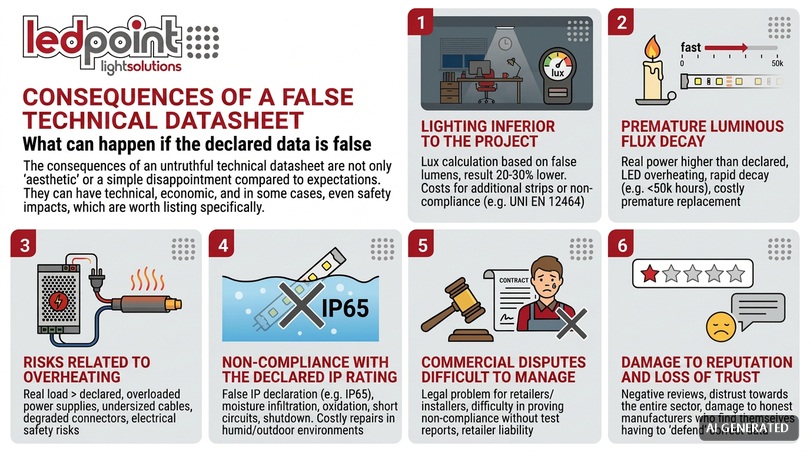
The consequences of an untruthful technical datasheet are not just "aesthetic" or simple disappointment compared to expectations. They can have technical, economic and in some cases even safety impacts, which are worth listing specifically.
Lighting lower than the project
The most frequent case: a designer calculates expected lux on a surface based on stated lumens, orders the necessary quantity of strip, and once the system is finished realizes that the real illuminance is 20-30% lower than the project. The solution, at that point, requires either adding additional meters of strip (with relative increase in costs and consumption not budgeted) or accepting a lighting result lower than the specifications required by the end customer or sector regulations (for example UNI EN 12464 for workplace lighting).
Premature luminous flux decay
If the real power consumed is higher than stated, the LEDs work at a higher junction temperature than that foreseen in the thermal design phase, with a direct effect on the speed of luminous flux decay over time. A strip that should have maintained 70% of initial flux after 50,000 hours could drop below that threshold in a fraction of that time, with consequent need for early replacement and relative unexpected costs, in addition to the discomfort of an installation (perhaps in a false ceiling or in a masonry work) difficult to reach for maintenance.
Risks related to overheating
When the real power consumed is significantly higher than stated, and therefore the system has not been thermally and electrically sized for that real load (cable section, power supply calibration, dissipation), the risk is not only a performance problem but can become an electrical safety issue: power supplies overloaded beyond their nominal power, undersized cables that heat up more than expected, connectors that degrade more rapidly. For this reason a correct power figure is not just a matter of commercial transparency, but a system safety requirement.
Non-compliance with stated IP rating
If a strip stated as IP65 does not actually pass a spray test according to IEC 60529, and is installed in an outdoor context or in a humid environment (bathroom, professional kitchen, pool area), the result is almost always moisture infiltration into the circuit, with contact oxidation, localized short circuits and progressive shutdown of entire strip segments. Repair or replacement in these cases is often more costly than the initial installation, because it requires the removal of parts already fixed, sealed or integrated into architectural elements.
Difficult-to-manage commercial disputes
From the point of view of a retailer or installer who has purchased the product from a third-party supplier and has resold or installed it for an end customer, an untruthful technical datasheet from their supplier also becomes a legal problem: without a test report to support, proving product non-compliance compared to what was stated becomes complex, dispute management times lengthen, and the risk of still having to respond to the end customer (who has a direct contractual relationship with the retailer, not with the upstream manufacturer) remains entirely with the intermediate link of the supply chain.
Image damage and loss of trust
On a broader scale, every case of untruthful technical datasheet that becomes public (negative reviews, sector groups, technical forums) contributes to a climate of generalized distrust towards the entire LED strip sector, damaging even manufacturers who work honestly and who find themselves having to "defend" correct figures simply because the market has learned, rightly, to distrust the numbers written on technical datasheets.
Case studies: four real situations of technical datasheet under the microscope
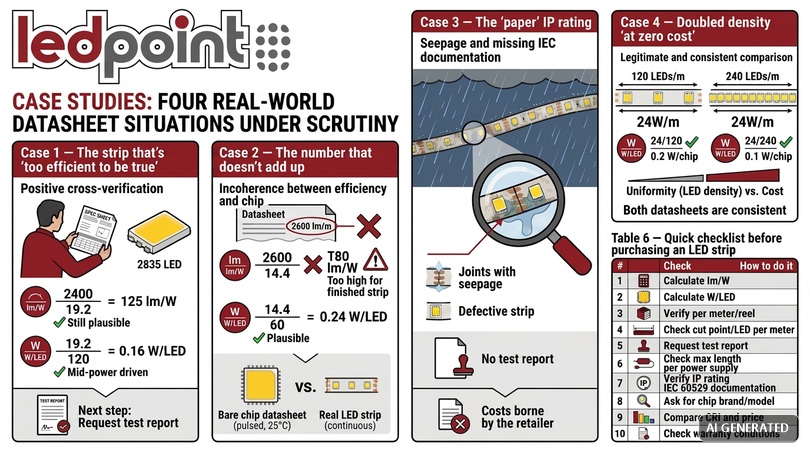
Case 1 — The "too efficient to be true" strip
A retailer receives from a new supplier the technical datasheet of a 2835 strip, 120 LEDs/m, stated 19.2 W/m and 2400 lm/m. Applying the first check: 2400 / 19.2 = 125 lm/W. The value falls within the high but still plausible range of Table 2. However, applying the second check, 19.2 W / 120 LEDs = 0.16 W per single chip: a value consistent with a well-driven mid-power 2835. In this case the two checks are consistent with each other: the technical datasheet, although ambitious, passes the basic cross-verification. The next step, before proceeding with a large order, still remains to request the test report to confirm the data with a real measurement.
Case 2 — The number that doesn't add up
A second technical datasheet, for an apparently competing product, states: 60 LEDs/m type 2835, 14.4 W/m, but a flux of 2600 lm/m. First check: 2600 / 14.4 = 180 lm/W, a value already at the upper limits of plausibility for a complete strip (Table 2). Second check: 14.4 / 60 = 0.24 W per LED, plausible value for a 2835. The problem is all in the first ratio: to emit 2600 lm/m with only 0.24 W per chip, each single LED should have an efficiency of about 180 lm/W at the component level mounted on strip, including all losses — a value that no mid-power 2835 chip currently on the market achieves in real continuous operation. This is the typical case where the lumen value was taken from a chip laboratory datasheet, at 25°C and under pulse conditions, and reported without any correction on the commercial technical datasheet of the finished strip.
Case 3 — The "paper" IP rating
An outdoor strip is sold as IP65 with visible silicone resin coating. No test report is provided. After three months of installation in an area exposed to driving rain, some segments stop working. Post-mortem analysis reveals moisture infiltration at the junction points between segments, where the resin coating proved to be applied discontinuously. In the absence of a test report based on IEC 60529 standard, the retailer has no objective tools to dispute non-compliance to the supplier, and finds themselves having to manage the replacement at their own expense towards the end customer.
Case 4 — The "zero cost" doubled density
A customer compares two apparently equivalent strips: both stated 24 W/m, but one with 120 LEDs/m and the other with 240 LEDs/m, both with the same stated flux of 2200 lm/m. At first glance, the 240 LEDs/m version seems the safer choice, because a higher LED density generally guarantees better beam uniformity and less dotting effects. However, the cross-check reveals an interesting detail: 24 W / 240 LEDs = 0.1 W per single chip, a very low and plausible value for a small power 2835 while in the 120 LED version, 24 W / 120 LEDs = 0.2 W per chip, also plausible. In this case both technical datasheets pass the internal consistency check: the choice between the two therefore does not concern the truthfulness of the data, but a legitimate compromise between beam uniformity (favored by higher density) and product cost, and is a good example of how not every difference between technical datasheets necessarily hides a false figure, provided that cross-checks confirm the physical consistency of both.
Practical checklist before purchasing an LED strip
| # | Check | How to do it |
|---|---|---|
| 1 | Calculate lm/W efficiency | Lumen/m ÷ Watt/m, compare with Table 2 |
| 2 | Calculate power per single LED | Watt/m ÷ LED/m, compare with Table 3 |
| 3 | Verify if lumen is "per meter" or "per reel" | Look for explicit wording in technical datasheet |
| 4 | Check cut/LEDs per meter consistency | Multiply LEDs per segment × number of segments in one meter |
| 5 | Request the test report | Verify that it is specific for that product code and batch |
| 6 | Verify maximum length per power supply point | Check that it is consistent with stated voltage |
| 7 | Verify IP rating with IEC 60529 documentation | Ask for the specific test report, not just the claim |
| 8 | Ask for LED chip brand and model | A transparent supplier states it without hesitation |
| 9 | Compare stated CRI with price range | Very high CRI at very low price is a warning sign |
| 10 | Verify warranty conditions | They must be specific, not generic |
Essential technical glossary
To navigate with confidence among LED strip technical datasheets it is useful to always have at hand the exact meanings of the most recurring terms, often used imprecisely even in commercial documentation, for this reason we report some of them below, you can find a complete glossary by clicking here.
| Term | Meaning |
|---|---|
| Lumen (lm) | Unit of measurement of total luminous flux emitted by a source |
| Lux (lx) | Illuminance, i.e. lumens received by a surface of one square meter |
| Watt (W) | Unit of measurement of absorbed electrical power |
| lm/W | Luminous efficiency: how much light is produced for each watt consumed |
| CRI / IRC | Color rendering index, measures the fidelity with which colors are reproduced |
| CCT | Correlated color temperature, expressed in Kelvin |
| SDCM | Standard deviation of color matching, measures color uniformity between LEDs and batches |
| IP (Ingress Protection) | Degree of protection against dust and water according to IEC 60529 |
| L70 / L80 | Percentage of residual luminous flux after a certain number of hours |
| B50 | Percentage of samples that respect the stated L70/L80 value |
| Binning | Selection of LEDs in homogeneous classes of flux, color and forward voltage |
| Thermal derating | Reduction of performance (generally luminous flux) caused by temperature increase |
| EPREL | European registration database mandatory for light sources |
| Test report | Laboratory document that reports real measurements on a physical sample |
How Ledpoint documents its LED strips
This article stems from a simple principle: an informed customer is a protected customer, and a supplier that invests in the transparency of its technical data works, in the medium term, to the advantage of the entire market. For this reason, for every reference in its range of LED strip lines (from the ECO line to the TOP line) Ledpoint makes available detailed technical information on chip used, real power, cut and electrical configuration, in addition to the technical insights present in the catalog for each type of PCB and IP protection rating.
The range includes solutions differentiated by need: from 230V LED strips for outdoor use, designed for applications where direct mains power represents an installation advantage, to pixel-per-pixel addressable LED strips for scenic and setup applications, up to high density professional strips for architectural applications where color uniformity and reliability over time are essential requirements. Those who wish to deepen the entire offer and compare the different lines available can contact us through the page dedicated to who we are, where the technical support for design offered in the choice of the most suitable product for each installation is also described.
Frequently asked questions
How can you tell if the lumens stated on an LED strip are real?Cross-reference the stated watts/meter with the number of LEDs per meter and the type of chip used, calculating the resulting efficiency in lm/W. If the value clearly exceeds realistic standards for that chip (generally 100-150 lm/W for a good quality complete strip), the figure is almost certainly inflated. |
What is an LED strip test report and why is it important?It is a document issued by a measurement laboratory that reports luminous flux, real power, CRI and color temperature measured on a real physical sample of the product. It is objective proof that the technical datasheet data has been verified, not just stated. |
Can a short cut LED strip really achieve the lumens per meter stated?No. The lumen/meter value always refers to a complete linear meter. A shorter cut segment will produce a proportional fraction of that flux, never the whole value stated per meter. |
Why can two LED strips with the same number of LEDs have different brightness?Because luminous flux also depends on chip quality, color binning, driving current, PCB quality and thermal dissipation, not just the number of LEDs mounted. |
What are the risks of installing an LED strip with false nameplate data?You risk lower than expected lighting, faster flux decay than expected, overheating with possible safety risks, IP non-compliance with infiltration and failures, as well as difficult-to-manage commercial disputes without a test report to support. |
What is a realistic luminous efficiency value (lm/W) for a quality LED strip?For a complete strip, including real losses, an efficiency between 100 and 150 lm/W is considered good with chips currently available. Values over 180-200 lm/W at complete strip level should be verified with caution. |
How do I recognize a transparent LED strip supplier?Spontaneously attaches laboratory test reports, states chip and manufacturer, clearly distinguishes between "per meter" and "per reel" data, specifies IP rating with documentary evidence and responds precisely to detailed technical questions. |
Is the IP rating stated in the technical datasheet always reliable?Not always. It should always be supported by an immersion or spray test performed according to IEC 60529 standard: visible resin coating to the eye does not automatically guarantee the stated IP class. |
LED strip: it is always good to choose it consciously.
A technical datasheet is not a simple information sheet: it is the basis on which an entire lighting project is built, from the single domestic strip to a contract system of thousands of meters. Learning to read it critically, cross-referencing the data with each other instead of trusting the single most obvious number, is today the only tool really within everyone's reach (professional or private) to distinguish a serious supplier from one that bets on the buyer's inattention.
The method described in this article does not require laboratory instrumentation: it only requires the calculator that anyone has in their smartphone and the willingness to devote five minutes before proceeding with an order. Five minutes that, as the analyzed cases demonstrate, can make the difference between a system that works as promised for years and one that disappoints, degrades rapidly or, in the worst cases, becomes a safety problem.
This article was developed with the support of artificial intelligence and subsequently reviewed, corrected, and validated by the Ledpoint.it technical team, which guarantees its reliability and compliance with official sources.