









LED strips: how to understand if the declared lumens/watts are real

Anyone comparing datasheets of seemingly identical LED strips (same chip, same density, same power) often finds declared luminous fluxes that differ by 30-40%. Some of these differences are physically impossible; others are real and depend on design choices that almost no datasheet explains. This guide shows how to tell the difference with three checks: overall efficiency, circuit configuration (number of LEDs in series), and declared CRI.
In this article...
The first check: overall efficiency (lm/W)
The first calculation is always the same: divide the declared lumens/meter by the declared watts/meter. The result is the efficiency of the complete strip, including all real losses (current-limiting resistors, PCB traces, thermal derating).
With the chips currently on the market, a good quality complete strip falls between 100 and 150 lm/W. Values between 150 and 170 lm/W are achievable only with high-end chips, limited driving currents, CRI 80, and neutral color temperatures. Above 180 lm/W at the finished strip level, the figure is almost certainly taken from the chip datasheet at a junction temperature of 25 °C and reported without corrections.
But within the 100-150 lm/W range, the datasheet alone does not say whether the product is well-designed or not. To understand this, the following two parameters are needed.
Why the number of LEDs in series matters more than the chip
A 24 V strip does not power the LEDs directly: each cuttable segment is an autonomous circuit composed of a certain number of LEDs in series plus a current-limiting resistor. The resistor absorbs the difference between the 24 V supply and the sum of the forward voltages (Vf) of the LEDs, and all the power it dissipates is lost power, not converted into light. The number of LEDs in series therefore determines, before any other consideration, how much of the absorbed power can become light.
With a typical white LED (Vf ≈ 3.0 V at operating current) on a 24 V supply:
| LEDs in series | Total forward voltage | Margin on the resistor | Share of "useful" voltage |
|---|---|---|---|
| 6 | ~18 V | ~6 V | 75% |
| 7 | ~21 V | ~3 V | 87.5% |
| 8 | ~23.2 V (Vf ≈ 2.9 V) | ~0.8 V | ~97% |
Translated into lm/W, with the same chip: going from 6 to 7 LEDs in series is worth about +17% in efficiency; going from 6 to 8 is worth about +29%. It's a huge difference, of the same order of magnitude as the difference between a cheap chip and a premium one — yet it never appears in the datasheet. Two strips with the exact same 2835 chip can legitimately declare 115 and 148 lm/W just because of this circuit choice.
The 8-in-series architecture is not "free"
With only 0.8 V of margin on the resistor, the 8-LED-in-series circuit becomes very sensitive to anything that reduces the available voltage:
- the voltage drop along the conductor over long runs quickly translates into a drop in current (and therefore brightness) towards the end of the strip, much more pronounced than on a 6s, where the 6 V of margin absorbs the variations;
- LED production tolerances (Vf dispersion between batches) and the thermal drift of the forward voltage directly affect the operating current;
- the configuration requires lower driving currents per LED, to maintain a safety margin despite tolerances, hence more LEDs per meter to obtain the same flux, hence higher cost.
A 6s is less efficient but more robust and uniform over long runs powered from one end; an 8s is more efficient but requires careful power supply (short runs or dual power supply) and a manufacturer that does serious binning. Neither is "wrong": what is wrong is not knowing which one you are buying.
How to count without having the datasheet
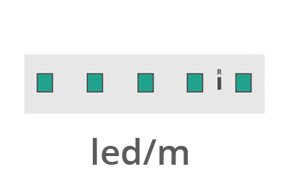
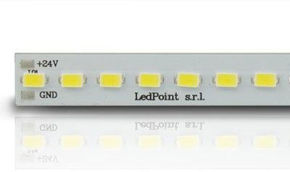
You don't need the datasheet: just count the LEDs between two consecutive cut points (visible in product photos or on the physical sample). On a single-color 24 V strip, that number is N. If a 6s strip declares the same efficiency as an 8s with an equivalent chip, one of the two figures is false — and usually it's not the 8s.
CRI has a direct cost in efficiency
The Color Rendering Index is not just a qualitative parameter: it has a direct cost in efficiency. To raise the CRI, phosphors with greater emission in the red are used, where the human eye is less sensitive — for the same wattage, higher color fidelity means fewer lumens. The orders of magnitude, with the same chip and color temperature:
| CRI | Variation compared to CRI 80 | Indicative efficiency |
|---|---|---|
| CRI 80 (reference) | 100% | 150 lm/W |
| CRI 90 | −10 ÷ −15% | 128-135 lm/W |
| CRI ≥ 95 | −20 ÷ −30% | 105-120 lm/W |
There are two practical consequences. First: with the same chip and color temperature, a higher CRI always costs efficiency — it's not a manufacturer defect but a physical limit of the phosphors (and it also applies to CCT: very warm whites, 2200-2700 K, lose an additional 5-10% compared to neutral ones). Comparing a CRI 80 strip with a CRI 95 strip based solely on the efficiency figure is a meaningless comparison.
Second: impossible combinations unmask themselves. A strip declared at 6 LEDs in series, CRI 95, with 150 lm/W cannot exist: even starting from an excellent chip (~180 lm/W at the component level), the calculation is 180 × 0.75 (6s circuit) × 0.75 (CRI 95 phosphors) × 0.92 (real thermal derating) ≈ 93 lm/W. Anyone declaring 150 is adding up the best of three worlds that cannot coexist.
Combined table: architecture × CRI
The following table crosses architecture and CRI starting from a good mid-to-high-end 2835 chip (4000 K), with realistic thermal derating included:
| Configuration | CRI 80 | CRI 90 | CRI 95 |
|---|---|---|---|
| 6 LEDs in series | 115-125 lm/W | 100-110 lm/W | 85-95 lm/W |
| 7 LEDs in series | 135-145 lm/W | 115-125 lm/W | 100-110 lm/W |
| 8 LEDs in series | 150-165 lm/W | 130-140 lm/W | 110-125 lm/W |
A declared figure that falls into the right cell of the table is plausible. A figure that ends up two cells higher than the actual configuration of the product is inflated, typically because it is taken from the chip datasheet under laboratory conditions.
Power per chip and meter/reel wording
Power per chip
Dividing watts/meter by LEDs/meter gives the average power per chip. A mid-power 2835 works reliably between 0.08 and 0.24 W in continuous operation: a board declaring 24 W/m on 60 LEDs/m is driving each chip at 0.4 W, outside the reliable range, with guaranteed thermal derating and accelerated decay.
Meter vs reel
Always verify that the declared flux is explicitly referred to the linear meter and not the entire reel: "9500 lm" on a 5-meter reel is 1900 lm/m, and the ambiguous wording is a still widespread commercial trick.
The test report: the only independent verification
All the checks above verify the internal consistency of the datasheet; only a laboratory test report (flux measured in an integrating sphere, power with a wattmeter, CRI with a spectrophotometer, on a sample identified by code and batch) verifies the correspondence with the actual product. The physiological gap between the test report and the datasheet is 5-10%; beyond 15-20%, or in the total absence of the document, the commercial data must be treated as unverified. A serious supplier provides it spontaneously, along with the brand and model of the chip and — now you know why to ask for it — the number of LEDs in series per segment.
Quick 7-point checklist
| # | Check | How to verify |
|---|---|---|
| 1 | Overall efficiency | lumens/m ÷ watts/m, compare with the combined table |
| 2 | LEDs in series per segment | count the LEDs between two cut points |
| 3 | Configuration consistency ↔ lm/W | does the table cell match the declared figure? |
| 4 | CRI for equal comparison | never compare lm/W between different CRIs |
| 5 | Power per chip | watts/m ÷ LEDs/m, within package limits |
| 6 | Meter vs reel | explicit wording in the datasheet |
| 7 | Test report | specific to product code and batch, gap <10% |
If a strip passes all seven checks, the declared figure is credible. If it fails even just one, it is worth asking the supplier for clarification before buying.
Frequently asked questions
Why do two LED strips with the same chip declare different lm/W?Because the final lm/W figure depends not only on the chip, but also on the number of LEDs in series per segment and the chosen CRI. With the same chip, an 8-LED-in-series configuration with CRI 80 can exceed the efficiency of a 6-LED-in-series with CRI 95 by 60-70%, without either datasheet explaining it. |
How many LEDs in series are better: 6, 7, or 8?It depends on the use. An 8-LED-in-series configuration is more efficient but more sensitive to voltage drops over long runs and requires more careful binning. A 6-LED-in-series is less efficient but more robust and uniform. None is objectively better: the choice depends on the installation length and the type of power supply. |
How do I count the LEDs in series without the datasheet?Just look at the product photos or the physical sample and count how many LEDs there are between two consecutive cut points: that number corresponds to the LEDs connected in series in each segment. It's a check that anyone can do in a few seconds, without tools. |
Why is a CRI 95 strip less efficient than a CRI 80 one?Because the phosphors used to increase color rendering emit more light in the red, where the human eye is less sensitive. For the same absorbed watts, this translates into fewer perceived lumens. The typical loss is 20-30% when going from CRI 80 to CRI 95 on the same chip. |
What does "lm/m" mean and why must it always be verified?It indicates the lumens produced per linear meter of strip. Some suppliers instead declare the total flux of the reel (e.g., 9500 lm on 5 meters, i.e., 1900 real lm/m) without specifying it clearly, making the product appear much more performing than it actually is. |
What is a test report and why is it more reliable than the datasheet?It is a laboratory document that measures real flux, power, and CRI on a physical sample identified by code and batch, using an integrating sphere, wattmeter, and spectrophotometer. Unlike the datasheet, it reflects the product actually in production: a deviation of more than 15-20% from the declared data is a warning sign. |