





LED strips for raising beneficial insects: spectrum, photoperiod, and ladybugs
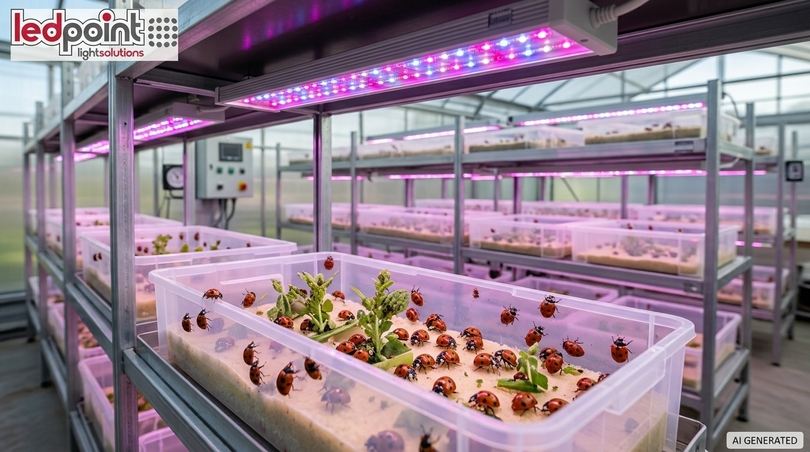
In just a few years, artificial lighting has gone from a simple accessory to a process lever in beneficial insect farming for agriculture. Whether you produce protein from black soldier flies, multiply ladybugs and Orius for biological control, or design climate chambers, you know that the bottleneck is almost never genetics or diet: it is the stability of egg-laying and hatching rates. And that stability depends, more than one might think, on light. In this technical guide, we analyze, with data in hand, how and when LED strips for insect farming can become a yield tool and not just a visibility aid, honestly distinguishing what research has proven from what remains promising but unproven.
The common thread is concrete: for each biological mechanism, we indicate the wavelength involved, the useful intensity, the management of the photoperiod, and the Ledpoint product that allows translating theory into a real-world setup. Because the advantage of LED strips for beneficial insect farming is not just spectral: it is modularity, low heat dissipation, water protection rating, dimmability, and a cost/efficiency ratio that no traditional light source can match today.
The guide is designed for R&D managers of industrial facilities, agronomists and biological control consultants in greenhouses, engineers developing lighting systems, and sustainability managers who must report on consumption and ESG. We will answer each of these profiles with the same logic: first the numbers, then the recommendations. No empty superlatives, only LED lighting for insect farming designed around the real photobiology of the species.
In this article...
1. Why LED strips have become strategic in insect farming
For decades, insectaries have used whatever was available: fluorescent tubes, halogen lamps, and more recently, generic white LEDs. The result was lighting designed for the human eye, not the compound eye of an insect. The breakthrough comes from a simple realization: insects perceive different spectral bands than we do, and their reproductive biology responds to light stimuli that a "white light" lamp distributes suboptimally. This is where LED strips for insect farming change the rules, because they allow composing the spectrum, dosing its intensity, and programming its cycle with previously unthinkable precision.
The second driver of change is industrial. The global demand for insect protein for animal feed and aquaculture is growing at double digits, requiring facilities with predictable yields. In this context, LED lighting for insect farming offers three structural advantages that no traditional source guarantees together: fine spectral control, extremely low heat emission (crucial in climate chambers where every thermal watt must then be removed), and physical modularity. A 24V LED strip can be cut, bent, and attached with double-sided tape to existing shelves and cages without redesigning the environment.
A market that demands precision
The economic context helps to understand why lighting has become so central. The insect protein sector is among the fastest-growing segments in agrifood: industry estimates converge on double-digit compound annual growth rates for the next decade, driven by animal feed, pet food, and aquaculture. Behind these numbers are increasingly large and capital-intensive facilities, where every percentage point of reproductive yield more or less shifts the bottom line. In this scenario, LED lighting for insect farming stops being an accessory cost and becomes a productivity variable to be optimized methodically.
The same logic applies to biological control. The transition towards zero-residue and organic agriculture increases the demand for beneficial insects (ladybugs, Orius, predatory mites) produced in dedicated insectaries. And with the electrification of greenhouses and the widespread shift to LEDs, agronomists and producers find themselves having to answer a new question: will the new light spectrum affect the beneficials? This is exactly the question this guide answers, band by band.
Table 0 — Drivers for adopting LED strips in insect farming
| Driver | Breeder's need | LED strip response |
|---|---|---|
| Growth in demand for insect protein | Predictable reproductive yields | Spectral and photoperiod control |
| Energy costs | Reduce consumption | High efficiency, low heat |
| ESG reporting | Reduce carbon footprint | Lower consumption per kg of product |
| Organic / zero-residue agriculture | More reliable beneficial insects | Controlled photoperiod and spectrum |
| Climate chambers | Limit thermal load | Extremely low heat emission |
From "shedding light" to "designing light"
The difference between lighting an insectary and designing its light lies entirely in the shift from a single metric (lux, designed for humans) to a set of biologically relevant parameters: dominant wavelength in nanometers, intensity in micromoles of photons per square meter per second (μmol/m²/s), duration and phasing of the photoperiod, and power supply stability to avoid flicker perceptible to insects. LED strips are the tool that makes all these parameters independently adjustable.
Why strips and not panels
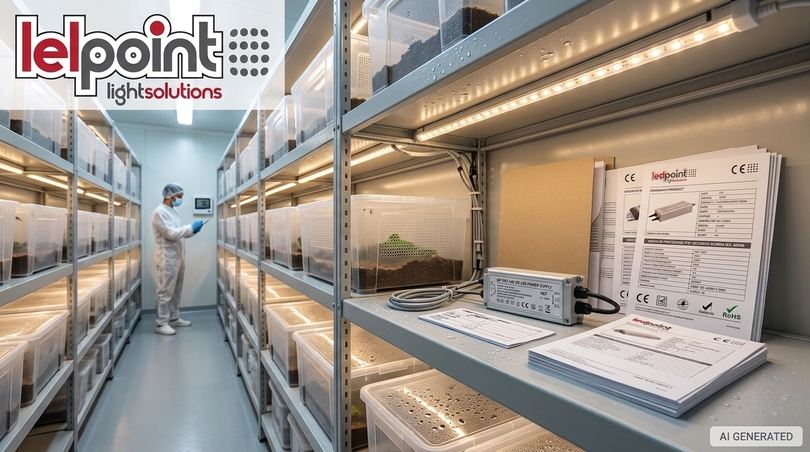
A panel illuminates a volume from above; an LED strip illuminates a proximity surface. In modular farms, where insects live on trays, shelves, and stacked cages, proximity lighting is often more efficient: it brings the useful spectrum to within a few centimeters of the animals, reduces losses, and allows differentiating lighting by level. A LED strip cuttable every 10 cm and equipped with 3M double-sided tape adapts to the geometry of the facility, not vice versa. This is the reason why LED strips for insect farming are replacing rigid lighting fixtures even in already established facilities.
There is also an often decisive economic and managerial advantage: incremental scalability. With panels, expanding or modifying lighting often means replacing entire fixtures; with strips, you add or shorten sections, change a band, or update a channel without rethinking the entire system. A farm that grows by modules can grow its lighting at the same pace, with the same technical language (24V, modular cutting, quick connectors) across the entire line. This consistency reduces spare parts inventory, simplifies staff training, and lowers the total cost of ownership of the facility over time: an argument that weighs as much as the spectrum when evaluating a multi-year investment in LED lighting for insect farming.
2. Applied photobiology: how insects "see" LED light
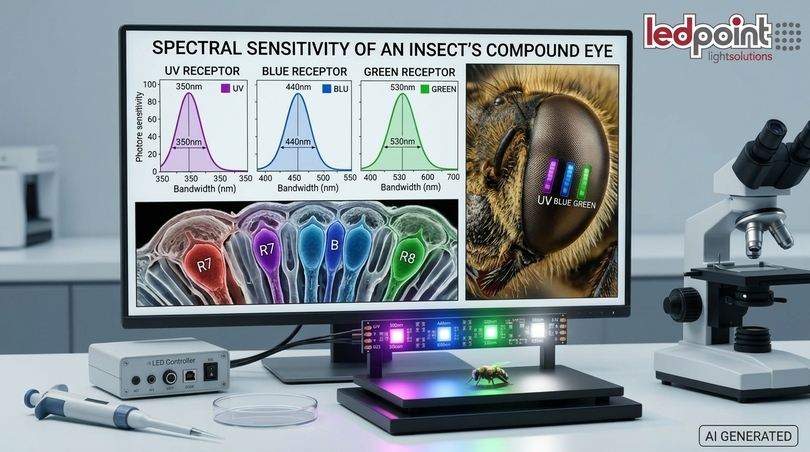
Before choosing any LED strip, you must understand what the insect responds to. The compound eyes of insects house photoreceptors sensitive to very specific bands of the electromagnetic spectrum, typically in the ultraviolet, blue, and green, with generally very low sensitivity to red. This seemingly academic fact has enormous operational consequences: a source that wastes power in red and yellow "heats" the environment without stimulating the animal, while a strip with a selected wavelength concentrates energy where the insect's visual and neuroendocrine system can use it.
The foundational research on this point is by Oonincx et al. (2016), which confirmed the sensitivity of the black soldier fly's compound eyes to UV, blue, and green, and demonstrated that an LED system designed around that sensitivity produces a significantly higher number of larvae compared to fluorescent tubes. This is the principle that guides the entire design of LED lighting for insect farming: not to replicate sunlight, but to reconstruct the spectrum that that specific species can read.
Spectrum, not just brightness
A recurring mistake is reasoning in terms of "more light = more yield". Insect photobiology is qualitative before it is quantitative: changing the wavelength at the same intensity can reverse reproductive behavior. The exact same facility, powered by a blue LED strip instead of a white one, can alter mating frequency, egg-laying, and hatching. For this reason, the choice of spectrum comes before power sizing.
Intensity: the forgotten parameter
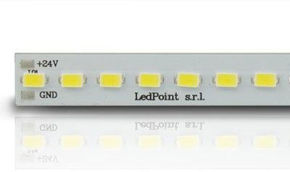
That said, intensity is not negligible. For the black soldier fly, literature indicates that irradiances on the order of 110-200 μmol/m²/s or higher are needed to effectively stimulate mating. Below this threshold, even the "right" spectrum yields little. This is why a high-density LED strip (120 LEDs/m or more) or a COB technology with continuous emission becomes preferable to sparse strips: they allow reaching the useful intensity on the laying surface without multiplying the rows. The Ledpoint COB LED strip range is designed precisely to deliver high and homogeneous fluxes over short distances.
Flicker and stability: a detail that matters
Insects often have a higher flicker fusion frequency than humans: they perceive as intermittent a light that appears continuous to us. An unstable power supply or a low-frequency PWM dimmer can therefore introduce unwanted stress. In insect farming with LED strips, it is good practice to use high-quality stabilized 24V power supplies and, where regulation is needed, high-frequency monochromatic dimmers.
The role of ultraviolet
Ultraviolet (typically 365-385 nm, with the violet band at 405 nm on the border) is the third component that many insects capture strongly. In the black soldier fly, UV enters the optimal spectral recipe and contributes to mating stimulation; in several natural enemies, it is a powerful attractant for phototaxis. However, it must be handled with care: UV has safety implications for operators and a marked biological effect, so it must be dosed and shielded where necessary. Ultraviolet LED strips and 405 nm violet chip strips allow introducing this band in a controlled and dimmable manner, calibrating its share within the mixture.
A reference spectral map
Summarizing photobiology into an operational map: UV and blue are the main reproductive and attractant activators; green completes the useful spectrum and intervenes in rhythms and behavior; red, being poorly perceived, is generally irrelevant for direct stimulation, but far-red has a specific role in interactions involving predatory mites. Having all these bands available in the same catalog as dimmable 24V LED strips is what makes it possible to move from photobiological theory to a real-world setup without compromise.
3. Blue spectrum 460-465 nm and egg-laying: the key band
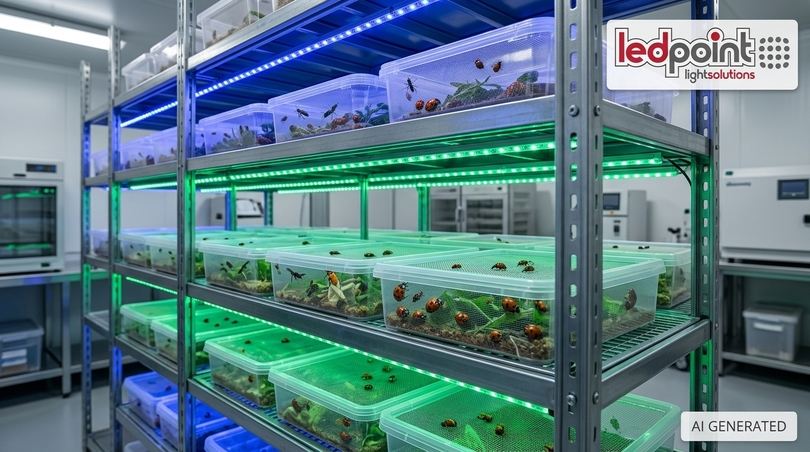
If we had to point to a single band to focus on in an insect farm with LED strips, it would be blue around 450-465 nm. It is the wavelength that appears, with different roles, in almost all studies on insects of economic interest: it stimulates photoreceptors, modulates biological rhythms, and, in multiple species, directly influences egg-laying. The blue LED strip is therefore the first spectral building block of any facility oriented towards reproductive yield.
A 2025 study on Orius insidiosus, a predatory bug of thrips among the most used in biological control, showed a particularly instructive two-faced spectral behavior. By extending the photoperiod with pure blue light, the frequency and duration of matings decreased; yet, the same blue spectrum promoted egg-laying and hatching, without compromising the population's vitality. Extending the photoperiod overall improved fertility, and the maximum number of second-generation adults was obtained in the full blue-green-red spectrum group. The operational message is clear: blue is a powerful lever, but it must be dosed and combined, not administered as an absolute monochromatic.
Why the 460-465 nm band
Spectral precision is not a brochure detail. Ledpoint blue LED strips with a 460-465 nm dominant wavelength fall exactly in the range that literature associates with egg-laying stimulation in various species. Two catalog references, both at 24V and dimmable:
- the 465 nm IP67 blue LED strip in solid silicone (code L52-BLUB), ideal where maximum cleanability and water resistance are needed;
- the 460-465 nm 2835 blue LED strip at 120 LEDs/m (code F52-BLU-120812), high density and high power to reach high intensities on the laying surface.
For facilities requiring even greater density and absence of a dotted effect, the blue COB LED strip at 320 chips/m offers a continuous and homogeneous blue light line, useful when irradiance uniformity is critical.
The black soldier fly confirms the data
The role of blue in egg-laying is corroborated by research on the black soldier fly. Here, blue (typically 450 nm) enters the spectral combination that maximizes laying, as we will see in the dedicated chapter. In summary, the blue LED strip is the component that most often "turns on" the reproductive response, provided it is combined with the other bands and a correct photoperiod.
The bidirectional effect of blue: how to manage it
The Orius case teaches the most important lesson about blue: the same spectrum can have opposite effects on different behaviors. If blue reduces mating but promotes laying, administering it indiscriminately risks penalizing one phase to benefit another. The practical solution is temporal and dosimetric: use blue especially during laying windows, maintain a more complete spectrum during mating phases, and leverage photoperiod extension (which improves overall fertility) as a general framework. With dimmable blue LED strips on a dedicated channel, this fine management is within reach of any facility.
Blue in scotophase: a targeted integration
An interesting application is the use of blue during the dark phase (scotophase), as emerged in some coccinellids, where it increased feeding frequency. In this scenario, an ultra-high-power strip is not needed, but a soft and well-distributed source: the 3528 blue LED strip at 60 LEDs/m, with its 4.8 W/m, is suitable for light integrations without drastically altering the light/dark balance. The choice between high and low power therefore depends on the objective: a strong push for laying or discreet behavioral integration.
Table 1 - The blue band in major studies on insects of economic interest
| Species | Band/source | Observed effect | Relevance for farming |
|---|---|---|---|
| Orius insidiosus (2025) | Blue + extended photoperiod | ↓ mating, ↑ egg-laying and hatching | Blue to be dosed, better in mixed spectrum |
| Black soldier fly | 450 nm in UV/green combination | ↑ laying, more larvae | Blue as a component of the mixture |
| Henosepilachna 28-punctata (2018) | Blue in scotophase | ↑ feeding frequency | Indirect clue for ladybugs |
4. Green spectrum 520-525 nm: biological rhythms and colony well-being
Alongside blue, the second band that the compound eyes of many insects capture efficiently is green around 520-525 nm. If blue is often associated with reproductive drive, green has a more subtle and complementary role: it contributes to the regulation of biological rhythms, helps recreate a light environment perceived as more "natural", and, in some species, intervenes in feeding and laying behavior. Integrating a green LED strip into the farm's spectrum means completing the part of radiation that the insect actually uses.
The 520-525 nm 2835 green LED strip at 60 LEDs/m (code F52-GRE) emits precisely in the green band captured by the photoreceptors of many insects. Powered at 24V, dimmable and cuttable every 10 cm, it is the natural candidate to accompany blue and build a two- or three-component spectrum. Where a continuous and high-density green light line is needed, the green COB LED strip at 480 LEDs/m guarantees superior uniformity and absence of dotting.
Green in the winning combination
Green does not work alone. The Hungarian study on the black soldier fly identified the combination of 365 nm : 450 nm : 515 nm in a 1:1:3 ratio as a more effective recipe than pure white LED light: green (515 nm) appears there as the dominant component in quantity. This is a valuable clue for facility designers: the green LED strip is not an aesthetic accessory but a precise share of the spectral mixture, often the most abundant.
The case of phytophagous ladybugs
A further clue comes from the 2018 study on Henosepilachna vigintioctopunctata, a phytophagous ladybug (thus a pest, not a beneficial): integration with yellow and green light during the dark phase significantly increased the number of eggs laid, while blue increased feeding frequency. This data must be used with due caution (the species is different from beneficial predatory ladybugs) but suggests that green may have a role in fertility in other coccinellids as well. For this very reason, green LED strips are included in the experimental protocols we recommend testing.
Green and colony stress
Beyond fertility, green is attributed a role in reducing stress and improving the general well-being of the colony, helping to create a light environment perceived as more natural compared to an aggressive monochromatic one. In a farm, a less stressed colony tends to have more stable and predictable reproductive performance: and it is precisely predictability, more than the absolute peak, that an industrial facility seeks. Integrating a share of green LED strip into the base spectrum is therefore also a choice for process stability, not just stimulation.
When to choose SMD and when COB
For the green band, the choice between SMD and COB technology depends on the objective. The 60 LEDs/m green SMD strip is versatile, economical, and sufficient for integrations and mixtures; the high-density green COB is preferable when an abundant and perfectly uniform green share is needed, as in the 1:1:3 recipe for the black soldier fly where green is the dominant component. Both are dimmable and at 24V, allowing precise regulation of green's contribution within the overall spectrum. Here too, the principle of independent channels applies: keeping green on a separate dimmer allows varying its share without touching blue and UV.
5. Ladybugs: what research really says about lighting
Intellectual honesty is required here, because this is the point where much commercial content promises more than science supports. The truth is that, compared to the black soldier fly, research on LED lighting for ladybugs is fragmented: there are solid preliminary clues, but very few LED parameters directly applicable to production. Those who breed predatory ladybugs as beneficials for biological control must therefore proceed with methodological caution, and LED strips should be used as a tool for controlled experimentation before being considered a turnkey solution.
The most important reference remains the study by Omkar et al. (2005) on two aphid-predatory ladybugs, Cheilomenes sexmaculata and Propylea dissecta. Comparing four types of light (white, blue, yellow, and red), both species showed the highest aphid consumption, fastest development, and best reproductive performance under white light, followed in order by yellow, blue, and red. The study did not use specific LED sources, but it provides a clear compass: for ladybugs, full-spectrum white light is the safest choice.
Full-spectrum white light as a base
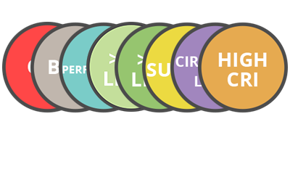
Translated into a facility, this means that for a ladybug farm, the backbone of the lighting should be a high color rendering white LED strip, possibly accompanied (in an experimental regime) by blue and green bands. The most suitable wide-spectrum Ledpoint solutions are the Sunled full-spectrum LED strips, which recreate a distribution similar to sunlight, and the range of high CRI white LED strips. It is on this base that it makes sense to graft any spectral modulations.
The photoperiod: the most solid lever for ladybugs
If the spectrum for ladybugs is still experimental ground, the photoperiod is a well-documented lever. A 2024 study by Yu et al. on the predatory ladybug Harmonia axyridis, published in the journal Insects, confirmed that extending the photoperiod from 9L:15D to 16L:8D significantly favors development and reproduction, with the adult predation rate increased by 89.64% under prolonged lighting conditions. This is an effect of light duration, not spectrum, and precisely for this reason it is easily exploitable: it is enough to correctly program the switching on of the LED strips.
To manage the photoperiod in a circadianly coherent manner, the Ledpoint Circadian Light range allows modulating intensity and tone throughout the day, while control via ZigBee systems allows automating light/dark cycles and gradual transitions, avoiding abrupt switch-ons.
Beware of non-peer-reviewed sources
A Chinese patent circulates describing a "ladybug farm" based on a film transparent to red light to promote reproduction. It must be taken for what it is: a patent claim, not peer-reviewed research data, and lacking biological logic supported by public literature (remember that sensitivity to red in insects is generally low). In doubt, for ladybugs, the two proven pillars remain valid: full-spectrum white light + extended photoperiod.
Why research on ladybugs is still behind
It is worth understanding why ladybugs are so little studied from the point of view of LED lighting, compared to the black soldier fly. The reason is industrial: BSF is produced on a huge scale for protein, thus attracting investment and applied research; predatory ladybugs, although invaluable for biological control, are bred in smaller volumes and with more artisanal processes. The result is a fragmented scientific corpus, made up of studies on different species (some phytophagous, like Henosepilachna), often with non-LED sources. Those who breed ladybugs today must therefore reason by cautious analogy: transfer clues from related species, but validate them internally before overturning a working protocol.
This does not mean giving up on innovation: it means adopting LED strips with a rigorous experimental design. Maintain a base of white light compatible with Omkar's results, extend the photoperiod as suggested for Harmonia axyridis, and introduce blue or green only on test batches compared with a control. This is how a ladybug farm can itself help close the knowledge gap, transforming the facility into a source of proprietary data — exactly what makes a company a reference in the sector.
Table 2 — Ladybugs: available evidence and practical indications
| Study | Species | Key result | Indication for LED facility |
|---|---|---|---|
| Omkar 2005 | C. sexmaculata, P. dissecta | White light = better predation, development, reproduction | Full-spectrum / Sunled base |
| Yu 2024 | Harmonia axyridis | Photoperiod 16L:8D: predation +89.64% | Program long photoperiod |
| Fang Mei 2018 | Henosepilachna (phytophagous) | Green/yellow ↑ eggs; blue ↑ feeding | Clue to test, not to apply as is |
| CN Patent | Ladybugs (generic) | Red light (unvalidated) | Not recommended |
6. Black soldier fly: the model species (UV + blue + green 1:1:3)
If ladybugs are the territory of uncertainty, the black soldier fly (Hermetia illucens) is the territory of certainties. It is the species on which research on LED lighting for insect farming is most mature, because its mating and egg-laying critically depend on adequate light stimulation. In a closed environment, without the sun, it is precisely artificial lighting that determines whether and how much the colony reproduces: a bottleneck that LED strips with a selected spectrum can measurably widen.
The most cited data comes from the thesis of López Juárez (2024): green, blue, and UV LED lamps can increase black soldier fly egg production by up to 180% compared to white light of equal intensity (3000K), also anticipating the start of egg-laying by at least one day. To this is added the spectral recipe identified by Hungarian research (365 nm : 450 nm : 515 nm in a 1:1:3 ratio) more effective than pure white LED light, and the confirmation by Oonincx (2016) on the higher number of larvae compared to fluorescent tubes.
Composing the 1:1:3 recipe with LED strips
Translating that ratio into a facility means combining three components: a share of UV (around 365-385 nm), one of blue (450-465 nm), and a triple share of green (515-525 nm). Ledpoint covers all three bands with 24V products:
- UV — the category of ultraviolet / UVC LED strips and, for the 405 nm violet band, the violet chip strips;
- blue — the high-density 460-465 nm blue LED strip;
- green — the 480 LEDs/m green COB LED strip, which provides the dominant green share uniformly.
The 1:1:3 ratio is obtained by dosing the length and installed power of each band and calibrating the intensity with monochromatic dimmers, using the threshold of 110-200 μmol/m²/s on the mating zone as a reference. For those who prefer an integrated approach to grow light, the Growing LED strips category collects biology-oriented spectrum solutions.
LED vs traditional sources: not just yield
The study by Heussler et al. (2018) compares LEDs, fluorescents, and halogens and, while not finding dramatic differences in egg-laying in every scenario, recommends LEDs for small-scale farming thanks to their energy efficiency. This is a point that recurs throughout the guide: even when the spectral gain is modest, the economic and thermal advantage of LED strips for insect farming remains systematic.
Table 3 - Black soldier fly: reference LED parameters
| Parameter | Value indicated by research | Ledpoint solution |
|---|---|---|
| Spectral recipe | UV 365 : blue 450 : green 515 = 1:1:3 | UV/violet + 465 nm blue + green COB |
| Egg increase | Up to +180% vs 3000K white | Dimmed multiband combination |
| Intensity for mating | ≈ 110-200 μmol/m²/s | High density 120 LEDs/m or COB |
| Anticipation of egg-laying | ≥ 1 day | Programmed photoperiod |

Dosing intensity: the critical point of BSF
The spectral recipe is a necessary but not sufficient condition: without adequate intensity, black soldier fly mating does not start. Literature indicates irradiances on the order of 110-200 μmol/m²/s or higher on the mating zone. Reaching this value with traditional sources means introducing a lot of heat into the environment; with high-density or COB LED strips it is achieved by concentrating useful photons, coldly. In practice, it is advisable to design the facility starting from the irradiance value to be centered on the target and working back to density, number of rows, and distance, then finely calibrating with monochromatic dimmers. Dimmability is not a whim: it allows experimentally seeking the point of maximum yield without rewiring.
Why separate spectral channels
The 1:1:3 recipe is not set in stone: the optimal ratio can vary with the strain, diet, and phase. For this reason, in the black soldier fly more than elsewhere, it is advisable to wire UV, blue, and green on independent dimmable channels. This way, the R&D manager can vary one ratio at a time and build their own yield curve, transforming the facility into a small laboratory. This is the approach that distinguishes a farm that "uses LEDs" from one that "designs light": LED strips for insect farming become an R&D tool, not just a production one.
Economic impact on a BSF facility
Economically, lighting affects two items: the direct consumption of the sources and the thermal load they impose on air conditioning. Replacing halogens and fluorescents with 24V LED strips acts on both. To this is added, in the case of BSF, the potential increase in reproductive yield (up to +180% eggs in experimental conditions): every extra point of yield dilutes the fixed costs of the facility per kilogram of product. The combination of "less energy + more eggs" is what makes spectral optimization economically interesting precisely in dedicated farms, where the insect is the final product.
7. Orius, predatory mites, and other natural enemies
In addition to the black soldier fly and ladybugs, LED lighting in biological control concerns predatory bugs like Orius and predatory mites like Phytoseiulus persimilis. Here the picture is more complex: the effects of the photoperiod are quite clear, while the spectrum often has species-specific and bidirectional effects (blue can promote laying but inhibit mating, as seen in Orius). This means that LED strips must be selected according to the species being bred and the priority objective.
Predatory mites and far-red light
For predatory mites, a previously neglected band comes into play: far-red. A 2023 study on tomatoes infested with Tetranychus urticae observed that the integration of far-red light does not alter the attraction of P. persimilis to plant volatile compounds, but promotes the increase of the predatory mite population, with effective final suppression of phytophagous mites. A subsequent 2025 study tested daily doses of 3 hours of red, blue, or far-red light: the nighttime treatment with red and blue significantly reduced phytophagous mites without penalizing predators (with the exception of daytime blue, which reduced predatory capacity on mobile forms).
For these applications, Ledpoint catalogs infrared LED strips, useful for exploring the red and far-red band in a timed regime, always at 24V and dimmable.
Phototaxis and natural enemies: the data on coccinellids
A 2023 study tested the attractiveness of four LED wavelengths (UV 385 nm, violet 405 nm, blue 450 nm, red 660 nm) on seven species of natural enemies, including Coccinellidae. It is one of the few works that directly involve ladybugs in the context of LED lighting and provides indications on their phototaxis, useful for designing light points that attract or guide beneficials within the facility. The availability of dedicated bands (from 405 nm violet to UV strips) allows replicating these protocols with precision.
A rule of common sense: safeguarding darkness
A recurring theme for all natural enemies is the protection of the day-night cycle. When using nighttime supplemental lighting for crops, it is necessary to avoid canceling the scotophase of the beneficials: many reproductive responses depend on the light/dark alternation. In insect farming with LED strips, it is therefore advisable to provide zones or windows of real darkness, managed via sensors and automation, rather than indiscriminate continuous lighting.
Timing of administration: day vs. night
A cross-cutting lesson from research on predatory mites is that the timing of administration matters as much as the spectrum. Identical doses of red or blue light produce different effects if delivered during the day or at night: the nighttime treatment with red and blue reduced phytophagous mites without penalizing predators, while daytime blue could reduce predatory capacity on mobile forms. For the breeder, this means that the hourly programming of LED strips (made simple by ZigBee systems) is a design variable in its own right, not a detail. The 3-hour windows tested in the literature show that short, targeted doses are enough to achieve significant effects.
Tritrophic interactions: light also acts on the plant
A fascinating aspect of mite studies is that light acts on a three-level system: plant, prey, predator. Far-red, while not altering the predator's attraction to plant volatiles, favored its demographic growth, contributing to prey suppression. This means that, in a greenhouse, the spectrum of LED strips can indirectly influence biological control through crop physiology, not just through the insect. This is one more reason to design lighting with a systemic vision, integrating the needs of the plant and the beneficials.
N. tenuis and light manipulation
The predatory bug Nesidiocoris tenuis is also the subject of studies on light manipulation, including the effects of UV-LED on its biological characteristics and on Bemisia tabaci, with the aim of improving the efficacy of biological control. These works, together with those on the phototaxis of Coccinellidae, outline a rapidly expanding field where the availability of dedicated LED bands (UV, violet, blue, red) is the experimental prerequisite. Those who have a flexible LED strip facility for insect farming are in the best position to rapidly adopt new evidence as it emerges.

8. The Dutch perspective: when spectrum matters little (and efficiency matters a lot)
No serious technical guide can ignore "uncomfortable" evidence. A line of Dutch research (the project on plant health in annual production under LED, with sector entities and companies) found that, within practical ranges, LED spectrum differences have minimal effects on pest pressure and the efficacy of natural enemies. In particular, different spectral compositions did not show significant effects on Encarsia formosa and Macrolophus pygmaeus. The authors' conclusion is pragmatic: in many cases, the LED spectrum can be chosen primarily based on plant growth and energy efficiency, without excessive fears for biological control.
Why is this data important and not contradictory? Because it delimits the field. Fine spectral design bears fruit especially in dedicated farms (black soldier fly in primis), where the insect is the product and light is its direct reproductive stimulus. In a greenhouse, where light serves the plant first and beneficials are "guests", expecting a particular LED spectrum to transform biological control is often a costly illusion. The operational message for the sustainability manager is liberating: it is not necessary to sacrifice energy efficiency for a "special spectrum for beneficial insects" when the objective is the crop.
Two regimes, two strategies
This leads to a two-regime design rule. In dedicated farming, it is advisable to invest in selected spectrum (blue, green, UV, far-red) and fine dimming, because there the return is measurable. In a productive greenhouse with biological control, it is instead advisable to choose efficient and long-lasting LED strips (prioritizing plant growth and efficiency) and intervene on beneficials mainly with the photoperiod and dark zones, rather than with the spectrum. In both cases, the technological basis is the same: reliable 24V LED strips, on aluminum profiles for dissipation, with stable power supply.
The Dutch lesson, ultimately, does not downsize the value of LED strips for insect farming: it brings it into focus. It avoids spending on a useless spectrum and directs spending where it produces measurable return. It is an invitation to rigor, not skepticism: designing light knowing exactly what is expected from each band, measuring its effect, and paying only for what is needed. A principle that accompanies this entire guide and that distinguishes a facility built on data from one built on promises.

9. Designing the facility: choosing the right LED strips
With photobiology clarified, the question becomes engineering: which LED strip to choose and how to install it in a breeding chamber? The answer is never "the most powerful", but "the most suitable" for the microclimate, hygiene needs, and the type of spectral stimulus desired. Designing a system of LED strips for insect farming means balancing five variables: protection rating, voltage and density, spectrum, heat dissipation, and control. We tackle them one by one.
IP rating and silicone coating
Breeding environments are often humid, subject to misting, and, above all, need to be periodically sanitized. Under these conditions, the protection rating is not optional. IP67 silicone-coated strips resist water, are easy to clean, and tolerate sanitization, a crucial aspect in climate chambers where cleanliness determines colony health. The IP67 solid silicone blue LED strip is the reference example for the blue band; where a sanitizable white base is needed, the high-density IP67 silicone LED strip offers robustness and homogeneity. For dry and well-ventilated shelves, an IP20 strip protected by an aluminum profile with a diffuser may suffice.
Voltage, density, and cutting
24V is the recommended standard for farms: at equal power, it reduces current, limits voltage drops over long runs, and improves safety. All strips mentioned in this guide are 24V LED strips. The LED density (from 60 to 480 LEDs/m, up to COBs) determines the achievable intensity and uniformity: the higher the density, the easier it is to hit the useful irradiance threshold without multiplying rows. Cutting every 10 cm (or 5 cm in high densities) and 3M double-sided tape make adaptation to trays and cages immediate.
Heat dissipation
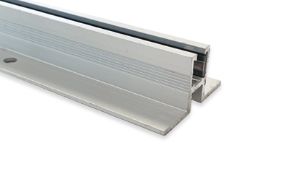
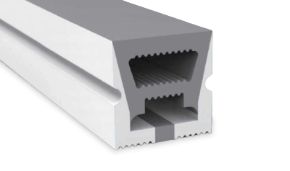
High-power strips must be applied to a metal heatsink, preferably anodized aluminum, so as not to compromise their lifespan and color stability. Ledpoint aluminum profiles fulfill this function and, with the corresponding diffusers, uniform the light by reducing the dotted effect. Proper dissipation is what separates a facility that lasts for years from one that degrades in a few months.
Power supply, control, and connections
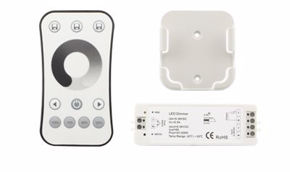
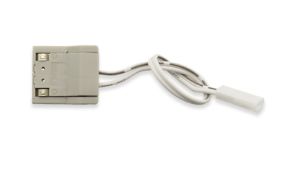
The system is completed with a 24V power supply sized with a margin on the maximum load, a monochromatic dimmer to calibrate intensity band by band, and quick connectors to wire without soldering. For facilities requiring dynamic scenarios and hourly programming, ZigBee control allows advanced photoperiod automation.
Table 4 - Criteria for choosing LED strips for farming
| Criterion | Humid / sanitizable environment | Dry shelving |
|---|---|---|
| IP rating | IP67 silicone | IP20 + profile |
| Voltage | 24V | 24V |
| Density | 120 LEDs/m or COB | 60-120 LEDs/m |
| Dissipation | Silicone + metal surface | Aluminum profile |
| Control | Dimmer + ZigBee | Monochromatic dimmer |
Layout and distribution: where to place the strips
The position of the LED strips matters as much as their spectrum. In a modular tray farm, the rule is to bring the useful band as close as possible to the mating and laying zone, which does not always coincide with the geometric center of the tray. For the black soldier fly, for example, mating occurs in flight in a precise illuminated zone: concentrating irradiance there, with strips mounted on the upper edges or dedicated frames, yields much more than dispersing light over the entire environment. In ladybug and Orius cages, where beneficials move on plant surfaces or substrates, a more uniform distribution along the shelves ensures that the entire population receives the same stimulus. In both cases, the modularity of cuttable LED strips allows adapting length and orientation to any geometry.
A useful principle is the distance-to-density ratio: the further the strip is from the target surface, the higher the LED density must be (or it is advisable to switch to a COB) to keep irradiance above the threshold. Moving the source a few centimeters closer can be worth, in terms of μmol/m²/s on the target, much more than increasing the installed power. This is one of the reasons why the proximity lighting of LED strips for insect farming is often more economical than overhead panels.
Uniformity and absence of hot spots
Lighting homogeneity prevents one part of the colony from being overstimulated and another understimulated. Traditional SMD strips create a dotted effect perceptible at close range; COB strips, with their closely spaced chips and 180° diffusion angle, produce a continuous line of light that improves uniformity on the target. Where SMDs are used, an opal diffuser mounted on the aluminum profile softens the beam and uniformizes the output. Uniformity, in addition to the biological benefit, also simplifies experimental validation: measuring irradiance is more reliable when the light field is regular.
Maintenance and hygiene over time
A breeding facility operates in harsh conditions: humidity, organic dust, cleaning cycles. The maintenance of LED strips hinges on three factors. The first is cleanability: IP67 silicone versions can be sanitized without damaging the LEDs, while IP20 versions require more delicate protection and cleaning. The second is continuous thermal management: a profile that dissipates well keeps the spectrum and power stable over time, avoiding premature degradation. The third is wiring redundancy: using quick connectors and sectionable runs allows replacing a faulty segment without stopping the entire line, a huge advantage in continuous production. Designing for maintenance, from the very beginning, is part of designing LED lighting for insect farming.
Compatibility with climate chambers and misting
Many insectaries operate at controlled temperature and humidity, sometimes with misting to maintain relative humidity. In these contexts, the combination of IP67 silicone strip + stabilized 24V power supply is the mandatory choice. The low heat emission of LED strips is a double ally: it does not alter the delicate thermal balance of the chamber and reduces the load on the air conditioning system, with a cascading effect on overall consumption. This is a point that always comes up when comparing LEDs with halogens and fluorescents, which introduce heat into the environment that must then be removed at an energy cost.
10. Comparative table: Ledpoint LED strips for farming
Below is an operational summary of the main Ledpoint products usable in an insect farming facility with LED strips, organized by spectral band and function. All models are 24V, dimmable, and cuttable; the links lead to the official catalog sheets, where datasheets, test reports, and technical specifications are available.
Table 5 - Recommended Ledpoint products by spectral band
| Band / function | Product | Technical data | Typical use |
|---|---|---|---|
| Blue (max hygiene) | Blue IP67 silicone | 465 nm, IP67, 24V | Egg-laying in humid environment |
| Blue (high power) | Blue 2835 120 LEDs/m | 460-465 nm, 24 W/m | High intensity on surface |
| Blue (low power) | Blue 3528 60 LEDs/m | 467-470 nm, 4.8 W/m | Soft integration, scotophase |
| Blue (uniform COB) | Blue COB 320/m | Continuous line, 180° | Homogeneous irradiance |
| Green | Green 2835 60 LEDs/m | 520-525 nm, 24V | Biological rhythms, mixture |
| Green (COB) | Green COB 480/m | Dominant green share 1:1:3 | Black soldier fly |
| UV | UV / UVC strips | UV band | BSF recipe component |
| Violet 405 nm | Violet chips | 405 nm | Phototaxis of natural enemies |
| Far-red / IR | Infrared strips | Red / far-red band | Predatory mites |
| Full-spectrum white | Sunled | Sun-like spectrum | Base for ladybugs |
11. Photoperiod management and dynamic spectrum control
The spectrum opens the door, the photoperiod throws it wide open. As we have seen, it is the most cross-cutting and documented lever: from the +89.64% predation in Harmonia axyridis with a 16L:8D photoperiod to the anticipation of egg-laying in the black soldier fly. A good LED strip facility for insect farming does not just turn on and off: it programs transitions, differentiates cycles by development phase, and, where needed, modulates the spectrum over time.
Hourly programming and gradual transitions
Abrupt switch-ons and switch-offs are unnecessary stress. With Ledpoint ZigBee systems and the Circadian Light range, it is possible to simulate dawn and dusk, set long photoperiods in reproductive phases, and guarantee the necessary scotophase. The calendar function (a different photoperiod according to the insect's stage) is exactly what insect lighting system engineers look for when designing "smart" products.
Dynamic spectrum by life phase
The frontier is the dynamic spectrum: more blue/UV/green in mating and laying phases, more white or off in resting phases. Having separate bands in the catalog (UV, blue, green, IR) each on its own dimmable channel, allows composing and recomposing the spectrum without redoing the facility. This is the reason why it is advisable to wire the bands on independent circuits from the design phase.
Photoperiod and diapause induction
The photoperiod does not only govern immediate reproduction: in many species, it is the signal that triggers or interrupts diapause, the state of quiescence with which insects cross unfavorable seasons. In farms, this translates into a powerful management tool: by regulating light hours with LED strips, the population can be kept in an active phase all year round, or a slowdown phase can be deliberately induced to synchronize production with demand. The ability to program stable and repeatable cycles (impossible with natural light) is one of the least advertised but most valuable advantages of LED lighting for insect farming.
Crepuscular transitions and stress reduction
Reproducing dawn and dusk is not an aesthetic whim. Gradual intensity transitions reduce light shock, respect the behavioral rhythms of insects, and favor activities like mating, which in nature often concentrates in specific time slots. With the Circadian Light range and ZigBee control, programming intensity rise and fall ramps is immediate, and allows building a daily light profile calibrated to the bred species. It is the difference between a switch and a conductor.
Automation and process repeatability
Finally, photoperiod automation guarantees repeatability, which in production is synonymous with quality. A manually managed light cycle is subject to errors; a programmed and monitored cycle via sensors is identical batch after batch. This consistency is what allows confidently attributing yield variations to real causes and not to lighting fluctuations, closing the loop with the experimental approach described later.

12. Energy efficiency, ROI, and carbon footprint
For the sustainability manager and those who must report on ESG, light is a consumption item that is anything but marginal in an insect farm. Here, LED strips offer the most solid and least debatable advantage of the entire guide: at equal reproductive yield, they reduce consumption and heat dissipation compared to halogens and fluorescents, with a direct impact on the carbon footprint per kilogram of product.
Why LEDs cut consumption
Three factors contribute. First: conversion efficiency, with strips ranging from a few watts to 24 W/m depending on density, without the thermal dispersion of traditional sources. Second: spectral selectivity, which concentrates energy in the bands useful to the insect, avoiding "heating" the environment with useless red and infrared. Third: lower heat production in the climate chamber, which cascades to reduce the load on the air conditioning system. As noted by Heussler (2018), LEDs are recommended for farming even just for energy efficiency.
The double message for ESG
Dutch research adds a valuable corollary for procurement: when the objective is the crop and not the insect-product, there is no need to pay a premium for "special" spectra; one can choose based on efficiency and durability. Conversely, in dedicated farming, the investment in a selected spectrum pays off with the yield increase (up to +180% eggs in the black soldier fly). The key is to distinguish the two scenarios and size the expenditure accordingly, documenting energy savings as a sustainability indicator.
Table 6 - Synthetic comparison of light sources in farming
| Characteristic | Halogen | Fluorescent | 24V LED strips |
|---|---|---|---|
| Energy efficiency | Low | Medium | High |
| Heat emitted | High | Medium | Low |
| Spectral control | None | Poor | Precise (per band) |
| Dimmability | Limited | Poor | Complete |
| Cleanability (IP67) | No | No | Yes (silicone) |
| Lifespan / modularity | Low | Medium | High / cuttable |
An example of reasoning on amortization
Without promising numbers that depend on the specific facility, it is useful to see the logic of the calculation. The annual savings of switching to LED strips arises from the difference in installed power at equal useful irradiance, multiplied by the annual operating hours and the energy cost, to which the indirect savings on air conditioning due to lower heat input is added. This saving is offset by the cost of strips, profiles, power supplies, and control. The payback time is the ratio between the investment and the total annual savings: in contexts with many hours of lighting per day (typical of industrial farms), the energy share is so high that payback times shorten significantly. In dedicated farms, moreover, the value of any yield increase must be added to the savings, which can dominate the calculation.
Table 8 - Items to consider in calculating return on investment
| Item | Effect on the income statement |
|---|---|
| Direct consumption of sources | Savings from higher LED efficiency |
| Thermal load on air conditioning | Indirect savings (less heat to remove) |
| Reproductive yield | More product for the same fixed costs |
| Lifespan and maintenance | Lower replacement cost over time |
| Initial investment | Strips, profiles, power supplies, control |
KPIs and measurement: optimizing methodically
To turn lighting into a yield lever, measurement is required. The essential KPIs of an LED-lit farm are: number of eggs laid per female, hatching rate, number of larvae or adults produced, energy consumption per unit of product, and (for beneficials) predation rate and longevity. There is only one methodological rule: vary one variable at a time (spectrum, intensity, or photoperiod), comparing parallel batches. Only in this way is the real effect isolated, avoiding attributing to a spectrum an improvement actually due to photoperiod or temperature. Dimmable LED strips with separate channels make this experimental design simple and repeatable, because each parameter is independently adjustable.
This data-driven approach is also what makes the results defensible in an ESG report or a technical dossier: not "we believe light helps", but "we have measured a delta in yield and consumption under controlled conditions". It is the difference between marketing and engineering, and LED strips for insect farming are the tool that allows you to stand on the side of engineering.

13. Step-by-step operational protocol
Let's line up the steps to start or convert an insect farm with LED strips, from diagnosis to commissioning. It is a template to be adapted to the species and the facility, not a rigid recipe: every insectary has its own microclimate and constraints.
Phase 1 - Define species, objective, and regime
Establish whether you are in dedicated farming (insect = product, selected spectrum is convenient) or in a greenhouse with biological control (priority to the crop, intervention on beneficials via photoperiod). Identify the priority objective: more eggs, more larvae, more predation, more longevity.
Phase 2 - Choose the base spectrum
For the black soldier fly, start with the UV : blue : green = 1:1:3 recipe. For ladybugs, start with full-spectrum white (Sunled) and test blue/green integrations. For Orius, favor a mixed blue-green-red spectrum with an extended photoperiod.
Phase 3 - Size the intensity
Verify the irradiance on the laying zone (BSF reference: 110-200 μmol/m²/s) by choosing adequate density and number of rows of LED strips.
Phase 4 - Select IP rating and supports
Humid/sanitizable environment: IP67 silicone. Dry environment: IP20 on aluminum profile with diffuser for dissipation.
Phase 5 - Wire for independent bands
Power with a 24V power supply sized with a margin; assign a dimmer to each band; use quick connectors.
Phase 6 - Program the photoperiod
Set cycles (e.g., 16L:8D in reproductive phases) with gradual transitions via ZigBee or Circadian Light, always guaranteeing a real scotophase.
Phase 7 - Measure and iterate
Record eggs laid, hatching rate, larvae produced, and consumption. Vary only one variable at a time (spectrum or intensity or photoperiod) to isolate the effect and optimize scientifically.
Phase 8 - Standardize and scale
Once the optimal configuration is identified, it must be frozen into a protocol: spectrum per band, intensity, photoperiod, IP rating, wiring diagram. Scaling the facility means replicating that exact configuration across multiple modules, using the same LED strips and accessories to guarantee yield uniformity. This is where the supplier's catalog continuity becomes decisive: being able to repurchase the same strip with the same spectrum, year after year, is what makes the protocol truly scalable and the yield data comparable over time.
This cycle (design, measure, standardize, scale) is the heart of an engineering approach to insect farming with LED strips. It does not promise miracles, but it promises something more valuable in production: repeatable and defensible results with numbers, on which to build efficiency, yields, and commercial credibility.
14. Common mistakes to avoid
We close the operational part with the mistakes we see most often when an LED strip facility for insect farming does not yield as it should. Avoiding them is often worth more than any spectral optimization.
- Confusing lux and μmol/m²/s: lux measure light for the human eye; insect biology responds to irradiance in its bands. Sizing "by eye" leads to under-lighting.
- Using only one monochromatic: pure blue can promote laying but inhibit mating (Orius). Dosed mixed spectra are better.
- Applying black soldier fly data to ladybugs: they are different species and visual systems: for ladybugs, the base remains white + photoperiod.
- Neglecting dissipation: high-power strips without an aluminum profile degrade quickly.
- Ignoring the IP rating: in a sanitizable environment, a non-IP67 strip is a point of failure and a health risk.
- Continuous lighting without darkness: canceling the scotophase harms the reproduction of many beneficials.
- Overinvesting in spectrum where it is not needed: in a greenhouse, with the crop as the objective, it is better to focus on efficiency and durability.
- Undersized power supplies or high flicker: they introduce instability and stress; use high-quality 24V power supplies.
15. Technical glossary of farming lighting
A common language avoids costly mistakes. We gather here the recurring terms in LED lighting for insect farming, with synthetic definitions designed both for the operator and for search engines and conversational assistants that cite well-structured content. It is the same terminology we will use, consistently, in all Ledpoint product sheets.
Table 7 - Essential glossary
| Term | Operational definition |
|---|---|
| Wavelength (nm) | Measure of the "color" of light in nanometers, determines which insect photoreceptor is stimulated. Blue ≈ 450-465 nm, green ≈ 515-525 nm, UV ≈ 365-385 nm. |
| Spectrum | Distribution of light energy across different wavelengths. With LED strips, it is composed by adding distinct bands on independent channels. |
| PPFD / μmol/m²/s | Photon flux density on the surface: the most correct unit to dose the intensity useful to the insect, more so than lux. |
| Photoperiod | Ratio between hours of light (L) and dark (D), e.g., 16L:8D. Primary lever on development, predation, and reproduction. |
| Scotophase | The dark phase of the cycle. Fundamental: many reproductive responses depend on the light/dark alternation. |
| CRI (Ra) | Color rendering index of white light; in full-spectrum bases for ladybugs, a high CRI is preferable (Ra>90). |
| IP rating | Protection from dust and water. IP67 in silicone = sanitizable and water-resistant, ideal in a climate chamber. |
| Dimmable | Strip whose intensity is regulated with a controller, essential for calibrating irradiance per band. |
| COB | Chip On Board: closely spaced LEDs that create a continuous, homogeneous line of light free of a dotted effect (180°). |
| Far-red | Band beyond red, relevant for predatory mites and tritrophic plant-prey-predator interactions. |
| Flicker | Flickering due to power modulation; insects perceive it more than humans, it must be minimized. |
16. Our clients' questions: answers by profile
Those who contact us come from different worlds and bring different questions. We have collected the most frequent ones and organized them by professional profile, because the same technology (LED strips for insect farming) responds to very different needs depending on who implements it.
R&D Manager of an industrial farm
The central question is: which wavelengths and intensity ratios maximize hatching and larvae production, and is the 365:450:515 = 1:1:3 recipe really always superior to white?
The honest answer is that this combination has proven more effective than white LED light in the black soldier fly and represents the best starting point, but it is not a universal law for every species and scenario: it must be validated on the facility. On the efficiency front, an LED system with dedicated bands reduces consumption and heat compared to halogens and fluorescents, with payback times that depend on installed power, hours/day, and energy cost, but which low thermal dissipation tends to shorten. On the famous +180% eggs: it is a real data point from a thesis (López Juárez 2024) obtained with green/blue/UV LEDs at equal intensity compared to 3000K white; however, it remains a value to be reproduced on a large scale with internal validation, not a contractual guarantee. The main path is a facility with dimmable multiband LED strips, on which to measure one's own yield curve.
Agronomist / biological control consultant in greenhouse
Here the concern is the opposite: will the new LED spectrum of the greenhouse harm natural enemies?
For ladybugs (e.g., Harmonia axyridis), LED-specific research is almost absent, so the practical indication is cautious: maintain a base compatible with white light, leverage the photoperiod as the main lever, and preserve the scotophase. The Dutch data on the "negligible" impact of the spectrum applies mainly to cases like Encarsia formosa and Macrolophus pygmaeus; automatically extending it to the ladybug + aphid system would be an unsupported logical leap, but it is reasonable to expect that, within practical ranges, the greenhouse spectrum is not the limiting factor. For nighttime supplemental lighting, the rule is to provide a period of real darkness: Circadian solutions and control via ZigBee allow protecting it.
Engineer / manufacturer of insect lighting systems
Those who design lamps ask us for a "map of biological needs": which spectral channels are needed, with what intensity, and is dynamic control needed by life phase?
In summary: provide UV (365-385 nm), blue (450-465 nm), green (515-525 nm) channels and, for mites, red/far-red; size the intensity to the BSF reference of 110-200 μmol/m²/s on the mating zone; design dynamic control with a calendar function from the start, because "different life phases = different lighting configurations" is a real commercial strength. Having separate bands available in the catalog (from UV to 405 nm violet, from 520 nm green to infrared) shortens prototyping times.
Sustainability / procurement manager
The question is economic-environmental: does an LED system designed around biology really reduce consumption at equal yield, and how much does it impact the carbon footprint per kg of protein?
The direction is clear: LEDs cut consumption and heat compared to traditional sources, and this translates into less energy per kilogram of product, an indicator that can be spent in ESG reporting. The liberating corollary emerges from Dutch research: when the objective is the crop (not the insect-product), there is no need to buy expensive "special insect" lamps; one can choose based on plant growth and efficiency. Spectral optimization is convenient where the insect is the product, because there it increases yield and thus improves the unit cost of insect-based feed.
17. Regulations, standards, and safety in insectaries
A well-designed LED strip facility for insect farming is also a compliant facility. In addition to photobiological performance, electrical safety, compatibility with humid environments, and document traceability matter. Working with certified products is not bureaucracy: it is what guarantees production continuity and reduces the risk of failures in critical environments.
Useful regulatory references
For lighting fixtures, the general reference is the IEC 60598 family (lighting fixtures), while for the lighting levels of work environments, UNI EN 12464 is consulted. CE marking and RoHS compliance on strips and power supplies are prerequisites; the protection rating according to the IP code defines suitability for the environment. Ledpoint makes datasheets, test reports, and downloadable technical sheets available for its products, an important documentary base also for reporting and audit purposes.
Electrical safety and humid environments
In a climate chamber, humidity is high and surfaces are sanitized: the choice of IP67 silicone strips and adequate 24V power supplies reduces electrical risk and extends the facility's life. 24V at extra-low voltage is intrinsically safer than mains voltage, a non-negligible advantage in the presence of water and personnel. Electrically conductive heatsinks in direct contact with the strip, which could cause short circuits, should also be avoided.
Traceability and supplier quality
Finally, an often underestimated criterion: supply continuity. A farm that standardizes its lighting protocol must be able to repurchase the same strips, with the same spectrum and quality, for years. Relying on a broad and stable catalog like Ledpoint's, with ample stock and verifiable technical sheets, is an integral part of designing a facility that must last.
18. Frequently Asked Questions (FAQ)
Synthetic answers to the most recurring questions about LED strips and beneficial insect farming. Click on each question to expand the answer.
Do LED strips really increase egg-laying?
|
Which blue wavelength to use to stimulate laying?
|
For ladybugs, is white or colored light better?
|
Is the 365:450:515 = 1:1:3 combination always superior to white?
|
What IP rating is needed in a breeding chamber?
|
Do LED strips consume a lot in a farm?
|
Is a special spectrum needed for natural enemies in a greenhouse?
|
How do I avoid interfering with the day-night cycle of beneficials?
|
Can I modulate the spectrum according to the insect's life phase?
|
What is the intensity threshold to stimulate black soldier fly mating?
|
19. Designing the light, not just turning it on
The LED strips for beneficial insect farming are not a promise of miracles, but a precision tool that returns control over a variable hitherto left to chance to the breeder: light. We have seen that the 460-465 nm blue and 520-525 nm green bands can stimulate egg-laying and biological rhythms, that the UV + blue + green 1:1:3 combination is the reference recipe for the black soldier fly with documented egg increases of up to 180%, and that for ladybugs the most solid path remains full-spectrum white light accompanied by an extended photoperiod.
But the true common thread is methodological: choosing the spectrum with knowledge, dosing the intensity, programming the light-dark cycle, and measuring the results batch after batch, paying only for what produces real return. This is how lighting stops being a cost and becomes a lever for yield, energy efficiency, and sustainability.
With a complete and verifiable catalog of 24V LED strips (blue, green, UV, infrared, full-spectrum) on dedicated profiles, power supplies, and controls, Ledpoint makes all the necessary bands available to transform photobiological theory into a facility that works, grows by modules, and pays for itself over time.
This article was developed with the support of artificial intelligence and subsequently reviewed, corrected, and validated by the technical team of Ledpoint.it, which guarantees its reliability and compliance with official sources.