







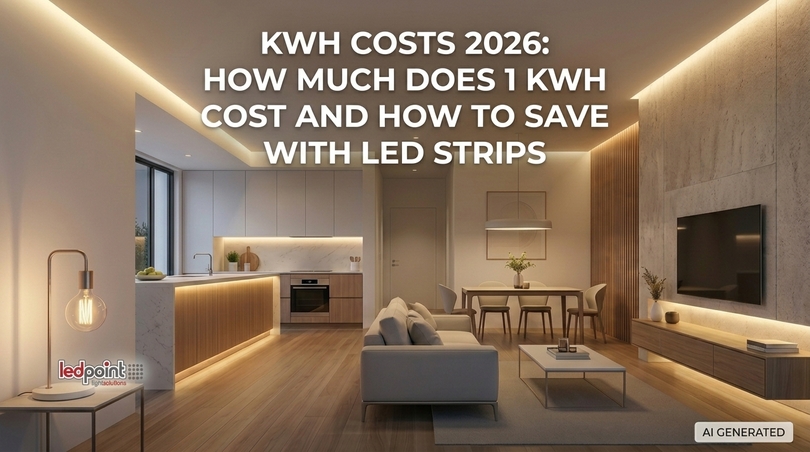
Every month the electricity bill arrives punctually, and with it, the same question: why do I pay so much and where does my money really go? Understanding kWh costs is the first step to stop suffering the price of electricity and start controlling it. You don't need to be an engineer: a few clear rules, some well-explained numbers, and the right tools are enough to turn an opaque expense item into a conscious choice.
In this technical guide, curated by the Ledpoint team, we comprehensively analyze what kWh costs are, how much a kWh costs today on the Italian market, who sets the electricity price, how to read time bands and meter power, and, above all, how to slash lighting electricity costs with professional LED strips. You will find comparison tables with older technologies, examples calculated on real products from our catalog, and two interactive configurators: the first calculates the kWh consumption of the strips you choose, the second estimates the cost in euros based on the updated market price.
Whether you are designing systems, managing a store, fitting out campers and boats, or simply want to know how much your new kitchen light will cost you, here you will find answers with verifiable data, ready-to-use formulas, and immediately applicable advice.
In this article...
1. What are kWh costs: watts, kW, and kWh simply explained
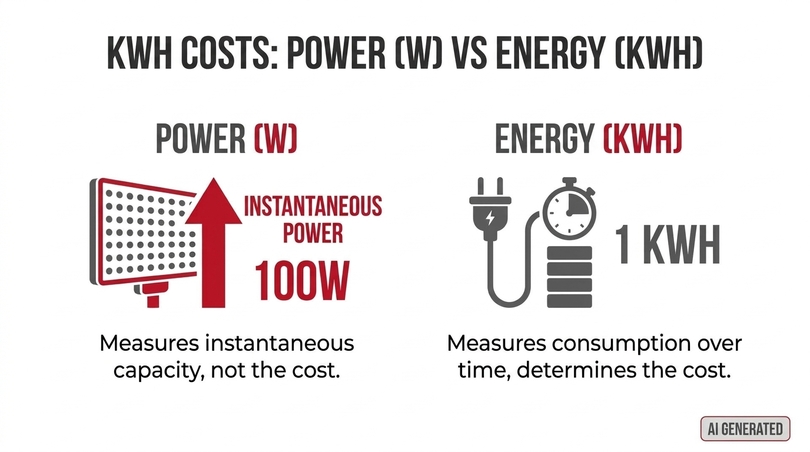
Before talking about prices, tariffs, and savings, we need to clarify the units of measurement. Much of the confusion around kWh costs stems from a trivial misunderstanding: confusing power with energy. The watt and the kilowatt measure how much an appliance "pushes" at a given instant; the kilowatt-hour measures how much energy it has used over time. It is this latter quantity that the supplier counts and charges you for.
What is 1 kWh and what does it correspond to
The kilowatt-hour (kWh) is the energy consumed by an appliance with a power of 1,000 watts running for one hour. 1 kWh corresponds to 3.6 million joules, but in everyday life it is more useful to translate it into concrete examples. With 1 kWh you can:
| Use | Indicative power | Operating time with 1 kWh |
|---|---|---|
| Electric oven | 2,000 W | 30 minutes |
| Hair dryer | 1,500 W | 40 minutes |
| Incandescent bulb | 60 W | about 16 hours and 40 minutes |
| Halogen bulb | 42 W | about 24 hours |
| 5 m LED strip at 4.8 W/m (24 W total) | 24 W | about 41 hours and 40 minutes |
| 5 m COB LED strip at 2.4 W/m (12 W total) | 12 W | over 83 hours |
This table already shows a key concept: for the same kWh paid, an efficient LED strip stays on for dozens of hours, while an oven exhausts them in half an hour. This is why talking about kWh costs without considering the power of the appliances makes no sense.
What is 1 watt equivalent to and what is its practical value
The watt (W) is the unit of power in the International System: 1 watt equals 1 joule per second. In electrical terms, it is obtained by multiplying voltage and current: 1 W = 1 volt × 1 ampere. A 24V LED strip drawing 1 ampere, therefore, operates at 24 W.
What is 1 W worth in euros? On its own, almost nothing. The economic value appears only when time comes into play. One watt running for 1,000 hours produces 1 kWh of consumption; with an average all-inclusive kWh cost of about €0.37, every watt left on for a whole year (8,760 hours) costs about €3.24. It seems like little, but multiply it by the 60 W of an old bulb left on for 5 hours a day and the figure becomes concrete.
The formula you must remember
All calculations in this guide derive from a single, simple, and universal formula:
kWh consumed = (power in W × hours of use) ÷ 1,000
Cost = kWh consumed × kWh price
For LED strips, the power is derived from the power per meter (W/m) indicated in the technical sheet, multiplied by the installed meters. A 9.6 W/m LED strip that is 4 meters long draws 38.4 W; running 4 hours a day for 365 days, it consumes about 56 kWh per year.
What is the difference between kW and kWh
This is the most searched question on the topic, and the answer is clear: kW measures instantaneous power, kWh measures energy consumed over time. An effective comparison is that of a car: kW is like the speed (kilometers per hour), kWh is like the distance traveled (kilometers). The electric meter's odometer counts kWh; the "maximum speed" you can reach without tripping the breaker is the contracted power, expressed in kW.
| Quantity | Unit | What it measures | Where to find it | How it affects the bill |
|---|---|---|---|---|
| Power | W, kW | How much energy the appliance absorbs at an instant | Product label, contract (contracted power) | Fixed power charge in €/kW/year |
| Energy | Wh, kWh | How much energy you have actually consumed | Meter, bill | Variable energy charge in €/kWh |
| Luminous flux | lumen (lm) | How much light is emitted | Technical sheet (lm/m for strips) | Indirect: more lumens per watt means fewer kWh |
| Luminous efficacy | lm/W | How much light you get per watt | Technical sheet | This is the parameter that determines savings |
How much does 1 kW cost? A question with two answers
Those searching for "how much does 1 kw cost" often actually mean the kilowatt-hour. If we are talking about energy, 1 kWh costs as indicated in the next section (about €0.20–€0.23 wholesale, €0.36–€0.40 all-inclusive). If we are truly talking about power, i.e., the kW contracted on the meter, the cost is a fixed annual charge you pay regardless of consumption, covered in the paragraph dedicated to meter power. Using "kW" instead of "kWh" is a common mistake that leads to calculations being off by a factor of a thousand.
What is energy cost and average cost
In economic language, energy cost is the total expenditure for the energy needed to carry out an activity: for a household it is the bill, for a store it is an income statement item affecting margins. The average cost, on the other hand, is the ratio between total expenditure and quantity consumed: if you pay €120 for 320 kWh, your average kWh cost is €0.375. The average cost also includes fixed charges, which is why those who consume little have a higher average cost per kWh than those who consume a lot.
Distinguishing between average cost and marginal cost is fundamental to evaluating an efficiency intervention: savings achieved with LEDs are calculated on the variable price of the kWh, because fixed charges remain unchanged even if you reduce consumption. Our configurators offer both options.
The economic cost of lighting over its lifecycle
The economic cost of a lighting system does not end with the purchase price. Lighting designers reason in terms of TCO (Total Cost of Ownership): purchase + installation + energy consumed + maintenance and replacements. Over a ten-year horizon, energy often represents over 70–80% of the total cost of a traditional light source, whereas with a well-designed LED system, the energy share drops drastically and the purchase price pays for itself in a few months.
2. How much does a kWh cost today: kWh price and average all-inclusive cost
Answering the question "how much does a kWh cost" seems simple, but the number changes depending on what you include in the calculation. There are in fact at least three different prices: the wholesale price, the supplier's energy commodity price, and the all-inclusive kWh cost that results from dividing the bill by consumption. Let's look at them one by one, with values updated to October 2026.
Current kWh price: the wholesale PUN
The PUN (Prezzo Unico Nazionale / Single National Price), today published as PUN Index, is the reference price of electrical energy traded on the Italian electricity exchange managed by GME – Gestore dei Mercati Energetici. It is determined every day, hour by hour, on the Day-Ahead Market and represents the "naked" cost of energy, without transport, charges, and taxes.
In the first half of October 2026, the daily PUN moved in a range between about €0.18 and €0.23/kWh, with a partial monthly average close to €0.20/kWh. On October 15, 2026, the value reached about €0.229/kWh. The most interesting data for those who light spaces is the hourly variation: during the central hours of the day, thanks to photovoltaics, the price drops significantly, while in the evening hours, when home and shop window lights are turned on, it rises to daily highs.
| Month 2026 | Indicative average PUN (€/kWh) | Trend |
|---|---|---|
| May | 0.119 | Spring lows, strong renewable production |
| June | 0.133 | Slight rebound |
| July | 0.157 | Summer demand for cooling |
| August | 0.180 | Steady increase |
| September | 0.208 | Resumption of production activities |
| October (partial) | approx. 0.20 | Upward trend with the arrival of the cold season |
Source: Ledpoint elaboration on public GME data and sector observatories, rounded values. Electricity prices today change every day: for the exact figure, use the real-time calculator further down.
Average kWh cost on the bill: why it is almost double the PUN
The current wholesale price is only a part of what you pay. The average all-inclusive kWh cost for a resident domestic customer, in October 2026, stands around €0.36–€0.40/kWh, according to indices that add grid losses, the average supplier spread, the variable share of transport and system charges, and 10% VAT to the PUN. In other words, for every euro of wholesale energy, you pay almost two on the bill.
The composition of the electricity bill
Every electricity bill, due to ARERA regulation, is divided into standard macro-items. Knowing them allows you to understand which ones you can influence and which you cannot:
| Expense item | What it includes | Type of charge | Indicative weight | Does it reduce with LEDs? |
|---|---|---|---|---|
| Cost of energy commodity | Energy price, supplier spread, dispatching, marketing | Variable (€/kWh) + fixed (€/month) | 50–60% | Yes, the variable part |
| Transport and meter management | Distribution, measurement, transmission | Fixed, power (€/kW) and variable | 15–20% | Only the variable part |
| System charges | Renewable support, general components | Prevalently variable | 8–15% | Yes |
| Taxes | Excise duty and VAT | Variable | 10–15% | Yes |
The practical conclusion is important: about 80–85% of an average household's bill depends on the kWh consumed. Reducing kilowatt-hours, therefore, lowers almost the entire expense, not just the "energy" item.
How much does an all-inclusive kWh cost: three price levels compared
| Price level | Indicative value October 2026 | When to use it in calculations |
|---|---|---|
| Wholesale PUN | €0.20–€0.23/kWh | To track market trends and indexed offers |
| Energy commodity offered by the supplier | €0.13–€0.25/kWh (fixed and variable offers) | To compare two contracts |
| Domestic all-inclusive kWh cost | €0.36–€0.40/kWh | To estimate how much you really save on the bill |
| Business all-inclusive kWh cost | variable, often €0.30–€0.45/kWh with 22% VAT | For stores, offices, workshops |
To estimate the savings achievable with LED lighting, the most correct value is the all-inclusive kWh cost excluding fixed charges: this is what truly disappears from the bill when a kWh is not consumed. In our calculator, you can choose which level to use.
How much does 1 kWh cost with Enel and what is the difference between Enel and Enel Energia
Many users search for "how much does 1 kWh cost Enel" or "Enel kilowatt-hour price" thinking there is a single price. In reality, the price depends on the subscribed offer, which can be fixed-price, PUN-indexed, single-rate, or time-of-use. To know it, you must read the "Cost of energy commodity" section of your bill or the contract summary sheet.
As for the difference between the companies: Enel S.p.A. is the parent company, Enel Energia is the company that sells electricity and gas on the free market, Servizio Elettrico Nazionale manages regulated services such as the one dedicated to vulnerable customers, while e-distribuzione is the distributor that manages the grid and meters in most of Italy. The distributor is the same regardless of your seller: changing supplier does not change the meter or the quality of the current.
3. Who sets the electricity price
Who sets the electricity price? There is no single entity: the final price is the result of a multi-level system, in which the market determines the cost of energy, the regulatory authority sets grid tariffs, and the State establishes charges and taxes. Understanding this supply chain helps to read news about price hikes and avoid surprises.
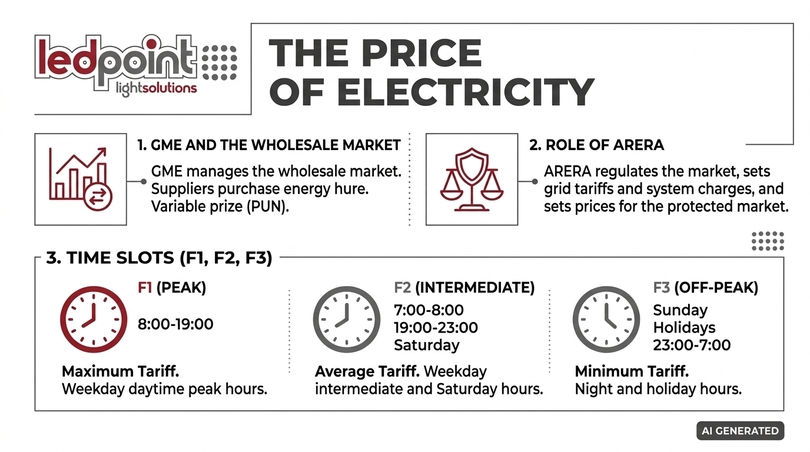
The role of GME and the wholesale market
On the electricity exchange managed by GME, producers and buyers submit sell and buy offers for every hour of the following day. The equilibrium price is formed through the marginal price mechanism: all accepted power plants are remunerated at the price of the last unit needed to satisfy demand, often a gas plant. This is why the price of electricity in Italy is strongly linked to the price of natural gas, and rises in the evening hours when photovoltaics are not producing.
The role of ARERA
ARERA, the Regulatory Authority for Energy, Networks and Environment, does not decide the price of energy on the free market, but it establishes transport and meter management tariffs, system charges, and the economic conditions of regulated services. Those searching for "ARERA electricity price today" will find periodic updates on the Authority's website regarding conditions for vulnerable customers, which serve as a useful market reference.
Free market, gradual protection, and vulnerable customers
Since 2024, the majority of non-vulnerable households have moved to the free market or the Gradual Protection Service. Energy costs in the free market vary greatly from one offer to another: fixed-price offers lock in the energy commodity for 12–36 months, while indexed ones follow the PUN plus a spread. Those falling into vulnerability categories (over 75, economic hardship, disability, medical equipment) can access the vulnerability protection service with conditions defined by ARERA.
Who is the cheapest electricity supplier?
There is no always-cheapest supplier: convenience depends on your consumption profile, contracted power, and when you use energy. The official and neutral tool to compare offers is the ARERA and Acquirente Unico Offers Portal, where by entering the annual consumption reported on your bill, you get a ranking based on estimated expenditure. However, remember that the cheapest kWh is the one you don't consume: a better offer saves you a few percentage points, while an efficient LED system can cut lighting consumption by 80% and more.
At what price is electricity sold
Those with a photovoltaic system can sell un-consumed energy back to the grid. Through the dedicated withdrawal managed by GSE, the injected energy is remunerated substantially at zonal market prices, meaning much less than what you pay for a kWh withdrawn from the grid. The lesson for those who light spaces is clear: it is better to self-consume, and low-absorption LED lighting, perhaps powered at 12V or 24V by a battery, allows you to make better use of the energy produced at home, in a camper, or on a boat.
4. Time bands F1, F2, F3: when electricity costs more
Time bands divide the week into periods with potentially different prices. For lighting, they are decisive, because lights are used mostly in the evening and on weekends, which is exactly when many offers apply different prices. Knowing in which band you turn on your LED strips allows you to choose the most suitable contract.
| Band | Days and times | Characteristics | Typical lighting use |
|---|---|---|---|
| F1 (peak hours) | Monday–Friday 8:00–19:00 | Maximum industrial demand | Stores, offices, workshops |
| F2 (intermediate hours) | Monday–Friday 7:00–8:00 and 19:00–23:00; Saturday 7:00–23:00 | Evening domestic demand | Home light in the evening, evening window displays |
| F3 (off-peak hours) | Monday–Saturday 23:00–7:00; Sunday and holidays all day | Minimum demand | Night lights, step lights, signs |
What is the difference between F2 and F3
F2 covers the evening hours of weekdays and Saturday, F3 covers the night, Sunday, and holidays. In dual-rate offers, these two bands are often grouped into "F23", with a price slightly lower than F1. For those who use lighting predominantly in the evening, a dual-rate tariff can be advantageous; for a store open during the day, however, the F1 price is what matters. Do not forget that the evening hourly PUN is often the highest of the day: reducing the watts turned on during those hours is the most effective way to contain kWh costs.
Single-rate or dual-rate for those who light with LEDs?
After switching to LEDs, the weight of lighting on total consumption is reduced so much that the choice of tariff becomes less critical. A practical rule: if over 65–70% of your consumption falls in F2 and F3, consider a dual-rate; otherwise, the single-rate is simpler and more predictable.
5. Meter power: cost difference between 3 kW and 6 kW
Contracted power is the maximum threshold you can draw simultaneously without tripping the meter. For a household, the standard value is 3 kW, with a tolerance allowing you to draw up to about 3.3 kW continuously. Increasing the power has an annual fixed cost, which you pay even if you never use it.
What is the cost difference between 3 kW and 6 kW
Going from 3 to 6 kW doubles the power charge, because it is paid in euros per kW per year. To this is added a one-off contribution for the power increase, regulated by ARERA. The annual difference typically translates to a few dozen euros more, plus the activation contribution. It only makes sense if you simultaneously use an induction hob, heat pump, oven, and electric car charging.
| Scenario | Recommended contracted power | Weight of LED lighting on power |
|---|---|---|
| Apartment with gas stove | 3 kW | Negligible: 30 m of strip at 9.6 W/m = 288 W |
| House with induction hob | 4.5–6 kW | Negligible |
| House with heat pump and electric car | 6 kW or more | Negligible |
| Store with halogen lighting | Often oversized | Relevant: switching to LEDs may allow reducing the power |
In commercial premises with many halogen spotlights or discharge lamps, replacing them with LED strips and aluminum profiles can free up kilowatts of power, sometimes allowing a reduction in contracted power and thus the fixed charge. This is a saving that adds to the kWh savings and is often forgotten.
6. 100, 200, 400, 500 kWh: how much they cost and when they are a lot
The numbers you read on your bill only gain meaning when compared to a reference. In this section, we translate the most searched consumptions into euros and answer very concrete questions: Is 1 kWh a lot? Are 10 kWh per day a lot? Are 100 or 200 kWh per month a normal consumption? We use an average all-inclusive kWh cost of €0.37, excluding monthly fixed charges.
Table: cost of 100, 400, 500, and 1,600 kWh
| Consumption | Cost at €0.22/kWh (PUN) | Cost at €0.30/kWh | Cost at €0.37/kWh (all-inclusive) | Cost at €0.40/kWh |
|---|---|---|---|---|
| 1 kWh | €0.22 | €0.30 | €0.37 | €0.40 |
| 10 kWh | €2.20 | €3.00 | €3.70 | €4.00 |
| 100 kWh | €22 | €30 | €37 | €40 |
| 200 kWh | €44 | €60 | €74 | €80 |
| 400 kWh | €88 | €120 | €148 | €160 |
| 500 kWh | €110 | €150 | €185 | €200 |
| 1,600 kWh | €352 | €480 | €592 | €640 |
| 2,700 kWh (typical annual household) | €594 | €810 | €999 | €1,080 |
The 1,600 kWh price, i.e., the cost of 1,600 kWh, is a useful reference because it corresponds to the annual consumption of a person living alone in a small apartment. In October 2026, 1,600 kWh cost about €590 in variable charges all-inclusive, to which fixed charges must be added.
Is 1 kWh a lot?
No: 1 kWh is a small amount for a house, but a large amount for a lamp. A typical Italian household consumes about 7–8 kWh per day; a 5-meter LED strip at 4.8 W/m takes almost two days of continuous operation to reach 1 kWh. This is why LED savings are perceived especially when operating hours are many or installed meters are many, such as in stores, hotels, corridors, and signs.
Are 10 kWh per day a lot?
For an apartment, yes, they are above average: 10 kWh per day equate to about 3,650 kWh a year, the consumption of a family of four with older appliances, or a house with an induction hob and electric water heater. If your consumption is of this order, it is worth checking how much lighting weighs: in a home still equipped with halogens, it can reach 1–1.5 kWh per day.
Are 100 kWh per month a lot? And 200 kWh?
100 kWh per month is a low consumption, typical of a single person or a rarely used second home. 200 kWh per month represents a normal consumption for a couple, corresponding to about 2,400 kWh a year. Above 300 kWh monthly, you enter the profile of a large family or a highly electrified home.
| Monthly consumption | Annual consumption | Typical profile | Indicative lighting share |
|---|---|---|---|
| 100 kWh | 1,200 kWh | Single, second home | 10–15 kWh/month |
| 200 kWh | 2,400 kWh | Couple, medium apartment | 15–30 kWh/month |
| 300 kWh | 3,600 kWh | Family of 4 | 25–45 kWh/month |
| 500 kWh | 6,000 kWh | Electrified home, heat pump, small store | 40–100 kWh/month |
How much lighting weighs on electricity costs
In the domestic sector, lighting absorbs on average between 7% and 15% of electricity consumption, with higher values in homes that still use halogens and dichroic spotlights. In the tertiary sector, the share rises significantly: in stores, offices, and hospitality structures, lighting can represent from 20% to over 40% of the electricity bill, according to analyses published by ENEA on building energy efficiency. This is where intervention on LEDs produces the fastest economic results.
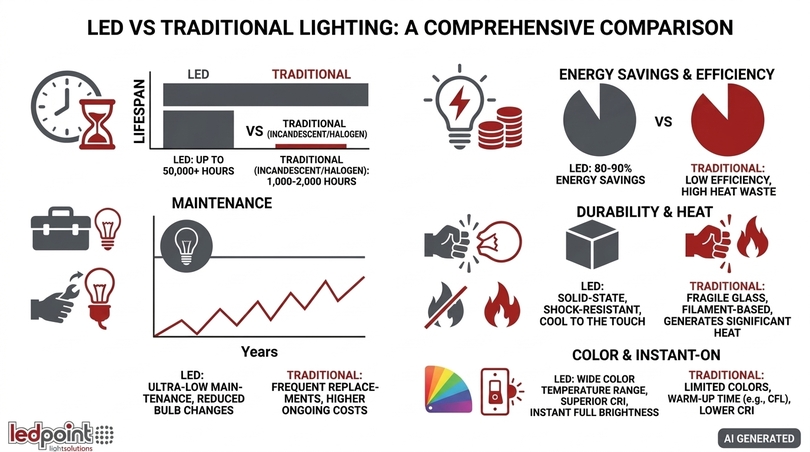
7. LED vs older technologies: consumption comparison table
To correctly compare two light sources, you should not look at watts, but at the light produced per watt. This is the concept of luminous efficacy, expressed in lumens per watt (lm/W). The higher this value, the fewer kWh are needed to obtain the same amount of light, and therefore the lower the kWh costs of the system.
The definitive comparison table
We have compared the main technologies at parity of luminous flux: 1,000 lumens, the light of a good reading lamp, running for 1,000 hours, with an all-inclusive kWh cost of €0.37.
| Technology | Typical efficacy (lm/W) | Watts per 1,000 lm | kWh per 1,000 hours | Energy cost per 1,000 hours | Average lifespan (hours) | LED savings vs technology |
|---|---|---|---|---|---|---|
| Traditional incandescent | 10–15 | approx. 80 W | 80 kWh | €29.60 | 1,000 | approx. 90% |
| Halogen | 15–25 | approx. 50 W | 50 kWh | €18.50 | 2,000–3,000 | approx. 85% |
| Compact fluorescent (CFL) | 50–70 | approx. 17 W | 17 kWh | €6.29 | 6,000–10,000 | approx. 55% |
| T8 fluorescent tube with ballast | 65–90 | approx. 13 W | 13 kWh | €4.81 | 12,000–15,000 | approx. 40% |
| Standard LED strip | 90–110 | approx. 10 W | 10 kWh | €3.70 | 30,000–50,000 | reference |
| High-efficiency LED strip (up to 150 lm/W) | 130–150 | approx. 7 W | 7 kWh | €2.59 | over 50,000 | top reference |
With a 150 lm/W LED strip, the same light as an incandescent lamp costs about eleven times less. To this is added maintenance savings: a quality strip lasts as long as 30–50 traditional bulbs.
Halogen bulb and spotlight consumption: do they consume a lot?
Yes, halogen spotlights consume a lot relative to the light they produce. A 50W GU5.3 dichroic spotlight, very common in stores and suspended ceilings, converts only a small part of the energy into light: the rest becomes heat, which in summer also increases the air conditioner's workload. Ten 50W halogen spotlights running 10 hours a day consume 1,825 kWh a year, about €675 at €0.37/kWh. The same space illuminated with LED strips in profiles may require less than 300 kWh.
LED bulb consumption and LED strip consumption
LED strips are chosen based on power per meter. On the Ledpoint catalog, you will find the entire range, from 4.8 W/m LED strips for accent lighting to 24 W/m and higher LED strips for high-flux main lighting. Here is some real data taken from the technical sheets of catalog products:
| Ledpoint Product | Power | Flux | Efficacy | kWh/year for 5 m, 4 h/day | Annual cost at €0.37/kWh |
|---|---|---|---|---|---|
| COB 3000K CRI>90 12V 2.4 W/m constant current control | 2.4 W/m | 215 lm/m | 98 lm/W | 17.5 kWh | €6.48 |
| COB 4000K CRI>90 12V 4.8 W/m constant current control | 4.8 W/m | 480 lm/m | 106 lm/W | 35 kWh | €12.95 |
| Neon Flex 5x5 mm 3000K 24V | 5.5 W/m | — | — | 40.2 kWh | €14.87 |
| Strip 2835 2700K IP67 24V | 12 W/m | — | — | 87.6 kWh | €32.41 |
| Strip 2835 4000K 3step 24V 19.2 W/m | 19.2 W/m | 2,600 lm/m | 150 lm/W | 140.2 kWh | €51.87 |
Note a decisive detail: the 19.2 W/m strip consumes more in absolute terms, but produces 2,600 lumens per meter at 150 lm/W, making it the most efficient choice when a lot of light is needed. To obtain the same 13,000 lumens of its 5 meters with halogen lamps would require over 600 W. Choosing the right strip means reasoning about the necessary lumens, not just the lowest watts.
ErP energy classes: how to read them
Since September 2021, light sources sold in Europe bear the new energy label from A to G, defined by EU Delegated Regulation 2019/2015, while ecodesign requirements are set by EU Regulation 2019/2020. The scale is very strict: a class D already corresponds to high efficiency, while class A is reserved for sources above 210 lm/W. On the Ledpoint website, each strip reports its ErP class, also consultable in the blog section dedicated to the ErP label.
8. How to slash kWh costs with LED strips
Replacing old lamps with LEDs is the first step, but not the only one. A truly efficient system is born from a series of coherent design choices: the right source, the right voltage, the right power supply, the right control, and proper heat dissipation. Each of these choices affects the kWh consumed and the lifespan of the system.
Choose lumens, not watts
Sizing always starts from the necessary light. A kitchen requires illuminance values of a few hundred lux on the worktop, consistent with illuminance standards and good lighting practices; a corridor requires much less. If you want to calculate lux precisely, we have dedicated an in-depth article to how to calculate the lux of an LED installation. Oversizing the light by 30% means paying 30% more in kWh for the entire life of the system.
Prefer high-efficiency strips and quality chips
Strips with quality 2835 chips reach very high efficiencies. In the 2835 LED strips range, you will find models up to 150 lm/W, while COB LED strips offer a continuous line of light without dots, ideal for visible or shallow profile installations. Those wishing to delve into chip technology can read our article on 2835 LED wires and gold and silver connections, which influence reliability and flux maintenance over time.
The Ledpoint data: measured, not declared
Ledpoint regularly tests its own strips with an integrating sphere and spectroradiometer, laboratory instruments that measure efficiency, lumens per meter, color temperature, spectrum, and CRI. This means that the lm/W values published in the technical sheets are those on which you can base your kWh cost calculations, with no surprises between rated data and real performance.
24V and 48V voltage: fewer losses, less waste
At equal power, a higher voltage requires less current and reduces Joule effect losses along the strip and in the cables. 24V LED strips and 48V LED strips allow longer runs with uniform brightness and fewer power injection points. The characteristics of 48V solutions are detailed in our guide to 48V LED strips, increasingly used as primary lighting.
Constant current control strips for campers, boats, and battery systems
In 12V battery systems, the voltage varies continuously. LED strips with constant current control systems maintain stable flux and consumption between 11 and 18V, protect the LEDs, and prolong battery autonomy. In these contexts, every watt-hour counts: saving energy means traveling longer without recharging. For marine applications, you will find dedicated solutions in the marine sector lighting section, for vehicles in the mobile lighting section.
Efficient and correctly sized power supplies
The power supply converts mains voltage to low voltage and inevitably introduces losses. A good power supply has an efficiency of 88–94%, a poor one can drop below 80%. Sizing it with a margin of about 20% over the load preserves its life and keeps it working in the best efficiency zone. On Ledpoint you will find 24V power supplies, 12V ones, and smart power supplies that integrate control functions.
Dimmers, sensors, and control: smart savings
The cheapest light is the one turned off when not needed, or regulated to the right level. An LED strip dimmer allows you to lower the intensity: a strip regulated to 60% consumes indicatively 60% of the energy, often with a more pleasant effect. Presence and motion sensors automatically turn off the light in corridors, walk-in closets, bathrooms, and warehouses. In more advanced projects, DALI and DMX systems or ZigBee devices allow programmed scenarios and regulation based on natural light.
Aluminum profiles: dissipate to last and save
Heat is the main enemy of LEDs: a strip that runs too hot loses efficiency and ages faster, emitting less light for the same consumption. Aluminum profiles dissipate heat, protect the strip, and, with the right diffuser, improve visual comfort. A well-dissipated strip maintains its luminous flux longer, and thus a better lumen/kWh ratio over time.
Quality light without waste: CRI and color temperature
High color rendering improves color perception but can slightly reduce efficiency. Our in-depth article discovering CRI explains when it is worth aiming for CRI>90 and when a CRI 80 is sufficient. Similarly, chromatic consistency between strips, described in the guide on MacAdam steps and CCT, avoids having to add light to compensate for tone differences. Choosing the right temperature for the environment avoids the temptation to increase lumens to correct light perceived as cold or dull.
9. Configurator: calculate the kWh consumption of Ledpoint strips
Theory and tables are useful, but the question that matters is only one: how much will your system consume? The following configurator allows you to choose a real Ledpoint catalog LED strip, indicate the meters, hours of use, and any dimmer regulation, and immediately obtain the daily, monthly, and annual kWh consumption. The calculation also includes power supply efficiency, often ignored by generic calculators.
How the calculation works
The configurator applies the standard formula: kWh = W/m × meters × (dimmer %) × hours ÷ power supply efficiency ÷ 1,000. If you prefer, you can manually enter the power per meter of any strip, for example by consulting the LED strips by power categories.
How to read the result
The result reports the total power absorbed from the grid, the kWh per day, month, and year. If the chosen strip has a declared flux, the configurator also calculates how many kWh a traditional technology would consume to produce the same light, showing the annual energy savings. The annual kWh value is automatically transferred to the cost calculator below.
Tips for a realistic calculation
For a kitchen, use 3–5 hours a day, for a living room 4–6, for a window display the number of opening hours plus any evening lighting, for a sign or hotel corridor even 12–24 hours. RGB and RGB+CCT strips rarely run with all channels at maximum: in those cases, set an average intensity of 30–50% to obtain a figure closer to reality.
10. Calculator: estimated cost with the updated market kWh price
Knowing the kWh is half the work; the other half is translating them into euros with a realistic price. This calculator attempts to download in real time the wholesale electricity price of the day from the electricity exchange, via open data published by the Energy-Charts platform by Fraunhofer ISE for the Northern Italian market zone, which closely follows the PUN. To the wholesale price, it then adds bill components to estimate the all-inclusive kWh cost.
If the connection is unavailable, the calculator uses the October 2026 reference value (€0.215/kWh wholesale) which you can modify manually, for example by entering the price indicated on your bill.
| Wholesale price (€/kWh) | Reference value October 2026. |
Why the result is an estimate
The wholesale price changes every hour and grid components are periodically updated by ARERA. The default items are calibrated to return an all-inclusive kWh cost consistent with October 2026 market indices, around €0.37/kWh. For a tailored result, replace the values with those from your bill: your contract's spread, your VAT rate, and, if you have a fixed-price offer, enter that price directly into the wholesale field by zeroing the spread.
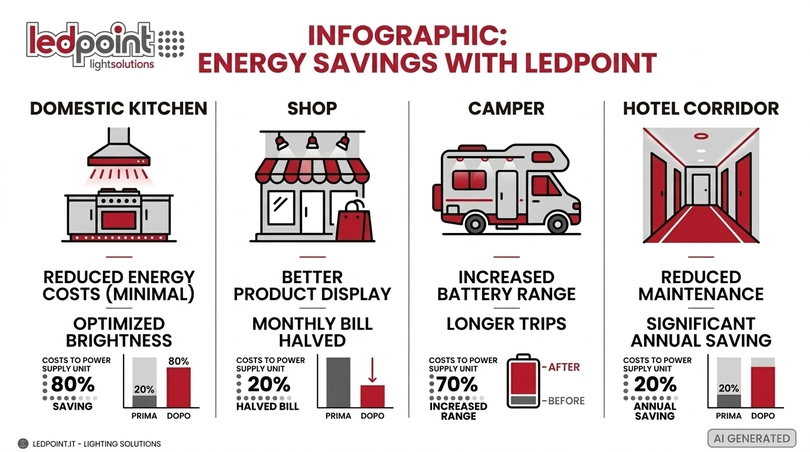
11. Real-life cases: how much you really save
Abstract numbers convince little; concrete examples much more. In this section, we apply the calculations to four typical situations our technical office encounters every day: a home kitchen, a store, a camper, and a hotel corridor. In all cases, we use an all-inclusive kWh cost of €0.37 and real power data, to transparently show where the savings come from.
Case 1: the home kitchen, from halogen spotlights to under-cabinet COB strips
Starting situation: six 35W halogen spotlights under the cabinets, on for an average of 4 hours a day. Consumption: 210 W × 4 h × 365 days = 306.6 kWh per year, equal to about €113 in energy.
LED solution: 4 meters of 4000K COB strip CRI>90 at 4.8 W/m in profile with opal diffuser, power supply with 90% efficiency. Power from the grid: 4.8 × 4 ÷ 0.9 = 21.3 W. Consumption: 21.3 W × 4 h × 365 = 31.1 kWh per year, about €11.50.
Result: savings of over €100 per year and about 90% less energy, with continuous light, no pinpoint shadows, and excellent color rendering of food. Strip, profile, and power supply pay for themselves in a few months.
Case 2: a clothing store, window display and showcases
Starting situation: thirty 50W halogen spotlights on for 10 hours a day for 300 days a year. Consumption: 1,500 W × 10 h × 300 = 4,500 kWh per year, about €1,665 in energy (with 22% VAT, the real cost for the business may be even higher). To this is added the emitted heat, which in summer increases the air conditioning load.
LED solution: 40 meters of 2835 strip 4000K 3step at 19.2 W/m and 150 lm/W regulated to 70% with a dimmer, in recessed profiles. Power from the grid: 19.2 × 40 × 0.7 ÷ 0.92 = 584 W. Consumption: 584 W × 10 h × 300 = 1,752 kWh per year, about €648, with a total luminous flux higher than the initial one.
Result: over €1,000 in annual savings on energy alone, contracted power reduced by almost a kilowatt, and more uniform light on the merchandise. For commercial setups, find inspiration in the lighting for setups section.
Case 3: campers and vans, every watt-hour weighs on the battery
In a camper, light is not paid in euros per kWh, but in battery autonomy. A 100 Ah 12V lithium battery stores about 1.2 kWh. Six 10W halogen lamps on for 5 hours a day consume 300 Wh, a quarter of the battery. With 6 meters of 3000K COB strip at 2.4 W/m with constant current control, consumption drops to 72 Wh, allowing you to stay more days without plugging into a campsite. The current control keeps the light constant even when the battery discharges and the voltage drops.
Case 4: hotel corridor lit 24/7
Starting situation: twenty 18W compact fluorescent lamps on all day, all year: 360 W × 8,760 h = 3,154 kWh, about €1,167. Solution: 40 meters of 4.8 W/m LED strip with presence sensors that reduce the light to 20% when the corridor is empty, for an estimated average intensity of 45%.
Power from the grid at full light: 192 W ÷ 0.9 = 213 W; with an average intensity of 45%, consumption becomes 213 × 0.45 × 8,760 = about 840 kWh, just over €310. Savings: over €850 per year for a single corridor. Multiplied by the floors of a facility, it is an intervention that changes the hotel's energy balance.
Summary table of cases
| Case | kWh/year before | kWh/year after | Energy savings | Annual economic savings |
|---|---|---|---|---|
| Home kitchen | 306.6 | 31.1 | 90% | about €102 |
| Store | 4,500 | 1,752 | 61% | about €1,017 |
| Camper (Wh/day) | 300 Wh | 72 Wh | 76% | more autonomy, fewer recharges |
| Hotel corridor | 3,154 | 840 | 73% | about €856 |
12. Mistakes that drive up lighting electricity costs
Even with LEDs, energy can be wasted. In our experience supporting installers and designers, most inefficient systems stem from a few recurring mistakes, easy to avoid if known in advance. Here they are in order of impact.
Comparing watts instead of lumens
A 4.8 W/m strip is not automatically cheaper than a 9.6 W/m one: it depends on how much light is needed. If to reach the desired illuminance you have to install two rows of the less powerful strip, you have spent more and consume the same. Always compare lumens per meter and efficiency in lm/W.
Ignoring power supply efficiency
A cheap power supply with 80% efficiency makes you consume 12.5% more than a 90% one, for its entire life. Furthermore, an overloaded power supply heats up, degrades, and can cause flickering. Investing a few euros more in the power supply pays off on the bill.
Installing strips without heat dissipation
Gluing a high-power strip directly onto wood or drywall makes it run at high temperatures: it loses flux, changes tone, and ages quickly. The result is that after a few years you pay the same kWh for much less light. The aluminum profile is an integral part of the system, not an aesthetic accessory.
Leaving the light on without control
Corridors, storerooms, night window displays, signs: these are the areas where the light stays on for hours without anyone benefiting. A sensor or a timer costs little and can halve the operating hours. For passageways, combining a motion sensor and a dimmer is the most effective solution.
Voltage drops on long runs
A 12V strip powered from one end over 10 meters shows an evident drop in brightness towards the end. Many react by increasing the power or adding strips, and thus consumption. The correct solution is to power from both ends or switch to 24V or 48V, which reduce current and losses.
Choosing a contract without knowing your profile
After reducing lighting consumption, many maintain a contract designed for a different consumption profile. Reviewing the tariff and contracted power after an efficiency intervention is the way to cash in on the savings down to the last cent.
13. How to read your bill and calculate your kWh costs in 6 steps
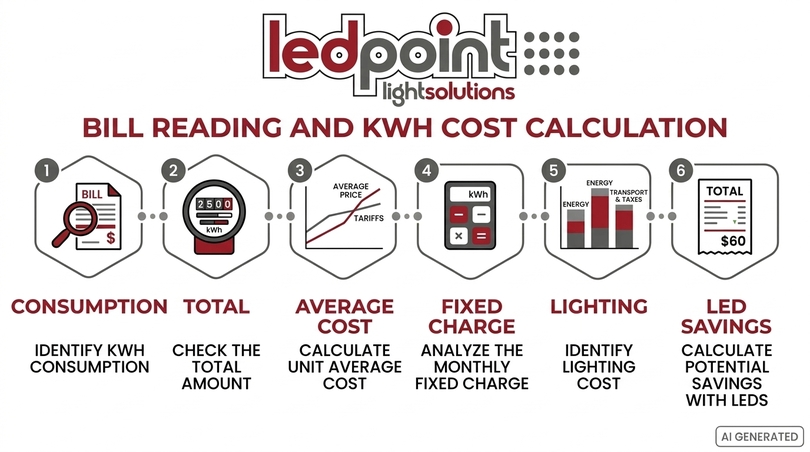
All the calculations in this guide become truly useful when you apply them to your numbers. The bill already contains all the necessary information, but it is often perceived as an indecipherable document. It takes just six steps, always the same, to derive your average kWh cost and understand how much lighting weighs. Keep your latest bill at hand and, if possible, those of the previous twelve months.
Step 1: identify the period's consumption
On the first page, you will find the kWh billed for the period, often divided into F1, F2, and F3 bands. Check whether these are actual (read from the meter) or estimated consumptions: with second-generation electronic meters, readings are almost always real, but it is good to check. The annual consumption, reported in the "annual consumption" section, is the most reliable data for any comparison.
Step 2: find the total amount to pay
Note the total amount of the bill, including VAT. Exclude any extraordinary items such as the RAI license fee, recalculations for previous periods, security deposits, or contributions for meter work, because they alter the average cost calculation.
Step 3: calculate the average kWh cost
Divide the total by the kWh consumed. Example: €112 ÷ 290 kWh = €0.386/kWh. This is your all-inclusive average kWh cost, useful for understanding how much you really pay for each unit of energy, including fixed charges distributed over consumption.
Step 4: separate fixed and variable charges
In the bill details, identify the fixed charges (euros per month) and the power charge (euros per kW). Subtract them from the total and divide the rest by the kWh: you obtain the marginal cost of the kWh, i.e., how much you save for every kWh you do not consume. This is the value to use in the calculator to estimate LED savings.
Step 5: estimate lighting consumption
Take inventory of the light sources: for each lamp, note the power and average daily operating hours. Sum the watt-hours and multiply by 365. For LED strips, use the configurator on this page. If lighting exceeds 10% of domestic consumption or 20% of business consumption, there is room for significant savings.
Step 6: simulate the intervention and calculate the payback time
Recalculate the kWh with the new LED strips, multiply the difference by the marginal cost of the kWh, and obtain the annual savings. Divide the cost of the intervention (strips, profiles, power supplies, possible installation) by the annual savings: the result is the payback time of the investment, which in the replacement of halogen sources is often measured in months, not years.
How to calculate the electricity bill with a complete example
A family consumes 2,700 kWh a year with a marginal cost of €0.33/kWh and fixed charges of about €130 annually. Estimated expenditure: 2,700 × 0.33 + 130 = €1,021. If lighting absorbs 350 kWh and switches to LEDs, dropping to 60 kWh, the savings are 290 × 0.33 = about €96 per year, 9.4% of the total bill, achieved without giving up anything.
14. Electricity prices: trends and outlook for 2026–2027
No one can predict the price of electricity with certainty, but some structural dynamics are now evident and help in making long-term decisions. For those investing in lighting, price volatility is itself an argument in favor of efficiency: every kWh saved protects you from future price hikes.
The link with gas and seasonality
As seen, the Italian wholesale price depends largely on the cost of gas used by thermal power plants. In 2026, the PUN went from values around €0.12/kWh in spring to over €0.20/kWh in autumn, following demand and gas quotations. Autumn and winter, when more lights are turned on for more hours, coincide with the months when the kWh costs the most: one more reason to reduce lighting consumption.
Renewables and increasingly differentiated hourly prices
The growth of photovoltaics lowers prices during central hours and accentuates the difference with evening hours. This phenomenon, known to analysts as the "duck curve", makes it increasingly advantageous to shift flexible consumption to sunny hours. Lighting, however, cannot be shifted: it is used when it is dark. For this reason, the only effective strategy on lighting kWh costs is to reduce its power.
What this means for those designing today
An LED system installed in 2026 will work for ten or fifteen years. Even assuming a stable price, the consumption difference compared to a traditional technology is worth many times the cost of the materials alone; in a scenario of price hikes, the advantage grows even more. Designing with high-efficiency strips, control, and correct dissipation is a form of insurance against market uncertainty.
kWh costs for households and businesses: the differences to know
kWh costs are not the same for everyone. Households and businesses pay the same wholesale price, but different grid components, excise duties, and VAT. The resident domestic customer applies 10% VAT and a residential use excise duty; non-domestic users, such as stores, offices, professional studios, and workshops, generally apply 22% VAT and grid tariffs linked to power and voltage level.
For a commercial activity, moreover, lighting electricity costs add to those of air conditioning: traditional sources produce a lot of heat, which in summer the air conditioner must remove, consuming more kWh. By switching to LEDs, a store therefore reduces its kWh costs twice: once on light and a second time on cooling. For businesses that can deduct VAT, the cost to consider in calculations is the one excluding the tax, while for households, the all-inclusive kWh cost matters.
| Item | Resident domestic customer | Non-domestic user (store, office) |
|---|---|---|
| VAT | 10% | Generally 22% |
| Excise duty | Rate for residential use | Rates for other uses, in consumption brackets |
| Light operating hours | Predominantly evening (F2, F3) | Predominantly daytime (F1) and evening for window displays |
| Weight of lighting on consumption | 7–15% | 20–40% and above |
| Benefit of LEDs | Savings on the variable charge | Savings on lighting, cooling, and sometimes contracted power |
15. Essential glossary of kWh costs and LED lighting
To navigate bills, technical sheets, and commercial offers, it is useful to have a shared vocabulary. We have collected the most frequently recurring terms, explained simply and with a practical reference to the use of LED strips.
| Term | Meaning | Why it matters for costs |
|---|---|---|
| Watt (W) | Unit of power, 1 joule per second | Determines how much energy a strip absorbs at any instant |
| Kilowatt (kW) | 1,000 watts | Unit of the meter's contracted power |
| Kilowatt-hour (kWh) | Energy of 1 kW for 1 hour | It is the unit on which kWh costs are calculated on the bill |
| PUN / PUN Index | Reference wholesale price of the Italian electricity exchange | Basis of indexed offers |
| Spread | Surcharge applied by the supplier to the PUN | Differentiates indexed offers |
| System charges | Components that finance objectives of general interest | Paid for every kWh withdrawn |
| Bands F1, F2, F3 | Time periods with potentially different prices | Influence the cost of evening lighting |
| Lumen (lm) | Amount of light emitted | Basis for sizing the system |
| Luminous efficacy (lm/W) | Light produced per watt | The parameter that determines savings |
| Lux (lx) | Lumens per square meter on the surface | Indicates whether the light is sufficient for the visual task |
| CRI (Ra) | Color Rendering Index | Light quality; has a small but measurable impact on efficiency |
| CCT (K) | Color temperature | Light perception: warm, neutral, cool |
| Power supply efficiency | Ratio between delivered and absorbed power | Every percentage point lost is paid in kWh |
| ErP Class | Energy efficiency class from A to G | Immediate comparison between different sources |
| L70 | Hours after which the flux drops to 70% | Useful life of the system and savings |
16. Checklist for a minimum kWh cost LED system
Before purchasing strips, profiles, and power supplies, review this checklist. It is the operational summary of the entire guide and helps you not to forget any of the factors that determine the consumption and lifespan of the system.
| Check | Question to ask yourself | Ledpoint Reference |
|---|---|---|
| Required light | How many lux are needed and how many lumens per meter are required? | Guide to calculating lux |
| Efficiency | Does the strip have a declared and measured efficiency in lm/W? | High-efficiency 2835 strips |
| Voltage | Are the runs long? Is 24V or 48V preferable? | LED strips by voltage |
| Power supply | Is the efficiency high and the load about 80% of the nominal power? | Power supplies |
| Control | Are dimmers, sensors, or a DALI/ZigBee system needed? | Controllers |
| Heat dissipation | Is the strip mounted on a suitable aluminum profile? | Profiles |
| Protection | Does the environment require IP65 or IP67? | Outdoor lighting |
| Contract | Are the tariff and contracted power consistent with the new consumption? | ARERA Offers Portal |
17. Which LED strip to choose for every environment without wasting kWh
Each environment has different light requirements, and therefore a different ideal power per meter. Choosing the strip based on the context, rather than "by eye", is the simplest way to get the right light with the minimum possible consumption. Here are the indications our technical office most frequently provides to installers, architects, and private individuals.
Living room and bedroom: atmospheric and indirect light
For ceiling coves, headboard backlighting, and TV furniture, strips from 4.8 to 9.6 W/m in warm tones are generally sufficient. A warm white LED strip between 2700K and 3000K, dimmable, ensures comfort and minimal consumption. Those wishing to also regulate the tone during the day can consider CCT LED strips or the Circadian Light line, designed to follow the natural rhythm of light.
Kitchen and bathroom: functional light and color rendering
On the worktop, precise and uniform light is needed, which renders food colors well. Strips from 4.8 to 14.4 W/m with CRI higher than 90, in profile with a diffuser, are the ideal choice. In the bathroom, near the sink and shower, choose versions with an adequate protection rating, and for the mirror consider a dedicated dimmer like those in the mirror dimmer category.
Main lighting with strips: when high powers are needed
Increasingly, LED strips replace ceiling lights and chandeliers as the main light, particularly in drywall false ceilings. In these cases, high-efficiency strips from 14.4 to 24 W/m, mounted in recessed profiles, are required. With 150 lm/W, 10 meters of 19.2 W/m strip provide 26,000 lumens with less than 200 W: an amount of light that with halogens would have required over 1,000 W.
Outdoors, signs, and decorations
For terraces, gardens, facades, and signs, products with IP65 or IP67 protection and resistance to atmospheric agents are required. Neon Flex offers a continuous line of light with contained consumption, around 5.5 W/m in mini sections. For signs lit for many hours, efficiency is decisive: every watt saved is worth over €3 a year if the light stays on all day.
Vending, retail, and food
Vending machines, refrigerated counters, and showcases run 24/7 and require compact, cool-to-the-touch, and efficient light. Ledpoint has dedicated solutions in the vending lighting and food lighting sections, with spectra designed to enhance products. In an always-on application, going from 10 to 5 W per fixture saves about €16 a year for each light point, a figure that multiplies by hundreds of machines in a fleet.
Horticulture and special applications
In indoor cultivation, light is a production factor and kWh costs directly impact the margin. Strips in the horticulture lighting section and the Growing line concentrate energy in the wavelengths useful to plants, avoiding paying kWh for light that the plant does not use.
| Environment | Recommended power | Color temperature | Recommended control | Indicative annual consumption (5 m) |
|---|---|---|---|---|
| Living room, indirect light | 4.8–9.6 W/m | 2700–3000K | Dimmer | 25–55 kWh (3 h/day) |
| Kitchen, under-cabinet | 4.8–14.4 W/m | 3000–4000K, CRI>90 | Switch or sensor | 35–105 kWh (4 h/day) |
| Main light in false ceiling | 14.4–24 W/m | 3000–4000K | Dimmer or DALI | 105–175 kWh (4 h/day) |
| Outdoor sign | 5.5–12 W/m | according to project | Timer or twilight sensor | 120–265 kWh (12 h/day) |
| Corridor, passageways | 4.8 W/m | 3000–4000K | Presence sensor | 35–90 kWh (based on use) |
18. Frequently asked questions about kWh costs
We have collected the questions most frequently asked to us about kWh costs, bills, and LED strip consumption. Click on each question to read the answer.
How much does a kWh cost today in Italy?In October 2026, the wholesale price of electricity (PUN) moves between about €0.18 and €0.23/kWh, with a monthly average around €0.20/kWh. The all-inclusive kWh cost for a domestic customer, which includes transport, charges, excise duties, and 10% VAT, is indicatively between €0.36 and €0.40/kWh, depending on the offer. |
What is the average all-inclusive kWh cost on the bill?The average all-inclusive kWh cost is obtained by dividing the total bill by the kWh consumed. For a typical household in autumn 2026, the value hovers between €0.36 and €0.40/kWh. Those who consume little have a higher average cost, because the monthly fixed charges are distributed over fewer kilowatt-hours. |
What is the difference between kW and kWh?kW measures power, i.e., how much energy an appliance absorbs at an instant; kWh measures energy consumed over time. A 24W strip running for 1,000 hours consumes 24 kWh. On the bill, you pay for kWh as a variable charge and for kW of contracted power as an annual fixed charge. |
How much do 100, 400, and 500 kWh cost?With an all-inclusive kWh cost of about €0.37, 100 kWh cost about €37, 400 kWh about €148, and 500 kWh about €185, excluding fixed charges. At the wholesale price of €0.22/kWh alone, the same quantities would cost €22, €88, and €110, respectively. |
How much does a 5-meter LED strip consume?It depends on the power per meter. A 4.8 W/m strip that is 5 meters long draws 24 W: running 4 hours a day, it consumes about 35 kWh a year, equal to about €13 at €0.37/kWh. A high-flux 19.2 W/m strip consumes about 140 kWh a year under the same conditions, but produces five times more light. |
How much do you save by switching from halogens to LED strips?At parity of light, LED strips consume indicatively 80–90% less than halogens and 90% less than incandescent lamps. In a kitchen with six 35W halogen spotlights running 4 hours a day, switching to a 4.8 W/m COB strip saves over €100 a year. |
Who sets the electricity price?The wholesale price is formed on the electricity exchange managed by GME, based on supply and demand. ARERA regulates grid tariffs, system charges, and conditions of protected services, while the State sets excise duties and VAT. On the free market, each supplier sets the price of their own offer starting from these references. |
What is the difference between band F2 and F3?Band F2 includes weekdays from 7 to 8 and from 19 to 23, and Saturday from 7 to 23. F3 covers night hours from Monday to Saturday, from 23 to 7, and the entire day on Sunday and holidays. In dual-rate tariffs, the two bands are often grouped into F23. |
Is it worth switching from 3 kW to 6 kW of power?Only if you simultaneously use very powerful appliances such as an induction hob, heat pump, oven, and electric car charging. Doubling the power doubles the fixed power charge and entails a one-off contribution. LED lighting, even extensive, has very little impact on the contracted power of a home. |
How much does 1 kWh cost with Enel?There is no single price: the cost depends on the offer subscribed with Enel Energia or another supplier, which can be fixed, PUN-indexed, single-rate, or time-of-use. The exact value is found in the "cost of energy commodity" section of the bill or in the contract summary sheet. |
Who is the cheapest electricity supplier?There is no always-cheapest supplier: convenience depends on consumption, bands, and power. The neutral tool for comparison is the ARERA and Acquirente Unico Offers Portal. However, reducing the kWh consumed, for example with efficient LED strips, produces savings much greater than any change of offer. |
Does the dimmer really save energy with LED strips?Yes. With LED strips, the absorbed power reduces almost proportionally to the intensity: a strip regulated to 50% consumes indicatively half. Unlike old incandescent lamps, regulation does not worsen efficiency and actually reduces the operating temperature, extending the life of the LEDs. |
19. The cheapest kWh is the one you don't consume
kWh costs are not a destiny. They depend on factors you can know and, to a large extent, control: the price of energy on the market, the contract you choose, the power you commit, and above all how many kWh you consume. On the first three levers, improvements of a few percentage points are obtained; on the last one, that of consumption, the margins are enormous.
Lighting is the area where efficiency costs the least and yields the most. With high-efficiency LED strips, quality power supplies, aluminum profiles, and intelligent control, it is realistic to reduce the energy dedicated to light by 80–90% compared to traditional technologies, obtaining at the same time better, more uniform, and longer-lasting light. The configurators on this page allow you to verify this with your numbers, on your project, with the market price of the day.
If you are designing a new system or want to replace an existing one, explore the complete catalog of Ledpoint LED strips, download technical sheets and catalogs from the catalogs page, or contact our technical office for a quote and personalized consultation: we will help you choose the right strip to get the light you desire with the lowest possible kWh costs. For further insights, visit the Ledpoint blog.