







How many lumens are needed per square meter: table for each room
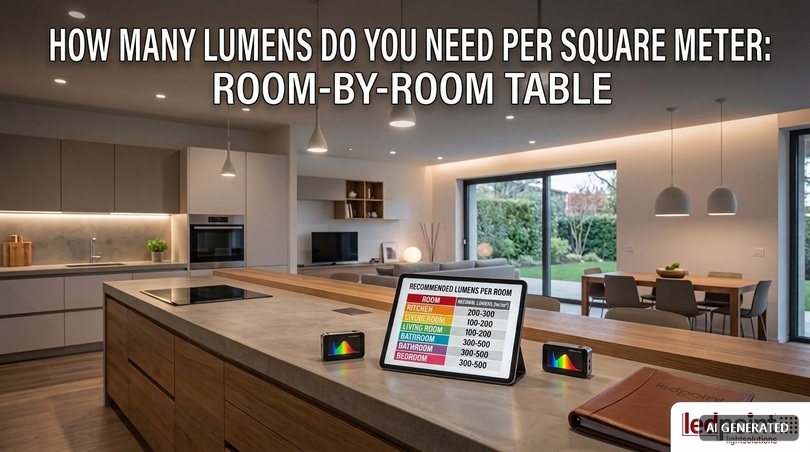
This guide was born from a daily observation on the construction site: the question "how many lumens per square meter" almost always receives wrong answers, because it confuses two different quantities. Lumen measures how much light comes out of a source, while lux measures how much light arrives on the surface. Between the two there is the geometry of the room, the color of the walls, the optics of the luminaire, the dust that will deposit over the next three years. Ignoring these steps means delivering installations undersized by 30–40%, which the customer perceives as "dark" without being able to explain why.
In the following sections you will find the complete calculation method, over thirty operational tables (lux/lumen conversion, lumen/watt, footcandle, regulatory values for use in Europe, North America, Asia and Oceania) and step-by-step worked examples, from the 6 m² bathroom to the 2,000 m² warehouse. It is designed to be used while developing and designing for the room, to be a real operational tool.
In this article...
1. Lumen: meaning, definition and what it really measures
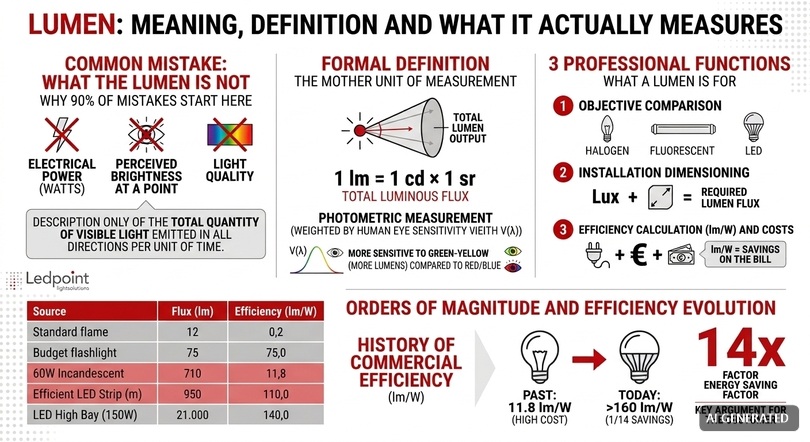
Before any table, the concept must be fixed, because 90% of sizing errors start here. The lumen does not describe electrical power, does not describe the perceived brightness at a point, and does not describe the quality of light. It describes only one thing: the total amount of visible light that a source emits in all directions per unit of time. Everything else (lux, candelas, watts, kelvin, CRI) are different quantities that answer different questions.
Lumen meaning: the official definition
The lumen (symbol lm) is the unit of measurement of luminous flux in the International System. The formal definition is this: one lumen is the luminous flux emitted by a point source of luminous intensity equal to one candela within a solid angle of one steradian. In formula, 1 lm = 1 cd × 1 sr.
The word comes from the Latin lumen, which means "light", "source of light", and the genitive luminis has generated in Italian terms such as illuminamento, luminanza, luminoso. It is no coincidence that in technical language this very term was chosen: the lumen is the "mother" quantity of photometry, from which all the others derive.
The decisive aspect, and almost always overlooked, is that the lumen is a photometric quantity, not radiometric. It does not measure the emitted radiant energy, but the radiant energy weighted on the sensitivity of the human eye, described by the spectral luminous efficiency curve V(λ) defined by the CIE. The eye in photopic vision has its maximum sensitivity at 555 nm (yellow-green), where 1 watt of radiation produces exactly 683 lumens: this is the absolute theoretical maximum of luminous efficacy.
A practical consequence follows, which every electrician should be aware of: with the same watts absorbed, a red or blue source produces very few lumens, a green source produces very many. Not because it emits more energy, but because the eye sees it better. This is why an RGB LED strip lit in blue looks "very weak" compared to the same strip in white, even though it consumes comparable power.
What a lumen is used for: the three practical functions
In professional practice, the lumen is used for three things, and nothing else.
First: to compare different sources on an objective basis: it is the only parameter that allows a halogen bulb, a fluorescent tube and an LED strip to be placed on the same level. Watts have not served this purpose since 2013, when EU Regulation 874/2012 required the indication of luminous flux in lumens to be prominently displayed on lamp packaging.
Second: to size an installation: knowing the lux required by the standard and the surface area, you can trace back to the total lumens needed and therefore to the number of luminaires or meters of strip to be installed.
Third: to calculate efficiency and therefore operating cost: the lumen/watt ratio (lm/W) is the indicator that determines the electricity bill. A 3,000 lumen source at 160 lm/W consumes 18.75 W; the same quantity of lumens at 80 lm/W consumes 37.5 W. Over 4,000 hours per year the difference is 75 kWh per single luminaire.
What a lumen is equivalent to: orders of magnitude
A single lumen is a very small amount of light. To build a physical intuition, this table reports the approximate luminous flux of known sources.
| Source | Luminous flux (lumens) | Typical power | Efficacy (lm/W) |
|---|---|---|---|
| Standard candle flame | 12–13 lm | – | 0.2 |
| LED indicator on household appliance | 0.1–1 lm | 0.02 W | 15–30 |
| Economy pocket flashlight | 50–100 lm | 1 W | 60–100 |
| Incandescent bulb 25 W | 230 lumens | 25 W | 9 |
| Incandescent bulb 40 W | 430 lumens | 40 W | 11 |
| Incandescent bulb 60 W | 710 lumens | 60 W | 12 |
| Incandescent bulb 100 W | 1,340 lumens | 100 W | 13 |
| Halogen 230V 150 W | 2,400 lumens | 150 W | 16 |
| Fluorescent T8 36 W | 3,350 lumens | 36 W + ballast | 75–93 |
| Modern LED bulb E27 8 W | 800–1,100 lm | 8 W | 100–135 |
| LED strip 24V 9.6 W/m (per meter) | 950 lumens/m | 9.6 W/m | 110 |
| LED strip 24V 20 W/m high efficacy (per meter) | 2,850 lumens/m | 20 W/m | 160 |
| Construction site LED floodlight 50 W | 5,000–7,000 lm | 50 W | 100–140 |
| Industrial LED high bay 150 W | 21,000–25,500 lm | 150 W | 140–170 |
| Metal halide lamp 400 W | 36,000 lumens | 400 W + ballast | 90 |
| Stadium tower (single 2 kW projector) | 200,000 lumens | 2,000 W | 100 |
| Sun (total flux) | 3.6 × 1028 lm | – | 93 |
The most useful reading of this table is not the lumen column, but the efficacy one. In a century we have gone from 12 lm/W to over 160 lm/W in commercial products: a factor of 13. This means that the same number of lumens today costs one thirteenth in energy compared to incandescence, and this is the strongest argument to bring to a customer who hesitates in front of a retrofit quote.
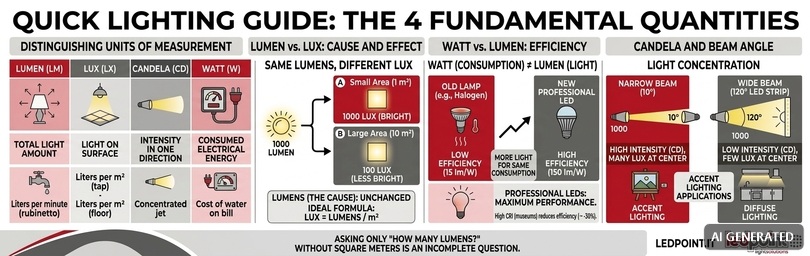
2. Lumen, lux, candela, watt: the four quantities not to be confused
If an installation turns out to be undersized, nine times out of ten it is because someone confused lumen and lux, or reasoned in watts. The four quantities answer four distinct questions and are not interchangeable.
| Quantity | Symbol | Unit | Question it answers | Hydraulic analogy |
|---|---|---|---|---|
| Luminous flux | Φ | lumen (lm) | How much light comes out of the source in total? | Liters per minute delivered by the tap |
| Illuminance | E | lux (lx) | How much light arrives on one square meter of surface? | Liters per minute per square meter of wet floor |
| Luminous intensity | I | candela (cd) | How much light goes in a specific direction? | Concentrated jet in one direction |
| Luminance | L | cd/m² | How bright does a surface appear to the eye? | Reflection perceived from the puddle |
| Electrical power | P | watt (W) | How much energy do I consume? | Cost of water in the bill |
What is the difference between lumen and lux
Lumen is the cause, lux is the effect. One lux corresponds to one lumen distributed over one square meter: 1 lx = 1 lm/m². The same 1,000 lumen source produces very different illuminances depending on how and where it distributes that light.
Concrete example: a 1,000 lumen lamp that illuminates 1 m² uniformly produces 1,000 lux on that surface. The same lamp, if the beam widens to 10 m², produces 100 lux. If it covers 100 m², it produces 10 lux. The emitted lumens never change, this radically changes the perceived result.
| Lumens emitted | Illuminated surface | Resulting illuminance | Perception |
|---|---|---|---|
| 1,000 lumens | 0.5 m² | 2,000 lux | Operating room light on small plane |
| 1,000 lumens | 1 m² | 1,000 lux | Precision work plane |
| 1,000 lumens | 2 m² | 500 lux | Compliant office desk |
| 1,000 lumens | 5 m² | 200 lux | Comfortable living area |
| 1,000 lumens | 10 m² | 100 lux | Corridor, transit light |
| 1,000 lumens | 20 m² | 50 lux | Soft scenographic lighting |
| 1,000 lumens | 50 m² | 20 lux | Parking lot, barely sufficient |
| 1,000 lumens | 100 m² | 10 lux | Practically operational darkness |
The operational conclusion is clear: asking "how many lumens do I need" without specifying the square meters is an incomplete question, exactly like asking how many liters of paint are needed without saying how many walls need to be painted.
Lux lumen ratio: the basic formula and its inverse
The two formulas to memorize are elementary:
lux = lumen ÷ square meters
lumen = lux × square meters
Be careful, however: these formulas are valid under the ideal hypothesis of perfectly uniform distribution and no losses. In the reality of a room they must be corrected with two coefficients, the utilization factor and the maintenance factor, which we will see in section 3. Anyone who skips this correction systematically undersizes the installation by 30–50%.
What is the difference between watt and lumen
Watt measures the energy absorbed from the grid; the lumen measures the light produced. The link between the two is luminous efficacy, expressed in lm/W, which varies by more than an order of magnitude depending on the technology.
| Technology | Efficacy (lm/W) | Lumens from 10 W | Watts per 1,000 lumens | Useful life L70 |
|---|---|---|---|---|
| Traditional incandescence | 10–15 | 100–150 lm | 67–100 W | 1,000 h |
| Halogen 230V | 15–20 | 150–200 lm | 50–67 W | 2,000 h |
| Low voltage halogen | 20–25 | 200–250 lm | 40–50 W | 4,000 h |
| Compact fluorescent | 50–70 | 500–700 lm | 14–20 W | 8,000 h |
| Linear fluorescent T5 | 90–105 | 900–1,050 lm | 10–11 W | 20,000 h |
| Economy LED (CRI 80) | 80–100 | 800–1,000 lm | 10–13 W | 15,000–25,000 h |
| Standard professional LED | 110–130 | 1,100–1,300 lm | 8–9 W | 50,000 h |
| High efficacy LED | 140–170 | 1,400–1,700 lm | 6–7 W | 50,000–70,000 h |
| LED CRI 95+ (high color rendering) | 70–110 | 700–1,100 lm | 9–14 W | 50,000 h |
| Theoretical limit white light | ~250–300 | 2,500–3,000 lm | 3.3–4 W | – |
Note the CRI 95+ row: raising the color rendering costs lumens. The phosphors needed to fill the spectrum in deep red absorb energy that does not translate into luminous flux weighted on the V(λ) curve. On a museum or fashion retail project, factoring in a −25/−35% of lumens per watt compared to a CRI 80 is part of the sizing, not a product defect.
What is the difference between lumen and LED
Recurring and poorly posed question, but it is worth answering: they are not comparable quantities. LED is a construction technology (a light-emitting diode) while lumen is the unit of measurement of how much that technology emits. An LED can produce 0.1 lumen or 20,000 lumens. Saying "I prefer LEDs to lumens" is equivalent to saying "I prefer diesel engines to horsepower".
Candela and beam angle: why two 1,000 lumen lamps are not the same
The candela introduces directionality. Two luminaires with identical 1,000 lumens but different opening angles produce completely different illuminances at the center.
| Beam angle | Approximate intensity (cd) | Lux at center at 2 m | Spot diameter at 2 m | Typical application |
|---|---|---|---|---|
| 10° (narrow spot) | ~13,000 cd | 3,250 lx | 0.35 m | Accent on artwork, jewelry showcase |
| 15° | ~5,800 cd | 1,450 lx | 0.53 m | Retail accent |
| 24° | ~2,300 cd | 575 lx | 0.85 m | Spot on kitchen counter |
| 36° | ~1,030 cd | 258 lx | 1.30 m | General living room spot |
| 60° | ~380 cd | 95 lx | 2.31 m | Diffused downlight |
| 90° | ~185 cd | 46 lx | 4.00 m | Ceiling light |
| 120° (bare LED strip) | ~110 cd | 28 lx | 6.93 m | Diffused linear lighting |
| 360° (globe bulb) | ~80 cd | 20 lx | whole room | Ambient light |
This table alone explains why a 1,400 lumen/m LED strip does not "illuminate" like a 1,400 lumen spotlight. The strip emits over 120° and distributes the flux over a large surface: perfect for diffused and uniform light, unsuitable as the only source on a work surface if not positioned correctly. The choice between professional LED strips and point sources is not a question of lumens, but of photometric distribution.
3. The calculation method: from regulatory lux to total lumens
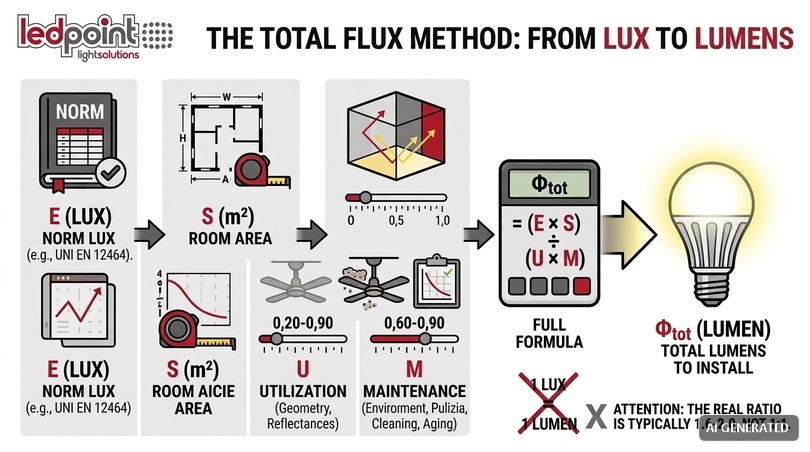
We arrive at the operational heart of the guide. The correct calculation of the required lumens is called the total flux method and is codified in international lighting practice. It is divided into five steps that are explained here so that they can be performed with a site calculator, without software.
The complete formula
Φtot = (E × S) ÷ (U × M)
Where:
| Symbol | Meaning | Unit | Where to find it |
|---|---|---|---|
| Φtot | Total luminous flux to be installed | lumens | This is the result we are looking for |
| E | Required maintained average illuminance | lux | UNI EN 12464-1, standard tables |
| S | Surface of the visual task or room | m² | Survey or plan |
| U | Utilization factor | 0.20–0.90 | Luminaire tables, depends on room index and reflectances |
| M | Maintenance factor | 0.60–0.90 | Environment, type of luminaire, cleaning frequency |
Step 1: determine the required lux
The value of E is not invented: it is read from the standard applicable to the intended use. In Europe the reference is UNI EN 12464-1 for interiors and UNI EN 12464-2 for exteriors. These are maintained illuminance values, i.e. the minimum that the installation must guarantee at the end of the maintenance cycle, not when new. The complete tables are in section 7.
Step 2: calculate the room index
The utilization factor depends on the geometry. The room index k is calculated as follows:
k = (L × W) ÷ [Hu × (L + W)]
where L is the length, W the width and Hu the useful height, i.e. the distance between the plane of the luminaires and the work plane (normally 0.85 m from the ground in offices, 0.75 m in domestic environments on tables, 0 m for corridors where the reference plane is the floor).
| Index k | Type of room | U with light walls (0.7/0.5/0.2) | U with medium walls (0.5/0.3/0.1) | U with dark walls (0.3/0.1/0.1) |
|---|---|---|---|---|
| 0.60 | Narrow and high (stairwell) | 0.42 | 0.33 | 0.26 |
| 0.80 | Small, high ceiling | 0.50 | 0.41 | 0.33 |
| 1.00 | Standard small room | 0.56 | 0.47 | 0.39 |
| 1.25 | Bedroom, single office | 0.62 | 0.53 | 0.45 |
| 1.50 | Medium living room | 0.66 | 0.58 | 0.49 |
| 2.00 | Small open space | 0.72 | 0.64 | 0.55 |
| 2.50 | Large office | 0.76 | 0.68 | 0.59 |
| 3.00 | Large hall | 0.78 | 0.71 | 0.62 |
| 4.00 | Low warehouse | 0.81 | 0.75 | 0.66 |
| 5.00 | Large surface | 0.83 | 0.77 | 0.69 |
The jump between light walls and dark walls is impressive: up to 40% more lumens needed for the same required lux. A loft with exposed concrete walls and anthracite black ceiling is a context in which standard calculations fail dramatically. These are cases where it is worth oversizing by 25% and providing dimmable regulation to calibrate on site.
Step 3: choose the maintenance factor
The M factor takes into account the decay of the flux over time: aging of the LEDs, deposition of dust on the optics, dirt on the surfaces of the room, failures. The EN 12464-1 standard requires it to be declared in the project.
| Environment | Open IP20 luminaire | Closed IP20 luminaire | IP65 luminaire | Recommended cleaning |
|---|---|---|---|---|
| Clean room, laboratory | 0.85 | 0.90 | 0.92 | every 12 months |
| Office, home | 0.80 | 0.85 | 0.88 | every 24 months |
| School, hospital | 0.78 | 0.83 | 0.86 | every 18 months |
| Retail, restaurant | 0.75 | 0.80 | 0.85 | every 12 months |
| Mechanical workshop | 0.68 | 0.74 | 0.80 | every 12 months |
| Food industry | 0.70 | 0.76 | 0.84 | every 6 months |
| Carpentry, cement factory | 0.58 | 0.65 | 0.74 | every 6 months |
| Urban exteriors | – | – | 0.80 | every 24 months |
| Industrial / marine exteriors | – | – | 0.70 | every 12 months |
Steps 4 and 5: calculation and verification
Once the coefficients have been applied, the total lumens are obtained, which must be divided by the flux of the single luminaire or by the lumens per meter of the chosen strip. The uniformity verification follows: the standard requires U0 = Emin/Emed not less than 0.60 on the task area and 0.40 on the immediate surrounding area.
Complete numerical example
Open space office, 8 × 6 m = 48 m², height 3 m, work plane at 0.85 m, light walls, ceiling-mounted luminaires.
| Step | Operation | Result |
|---|---|---|
| 1. Required lux (EN 12464-1, writing/reading) | From regulatory table | 500 lux |
| 2. Surface | 8 × 6 | 48 m² |
| 3. Useful height | 3.00 − 0.85 | 2.15 m |
| 4. Room index k | (8×6) ÷ [2.15 × (8+6)] | 1.59 |
| 5. Utilization factor U (light walls) | From table 7 | 0.67 |
| 6. Maintenance factor M | Office, closed luminaire | 0.85 |
| 7. Total lumens | (500 × 48) ÷ (0.67 × 0.85) | 42,150 lumens |
| 8. Effective lumens per square meter | 42,150 ÷ 48 | 878 lumens/m² |
| 9. Number of 4,000 lm luminaires | 42,150 ÷ 4,000 | 11 luminaires (rounded to 12 for 4×3 grid) |
| 10. Power verification with 130 lm/W LED | 42,150 ÷ 130 | 324 W total – 6.75 W/m² |
The data in row 8 is what surprises everyone: to get 500 lux you need 878 lumens per square meter, not 500. The ratio between installed lumens and lux obtained in a real room is typically 1.6–2.0. This is the main reason why the simplified tables found on the web produce dark installations: they apply the 1:1 ratio.
4. Master table: how many lumens per square meter, room by room
This is the section to bookmark. The following tables report, for each intended use, the lux required by the standard, the lumens per square meter to be installed (already including the average coefficients U = 0.65 and M = 0.80, therefore with an overall correction factor of about 1.92) and the total lumens for recurring surface sizes.
How to read them: the "standard lux" column is the target on the work plane; the "lumens/m² to install" column is the number that is really needed at the purchasing stage. If the room has very light walls and a low ceiling you can go down by 15%; if it has dark walls or ceilings over 4 m you must go up by 20–30%.
Residential
| Environment | Standard lux | Lumens/m² to install | 10 m² | 15 m² | 20 m² | 30 m² | Recommended temperature |
|---|---|---|---|---|---|---|---|
| Entrance / hallway | 100 lx | 190 lm/m² | 1,900 lumens | 2,850 lumens | 3,800 lumens | 5,700 lumens | 2700–3000K |
| Corridor | 100 lx | 190 lm/m² | 1,900 lumens | 2,850 lumens | 3,800 lumens | 5,700 lumens | 2700–3000K |
| Living room – general light | 100–150 lx | 190–290 lm/m² | 1,900–2,900 lm | 2,850–4,350 lm | 3,800–5,800 lm | 5,700–8,700 lm | 2700–3000K |
| Living room – reading area | 300–500 lx | 580–960 lm/m² | – | – | – | – | 3000K |
| Dining room (on the table) | 200–300 lx | 385–575 lm/m² | 3,850–5,750 lm | 5,775–8,625 lm | 7,700–11,500 lm | – | 2700–3000K |
| Kitchen – general | 200–300 lx | 385–575 lm/m² | 3,850–5,750 lm | 5,775–8,625 lm | 7,700–11,500 lm | – | 3000–4000K |
| Kitchen – work plane | 500 lx | 960 lm/m² | – | – | – | – | 3000–4000K |
| Bedroom – general | 100 lx | 190 lm/m² | 1,900 lumens | 2,850 lumens | 3,800 lumens | 5,700 lumens | 2200–2700K |
| Bedroom – bedside reading | 300 lx | 575 lm/m² | – | – | – | – | 2700K |
| Children's room / study | 300–500 lx | 575–960 lm/m² | 5,750–9,600 lm | 8,625–14,400 lm | 11,500–19,200 lm | – | 4000K |
| Bathroom – general | 150–200 lx | 290–385 lm/m² | 2,900–3,850 lm | 4,350–5,775 lm | – | – | 3000–4000K |
| Bathroom – mirror | 500 lx | 960 lm/m² | – | – | – | – | 4000K CRI>90 |
| Study / home office | 500 lx | 960 lm/m² | 9,600 lumens | 14,400 lumens | 19,200 lumens | 28,800 lumens | 4000K |
| Walk-in closet | 200–300 lx | 385–575 lm/m² | 3,850–5,750 lm | – | – | – | 4000K CRI>90 |
| Laundry / storage room | 150–200 lx | 290–385 lm/m² | 2,900–3,850 lm | – | – | – | 4000K |
| Garage / car box | 75–150 lx | 145–290 lm/m² | 1,450–2,900 lm | 2,175–4,350 lm | 2,900–5,800 lm | 4,350–8,700 lm | 4000–5000K |
| Cellar / under-stairs | 100 lx | 190 lm/m² | 1,900 lumens | 2,850 lumens | – | – | 4000K |
| Internal staircase | 100–150 lx | 190–290 lm/m² | 1,900–2,900 lm | – | – | – | 3000K |
| Habitable attic | 150–300 lx | 290–575 lm/m² | 2,900–5,750 lm | 4,350–8,625 lm | 5,800–11,500 lm | 8,700–17,250 lm | 3000K |
| Terrace / porch | 50–100 lx | 95–190 lm/m² | 950–1,900 lm | 1,425–2,850 lm | 1,900–3,800 lm | 2,850–5,700 lm | 2700–3000K |
The reference value that almost everyone is looking for is this: in the domestic environment you size between 150 and 300 lumens per square meter for general light, rising to 900–1,000 lumens/m² on work surfaces. It is not a uniform value throughout the home: it is the stratification between general light, task light and accent light that makes an apartment comfortable. An installation that spread 200 lumens/m² everywhere, kitchen included, would be insufficient where needed and wasted elsewhere.
Offices and tertiary
| Environment | Standard lux (Em) | Lumens/m² to install | 20 m² | 50 m² | 100 m² | Max UGR | Min CRI |
|---|---|---|---|---|---|---|---|
| Archiving, copying | 300 lx | 575 lm/m² | 11,500 lumens | 28,750 lumens | 57,500 lumens | 19 | 80 |
| Writing, reading, data processing | 500 lx | 960 lm/m² | 19,200 lumens | 48,000 lumens | 96,000 lumens | 19 | 80 |
| Technical drawing | 750 lx | 1,440 lm/m² | 28,800 lumens | 72,000 lumens | 144,000 lumens | 16 | 80 |
| CAD workstations | 500 lx | 960 lm/m² | 19,200 lumens | 48,000 lumens | 96,000 lumens | 19 | 80 |
| Meeting room | 500 lx | 960 lm/m² | 19,200 lumens | 48,000 lumens | 96,000 lumens | 19 | 80 |
| Reception | 300 lx | 575 lm/m² | 11,500 lumens | 28,750 lumens | 57,500 lumens | 22 | 80 |
| Archives | 200 lx | 385 lm/m² | 7,700 lumens | 19,250 lumens | 38,500 lumens | 25 | 80 |
| Tertiary corridors | 100 lx | 190 lm/m² | 3,800 lumens | 9,500 lumens | 19,000 lumens | 28 | 40 |
| Stairs and elevators | 150 lx | 290 lm/m² | 5,800 lumens | 14,500 lumens | 29,000 lumens | 25 | 40 |
| Company canteen | 200 lx | 385 lm/m² | 7,700 lumens | 19,250 lumens | 38,500 lumens | 22 | 80 |
| Technical rooms, panels | 200 lx | 385 lm/m² | 7,700 lumens | 19,250 lumens | 38,500 lumens | 25 | 60 |
| Server room | 500 lx | 960 lm/m² | 19,200 lumens | 48,000 lumens | 96,000 lumens | 19 | 80 |
| Call center | 500 lx | 960 lm/m² | 19,200 lumens | 48,000 lumens | 96,000 lumens | 19 | 80 |
| Training room | 500 lx | 960 lm/m² | 19,200 lumens | 48,000 lumens | 96,000 lumens | 19 | 80 |
| Blackboard / vertical surface | 500 lx vertical | – | – | – | – | 19 | 80 |
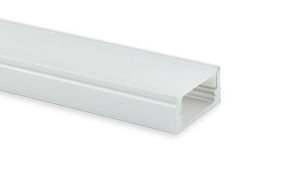
The UGR parameter (Unified Glare Rating) is as binding as lumens. An office can have perfect 500 lux and be unacceptable for glare if luminaires without optical control have been used. This is why in the professional environment the LED strip must always be inserted in an aluminum profile with an opal diffuser: the point source visible to the naked eye produces local luminances that make any UGR verification jump.
Retail and commercial
| Environment | Standard lux | Lumens/m² to install | 50 m² | 100 m² | 300 m² | Recommended CRI |
|---|---|---|---|---|---|---|
| Shop – general light | 300 lx | 575 lm/m² | 28,750 lumens | 57,500 lumens | 172,500 lumens | ≥80 |
| Clothing store – general | 300–500 lx | 575–960 lm/m² | 28,750–48,000 lm | 57,500–96,000 lm | 172,500–288,000 lm | ≥90 |
| Clothing store – accent | 1,000–1,500 lx | 1,920–2,880 lm/m² | – | – | – | ≥95 |
| Showcase | 1,500–3,000 lx | 2,880–5,760 lm/m² | – | – | – | ≥95 |
| Supermarket – aisles | 500 lx | 960 lm/m² | 48,000 lumens | 96,000 lumens | 288,000 lumens | ≥80 |
| Fruit and vegetable counter | 750–1,000 lx | 1,440–1,920 lm/m² | – | – | – | ≥90 (high R9) |
| Butcher / fish counter | 750–1,000 lx | 1,440–1,920 lm/m² | – | – | – | ≥90 (high R9) |
| Cash registers | 500 lx | 960 lm/m² | – | – | – | ≥80 |
| Jewelry store – displays | 2,000–3,000 lx | 3,840–5,760 lm/m² | – | – | – | ≥95 |
| Pharmacy | 500 lx | 960 lm/m² | 48,000 lumens | 96,000 lumens | – | ≥90 |
| Restaurant – room | 100–200 lx | 190–385 lm/m² | 9,500–19,250 lm | 19,000–38,500 lm | 57,000–115,500 lm | ≥90 |
| Restaurant – kitchen | 500 lx | 960 lm/m² | 48,000 lumens | 96,000 lumens | – | ≥80 |
| Bar / café | 150–300 lx | 290–575 lm/m² | 14,500–28,750 lm | 29,000–57,500 lm | – | ≥90 |
| Hotel – room | 100–150 lx | 190–290 lm/m² | – | – | – | ≥90 |
| Hotel – hall | 200–300 lx | 385–575 lm/m² | 19,250–28,750 lm | 38,500–57,500 lm | 115,500–172,500 lm | ≥90 |
| Gym / fitness | 300–500 lx | 575–960 lm/m² | 28,750–48,000 lm | 57,500–96,000 lm | 172,500–288,000 lm | ≥80 |
| Hairdresser / beauty center | 500–750 lx | 960–1,440 lm/m² | 48,000–72,000 lm | 96,000–144,000 lm | – | ≥95 |
| Car showroom | 500–750 lx | 960–1,440 lm/m² | – | 96,000–144,000 lm | 288,000–432,000 lm | ≥90 |
| Art gallery / museum | 50–200 lx | 95–385 lm/m² | 4,750–19,250 lm | 9,500–38,500 lm | 28,500–115,500 lm | ≥95 |
In retail the ratio between general lumens and accent lumens is a measurable commercial lever. The recommended contrast ratio between product and background is 3:1 for discreet highlighting, 5:1 for sharp focus, 10:1 for theatrical effect. On a shop with 500 general lux this means bringing the display to 1,500, 2,500 or 5,000 lux respectively. COB LED strips and electrified tracks cover the two roles in a complementary way.
Industry, logistics, craftsmanship
| Activity | Standard lux | Lumens/m² to install | 200 m² | 500 m² | 1,000 m² | 2,000 m² |
|---|---|---|---|---|---|---|
| Warehouse – automatic storage | 50–100 lx | 95–190 lm/m² | 19,000–38,000 lm | 47,500–95,000 lm | 95,000–190,000 lm | 190,000–380,000 lm |
| Warehouse – with operator presence | 150–200 lx | 290–385 lm/m² | 58,000–77,000 lm | 145,000–192,500 lm | 290,000–385,000 lm | 580,000–770,000 lm |
| Picking and packing area | 300 lx | 575 lm/m² | 115,000 lumens | 287,500 lumens | 575,000 lumens | 1,150,000 lumens |
| Rough work | 200 lx | 385 lm/m² | 77,000 lumens | 192,500 lumens | 385,000 lumens | 770,000 lumens |
| Medium work | 300 lx | 575 lm/m² | 115,000 lumens | 287,500 lumens | 575,000 lumens | 1,150,000 lumens |
| Fine work | 500 lx | 960 lm/m² | 192,000 lumens | 480,000 lumens | 960,000 lumens | 1,920,000 lumens |
| Precision work | 750 lx | 1,440 lm/m² | 288,000 lumens | 720,000 lumens | 1,440,000 lumens | – |
| Electronics assembly / micro-assembly | 1,000–1,500 lx | 1,920–2,880 lm/m² | 384,000–576,000 lm | 960,000–1,440,000 lm | – | – |
| Visual quality control | 1,000 lx | 1,920 lm/m² | 384,000 lumens | 960,000 lumens | – | – |
| Color inspection (booth) | 1,000–1,500 lx | – | – | – | – | – |
| Welding | 300 lx | 575 lm/m² | 115,000 lumens | 287,500 lumens | – | – |
| Painting / booth | 750–1,000 lx | 1,440–1,920 lm/m² | 288,000–384,000 lm | – | – | – |
| Food industry – production | 500 lx | 960 lm/m² | 192,000 lumens | 480,000 lumens | 960,000 lumens | – |
| Food industry – inspection | 1,000 lx | 1,920 lm/m² | – | – | – | – |
| Carpentry – bench | 500 lx | 960 lm/m² | 192,000 lumens | 480,000 lumens | – | – |
| Mechanical workshop – general | 300 lx | 575 lm/m² | 115,000 lumens | 287,500 lumens | 575,000 lumens | – |
| Auto repair shop – pit / lift | 500 lx | 960 lm/m² | – | – | – | – |
| Greenhouse / indoor cultivation (service light) | 200 lx | 385 lm/m² | 77,000 lumens | 192,500 lumens | 385,000 lumens | – |
In large surfaces the decisive parameter becomes power density (W/m²), because it affects the electrical system and the thermal load. With LEDs at 150 lm/W, a 1,000 m² warehouse at 150 lux requires about 290,000 lumens, i.e. about 1,930 W: less than 2 W/m². With old metal halide lamps the same result cost 8–10 W/m². Over 6,000 hours per year the difference exceeds 48,000 kWh.
Healthcare, school, sports
| Environment | Standard lux | Lumens/m² to install | Min CRI | Notes |
|---|---|---|---|---|
| School classroom | 300–500 lx | 575–960 lm/m² | 80 | UGR ≤ 19 |
| Blackboard | 500 lx vertical | – | 80 | dedicated asymmetric lighting |
| Teaching laboratory | 500 lx | 960 lm/m² | 80 | UGR ≤ 19 |
| School gym | 300 lx | 575 lm/m² | 80 | impact-protected luminaires |
| Hospital ward – general | 100 lx | 190 lm/m² | 80 | – |
| Patient bed – reading | 300 lx | 575 lm/m² | 80 | – |
| Medical examination | 1,000 lx | 1,920 lm/m² | 90 | – |
| Operating room – ambient | 1,000 lx | 1,920 lm/m² | 90 | shadowless lamp excluded |
| Operating field | 10,000–100,000 lx | – | 95 | dedicated equipment |
| Dental surgery | 1,000 lx | 1,920 lm/m² | 90 | – |
| Analysis laboratory | 500 lx | 960 lm/m² | 80 | – |
| Competitive gym – training | 300–500 lx | 575–960 lm/m² | 65 | – |
| Regional competition | 500–750 lx | 960–1,440 lm/m² | 70 | – |
| National competition | 750–1,000 lx | 1,440–1,920 lm/m² | 80 | – |
| HD TV broadcast | 1,400–2,000 lx vertical | – | 90 | flicker-free mandatory |
| Indoor swimming pool | 300–500 lx | 575–960 lm/m² | 80 | IP65 minimum |
Exteriors (UNI EN 12464-2 and road references)
| Environment | Standard lux | Lumens/m² to install (M=0.70) | 100 m² | 500 m² | Notes |
|---|---|---|---|---|---|
| Private pedestrian path | 5–10 lx | 10–20 lm/m² | 1,000–2,000 lm | 5,000–10,000 lm | reduce light pollution |
| Residential garden | 5–20 lx | 10–40 lm/m² | 1,000–4,000 lm | 5,000–20,000 lm | 2200–2700K |
| Building entrance | 50–100 lx | 100–200 lm/m² | 10,000–20,000 lm | – | – |
| Private parking | 20–50 lx | 40–100 lm/m² | 4,000–10,000 lm | 20,000–50,000 lm | – |
| Public parking | 50–75 lx | 100–150 lm/m² | 10,000–15,000 lm | 50,000–75,000 lm | – |
| Industrial maneuvering area | 50–100 lx | 100–200 lm/m² | – | 50,000–100,000 lm | – |
| Loading/unloading area | 150 lx | 300 lm/m² | 30,000 lumens | 150,000 lumens | – |
| Construction site – general area | 50 lx | 100 lm/m² | 10,000 lumens | 50,000 lumens | – |
| Construction site – work | 200 lx | 400 lm/m² | 40,000 lumens | 200,000 lumens | – |
| Facade – grazing lighting | 20–60 lx | 40–120 lm/m² | 4,000–12,000 lm | – | depends on material reflectance |
| Fuel station | 100–150 lx | 200–300 lm/m² | 20,000–30,000 lm | – | – |
For exteriors, extra attention is needed: many Italian regions and several European countries impose strict limits on upward emission and blue content to contain light pollution. In practice: luminaires with upper hemispheric flux close to zero and color temperatures not exceeding 3000K, often 2700K or 2200K in protected areas. This is not an aesthetic recommendation, it is an authorization constraint.
5. Conversion tables: lumen → lux, lumen → watt, lux → footcandle
This section is designed as a quick reference tool. These are the conversions that are really needed on site, when you have to decide in two minutes whether a product available in stock can replace the one planned in the project.
Lumen → lux conversion by surface
| Total lumens | 5 m² | 10 m² | 15 m² | 20 m² | 30 m² | 50 m² | 100 m² |
|---|---|---|---|---|---|---|---|
| 500 lumens | 100 lx | 50 lx | 33 lx | 25 lx | 17 lx | 10 lx | 5 lx |
| 1,000 lumens | 200 lx | 100 lx | 67 lx | 50 lx | 33 lx | 20 lx | 10 lx |
| 2,000 lumens | 400 lx | 200 lx | 133 lx | 100 lx | 67 lx | 40 lx | 20 lx |
| 3,000 lumens | 600 lx | 300 lx | 200 lx | 150 lx | 100 lx | 60 lx | 30 lx |
| 4,000 lumens | 800 lx | 400 lx | 267 lx | 200 lx | 133 lx | 80 lx | 40 lx |
| 5,000 lumens | 1,000 lx | 500 lx | 333 lx | 250 lx | 167 lx | 100 lx | 50 lx |
| 7,500 lumens | 1,500 lx | 750 lx | 500 lx | 375 lx | 250 lx | 150 lx | 75 lx |
| 10,000 lumens | 2,000 lx | 1,000 lx | 667 lx | 500 lx | 333 lx | 200 lx | 100 lx |
| 15,000 lumens | 3,000 lx | 1,500 lx | 1,000 lx | 750 lx | 500 lx | 300 lx | 150 lx |
| 20,000 lumens | 4,000 lx | 2,000 lx | 1,333 lx | 1,000 lx | 667 lx | 400 lx | 200 lx |
| 30,000 lumens | – | 3,000 lx | 2,000 lx | 1,500 lx | 1,000 lx | 600 lx | 300 lx |
| 50,000 lumens | – | 5,000 lx | 3,333 lx | 2,500 lx | 1,667 lx | 1,000 lx | 500 lx |
| 100,000 lumens | – | – | – | 5,000 lx | 3,333 lx | 2,000 lx | 1,000 lx |
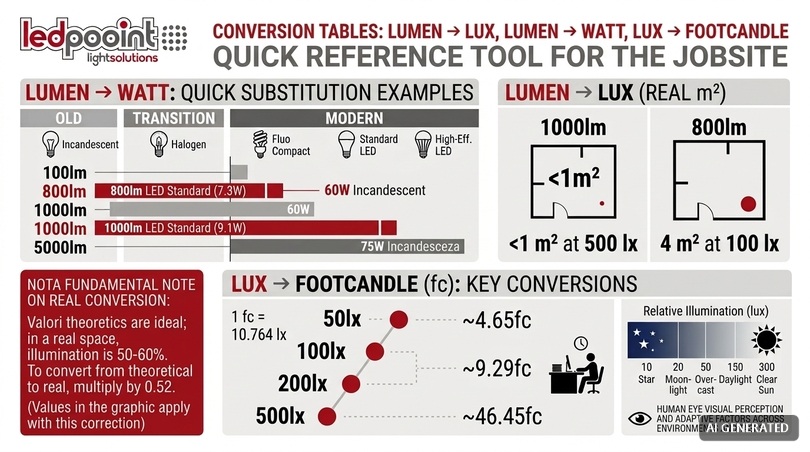
Fundamental warning on this table: the values are theoretical, under ideal conditions. In a real room the effective illuminance is 50–60% of that indicated. To go from theoretical to real, multiply by 0.52 (average value with U=0.65 and M=0.80). Those who want the real result should read tables 10–15 directly.
Lumen → watt conversion by technology
| Lumens | Incandescence | Halogen | Compact fluo | Standard LED (110 lm/W) | High efficacy LED (160 lm/W) |
|---|---|---|---|---|---|
| 100 lumens | 15 W | 10 W | 2 W | 0.9 W | 0.6 W |
| 250 lumens | 25 W | 18 W | 5 W | 2.3 W | 1.6 W |
| 400 lumens | 40 W | 28 W | 8 W | 3.6 W | 2.5 W |
| 470 lumens | 45 W | 32 W | 9 W | 4.3 W | 2.9 W |
| 600 lumens | 50 W | 38 W | 11 W | 5.5 W | 3.8 W |
| 800 lumens | 60 W | 45 W | 14 W | 7.3 W | 5.0 W |
| 1,000 lumens | 75 W | 55 W | 17 W | 9.1 W | 6.3 W |
| 1,200 lumens | 90 W | 65 W | 20 W | 10.9 W | 7.5 W |
| 1,500 lumens | 110 W | 80 W | 25 W | 13.6 W | 9.4 W |
| 2,000 lumens | 150 W | 105 W | 33 W | 18.2 W | 12.5 W |
| 2,400 lumens | 175 W | 125 W | 40 W | 21.8 W | 15.0 W |
| 3,000 lumens | 200 W | 150 W | 50 W | 27.3 W | 18.8 W |
| 4,000 lumens | 275 W | 200 W | 65 W | 36.4 W | 25.0 W |
| 5,000 lumens | 350 W | 250 W | 80 W | 45.5 W | 31.3 W |
| 6,000 lumens | 420 W | 300 W | 95 W | 54.5 W | 37.5 W |
| 8,000 lumens | 560 W | 400 W | 125 W | 72.7 W | 50.0 W |
| 10,000 lumens | 700 W | 500 W | 155 W | 90.9 W | 62.5 W |
| 15,000 lumens | – | 750 W | 230 W | 136.4 W | 93.8 W |
| 20,000 lumens | – | 1,000 W | 305 W | 181.8 W | 125.0 W |
Lux → footcandle conversion and other Anglo-Saxon units
Those who work on international, naval or American contracts must handle imperial units. The basic conversion is: 1 footcandle (fc) = 10.764 lux, and vice versa 1 lux = 0.0929 fc. The footcandle is defined as one lumen per square foot.
| Lux | Footcandle | Lumens/m² | Lumens/ft² | Typical context |
|---|---|---|---|---|
| 10 lx | 0.93 fc | 10 | 0.93 | Outdoor path |
| 20 lx | 1.86 fc | 20 | 1.86 | Parking lot |
| 50 lx | 4.65 fc | 50 | 4.65 | Automatic warehouse |
| 100 lx | 9.29 fc | 100 | 9.29 | Corridor |
| 150 lx | 13.94 fc | 150 | 13.94 | Stairs, garage |
| 200 lx | 18.58 fc | 200 | 18.58 | General kitchen |
| 300 lx | 27.87 fc | 300 | 27.87 | General retail |
| 500 lx | 46.45 fc | 500 | 46.45 | Compliant office |
| 750 lx | 69.68 fc | 750 | 69.68 | Technical drawing |
| 1,000 lx | 92.90 fc | 1,000 | 92.90 | Quality control |
| 2,000 lx | 185.81 fc | 2,000 | 185.81 | Showcase, jewelry |
| 5,000 lx | 464.52 fc | 5,000 | 464.52 | Photo studio |
| 10,000 lx | 929.03 fc | 10,000 | 929.03 | Cloudy day outdoors |
| 100,000 lx | 9,290.3 fc | 100,000 | 9,290.3 | Direct summer sun |
Natural reference illuminances
| Condition | Illuminance | Equivalent in lumens on 10 m² |
|---|---|---|
| Moonless night, starry sky | 0.001–0.002 lx | 0.01–0.02 lm |
| Quarter moon | 0.01 lx | 0.1 lumens |
| Full moon, clear sky | 0.25–1 lx | 2.5–10 lm |
| Deep twilight | 3–10 lx | 30–100 lm |
| Urban lit street | 10–20 lx | 100–200 lm |
| Clear sunrise / sunset | 400 lx | 4,000 lumens |
| Interior near window, overcast day | 500–1,000 lx | 5,000–10,000 lm |
| Outdoors, very overcast sky | 1,000–2,000 lx | 10,000–20,000 lm |
| Outdoors, cloudy day | 10,000–25,000 lx | 100,000–250,000 lm |
| Daylight in shade | 10,000–20,000 lx | – |
| Direct sun | 32,000–100,000 lx | – |
| Direct sun at zenith in tropics | 120,000–130,000 lx | – |
This table resizes many discussions. The most illuminated office to standard (500 lux) is twenty times darker than a cloudy day outdoors. The reason we don't perceive it this way is the adaptation of the eye, which covers a dynamic range of about ten orders of magnitude. A customer who says "I want the light of the sun at home" is literally asking for an installation of millions of lumens: the real request is spectral quality, not quantity.
6. What 100, 400, 800, 1000, 2000, 3000, 4000, 5000 lumens correspond to
This is the section of direct questions. Each value is contextualized in three ways: equivalence with the old incandescent bulb, surface it can illuminate at a given level, typical practical application.
| Lumens | Equivalent to incandescence | Surface at 100 lux | Surface at 300 lux | Surface at 500 lux | Typical application |
|---|---|---|---|---|---|
| 100 lumens | 15 W | 0.5 m² | 0.2 m² | 0.1 m² | Night light, step light, drawer lighting |
| 200 lumens | 20 W | 1.0 m² | 0.3 m² | 0.2 m² | Soft bedside lamp |
| 300 lumens | 30 W | 1.6 m² | 0.5 m² | 0.3 m² | Accent spotlight, under-cabinet light 1 m |
| 400 lumens | 40 W | 2.1 m² | 0.7 m² | 0.4 m² | Wall sconce, basic desk lamp |
| 470 lumens | 45 W | 2.4 m² | 0.8 m² | 0.5 m² | Small LED bulb E14 |
| 600 lumens | 50 W | 3.1 m² | 1.0 m² | 0.6 m² | Recessed spotlight 7 W |
| 800 lumens | 60 W | 4.2 m² | 1.4 m² | 0.8 m² | Standard E27 bulb, single bedroom light point |
| 1,000 lumens | 75 W | 5.2 m² | 1.7 m² | 1.0 m² | Small bathroom ceiling light, 1 m medium density LED strip |
| 1,200 lumens | 90 W | 6.3 m² | 2.1 m² | 1.3 m² | Large LED bulb, outdoor wall sconce |
| 1,500 lumens | 100 W | 7.8 m² | 2.6 m² | 1.6 m² | Bedroom ceiling light 12 m² (with other sources) |
| 2,000 lumens | 150 W | 10.4 m² | 3.5 m² | 2.1 m² | Living room ceiling light, basic 60×60 LED panel |
| 2,400 lumens | 175 W | 12.5 m² | 4.2 m² | 2.5 m² | Replacement for T8 36 W fluorescent tube |
| 3,000 lumens | 200 W | 15.6 m² | 5.2 m² | 3.1 m² | Office LED panel, 15 m² kitchen ceiling light |
| 4,000 lumens | 275 W | 20.8 m² | 6.9 m² | 4.2 m² | 60×60 professional panel, garage ceiling light |
| 5,000 lumens | 350 W | 26.0 m² | 8.7 m² | 5.2 m² | 40 W outdoor floodlight, double waterproof ceiling light |
| 6,000 lumens | 420 W | 31.3 m² | 10.4 m² | 6.3 m² | Small industrial ceiling light |
| 8,000 lumens | 560 W | 41.7 m² | 13.9 m² | 8.3 m² | 60 W square floodlight |
| 10,000 lumens | 700 W | 52.1 m² | 17.4 m² | 10.4 m² | 70 W LED high bay |
| 15,000 lumens | – | 78.1 m² | 26.0 m² | 15.6 m² | 100 W industrial high bay |
| 20,000 lumens | – | 104.2 m² | 34.7 m² | 20.8 m² | 130 W industrial high bay, sports projector |
Reading note: the indicated surfaces are calculated under real conditions, applying the correction coefficient 0.52 to the theoretical calculation. They are therefore values that can be used directly in quotes.
The direct answers to the most frequent questions
What does 800 lumens correspond to? They are the equivalent of the classic 60 W incandescent bulb. They adequately illuminate about 4 m² at general domestic light level, or less than 1 m² if a 500 lux work surface is needed. They are the reference value for replacing a standard bulb without anyone noticing the difference.
What does 800 lumens mean? It means that the source emits a total of 800 lumens of flux in all directions. By itself this figure does not say how bright the room will be: it depends on the optics, the height and the surface.
What does 1000 lumens correspond to? About 75 W of incandescence. They are the typical equipment of a small bathroom ceiling light or one linear meter of medium density LED strip. In a real room they are enough to bring about 5 m² to 100 lux.
How much light does 1000 lumens make? In practical terms: enough to move around and live in an environment of 5–6 m²; insufficient to work on a surface over 1 m².
What does 2000 lumens correspond to? They replace a 150 W halogen. They cover a living room of about 10 m² at general light level, or a 2 m² work surface at 500 lux.
What does 3000 lumens correspond to? They are the flux of a good office LED panel. They bring 15 m² to 100 lux or 3 m² to 500 lux. For a 12–15 m² kitchen they are the right value for general light alone.
What does 4000 lumens correspond to? They are equivalent to about 275 W of incandescence. They cover a double garage or a 20 m² technical room at 100 lux.
What does 5000 lumens mean? It is the flux of a good quality 35–45 W LED floodlight. It illuminates a 25 m² square at 100 lux or a 5 m² work area at 500 lux.
What does 6000 lumens mean? We are in the field of professional lighting: small industrial ceiling light, construction site floodlight, or about 3 meters of high density and high power LED strip.
What does 100 lumens mean? Very little light in absolute terms: an economy flashlight, a step light, a courtesy lamp. Useful only as orientation lighting.
What does 470 lumens mean? It is the typical value of an E14 candle or globe LED bulb, equivalent to 40–45 W of incandescence.
What does 300 lumens mean? It corresponds to a traditional 30 W bulb: suitable for a decorative wall sconce or one meter of low density LED strip used as ambient light.
How much is 1200 lumens? About 90 W of incandescence; a large E27 LED bulb, or a medium power outdoor spotlight.
How much is 5000 lumens? An important flux, manageable with about 31 W if using a 160 lm/W LED or with 45 W at 110 lm/W.
7. Standards: UNI EN 12464-1, IES, JIS, GB, AS/NZS compared
Those who design lighting do not choose the lux: they read them from a standard. Knowing which standard applies is an integral part of professional competence, and on international contracts it is the difference between a passed test and an installation to be redone. This section compares the main world references on the same environments.
The European framework: UNI EN 12464
UNI EN 12464-1 ("Lighting of work places – Part 1: Indoor work places") is the binding reference throughout the CEN area. It sets for each visual task a triplet of values: maintained illuminance Em in lux, unified glare index UGRL, uniformity U0 and minimum color rendering Ra. The 2021 revision introduced the concept of modifiable illuminance range, with the possibility of increasing the base values in the presence of operators over 50 years of age, critical visual tasks or errors with serious consequences.
UNI EN 12464-2 covers outdoor work places. UNI EN 1838 regulates emergency lighting: 1 lux minimum on the axis of escape routes, 0.5 lux in the central band, 15 lux at first aid points and near fire-fighting devices, 15 lux in high-risk areas or 10% of ordinary lighting, whichever is greater.
Electrical safety is regulated by a parallel track: IEC/EN 60598 for lighting equipment, IEC 62471 for photobiological risk (risk groups RG0–RG3), IEC 61347 for power supplies, EN 55015 and EN 61000 for electromagnetic compatibility, CEI 64-8 for the installation. On professional LED strips it is now standard to find the declaration of conformity to IEC/TR 62778 with risk group 1, a data that must be reported in the end-of-work documentation.
International comparison on the same environments
| Environment | EU – EN 12464-1 | USA – IES | UK – CIBSE/SLL | Japan – JIS Z 9110 | China – GB 50034 | Australia – AS/NZS 1680 |
|---|---|---|---|---|---|---|
| Office, VDT work | 500 | 300–500 | 300–500 | 500–750 | 300–500 | 320–400 |
| Meeting room | 500 | 300 | 300–500 | 500 | 300 | 240–320 |
| Reception | 300 | 200–300 | 200 | 300–500 | 200–300 | 160–240 |
| Corridor | 100 | 50–100 | 100 | 100–200 | 50–100 | 40–80 |
| School classroom | 300–500 | 300–500 | 300 | 300–750 | 300 | 240–320 |
| Supermarket | 500 | 500–750 | 500 | 500–750 | 300–500 | 400–800 |
| Warehouse | 100–200 | 100–300 | 100–200 | 75–150 | 100–200 | 80–160 |
| Workshop, medium work | 300 | 300–500 | 300 | 300–750 | 200–300 | 240–400 |
| Hospital, ward | 100 | 100–300 | 100 | 100–200 | 100 | 80–160 |
| Restaurant | 200 | 100–300 | 150–300 | 200–500 | 100–200 | 80–240 |
| Covered parking | 75 | 50–100 | 75 | 75–150 | 50–75 | 40–80 |
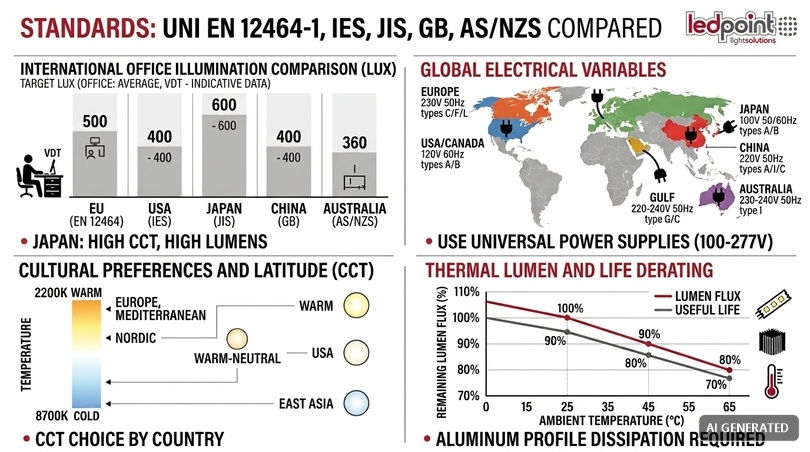
The most interesting data in this comparison is the systematic difference between Japan and Europe. Japanese standards require illuminances 30–50% higher on the same environments, with a cultural preference for high color temperatures (5000–6500K) that in Mediterranean Europe would appear cold. Those who export equipment or design for Japanese customers must take this into account at the offer stage: the same room requires more lumens installed. Conversely, Australia adopts lower values, partly due to the greater availability of natural light.
Minimum efficiency and energy constraints by country
| Area | Reference | Main constraint | Implication on lumens |
|---|---|---|---|
| European Union | EU Reg. 2019/2020 (SLR) and label 2019/2015 | Minimum efficiency and limits on flicker (PstLM ≤ 1, SVM ≤ 0.4) | Obligation to declare lumens, A–G classes recalibrated |
| Italy | CAM Public lighting, Ministry of Environment D.M. | Minimum equipment efficiency, light pollution limits | Upward lumens close to zero |
| Germany | DIN 5035, GebEG | Limit power density in buildings | Forces high efficacy LEDs to reach lux |
| France | RE2020, arrêté nuisances lumineuses 2018 | Night shutdown of showcases and offices, max CCT 3000K in many areas | Design with time scenarios |
| United Kingdom | Building Regulations Part L | Minimum 95 lm/W for non-domestic general lighting | Effectively excludes obsolete sources |
| USA | ANSI/ASHRAE/IES 90.1, Title 24 California | Maximum Lighting Power Density in W/ft² | Constrains watts, not lumens: rewards efficiency |
| Canada | NECB | Maximum LPD | Analogous to 90.1 |
| China | GB 50034, GB 37478 | Maximum LPD by intended use | Stringent values on retail and offices |
| Japan | Top Runner Program | Progressive minimum efficiency | Pushes beyond 130 lm/W |
| Australia / NZ | MEPS, AS/NZS 4783 | Minimum efficiency and product registration | Obligation of testing in accredited laboratory |
| Gulf (UAE, KSA) | ESMA, SASO | Mandatory certification, resistance to 50°C ambient | Very relevant thermal derating of lumens |
| India | BIS, UJALA / EESL | Minimum efficiency and certification | Focus on cost per lumen |
| Brazil | INMETRO | Mandatory certification | Local photometric tests |
8. International differences: why the same room changes lumens from Milan to Miami
A lighting project replicated in different countries cannot be copied and pasted. The variables that change the number of lumens to be installed are six, and none of them is trivial.
Mains voltage and frequency
| Area | Voltage | Frequency | Plug | Implication for LED lighting |
|---|---|---|---|---|
| Italy, continental EU | 230 V | 50 Hz | Type C/F/L | Standard 230→24V power supplies; 230V strips subject to flicker |
| UK, Ireland | 230 V | 50 Hz | Type G | Like EU; UKCA marking required |
| USA, Canada | 120 V | 60 Hz | Type A/B | 100–277V power supply needed; UL/ETL certification |
| Mexico, part of Central America | 127 V | 60 Hz | Type A/B | Like USA |
| Japan | 100 V | 50/60 Hz | Type A/B | Lower voltage: attention to power supply derating |
| China | 220 V | 50 Hz | Type A/I/C | Compatible with European power supplies |
| Australia, NZ | 230–240 V | 50 Hz | Type I | Compatible; RCM certification |
| Gulf, Middle East | 220–240 V | 50 Hz | Type G/C | Extreme ambient temperatures: thermal derating mandatory |
| Brazil | 127/220 V | 60 Hz | Type N | Dual voltage: universal power supplies |
| India | 230 V | 50 Hz | Type D/M | Wide grid fluctuations: protect power supplies |
| Naval / off-shore | 24 V DC, 110/230 V AC | 50/60 Hz | – | Vibrations, salinity: IP67 and RINA/DNV compliance |
The practical point for the installer working on foreign contracts is the choice of power supply, not the strip. A 24V LED strip works identically anywhere in the world: what changes is the driver that powers it. Selecting 24V power supplies with universal input range 100–277 V AC solves the problem at the root, and simplifies logistics when the same project is installed in different countries.
Latitude, natural light and cultural preferences
Perceptual habits change much more than technique would suggest. In Nordic countries, where natural light is very scarce in winter, the tendency is towards higher indoor illuminances and neutral color temperatures during working hours, with a decisive switch to warm in homes. In Mediterranean Europe warm white prevails even in commercial contexts. In East Asia cool white is perceived as synonymous with cleanliness and modernity.
| Area | Residential | Office | Retail | Notes |
|---|---|---|---|---|
| Italy, Spain, Greece | 2700K | 4000K | 3000K | Strong preference for warm |
| France | 2700–3000K | 4000K | 3000K | Constraints on outdoor CCT |
| Germany, Austria, Switzerland | 2700–3000K | 4000K | 3000–4000K | Attention to UGR and flicker |
| United Kingdom | 2700K | 4000K | 3000–4000K | – |
| Scandinavia | 2200–2700K | 4000K + human centric | 3000K | Wide diffusion of circadian systems |
| USA | 2700K | 3500–4000K | 3000–3500K | 3500K is much more common than in Europe |
| China, Korea, Japan | 4000–5000K | 5000–6500K | 4000–5000K | Cool white is the expected standard |
| Gulf | 3000K | 4000K | 3000–4000K | Heavy use of accent lighting |
| India | 4000–6500K | 6500K | 4000–6500K | "Cool daylight" dominates the market |
| Latin America | 3000–4000K | 4000–5000K | 4000K | – |
A catalog covering from warm white 2200–3500K to cool white 5500–8700K, through adjustable temperature CCT solutions, allows you to respond to markets with opposite expectations without changing the project logic: same lumens, same profile, same power supply, different tone.
Ambient temperature: the derating that no one calculates
Ambient temperature directly affects the lumens actually emitted. Catalog photometric data are normally referred to 25°C. In a Dubai warehouse at 45°C, or under a sheet metal roof in August, reality is different.
| Ambient temperature | Estimated Tj (strip in profile) | Residual flux | Relative useful life | Design note |
|---|---|---|---|---|
| 0°C | ~25°C | 103–105% | >100% | LED performs better when cold |
| 15°C | ~40°C | 100% | 100% | Typical winter indoor condition |
| 25°C | ~50°C | 97–98% | 100% | Catalog reference |
| 35°C | ~62°C | 93–95% | 85% | Summer without air conditioning |
| 45°C | ~75°C | 88–91% | 65% | Attic, hot climate |
| 55°C | ~88°C | 83–87% | 45% | Operating limit of many strips |
| 65°C | ~100°C | 78–82% | 25% | Out of specification: rapid decay |
| >75°C | >110°C | <75% | <15% | Risk of early failure and adhesive detachment |
There is only one technical countermeasure and it costs little: the aluminum profile. An LED strip glued directly onto plasterboard or wood can exceed 80°C junction temperature even in a 25°C environment, because the heat has no way out. The same strip in a dissipating aluminum profile works 20–30°C cooler, maintains the declared lumens and doubles the useful life. It is not an aesthetic accessory: it is a thermal component.
9. Designing in lumens with LED strips: lm/m, density, optics
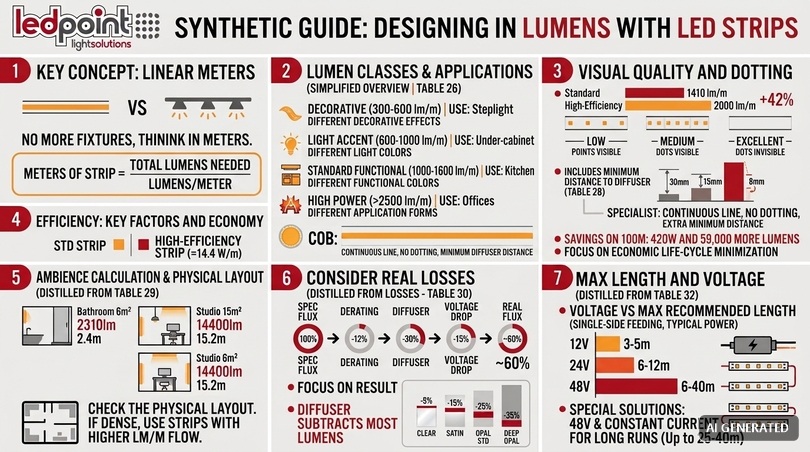
LED strips have rewritten the way lumens are distributed in an environment. Instead of concentrating the flux in a few points, it is distributed along continuous lines, obtaining high uniformity with contained powers. But the sizing changes: you no longer think in terms of luminaires, you think in linear meters.
The key quantity: lumens per meter
The nameplate parameter of an LED strip is the flux per linear meter (lm/m). From this, knowing the total lumens required, the linear development to be installed is directly calculated:
Meters of strip = Total lumens required ÷ lumens per meter of the strip
| Class | Lumens per meter | Typical power | LED density | Intended use |
|---|---|---|---|---|
| Decorative / ambient | 300–600 lumens/m | 4.8–6 W/m | 30–60 led/m | Step lights, contours, soft coves |
| Light accent | 600–1,000 lumens/m | 6–9.6 W/m | 60–120 led/m | Luminous frames, decorative under-cabinet |
| Standard functional | 1,000–1,600 lumens/m | 9.6–14.4 W/m | 120–240 led/m | Kitchen under-cabinet, light coves, wardrobes |
| Intensive functional | 1,600–2,500 lumens/m | 14.4–20 W/m | 120–280 led/m | Main light of environments, retail |
| High power | 2,500–4,000 lumens/m | 20–28.8 W/m | 240–480 led/m | Offices, ceiling light replacement, light industrial |
| Very high power | >4,000 lumens/m | >30 W/m | >480 led/m or dense COB | Special applications, main linear light |
Some real examples of products in the catalog, useful as a concrete numerical reference:
| Product | Lumens per meter | Power | Efficacy | Meters per 10,000 lm | Power per 10,000 lm |
|---|---|---|---|---|---|
| Strip 3000K 2835 120led/m 24V 9.6 W/m | 950 lumens/m | 9.6 W/m | 110 lm/W | 10.5 m | 101 W |
| Strip 3000K 2835 120led/m 24V 14.4 W/m | 1,410 lumens/m | 14.4 W/m | 110 lm/W | 7.1 m | 102 W |
| Strip 3000K 2835 240led/m 24V 14.4 W/m high efficacy | 2,000 lumens/m | 14.4 W/m | 155 lm/W | 5.0 m | 72 W |
| Strip 3000K 2835 240led/m 24V 20 W/m | 2,850 lumens/m | 20 W/m | 160 lm/W | 3.5 m | 70 W |
| Strip 3000K 2835 120led/m 24V 24 W/m | 2,345 lumens/m | 24 W/m | 110 lm/W | 4.3 m | 102 W |
| Strip 230V IP65 3000K 120led/m 16.5 W/m | 1,535 lumens/m | 16.5 W/m | 105 lm/W | 6.5 m | 108 W |
The comparison between the second and third rows is the most useful lesson in the entire table. At exactly the same absorbed power (14.4 W/m), the high efficacy strip produces 590 more lumens per meter: +42%. On a 100 linear meter project this means 59,000 more lumens at zero energy cost, or (choosing to maintain the same flux) a saving of about 420 W of installed power. Those who evaluate LED strips only on price per meter are ignoring the economically heaviest variable of the life cycle.
LED density, dot effect and distance from diffuser
Density (led/m) does not only affect the flux, but the visual quality of the result. The phenomenon to be controlled is the so-called dot effect or dotting: the perception of individual LEDs as distinct points through the diffuser.
| Density | Pitch between LEDs | Minimum distance opal diffuser | Minimum distance satin diffuser | Visual result |
|---|---|---|---|---|
| 30 led/m | 33.3 mm | 30 mm | 45 mm | Points always visible in low profiles |
| 60 led/m | 16.7 mm | 15 mm | 22 mm | Acceptable in medium profiles |
| 120 led/m | 8.3 mm | 8 mm | 12 mm | Good continuity in most profiles |
| 180 led/m | 5.6 mm | 5 mm | 8 mm | Excellent continuity |
| 240 led/m | 4.2 mm | 4 mm | 6 mm | Practically continuous |
| 320–480 led/m | 2–3 mm | 3 mm | 4 mm | Continuous even in flat profiles |
| COB (continuous line) | – | 0 mm | 0 mm | Perfectly continuous light, no dotting |
When the strip will remain visible or semi-visible — low light coves, shelves, flush under-cabinet — the rational choice are COB LED strips, which eliminate the problem at the root thanks to the continuous phosphor line. When instead the strip will be completely hidden in a deep cove, density matters little and it is convenient to optimize on lumens per euro.
How many meters of strip are needed per room
| Environment and surface | Total lumens | With 950 lumens/m | With 1,410 lumens/m | With 2,000 lumens/m | With 2,850 lumens/m |
|---|---|---|---|---|---|
| Bathroom 6 m² (200 lx) | 2,310 lumens | 2.4 m | 1.6 m | 1.2 m | 0.8 m |
| Bedroom 12 m² (100 lx) | 2,280 lumens | 2.4 m | 1.6 m | 1.1 m | 0.8 m |
| Kitchen 12 m² (300 lx) | 6,900 lumens | 7.3 m | 4.9 m | 3.5 m | 2.4 m |
| Living room 25 m² (150 lx) | 7,200 lumens | 7.6 m | 5.1 m | 3.6 m | 2.5 m |
| Study 15 m² (500 lx) | 14,400 lumens | 15.2 m | 10.2 m | 7.2 m | 5.1 m |
| Office 30 m² (500 lx) | 28,800 lumens | 30.3 m | 20.4 m | 14.4 m | 10.1 m |
| Office 60 m² (500 lx) | 57,600 lumens | 60.6 m | 40.9 m | 28.8 m | 20.2 m |
| Shop 80 m² (300 lx) | 46,000 lumens | 48.4 m | 32.6 m | 23.0 m | 16.1 m |
| Corridor 20 m² (100 lx) | 3,800 lumens | 4.0 m | 2.7 m | 1.9 m | 1.3 m |
| Warehouse 200 m² (150 lx) | 58,000 lumens | 61.1 m | 41.1 m | 29.0 m | 20.4 m |
| Laboratory 50 m² (750 lx) | 72,000 lumens | 75.8 m | 51.1 m | 36.0 m | 25.3 m |
Attention to a physical limit often ignored: the resulting meters must find a place in the room. Thirty meters of strip in a 30 m² office mean ten lines of three meters, or six lines of five: it is a dense ceiling layout, which must be drawn before ordering the material. If the calculation returns a linear development impossible to place, the answer is not to force it, but to switch to a strip with more lumens per meter.
10. Real losses: profile, diffuser, temperature, voltage drop
Between the lumens declared on the data sheet and those that arrive on the work plane there is a chain of losses that, added together, easily reach 40%. Ignoring them is the mistake that leads to systematically undersized installations.
The chain of losses, quantified
| Phase | Typical loss | Residual lumens (starting 1,000 lm/m) | How to contain it |
|---|---|---|---|
| Declared flux at 25°C | – | 1,000 lumens | Verify that the data is LM-79 and not "calculated" |
| Thermal derating in operation | −5 / −12% | 880–950 lm | Aluminum profile, do not exceed 20 W/m without dissipation |
| Opal diffuser absorption | −15 / −30% | 620–810 lm | Use satin (−8/−12%) where dotting is not critical |
| Internal reflections in the profile | −2 / −5% | 590–790 lm | Profile with light or reflective interior |
| Voltage drop on the line | −3 / −15% | 500–770 lm | Feed from both sides, adequate sections |
| Production tolerance | ±10% | 450–850 lm | Products with tight binning and 3 SDCM |
| End-of-life decay (L70–L80) | −20 / −30% | 360–680 lm | Already considered in the maintenance factor |
| Realistic result in operation | −30 / −45% | 550–700 lm | – |
The diffuser is the single component that subtracts the most lumens from the entire chain. A deep opal diffuser guarantees maximum visual comfort and maximum uniformity, but can cost up to a third of the flux. The choice is a conscious compromise, not a detail: the various types of diffusers available must be compared according to the installation height and the direct visibility of the source.
| Type of diffuser | Transmittance | Lumen loss | Hides LED dots | Recommended use |
|---|---|---|---|---|
| Transparent | 92–95% | −5 / −8% | No | Only mechanical protection, hidden strip |
| Light satin | 85–90% | −10 / −15% | Partially | Tall profiles with density ≥120 led/m |
| Standard opal | 70–80% | −20 / −30% | Yes | General use, visual comfort |
| Deep / double opal | 60–70% | −30 / −40% | Totally | Low profiles, source in view |
| Microprismatic UGR<19 | 75–85% | −15 / −25% | Yes | Offices, VDT workstations |
| Black matte anti-glare | 50–65% | −35 / −50% | Totally | Retail, conference rooms, hospitality |
Voltage drop: the table that saves construction sites
Low voltage strips suffer from voltage drop along the development. The symptom is unmistakable: the strip is bright near the power supply and visibly weaker at the end. It is not a product defect, it is an electrical design error.
| Voltage | Power | Feed from one side | Feed from two sides | Lumen loss at end if exceeded |
|---|---|---|---|---|
| 12V | 4.8 W/m | 7–8 m | 14–16 m | −20 / −35% |
| 12V | 9.6 W/m | 4–5 m | 8–10 m | −25 / −40% |
| 12V | 14.4 W/m | 3–4 m | 6–8 m | −30 / −45% |
| 12V | 19.2 W/m | 2–3 m | 4–6 m | −35 / −50% |
| 24V | 4.8 W/m | 15–18 m | 30–36 m | −15 / −25% |
| 24V | 9.6 W/m | 10–12 m | 20–24 m | −18 / −28% |
| 24V | 14.4 W/m | 8–10 m | 16–20 m | −20 / −30% |
| 24V | 20 W/m | 6–7 m | 12–14 m | −22 / −32% |
| 24V | 24 W/m | 5–6 m | 10–12 m | −25 / −35% |
| 48V | 14.4 W/m | 20–25 m | 40–50 m | −10 / −18% |
| 24V constant current | various | up to 20 m | up to 40 m | constant flux by design |
| 230V | 16.5 W/m | 50–100 m | – | negligible |
The row on constant current strips deserves careful reading. Strips with integrated current control system maintain constant flux along the entire length regardless of voltage drop: they solve the problem by design, and are the correct choice on long runs where uniformity is a contractual requirement. Those who work on hotel corridors, continuous perimeter false ceilings or facades appreciate their value from the first test.
For 48V strips the discussion is even more favorable: quadrupling the voltage compared to 12V reduces the power dissipated on the copper by sixteen times for the same power transported, which allows runs up to 25 meters with a single power supply.
11. Power supply sizing, cable sections and protections
Once the lumens and therefore the meters of strip have been defined, the properly electrical part remains. This is where the electrician makes the difference compared to DIY, and it is also where warranty disputes are concentrated.
Power supply calculation
The rule is simple but must be applied rigorously:
Ppower supply = (W/m × meters) × 1.25
The coefficient 1.25 represents the minimum margin of 20–25% that prevents the driver from working at the limit. A power supply loaded at 100% heats up, ages rapidly and becomes the main cause of system failure. On installations in hot environments or recessed it is better to go up to 1.35.
| Meters | 4.8 W/m | 9.6 W/m | 14.4 W/m | 20 W/m | 24 W/m |
|---|---|---|---|---|---|
| 1 m | 10 W | 15 W | 20 W | 30 W | 30 W |
| 2 m | 15 W | 30 W | 40 W | 50 W | 60 W |
| 3 m | 20 W | 40 W | 60 W | 75 W | 90 W |
| 5 m | 30 W | 60 W | 90 W | 150 W | 150 W |
| 7.5 m | 50 W | 90 W | 150 W | 200 W | 240 W |
| 10 m | 60 W | 150 W | 200 W | 250 W | 320 W |
| 15 m | 90 W | 200 W | 280 W | 400 W | 2×250 W |
| 20 m | 150 W | 250 W | 400 W | 2×250 W | 2×320 W |
| 25 m | 150 W | 320 W | 2×250 W | 2×320 W | 3×250 W |
| 50 m | 320 W | 2×320 W | 3×320 W | 4×320 W | 5×320 W |
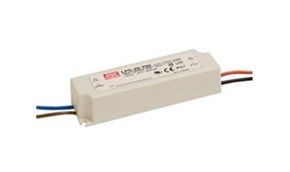
Above 300–400 W it is almost always better to split over multiple distributed power supplies rather than centralize: cable sections, voltage drops and the risk that a single failure turns off the entire system are reduced. The range of power supplies for LED strips must be chosen also evaluating the IP degree, the power factor and the compatibility with the planned regulation system.
Conductor section
| Current | 2 m | 5 m | 10 m | 15 m | 20 m |
|---|---|---|---|---|---|
| 1 A (24 W at 24V) | 0.50 mm² | 0.75 mm² | 1.00 mm² | 1.50 mm² | 1.50 mm² |
| 2 A (48 W at 24V) | 0.75 mm² | 1.00 mm² | 1.50 mm² | 2.50 mm² | 2.50 mm² |
| 4 A (96 W at 24V) | 1.00 mm² | 1.50 mm² | 2.50 mm² | 4.00 mm² | 4.00 mm² |
| 6 A (144 W at 24V) | 1.50 mm² | 2.50 mm² | 4.00 mm² | 6.00 mm² | 6.00 mm² |
| 8 A (192 W at 24V) | 1.50 mm² | 2.50 mm² | 4.00 mm² | 6.00 mm² | 10.0 mm² |
| 10 A (240 W at 24V) | 2.50 mm² | 4.00 mm² | 6.00 mm² | 10.0 mm² | 10.0 mm² |
| 12.5 A (300 W at 24V) | 2.50 mm² | 4.00 mm² | 6.00 mm² | 10.0 mm² | 16.0 mm² |
At the same power, going from 12V to 24V halves the current and therefore allows halving the section, with a saving of copper that on medium-large installations is economically relevant and reduces the bulk in the trunking. This is why 24V is now the de facto professional standard and 12V survives almost only in camper, nautical and furniture applications.
Regulation: dimming without losing quality
Flux regulation is an increasingly frequent requirement, both for comfort and for savings. There are three main methods.
| System | Principle | Useful range | Flicker risk | Suitable for |
|---|---|---|---|---|
| PWM on low voltage side | Pulse width modulation | 1–100% | High if frequency < 1 kHz | General use, requires >3 kHz for video shooting |
| Analog constant current | Current variation | 10–100% | None | Photo studios, TV, healthcare |
| 0/1-10V | Analog signal on driver | 1–100% | Low | Tertiary, BMS integration |
| DALI / DALI-2 | Addressable digital bus | 0.1–100% | None | Large buildings, centralized management |
| DMX512 | Scenographic bus | 0–100% | Low | Dynamic retail, architectural, events |
| TRIAC on 230V | Phase cutting | 20–100% | High | Residential retrofit with existing dimmers |
| Radio 2.4 GHz / ZigBee | Wireless | 1–100% | Depends on the receiver | Renovations without additional wiring |
For environments where video is shot — photo studios, conference rooms with streaming, spaces for content creators — the constraint is not on lumens but on flicker. A perfect installation in terms of illuminance becomes unusable if it produces bands on the camera sensor. In these cases anti-flicker drivers and 0/1-10V or DALI and DMX systems are preferred, which regulate without perceptible modulation.
12. Twelve worked cases: from the 6 m² bathroom to the 2,000 m² warehouse
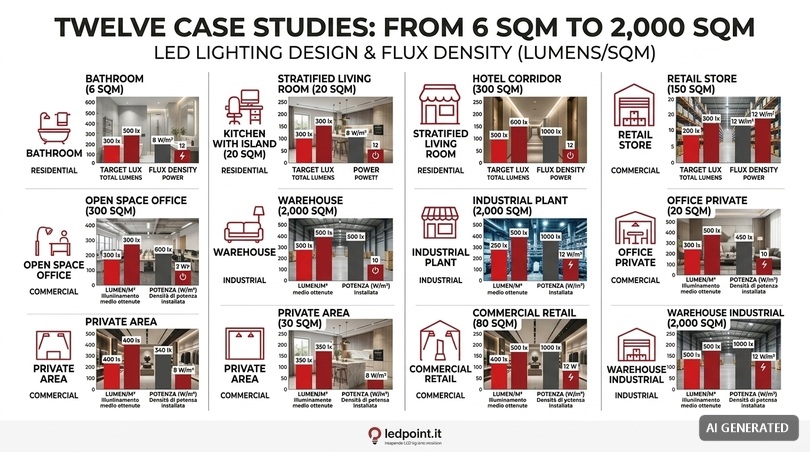
Theory becomes useful only when it turns into applicable numbers. This section presents twelve complete sizings, with all steps explicit, from the lumens required to the list of materials. These are the cases that most frequently recur in quote requests.
Case 1 – Bathroom 6 m², renovation
| Item | Data |
|---|---|
| Required lux (general) | 200 lx |
| Required lux (mirror) | 500 lx on the face, vertical |
| Factor U (k=1.05, very light walls) | 0.60 |
| Factor M | 0.85 |
| Required general lumens | (200 × 6) ÷ (0.60 × 0.85) = 2,353 lm |
| General solution | 3 IP44 spotlights of 800 lm or 2.5 m of 950 lm/m strip in perimeter cove |
| Mirror solution | 2 vertical lines of 60 cm, 1,410 lm/m, CRI>90, 4000K = 1,692 lm |
| Total power | about 42 W |
| Effective lumens/m² | 392 lm/m² |
The critical point of the bathroom is the mirror, not the ceiling. Lighting from above produces marked shadows under eyes and chin, making it impossible to shave or apply makeup. The two lateral vertical lines at 4000K with CRI greater than 90 solve the problem, and are the application in which a continuous light COB strip gives the best result. Attention to IP degrees: in zone 2 according to CEI 64-8/7 at least IP44 is required.
Case 2 – Kitchen 14 m² with island
| Area | Target lux | Surface | Required lumens | Solution |
|---|---|---|---|---|
| General | 300 lx | 14 m² | 8,235 lumens | 6 spots of 1,000 lm + 2 m perimeter strip 1,410 lm/m |
| Under-cabinet work plane | 500 lx | 2.4 m² (3.0 × 0.8 m) | 2,400 lumens | 3.0 m strip 950 lm/m in profile with opal diffuser = 2,850 gross lm |
| Island / peninsula | 500 lx | 1.8 m² | 1,800 lumens | 3 pendants of 700 lm |
| Inside cabinets | 150 lx | – | – | 1.5 m strip 600 lm/m with door sensor |
| Total installed | – | – | ~14,500 lm | ~110 W |
| Overall lumens/m² | – | – | 1,036 lm/m² | – |
The kitchen is the domestic environment with the highest lumen per square meter requirement of all, higher than many offices, because it combines precision visual tasks (cutting, reading labels, evaluating cooking) with the need for high color rendering on food. A CRI of 90 or higher is fully justified here: under a CRI 80 light the meat appears gray and the vegetables dull.
Case 3 – Living room 30 m² with stratified lighting
| Level | Function | Lumens | Percentage | Technical solution | Control |
|---|---|---|---|---|---|
| General | Ambient base | 5,700 lumens | 45% | 12 m perimeter cove with 600 lm/m towards ceiling | Dimmer 0–100% |
| Task | Armchair reading, table | 3,500 lumens | 28% | 2 floor lamps + 1 pendant | Local switch |
| Accent | Pictures, bookcase, greenery | 2,400 lumens | 19% | 4 adjustable spots of 600 lm, 24° | Dedicated scenario |
| Decorative | Ambience, TV backlight | 1,000 lumens | 8% | 3 m RGBW strip behind TV | Wireless |
| Total | – | 12,600 lm | 100% | ~95 W | 420 lm/m² |
The 45/30/20/5 rule between general, task, accent and decorative light is a tested design guide for living spaces. It is not the sum of lumens that makes the perceived quality, but the possibility of turning on only the level needed at that moment. A living room with 12,600 lumens all on a single switch is worse, from the point of view of experience, than one with 6,000 lumens on four independent circuits. The RGBW strip adds the chromatic level without sacrificing the availability of quality white.
Case 4 – Open space office 120 m²
| Step | Value |
|---|---|
| Required lux (EN 12464-1) | 500 lx on work plane |
| Room index k | (15×8) ÷ [2.35 × 23] = 2.22 |
| Factor U | 0.74 |
| Factor M | 0.85 |
| Total lumens | (500 × 120) ÷ (0.74 × 0.85) = 95,390 lm |
| Lumens per square meter | 795 lm/m² |
| Option A – 60×60 panels | 24 panels of 4,000 lm, 30 W = 720 W total |
| Option B – continuous LED lines | 48 m of line at 2,000 lm/m = 96,000 lm, 14.4 W/m = 691 W |
| Option C – high efficacy lines | 34 m at 2,850 lm/m = 96,900 lm, 20 W/m = 680 W |
| Annual consumption (2,500 h) | 1,700–1,800 kWh |
| Power density | 5.7–6.0 W/m² |
The power density of 5.7 W/m² is the true indicator of project quality. With T5 fluorescence the same office required 12–15 W/m², with the first LEDs, 9–10 W/m². Going below 6 W/m² while maintaining 500 lux and UGR<19 is today the reference standard for a high-level energy certification, and on some protocols (LEED, BREEAM, WELL) it becomes a score.
Case 5 – Clothing store 90 m²
| Area | m² | Target lux | Required lumens | Solution | CRI |
|---|---|---|---|---|---|
| General sales | 65 | 300 lx | 37,400 lumens | 18 track spots of 2,100 lm | 90 |
| Wall displays | – | 900 lx | ~14,000 lm | 18 m strip 2,000 lm/m in profile | 95 |
| Showcase | 8 | 2,000 lx | 30,700 lumens | 10 projectors of 3,000 lm, 24° | 95 |
| Fitting rooms | 6 | 500 lx | 5,750 lumens | Vertical lines 1,410 lm/m, 3000K | 95 |
| Cash desk | 4 | 500 lx | 3,800 lumens | 2 spots + under-counter strip | 90 |
| Stockroom | 7 | 200 lx | 2,700 lumens | 1 linear ceiling light | 80 |
| Total | 90 | – | ~94,400 lm | ~750 W | – |
On fitting rooms it is worth spending a note, because it is the most expensive mistake in fashion retail: a top light with low CRI makes any customer look bad, and sales suffer in a measurable way. The correct configuration provides lateral vertical sources at 3000K, CRI greater than 90, with uniform vertical illuminance on the face and body. The difference compared to a single downlight is not subtle: it is the difference between a garment the customer buys and one they put back on the hanger.
Case 6 – Logistics warehouse 800 m² with shelving
| Parameter | Value | Note |
|---|---|---|
| Required lux aisles | 150 lx on the floor | 200 lx if manual picking |
| Required lux vertical on shelf | 100 lx at 1.5 m height | Often forgotten |
| Factor U (with shelves) | 0.45 | Much lower than empty room |
| Factor M | 0.75 | Medium dustiness |
| Total lumens | (150 × 800) ÷ (0.45 × 0.75) = 355,556 lm | 444 lm/m² |
| Solution | 24 high bays of 15,000 lm, 60°×90° optics | 360,000 lumens |
| Power | 24 × 100 W = 2,400 W | 3.0 W/m² |
| Annual consumption (4,000 h) | 9,600 kWh | – |
| Comparison with 400 W metal halide | 36 luminaires × 440 W = 15,840 W | 63,360 kWh/year |
| Annual saving | 53,760 kWh | over €13,000 at €0.25/kWh |
The utilization factor at 0.45 is the data that almost everyone gets wrong in warehouses. Shelving absorbs light and creates deep shadows: the calculation done on the empty room underestimates the need for lumens by over 30%. The correct design solution is to align the luminaires above the aisles, not on a regular grid, and to use asymmetric optics that push the flux vertically onto the shelves.
Case 7 – Hotel corridor 40 m
| Item | Data |
|---|---|
| Required lux | 100 lx by day, 50 lx by night |
| Required lumens (day) | (100 × 72) ÷ (0.55 × 0.85) = 15,400 lm |
| Continuous linear solution | 40 m of 400 lm/m strip dimmed at 100% day / 45% night |
| Main criticality | Uniformity over 40 m with voltage drop |
| Technical solution | Constant current strip or 4 sections of 10 m fed independently |
| Emergency lighting | 1 lux minimum on the axis (UNI EN 1838) |
| Power | about 160 W |
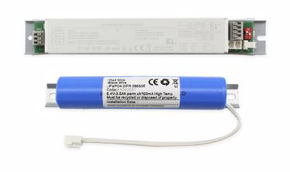
This is the case where the advantage of constant current strips becomes evident and verifiable with a lux meter: the difference in illuminance between the first and last meter is less than 3%, against the 20–25% of a traditional strip on an equivalent run. A emergency lighting module must also be provided to comply with the standard on escape routes.
Cases 8–12 in synthetic form
| Case | Surface | Lux | Total lumens | Lumens/m² | LED power | Recommended solution |
|---|---|---|---|---|---|---|
| Double garage | 32 m² | 150 lx | 10,900 lumens | 341 | 75 W | 2 IP65 waterproof linear ceiling lights |
| Dental laboratory | 25 m² | 1,000 lx | 52,900 lumens | 2,116 | 380 W | Continuous lines CRI 95 + task light |
| Private gym | 60 m² | 300 lx | 36,400 lumens | 607 | 250 W | 4000K panels UGR<22 |
| Winery / barrel room | 150 m² | 100 lx | 32,300 lumens | 215 | 230 W | IP65 2700K strips on vaults |
| Production warehouse | 2,000 m² | 300 lx | 1,176,000 lumens | 588 | 7,400 W | 60 high bays 20,000 lm + task lighting |
13. The ten mistakes that make a compliant installation look "dark"
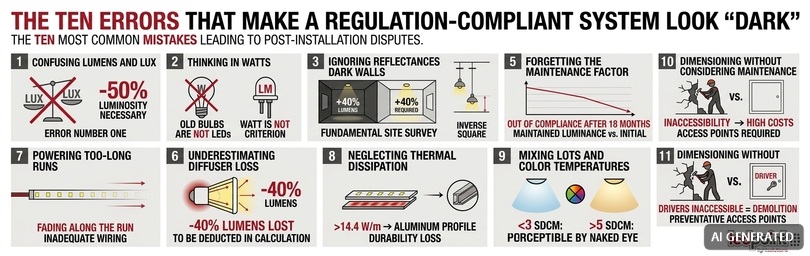
These are the recurring mistakes that lead to customer calls two weeks after delivery. Recognizing them in advance avoids rework.
Confusing lumen and lux
Applying the formula lumen = lux × m² without coefficients produces an installation at 50–55% of what is needed. It is the number one mistake in absolute terms and concerns all the others: if you get this wrong, no subsequent product choice saves the project.
Reasoning in watts
"Before there were six 60 W bulbs, I put six 10 W LEDs": six 10 W LEDs at 100 lm/W make 6,000 lumens, against the 4,260 of the old bulbs. It seems like a gain, but if the new luminaires have narrower optics or are recessed with glass, the result on the work plane can be worse. Watt is never a design criterion.
Ignoring reflectances
A room with dark walls requires up to 40% more lumens. The project done on plan without survey, or before the finishes, is a gamble.
Not considering height
Doubling the distance between source and plane, the illuminance is reduced to a quarter (inverse square law). A spotlight that at 2.5 m gives 300 lux, at 5 m gives 75.
Forgetting the maintenance factor
An installation designed "exact" when new will be below standard after eighteen months. The standard requires maintained illuminance, not initial.
Underestimating diffuser loss
Up to 40% of lumens can stay in the diffuser. It must be scaled in the calculation phase, not discovered during testing.
Feeding too long runs
The strip progressively turns off along the run. The customer notices it immediately, at night, and it is a difficult dispute to close without redoing the wiring.
Neglecting thermal dissipation
Strips above 14.4 W/m glued directly onto non-metallic surfaces lose lumens and duration. The aluminum profile is not optional above this threshold.
Mixing batches and color temperatures
Two reels of the same reference but of different batches can differ visibly. The 3 SDCM selection is what makes a continuous line really homogeneous; below 5 SDCM the difference is perceptible to the naked eye on white surfaces.
Sizing without thinking about maintenance
A strip embedded in plasterboard without inspectability, fed by a driver walled in a closed false ceiling, will sooner or later produce a demolition intervention. Access points must be provided, and the driver must always be placed in a reachable position.
14. Lumens by profession: lighting design, photography, interior, retail, content creation
The same number of lumens is read differently depending on the profession of the designer. This section answers the typical questions of five professional figures who deal daily with this quantity.
Lighting engineer: large projects and efficiency
What is the ideal lumen level for industrial lighting? There is no absolute value: you start from the lux required by the visual task (200 lx for rough work, 300 lx for medium, 500–750 lx for fine) and you go back to lumens with the real coefficients of the environment. In a typical warehouse you land on 400–700 lumens per square meter installed.
How to compare lumens between different products? Only on an LM-79 basis, i.e. measurement of the complete luminaire in an integrating sphere or accredited goniophotometer. Comparing the flux of bare chips with that of a finished luminaire is incorrect: the difference between source flux and luminaire flux can exceed 25%.
How does the number of lumens affect consumption? Directly, through efficiency: W = lumens ÷ (lm/W). Consumption is cut by acting on three levers, in this order of effectiveness: eliminate unnecessary lumens (targeted design and controls), increase the efficiency of the source, reduce operating hours with sensors and regulation.
| Intervention | Typical saving | Investment | Payback |
|---|---|---|---|
| Replacement of sources with high efficacy LEDs | 40–65% | Medium | 1.5–3 years |
| Presence sensors in discontinuous areas | 25–45% | Low | <1 year |
| Regulation according to natural light | 20–40% | Medium | 2–4 years |
| Task lighting instead of general over-illumination | 15–30% | Low | 1–2 years |
| Correct optics (avoid wasted lumens) | 10–25% | None if in design | Immediate |
| Scheduled maintenance (cleaning) | 10–20% | Low | Immediate |
| Lighter internal surfaces | 10–25% | Low in renovation | – |
Professional photographer: lumens, lux and stops
For the photographer the operational quantity is not the lumen but exposure. The useful conversion is between lux and exposure value (EV) at ISO 100.
| Illuminance | EV at ISO 100 | Example shot | Indicative lumens on 4 m² set |
|---|---|---|---|
| 50 lx | ~4.3 EV | Ambient evening atmosphere | ~400 lm |
| 100 lx | ~5.3 EV | Soft interior | ~800 lm |
| 250 lx | ~6.6 EV | Portrait in ambient light | ~2,000 lm |
| 500 lx | ~7.6 EV | Video with modern sensor | ~4,000 lm |
| 1,000 lx | ~8.6 EV | Stable 4K video | ~8,000 lm |
| 2,500 lx | ~9.9 EV | Product still life | ~20,000 lm |
| 5,000 lx | ~10.9 EV | Commercial set | ~40,000 lm |
| 10,000 lx | ~11.9 EV | High speed / slow motion | ~80,000 lm |
For the photographer the decisive parameter is not the quantity of lumens but the spectral quality and temporal stability. CRI greater than 95 with high R9, TLCI greater than 90, total absence of flicker and stability of the color temperature during dimming are needed. A 2,000 lumen source with these requirements is worth more than a 6,000 lumen one without. The Sunlike series strips, with a spectrum that reproduces sunlight and very high CRI, are designed exactly for this need.
Interior architect: lumens and perception of space
How does lumen affect the perception of space? Much more than quantity, distribution matters. Illuminating vertical surfaces makes an environment appear larger and brighter even with the same lumens installed; concentrating all the flux on the floor produces the opposite effect. A tested practical rule: devoting at least 30% of the flux to the walls increases perceived brightness equivalent to a +40% of total lumens distributed only horizontally.
| Strategy | Perceptual effect | When to use it | Technique |
|---|---|---|---|
| Grazing light on wall (wall washing) | Larger and brighter environment | Small or narrow rooms | Strip in cove 15–25 cm from wall |
| Light towards ceiling (uplight) | Higher ceiling, soft atmosphere | Low ceilings | Perimeter cove, suspension profile |
| Concentrated light downwards | Intimacy, collection | Dining areas, lounge | Pendants, narrow spots |
| Grazing on material | Enhances texture (stone, brick, wood) | Textured walls | Strip 5–10 cm from surface |
| Backlight | Lightness, visual suspension | Furniture, mirrors, false ceilings | Strip behind panel |
| Hidden recessed light | Invisible source, magic effect | High-end projects | Frameless recessed profiles |
Retailer and installer: recommending the right product
How to recommend the best ratio between lumens and consumption? The criterion is the cost per lumen over the entire life cycle, not the purchase price. A product that costs 40% more but lasts three times longer and is 45% more efficient has a lower total cost already from the second year in applications with many operating hours.
| Scenario | Efficacy | Power | Energy 10 years | Energy cost | Replacements | Indicative total |
|---|---|---|---|---|---|---|
| Economy LED | 90 lm/W | 1,111 W | 44,440 kWh | €11,110 | 2–3 | ~€13,500 |
| Professional LED | 120 lm/W | 833 W | 33,320 kWh | €8,330 | 0–1 | ~€9,800 |
| High efficacy LED | 160 lm/W | 625 W | 25,000 kWh | €6,250 | 0 | ~€7,900 |
| Fluorescent T5 | 95 lm/W | 1,053 W | 42,120 kWh | €10,530 | 3–4 | ~€13,200 |
| Metal halide | 85 lm/W | 1,176 W | 47,040 kWh | €11,760 | 4–5 | ~€15,000 |
The difference between the first and third row exceeds €5,600 over ten years for just 100,000 lumens installed. This is the argument that converts a quote: not "this product is better", but "this product costs €5,600 less".
Content creator and home studio
Those who produce content at home have precise needs that rarely coincide with standard residential lighting. 800 to 2,000 lux are needed on the subject for clean video with consumer sensors, soft and diffused light (large emitting surfaces, not points), CRI greater than 95, consistent color temperature between all sources in the frame and absence of flicker with any shutter.
| Setup | Lux on subject | Indicative total lumens | Configuration |
|---|---|---|---|
| Professional video call | 300–500 lx | 2,000–3,500 lm | 1 diffused front key + ambient light |
| Video podcast | 500–800 lx | 4,000–6,500 lm | Key + fill + accent on background |
| YouTube talking head | 800–1,200 lx | 6,500–10,000 lm | Key + fill + back + background |
| Unboxing / product | 1,000–2,000 lx | 8,000–16,000 lm | Zenithal softbox + two side |
| Beauty / makeup | 1,200–2,000 lx | 10,000–16,000 lm | Wide front light CRI 97 |
| Fixed multi-camera set | 1,500–2,500 lx | 15,000–25,000 lm | Linear ceiling grid + RGB accents |
For the background, RGB+CCT strips allow you to change the ambient color while maintaining the availability of quality white on the subject. For the main light, on the other hand, lumens with full spectrum and flicker-free regulation are needed.
15. Luminous efficacy, consumption and ROI: how much does every 1,000 lumens cost
Translating lumens into euros is the operation that closes the sale and justifies a technical choice. The following tables allow you to calculate it in thirty seconds in front of the customer.
| Efficacy | Watts per 1,000 lm | 1,000 h/year | 2,500 h/year | 4,000 h/year | 6,000 h/year | 8,760 h/year |
|---|---|---|---|---|---|---|
| 15 lm/W (incandescence) | 66.7 W | €16.68 | €41.69 | €66.70 | €100.05 | €146.07 |
| 60 lm/W (compact fluo) | 16.7 W | €4.18 | €10.44 | €16.70 | €25.05 | €36.57 |
| 90 lm/W (base LED) | 11.1 W | €2.78 | €6.94 | €11.10 | €16.65 | €24.31 |
| 110 lm/W (standard LED) | 9.1 W | €2.28 | €5.69 | €9.10 | €13.65 | €19.93 |
| 130 lm/W | 7.7 W | €1.93 | €4.81 | €7.70 | €11.55 | €16.86 |
| 150 lm/W | 6.7 W | €1.68 | €4.19 | €6.70 | €10.05 | €14.67 |
| 160 lm/W (high efficacy) | 6.3 W | €1.58 | €3.94 | €6.30 | €9.45 | €13.79 |
| 180 lm/W (best in class) | 5.6 W | €1.40 | €3.50 | €5.60 | €8.40 | €12.26 |
On a 90,000 lumen retail installation on for 4,000 hours a year, going from 90 to 160 lm/W means saving €432 a year. On a 360,000 lumen warehouse on for 4,000 hours, the annual saving is €1,728. Over ten years, without counting the increase in energy prices, we are talking about €4,320 and €17,280 respectively.
Cost per lumen of products
| Range | Indicative price | Efficacy | CRI | Binning | Warranty | Appropriate use |
|---|---|---|---|---|---|---|
| Consumer | €3–8/m | 70–90 lm/W | 70–80 | >7 SDCM | 1 year | Temporary decoration |
| Semi-professional | €8–15/m | 90–110 lm/W | 80–85 | 5–7 SDCM | 2 years | Non-critical residential |
| Professional | €15–28/m | 110–145 lm/W | 85–90 | 3 SDCM | 3–5 years | Tertiary, retail, quality residential |
| High efficacy | €22–38/m | 145–170 lm/W | 80–90 | 3 SDCM | 5 years | Large surfaces, many hours |
| High color rendering | €28–55/m | 70–110 lm/W | 95–98 | 2–3 SDCM | 5 years | Museum, fashion retail, photography |
| Special (IP67, naval, food) | €35–70/m | 90–140 lm/W | 80–95 | 3 SDCM | 5 years | Severe environments |
For long-life projects it is always worth checking the availability of promotional solutions in the professional range, which often allow you to move up a category at the same budget, and evaluate the profile and accessory kits that reduce installation times.
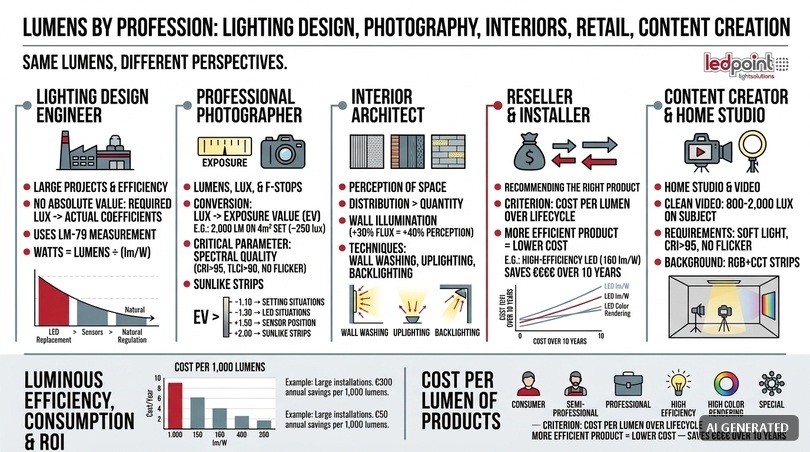
16. Measuring lumens: lux meter, integrating sphere, LM-79, LM-80, TM-21
No electrician measures lumens on site, and he should not: the total luminous flux is measured in the laboratory. On site you measure lux, and from those you verify whether the project has been respected.
How lumens are measured in the laboratory
| Standard | What it measures | Instrument | Typical duration | Practical relevance |
|---|---|---|---|---|
| IES LM-79 | Total flux, power, CRI, CCT of the complete luminaire | Integrating sphere or goniophotometer | Hours | This is the reliable nameplate data |
| IES LM-80 | Flux maintenance of LED chips over time | Climatic chamber | 6,000–10,000 h | Base for estimating duration |
| IES TM-21 | Extrapolation of useful life (L70, L80, L90) | Calculation on LM-80 data | – | Foundations of warranty declarations |
| IES TM-30 | Quality of color rendering (Rf, Rg) | Spectroradiometer | – | More informative than CRI alone |
| EN 13032 | Measurement and presentation of photometric data | Goniophotometer | – | Generates IES/LDT files for calculation |
| IEC 62717 | Performance requirements of LED modules | – | – | European reference |
| IEC/TR 62778 | Photobiological risk from blue light | Spectroradiometer | – | Mandatory in documentation |
The operational advice is simple: always demand the LM-79 report of the luminaire, not the sum of the declared fluxes of the chips. A product that declares "LEDs at 200 lm/W" without specifying the flux of the finished luminaire is communicating the data of the component, not of the product: the loss between the two is typically 15–30%.
How it is verified on site
The verification is performed with a lux meter compliant at least with class C according to DIN 5032-7, according to a codified procedure:
| Step | Operation | Attention |
|---|---|---|
| 1 | Turn on the system and wait for stabilization | 30 minutes minimum for LEDs |
| 2 | Exclude natural light | Measure at night or with total blackout |
| 3 | Define the measurement grid | Step according to EN 12464, typically 0.5–2 m |
| 4 | Position the sensor on the task plane | 0.85 m for offices, 0.75 m tables, floor in transit areas |
| 5 | Operator outside the light cone | The operator's shadow falsifies the measurement by up to 20% |
| 6 | Record all points and calculate Emed | Arithmetic mean of the values |
| 7 | Calculate uniformity U0 = Emin/Emed | ≥ 0.60 on the task area |
| 8 | Compare with the maintained design value | A new installation must exceed it by about 20% |
| 9 | Verify vertical illuminance where required | Fitting rooms, shelves, blackboards |
| 10 | Draw up the report with date, instrument, conditions | Contractual document |
Point 8 is the one that generates the most misunderstandings with customers. A newly delivered installation must measure more than the design lux, because the regulatory value is the one maintained at the end of the cycle. If a new installation measures exactly 500 lux where 500 maintained are needed, in two years it will be out of standard. This must be explained during testing, not afterwards.
Smartphone apps that measure lux have typical errors of 20–40% and cannot be used for contractual verifications. They can serve for a quick order of magnitude, never for a report.
17. Site checklist and quick decision scheme
This is the operational summary to keep on your phone. Seven questions, in order, and the sizing in lumens is closed.
| # | Question | Where to find the answer | Error to avoid |
|---|---|---|---|
| 1 | What intended use and what visual task? | Tables 10–15 and applicable standard | Using a generic value for the whole room |
| 2 | How many actual square meters of the task? | Survey | Confusing room surface and task surface |
| 3 | What reflectances do ceiling, walls, floor have? | Site visit or finishes specifications | Designing before knowing the finishes |
| 4 | What useful height and what room index? | Formula section 3.3 | Ignoring the height of the work plane |
| 5 | What maintenance factor is realistic? | Table 8 | Always using 0.80 regardless of the environment |
| 6 | How many total lumens and how do I distribute them? | Formula section 3.1 | Concentrating all the flux in a few points |
| 7 | Which product, which optics, which control? | Tables 26–35 | Choosing the product before doing the calculation |
| If the condition is... | Then choose... | Why |
|---|---|---|
| Visible strip or low profile | COB or ≥240 led/m | Eliminates the dot effect |
| Run over 10 m without interruptions | Constant current or 48V | Uniformity over the entire length |
| Damp environment or outdoor | IP65 or IP67 | Protection from water and dust |
| Fashion retail, museum, food | CRI ≥95 with high R9 | Color rendering on materials and products |
| Many hours of operation | ≥150 lm/W | Operating cost dominant |
| Video or photo shooting | Constant current, no slow PWM | Absence of flicker |
| Above 14.4 W/m | Always in aluminum profile | Thermal dissipation |
| Environments to be air-conditioned | Maximum efficiency | Every watt of light is a watt of heat to be dissipated |
| Request for scenarios or color | RGBW or RGB+CCT | Color without giving up quality white |
| Well-being and circadian rhythm | Tunable white / circadian | CCT variation during the day |
For installations that must follow the biological rhythm of the occupants (offices, healthcare facilities, residences for the elderly, environments without natural light) the Circadian Light solutions allow you to vary color temperature and intensity during the day while maintaining the lumens required by the standard in the working ranges.
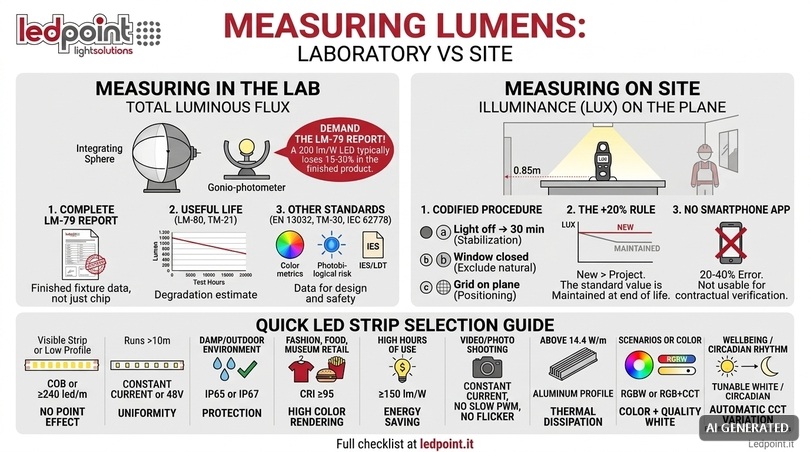
18. Technical glossary and related searches
The lighting engineering vocabulary is full of terms that look alike and are used as synonyms even in professional contexts. This table separates them definitively and closes all ambiguities between lumen, lux, candela and derived quantities.
| Term | Symbol / unit | Definition |
|---|---|---|
| Lumen | lm | Unit of measurement of luminous flux: total amount of visible light emitted by a source |
| Lux | lx | Unit of measurement of illuminance: one lumen per square meter of surface |
| Candela | cd | Unit of luminous intensity in a direction; fundamental quantity of the SI |
| Luminance | cd/m² | Perceived brightness of an emitting or reflecting surface |
| Footcandle | fc | Anglo-Saxon unit: one lumen per square foot, equal to 10.764 lux |
| Luminous efficacy | lm/W | Ratio between lumens emitted and watts absorbed |
| Maintained illuminance | Em | Minimum guaranteed illuminance at the end of the maintenance cycle |
| Uniformity | U0 | Ratio between minimum and average illuminance |
| UGR | – | Unified glare rating index |
| CRI / Ra | – | Color rendering index on a 0–100 scale |
| R9 | – | Rendering of saturated red, not included in the calculation of Ra |
| CCT | K | Correlated color temperature, in kelvin |
| SDCM / MacAdam | step | Chromatic tolerance between specimens: 3 SDCM is the professional standard |
| L70 / L80 / L90 | h | Hours after which the flux drops to 70/80/90% of the initial |
| IP degree | IPxx | Protection against solid and liquid bodies |
| Flicker / SVM | – | Oscillation of the luminous flux over time |
| Beam angle | ° | Opening within which the intensity is at least 50% of the maximum |
| Utilization factor | U | Share of lumens emitted that reaches the useful plane |
| Maintenance factor | M | Predicted decay coefficient of the installation |
| Power density | W/m² | Installed power per square meter |
| Steradian | sr | Unit of solid angle used in the definition of lumen |
| V(λ) curve | – | Spectral sensitivity of the eye, basis of the watt→lumen conversion |
Related searches on lumens, lux and illuminance
We collect here, in the form of a short answer, the most common formulations with which this topic is searched. They are the same questions as the guide, posed in different words: we report them because each corresponds to a real doubt that is worth clarifying.
| How it is searched | Answer in one line |
|---|---|
| lumen meaning | Unit of measurement of the total luminous flux emitted by a source |
| lux meaning / lux unit of measurement | Unit of measurement of illuminance, equal to one lumen per square meter |
| what are lumens / what lumens are | The overall amount of visible light produced, independent of the illuminated surface |
| difference between lux and lumen / lux lumen difference | The lumen is emitted light, lux is light received on one square meter |
| lumen to lux / lux to lumen / lumen lux conversion | lux = lumen ÷ m²; lumen = lux × m² |
| lux lumen converter / lumen lux converter | Table 16 of this guide is used, which covers from 500 to 100,000 lumens |
| lux lumen ratio / lumen lux ratio | It is the ratio of division by the surface, corrected by factors U and M in real environment |
| lux vs lumen / lux or lumen | To buy you look at lumens; to verify on site you measure lux |
| lux calculation / lux measurement / lux test | It is performed with a lux meter on the task plane, according to the procedure in table 52 |
| 1 lux / illuminance lux / minimum illuminance lux | 1 lux is the minimum level required on escape routes by UNI EN 1838 |
| lux 500 / lux room / lux lighting | 500 lux is the regulatory value for offices and domestic work planes |
| lm to lux / lumens lux / lumen lux conversion | Same formula: divide the lumens by the surface in square meters |
| lm lumen / unit of measurement lumen / lumen scale | lm is the symbol of the lumen; the practical scale goes from 100 lm (flashlight) to over 20,000 lm (industrial high bay) |
| lux watt / lumen lighting | There is no direct lux–watt conversion: you need to know efficiency, optics and surface |
| measure lumens / how to calculate the lumen | In the laboratory with an integrating sphere according to LM-79; on site you measure lux |
| 100 lux how many lumens are they | It depends on the surface: 100 lux on 10 m² are equivalent to 1,000 theoretical lumens, about 1,900 real |
| brightness lux / low lux / lux measure | Terms that indicate the level of illuminance measured on the surface |
| definition lux / lux wikipedia / lumen wikipedia | Both are units of the International System, defined by the CIE and adopted by the BIPM |
| equivalent to one lumen / what 1 lumen is equivalent to | To a candle that emits in a solid angle of one steradian; a real candle produces about 12 |
| lumen and lux / lux and lumen / lumen lux | The two basic quantities of lighting engineering: emission and reception of light |
| e-lumen / meaning lumen / lumen of tabu / prestige lumen / lumen diet | Commercial names or from other fields, with no relation to the photometric unit |
19. FAQ: 34 quick answers about lumens
The questions are collected by topic and formulated as they actually arrive from customers and colleagues. Each answer is self-sufficient: it can be read without having read the rest of the guide.
How many lumens per square meter are needed?It depends on the intended use. In the residential environment you size between 150 and 300 lumens per square meter for general light; in the office about 800–960 lumens/m² are needed to reach the 500 lux of the standard; in the industrial environment you go from 190 lumens/m² of a warehouse to over 1,900 lumens/m² of a quality control department. |
How many lumens for 30 sqm?For a 30 m² living room at 150 lux about 8,700 lumens installed are needed. For an office of the same surface at 500 lux about 28,800 are needed. For a warehouse at 150 lux, about 5,700. The surface alone is not enough: you need to know what activity takes place there. |
How many lumens to illuminate a room?You multiply the square meters by the lumens/m² value of the intended use, obtainable from tables 10–15. A 14 m² bedroom requires about 2,700 lumens of general light, integrated by local sources for reading. |
What is the difference between lumen and lux?The lumen measures the light that comes out of the source; lux measures the light that arrives on one square meter of surface. One lux is one lumen distributed over one square meter. The same 1,000 lumen source produces 1,000 lux on 1 m² and only 100 lux on 10 m². |
What is the difference between watt and lumen?Watt measures the energy absorbed, the lumen the light produced. The link is the efficacy in lm/W, which varies from 12 lm/W of incandescence to over 160 lm/W of modern LEDs. To compare two products you look at lumens, never watts. |
How to convert lumens to watts?You divide the flux by the efficacy: watts = lumens ÷ (lm/W). For 1,000 lumens about 9.1 W are needed with a 110 lm/W LED, 6.3 W with a 160 lm/W one, 75 W with an incandescent bulb. |
How many watts are 1000 lumens?With standard LED about 9 W; with high efficacy LED about 6.3 W; with halogen about 55 W; with incandescence about 75 W. |
How many watts are 2000 lumens?About 18 W with standard LED, 12.5 W with high efficacy LED, 105 W with halogen, 150 W with incandescence. |
How many watts are 2400 lumens?About 22 W with 110 lm/W LED and 15 W with 160 lm/W LED. It is the typical flux of a 36 W T8 fluorescent tube, which is therefore replaced with a quarter of the power. |
How many lumens per watt?In current professional products you go from 110 to 170 lumens per watt. Below 90 lm/W the product is technologically outdated; above 180 lm/W you are in the experimental range or these are data referred to the chip alone, not to the luminaire. |
What is a lumen used for?It is used for three things: to objectively compare sources of different technologies, to size an installation starting from the required lux, to calculate efficiency and therefore the operating cost. |
What is 1 lumen equivalent to?To the flux emitted by a source of one candela in a solid angle of one steradian. In practical terms, a lit candle emits about 12–13 lumens overall. |
What do 100 lumens correspond to?To a 15 W incandescent bulb or a small flashlight. Sufficient as orientation light on about half a square meter. |
What do 400 lumens correspond to?To a traditional 40 W bulb. They cover about 2 m² at ambient light level, or 0.8 m² at 500 lux. |
What do 800 lumens correspond to? What does 800 lumens mean?They are the equivalent of the 60 W incandescent bulb, the standard replacement value for a domestic light point. They illuminate about 4 m² of general light. |
What does 1000 lumens correspond to? How much light does 1000 lumens make?They are equivalent to 75 W of incandescence. In a real room they bring about 5 m² to 100 lux: suitable for a small bathroom or one meter of medium density LED strip. |
What do 2000 lumens correspond to?To a 150 W halogen. They cover a living room of about 10 m² as general light or a 2 m² work plane at 500 lux. |
What do 3000 lumens correspond to? What does 3000 lumens mean?It is the flux of a good office LED panel or a 15 m² kitchen ceiling light. It corresponds to about 200 W of incandescence. |
What do 4000 lumens correspond to?To about 275 W of incandescence. Sufficient for a double garage or a 20 m² technical room at 100 lux. |
What does 5000 lumens mean? How much is 5000 lumens?It is the flux of a good quality 35–45 W LED floodlight, sufficient for a 25 m² square at 100 lux or a 5 m² work area at 500 lux. |
What does 6000 lumens mean? What does 6000 lumens mean?A professional lighting flux: small industrial ceiling light, construction site floodlight, or just over two meters of high power LED strip. |
How much light does 470 lumens make? What does 470 lumens mean?It is the typical value of an E14 candle or globe LED bulb, equivalent to 40–45 W of incandescence. Suitable for wall sconces and multi-light chandeliers. |
How much light does 700 lumens make?A little less than a 60 W bulb. They cover about 3.5 m² as domestic general light. |
What is the difference between lumen and LED?They are not comparable: LED is a technology, the lumen is the unit that measures how much light that technology produces. An LED can emit from fractions of lumens to tens of thousands. |
What are lumens in LEDs?They are the declared luminous flux of the luminaire or of the meter of strip. They must always be verified on the LM-79 report of the complete luminaire, not on the data of the chip alone, which is typically 15–30% higher. |
What is the symbol of the lumen?The symbol is lm, always in lowercase and without a dot. In the International System it is a derived unit: 1 lm = 1 cd·sr. |
How are the lumens of an environment calculated?With the formula Φ = (E × S) ÷ (U × M), where E are the standard lux, S the surface, U the utilization factor and M the maintenance factor. The ratio between lumens installed and lux obtained in a real room is typically 1.6–2.0. |
How are lumens measured?In the laboratory, with an integrating sphere or goniophotometer according to the IES LM-79 standard. It is not possible to measure lumens on site: you measure lux with a lux meter and verify compliance with the project. |
How many lumens are needed in the kitchen?About 385–575 lumens per square meter of general light, plus 900–1,000 lumens per linear meter on the work plane. A 12 m² kitchen therefore requires about 5,500 general lumens plus 2,500–3,000 under-cabinet lumens. |
How many lumens are needed in the office?UNI EN 12464-1 requires 500 lux on work planes: about 800–960 lumens per square meter installed, with UGR not exceeding 19 and color rendering at least 80. |
Why does my installation look dark even if I put the right lumens?The most frequent causes are five: not having applied the U and M factors, dark walls, too absorbent diffuser, excessive installation height, wrong optics. In most cases the problem is the calculation, not the product. |
Is it better to have more lumens or more light points?More light points, almost always. Distributing the same lumens over more sources improves uniformity, reduces sharp shadows and lowers glare. A single very powerful luminaire almost always produces a worse result. |
Are the lumens of an LED strip per meter or total?By professional convention they are declared per meter (lm/m). The total of the reel is obtained by multiplying by the length: a 1,410 lm/m strip in a 5 m reel provides 7,050 lumens overall. |
What company is Lumen? Who is Lumen?Several companies and products in different sectors use this name, but they have no relation to the unit of measurement. In lighting engineering the lumen is exclusively the SI unit of luminous flux; in Latin it means "light", and in anatomy it indicates the internal cavity of a hollow organ. |
20. Lumen: final recommendations
If only one thing were to remain from this guide, it would be this: the number of lumens per square meter is not a figure copied from a table, but the result of a calculation that starts from standard lux levels and accounts for the actual geometry of the room. The tables on this page provide a starting point, but the corrective coefficient between theory and reality (that 1.6–2.0 factor that almost no one applies) is the difference between a compliant system and one that needs to be redone.
The three numbers to keep in mind are simple. Residential: 150–300 lumens per square meter of general lighting. Tertiary and offices: 800–960 lumens per square meter. Work surfaces and precision visual tasks: from 960 to over 1,900 lumens per square meter. Everything else is just corrections to these three orders of magnitude.
On the product side, the choice that most affects the final result is not the brand, but three concrete parameters: efficiency in lm/W (which determines the operating cost), color stability at 3 SDCM (which determines whether a continuous line will be uniform or patchy), and thermal management (which determines whether the declared lumens will still be there in five years). An aluminum profile costing just a few euros per meter protects a much more substantial investment in LED strips.
To delve deeper into the product side, it is best to start with an overview of the professional LED strips in the catalog, compare the IP protection types and PCB types, and check the availability of the complete technical catalogs with all photometric data. For cases where the standard solution is not enough, there are custom profiles; for a direct comparison on a specific project, the technical support service responds with hard data. Those who want to delve deeper into the most frequent application can also read the guide dedicated to the ceiling LED strip.
This article was developed with the support of artificial intelligence and subsequently reviewed, corrected, and validated by the technical team at Ledpoint.it, who guarantee its reliability and compliance with official sources.