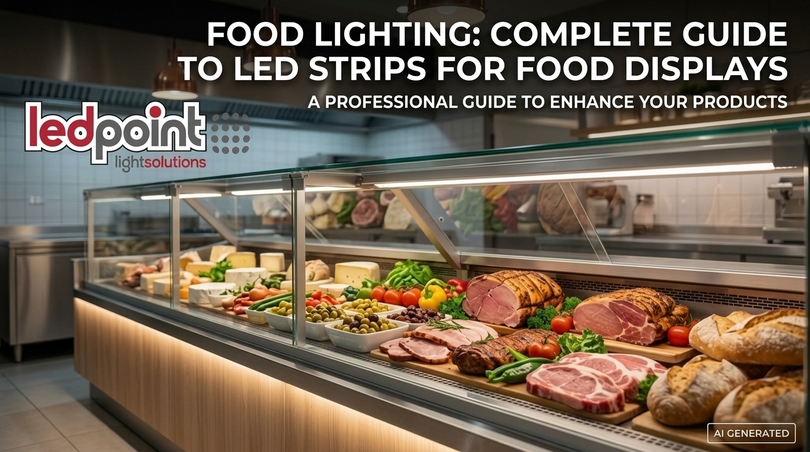
Food lighting: complete guide to LED strips for food counters
Food lighting is the set of light sources designed to display fresh food without altering its color, temperature, and preservation. It is based on LED strips with a dedicated spectrum (pink for meat, 3000K for bread and cheese, 4000K for fish and produce), high color rendering, absence of UV and infrared, aluminum profiles, and power supplies sized with a 20% margin.
Walk into a butcher shop and look at the counter: even before reading a price, you have already decided whether that meat looks fresh to you. Light speaks first. In the food trade, the eye buys before the wallet, and the wrong light can make a freshly cut steak look gray, a sea bass fillet caught at dawn look yellowish, or a crate of seasonal strawberries look dull.
This guide to food lighting stems from the technical experience of Ledpoint, a company in Faenza that has been designing and distributing professional LED strips, aluminum profiles, and power supplies for commercial setups for years. You will find the scientific explanation of why light damages food, the correct color temperatures for each product category, consumption and cost tables, installation rules in refrigerated and humid environments, and an interactive configurator that calculates the strip, profile, and power supply based on the length of your counter and the type of food displayed.
Whether you are a deli owner, a supermarket manager, an interior architect working on a store renovation, or a marketing manager looking for a way to enhance the product, here you will find an organized path: from theory to component selection, all the way to installation and maintenance.
1. What is food lighting and what is an LED counter
Before talking about watts and kelvins, it is worth clarifying what we mean by food lighting. When we talk about food lighting, we do not simply mean "putting a light over the food", but designing a lighting system that meets three objectives simultaneously: making the product appear in its natural color (or its "best" color), not damaging it during display hours, and consuming as little as possible in an environment that remains on 10–14 hours a day, often seven days a week.
Definition of food lighting
Food lighting, also called food lighting, is a specialized sector of commercial lighting technology. Its purpose is to enhance the appearance of displayed foods while keeping their quality intact, limiting the spectrum components that cause oxidation, discoloration, heating, and weight loss. For this reason, LED sources with spectra calibrated for the specific category are used: the so-called food LEDs.
Unlike the general lighting of a store, which must guarantee a uniform illuminance (lux)level to move safely, food lighting is accent lighting: it works at close range (often 10–40 cm from the product), inside refrigerated counters, display cases, risers, and shelves, where every degree of temperature and every nanometer of spectrum counts.
What is an LED counter
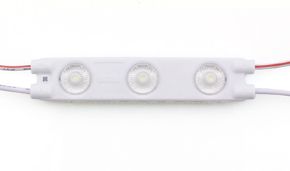
In the food sector, the term LED counter refers to a display counter (refrigerated or at room temperature) in which the lighting is created with LED strips integrated into the structure: under the canopy, along the edge of the basin, under the shelves, or inside recessed aluminum profiles. The LED counter replaces old fluorescent tubes and halogen lamps with thin lines of light that are cool to the touch and much more efficient.
Main components of an LED counter
Component
Function
What to choose on Ledpoint
LED strip
Light source: determines color, lumens, color rendering, consumption
In food retail, there are mainly five families of counters, each with different lighting needs:
Refrigerated served counter (butcher shop, deli, gastronomy, fish market): curved or straight front glass, light under the canopy and often under the glass.
Self-service refrigerated wall unit (dairy, packaged meats, 4th range produce): multiple overlapping shelves, one strip under each shelf.
Chest freezer (frozen foods, packaged ice cream): light on the edge or in the lid, temperatures down to −25 °C.
Hot or neutral display case (pastry shop, bakery, rotisserie): glass shelves, warm light, attention to additional heat.
Produce islands and displays: overhead light with LED bars or profiled strips, often in the presence of misters.
Distinctive features compared to other displays
Compared to a simple lighted display or a spotlight, a professional LED counter stands out for four characteristics: spectrum dedicated to the food, emission practically free of ultraviolet radiation and infrared towards the product, extremely compact size (Ledpoint strips are 8–12 mm wide and 1.5–6 mm high), and the possibility of custom cutting every 2.5–10 cm. This means that the light adapts to the counter, and not the other way around.
2. Data, statistics, and market: why light sells
Talking about food lighting means talking about margins, because food lighting affects sales, waste, and consumption. The fresh food department is the one with the highest added value for a food store, but also the one with the most perishable goods. Light affects three items on the income statement: sales, waste, and the electricity bill. Let's see to what extent, distinguishing between literature data and technical calculations that anyone can verify.
The weight of lighting on the consumption of a food store
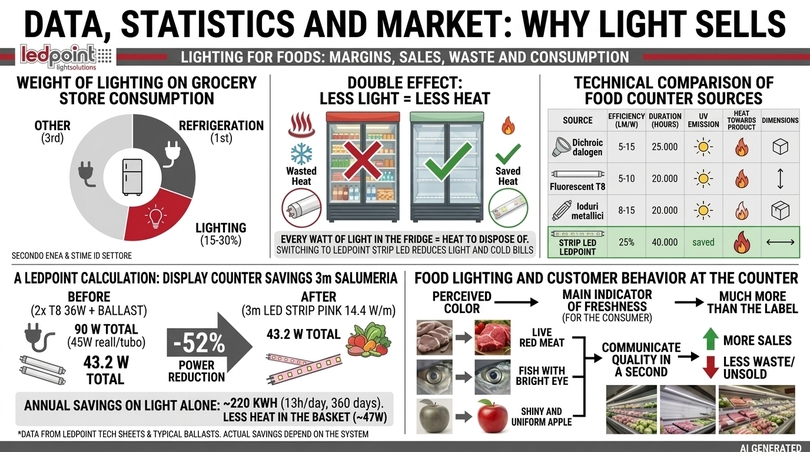
According to energy analyses published by efficiency agencies and bodies (in Italy ENEA), in supermarkets, refrigeration is the first item of electricity consumption, while lighting generally occupies the second or third position, with shares that industry estimates place between 15% and 30% of the total, depending on the age of the system. However, there is a lesser-known effect: every watt of light installed inside a refrigerated counter becomes heat that the compressor must dissipate. Switching from T8 fluorescent tubes to LED strips therefore reduces two bills into one: the electricity bill and the cooling bill.
Technical comparison between light sources for food counters
Source
Typical efficiency (lm/W)
Typical lifespan (hours)
UV emission
Heat towards the product
Size
Dichroic halogen
12–20
2,000–4,000
Present (if unfiltered)
Very high (IR)
Medium
T8 Fluorescent
60–90
10,000–20,000
Present
Medium
Large (Ø 26 mm)
Metal halide
70–100
9,000–15,000
Present
High
Large
Ledpoint LED strip
70–155
> 30,000 (in dissipating profile)
Negligible
Very low
8–12 mm
The efficiency values of the LED strips reported are those declared in the Ledpoint technical data sheets: they range from 70 lm/W of the pink strips for meat, which sacrifice a bit of efficiency to obtain the dedicated spectrum, to 155 lm/W of the 3000K warm white LED strip 240 led/m 14.4 W/m.
A Ledpoint calculation: how much heat is removed from the refrigerated counter
Let's take a 3-meter deli counter originally lit by two 36 W T8 fluorescent tubes with an electromagnetic ballast (about 45 W actual per tube, 90 W total). Replacing them with 3 meters of pink LED strip for meat counters 60 led/m 24V 14.4 W/m installs 43.2 W. The electrical power is reduced by about 52%, and about 47 W less heat enters the refrigerated basin every hour of operation. Over 13 hours a day for 360 days, this is about 220 kWh of light saved per year on a single counter, plus the energy that the refrigerator does not have to spend to remove that heat.
Methodological note: the calculation uses the nameplate data from Ledpoint technical data sheets and typical values for electromagnetic ballasts; the actual savings depend on the existing system.
Food lighting and customer behavior at the counter
Research in sensory marketing and neuromarketing applied to retail agree on one point: perceived color is the main indicator of freshness used by the consumer, much more than the label. Vivid red meat, fish with bright eyes and silvery skin, a shiny and uniform apple communicate quality in a fraction of a second. A light with poor color rendering or the wrong color temperature instead communicates "old product", even when it is not. The result is twofold: fewer sales and more unsold goods to discount or dispose of.
3. Why light damages food
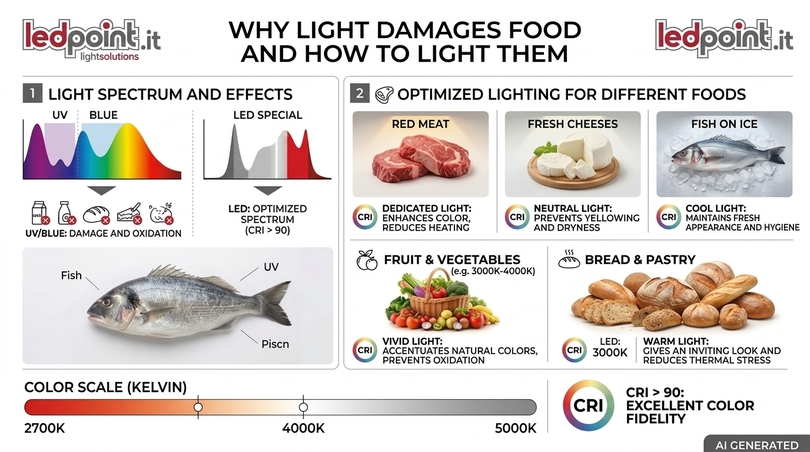
Light is not just what we see: it is energy. When it hits a food item, part of it is reflected (and that is what reaches our eyes), and part is absorbed and transformed into chemical reactions or heat. This is why poorly designed food lighting can shorten the commercial life of the product by several hours. Understanding the mechanisms helps in choosing the right light sources.
Photo-oxidation
Photo-oxidation is the process by which light, in the presence of oxygen, initiates oxidation reactions of fats, pigments, and vitamins. The most energetic wavelengths (ultraviolet and blue-violet, below 450 nm) are the most aggressive. In dairy products, for example, riboflavin (vitamin B2) acts as a photosensitizer: it absorbs light and triggers lipid oxidation, generating the characteristic "old taste" of milk and fresh cheeses. In cured meats and aged cheeses, photo-oxidation accelerates the rancidityof fats.
Meat discoloration
The color of red meat depends on myoglobin. When bound to oxygen (oxymyoglobin), the meat appears bright red; when it oxidizes to metmyoglobin, it turns brownish-gray. Light, especially the UV and blue components, and heat accelerate the formation of metmyoglobin: this is why a steak under a halogen lamp "ages" before the customer's eyes. In cured and cooked meats, the pigment is different (nitrosomyoglobin), but it is also photosensitive and tends to fade to grayish-pink.
Heat and dehydration
Halogen and metal halide lamps emit a significant amount of infrared. On the product, this means an increase in surface temperature, water loss, weight loss (which is also an economic loss, as it is sold by weight), cheeses that "sweat", chocolate that blooms, icings that melt, and vegetables that wilt. LED strips do not emit infrared in the light beam: the heat they produce is generated on the rear printed circuit board and is dissipated by the aluminum profile, away from the food.
Chlorophyll and produce
Fruits and vegetables are living organisms even after harvest. Light can stimulate chlorophyll (with the greening of potatoes, for example, linked to the formation of solanine) or accelerate the ripening and yellowing of leaves. Proper produce lighting uses adequate intensity, no UV, and controlled on-times.
Light damage and food lighting: table by category
Food
Main damage
Responsible component
LED solution
Fresh red meat
Browning (metmyoglobin)
UV, blue, heat
Pink meat strips, low temperature, no UV
Cured meats
Fading, rancidity
UV, blue
Pink or 3000K strips, moderate intensity
Milk, dairy, fresh cheeses
Light taste, oxidation
Blue-violet (riboflavin)
3000-3500K, no UV, nighttime dimming
Aged cheeses
Sweating, yellowing
Heat, UV
3000K, strip in dissipating profile
Fish
Loss of brightness, fat oxidation
Heat, UV
4000-5000K, IP65/IP67 in closed profile
Produce
Wilting, greening
Heat, excessive intensity
3000-4000K high CRI
Bread and pastry
Dehydration, icing melting
Infrared
2700-3000K, low-power strip
Chocolate and ice cream
Blooming, melting
Heat
Low-power COB, 3000-4000K
LED is not automatically harmless: even an LED strip, if too powerful, mounted without a profile or with a blue-rich spectrum, can contribute to photo-oxidation. It is the design of the system, not just the technology, that makes the difference.
4. Colors, color temperature, and spectrum suitable for food
What are the colors associated with food? And which light colors are suitable for each food? These are two different and often confused questions. The first concerns color psychology in food marketing; the second concerns the physics of light. Effective food lighting must take both into account, starting from three technical parameters: color temperature, color rendering, and spectral distribution.
Colors associated with food in consumer perception
In food marketing, some colors are almost universally associated with specific sensations. Red stimulates appetite and communicates energy and flavor, yellow and orange evoke warmth, oven, and sweetness, green recalls freshness and naturalness, white suggests cleanliness and hygiene, golden brown tells of cooking and crispiness. Blue, on the other hand, is rare in natural food and tends to reduce appetite: for this reason, it is used with great caution on counters, except in fish markets, where a slightly cool light recalls ice and the sea.
The color rendering index (CRI or Ra) indicates how faithfully a source reproduces colors compared to a reference source, on a scale up to 100. For food display, the minimum recommended CRI is 80, but for produce, fish markets, and pastry shops, a CRI above 90 makes a visible difference. Ledpoint has dedicated an in-depth article to this topic: Discovering CRI. An important detail: the general CRI (Ra) is the average of eight pastel colors, while saturated red (R9 index), decisive for meats, tomatoes, and red fruits, is not included in the average.
Special spectra for food
Strips for food lighting are not simple white LEDs: they use phosphors that shift the emission towards the wavelengths that the product reflects best. Pink light for meat counters, for example, enriches the red component of the spectrum by enhancing the color of myoglobin, while reducing the components that would make the fat yellowish. The result is redder meat and whiter fat, without having to increase the lumens.
Ledpoint offers a dedicated line of food LED strips with three pink models for meat counters:
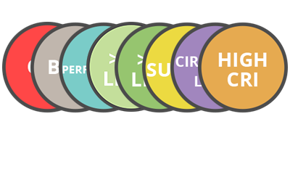
For other foods, high-quality white strips with the correct color temperature and a high color rendering index are used, such as the Sunled line, designed to reproduce a spectrum close to that of sunlight.
Summary table of food lighting: light color for each category
Category
Recommended light
Minimum CRI
Effect achieved
To avoid
Red meats, butcher shop
Dedicated pink (meat spectrum)
80
Vivid red, white fat
Cold light > 5000K
Cured meats, deli
Dedicated pink or 3000K
80
Pink slice, pure white fat
Greenish light
Poultry, white meats
3000-3500K
80
Natural golden skin
Intense pink light (artificial effect)
Fish, seafood
4000-5000K
90
Silvery skin, bright ice
Warm light < 3000K ("old" fish)
Cheeses, dairy
3000-3500K
80-90
Straw-colored paste, warm rind
Cold light, UV
Produce
3000-4000K
90
Saturated and natural colors
Low CRI
Bread, pastry, cakes
2700-3000K
80-90
Golden crust, "freshly baked" appearance
Cold light, heat
Ice cream
3000-4000K
90
Faithful pastel colors
Warm sources (heat)
Gastronomy, ready meals
3000K
90
Homemade and appetizing appearance
Cold light
Jams, pantry, wines
2700-3000K
80
Shiny glass, deep colors
UV (degrades labels and product)
An important ethical rule: light must enhance, not deceive. Various European national regulations and industry guidelines advise against using lights that misleadingly alter the real color of foods, particularly meat. Dedicated Ledpoint strips work by enhancing natural colors, not by creating colors that the product does not have. A good practice is to ensure that the customer, when taking the product under the general store lighting, finds it consistent with what was seen at the counter.
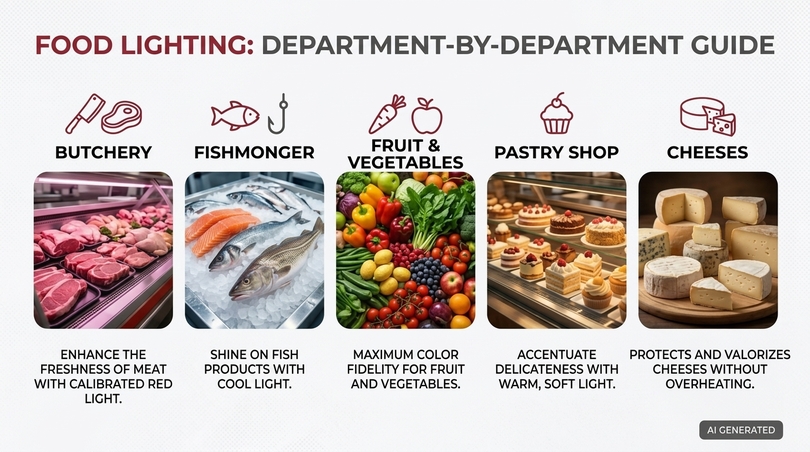
5. Food lighting: department-by-department guide
Each department has its own light, and food lighting must be thought of department by department. In this section, we analyze the main product categories one by one, with practical indications on color temperature, intensity, positioning, and recommended Ledpoint products. If you are in a hurry, you can go directly to the configurator; if you want to understand the reasons behind the choices, keep reading.
Food lighting in a butcher shop: how to light the counter, lights for butcher counters, and LED strips for meat counters
How can I light my butcher shop? This is the question we are asked most often, and the answer starts with the counter. In a butcher shop, the food lighting of the counter is the main sales tool: it must highlight the red of fresh meat, keep the fat white, and not heat the surface.
The meat counter
For the served counter, the reference solution is a pink LED strip for meat counters, mounted in an angular profile under the canopy so as to point the light at 45° towards the bottom of the basin. For deep counters or those with very intense ambient lighting, the pink strip 120 led/m 24 W/m at 1320 lm/m is chosen; for standard or small counters, the pink strip 60 led/m 14.4 W/m, which dissipates less heat, is sufficient.
The cold room and back counter
In the cold room and processing areas, the priority becomes visibility for operators and hygiene: 4000K white strips in a closed profile with a diffuser are used, which are easily washable. Above the work block, neutral and uniform light is needed to properly evaluate the cut.
The LED ceiling light for butcher shops
For the general lighting of the premises, many butchers look for an LED ceiling light for butcher shops. A valid, more flexible and customizable alternative is to create continuous lines of light with LED strips in suspended or ceiling profiles, such as the 44x12 mm aluminum profile for plasterboard or profiles with suspension cables. In this case, neutral light (3500–4000K) is used, and the task of "coloring" the product is left to the counter.
Deli lighting and cured meat lighting
Deli lighting has similar needs to butcher shops, but with some important differences. Sliced cured meat must show the difference between lean and fat (think of a raw ham, a mortadella, a coppa), and the product remains exposed for longer, often with the cut surface uncovered. For cured meats, the priority is not to accelerate oxidation: moderate intensities and strips without a UV component are preferred.
For the deli counter, the deli owner has two paths:
Dedicated pink light: ideal for raw hams, bresaola, salami, and coppa, where you want to enhance the red. The pink strip 60 led/m 24V is the most balanced choice.
3000K warm white light: ideal for mixed cured meat-cheese-gastronomy counters, where pink light would alter cheeses and vegetables. The 3000K warm white strip 120 led/m 14.4 W/m with 3-step MacAdam color tolerance is recommended.
On hams hanging or displayed vertically on the back counter, a grazing line of light from above works well, with a 16 mm angular profile, which highlights the texture of the rind.
Fish lighting: the fish market
Fish is sold with the eyes: bright eye, red gills, shiny skin, pure white ice. Fish lighting, the most technical form of food lighting, requires neutral or slightly cool light (4000-5000K) with very high color rendering, which renders the silvery effect of the scales and the transparency of raw flesh. A warm light, on the contrary, makes the fish appear yellowish and not fresh.
The fish market is also the most hostile environment for electronics: ice, meltwater, salinity, frequent washing. Here, the IP protection rating is fundamental: strips in a closed profile with a sealed diffuser, or strips with IP65/IP67 protection are used. An effective solution is the 4000K white strip 238 led/m 19.2 W/m at 2600 lm/m and 150 lm/W, inserted into a profile with a diffuser and end caps sealed with neutral silicone.
Dairy food lighting: cheese lighting and dairy lighting
Cheeses are among the foods most sensitive to light, as we saw when talking about riboflavin. In dairy food lighting, the ideal cheese lighting is warm (3000–3500K), without UV, and with contained intensity, because the straw color of the paste and the amber rind are enhanced by warm tones. For fresh cheeses and dairy products (mozzarella, ricotta, yogurt, butter), it is advisable to avoid lights that are too intense and, where possible, to dim or turn off the lights of self-service counters during closing hours.
Fresh produce lighting: light for fruit and light for vegetables
The produce department is often the first the customer encounters when entering the supermarket, and it "sets the tone" for the entire store. Fruit and vegetable lighting must render saturated and natural colors: a CRI above 90 and a temperature between 3000K and 4000K are needed. Warmer light enhances oranges, tomatoes, peppers, and red fruits; more neutral light enhances salads, aromatic herbs, and leafy vegetables.
Light for fruit: 3000-3500K, CRI>90, with attention to saturated red (R9) for strawberries, cherries, red apples.
Light for vegetables: 3500-4000K, CRI>90, to render bright greens without shifting to yellow.
Mixed islands: 3500K as a compromise, or CCT strips with variable temperature to adjust the hue based on the season and the goods displayed.
In displays with misters, the strip must be protected: closed profile, diffuser, sealed end caps, or IP67 silicone strips such as the 2700K IP67 solid silicone strip 120 led/m 12 W/m, suitable where a very warm and golden light is desired, for example on citrus fruits, dried fruit, and wooden crates.
Sweet food lighting: pastry lighting, sweet lighting, and cake lighting
In the pastry display case, the light must tell the story of the oven, the cream, the butter. Pastry lighting works with warm temperatures (2700–3000K) and low-power strips per meter, because icings, chocolate, and whipped creams suffer even a few extra degrees. Cakes, with their shiny surfaces, require diffused light to avoid pinpoint reflections: here, COB strips, free of the dotted effect, give the best results.
In food lighting, the ice cream display case is a special case: storage temperatures around −12/−14 °C, fogging glasses, pastel colors that must be recognizable from a distance (pistachio, hazelnut, strawberry, fior di latte). For ice cream lighting, low-power COB strips with CRI>90 and a temperature of 3000-4000K are recommended, in order to faithfully render the colors without adding heat to the tubs. The COB strip 4000K CRI>90 4.8 W/m with current control offers 480 lm/m with an efficiency of 106 lm/W and a perfectly uniform line of light.
Gastronomy lighting
Lasagna, roasts, grilled vegetables, seafood salads: gastronomy mixes very different colors and textures. The ideal light is a 3000K warm white with high color rendering, which gives a "homemade" and appetizing appearance. If the gastronomy counter is contiguous with the cured meat counter, it is advisable to uniform the color temperature to avoid the "leopard spot" effect along the counter.
Jam, pantry, and packaged product lighting
Even for shelves of jams, honey, preserved foods, wines, and typical glass products, light serves to make the container shine and the labels readable. A 2700–3000K strip under each shelf, in a profile with a diffuser, creates the typical "shop" effect of quality gastronomies. Beware of sources with UV, which over time fade labels and alter oil and wine.
Poultry and white meats
White meats do not benefit from pink light, which would make them appear unnatural. A 3000-3500K with good color rendering is used, which makes the skin slightly golden. In mixed red-white meat counters, the counter can be divided into two zones with different strips, powered by the same 24V power supply if the voltage matches.
6. Ledpoint configurator: strip, profile, and power supply for your food counter
We have transformed the rules of this guide into a practical tool. Enter the type of food, the length of the counter, the number of light lines, the mounting type, and the environment: the configurator will indicate the correct LED strip for color, lumens, and spectrum, the suitable aluminum profile, the power supply wattage with a 20% safety margin, and the number of power points. The results are a project basis: for complex systems, the Ledpoint technical team is available for a free verification.
Food lighting configurator
Select your counter data: we calculate the strip, profile, and power supply.
7. Components of food lighting, materials, and technologies: SMD, COB, profiles, power supplies, controllers
A food lighting system is only as reliable as its weakest component. An excellent strip mounted without dissipation, or powered by an undersized power supply, will last a fraction of its theoretical lifespan. In this section, we examine materials and technologies, also answering frequent questions like "how many types of LEDs are there?", "which is the brightest LED?", and "which is the best LED?".
How many types of LEDs are there
In the world of strips, LEDsare distinguished mainly by the chip format and mounting technology. The main ones are:
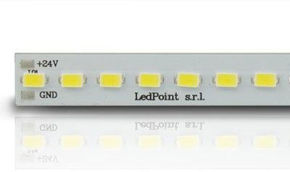
SMD LEDs (Surface Mount Device): chips soldered on the surface of the circuit. The name indicates the dimensions in tenths of a millimeter: 2835 LED strips (2.8 × 3.5 mm, the most widespread professional standard), 2216, 3535, 4040, and others.
COB LEDs (Chip On Board): hundreds of micro-chips per meter covered by a continuous layer of phosphors. The result is a dotted-free line of light with diffusion up to 180°. See COB LED strips.
Side-view LEDs: emit laterally, useful for thin backlights. See 335 side LED strips.
Colored and RGB/RGBW LEDs: for scenic effects, signs, and scenes, not for direct food display.
Which is the brightest LED and which is the best LED
The "brightest LED" is not necessarily the best for food. For food lighting, the quality of light matters more than the quantity: a 2600 lm/m strip with mediocre color rendering may sell less than a 1400 lm/m strip with the right spectrum. To evaluate correctly, four numbers are needed:
> 100 lm/W for white strips; 70–75 lm/W for special spectra
CRI / Ra
Color fidelity
> 80, better > 90
Color tolerance (MacAdam steps)
Color uniformity among LEDs
3 steps or less
Among Ledpoint white strips, the brightest mentioned in this guide are the 4000K 238 led/m (2600 lm/m) and the 3000K 240 led/m (2000 lm/m, 155 lm/W), the latter also among the most efficient. For those seeking absolute maximum light, there is the category of LED strips over 24 W/m, which, however, must be carefully evaluated inside refrigerated counters due to the heat produced.
Color tolerance and MacAdam steps
On a 6-meter counter made of multiple sections, a difference in hue between one section and another immediately catches the eye. Tolerance is expressed in steps of the MacAdam ellipse: 3 steps means that color differences are barely perceptible, a minimum condition for professional display. Ledpoint explains this in the in-depth article MacAdam Steps and CCT.
The printed circuit board and current control
LED strips are built on a flexible copper PCB with 3M double-sided tape on the back (the mentioned Ledpoint strips use 3M 9495LE). The thickness of the copper and the presence of constant current control determine uniformity and lifespan: in strips with regulation chips, such as constant current COBs, brightness remains stable even with small voltage variations, and the first meter is not brighter than the last.
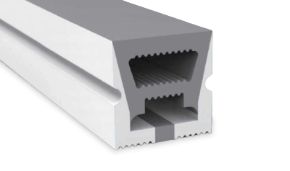
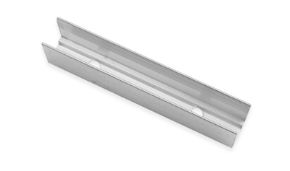
Aluminum profiles: dissipation, hygiene, optics
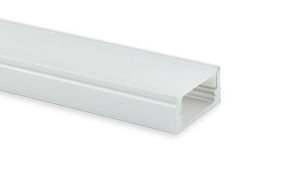
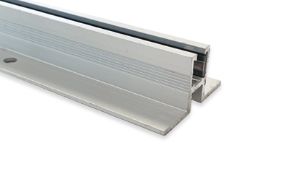
The profile is not an aesthetic accessory. Aluminum acts as a heat sink: it lowers the junction temperature of the LEDs and extends their life. Furthermore, it protects the strip from impacts during counter restocking, creates a smooth and washable surface (an important requirement in HACCP self-control plans), and, through the diffuser, controls glare.
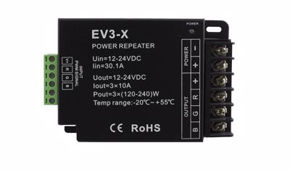
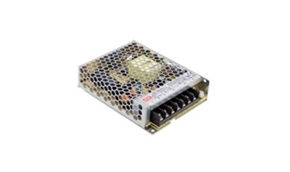
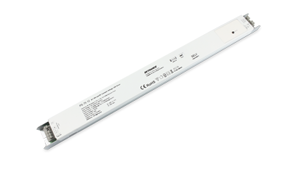
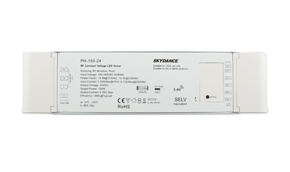
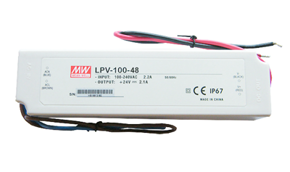
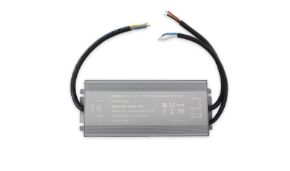
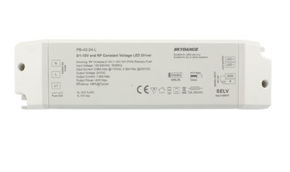
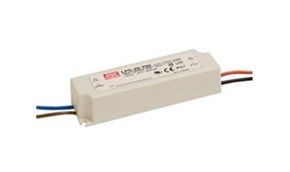
Strips operate on low DC voltage (12V, 24V, or 48V). The LED power supply transforms mains voltage into stabilized voltage. In food counters, 24V LED strips are preferable: for the same power, they draw half the current compared to 12V and suffer less voltage drop along the counter. For very long installations, 48V LED strips are available.
How to power an LED strip correctly
The basic rule for connecting an LED strip to a power supply is simple: the power supply's wattage must exceed the total wattage of the connected strips by at least 20%, and the power supply voltage must exactly match that of the strip. Example: 4 meters of pink strip 24 W/m = 96 W; with a 20% margin, 115 W are needed, so a 150 W 24V power supply. The power supply amperage (maximum deliverable current) is obtained by dividing the power by the voltage: 150 W / 24 V = 6.25 A.
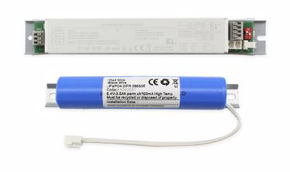
Ledpoint offers power supplies for DIN rail, slim furniture, and IP67 waterproof for humid environments, as well as smart power supplies with integrated dimming and anti-flicker drivers, useful when the store is photographed or filmed with a smartphone for social media: a flicker invisible to the eye can create dark bands in videos.
Control systems
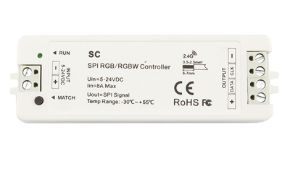
Lighting control allows for energy savings and product protection. The most used solutions in food retail are:
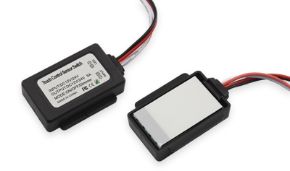
Wireless and remote control: with ZigBee devices, scenes and schedules are managed from a smartphone or via home automation systems, even remotely.
8. How to choose and size an LED counter
At this point, we know the theory and the components. Now we need a method: how do we go from "I have a 3.5-meter cheese counter" to a correct bill of materials? This section proposes a six-step procedure, valid for both the shop owner and the architect or installer, with real calculation examples.
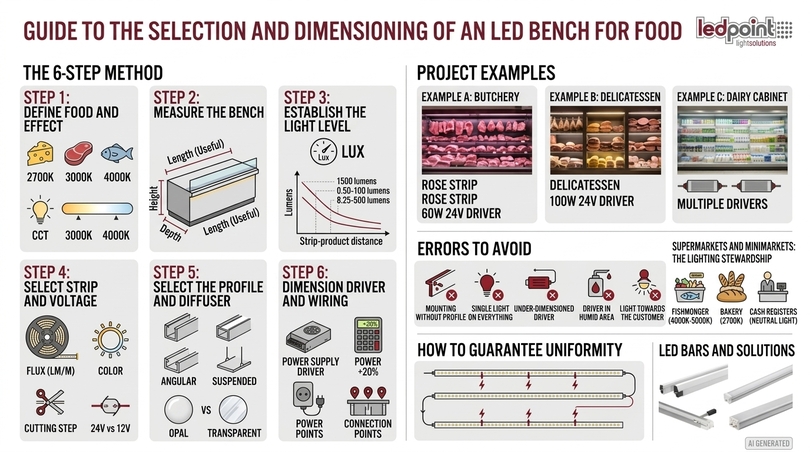
Designing food lighting: the six-step method
Step 1 – Define the food and the desired effect
In food lighting, you always start from the product, not the lamp. The table in chapter 4 indicates color temperature and CRI for each category. If multiple foods coexist in the counter, choose the light for the most "sensitive" food or divide the counter into zones.
Step 2 – Measure the counter
You need the useful length (the section actually to be lit, excluding shoulders and ends), basin depth, distance between the strip mounting point and the product, and the number of shelves.
Step 3 – Establish the light level
The UNI EN 12464-1standard sets the illuminance requirements for indoor workplaces, including sales areas and checkouts. For accent lighting on counters, professional practice provides for levels significantly higher than the general room light, typically 2 to 5 times, because the product must "stand out" from the environment. To estimate the lux on the display surface, you can use the Ledpoint guide How to calculate the lux of an LED installation.
Once color and flux are chosen, the strip is selected. 24V is preferred for counters over 2–3 meters. The cut step is verified: a strip with a cut every 5 cm adapts better to "odd" measurements than one with a cut every 10 cm.
Step 5 – Choose the profile and diffuser
The profile depends on the mounting (angular, surface-mounted, recessed, suspended) and the environment (dry or humid). The opal diffuser gives soft and uniform light, the transparent one maximizes the flux.
Step 6 – Size the power supply and wiring
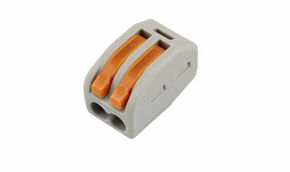
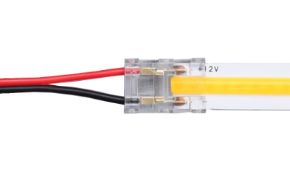
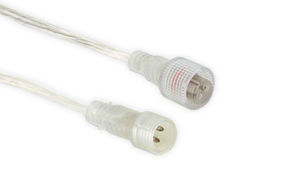
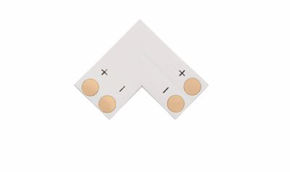
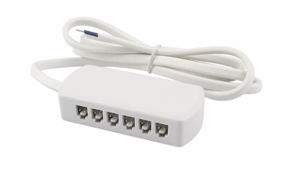
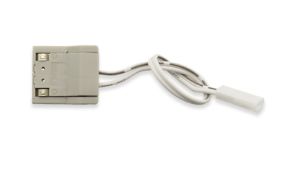
Total power + 20%, correct voltage, number of power points depending on the length of the runs, cable section adequate to the distance between the power supply and the strip. For wiring, cables, PCB connectors, and multiple quick connectors are available on Ledpoint.
Three food lighting project examples
Example A – Neighborhood butcher shop, 3 m served counter
43.2 W → with margin 51.8 W → 60 W 24V power supply
Profile
Angular 16 mm, 2 bars of 2 m (cut to size)
Total flux
2,910 lm
Annual consumption (13 h × 360 days)
about 202 kWh
Example B – Deli-gastronomy, 5 m counter with two zones
Cured meat zone (3 m)
Pink 60 led/m 24V → 43.2 W
Cheese and gastronomy zone (2 m)
3000K 120 led/m 24V → 28.8 W
Total
72 W → with margin 86.4 W → single 100 W 24V power supply (same voltage)
Control
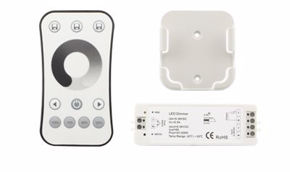
Monochromatic dimmer to reduce light after peak hours
Example C – Self-service dairy wall unit 6 m, 5 shelves
Strip
3000K 120 led/m 24V 14.4 W/m – 30 m (6 rolls)
Power
432 W → with margin 518 W → two 320 W power supplies or three 200 W, dividing the shelves
Profile
17x8 mm with diffuser, 15 bars of 2 m
Power supply
Each 6 m shelf powered from both sides or in the center
Control
Presence sensor or timer to dim at closing
How to ensure uniform lighting
Architects often ask us: how do you avoid the "spotty" effect? There are four rules. Use strips with 3-step color tolerance from the same batch; choose high-density strips (120–240 led/m) or COB when the strip is close to the product or visible; use opal diffusers; power long runs from multiple points to avoid voltage drop that makes the last meter less bright.
Mistakes to avoid
Mounting the strip directly on the counter sheet metal without a profile: the double-sided tape gives way with humidity and the LEDs overheat.
Using pink light on everything: cheeses, fish, and white meats appear unnatural.
Undersizing the power supply: it works for the first few months, then it fails or causes flickering.
Putting the power supply inside the refrigerated basin: condensation and washing damage it; it must be installed in a dry and ventilated area.
Pointing the light towards the customer: glare and reflections on the glass. The strip must "look at" the product.
9. Supermarket and minimarket lighting
When moving from a single counter to the entire store, food lighting becomes a directing project. Supermarket lighting must guide the customer along a path, highlight the highest-margin departments, make prices and offers readable, and, at the same time, contain the energy costs of a system that is on for many hours a day. The same rules apply, on a smaller scale, to the LED lighting of minimarkets and department stores.
How many types of lighting exist in a store
In lighting technology, three levels are distinguished, which coexist in a supermarket:
Type of lighting
Purpose
Typical LED solutions
General (or ambient)
Uniform visibility, safety, orientation
Continuous lines in profile, panels, ceiling LED bars
Accent
Enhance products and departments
Food strips in counters, under-shelf strips, track spotlights
Checkouts: neutral and comfortable light for operators, without glare on monitors.
LED bars for display cases and shelves
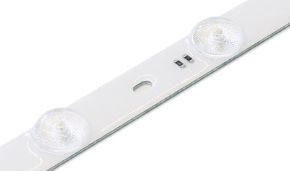
For display cases, shelves, and risers, LED display bars are a valid alternative to loose strips: they come already assembled with strip, profile, and diffuser. Ledpoint offers LED bars and backlighting LED bars, as well as ready-to-use profile and accessory kits. For modular shelves with repositionable shelves, electrified furniture tracks are convenient, which bring power to the shelves without visible cables.
How to use light to promote special offers
The supermarket manager often asks us how to use LED counters to promote offers. The principle is contrast: the eye goes where there is more light. A gondola endcap lit to a higher level than the aisles, a line of colored light with Neon Flex around the promotional area, a "product of the month" island with a warm accent are simple and effective tools. With RGBW or CCT strips, you can change color or hue depending on the campaign (Christmas, summer, local product week) without modifying the system.
A useful clarification: in common language, "LED counter" can also indicate digital screens (LED walls, monitors, displays) used to show content and offers. Ledpoint does not produce video screens, but provides the lighting that makes products and setups visible: the two systems work well together, provided that the counter light does not generate reflections on the screens.
Remote control and centralized management
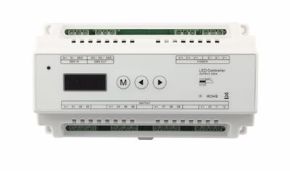
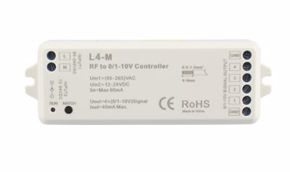
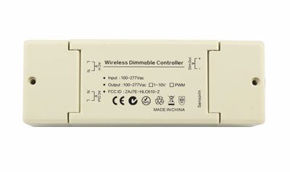
In larger stores, lighting is managed by zones: opening, peak hours, cleaning, closing. With DALI decoders, 0/1-10V controllers, or ZigBee devices, it is possible to program scenes, monitor on-times, and adjust intensity remotely. Dimming the counters by 30-40% during low-traffic hours reduces consumption and light stress on sensitive products, such as dairy.
LED lighting for minimarkets and neighborhood stores
In a minimarket, the budget is tighter, spaces are narrow, and the owner often installs (or has installed) in multiple phases. The recommended strategy is to start with the fresh food counters, where the return on sales is immediate, and then move to general lighting. An LED lighting system for minimarkets based on profiled strips is modular: it can be extended with other sections of the same code while maintaining the identical hue.
Lighting for the food industry and laboratories
Butcher, pastry, dairy, and processing company laboratories have different needs than the point of sale: priority to visibility, hygiene, resistance to washing, and thermal shocks. The LED lamp for the food industry must have an adequate protection rating, smooth surfaces, no breakable glass parts above production lines, and neutral light (4000K) with good CRI for visual quality control. IP67 silicone strips or closed profiles are suitable for under-cabinet and workstations, while for general lighting of large environments, bars and floodlights are considered.
10. Step-by-step installation and maintenance
Installing an LED counter simply and safely is possible, provided you follow a precise order and entrust the mains connection part to a qualified electrician. This section describes the typical procedure for a retrofit on an existing counter, designed to be executed in a few hours with the store closed, without interrupting business.
Before starting: technical requirements
Counter turned off and disconnected from the mains, basin clean and dry.
Mounting surface degreased with isopropyl alcohol.
Surface temperature between 21 and 38 °C at the time of gluing, as indicated in the Ledpoint data sheets: the double-sided tape reaches full adhesion after about 72 hours. In refrigerated counters, the strip is glued into the profile at room temperature, and only then is the profile fixed in the counter.
Tools: utility knife or scissors, soldering iron or connectors, tester, neutral silicone for humid environments. On Ledpoint you will find tools and solder joints.
The installation procedure
1. Remove the old lighting
Dismantle fluorescent tubes, ballasts, and lamp holders. Recover the existing cable passage, which is often reused for the new low-voltage line.
2. Cut profiles and strips to size
Cut the profile to the length of the counter. Cut the strip exclusively at the indicated cut points (every 2.5, 3.33, 5, or 10 cm depending on the model).
3. Glue the strip into the profile
Progressively remove the double-sided tape film and press the strip along the entire bottom of the profile, without bending it on the short side.
4. Connect the cables
Solder or connect the power cables with connectors, respecting polarity (+/−). Insert the diffuser and close with end caps; in humid environments, seal with neutral silicone.
5. Fix the profile in the counter
Fix the profile with mounting clips or stainless steel screws, orienting the light towards the product.
6. Install the power supply
Position it in a dry and ventilated area, away from compressors and drains. The 230V mains connection must be performed by qualified personnel, in compliance with the rules of the art.
7. Testing
Turn on, verify color and brightness uniformity, measure the voltage at the end of the strip (it must not drop too much compared to the nominal value), check that there are no annoying reflections on the glass from the customer's point of view.
IP protection ratings: which to choose
The IP codeindicates protection against dust and water. The first digit concerns solids, the second liquids.
IP rating
Protection
Use in food retail
IP20
No water protection
Dry display cases, always in closed profile in counters
IP54
Water splashes
Dry refrigerated counters with occasional condensation
IP65
Water jets
Counters with washing, produce with misters
IP67
Temporary immersion
Fish markets, cold rooms, laboratories with intensive washing
Maintenance and lifespan
An LED food lighting system requires very little maintenance, but not zero. Periodic cleaning of the diffuser is the most important intervention: grease, dust, and limescale can reduce the outgoing light by 20–30% without anyone noticing. Use a soft cloth with neutral detergent, avoiding solvents that cloud the polycarbonate. Once a year, it is advisable to check the tightness of the power supply terminals and the integrity of the seals.
Maintenance costs
Compared to fluorescents, which required periodic replacement of tubes and starters, the LED counter has very low maintenance costs: the component that most often requires attention after many years is the power supply, which is easily replaceable without touching the strips and profiles.
11. Costs, consumption, lifespan, and incentives
How much does it cost me and how much does it consume are the questions that close every negotiation. In this section, we answer with verifiable numbers, distinguishing between what depends on technical data (consumption, lifespan) and what varies based on the project and the market (prices). For energy, we assume a calculation hypothesis of 0.25 €/kWh for a commercial user: replace the value with that of your bill to obtain the real data.
How much does a 10-meter LED strip consume
The consumption of a strip is calculated by multiplying the power per meter by the length. A 10-meter LED strip at 14.4 W/m absorbs 144 W; at 24 W/m it absorbs 240; a 4.8 W/m COB only 48.
Strip (10 m)
Power
Consumption in 13 h/day for 360 days
Annual cost (0.25 €/kWh)
Consumption always on 24/7
Annual cost 24/7
COB 3000K 2.4 W/m
24 W
112 kWh
28 €
210 kWh
53 €
COB 4000K 4.8 W/m
48 W
225 kWh
56 €
420 kWh
105 €
Pink meat / 3000K 14.4 W/m
144 W
674 kWh
168 €
1,261 kWh
315 €
4000K 19.2 W/m
192 W
899 kWh
225 €
1,682 kWh
420 €
Pink meat 24 W/m
240 W
1,123 kWh
281 €
2,102 kWh
526 €
How much does an LED consume on all day
A single 1 W LED on 24 hours a day consumes 24 Wh per day, i.e., about 8.8 kWh per year: just over 2 euros with the hypotheses of this guide. How much an always-on LED costs therefore depends almost entirely on its power: for a 10 W LED bulb always on, you spend about 22 euros a year, compared to over 200 for a 100 W incandescent lamp.
What 100 W in LED is equivalent to
A 100 W incandescent lamp emits about 1,300-1,500 lumens. With an efficiency of 100–150 lm/W, the same light is obtained with 10–15 W of LED. In terms of strips, 1,400 lm correspond to about one meter of the 3000K 120 led/m strip (1,410 lm/m, 14.4 W) or 70 cm of the 3000K 240 led/m strip (2,000 lm/m).
How long does an LED last
The lifespan of an LED is not measured by "it burns out / it doesn't burn out", but by the loss of flux over time. The L70 value indicates after how many hours the LED emits 70% of its initial light. For quality strips mounted in a dissipating profile, values above 30,000 hours are typically considered; some Ledpoint strips comply with the LM-80 measurement standard, which documents the flux decay of the chips.
Lifespan (L70)
Years with 13 h/day, 360 days
Years always on 24/7
30,000 h
about 6.4 years
about 3.4 years
50,000 h
about 10.7 years
about 5.7 years
How many years does an LED last? It depends mainly on the temperature: the same strip mounted without a profile in a warm environment can lose light much faster. This is why the profile and correct power supply are not a cost, but an insurance on lifespan.
How much does a food lighting system cost
The price of an LED counter, and more generally of food lighting, depends on five factors: total length, type of strip (special spectrum, high density, COB, IP), profile and diffuser, power supplies and controls, labor. The updated prices of individual components can be consulted directly on the Ledpoint product data sheets; below is an indicative breakdown of the items to get oriented.
Cost item
Indicative incidence on material
Factors that vary the price
LED strip
35–50%
Dedicated spectrum, LED/m density, CRI, color tolerance, IP
Profiles and diffusers
25–35%
Section, finish (anodized, painted), opal or transparent diffuser
Power supplies
10–20%
Power, IP, dimmability, control protocol
Controls and accessories
5–15%
Dimmers, sensors, DALI, ZigBee, connectors, end caps
How much does LED per meter cost
In the professional market, a quality LED strip indicatively costs from a few euros to a few tens of euros per meter, depending on density, spectrum, and protection. Dedicated spectrum strips and high CRI strips have a higher cost per meter, but they directly impact counter sales. Ledpoint prices are indicated per 5-meter roll on the product data sheets.
How much does an LED bar cost
A pre-assembled LED bar costs more than the sum of strip and profile purchased separately, because it includes assembly, wiring, and testing. It is convenient when a few standard sizes are needed or specialized installers are not available. See Ledpoint LED bars and LED bars on offer.
How much does a 60x60 LED panel cost
60x60 LED panels for suspended ceilings are a widespread solution for general lighting and have highly variable prices based on efficiency, UGR (glare), and driver. In food retail, however, panels only serve the environment: the light that sells remains that of the counters.
How much does an LED sign cost
The cost of an LED sign depends on size, materials, processing, and installation at height, and can range from a few hundred to several thousand euros. For internal signs, lettering, and luminous logos, a flexible and economical solution is Neon Flex, which can be hand-shaped to reproduce the store's logo.
How much does a bar counter cost
The bar counter is a custom-made furnishing whose price depends on carpentry, refrigeration, and finishes, and must be requested from the furniture manufacturer. LED lighting accounts for a small share of the overall cost but a lot of the final effect: a line of light in the recessed profile under the top or in the refrigerated display case of brioches transforms a standard counter into a design element.
Return on investment
Let's take the example from chapter 2: a 3-meter counter that goes from 90 W (fluorescents with ballast) to 43.2 W (pink strip) saves about 219 kWh per year, i.e., about 55 euros with our hypotheses, to which is added the reduced work of the refrigeration unit and the absence of periodic tube replacements. In food lighting, however, the true return is measured on sales and the reduction of unsold goods: even a small increase in the average ticket of the fresh food department pays back the system in a short time.
What are the bonuses for LED lighting
Incentives for energy efficiency, also applicable to food lighting, change frequently. In recent years, companies have been able to access, depending on the periods and requirements, measures such as the Thermal Account managed by the GSE, tax credits, and incentives for investments in instrumental goods and energy efficiency provided by budget laws, in addition to building bonuses for real estate. Before purchasing, check with your accountant or an ESCo which measures are in force in 2026 and what documentation is needed (invoices with detailed description, technical data sheets, any ex-ante and ex-post energy diagnoses).
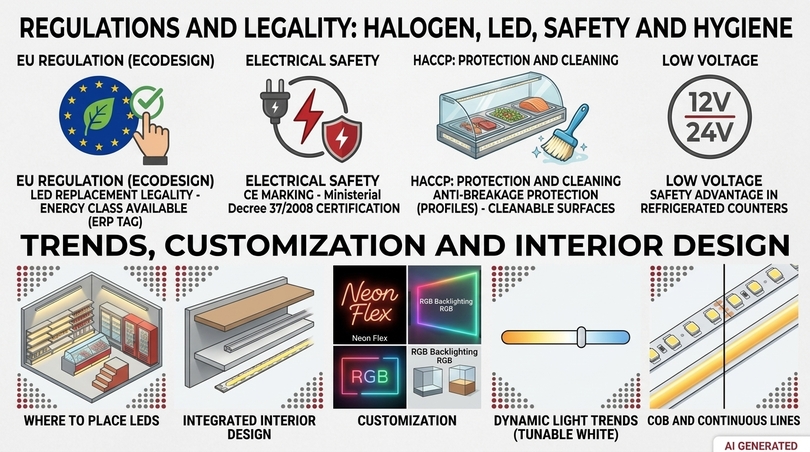
12. Regulations and legality: halogens, LEDs, safety, and hygiene
Anyone renovating a food store must navigate between European ecodesign regulations, system standards, and hygienic-sanitary requirements. You don't need to become an expert, but knowing the key points avoids costly errors and disputes during inspections.
Is it legal to replace halogen lamps with LEDs?
Yes. Replacing halogen or fluorescent lamps with LEDs is not only legal, but it is the direction indicated by European regulations. The Regulation (EU) 2019/2020 on the ecodesign of light sources has set efficiency requirements that have led to the market exit of most halogen lamps, and subsequent revisions of the RoHS directive exemptions have phased out most fluorescent lamps. Ledpoint strips report the energy class required by the regulation, consultable via the ErP tag.
Is it legal to install LED bulbs?
Certainly yes, provided the products are CE marked and comply with the safety standards applicable to lighting fixtures (IEC/EN 60598 family). Two cautions: verify compatibility with any existing transformers or dimmers and, in work environments and commercial activities, entrust modifications to the fixed electrical system to companies authorized under D.M. 37/2008, which issue the declaration of conformity.
Food and food lighting rules: hygiene and food safety
For food lighting, Regulation (EC) 852/2004 on the hygiene of foodstuffs requires that premises have adequate natural and/or artificial lighting. In the practice of HACCP self-control plans, shared criteria are added:
Shatter protection: sources above unpackaged foods must be protected, so that fragments cannot fall on the product. Aluminum profiles with a polycarbonate diffuser respond well to this requirement.
Cleanability: smooth surfaces, without interstices where dirt and moisture can accumulate.
Sufficient light for visual checks in processing areas.
Correct representation of the product: light must not mislead the consumer about the characteristics of the food.
Electrical safety in refrigerated counters
Safety extra-low voltage (12V or 24V DC) is an important advantage in food counters: it reduces electrical risk in humid environments and during cleaning. The 230V part must still be confined outside wet zones, with power supplies of adequate IP rating and upstream differential protections.
13. Trends, customization, and interior design
Food lighting in stores is undergoing a transformation: from a purely technical function to an integral part of the store concept. Interior architects, marketing managers, and restaurant entrepreneurs ask for solutions that tell the brand story, integrate into the furnishings, and adapt over time. Here are the most relevant trends and the customization possibilities offered by LED strips.
Where can LEDs be placed
Practically anywhere. Thanks to their small size and the possibility of cutting, strips can be inserted under shelves and cabinets, in the canopies of counters, on the edges of basins, in risers, on the steps of stepped counters, inside refrigerated display cases, in suspended ceilings, in shelving, in bar counters, and in vending machines (Ledpoint has a section dedicated to vending lighting). The only rule is that the LED always has a way to dissipate heat and a protection rating suitable for the environment. For commercial and exhibition setups, see also the exhibition lighting page.
Integrating the LED counter into an interior design project
For the architect, food lighting must disappear into the furnishing: the effect is seen, not the source. The most used solutions are:
Flush recessed profiles in wooden or laminated shelves, with an opal diffuser that creates a continuous line.
COB strips for shiny surfaces and display cases where even the reflection of a single LED would be visible.
White painted or anodized profiles coordinated with the finishes.
Ceiling light lines in plasterboard profiles that draw paths and recall the geometry of the counters.
How to customize an LED counter with your logo? The simplest way is to add a decorative element to the technical lighting of the counter: a Neon Flex logo on the front or back wall, a brand backlight with LED modules, an institutional color line under the counter with RGB strips. Golden rule: brand colors go on the furnishing, never on the food product, which must remain illuminated with the correct light for its category.
For the display of premium products (wines, chocolate, typical products), display boxes with integrated lighting create small jewel-like showcases.
2026 trends in food lighting
Dynamic light and tunable white
CCT strips, managed with CCT controllers, allow varying the color temperature: warmer in the evening in restaurants, more neutral in the morning in the produce department, adapted to the goods displayed in each season.
"Natural" light and continuous spectra
Interest is growing in sources with a continuous spectrum similar to sunlight, such as the Sunled line, and in lighting that respects the biological rhythms of those who work many hours in the store, such as the Circadian Light line.
Continuous lines without dots
COB strips are replacing SMDs in all applications where the strip is visible or very close to the product: pastry shops, ice cream parlors, cocktail bars, design display cases.
Intelligent control and data
Programmed scenes, presence sensors, integration with energy management systems: light becomes a managed variable, not a switch. Monitoring the consumption of the lighting system over time allows verifying savings and intervening promptly.
Sustainability
Reduction in consumption, lower thermal load on refrigeration, less food waste thanks to products that keep better and sell faster: food lighting is today also a sustainability lever, increasingly present in the ESG reports of large-scale distribution.
Catering: good visibility even with a lot of natural light
The catering entrepreneur often asks us how to keep display cases and counters visible in premises with large windows. Natural light reduces contrast: to compensate, strips with higher flux and the possibility of regulating them are needed, raising them during sunny hours and lowering them in the evening. Opal diffusers and profiles that shield the source prevent the reflection of the sun and that of the LED from adding up on the glass. In premises with many opening hours, the combination of dimmers and ambient light sensors optimizes consumption and visual performance.
Compatibility with other digital systems
For marketing managers who want to coordinate light, screens, and campaigns: DALI, 0/1-10V, and ZigBee protocols allow integrating lighting with building automation and time programming systems. In this way, the promotional counter light can turn on or change hue in sync with the ongoing campaign.
Frequently asked questions about food lighting
On food lighting, we have collected the questions that shop owners, architects, supermarket managers, and restaurateurs ask us most often. Click on each question to open the answer.
What is the best lighting for food?
There is no single light: the best food lighting is the one with the spectrum suitable for the category. Dedicated pink light for meats and cured meats, 3000K for cheeses, bread, and sweets, 4000K high CRI for fish and vegetables. Absence of UV, low heat, CRI above 80, and aluminum profiles are always required.
How to light a butcher shop?
The meat counter is lit with a dedicated pink LED strip mounted in an angular profile under the canopy, with light tilted at 45° towards the product. The environment is lit with neutral 3500–4000K light. The pink strip enhances the red of the meat and keeps the fat white without heating the surface.
Why does light damage food?
The most energetic wavelengths, ultraviolet and blue, initiate photo-oxidation of fats, pigments, and vitamins, while infrared heats and dehydrates. In meat, metmyoglobin is formed which makes it brown, in dairy products riboflavin generates the "light taste". Dedicated LED strips limit UV and infrared.
What color temperature to use for fruit and vegetables?
For produce, 3000–4000K with a color rendering index above 90 are used. Warmer light (3000–3500K) enhances red fruits, citrus, and tomatoes; more neutral light (3500–4000K) makes salads and leafy vegetables bright. CCT strips allow adjusting the hue based on the goods displayed.
How much does a 10-meter LED strip consume?
It depends on the power per meter: a 14.4 W/m strip consumes 144 W, a 24 W/m one 240 W, a 4.8 W/m COB only 48 W. On for 13 hours a day for 360 days, a 144 W strip consumes about 674 kWh a year, about 168 euros with energy at 0.25 €/kWh.
How many years does an LED last?
A quality LED strip mounted in an aluminum profile typically reaches over 30,000 hours before dropping to 70% of initial flux (L70). With 13 hours of use per day, that's over 6 years; with 50,000 hours, over 10 years. Excessive heat and inadequate power supplies reduce its lifespan.
How to size the power supply of an LED strip?
Multiply the power per meter by the installed meters and add at least a 20% margin. The power supply voltage must match that of the strip. Example: 4 meters of 24 W/m strip absorb 96 W, so a power supply of at least 115 W is needed: choose the 150 W 24V size.
Can LED strips be used inside refrigerated counters?
Yes, Ledpoint strips operate between −10 °C and +45 °C. They must be glued into the profile at room temperature, between 21 and 38 °C, and then installed in the counter. In the presence of condensation or washing, a closed profile with a diffuser and sealed end caps is used, and the power supply must be positioned outside the cold and humid zone.
Is it legal to replace halogen lamps with LEDs in stores?
Yes, and it is the direction indicated by Regulation (EU) 2019/2020 on ecodesign, which has phased out most halogens. Products must be CE marked, and modifications to the fixed electrical system of a commercial activity must be carried out by authorized companies according to D.M. 37/2008.
How much does an LED system for a food counter cost?
The cost depends on length, type of strip, profiles, power supplies, controls, and labor. Strips indicatively account for 35–50% of the material, profiles for 25–35%, power supplies for 10–20%. Energy savings, lower load on the refrigerator, and increased fresh food sales pay back the investment in a short time.
What is 100 W in LED equivalent to?
A 100 W incandescent lamp produces about 1,300–1,500 lumens. With 100–150 lm/W LEDs, the same light is obtained with 10–15 W. In terms of strips, about one meter of 3000K strip at 1,410 lm/m and 14.4 W/m is equivalent to a traditional 100 W bulb.
What lighting is needed for a supermarket?
A supermarket combines uniform general lighting (typically 4000K), accent lighting in counters with dedicated spectra for each department, and decorative lighting for the brand and promotions. DALI, 0/1-10V, or ZigBee controls allow managing time scenarios, dimming during low-traffic hours, and reducing consumption.
15. The right light sells the right product
Food lighting is a discipline where science, technology, and marketing meet. We have seen that light can damage food through photo-oxidation and heat, that each product category has its ideal color temperature, that the quality of light matters more than the quantity, and that profile and power supply are as important as the strip. A well-designed LED counter makes the product look fresh, preserves it better, consumes less, and lasts for years.
To recap: dedicated pink light for meats and cured meats, 3000K warm white for cheeses, gastronomy, bread, and sweets, 4000K neutral light with high CRI for fish and vegetables, low-power COB for ice cream and pastry; 24V strips in aluminum profile, power supply with a 20% margin, IP protection adequate for the environment, periodic cleaning of diffusers.
If you are designing a new store or renovating an existing counter, start with the configuratorand then explore the range of Ledpoint food LED strips. For custom projects, quotes for large-scale distribution, or technical doubts, the Ledpoint team in Faenza is available via the contacts page; complete catalogs with technical data sheets can be downloaded from the website.
This article was developed with the support of artificial intelligence and subsequently reviewed, corrected, and validated by the Ledpoint.it technical team, which guarantees its reliability and compliance with official sources.
Make your counter shine before the competition
Subscribe to the Ledpoint newsletter and receive technical guides on food lighting, ready-made configurations for butcher shops, delis, fish markets, pastry shops, and supermarkets, news on dedicated spectrum LED strips, case studies of renovated stores, and updates on regulations and incentives. Practical content, written by our technicians, to sell more, waste less, and save energy: the right light for your product arrives first in your inbox.