









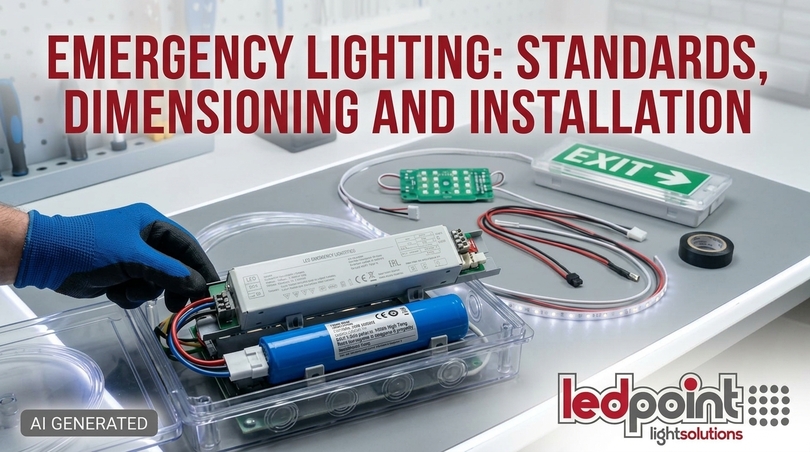
Ledpoint technical guide updated to October 2026 – UNI EN 1838:2025, CEI EN 50172:2024, UNI CEI 11222, Legislative Decree 81/08, and Fire Prevention Code.
Emergency lighting is the set of luminaires and power supply systems that automatically activate when the ordinary electrical grid fails, allowing people to safely leave a building, prevent panic, secure hazardous operations, and, if provided, continue essential activities. In Italy, it is regulated by UNI EN 1838:2025, CEI EN 50172, and Legislative Decree 81/08.
It only takes a few seconds of blackout in a windowless corridor, a warehouse with high shelving, or the stairwell of an apartment building to understand why emergency lighting is not an accessory but a true lifesaving device. In the dark, a person loses their bearings in a few moments, spatial references vanish, and the risk of falls, collisions, and panic behaviors grows exponentially. For this reason, the Italian and European legislator has built a very precise system of regulations around emergency lighting, which establishes how many lux are needed, for how long, where to position the luminaires, how to verify them, and who is responsible.
In this guide, designed for safety managers (RSPP), electrical engineers, installers, construction companies, maintenance personnel, and business owners, we lay out everything you need to know: from the difference between emergency and safety lighting to the latest emergency lighting regulations, from emergency lighting calculation with numerical examples to installation, periodic maintenance, and innovative technologies. Plus, we show you how Ledpoint LED strips paired with the emergency power kit with LiFePO4 battery and 3-hour autonomy allow you to integrate safety light into architectural light lines, without sacrificing aesthetics.
Our goal is simple: by the end of this reading, you should be able to understand if an emergency lighting system is compliant, how to size it, and which products to choose. We have included summary tables, regulatory values, operational checklists, and an FAQ section that directly answers the most frequent questions.
In this article...
1. What is emergency lighting and what is it for
Before talking about lux, batteries, and regulations, it is advisable to firmly establish the concepts, because in common language "emergency light", "safety light", "emergency lamp", and "standby lighting" are often used as synonyms, but they are not. The technical standard uses a precise vocabulary, and understanding the definitions is the first step to correctly designing, purchasing, and verifying an emergency lighting system.
Definition of emergency lighting
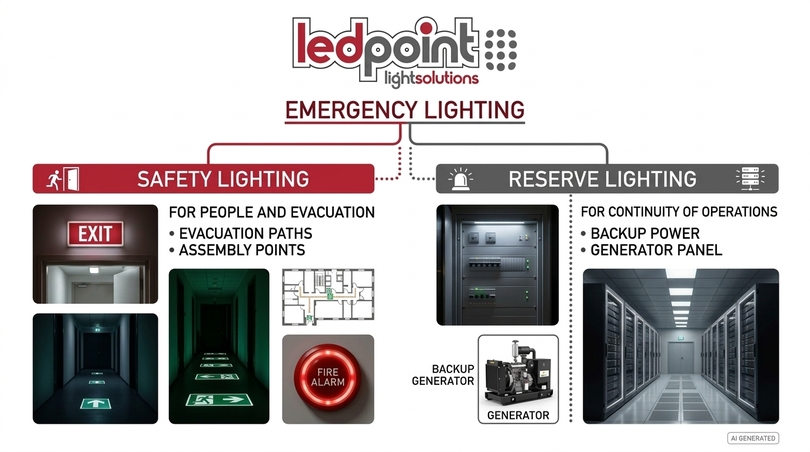
According to UNI EN 1838 and CEI EN 50172, emergency lighting is the lighting intended to come into operation when the power supply to the ordinary lighting fails. It is therefore an "umbrella" term that encompasses two main families: safety lighting, which protects people, and standby lighting, which ensures business continuity. When asking "what is meant by emergency lighting?", the correct answer is precisely this: a system that replaces, in whole or in part, ordinary light at the moment it goes out due to a fault, a blackout, or the intervention of electrical protections.
The decisive aspect is automation: emergency lighting must not require any human intervention. The transition from the mains to the safety power supply must happen on its own, within times defined by the standard, and must last for the entire time necessary for evacuation or the continuation of activities.
What emergency lighting is for
The functions of emergency lighting can be summarized in five concrete objectives, which we also find in corporate risk assessment documents:
- Make escape routes and exits visible, allowing people to reach a safe place.
- Prevent panic in large environments, providing sufficient illumination to perceive obstacles and directions.
- Secure hazardous operations, allowing the operator to stop a machine, crane, or process without risks.
- Illuminate safety equipment: fire extinguishers, hydrants, alarm buttons, first-aid kits, and electrical panels.
- Ensure operational continuity in rooms where activity cannot be interrupted (operating rooms, control centers, data centers).
In summary, emergency lights serve to transform a potentially dramatic event, such as sudden darkness, into a manageable situation. This is why Legislative Decree 81/08 considers them an integral part of prevention and protection measures in workplaces.
When emergency light activates
Activation situations are more numerous than one might think. Emergency lighting comes into operation in the event of a public grid blackout, intervention of a residual current or circuit breaker, failure on a backbone line, fire damaging cables, flooding of panels, or voluntary disconnection of the electrical system via the fire emergency button. This last case is often underestimated: when the Fire Department or fire safety officers activate the general disconnection, the emergency lighting must remain on, because it is powered by an independent source (battery or central power supply) and not by the circuit that has been sectioned.
A good design also ensures that emergency lighting activates even in the event of a voltage loss on the single local circuit and not just on the entire building: if only the light line of a corridor trips, the emergency lamps in that corridor must turn on. This principle directly influences how the luminaires must be connected, as we will see in the installation chapter.
What is safety lighting
Safety lighting is the part of emergency lighting intended to ensure the safety of people who must leave a place or finish a potentially dangerous activity. It is the mandatory component in the vast majority of cases and is the one referred to by laws when they speak of "safety lighting" in workplaces and activities subject to fire prevention. What is safety lighting for? To allow evacuation, prevent panic, and make fire-fighting and first-aid devices identifiable at all times.
What is standby emergency lighting
Standby lighting is the part of emergency lighting that allows normal activities to continue without substantial changes when the mains fails. It is the answer to the question "what lighting is intended for the continuation of activity in the event of a power failure?". Typical examples are operating rooms, control rooms, data processing centers, broadcast studios, and some continuous-cycle production departments. Unlike safety lighting, standby lighting is almost never imposed by a general standard: it is a client's choice or a specific sector requirement. However, if it is also used as safety lighting, it must meet all its requirements.
Difference between emergency and safety lighting
We arrive at the most frequent question of all: what is the difference between safety lighting and emergency lighting? The answer is hierarchical. Emergency lighting is the general category; safety lighting is a subcategory of it, along with standby lighting. Therefore, all safety lighting is emergency lighting, but not all emergency lighting is safety lighting. The following table clarifies the differences immediately.
| Characteristic | Safety Lighting | Standby Lighting |
|---|---|---|
| Purpose | Protect people during evacuation and shutdown of operations | Continue activities without interruptions |
| Mandatory | Mandatory by law in workplaces and regulated activities | Optional, except for sector requirements |
| Illuminance levels | Minimums set by UNI EN 1838 (e.g., 1 lx on escape routes) | Defined by the client based on the activity, often close to ordinary levels |
| Autonomy | Minimum 1 hour, often 2–3 hours based on the technical rule | For the entire duration necessary for continuity |
| Power sources | Integrated batteries, centralized central power supplies, groups compliant with EN 50171 | UPS, generator sets, dual power supply lines |
| Main standards | UNI EN 1838, CEI EN 50172, UNI CEI 11222, EN 60598-2-22 | CEI 64-8, sector-specific specifications |
The concept of "safety and emergency lighting" used in many specifications therefore indicates the combination of the two systems: safety protects people, standby protects the process.
2. Types of emergency lighting: safety, standby, and signaling
Once the general concept is clear, it is time to delve into the types. The classification of European standards is not an academic exercise: each category has its own requirements for illuminance, uniformity, intervention time, and autonomy. Choosing the wrong category means poorly sizing the emergency lighting system, with the risk of failing the commissioning test or, worse, leaving people in the dark exactly where light is needed most.
The main categories of emergency lighting
To the question "what are the main categories into which emergency lighting is distinguished?", UNI EN 1838:2025, read together with CEI EN 50172, responds with a tree schema that is worth memorizing:
| Level | Category | Purpose |
|---|---|---|
| 1 | Emergency Lighting | General term: light that intervenes when ordinary power fails |
| 1.1 | Safety Lighting | Protection of people |
| 1.1.1 | Safety lighting for escape (escape routes) | Identify and safely traverse escape routes |
| 1.1.2 | Anti-panic lighting (large areas) | Prevent panic and allow reaching escape routes |
| 1.1.3 | High-risk area lighting | Safely stop dangerous processes and machines |
| 1.1.4 | Local area lighting (2024/2025 novelty) | Guarantee minimum light in specific rooms such as restrooms, technical rooms, areas with control panels |
| 1.2 | Standby Lighting | Business continuity |
Alongside these categories, the standard regulates illuminated safety signage, which is an integral part of safety lighting for escape.
Emergency lighting for escape: the safety of escape routes
This is the best-known form of safety lighting: it serves to make corridors, stairs, ramps, and passages passable up to the exit. The standard requires a minimum illuminance on the floor along the center line of the escape route and, with the 2024 revision of EN 1838, places greater attention on covering the entire width of the escape route, not just its centerline. In practice, it is no longer enough to "light up the center of the corridor": the edges, where obstacles are often found, must also be sufficiently illuminated. This is one of the reasons why linear light sources, such as LED strips in profiles, are gaining ground in design: they distribute light continuously and uniformly along the entire path.
Anti-panic emergency lighting
Anti-panic lighting concerns large areas without defined paths: open spaces, large meeting rooms, gyms, waiting rooms, showrooms. Here, people do not follow a corridor but must orient themselves in an open space to reach an escape route. The goal is to reduce the probability of panic by ensuring sufficient vision to identify obstacles and directions. The required values are lower than for escape routes, but they must be distributed homogeneously over the useful surface.
Emergency lighting for high-risk areas
This is the category that closely concerns industry. It concerns areas where a sudden lack of light puts the operator or those nearby in danger: machine tools with rotating parts, presses, bottling lines, chemical laboratories, crane handling areas. Industrial safety lighting in these zones must be much more intense, with almost instantaneous intervention times, because the operator must be able to see and activate the stop controls. The typical case of safety lighting for overhead cranes falls here: the crane operator must be able to deposit the load and move away from the maneuvering area under adequate visibility conditions.
Local area lighting: the novelty of EN 1838:2024
The main novelty introduced by EN 1838:2024, adopted in Italy as UNI EN 1838:2025, is the new typology of local area lighting. It concerns rooms that are not escape routes or anti-panic areas in the strict sense, but where people may be present at the time of a blackout and must be able to exit or operate: restrooms, ante-rooms, technical rooms, electrical cabins, areas with control panels. For control equipment and electrical panels associated with ordinary and emergency lighting, a minimum illuminance of 5 lux on the visual task plane is required, allowing the maintenance worker to intervene safely.
What is signaling lighting
By "signaling lighting" we mean the light that makes safety signs visible: the green arrows with the running man indicating exits, fire-fighting and first-aid equipment signs. Signs can be internally illuminated (luminaire with integrated pictogram) or externally illuminated (photoluminescent or printed sign illuminated by a dedicated luminaire). Pictograms must comply with UNI EN ISO 7010 and their minimum luminance is fixed by EN 1838. A novelty of the recent revision is the possibility of integrating signage with adaptive signs, which change indication (for example, a red cross instead of an arrow) when an escape route is compromised by smoke or fire.
What are the 3 types of lighting in a building
Many users ask "what are the three types of lighting?". In the context of installations, the most useful answer is: ordinary lighting (everyday lighting, regulated for workplaces by UNI EN 12464-1), safety lighting, and standby lighting. The last two make up emergency lighting. In a modern design perspective, these three functions increasingly tend to merge into the same luminaire: the same LED light line that illuminates a corridor during the day can, thanks to an emergency kit, also guarantee safety light in the event of a blackout.
Operating modes: SA, SE, maintained and non-maintained
Another fundamental classification concerns how the luminaire behaves when the mains is present:
| Mode | Abbreviation | Behavior with mains present | Behavior in emergency | Typical applications |
|---|---|---|---|---|
| Non-maintained | SE (standby emergency) | Off, battery charging | Turns on automatically | Corridors, offices, warehouses |
| Maintained | SA (sustained) | On, powered by mains | Remains on with safety power | Cinemas, theaters, public assembly venues, exit signage |
| Combined | - | Contains two or more light sources, at least one powered in emergency | The emergency source remains active | Ceiling lights, LED light lines with emergency kits |
| Composite | - | Emergency luminaire and power supply in separate enclosures | Emergency function performed by the external unit | Suspended ceilings, architectural profiles |
The system achievable with a Ledpoint LED strip and the emergency power kit conceptually falls into the logic of the combined or composite luminaire: the same LED source works in ordinary mode powered by the mains driver and, in emergency, is sustained by the kit's battery.
Autonomous or centralized emergency lighting
From the power supply point of view, there are two possible solutions, with many intermediate variants. In autonomous systems, each luminaire contains its own battery, charger, and switching circuit. In centralized emergency lighting, a single central power supply system (compliant with EN 50171) powers all the building's luminaires via a dedicated network. There are also generator set systems, typical of standby lighting in hospitals and industry, and uninterruptible power supply (UPS) systems, used for data centers and control rooms.
| System | Advantages | Disadvantages | When to choose it |
|---|---|---|---|
| Autonomous (on-board battery) | Simple installation, no dedicated network, fault limited to a single luminaire, low initial cost | Distributed maintenance, battery replacement at every point, more laborious control without self-testing | Small and medium buildings, shops, offices, retrofits |
| Centralized (EN 50171 central power supply) | Batteries concentrated in a single room, centralized maintenance, long useful life, simple monitoring | Fire-resistant distribution network, high initial cost, single critical point to protect | Large buildings, hospitals, shopping centers, industrial plants |
| Generator set | Very long autonomy, high powers | Start-up time (not suitable alone where 0.5 s is required), mechanical maintenance | Standby lighting, essential services |
| UPS | Instantaneous switching, protection of sensitive loads | Limited autonomy from batteries, high cost per kWh | Data centers, control rooms, laboratories |
| Emergency kit on LED source | Total aesthetic integration, no additional visible luminaires, reuse of the same source | Limited emergency power, need to verify the compliance of the assembly | Architectural light lines, profiles, suspended ceilings, localized standby lighting |
There is no absolutely better system: there is the right system for the building, the number of light points, the budget, and the maintenance strategy. In many real projects, the two architectures coexist: a centralized central power supply for common areas and autonomous luminaires or integrated kits for peripheral rooms.
3. Emergency lighting regulations: laws, technical standards, and certifications
Emergency lighting regulations in Italy are layered on two levels that it is essential to distinguish. The first is the legislative level: state decrees and laws that establish when safety lighting is mandatory. The second is the technical level: UNI, CEI, and EN standards that define how to implement it. Laws often refer to technical standards, which thus become de facto binding. The 2024–2025 period has been particularly intense, with the almost simultaneous publication of three fundamental updates.
The legislative level
Legislative Decree 81/2008: lighting in workplaces
The Consolidated Law on health and safety at work (Legislative Decree 81/08) is the legal basis for emergency lighting in workplaces. Article 63 refers to the requirements of Annex IV, which in point 1.10 regulates natural and artificial lighting and provides that workplaces where workers are particularly exposed to risks in the event of artificial lighting failure must have safety lighting of sufficient intensity. The same annex requires that escape routes and emergency exits requiring lighting be equipped with safety lighting of sufficient intensity, which comes into operation in the event of an electrical system failure. "Workplace lighting 81/08" is therefore a direct obligation of the employer, who must evaluate it in the Risk Assessment Document (DVR).
Title V of the same decree, with Annexes XXIV and following, regulates safety signage, including illuminated emergency exit signs.
Fire Prevention Code (Ministerial Decree August 3, 2015 and subsequent amendments)
The Fire Prevention Code addresses safety lighting in strategy S.4 "Escape". The principle is clear: during escape, the safety lighting system must guarantee sufficient horizontal illuminance on the floor to allow evacuation, in compliance with UNI EN 1838 and in any case not less than 1 lux along the center line of the escape route. The vertical technical rules (RTV) for offices, hotels, schools, garages, commercial activities, hospitals, and public assembly venues may then set additional requirements on autonomy and levels.
Ministerial Decrees of September 1 and 2, 2021: controls and management
The Ministerial Decree of September 1, 2021 ("controls decree") regulates the maintenance of fire safety systems, equipment, and other systems, including safety lighting systems, and introduces qualification requirements for maintenance technicians. The Ministerial Decree of September 2, 2021 ("GSA") concerns fire safety management in operation and in an emergency. Together, these decrees have made the issue of who must check emergency lights and how to document it much more stringent.
Installation standards: Ministerial Decree 37/08
Emergency lighting systems are electrical systems in all respects: their realization requires a company authorized under Ministerial Decree 37/2008 and the issuance of a declaration of conformity.
The technical level: the standards to know
UNI EN 1838:2025 – Emergency lighting for buildings
What is the UNI standard for emergency lighting? It is UNI EN 1838, the reference lighting standard. It specifies the lighting requirements of emergency lighting systems, including adaptive escape route systems, installed in places accessible to the public and workers. The current edition is UNI EN 1838:2025, in force since February 6, 2025, which adopts EN 1838:2024 and replaces UNI EN 1838:2013, destined for definitive withdrawal on June 18, 2027. Until that date, the two editions coexist, but for new projects it is advisable to apply the most recent version immediately.
Among the main technical modifications compared to the 2013 edition we find: escape route requirements extended to the width of the route, more details for specific danger points and areas, the new local area lighting, specific attention to restrooms, vertical illuminance of 5 lux on fire-fighting and first-aid equipment, adaptive signs, and the obligation to apply a maintenance factor determined according to ISO/CIE TS 22012 and EN 12665. The standard must be read in conjunction with EN 50172.
A practical note for those searching for "UNI EN 1838 emergency lighting pdf": UNI standards are documents protected by copyright and the official text is purchased from the UNI catalog. Beware of unofficial PDFs circulating online: they are often outdated editions (2013) and do not report the modifications introduced in 2025.
CEI EN 50172:2024 – Emergency escape lighting systems
What does the CEI EN 50172 standard specify for emergency escape lighting systems? It is the installation standard that defines how an emergency safety lighting system for escape must be designed, installed, documented, and verified: area classification, minimum duration, project documentation, logbook, periodic test procedures. The 2024 update concerned in particular centralized energy emergency lighting systems. It is the answer to the question "what is the CEI standard for emergency lighting?".
UNI CEI 11222 – Periodic verification, maintenance, and commissioning
What does the UNI CEI 11222 standard define? The procedures for initial verification, periodic verification, maintenance, revision, and commissioning of safety lighting systems in buildings. It is the operational reference for maintenance workers and technical managers: it establishes what to check, with what frequency, and how to record it. Among the planned checks, the periodic lighting inspection stands out, which requires checking the photometric requirements according to EN 1838 with levels compliant with the design minimums.
CEI EN 60598-2-22 – Luminaires for emergency lighting
What does the EN 60598-2-22 standard specify? It is the product standard that establishes the safety and performance requirements of emergency lighting luminaires: declared autonomy, recharge times, battery behavior, heat resistance, markings, status indicators. UNI EN 1838 explicitly requires that every emergency lighting luminaire complies with EN 60598-2-22. It is the first datum to look for in the technical data sheet when purchasing emergency lamps.
Other related standards
| Standard | Scope | Why it is important |
|---|---|---|
| EN 50171 | Central power supply systems | Requirements for central power supplies and centralized battery groups |
| EN 61347-2-7 | Electronic battery-powered emergency control gear | Concerns battery-powered drivers and emergency kits |
| EN 62034 | Automatic test systems | Self-testing and automatic testing of battery-powered luminaires |
| IEC 62386-202 (DALI) | Digital control of emergency lighting | Communication and testing via DALI bus |
| CEI 64-8 (ed. 2024) | Electrical installations of buildings | Safety services, circuits, protection, and wiring of conduits |
| UNI EN 12464-1:2021 | Lighting of indoor work places | Ordinary illuminance levels, calculation basis for high-risk areas |
| UNI EN 12464-2:2025 | Lighting of outdoor work places | Yards, docks, construction sites, loading areas |
| UNI EN ISO 7010 | Graphical symbols - Safety colours and safety signs | Exit and equipment pictograms |
| EN 81-20 | Lifts | Emergency lighting in the cabin |
The new regulations for emergency lights: what changed between 2024 and 2025
Those asking "what are the new regulations for emergency lighting?" must keep in mind three updates published between late 2024 and early 2025: the new edition of CEI 64-8 (September 2024), the update of CEI EN 50172 (September 2024), and the revision of UNI EN 1838 (in force since February 2025). The table summarizes the practical impact.
| Theme | Before (EN 1838:2013) | Now (UNI EN 1838:2025) | Practical impact |
|---|---|---|---|
| Escape routes | Focus on the center line and central band | Requirements extended to the width of the route | More attention to uniformity on the edges: linear sources are useful |
| Fire-fighting and first-aid equipment | 5 lx on the floor nearby | 5 lx vertically on the equipment | Optics and positioning to be reviewed |
| New areas | Not provided | Local area lighting (restrooms, technical rooms, panels) | More light points in bathrooms, ante-rooms, and technical rooms |
| Signage | Static | Adaptive signs allowed | Integration with fire detection |
| Maintenance | Generic maintenance factor | Factor according to ISO/CIE TS 22012 | More realistic projects regarding depreciation |
Necessary certifications for emergency devices
Construction entrepreneurs and retailers often ask which certifications to demand. For an emergency lighting luminaire, the minimum references are: CE marking (Low Voltage Directive, Electromagnetic Compatibility, RoHS), EU declaration of conformity with the list of applied harmonized standards (in particular EN 60598-1 and EN 60598-2-22), voluntary third-party marks such as ENEC or IMQ, photometric data in LDT or IES format for lighting calculation, declared nominal autonomy, and battery type. For the certification of LED lamps as a whole, eco-design regulations and energy labeling must also be considered, which Ledpoint indicates on every product data sheet with the respective class.
A point often overlooked: when assembling a system (LED source, profile, driver, and emergency kit), the result is a new luminaire and the responsibility for its compliance as an emergency luminaire falls on whoever realizes or puts it into service. For this reason, in the escape routes of activities subject to Fire Department control, the designer must carefully evaluate whether to use luminaires certified as such or composite solutions, documenting their compliance.
4. When emergency lighting is mandatory
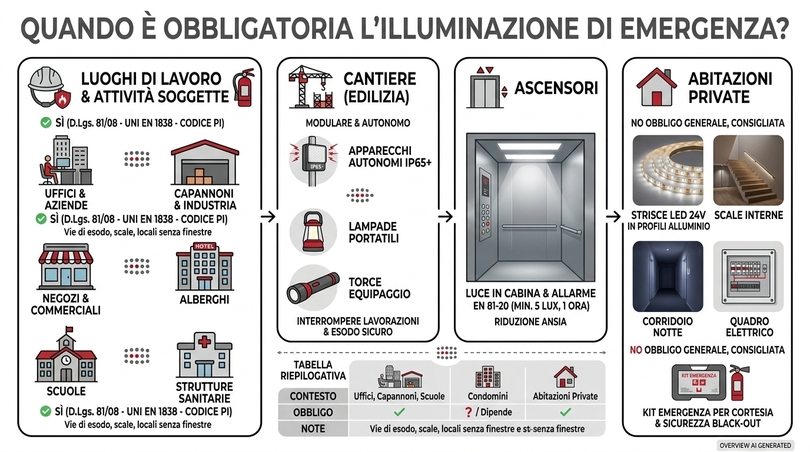
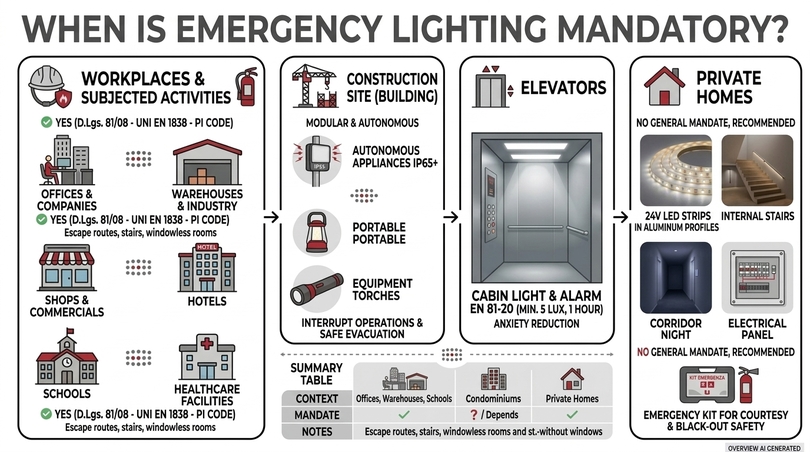
Is safety lighting mandatory? The short answer is: yes, in almost all workplaces and all activities subject to fire prevention; no, in general, in private homes. The complete answer, however, depends on the type of activity, the number of people present, the conformation of the premises, and the outcome of the risk assessment. Let's look at the main cases through the eyes of someone who has to make concrete decisions.
Emergency lighting in workplaces
For Legislative Decree 81/08, the obligation arises from risk assessment. Emergency lighting in workplaces is necessary when the sudden lack of light exposes workers to risks: environments without sufficient natural light, activities carried out in the evening or at night, internal escape routes, presence of dangerous machines, stairs, and level differences. In practice, almost every company with closed premises, corridors, or work after sunset must equip itself with safety lighting, because it is difficult to prove that sudden darkness generates no risk. The employer, with the RSPP, must document its presence and status in the DVR.
Activities subject to Fire Department controls
For the activities listed in Presidential Decree 151/2011 (offices above a certain presence threshold, hotels, schools, hospitals, garages, commercial activities, public assembly venues, civil buildings with significant fire height, and many others), the obligation for emergency lamps derives from the Fire Prevention Code or the applicable vertical technical rule. In these cases, safety lighting for escape is always required, and UNI EN 1838 becomes the design reference.
Summary table: where emergency lights are mandatory
| Context | Obligation | Reference | Practical notes |
|---|---|---|---|
| Offices, companies, laboratories | Yes, if lack of light entails risks (almost always) | Legislative Decree 81/08 Annex IV; Fire Code if regulated activity | Escape routes, stairs, windowless rooms |
| Sheds and industry | Yes | Legislative Decree 81/08; UNI EN 1838 (high risk) | Machines, overhead cranes, shelving, internal routes |
| Shops and commercial activities | Yes, always for escape routes and areas open to the public | Fire Code / RTV commercial activities; Legislative Decree 81/08 | Anti-panic in the sales area, exits |
| Hotels and accommodation facilities | Yes | RTV accommodation facilities | Autonomy often greater than one hour |
| Schools | Yes | RTV schools | Classrooms, corridors, gyms, stairs |
| Healthcare facilities | Yes, with standby lighting in critical areas | RTV healthcare facilities; CEI 64-8 medical locations | Very rapid switching in operating rooms |
| Public assembly venues | Yes, often with maintained luminaires (SA) | RTV public assembly venues | Signage always on |
| Garages | Yes, above legal thresholds | RTV garages | Ramps, lanes, pedestrian exits |
| Condominiums | Depends on height and fire regulations; always recommended for stairs and entrances | Fire Code for subject residential buildings | Stairwell, meter room, garage |
| Elevators | Yes, emergency light in the cabin | EN 81-20 | Light on the alarm device and in the cabin |
| Construction sites | Yes, if working in the absence of natural light or in confined spaces | Legislative Decree 81/08 (Title IV and annexes) | Portable and autonomous luminaires with high IP rating |
| Private homes | No, but strongly recommended | – | Internal stairs, corridors, electrical panel |
What safety lighting must guarantee on a construction site
For the construction entrepreneur, the site is a particular workplace: it changes every day, has areas not yet enclosed, excavations, scaffolding, stairwells without definitive railings, and often a temporary electrical system. Safety lighting on a construction site must guarantee that, in the event of a power failure, workers can reach a safe place without falling into excavations or openings, stop using equipment, and exit underground or confined spaces. The most effective solution is to combine autonomous luminaires with a high degree of protection (IP65 or higher, see IP code) installed on main routes, rechargeable portable emergency lamps in working rooms, and emergency torches provided to teams. For construction sites, the best emergency lighting system is therefore almost always autonomous and modular, easy to move as the site progresses.
Emergency light in the elevator
Elevator cabin lighting regulations are often sought by administrators and maintenance workers. EN 81-20, the reference for new installations, requires that the cabin have emergency lighting with an automatically rechargeable reserve power supply, capable of guaranteeing about 5 lux on the alarm device and in the cabin for at least one hour. The goal is twofold: to allow the trapped passenger to find and activate the alarm button and to reduce anxiety while awaiting rescue. In access shafts and machine rooms, the general safety lighting requirements apply instead.
Emergency lights at home: when they are needed
In a private home, there is no general obligation, but home emergency lights are a sensible choice, especially in multi-story villas, homes with elderly people or children, basements, and taverns. The most useful positions are internal stairs, the corridor connecting the sleeping area to the exit, the electrical panel room, and the entrance. Here, one can reason with more aesthetic freedom: a 24V LED strip in an aluminum profile under the step or as a baseboard, connected to an emergency kit, becomes both a courtesy light and a safety light in the event of a blackout.
5. Emergency lighting requirements: how many lux, uniformity, times, and autonomy
This is the chapter that interests designers and verifiers the most, because it translates standards into numbers. How many lux for emergency lighting? How long must emergency lights stay on? How many lumens should an emergency lamp have? The answers are here, ordered by type. Remember that the UNI EN 1838 values are minimums and must be guaranteed for the entire duration of the autonomy and for the entire life of the emergency lighting system, taking into account the aging of sources and batteries.
UNI EN 1838 requirements table
| Typology | Minimum Illuminance | Uniformity | Intervention Time | Minimum Duration |
|---|---|---|---|---|
| Escape routes | ≥ 1 lx on the floor along the center line, with coverage extended to the width of the route | Emax/Emin ≤ 40:1 | 50% within 5 s, 100% within 60 s | 1 h |
| Anti-panic (large areas) | ≥ 0.5 lx on the floor over the useful area, excluding a 0.5 m perimeter border | Emax/Emin ≤ 40:1 | 50% within 5 s, 100% within 60 s | 1 h |
| High-risk areas | ≥ 10% of the ordinary maintained illuminance and never less than 15 lx | Emin/Eaverage ≥ 0.1 | Full illuminance within 0.5 s | For the entire risk period |
| Fire-fighting, first-aid equipment, alarm buttons | ≥ 5 lx vertically on the equipment | – | Same as escape route | Same as escape route |
| Panels and control equipment (local area) | ≥ 5 lx on the visual task plane | – | As per design | As per design |
To these values are added the color rendering requirements (minimum CRI index Ra 40 to recognize safety colors) and glare limits, which require not exceeding certain luminous intensities in the direction of gaze. For this reason, a diffuse and low-luminance source, such as a COB LED strip behind an opal diffuser, is also advantageous from a glare perspective.
How many lux for emergency lighting: the quick answer
Summarizing for those searching "how many lux emergency lighting": 1 lux on escape routes, 0.5 lux in anti-panic areas, at least 15 lux (and 10% of ordinary) in high-risk areas, 5 lux vertically on fire-fighting and first-aid equipment. For a frame of reference, 1 lux corresponds roughly to the light of a full moon night in an open field: sufficient to walk and recognize obstacles, not to read. The minimum emergency illuminance in lux is therefore low, but it must be guaranteed everywhere and without shadowed areas.
Ordinary lighting regulations and workplaces: the link with UNI EN 12464-1
How should lighting be in workplaces under normal conditions? What does the UNI EN 12464-1 technical standard provide? The standard establishes, for each type of visual task, the maintained illuminance (Em), uniformity, UGR glare limit, and minimum color rendering. Some examples: about 500 lux for writing and VDT use in offices, 100 lux for corridors, 150–300 lux for warehouses depending on the activity, 300–750 lux for industrial work of increasing precision.
Correct lighting in work environments is that which respects these values without glaring or flickering. The connection with emergency lighting is direct: in high-risk areas, safety lighting must provide at least 10% of the designed ordinary illuminance, so a task designed at 500 lux requires at least 50 lux in emergency. For outdoor areas, the reference is UNI EN 12464-2:2025, which sets the lighting requirements for outdoor workplaces such as yards, docks, and loading areas.
How long emergency lights must last: autonomy
What must be the autonomy of an emergency lighting system? UNI EN 1838 sets a minimum duration of 1 hour for escape route and anti-panic lighting. However, many vertical technical rules, CEI EN 50172, and good design practice require greater autonomy, typically 2 or 3 hours, when the building is not evacuated immediately or may be reoccupied before the battery has recharged: hotels, residences, healthcare facilities, large shopping centers. For this reason, the vast majority of commercially available luminaires, and the Ledpoint kit itself, offer 3 hours of nominal autonomy: it is the choice that covers the most situations without having to change the product.
| Situation | Indicative Autonomy | Motivation |
|---|---|---|
| Escape routes and anti-panic, buildings evacuated immediately | 1 h (UNI EN 1838 minimum) | Time sufficient for evacuation and rescue intervention |
| Buildings with sleeping people or not evacuated immediately | 2–3 h | Possible prolonged occupancy |
| High-risk areas | For the entire duration of the risk | The process must be secured |
| Elevator cabin | ≥ 1 h | Waiting for rescue |
| Standby lighting | According to continuity needs | Often with a generator set or UPS |
Pay attention to the recharge time: EN 60598-2-22 provides that the battery recovers nominal autonomy within a defined time (typically 24 hours). A discharged device protects no one: for this reason, after a long blackout, it is prudent to check the state of charge before considering the emergency lighting system efficient again.
How long emergency lighting lasts over time
Another thing is the useful life of the device. How long do emergency lamps last? Modern LED sources easily exceed 50,000 hours of operation with high flux maintenance, while the critical element is the battery: Ni-Cd and Ni-MH batteries generally have a life of 4–5 years, while lithium-iron-phosphate (LiFePO4) batteries offer a higher number of cycles, better thermal stability, and lower self-discharge. The annual full duration test, required by standards, serves precisely to intercept batteries that no longer guarantee the declared autonomy.
How many lumens an emergency lamp must have
There is no single value: the necessary flux depends on installation height, optics, and spacing. As a rule of thumb, luminaires for escape routes in environments with a height of 2.5–3.5 m have emergency fluxes between 100 and 400 lumens; for industrial heights (6–12 m), fluxes of 500–1,500 lumens or specific optics are required. The datum to compare is not just the nominal flux but the flux in emergency declared at the end of autonomy and the photometric curve, which determines the maximum spacing between luminaires. To delve into the relationship between lumens and lux, you will find a dedicated paragraph later.
Requirements for illuminated safety signage
Emergency lamps for the safety exit with a pictogram must respect requirements for luminance, contrast, and visibility. The maximum recognition distance is calculated with the formula d = Z × h, where h is the height of the pictogram and Z is 100 for externally illuminated signs and 200 for internally illuminated ones. A 10 cm high, backlit pictogram is therefore readable up to 20 meters; the same pictogram illuminated from the outside only up to 10 meters.
| Parameter | Value |
|---|---|
| Minimum luminance of the safety color | ≥ 2 cd/m² in every zone of the sign |
| Luminance ratio white/safety color | between 5:1 and 15:1 |
| Luminance uniformity | not greater than 10:1 |
| Viewing distance (internal illumination) | d = 200 × h |
| Viewing distance (external illumination) | d = 100 × h |
| Externally illuminated signs | ≥ 5 lx vertically on the sign |
What are the requirements for an emergency lighting system: synthetic checklist
- Risk assessment and area classification (escape, anti-panic, high risk, local area).
- Luminaires compliant with EN 60598-2-22 and, if centralized, a central power supply compliant with EN 50171.
- Minimum illuminance, uniformity, and intervention times according to UNI EN 1838:2025.
- Autonomy adequate to the applicable technical rule (minimum 1 h, 3 h recommended).
- Coverage of all emphasis points and fire-fighting equipment with 5 lx vertically.
- Signage compliant with UNI EN ISO 7010 with verified viewing distances.
- Circuits and wiring compliant with CEI 64-8, with fire resistance where required.
- Project documentation, declaration of conformity Ministerial Decree 37/08, and inspection logbook according to CEI EN 50172 and UNI CEI 11222.
6. Emergency lighting calculation: how to size the system
Sizing is the heart of design. A correctly calculated emergency lighting system guarantees minimum values wherever needed, avoids wasting unnecessary luminaires, and simplifies commissioning. In this chapter, we look at the method, the parameters that determine the number of emergency lamps, two complete numerical examples, and the most used software tools.
Parameters that determine the number of emergency lamps
The number of devices is not established "per square meter" but based on a series of combined factors:
- Geometry: length and width of escape routes, surface area of anti-panic areas, installation height.
- Mandatory emphasis points: every exit, every emergency door, every staircase, every change in level and direction, every corridor intersection, every fire-fighting and first-aid equipment.
- Luminaire photometry: emergency flux and intensity distribution, from which the maximum spacing is derived.
- Maintenance factor: accounts for flux depreciation, battery aging, and dirt.
- Reflections: UNI EN 1838 requires considering only direct light, neglecting reflected contributions from walls and ceilings, which are unreliable in an emergency.
- Redundancy: every environment should be covered by at least two luminaires, so that the failure of one does not leave the entire area in the dark.
The five-step method
- Classify the areas on the floor plan: escape routes, anti-panic areas, high-risk areas, local areas, equipment.
- Position the emphasis points first: exits, stairs, direction changes, equipment. These luminaires are mandatory regardless of the calculation.
- Fill the intermediate sections using the maximum spacing derived from photometry to guarantee 1 lx (escape) or 0.5 lx (anti-panic).
- Verify uniformity (40:1) and point values with a point-by-point calculation or lighting software.
- Apply the maintenance factor and verify that the minimum values remain guaranteed at the end of autonomy.
Calculation example: 30-meter corridor
Consider a corridor in an office building 30 m long and 2 m wide, with a 3 m ceiling and two exits at the ends. We use a luminaire with an emergency flux of 200 lm and an approximately lambertian distribution. The intensity on the axis is about I₀ = Φ/π ≈ 64 cd. Directly under the luminaire, at 3 m, the illuminance is E = I₀/h² ≈ 7.1 lx. At a horizontal distance d, with a lambertian distribution, the illuminance on the floor is E = I₀ · cos⁴θ / h², where tanθ = d/h.
To have at least 1 lx at the midpoint between two luminaires, each must contribute 0.5 lx: cos⁴θ = 0.5 × 9 / 64 ≈ 0.07, so cosθ ≈ 0.515, θ ≈ 59° and d ≈ 5 m. The theoretical spacing would be about 10 m; applying a maintenance factor of 0.8 and a design margin, we drop to about 8 m.
| Item | Calculation | Result |
|---|---|---|
| Luminaires on exits (emphasis points) | 2 exits | 2 |
| Section to cover between exits | 30 m / 8 m ≈ 3.75 intervals | 3 intermediate luminaires |
| Direction change / fire extinguisher halfway down the corridor | coincides with intermediate luminaire | 0 additional |
| Total | 2 + 3 | 5 luminaires, 7.5 m spacing |
| Estimated minimum illuminance on the center line | contribution of two luminaires at 3.75 m, × 0.8 | about 1.7 lx, well above 1 lx |
The result shows an important aspect: often the number of luminaires is dictated more by emphasis points than by pure calculation. The calculation serves to verify that intermediate sections do not drop below the minimums.
Calculation example with linear source: LED strip and emergency kit
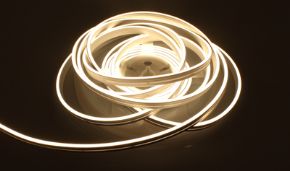
Let's repeat the exercise with an architectural solution: a continuous light line made with the COB LED strip 4000K 4.8 W/m 12V with current control (640 lm/m, 149 lm/W) inserted into a profile with a diffuser. In ordinary operation, the strip is powered by the mains driver; in an emergency, a section of about 1 m is sustained by the Ledpoint 5 W emergency power kit with a LiFePO4 battery and 3-hour autonomy.
Ledpoint technical estimate: 5 W applied to a source with an efficiency of about 150 lm/W corresponds to a theoretical flux on the order of 600–700 lm. Considering conversion losses, the emergency flux factor, and diffuser absorption, we prudently adopt a design value of about 400 lm per section powered in emergency. With mounting at 3 m and estimated axial intensity of about 127 cd, the illuminance under the source is about 14 lx; at 5 m horizontal distance, each section contributes about 1 lx. Two emergency sections 10 m apart therefore guarantee, at the center, about 2 lx theoretically and about 1.6 lx with a maintenance factor of 0.8.
| Parameter | Autonomous luminaire 200 lm | LED line + emergency kit (≈400 lm per section) |
|---|---|---|
| Indicative spacing for 1 lx (h = 3 m, MF 0.8) | about 8 m | about 10 m |
| Emergency points over 30 m with 2 exits | 5 | 4 |
| Aesthetic impact | Visible ceiling or wall luminaires | No additional luminaires: light integrated into the line |
| Uniformity across the width of the route | Good | Very good thanks to the linear and diffuse source |
| Glare | Depends on the optics | Reduced thanks to the opal diffuser |
The values are preliminary design estimates: the final verification must always be carried out with real photometric data and calculation software, and the strip-profile-kit assembly must be evaluated by the designer for compliance with the intended use. If you want a verification for your specific case, our Ledpoint technical office is at your disposal.
Lux and lumen: difference, conversion, and quick formula
Many sizing errors stem from confusion between lux and lumen. The lumen (lm) measures luminous flux, i.e., the total amount of light emitted by a source. The lux (lx) is the unit of measurement of illuminance, i.e., the amount of light arriving on a surface: 1 lux equals 1 lumen distributed uniformly over 1 square meter. The lux-lumen conversion, in the ideal case of uniform light over a surface, is therefore E (lx) = Φ (lm) / A (m²). In reality, light is never distributed perfectly uniformly and some is lost: this is why point-by-point methods and utilization factors are used in emergency calculations. For a practical deep dive, we recommend our guide on how to calculate the lux of an LED installation.
| Quantity | Unit | What it measures | Use in emergency |
|---|---|---|---|
| Luminous flux | lumen (lm) | Total light emitted | Comparison between luminaires, emergency flux |
| Illuminance | lux (lx) | Light arriving on a surface | UNI EN 1838 requirements (1 lx, 0.5 lx, 15 lx, 5 lx) |
| Luminous intensity | candela (cd) | Light emitted in a direction | Point-by-point calculation, glare limits |
| Luminance | cd/m² | Perceived brightness of a surface | Safety signage (≥ 2 cd/m²) |
| Luminous efficacy | lm/W | Light produced per watt consumed | Maximize flux for the same battery |
Software for emergency lighting calculation
For projects of a certain size, manual calculation serves only as a maximum verification. Electrical engineers use lighting software such as DIALux or Relux, or calculation tools provided by luminaire manufacturers, which import photometric files in LDT or IES format and generate isolux maps, point values, uniformity, and automatic verifications according to UNI EN 1838. It is good practice to attach calculation tables to the project, as they will be the reference for the periodic lighting inspection.
How to optimize costs without compromising safety
Optimizing does not mean reducing luminaires below the minimum, but choosing the right ones. The most effective levers are: using luminaires with corridor-dedicated optics that extend spacing, integrating emergency into ordinary lighting luminaires (combined solutions) to avoid additional light points, adopting systems with self-testing that drastically reduce maintenance costs, choosing long-life batteries like LiFePO4 to space out replacements, and designing rational circuits that simplify checks. Over a 10-year horizon, maintenance often weighs more than the purchase: that is where the greatest savings are concentrated.
7. Main components and operation of emergency lights
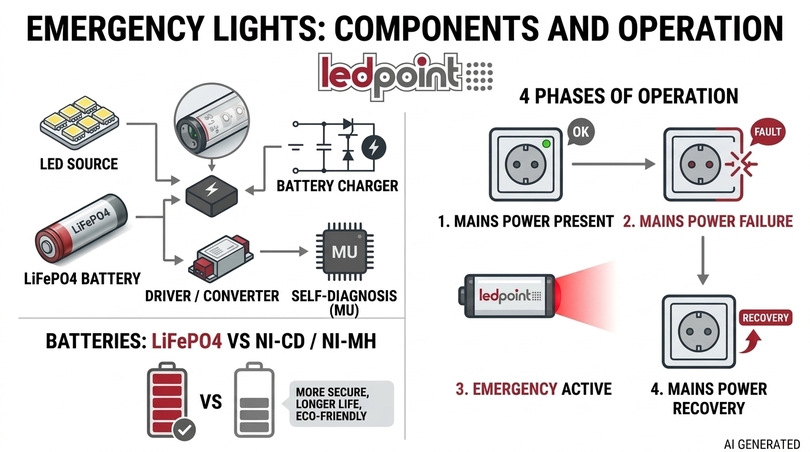
How does emergency light work? Behind a seemingly simple luminaire is a miniature electrical power station, which must remain ready for years to intervene in a few tenths of a second. Knowing the components helps to choose the best products, recognize signs of malfunction, and plan maintenance intelligently.
Components of an emergency lighting system
| Component | Function | What to check in the technical data sheet |
|---|---|---|
| Light source (LED) | Produces light in ordinary and/or emergency mode | Emergency flux, lm/W efficiency, CRI, color temperature |
| Battery | Stores energy for emergency | Chemistry (Ni-Cd, Ni-MH, LiFePO4), capacity, useful life, operating temperature |
| Charger | Keeps the battery charged with mains present | Recharge time, overcharge protection |
| Switching circuit | Detects mains failure and activates emergency | Intervention threshold, switching time |
| Emergency driver / converter | Powers the source from the battery with adequate voltage or current | Emergency power, output voltage range, EN 61347-2-7 compliance |
| Status indicator (LED) | Signals charging, fault, test result | Presence, color codes |
| Self-test / control module | Performs automatic tests, communicates status | EN 62034 compliance, DALI-2, connectivity |
| Enclosure and optics | Protects and distributes light | IP, IK rating, glow-wire resistance, corridor optics |
How emergency lights work, phase by phase
Phase 1: mains present
Under normal conditions, the luminaire is powered by the 230 V mains. The charger keeps the battery in trickle charge, the status indicator (usually a green LED) signals that everything is regular. In non-maintained luminaires (SE), the source is off; in maintained (SA) or combined ones, it is on and powered by the mains.
Phase 2: mains failure
The control circuit detects that the voltage has dropped below the intervention threshold (generally about 60–70% of nominal) and within a few milliseconds switches the source's power supply to the battery. The transition is automatic, requires no switches, and occurs even if the failure concerns only the local circuit.
Phase 3: emergency operation
The emergency converter draws energy from the battery and powers the source with the planned emergency flux, for the entire declared autonomy. A protection circuit prevents deep discharge, which would irreversibly damage the battery.
Phase 4: return of mains
When the mains returns, the luminaire returns to its initial state and the charger begins to recharge the battery, an operation that typically requires up to 24 hours for full autonomy.
Emergency lighting batteries: Ni-Cd, Ni-MH, and LiFePO4 compared
The battery is the heart and, often, the weak point of emergency lighting. The choice of chemistry impacts duration, safety, size, and maintenance costs.
| Characteristic | Ni-Cd | Ni-MH | LiFePO4 |
|---|---|---|---|
| Energy density | Low | Medium | High |
| Typical useful life | 4–5 years | 4–5 years | Superior, with a high number of cycles |
| Thermal stability and safety | Good | Good | Very high among lithium chemistries |
| Self-discharge | Medium | High | Low |
| Environmental impact | Contains cadmium | Better | Without toxic heavy metals |
| Size for equal autonomy | Large | Medium | Reduced |
It is no coincidence that the Ledpoint kit uses a LiFePO4 battery: it is the chemistry that today offers the best compromise between safety, compactness, and duration, decisive characteristics when the battery must be hidden in a suspended ceiling or next to an LED profile.
Activation sensors and self-testing in emergency lighting
In more advanced luminaires, the "sensor" is not limited to detecting mains failure. The self-test module periodically performs short functional tests (switching on in emergency for a few seconds) and full autonomy tests, verifying the status of the source, battery, and charging circuit. The result is signaled locally with different colored LEDs or transmitted to a central unit via a dedicated bus, DALI, or wireless. This approach, regulated by EN 62034, allows you to know at any moment which luminaires are efficient without having to physically inspect every point.
How emergency lighting is integrated into the electrical system
The integration of emergency lighting with the ordinary system follows some fundamental rules of CEI 64-8: autonomous luminaires must be powered from the same circuit as the ordinary lighting of the area they protect, upstream of any local switches, so that they intervene both in the event of a general blackout and in the event of a single line fault. In centralized systems, the distribution network must be dedicated, selectively protected, and, where required, made with fire-resistant cables. A classic error is connecting the emergency lamp downstream of the light switch: in this case, every time the light is turned off, the device thinks the mains has failed and drains the battery.
8. Ledpoint LED strips and emergency kits: safety light integrated into architecture
So far, we have talked about regulations and design in general. It is time to enter the field in which Ledpoint works every day: linear LED sources. In recent years, designers and architects increasingly ask to avoid the classic visible "emergency ceiling light", which interrupts the cleanliness of a ceiling or a design corridor. The answer is to integrate the emergency function directly into the light lines, with a combination of LED strip, aluminum profile, driver, and emergency kit.
The Ledpoint emergency power kit
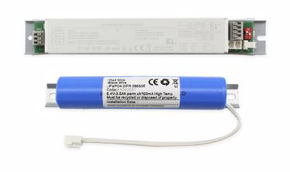
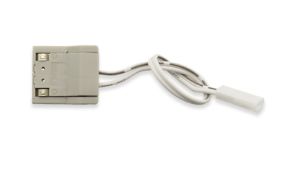
The key product is the Ledpoint emergency power supply with 3h autonomy and LiFePO4 battery (code PW-EM5DH-10.60-30L), available in the emergency lighting category of our catalog. It is a converter that, inserted between the strip's power supply and the strip itself, keeps the LED source lit when the mains fails.
| Specification | Value |
|---|---|
| Code | PW-EM5DH-10.60-30L |
| Autonomy | 3 hours |
| Battery | LiFePO4 |
| Maximum emergency power | 5 W |
| Input voltage | 230 V |
| Output voltage | 10–60 V |
| Emergency output current | 300 mA |
| Compatibility | Constant voltage and constant current systems |
| Protection degree | IP20 (indoor use) |
| Converter dimensions | 220 × 30 × 21 mm |
| Battery dimensions | 160 × 25 × 30 mm |
| Battery cable | 15 cm |
The 10–60 V output range makes it compatible with the main families of 12V LED strips, 24V LED strips, and 48V LED strips. The compact dimensions (21 mm height) allow it to be housed in suspended ceilings, technical compartments, and junction boxes. The product data sheet reports two distinct connection diagrams, depending on whether the output current of the mains power supply is lower or higher than 3 A: it is fundamental to follow the correct one.
Which LED strips to choose for emergency
Since the emergency power is limited to 5 W, the golden rule is to maximize lumens per watt. Here are the criteria we apply in our projects:
| Criterion | Why it matters in emergency | Recommended Ledpoint product |
|---|---|---|
| High efficiency (≥ 140 lm/W) | More light with the same battery energy | 2835 LED strip 3000K 240 led/m 24V 14.4 W/m (155 lm/W) |
| Low power per meter | With 5 W, a longer section can be powered | 4.8 W/m LED strips |
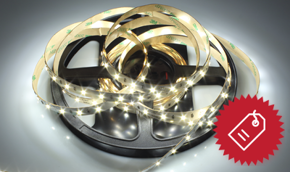
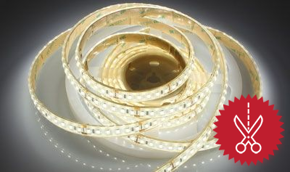
| Integrated current control | Stable light even with variable battery voltages | COB strip 4000K 12V 4.8 W/m with current control (149 lm/W) |
| Continuous light without dots | Uniformity and low glare along escape routes | COB LED strips |
| Neutral white 4000K | Good perception of contrasts and safety colors | White LED strips 3800–5300K |
| High flux for large environments | High-performing ordinary with dedicated emergency section | 4000K 3step 2835 24V 19.2 W/m LED strip (2600 lm/m, 150 lm/W) |
A useful indication: a high CRI (like the CRI >90 of the 4000K COB strip) is not required by the emergency standard, which is satisfied with Ra 40, but it significantly improves the recognition of the green and red of signs and equipment. To understand why color consistency matters even in emergency, read our guide on MacAdam Step and CCT.
Profiles, diffusers, and accessories
A bare LED strip is not a luminaire: it needs a support that dissipates heat, protects it, and diffuses its light. For emergency applications, we recommend:
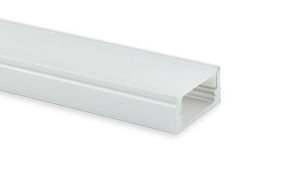
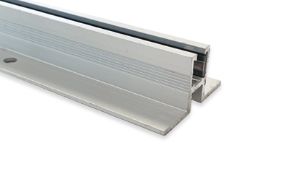
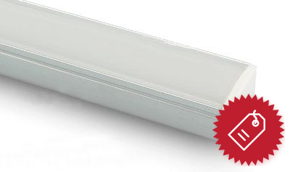
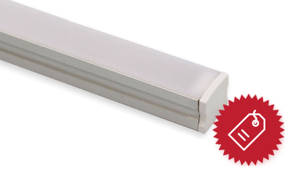
- 17×8 mm aluminum profile, 2 meters, versatile for ceiling and wall installations along corridors.
- 16 mm angular profile, ideal under the handrail or in the wall-ceiling corner to illuminate stairs and ramps.
- 23×8 mm recessed profile, for flush light lines in walls, steps, and furniture.
- 44×12 mm plasterboard profile, which disappears into the suspended ceiling leaving only the light line visible.
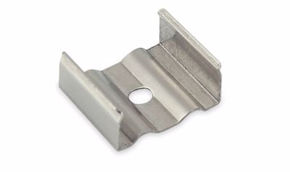
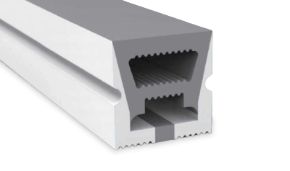
- Diffusers opal to reduce luminance and glare, end caps, and mounting clips for secure fixing.
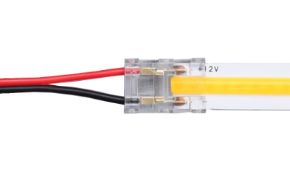
- Connectors and high-quality cables, because a faulty connection is the primary cause of failure to turn on in an emergency.
- 24V power supplies or constant current power supplies for the ordinary lighting of the line.
Ideal applications for the LED strip + emergency kit solution
| Application | Suggested configuration | Added value |
|---|---|---|
| Design office and hotel corridors | Continuous line in plasterboard profile, emergency sections every 10 m approx. | No visible luminaires, uniformity across the width of the route |
| Internal stairs and under-steps | Recessed or angular profile with COB strip, one kit per ramp | Step edges always visible, reduced fall risk |
| Shops and showrooms | Perimeter light lines with emergency sections for anti-panic | Aesthetic continuity of the setup |
| Technical rooms and electrical panels | Strip section above the panel with dedicated kit | Support for 5 lx local area lighting on the work plane |
| Furniture, niches, and handrails | Profile integrated into furniture or handrail | Low-height orientation light, effective even in the presence of smoke |
| Residential environments and B&B | Luminous baseboard or courtesy light in the night corridor | Night safety and in case of blackout |
| Localized standby lighting | Multiple kits on line sections in operational environments | Minimum business continuity |
A note of transparency, because safety comes first: the combination of strip, profile, and kit constitutes an assembled system. For use as safety lighting in the escape routes of regulated activities, the designer must evaluate the compliance of the assembly with the requirements of EN 60598-2-22 and UNI EN 1838, verify the technical documentation of the kit, and prepare the installer's declaration. In many projects, the optimal solution is hybrid: luminaires for emergency lighting certified at exits and emphasis points, LED lines with emergency kits to uniform the light along paths, in stairs, in technical rooms, and in representative spaces.
Emergency lighting outdoors and in humid environments
The emergency kit has an IP20 protection degree and must be installed in a dry environment. Nothing prevents powering, through adequate cables, sources installed in more severe environments, such as the Led Neon Flex 3×5 mm 4000K 24V IP65 or other solutions from the Neon Flex range, keeping the converter and battery in a protected compartment. For outdoor areas, also consider the solutions in the outdoor lighting section of our website.
9. Where to position emergency lamps
Where should emergency lights be positioned? It is one of the most searched questions, in dozens of variations: where to put them, where to install them, where they must be placed. The answer starts from a simple principle: first cover the emphasis points indicated by the standard, then complete the intermediate sections based on the calculation. Let's look at the practical rules for workplaces, commercial activities, and homes.
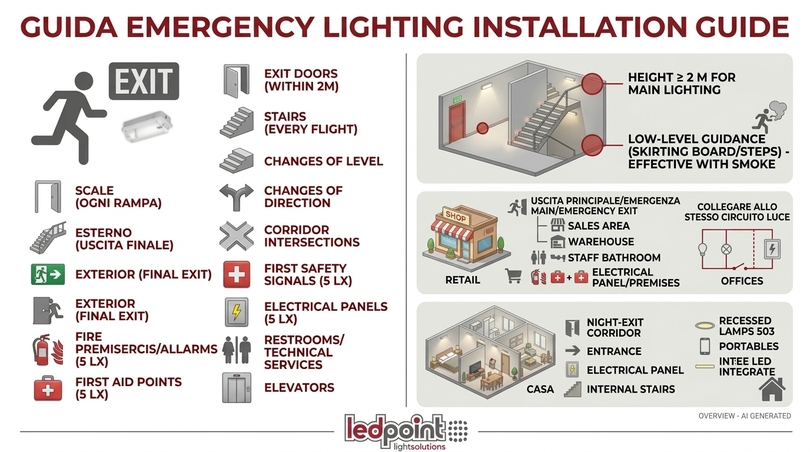
Mandatory points: the "emphasis points" of UNI EN 1838
| Position | Practical indication |
|---|---|
| Every exit door intended for use in an emergency | Luminaire within about 2 m horizontally from the door |
| Stairs | Every flight must receive direct light, so that each step is illuminated |
| Changes in level | Isolated steps, ramps, level differences of even a few centimeters |
| Changes in direction | Every curve in the escape route |
| Corridor intersections | Every intersection |
| Mandatory emergency exits and safety signs | Illumination of the sign and the door |
| Outside, near every final exit | Up to reaching a safe place |
| Fire-fighting equipment and alarm buttons | 5 lx vertically on the equipment |
| First-aid points | 5 lx vertically |
| Electrical panels and control equipment | 5 lx on the work plane (local area) |
| Restrooms, ante-rooms, technical rooms | According to the new local area indications |
| Elevators | Light in the cabin and near the accesses |
At what height to install emergency lighting
The standard indicates installing luminaires for escape route lighting at a height of at least 2 m from the floor, to avoid impacts and ensure good light distribution. Exceptions are low-level guide solutions (baseboards, handrails, under-steps), which are very effective in the presence of smoke because smoke tends to stratify upwards: in these cases, low orientation light is a precious integration, not a substitute for the main lighting. Exit signs must be placed so as to be visible from every point of the escape route, generally above doors or along the path, respecting the calculated viewing distances.
Where to put emergency lights in shops and offices
For the owner of an electronics store or a small commercial business, the key positions are: the main exit and the emergency exit (with illuminated sign), the sales area (anti-panic lighting), the rear warehouse, the staff bathroom, the electrical panel, and fire-fighting equipment. To integrate emergency lights into the shop's security systems, it is advisable to connect them to the same light circuit of the served areas and, if an alarm or video surveillance system is present, ensure that the security system also has autonomous power: in a blackout, light and surveillance must remain active together.
Where to put emergency lights at home and in apartments
In an apartment, the most useful positions are the corridor connecting the sleeping area to the exit, the entrance, the electrical panel room, and any internal stairs. The most practical solutions are the recessed emergency lamp on a standard 503 box, rechargeable portable lamps that also function as a torch, and, for those renovating, LED light lines with emergency kits integrated into baseboards, steps, or niches. In a multi-level villa, the stairs are absolutely the most important point.
Where the emergency light should be connected
Where should emergency lights be connected? Autonomous luminaires must be connected to the ordinary lighting line of the room they protect, drawing power upstream of the control (switch, two-way switch, relay). In this way, the device "sees" the lack of voltage both for a general blackout and for the intervention of that circuit's protection, but it does not activate when the light is simply turned off. The connection of the emergency lamp must always be performed by a qualified installer, in compliance with CEI 64-8 and with the issuance of a declaration of conformity.
10. Emergency lighting installation: step-by-step guide
A perfect project can be ruined by approximate installation. In this chapter, you will find the operational sequence followed by professional installers, with particular attention to solutions with LED strips and emergency kits. Remember that the realization of emergency lighting systems is an activity reserved for companies authorized under Ministerial Decree 37/08: the following indications serve to understand the process and control its quality, not to replace the professional.
Before installation: project and materials
Before climbing the ladder, it is necessary to have: the floor plan with area classification and luminaire positioning, the lighting calculation, the list of materials with their respective declarations of conformity, the electrical diagram of the circuits. Check that the luminaires have the protection degree suitable for the environment (IP20 for dry interiors, IP44–IP65 for humid rooms or outdoors) and an operating temperature compatible with the installation location.
Installation of an autonomous luminaire
- Isolate the circuit and verify the absence of voltage.
- Fix the luminaire to the wall or ceiling at the planned height (normally at least 2 m), respecting the orientation of the corridor optics if present.
- Connect phase and neutral by taking them upstream of the room's light control; in luminaires with an inhibition or control input, also connect the control circuit according to the diagram.
- Connect the battery only at the end of the connections, as indicated by the manufacturer (many luminaires are shipped with the battery disconnected).
- Apply voltage and leave to charge for the indicated time (generally 24 hours) before the autonomy test.
- Perform the functional test by removing voltage from the circuit and verifying emergency activation.
- Register the luminaire in the emergency lighting system logbook with position, code, and installation date.
Installation of an LED line with a Ledpoint emergency kit
- Choose the emergency section: identify which portion of the light line must remain lit in an emergency, respecting the 5 W limit.
- Mount the profile and glue the strip to the clean, degreased bottom; for correct adhesion, the surface and strip must be between 21 and 38 °C, and full adhesion is reached after about 72 hours.
- Position the converter and battery in an accessible and ventilated compartment, within the battery cable length (15 cm), away from heat sources.
- Follow the connection diagram reported in the kit's data sheet, choosing the one corresponding to the power supply current (lower or higher than 3 A).
- Power the kit from the permanent line upstream of the control, so that it detects the mains failure and not the voluntary turning off of the light.
- Charge the battery for the indicated time before commissioning.
- Commission with an intervention test and lux measurement with a lux meter at critical points.
Emergency lighting: the most frequent installation errors
| Error | Consequence | How to avoid it |
|---|---|---|
| Connection downstream of the light switch | Battery drained at every turn-off, reduced autonomy | Draw power upstream of the control |
| Luminaires powered by a different circuit than the area's | Failure to intervene if the local line trips | Associate each luminaire with the light circuit of the served room |
| Forgotten emphasis points | Non-compliance at commissioning | Position exits, stairs, and equipment first |
| Installation near heat sources | Premature battery aging | Respect the operating temperature |
| Signs covered by furniture or setups | Escape routes not recognizable | Verify visibility after setup |
| Absence of a logbook | Inability to demonstrate checks | Open the logbook at commissioning |
Realization of industrial emergency lighting systems
In industrial emergency lighting systems, heights are elevated, environments are often dusty or humid, and operations are hazardous. Typical choices are: high-flux luminaires with intensive optics for heights over 6 m, IP65 or higher protection degree, centralized systems to reduce interventions at height, dedicated high-risk area lighting on machines, presses, and crane control stations, integration of emergency into ordinary lighting floodlights. An integrated emergency lighting system, with centralized supervision, is in these contexts the solution that offers the best ratio between safety and management cost.
11. Emergency lighting maintenance: periodic checks, logbook, and responsibility
An unverified emergency lighting system is, in fact, a system whose efficiency is unknown. Batteries age, LEDs can fail, connections loosen, furniture covers signs. Standards therefore impose a program of documented periodic checks, which closely concerns maintenance managers and RSPPs.
Who must check emergency lights
Responsibility falls on the employer or the person in charge of the activity, who must guarantee the efficiency of safety equipment. Daily or periodic visual checks can be carried out by trained internal staff; functional tests, autonomy tests, lighting inspections, and maintenance must be entrusted to competent personnel. With the Ministerial Decree of September 1, 2021, checks and maintenance of fire safety systems, including the safety lighting system, must be performed by qualified maintenance technicians according to the modalities provided by the decree.
The check calendar
| Frequency | Activity | Who | Reference |
|---|---|---|---|
| Daily / frequent | Visual check of the status indicators of luminaires and the centralized central power supply | Assigned personnel | CEI EN 50172 |
| Monthly | Short functional test: simulate mains failure and verify activation of all luminaires and signs | Competent personnel or self-testing | CEI EN 50172, UNI CEI 11222 |
| Six-monthly | More in-depth functional verification according to the maintenance plan | Maintenance worker | UNI CEI 11222 |
| Annual | Full autonomy test for the nominal duration; general verification that repeats the initial checks | Qualified maintenance worker | CEI EN 50172, UNI CEI 11222 |
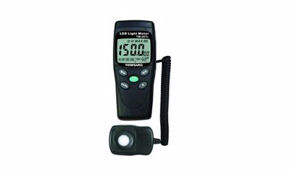
| Five-yearly | Lighting inspection: measurement of illuminance levels and comparison with UNI EN 1838 design minimums | Qualified technician with lux meter | UNI CEI 11222 |
| After every modification | Verification of layout and signage compliance | Designer / maintenance worker | UNI EN 1838 |
The annual autonomy test must be scheduled at times when the building is lightly occupied, because at the end the batteries will be discharged and will require up to 24 hours to become efficient again. In autonomous systems, it is advisable to test luminaires in alternating groups, so as to never leave an entire area without protection.
The emergency lighting inspection logbook
The logbook is the document that demonstrates, in the event of an inspection or incident, that the emergency lighting system has been checked. It must contain: commissioning date, list and position of luminaires, date and outcome of every check, faults found and corrective interventions, battery and lamp replacements, name and signature of the person who performed the operations. With centralized self-testing systems, much of this information is recorded automatically and can be exported in digital format.
How to verify the effectiveness of installed emergency lights
For an RSPP, the key question is: how do I know that the emergency lights would truly work? Complete verification is based on three checks: operation (do they all turn on when the mains fails?), autonomy (do they stay on for the entire declared duration?), and lighting performance (do they guarantee the minimum lux at the planned points?). This last check is carried out in the dark, with a lux meter placed on the floor along the center line of the escape routes and at emphasis points, and with vertical measurements on fire-fighting equipment.
Signs of emergency light malfunction
- Status indicator off, red, or flashing abnormally.
- Luminaire that turns on in emergency but turns off before the end of autonomy.
- Light sensibly weaker than other luminaires.
- Battery swollen, oxidized, or hot to the touch.
- Luminaire that turns on in emergency even with mains present (possible detection circuit fault).
- Diffuser yellowed, broken, or covered in dust.
- Exit signs barely legible or hidden by furniture and setups.
Tools for emergency lighting maintenance
| Tool | What it is used for |
|---|---|
| Lux meter (adequate class, measures from 0.1 lx) | Verification of illuminance levels |
| Luminance meter | Verification of sign luminance |
| Multimeter / clamp ammeter | Verification of voltages, currents, battery status |
| Stopwatch | Measurement of intervention times and autonomy |
| Inhibition remote control or test central unit | Management of tests and rest mode |
| Supervision software | Reading of self-test results |
| Logbook (paper or digital) | Documentation of interventions |
How to reduce downtime in case of failure
Three strategies make a difference: keep a small stock of batteries and spare luminaires of the installed models in the warehouse, adopt luminaires with a replaceable battery without dismantling the entire body, and use systems with self-testing that signal the fault at the very moment it occurs, instead of discovering it at the monthly check. For LED lines with emergency kits, having the converter in an accessible compartment reduces the intervention to a few minutes.
Replacement and updating of emergency lights
Best practices for replacement are: replace batteries according to the declared useful life or at the first negative outcome of the autonomy test, replace the entire luminaire if it is over 10–12 years old or uses obsolete fluorescent sources, standardize models to simplify spare parts and training, and seize the opportunity of every replacement to verify compliance with UNI EN 1838:2025.

12. Emergency lighting costs, retrofit, and optimization
Talking about costs is always delicate, because they vary greatly by geographic area, building complexity, and technical choices. However, we can provide orders of magnitude useful for setting a budget and comparing alternatives, distinguishing between purchase, installation, and management costs.
How much emergency lighting costs: orders of magnitude
| Item | Indicative order of magnitude | Notes |
|---|---|---|
| Autonomous LED luminaire for escape routes | from a few tens to over a hundred euros | Increases with self-testing, high IP, dedicated optics |
| Illuminated exit sign | from a few tens of euros upwards | Depending on viewing distance |
| Centralized central power supply | from a few thousand euros | Plus dedicated distribution network |
| Installation per light point | variable based on height and accessibility | Higher at height and in suspended ceilings |
| Periodic checks | annual contract by fee or per point | Reduced by self-testing |
| Battery replacement | periodic, every 4–5 years for Ni-Cd/Ni-MH | Spaced out with LiFePO4 |
The values are indicative and serve only to guide comparison: for a reliable quote, a site visit and a project are necessary.
How to reduce installation and maintenance costs
For a construction company, the greatest savings come from integrated design: planning the correct power lines, compartments for emergency kits, and luminaire positions from the outset avoids costly modifications at the end of the works. Other levers are the use of combined luminaires that perform both ordinary and emergency functions, self-testing that cuts verification costs, standardization of models, and the choice of long-life batteries.
How to update existing emergency lighting systems
Many buildings still have luminaires with fluorescent tubes and Ni-Cd batteries installed 15 or 20 years ago. Retrofitting involves replacement with LED luminaires, which consume less, have smaller batteries, and last longer, accompanied by a layout verification against UNI EN 1838:2025. It is also the opportunity to introduce self-testing and, where the renovation allows, to replace visible ceiling lights with LED light lines integrated into profiles, equipped with emergency kits.
13. Advantages, data, and importance of emergency lighting
We have seen regulations, numbers, and procedures. But why invest well in emergency lighting, beyond simple regulatory compliance? The reasons are related to safety, legal, economic, and reputational aspects.
Protection of people and accident prevention
In the event of a fire, earthquake, or simple blackout, the difference between an orderly evacuation and an accident is often made by light. A well-designed safety lighting system reduces evacuation times, prevents falls on stairs, and allows operators to safely stop machines. Lighting risk, i.e., the risk linked to the sudden absence of light, is one of the cross-cutting risks that the DVR must always consider.
Regulatory compliance and legal protection
A compliant and documented system protects the employer, the person in charge of the activity, and the professional in the event of an inspection by supervisory bodies or an incident. The lack or inefficiency of safety lighting can constitute violations of Legislative Decree 81/08 and fire regulations, with sanctioning consequences and, in the most serious cases, criminal ones.
Ledpoint data: what users search for regarding emergency lighting
To build this guide, we analyzed Italian market search data related to the sector. The result photographs a very concrete demand, oriented towards the product and the standard.
| Search | Average monthly volume (Italy) | Prevalent intent |
|---|---|---|
| emergency light bulbs | 5,400 | Purchase and information |
| emergency lamps | 3,600 | Purchase and information |
| emergency lights | 2,900 | Purchase |
| wall emergency lamp | 1,300 | Purchase |
| emergency light | 1,300 | Purchase and information |
| emergency lights | 880 | Information |
| led emergency lamp | 880 | Purchase and information |
| emergency lighting | 390 | Information |
| lux lumen | 390 | Information |
| battery led strips | 1,900 | Information |
Source: Ledpoint elaboration on keyword research data of the Italian market, 2026.
The most interesting datum is the growing interest in battery-powered LED solutions and in understanding the difference between lux and lumen: users are not just looking for a product, but want to understand how to size it. This is exactly the approach we have followed in this guide.
Advantages of LED in emergency lighting
| Advantage | Practical effect |
|---|---|
| Efficiency up to 150 lm/W and beyond | Smaller batteries for the same autonomy or more light for the same battery |
| Instantaneous ignition | Ideal for high-risk areas (0.5 s) |
| Long source life | Maintenance concentrated on the battery only |
| Reduced dimensions | Integration into profiles, furniture, suspended ceilings |
| No mercury | Simpler disposal compared to fluorescents |
| Precise optics | Greater spacing and fewer luminaires |
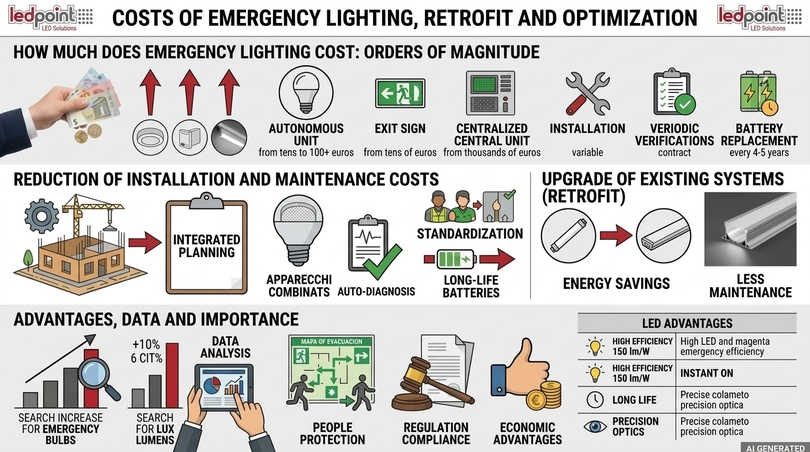
14. Innovative technologies and future trends in emergency lighting
Emergency lighting is undergoing a profound transformation, driven by LEDs, digital electronics, connectivity, and new standards. For the electrical engineer and the safety manager, knowing these trends means designing systems that will remain current for the next 10–15 years.
Smart emergency lighting and self-testing
Smart emergency lighting is based on luminaires that test themselves, communicate their status, and can be managed remotely. The most advanced systems use the DALI-2 protocol with the emergency-specific part (IEC 62386-202), wireless mesh networks, or cloud solutions with smartphone apps, which send notifications in case of failure and automatically generate the inspection logbook. The result is a drastic reduction in manual inspections and the certainty, at any moment, of the emergency lighting system's status. For projects with digital control of ordinary lighting, Ledpoint offers DMX and DALI decoders for LED lines.
Adaptive signage and dynamic escape routes
UNI EN 1838:2025 officially opens up to adaptive systems: signs that change indication based on the emergency scenario, connected to the fire detection system. If smoke invades a corridor, the arrow can be replaced by a prohibition sign and occupants are directed towards the alternative exit. It is one of the most significant innovations in recent years in the field of fire safety.
Emergency lighting, lithium batteries, and energy saving
LiFePO4 batteries are progressively replacing Ni-Cd: more cycles, less bulk, no toxic heavy metals. Combined with high-efficiency LED sources, they allow reducing maintenance consumption and the weight of luminaires. Energy saving does not only concern emergency: by integrating the safety function into efficient LED lines, the same source illuminates in ordinary mode with reduced consumption.
Architectural integration and linear sources
The most evident design trend is the disappearance of the emergency luminaire as a visible object. Light lines in plasterboard profiles, luminous handrails, baseboards, and illuminated steps integrate safety light into the architecture. High-efficiency LED strips and compact emergency kits, like those present in the Ledpoint catalog, are the technological enablers of this evolution.
Sensors, IoT, and building management
Emergency lighting systems are increasingly integrated with building management systems (BMS): fire detection, access control, video surveillance, people counting. Presence sensors can manage ordinary lighting and, in an emergency, the system can know which areas are still occupied and guide the evacuation. In perspective, the data collected by the luminaires becomes a predictive maintenance tool: the battery that loses capacity is replaced before it fails the test.
The future of emergency lighting in summary
| Trend | Today | Coming years |
|---|---|---|
| Diagnostics | Widespread local self-testing | Cloud monitoring and predictive maintenance |
| Communication | DALI-2, proprietary buses | Wireless mesh, native integration with BMS |
| Batteries | Transition from Ni-Cd to lithium | LiFePO4 as standard |
| Signage | Static, first adaptive solutions | Dynamic escape routes |
| Design | Compact luminaires | Emergency integrated into light lines and furniture |
| Standards | UNI EN 1838:2025, CEI EN 50172:2024 | Greater digitalization of logbooks and checks |
15. Operational checklists by professional profile
To conclude the technical part, we have gathered the typical questions of the various professionals who deal with emergency lighting, with the priority actions for each.
| Profile | Key question | Priority actions |
|---|---|---|
| Safety Manager (RSPP) | Is my system compliant with the latest regulations? | Update the DVR, verify compliance with UNI EN 1838:2025, check logbook and checks, plan the lighting inspection |
| Construction entrepreneur | What is the best system for construction sites and buildings under construction? | Autonomous IP65 and portable luminaires on site, integrated design of compartments and lines in the finished building |
| Shop owner / retailer | Which products to offer to customers? | Products with EN 60598-2-22 declaration of conformity, 3 h autonomy, self-testing, integrated LED solutions for design |
| Electrical engineer | How to design efficiently and in compliance? | Classify areas, start from emphasis points, use real photometric data, apply the maintenance factor, document calculations |
| Maintenance manager | How to guarantee continuous operation? | Check calendar, spare parts stock, self-testing, scheduled battery replacement, digital logbook |
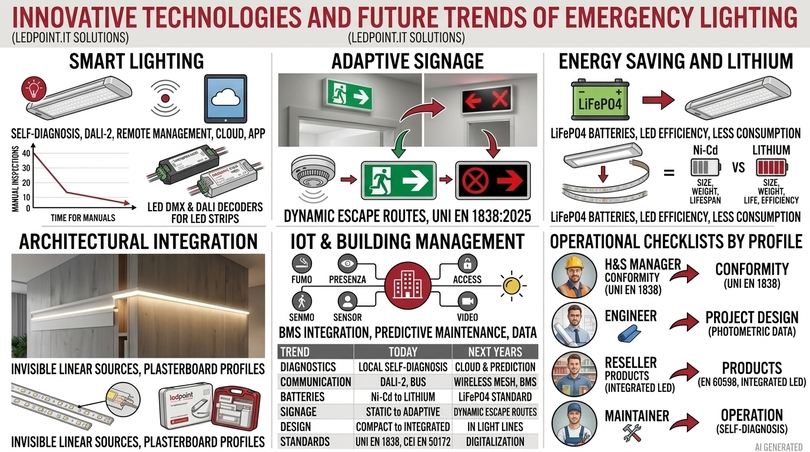
16. Frequently asked questions about emergency lighting
We have gathered the most searched questions on Google and asked to artificial intelligences about emergency lighting, with brief and direct answers. Click on each question to open the answer.
What is emergency lighting?Emergency lighting is the lighting that turns on automatically when the ordinary power supply fails. It includes safety lighting, which protects people during evacuation and the shutdown of hazardous operations, and standby lighting, which allows activities to continue. In Italy, it is regulated by UNI EN 1838:2025 and CEI EN 50172. |
What is the difference between emergency lighting and safety lighting?Emergency lighting is the general category; safety lighting is a part of it, dedicated to protecting people. The other part is standby lighting, which serves business continuity. Therefore, all safety lighting is emergency lighting, but the reverse is not true. |
What is the standard for emergency lighting?The reference lighting standard is UNI EN 1838:2025, in force since February 6, 2025, which adopts EN 1838:2024. It must be applied together with CEI EN 50172 for system design, UNI CEI 11222 for inspections and maintenance, and EN 60598-2-22 for luminaires. |
When is emergency lighting mandatory?It is mandatory in workplaces when the lack of artificial light exposes workers to risks, according to Legislative Decree 81/08, and in activities subject to fire prevention regulations according to the Fire Code and vertical technical rules. In private homes, it is not mandatory but strongly recommended for stairs and corridors. |
How many lux are required for emergency lighting?UNI EN 1838 requires at least 1 lux on the floor along escape routes, 0.5 lux in anti-panic areas, at least 15 lux and 10% of the ordinary illuminance in high-risk areas, 5 lux vertically on fire-fighting and first-aid equipment, and 5 lux on the work plane of control panels. |
How long must emergency lights last?The minimum duration required by UNI EN 1838 for escape routes and anti-panic areas is 1 hour. Many technical rules and best practices require 2 or 3 hours in buildings where people do not evacuate immediately, such as hotels and healthcare facilities. For this reason, a 3-hour autonomy is the most common choice. |
Where should emergency lamps be positioned?First, emphasis points must be covered: every emergency exit, every staircase, changes in level and direction, corridor intersections, fire-fighting equipment, first-aid points, and electrical panels. Then, intermediate sections are completed with the calculated spacing, installing the luminaires at a height of at least 2 meters. |
Where should the emergency light be connected?Autonomous luminaires must be connected to the ordinary lighting circuit of the room they protect, drawing power upstream of the switch. This way, they turn on both during a general blackout and if the single circuit protection trips, but they do not drain the battery when the light is turned off normally. |
Who must check the emergency lights?Responsibility lies with the employer or the person in charge of the activity. Visual checks can be carried out by trained internal staff, while functional tests, autonomy tests, lighting inspections, and maintenance must be performed by competent personnel and, for fire protection systems, by qualified technicians according to the Ministerial Decree of September 1, 2021. |
How often should emergency lights be checked?Frequent visual checks of the indicators, a monthly functional test, an annual full autonomy test, and a lighting inspection with lux measurement every five years are required, according to CEI EN 50172 and UNI CEI 11222. Every check must be recorded in the inspection logbook. |
What is centralized emergency lighting?It is a system in which a single central power supply system, compliant with EN 50171, powers all emergency lighting luminaires in the building via a dedicated network. It concentrates batteries in one room, simplifies maintenance and monitoring, but requires a higher initial investment and a protected distribution network. |
What is meant by a central power supply system in safety lighting installations?The central power supply system is the centralized power unit that, in the event of a mains failure, supplies energy to the safety lighting luminaires through batteries and an inverter. It must comply with EN 50171, be installed in a protected room, and undergo periodic checks like the rest of the emergency lighting system. |
Can I use an LED strip as an emergency light?Yes, by pairing it with an emergency power kit like the Ledpoint one with a LiFePO4 battery and 3-hour autonomy, which keeps the strip lit up to 5 W when the mains fails. For use in escape routes of regulated activities, the designer must verify the compliance of the assembly with product standards and UNI EN 1838. |
How many lumens should an emergency lamp have?It depends on height, optics, and spacing. For environments 2.5–3.5 m high, luminaires with 100 to 400 lumens in emergency mode are typically used; for industrial heights, higher fluxes or intensive optics are required. The data to verify is the declared emergency flux and the photometric curve, not just the power. |
What changes with the new UNI EN 1838:2025?The new edition extends requirements to the width of escape routes, introduces local area lighting for restrooms, technical rooms, and panels, requires 5 lux vertically on fire-fighting and first-aid equipment, allows adaptive signs, and mandates a maintenance factor calculated according to ISO/CIE TS 22012. |
What emergency lighting is required in an elevator?EN 81-20 requires an emergency lighting system in the cabin with an automatically rechargeable reserve power supply, capable of guaranteeing about 5 lux on the alarm device and in the cabin for at least one hour, so that the passenger can activate the alarm and await rescue with visibility. |
17. An emergency lighting system that truly works
Emergency lighting is one of those systems that you hope to never have to use, but which must work perfectly in the only moment it is needed. We have seen that the regulatory framework is clear and recently updated: UNI EN 1838:2025 defines the lighting requirements, CEI EN 50172 the system, UNI CEI 11222 the checks, EN 60598-2-22 the products, while Legislative Decree 81/08 and the Fire Prevention Code establish when the emergency lighting system is mandatory.
The numbers to remember are few but decisive: 1 lux on escape routes, 0.5 lux in anti-panic areas, 15 lux and 10% of ordinary in high-risk areas, 5 lux vertically on equipment, at least 1 hour of autonomy and preferably 3. Sizing starts from emphasis points and is completed with calculation; maintenance relies on monthly checks, annual tests, five-yearly lighting inspections, and an always-updated logbook.
LED technologies, LiFePO4 batteries, self-testing, and adaptive systems are making emergency lighting more reliable, cheaper to manage, and integrable into architecture. With Ledpoint LED strips, aluminum profiles, and the emergency power kit with 3-hour autonomy, you can transform a design light line into a safety light, without additional visible luminaires.
Do you have a project to verify or want to understand which combination of strip, profile, and kit is most suitable for your building? Consult the Ledpoint emergency lighting category, download our technical catalogs or request a quote from our technical office: we will help you size the solution and choose the right components. For further insights, visit the Ledpoint blog and the guide to 48V LED strips, ideal for long light lines with a single power point.
Disclaimer: the indications in this guide have a technical-informative character and do not replace the project of an authorized professional, the employer's risk assessment, nor the official text of the cited standards, which must always be consulted in its current edition.