






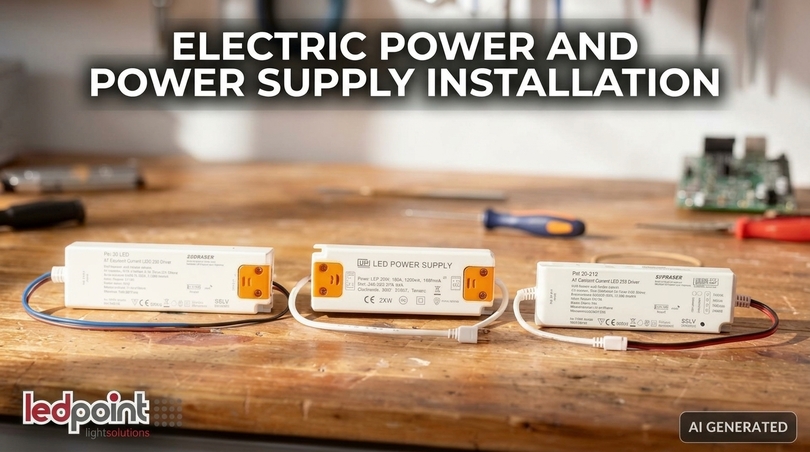
Electrical power and power supply installation
Electrical power is the amount of energy a circuit transfers or absorbs in one second: it is measured in watts (W) and calculated with the formula P = V × I, i.e. voltage times current. For an LED strip, the total electrical power is obtained by multiplying the watts per metre by the installed length; the power supply must then be chosen with a margin of 20–30% extra.
Anyone designing a lighting system with LED strips sooner or later faces the same question: how many watts are really needed? The answer always goes through electrical power, the concept that links voltage, current, energy consumed and cost on the bill. In this guide we start from the basics of physics, move on to the formulas for electrical power in direct current, single-phase and three-phase, and apply them step by step to choosing and installing the LED power supply.
You will find worked examples, conversion tables, an interactive configurator to calculate the power supply power for Ledpoint products, the rules for safe wiring and a troubleshooting section to solve flickering, shutdowns and brightness drops. The goal is simple: to give you all the tools to size an LED system correctly on the first try, whether it is a home kitchen, a shop window or an architectural project.
In this article...
1. Who this guide is for
Electrical power is a topic that interests very different people: the student who has to review the formulas, the private individual who wants to light the kitchen with an LED strip, the electrician who has to wire a shop, the designer working on a hotel or a museum. Each starts from different questions, but they all arrive at the same point: understanding how much electrical power is needed, how to calculate it and how to turn it into a safe and long-lasting system. That is why we have organised the guide so that each person can immediately find their own path.
| Profile | Typical question | Recommended sections |
|---|---|---|
| Private individual / DIY enthusiast | "Which power supply should I buy for 5 metres of LED strip?" | 8, 9, 12 |
| Electrician / installer | "What cable cross-section should I use? How do I avoid voltage drop?" | 10, 12, 13 |
| Designer / architect / lighting designer | "How much installed electrical power do I have per square metre? How do I manage DALI and dimming?" | 5, 6, 10, 14 |
| Student / trainee technician | "What is the electrical power formula? How is it calculated in three-phase?" | 2, 3, 4, 6, 7, 11 |
| Purchasing manager / facility manager | "How much does the system consume in a year and how much does it cost?" | 5, 7, 11 |
Whatever your profile, we recommend reading at least sections 2 and 4: they are the foundations on which everything else rests, and in a few minutes they allow you to reason in watts, volts and amperes with the same confidence as a technician.
2. What electrical power is: definition and simple explanation
Before talking about power supplies and LED strips we must clarify what we mean by power. In everyday language "powerful" means "strong", but in physics the term has a precise meaning, linked to time. It is precisely this temporal dimension that makes electrical power so useful in practice: it tells us not only how much energy is involved, but how quickly it is transferred.
Power in physics: work, energy and time
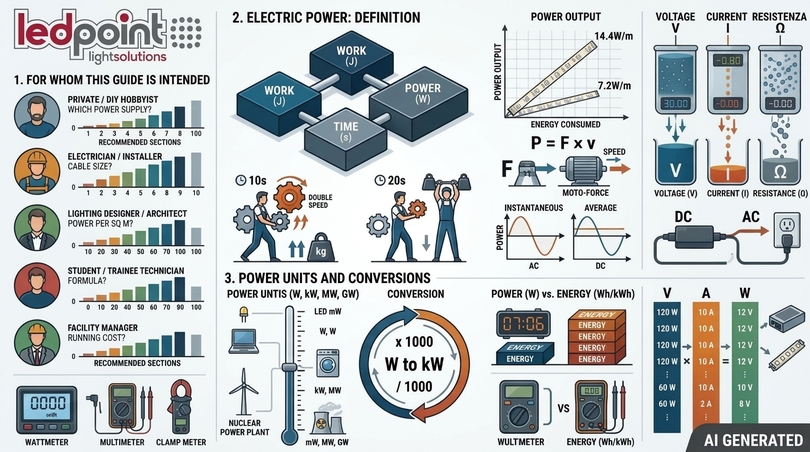
In physics, power is defined as the ratio between the work done (or the energy transferred) and the time taken to do it. The fundamental formula for power is:
P = L / t or P = E / t
where P is the power in watts, L the work in joules, E the energy in joules and t the time in seconds. Hence the answer to the question "what does power equal?": power equals the energy transferred per unit of time. It is a scalar quantity, i.e. described by a single number without direction, and it tells us how quickly a system does work.
Let's take an intuitive example. Two people lift the same bucket of water to the first floor: the work done is identical, because the weight and the height are identical. But if one takes 10 seconds and the other 20, the first has developed twice the power. The same applies to circuits: a 14.4 W/m LED strip consumes twice the energy of a 7.2 W/m one in an hour, because it converts electrical energy into light and heat at twice the rate.
Mechanical power: P = F × v
When a force sets a body in motion, mechanical power is calculated as the product of force and speed: P = F × v, or more generally P = F × v × cosθ, where θ is the angle between the direction of the force and that of the displacement. It is the formula used for a motor, a car or a lift. We mention it because it helps to understand the concept: power is always "something that pushes" multiplied by "how fast it moves". In electrical power, the role of force is played by voltage and that of speed by current.
Average power and instantaneous power
Average power is calculated over the entire time interval (total energy divided by total time), while instantaneous power is the value at a precise instant, mathematically the derivative of energy with respect to time: p(t) = dE/dt. In direct current, such as at the output of a 24V power supply feeding an LED strip at fixed brightness, the two coincide. In alternating current, on the other hand, instantaneous power oscillates 100 times per second (at 50 Hz) and what matters for consumption is the average value: we will see this in section 6.
Definition of electrical power
Now we can give the definition of electrical power rigorously: electrical power is the electrical energy that a component absorbs or delivers per unit of time. When electrical charges move through a potential difference (the electrical voltage), they exchange energy with the circuit. If this exchange happens quickly, the electrical power is high; if it happens slowly, it is low.
Simple explanation, for those who don't like formulas: imagine a water pipe. The water pressure is the voltage (volts), the amount of water passing each second is the current (amperes), and the overall "strength" of the jet, i.e. how much water arrives with how much push, is the electrical power (watts). The higher the pressure or the greater the flow, the greater the electrical power available. An LED power supply is like a pump: it must guarantee the right pressure (the strip's voltage) and sufficient flow (the current) for all the connected LEDs.
What power is in electrical engineering and electronics
In electrical engineering, electrical power is the tool with which lines, protections, transformers and meters are sized. In electronics it is the parameter that determines how much heat a component must dissipate: every resistor, transistor or LED has a maximum power beyond which it is damaged. In the world of LED lighting both perspectives coexist: the electrical power of the strip determines how much light we get and how much heat we must dissipate, while the electrical power of the power supply determines how many metres we can connect safely.
What electric current, voltage and the volt are
Three quantities recur in every electrical power calculation, and it is useful to fix them immediately:
- Voltage (V): the potential difference between two points, measured in volts. The volt is the unit that indicates how much energy (in joules) each coulomb of charge receives as it passes through the circuit: 1 V = 1 J/C. It is the "push" that makes charges move. Ledpoint LED strips work at 5, 12, 24, 48 or 230 volts.
- Current (I): the amount of charge that passes through a conductor every second, measured in amperes. Electric current (or current intensity) is what heats cables and determines their minimum cross-section.
- Resistance (R): the opposition a material offers to the passage of current, measured in ohms (Ω). According to Ohm's law, V = R × I.
What is direct current? It is the current that always flows in the same direction with a constant value: it is the one that comes out of a 12V or 24V LED power supply, or from a battery. Alternating current, on the other hand, periodically reverses its direction (50 times per second in Europe) and is the one of the 230V household mains. The LED power supply is precisely the device that converts the alternating current of the mains into low-voltage direct current, suitable for LEDs.
3. Units of measurement of electrical power: watts, kW and conversions
Knowing how to read and convert units of measurement is the first step to avoiding calculation errors. Many mistakes arise from a simple swap between watts and watt-hours, or between kW and kWh, which look similar but measure completely different quantities. In this section we set things straight once and for all, with ready-to-use tables.
The watt: SI unit of power
The unit of measurement of electrical power in the International System is the watt (symbol W), in honour of the Scottish engineer James Watt. What does 1 W equal? One watt equals one joule of energy transferred in one second (1 W = 1 J/s), and in electrical terms one volt times one ampere (1 W = 1 V × 1 A). What is W in physics, then? It is the symbol for the watt; be careful, however, because in many school textbooks the letter W (or L) also indicates work, measured in joules. The context always clarifies the meaning.
The watt is a small unit: for this reason in practice its multiples are often used. An LED strip is measured in watts per metre (W/m), a power supply in watts, a household appliance in kilowatts, a power plant in megawatts.
Multiples, submultiples and conversions
| Unit | Symbol | Equivalent in watts | Practical example |
|---|---|---|---|
| milliwatt | mW | 0.001 W | Single low-current SMD LED |
| watt | W | 1 W | 1 metre of 4.8 W/m LED strip ≈ 5 W |
| kilowatt | kW | 1,000 W | Standard household contract: 3 kW |
| megawatt | MW | 1,000,000 W | Large ground-mounted photovoltaic plant |
| gigawatt | GW | 1,000,000,000 W | Large thermoelectric power plant |
| horsepower (metric) | CV | ≈ 735.5 W | Power of engines and vehicles |
| horsepower | hp | ≈ 745.7 W | Anglo-Saxon unit for engines |
How are kW calculated? Simply divide the watts by 1,000: 2,500 W = 2.5 kW. Conversely, to go from kW to watts multiply by 1,000. And a megawatt is how many watts? One million. Metric horsepower is a historical unit, still used for engines and cars: 1 CV ≈ 0.7355 kW, so a 100 CV engine develops about 73.5 kW of mechanical power.
What difference there is between watt and kW, between watt and watt-hour
Between watt and kW there is only a factor of one thousand: they are the same quantity, electrical power, expressed on different scales. Between watt and watt-hour (Wh), on the other hand, the difference is substantial: the watt measures a power (a speed), the watt-hour measures an energy (a quantity). It is the same difference that exists between km/h and km. A 50 W LED strip switched on for 2 hours consumes 100 Wh, i.e. 0.1 kWh. We will explore the link between energy and electrical power in section 5.
Volt, ampere and watt: the table of relationships
The searches "watt ampere volt", "from volt to watt" or "1 watt how many amperes are" all have the same answer: it depends on the voltage. One watt does not correspond to a fixed number of amperes, because current is obtained by dividing electrical power by voltage: I = P / V. Here is a practical table referring to the voltages of Ledpoint power supplies:
| Electrical power | Current at 5V | Current at 12V | Current at 24V | Current at 48V | Current at 230V |
|---|---|---|---|---|---|
| 1 W | 0.20 A | 0.083 A | 0.042 A | 0.021 A | 0.004 A |
| 30 W | 6.0 A | 2.5 A | 1.25 A | 0.63 A | 0.13 A |
| 60 W | 12.0 A | 5.0 A | 2.5 A | 1.25 A | 0.26 A |
| 100 W | 20.0 A | 8.3 A | 4.2 A | 2.1 A | 0.43 A |
| 150 W | 30.0 A | 12.5 A | 6.25 A | 3.1 A | 0.65 A |
| 240 W | 48.0 A | 20.0 A | 10.0 A | 5.0 A | 1.04 A |
Notice how, for the same electrical power, the current halves when going from 12V to 24V and halves again at 48V. This is why long installations are designed at higher voltage: less current means thinner cables, less heat and less voltage drop. A very common search is also "12V 10A power supply": its electrical power is simply 12 × 10 = 120 W.
How electrical power is measured
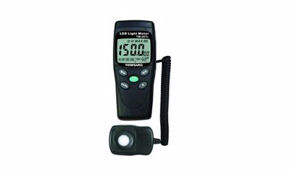
Electrical power is measured with a wattmeter, an instrument that simultaneously detects voltage and current and calculates their product. In the home, plug-in meters are used, inserted between socket and appliance; in electrical panels, DIN-rail meters are installed; for in-depth analysis, network analysers are used that also measure reactive power and power factor. Alternatively, with an ordinary multimeter you can measure voltage and current separately and then multiply them: in direct current, P = V × I is an exact measurement; in alternating current the cosφ is also needed. For measurements on the LED side, a multimeter and a clamp meter are sufficient. The household meter, finally, measures energy (kWh) and also shows the instantaneous power drawn.
4. Electrical power formulas and inverse formulas
The formulas for electrical power are few and all derive from two relationships: the definition P = V × I and Ohm's law V = R × I. Once this link is understood, there is no need to memorise them parrot-fashion: they can be reconstructed in a few seconds. In this section we look at them one by one, with the inverse formulas to derive current, voltage and resistance.
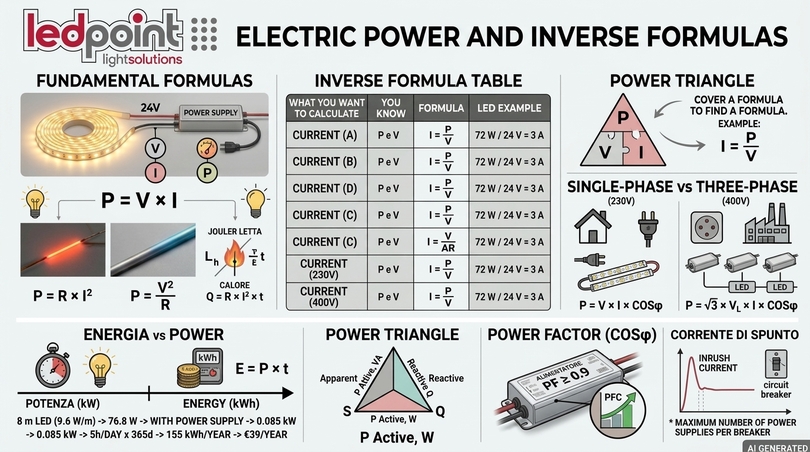
The fundamental formula: P = V × I
What is the formula for electrical power? It is the simplest of all:
P = V × I
Electrical power in watts equals voltage in volts multiplied by current in amperes. This formula always applies in direct current, so it is the one used at the output of a power supply for LED strips. Example: a 24V power supply delivering 6.25 A provides an electrical power of 24 × 6.25 = 150 W.
The formulas with resistance: P = R × I² and P = V² / R
By substituting Ohm's law into the basic formula, we obtain two other expressions of electrical power, very useful when the resistance is known:
- P = R × I²: used to calculate the power dissipated as heat by a conductor carrying current. It is the formula of the Joule effect and explains why a cable that is too thin heats up: the power lost grows with the square of the current.
- P = V² / R: used when the voltage applied to a resistive load is known, for example a heating resistor.
What does Joule's law say? That the heat produced in a conductor is proportional to its resistance, to the square of the current and to the time: Q = R × I² × t. This is why doubling the current in a cable quadruples the losses. Keep this in mind when choosing the voltage of the LED system: at 12V the current is double that at 24V and the losses on the cables are four times greater.
Inverse formulas: current intensity, voltage and resistance
The inverse formulas serve to derive one quantity when the other two are known. They are the ones searched for with "current intensity formula", "how electrical voltage is calculated" or "inverse electrical power formula":
| What you want to calculate | You know | Formula | LED example |
|---|---|---|---|
| Electrical power (W) | V and I | P = V × I | 24 V × 5 A = 120 W |
| Electrical power (W) | R and I | P = R × I² | 0.1 Ω × (10 A)² = 10 W lost on the cable |
| Electrical power (W) | V and R | P = V² / R | (12 V)² / 1.2 Ω = 120 W |
| Current (A) | P and V | I = P / V | 72 W / 24 V = 3 A |
| Current (A) | V and R | I = V / R | 12 V / 4 Ω = 3 A |
| Current (A) | P and R | I = √(P / R) | √(36 W / 4 Ω) = 3 A |
| Voltage (V) | P and I | V = P / I | 144 W / 6 A = 24 V |
| Voltage (V) | R and I | V = R × I | 0.05 Ω × 8 A = 0.4 V drop |
| Resistance (Ω) | V and I | R = V / I | 12 V / 3 A = 4 Ω |
A trick to remember them is the "power triangle": P at the top, V and I at the bottom. By covering with a finger the quantity you are looking for, the other two show you the operation to perform. If you cover P you see V next to I (multiplication), if you cover I you see P above V (division). The most used current formula in LED design is I = P / V, because it immediately tells you how many amperes the power supply must withstand and what cross-section the cables must have.
Electrical power formula in single-phase alternating current
In alternating current the electrical power formula gains a term, the power factor cosφ:
P = V × I × cosφ
where V and I are the effective (RMS) values of voltage and current. For purely resistive loads, such as an electric heater, cosφ = 1 and the formula becomes identical to the one in direct current. For loads with inductive or electronic components, such as motors or power supplies, the cosφ is less than 1. We discuss this in detail in section 6, together with the three-phase formula.
Three-phase electrical power formula
In three-phase systems, typical of companies, large shops and industrial plants, the formula for calculating three-phase electrical power is:
P = √3 × VL × I × cosφ
where VL is the line-to-line voltage (400 V in Italy), I the line current and √3 ≈ 1.732. Example: a three-phase load drawing 10 A with cosφ = 0.95 has an electrical power of 1.732 × 400 × 10 × 0.95 ≈ 6.58 kW. For LED lighting, three-phase matters above all in large systems, where power supplies are distributed in a balanced way across the three phases.
5. Energy and electrical power: kW, kWh and consumption
Energy and electrical power are continually confused, even on bills. Yet the distinction is simple and, once clarified, allows you to calculate precisely how much it costs to keep an LED installation switched on. In this section we answer the most searched question on the subject: 1 kW how many kWh is it?
What difference there is between energy and power
Electrical power is the speed at which energy is used; energy is the total quantity used in a certain time. What link exists between energy and power? Energy is the product of power times time: E = P × t. Consequently, if you know the energy and the time, the power is calculated as P = E / t. What is electrical energy, then? It is the ability of the system to do work thanks to the movement of charges, and it is measured in joules or, more commonly, in kilowatt-hours.
What a kWh corresponds to and 1 kW how many kWh is it
The kilowatt-hour (kWh) is the energy consumed by an appliance with an electrical power of 1 kW that stays on for one hour. In joules, 1 kWh = 3,600,000 J (1,000 W × 3,600 s). Therefore 1 kW is not "equal to" a number of kWh: 1 kW maintained for 1 hour produces a consumption of 1 kWh. Maintained for 5 hours, 5 kWh. Maintained for half an hour, 0.5 kWh. The question "1 kW how many kWh is it?" therefore only makes sense if the time is specified.
| Electrical power | On time | Energy consumed |
|---|---|---|
| 1 kW | 1 hour | 1 kWh |
| 1 kW | 30 minutes | 0.5 kWh |
| 100 W | 10 hours | 1 kWh |
| 50 W (kitchen LED strip) | 4 hours a day × 365 days | 73 kWh/year |
| 300 W (shop) | 12 hours a day × 310 days | 1,116 kWh/year |
How to calculate the consumption and cost of an LED system
How is energy calculated having the power? Multiply the electrical power (in kW) by the hours of operation. To obtain the cost, multiply the energy by the price of the kWh. Here is the complete procedure:
- Electrical power of the system: sum of the W/m × metres of all strips (e.g. 8 m × 9.6 W/m = 76.8 W).
- Add the power supply losses: divide by the efficiency (e.g. 76.8 / 0.90 ≈ 85 W drawn from the mains).
- Convert to kW: 85 W = 0.085 kW.
- Multiply by the annual hours: 0.085 kW × 5 h × 365 = 155 kWh/year.
- Multiply by the energy price: with an indicative price of €0.25/kWh, the cost is about €39 per year.
This calculation shows why LEDs are so convenient: 8 metres of continuous linear light cost less than 40 euros a year in energy, with 5 hours of daily switching on. Our configurator (section 9) performs this calculation automatically. To explore the relationship between efficiency and consumption you can read our guide on energy efficiency classes and calculation method.
Contracted power, available power and the household meter
Italian household bills show two electrical power values. The contracted power is the one signed in the contract, typically 3 kW; the available power is the one actually drawable before the meter trips, normally 10% higher (3.3 kW for a 3 kW contract), with a further tolerance for short periods. How is the meter power you need calculated? By adding up the electrical power of the appliances that can operate simultaneously. What cost difference is there between 3 kW and 4.5 kW or 6 kW? The power quota on the bill changes, which is proportional to the kW contracted, in addition to a one-off contribution for the change: the updated values are published by ARERA.
Good news for those installing LEDs: LED lighting has very little impact on contracted power. Even a generous household system, with 20 metres of 14.4 W/m strips, reaches about 290 W, less than 10% of a 3 kW contract. How many amperes does household current have? With a 3 kW contract at 230 V, the maximum continuous current is about 3,300 / 230 ≈ 14.3 A.
6. Power in alternating current: single-phase, three-phase and cosφ
The LED power supply lives between two worlds: at its input it receives alternating current at 230V, at its output it provides low-voltage direct current. To choose a power supply well and understand its datasheets you need to know at least the basics of power in alternating current. Don't worry: we explain them with concrete examples, without complex calculations.
Active, reactive and apparent power
In alternating current, electrical power is broken down into three quantities:
- Active power (P), in watts (W): it is the power actually transformed into light, heat or mechanical work. It is the one you pay for on the bill.
- Reactive power (Q), in volt-amperes reactive (VAR): it is the power that oscillates back and forth between mains and load to magnetise inductances or charge capacitors, without producing useful work. What is Q power? It is precisely this.
- Apparent power (S), in volt-amperes (VA): it is the product of effective voltage and current, S = V × I. What is apparent power for? For sizing cables, transformers and uninterruptible power supplies, because the actual current flowing through them depends on S, not only on P.
The three powers are linked by the "power triangle": S² = P² + Q². This is why an uninterruptible power supply (UPS) is rated in VA and not in W: it must withstand the total current, including the reactive component.
The power factor (cosφ) and the PFC of power supplies
The power factor is the ratio between active and apparent power: PF = P / S. A PF of 1 means that all the current drawn produces useful work; a PF of 0.5 means that to obtain the same work you draw twice the current. Quality LED power supplies integrate a PFC (Power Factor Correction) circuit that brings the power factor above 0.9 for the larger sizes, reducing line currents, harmonic disturbances and stress on the system.
When you consult a power supply's datasheet, look for "PF" or "Power Factor": a value ≥ 0.9 at full load indicates a well-designed product. Note: the PF of a power supply drops when it operates at a very reduced load. This is also why it is not advisable to oversize the power supply excessively: a 300 W model feeding 40 W works outside its optimum point.
Single-phase or three-phase: which electrical power to choose
Italian homes are almost always supplied single-phase at 230 V; shops, offices, hotels and warehouses often have a three-phase supply at 400 V. For LED lighting this means two things. First: LED power supplies are always connected between phase and neutral at 230 V, even in a three-phase system. Second: in a three-phase system the power supplies must be distributed in a balanced way across the three phases, so that each carries about a third of the total electrical power. The single-phase electrical power calculation uses P = V × I × cosφ; the three-phase calculation P = √3 × V × I × cosφ.
| Characteristic | Single-phase | Three-phase |
|---|---|---|
| Voltage | 230 V (phase-neutral) | 400 V line-to-line, 230 V phase-neutral |
| Electrical power formula | P = V × I × cosφ | P = √3 × V × I × cosφ |
| Typical users | Homes, small offices | Large shops, hotels, industry |
| LED power supply connection | Phase-neutral | Phase-neutral, distributed across the 3 phases |
| Typical supply electrical power | 3–6 kW | from 10 kW upwards |
Inrush current
An aspect that those installing LED power supplies must know is the inrush current: at switch-on, the input capacitors of the power supply charge and for a few milliseconds they draw a current much higher than the nominal one, even tens of amperes. If many power supplies are connected to the same line protected by a magnetothermal circuit breaker, the sum of the inrushes can trip it at switch-on. This is why datasheets indicate the maximum number of power supplies per breaker (curve B or C). In large systems, inrush limiters are used or the power supplies are split across several lines: among the power supply accessories Ledpoint you will find components dedicated to installation.
7. Efficiency, absorbed power and output power
No machine converts 100% of the energy it receives into useful energy: a part is always lost, almost always as heat. Efficiency measures precisely this effectiveness and is a decisive parameter when choosing an LED power supply, because it affects consumption, temperatures and service life. Let's see how to correctly read nominal power, absorbed power, output power and useful power.
Absorbed, output and useful power
- Absorbed power: the electrical power an appliance draws from the mains. For a power supply it is the input power at 230 V.
- Output power (or delivered): the power the appliance supplies to the load. For a power supply it is the output power at 12/24 V towards the LED strips.
- Useful power: the portion of power that produces the desired effect. For an LED it is the fraction transformed into visible light.
- Nominal power: the maximum value declared by the manufacturer for safe continuous operation. A "100 W" power supply has a nominal output electrical power of 100 W.
The efficiency formula
Efficiency (η, "eta") is the ratio between output power and absorbed power:
η = Poutput / Pabsorbed (often expressed as a percentage)
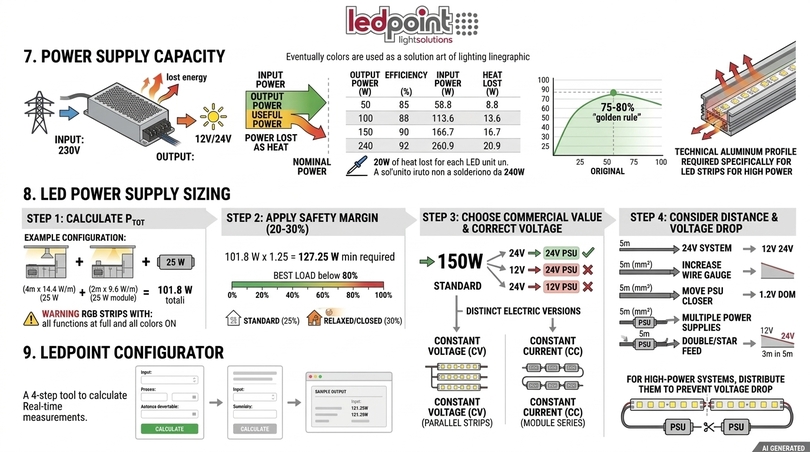
The difference between the two is the power lost: Plost = Pabsorbed − Poutput. How is useful power calculated? By multiplying the absorbed power by the efficiency. A modern good-quality LED power supply typically has an efficiency between 85% and 94%, depending on the size: smaller models tend to have lower efficiencies, high-power ones higher.
| Power output to LEDs | Efficiency | Power absorbed from the mains | Power lost as heat |
|---|---|---|---|
| 50 W | 85% | 58.8 W | 8.8 W |
| 100 W | 88% | 113.6 W | 13.6 W |
| 150 W | 90% | 166.7 W | 16.7 W |
| 240 W | 92% | 260.9 W | 20.9 W |
Those lost watts become heat inside the power supply: this is why ventilation is so important. A 240 W power supply closed in a compartment without air must dissipate over 20 W of heat, as much as a small soldering iron left on permanently.
Efficiency and load curve
Efficiency is not constant: it varies with the load. Most switching power supplies reach maximum efficiency between 50% and 90% of the nominal power, while below 20–30% load the efficiency drops significantly. This confirms the golden rule: making the power supply work at around 75–80% of its nominal power is the ideal compromise between efficiency, temperature and service life.
Electrical power and thermal power: where the energy goes
Every watt that does not become light becomes heat. In modern LEDs, a significant part of the absorbed electrical power is still transformed into heat on the board (PCB), which must be dissipated through the support. This is why, on medium-high power strips, mounting in an aluminium profile is not an aesthetic whim, but a technical necessity: the aluminium acts as a heat sink and keeps the LEDs at a temperature that preserves luminous flux and service life. The relationship between thermal power and electrical power is direct: in steady state, the thermal power to be dissipated equals the absorbed electrical power minus the power emitted as luminous radiation.
8. LED power supply power: the 4-step method
We have reached the practical heart of the guide. Correct sizing of the power supply power is the first step towards a reliable LED system: an undersized power supply causes flickering, overheating and premature failures, while an excessively oversized one wastes energy and money and works with lower efficiency. The procedure that follows, tested on thousands of installations, is divided into four steps to be followed always in the same order.
Step 1: calculate the total load power (Ptot)
Determining the exact consumption of all the LED components in the system is essential to correctly size the electrical power. The starting datum is always the strip's datasheet, which reports the power in watts per metre (W/m). Ledpoint organises its catalogue precisely on this parameter, from 4.8 W/m LED strips for mood lighting to 24 W/m LED strips and above for main lighting; you will find all the ranges in the LED strips by power category.
Basic formula for LED strips:
Ptot (W) = power per metre (W/m) × total length (m)
For individual LED modules:
Ptot (W) = power per module (W) × number of modules
Practical example: kitchen lighting
- 4 metres of LED strip under wall units: 14.4 W/m
- 2 metres of LED strip inside the extractor hood: 9.6 W/m
- 1 linear module above the worktop: 25 W
Calculation: (4 m × 14.4 W/m) + (2 m × 9.6 W/m) + 25 W = 57.6 W + 19.2 W + 25 W = 101.8 total watts.
Watch out for multicolour strips: for RGB, RGBW and CCT LED strips the declared power is normally that with all channels on at maximum. Always size the power supply on the worst case, even if in practice you will often use only one colour.
Step 2: apply the safety margin (20–30%)
A power supply working at 100% of its nominal power overheats, drastically reducing its useful life and increasing the risk of failure. The margin also compensates for production tolerances of the strips, high ambient temperatures and ageing of components.
Formula: Pminimum power supply = Ptot × 1.25 (or × 1.30 in hot or enclosed environments)
Continuing the example: 101.8 W × 1.25 = 127.25 minimum watts required.
In other words, the load should not exceed 80% of the power supply's nominal power. Use a 20% margin in normal, well-ventilated conditions, 25% as the standard choice, 30% in false ceilings, closed furniture, environments with temperatures above 35 °C or when the system stays on for many hours a day.
Step 3: choose the commercial value and the correct voltage
Among the standard commercial values (for example 30 W, 50 W, 75 W, 100 W, 150 W, 200 W, 300 W) you select the one immediately above the calculated power.
In our example: choose a 150 W power supply.
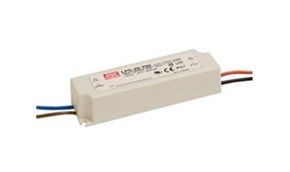
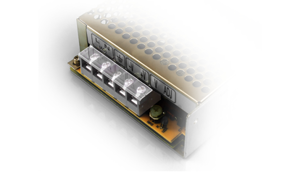
Mind the voltage: check that the output voltage corresponds exactly to that of all the connected strips and modules. A 12V strip connected to a 24V power supply burns out in a few seconds; a 24V strip connected to 12V stays off or almost off. For projects with mixed voltages, separate power supplies are needed. In the Ledpoint catalogue you will find power supplies divided by voltage: 5V power supplies, 12V power supplies, 24V power supplies and 48V power supplies.
Constant voltage or constant current?
Traditional LED strips are powered at constant voltage (CV): the power supply keeps the voltage fixed (e.g. 24V) and the strip draws the current it needs. Some modules and power LEDs instead require a constant current (CC) power supply, which keeps the current fixed (e.g. 350 mA, 700 mA) and lets the voltage vary. They are not interchangeable: always check the product datasheet. For these loads Ledpoint offers a dedicated category of constant current power supplies.
Step 4: consider distance and voltage drop
For distances greater than 3–4 metres between the power supply and the first LED point, the voltage drop becomes significant, especially at 12V, and may require greater attention in choosing cables and positioning. The voltage drop on a direct current line is calculated as follows:
ΔV = (2 × L × I × ρ) / S
where L is the cable length in metres (multiplied by 2 because the current goes and returns), I the current in amperes, ρ the resistivity of copper (about 0.0175 Ω·mm²/m) and S the cross-section in mm². Example: 5 metres of 1.5 mm² cable carrying 8.3 A (100 W at 12V) generate a drop of 2 × 5 × 8.3 × 0.0175 / 1.5 ≈ 0.97 V, i.e. 8% of 12V: definitely too much. At 24V the current halves and the drop falls to 0.48 V, i.e. 2%.
Solutions
- Use a 24V system: for the same power, it carries half the current, halving the voltage drop. For even longer runs consider 48V LED strips (see the dedicated article on the characteristics of 48V LED strips).
- Increase the cable cross-section: for example 1.5 mm² or 2.5 mm² instead of 0.75 mm². Ledpoint cables are available in various cross-sections.
- Place the power supply closer to the load.
- Use several distributed power supplies along the route.
- Feed the strip from both ends or from a central point ("star" feeding).
9. Ledpoint LED power supply configurator
We have turned the 4-step procedure into an interactive tool. Enter the voltage of your strips, up to three runs with different powers, the safety margin and the distance of the power supply: the configurator calculates in real time the required electrical power, the recommended power, the current, the commercial size, the voltage drop on the cables and the annual consumption in kWh and euros, with a direct link to the Ledpoint power supply category suited to your project.
LED power supply configurator
Calculate the power needed for your lighting project
| LED strip voltage (V) | |
| Run 1 – power (W/m) and length (m) | W/m m |
| Run 2 (optional) | W/m m |
| Run 3 (optional) | W/m m |
| Other loads (modules, bars, total W) | W |
| Safety margin | |
| Power supply → strip distance (m) and cable cross-section | m |
| Hours on per day and energy price (€/kWh) | h € |
Note: for greater safety, we recommend choosing a power supply with a power at least 20% higher than the calculated value, to avoid overloads and ensure a long product life.
| Electrical power required by the strips | 0 W |
| Recommended power (with safety margin) | 0 W |
| Output current (I = P / V) | 0 A |
| Recommended commercial size | – |
| Estimated voltage drop on the cable | – |
| Estimated annual consumption (90% efficiency) | – |
| Where to choose the power supply | – |
The calculated values are indicative. Always check the product technical specifications.
How to read the configurator results
The most important result is the recommended commercial size, accompanied by the load percentage: if the value is between 60% and 80% you are in the ideal zone. The voltage drop line tells you whether the cable you have chosen is adequate: below 3% the brightness remains uniform, between 3% and 5% it is advisable to intervene, above 5% the difference in light between the beginning and end of the strip becomes visible. Finally, the annual consumption allows you to compare different solutions: moving from a 19.2 W/m strip to a 14.4 W/m one with higher efficiency can reduce consumption by 25% for the same perceived light, depending on the efficiency of the LEDs chosen.
When multiple power supplies are needed
If the recommended power exceeds the maximum available size, or if the runs are far apart, it is preferable to split the system across several power supplies, each dedicated to a section. Never connect the outputs of two power supplies in parallel on the same strip: small voltage differences can cause one of the two to overload. Each power supply must have its own run, separated from the others by cutting the strip at the intended cutting point.
10. 5V, 12V, 24V, 48V or 230V: which voltage to choose
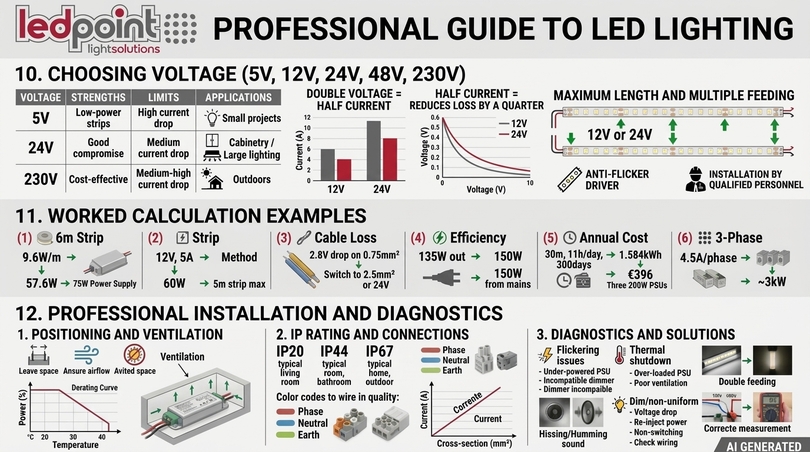
The system voltage is not a detail: it affects current, cable cross-section, maximum run length, safety and flexibility. Choosing the right voltage at the start of the project avoids most of the problems we will see in the diagnostics section. For the same electrical power, every doubling of voltage halves the current and reduces losses on the cables to a quarter.
| Voltage | Strengths | Limits | Typical applications |
|---|---|---|---|
| 5V | Compatibility with USB and microcontrollers, addressable pixels | Very high currents, short runs | Small objects, signs, dynamic effects |
| 12V | Reduced cutting pitch, wide availability of accessories | Noticeable voltage drop beyond 3–5 m | Furniture, shop windows, niches, camper vans and boats |
| 24V | Half the current compared to 12V, longer runs, professional standard | Wider cutting pitch | Domestic and commercial lighting, grooves, false ceilings |
| 48V | Very long runs from a single point, thin cables | More specialist range | Large environments, primary lighting, architectural |
| 230V | No low-voltage power supply, very long runs | Requires qualified installation, attention to flicker | Outdoors, long lengths, cornices |
Maximum length and multiple feeding
Besides the voltage drop in the connection cables, there is a drop along the strip itself, due to the resistance of the copper tracks on the printed circuit board. This is why each strip has a maximum length that can be fed from one end only, indicated in the datasheet. Beyond that limit, the power must be re-injected at one or more intermediate points. There are also LED strips with constant current control system, which integrate regulation circuits to keep brightness uniform over longer runs.
230V strips and anti-flicker drivers
230V strips are connected directly to the mains via a special cable with a rectifier. To reduce the flicker effect typical of rectified mains voltage, it is advisable to use the 230V anti-flicker drivers, also sized on the electrical power of the strip with the usual margin. Remember that 230V installations must be carried out by qualified personnel, in compliance with current installation standards.
11. Worked calculation examples
Theory becomes truly useful when applied to concrete cases. Below you will find six worked exercises, from the simplest to the most complex, covering all the electrical power formulas seen so far. For each we indicate data, procedure and result, with the checking of units of measurement, which is the best way to immediately notice an error.
Example 1: calculating the electrical power of an LED strip
Data: 24V strip, 120 LEDs/m, 9.6 W/m, length 6 m.
Procedure: P = 9.6 W/m × 6 m = 57.6 W. Units: (W/m) × m = W. Current: I = 57.6 W / 24 V = 2.4 A.
Result: the strip draws 57.6 W and 2.4 A. With a 25% margin: 72 W → 75 W power supply at 24V.
Example 2: how to calculate power in watts knowing volts and amperes
Data: on a power supply's label you read "Output 12V ⎓ 5A".
Procedure: P = V × I = 12 V × 5 A = 60 W.
Result: nominal output power 60 W. Recommended maximum load (80%): 48 W, i.e. for example 5 m of 9.6 W/m strip at 12V.
Example 3: power dissipated by a cable (Joule effect)
Data: 0.75 mm² two-core cable, length 6 m, current 10 A (120 W at 12V).
Procedure: total resistance R = ρ × 2L / S = 0.0175 × 12 / 0.75 = 0.28 Ω. Power lost P = R × I² = 0.28 × 100 = 28 W. Voltage drop ΔV = R × I = 2.8 V.
Result: 28 W lost as heat and 2.8 V of drop (23% of 12V!): the strip will be visibly less bright. Solution: 2.5 mm² cable (loss reduced to about 8.4 W) or, much better, switching to 24V (current 5 A, loss on the 0.75 mm² cable reduced to 7 W).
Example 4: efficiency and power absorbed from the mains
Data: power supply with 90% efficiency delivering 135 W to the strips.
Procedure: Pabsorbed = Poutput / η = 135 / 0.90 = 150 W. Plost = 150 − 135 = 15 W.
Result: the system draws 150 W from the mains and the power supply must dissipate 15 W of heat. With cosφ = 0.95 the current at 230 V is I = 150 / (230 × 0.95) ≈ 0.69 A.
Example 5: calculating annual energy and cost
Data: shop with 30 m of 14.4 W/m strip, on 11 hours a day for 300 days, power supply efficiency 90%, energy at €0.25/kWh.
Procedure: PLED = 30 × 14.4 = 432 W; Pmains = 432 / 0.9 = 480 W = 0.48 kW. Annual energy E = 0.48 kW × 11 h × 300 = 1,584 kWh. Cost = 1,584 × 0.25 ≈ €396.
Result: about 1,584 kWh and €396 per year. Recommended power supplies: 432 × 1.25 = 540 W, split for example across three 200 W power supplies at 24V, each dedicated to 10 m of strip.
Example 6: three-phase electrical power calculation
Data: warehouse with LED lighting distributed across the three phases; each phase draws 4.5 A at 230 V with cosφ = 0.96.
Procedure: with a balanced load you can use P = √3 × VL × I × cosφ = 1.732 × 400 × 4.5 × 0.96 ≈ 2,993 W. Check per phase: 230 × 4.5 × 0.96 = 993.6 W × 3 = 2,981 W (the small difference depends on the rounding of 400/√3 ≈ 230.9 V).
Result: total electrical power about 3 kW. In kW: 2,993 / 1,000 ≈ 2.99 kW.
| Example | Formula used | Result |
|---|---|---|
| 1. LED strip | P = W/m × m; I = P / V | 57.6 W; 2.4 A |
| 2. Power supply label | P = V × I | 60 W |
| 3. Cable losses | P = R × I² | 28 W lost |
| 4. Efficiency | Pabs = Pout / η | 150 W |
| 5. Annual energy | E = P × t | 1,584 kWh |
| 6. Three-phase | P = √3 × V × I × cosφ | ≈ 3 kW |
12. Professional installation of the power supply
A perfectly sized power supply can still fail early if badly installed. Heat, rough connections and lack of protections are the three most frequent causes of problems in LED systems. In this section we see how to position, ventilate and connect the power supply correctly, both on the 230 V mains side and on the low-voltage LED side. Operations on the 230 V side must be carried out by a qualified installer, in compliance with current CEI standards.
Positioning and ventilation
Heat reduces the efficiency and life of the power supply: as a rule of thumb, the useful life of electrolytic capacitors halves roughly every 10 °C above the nominal temperature, also compromising the actual deliverable power. Many power supplies, in fact, reduce their maximum power (derating) when the ambient temperature exceeds a certain threshold, typically 40–50 °C: the derating curve is shown in the datasheet.
Essential guidelines
- Never install in closed, hermetic or unventilated spaces.
- Leave at least 5–10 cm of free space around the power supply.
- For installations in false ceilings or furniture, ensure passive air circulation, for example with ventilation grilles.
- For high-power power supplies (over 100 W), install on a metal surface that acts as an additional heat sink.
- Avoid direct exposure to heat sources or sunlight.
- Do not cover the power supply with insulating materials (rock wool, polystyrene, fabrics).
- Make the power supply inspectable: sooner or later it will need to be checked or replaced.
IP protection rating and installation environment
The IP protection rating, defined by standard CEI EN 60529, indicates the enclosure's resistance to dust and water. The first digit refers to solids, the second to liquids.
| IP rating | Protection | Where to use it |
|---|---|---|
| IP20 | Against solid bodies > 12 mm, no water protection | Dry interiors, panels, false ceilings |
| IP44 | Against bodies > 1 mm and water splashes | Bathrooms (outside the most exposed zones), technical rooms |
| IP65 | Totally against dust, water jets | Sheltered outdoors, professional kitchens |
| IP67 | Totally against dust, temporary immersion | Exposed outdoors, gardens, façades |
IP20 power supplies are more compact, cheaper and cool better; IP67 ones are resin-sealed and can work outdoors, but dissipate heat only by conduction. Choose the IP rating based on the environment, not "for safety": an IP67 in a closed cabinet offers no advantages and may heat up more.
Safe electrical connections
During installation it is important to pay attention to safety on both sides of the power supply. Let's see how.
230V AC side (input)
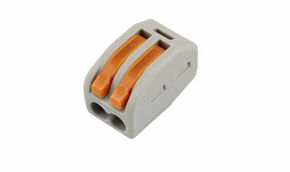
- Use quality screw terminals or lever/crimp connectors; the right connectors make the difference in terms of reliability.
- Mains cable cross-section: minimum 0.75 mm² (1 mm² recommended for powers above 100 W), compatibly with the upstream protection.
- Wire colour code:
- Brown, black or grey: live
- Blue: neutral
- Yellow-green: earth (protection)
- The earth connection is essential for class I power supplies (with earth terminal), especially at high powers.
- Protect the line with a suitable magnetothermal-differential circuit breaker, taking into account the inrush current (section 6.4).
12V/24V DC side (output)
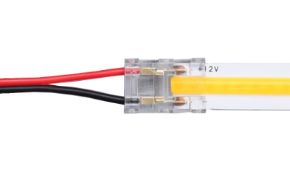
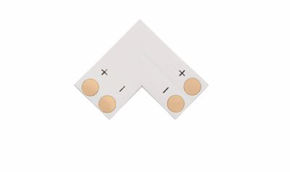
- For high currents prefer soldering or screw connectors to pressure connectors. For permanent joints on the strip, solder joints and PCB connectors for LED strips are useful.
- Always respect polarity (+ and −): reversal can damage the LEDs or the connected controllers.
- Size the cable cross-section according to current and length (table below).
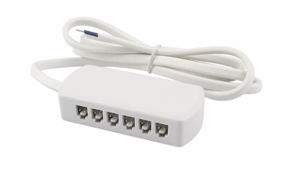
- To distribute power to multiple runs in an orderly way, use multiple quick connectors.
| Current | Minimum cross-section | Recommended cross-section | Notes |
|---|---|---|---|
| Up to 5 A | 0.75 mm² | 0.75 mm² | Short runs (< 3 m) |
| 5–10 A | 1.0 mm² | 1.5 mm² | Check voltage drop |
| 10–15 A | 1.5 mm² | 2.5 mm² | Prefer 24V if possible |
| 15–20 A | 2.5 mm² | 4 mm² | Consider distributed power supplies |
Dimming and control
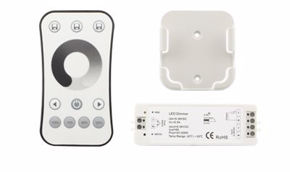
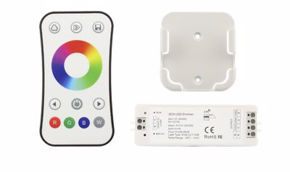
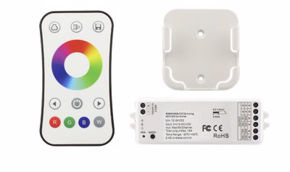
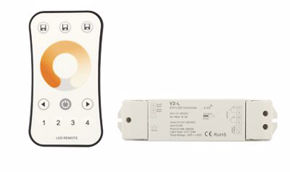
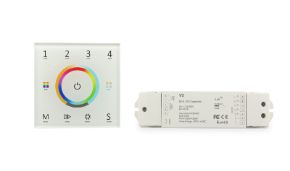
If the system must be adjustable, the type of control affects the choice of power supply. The main solutions are four: PWM dimmers on the low-voltage side, connected between power supply and strip (see the monochrome dimmers and Ledpoint controllers); TRIAC dimmable power supplies, controlled by a phase-cut dimmer on the 230 V side; 0/1-10V systems, with a separate analogue signal (0/1-10V category); DALI and DMX digital systems for building automation and scenography (DMX and DALI decoders). For those who want control from a smartphone or voice assistants, there are Smart power supplies and ZigBee devices.
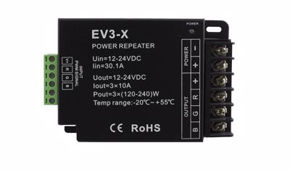
Remember that dimmers and controllers also have a maximum electrical power (or a maximum current per channel): they must be sized with the same margin as the power supply. If the load exceeds the controller's capacity, signal amplifiers are used, each with its own power supply.
Input protection (optional but recommended)
Protecting the investment from voltage spikes, lightning and mains disturbances extends the life of the whole system:
- Modular surge protective device (SPD) in the electrical panel.
- Plug-and-play surge limiter between socket and power supply, for small systems.
- Uninterruptible power supply (UPS) for critical applications, sized in VA on the apparent power.
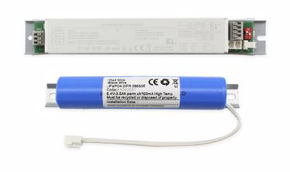
- Emergency lighting in public premises and escape routes: Ledpoint offers a dedicated category for emergency lighting.
Installation checklist
| Check | Expected value |
|---|---|
| Power supply voltage = strip voltage | Identical (5/12/24/48V) |
| Load relative to nominal power | Maximum 80% |
| Free space around the power supply | 5–10 cm, ventilated compartment |
| IP rating suitable for the environment | IP20 indoors, IP67 exposed outdoors |
| DC output polarity | + to +, − to − |
| Voltage drop on the run | ≤ 3% (ideal), ≤ 5% (maximum) |
| Earth connection (class I) | Present and verified |
| Accessibility for maintenance | Inspectable power supply |
13. Diagnostics and troubleshooting
Despite the correct choice of power supply and the accurate calculation of electrical power, some problems may arise. The good news is that almost all defects in an LED system have recurring causes and known solutions. For effective diagnosis a multimeter, a bit of method and the right tools are enough. Let's look at the most frequent cases.
The LED strip flickers (flickering)
Causes and solutions
- Power supply undersized in power: the power supply enters protection and restarts cyclically. Replace with a model of adequate power (check with the configurator).
- Dimming incompatibility: check compatibility between power supply and dimmer. For LEDs you need "trailing edge" or "TRIAC for LED" dimmers and power supplies declared dimmable.
- Poor electrical contact: inspect and redo the connections, check solder joints and terminals.
- Poor-quality power supply: replace with a certified power supply (CE marking, RoHS compliance, declared IP rating).
- 230V strip without a suitable driver: use an anti-flicker driver.
The power supply switches itself off (thermal shutdown)
Probable cause: overload or insufficient ventilation. The power supply reaches the critical temperature at which the protection trips and switches off automatically, then switches back on when it has cooled down.
Solutions
- Check that the load power is ≤ 80% of the power supply's nominal power.
- Improve ventilation, open ventilation grilles or move the power supply to a larger compartment.
- Reduce the ambient temperature or choose a model with a more favourable derating curve.
- If the problem persists at reduced load and with good ventilation: faulty power supply, to be replaced.
Noise: hum or whistling
Noise usually does not compromise either the operation of the LED strip or safety, but it can be annoying in bedrooms, offices and shops.
50 Hz hum (low)
- It comes from the transformer core in old-generation magnetic power supplies or from phase-cut dimmers.
- Solution: replace with a modern switching power supply, which works at high frequency with less vibration.
High-pitched whistle (high frequency)
- It comes from the magnetic components (coils) of switching power supplies, often at very low load or with low-frequency PWM dimming.
- Solution: choose quality power supplies with encapsulated components, avoid making them work almost at no load, use high-frequency PWM dimmers.
The lights do not reach maximum brightness or are not uniform
If the lights are not uniformly illuminated or do not reach the desired brightness, the main cause is almost always excessive voltage drop on the cables or along the strip, which reduces the electrical power actually available to the LEDs.
Diagnostics
- Measure the voltage at the power supply output (it must be 12V or 24V ±5%).
- Measure the voltage at the end of the LED strip.
- If the difference exceeds 0.5 V (at 12V) or 1 V (at 24V): voltage drop problem.
Solutions
- Increase the cross-section of the connection cables.
- Switch to a 24V or 48V system, which handles electrical power better over long distances.
- Feed the strip from both ends or from the centre.
- Move the power supply closer to the load.
- Install additional power supplies along the route.
The strip does not turn on
Before replacing anything, check in this order: presence of 230 V at the power supply input; presence of the correct voltage at the output; polarity of the connections; integrity of the connector on the strip; operation of the controller or receiver (try excluding it by connecting the strip directly). Nine times out of ten the problem is a connection, not a faulty component.
| Symptom | Most likely cause | First action |
|---|---|---|
| Regular flickering | Overload, cyclic protection | Reduce the load or increase the size |
| Switching off after a few minutes | Overheating | Improve ventilation |
| End of strip darker | Voltage drop | Double feeding, 24/48V |
| Wrong colours at end of run (RGB) | Voltage drop on the blue/green channel | Re-inject power |
| Whistling | Load too low or slow PWM | Smaller power supply, high-frequency dimmer |
| No switching on | Connection or polarity | Check with multimeter |
14. Maintenance and choice by environment
A well-designed LED system requires very little maintenance, but "very little" does not mean "none". A few periodic checks allow you to catch loose connections, dust build-up or power supplies running too hot before they become a failure. At the same time, every environment has different needs: the perfect power supply for a kitchen is not necessarily the right one for a garden or a museum.
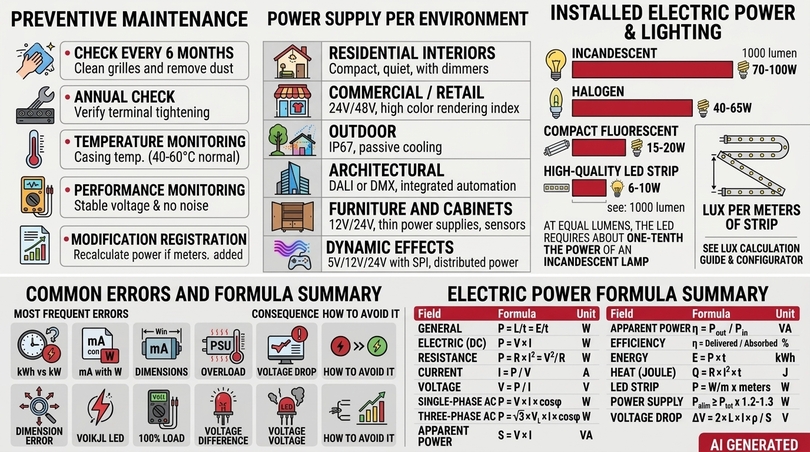
Preventive maintenance and periodic checks
To ensure system longevity and maintain nominal power over time:
- Every 6 months: clean ventilation grilles and any fans, remove dust from technical compartments.
- Annually: check the tightness of all terminals, both on the 230 V side and on the low-voltage side.
- Check the temperature of the casing during operation: values between 40 and 60 °C are normal for many models; above that, check ventilation and load.
- Monitor performance: stable output voltage and no abnormal noises.
- Record changes: if you add metres of strip over time, recalculate the total electrical power. It is one of the most common mistakes in systems that have "grown" over the years.
Which power supply for which environment
Here are the characteristics to pay attention to depending on the installation context:
| Environment | Recommended characteristics | Related Ledpoint products |
|---|---|---|
| Residential interiors | Compact, silent power supplies, dimmable if necessary | 24V power supplies, warm white strips |
| Commercial / retail | 24V or 48V to reduce drops over long distances, high colour rendering | 48V strips, COB strips |
| Outdoor | IP67 power supplies with passive cooling (no fans) | Neon Flex, 230V strips |
| Architectural | DALI or DMX control for integration with building automation | DMX and DALI decoders, RGBCCT strips |
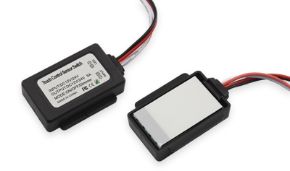
| Furniture and cabinets | 12V or 24V, slim power supplies, presence sensors | Sensors, electrified tracks |
| Dynamic effects | 5V, 12V or 24V with SPI controllers, distributed power | Addressable strips, SPI controllers |
Installed electrical power and lighting: how many watts per square metre
In professional projects one often reasons in terms of installed electrical power for lighting, expressed in W/m². The figure depends on the required illuminance (in lux), the efficiency of the luminaires (in lm/W) and the geometry of the environment. The reference illuminance values for workplaces are set by standard UNI EN 12464-1. Thanks to the efficiency of modern LEDs, the installed power needed to light an environment has been drastically reduced compared to traditional technologies. To go from lux to metres of strip and then to watts, you can start from our guide on how to calculate the lux of an LED installation, then enter the result in the configurator in section 9.
| Technology | Indicative luminous efficiency | Power needed to obtain 1,000 lumens |
|---|---|---|
| Incandescent lamp | 10–15 lm/W | ≈ 70–100 W |
| Halogen | 15–25 lm/W | ≈ 40–65 W |
| Compact fluorescent | 50–70 lm/W | ≈ 15–20 W |
| Quality LED strip | 100–180 lm/W and above | ≈ 6–10 W |
The table explains immediately why the electrical power of lighting systems has collapsed in recent years: for the same light, an efficient LED strip requires about a tenth of the power of an incandescent lamp. For the correct choice of light quality, besides power, also consider colour rendering: we discuss it in the in-depth article Discovering CRI.
15. Common mistakes and summary of formulas
After so many formulas and examples, it is worth pausing to collect the mistakes we see most often, both in physics homework and in real systems. Recognising them in advance saves time, money and the odd power supply. At the end you will find the summary of all the electrical power formulas, to keep to hand.
The most frequent mistakes
| Mistake | Consequence | How to avoid it |
|---|---|---|
| Confusing energy and power (kW and kWh) | Wrong consumption and cost estimates | Remember: kWh = kW × hours |
| Using inconsistent units (mA with W, km with m) | Results wrong by a factor of 1,000 | Convert everything to SI units before calculating |
| Sizing the power supply at 100% of the load | Overheating, early failures | 20–30% margin, load ≤ 80% |
| Oversizing excessively | Low efficiency, whistling, unnecessary costs | Choose the size immediately above |
| Ignoring voltage drop | Uneven light, dark end of strip | Adequate cross-sections, 24/48V, double feeding |
| Strip voltage ≠ power supply voltage | Burned-out or dead LEDs | Always check the datasheet |
| Forgetting cosφ in alternating current | Underestimated line current | Use P = V × I × cosφ |
| Connecting two power supplies in parallel | Overload of one of the two | One power supply for each separate run |
| Closing the power supply in a hermetic compartment | Thermal shutdown, reduced life | 5–10 cm free, ventilation |
Summary of all the power formulas
| Field | Formula | Units |
|---|---|---|
| General definition | P = L / t = E / t | W = J / s |
| Mechanical power | P = F × v × cosθ | W = N × m/s |
| Electrical power (DC) | P = V × I | W = V × A |
| With resistance | P = R × I² = V² / R | W |
| Current | I = P / V | A |
| Voltage | V = P / I | V |
| Single-phase AC | P = V × I × cosφ | W |
| Three-phase AC | P = √3 × VL × I × cosφ | W |
| Apparent power | S = V × I; S² = P² + Q² | VA |
| Efficiency | η = Poutput / Pabsorbed | % or pure number |
| Energy | E = P × t | Wh, kWh, J |
| Heat (Joule) | Q = R × I² × t | J |
| LED strip | P = W/m × metres | W |
| Power supply | Ppsu ≥ Ptot × 1.2–1.3 | W |
| Voltage drop | ΔV = 2 × L × I × ρ / S | V |
How to calculate power correctly: the three-question method
Every time you have to calculate electrical power, ask yourself three questions: what do I know? (voltage, current, resistance, energy, time); what regime am I working in? (direct current, single-phase alternating, three-phase); what do I actually need? (absorbed power, output power, energy, current for the cables). With these three answers you choose the right formula from the table and, before writing the result, check that the unit of measurement is consistent. It is the same method used by Ledpoint technicians when supporting customers in sizing systems.
16. Frequently asked questions about electrical power and power supplies
We have collected the questions we most often receive from customers, installers and designers. Click on each question to read the answer.
What is electrical power and how is it measured?Electrical power is the electrical energy transferred or absorbed per unit of time. It is measured in watts (W) with a wattmeter, which detects voltage and current together. In direct current it can also be derived with a multimeter, measuring volts and amperes and multiplying them. In alternating current the power factor cosφ must also be considered. |
What is the electrical power formula?The basic formula is P = V × I: power in watts equals voltage in volts times current in amperes. Combining it with Ohm's law gives P = R × I² and P = V² / R. In single-phase alternating current P = V × I × cosφ is used, in three-phase P = √3 × V × I × cosφ. |
1 kW how many kWh is it?kW measures power, kWh measures energy: they are not directly equivalent. A 1 kW appliance switched on for one hour consumes 1 kWh; for three hours, 3 kWh; for half an hour, 0.5 kWh. The relationship is always energy = power × time. In joules, 1 kWh corresponds to 3.6 million joules. |
How is the power supply power for an LED strip calculated?Multiply the strip's watts per metre by the total length, add any other loads and add a 20–30% margin. Then choose the commercial size immediately above, with the same voltage as the strip. Example: 5 m × 14.4 W/m = 72 W; × 1.25 = 90 W; 100 W power supply. |
How are amperes calculated knowing the watts?Divide the power by the voltage: I = P / V. A 72 W strip at 24V draws 72 / 24 = 3 A; the same power at 12V requires 6 A. This is why one watt does not correspond to a fixed number of amperes: it always depends on the system voltage. In alternating current the cosφ must also be considered. |
Is a 12V or 24V power supply better?For the same power, 24V halves the current and reduces losses in the cables to a quarter, allowing longer runs and more uniform light. 12V remains useful for short runs, furniture, niches and applications on campers or boats. For long and professional installations, 24V or 48V are generally preferable. |
Can I use a more powerful power supply than necessary?Yes, as long as the voltage is identical: the strip draws only the power it needs. However, a heavily oversized power supply works at reduced load, with lower efficiency and power factor, and costs more. The ideal is a load between 60% and 80% of the power supply's nominal power. |
What difference is there between absorbed power and nominal power?Nominal power is the maximum value the manufacturer guarantees for continuous operation; absorbed power is the one actually drawn from the mains at a given moment. For a power supply, the absorbed power equals the power delivered to the LEDs divided by the efficiency, so it is always slightly higher. |
Why is the end of the LED strip less bright?It is the effect of voltage drop: cables that are too thin, runs that are too long or low voltage reduce the volts available to the furthest LEDs. It is solved by increasing the cable cross-section, feeding the strip from both ends, moving the power supply closer or switching to a 24V or 48V system. |
How many amperes does household current have?It depends on the contracted power. With a 3 kW household contract at 230 V, the maximum continuous current is about 14 A (3.3 kW of available power divided by 230 V). With 6 kW it reaches about 29 A. Standard household sockets are rated for 10 A or 16 A. |
17. The pillars of LED power supply
We started from the definition of power in physics and arrived at a complete, sized, wired and tested LED system. The common thread has always been the same: electrical power is the common language that links the strip, the power supply, the cables, the household mains and the bill. Those who master it can design any system with confidence, from the simplest to the most complex.
The power supply is not a mere accessory, but the critical component that determines the stability, efficiency and life of the entire LED system. A correct choice of power, a professional installation and the selection of quality products represent an investment that pays off over time with:
- Optimised energy savings, thanks to high efficiencies and loads in the ideal zone.
- Extended system life, with power supplies running cool and LEDs powered at the correct voltage.
- Safety for people and property, with properly executed connections and adequate protections.
- Constant light quality, uniform and free from flicker.
Whether it is residential lighting or a complex architectural project, paying attention to the choice of power and the characteristics of the power supply means building the success of your lighting project on solid foundations. Use the configurator for your calculations, choose from the LED strips and Ledpoint power supplies and, for custom projects, contact our technical team: we will help you turn the right watts into the right light. You can also consult the Ledpoint catalogues with all the datasheets.
This article was developed with the support of artificial intelligence and subsequently reviewed, corrected and validated by the technical team of Ledpoint.it, which guarantees its reliability and compliance with official sources.