






DIY LED Wall Lights: Complete Guide to Making Custom Wall Sconces
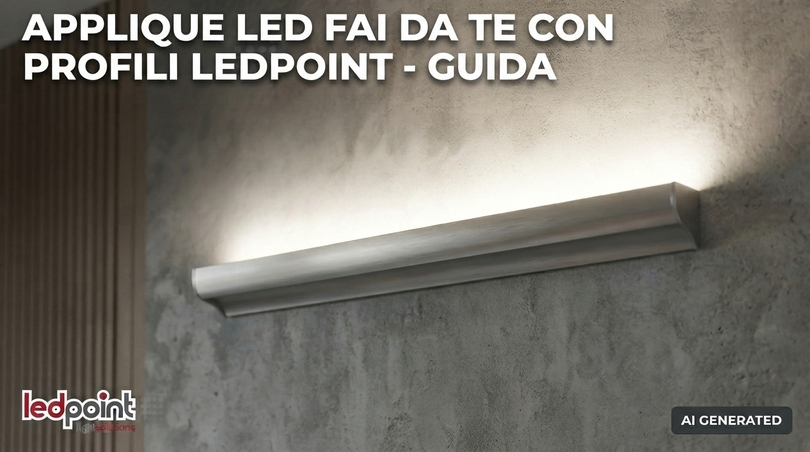
A DIY LED wall sconce made with LED strips, aluminum profiles, and controllers is a custom wall lamp: you choose the length, the light (warm, natural, cool, RGB), the beam direction, and the effects. With Ledpoint components, you get modern, efficient, dimmable wall sconces compatible with remote controls and home automation.
The wall sconce has always been the lamp that gives character to a wall: it frames a painting, guides the eye along a hallway, creates an intimate atmosphere in the bedroom, and welcomes guests at the entrance. Today, however, a wall sconce is no longer just an object to choose from a catalog: thanks to professional LED strips, design aluminum profiles, and controllers with remote controls, it is possible to design and build a custom wall sconce, with the exact length of the wall, the desired light tone, and even dynamic effects. In this guide-tutorial, we will walk you step by step, from the definition of a wall sconce to cutting the strip, wiring, choosing the controller, and the lighting effects you can achieve with the Ledpoint catalog.
The goal is simple: by the end of this reading, you will know which LED wall sconce to build for every environment, which components to buy, how to calculate lumens and watts, at what height to install the sconces, how much they consume, and how to control them with a remote control or smartphone. You will find comparison tables, real project examples designed for interior designers, architects, electricians, homeowners, renters, and hospitality business owners, and an FAQ section answering the most searched questions on Google and artificial intelligences.
In this article...
1. What is a wall sconce: meaning, definition, and differences with ceiling lights, chandeliers, and spotlights
Before picking up scissors and LED strips, it is advisable to clarify exactly what we mean by a wall sconce. The term is widely used in interior design language, but it is often confused with ceiling lights, spotlights, and generic wall lamps. Knowing the precise meaning of a wall sconce helps you design the lighting better and choose the correct components.
Wall sconce meaning: where the word comes from
The word "applique" (wall sconce) derives from the French appliquer, "to apply": it indicates an object applied to a surface. The Treccani dictionary defines a wall sconce as a lighting fixture fixed to the wall. Curiosity: in the sewing world, "applique" also indicates a fabric decoration sewn onto a textile, which is why online you find searches like "patchwork applique" or "embroidery applique". In this guide, we are talking exclusively about wall sconces as wall lamps, that is, wall lighting for interiors and exteriors.
Regarding grammar, in Italian "applique" is an invariable feminine noun: you say "un'applique", "le applique". Some people write "aplique", "plique a muro" or "applichi a muro", but the correct form remains "applique". Common synonyms are wall lamp, wall light, or, in technical terms, wall-mounted fixture.
What is a wall sconce in lighting terms
From a technical point of view, a wall sconce is a fixture fixed vertically to the wall that emits direct, indirect, or mixed light (up and down). Unlike a chandelier, which diffuses light from above throughout the room, the wall sconce works from the side: it illuminates the wall itself, creates light gradients, enhances textures and materials, and completes the general lighting with accent or atmospheric light.
For this reason, the wall sconce is a fundamental tool in layered lighting: general light (chandeliers and ceiling lights), functional light (reading, work, mirror), and accent light (wall sconces, spotlights, LED strips). A well-designed LED wall sconce can perform all three functions, especially if it is dimmable and has an adjustable color temperature.
What is the difference between a wall sconce and a ceiling light?
This is one of the most searched questions: a ceiling light is fixed to the ceiling and provides general diffused light, while a wall sconce is fixed to the wall and provides lateral, accent, or atmospheric light. However, there are hybrid models, called "ceiling-wall lights", which can be mounted both on the ceiling and on the wall: they are generally discs or panels with an opal diffuser. What is a ceiling light for? It is used to uniformly illuminate an environment when there is no space for a chandelier, for example in hallways, bathrooms, or utility rooms.
Difference between wall sconce, chandelier, spotlights, and table lamp
To have a complete picture, here is a comparison table of the main types of domestic lighting. It will help you understand when a wall sconce is convenient and when another solution is better.
| Typology | Position | Type of light | Main function | When to choose it |
|---|---|---|---|---|
| Wall sconce | Wall | Direct, indirect, or up & down | Accent, atmosphere, orientation | Hallways, bedrooms, living rooms, entrances, outdoors |
| Ceiling light | Ceiling (sometimes wall) | Diffused | General light | Bathrooms, kitchens, utility rooms |
| Chandelier / pendant | Ceiling, suspended | Diffused or direct | General and scenic light | Dining rooms, large living rooms |
| Wall spotlights | Wall or ceiling | Concentrated and adjustable beam | Accent on objects | Paintings, niches, bookshelves |
| Table lamp / abat-jour | Furniture | Localized direct | Reading, visual task | Bedside tables, desks |
| Wall sconce with profiles and LED strips | Wall, corner, above and below shelves | Linear, uniform, adjustable | Accent, functional, decorative, dynamic | Any environment, even custom-made |
What is the difference between a wall sconce and a lamp? Strictly speaking, every wall sconce is a lamp, but not every lamp is a wall sconce: the latter is specifically designed to be fixed to the wall. And what is the difference between a wall sconce and spotlights? The spotlight concentrates light into a beam, while the wall sconce distributes it along the wall; however, there are also spotlight wall sconces and adjustable wall spotlights that combine both functions.
What are lamps attached to the wall called?
Lamps attached to the wall are primarily called wall sconces. In common language, "wall lamps", "wall lights", and, for the exterior, "wall lanterns" are also used. Wall lamps attached to the wall with an articulated arm are called articulated wall sconces, adjustable wall sconces, or adjustable wall lamps.
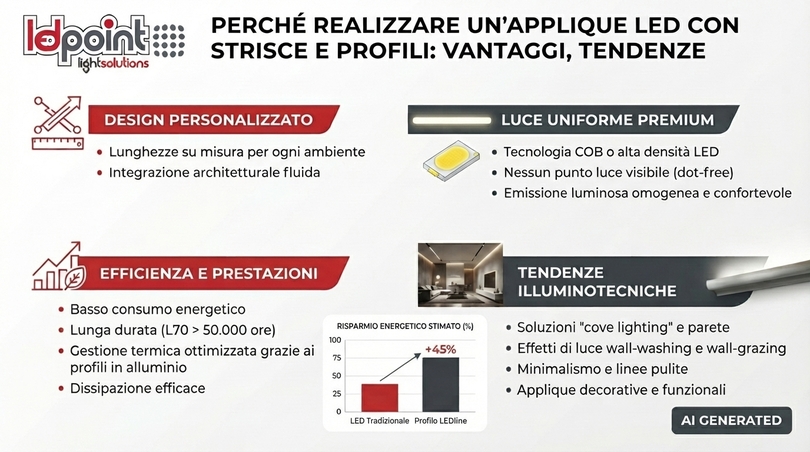
2. Why build an LED wall sconce with strips and profiles: advantages, data, and trends
Why build an LED wall sconce instead of buying a ready-made one? The answer lies in design freedom: dimensions, power, color, and control are customizable to the centimeter. Let's look at the concrete advantages, market trends, and numbers that make the LED wall sconce the smartest choice in 2026.
What are LED lamps for and what does LED lighting mean
LED is the acronym for Light Emitting Diode: a semiconductor that transforms electricity directly into light with an efficiency much higher than old light bulbs. LED lamps are therefore used to illuminate while consuming little, heating up little, and lasting a long time. A quality LED source consumes up to 80-90% less than an incandescent bulb for the same amount of light emitted and can exceed 30,000-50,000 hours of useful life.
The 7 advantages of a custom LED profile wall sconce
Exact dimensions
LED strips can be cut in steps of a few centimeters, and aluminum profiles can be cut with a normal hacksaw: you can build a 30 cm wall sconce for a bedside table or a 3-meter-long wall sconce for a living room wall. Long wall sconces and bar wall sconces are indeed among the most requested solutions in contemporary projects.
Perfectly uniform light
With COB strips or high-density LED strips paired with opal diffusers, you get a continuous line of light, without visible dots: this is the typical "blade of light" effect of design wall sconces.
Choice of color temperature
Warm light for the bedroom, natural light for the kitchen, cool light for the garage, or adjustable light from 2700 K to 6500 K with CCT strips: a custom LED wall sconce adapts to any environment.
Effects and colors
With RGB, RGBW, RGB+CCT strips, and addressable pixel LEDs, a wall sconce becomes scenic: colors, gradients, trail effects, breathing, synchronization with music.
Total control
Radio remote controls, wall buttons, apps, voice assistants, ZigBee, DALI: Ledpoint LED wall sconces integrate with every system.
Minimal consumption
A 1-meter linear wall sconce with a 9.6 W/m strip consumes less than 10 W: turned on for 4 hours a day, it costs a few euros a year.
Simple maintenance
Profile, diffuser, and strip are separate components: if in the future you want to change the light tone, you will only need to replace the strip while keeping the wall sconce.
2026 Trends: what chandeliers and wall sconces are used today
What are the trending lamps for 2026? Online searches and interior design projects show some clear directions: minimal linear wall sconces, indirect grazing light, up and down wall sconces, integrated recessed sources, dynamic and circadian light. Traditional wall sconces with bulbs remain widespread in classic styles, but the demand is growing especially for integrated LED wall sconces, which can be a few millimeters thin and disappear into the architecture.
| Trend | Description | Recommended Ledpoint components |
|---|---|---|
| Minimal linear wall sconces | Thin lines of light on the wall, horizontal or vertical | Slim profiles + COB strip + opal diffuser |
| Indirect light and wall washing | Wall "washed" by light, soft effect | Wall profiles with upward emission + high-efficiency strip |
| Up & down wall sconces | Double emission above and below | Double emission profiles or two parallel strips |
| Circadian light | Tones that follow the daily rhythm | CCT or Circadian Light strips + CCT controller |
| Dynamic light | Colors and animated effects | RGB/RGBW/pixel strips + SPI controller |
| Smart home | App and voice control | ZigBee controllers, smart power supplies |
Custom LED wall sconce vs catalog wall sconce: comparison
| Criterion | Catalog wall sconce | LED wall sconce with Ledpoint profiles and strips |
|---|---|---|
| Dimensions | Fixed | Custom, to the centimeter |
| Color temperature | Often single | From 2200 K to 6500 K, adjustable with CCT |
| Colors and effects | Rare | RGB, RGBW, RGB+CCT, pixel |
| Control | Switch | Dimmer, remote control, app, voice, sensors |
| Light uniformity | Variable | Very high with COB strips and opal diffusers |
| Maintenance | Often complete replacement | Components replaceable individually |
| Cost | From cheap to very high | Contained, proportional to length |
The key data is this: with a wall sconce made with LED profiles, you only pay for what you really need, without the aesthetic markup of a branded object, and you get controllable lighting performance. Furthermore, Ledpoint tests its strips with an integrating sphere and spectroradiometer, measuring efficiency, lumens per meter, color temperature, and color rendering: data that you can find in the product sheets and Ledpoint catalogs.
3. Types of wall sconces you can build with Ledpoint products
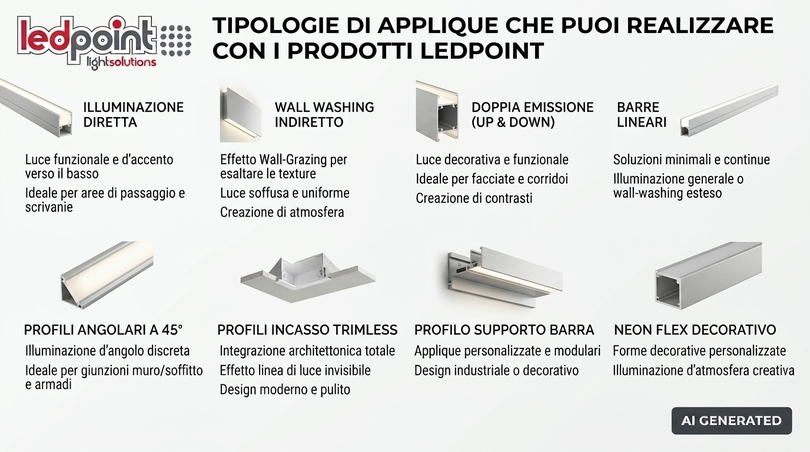
What are the different types of wall sconces? There are many classifications: by light direction, by shape, by installation method, by style. In this section, we show you the main types of wall sconces and, for each, how to build it concretely with LED strips, profiles, and accessories from the Ledpoint catalog.
Direct light wall sconce
The direct light wall sconce directs the beam towards the environment or a specific point: a reading area, a worktop, a mirror. It is the right choice when the wall sconce must perform a visual task, such as a reading wall sconce above the bed or a bathroom mirror wall sconce. It is built with an aluminum profile on the wall oriented downwards or frontally, a high-efficiency strip, and an opal or satin diffuser to avoid glare.
Indirect light wall sconce
The indirect light wall sconce projects light towards the ceiling or along the wall: the light reaches the eye after being reflected, so it results in soft, enveloping light, free of harsh shadows. It is the ideal light for living rooms, bedrooms, hotels, and relaxation environments. With LED profiles, it is obtained by mounting the profile with the opening facing upwards, perhaps hidden behind a shelf, a frame, or a cove ceiling.
Up and down wall sconce (light above and below)
The up and down wall sconce, also called double emission wall sconce, emits light simultaneously upwards and downwards, drawing two cones or two blades of light on the wall. It is highly requested both as an indoor and outdoor wall sconce on facades. With LED strips, it is built in two ways: with a double-compartment profile, one strip per side, or with two overlapping profiles. By connecting the two strips to different channels of a controller, you can even adjust the light above and the light below separately.
Linear wall sconces and bar wall sconces
Linear wall sconces are the symbol of contemporary lighting: thin bars of horizontal or vertical light, surface-mounted or recessed. Long wall sconces and bar wall sconces are easily built with 2 or 3-meter profiles cut to size and joined with profile joints when a greater length is needed. For a "continuous line" effect without dots, we recommend COB LED strips.
Corner wall sconces and angular wall sconces
Corner lamps and angular wall sconces exploit the edge between two walls or between wall and ceiling. With 45° angular profiles, the light is projected diagonally and illuminates both surfaces: a perfect solution for dark corners of the living room, L-shaped hallways, niches, and walk-in closets. An indoor angular wall sconce made with an angular profile is also one of the most discreet solutions absolutely.
Recessed wall sconces and built-in wall sconces
The recessed wall sconce, or built-in wall sconce, is integrated into the wall or drywall: you only see the light, not the fixture. With Ledpoint recessed profiles, you can create cuts of light in drywall, luminous lines in the wall, and plaster wall sconces with an architectural effect. It is the preferred solution for architects and interior designers to achieve clean and minimal wall lighting.
Wall sconces for paintings and mirror wall sconces
The wall sconce for paintings (or picture light) illuminates an artwork from above, grazing, without reflections on the glass. A short LED bar with an inclined profile and high color rendering light (CRI 90 or higher) is perfect: the colors of the painting remain faithful. For the bathroom mirror, on the other hand, side wall sconces or above the mirror are used, with 4000 K neutral light and a touch mirror dimmer.
Decorative wall sconces with Neon Flex
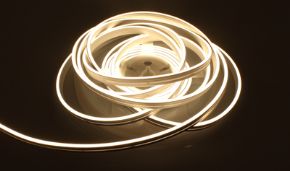
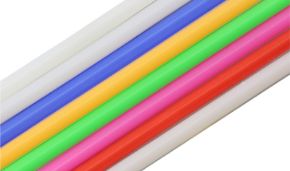
Particular, original, and colorful wall sconces are built with Neon Flex, a flexible LED tube that bends and draws shapes, writings, and curved lines. With Neon Flex, wave wall sconces, cloud wall sconces, wall sconces with writings, spiral wall sconces are born: perfect for kids' rooms, venues, shops, and design hotels. The second-generation Neon Flex offers even more uniform light.
Backlit wall sconces and under-shelf wall sconces
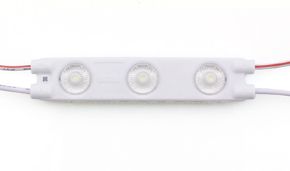
A wooden panel, a thin stone slab, an acoustic panel, or a shelf can become backlit wall sconces: the LED strip hidden behind the object creates a luminous halo on the wall. It is the "halo" effect widely used in headboards, TV walls, and hotel lobbies. For panels and signs, LED modules can also be used.
Summary table of wall sconce types
| Type of wall sconce | Lighting effect | Ideal environments | Key components | Difficulty |
|---|---|---|---|---|
| Direct light | Functional beam | Reading, mirror, desk | Wall profile + opal diffuser | Easy |
| Indirect light | Soft, reflected | Living room, bedroom, hotel | Profile with upward emission | Easy |
| Up & down | Double blade of light | Hallways, facades, entrances | Two strips or double profile | Medium |
| Linear / bar | Continuous line | Any modern environment | COB strip + slim profile | Easy |
| Angular | Diagonal on two walls | Corners, L-shaped hallways | 45° angular profile | Easy |
| Recessed | Architectural cut of light | Drywall, design projects | Recessed profile | Medium |
| For paintings | Grazing, true to colors | Galleries, living rooms | CRI 90+ strip + inclined profile | Easy |
| Neon Flex | Shapes, curves, writings | Kids' rooms, venues, shops | Neon Flex + accessories | Medium |
| Backlit | Halo on the wall | Headboards, TV walls | Strip behind panel | Easy |
4. Components to build an LED wall sconce: guide to the Ledpoint catalog
A custom LED wall sconce is composed of a few well-chosen elements: light source, container, optics, power supply, and control. In this section, we analyze each component, explaining how to choose it and which category of the Ledpoint catalog to consult. The final quality of the wall sconce depends on the balance between these five elements.
The source: LED strips for wall sconces
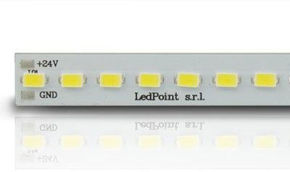
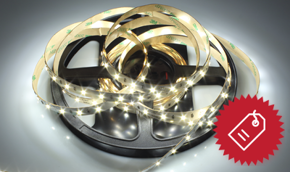
The LED strip is the "heart" of your wall sconce. Ledpoint offers a complete range of professional LED strips, which you can filter by color, power, voltage, chip type, and density.
Voltage: 12V, 24V, 48V, or 230V?
For domestic wall sconces, we recommend extra-low safety voltage (SELV) strips. 24V LED strips are the ideal standard: contained losses, longer runs without brightness drop, wide compatibility with controllers and power supplies. 12V LED strips are fine for short wall sconces or battery/camper-powered ones. 48V strips are suitable for very long lines, while 230V LED strips connect directly to the mains without a power supply, but require greater attention during installation and are more suitable for exteriors and large surfaces.
Chip type: COB, 2835, side LED
COB LED strips have LEDs so close together that they form a continuous line of light: they are the number one choice for visible linear wall sconces and shallow profiles. 2835 LED strips offer an excellent efficiency/price ratio and are perfect in profiles with an opal diffuser and good distance between LEDs and cover. 335 side LED strips emit light laterally: useful for backlighting thin panels, shelf edges, and glass or plexiglass slabs.
Power: how many W/m for a wall sconce?
For a decorative or atmospheric wall sconce, 4.8 W/m strips or those in the 4.9-9.5 W/m range are sufficient. For a functional wall sconce (reading, hallway, mirror), 9.6 W/m strips and 14.4 W/m ones are ideal. For very bright wall sconces, wall washing on high walls, or indirect light that must illuminate an entire living room, you go up to 19.2 W/m or more. Remember: higher power also means more heat, so an aluminum profile that dissipates correctly is needed.
Color temperature: warm, natural, or cool light
Color temperature is measured in kelvin (K). 2200-3500K warm white LED strips create welcoming atmospheres: perfect for bedrooms, living rooms, hotels. 3800-5300K white strips (natural/neutral light) are ideal for kitchens, bathrooms, studies, offices. Cool white strips are used in garages, laboratories, and technical environments. CCT LED strips allow you to adjust the tone from warm to cool with a controller.
Color rendering (CRI)
The color rendering index (CRI or Ra) indicates how faithfully the light reproduces the colors of objects. For a domestic wall sconce, a CRI ≥ 80 is recommended; for wall sconces for paintings, mirrors, shops, and hotel rooms, CRI ≥ 90 is better. The Sunled line reproduces a spectrum very close to sunlight, while the Circadian Light line is designed to follow the natural rhythm of the day.
Colored strips and effects
For colored and dynamic wall sconces: RGB LED strips (millions of colors), RGBW strips (colors + pure white), RGB+CCT strips (colors + adjustable white, the most complete solution), addressable pixel LED strips (each LED is controlled individually for moving effects), and monochromatic colored light strips.
| Strip type | Ideal for the wall sconce... | Paired controller |
|---|---|---|
| Monochromatic warm white | Bedroom, living room, hotel, classic exterior | Monochromatic dimmer |
| Monochromatic natural white | Kitchen, bathroom, study, office | Monochromatic dimmer |
| CCT (adjustable white) | Multifunction living room, bedroom, hotel | CCT controller |
| RGB | Decorative wall sconces, venues, kids' rooms | RGB controller |
| RGBW | Decorative + functional | RGBW controller |
| RGB+CCT | Maximum versatility, smart home | RGB+CCT receiver |
| Addressable pixel | Trail, chasing, rainbow effects | SPI controller |
The container: aluminum profiles for wall sconces
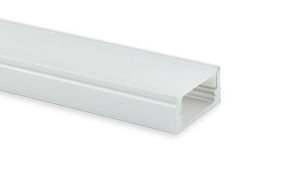
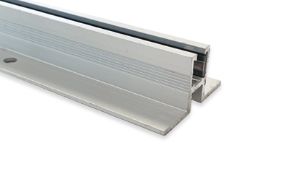
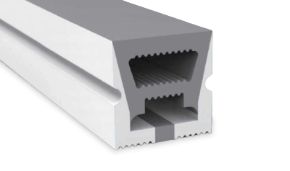
The profile is the "body" of the wall sconce. Ledpoint aluminum profiles, including the Lighting Line design range, perform three fundamental functions: they dissipate the heat of the strip, extending its life, protect the LEDs from dust and impacts, and define the aesthetics of the wall sconce. Aluminum, often anodized, is lightweight, corrosion-resistant, and available in silver, black, or white finishes.
Surface profiles
They are fixed directly to the wall with clips or screws: they are the base for surface-mounted wall sconces, under-shelf wall sconces, and above-mirror wall sconces.
Recessed profiles
They are inserted into a groove in drywall, wood, or masonry: they generate recessed wall sconces and cuts of light.
Angular profiles
Designed for 90° corners, they emit light at 45°: perfect for angular wall sconces.
Suspension profiles and wall profiles with double emission
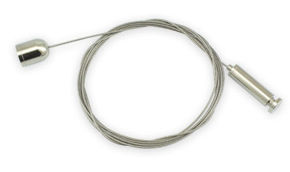
With suspension cables, the same profile can become a pendant lamp; double emission profiles are the base of up & down wall sconces.
Waterproof profiles
Profiles with gaskets and a high IP rating for outdoor wall sconces, bathrooms, and humid environments.
Custom profiles
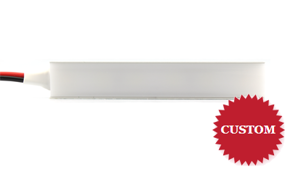
For special projects, hotels, shops, and professional supplies, custom profiles are available upon request.
The optics: diffusers, caps, and clips
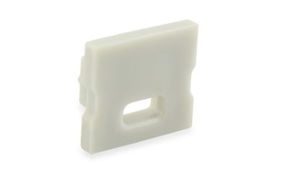
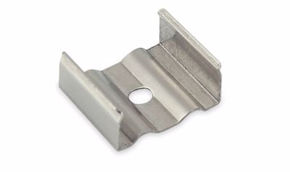
The diffuser transforms the light of individual LEDs into homogeneous light. The opal diffuser offers maximum uniformity (with an indicative light reduction between 25% and 45% depending on the model), the satin one is a compromise between uniformity and efficiency, and the transparent one maximizes brightness. The wall sconce is completed by end caps, which close the ends of the profile and let the cable pass, and mounting clips, which allow you to hook and unhook the profile from the wall without dismantling anything. To start without errors, there are also profile and accessory kits.
The power supply: power supplies and drivers
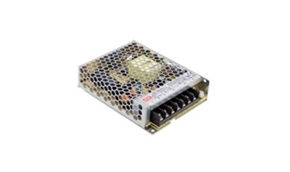
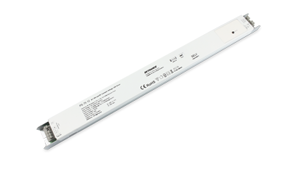
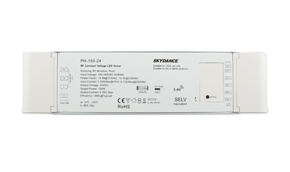
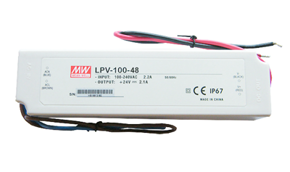
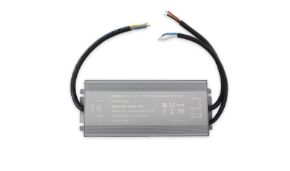
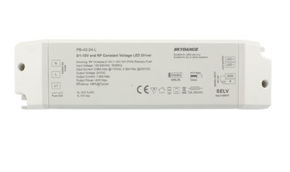
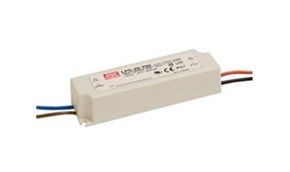
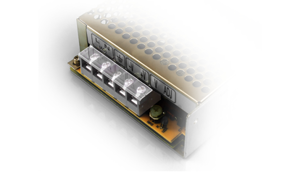
Low-voltage strips require a power supply that converts 230V mains to 12V, 24V, or 48V. For most domestic wall sconces, 24V power supplies are used. For superior visual comfort, especially in bedrooms and offices, there are anti-flicker drivers, which eliminate flickering. Smart power supplies already integrate remote control, while constant current power supplies are used for modules and sources that require it.
How to size the power supply
The rule is simple: power supply power = total strip power × 1.2 (20% safety margin). Example: two 1.5 m wall sconces with 9.6 W/m strips → 3 m × 9.6 W = 28.8 W × 1.2 = about 35 W: choose a power supply of at least 35-40 W.
Connections: connectors, cables, joints
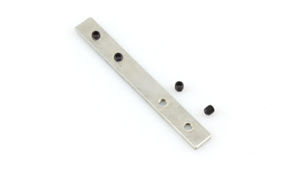
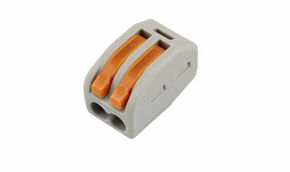
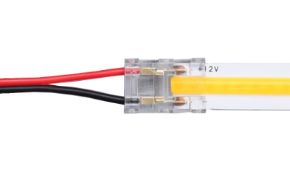
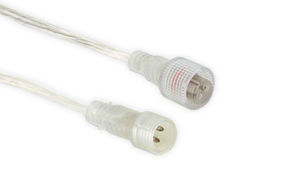
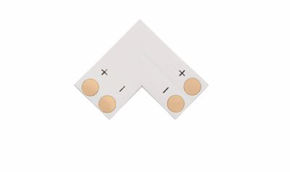
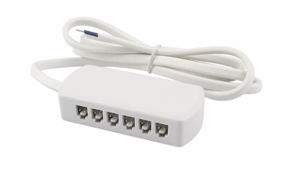
To connect the strip without soldering, there are PCB connectors for LED strips and quick connectors; those who prefer maximum reliability can use soldered joints. The equipment is completed by cables, multiple quick plugs to distribute power to multiple wall sconces, LED strip caps, and work tools.
The control: controllers, receivers, and remote controls
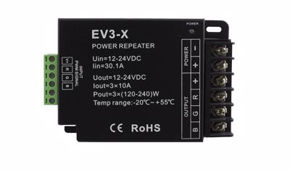
The controller is what transforms a simple wall sconce into a smart wall sconce: it regulates intensity, color temperature, colors, and effects. We will discuss this in depth in chapter 7, dedicated to controllers, remote controls, and lighting effects.
5. Designing the wall sconce: lumens, watts, height, distance, and dimensions
A beautiful wall sconce but wrong in numbers will glare, illuminate little, or create spots on the wall. In this chapter, we transform the most frequent questions ("how many lumens to get a lot of light?", "at what height to put wall sconces?", "how much distance between wall sconces?") into practical rules and ready-to-use tables, valid for both an apartment and a professional project.
Lumens, lux, and watts: the three quantities to know
The lumen (lm) measures the amount of light emitted by the source; the lux (lx) measures the light that reaches a surface (1 lux = 1 lumen per square meter); the watt (W) measures the energy consumed. The ratio between lumens and watts is the luminous efficacy (lm/W): the higher it is, the less the wall sconce consumes for the same amount of light. Quality LED strips easily exceed 100 lm/W, while an old incandescent bulb stopped at around 12-15 lm/W.
How many lumens per square meter and per environment
How many lumens per square meter are needed? It depends on the function of the environment. The UNI EN 12464-1 standard sets the illuminance levels for workplaces; for the domestic sphere, reference values derived from design practice are used. Remember that the wall sconce is rarely the only source of light: it usually covers a part of the requirement.
| Environment | Indicative illuminance (lux) | Total lumens for 10 m² | Role of the wall sconce | Recommended temperature |
|---|---|---|---|---|
| Living room | 100-200 | 1,000-2,000 | Atmosphere and accent | 2700-3000 K |
| Bedroom | 100-150 | 1,000-1,500 | Atmosphere and reading | 2700-3000 K |
| Hallway | 100 | 1,000 | Main light or guide | 3000 K |
| Entrance | 150-200 | 1,500-2,000 | Welcome | 3000 K |
| Kitchen (worktop) | 300-500 | 3,000-5,000 | Functional | 3500-4000 K |
| Bathroom (mirror) | 300-500 on the face | 2,000-3,000 | Functional | 4000 K |
| Study / office | 300-500 | 3,000-5,000 | Support | 4000 K |
| Stairs | 100-150 | — | Safety | 3000 K |
How many lumens to get a lot of light?
For a "very bright" wall sconce in a living room or hallway, consider at least 1,000-1,500 useful lumens per fixture. With LED strips, the calculation is immediate: multiply the lumens per meter of the strip by the length, then subtract the diffuser loss. Example: 14.4 W/m strip with about 1,500 lm/m, 1.2 m wall sconce, opal diffuser with 30% loss → 1,500 × 1.2 × 0.7 = about 1,260 useful lumens. A result for very bright wall sconces.
How many LED watts to illuminate a 20 sqm room?
A 20 m² living room requires indicatively 2,000-4,000 total lumens. With LED sources of about 100 lm/W, you therefore need between 20 and 40 LED W in total, distributed between general light and wall sconces. For example: two 1.5 m linear LED wall sconces with 9.6 W/m strips (about 29 W, over 2,500 nominal lumens) can cover a good part of the atmospheric light requirement, integrated by a pendant or spotlights for general light.
At what height are wall sconces placed?
This is perhaps the most searched question of all. The general rule is to install the wall sconce between 160 and 180 cm from the floor, that is, slightly above eye level, to avoid direct glare. However, there are many exceptions, summarized in this table.
| Wall sconce position | Indicative height from the floor | Notes |
|---|---|---|
| Living room, general use | 160-180 cm | Above eye level, indirect light upwards |
| Hallway | 170-190 cm (or grazing at 30-40 cm as a step marker) | Regular distance between wall sconces |
| Bedroom, bedside wall sconce | 60-80 cm above the mattress (approx. 110-140 cm from the floor) | Beam towards the pillow |
| Backlit headboard | Behind the headboard, 100-120 cm | Indirect light halo |
| Bathroom mirror, sides | Center of the source at face height, approx. 150-170 cm | Uniform light without shadows |
| Bathroom mirror, above | 5-10 cm above the mirror, approx. 180-200 cm | Downward and frontal beam |
| Painting | 15-30 cm above the frame | Grazing beam on the artwork |
| Stairs | 30-40 cm from the step (step marker) or 180 cm | Safety |
| Exterior, entrance | 180-200 cm, beside or above the door | Illuminates face and lock |
| Facade | 200-250 cm | Up & down for architectural effect |
For wall sconces above or behind the sofa, work between 150 and 170 cm, or hide a strip behind the backrest for indirect floor light. For wall sconces in attics and under wooden beams, adapt the height to the pitch of the ceiling.
Distance between wall sconces: how to calculate it
How to calculate the ideal distance between multiple wall sconces? A practical rule used by designers is to space the wall sconces by about 2-3 times the height at which they are installed relative to the point to be illuminated, or, in hallways, by a distance of about 2-3 meters. Here are the most common values:
| Situation | Recommended distance between wall sconces |
|---|---|
| Domestic hallway | 200-300 cm |
| Hotel hallway | 250-400 cm, alternating or face-to-face |
| Wall sconces beside a double bed | At the edges of the headboard, approx. 180-220 cm apart |
| Wall sconces beside a mirror | Equal to the width of the mirror + 10-20 cm |
| Exterior facade | 300-400 cm, depending on the rhythm of the windows |
With linear LED strip wall sconces, the distance problem is often solved at the root: a single continuous line of light replaces multiple light points and guarantees perfectly homogeneous wall lighting.
Wall sconce dimensions: correct proportions
For dimensions, a good rule is that the linear wall sconce should occupy between one-third and two-thirds of the width of the element it accompanies (bed, sofa, mirror, console). On a free 4-meter wall, a 1.5-2 meter long wall sconce creates an elegant sign; in a narrow hallway, thin profiles with little protrusion (under 3-4 cm) are better, so as not to obstruct passage.
What type of light to put in the house: the 3 types of lighting
What are the 3 types of lighting? General (diffuses light throughout the environment), functional or localized accent (illuminates a task: reading, cooking, applying makeup), and atmospheric or decorative (creates emotion, enhances architecture and objects). A custom LED wall sconce can belong to all three categories: this is why it is so versatile. What lights to put in the living room? Ideally a combination: pendant or spotlights for general light, wall sconces for atmospheric light, a reading lamp near the armchair.
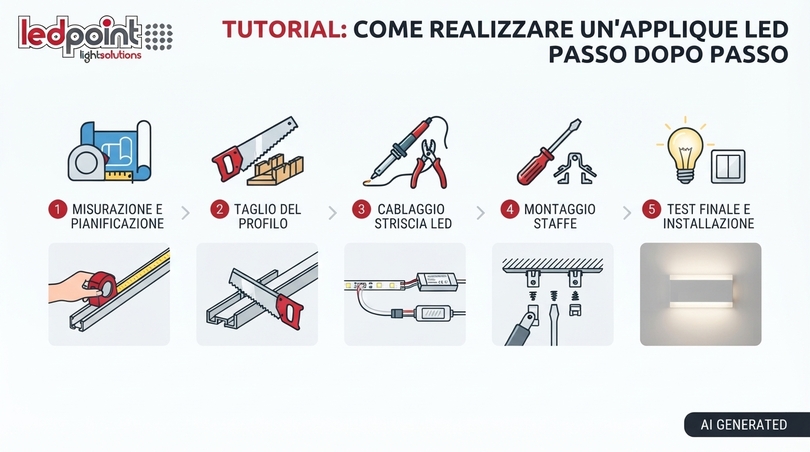
6. Tutorial: how to build an LED wall sconce step by step
And here we are at the practical heart of the guide. We show you how to cut, assemble, wire, and install a linear LED wall sconce with an aluminum profile, strip, diffuser, power supply, and controller. The procedure is the same for a 30 cm wall sconce above a bedside table and for a 3-meter light line in the living room: only lengths and powers change.
What you need: list of materials and tools
| Material | Where to find it on Ledpoint | Note |
|---|---|---|
| 24V LED strip | 24V LED Strips | COB for continuous light, 2835 for efficiency |
| Aluminum profile | Profiles | Surface, recessed, or angular |
| Diffuser | Diffusers | Opal for uniformity |
| Caps | Caps | One solid and one holed for the cable |
| Mounting clips | Clips | One every 40-50 cm approx. |
| Connectors or joints | PCB Connectors | Or soldering |
| Cable | Cables | Section adequate to the current |
| 24V Power supply | 24V Power supplies | Power × 1.2 |
| Controller + remote control | Controllers | Based on the strip type |
Tools: tape measure, pencil, level, hacksaw with fine-toothed blade (or chop saw with aluminum blade), file, scissors, wire strippers, soldering iron (optional), drill, wall plugs and screws, screwdriver, tester.
Phase 1 – Measure and design
Measure the wall and decide the length of the wall sconce. Check where the existing light point is or where the cable will pass. Check the cutting pitch on the strip datasheet (for example, every 5 cm, 10 cm, or 2.5 cm on COBs): the final length of the strip must be a multiple of the pitch. Calculate the profile slightly longer than the strip (about 1-2 cm) to leave room for the caps and the cable.
Phase 2 – Cut the aluminum profile
Secure the profile in a protected vise (with rags or wood to avoid scratching the anodization) and cut with the fine-toothed hacksaw, keeping the cut perfectly perpendicular. File the burrs and clean the chips: an aluminum chip inside the profile can damage the strip. Cut the diffuser to the same measure with a hacksaw or, for soft diffusers, with a robust cutter.
Phase 3 – Cut the LED strip
Cut the strip exactly on the indicated cutting line (usually marked with a scissor symbol between the copper pads). Use sharp scissors and cut in one go. Never cut outside the indicated points: the section would not work. If you have leftover pieces, keep them: they are perfect for small wall sconces for paintings or shelves. Ledpoint also sells LED strip cut-offs at an advantageous price, ideal for small projects.
Phase 4 – Connect the cable to the strip
You have two possibilities. With clip connectors, insert the strip into the connector respecting the polarity (+ and −, or the R, G, B, W, CW/WW channels on multicolor strips) and close the flap. With soldering, tin the pads and the cable, then join: it is the most reliable and least bulky solution, recommended in small profiles. Before closing everything, test the strip with the power supply: it is the most economical time to discover an error.
Phase 5 – Insert the strip into the profile
Clean the bottom of the profile with isopropyl alcohol, remove the strip's adhesive film, and make it adhere to the profile starting from one end, pressing with a cloth without touching the LEDs. Let the cable come out of the holed cap. The thermally conductive adhesive and the contact with the aluminum are fundamental for heat dissipation.
Phase 6 – Close with diffuser and caps
Insert the diffuser by pressure or sliding, then the caps at the ends (eventually with a drop of neutral silicone). Now the LED wall sconce is assembled: it is a single, lightweight, and robust body.
Phase 7 – Fix the wall sconce to the wall
Mark the position with the level, fix the clips with wall plugs and screws suitable for the support (solid masonry, hollow, drywall), and hook the profile to the clips with slight pressure. For recessed wall sconces, prepare the groove in the drywall or wood first. The clips allow you to remove the wall sconce at any time, useful for maintenance.
Phase 8 – Wire power supply and controller
The basic scheme is: 230V mains → (switch) → 24V power supply → controller/receiver → strip. The power supply must be positioned in an accessible and ventilated place: a junction box, an inspectable false ceiling, a piece of furniture. All 230V side connections must be performed by a qualified electrician in compliance with the IEC 60364 standard; the extra-low voltage part (24V) is within the reach of a careful hobbyist.
Phase 9 – Pair the remote control and test
Most radio receivers pair with the remote control with a simple procedure: press the "match" button on the receiver (or turn the power back on) and, within a few seconds, press a button on the remote control. Once done, test all functions: turning on, dimming, color temperature, colors, effects.
Mounting a wall sconce without wall chasing
Is it possible to mount a wall sconce without chasing the wall? Yes, and LED strip wall sconces are perfect for this. There are three solutions: surface-mounted trunking paintable like the wall; plug-in power supply to plug into a nearby socket (plug-in wall sconce); battery power with 5V or 12V strips and a rechargeable battery (wireless wall sconce, battery wall sconce). With clips fixed via structural double-sided tape or a few wall plugs, the wall sconce can be removed at the end of the contract: ideal for renters.
How to mount a wall sconce: summary in 9 steps
| Step | Operation | Indicative time |
|---|---|---|
| 1 | Measure wall and strip cutting pitch | 10 min |
| 2 | Cut profile and diffuser | 10 min |
| 3 | Cut the strip on the indicated line | 2 min |
| 4 | Connect the cable (connector or soldering) | 10 min |
| 5 | Glue the strip into the profile | 5 min |
| 6 | Close with diffuser and caps | 5 min |
| 7 | Fix clips and hook the wall sconce | 15 min |
| 8 | Wire power supply and controller | 15-30 min |
| 9 | Pair the remote control and test | 5 min |
The most common errors to avoid
- Strip too powerful in a small profile: overheating and reduced lifespan. Choose larger profiles for strips over 14.4 W/m.
- Undersized power supply: flickering and shutdowns. Remember the 20% margin.
- Too long runs powered from one side: the light fades at the end. Beyond 5 meters (24V), power from both sides.
- Reversed polarity: the strip does not turn on. Check + and −.
- Diffuser too close to the LEDs: dots are visible. Use COB strips or deeper profiles.
- IP20 strip in the bathroom or outdoors: use strips and profiles with an adequate IP rating.
7. Controllers, remote controls, and lighting effects: how to make the wall sconce smart
The real quality leap of a custom LED wall sconce comes with control. A wall sconce turned on and off with a switch is useful; a wall sconce that dims, changes tone, creates scenes, and responds to voice becomes part of the decor and the experience of the environment. Let's look at all the control systems in the Ledpoint catalog and the effects you can achieve.
What does dimmable mean?
Dimmable means that the light intensity can be continuously adjusted, from 100% down to a few percentage points. In LED strips, regulation normally occurs via PWM modulation: the controller turns the LEDs on and off thousands of times per second, varying the pulse duration. A quality controller with high PWM frequency avoids visible flickering and that perceived by smartphone cameras. A dimmable wall sconce allows you to switch from full light for cleaning or reading to soft light for a dinner or a movie.
Monochromatic controllers: dimmers, receivers, and remote controls
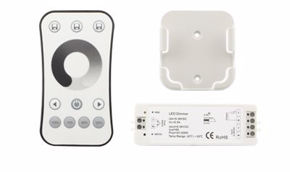
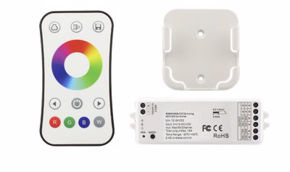
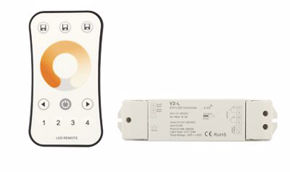
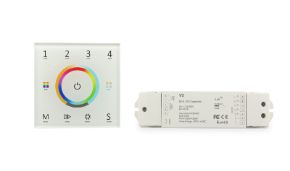
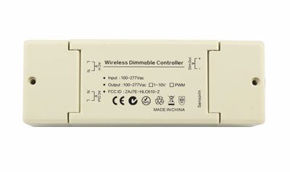
For single white light wall sconces (warm, natural, or cool), monochromatic controllers are needed. The system consists of a receiver, installed between the power supply and the strip, and a radio remote control or a wall button. Alternatively, there are knob or touch dimmers. Obtainable effects: soft on and off (soft start), intensity regulation, scene memories, management of multiple wall sconces in separate zones with a single multi-zone remote control.
CCT controllers: adjustable white light (tunable white)
With CCT strips and CCT controllers, the same wall sconce goes from warm light (about 2700 K) to cool light (about 6500 K) and all intermediate shades. CCT receivers and CCT remote controls with a wheel or slider are used. It is the ideal solution for those who are undecided about warm or cool light for the wall sconce: with CCT, you don't have to choose. In a living room, you can use neutral light during the day and warm light in the evening; in a hotel room, the guest chooses the light they prefer.
RGB controllers: millions of colors
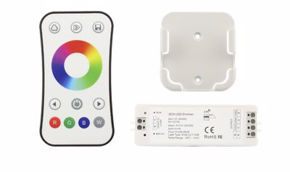
RGB controllers manage red-green-blue strips. By combining controllers, receivers, and RGB remote controls with a touch color wheel, you get: static colors, slow color change (fade), color jumps (jump), flashing (strobe), adjustable speed. Perfect for colored wall sconces in kids' rooms, taverns, venues, shops, and for themed lighting at parties.
RGBW and RGB+CCT controllers
RGB strips obtain white by mixing the three colors, but the result is not a pure white. RGBW strips with RGBW controllers add a dedicated white channel. RGB+CCT solutions, with receivers and RGB+CCT remote controls, combine colors and adjustable white: a single wall sconce for the functional light of everyday life and for the colored atmosphere of special occasions.
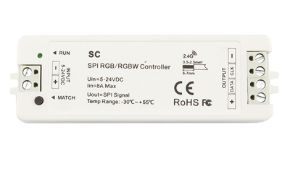
SPI controllers and pixel LEDs: dynamic moving effects
With addressable strips (pixel LEDs) and SPI controllers, each LED, or small group of LEDs, is controlled individually. This is how the most spectacular effects are born:
- Trail or comet effect: a luminous point travels along the wall sconce leaving a faded tail.
- Chasing effect: segments of light chase each other along the profile.
- Scrolling rainbow: the color spectrum scrolls along the wall sconce.
- Progressive fill: the wall sconce "charges" from one end to the other upon turning on.
- Breathing effect: the light grows and fades like a breath.
- Music synchronization: with microphone-equipped controllers, the light follows the rhythm.
For very long wall sconces or multiple wall sconces in series, signal amplifiers keep the control signal stable.
Sensors: wall sconces with motion and twilight sensors
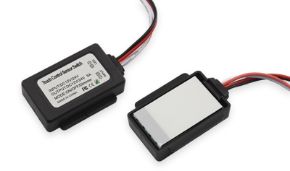
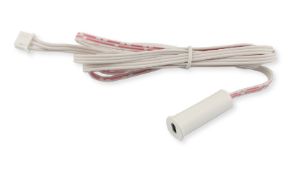
Are there wall sconces with motion sensors to illuminate the entrance? Yes: with Ledpoint sensors, the wall sconce turns on when you pass and turns off after an adjustable time. It is perfect for night hallways, stairs, walk-in closets, entrances, garages. By combining a twilight sensor, the outdoor wall sconce turns on only at sunset. A wall sconce with a sensor further reduces consumption because it stays on only when needed.
Kinetic: wall sconces that turn on with a gesture
The Kinetic range offers wireless and battery-free buttons, which generate the necessary energy from the pressure itself. You can place a command next to the bed, at the entrance, or near the sofa without wall chasing: a concrete answer to those asking for wall sconces with a wireless switch.
Home automation: ZigBee, apps, and voice assistants
LED wall sconces compatible with home automation are obtained with ZigBee controllers or smart power supplies. ZigBee is a low-power radio protocol used by major smart home hubs: the wall sconce becomes controllable via app, programmable with timers and scenes (for example, "good night", "cinema", "wake up"), and manageable with voice commands via assistants compatible with the hub used.
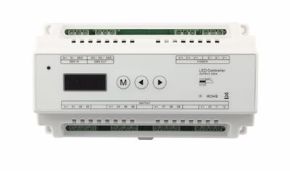
Professional systems: DALI, DMX, and 0/1-10V
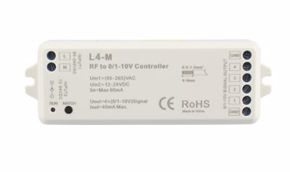
For hotels, offices, shops, and architectural projects, professional control systems are needed. DMX and DALI decoders connect LED wall sconces to DALI systems (standard for light management in buildings) or DMX512 (standard for scenic lighting). 0/1-10V devices allow integration with existing analog systems and building automation systems.
Table of effects obtainable with Ledpoint controllers
| Effect on the wall sconce | Required strip | Controller | Typical use |
|---|---|---|---|
| Dimming 1-100% | Monochromatic | Dimmer / monochromatic receiver | Any environment |
| Soft start | Any | Any controller with soft start | Bedrooms, night hallways |
| Warm ↔ cool light | CCT | CCT controller | Living room, bedroom, hotel, office |
| Circadian light | CCT / Circadian Light | Programmable CCT controller | Wellness, offices, healthcare facilities |
| Static colors | RGB / RGBW / RGB+CCT | RGB / RGBW / RGB+CCT controller | Decoration, venues |
| Fade, jump, strobe | RGB / RGBW | RGB / RGBW controller | Parties, entertainment |
| Trail, chasing, rainbow | Addressable pixel | SPI controller | Scenic wall sconces |
| Turn on at passage | Any | Sensor + controller | Hallways, stairs, entrances |
| App and voice control | Any | ZigBee / smart power supplies | Smart home |
| Centralized control | Any | DALI / DMX decoder | Hotels, offices, shops |
| Separate up and down | Two strips | Multi-channel or zone controller | Double emission wall sconces |
Ready-to-use lighting scenes
"Evening Relax" scene (living room)
Indirect light CCT wall sconces set to 2700 K and 30% intensity, pendant light off. Warm atmosphere, maximum visual comfort.
"Reading" scene (bedroom)
Bedside wall sconces at 3000 K and 80%, headboard wall sconce at 20%. Light concentrated on the book, soft halo on the wall.
"Night" scene (hallway)
Step marker wall sconce with motion sensor at 10%, warm light 2200-2700 K so as not to disturb sleep.
"Party" scene (tavern or covered terrace)
RGB+CCT wall sconces in slow color fade mode; at the end, return to warm white with one button.
"Guest Welcome" scene (hotel)
Room wall sconces that turn on at 60% and 3000 K upon card insertion, managed by a DALI system.
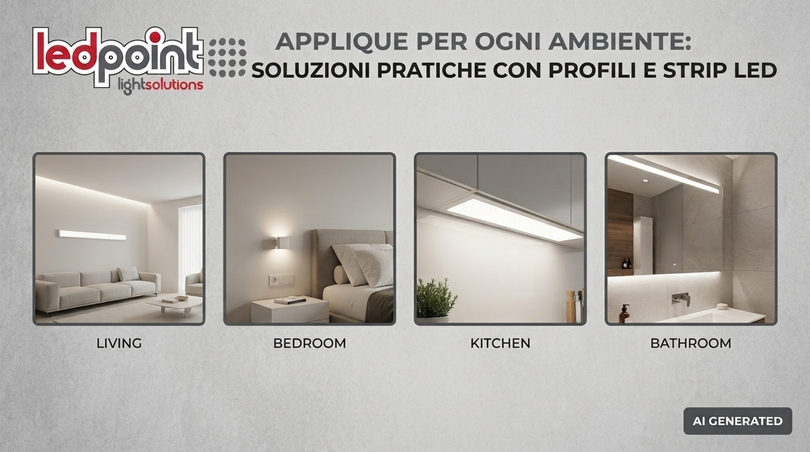
8. Wall sconces for every environment: practical solutions with profiles and LED strips
Each room has different needs: intimacy in the bedroom, precision in the kitchen, orientation in the hallway, welcome at the entrance. In this chapter, we see, environment by environment, which LED wall sconce to build, with which components and which controller, also answering the questions of professionals who design for their clients.
Wall sconce for a modern living room
Which wall sconces are most suitable for a modern living room? Linear indirect light wall sconces and up & down wall sconces, which wash the wall and create depth. A very effective solution is a horizontal light line at 170 cm, with a 9.6-14.4 W/m CCT strip in a surface profile with upward emission, controlled by a CCT remote control. For the TV wall, a strip behind the panel creates a halo that reduces visual fatigue. To illuminate the living room with wall sconces without shadow zones, distribute the sources on at least two walls.
Wall sconce for the bedroom
In the bedroom, the wall sconce plays two roles: atmosphere and reading. Which models are most suitable for a minimalist bedroom? Short linear bedside wall sconces (40-60 cm) with 2700-3000 K warm light and a backlighting strip behind the headboard. Two channels of a controller allow you to turn on the left and right sides separately, so each person can read without disturbing the other. For night light, a motion sensor under the bed turns on a strip at 5-10%. How to illuminate the wall behind the bed? With a strip hidden behind the headboard or in a drywall cove: guaranteed hotel effect.
Wall sconce for the hallway
What LED power is needed to illuminate a hallway well? For a domestic hallway about 1-1.2 m wide, about 100 lux is enough, obtainable with 8-10 LED W for every 2-3 meters of hallway, for example, 60-80 cm linear wall sconces with 14.4 W/m strips. Alternatively, a continuous grazing line at 30-40 cm from the floor with a 4.8 W/m strip and a motion sensor creates an elegant and safe step marker effect. For narrow hallways, choose profiles with little protrusion or recessed ones.
Wall sconce for the entrance
The entrance is the calling card of the house. A wall sconce above the console or next to the mirror with 3000 K light, combined with a presence sensor, welcomes those who enter without looking for the switch. A frame of light around the mirror with a slim profile and COB strip is one of the most scenic and requested solutions.
Wall sconce for the bathroom and bathroom mirror
In the bathroom, the light must illuminate the face uniformly, without shadows under the eyes and chin. Side wall sconces to the mirror or a perimeter light frame at 4000 K with CRI ≥ 90 are the best solution for makeup and shaving. The touch mirror dimmer allows you to adjust the light by touching the glass. Pay attention to the IP rating: in the bathroom, the safety zones provided by the CEI 64-8 standard (part 7) must be respected, using strips and profiles with adequate protection near the bathtub and shower, and power supplies always outside the wet zones.
Wall sconce for the kitchen
In the kitchen, the under-cabinet wall sconce is a classic: a 9.6-14.4 W/m strip at 4000 K in a profile with an opal diffuser, fixed under the cabinets, illuminates the worktop by eliminating the shadows produced by the ceiling light. For the dining area, a dimmable warm light wall sconce creates the right atmosphere for dinner. For food use, there are also Food strips, designed to enhance food in showcases and counters.
Wall sconce for indoor stairs
On the stairs, the wall sconce is primarily a safety element. Step marker wall sconces every 2-3 steps, at 30-40 cm from the tread, or a continuous line along the handrail: both solutions are built with profiles and strips. With an SPI controller, you can even make the steps light up in sequence when you pass, a great impact effect for modern indoor stairs.
Wall sconce for study and office
In the office, the wall sconce contributes to visual comfort. 4000 K strips with CRI ≥ 80, anti-flicker power supplies, and DALI or 0-10V control allow you to integrate wall sconces into the building's light management, in compliance with UNI EN 12464-1. An indirect light wall sconce reduces glare on screens.
Wall sconce for boutique hotels and hospitality structures
Which wall sconces are most suitable for hotel rooms? Robust wall sconces, easy to clean, with intuitive controls and quality warm light. Aluminum profiles with opal diffuser, CRI ≥ 90 strips, and CCT or DALI controllers guarantee durability and constant performance even with intense daily use. Are there models with an integrated switch for guest rooms? With wireless Kinetic buttons or local dimmers, the control is brought directly next to the bed. For hotel hallways, linear up & down wall sconces every 3-4 meters and presence sensors reduce night consumption. Aesthetic coordination is achieved by using the same profile family in all areas.
Wall sconce for the kids' room
In children's rooms, colored and original wall sconces stimulate the imagination: a cloud or a star in Neon Flex, an RGB line that becomes a soft night light, a dimmable warm strip for reading a fairy tale. Always use extra-low voltage power and closed profiles.
Summary table: LED wall sconce by environment
| Environment | Type of wall sconce | Recommended strip | Temperature | Control |
|---|---|---|---|---|
| Living room | Linear indirect / up & down | CCT 9.6-14.4 W/m | 2700-4000 K | CCT remote control, ZigBee |
| Bedroom | Bedside + backlit headboard | Warm white / CCT | 2700-3000 K | Multi-zone remote control |
| Hallway | Linear or step marker | 4.8-14.4 W/m | 3000 K | Motion sensor |
| Entrance | Mirror frame / above console | COB | 3000 K | Sensor + dimmer |
| Bathroom | Mirror sides / frame | CRI 90+, adequate IP | 4000 K | Mirror dimmer |
| Kitchen | Under-cabinet | 9.6-14.4 W/m | 4000 K | Dimmer / sensor |
| Stairs | Step marker / sequential | 4.8 W/m or pixel | 2700-3000 K | Sensors, SPI |
| Office | Indirect | CRI 80+ | 4000 K | DALI / 0-10V |
| Hotel | Linear, up & down, bedside | CRI 90+, CCT | 2700-3000 K | DALI, Kinetic |
| Kids' room | Decorative, Neon Flex | RGB / warm white | 2700 K + colors | RGB remote control |
9. Styles, materials, and finishes: how to choose the right wall sconce for your decor
How to choose a wall sconce based on the style of the decor? The light must dialogue with the materials, colors, and proportions of the environment. A custom wall sconce has a great advantage: you can choose the profile finish, the shape of the diffuser, and the color of the light to integrate it into any style, from minimal to classic.
Modern and minimalist wall sconces
For a modern or minimal style, choose thin profiles in anodized silver or black aluminum, opal diffusers flush with the wall, COB strips without dots. The wall sconce must seem like a graphic sign, not an object. The most successful modern LED wall sconces are those that disappear during the day and draw the wall in the evening.
Industrial style wall sconces
The industrial style loves visible metal, matte black, textile cables, warm light. A black profile suspended with cables, a 2200-2700 K strip that recalls filament bulbs, and a rough wall finish create an industrial wall sconce with a strong character.
Classic and elegant wall sconces
Even in a classic environment, the LED wall sconce finds space: a strip hidden behind a plaster frame, a cove that illuminates a decorated ceiling, grazing light on wainscoting. 2700 K warm light with high CRI enhances woods, stuccos, fabrics, and gilding. Traditional classic wall sconces (in brass, crystal, ceramic, wrought iron) can coexist with hidden LED lines that complete their light.
Scandinavian, rustic, and mountain wall sconces
In Nordic style and mountain houses, wood is the protagonist: profiles recessed in beams, shelves, or wooden panels with 2700-3000 K light create warm and natural wooden wall sconces. For rustic environments and taverns, indirect light on stone walls enhances the texture of the material.
Materials and finishes compared
| Material | Advantages | Limits | Ideal style |
|---|---|---|---|
| Anodized aluminum | Dissipates heat, lightweight, durable | Requires precise cutting | Modern, minimal, technical |
| Painted black or white aluminum | Integrates with walls and furniture | Scratches visible if mishandled | Industrial, contemporary |
| Glass | Elegant reflections, brilliant light | Fragile, heavier | Classic, modern chic |
| Ceramic | Craftsmanship, material effect | Little adaptable to measures | Mediterranean, rustic |
| Wood | Warmth, naturalness | To be protected from direct heat | Nordic, mountain, rustic |
| Plaster and drywall | Recessed wall sconces, paintable | Requires installation work | Architectural, classic |
| Fabric | Soft light, acoustic | More delicate cleaning | Hotels, bedrooms |
How to match wall sconces to wall and furniture colors
Light walls reflect a lot of light: less powerful wall sconces are enough, and indirect light performs at its best. Dark walls absorb light: more powerful strips and more grazing light are needed to enhance their texture. Golden rule: warm light with woods, beige, terracotta, and warm colors; neutral light with grays, pure whites, blues, and technical materials. A white profile on a white wall disappears; a black profile on a light wall becomes a graphic sign.
How to create atmospheric lighting with multiple wall sconces
To create atmosphere, use multiple low-intensity wall sconces instead of a single very powerful one; alternate indirect light (halo) and punctual accents (paintings, plants, bookshelves); control all wall sconces from the same multi-zone remote control to recall different scenes. The result is a deep, layered environment that changes its face with a button.
10. Outdoor wall sconces: IP rating, materials, and solutions for facades, balconies, and entrances
Illuminating entrances, terraces, and facades increases the safety and aesthetic value of the house. But an outdoor wall sconce must resist rain, sun, frost, and temperature changes. Let's see which wall sconces are suitable for outdoor lighting and how to build them with the right components.
Indoor and outdoor wall sconces: the differences
The main difference is the protection against water and dust, indicated by the IP protection rating according to the IEC 60529 standard. The first digit indicates protection against solids, the second against liquids. An indoor wall sconce can be IP20; an outdoor wall sconce exposed to rain must be at least IP65.
| IP Rating | Protection | Wall sconce use |
|---|---|---|
| IP20 | No water protection | Dry interiors |
| IP44 | Water splashes | Bathrooms (outside the most exposed zones), covered exteriors |
| IP54 | Dust and splashes | Porches, covered balconies |
| IP65 | Total dust and water jets | Facades, exposed entrances, gardens |
| IP67 | Temporary immersion | Areas subject to water stagnation |
| IP68 | Continuous immersion | Fountains, swimming pools |
Which materials resist rain, sun, and temperature changes best?
Anodized or painted aluminum resists corrosion well; stainless steel is ideal in marine areas; UV-stabilized polycarbonate prevents diffusers from yellowing. Outdoor strips must be protected with a sheath or silicone resin, and protection restoration after cutting must be performed with dedicated caps and accessories. For exteriors, Neon Flex is particularly suitable thanks to its silicone body.
Wall sconces for facades, balconies, terraces, and gardens
On facades, up & down wall sconces draw architectural rhythms; on balconies and terraces, an indirect line under the parapet or under the cornice creates light without glaring; in the garden, step marker wall sconces guide along paths. To uniformly illuminate an exterior wall (wall washing), high-power strips in waterproof profiles positioned at the base or top of the wall are used. For large surfaces, Ledpoint floodlights complete the lighting.
Outdoor wall sconces with motion and twilight sensors
At the entrance, a motion sensor turns on the wall sconce when you approach with keys in hand; a twilight sensor turns it on at sunset in reduced mode, and a sensor brings it to 100% upon passage. This combination increases safety and reduces consumption.
Classic style outdoor wall sconces
How to choose a classic style outdoor wall sconce? You can maintain lanterns and traditional wall sconces for their aesthetic value, replacing the source with warm light LED bulbs, and flanking hidden LED lines under the cornices to enhance the facade. The result combines classic charm and modern efficiency.
11. Safety, regulations, and certifications of LED wall sconces
A wall sconce, even if custom-built, is an electrical appliance and must be safe. In this chapter, we see which certifications to verify, which regulations to respect, and how to verify compatibility with the existing electrical system: valuable information for both private individuals and installing electricians.
What safety certifications must wall sconces have?
Components of an LED wall sconce sold in the European Union must bear the CE marking, which attests compliance with the Low Voltage and Electromagnetic Compatibility directives; sources and power supplies must also comply with the RoHS directive on hazardous substances. Lighting appliances refer to the IEC/EN 60598 family of standards. Always verify on technical datasheets and packaging the CE marking, IP rating, insulation class, and power supply nameplate data.
Insulation class
| Class | Characteristic | Example |
|---|---|---|
| Class I | Requires ground connection | Metal wall sconces powered at 230V |
| Class II | Double insulation, no ground | Many power supplies and plastic appliances |
| Class III | Safety extra-low voltage (SELV) power | 12V/24V LED strips powered by SELV power supply |
Wall sconces built with extra-low voltage strips are intrinsically safer on the user side, because mains voltage is not present on the strip.
How to verify compatibility with the electrical system
Before installing, verify: the presence of a light point or a junction box; the voltage and cross-section of the conductors; the presence of the ground conductor if the appliance is in class I; the possible presence of a pre-existing wall dimmer (traditional dimmers for incandescent lamps are often not compatible with LED power supplies: replace them with dedicated dimmers or a receiver system); the space to house the power supply and controller in a ventilated and inspectable manner.
Installation in bathrooms and humid environments
How to correctly install a wall sconce in the bathroom? Respect the zones 0, 1, and 2 defined by the CEI 64-8 standard section 701: in the zones closest to the bathtub and shower, only appliances with an adequate IP rating and SELV power with the power supply installed outside the zones are allowed. Power supplies must never be placed in zones subject to splashes. For the mirror, use closed profiles and strips with adequate protection.
Who can install a wall sconce?
Replacing an existing wall sconce by connecting it to the same light point is a common operation, but interventions on the 230V system, the creation of new light points, and installations in special environments must be performed by a qualified installer, who issues the declaration of conformity provided by DM 37/08. The extra-low voltage part (assembly of the wall sconce, strip-controller connection) can be performed with attention even by a DIY enthusiast.
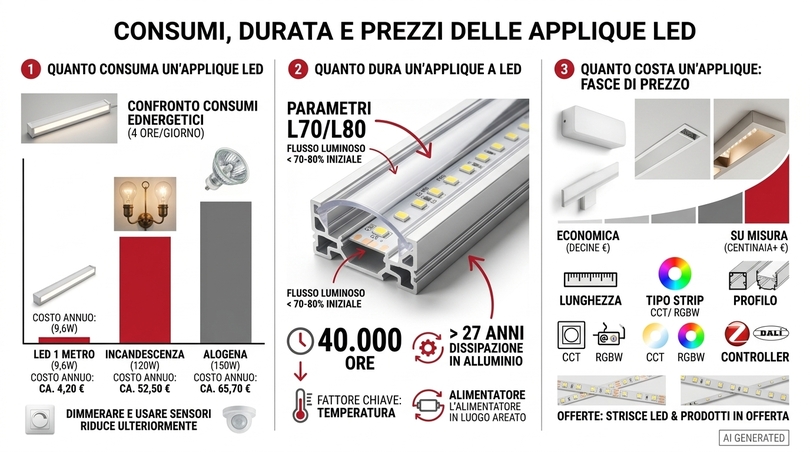
12. Consumption, lifespan, and prices of LED wall sconces
How much do LED wall sconces consume? How long does an LED wall sconce last? How much does a wall sconce cost? In this chapter, we transform questions into concrete numbers, with calculation examples that you can adapt to your project.
How much does an LED wall sconce consume
Consumption is calculated as follows: power (W) × hours of use ÷ 1000 = kWh. Multiplying the kWh by the energy price gives you the cost. In the table, we use an indicative price of 0.30 €/kWh and 4 hours of use per day.
| Wall sconce | Power | kWh/year (4 h/day) | Indicative annual cost |
|---|---|---|---|
| LED wall sconce 50 cm, 4.8 W/m strip | 2.4 W | 3.5 kWh | approx. 1 € |
| LED wall sconce 1 m, 9.6 W/m strip | 9.6 W | 14 kWh | approx. 4.20 € |
| LED wall sconce 1.5 m, 14.4 W/m strip | 21.6 W | 31.5 kWh | approx. 9.50 € |
| LED wall sconce 2 m, 19.2 W/m strip | 38.4 W | 56 kWh | approx. 16.80 € |
| Traditional wall sconce 2 × 60 W incandescent | 120 W | 175 kWh | approx. 52.50 € |
| 150 W halogen wall sconce | 150 W | 219 kWh | approx. 65.70 € |
The data speaks for itself: a 1-meter LED wall sconce consumes about one-twelfth of an old wall sconce with two incandescent bulbs. By dimming to 50% and using presence sensors, actual consumption is further reduced.
How long does an LED wall sconce last
The lifespan of quality LED strips is expressed with the L70 or L80 parameter: the hours after which the luminous flux drops to 70% or 80% of the initial value. Values of 30,000-50,000 hours are common for professional products correctly dissipated. At 4 hours a day, 40,000 hours equal over 27 years of use. The actual lifespan depends above all on temperature: this is why the aluminum profile is so important. The power supply also has its own useful life, linked to the operating temperature: install it in a ventilated place.
How much does a wall sconce cost: price ranges
How much does a wall sconce cost? The price varies enormously: from cheap wall sconces of a few tens of euros to signed design wall sconces that exceed hundreds or thousands of euros. A custom LED wall sconce has a cost proportional to the chosen components. Here are the factors that affect it:
| Factor | Impact on cost | Advice |
|---|---|---|
| Length | Proportional | Design the minimum effective size |
| Strip type | Monochromatic < CCT < RGBW < RGB+CCT < pixel | Choose the control you will actually use |
| Profile | Surface < recessed < design/custom | Evaluate the profiles on offer |
| Controller | Basic dimmer < radio < ZigBee < DALI | One remote control can manage multiple wall sconces |
| Power supply | Based on power and quality | One power supply for multiple wall sconces reduces costs |
| Installation | Variable | Use existing light points |
The cost of installing a wall sconce by an electrician depends on the area, complexity, and need for new chases: always ask for a detailed quote. For those looking for cheap wall sconces without sacrificing quality, the LED strips on offer and other products on offer sections are a great starting point.
13. Maintenance, cleaning, and common problems of LED wall sconces
An LED wall sconce requires very little maintenance, but a little attention prolongs its life and keeps the light always brilliant. Let's see how to clean it, how to replace components, and how to solve the most frequent problems.
How to clean the diffuser of a wall sconce
With the light off and the wall sconce cold, dust with a dry microfiber cloth. For more stubborn dirt, use a cloth barely dampened with water and a few drops of neutral detergent; avoid alcohol, solvents, and abrasive products on polycarbonate or PMMA diffusers, which could become opaque. Thanks to the clips, you can unhook the profile and clean it comfortably.
Replacement of the bulb or LED module
In traditional wall sconces, the bulb is replaced (E27, E14, G9, GU10, R7s bases): for wall sconce bulbs, choose LED versions with similar lumens and temperature to the original. In LED strip wall sconces, the strip is replaced: pull out the diffuser, detach the old strip, clean the profile, and glue the new one. Which models allow rapid replacement? Those with quick-connect connectors instead of soldered ones: useful for maintenance workers and hospitality structures.
Common problems and solutions
| Problem | Probable cause | Solution |
|---|---|---|
| The wall sconce does not turn on | Reversed polarity, connector not inserted, faulty power supply | Check + and −, check connectors, measure voltage with a tester |
| Flickering | Undersized power supply, incompatible dimmer, low frequency PWM | Increase power supply power, use dedicated controllers or anti-flicker drivers |
| Light weaker at the end | Voltage drop | Power from both sides, use 24V or 48V strips |
| Wrong colors | RGB channels swapped | Reconnect channels or reconfigure the controller |
| Dots are visible | Diffuser too close | COB strip, opal diffuser, deeper profile |
| Strip peeling off | Unclean surface, heat | Clean with alcohol, use dedicated adhesive tapes |
| Remote control does not respond | Lost pairing, dead battery | Repeat the match procedure, change battery |
| Buzzing from the power supply | Very low load or unsuitable dimmer | Check compatibility and minimum load |
Maintenance for high-use structures
How to choose resistant lamps for intense daily use? In hotels, offices, and shops, it is convenient to standardize: same profile family, same strips, same controllers, a stock of spare parts in the warehouse. Standardization reduces intervention times and management costs and guarantees a coherent image throughout the structure.
14. Five ready-to-build LED wall sconce projects
To make everything even more concrete, here are five typical projects, designed for the reader profiles who most often turn to Ledpoint: homeowners, renters, interior designers, hotel owners, and electricians. Each project indicates components, data, and expected result.
Project 1 – Linear up & down wall sconce for living room (for interior designers)
Objective: modern, elegant, and versatile wall sconce for a 25 m² living room.
Components: 180 cm double emission profile, two 9.6 W/m CCT strips (one upwards, one downwards), opal diffusers, 60 W 24V power supply, two-zone CCT receiver, CCT remote control.
Result: light above and below adjustable separately, from 2700 K to 6500 K, over 2,500 nominal lumens total, maximum consumption about 35 W. Perfect to propose to clients because it adapts to different styles by changing only the profile finish.
Project 2 – Chase-free bedside wall sconce (for renters)
Objective: improve the bedroom without permanent interventions.
Components: two 50 cm slim profiles, 2700 K warm white 4.8 W/m strip, 24V power supply with plug, cable in paintable adhesive trunking, two-zone monochromatic remote control.
Result: two independent reading wall sconces, consumption under 5 W, removable at the end of the contract leaving only a few holes easily filled (or none, with structural adhesive fixings).
Project 3 – Hotel hallway with sensors (for hospitality structures)
Objective: durable and refined hallway wall sconces, with low night consumption.
Components: 120 cm linear wall sconces every 3.5 m with CRI 90 3000 K 14.4 W/m strip, aluminum profiles with opal diffuser, DALI decoder, presence sensors.
Result: light at 30% during the night, 100% upon passage, coherent image with the boutique style, simplified maintenance thanks to standard components.
Project 4 – Light frame for bathroom mirror (for homeowners)
Objective: perfect light for makeup and shaving.
Components: angular or slim profiles on three sides of the mirror, COB 4000 K CRI ≥ 90 strip, touch mirror dimmer, power supply installed outside the wet zones.
Result: face illuminated without shadows, touch regulation, consumption of a few watts.
Project 5 – Facade with up & down wall sconce (for detached houses)
Objective: enhance the facade and increase safety.
Components: waterproof profiles with IP65 warm white strip, twilight sensor, motion sensor at the entrance, outdoor power supply in a watertight box.
Result: facade illuminated at sunset in soft mode, entrance at 100% upon passage, outdoor wall sconces resistant to rain and sun.
15. Final checklist: how to choose and buy the ideal wall sconce
Before proceeding with the purchase, answer these questions. The checklist summarizes the entire guide and helps you not to forget anything, whether you are designing a wall sconce for your home or for a client.
| Question | Options | Ledpoint component |
|---|---|---|
| Where does the wall sconce go? | Interior / bathroom / exterior | Strips and profiles with adequate IP |
| What is its function? | Atmosphere / reading / guide / accent | W/m power and optics |
| What light do I want? | Warm / natural / cool / adjustable / colors | Warm white, neutral, CCT, RGB, RGB+CCT |
| What style? | Minimal / industrial / classic / Nordic | Profile finish, diffuser |
| How long? | From bedside to entire wall | 2-3 m profiles + joints |
| Direct, indirect, or up & down? | One or two emissions | Single or double profile |
| How do I control it? | Switch / remote control / app / voice / sensor / DALI | Controllers, ZigBee, sensors, decoders |
| How do I power it? | Light point / plug / battery | 12V-24V power supplies, smart |
| Is an electrician needed? | Yes for 230V and new light points | — |
| What is the budget? | Economic / medium / premium | Offer sections and cut-offs |
Do you have doubts about a specific project? The Ledpoint technical team will help you choose strips, profiles, and controllers: contact us for a consultation, consult the Ledpoint blog for other guides, and download the complete catalogs.
16. Frequently asked questions about LED wall sconces (FAQ)
We have collected the most searched questions on Google and asked to artificial intelligences about wall sconces, LED wall sconces, and wall lamps. Click on each question to open the answer.
What is a wall sconce?A wall sconce is a lamp fixed to the wall that emits direct, indirect, or up and down light. It is used for atmospheric, accent, or functional light. The term derives from the French "appliquer", to apply. With LED strips, aluminum profiles, and Ledpoint controllers, custom, efficient, and dimmable wall sconces are built. |
What is the difference between a wall sconce and a ceiling light?A ceiling light is installed on the ceiling and diffuses uniform general light; a wall sconce is fixed to the wall and creates lateral, accent, or atmospheric light. There are ceiling-wall lights that do both. In a well-made project, the two solutions integrate: ceiling light for general light, wall sconce for depth and comfort. |
At what height are wall sconces placed?In general, between 160 and 180 cm from the floor, just above eye level, to avoid glare. Bedside wall sconces are installed 60-80 cm above the mattress, those for mirrors at face height or 5-10 cm above the mirror, step markers at 30-40 cm from the floor, outdoor ones between 180 and 200 cm. |
How to mount an LED wall sconce with profile and strip?Cut the profile and strip to size at the indicated points, connect the cable with a connector or soldering, glue the strip into the profile, close with diffuser and caps, fix the clips to the wall, and hook the wall sconce. Finally, connect the power supply and controller; the 230V part must be entrusted to an electrician. |
How many lumens are needed for a very bright wall sconce?For a very bright wall sconce in a living room or hallway, aim for at least 1,000-1,500 useful lumens. With LED strips, calculate lumens per meter times length, subtracting the diffuser loss (25-45% for opal). A 14.4 W/m strip 1.2 meters long with an opal diffuser provides about 1,200-1,300 lumens. |
How much does an LED wall sconce consume?Very little: a 1-meter LED wall sconce with a 9.6 W/m strip consumes 9.6 W, about 14 kWh a year with 4 hours of daily use, equal to about 4 euros with energy at 0.30 €/kWh. An old wall sconce with two 60 W incandescent bulbs consumes over ten times as much. |
How long does an LED wall sconce last?Professional LED strips correctly dissipated in an aluminum profile reach 30,000-50,000 hours (L70 or L80 parameter). With 4 hours of use per day, this means over twenty years. The lifespan depends above all on the operating temperature and the quality of the power supply, to be installed in a ventilated place. |
Warm or cool light for a wall sconce?Warm light 2700-3000 K for bedrooms, living rooms, hotels, and atmosphere; natural light 4000 K for kitchens, bathrooms, mirrors, and offices; cool light over 5500 K only for technical environments. If you don't want to choose, use CCT strips with a controller: the same wall sconce goes from warm to cool light with the remote control. |
What does dimmable wall sconce mean?It means that the light intensity is continuously adjustable, from maximum down to a few percentage points. In LED strip wall sconces, dimming occurs with a PWM controller commanded by remote control, button, app, or DALI system. It allows you to switch from full light to soft light with a single gesture. |
Are there wireless or battery-powered wall sconces?Yes. LED battery wall sconces can be built with 5V or 12V strips and a rechargeable battery, or plug-in wall sconces powered by a nearby socket with a cable in trunking. For controls, there are wireless and battery-free Kinetic buttons. These are ideal solutions for rented houses. |
How to install a wall sconce without wall chasing?Use a plug-in power supply and run the cable in a paintable trunking, or choose battery power. Fix the profile with clips and a few wall plugs or with structural double-sided tape. To turn on and off, use a radio remote control or a wireless button: no masonry work. |
What IP rating is needed for an outdoor wall sconce?For an outdoor wall sconce exposed to rain, at least IP65 is required; IP44 or IP54 are sufficient only in covered areas like porches and sheltered balconies. For areas subject to water stagnation, go up to IP67. After cutting waterproof strips, protection must be restored with dedicated caps and accessories. |
Are there wall sconces with motion sensors?Yes: by combining a motion sensor with the controller, the wall sconce turns on when you pass and turns off after a set time. It is ideal for entrances, hallways, stairs, walk-in closets, and facades. With a twilight sensor, the outdoor wall sconce turns on only when it gets dark, reducing consumption. |
Are LED wall sconces compatible with home automation?Yes. With ZigBee controllers or smart power supplies, the LED wall sconce is controlled via app, programmed with timers and scenes, and commanded by voice via assistants compatible with the hub. For hotels and offices, DALI, DMX, or 0/1-10V interfaces connected to building automation are used. |
What is the difference between a wall sconce and spotlights?The spotlight concentrates light into a narrow, adjustable beam to highlight an object; the wall sconce distributes light on the wall or in the environment. There are hybrid solutions like the spotlight wall sconce. With LED profiles, you can obtain both diffused light lines and grazing accents on paintings and niches. |
Which wall sconces are suitable for a rented house?LED strip wall sconces with a plug-in power supply, battery-powered ones, and those fixed with clips and a few wall plugs: they are mounted without chasing and removed at the end of the contract. Slim profiles with warm light and a remote control immediately improve the appearance of the bedroom, living room, and entrance without permanent interventions. |
What certifications must a wall sconce have?Components must bear the CE marking and comply with the Low Voltage, Electromagnetic Compatibility, and RoHS directives; lighting appliances refer to the IEC/EN 60598 standards. Also verify the IP rating, insulation class, and power supply data. The 230V installation must be certified by the electrician. |
How much does a custom LED wall sconce cost?The cost depends on length, strip type, profile, controller, and power supply. A one-meter monochromatic wall sconce has a contained cost, while RGB+CCT, pixel, or DALI solutions cost more. A single power supply and a single remote control can serve multiple wall sconces, reducing the overall expense. |
How to illuminate the wall behind the bed?Hide an LED strip behind the headboard or in a drywall cove, facing upwards or towards the wall: a halo of warm indirect light is created. Add linear bedside wall sconces for reading and a two-zone controller to adjust them separately. It is the typical effect of hotel rooms. |
How to clean an LED wall sconce?With the light off and the wall sconce cold, use a dry microfiber cloth or one barely dampened with water and neutral detergent. Avoid alcohol and solvents on polycarbonate or PMMA diffusers. Thanks to the mounting clips, you can unhook the profile and clean it comfortably, without dismantling the system. |
What to put in place of a wall sconce or a chandelier?A line of LED light in an aluminum profile, on the wall or ceiling, effectively replaces wall sconces and chandeliers: it is thin, uniform, and custom-made. Alternatively, coves with indirect light, adjustable spotlights, or linear suspensions made with profiles and suspension cables are used. |
17. Your custom and smart LED wall sconce
We have seen what a wall sconce is, what types exist, how to design it with correct lumens, watts, heights, and distances, how to build it step by step with LED strips and aluminum profiles, and how to make it smart with controllers, remote controls, sensors, and home automation. An LED wall sconce built with Ledpoint components combines creative freedom, professional performance, and minimal consumption: it is the concrete answer for those looking for modern wall sconces, indoor and outdoor wall sconces, cheap but quality wall sconces, wall sconces for hotels, and architecture projects.
The next step is yours: choose the LED strip, the aluminum profile, and the controller suitable for your environment, or ask for support from our technical team. Your wall is ready to become the most beautiful light point in the house.
This article was developed with the support of artificial intelligence and subsequently reviewed, corrected, and validated by the Ledpoint.it technical team, which guarantees its reliability and compliance with official sources.