






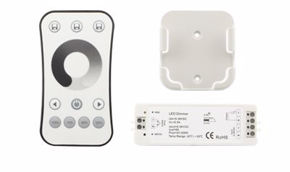
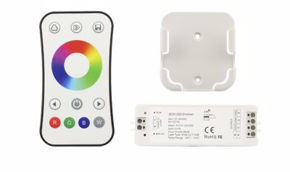
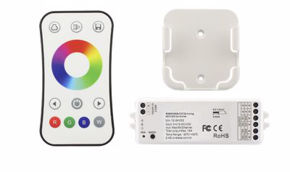
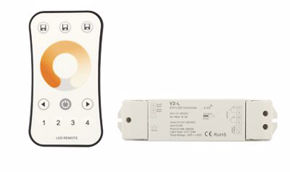
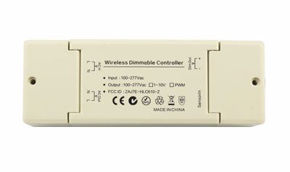
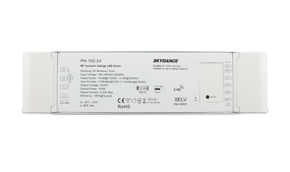
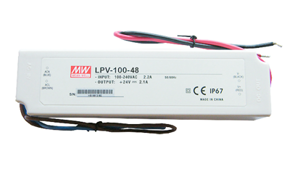
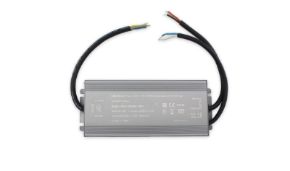
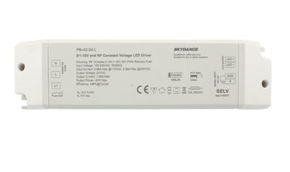



Dimmable drivers TRIAC vs 0-10V vs DALI vs DMX
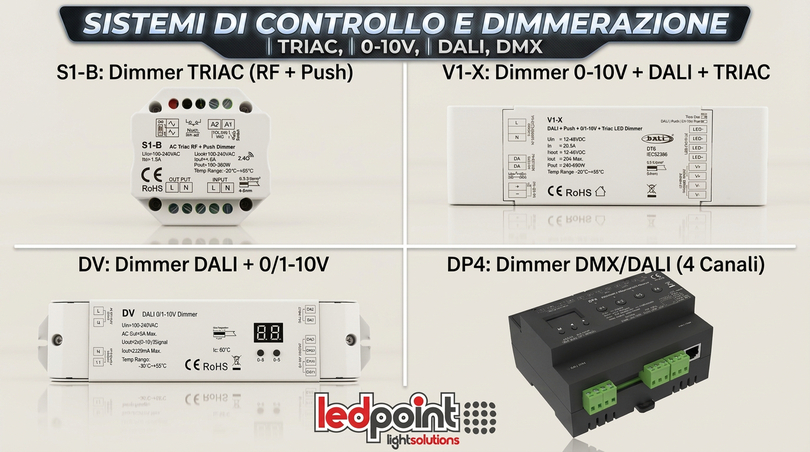
The four dominant dimming systems for LEDs are: TRIAC (analog, phase-cut on 230 V, residential retrofit), 0-10V (analog, low-voltage signal, industrial retrofit), DALI (bidirectional digital dedicated to lighting, professional standard), DMX512 (high-speed digital, born for stage lighting, now standard for dynamic architectural lighting). TRIAC and 0-10V are simple and cheap but rigid; DALI and DMX require dedicated wiring but offer individual addressing, scenes, high resolution, and zero flicker.
What is dimming in LEDs and how it works
Dimming is the adjustment of a light source's intensity. In LEDs, it is not achieved by reducing the voltage (as in halogens) but by acting on the driver, the electronic power supply that converts the 230 V AC mains into constant voltage/current DC. There are two fundamental techniques:
- Analog dimming (CCR — Constant Current Reduction): reduces the current supplied to the LED. More stable, less flicker, slight color shift at low intensity.
- PWM (Pulse Width Modulation): turns the LED on and off at high frequency by varying the duty cycle. Maintains constant color but can generate visible or stroboscopic flicker if the frequency is low.
The four protocols we will see below are not dimming techniques but control protocols: they tell the driver "how much light to emit", leaving the choice between CCR and PWM to the driver itself.
TRIAC: Phase-cut on 230V
TRIAC dimming (also called phase-cut or leading-edge) is the most widespread system in residential environments. The wall dimmer "cuts" a portion of the 230 V sinusoidal wave (on the rising or falling edge, hence the leading-edge and trailing-edge variants), reducing the average power transmitted to the driver. The LED driver interprets this reduction and adjusts the output current accordingly.
Pros
- Wiring identical to traditional setups: 2 mains wires, wall dimmer
- Very low cost (dimmer from €15–40)
- Immediate retrofit on existing halogen systems
- No programming required
Cons
- Compatibility not guaranteed: requires explicitly "TRIAC dimmable" drivers and dimmers
- Limited dimming depth (typically 10–100%, rarely below 5%)
- Possible flicker, buzzing, or instability at low intensities
- Zone dimming only, not individual per fixture
- Not scalable for large installations
0-10V: Low-voltage analog signal
The 0-10V system (also 1-10V in the European EN 60929 variant) uses two dedicated low-voltage wires, separate from the 230 V mains. The dimmer outputs a variable voltage between 0 and 10 V DC that the driver interprets as a brightness command: 10 V = 100%, 1 V = minimum, 0 V = off (or minimum, depending on the variant).
Pros
- Excellent reliability: simple, robust protocol, immune to minor interference
- Good dimming depth (1–100%)
- Contained cost for medium installations
- Widespread in industrial settings, warehouses, sheds, technical lighting
Cons
- Requires additional dedicated wiring (2 extra wires)
- Group dimming only: all fixtures connected to the same line have the same level
- No feedback from the driver
- No individual addressing, no complex scenes, no color tuning
- Signal polarity critical (wiring error = driver at 100% or off)
DALI: Bidirectional digital
DALI (Digital Addressable Lighting Interface) is the IEC 62386 standardized digital protocol dedicated to lighting. It operates on 2 dedicated low-voltage wires (16 V DC), supports up to 64 individual addresses per line, 16 groups, and 16 scenes. It is bidirectional: the driver responds to the master by providing status, current level, errors, operating hours (DALI-2 and D4i).
Pros
- Individual addressing of every fixture
- Excellent dimming depth (0.1–100% with logarithmic curve)
- Scenes, groups, sensors, daylight dimming, color tuning (DT8)
- Bidirectional feedback: diagnostics, counters, asset reporting (D4i)
- Guaranteed interoperability between DiiA certified manufacturers (DALI-2)
- Non-critical polarity in DALI-2
Cons
- Higher device cost than TRIAC and 0-10V (15–25% more)
- Requires initial configuration (manufacturer tool or ETS via gateway)
- Contained update speed (1200 bit/s): not suitable for complex dynamic color effects
- Limit of 64 addresses per line (multi-line gateway needed beyond that)
To delve deeper into the comparison with horizontal home automation, also read DALI vs KNX.
DMX512: High-speed digital for dynamic architecture
DMX512 (USITT DMX512-A, ANSI E1.11 standard) was created in 1986 for controlling stage lighting (theaters, concerts). It operates at 250 kbit/s on shielded RS-485 cable, supports 512 channels per universe, updated at 44 Hz. Each "channel" is a 0–255 (8-bit) or 0–65535 (16-bit) value that can represent brightness, R/G/B color, position of a moving head, etc.
Today, DMX is widely used in dynamic architectural lighting: RGB/RGBW facades, luminous fountains, monuments illuminated with programmed scenes, experiential retail, theme parks.
Pros
- Very high update rate (44 Hz): ideal for fluid color changes
- Fine resolution (16-bit possible): imperceptible dimming, perfect color transitions
- 512 channels per universe, multiple universes can be combined
- Vast ecosystem of consoles, software, and devices
- DMX-RDM adds bidirectionality (diagnostics, remote configuration)
Cons
- Dedicated shielded RS-485 wiring (120 Ω terminating resistor mandatory)
- Strictly daisy-chain topology, no star topology
- Manual channel configuration via DIP-switch or software
- High cost for purely functional lighting installations
- Does not handle presence sensors, daylight harvesting, energy reporting
Comparative Table: TRIAC vs 0-10V vs DALI vs DMX
| Criterion | TRIAC | 0-10V | DALI-2 | DMX512 |
|---|---|---|---|---|
| Signal Type | Analog 230V | Analog 0-10 V DC | Digital 16 V DC | Digital 250 kbit/s |
| Dedicated Wiring | No (uses mains) | Yes (2 wires) | Yes (2 wires) | Yes (shielded RS-485) |
| Individual Addressing | No | No | Yes (64/line) | Yes (512 channels/universe) |
| Dimming Depth | 10–100% | 1–100% | 0.1–100% | 0–100% (16 bit) |
| Bidirectional | No | No | Yes | Yes (with RDM) |
| Color tuning / RGB | No | No | Yes (DT8) | Yes (native) |
| Update Rate | 50 Hz mains | Continuous | ~5 Hz | 44 Hz |
| Programmable Scenes | No | No | 16 per group | Unlimited (console) |
| Average Device Cost | € | €€ | €€ | €€€ |
| Learning Curve | None | Low | Medium | High |
| Retrofit Compatibility | Very High | High | Medium (requires dedicated drivers) | Low |
| Typical Application | Residential, retrofit | Industrial, warehouses | Commercial, retail, hotels | Dynamic architecture, stage |
Flicker, dimming quality, and visual impact
The real quality of a dimming system is not measured only by its depth but by its optical stability:
- Flicker percent (%): amplitude of the light oscillation. Below 8% it is imperceptible, above 30% it is critical for visual health.
- Flicker index: integral of the oscillation, standardized by IEEE 1789-2015.
- Stroboscopic Visibility Measure (SVM): probability of perceiving stroboscopic effects on moving objects. EU Regulation 2019/2020 requires SVM ≤ 0.4 at 100% intensity from September 2024.
TRIAC tends to have visible flicker at low intensity (10–25%); 0-10V with quality drivers achieves flicker <5%; DALI and DMX with flicker-free drivers (PWM ≥ 1000 Hz or pure CCR) reach flicker <1%, essential for video, photography, healthcare, and school environments. All Ledpoint dimmable drivers declare flicker percent, SVM, and PWM frequency in their data sheets.
Application scenarios: which to choose
TRIAC: homes with traditional wall dimmers, retrofit of halogen lamps, small commercial premises with a central dimmer, B&Bs and small hospitality.
0-10V: warehouses with group daylight dimming, industrial sheds, outdoor technical lighting (parking lots, squares), simple installations with few homogeneous zones.
DALI-2: offices, retail, hotels, restaurants, schools, healthcare, prestigious commercial buildings, any installation where individual addressing, integrated sensors, scenes, and color tuning are needed. The de facto standard for professional lighting.
DMX512: dynamic architectural facades, monument lighting with programmed night scenes, luminous fountains, experiential retail (luxury boutiques, concept stores), theme parks, interactive museums, theaters, events, and temporary installations.
Hybrid architectures: in complex smart buildings, it is common to find KNX + DALI + DMX coexisting via gateways: KNX manages general automation, DALI handles functional lighting, and DMX handles the scenographic part.
Regulations and standards
Dimming systems are regulated by the following standards:
- TRIAC: no specific international standard; compatibility at the product level. General reference IEC 61347 on drivers.
- 0-10V: EN 60929 Annex E (European 1-10V variant), ESTA E1.3 (American 0-10V variant).
- DALI: IEC 62386 (all parts). DiiA certification for DALI-2.
- DMX: USITT DMX512-A, ANSI E1.11 (DMX), ANSI E1.20 (RDM).
- Flicker and SVM: Regulation EU 2019/2020 (Ecodesign for light sources), IEEE 1789-2015, EN 12464-1 for flicker requirements in workplaces.
Ledpoint Case Study
For the lighting renovation of a civic museum (8 exhibition rooms, 1 conference room, atrium, exterior facade), Ledpoint suggested a multi-protocol system:
- DALI-2 on the 240 CRI 97 museum spotlights in the exhibition rooms: individual fixture dimming, "opening", "guided tour", "closing", "cleaning" scenes
- DMX512 on the 48 RGBW wall washers on the exterior facade: programmed night scenes, seasonal animations, special events synchronized with the museum calendar
- 0-10V on the 60 LED panels in the atrium and technical corridors: zone daylight dimming
- Centralized KNX supervision with control touch panels
Measured results at 12 months:
- Energy savings: −64% compared to the previous on/off halogen system
- Average flicker on DALI museum spotlights: 0.8% (suitable for professional video recording)
- Detected SVM: 0.12 (well below EU 2019/2020 threshold)
- Average setup time for a new exhibition scene: reduced from 4 hours to 25 minutes
- Zero interventions for flicker or instability in the first 12 months
FAQ
- What is the difference between TRIAC, 0-10V, DALI, and DMX?
- TRIAC is analog and phase-cuts the 230V mains (retrofit). 0-10V uses a low-voltage analog signal on 2 dedicated wires. DALI is digital and bidirectional, with individual fixture addressing. DMX512 is a 250 kbit/s digital broadcast, originally for stage lighting and now used for RGB and dynamic architectural lighting.
- What is the best dimming system for residential use?
- For residential use, TRIAC remains the simplest and most cost-effective standard, compatible with traditional wall dimmers. However, LED driver compatibility with the dimmer must be verified: not all TRIAC LEDs dim correctly down to zero. DALI is increasingly used for high-end residential installations.
- Why does TRIAC cause flicker issues with LEDs?
- TRIAC was designed for resistive halogen lamps: LEDs, being low-power capacitive loads, can conflict with phase-cutting and produce flicker, buzzing, or instability at low brightness. LED drivers explicitly declared 'TRIAC dimmable' and dimmers compatible with LED loads must be used.
- DALI or 0-10V: which to choose for an office?
- DALI is preferable for medium to large offices: it allows individual addressing, scenes, sensors, color tuning, and feedback. 0-10V is valid for simple installations in homogeneous zones with group dimming (e.g., open spaces with a single daylight zone). DALI costs 15–25% more but offers significantly higher flexibility.
- Is DMX only for stage lighting or also for architecture?
- DMX was created for stage lighting (theaters, concerts) but is now widely used in dynamic RGB/RGBW architectural lighting, illuminated facades, fountains, monumental lighting, and theme parks. It allows value updates at 44 Hz, ideal for fluid color effects. DMX-RDM adds bidirectional feedback.
- Can I mix different dimming systems in the same installation?
- Yes, via dedicated gateways: DALI/0-10V, DALI/DMX, KNX/DALI, KNX/DMX converters exist. This is common practice in complex installations (hotels, museums, premium retail) where DALI manages functional lighting and DMX handles the scenographic/architectural part, supervised by a KNX bus.
- What is the actual dimming depth of each system?
- TRIAC is typically 10–100% (rarely drops below 5%). Analog 0-10V is 1–100%, with a lower limit varying by manufacturer. Digital DALI is 0.1–100% (logarithmic curve, perceived as linear). DMX is 0–100% with 8 or 16-bit resolution (256 or 65,536 levels). DALI and 16-bit DMX offer the smoothest dimming.
- Which system is most suitable for outdoor architectural lighting?
- For static architectural lighting: DALI-2. For dynamic lighting with color changes, programmed scenes, synchronization with music or events: DMX512 or DMX-RDM. For mixed facade and high-end interior installations, a KNX + DALI + DMX architecture on dedicated subnets is often used.
There is no single best protocol, only the right fit for each environment!
There is no single "best" protocol: there are the right protocols for each application. Ledpoint's rule of thumb: TRIAC for residential and small retrofits; 0-10V for industrial installations with simple zones; DALI-2 as the professional standard for commercial, retail, hospitality, and healthcare; DMX512 for dynamic architectural lighting and stage. In all cases, choose drivers with flicker <5% and SVM <0.4 to guarantee visual quality and regulatory compliance. For complex installations, evaluate hybrid architectures with dedicated gateways.
| Want the right driver for your project? |