










Warm light (3000K) vs. natural light (4000K) vs. cool light (6000K): A guide to choosing | Ledpoint
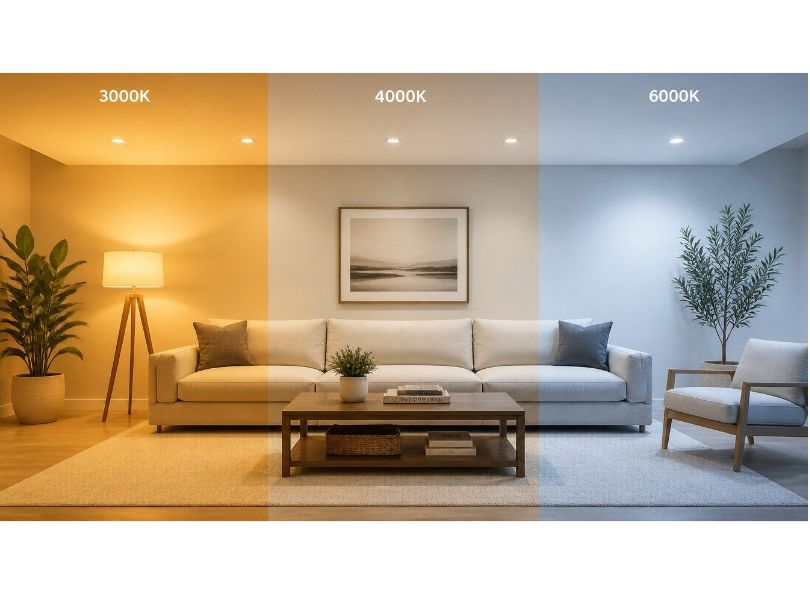
The color temperature of an LED source is measured in kelvin (K) and defines the hue of the emitted light: 3000K produces a warm amber light ideal for residential and hospitality environments; 4000K a neutral natural light suitable for offices, retail and technical environments; 6000K a cool bluish light used in industrial, healthcare and security contexts. The choice affects visual comfort, color perception and perceived consumption.
What is color temperature and how it is measured
Correlated color temperature (CCT) describes the chromatic hue of a white light source, expressed in kelvin on the Planckian black body scale. Low values (2700–3000K) correspond to warm hues towards yellow-amber, medium values (3500–4500K) to neutral hues, high values (5000–6500K) to cool hues towards blue.
It is important not to confuse color temperature with luminous intensity (lumens) or color rendering (CRI): three 1000 lumen LEDs with CRI 90 and CCT of 3000K, 4000K and 6000K respectively emit the same amount of light but with radically different visual perception.
Warm light 3000K: characteristics and applications
3000K light is close to the color of old halogen lamps and produces a welcoming and relaxing atmosphere. It stimulates melatonin production and promotes evening relaxation.
Ideal applications:
- homes: living rooms, bedrooms, dining rooms
- hotels, restaurants, bars, SPA
- architectural lighting of historic buildings and warm materials (stone, wood, brick)
- high-end clothing boutiques, jewelry stores (in combination with CRI ≥ 90)
Disadvantages: it may appear yellowed on white or cool materials (steel, glass, light ceramics); it reduces the perception of sharpness in fine details.
Natural light 4000K: characteristics and applications
At 4000K the light is balanced, neutral, perceived as "average daylight". It is the most common compromise in environments where visual attention is needed without the light being aggressive.
Ideal applications:
- offices and open spaces (in line with UNI EN 12464-1)
- general retail (supermarkets, electronics, mid-market clothing)
- schools, libraries, study rooms
- car showrooms, professional kitchens
- common areas of tertiary buildings
Advantages: it maintains faithful color perception, does not strain the eyes in prolonged activities, it is the safest choice when the use of the environment is mixed.
Cool light 6000K: characteristics and applications
At 6000–6500K the light tends to blue-white, similar to midday daylight with clear sky. It increases alertness and concentration, suppresses melatonin: for this reason it is not recommended in rest environments.
Ideal applications:
- industry, warehouses, workshops, laboratories
- hospitals, operating rooms, clinics (often 5000–6500K with CRI ≥ 90)
- safety and emergency lighting
- technical outdoor areas (parking lots, logistics yards)
- indoor sports lighting (gyms, sports halls)
Disadvantages: it can appear cold and unwelcoming; in residential or hospitality settings it is generally to be avoided.
Comparison table 3000K vs 4000K vs 6000K
| Criterion | 3000K (warm) | 4000K (natural) | 6000K (cool) |
|---|---|---|---|
| Perceived hue | Amber-yellow | Neutral white | Blue-white |
| Psychophysiological effect | Relaxing | Neutral | Stimulating, activating |
| Optimal color rendering on | Warm materials, skin | All colors | Whites, metals |
| Recommended environments | Residential, hospitality | Offices, retail, schools | Industry, healthcare, security |
| Compatibility with evening rest | High | Medium | Low |
| Perceived lumens at equal real output | Slightly lower | Reference | Slightly higher |
| Electrical consumption (W) | Identical at equal lm | Identical | Identical |
| Average LED cost (€/klm) | Comparable | Comparable | Comparable |
Note: electrical consumption does not depend on color temperature, but on the luminous efficacy (lm/W) of the specific LED. A frequent myth is that cool light "consumes less": false at equal real lumens.
Color temperature, CRI and perception
Color temperature should always be evaluated together with CRI (Color Rendering Index). A 3000K LED with CRI 70 will illuminate food and skin in an unrealistic way; a 3000K LED with CRI ≥ 90 will render them natural and pleasant. For environments where color fidelity matters (museums, art galleries, premium retail, medical clinics) Ledpoint always recommends CRI ≥ 90, regardless of the chosen K.
Reference regulations
UNI EN 12464-1 (lighting of indoor workplaces) prescribes minimum illuminance values (lux), uniformity and UGR, and indicates recommended CCTs for areas of use. For typical offices it suggests 500 lux at 4000K with UGR ≤ 19 and CRI ≥ 80. For precision activities (laboratories, operating rooms) values up to 5000–6500K with CRI ≥ 90 are allowed.
Ledpoint case study
In a redevelopment project for a women's clothing boutique, Ledpoint replaced the existing 4000K CRI 80 lighting with a mixed system: 3000K CRI 95 in fitting rooms and trial areas, 3500K CRI 90 on display islands. Internal colorimetric tests detected an improvement in skin "warmth" perception of +18% (evaluation panel of 12 observers) and a 22% increase in average time spent in store, according to counts provided by the client in the three months following the intervention.
FAQ - Frequently asked questions
- What is the difference between 3000K and 4000K?
- 3000K produces a warm amber light suitable for residential and hospitality; 4000K a neutral white light more suitable for offices, schools and retail. The difference is perceptual and functional, not energetic: at equal lumens, consumption is the same.
- Is 6000K cool light harmful to the eyes?
- It does not damage the eyes per se, but suppresses melatonin and can disturb sleep if used in the evening hours in domestic environments. It is recommended for technical work, healthcare and industrial environments, not for bedrooms.
- What is the best color temperature for an office?
- The most common standard is 4000K with CRI ≥ 80 and UGR ≤ 19, in line with UNI EN 12464-1. For prolonged reading or VDT activities, it is the best compromise between comfort and productivity.
- Can I mix different color temperatures in the same environment?
- Yes, it is a technique used in retail and hospitality to create distinct functional zones. However, it must be managed carefully: differences greater than 1000K in the same visual scene can be disturbing. Ledpoint offers tunable white systems to dynamically adjust the K.
- Does color temperature affect energy consumption?
- No. Consumption depends on luminous efficacy (lm/W) and driver power, not on K. A 6000K LED and a 3000K LED of the same technology consume the same energy to produce the same lumens.
- Which K should I choose to illuminate a historic facade?
- For stone, brick, ancient plaster, terracotta: 2700–3000K enhance the warm tones of the material. For modern facades in glass, steel, exposed concrete: 4000K maintains chromatic neutrality. The CRI must be at least 80, preferably 90 for high-end projects.
- Is there a "universal" color temperature?
- No. The choice depends on the function of the environment, materials present, hours of use and emotional objective. For this reason Ledpoint offers most of its floodlights and architectural fixtures in tunable white version (1800–6500K) or selectable multi-CCT.
Color temperatures: the right one for every project...
3000K, 4000K and 6000K are not "better" or "worse" in absolute terms: they are different design tools. The correct choice arises from the intersection between intended use, materials, applicable regulations and desired atmosphere. For complex projects, the most flexible solution today is tunable white, which allows you to adjust the color temperature according to the time and activity.
| Want the right K for your project? |