








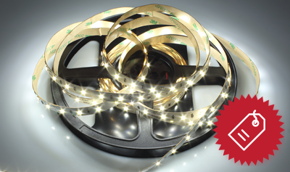
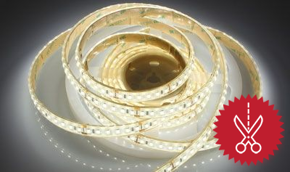

New 48V CCT Led Strips
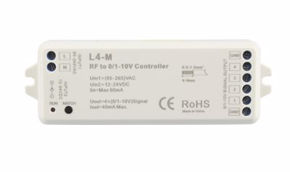
48V CCT (dual white) LED strips, thanks to the integration of two LEDs warm white and cool white, allow to select easily the desired shade of white, from “warm” white 2.700°K to “cool” white 6.500°K, selecting all the intermediate white tones. Moreover, it is possible to adjust the brightness keeping the selected shade (depending on the controller).
48V SYSTEM
The 48V system has the advantage to significantly reduce the voltage drop that affects both the electrical cables and the LED strip itself.
The electrical resistance of cables and above all of the LED strip’s PCB causes a voltage drop that is proportional to the current. The great advantage of 48V over a traditional 24V is that only half as much current is required to get the same power.
Thanks to this reduction it is possible to use longer cables and to reduce the loss of brightness.
It is important to highlight that in high power LED strips (>14W/m) longer than 5m and not corrrectly powered with cables, the different brightness at the beginning and at the end of the LED strip is clearly visible with a reduction of light up to 50%.
The 48V system and the current control chip integrated on the circuit allow to install up to 20 meters with just one wire and 14,4W/m LED strips.
The first thing to take into account to establish the maximum length of the installation is the LED strip power: the lower the power of the LED strip is, the lower the total current will be and the longer the installation with one wire will be and viceversa.
To sum up, the use of 48V LED strips has a double advantage: there is no need to take long cables to one side and at the same time it is possible to have an homogeneous light.

BETTER EFFICIENCY
In LED strips the efficiency is strictly connected to the chip installed and to the structure of the LED strip itself. The electric circuit of an LED strip is quite simple and basically made of branches of LEDs multiplied (and therefore put in parallel) until the desired length is reached. The efficiency is directly related to the number of LEDs in series (or LEDs par cut) for each branch. Having the same voltage, the more LEDs you put in series the higher the efficiency is.
The following example is useful to explain this idea better. A very common LED strip is the 60 led/m 14,4W/m. This LED strip is made of 10 branches of 6 LEDs in series for each branch.
Each branch will therefore have a power of 1,44W (24V with 60mA of current). If we add an LED for each branch we have a 70 led/m strip with the same power or a 80 led/m strip if we add two. The current for each branch does not change (as the power) but at the same time the amount of light emitted is different. In the case of a 70 led/m strip we have 10 LEDs more and, as a consequence, an increase of light of 16,6% and of efficiency. The 80 led/m strip have 20 led/m more with an increase of light of 33,3%!
It is clear that the increase of the number of LEDs for each branch causes an increase of the LED strip efficiency but at the same time make it more sensitive to voltage drops. Moreover 8 LEDs strips need the use of LEDs with a low Vf.
This kind of example is also valid for 12V LED strips (standard models have 3 LEDs in series) and 48V LED strips (where the initial number is 12 LEDs in series).
Our 48V CCT strip features 16 LEDs in series, that is the equivalent of 8 LEDs in series in a 24V LED strip, to get the maximum efficiency.
To sum up this LED strip is the best solution for main lighting in those environments where you need an high efficiency and you want to control the colour temperature (F52-CCT-256824A-C90).
A special version of this strip (F52-CCT-2568U4A) is available for those who want to make installations related to the circadian lighting.