







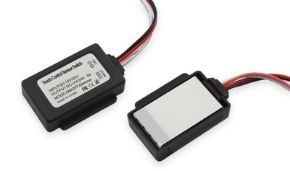
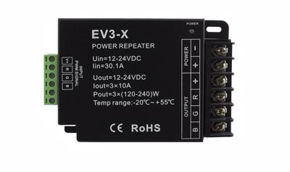
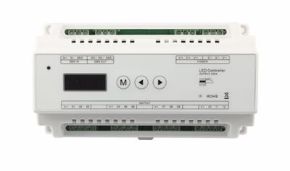
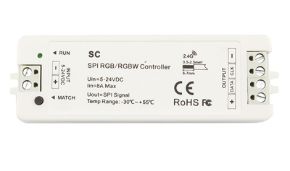



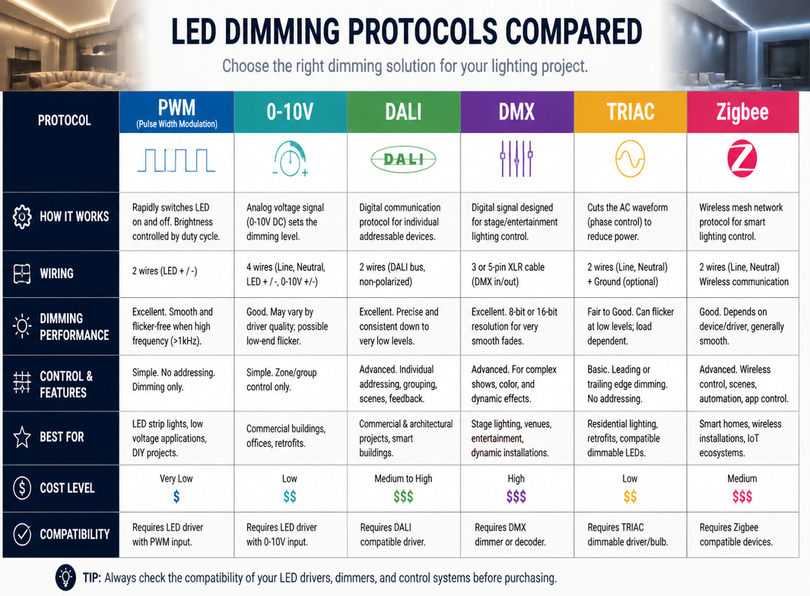
Choosing the dimming protocol for a professional LED installation is a technical decision that impacts the entire system architecture: from the type of power supply to the controller, from the user interface to compatibility with existing home automation systems. This article presents a complete comparative table of the main LED dimming protocols to help you make the right choice based on the type of installation.
Comparative table of LED dimming protocols
| Protocol | Signal type | Dimming range | Curve | Feedback | Number of devices | Wiring | Ledpoint compatibility | Ideal application |
|---|---|---|---|---|---|---|---|---|
| PWM | Digital (0–10V or 5V) | 0–100% | Linear or programmable | No | Multiple in parallel | 2 signal wires + power | Skydance controllers, RF/WiFi dimmers | Residential, standard professional |
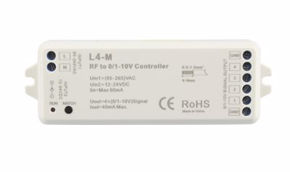
| 0–10V | Analog (current) | 10–100% (min ~10%) | Linear | No | Multiple on same bus | 2 signal wires + power | Ledpoint 0-10V power supplies | Offices, BMS systems, KNX |
| 1–10V | Analog (current) | 10–100% | Linear | No | Multiple on same bus | 2 signal wires | 1-10V power supplies | 0-10V variant for offices |
| DALI / DALI-2 | Bidirectional digital | 0–100% (10,000 steps) | Logarithmic (IEC standard) | Yes (diagnostics) | 64 devices/bus | 2 bus wires + power | Ledpoint DALI decoders | Retail, hotels, smart offices |
| DMX512 | Unidirectional digital | 0–100% (256 steps/channel) | Linear (programmable) | No (RDM: yes) | 512 channels/universe | 2 or 3 wire DMX bus | Ledpoint DMX decoders | Stage, entertainment, dynamic |
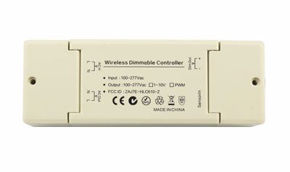
| TRIAC (phase-cut) | Modified 230V AC | 0–100% (depends on driver) | Linear | No | 1 circuit per dimmer | Existing 230V wiring | Anti-flicker 230V driver | Retrofit, simple residential |
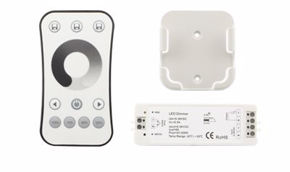
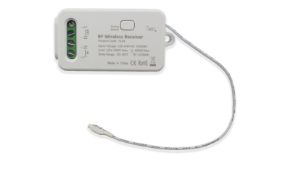
| RF (radio frequency) | Wireless 433/868MHz | 0–100% | Linear | No | Multiple on same frequency | None (wireless) | Skydance RF controllers | Residential, easy installation |
| WiFi (Tuya/Matter) | Wireless 2.4GHz | 0–100% | Linear | Limited (status) | Unlimited (via cloud) | None (wireless) | Skydance WiFi controllers | Smart home, Google/Alexa |
| Bluetooth | Wireless 2.4GHz | 0–100% | Linear | Limited | Dozens (mesh) | None (wireless) | Skydance BT controllers | Local without cloud |
| Zigbee | Wireless 2.4GHz mesh | 0–100% | Linear | Yes (mesh) | Dozens (mesh) | None (wireless) | Ledpoint Zigbee controllers | Advanced home automation, HA |
PWM: the most common dimming method
PWM (Pulse Width Modulation) is the most widespread dimming method in residential and light-commercial LED installations. It works by modulating the signal duty cycle: at full power, current flows 100% of the time; at 50%, it flows only for half the cycle; at 0%, it never flows. The modulation frequency determines whether flickering is perceptible.
| PWM Frequency | Flickering | Suitable for | Notes |
|---|---|---|---|
| < 100 Hz | Very visible | Do not use for lighting | Causes visual fatigue |
| 100–500 Hz | Visible in motion | Stage/decorative use only | Perceptible with camera |
| 500–1000 Hz | Almost imperceptible | Standard residential | Acceptable for most uses |
| 1000–3000 Hz | Imperceptible | Offices, quality residential | Recommended for work environments |
| > 3000 Hz (often 20kHz+) | None | Medical, museums, photography | Maximum visual quality, no issues with cameras |
DALI: the standard for professional lighting
The DALI (Digital Addressable Lighting Interface) protocol, defined by IEC 62386 standard, is today the reference standard for professional lighting in commercial buildings, hotels, and public spaces. Its main features are:
- Individual addressing: each DALI driver has a unique address (0–63) on the bus, so it can be controlled individually or in groups. A single DALI bus can manage 64 independent devices.
Logarithmic curve: dimming follows a curve that replicates the human eye's response, making transitions extremely smooth and "natural".
Feedback: unlike PWM and 0-10V, DALI is bidirectional: the controller can query each device to know its status, diagnose faults, and obtain consumption information.
Stored scenes: each driver can store up to 16 lighting scenes, which are activated with a single command.
DMX512: the entertainment standard
The DMX512 (Digital Multiplex) protocol was created in 1986 for controlling stage lighting and remains today the entertainment industry standard. Each DMX universe has 512 channels, each with 256 levels (0–255). DMX decoders receive the signal and convert it to PWM outputs for LED strips.
DMX is unidirectional in the basic version (RDM, Remote Device Management, adds optional feedback), but guarantees an update rate of about 40 frames per second, sufficient for smooth and synchronized visual effects. It is the protocol of choice for dynamic architectural installations, illuminated facades, events, and stage sets.
Wireless: WiFi, Zigbee, RF, Bluetooth compared
| Technology | Range | Latency | Cloud required | Works offline | Home automation standard | Ideal use |
|---|---|---|---|---|---|---|
| RF 433/868MHz | 30–100m | Low | No | Yes | Proprietary | Simple, reliable, no app |
| WiFi 2.4GHz (Tuya) | 20–30m | Variable | Yes (Tuya cloud) | Partial | Tuya / Google / Alexa | Consumer smart home |
| Bluetooth | 10–30m | Low | No | Yes | Limited | Local control, no internet |
| Zigbee | mesh (100m+) | Low | No | Yes | Zigbee2MQTT, HA, HomeKit | Advanced home automation, privacy |
| Matter/Thread | mesh (100m+) | Low | No (local) | Yes | Apple / Google / Amazon / HA | Future interoperable standard |
Skydance controller compatibility — Protocol table
| Controller Series | Compatible strip | Protocol | App | Output channels | Function |
|---|---|---|---|---|---|
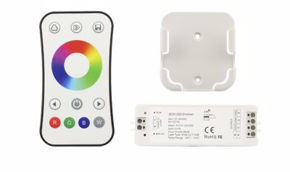
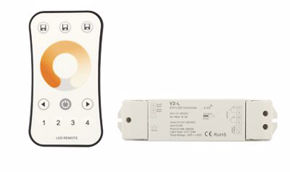
| Skydance V3 RF | Monochromatic (CCT) | RF 2.4GHz | No | 2 | Dimming + color temperature |
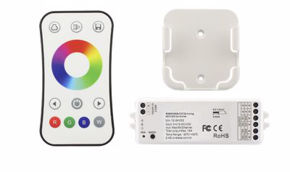
| Skydance V4 RF | RGB | RF 2.4GHz | No | 3 (RGB) | RGB color + dimming |
| Skydance V5 RF | RGBW / RGBCCT | RF 2.4GHz | No | 4–5 | Color + white |
| Skydance WiFi (Tuya) | CCT / RGB / RGBW | WiFi 2.4GHz | Tuya Smart / Smart Life | Variable | App, Google, Alexa, Scenes |
| Skydance Zigbee | CCT / RGB / RGBW | Zigbee 3.0 | HA, Zigbee2MQTT | Variable | Advanced home automation |
| Decoder DMX D4 | RGB | DMX512 | DMX Software | 3 (RGB) | Stage control |
| Decoder DMX D5 | RGBW / RGBCCT | DMX512 | DMX Software | 4–5 | Color stage control |
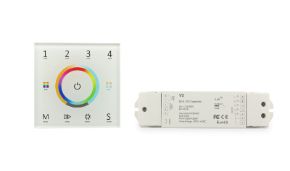
| Controller DALI DA4 | CCT / Mono | DALI / DALI-2 | DALI Gateway | 4 | Smart buildings, KNX |
FAQ - Frequently Asked Questions
What is the best dimming method to avoid flickering?
High-frequency PWM dimming (≥1000Hz) is the most effective at eliminating flickering. DALI implements a logarithmic curve ensuring smooth transitions. Analog 0-10V dimming may exhibit flickering at low intensities if the power supply is not of good quality.
DALI vs DMX: what's the difference?
DALI is a bidirectional protocol for fixed professional lighting, with individual addressing and logarithmic curve. DMX512 is unidirectional, originally designed for stage lighting, with 512 channels per universe and fast update for dynamic effects.
Can I dim with a standard 230V wall dimmer?
Only by using a TRIAC-compatible LED driver. The TRIAC anti-flicker driver converts the wall dimmer signal into a PWM signal for the strip. You cannot connect a 230V dimmer directly to a low-voltage LED strip.
LED dimming: the importance of choosing the right protocol from the start
Dimming is not an accessory: it is a structural component of the LED system, and as such should be chosen before even ordering strips or power supplies. Changing protocols after installation is complete means, in most cases, replacing power supplies, controllers, and rewiring significant portions of the system—a cost that far exceeds that of a thoughtful choice during the design phase.
The map is quite clear: PWM for everything residential and consumer home automation, with the flexibility to choose the wireless protocol based on the ecosystem already present in the home; DALI-2 for professional environments requiring bidirectional feedback, individual addressing, and integration with KNX or BMS; DMX512 for any context where light is dynamic, choreographed, part of a show or installation; 0-10V for existing systems where analog simplicity is still the most pragmatic choice. No protocol is universally better than others: each is optimal in its context and becomes a problem outside of it.
If you are designing an installation and still have doubts about the most suitable protocol, the Ledpoint team is available for free technical consultation: knowing the type of strip, the length of the system, any existing home automation system, and the available budget is enough to indicate the most efficient path and help you avoid the classic mistake of discovering incompatibility only when the profiles are already walled in.